Substack

Thursday, November 12, 2009

Anchoring interest rate expectations

In uncertain times like the present, where interest rates are ruling at historic lows, government deficits are mounting, and inflationary pressures (atleast in the medium to long term) remain a strong possibility, one of the more important goals of monetary policy making is to remove uncertainty about interest rate (and inflation) expectations. Central Banks have tried to approach this goal by making public statements to guide expectations about future short-term rates, with and without specifying clear time lines and/or rates (or rate ranges).

US Federal Open Market Committee meeting of August 12, 2009

"The Committee... continues to anticipate that economic conditions are likely to warrant exceptionally low levels of the federal funds rate for an extended period."


Bank of Canada's interest rate meeting on April 21, 2009

"Bank of Canada lowers overnight rate target by 1/4 percentage point to 1/4 per cent and, conditional on the inflation outlook, commits to hold current policy rate until the end of the second quarter of 2010."


Two economists from the San Francisco Fed have compared the experiences of both Canada and the US and find no evidence that market participants make distinctions between these statements and expectations generated by their respective policy implications. One of the fundamental challenges of central banking, especially in uncertain times, is to provide clear communication about "the expected path of short-term interest rates, which influences long-term interest rates today", which in turn plays a crucial role in investment and spending decisions. As the authors write, "the ability of central banks to influence the economy today depends upon their ability to shape market expectations about the path of policy rates in the future".

However, Central Bankers face a dilemma with their interest rate communications,
"Make an explicit statement that may have a substantial impact now with the risk of problems in the future, or avoid the risk and make a more cautious statement that may have only a marginal impact".


The authors compared the forward rates on interest rates of both US and Canada and assessed the two contrasting interest rate communication policy stances adopted by the respective Central Banks,

"We find little to suggest that the announcement of a fixed end date has significantly affected expectations of future monetary policy in Canada. It seems that market participants see little difference between the US phrase "extended period" and Canada's conditional commitment to keep rates fixed for a specified period."


In any case, both Central Banks' strong and explicitly made commitment to "promote economic recovery and preserve price stability", coupled with their strong credibility, may have had the effect of marginalizing the subtle differences in their interest rate communications. However, this may not be the case with other Central Banks who do not enjoy similar credibility and autonomy. In case of these Central Banks, the markets may find positive signals in more explicit targets during uncertain times.

Update 1
Nick Rowe has a nice analysis of the dilemmas facing Central Banks when they promise to keep nominal interest rates low for too long to escape a liquidity trap - output today Vs inflation in the future. He feels that a public policy communication to create a higher inflation (than what is the normal, and which in turn is clearly defined) in the future than it would want in future, in order to buy higher inflation, lower real interest rates, and higher output today may be more explicit than one that promises to keep the overnight rate near zero for an extended period, conditional on the outlook for inflation.

Update 2
Brad De Long suggested that the Fed fix an explicit inflation target of 3%, so as to lower the real interest rate and boost investment and consumption in the economy. Ben Bernanke replied by pointing to the "risk that such a policy could cause the public to lose confidence in the central bank’s willingness to resist further upward shifts in inflation, and so undermine the effectiveness of monetary policy going forward".

Paul Krugman feels that the Fed should real interest rates by either itself buying long-term assets, driving down the wedge between short and long rates, or raise expected inflation, or do both.

Impact of ARRA on US unemployment

The Obama administration's official announcement that the spending measures of the $787 bn fiscal stimulus (or ARRA) has so far created or saved just over 640,000 jobs has triggered off an intense debate. Critics have questioned the veracity of the figures, especially those relating to jobs saved, and point to the rising unemployment figures to rubbish these claims.


Supporters though argue that since the figures do no reflect measures such as tax cuts, boosted unemployment benefits or jobs created indirectly by stimulus spending, the actual numbers may be closer to one million. They also argue that the stimulus saved the country from slipping into a Depression and contributed to the second quarterly growth of 3.5% for this fiscal year. As Jeff Frankel writes, the biggest problem is with estimating the jobs saved since "one cannot estimate accurately, let alone prove, what would have happened in the absence of the stimulus package". Paul Krugman has this evidence that the ARRA is working.

The extent of the recession has been so deep that initial estimates and forecasts of the stimulus support required have been wide off the mark. The most striking indicator of this is the steep divergence between the estimates of unemployment with and without stimulus spending and the actual unemployment figures due to the mistaken assumptions behind the baseline figures. Greg Mankiw has been continuously updating on the unemployment forecasts made by Christina Romer and Jared Bernstein based on the estimated impact of the $787 bn stimulus measures with the actual unemployment figures.


The depth of the recession, already the longest since the war, and the devastation caused to the credit markets has meant that a long drawn out, at best U-shaped or at worst an L-shaped, recovery is inevitable. In fact, in anticipation of continuing weakness, there have been mounting calls for a second round of stimulus spending. In fact the NYT has gone on to assert that "without another round of effective stimulus, the worst recession in modern memory will likely become — at best — the weakest recovery in modern memory".

Already many of the stimulus spending measures which have run out, like the extension for unemployment insurance etc, have been extended for some more time. Given the persisting weakness in aggregate demand due to the damage suffered by households and businesses, it has been estimated that the output gap is is substantial and is likely to persist well into the next few years. Unemployment rates could remain high for many years to come.


Fundamentally, unemployment has always been a lagging indicator and therefore in previous recessions too the unemployment figures have continued to rise well into the economic recovery period. And it may be no different (or even worse, if Paul Krugman is to be believed) this time round too.


Mark Thoma has an excellent post in his new blog, which feels that the US unemployment rate could have a higher rate of normal unemployment (from its present normal of around 4%), in view of the possibility of high structural unemployment, even after normalcy is restored. This would be due to the structural changes that have taken as a result of globalization and the recent crisis - reduction in resources employed in housing, finance, and automobile production, higher savings rate and correspondingly lower consumption expected from households in the future etc.

Nouriel Roubini feels that it is most likely that the unemployment rate will peak close to 11% and will remain at a very high level for two years or more. He claims that the weakness in labor markets and the sharp fall in labor income will ensure a weak recovery of private consumption and an anemic recovery of the economy, and increases the risk of a double dip recession.

Update 1
Paul Krugman points to the not-so frightening US public debt as a share of GDP, Taylor Rule and yields on TIPS to argue that inflation may not be an immediate danger. Larry Summers too feels not much cause for alarm with US public debt.

Update 2
Mark Thoma explains why unemployment lags output in recoveries - businesses waiting to see whether the recovery is for real; firms bring back their on-the roll, and not laid off, slack employees back to work at the first signs of recovery (labor hoarding); having discovered how to reorganize to increase productivity, the demand for labor on the upside will be smaller than the amount lost on the downside thereby causing sluggishness in the recovery of labor etc

Update 3
CBO's estimates of the impact of ARRA on employment and economic output as on September 2009 is available here (pdf here).

Update 4
See Paul Krugman on the impact of the stimulus.

Update 5
Menzie Chinn on the importance of structural unemployment in the current recession.

Update 6
NYT examines the debate on the impact of ARRA on output and employment, and feels that ARRA contributed towards mitigating the effects of the recession and if anything may have been designed on assumptions (with the stimulus, the jobless rate was estimated by the Obama administraiton to peak at 8.1 percent) which were overly optimistic.


John Taylor though expresses doubts about these claims.

Update 7
Economic research firms IHS Global Insight, Macroeconomic Advisers and Moody’s Economy.com all estimate that the ARRA has added 1.6 million to 1.8 million jobs so far and that its ultimate impact will be roughly 2.5 million jobs, an estimate the CBO considers conservative.

David Leonhardt writes that aid to states and cities may be the single most effective form of stimulus and calls for another round of spending focussed on that. Unlike road- or bridge-building, it can happen in a matter of weeks and unlike tax cuts, state and local aid never languishes in a household’s savings account. He also proposes extended jobless benefits, which also tend to be spent, and tax credits carefully drafted to get businesses to hire and households to spend, like the cash-for-clunkers program.


Update 8
The CBO estimates that in the last quarter of 2009, the stimulus "added between 1.0 million and 2.1 million to the number of workers employed in the United States, and it increased the number of full-time-equivalent jobs by between 1.4 million and 3.0 million" (people who had been working part time but became full time, or otherwise increased their hours). It also estimates that the inflation-adjusted gross domestic product was most likely 1.5 to 3.5 percent higher in the fourth quarter than it would have been without the stimulus.

Update 9 (10/3/2010)
Mark Thoma has this post which argues that the Fed could not have done much more to stimulate employment. He feels that that "further easing by the Fed may not have much additional effect on long-term real interest rates, that even if rates could be brought down, consumers and businesses would be unlikely to respond by increasing investment and the consumption of durables - firms already have considerable idle capacity, so why build more, and consumers are pessimistic about their futures, so why buy on credit - and that there is an inflation risk from further easing".

Update 10 (16/3/2010)
Econbrowser points to a WSJ survey of forecasters whose results indicate that instead of the 0.15% growth rate recorded in 09Q4 y/y growth, the growth rate would have been -0.93%. For 2010Q4 Q4/Q4 growth, they forecast 3% growth, and in the absence of the ARRA, they would have predicted 2.2% growth.

Update 11 (25/3/2010)
Ray Fair from the Cowles Foundation has this estimate of the macroeconomic impact of the US stimulus bill passed in February 2009. It finds that both the real output and employment increased due to the stimulus bill.

Update 12 (29/5/2010)
The US CBO has released its latest assessment of America's 2009 fiscal stimulus, for the first quarter of 2010. It estimates that the in the first quarter of calendar year 2010, ARRA’s policies raised the level of real (inflation-adjusted) GDP by between 1.7-4.2%; lowered the unemployment rate by between 0.7-1.5 percentage points; increased the number of people employed by between 1.2-2.8 million; and increased the number of full-time-equivalent jobs by 1.8-4.1 million compared with what those amounts would have been otherwise. It also estimates that the effects of ARRA on output and employment are expected to increase further during calendar year 2010 but then diminish in 2011 and fade away by the end of 2012.

Update 13 (12/6/2010)
See David Leonhardt and Edward Glaeser on the impact of AARA.

Update 14 (1/7/2010)

CBO assessment of the jobs created by ARRA


See also this on the broad market impact of the stimulus.

Update 15 (27/7/2010)

David Leonhardt points to the fact that cash-strapped local and state governments in the US did not have to lay-off teachers, policemen, and other local government staff in large numbers across the country as proof of the effect of the stimulus (transfers to these governments were a major component of ARRA). Most major analysis of ARRA estimate that the stimulus is responsible for something like 2.5 million jobs that would not otherwise exist today.

Wednesday, November 11, 2009

Is Modigliani-Miller theorem the next casualty?

The dramatic events in the aftermath of the bursting of the sub-prime mortgage bubble has destroyed many reputations and repudiated much of the theoretical edifice of modern finance including the famous Efficient Market Hypothesis (EMH). The latest casualty may be the Modigliani-Miller theorem, the cornerstone of corporate finance, which states that under cetain conditions (absent taxes and in an efficient market) a firm’s value is unaffected by its capital structure (deb-equity ratio).

The Economist points to the evidence that MM theory may not hold - in the form of the reluctance of leverage-hungry bankers to increase their equity base on the grounds that "equity is too expensive and will have a knock-on effect on the price of credit". This arguement that flies in the face of MM theory, comes in the face of the tumultuous events of the past twelve months that have highlighted the need for banks to have deep enough equity buffers to cover for losses and the cost of any potential bailout.

As The Economist explains, "This theory says that although equity owners demand a higher return than creditors, their required rate of return on each unit falls as the amount of equity rises, since profits after interest become less volatile. The cost of debt falls too, since creditors have a bigger buffer beneath them. The firm’s blended cost of capital is unchanged, and is driven largely by the risk of the firm’s assets, not how they are paid for."

The article points to "quirks in the real world", which comes in the way of MM by making debt very attractive and equity costly and therefore uncompetitive, atleast in case of banks

1. The tax-deductibility of interest costs give debt an advantage and incentivize financial institutions to gorge on debt. In the lead up to the sub-prime crisis, leverage had accordingly become the pivot that amplified the gains of many banks, leave alone hedge funds and private equity firms.

2. Banks enjoy the advantage of using their deposits (which are liabilities), in addition to their equity, to fund their assets, and having these deposits covered with government backed guarantees. Other creditors too now enjoy a near-explicit government guarantee.

3. Further the deposits are priced at the Central Banks' short term interest rates, whereas the returns they make (or interests they charge) on their long term debt (or loans) are much higher. This coupled with access to unlimited short-term liquidity, thanks to the generous liquidity auction windows, means that banks do not have to worry about financing their short-term liabilities even if mismatches arise.

4. Further, the prevailing low interest rates means that the cost of raising debt is minimal compared to the returns available from the numerous investment alternatives. America’s mega-banks typically paid a blended annual interest rate on borrowings and deposits of 1-2% in the second quarter.

5. Finally, armed with the confidence (and resulting moral hazard) and societal/systemic underwirting that they are "too-big-to-fail", banks prefer smaller equity buffers and periodic bailouts over big equity buffers that push up the price of credit but make things safer.

The solution to keeping banks honest and covering the cost of potential bailouts from a systemic crisis include raising the ratio of equity to risk-adjusted-assets (or capital adequacy ratio) or even simple asset based reserve ratios, knockout ratio (ratio of gross NPAs to equity), force creditors to take the hit, have a layer of convertible debt (that gets used up after the equity is covered) etc.

In defence of MM theorem, it can be argued that the aforementioned "quirks in the real world" means that the pre-conditions required for it to hold - absence of taxes, bankruptcy costs, and asymmetric information, and efficient market - are not available.


Update 1 (20/3/2010)

The MM Theorem states that a firm’s value as a business enterprise is independent of how it is financed, i.e, its debt (leverage) to equity ratio. The debt-equity ratio determines how the risky cash flow from operations is divided among creditors and owners, but it does not affect whether the firm is fundamentally viable as an on-going concern.

As Greg Mankiw points out, the rate of return on equity should be endogenous (dependent) to the degree of leverage - if a bank is less levered, its equity will be safer, and the required rate of return (for both equity and debt) should fall. However, a bank with little or almost no leverage (and making loans with its own capital) will not play any "maturity transformation" role that conventional banks and other intermediaries play by borrowing short and lending long. And it has for long come to be accepted that this maturity transformation is a crucial feature of a successful financial system.

In other words, as Mankiw puts it, the debate is between whether as the Modigliani-Miller theorem says leverage and capital structure are irrelevant, or as many bankers claim they are central to the process of financial intermediation. However, given the central role played by maturity mismatch in all banking panics and financial crises, it is a moot point as to what value maturity transformation has. Do the benefits of our current highly leveraged financial system exceed the all-too-obvious costs?

Tuesday, November 10, 2009

Gold prices and Central Bank reserves

Early this month, in a moved aimed at diversifying its forex holdings, the RBI sprang a surprise by purchasing 220 tons of gold from the IMF (its first sale in a decade) for $6.7 billion, making gold account for 6.2% of India's $285.5 bn forex reserves. This decision, coming at a time when gold prices are touching record highs ), underlines the attraction of gold as a safe and remunerative investment alternative for Central Banks looking to diversify their holdings away from dollar denominated assets. And mirroring this sentiment and the weak economic times, while gold consumption declined 20% in the second quarter of 2009, investor demand increased 51%. But is gold as attractive an investment alternative as is made out or is it just an excellent hedge during uncertain times?

Gold has gained more than 25% in 2009, driven by persistent weakness in the US dollar and the uncertainty surrounding the economic prospects of US and other advanced economies. It touched $1104 an ounce or adjusted for inflation an all time high of $1,885 per ounce (or Rs 16,900 per 10 gram in the Indian bullion market) a few days back and looks set to rise further.


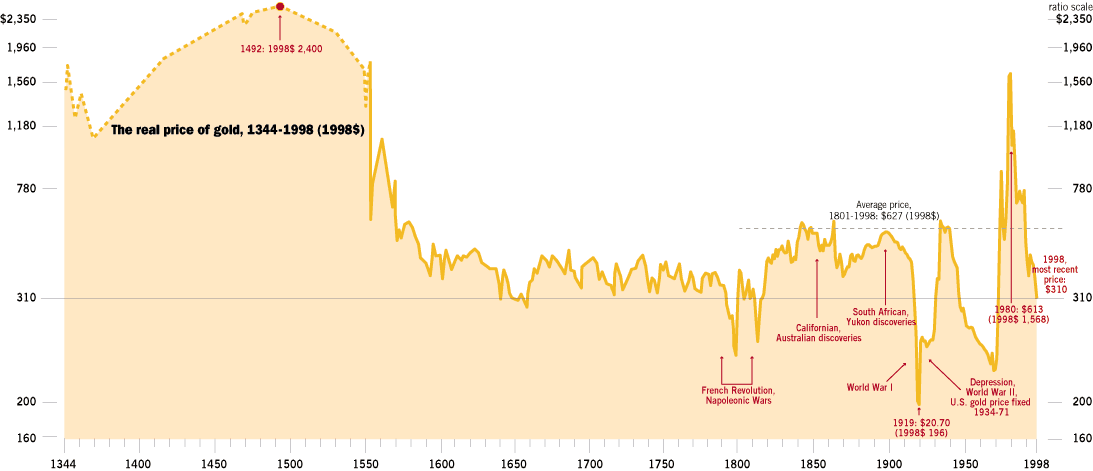
However, though gold is a secure asset but historical statistics show that, excluding its speculative side, it yields a low, long-term rate of returns from collateral fees. An investment of Rs 10,000 in gold in 1981 would would have grown to just Rs 35,832 over 20 years to 2002, a return of 6.3 per cent per annum, whereas similar investments in BSE Sensex would be worth Rs 240,062, outperforming gold by over 10 percentage points. A similar investment in even one-year bank fixed deposits over the same period would be worth Rs 82,350 by 2002, an annual growth rate of 10.6%, outperforming gold by 2.3 times. The graphic below compares the performance of gold for different periods from 2008 down


The price of gold over a broad sweep of history (1344-1998) shows this trend in gold prices


Gold prices have been on an upward trend in since 2002...


Gold has always been a safe haven in uncertain times and when the economy is on a decline, with investors scrambling to its safety and liquidity during such times, thereby driving up gold prices. This has given gold business a recession-proof character. Further, its proven negative correlation with the US dollar makes it a good option for investors wishing to diversify their portfolio from the currency. This current increase in gold prices is a consequence of the uncertainty surrounding the global financial markets in the wake of the bursting of the sub-prime mortgage bubble and the ongoing economic recession.

Further, global gold reserves are too limited in quantity (less than $1 trillion in value) to be a meaningful source of parking forex reserves. In addition, its liquidity is poor, it pays no interest and the cost of storage is high. In addition to the aforementioned, the high prevailing market prices will also be a deterrent to Central Banks purchasing gold in large quantities. In the circumstances, the RBI's decision to purchase gold at around $1045 an ounce is atleast four years too late ($500 to an ounce in 2005) and has to be seen as an example of buying high, and only history will show whether it was a wise decision.

Update 1
William Buiter writes that gold is a fiat commodity and cannot be compared to other similar assets - shares, real estate etc - as an investment nor to paper money as a store of value given the large cost associated with producing it.

Update 2
This graphic form the FE explains gold price movements over the last four decades


See also the FE articles here, here and here.

Update 3

Nouriel Roubini explains why gold prices are rising and why it may not be sustainable - "Gold prices rise sharply only in two situations: when inflation is high and rising, gold becomes a hedge against inflation; and when there is a risk of a near depression and investors fear for the security of their bank deposits, gold becomes a safe haven".

Update 4
Chris Dillow points to a negative co-relation between gold prices and inflation - "global inflation rises, the world’s central bankers could reverse their slack monetary policies, causing gold to fall".

Update 5
Martin Feldstein doubts the utility of gold as a hedge - "The dollar price of gold does not increase with the US price level. And the value of gold does not increase in dollars to offset the fall in the value of the dollar relative to the euro or the yen."

Sunday, November 8, 2009

Comparative advantage and increasing returns in global trade

Paul Krugman has a working draft that argues and models how increasing returns, in the form of localized external economies, plays a major role in explaining trade patterns even in a world of comparative advantage.

He traces the history of international trade to three parts - pre-War (export of different goods - manufactures and primary products - based on comparative advantage), post-War (trade between similar countries and similar products, driven by increasing returns due to specialization and explained using models of monopolistic competition), and post-trade liberalization of the eighties (comparative advanatage driven trade between developing and developed countries in manufactured goods based on their labor and skill intensities).

Standard trade theories have sought to explain international trade in terms of comparative advantage and increasing returns from specialization. In the past two decades, increasing returns have taken the form of localized external economies (or the concentration of specialized industries in particular localities) which has been sustained by Alfred Marshall's trinity of agglomeration effects - information spillovers (network effects in the knowledge economy), specialized suppliers, and thick labor markets.

Krugman illustrates this with the example of China's comparative advantage with abundant labor and relatively high manufacturing competence, and its high degree of industrial localization - 60% of the world’s buttons are manufactured in the small town of Qiaotou, Wenzhou produces 95% of the world’s cigarette lighters, and Yanbu is the underwear capital of the world! While comparative advantage explains the overall pattern of trade, external economies explains the national origins of industrialization based on local differentiation and specialization. He writes about the double gain from trade

"There are gains from trade due to the specialization of China in labor-intensive industries like button manufacture, but there are further gains from trade – gains that accrue to the world as a whole – from the concentration of world button production in the single small town of Qiaotou... eras in which comparative advantage seems to have ruled international trade are also the eras in which increasing returns has seemed to exert its strongest influence on intra-national economic geography... gains from localization arguably are a significant source of gains from trade, even if they don’t seem to affect the pattern of specialization."

Krugman invokes the role of external economies of local industrialization to argue that the depressing effect (arising from the Samuelson-Stolper effect) of labor intensive imports from developing countries on the real wages of less-skilled workers (who are relatively less abundant there) in developed economies may not be as large as claimed. Further, there is always the possibility that the Stolper-Samuelson reduction in wages of American workers has been covered by the TFP increases due to import competition.

Nominal spending crash and the Great Recession

David Beckworth has two graphs that depicts the nominal spending changes in the US economy and among OECD economies for the half century since 1960, which are strikingly similar, especially in the great crash in nominal spending since the later half of 2008.


The immediate conclusion drawn from this is the apparent insufficiency of monetary expansion in recent times. Marginal Revolution feels that some inflation could give nominal spending a boost. Paul Krugman, though differs and uses the money supply-velocity equation (MV=PY) to argue that focussing on nominal spending when faced with a liquidity trap monetary policy has no traction. The equation itself tells us that "any changes in the money supply are offset one for one by changes in velocity". Further, in the real world, where Central Banks control only the monetary base (and not the money supply), money supply becomes constrained in any case when facing the liquidity trap.

See also Beckworth's response to Krugman here, where he argues that changing expectations of future inflation can make monetary policy effective and this in turn can be achieved with the Fed annoucing an explicit inflation target. Free Exchange's response is here.

The fundamental issue here is whether monetary policy will have any more steam in stimulating demand given the present circumstances. Supporters say that "if you put enough money in the hands of American consumers, then eventually they'll begin spending it" and there are many ways to do this. Opponents like Krugman say that, all this is fine under ordinary cirumstances, but when faced with the zero-bound liquidity trap, people will just save or pay-off debts and not spend the money put into their pockets. In any case, when economists and historians discuss the Great Recession in later years, this will surely be one of the most contentious issues of debate.

Cost of Bush tax cuts - $2.34 trillion!

When the Bush era tax cuts expire next year, they would have cost the US Government $2.34 trillion, 61.4% of which would have gone to the top quintile of Americans. When the cuts expire, the two top tax rates will move up from 33% and 35% to 36% and 39.6% respectively.


Update 1 (26/7/2011)

Bruce Bartlett has an excellent article highlighting the point that Bush tax cuts are at the root of America's fiscal mess.