Substack

Saturday, January 21, 2023

Weekend reading links

1. The Economist points to a quiet energy transformation happening in the North Sea region involving large wind farms, hydrogen storage banks, CO2 capture and storage, and LNG terminals.

In 2022 North Sea countries auctioned off 25 gigawatts (GW) in wind-power capacity, making it the busiest year by far. Nearly 30 GW-worth of tenders have already been scheduled for the next three years... At a meeting in Esbjerg in May the European Commission and four North Sea countries agreed to install 150 GW by 2050, five times Europe’s and three times the world’s current total. In September this group and another five countries raised the number to 260 GW, equivalent to 24,000 of today’s largest turbines. This ambition is made possible by wind’s version of Moore’s law, which described the exponential rise in computing power. Three decades ago the world’s first offshore wind farm—Vindeby in Denmark, comprising 11 turbines—had a total capacity of five MW. Today a single turbine can generate 14 MW, and one farm may contain more than 100 of them. More robust cables and transformers at sea to convert wind power from alternating into direct current, which can travel over long distances without big losses, enable more electricity to be generated farther away... Economies of scale are driving down costs, making offshore wind competitive with other sources of power. In July Britain awarded contracts to five projects, including Dogger Bank, at a price of £37 ($44) per megawatt-hour—less than a sixth of the British wholesale electricity price in December...

With average wind speeds of ten metres per second, the North Sea basin is one of the gustiest in the world... The North Sea floor is mostly soft, which makes it easier to fix turbines to the seabed (the floating kind have yet to be deployed at scale anywhere in the world). It is also typically no more than 90 metres deep, which allows wind farms to be placed farther away from the coast, where winds are more consistent... offshore turbines work at up to 60% of capacity, compared with the 30-40% that is typical onshore.

2. As Union Budget nears, The Ken has an article on India's complex capital gains taxation system.  

Capital gains vary across asset categories based on tenure of holding, indexation, exemptions, and tax rates. 

3. Fascinating profile of Robert Habeck, the former leader of German Greens and the current Economy Minister. Amidst the Russian invasion of Ukraine and related supply disruptions, Habeck has had to preside over several decisions that Greens strongly oppose. They include the establishment of Germany's first LNG terminals; reopening of some closed coal power stations; deal with RWE allowing it to bulldoze Lutzerath, an abandoned Rhineland village, to make way for an opencast coal mine so that it could operationalise two thermal plants; allow Germany's three remaining nuclear plants stay operational till April 2023; and reversal of German position to not send troops abroad. 

Habeck's pragmatism runs the risk of diluting the Greens' ideological strength. 

4. Ruchir Sharma on Xi Jinping's apparent reversal,
Aiming to revive the economy after the congress, Xi’s government started sounding less Maoist. It has dropped the “three red lines” on borrowing by developers, and announced that the “rectification” campaign against fintech firms is nearly complete. After tightening state control for years, it is sending out messages of support to the private sector, even offering details of its new global data market that suggest respect for private data ownership... within weeks, Xi’s government has reversed its efforts to control Covid-19, Big Tech companies, the property market and more. It has shown signs of reduced support for Russia’s war in Ukraine while easing tensions with the US and in its territorial disputes in the South China Sea.
... a transformation of Singapore that is becoming a proxy for the way in which one segment of China is dealing with geopolitical tension and decoupling. Chinese individuals, their families, their companies and their advisers, according to a wide range of bankers, lawyers, accountants, investors interviewed by the Financial Times, now see Singapore as the vessel that can navigate them through a series of expected storms. At the same time, they add, it is becoming an increasingly vital place for outposts of Wall Street and the global financial industry to interact with them. For many years, Singapore has liked to sell itself as the Switzerland of Asia. The new cold war, says one former top official, is finally turning that pitch into a reality. The big question, though, is how far Singapore will tolerate being Switzerland with Chinese characteristics...
The change on the ground in Singapore is palpable. Property deals by mainland buyers are the dominant transaction, the international schools are bursting at the seams, with hundreds of Chinese applicants for a vanishingly small number of places. Chinese Michelin-starred restaurants might — just — be able to find diners an available dinner booking next April. Singapore’s status as an Asian financial hub has been doubly enhanced by the Chinese influx. The number of Chinese family funds in Singapore has soared from a handful a few years ago to an estimated 600 today. At the same time, some 500 Chinese businesses have registered in the city in the past year, preparing to use their Singapore-based status to venture more boldly into India and other jurisdictions where they face obstacles... he cost of living has soared in Singapore, angering locals who see danger and division in the soaring rents, the bursting schools and the growing number of Rolls-Royces. Meanwhile, the inflow of so much capital so quickly also exposes Singapore to the potential for bad actors using it as a spot to hide money... Roughly three-quarters of Singapore’s 3.5mn citizens are ethnically Chinese, making it culturally an easy fit for the newest arrivals.

The biggest loser in this transformation, Hong Kong.

6. Good article in The Economist examining the reasons behind the slowdown or reversal of globalisation and rise of protectionism. 

In a speech in September America’s national security adviser, Jake Sullivan, spelled out the basic tenets of this beggar-thy-neighbour approach. Merely retaining a technological lead over China and other rivals was no longer enough, he argued. Instead, he said, America had to pursue “as large of a lead as possible” in chipmaking, quantum computing, artificial intelligence, biotechnology and clean energy... Mr Sullivan described two main ways to ensure American supremacy: using subsidies and other forms of industrial policy to shift supply chains away from geopolitical rivals, and stricter investment screening and export controls to keep advanced technology out of unfriendly hands. As America, once the world’s loudest advocate of free trade and open economies, adopts and reinforces such policies, other countries are mimicking its approach. The result is a proliferation of obstacles to international trade and investment at a time when both were already stagnating.
7. The fascinating story behind the origin of European foods,
... trdelnik is no local snack at all. Nobody in Prague recalls seeing this supposed Czech staple for sale until about a decade ago. Even today, trdelnik scent blankets the touristy bits of Prague like a smog, but is hard to find anywhere else. Food sleuths place trdelnik as a delicacy from Romania or Slovakia... Take ciabatta. Italy’s now-ubiquitous bread is paraded as a timeless Italian classic, perhaps once baked in the earthen ovens of ancient Rome. In fact the elongated loaf was devised in 1982 by Italian bakers trying to fend off the French baguette. Belgian beers top global league tables, known for their alcohol content, which can exceed that of wine. Is that distinctive feature the outcome of brewing traditions devised by the various monks and friars featured on the beers’ labels? Pish. The strength of low-country beer is a modern regulatory dodge. In 1919 Belgian taverns were banned from selling spirits, a prohibition that lasted until 1983. Drunks in search of an efficient tipple nudged breweries towards making dubbel-strength beers. Tripels followed soon enough.

The dairy lobby is a keen fabricator of heritage. It is largely down to Big Cheese’s Swiss arm, the Schweizerische Käseunion, that fondue has emerged as Switzerland’s national dish. Facing a glut of Gruyère and Emmentaler in the 1930s as exports melted, cheese-peddlers proclaimed the Alpine virtues of a dish consisting overwhelmingly of cheese. British farm labourers of yesteryear were unfussy about their mid-day meals. Nevertheless in the 1960s the Milk Marketing Board revived the idea of a cheese-laden Ploughman’s Lunch, now a pub staple. As skimmed milk gained popularity in Ireland in the 1970s, a new way to use surplus cream was needed. Thus Bailey’s Irish Cream (a sickly mix of whiskey, cream and cocoa extract) was born. An Irish meadow on its label suggests centuries of heritage; in fact it is younger than Liam Gallagher.

Governments trying to nudge the populace towards new foods are nothing new. The potato went from South American curio to European favourite thanks in part to 18th-century French efforts to diversify away from wheat. Antoine-Augustin Parmentier, its keenest promoter, stationed armed guards around a potato patch to make it seem valuable and removed them at night so that peasants would steal and plant the tubers. Polish authorities in the 1940s started peddling carp—a bottom-feeding fish that tastes like muddy pond—in the absence of more flavourful fish. “A carp on every Christmas table” was advised; the fish (previously mostly a Jewish delicacy) was handed out to workers as festive bonuses. It has endured as a holiday staple. An even more ambitious fish-peddling scheme was later devised by Norway. In the 1980s supply of salmon exceeded domestic demand. Japan seemed an obvious market, but only tuna and sea bream were considered acceptable to eat as sushi and sashimi: at the time, the Japanese were as likely to eat raw salmon as an Italian to dip his spaghetti in mayonnaise. One marketing blitz (and a few discounted consignments of Norwegian salmon) later, a new tradition of orange sushi was born.

8. Sweden discovers rare earth deposits of more than 1 million tonnes. 

9. A new paper by Alexander Dyck, Adair Morse and Luigi Zingales has found that corporate fraud in the US is more pervasive than thought, with only one-third actually being detected. 

We estimate that on average 10% of large publicly traded firms are committing securities fraud every year, with a 95% confidence interval of 7%-14%. Combining fraud pervasiveness with existing estimates of the costs of detected and undetected fraud, we estimate that corporate fraud destroys 1.6% of equity value each year, equal to $830 billion in 2021... We find that two out of three corporate frauds go undetected, implying that, pre Sox, 41% of large public firms were misreporting their financial accounts in a material way and 10% of the firms were committing securities fraud, imposing an annual cost of $254 billion on investors.

See also this. 

10. MGI graphic informs that only 59-72 tomatoes grown in developed countries reach the retailer. 

In fact, 19-27 are lost/left in the field at harvest itself. 

11. On the issue central bank's role in climate change policy making, Jerome Powell feels they should stick to their knitting,
Today, some analysts ask whether incorporating into bank supervision the perceived risks associated with climate change is appropriate, wise, and consistent with our existing mandates. Addressing climate change seems likely to require policies that would have significant distributional and other effects on companies, industries, regions, and nations. Decisions about policies to directly address climate change should be made by the elected branches of government and thus reflect the public’s will as expressed through elections. 

At the same time, in my view, the Fed does have narrow, but important, responsibilities regarding climate-related financial risks. These responsibilities are tightly linked to our responsibilities for bank supervision. The public reasonably expects supervisors to require that banks understand, and appropriately manage, their material risks, including the financial risks of climate change. But without explicit congressional legislation, it would be inappropriate for us to use our monetary policy or supervisory tools to promote a greener economy or to achieve other climate-based goals. We are not, and will not be, a “climate policymaker.”

12. Finally, Martin Wolf points to a new McKinsey report on global flows

Thursday, January 19, 2023

Incidence of indirect taxes illustrated

Econ 101 informs that indirect tax incidence is higher on the poor and therefore are regressive and encourages a greater share of national tax revenues come from direct taxes. However, in countries like India revenues from indirect taxes are almost equal to that from direct taxes (in 2021-22, direct tax to GDP ratio was 6.1%, compared to 5.6% for indirect taxes). 

A new Oxfam report has a hugely informative table on what proportion of indirect taxes is contributed by different income categories.

As a corollary, the share of income spent on indirect taxes is orders of magnitude higher for the bottom half compared to the top decile. 

The report also points to high levels of wealth inequality in India

By 2020, the income share of bottom 50% was estimated to have fallen to only 13 per cent of the national income and have less than 3 per cent of the total wealth... This is in stark contrast to the top 30 per cent who own more than 90 per cent of the total wealth. Among them, the top 10 per cent own more than 80 per cent of the concentrated wealth. The wealthiest 10 per cent own more than 72 per cent of the total wealth, the top 5 per cent own nearly 62 per cent of the total wealth, and the top 1 per cent own nearly 40.6 per cent of the total wealth in India.

Monday, January 16, 2023

Land value capture and metro railways

I have blogged earlier (here and here) on the application of land value capture instruments to mobilise tax revenues. 

The central point is that public investments like metro railways increase land values, which being an unearned increment for the land owner, should be partially captured by the government and used to finance the investment itself. 

An excellent new working paper (abstract here) presented at the annual American Economic Association Conference by Maureen Cropper and Palak Suri examined the impact on land prices of the first subway line in Mumbai (the 11.4 km Metro Line 1) which became operational in June 2014. Their findings on its impact is striking

To estimate the effect of Line 1 on property prices we use administrative data on assessed prices in 725 sub-zones of Mumbai from 2011-18 for residential, commercial, and industrial land use categories. Using difference-in-differences in an event study framework, we compare areas that are within 1 km of Line 1 with control areas between 1 and 3 km from Line 1 before and after Line 1 opened. We find that up to two years prior to the opening of Line 1, the change in property prices in areas within 1 km of Line 1 was about 5-6% higher than the change in areas between 1 and 3 km from Line 1, reflecting anticipatory effects of the policy. After 2014, prices for residential and commercial properties within 1 km of the Metro increased between 17% and 13% compared to the control group... The magnitude of increase in prices goes down as the size of control group is expanded to include regions beyond 3 km, reflecting changes in other parts of the city. The increase in residential, commercial office, and open land- use prices was greater than the increase in industrial and commercial shop prices.  

They also examine the contributors to this increase in land values,
To study the factors affecting residential prices, we estimate hedonic price regressions using data on 3,000 houses in a 2019 World Bank survey. Log price depends on distance from the nearest rail station and on an employment accessibility index, in addition to housing and other neighborhood characteristics. Employment accessibility is measured using a commute-time- weighted average of wages obtainable across the city, estimated using a gravity equation. A house that is 1 km closer to a rail station sells for 5.6% more than an other wise identical house. A one standard deviation increase in employment accessibility raises house price by 4%. We also compute the employment accessibility index for 2004, using a 2004 World Bank survey to study the changes in sub- zone level employment accessibility. The employment accessibility index within 1 km of Line 1 increased faster over this period than in other parts of Mumbai. Improvements in employment accessibility and access to rail stations are plausible channels underlying the observed capitalization effects.

They even make an assessment of the aggregate increase in property values just due to this one investment,

How large are the increases in property values within 1 km of Line 1 and how do they compare with the aggregate benefits due to commute time savings? Lacking precise data on floor space within 1 km of Line 1, we conservatively approximate the increase in property values after the opening of Line 1 to be $20 billion (PPP). Annualizing this over 30 years using a 10% interest rate yields a value of $2 billion (PPP). This is approximately twice as large as Suri’s $1 billion (PPP) estimate of the value of travel time savings, highlighting the need for a more comprehensive framework to study the benefits of infrastructure projects.

The paper referred above examined the impact of commute time savings due to Metro Line 1 finds,

I value travel time savings due to: (i) Line 1 (11.4 km), operational since 2014, and (ii) three upcoming lines (92 km), scheduled to open during 2021-22. The value of short-term benefits for an average beneficiary under either project is Rs. 71-99 per month (9-14% of the average out-of-pocket cost). The medium-term benefits are over twice the short-term benefits for Line 1, and 6-7 times the short-term benefits for the upcoming lines. Women, college educated workers, and high-income households receive greater benefits...

The average medium-term values are an order of magnitude higher, valued at Rs. 189 and Rs 618 for Line 1 and Lines 2, 3 and 7, respectively. This is about 2-6% of the average monthly rental price. In the short-term 19% of commuters have a positive willingness to pay for Line 1, while 51% of commuters have a positive willingness to pay for Lines 2, 3 and 7. In the medium-term, virtually every household experiences positive benefits. Therefore, in terms of aggregate benefits, the implied annual medium-term benefits for Line 1 (Lines 2, 3 and 7) are 5-10 times (10 times) the short-term benefits.

Both are excellent papers, rare ones with immediate public policy relevance. The first paper brings hard evidence in quantitative terms from a very salient Indian example. Land value capture is gradually becoming accepted as an important means of municipal finance in India, as is seen from this policy framework. But its widespread adoption remains a step away. Such papers can be very useful in the internalisation of the idea among important policy makers and expediting the adoption of land value capture policy instruments. 

This goes to the heart of an important insight to increase municipal finance, one which has been a constant in this blog. Instead of scatter shot trying several approaches and struggling in everything, the focus should be just two-fold - increase property tax revenues and collections (shift from the opaque rental value to capital value based property taxation system, and target a gradual increase in PT as a share of GDP); and tap the full potential of all LVC instruments. To this one can add the idea of fixing a basic FAR with property right and having the rest purchased. 

Saturday, January 14, 2023

Weekend reading links

We find immigrants represent 16 percent of all US inventors, but produced 23 percent of total innovation output, as measured by number of patents, patent citations, and the economic value of these patents. Immigrant inventors are more likely to rely on foreign technologies, to collaborate with foreign inventors, and to be cited in foreign markets, thus contributing to the importation and diffusion of ideas across borders. Using an identification strategy that exploits premature inventor deaths, we find that immigrant inventors create especially strong positive externalities on the innovation production of their collaborators, while natives have a much weaker impact. A simple decomposition illustrates that immigrants are responsible for 36% of aggregate innovation, two-thirds of which is due to their innovation externalities on their native-born collaborators.

2. Latest status on world nuclear forces (HT: Adam Tooze)

This on India's nuclear force

Finland... with a population of 5.5 million and a GDP roughly equal to the state of Oregon experienced what looked like a high tech-led productivity revolution. Real GDP per capita in local currency terms rose 55 percent from 1995 to 2007—nearly double the US increase... but from 2008 to 2019 real Finnish per capita income declined... large part is due to Finland having many of its growth eggs in a single basket: Nokia. Nokia’s handsets and related telephony equipment accounted for 20 percent of Finnish exports at peak, driving Finland’s current account surplus to nearly 7 percent of GDP. When the Apple iPhone launched in 2007, Nokia’s handset market collapsed, exports fell by half, Finland’s current account swung into deficit, and a decade plus of economic stagnation began.

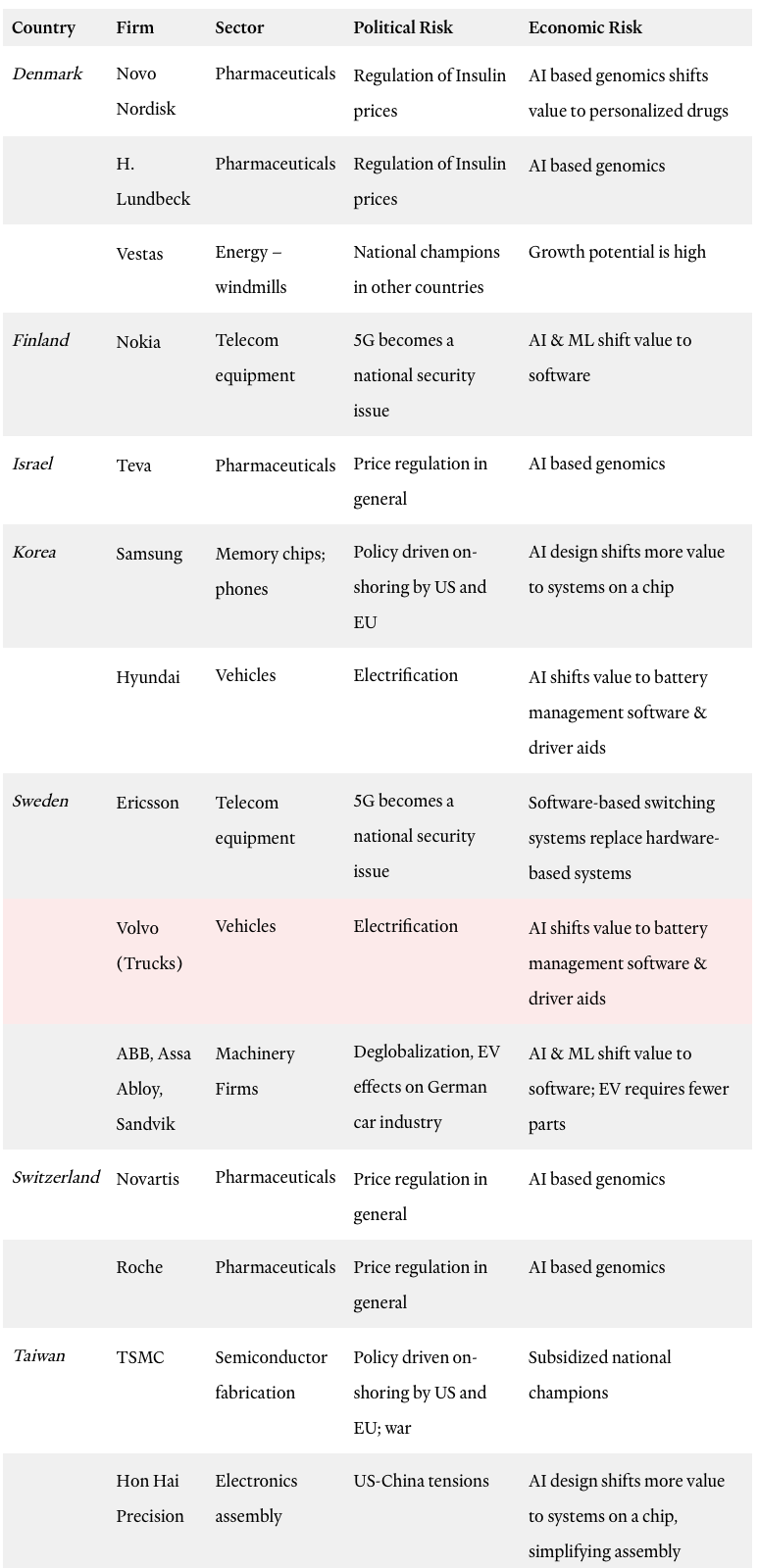
This Nokia Risk is raised in an article by Herman Schwartz, who says there are other countries facing this risk,

A larger group of seven countries—all of them relatively small, rich, and with stable governments—are similarly exposed. In Denmark, Israel, South Korea, Sweden, Switzerland, and Taiwan a handful of firms account for a hugely disproportionate share of both profits and R&D spending. The firms which dominate these seven economies have all been extraordinarily successful in the knowledge economy of the past three decades... For the decade of 2011–2020, these firms have had large shares of cumulative profits both domestically and abroad. It is largely thanks to these profits that these small countries have such a significant share of global profit (larger than their share of global GDP) and, in turn, a relatively high per capita income.

The economic and political risks borne by the companies in these countries are captured in the table.

4. Kanika Datta writes about Indian billionaires and their companies,
Of the Big Two Indians at the top end of the rich list only one of them can boast a Global Fortune 500 ranking — Mukesh Ambani’s Reliance Industries — which is based on the hard fact of revenues rather than the ephemerals of market sentiment... Reliance remains outside the top 100 with a rank of 104... Among the Indian private sector companies on the Global 500 list are Tata Motors (370th), Tata Steel (435th) and Rajesh Exports (437th)... there are some 145 Chinese corporations in the Fortune 500 to India’s nine (four of them in the private sector). Though Chinese businesspeople do not feature as high on the global rich lists as Indians do, more of them run corporations that have a global arc...

Despite India’s reputation as an IT powerhouse, it is the Chinese technology companies that can claim durable global leadership. The four Indian IT majors mostly predate the Chinese tech giants by a decade or more — Infosys in 1981, TCS 1968, Wipro’s IT services division in 1980 and HCL in 1991. The oldest of the Fortune 500 Chinese tech majors is Hon Hai, started in 1974. But Huawei was founded in 1987, Alibaba in 1999 and Tencent in 1998.

5. R Gopalakrishnan on corporate governance issues in India's private sector

Two major banes found among many Indian corporate groups are (i) too many subsidiaries, accompanied by (ii) related-party transactions.

6.  FT points to the story of an abandoned German village of Lutzerath in the country's industrial Rhineland, which has become the ground zero for protests against coal mining and a stern test for the German coalition government which includes the Greens. The energy giant RWE plans to raze the settlement and dig up lignite underneath. Lutzi has both wind turbines and coal-fired power plants, thereby exposing the difficulties and contradictions with a Green climate policy. 

RWE has been given permission to mine coal as part of an agreement brokered by the German government to keep two lignite-fired power plants running longer than planned to compensate for the sudden loss of Russian gas after Gazprom slashed supplies. 

7. The appreciation of US dollar in the current US rate hike cycle has been the highest in over 40 years, thereby imposing steep debt service costs on dollar debts.

The steep and rapid rate hikes in the US have led to a 17 percentage points rise in spreads on sovereign borrowing in foreign currencies of commodity importing countries with weak credit ratings in 2022, thereby shutting them out of markets. 
8. FT has an article which discusses whether China is undertaking a reset on its economic, domestic, and foreign policies to win back friends and shed its recent belligerent and insular image. 
As it seeks to repair ties with European powers, Beijing is insisting that its European counterparts agree to repeat a “no decoupling” mantra — marking a clear difference with Washington, which is seeking to limit US commercial ties with China in certain areas, particularly with regard to sensitive technologies. “China has realised that it has antagonised too many countries at the same time, particularly among developed countries which still today are its main trade and economic partners,” says Jean-Pierre Cabestan, a China expert at Hong Kong Baptist University. “So it is trying very hard to reach out to the EU and key European nations — Germany, France, Italy and Spain — as well as America’s Asian allies, such as Japan and South Korea and US partners such as Vietnam.”

It's the relations with Europe that China appears most intent to reset, 

China’s desire for a diplomatic reset with Europe appears to be yielding significant results. Visits to Beijing in November by Olaf Scholz, the German chancellor, and Charles Michel, president of the European Council, are set to be followed early this year by French president Emmanuel Macron and Italian prime minister Giorgia Meloni. Macron is expected to follow Scholz in voicing opposition to “decoupling” from China, thereby ceding to Beijing some ground in its long-running strategy to sow division between European powers and the US. Although he has also talked about reducing dependency on China, Scholz made clear during this visit that Berlin not only rejects “decoupling” but also sees China as an “important economic and commercial partner”. “Macron, like Scholz, is opposed to decoupling. He is still promoting engagement,” says Cabestan. “China will try to utilise Macron’s strategic autonomy ambitions to drive a wedge between Europe and America.”

See also Mihir Sharma here. 

9. Is Germany at the vanguard of the anti-trust movement?

Regulators in Germany argue that Section 19a of the German Competition Act is years ahead of the EU’s landmark piece of antitrust legislation, the Digital Markets Act, and with the potential to capture even more illegal conduct by being less prescriptive on what constitutes anti-competitive behaviour. The Section 19a law, which came into force in January 2021, places Berlin at the vanguard of Europe’s attempts to clamp down on the power of big tech, where the US and EU have so far failed or are still running behind. Like the DMA, the law gives antitrust authorities in Germany powers to go after so-called gatekeepers such as Meta, Google and Amazon — including the ability to impose sanctions like forced divestments against companies and the possibility to break them up. But while EU regulators are only now working out the details on how the DMA, which became law in November, will be implemented, Berlin has both designated who the gatekeepers are and is already pursuing them. 

The rules in Brussels are prescriptive and give a list of specific actions that are illegal, including a ban on platforms ranking their own services ahead of rivals. Section 19a does all this but also prohibits conduct in areas where platforms are not yet dominant and leaves the door open to tackling future anti-competitive behaviour that has not yet been identified. If companies are ruled to be of “paramount significance for competition across markets”, then the regulator can prohibit them from ranking their own services ahead of rivals, from denying rivals access to data, and from preventing users from taking their own data to other competing services. Since Section 19a came into effect, Germany’s antitrust watchdog has opened high-profile investigations against the world’s largest tech companies. The Federal Cartel Office’s investigation into whether Facebook grants an unfair advantage to users of its social network platforms on its VR glasses has already brought benefits to consumers, even as it continues. The German watchdog has ensured users can use the headsets without a Facebook or Instagram account. It is also investigating Google Maps over potential anti-competitive restrictions to the detriment of rivals and opened two separate probes into Amazon’s marketplace practices over concerns that the platform is disadvantaging the position of third-party sellers.

10. Livemint has a good infographic which highlights the growth of EV industry in India

The extent of government regulatory engagement in the last couple of years is very impressive. It's a very good example of facilitating market growth through enabling policies. 

While four-wheelers are where the action today globally is on the EV industry, it's likely to shift more towards two and three-wheelers in the years ahead. 
And it's here that Indian companies are well-placed to assume leadership. Will Ather Energy, for example, emerge as the new Hero Motors?

11. Good set of graphics in Livemint comparing Swiggy and Zomato the duopoly that controls the country's online food delivery market. 

12. What does it say about the startup company when some its investors, also globally reputed VCs with some of the biggest risk appetites, are looking for exit, even at steep valuation discounts, and that too in a sector which is considered one of the most promising and that too in one of the world's largest markets? 

More on Byju's and some of its investors here. 

Exports of garments and textiles exceeded a record $45bn in the 12 months to end of June 2022, more than 85 per cent of total export earnings.

The article is a very good read, pointing to the animosity between President Sheikh Hasina and the founder of Grameen Bank, Mohammed Yunus. 

Wednesday, January 11, 2023

More on business concentration

Matt Stoller on business concentration in agriculture in the US

The monopoly problem farmers face is really bad. On the input side they must deal with equipment producer John Deere, fertilizer giants CF Industries and Nutrien, and seed/chemical goliaths Bayer/Monsanto, among others. On the other side, they face giant buyers like ADM, Bunge, Cargill and Louis Dreyfuss, who in turn sell to large supermarket chains like Walmart and Kroger, and broadliners Sysco and U.S. Foods who sell to restaurants, institutional facilities, and food service giants. It’s consolidation all the way up and down the chain... Corteva and Syngenta have essentially been paying distributors not to carry rival, cheaper products, so they can maintain higher prices. This is done under the veil of “loyalty” programs to dealers, but it’s a way of blocking competition and keeping prices high.

This oped by the FTC Chairperson, Lina Khan, describes the "loyalty" program in an oped

Companies like Syngenta and Corteva are in the business of inventing new active ingredients for pesticides. Each time they do, they get to patent that invention. A patent entitles an inventor to a 20-year period where only they are allowed to sell the invention. But there’s a compromise: Once the patent expires, anyone is free to bring a generic version into the market... Syngenta and Corteva weren’t satisfied with this compromise. They wanted to keep raking in big profits even after the patents expired. To do that, our lawsuit alleges, each company plotted to cut farmers off from cheaper generic alternatives. In general, manufacturers don’t sell pesticides directly to farmers. They sell to distributors. Syngenta and Corteva realized that these distributors were a potential choke point. So they each launched “loyalty programs” in which distributors who bought their products would receive large payments, styled as a rebate. The catch: If those middlemen distribute too many generic pesticides, they don’t get the money. In other words, distributors get paid to exclude generics... Distributors don’t want to miss the payments, so they go along with the program. After all, it doesn’t hurt them to spend more on brand-name pesticides, because they get to pass those costs on to retailers and, ultimately, to farmers. With distributors under-stocking generics, farmers end up having little choice but to buy Syngenta and Corteva. And here is the payoff to the whole scheme: Because farmers are locked into buying their stuff, Syngenta and Corteva can keep charging inflated prices, as if their products were still under patent. The pesticide giants can make more profits by blocking rival products from the market than by competing with them.
This US Department of Defence report is a stunning summary of the shocking level of business concentration in the defense industrial base,
Since the 1990s, the defense sector has consolidated substantially, transitioning from 51 to 5 aerospace and defense prime contractors. As a result, DoD is increasingly reliant on a small number of contractors for critical defense capabilities. Consolidations that reduce required capability and capacity and the depth of competition would have serious consequences for national security. Over approximately the last three decades, the number of suppliers in major weapons system categories has declined substantially: tactical missile suppliers have declined from 13 to 3, fixed-wing aircraft suppliers declined from 8 to 3, and satellite suppliers have halved from 8 to 4. Today, 90% of missiles come from 3 sources.

This table captures the state of business concentration across product categories.


This captures the trajectory of consolidation in the solid rocket motor production industry.

As I have blogged earlier, business concentration is an inexorable dynamic emerging from the features of unfettered (American-style) capitalism. Quite apart from the innate nature of certain businesses like those in technology which enjoy virtually unlimited increasing returns to scale, there is the more pernicious issue of capture of rule-making by the large corporate interests.  This can be controlled only through active regulation and not allowing firms to grow too big. 

Monday, January 9, 2023

Airline industry trends of the day

Peggy Hollinger points to an interesting likely trend in the airline industry, about shifting of passengers from planes to railways for shorthaul routes. 

That it's sound economics is well known,

While many short-haul routes are important to legacy airlines to feed passengers on to their more lucrative long-haul flights, they are not profitable for many flag carriers on their own. “They are just a means to an end,” says one airline executive... Seven of the top 10 revenue-generating routes in the world are long-haul international flights, according to OAG.

So, airline operators in Europe are exploring the option of getting passengers to their hubs through trains,

So if airlines have a stake in getting passengers to their hubs by another route, with seamless ticketing and check-in services to smooth the journey, they can then use the slots that have been freed up for more lucrative services... For KLM, it is particularly urgent to make better use of their slots, given that the Dutch government has ordered the number of flights from its Schiphol hub to be cut by more than 10 per cent to 440,000 a year to reduce emissions. But KLM is not the only airline to be exploring closer relationships with train operators. Lufthansa, Austrian Airlines and others have been doing the same. Deutsche Bahn has even become the first non-airline member of the Star Alliance of airline operators, which jointly market flights and connections across their networks. “Airlines could get people to book rail tickets through them and perhaps take a commission. It could be a nice way to make a bit of money,” says Robert Thomson of Roland Berger. But it could also be a useful tool against low-cost competition on crucial feeder routes — assuming the airlines and rail operators can get the service right.

But such mode shifts this may not be good for the environment

In fact, according to consultants Roland Berger, even if these obstacles were overcome and all air journeys of less than 1,000km were transferred to rail (adding some four hours to the trip), the carbon savings for aviation would be less than 5 per cent.

Airline operators in India should pay attention to this trend. India is similarly continental like Europe. There are several small towns within a few hours of the metropolitan cities which act as hubs for international travel. Currently, the international travellers from these towns are serviced by code-share arrangements with the low-cost airlines. Is there an opportunity for railways and even road operators here?

Indian Railways too should explore opportunities of partnership with long-haul flight operators. How about a partnership between IR and Emirates or the European carriers, or now between IR and Vistara/Air India to ferry travellers to their metropolitan local hubs from nearby smaller towns? The airline operators would presumably want some competition to their current air code-share arrangements with low-cost airlines. The problem is the last-mile connectivity - IR does not connect to the airports. This means the need for IR to arrange another road leg connecting the stations to the airports. But wouldn't price sensitive customers not mind the inconvenience if it comes at a lower ticket cost?

Saturday, January 7, 2023

Weekend reading links

1. Industrial policy in the US

The chips and Science Act, a $280bn effort to shore up America’s microchips industry... the administration eventually compromised enough to overcome the resistance of Joe Manchin of West Virginia, often the swing Democrat in a 50-50 Senate, to pass a more modest, inaptly named Inflation Reduction Act, promising spending of $369bn over a decade. Its climate spending will be the most substantial in American history. Together with an infrastructure package passed in November 2021, the trio of bills will make for annual spending of nearly $100bn on industrial policy, by one reckoning. America could end up spending more, as a share of GDP, on industrial policy than unabashed champions of the practice such as France, Germany and Japan.

2. How broad-based is inflation across OECD countries? The graphic below points to the share of items in each country's inflation basket whose prices have risen by more than 2% in the past year.

3. Scott Galloway has a reality check on the new Gods of Technology,
As search engines and iPhones replace mythical and spiritual beings as our sources of truth, our worship shifts to the gods responsible — the wealthiest person in tech has a 1 in 3 chance of being Time’s Person of the Year. Our new gods: Bill Gates, Steve Jobs, Larry and Sergey, Elon Musk, Elizabeth Holmes, Sam Bankman-Fried... Our gross, nonsensical adoration of tech innovators may have peaked. It’s been a tough couple of months for the Church of Technology: Elizabeth Holmes was sentenced to 11 years, and her colleague to 13 years; Nikola founder Trevor Milton was convicted of fraud; Celsius Network went bankrupt and faces federal investigations; and SBF’s Oops I Did it Again apology tour was cut short due to an outbreak of law.

I hope a fresh round of bankruptcies, margin calls, and orange jumpsuits dethrones our modern-day gods and sobers up the media, the public, and elected leaders who worship them. I’m optimistic these abusers will not just be reassigned to different parishes, but their close-up will illuminate the importance of regulation, trust, and independent boards. We may even realize the people responsible for prosecuting fraudulent actors, maintaining backstops on savings accounts, and writing laws are the people who are really on y(our) side.

And on the announcement of Elon Musk as Time Person of the Year,

Confirmation that our idolatry of innovators is worsening, as we increasingly treat billionaire tech founders not as influencers or even heroes, but gods whose bigotry and idiocy are just more genius waiting to be revealed.

4. The US Clean Water Act 1972 is celebrating its half-century. 

Fifty years ago, Congress voted to override President Richard Nixon’s veto of the Clean Water Act. It has proved to be one of the most transformative environmental laws ever enacted. At the time of the law’s passage, hundreds of millions of gallons of raw sewage was dumped by New York City into the Hudson River every day. This filth was compounded by industrial contaminants emptied into the river along much of its length. The catch basin for all of this was New York Harbor, which resembled an open sewer. At its worst, 10 feet of raw human waste blanketed portions of the harbor bottom, and certain reaches held little or no oxygen to sustain the life of its fishery. Trash floated among oil slicks.

Health advisories against eating fish from the Hudson remain, but its ecology has largely recovered, thanks to the law, which imposed strict regulations on what could be discharged into the water by sewage treatment plants, factories and other sources of pollution. Today people swim in organized events in New York Harbor, which would have been unthinkable in 1972 when the law was passed. Across the country, billions of dollars were also spent to construct and improve sewage treatment plants, leading to recoveries of other urban waterways. Cleaner water has made the harbor far more hospitable, and other steps have helped to rebuild life there, like fishing restrictions and the removal of some dams on tributaries in the Hudson River watershed.

Its mandate 

The act regulated so-called point-source pollution, requiring factories and towns to stop direct discharges or remediate them in some way. It provided grants for sewage treatment plants. And it established water quality standards that, when achieved, were intended to make lakes and streams safe for fishing and swimming, at the same time protecting drinking water supplies.

This draws attention to the importance of regulation, even if not very well implemented, in addressing negative externalities. 

5. A measure of the credibility of budgets is the difference between the budget estimates and the actual realisation. States typically have the incentive to boost their revenues and under-estimate their expenditures so as to ensure that their fiscal deficits remain within the FRBM limit.

As the latest PRS report on state government finances, there are large variations between the budget estimates and the actuals. The average shortfall in revenue receipts was 10% over the 2015-16 to 2019-20 period.
The average shortfall in total expenditure over the same period was 9%.
While the average shortfall in revenue expenditure was 8%, that in capital expenditure was a disturbing 17%.

6. Bloomberg points to this database on corporate settlements in the US whereby corporates pay large fines to settle with the prosecutors and DoJ on all kinds of violations ranging from tax evasion to market manipulation to money laundering. 
7. Private sector companies far outperformed public sector ones in the Indian stock markets over the past decade.
Google advertising accounted for almost four-fifths of Alphabet’s revenue in the last quarter... Google Search has no real competitors... The prevalence of Google’s Chrome browser and the fact that it pays Apple to be the default search engine give it a huge advantage.

9. FT has an article on Top Glove the Malaysian rubber gloves manufacturer which is battling corruption and poor labour practices allegations in western markets. 

Until the Covid-19 pandemic, the group had quietly led a national industry that produced up to two-thirds of the world’s rubber gloves. Top Glove alone claims a 26 per cent market share.

The controversies apart, rubber gloves industry in Malaysia, the world's largest natural rubber producer, is a good example of capturing value domestically by leveraging local natural resources to establish leadership in the global manufacturing industry. Top Glove is an example that resource industries in other developing countries should look closely. 

10. Ruchir Sharma has some predictions for 2023 - end of a long period of dollar strength; rise of rest of world financial markets relative to the US; beginning of the end of the Big Tech dominance; the return of Japanese economy; manufacturers relocating away from China etc. This is an outstanding graphic.

Since the second world war, the US stock market has tended to outperform the ROW one decade, then trail behind the next. The 1950s, ’70s and 2000s were great decades for investing outside the US. In the boom of the 2010s, the value of the US stock market expanded, reaching 60 per cent of the global total in 2021, a full 15 per cent above its long-term average.

11. The Lina Khan led US Federal Trade Commission (FTC) has unveiled a rule to block companies from limiting their employees' ability to work for a rival. 

The proposed rule would ban provisions of labor contracts known as noncompete agreements, which prevent workers from leaving for a competitor or starting a competing business for months or years after their employment, often within a certain geographic area. The agreements have applied to workers as varied as sandwich makers, hairstylists, doctors and software engineers... The commission’s proposal appears to address this issue by requiring employers to withdraw existing noncompetes and to inform workers that they no longer apply. The proposal would also make it illegal for an employer to enter into a noncompete with a worker or to try to do so, or to suggest that a worker is bound by a noncompete when he or she is not. The proposal covers not just employees but also independent contractors, interns, volunteers and other workers.

Non-competes are widely used in the US and its effects not benign,

Studies show that noncompetes, which appear to directly affect roughly 20 percent to 45 percent of U.S. workers in the private sector, hold down pay because job switching is one of the more reliable ways of securing a raise. Many economists believe they help explain why pay for middle-income workers has stagnated in recent decades. Other studies show that noncompetes protect established companies from start-ups, reducing competition within industries. The arrangements may also harm productivity by making it hard for companies to hire workers who best fit their needs... The agency estimated that the rule could increase wages by nearly $300 billion a year across the economy... Evan Starr, an economist at the University of Maryland who has studied noncompetes, said noncompetes appeared to lower wages both for workers directly covered by them and for other workers, partly by making the hiring process more costly for employers, who must spend time figuring out whom they can hire and whom they can’t.

He pointed to research showing that wages tended to be higher in states that restrict noncompetes. One study found that wages for newly hired tech workers in Hawaii increased by about 4 percent after the state banned noncompetes for those workers. In Oregon, where new noncompetes became unenforceable for low-wage workers in 2008, the change appeared to raise the wages of hourly workers by 2 percent to 3 percent. Although noncompetes appear to be more common among more highly paid and more educated workers, many companies have used them for low-wage hourly workers and even interns. About half of states significantly constrain the use of noncompetes, and a small number have deemed them largely unenforceable, including California.