Substack
Wednesday, October 18, 2023
Thesis gone too far begets anti-thesis - explaining retreat of orthodoxy
Thursday, August 3, 2023
Family is destiny - evidence from college admissions in the US
I have blogged many times on the ovarian lottery, the disproportionate importance of family connections in determining life outcomes. Family is destiny.
Raj Chetty, David Deming, and John Friedman have just released a new Opportunity Insights study (pdf here and NYT illustration here) using college admissions data from 1999 to 2015 from 12 elite colleges (Ivy League, MIT, Duke, U Chicago, and Stanford) that illustrate the outsized nature of preferential treatment that children of alumni (legacy applicants) enjoy in Ivy League undergraduate admissions. The authors used detailed anonymised internal admissions assessments data, SAT and ACT scores, and incomes of parents and post-graduation incomes of students. A summary of their findings
Children from families in the top 1% are more than twice as likely to attend an Ivy-Plus college as those from middle-class families with comparable SAT/ACT scores. Two-thirds of this gap is due to higher admissions rates for students with comparable test scores from high-income families; the remaining third is due to differences in rates of application and matriculation. In contrast, children from high-income families have no admissions advantage at flagship public colleges.The high-income admissions advantage at private colleges is driven by three factors: (1) preferences for children of alumni, (2) weight placed on non-academic credentials, which tend to be stronger for students applying from private high schools that have affluent student bodies, and (3) recruitment of athletes, who tend to come from higher-income families... we show that attending an Ivy-Plus college instead of the average highly selective public flagship institution increases students’ chances of reaching the top 1% of the earnings distribution by 60%, nearly doubles their chances of attending an elite graduate school, and triples their chances of working at a prestigious firm. Ivy-Plus colleges have much smaller causal effects on average earnings... Adjusting for the value-added of the colleges that students attend, the three key factors that give children from high-income families an admissions advantage are uncorrelated or negatively correlated with post-college outcomes, whereas SAT/ACT scores and academic credentials are highly predictive of post-college success.We conclude that... highly selective private colleges serve as gateways to the upper echelons of society in the United States. Because these colleges currently admit students from high-income families at substantially higher rates than students from lower-income families with comparable academic credentials, they perpetuate privilege across generations.
The graphic below captures the admissions advantage enjoyed by legacy students
They also compared legacies’ chance of admission at the colleges their parents attended versus similarly elite schools. They found that they were slightly more likely to get in to the other colleges than applicants with the same test scores. But that was dwarfed by the advantage they got at the school their parents attended.
They estimated that legacy students were no more likely than other graduates to make it into the top 1 percent of earners, attend an elite graduate school or work at a prestigious firm. If anything, they were slightly less likely to do so.
Needless to say, legacy students are more likely to be white and more likely to come from rich families. The study found that even among the legacies, the richest had an advantage. One in six Ivy League students has parents in the top 1%.
The legacy status builds on an already entrenched advantage arising from these students having access to much superior schooling, tuition, coaching, exposure and so on. Unsurprisingly, the study finds that even without legacy status, these students would still be about 33% more likely to be admitted than applicants with the same test scores, based on all their other qualifications. In fact, even without legacy, family wealth already has a stunning relationship with elite college admissions.
The academic ratings of richer students didn’t vary much from other students with the same test scores. But richer students were vastly more likely to earn high marks on nonacademic measures like extracurricular activities and recommendation letters... At one of the colleges that shared admissions data, students from the top 0.1 percent were 1.5 times as likely to have high nonacademic ratings as those from the middle class... The biggest contributor was that admissions committees gave higher scores to students from private, nonreligious high schools. They were twice as likely to be admitted as similar students — those with the same SAT scores, race, gender and parental income — from public schools in high-income neighborhoods. A major factor was recommendations from guidance counselors and teachers at private high schools... Recommendation letters from private school counselors are notoriously flowery... and the counselors call admissions officers about certain students... Nobody’s calling on behalf of a middle- or lower-income student. Most of the public school counselors don’t even know these calls exist.
Even after adjusting for higher SAT scores, finely honed resumes, higher application rates etc, they were still over-represented.
For applicants with the same SAT or ACT score, children from families in the top 1 percent were 34 percent more likely to be admitted than the average applicant, and those from the top 0.1 percent were more than twice as likely to get in.
The new data shows that among students with the same test scores, the colleges gave preference to the children of alumni and to recruited athletes, and gave children from private schools higher nonacademic ratings. The result is the clearest picture yet of how America’s elite colleges perpetuate the intergenerational transfer of wealth and opportunity... In effect, the study shows, these policies amounted to affirmative action for the children of the 1 percent, whose parents earn more than $611,000 a year.
At places like the University of Texas at Austin and the University of Virginia, applicants with high-income parents were no more likely to be admitted than lower-income applicants with comparable scores.
“Are these highly selective private colleges in America taking kids from very high-income, influential families and basically channeling them to remain at the top in the next generation? Flipping that question on its head, could we potentially diversify who’s in a position of leadership in our society by changing who is admitted?”
This Mathew Effect has two implications - wealth begets wealth, and also wealth shuts out the rest. To borrow Peter Turchin's framework in his latest book, End Times, the former leads to elite overproduction and the latter leads to mass immiseration. At a macro-level, the former is a dynamic of capitalism, especially the modern globalised economy with its economies of scale and knowledge-based sectors with their network effects. And the latter is accentuated by the elite capture of the establishment and the rules -making process. As I have blogged on several occasions, it's this latter dynamic that's the most disturbing aspect of modern capitalism - Big Tech and Wall Street invariably end up capturing the rules-making process and corroding the social contract.
Most of the disturbing economic, social and political trends we see today across the world have these two factors as important contributors. The rise of populism and widening inequality threatens to destroy the social fabric and usher in the crisis that the likes of Turchin and Neil Howe write about.
Instead of their mindless and almost unconstrained pursuit of market capitalisation, executive compensation, profits maximisation, tax reduction and avoidance, deregulation, efficiency maximisation, automation, technology led lifestyles, union busting, etc elites need to realise that the ship is entering very stormy waters and could sink. Karl Marx may turn out to have the last laugh, if only a few decades late.
Update 1 (05.08.2023)
From David Brooks
A 2018 study found that more than 50 percent of the staff writers at the beloved New York Times and The Wall Street Journal attended one of the 29 most elite universities in the nation.
Sunday, July 24, 2022
Weekend reading links
1. Long read in FT on the issue of weight-loss drugs, especially Wegovy the new drug by Novo Nordisk. The self-administered weekly injection is part of the increasing belief that obesity is a disease rather than resulting from unhealthy habits and for the seriously overweight medical treatment may be necessary.
The article points to the long history of failures with weight loss drugs,
Despite the vast need, many major pharmaceutical companies have held back from developing weight-loss drugs, in part because the category is marred by a long history of quackery and safety scares. From the 1930s to the 1960s, the industry poured money into diet pills based on amphetamines. These eventually fell out of favour because they were highly addictive and had harmful side effects. In the 1990s, fen-phen — a combination of fenfluramine and phentermine — became so popular that weight-loss clinics sprung up across the US just to prescribe it, even though some patients on the drug experienced manic episodes. It was later taken off the market after a study showed up to a third of patients could suffer from heart valve defects. As recently as 2020, US regulators forced the withdrawal of weight-loss drug Belviq because of concerns it increased the risk of cancer. For the most desperate, surgery has become popular, though it is expensive and comes with its own risks and restrictions.
2. George Bass, a security guard in a university, has a brilliant essay chronicling life in times of rising inflation.
In my job keeping people and property safe on a university campus, I earn £10.71 per hour. Working 16 12-hour shifts a month bags me an average £1,400, after tax. I’ve always been comfortable earning a modest wage. Since I began working at the age of 15, I’ve picked jobs based on two guiding principles: I don’t want to have to tell lies all day, and I don’t want to get work calls beyond the car park. In my various roles over the past 25 years, working on a gun range, in a lead factory, as a labourer and shifting boxes, those two rules have never been broken. Getting a job in security taught me a third: once the uniform’s on, you need to help people. This year, the drumbeat of news about inflation has made me increasingly anxious.
The essay is a great example of how exceptional talent can remain hidden in all of us. Some, and only some, realise it and become rich and famous (in varying degrees), whereas it remains latent in the lives of most others. And the reason for the talent getting expressed in most cases is either the ovarian lottery of birth circumstances or plain good luck.
3. The tumult in financial markets have hit emerging market bonds very hard. It's estimated than $52 billion has already been pulled out from EM bonds this year, with devastating consequences on EM bond yields.
EM bonds are having their worst year on record.
4. As it pulls ahead in mass manufacturing of 5 nm chips, TSMC's lead in the semiconductor chip business increases.
5. The age of ultra-loose monetary policy is being followed by a period of frenetic tightening,
In the three months to June, 62 policy rate increases of at least 50 basis points were made by the 55 central banks tracked by the Financial Times. Another 17 big increases of 50 basis points or more have been made in July so far, marking the biggest number of large rate moves at any time since the turn of the millennium and eclipsing the most recent global monetary tightening cycle, which was in the run-up to the global financial crisis. “We’ve seen this pivot point in the market where 50 is the new 25,” said Jane Foley, head of foreign exchange strategy at Rabobank.
This demonstrated collective resolve is an important point that can help anchor inflation expectations.
6. Pratik Datta writes about the latest example of judicial activism which threatens the future of the Insolvency and Bankruptcy Code.
The Supreme Court recently passed an important judgment in Vidarbha Industries Power Ltd. v. Axis Bank. It held that the National Company Law Tribunal (NCLT) cannot admit an insolvency application filed by a financial creditor merely because a financial debt exists and the corporate debtor has defaulted in its repayment. Instead, the NCLT must consider any additional grounds that the corporate debtor may raise against such admission... The balance-sheet test is one method for determining insolvency at the point of trigger. This test, however, is vulnerable to the quality of accounting standards. That’s why the Bankruptcy Law Reforms Committee did not favour this test in the Indian context. Instead, it recommended that a filing creditor must only provide a record of the liability (debt), and evidence of default on payments by the corporate debtor. This twin-test was expected to provide a clear and objective trigger for insolvency resolution. The hope was this would minimise litigation at admission stage, enabling quicker resolution of distressed businesses. The Supreme Court’s latest ruling is likely to radically alter these expectations. Even if the NCLT is satisfied that a financial debt exists and that the corporate debtor has defaulted, it may not admit the case for resolution if the corporate debtor resists admission on any other grounds. Corporate debtors are likely to use this precedent to the fullest to resist admission into IBC. The likely outcome would be more litigation and delay at the admission stage, enhancing the risks of value destruction in the underlying distressed business. Unless the NCLT consciously constrains the use of its own discretion at the admission stage, the IBC may well end up like the SICA.
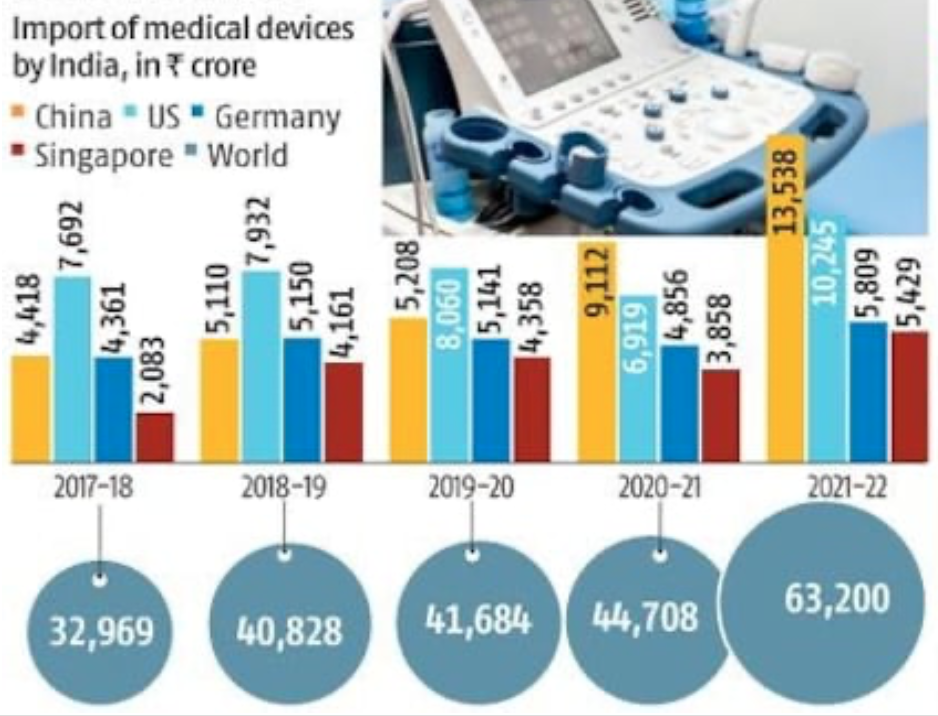
7. The rising dependence on imported medical devices, in particular from China.
8. FT has a long read on the enduring high risk appetite among young investors in the US. It has a graphic which points out that only half Americans born in 1984 were likely to out-earn their parents at 30.
Gary Stevenson, a 35-year-old former trader and financial education campaigner from east London, is one: “My dad never went to university. He worked at the post office for 35 years and could raise three kids and pay off [a mortgage] . . . he has a comfortable retirement,” he says. “That is off the table for most young people now. It’s created a bit of a panic.” “If you can’t do what your dad or grandad did . . . you have to come up with a better plan,” he adds. At some point, risky bets starts to look like the rational choice: “One way, you see a zero per cent chance of success. But if you take on insane risk . . . at least you have a chance.”... “If you said, ‘My dad spends all day gambling,’ [I’d] say, ‘Oh man I’m so sorry for your family’,” he says. But “if someone says, ‘My dad spends all day FX trading’, you think he’s the Wolf of Wall Street . . . It’s not gambling, it’s investing — and investing is how you get rich.”
9. Esther Bintliff has a long read in FT assessing the value of feedback in improving performance. She examines the research and literature on the topic and leaves you wondering whether there is any scientific basis to the claim that negative feedback when given appropriately can lead people to change habits and behaviours and improve their performance.
The article points to a 1996 meta-study of feedback literature by two academic researchers Avraham Kluger and Angelo De Nisi,
The two reviewed hundreds of feedback experiments going back to 1905. What they found was explosive. In 38 per cent of cases, feedback not only did not improve performance, it actively made it worse. Even positive feedback could backfire... Kluger came to believe that as a performance management tool, it is so flawed, so risky and so unpredictable, that it is only worth using in limited circumstances, such as when safety rules must be enforced. If a construction worker keeps walking around a site without a helmet, negative feedback is vital, Kluger acknowledges. The most effective way to give it is with great clarity about potential consequences. The worker should be told that the next time they go without a helmet, he or she will be fired. But in many other types of work, the formula for good feedback includes too many variables: the personality of the recipient, their motivations, whether they believe they are capable of implementing change, the abilities of the manager...
Instead of managers giving top-down feedback, he argues they should spend more time listening to their direct reports. In the process of talking in depth about their work, the subordinate will often recognise issues and decide to correct them on their own. Based on this theory, Kluger developed something he calls the “feed-forward interview” as an alternative, or prologue, to a performance review. He offers to give me a demo... Much of how we respond to feedback is driven by the nature of our relationship with the person giving it. This is why Kluger believes it’s useless to focus on the recipient of feedback alone. The outcome will always depend on the “dyad” — the sociological term for two people in a particular relationship — and what transpires between them.
The time, effort, and skill required to do a good feed-forward interview is too rare as to make the likelihood of a feedback being effective very rare.
10. Even as the Sri Lankan crisis occupies attention, the situation in Pakistan deserves greater attention as things worsened this week,
The Pakistani rupee’s 7.6 per cent tumble to Rs228 to the dollar marked the latest setback for the currency, which has fallen sharply this year. It marked the rupee’s sharpest weekly drop since October 1998. The latest slide reflected mounting concerns that a $1.2bn loan disbursement from the IMF agreed last week might not be enough to avert a balance of payments crisis. Pakistan’s bonds have been among the worst performers in emerging markets this year... Fitch Ratings this week downgraded its country outlook to negative from stable, noting what it called a “significant deterioration in Pakistan’s external liquidity position and financing conditions” this year. The rating agency said the central bank’s forex reserves had declined to about $10bn by June 2022, down from $16bn a year previously and equivalent to just over one month’s worth of current external payments. Pakistan’s central bank raised its main policy interest rate 125 basis points to 15 per cent on July 7 in an effort to stem demand for foreign currencies and reduce inflation.
Friday, November 26, 2021
Access to opportunity graphics of the day
Arguably the most important perpetuating factor in widening inequality is the barriers to equality of opportunity in accessing higher education. As Michael Sandel has written in his book, Tyranny of Merit, higher education has become the system by which modern societies "allocate opportunity".
I have blogged earlier pointing to the empirical reality of the higher quality higher education becoming the preserve of the richest people. This, this and this are posts about the Ovarian lottery that access to good higher education has become.
Scott Galloway has two points. The first highlights the fact that undergraduate tuition in the US has risen three times as fast as consumer price inflation since 1980.
The second draws attention to its impact being much higher on the poor.
This conveys the point about both forced scarcity and galloping prices,
The greatest assault on middle-class America’s prosperity may be the relentless, four-decade-long inflation in higher education. Student loan debt ($1.7 trillion) is now greater than credit card debt... The number of Americans who have more than $100,000 in student debt is greater than the population of Utah.The top 200 schools in America educate only 10% of college attendees. And these universities raise prices in perfect lockstep, miraculously, resulting in millions of kids who get arbitraged to mediocre universities but pay an elite price. It’s a cartel, enforced by the accreditation organizations, institutions who are as corrupt as the NCAA … minus the charm. Accreditation has teeth because it determines access to federally guaranteed student loans. And in the last 20 years, these organizations have blessed only 159 new institutions — most of them small and specialized schools — which have collectively grown total enrollment by less than 0.15% per year.
About costs and high salaries paid to senior leaderships in universities. This is mind boggling,
Nearly all of the 100 highest-paid civil servants in Massachusetts are employed by (wait for it) the University of Massachusetts.
Sandel has some stunning statistics about the access barriers,
More than 70% of students at the hundred or so most competitive colleges comes from the top quarter of the income scale, only 3% come from bottom quarter. At Ivy League colleges, Stanford, Duke, and other prestigious places, there are more students from the wealthiest 1% of families than from the entire bottom half of the country. At Yale and Princeton, only about one student in fifty comes from a poor family (bottom 20%). If you come from a rich family (top 1%), your chances of attending an Ivy League school are 77 times greater than if you come from a poor family (bottom 20%). The children of the working class and poor are as unlikely to attend Harvard, Princeton and Yale today as they were in 1954.
Leaving the last word to Sandel,
American higher education is like an elevator in a building that most people enter on the top floor.
Wednesday, June 17, 2020
The illusion of meritocracy
My parents got me to first base before I was born, immigrating to the US... In Europe I’d make much less money being an entrepreneur and challenging institutions. In China I’d likely be in jail. Having one of my companies fail would have bankrupted me in Europe, as the tolerance for risk or failure is scant. I have no idea what would have happened in China...
I have some talent and have worked really hard, but mostly my success is due to being born in the right place at the right time, and being a white heterosexual male. Coming of professional age as a white male in the nineties was the greatest economic arbitrage in history. Today’s 54-to-70-year-olds saw the Dow Jones increase an average of 445% from 25-40, their prime working years. For other ages, it doubles at most. Economic liberalization (globalization, technology, market deregulation) coupled with social norms that clung to the past meant 31% of America (white males) were given license over a lion’s share of the spoils. In nineties San Francisco, I raised over $100 million for my start-ups. I didn’t know a single woman under 40 who raised more than a million...
Rich, fabulous people are the ideal billboards for luxury brands. Our nation’s best universities have adopted the same strategy. Universities are no longer nonprofits, but the highest-gross-margin luxury brands in the world. Another trait of a luxury brand is the illusion of scarcity. Over the last 30 years, the number of applicants to Stanford has tripled, while the size of the freshman class has remained static. Harvard and Stanford have become finishing school for the global wealthy. In the class of 2013 in the Ivy League, five of the eight colleges (Dartmouth, Princeton, Yale, Penn, and Brown) had more students from the top 1% of the income scale than the bottom 60%.
Not recognizing your blessings feeds into the dark side of capitalism and meritocracy: the notion that success is a choice, and that those who haven’t achieved success are not unlucky, but unworthy. This leads to regressive policies that further reward the perceived winners and punish the perceived losers based on income level.
There is so much that’s jarring about American exceptionalism... We idolize the founder of Amazon, who has added the GDP of Estonia to his wealth (all tax-free/deferred) during this pandemic, as we discover 25% of New Yorkers are at risk for becoming food insecure. This isn’t a United States, it’s The Hunger Games. This country was built by titans of industry even wealthier than billionaires today — Vanderbilt, Rockefeller, Carnegie, and J.P. Morgan. But 1 in 11 steel workers didn’t need to die for bridges and skyscrapers to happen. We are a country that rewards genius. Yet no one person needs to hold enough cash to end homelessness ($20 billion), eradicate malaria worldwide ($90 billion), and have enough left over for 700,000 teachers’ salaries. Bezos makes the average Amazon employee’s salary in 10 seconds. This paints us as a feudal state and not a democracy. Our lack of empathy for fellow Americans is vulgar and un-American. We can and should replace the hollow tributes with federally mandated $20/hour minimum wage. This “outrageous” lift in minimum wage would vault us from the 1960s to the present. As of 2018, the federal minimum wage was worth 29% less than in 1968.
Sandel notes that in the US the chance of students from households with more than $200,000 in income scoring above 1,400 on the SAT college admission test is one in five. For those from families that make less than $20,000 it is only one in 50.
Wednesday, April 1, 2020
The choice for capitalism - facing up to the reality of unearned windfalls!
If only Murdstone were kinder to David Copperfield. If only all bosses were as nice as Fezziwig. That no one should have such awesome power over others in the first place goes unsaid by Dickens, and presumably unthought. And so his worldview, says Orwell, is “almost exclusively moral”. Dickens wants a “change of spirit rather than a change of structure”. He has no sense that a free market is “wrong as a system”. The French Revolution could have been averted had the Second Estate just “turned over a new leaf, like Scrooge”. And so we have “that recurrent Dickens figure, the Good Rich Man”, whose arbitrary might is used to help out the odd grateful urchin or debtor. What we do not have is the Good Trade Unionist pushing for structural change. What we do not have is the Good Finance Minister redistributing wealth. There is something feudal about Dickens. The rich man in his castle should be nicer to the poor man at his gate, but each is in his rightful station. You need not share Orwell’s ascetic socialism to see his point. And to see that it applies just as much to today’s economy. Some companies are open to any and all options to serve the general good — except higher taxes and regulation. “I feel like I’m at a firefighters’ conference,” said the writer Rutger Bregman, at a Davos event about inequality that did not mention tax. “And no one is allowed to speak about water.”
What Orwell would hate about Stakeholder Capitalism is not just that it might achieve patchier results than the universal state. It is not even that it accords the powerful yet more power — at times, as we are seeing, over life and death. Under-resourced governments counting on private whim for basic things: it is a spectacle that should both warm the heart and utterly chill it. No, what Orwell would resent, I think, is the unearned smugness. The halo of “conscience”, when more systemic answers are available via government. The halo that Dickens still wears. You can see it in the world of philanthropy summits and impact investment funds. The double-anniversary of England’s most famous writers since Shakespeare... serve as a neat contrast of worldviews. Dickens would look at the crisis and shame the corporates who fail to tap into their inner Fezziwig. Orwell would wonder how on earth it is left to their caprice in the first place. The difference matters because, when all this is over, there is likely to be a new social contract. The mystery is whether it will be more Dickensian (in the best sense) or Orwellian (also in the best sense). That is, will it pressure the rich to give more to the commons or will it absolutely oblige them?
He was, for all his privilege, incredibly motivated to make something more of his life... Religion played an important role in sharing his character... Pinchot in many ways embodied Max Weber's Protestant work ethic, observing that "my own money came from unearned increment on land in New York held by my grandfather, who willed the money, not to the land, but to me. Having got my wages in advance in that way, I am now trying to work them out".
Wednesday, November 20, 2019
The "liberal meritocratic capitalism"?
Apple currently holds about $252 billion in profits offshore, where it can avoid paying U.S. taxes. That’s over 90% of the company’s total cash on hand. This profit is subject to the corporate income tax as soon as it’s “repatriated” back to the U.S. Before the recent tax code overhaul, the company would’ve paid $78.6 billion in taxes if it brought the money home, according to the Institute on Taxation and Economic Policy. Apple didn’t want to pay this tax, so it let the cash sit offshore for years.
In the meantime, Apple and its peers have been working furiously to tilt the tax code in their favor. Apple spent $2.3 million in the third quarter of 2017 alone lobbying. The other four big tech companies—Microsoft, Facebook, Alphabet (which owns Google), and Amazon—chipped in another $14 million. For their efforts, these titans of Silicon Valley are being rewarded handsomely. Now their offshore profits will be taxed at a one-time, 15.5% repatriation rate, also called a tax holiday. And all other corporate profits will be taxed at 21%, down from a previous nominal rate of 35%. So that $38 billion Apple’s going to pay in taxes now? It means the company effectively dodged more than $40 billion it would’ve otherwise paid.
Saturday, June 22, 2019
Ray Dalio is wrong on what ails capitalism
Tuesday, May 28, 2019
The note of caution on claims of alpha
... in a competition in which all the leaders are highly skilled, randomness may explain the difference between triumph and failure. Good luck plus skill beats bad luck plus skill any time.
One of the biggest concerns with present day capitalism is that its dynamic has amplified Mathew Effect, thereby entrenching winners. In fact, such Mathew Effect even conceals the deep deficiencies and incompetence in such winners and perpetuates a very inefficient market. In a broader sense, there is so much evidence piling up that access to life's opportunities itself is increasingly dependent on the ovarian lottery.
Friday, May 17, 2019
Ovarian Lottery and Inequality - UK Edition
As many Oxbridge places go to students from just eight, mostly private, schools as from 2,900 other secondary schools, according to the Sutton Trust, an education charity.
A report from the Sutton Trust last year showed that almost half of all Oxbridge places go to children at private schools, although only 7 per cent of kids in the UK attend these.
When it comes to issues of social mobility and university, the UK and US are not so far apart: the OECD calculates that while Americans from families with university degrees are 6.8 times more likely to attend college than people from families without a degree, this ratio is only slightly better, at 6.3, in England. In Finland and South Korea, by contrast, it is just over one.
Update (12.06.2019)
From the US in the context of Supreme Court Justice Brett Kavanagh's hiring of the daughter of writer Amy Chua to clerk for him, Ed Luce writes,
On pure arithmetic, the average American’s chances of entering a top university are tiny if they are born into the wrong home. Studies show that an eighth grade (14-year-old) child from a lower income bracket who achieves maths results in the top quarter is less likely to graduate than a kid in the upper income bracket scored in the bottom quarter. This is the reverse of how meritocracy should work. Children from the wealthiest 1 per cent take more Ivy League places than the bottom 60 per cent combined.
Tuesday, January 22, 2019
The inequality graphic of the day
A full 29 percent of last year’s freshman class at Harvard were relatives of Harvard graduates.
Saturday, February 18, 2017
Capitalism and Mathew effect
Tenured faculty represent only 17 percent of college instructors. Part-time adjuncts are now the majority of the professoriate and its fastest-growing segment... A 2014 congressional report suggests that 89 percent of adjuncts work at more than one institution; 13 percent work at four or more... An English-department adjunct at Berkeley, for example, received $6,500 to teach a full-semester course... According to the 2014 congressional report, adjuncts’ median pay per course is $2,700... Thirty-one percent of part-time faculty members live near or below the poverty line. Twenty-five percent receive public assistance, like Medicaid or food stamps... We cannot blame this professional anemia on scarce funding. The largest adjunct-faculty increases have taken place during periods of economic growth, and high university endowments do not diminish adjunctification. Harvard has steadily increased its adjunct faculty over the past four decades, and its endowment is $35.7 billion. This is larger than the GDP of a majority of the world’s countries.
The key feature of adjunctification is a form of labor-market polarization. The desirability of elite faculty positions doesn’t just correlate with worsening adjunct conditions; it helps create the worsening conditions. The prospect of intellectual freedom, job security, and a life devoted to literature, combined with the urge to recoup a doctoral degree’s investment of time, gives young scholars a strong incentive to continue pursuing tenure-track jobs while selling their plasma on Tuesdays and Thursdays. This incentive generates a labor surplus that depresses wages. Yet academia is uniquely culpable... New faculty come from a pool of candidates that the academy itself creates, and that pool is overflowing. According to the most recent MLA jobs report, there were only 361 assistant professor tenure-track job openings in all fields of English literature in 2014-15. The number of Ph.D. recipients in English that year was 1,183. Many rejected candidates return to the job market year after year and compound the surplus... From 2008 to 2014, tenure-track English-department jobs declined 43 percent. This year there are, by my count, only 173 entry-level tenure-track job openings — fewer than half of the opportunities just two years ago. If history is any guide, there will be about nine times as many new Ph.D.s this year as there are jobs.
Universities rely upon a revolving door of new Ph.D.s who work temporarily for unsustainable wages before giving up and being replaced by next year’s surplus doctorates. Adjuncts now do most university teaching and grading at a fraction of the price, so that the ladder faculty have the time and resources to write. We take the love that young people have for literature and use it to support the research of a tiny elite... If you are a tenured (or tenure-track) faculty member teaching in a humanities department with Ph.D. candidates, you are both the instrument and the direct beneficiary of exploitation. Your roles as teacher, adviser, and committee member generate, cultivate, and exploit young people’s devotion to literature.
And it may well carry the "seeds" of capitalism's own decline. Marx may well have been right, albeit with a delay of nearly two centuries! We need a version of "maximin capitalism", one where the rules of the game positively favour the less advantaged so as to counterbalance the inevitable Mathew Effect.
Monday, December 12, 2016
The case for an "examined life"
The point of liberal arts education is an examined life… The examined life is a life in which you are constantly questioning yourself. You’re subjecting yourself to self-criticism. Intellectual humility is a central virtue because in order to carry out the enterprise of self-criticism, you have to actually deal with the possibility that you might be wrong, and that’s hard, especially if changing your view would result in your being stigmatized, ostracized, isolated on your campus or in your community, whether your community is right, left, center, Protestant, Catholic, Jewish, Muslim — whatever your community is. Seeking the examined life can be a very dangerous thing if what you’re after in life is satisfaction and feeling good. It’s a probe. It’s a prod. It’s a disruptor.
And I think part of the problem with spiritual blackout these days in the United States, and it’s a kind of indictment in some ways of our educational system, is that we have not adequately prepared our fellow citizens, not just those who go to college. One reason why I’ve taught in prisons for 37 years is that the paideia that we’re talking about, this deep education that we’re talking about, has to be widely available. It can’t just be available to those that gain access to institutions of higher learning. About two-thirds of our fellow citizens never go to college. They’re going to get their education one way or the other. They turn on the television, not too high quality, listen to the music, and I listen to Stephen Sondheim. If they’d listen to Sondheim every day, it would be a different situation because that’s some serious paideia going on in his music. They listen to the flattened, narrow, parochial stuff for titillation and stimulation, not for self-examination.
If you want to figure out what you should be doing right now, imagine looking at your situation right now from the point of your death and look back on it. Will it look like this was worth your time and attention and effort from the perspective of your death? For many, many of our young people, especially our most gifted and advantaged young people, they care about what’s on their C.V. when they ought to be caring about what’s going to be on their tombstone. If you look at the question, what is going to be on my tombstone instead of what’s on my C.V., you might have a very different set of decisions. You might make very different decisions about what you’re going to do now and next week and next year and for the next five years.
But as Prof West says, even this, if achieved, would cover only those who complete higher education. In a society where large numbers, even the vast majority, are unlikely to do higher education, the challenge of disseminating and internalising paideia is much greater. That would require a radical transformation from our present economic, political, and social equilibrium.