Substack

Showing posts sorted by date for query asset stripping. Sort by relevance Show all posts

Monday, June 29, 2026

Indian economy's cost competitiveness constraints - a graphical summary

I had blogged here, arguing that the Indian economy faces a cost-competitiveness constraint. I had written that on many inputs, domestic firms face the cost structure of a developed country. This post will examine the empirical evidence in this regard. 

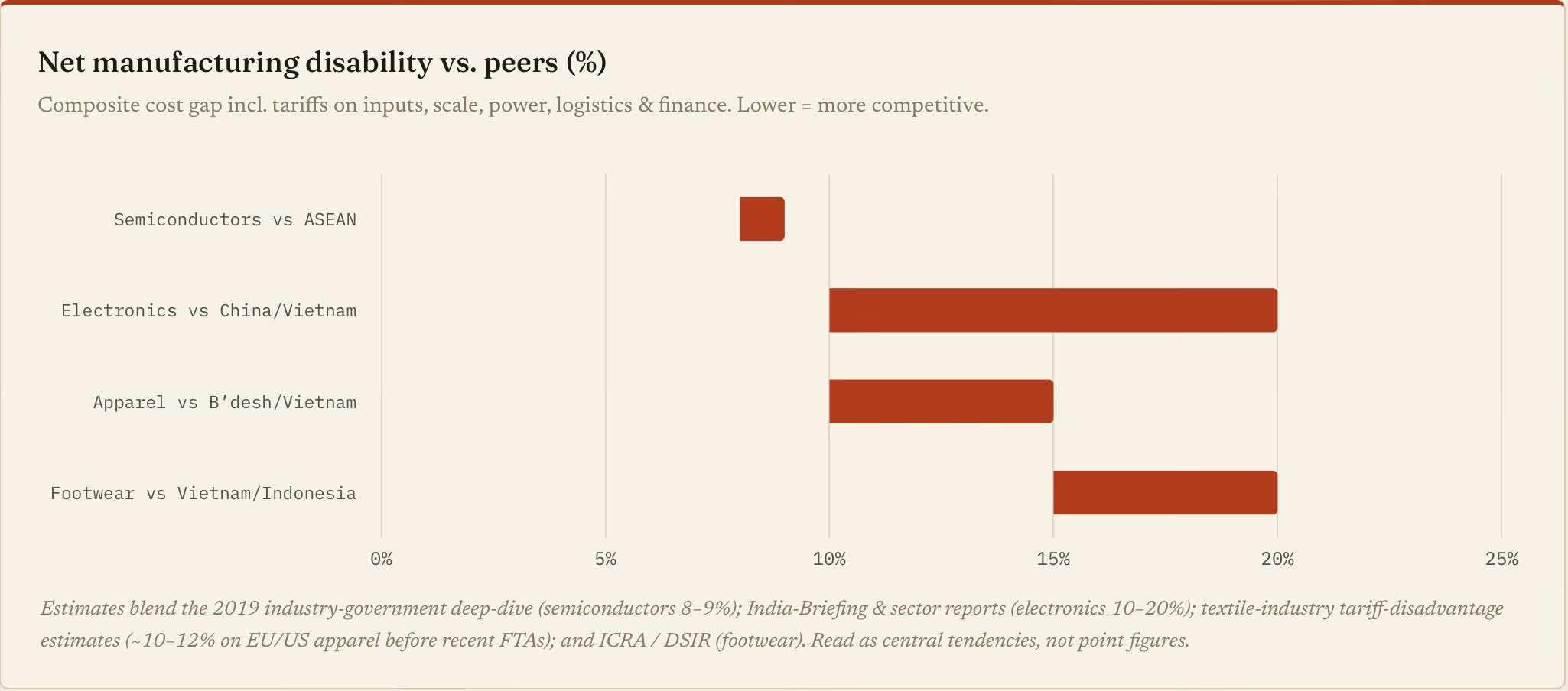
This cost structure reflects in the global competitiveness of the country’s manufacturers. India suffers from a persistent and high price disability compared to peers across manufacturing sectors. 
What are the contributors to this competitiveness wedge?

Indian factory wages (~$2.1/hour) are the lowest in Asia, about two-thirds of Vietnam's and a third of China's. Its effective corporate tax rate at 17.2% is among the lowest, its GST rates are comparable, and its logistics costs (while contested) are at least not much higher. 
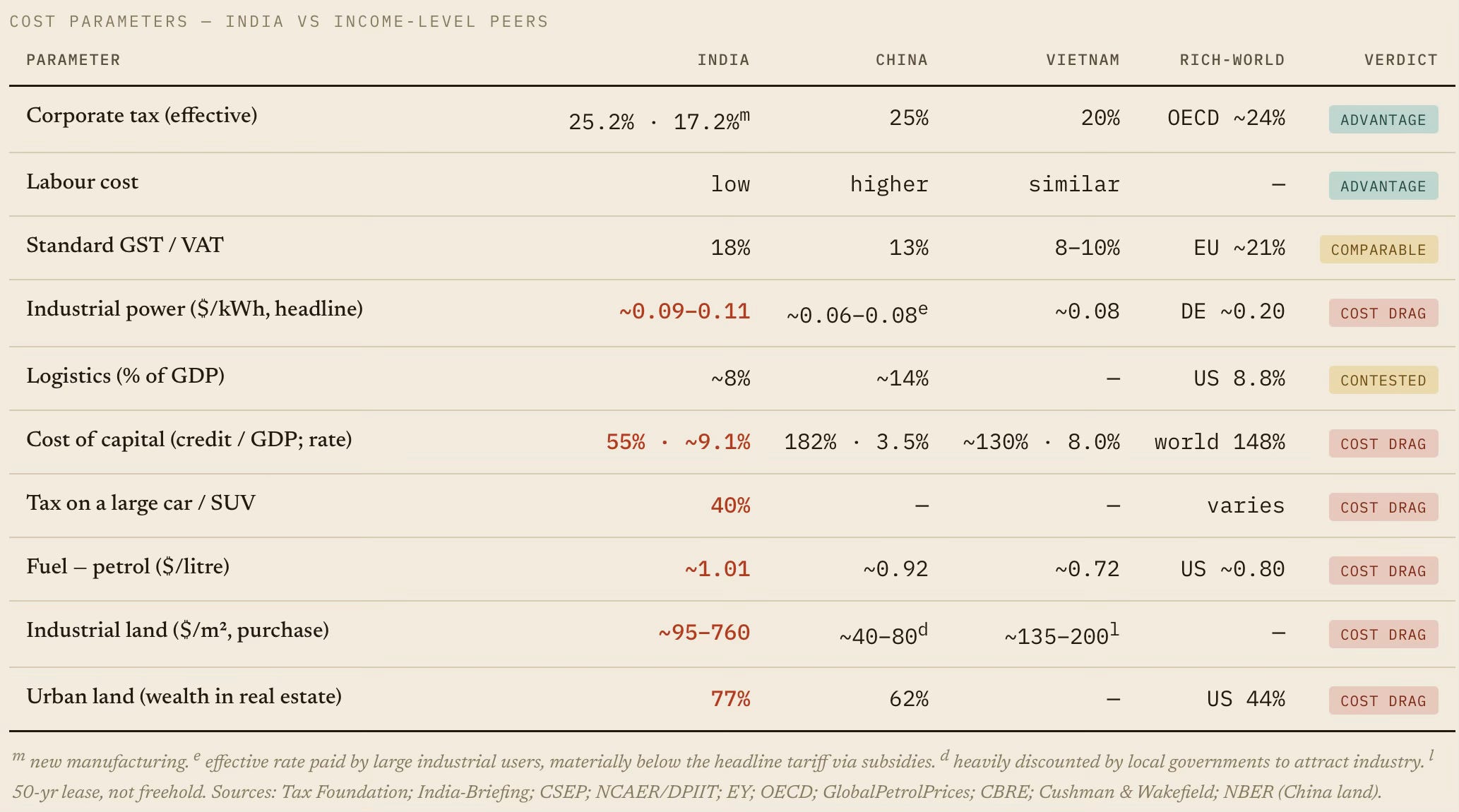
So if India loses on net cost, the disability is entirely in non-wage factors: land, capital, power, fuel, scale, tariffs on inputs, and labour productivity.
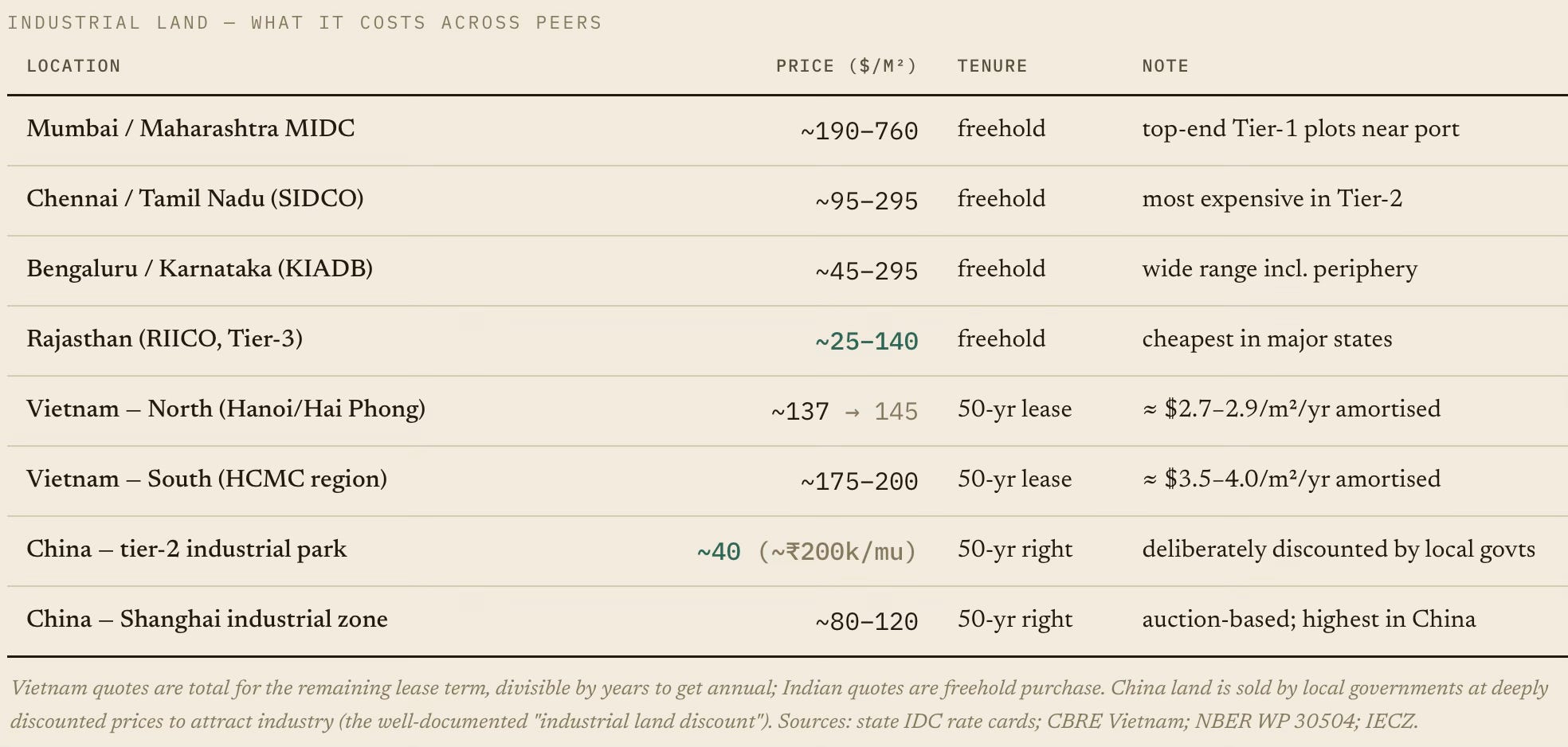
Start with land, the largest cost wedge. Urban land is priced like that of a rich country, and, most problematically, hoards the nation's savings. Mumbai ranks among the world's 20 most expensive prime markets, and Indians park ~77% of household wealth in real estate. The high land valuations result in capital misallocation and squeeze out the capital that would otherwise have resulted in investment. 
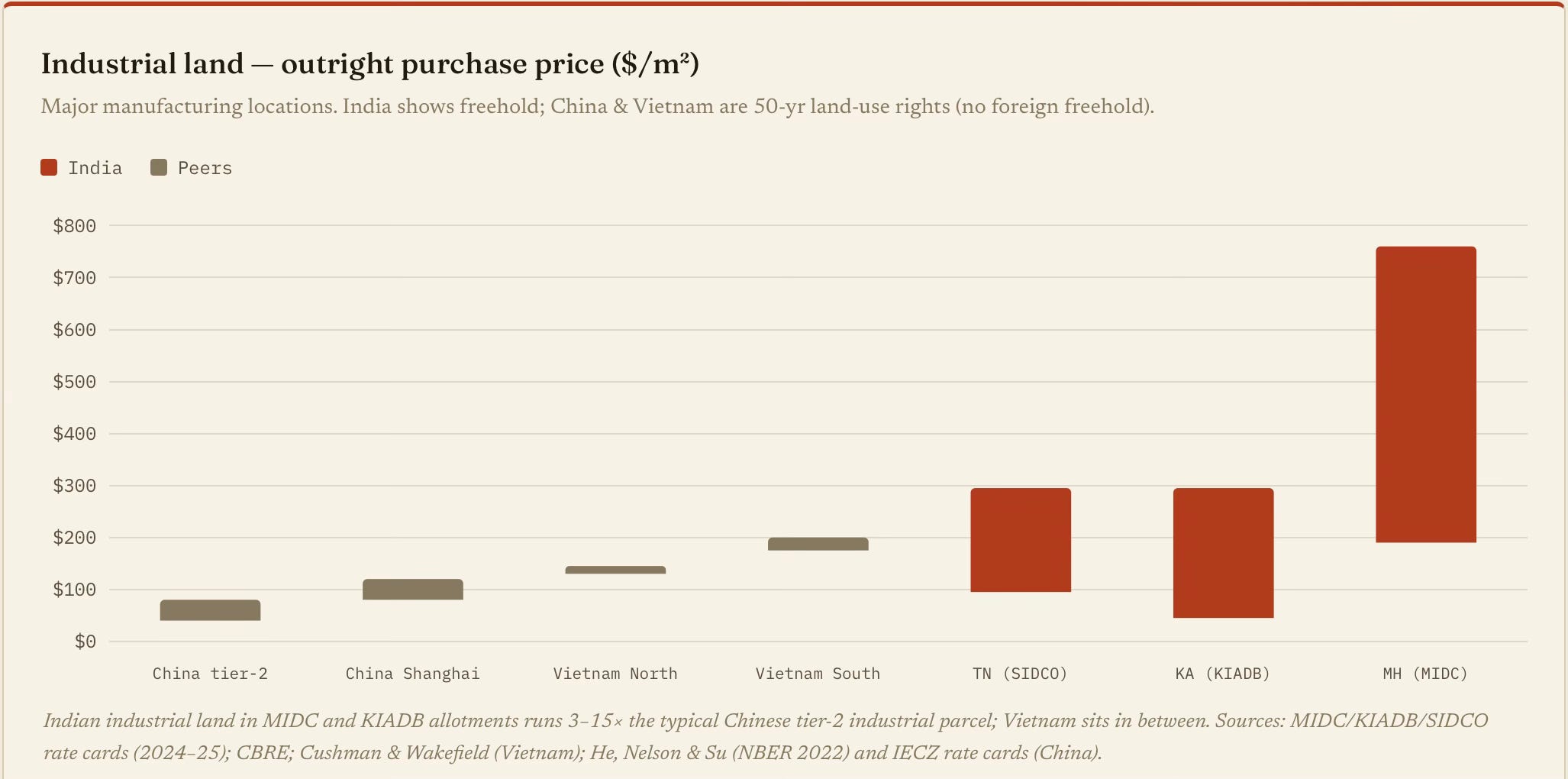
In fact, high land valuations, even in the smaller cities, appear to be a big entry barrier for businesses. An Indian manufacturer pays roughly 5–15 times more for industrial land than a Chinese counterpart in a comparable tier-2 city, and 1–4 times a Vietnamese peer. That gap is policy-made. China's local governments subsidise industrial land to attract production, whereas India's restrict supply (FSI, fragmented titles, slow acquisition) and treat land as a fiscal asset to maximise revenues.
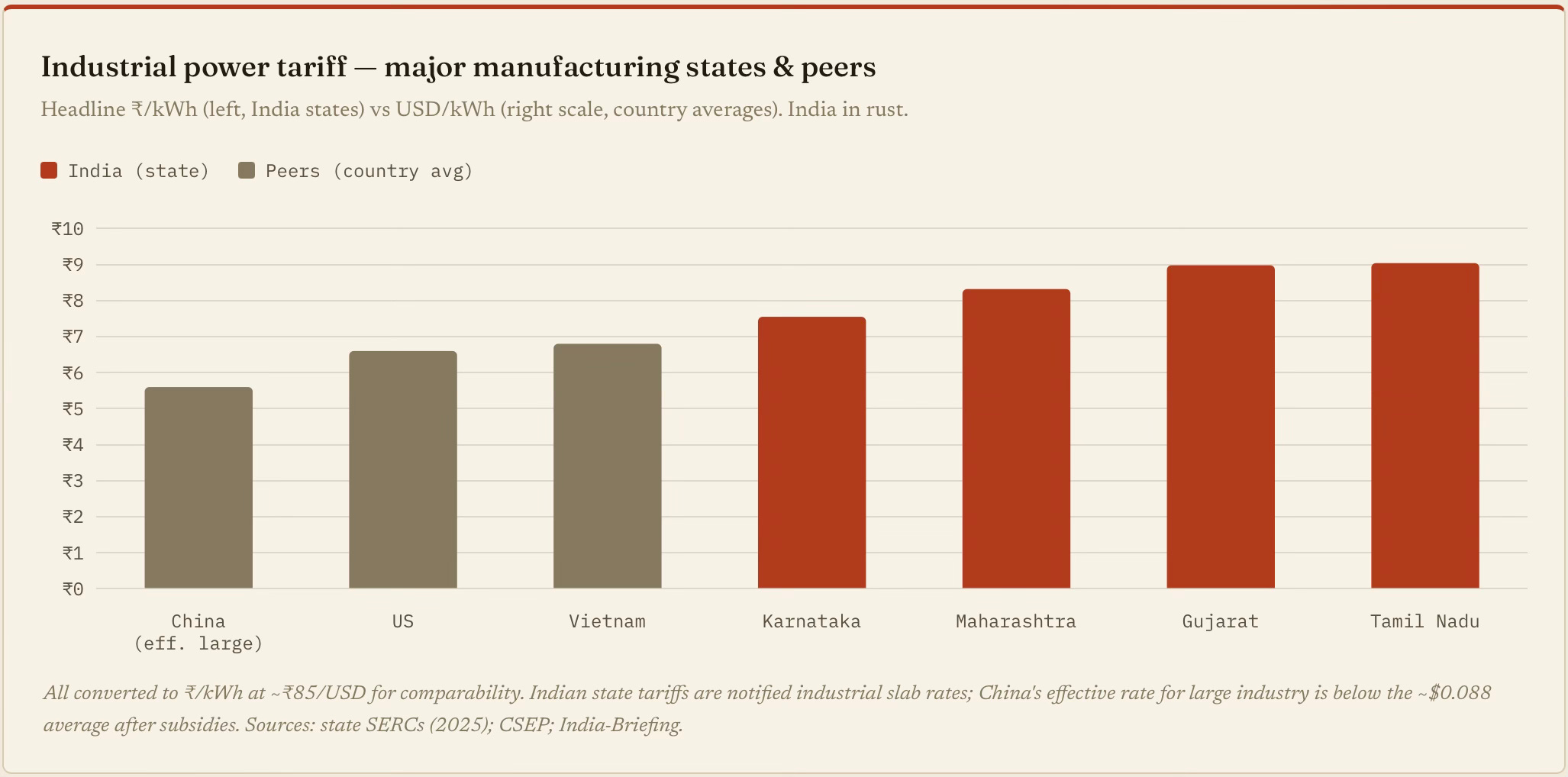
Now, come to power tariffs. Indian industrial users pay ~₹7.5–9/kWh ($0.09–0.11), materially above what comparable Asian peers' large industrial users effectively pay. Indian electricity is among the world's most expensive on a PPP basis, with one of the world's widest spreads across consumer types. 
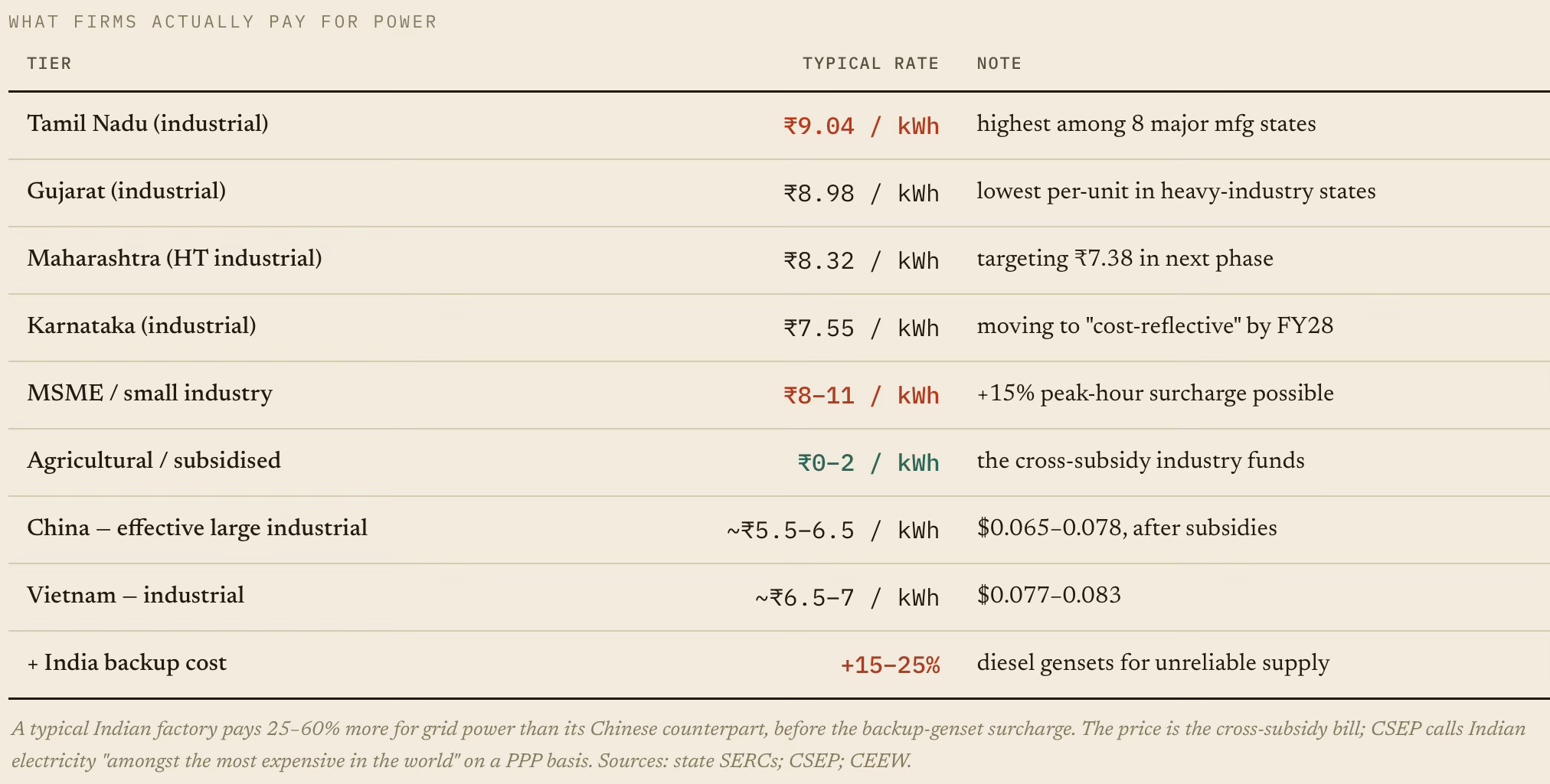
The comparisons of electricity prices based on averages are misleading. For example, India and China have similar average electricity tariffs at $0.08/kWh. It conceals that India has one of the world's widest cross-subsidy spreads (farms near zero, industry penalised). The rate that matters for competitiveness is the industrial slab, which is materially higher. Industry overpays to cross-subsidise farms and households, again, another policy choice. To this, we must add another 15–25% for diesel backup against unreliable supply.
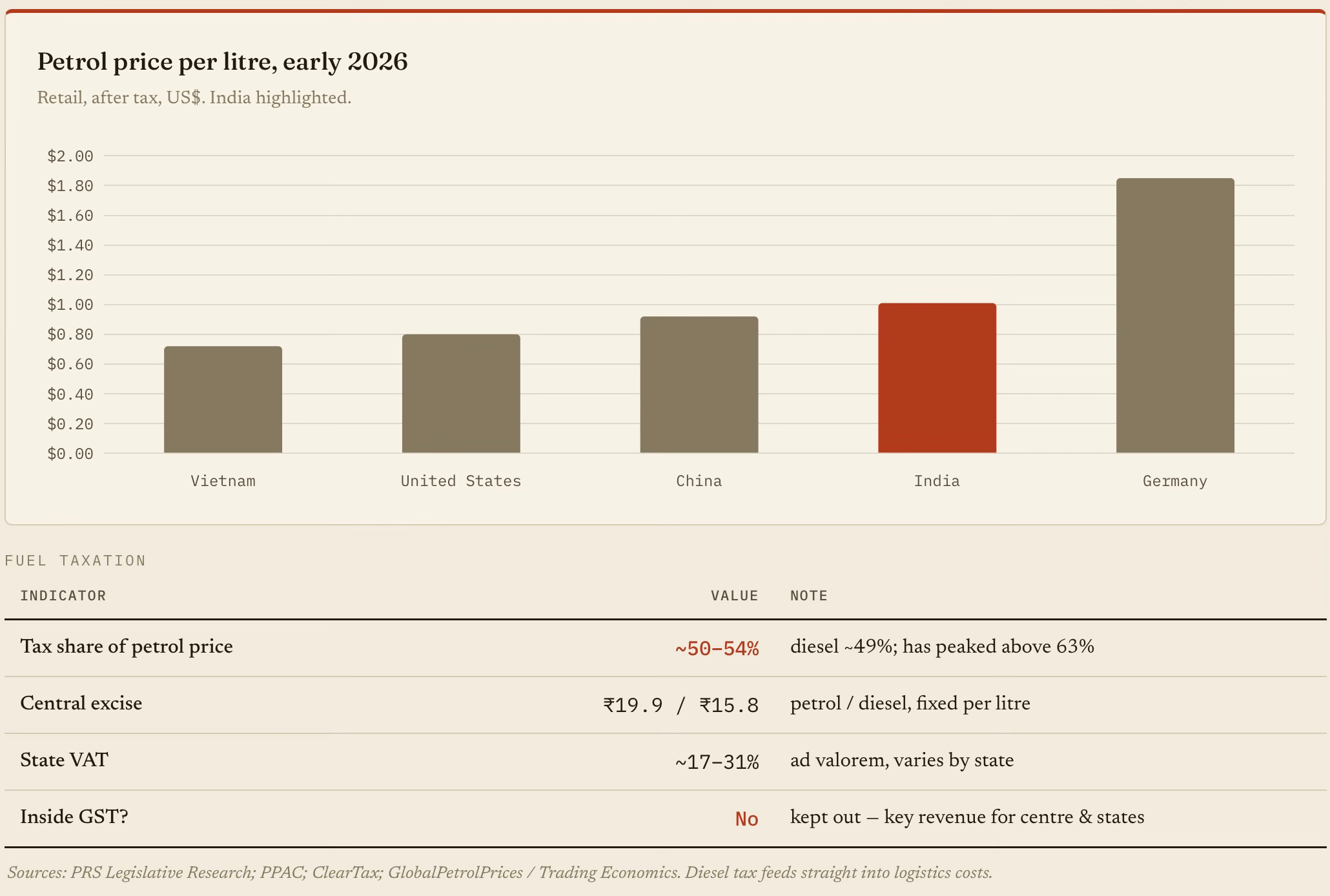
The same applies to gasoline prices. Kept outside GST as a revenue mainstay for state governments, petrol and diesel carry stacked central excise plus state VAT. Roughly half the pump price is tax. In raw dollars, India's fuel is dearer than China's, Vietnam's or America's, despite far lower incomes.
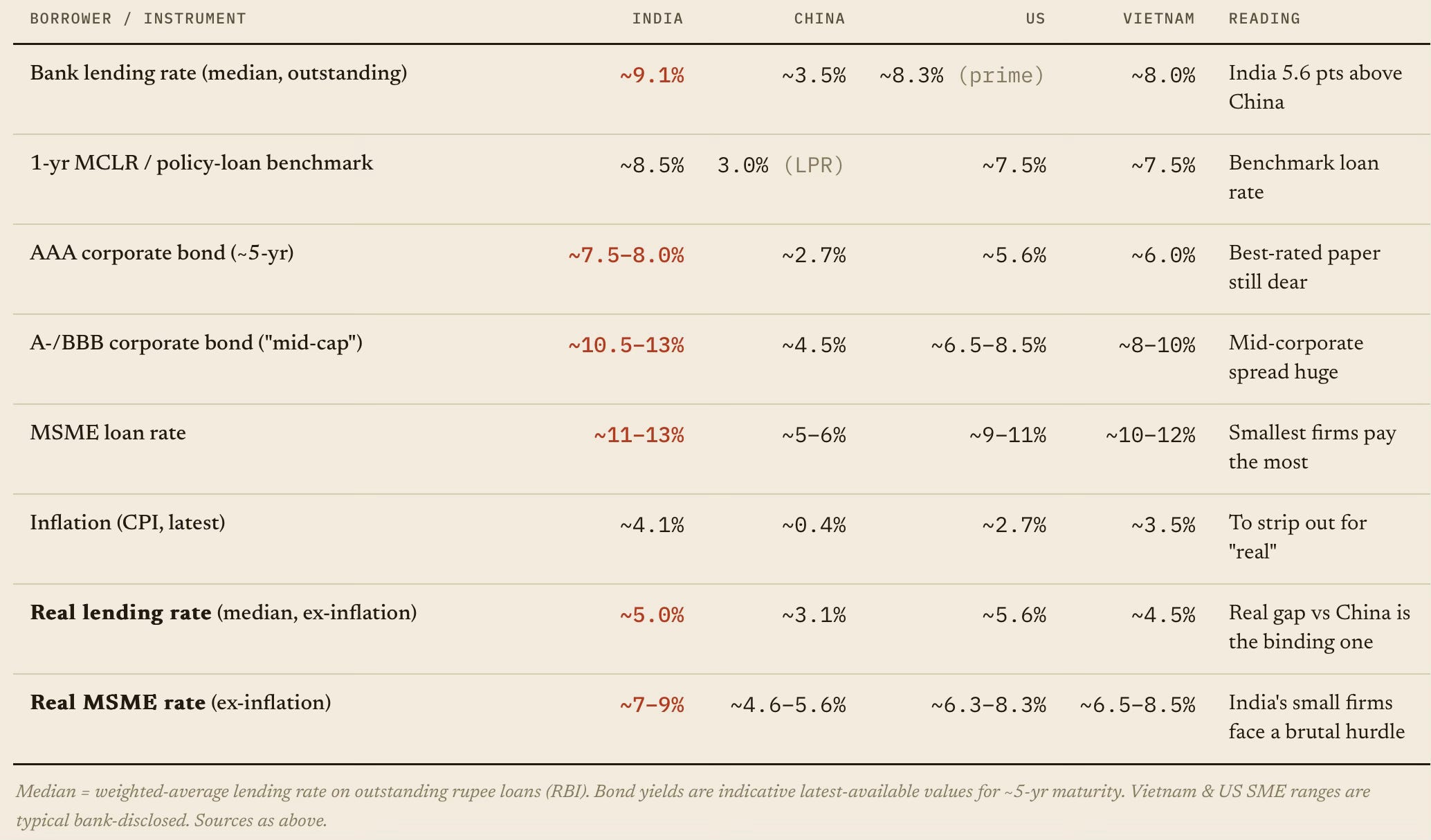
The cost of capital adds to the wedge. The credit-to-GDP ratio measures the availability of capital. The other half of the problem is the price. Indian firms pay materially more than peers - across banks, bonds and the SME segment. In fact, after stripping out inflation, the gap stays large, which is the more realistic measure of whether real investment can clear its hurdle rate.
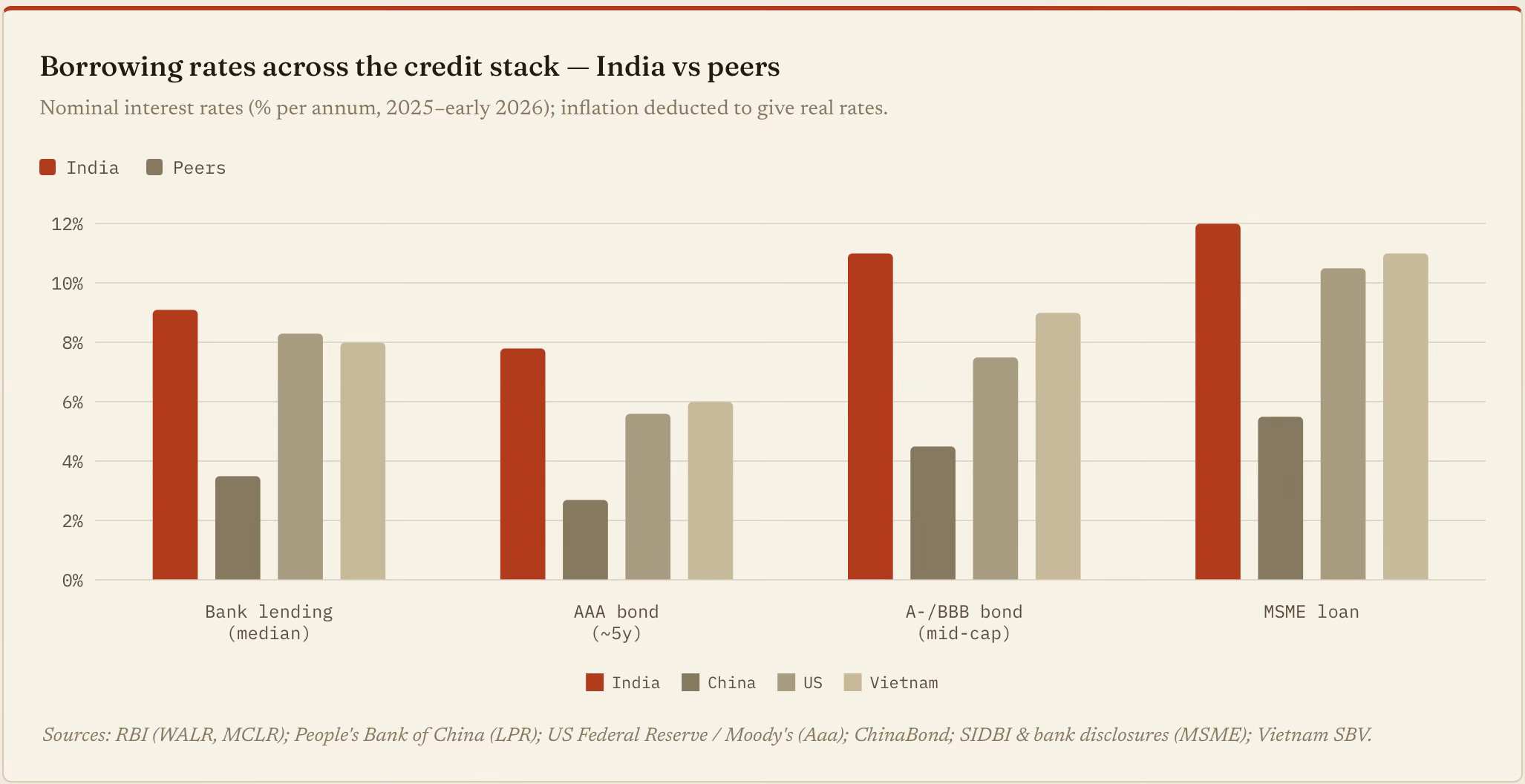
The capital markets are no different. An Indian mid-cap pays roughly 2–3 times the bond yield a Chinese mid-cap pays and ~50% more than a US one, in nominal terms. After inflation, the gap narrows but doesn't vanish. India's real lending rate (~5%) is ~2 percentage points above China's, and the real MSME rate is among the world's highest. Combined with credit availability stuck at 55% of GDP, this means Indian firms, and especially the missing middle, face the worst combination of dear and scarce capital among large economies.
Let’s dig a bit deeper into the capital cost wedge. 

Econ 101 informed that the high cost of capital is a reflection of the demand-supply mismatch. On the demand side, as we have seen, the high land valuations are encouraging resource misallocation. What about the supply side?

The country’s reasonable gross domestic savings rate (~30%) conceals a disproportionately high share of illiquid assets. When 77% of wealth sits in physical assets (land and gold), and only ₹40 for every ₹100 of household financial savings reaches the financial system, the banks have less to lend, the bond market stays thin, and the price of credit rises. 
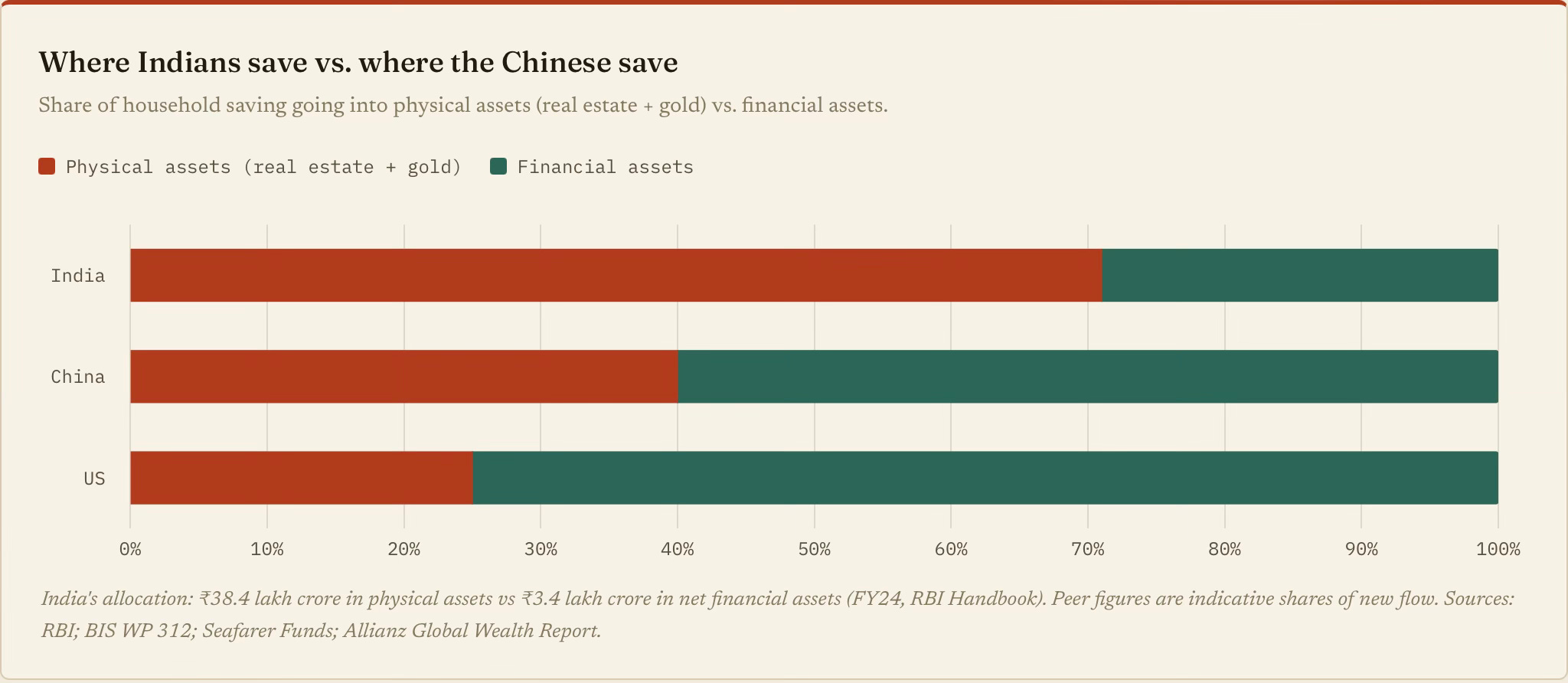
In other words, there’s a link between the land and capital problems facing the economy. The causal chain goes something like this - physical-asset preference (land + gold) → low household financial savings (5.3% of GDP) → shallow bank deposits & bond market → low credit-to-GDP (55%) → dear capital (~9% vs ~3.5% in China). The same wealth-allocation pattern that raises land prices also raises the cost of capital. It is one mechanism, not two.
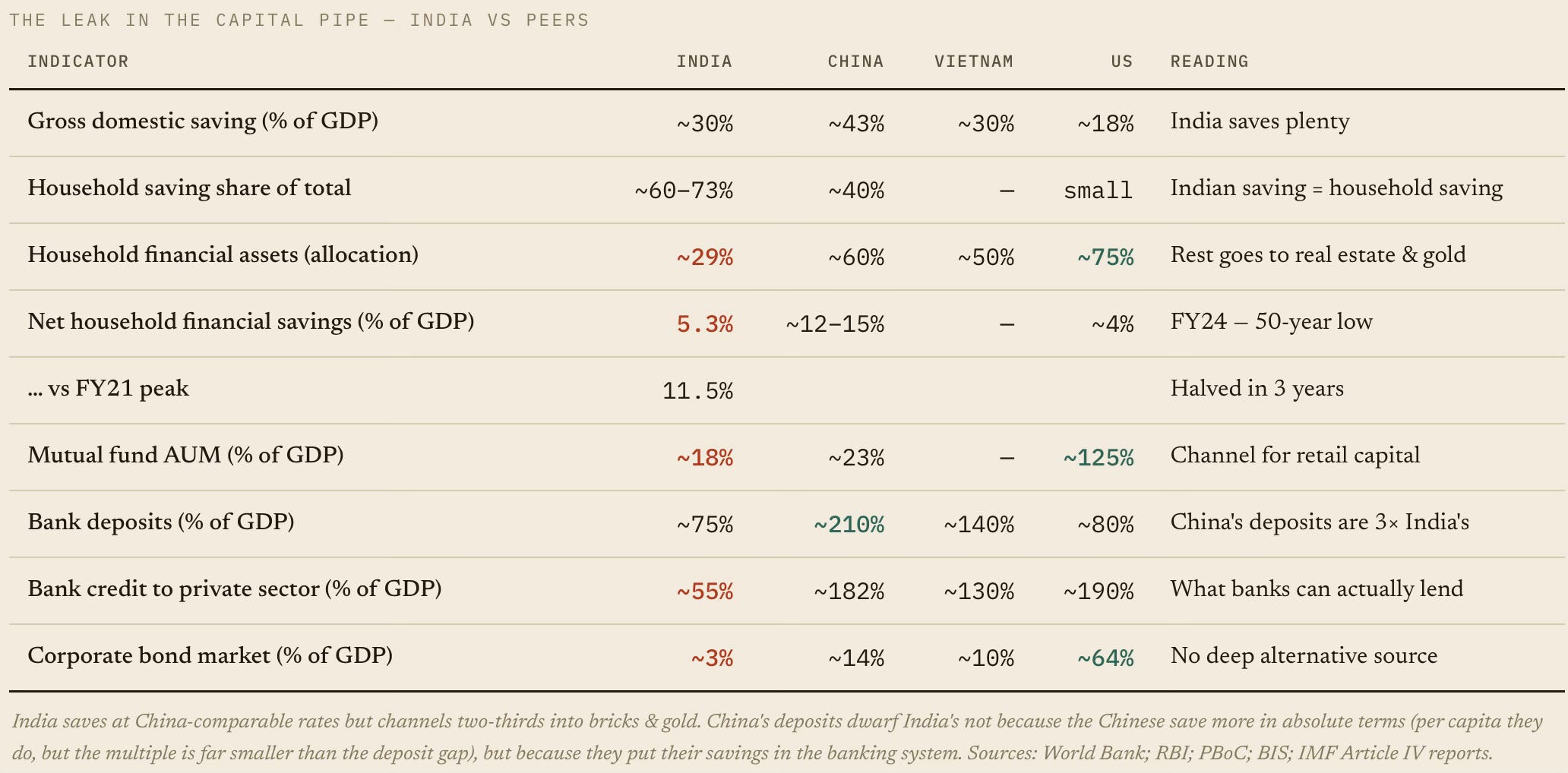
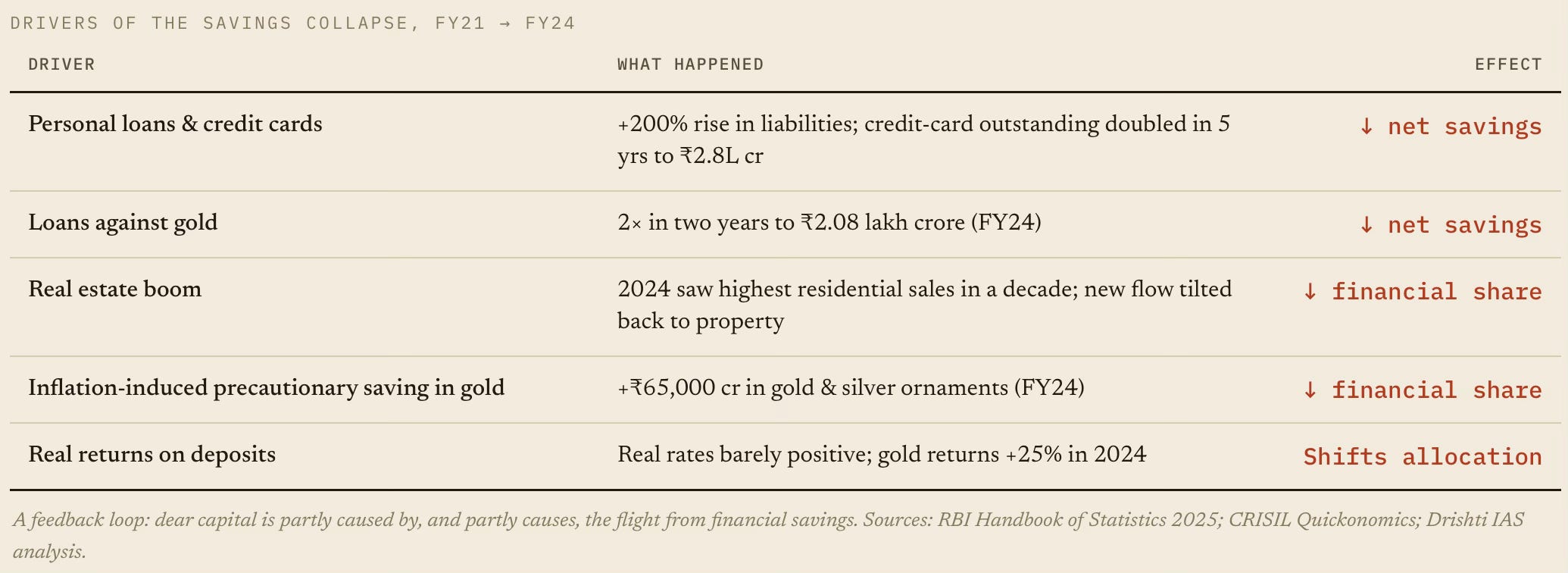
Worsening matters, the net household financial savings fell from ~11.5% of GDP in FY21 to 5.3% in FY24, a 50-year low. The table below breaks down how the cost wedge feeds itself. Households are borrowing more (against assets), and routing more new savings back into physical assets

The cost constraints impact the economy in two ways. One, it restrains private investment. Second, it weakens global competitiveness and hurts exports. 

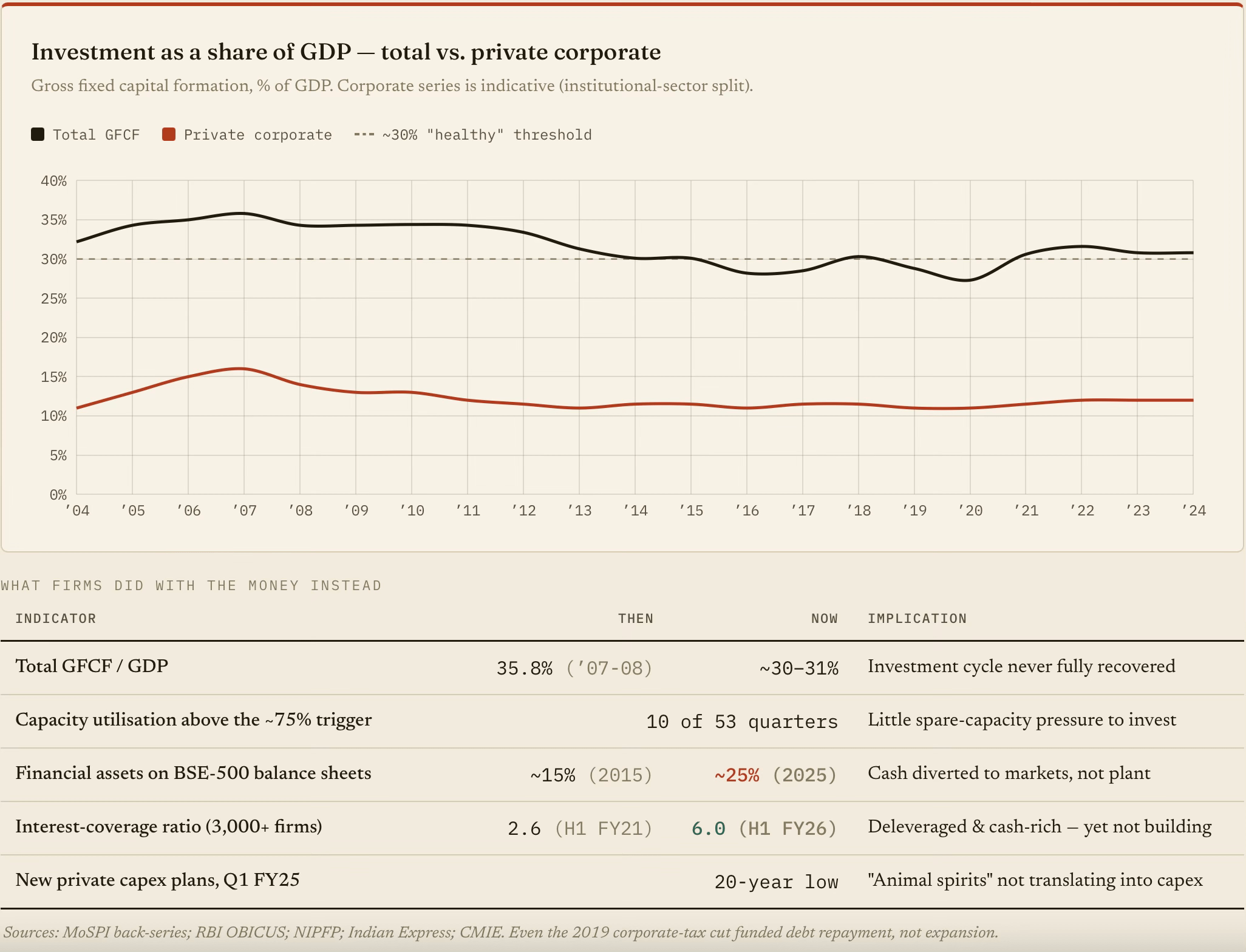
Take the first. Overall investment slid from a 35.8% peak in 2007-08. Public capex has since surged, but private corporate investment never recovered, flat near 11-12% of GDP. Flush with cash, firms deleveraged and bought financial assets instead of building capacity. I blogged here on this. 
The East Asian economies found exports to rich countries as the outlet to overcome thin domestic demand and drive economic growth. Unfortunately, in India’s case, this is exactly the outlet that the cost wedge closes: dear capital, costly logistics, unreliable power and the world's highest tariff walls all erode competitiveness. The result is that India is losing its share of labour-intensive exports to Vietnam and Bangladesh , even as its overall merchandise share stalls near 1.8%.
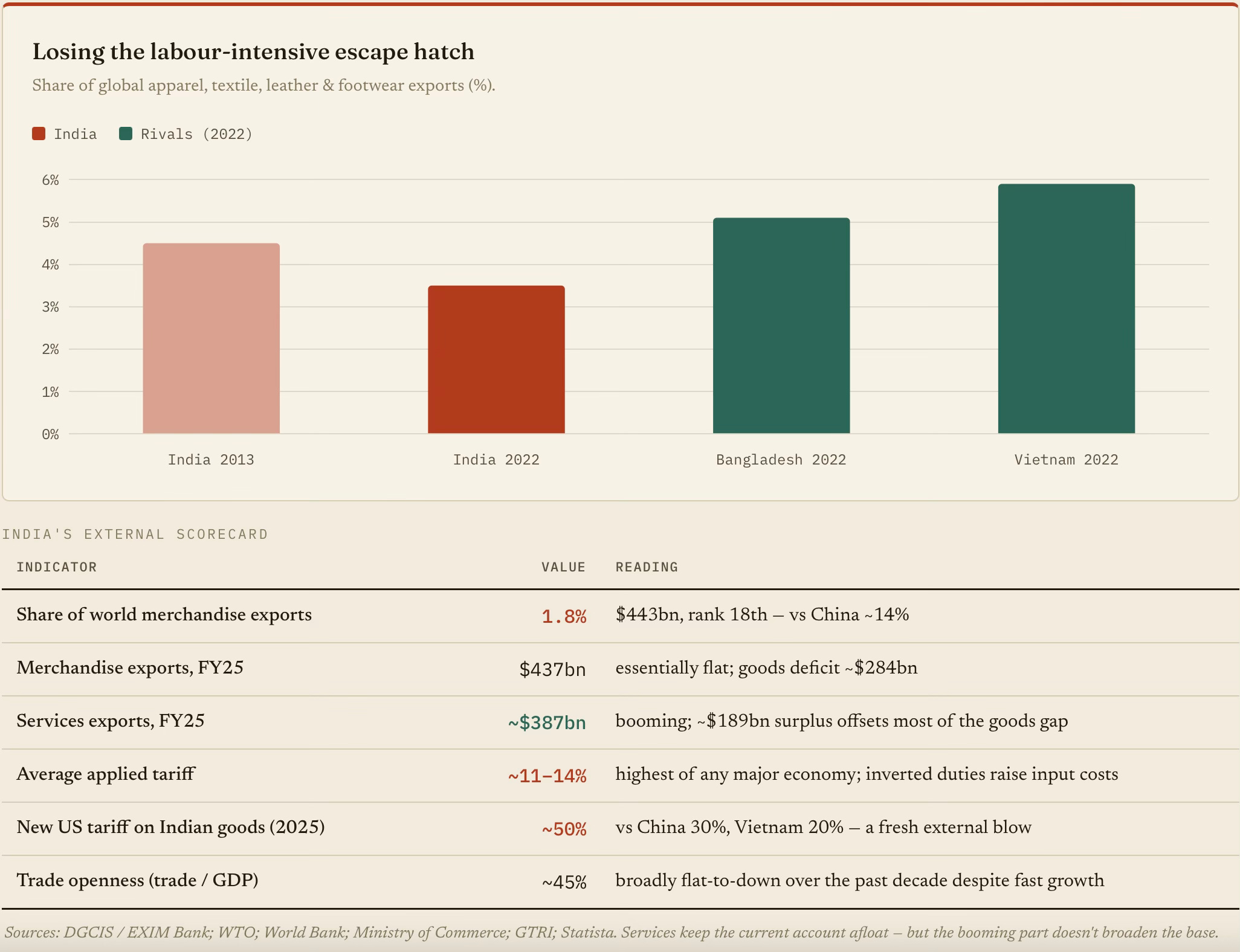
In fact, the Economic Survey 2016-17 chapter Clothes & Shoes: Can India Reclaim Low-Skill Manufacturing? warned that the space China vacated was being taken by Bangladesh and Vietnam in apparel, and Vietnam and Indonesia in leather and footwear. A decade later, the warning could not have been more prophetic. 
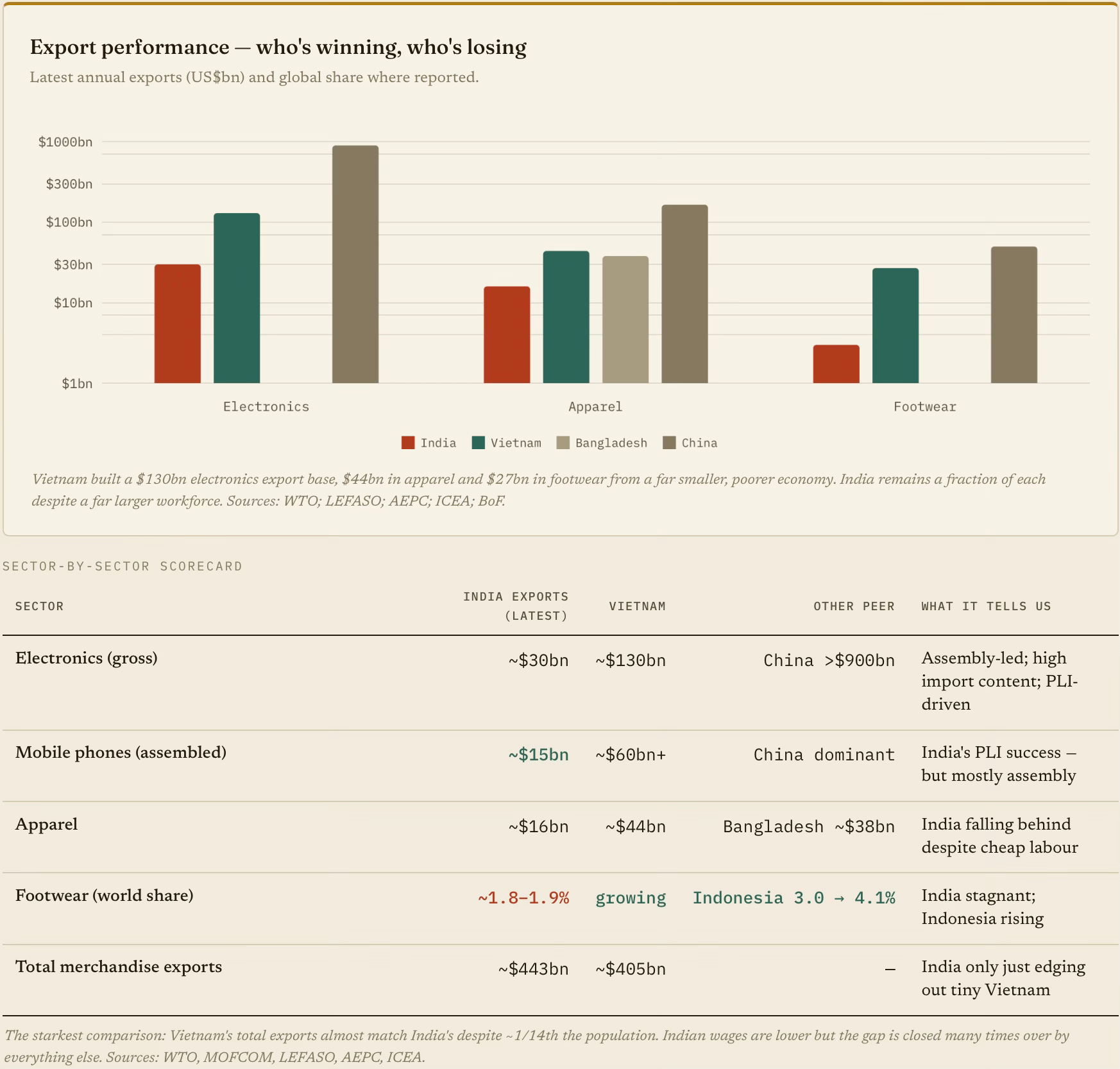
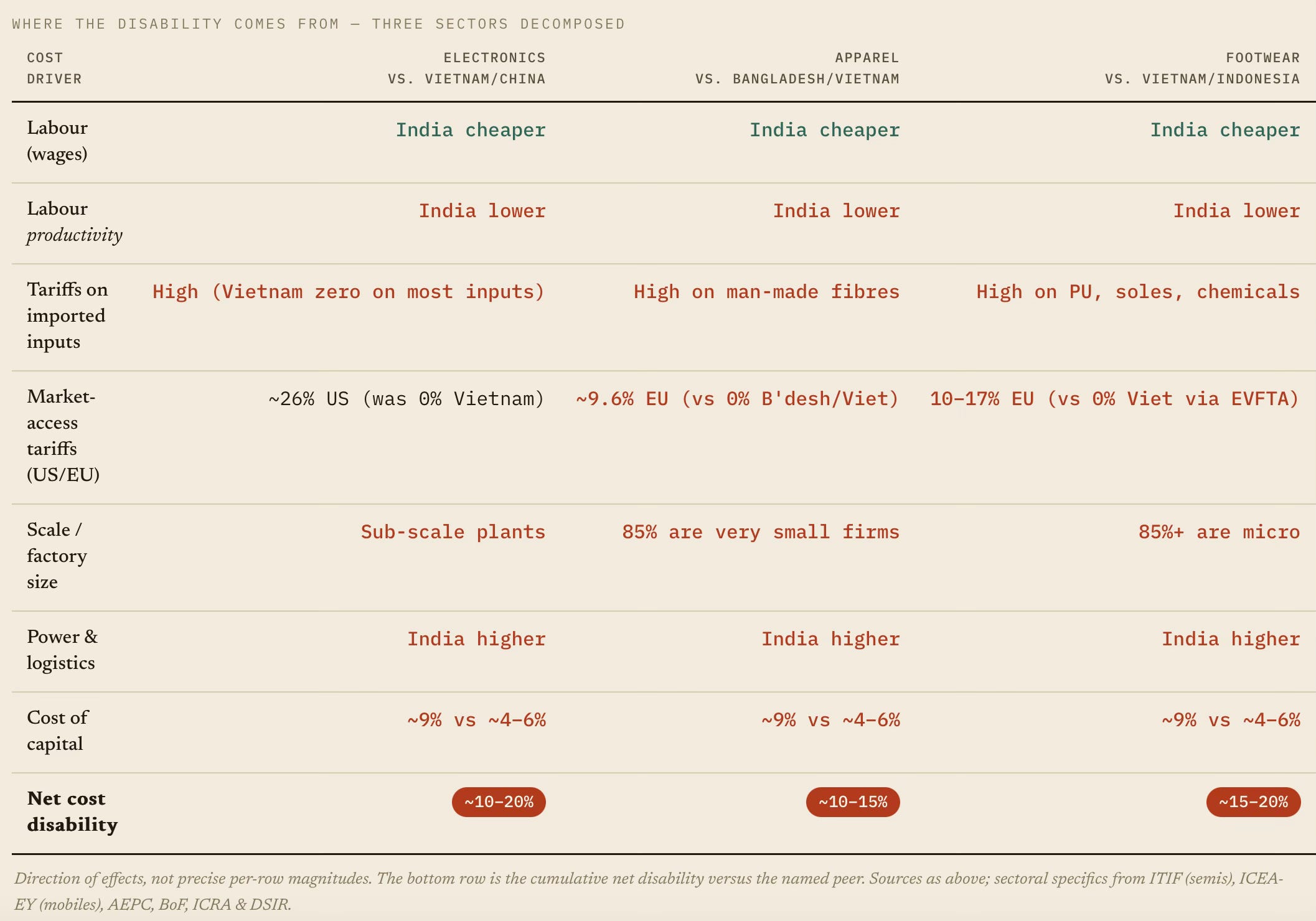
In the net, India wins on wages (~$2.1/hour) but loses on net cost. So the disability is entirely from non-wage factors: capital, power, logistics, scale, tariffs on inputs, and productivity. India has a cost structure that is comparable to that of a developed country. That's the central analytical point.
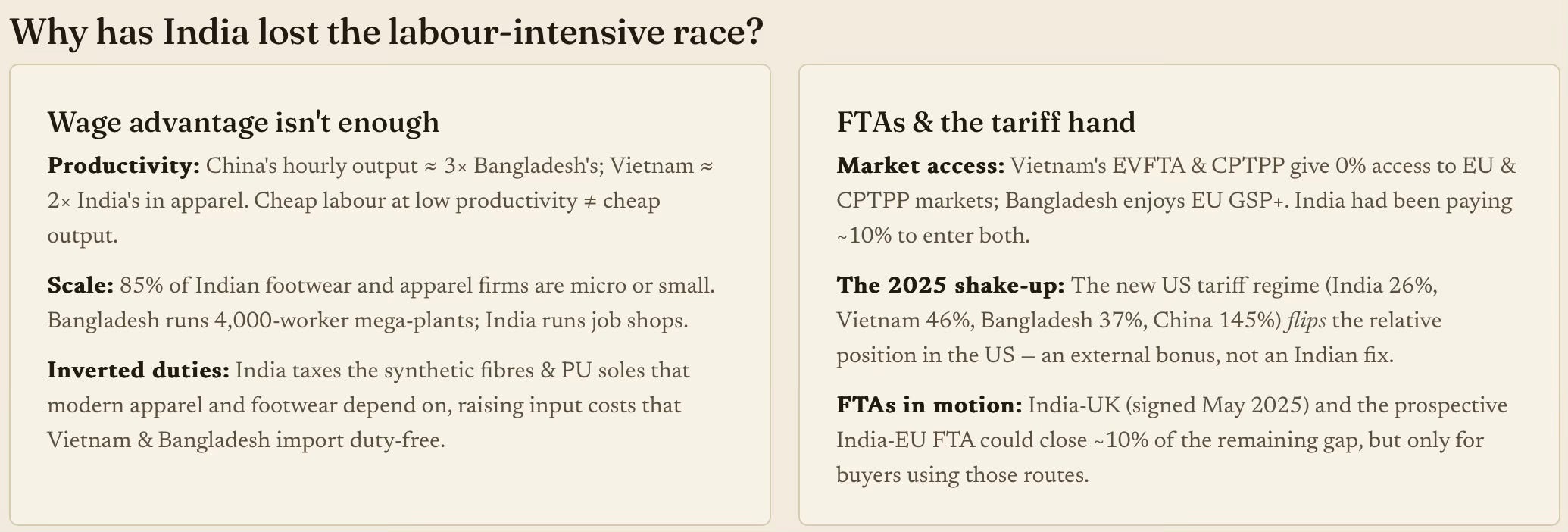
India enters every labour-intensive sector with the world's cheapest workers and exits with a 10–20% cost disability. This is proof that wages aren't the binding constraint. The wedge comes from the rest - scale, input tariffs, capital, power, logistics and productivity, in a market structure that punishes the firms that should be growing. This is why India hasn't replaced China, where Vietnam and Bangladesh have, despite the structural opportunity being identical for all three.

Indian businesses (and especially manufacturers) face a structural cost constraint. It does not have to do with taxation or wages, but with factors like land, power, fuel, cost of capital, input tariffs, labour productivity, and business size/scale. A disproportionate attention and effort go into taxation reforms instead of these more important structural limiting factors.  

Thursday, December 19, 2024

The forbidding trilemma of infrastructure finance

I have blogged extensively on the water privatisation in the UK. This is about the ongoing crisis at Thames Water, this and this are about the balance sheet of UK water privatisation, this is about regulatory failure/capture and returns maximisation incentives of investors, and this is about the UK’s infrastructure privatisation in general.

After teetering on the brink of default, Thames Water has managed to get a proposal from a bunch of creditors for a £3bn emergency loan, enough to cover operations till at least next October or even May 2026. The loan has received government approval. But the emergency loan comes with a headline interest rate of 9.75 per cent, and the company spent over £50mn on advisers in raising the debt. It’s also in the process of finding new equity investors, and restructuring its complex capital structure. 

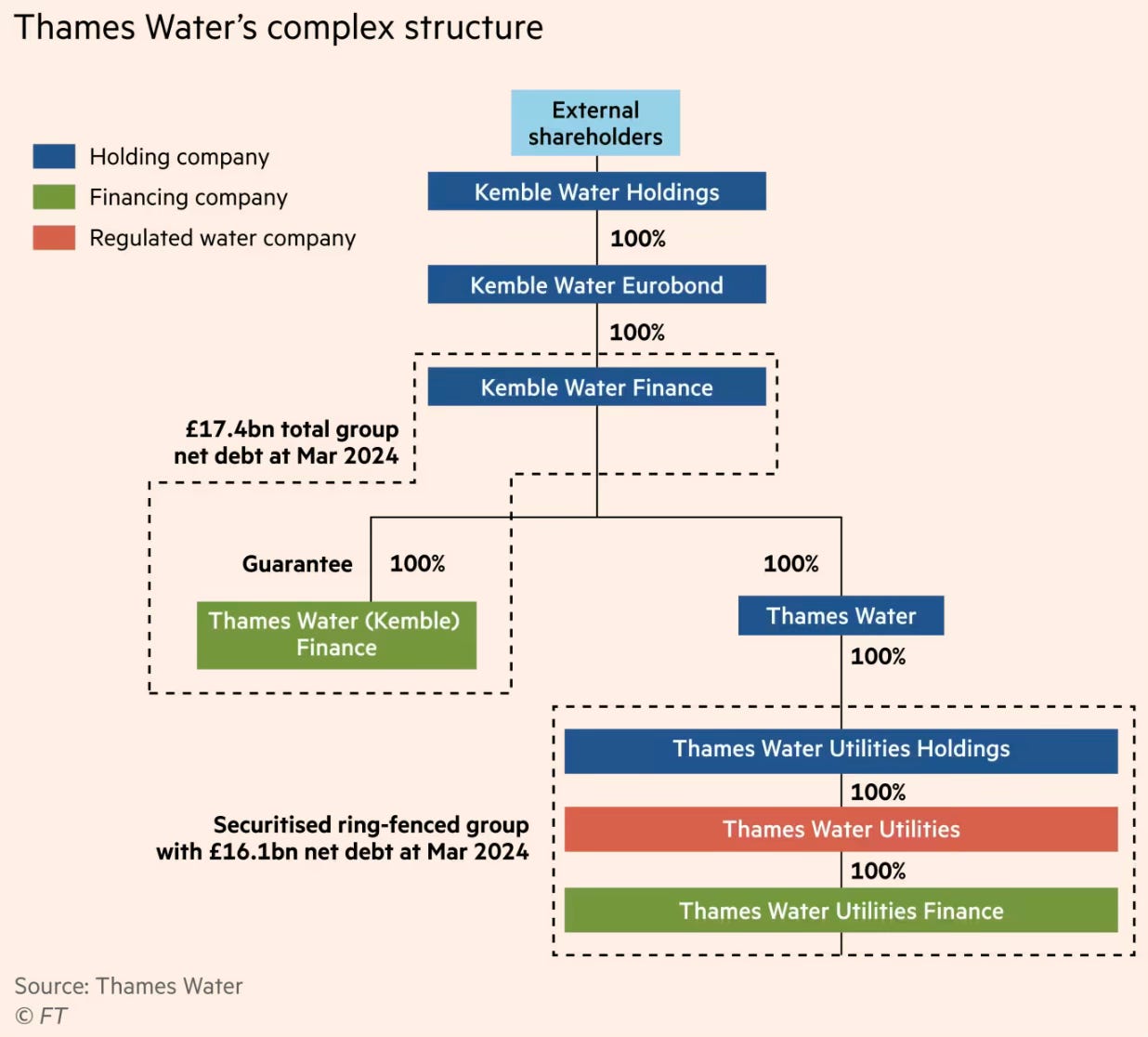
This is the latest update on the Kemble Water Holdings structure.

However, the government approval for the emergency loan proposal has been criticised by Sir Dieter Helm, who believes it’s a case of endless sticking of plasters. He has instead proposed that Thames Water be placed under a Special Administrator to allow a proper restructuring and enable the management to focus on operations instead of financing negotiations. 

In a paper explaining his views, Helm makes some very important points that are of relevance not only to the present case but to infrastructure and public-private partnerships in general. He has argued that the emergency loan is not only not going to fix Thames’s problems but also risks spreading the contagion across the rest of the water industry. He writes

Thames will probably get sold at a very steep discount in a process controlled by its A-class bondholders, and will probably get broken up. Yet even if this turns out to be a potentially very profitable opportunity to purchase the business for a deeply discounted value, it does not bode well for Thames’s future. The private interests of the sellers in the short term should not be confused with the public interest that a Special Administrator would pursue… it is important to understand why Thames is not a self-righting ship; why it is unlikely to emerge as an efficient water and sewerage company over the next decade; and why the sticky plasters may serve to gradually undermine it further.

He has blamed the crisis at the Thames on a combination of bad management, bad regulation, and the failings of successive governments. He points to fundamental incentive distortions and perversions that detracted the management from working to realise the objectives of privatisation. 

Like all the water companies, Thames was privatised with zero debt (indeed a small cash injection was provided upon privatisation). It (and the other water companies) were privatised in order to run their networks and infrastructures better (bringing private sector cost disciplines) and to raise finance to pay for capital investments on the basis of borrowing so that current customers (and current voters) would not have to pay. The Thames model, like that of the other companies, was pay-when-delivered, not pay-as-you-go.

This gave two tasks to the management of all the companies: run the business more efficiently; and raise finance for capital investment. Thames has turned out not to have done the former very well; and it has used the balance sheet to securitise the business, rather than for the objective at privatisation, which was to borrow solely to invest. In both, it has been at the outer edge of water company performance and gearing… it is worth examining what the incentives have been and why cost-cutting has had priority over capital maintenance. RPI-X as a regulatory rule had the advantage of simplicity at the outset. The regulator would set the (fixed) prices ex ante every five years (originally it was supposed to be every ten), and the companies would maximise profits by minimising costs.

As was witnessed across the privatised utilities, this deceptively simple rule required regulators to be very clear about the outputs that had to be delivered as part of the fixed-price contract, and to make sure that they were actually delivered. In practice, this meant approving the business plan for the period, and having clear, measurable and enforceable environmental and social outcomes. Thames (and others) ran rings around the regulators, and provoked a process of regulatory creep with ever-more complex and detailed interventions by the regulators, which even ended up regulating Thames’s dividends. As a rough rule of thumb, regulators added at least two new mechanisms at each periodic review. The added complexity did not result in greater performance improvements…

The governments, OFWAT, the NRA/EA and the companies all implicitly worked on the basis of an approach that started with what they thought customers could afford and then agreed what could be done for these amounts, rather than starting with the environmental and other outcomes required, and then setting charges at whatever it costs to achieve them efficiently. This is the origin of a context in which a blind eye was turned to environmental failures, and the fines were so low as to be part of the cost of doing business. This affordability criterion has undoubtedly curtailed environmental improvements. All this went under the guise of the quadripartite process in the early periodic reviews… As ever, there is a mismatch between, on the one hand, the demands for higher river and water quality, and, on the other hand, the opposition to bills being raised to pay for these. The belated and relatively sudden imposition of large fines reflects this change of tone. Thames and others could have reasonably assumed that the “implicit deal” around affordability would let them off the hook. What their successive boards failed to realise is that the licence gave them the obligations, and relying on politicians and regulators being objective, rather than following public opinion and media coverage, was always a dangerous strategy to pursue.

He also writes about the egregious operational failings of Thames Water, resulting in the normalisation of untreated sewerage spillages into rivers, asset mapping of its networks, and lagging behind in the adoption of digital technologies to improve maintenance. The biggest failing was its financial engineering and asset stripping, second only to the regulatory failure to spot and prevent it.

What makes Thames more of a basket case than the others is that, in addition to failing on the capital maintenance, it was profit-maximising by gearing up its balance sheet at the outer limits of what was sustainable. This turned out to be the most profitable activity of the company. Whereas the balance sheet had been set up at privatisation to move from pay-as-you-go to pay-when-delivered, Thames (and others) used the balance sheet to mortgage the assets and pay out the proceeds in special dividends and other benefits to the shareholders. All the companies were doing this, but Thames pushed it further (though not as far as, for example, Heathrow Airport, at 95% gearing). 

The reason that this model was so profitable was the combination of very poor regulation and extremely low interest rates. OFWAT is the stand-out case of the failure to protect the balance sheets for the purposes they were intended (although OFGEM has neglected balance sheets too). Indeed, OFWAT stressed the importance of leaving matters pertaining to the capital structure and the balance sheets to the companies. OFWAT sets the cost of capital using the CAPM (capital asset pricing model) and then applies a WACC (weighted average cost of capital) to set the allowed returns. The WACC is an average of the costs of debt and the costs of equity. By definition, it will over-reward debt and under-reward equity – before any other consideration is applied to the tax and other impacts. Hence the simple opportunity: replace equity with debt by mortgaging the assets.

Thames took this to a whole new scale, engaging in whole-company securitisation and creating an offshore set of companies to facilitate this, going under the label of various Kemble entities. It was brilliantly executed, building on a strategy that had its origins back in the mid-1990s when OFWAT (and OFGEM’s predecessors: OFFER and OFGAS) decided not to act to protect the balance sheets… the owners… were simply exploiting the opportunities placed in front of them. OFWAT belatedly recognised the mistake of ignoring gearing and balance sheets, and went so far as to give indications about the sorts of gearing it might like, yet at no point did it run proper pro-forma balance sheets from privatisation setting the gearing against investments not paid for by current customers.

The upshot of this combination of failures – failure by Thames to run itself efficiently; failure by Thames to do the necessary capital maintenance; failure by Thames to understand its assets; failure by OFWAT to get a grip on the balance sheets and prevent the huge scale of financial engineering; failure by the NRA and then the EA to properly enforce environmental standards and performance; failure by governments, OFWAT and Thames to ensure that the periodic reviews provided sufficient revenues through customers’ bills; and failure by Thames to appeal against the OFWAT periodic review determinations – is the sorry mess that Thames now finds itself in.

Further, an investigation by the Office for Environmental Protection has revealed regulatory failure and excessive leniency on sewage spillage by the water companies during normal times by three authorities in the UK - the Department for Environment, Food and Rural Affairs; the Environment Agency; and the Water Services Regulation Authority, which is known as Ofwat.

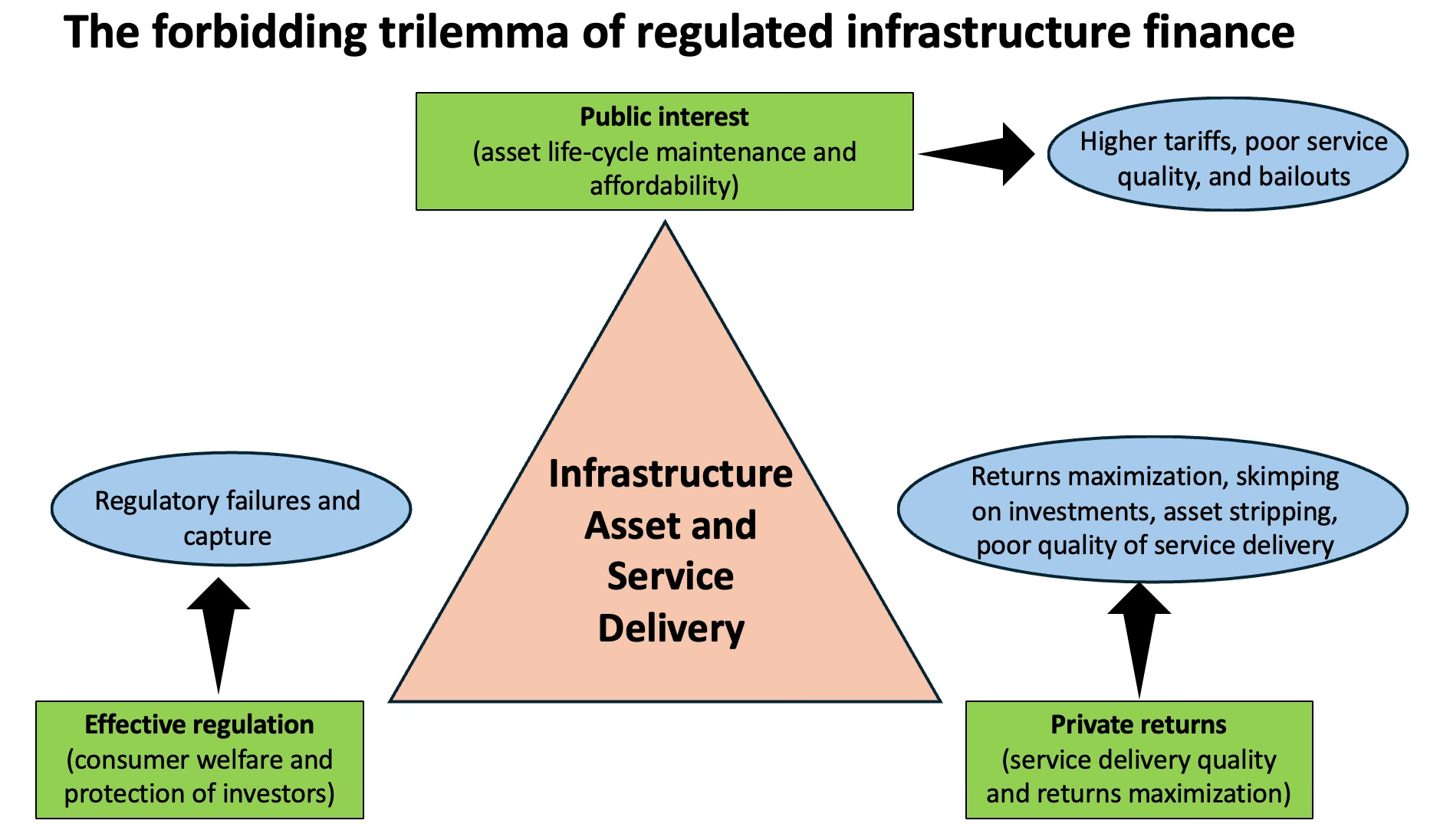
The Thames Water example is an illustration of three forbidding challenges with private investments in infrastructure - the political economy of ensuring the affordability of service delivery; the incentive compatibility of investors in balancing life-cycle asset management and quality of service delivery (public interest) with maximising their financial returns (private interest); and the capability of regulators in reconciling the interests of consumers and investors. 

In the real world, politicians always face the pressure of keeping a lid on prices/tariffs and generally succumb to it; investors cannot but not subordinate all else to returns maximisation; and regulators fail to keep their eye on their primary objectives, struggle to keep up with the changing practices/trends of the industry, and end up being captured by the regulated. 

Taken together, there’s a forbidding trilemma in infrastructure privatisation and PPPs. Private investments in infrastructure struggle when faced with managing public interest, private returns, and effective regulation! It’s very hard to meet all three challenges simultaneously. 

In fact, it boils down to the fundamental and unbridgeable tension between affordability of service delivery and returns maximisation. This challenge becomes daunting with investors like private equity whose returns maximisation objectives fundamentally conflict with infrastructure assets' risk and returns profile. 

None of this should be taken to mean that we should avoid private investments in infrastructure. Instead, it’s a note of caution on the daunting challenges of making private investments work in real-world contexts. 

Given the political economy, private incentives, and weak and/or vulnerable regulatory capabilities, private investments in infrastructure must be intermediated by simple financing structures, contracts with simple and easily observed outcomes, and an acknowledgement of the real costs of capital maintenance and service delivery. Among investors, it must also be incentivised by lower return expectations (or stability and portfolio diversification objectives). 

Thursday, October 24, 2024

Water privatisation in UK and the roles of Ofwat and investors

The UK water utilities are a great case study on the problems of privatising public facilities. I have blogged on multiple occasions (hereherehere, and here), and this post updates the numbers based on a recent NYT article

It has the latest balance sheet of water utilities privatisation in the UK 

When the British government, under Margaret Thatcher, privatized water utilities, it went further than many other countries had. The water and sewage assets were transferred to companies with limited liability and cleared of debt. Shares were floated on the stock exchange, but most of the companies are now privately held, a relatively rare ownership model, though some countries or cities have contracts with private companies for the management of the water systems…

Across England and Wales, insufficient investment in the sewage infrastructure and the water supply has led to a crisis that has been brewing for years. Now, more people are putting the blame on the ownership of the water utilities, which are regional monopolies, predominantly owned by multinational conglomerates and asset managers, including sovereign wealth funds and pension funds. Critics argue that shareholders in the water companies have received billions of pounds in dividends since privatization but failed to put enough money back into the water system while piling up debt…

Thames Water, which has debt of about £15 billion, or $20 billion, said it would run out of cash by May if it was unable to raise more equity. Its shareholders, who own the company through Kemble Water Holdings, include a Canadian pension fund, Abu Dhabi’s sovereign wealth fund and a British pension plan for university staff, and they have been reluctant to inject fresh cash amid clashes with regulators over how much to raise customers’ bills... The average utility bill in England and Wales is £441 a year, higher than some of their European neighbors, like France, but lower than others, such as Norway. Ofwat has proposed increasing consumers’ bills by more than a fifth on average over the next five years.

And the public reaction to this state of affairs has swung towards nationalisation.

The 10 water utilities in England and Wales, which were privatized in 1989 during a wave of deregulation and free-market liberalization, have become a target of public ire over polluted waterways and rising household bills. The number of people getting sick from the water is growing… In June, the Henley Town Council called for the nationalization of Thames Water, which serves about 16 million people, saying the company’s track record has been “beyond concerning.”.. More than 80 percent of Britons said water companies should be run in the public sector, according to a poll in July. In Scotland and Northern Ireland, the water companies are owned by their governments. In 2001, one of Wales’s water companies became a nonprofit organization.

The market is a good mechanism for efficiently allocating general goods and services. But when the goods and services are essentials for human survival and especially when monopolists provide them, the market has been consistently found to fail the allocation test. This is why utilities are tightly regulated and outright privatisation is rare in sectors like water, sewerage, mass transit, and electricity distribution. In fact, the water and sewerage sector is publicly owned in most of the world. There’s a comparator in the UK itself

The Scottish system has remained under public ownership and Scottish Water has invested nearly 35% more per household in the system since 2002 than counterparts south of the border, while it charges 14% less for water. It is reported that the highest paid director of Scottish Water took home less than £400 000 in pay and benefits in 2021—a fraction of what his English counterparts receive.

The UK water utilities are also a good case study on foreign investments in infrastructure sectors like water

Famous investors in Thames Water included Australian Macquarie Capital Funds, until 2017 when they sold their share. Estimates at the time said the fund made between 15.5-19% in annual rate of returns, however, it also faced criminal fines of up to £20m in 2017 for leakages affecting the Thames. In September 2021 Macquarie re-entered the UK private water infrastructure market by investing £1.1bn in equity into Southwestern Water group committing to delivering reliable services and protecting and improving health of rivers and sea… Other well-known financial service companies include Blackrock, Lazard and Vanguard (Severn Trent, United Utilities and South West Water), Germany’s Deutsche Asset Management an US based Corsair Capital (Yorkshire Water). JP Morgan Asset Management owns 40% in Southern Water, and Australian Colonial First State Global Asset Management owns stakes in Anglian Water, Severn Trent, United Utilities and South West Water. Apart from these companies there are numerous other foreign investors from the Arab Emirates, Kuwait, China and Australia (Thames Water), a Malaysian company (Wessex Water), and Cheung Kong Group (Northumbrian Water), an in the Cayman Islands registered fund associated with Hong Kong’s richest person, involved.

The role and influence of foreign investors can be understood best when looking at the Thames Water external shareholders. Canada’s largest shareholder pension fund, Ontario Municipal Employees Retirement System (OMERS), holds over 30% in the water and sewage systems company. The fund had net assets of $129bn at the end of 2023 and invested in Thames Water in 2017. The investment was made using several investment vehicles based in different locations, such as among others Singapore. Close to 10% in the company is held by Infinity Investments SA, a subsidiary of the Abu Dhabi Investment Authority who invested in 2011. The fund also has done an $800m investment into Statoil, a Norwegian natural gas transport company. In 2012, China Investment Corporation, one of the biggest sovereign wealth funds in the world has acquired a 9% share in Thames Water. Further foreign institutional investments include Queensland Investment Corporation, a government owned Australian investment firm (5.3%), and Stichting Pensioenfonds Zorg en Welzijn, the second largest pension fund in the Netherlands… more than 70% of the privatised water industry in the UK is owned by foreign investment firms, private equity, pension funds and, in some cases, businesses based in tax havens, which raises concerns about the public utilities companies acting in the interest of shareholders rather than general population.

While foreign investments, in general, are not bad, as I shall discuss later, the nature of those investors might be a problem in essential public utilities. This is especially since their interests are unlikely to be aligned with the sustainability of the business and would be seeking to maximise their returns. 

Apart from the general consumer welfare decreasing dynamics of monopoly markets, some important reasons for the market failure are the propensity of utility operators to skimp on investments and maximise returns. All these get amplified with private equity ownership, besides engendering other perverse trends like asset stripping by using leverage to pay dividends. Further, their relatively short investment horizons mean that their primary objective as owners is not to build enduring companies but to maximise the returns during their investment tenures and then pass the parcel to the next investors.

Consider the accounts of the water utilities. When the 16 water companies were privatised, the government wrote off all their debts of £4.9 bn and injected a green dowry of £1.5 bn to meet investment requirements. Since being handed over debt-free and till March 2023, they assumed £64 bn in debt, paid out £78 bn in dividends, and invested £190 bn

In other words, in the 32 years since privatisation, the owners of the UK water companies took out or created obligations to the tune of £142 bn while investing only £190bn. Alternatively, for every pound invested from internal accruals, 62 pence was returned to owners, or nearly two-fifth of internal accurals was paid out as dividends. 

A study in 2018 by Karol Yearwood of Greenwich University has this picture of Thames Water.

The company is now owned by a consortium of Private Equity and financial investors, having previously been in the hands of the infamous Macquarie Group since 2006. Shockingly, Macquarie borrowed more than £2.8bn to finance purchase, and later supposedly repaid £2bn of the debt through new loans raised by Thames Water through a subsidiary in Cayman Islands, effectively transferring the purchase costs to customers. Furthermore, in those 10 years, debt increased 2.3x times (from £4bn to £10bn), dividends averaged 270m per year, yet between 2011 and 2015 they paid no tax.

This article examines the Thames Water case in detail. 

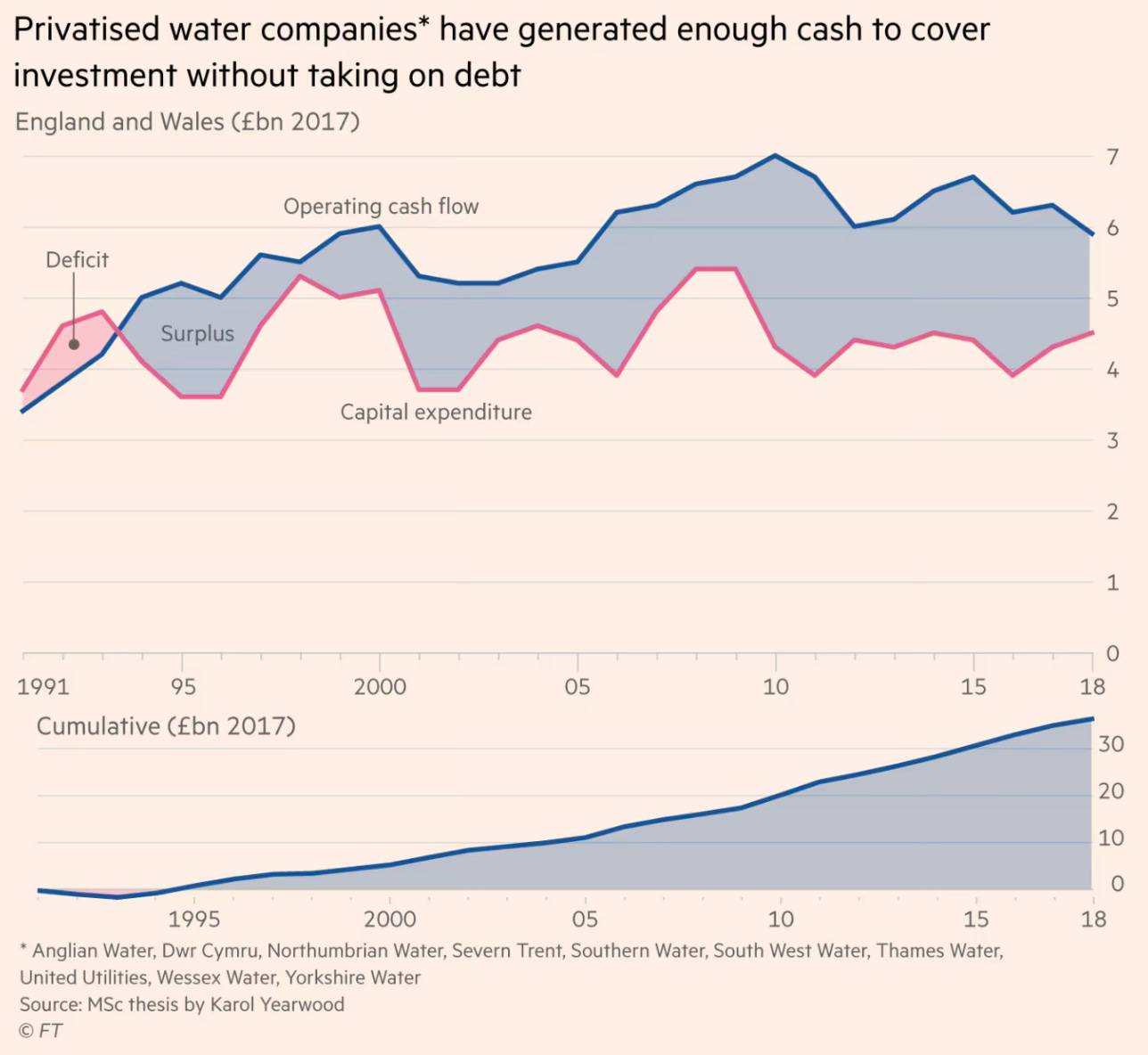
There are two defining graphics about how the UK water privatisation went wrong. The first shows how the utilities kept piling up debts even as their equity base remained the same (or even depleted). 

The second shows that even as they were accumulating all the debt, the private companies were generating sufficient cash to meet their investment needs without taking on debt. In fact, they could have paid out an average of £1.5bn in annual dividends without taking any debt at all. Instead they raised debt and paid out more, thereby causing the current debt pile. It’s no coincidence that £1.5bn of customers’ money is spent yearly by paying interest on these loans.

The two graphs beg the question as to what was Ofwat doing all along. The trends were hard to miss. But Ofwat choose not to act. It is hard not to feel that Ofwat’s monitoring systems failed abjectly in raising red flags to rein in such practices. British water privatisation is as much a story of regulatory capture as it is of the avariciousness of private capital. 

Ofwat’s role in the general failure of supervision and regulation has been a matter of debate for some time now. The British government has just constituted a commission to carry out a “root and branch” assessment of Ofwat and consider all options for the regulation of the industry. The Environment Secretary has blamed the regulator and lack of proper oversight for the failure of the water sector. The Commission, headed by former BoE Deputy Governor Jon Cunliffe, will “will look at strategic planning, protecting consumer interests, and how to come up with rules that hold companies to account without putting off potential investors.” 

Ofwat is undertaking its latest five-year price reviews for the water utilities, on price determination for the period till 2030. The industry sought a 29% increase and got an interim direction for a 19% rise. 

The graphs also draw attention to the point that I have repeatedly made in this blog on the importance of the nature of investors in regulated sectors like utilities. These are low but stable return sectors, appropriate for investors satisfied with low returns but seeking to diversify their returns. 

It’s difficult to believe that private equity firms meet this requirement. PE firms are not known for their commitment to stakeholder responsibilities and for building enduring companies. They have a single-minded focus on maximising returns, which leads them into questionable practices like asset-stripping and loading up their portfolio companies with excessive debt. Their emerging track record across sectors point to a consistent practice of pass-the-parcel after squeezing out all possible returns from their investees. Monopoly public utilities like water and sewerage cannot be left exposed to such practices. 

Instead of targeting specific categories of investors like PE or foreign funds in general, it may be useful for policy makers to put in place conditions that align the incentives of investors and also safeguards against asset stripping by private investors in regulated infrastructure sectors. This is an important requirement given the pass-the-parcel nature of dispersed private ownership associated with those like the kind of investors in UK water utilities. 

The objective should be to ensure that investors be held accountable for the life-cycle of the infrastructure asset by mandating certain fiduciary responsibilities during their ownership of the asset. On the positive side, there should be adherence to clear investment responsibilities, service level standards, and maintenance of asset quality levels. On the negative side, there should be debt-equity ratio ceilings, caps on returns, and close watch on the finances of the asset holding company. 

It’s also for this reason that private participation in public infrastructure like utilities, roads, mass transit etc., should be confined to simple concession contracts of services with tight caps on returns, including all kinds of payouts. It should be made explicit that the investors in such investments are fiduciaries and their value proposition is only stability of returns and not high returns.