Substack

Showing posts sorted by relevance for query business concentration. Sort by date Show all posts

Monday, August 27, 2018

The impossible dilemma - business concentration and competition cannot co-exist

John Van Reenen has a paper at the Kansas City Fed's Jackson Hole Symposium analysing the changes in market structure and contributors to business concentration. He writes,
In recent decades the differences between firms in terms of their relative sales, productivity and wages appear to have increased in the US and many other industrialized countries. Higher sales concentration and apparent increases in aggregate markups have led to the concern that product market power has risen substantially which is a potential explanation for the falling labor share of GDP, sluggish productivity growth and other indicators of declining business dynamism. I suggest that this conclusion is premature. Many of the patterns are consistent with a more nuanced view where many industries have become “winner take most/all” due to globalization and new technologies rather than a generalized weakening of competition due to relaxed anti-trust rules or rising regulation.
In simple terms, Reenen appears to be saying that business concentration may be happening due to globalisation and new technologies which have changed the nature of competition, and not weakened it, and that may not be a matter of concern.

He goes on,
There are other explanations of the increasing differences that do not rest on a generalized fall in product market competition. Indeed, an equally strong case could be made that the forces of globalization and new technologies have changed the nature of competition without necessarily diminishing it across the board. For example, if more markets are becoming “winner take all” as with digital platform competition, this will generate the dominance of “superstar firms” such as Amazon, Apple, Facebook, Google and Microsoft. The success of such firms may be as much due to intensified competition “for the market” rather than anti-competitive mergers or collusion “in the market”. Furthermore, even in lower tech markets like retail and wholesale, rapid falls in quality-adjusted ICT prices (information and communication technologies) may give larger firms - who can invest heavily in developing proprietary software - major advantages in logistics and inventory control management...
if firms differ in their productivity and markets are not perfectly competitive more productive firms will have bigger market shares. Furthermore, these large “superstar” firms will tend to have higher profit margins and lower labor shares of value added. If market competition rises (e.g. consumers become more price sensitive) then more output is allocated to the larger, most productive firms – i.e. concentration rises. This can be through the extensive margin (less productive badly managed firms exit) and the intensive margin (amongst the survivors, high productivity firms get even larger market shares). Hence an increase in competition could easily lead to rising concentration. 
In fact, far from being anti-competitive, such business concentration may be due to "intensified competition for the market". He also argues that "the fall in the labor share is due to reallocation towards large, high margin firms rather than a general increase in the markup across all firms". He dwells on the important finding of "rising firm-level productivity dispersion" and "most of the widening earnings inequality being between firms and not within firms". And isn't reallocation towards more dynamic firms in an industry to be welcomed? 

And the underlying premise of the dynamics of modern technologies and other trends favouring "superstar firms" and the fact that these firms dominate the most innovative and vibrant sectors of the economy appears to indicate a merit-based and market-driven selection of these firms. In fact, nothing could be farther from the truth.

It is here that economists would do well to ground their theories of change on priors and not just objective and logical arguments. They need to draw on historical perspectives and on other branches of social sciences to inform their theories. More than anything they need to just watch what is happening in the real world. 

Sample this logically perfect rationalisation, 
Higher competition in general will give firms with a cost or quality advantage a large share of the market. But the growth of platform competition in digital markets has led to dominance by a small number of firms such as internet search (Google), ride sharing (Uber), social media (Facebook, Twitter), operating systems for cellphones (Apple, Android), home sharing (AirBnB), etc. Network effects mean that small quality differences can tip a market to one or two players who earn very high profits. The growth of such industries does not mean that competition has disappeared, rather its nature has changed. There is more competition “for the market” rather than “in the market”.
"Growth of platform competition" driving the trends in digital markets! Really? If nothing else, read the ProMarket Blog please. There are countless articles, including nowadays in the mainstream media, which calls out this argument and describes the anti-competitive practices of these platform companies.

From a historical and inter-disciplinary perspective, intellectuals from Adam Smith to Karl Marx, not to speak of several others subsequently (Pareto, Mosca, Wright Mills, Eisenhower, Galbraith and so on), have all warned of the dangers of political capture by those who exercise economic power. And it cannot be denied that superstar firms or the largest firms, left to their own devices, will not only exercise economic power but also seek political power to entrench their economic power.

In other words business concentration and political capture invariably go together. Alternatively, competition and business concentration cannot co-exist. This is the impossible dilemma of any market structure. 

In simple terms, Reenen's line of reasoning overlooks the central issue. The problem is the reality of business concentration and all its consequences (including the fall in labour share of income). The "superstar firms" are themselves the problem. And not what causes this business concentration or their rise. Not even what is its future. Much less whether this is caused by decreasing or rising competition. 

Economists and researchers schooled in mathematical models gloss over the dynamics of real-world human interaction. Just consider access itself. It was reported that Google for example had 120 lobby meetings with a commissioner, cabinet member or director-general of the EU between 2014-16. Or the extraordinary access of Google to the Obama White House or Goldman Sachs to Hank Paulson when TARP was being formulated or the unprecedented access of corporate executives to President Obama himself. This access, even without malafide intent on any side, itself deeply questionable, marginalises incentives and logical reasoning (and attendant utility preference functions) and primes decision-makers into internalising a particular world-view or line of thinking about an issue. It is just that's the way human beings are. Call it influence, hegemony, socialisation, or whatever. It's a reality that cannot be wished away! This access has to be contrasted with the minimal or no access that the opposing and alternative points of view, which in turn amplifies the influence of business interests.

At a most basic level, if we buy into the inevitability of political capture, it is immaterial what is driving business concentration. The mere fact of business concentration raises the possibility inevitability of the exercise of economic power and political capture.

When Piketty came out, instead of embracing the central message of a world of widening inequality, economists went about detracting attention from it by hair-splitting around the inequality r > g. A similar debate is being reprised amidst the mounting evidence of the harmful effects of business concentration, irrespective of what drives it and what is its future.

Wednesday, April 19, 2023

Indian economy business concentration update

Business concentration has been an important area of focus in this blog. This and this are the last two posts on business concentration in India. 

It's now no longer under dispute as to the reality that market concentration is a uniform trend across sectors globally and India too. In fact, it can be argued that the most salient feature of modern capitalism over the last two decades has been a form of Mathew Effect which has seen the big companies getting bigger still across important sectors of the economy. Further, as I blogged here last week, this market concentration has been associated with another trend of price mark-ups and increased business margins

The debate rages on its causes. They include regulatory and political capture, the role of technology, globalisation and emergence of global markets, the long period of cheap money and financialisation, loss of labour's bargaining power, dominance of private equity etc. The right answer is probably a confluence of some or all of them combining to turbocharge the efficiency and profit maximising model of modern capitalism. However, it's now amply clear that the pandemic has provided a boost to this trend. 

On the issue of business concentration in India, this post will point to three recent commentaries. 

In their latest update on market concentration in India, the Marcellus Asset Managers write (the earlier one here and I blogged about it here). 
As explained in this note, improvements in transport infrastructure (e.g., the highway network has doubled over the past decade), the introduction of GST (in 2017) and new business models which have migrated from the developed world to India over the past decade, are resulting in India’s 20 largest profit generators earning a staggering 80% of the nation’s profits as compared to around 40% a decade ago. This in turn is leading to an increasingly polarized stock market.

In the decade ending 31st March 2012, the Nifty added around $440 bn in market cap. In these ten years, ~80% of the value generated came from 17 companies and the median Total Shareholder Return (TSR) CAGR was 26% for these 17 companies. Moving forward by a decade, in the decade ending March 31st, 2022, the Nifty added ~$1.4 trillion in market cap. And 80% of the value generated in these ten years came from just 20 companies whose median TSR CAGR was 18%. As the table above shows, wealth creation in India is being driven by a dozen and a half companies. Another way to understand this is to look at the polarisation in Free Cashflows to Equity (FCFE). A decade ago, the top 20 FCFE generating companies in the Nifty (in the decade ending March 2012) accounted for just 23% of India Inc’s FCFE. Moving forward by a decade, if we look at the top 20 FCFE generating companies in the Nifty in the decade ending 31st March 2022, they account for 51% of India Inc’s FCFE.

The list of these companies is below

In a recent paper, former RBI Deputy Governor Viral Acharya used the Prowess data to document a sharp rise in business concentration with industries.  The market share of the Top 5 firms by sales has started rising since 2016 after having declined for long.

Much the same trend of reversal is observed in case of Top 5 by assets

This concentration has been especially pronounced among the Big Five corporate groups (Ambani, Tata, Aditya Birla, Adani, and Bharti Telecom). The sales share of the Big 5 have been rising, compared to the declining share of the next five. 


The Big Five have been consolidating their presence at the extensive margin (expanding into newer industries)

And also at the intensive margin (deepening their assets share in the already existing industries) 

Finally, Ishan Bakshi in the Indian Express documents several duopolies across sectors, mostly foreign owned,

The automobile sector in India is dominated by Maruti Suzuki and Hyundai. Both are foreign-owned. Together, the two account for roughly six out of every 10 cars sold in the country. Add Tata Motors, the biggest Indian auto player, and these three players control almost 70 per cent of the total car market... Three players — Hero MotoCorp, Honda and TVS Motor — account for nearly three-fourths of the total two-wheelers market. Two of these – Hero and TVS – are Indian-owned while Honda is a subsidiary of a Japanese firm... the mobile phone market in India is dominated by the Chinese brands Xiaomi, Vivo and Realme, and the South Korean giant Samsung. Vivo, Realme, Oneplus and Oppo are reportedly linked to the same Chinese company. Together these companies controlled roughly 70 per cent of the market in 2022. The smart TV market is similarly dominated by the likes of Xiaomi, Samsung and LG. Similar patterns can be observed in other consumer appliance markets as well as in various segments of the FMCG market... Indian players exercise more control in the core infrastructure sectors. For instance, in steel, the four biggest companies — JSW Steel, SAIL, Tata Steel and JSPL — control more than half the market... Similarly, the four biggest Indian cement firms command half of the market share in the country...

The telecoms sector is dominated by two large players (Jio and Airtel) and a weak third player (Vi) with an uncertain future. Together, Jio and Airtel account for more than two-thirds of the market... The airline industry (domestic travel) is also now dominated by two players — Indigo and Tata (Air India, Vistara, AirAsia India and Air India Express). Taken together, the two airline groups accounted for more than 80 per cent of the domestic market share in the year so far (Jan-Feb). In the private banking space, HDFC, ICICI and AXIS account for a significant share (though all of them have sizeable foreign ownership), while concentration is also evident in airports and ports. Similar patterns can be observed in online markets as well. For instance, the retail market is dominated by Amazon and Flipkart; the payments market has been cornered by PhonePe and Google Pay; food delivery is split between Zomato and Swiggy; and transportation between Ola and Uber. Most of these companies are either foreign-owned or majorly backed by foreign players.
In the Indian context, the Marcellus report points to a the digitisation of business activities and the associated network and other effects which benefit the largest firms, the improvements in transportation infrastructure, increased formalisation of the economy, emergence of new business models, the introduction of GST etc as being responsible for benefiting the large incumbents at the cost of their smaller competitors. 

Since business concentration is invariably associated with political and regulatory capture (with all its  corrosive consequences not just on capitalism but on politics and society in general) and price mark-ups, there is a strong case to regulate business concentration as an end in itself. The current regulatory tests of consumer welfare and market harm have to be supplemented with this additional test of the likelihood of business concentration resulting in regulatory and political capture. This may entail making explicit the objective of breaking up large corporations. 

Critics will point to loss of innovation and efficiency associated with this approach But a cost-benefits assessment would reveal that this loss would be more than off-set by the avoidance of political and societal harm from the inevitable regulatory and political capture by large firms. Further, there is nothing to suggest that large firms are essential for innovation and productivity improvements. In fact, the recent history of capitalism would suggest exactly the opposite - innovation and business dynamism coming from smaller and newer firms. 

Furthermore, even if we agree with the contention of loss of efficiency and innovation, there is the question of whether human society needs so much innovation and efficiency which anyways benefits only a small majority of the global population. There is a strong case that the far more important priority and greater challenge is that of broad-based diffusion of the progress that has already been achieved. Finally, there is also the philosophical question of the environmental sustainability (climate change, resources depletion etc) and social desirability (social media, automation, AI, widening inequality etc) of such levels of turbo-charged innovation and efficiency maximisation. 

Wednesday, June 14, 2017

Business concentration and labour share of incomes

Tim Harford points to the work of David Autor, David Dorn, Lawrence Katz, Christina Patterson, and John Van Reenen which finds evidence that the declining share of labour in national output has been caused by business concentration across sectors. They analyse micro-panel data on 676 industries from the US Economic census since 1982 and international sources and find the causal chain running into the rise of "superstar firms",
If globalization or technological changes advantage the most productive firms in each industry, product market concentration will rise as industries become increasingly dominated by superstar firms with high profits and a low share of labor in firm value-added and sales. As the importance of superstar firms increases, the aggregate labor share will tend to fall. Our hypothesis offers several testable predictions: industry sales will increasingly concentrate in a small number of firms; industries where concentration rises most will have the largest declines in the labor share; the fall in the labor share will be driven largely by between-firm reallocation rather than (primarily) a fall in the unweighted mean labor share within firms; the between-firm reallocation component of the fall in the labor share will be greatest in the sectors with the largest increases in market concentration; and finally, such patterns will be observed not only in U.S. firms, but also internationally. We find support for all of these predictions.
They found that while in the early 1980s, the largest four players in any given US manufacturing industry averaged 38% of sales, it had risen to 43% three decades later. In utilities and transportation, the share rose from 29% to 37%, while in retail, it rose form 14% to 30%. In the same time workers share of the economic value added declined from 66% to 60%.

About the reasons for such business concentration, they posit a few possible contributors,
One source for the change in the environment could be technological: high tech sectors and parts of retail and transportation as well have an increasingly “winner takes all” aspect. But an alternative story is that leading firms are now able to lobby better and create barriers to entry, making it more difficult for smaller firms to grow or for new firms to enter. In its pure form, this “rigged economy” view seems unlikely as a complete explanation. The industries where concentration has grown are those that have been increasing their innovation most rapidly as indicated by patents. One might be concerned that these patents are designed to thwart innovation and enshrine monopolies... A more subtle story, however, is that firms initially gain high market shares by legitimately competing on the merits of their innovations or superior efficiency. Once they have gained a commanding position, however, they use their market power to erect various barriers to entry to protect their position...


The rise of superstar firms and decline in the labor share also appears to be related to changes in the boundaries of large dominant employers with such firms increasingly using domestic outsourcing to contracting firms, temporary help agencies, and independent contractors and freelancers for a wider range of activities previously done in-house, including janitorial work, food services, logistics, and clerical work. This fissuring of the workplace can directly reduce the labor share by saving on the wage premia (firm effects) typically paid by large high-wage employers to ordinary workers and by reducing the bargaining power of both in-house and outsourced workers in occupations subject to outsourcing threats and increased labor market competition. 
Business concentration has other implications. An OECD study found that the "productivity gap between the most productive firms and the rest is growing". It also squares up with the work of Jason Furman and Peter Orzag who find that the widening inequality in the US is "driven more by a widening gap in the average earnings of workers in different companies than by a widening gap between pay checks inside individual businesses", and that too driven by top-tier firms in healthcare, finance, and information technology.

Wednesday, January 11, 2023

More on business concentration

Matt Stoller on business concentration in agriculture in the US

The monopoly problem farmers face is really bad. On the input side they must deal with equipment producer John Deere, fertilizer giants CF Industries and Nutrien, and seed/chemical goliaths Bayer/Monsanto, among others. On the other side, they face giant buyers like ADM, Bunge, Cargill and Louis Dreyfuss, who in turn sell to large supermarket chains like Walmart and Kroger, and broadliners Sysco and U.S. Foods who sell to restaurants, institutional facilities, and food service giants. It’s consolidation all the way up and down the chain... Corteva and Syngenta have essentially been paying distributors not to carry rival, cheaper products, so they can maintain higher prices. This is done under the veil of “loyalty” programs to dealers, but it’s a way of blocking competition and keeping prices high.

This oped by the FTC Chairperson, Lina Khan, describes the "loyalty" program in an oped

Companies like Syngenta and Corteva are in the business of inventing new active ingredients for pesticides. Each time they do, they get to patent that invention. A patent entitles an inventor to a 20-year period where only they are allowed to sell the invention. But there’s a compromise: Once the patent expires, anyone is free to bring a generic version into the market... Syngenta and Corteva weren’t satisfied with this compromise. They wanted to keep raking in big profits even after the patents expired. To do that, our lawsuit alleges, each company plotted to cut farmers off from cheaper generic alternatives. In general, manufacturers don’t sell pesticides directly to farmers. They sell to distributors. Syngenta and Corteva realized that these distributors were a potential choke point. So they each launched “loyalty programs” in which distributors who bought their products would receive large payments, styled as a rebate. The catch: If those middlemen distribute too many generic pesticides, they don’t get the money. In other words, distributors get paid to exclude generics... Distributors don’t want to miss the payments, so they go along with the program. After all, it doesn’t hurt them to spend more on brand-name pesticides, because they get to pass those costs on to retailers and, ultimately, to farmers. With distributors under-stocking generics, farmers end up having little choice but to buy Syngenta and Corteva. And here is the payoff to the whole scheme: Because farmers are locked into buying their stuff, Syngenta and Corteva can keep charging inflated prices, as if their products were still under patent. The pesticide giants can make more profits by blocking rival products from the market than by competing with them.
This US Department of Defence report is a stunning summary of the shocking level of business concentration in the defense industrial base,
Since the 1990s, the defense sector has consolidated substantially, transitioning from 51 to 5 aerospace and defense prime contractors. As a result, DoD is increasingly reliant on a small number of contractors for critical defense capabilities. Consolidations that reduce required capability and capacity and the depth of competition would have serious consequences for national security. Over approximately the last three decades, the number of suppliers in major weapons system categories has declined substantially: tactical missile suppliers have declined from 13 to 3, fixed-wing aircraft suppliers declined from 8 to 3, and satellite suppliers have halved from 8 to 4. Today, 90% of missiles come from 3 sources.

This table captures the state of business concentration across product categories.


This captures the trajectory of consolidation in the solid rocket motor production industry.

As I have blogged earlier, business concentration is an inexorable dynamic emerging from the features of unfettered (American-style) capitalism. Quite apart from the innate nature of certain businesses like those in technology which enjoy virtually unlimited increasing returns to scale, there is the more pernicious issue of capture of rule-making by the large corporate interests.  This can be controlled only through active regulation and not allowing firms to grow too big. 

Monday, June 18, 2018

Three new business concentration graphs

Market concentration and its harmful effects on the economy is well documented. But important decision makers (and opinion makers), especially in the US, remain unconvinced by the growing evidence. Or is it a matter of them being captured?

The latest comes in the form of the decision last week by a US Federal Court judge allowing the $85 bn merger of AT&T and Time Warner. The former provides phone, internet, video and data services (or distributes content), while the latter owns television channels across news, entertainment, and sports (produces content), and together they "can count as customers practically every household in America". The Judge ruled against a very weak challenge by the US Justice Department that the combination of a major producer and distributor of content could substantially lessen competition in media industry. The Steven Pearlstein in Washington Post has very nicely described the judgement as a "hatchet job" involving selective and biased evidence by a "judicial scoundrel"!

Be that as it may, here are three latest graphs that highlight the growing market concentration.

David Leonhardt has two graphs on economy-wide business concentration in the US from Business Bureau's Business Dynamics Statistics. The first captures the rising share of businesses with more than 10000 workers and the declining share of those with less than 20 workers.
And companies with more than 10000 workers employ more people than those with less than 50 workers. 
His documentation of the changes in the past quarter century are stunning,
In the late 1980s, small companies were still a lot bigger, combined, than big companies. In 1989, firms with fewer than 50 workers employed about one-third of American workers — accounting for millions more jobs than companies with at least 10,000 employees... The share of Americans working for small companies fell to 27.4 percent in 2014, the most recent year for which data exists, down from 32.4 in 1989. And big companies have grown by almost an identical amount. Today, companies with at least 10,000 workers employ more people than companies with fewer than 50 workers.
The third graphic covers a forthcoming IMF study on business concentration in developed and developing economies using data for publicly listed companies in 74 countries. It captures a measure of market concentration, average mark ups (or how much a company charges for its products compared with how much it costs to produce an additional unit of this product, expressed as a ratio).
The rise since the early nineties in the developed economies is capitalism gone berserk! Markups have increased by 43 percent since the eighties in those countries.

Ananth has a nice post on the irony of how the elites and decision-makers, even at places like the IMF, continue to pay lip-service to the evidence that their own research department comes up with.

Monday, March 18, 2019

Entry costs and business concentration

More from the excellent German Gutierrez and Thomas Philippon, this time along with Calum Jones, on the trends with entry costs and business concentration in the US. I had blogged earlier from Gutierrez and Philippon about how low interest rates has contributed to business concentration and rise in firm surplus 

The reality of business concentration, increase in firms' profit margins, and weaker investment in precisely those industries which have become more concentrated is now widely acknowledged. But its exact causes are a matter of debate. 
Business investment in terms of ratio of net investment to net operating surplus for US non-financial corporates has fallen while that in respect of net buybacks has risen. 
They examine the implied capital gap relative to the Q ratio for the most and least concentrating industries and find that the capital gap is coming from concentrating industries.
The summary of their findings,
Entry has decreased in the US economy, and markets have become more concentrated. We find that entry costs shocks have played an important role and that they are related to entry regulations... our main finding is that time-varying competition has had a significant impact on macro-economic dynamics over the past 30 years. For instance, absent the decrease in competition since 2003, consumption would be 5 to 10 percents higher by 2015 and the capital stock would have been 1 to 3 percent higher by 2015... By 2015, the cumulative under-investment is large at around 10% of capital.

Wednesday, May 24, 2017

Business concentration, superstar effect, and hegemony

I like Tim Harford and enjoyed reading his several books. But I cannot help getting the impression that he has lost the plot here. And it is a teachable moment in the cognitive blindspot of the liberal establishment and how it causes alienation that leads to the likes of Brexit and Trump. The article has several blindpsot based arguments. Sample this,
Why hasn’t competition chipped away at the market position of the leading companies? The simplest explanation: they are very good at what they do. Competition isn’t a threat to them. It’s an opportunity. What Professor Autor and his colleagues call “superstar firms” tend to be more efficient. They sell more at a lower cost, so they enjoy a larger profit margin. Google is the purest example: its search algorithm won market share on merit. Alternatives are easily available, but most people do not use them. But the pattern holds more broadly: superstar firms have grown not by avoiding competitors but by defeating them... The policy response required is subtle: after all, the growth of innovative, productive companies is welcome. It’s the unintended consequences of that growth that pose problems.
The last is a deep and unqualified statement. Let us unpack it. This essentially means that superstars firms like Google competed on a level-playing field with competitors and won the race on merits. How can we be so sure? In fact, there are strong arguments to dispute this narrative.

I see several alternate narratives. What if there were entry barriers (beyond a network size) that stifled competition and that Google was, by happenstance, the first to cross this? What if these barriers gave Google the time and network density to gather more data to refine its search algorithm, which in turn entrenched its position even further? What if there is some stickiness to search engine users that confers definitive first mover advantage (beyond a certain network size)? What if Google manipulated its search algorithms to steer traffic towards itself and away from competitors?

What if Google manipulated the market with unfair business practices that took advantage of its initially emerging leadership share? Or what if Google used its rising market power to lobby and put in place rules of the game that erected subtle entry barriers - after all Eric Schmidt was the Technology Czar in the first Obama administration and there is some argument that the frequent visits by Google executives to White House helped swing the anti-trust investigations by Federal Trade Commission their way? For more on a theory of such narratives, whether you believe them or not, read Matt Ridley here.

I am not suggesting in favour of any of these narratives. In fact, most reasonable people would agree with me that all these narratives, including the one unquestioningly embraced by Mr Harford, are possibly equally likely (even people like David Autor included). Maybe all of them played some part or other in elevating Google. It is true that they may arrive at different choices when they apply their judgement call on the various alternatives. I am inclined to believe that we may never be able to decipher the true dynamic that has catapulted Google to where it is today. 

But I am disturbed by the nonchalant, almost reflexive, manner in which Mr Harford overlooks all these alternatives to embrace his narrative to rationalize away the trend of business concentration as the meritorious evolution of superstar firms. By calling it an "unintended consequence of growth", Harford is dramatically altering the frame of reference in conversations surrounding business concentration. It attenuates the sting of the economic efficiency and moral repugnancy arguments against business concentration. It is inconceivable that an intelligent and shrewd commentator like Mr Harford is unaware of these. It is more likely that he considers them less likely or unimportant.

This is hegemony. Such depth of mental capture is disturbing. And it is true of many important public concerns among even the most influential liberal thinkers and opinion makers.

Monday, July 14, 2025

Business concentration - airport services edition

A feature of the efficiency-maximising (American version) capitalism is the trend of business concentration at the extensive and intensive margins. The former involves horizontal integration, whereby a handful of firms make up an increasingly major market share in their respective industries. It’s a phenomenon that spans industries and countries in varying degrees. The latter refers to the trend of vertical integration, where the dominant firm tends to capture an increasing share of value addition within the industry. This feature is pervasive in certain sectors like IT, healthcare, infrastructure, etc.

The Ken has a story on the rapid changes in business models in the airport services industry due to the increasing dominance of the Adani Group. The predominantly outsourced model of services in the airport industry in India is giving way to a more vertically integrated model. 

Traditionally, the various non-aeronautical services in the airport, like lounges, food and beverages (F&B), retail, etc., were outsourced to specialised service providers who in turn contracted with aggregators who brought together brands (like banks for lounges, retail brands for F&B and retail space, etc.). This is now giving way to a strategy where the real-estate concessionaire (Adani Group) is seeking to maximise value capture from airport services by creating its own service companies and squeezing out the outsourced service providers. 

The article narrates the story of Dreamfolks Services.

Dreamfolks Services, a publicly traded company that has quietly built a 90% monopoly in the lucrative business of getting Indian credit-card holders into airport lounges. It sits in the middle of a four-way handshake among banks, card networks, lounge operators, and travellers… TFS and Encalm ran the physical lounge spaces. But it was aggregators like Dreamfolks that unlocked access by bundling lounge networks and partnering with banks and credit-card issuers. If a lounge visit costs Rs 100, the aggregator might charge Rs 115, pass Rs 5 back to the operator, and keep the rest. Banks liked the convenience. Aggregators liked the margins… Around them, a cottage industry of brands and partners grew…

Liberatha Peter Kallat, the company’s founder and chairperson, appeared on CNBC TV-18 and accused Adani Airport and the second-largest airport operator, GMR Airports—without naming them directly—of pressuring banks like ICICI and Axis to abandon aggregators like hers in favour of themselves… Travel Food Services (TFS) and Encalm Hospitality, both prominent lounge operators, have since cut out Dreamfolks and signed directly with Adani. Banks are following suit… As tech infrastructure improved, there was no longer a strong reason to maintain the middle layer… every airport and lounge operator is now building its own backend.

It describes how in-sourcing is happening across service verticals.

Unlike Adani’s other airports, where retail concessions are often managed by third parties, in the Mumbai airport, Adani directly runs the non-aero business… Adani Airport has moved to a franchisee model—a shift from the earlier system, where brands paid rent (fixed or revenue-linked) to concessionaires who had won competitive bids for spaces. Now, instead of paying rent, they are licensing their brand to the airport and letting it run the show… 

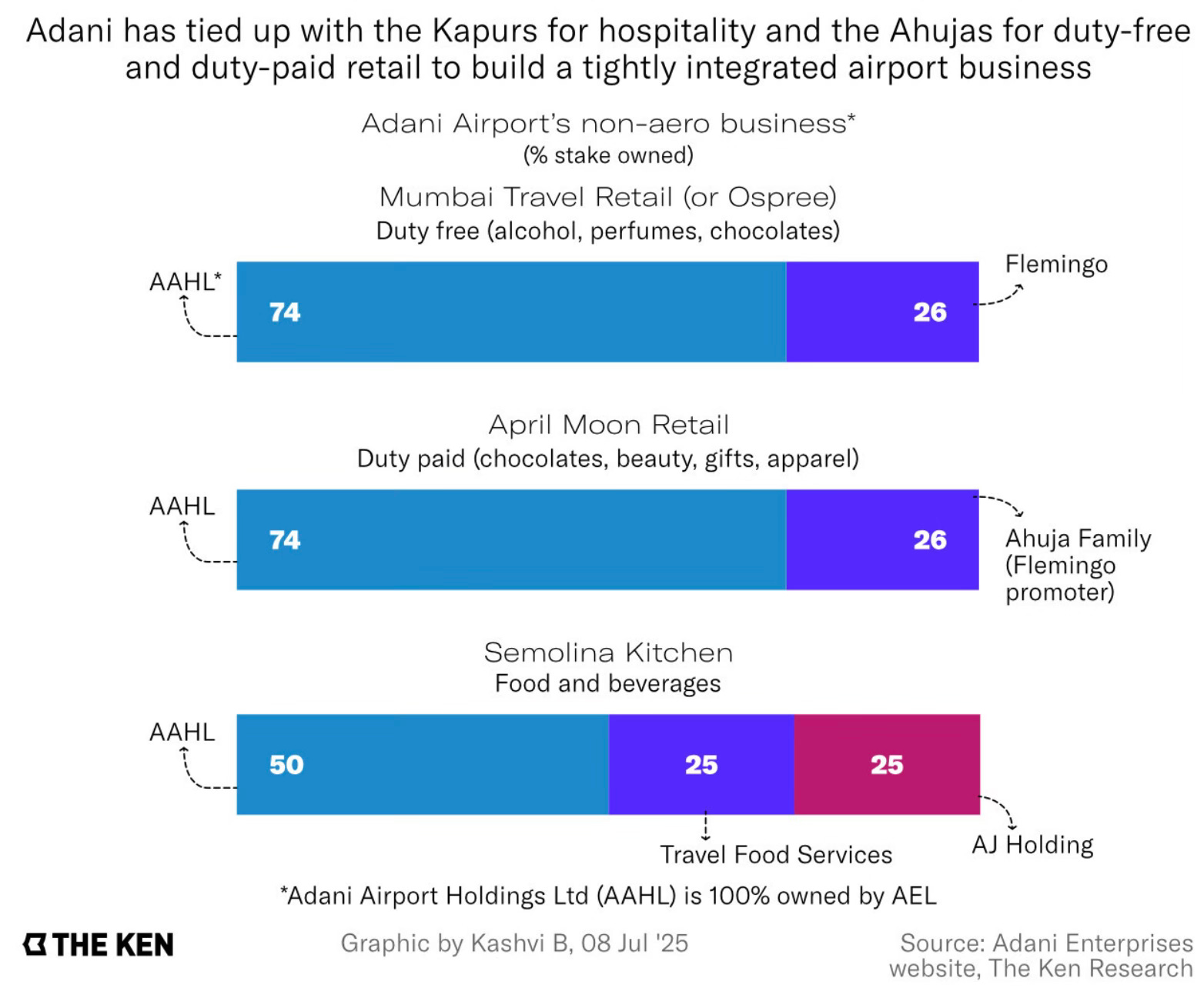
In Mumbai, three large players—TFS, Lite Bite Foods, and Devyani International—used to dominate F&B. That has changed. Last March, Adani acquired a majority stake in Semolina Kitchens, a TFS subsidiary. TFS, now aligned with Adani, is emerging as the primary F&B operator at the airport. Lite Bite’s share has reportedly fallen from 50% to under 20%, said F&B operators in the know. Both it and Devyani are expected to exit entirely once their contracts expire later this year… 

Of the eight lounges at the Mumbai airport, at least five are now managed by TFS. Through Semolina, TFS has lounge and Quick Service Restaurant (QSR) concession rights at six Adani-operated airports, as well as Goa (operated by GMR), according to its pre-IPO documents. The roles are consolidating. The partners are getting fewer. The integration is getting tighter… So if a brand is trying to operate at the airport, they can’t be surprised if the space goes to TFS’s in-house brands like Caffecino, Curry Kitchen, or Dilli Streat instead… 

Over the past 18–24 months, categories like watches, apparel, cosmetics, salons, and even convenience stores have seen a shift in how business is done at Adani-run airports. The model is familiar by now: migrate the old setup into a new one, run by a close partner. In this case, that partner is April Moon Retail, claimed multiple brand owners. Stores at these airports still carry their logos and branding, but the backend has moved, they said. Employees are now on April Moon’s payroll. Bills carry the brand’s name, but the GST number belongs to April Moon… 

April Moon has begun launching in-house formats across categories. Stores like Bon Voyage, which sell everything from snacks and books to travel accessories, now operate across multiple Adani Airports… What’s really taking off is the retail-cloning strategy. When something sells well at the airport, it doesn’t take long for a lookalike to show up—all run by April Moon. A luxury watch counter resembling Ethos or Helios? That’s Meridiem. A beauty and cosmetics outlet that looks like Nykaa? Meet Amara Luxe. Something that feels like Lenskart or Titan Eye+? It’s probably Vue De Luxe. Handicrafts à la Rare Planet? That’d be Pravasi. There’s even talk of a Hamleys knockoff said to be in the works.

This trend, in turn, creates several disturbing concerns.

TFS, whose IPO opens on 7 July, was founded by the Kapur family—the same folks behind Copper Chimney, Bombay Brasserie, and The Irish House… TFS could eventually be replaced, too. Adani is reportedly talking to Plaza Premium, the global lounge operator, for future airport lounge ops… 

April Moon began appearing around 2021. Its role was to take over the duty-paid retail at airports. That September, Adani acquired a 74% stake in Flemingo Travel Retail—a global duty-free operator founded by Atul Ahuja—for just Rs 2.8 crore. This, for a company that had clocked nearly Rs 900 crore in revenue in FY19. The deal, struck mid-pandemic when travel retailers were reeling, came at a throwaway price. And it gave Adani near-total control over both duty-free and duty-paid retail. For brands, that left little room to negotiate: either go through April Moon, or lose access to airport shelves… “If we made Rs 15 lakh in monthly sales at a store, we’d only be allowed to record Rs 5–6 lakh,” said one retailer. After costs, they say, the effective take-home margin is 5–6%. “Retailers who spent decades building these brands are now effectively just vendors.”

Strong financial incentives are driving these trends

At AAI airports, non-aeronautical revenue makes up maybe 10% of the pie. At private airports like Mumbai or Delhi, that jumps to 62%, per data cited by Crisil in TFS’s IPO documents. And within that, F&B alone account for as much as 40%. For instance, the top five Starbucks outlets in India by revenue are all located at airports, according to an F&B operator. A single store can bring in Rs 1.5 crore a month; that’s 3–4X more than a high-street outlet. And margins are nothing to sneeze at. A Rs 400 latte at an airport (Rs 350 at other outlets) contains roughly Rs 20 worth of ingredients.

Business concentration through horizontal and vertical integration may be inherent to the dynamic of capitalism with its profit-maximising firms. And there are doubtless efficiencies to be realised from both these trends. 

But the case of the airport sector in India, representative of trends across several sectors, raises questions about the stifling of entrepreneurship and innovation, and business dynamism in general. 

For example, what’s the incentive for entrepreneurs to start something like Dreamfolks Services, or April Moon Retail, or TFS, if there’s an imminent threat of being squeezed out of the market or being taken over by the dominant airport operator? Wouldn’t such trends deter investors from putting their money behind entrepreneurs whom they would otherwise have supported? More generally, is business concentration at the extensive and intensive margins likely to scare risk capital away from these sectors?

In addition, there’s a compelling argument that vertical integration under a corporate behemoth would lower innovation, service quality, and sector-wide dynamism. There’s a strong likelihood that once these services are taken in-house, like with all monopolies, the airport operator will have diminished incentives to pursue innovation and service quality and instead will have increased incentives to maximise profits. 

In any case, it’s unlikely that large infrastructure groups or their subsidiaries will be as innovative or driven to improve service quality (say, cater to all market segments), expand service portfolios (including interoperability with similar services globally), explore adjacent market synergies, and so on. This has been the global experience from across sectors, especially but not only in the infrastructure sector, over time.

It’ll be easy for the airport industry in India to become entrapped in a sub-optimal equilibrium of a horizontally and vertically integrated market dominated by a couple of operators. Given the inevitable growth in traffic due to economic growth starting from a low baseline, the associated inefficiencies can be papered over for a long time. But its opportunity cost can be considerable. 

Vertical integration also creates problems with the transparency of accounting for all those involved. Being part of the same corporate group means that there will be incentives to indulge in manipulation of accounts to minimise statutory payments and taxes, besides also maximising leverage. The operator can show lower revenues by over-invoicing and shifting profits to subsidiaries. Entities within a corporate group can do tax arbitrage by shifting profits among themselves. 

There’s also the case that horizontal integration creates the incentives for vertical integration. Adani Airport will have the incentive to in-source hitherto outsourced airport services only if it enjoys the economies of scope and scale from operating multiple airports. This underlines the importance of controlling market shares in such technically monopolistic markets (which also include those in IT, which benefit from network effects).

However, concerns about business concentration must be balanced with the need for large capital, a high risk appetite, and business ambition, especially if the objective is to scale big and rapidly. The country’s rapid and high growth ambitions require massive investments. The government is expanding airports at a rapid pace, and the airline industry is expected to grow fast for several years. Given their long gestation and deep exposure to the business cycle, only businesses with a high risk appetite and access to patient capital will invest in these sectors. 

Take the example of smart meters. The Government of India wants to install bi-directional smart meters in all 250 million households by the end of 2026. Even at a very conservative Rs 10,000 per smart meter (and its allied components), this would require a staggering investment of Rs 2500 billion (or about $28 bn). Given that regulatory conditions would restrict the discoms from recovering the cost of these new meters from existing metered customers, this cost must be borne by the government or the discoms. 

Since mobilising upfront capex of this scale would have been impossible, a totex model was adopted where the major share of capex would be borne by the concessionaires who would recover it over the eight years of the contract. This also means that the concessionaires would have to bear the significant risks (technology obsolescence, political economy of electricity tariffs, policy shifts, and local politics) involved and carry them in their balance sheets over the contract period. Only a few firms with the deepest pockets and highest risk appetites can assume such risks and make money from these contracts.

In conclusion, business concentration poses a dilemma for policy-making in many sectors. Its harms are well-known and often salient in a bad way, but its benefits are less known. When it unleashes a dynamic that confines an increasing and dominant share of the benefits in the hands of a few corporate groups, then there will be problems. 

Econ 101 would have it that such monopolistic trends should be formally regulated. But regulation is fraught with problems, given its inefficiencies and the political economy. Besides, there are limits to the extent of regulation required to control these business dynamics. 

From another perspective, the reliance on large corporate groups to drive high-growth aspirations is essentially a legitimate political economy choice that many countries, including those in the West, have made in their growth trajectories. Therefore, it’s only natural that a recognition of the problems that accompany the pervasiveness of large corporate groups be met with a similar political economy choice to force some form of restraints on their overreach.

Friday, May 22, 2020

India business concentration fact of the day

If you thought business concentration was a western phenomenon, wait till you see this on India, from The Economist,
In America 20 companies capture roughly a quarter of all corporate profits. If you thought that was sobering news for budding American capitalists, spare a thought for their Indian counterparts. According to a study by Marcellus Investment Managers, a Mumbai-based firm, last year a score of companies accounted for nearly 70% of India Inc’s total earnings, up from 14% three decades ago (see chart). In a growing number of product categories—from paint and adhesives to biscuits and baby formula—monopolies or duopolies skim off 80% of profits.
In other words, just 20 companies took nearly 70% of profits of corporate India in 2019, up from just 14% three decades back, and compared to nearly 25% in the US!

Update 1 (08.08.2020)

From Arjun Srinivas in Livemint, on business concentration in India,
An analysis of 2035 listed companies across 298 industry groups shows that in up to 100, or 33% of all industry groups, there is one single company that controls over 50% of the net sales in the sector. Even with a stricter definition—at 70% of the net sales—there are still 50 or 17% of industries which have a dominant firm, according to data sourced from Capitaline... Data shows that while the number of industries or sectors with dominant firms has declined—as it often does in an expanding economy—the dominant firms’ market cap in their respective industries has increased correspondingly.

And it extends to the digital economy, as elsewhere,
... estimates indicate that Facebook and Google together mop up 68%of India’s digital ad market revenues, while Amazon and Flipkart serviced 90% of all e-commerce orders during the 2019 festival season period in October.
This balance sheet of the Competition Commission of India (CCI) should be a matter of concern,  
Since its inception, till 31 March 2019, the CCI has noted 1008 instances of ‘anti-trust’ matters, meaning, instances of anti-competitive practices. Over 20% of these cases have been in the real estate sector, followed by automobiles at 10%. In the year 2018-19 alone, the CCI received 68 cases related to anti-competitive agreements and abuse of dominant position. It passed prima facie orders in 65 of these cases and completed investigation in 51 instances and imposed penalties to the tune of ₹357.85 crore. However, merely ₹1.41 crore was actually realized as on 31 March 2019. This is because most of the orders of the CCI are under appeal before the National Company Law Appellate Tribunal (NCLAT) or under challenge in the high courts or the Supreme Court.
Over the past 10 years, the CCI has imposed penalties amounting to ₹13,381 crore, but less than 1% of that amount (about ₹127 crore) has been actually realized (See chart 2). Shockingly, ₹66 crore, or over half of this fine amount, has been refunded to the offending parties. In August 2016, the CCI had imposed its largest-ever penalty of over ₹6,700 crore on 11 cement companies and their trade association, Cement Manufacturers Association, for cartelization and fixing prices. Even though this fine was upheld by the NCLAT, the Supreme Court in 2018 stayed this order, directing the companies to pay only 10% of the penalty amount. 
Update 2 (28.08.2020)

More market concentration facts from Indian economy,
An analysis of Capitaline database of over 1,000 listed firms over the last five financial years till March 2020 across sectors show the share of top five players on the rise. Between FY16 and FY20, the top five cement players have added over 8 percentage points to their share of the sector’s total sales. For the comparable period, the gain for the top five was over 4 percentage points for banks (in terms of interest income), 3.5 percentage points for metal players, 3 percentage points for capital goods, 2 percentage points for oil & gas players. Even in an already consolidated industry like IT, the big five upped their share by over 2 percentage points. The only outliers were pharmaceuticals (loss of 3.5 percentage points), auto (1.6) and realty (1.4). Management consultant Bain & Company’s most recent India Mergers & Acquisition Report too points to the big getting bigger trend. In steel, the top five players increased their share of production by 7 percentage points between FY14 and FY19. For a comparable period, the top five power producers increased their share of installed capacity by 5 percentage points, and the top three telecom firms by almost 20 percentage points in terms of subscribers, according to the Bain report.
Update 3 (14.09.2020)

Business Standard has more market concentration facts,
India is “hyper-Pareto” with the largest 15 per cent of listed businesses generating over 90 per cent of revenue and profit. In Q1, 2020-21, for a sample of the 1,700 largest listed businesses, the top 30 firms by revenue generated over 53 per cent of all revenues and over 73 per cent of profits after tax. The top 100 firms generated 78 per cent of revenues and 72 per cent of profits. Further, the top 250 firms (encompassing all large-caps and mid-caps) generated 91 per cent of revenues and 96 per cent of net profits.

Update 4 (25.09.2021)

Livemint writes that just five companies alone took home 21% of all profits earned by 2863 listed companies across 20 broad industries in 2020-21, up from 17% six years back. In 11 out of 13 industries where top five firms made up 75% or more of market share, market concentration in terms of profits increased during the Covid year.

It increased with respect to revenues too. 
This is in line with rising market concentration globally too, like in the US.

Saturday, August 25, 2018

Weekend reading links

1. In a generally dismal world of public and civic life, I thought that the flood relief work in Kerala was exemplary. Every one displayed remarkable and very rare maturity and dignity in their response, both words and action, not to speak of commitment. I was impressed by the local media (and not the Delhi media) and the local political leaders, not two constituencies that are expected to cover themselves in glory in our times.

This Livemint story of exemplary courage, commitment, and hardwork by different people and groups is very good. Surely something others can learn from Kerala!

2. South Korea market specialisation fact of the day,
According to the Hyundai Research Institute, semiconductors have accounted for as much as 20 per cent of exports so far this year, up from 12 per cent in 2016.
And the chaebol market power graphic
3. Rana Faroohar has a very good article on the challenges posed by the sharing economy and the need for them to share benefits with their clients,
In reality, most Uber drivers are black, Asian or Latino and making below minimum wage. And, on the whole, algorithmic management puts dramatically more power in the hands of platform companies. Not only can they monitor workers 24/7, they benefit from enormous information asymmetries that allow them to suddenly deactivate drivers with low user ratings, or take a higher profit margin from riders willing to pay more for speedier service, without giving drivers a cut. This is not a properly functioning market. It is a data-driven oligopoly that will further shift power from labour to capital at a scale we have never seen before...


Airbnb often touts its ability to open up new neighbourhoods to tourism, but research shows that in cities like New York, most of its business is done in a handful of high end areas — and the largest chunk by commercial operators with multiple listings, with the effect of raising rents and increasing the strains caused by gentrification. Officially Airbnb has a “one host, one home” policy in New York, but better enforcement is needed.
4. Last week the British Government took back control of HM Prison Birmingham, one of the country's largest prisons which had been outsourced to G4S. This followed a surprise visit to the facility early this month by the Chief Inspector of Prisons which revealed Dickensian conditions and rampant hooliganisms. 
HMP Birmingham was graded “poor” across all four categories — safety, respect, activity and resettlement... Inspectors found open drug dealing, blood and vomit left uncleaned, broken windows and leaking toilets. Some staff were found asleep, while others had locked themselves in their offices. The chief inspector told the BBC Today programme that he had had to leave one area of the prison after feeling the effect of narcotics in the air. Mr Clarke said in his report that he was “astounded” that the prison had “been allowed to deteriorate so dramatically over the 18 months since the previous inspection”. He added that he had “no confidence in the ability of the prison to make improvements”... HMP Birmingham recorded 1,434 assault incidents in the 12 months to July this year, the largest volume of any jail in Britain.
This is the first time the Government has exercised its power to strip a prison contractor since the first privatisation in 1991. Prisons have been buffeted by sharp increase in prisoner population and drastic cuts in public financing. Of UK's 123 prisons, 17 are run by private companies. 

This is bound to amplify the debate on renationalisation that had been gathering ground in recent times, and had been aided by the liquidation of outsourcing contractor Carillion in January and the nationalisation of East Coast railway line a few weeks later.

5. The current rise of the US S&P 500 stock index crossed the longest bull market in history, at 3453 days. It has soared 320% since March 2009 creating $18 trillion of wealth.
6. Has Trump managed to unsettle the Chinese as none before? Yes, it would appear so given their frenzied domestic policy responses,
Chinese officials are pushing banks to lend more and allowing indebted local governments to spend money on big projects again. They have moved to shore up the value of the country’s currency. They have also helped out the stock market... China is taking steps to make sure its companies and spenders have enough money. The central bank announced on Aug. 10 that it would make sure enough credit reached companies. China’s banking regulator announced on Aug. 11 and again over the weekend that it wanted the country’s state-controlled banking sector to provide ample credit to exporters, small and medium-size businesses and infrastructure projects. Regulators are taking other steps to give banks the financial space needed to step up lending. The official China Securities Journal reported on Tuesday that financial regulations may soon be changed to let banks keep practically limitless holdings of local government bonds without including them in their calculations of their ability to endure hard times... The authorities are also encouraging local projects. The Finance Ministry is helping deeply indebted local governments borrow far more money this autumn so that they can restart stalled infrastructure projects. China’s central planners have allowed a series of big local government projects to proceed that had previously been blocked because of debt concerns... Its banking regulator has begun encouraging the country’s four big asset management companies to aid highly speculative peer-to-peer lending schemes that have been collapsing in recent months, though the details of that help remain unclear. And the government has deferred plans for a more stringent crackdown on various kinds of informal lending, or shadow banking, including off-balance sheet lending by banks.
Unfortunately, this also means all the old practices - excess credit, shadow banking, over-building etc - are back. And the much anticipated recalibration takes two steps back.

7. Despite ample evidence on the harmful effects of business concentration and the imperative to take steps to address it, some like Robin Harding of FT think it is still a matter to debate. Selective reading of the literature is the mark of such articles. 

Consider the reference to the famous Loecker-Eckhout paper which claimed mark-ups have rise from 18% to 67% in the US since 1980, and its apparent disputation by referring to the James Traina paper which includes other costs. But leaving this debate as such without reference to this more comprehensive IMF paper on publicly traded companies across 74 countries for the 1980-2016 period is nothing but selective application of evidence. It had found that markups increased by an average of 39% in developed economies, broad based across industries and countries.

In fact Robin Harding's argument to focus at least as much on governance and corporate behaviour is a classic diversion tactic of the incumbents. As much as you may want to and may even get the system to focus on such issues, the concentration of business power makes such efforts almost invariably certain to fail.

8. Talking about business concentration, FT sets the stage for the annual Jackson Hole meeting where the issue is expected to be an important focus. Contracting competition is leading to business concentration...
... leading to higher business profits, but lower labour income share.
In fact, the Herfindhal-Hirschmann Index of business concentration has risen by 48% since 1996, and it has risen in more than three-quarters of US industries. 

Robin Harding should read more of the likes of his colleagues like Sam Fleming and Bloomberg's Noah Smith!

9. A nice snippet that captures the extent of lobbying that goes on at the highest levels, especially by the technology companies,
According to lobbyfacts.eu, Google for example had 120 lobby meetings with a commissioner, cabinet member or director-general of the EU between 2014-16.
10. Convulsions in the #MeToo movement. Asia Argento, one of the first to accuse Harvey Weinstein, stands accused of sexual harassment of a minor and paid hush money to silence her accuser. Avital Ronell, a Professor of German and Comparative Literature at NYU, who was found guilty by the University of sexual harassment   of one of her students and suspended for one academic year, has got unqualified support from some of the luminaries of the Feminist movement seeking to discredit her accuser. See this and this.

11. Finally, the Kansas Fed's annual Jackson Hole Symposium papers available here