Substack

Saturday, October 18, 2025

Weekend reading links

1. As Zohran Mamdani charges to victory in New York mayoral elections, an FT long read looks at the rise of Democratic Socialists of America (DSA) and socialism in general in the US.

In 1910, Wisconsin elected the first Socialist member of the US House of Representatives. And in the same year, Milwaukee, the largest city in the state, returned a socialist as mayor. Socialists would run Milwaukee for a total of 38 of the next 50 years, earning it the reputation as one of the best-governed cities in the country. The press called the Milwaukee mayors “sewer socialists”, a label they adopted for themselves, as it drew attention to their preference for providing high-quality public goods and services over the pursuit of class struggle. The term made a comeback this year when Mamdani used it to describe his own vision for New York. “Sewer socialism,” he said, means “that we want to showcase our ideals, not by lecturing people about how correct we are, but rather by delivering and letting that delivery be the argument itself.” 

As the historian Joshua Freeman pointed out, New York had a sewer socialist of its own in the first half of the 20th century: Fiorello La Guardia, who was mayor from 1934 to 1946. Although nominally a Republican, La Guardia governed “like a socialist”, Freeman argued. During his tenure, the city’s physical infrastructure was transformed out of all recognition. And as well as building highways, swimming pools and playgrounds across all five boroughs, he established the New York City Housing Authority, the first such public body in the country, introduced rent controls, brought competing private subway lines under unified public control and kept transport fares low — priorities all echoed in Mamdani’s promises to “freeze the rent” for stabilised tenants and provide “fast and free buses”. “Zohran has definitely seen La Guardia as one of the mayors to emulate,” said Gustavo Gordillo, a co-chair of the New York DSA.

2. Good primer on the practice of borrowing against receivables. This practice has a long history, including Satyam Computers in India to Enron in the US. 

Receivables are difficult for auditors to scrutinise. Companies have lots of clients. Even when they are legitimate, it is hard to tell how much cash will eventually arrive from them. Shady practices such as “channel stuffing”, which involves sending customers more product than they have ordered and temporarily recognising the additional revenue, require a forensic eye to spot... Factoring, in which a supplier sells its receivables to another party at a discount to get hold of cash more quickly, has grown fast. According to FCI, a trade body, the field had a turnover of $4trn last year, up from just over $2trn in 2010... the cost of digging into the creditworthiness of a given company’s receivables can ruin the economics of lending money in such a manner, as margins are often thin. Some forms of credit, such as that secured against regular transactions, are among the most reliable in corporate lending, and thus offer modest returns. Others are riskier and mean borrowers must cough up to entice lenders. 

China’s local-government-financing vehicles, through which the country’s astounding infrastructure boom has been funded, might be the source of the next receivables blow-up. According to data collected by Goldman Sachs, a bank, the receivables of LGFVs for which financial information is available ran to 22.7trn yuan last year, equivalent to $3.2trn or 17% of China’s GDP, up from 13% in 2018. That is bad enough. Worse still, money is largely owed to the LGFVs by local governments themselves, many in perilous financial positions.

3. Important China fact of the day - Nobel Prize edition.

China, despite its vast scientific workforce, has won only one Nobel for research conducted on the mainland (although six Chinese-born laureates have won for research in America, and one for research in Britain).

4. Africa is returning to the era of long-serving dictators


 5. Advances in battery and e-bike technologies and dedicated bike lanes are powering a revolution in the use of bicycles across global cities. 

Montreal has become North America’s leading cycling city... Across the city more than a third of the population cycles at least once a week... In London cyclists now outnumber cars in the City, the financial district, by two to one. Paris, where they now outnumber motorists across the whole city, is catching up with Europe’s traditional bike capitals, Amsterdam and Copenhagen, though cycling is still growing in those cities, too. In Copenhagen, the Danish capital, bikes account for almost half of commuter journeys to work and school... Even in Beijing, just 30 years after most cyclists were pushed off the city’s roads to make way for cars, the number of cyclists is rising again.
6. The Government of India has approved a new scheme to promote the shipbuilding industry.
The Union Cabinet has just approved an outlay of nearly ₹70,000 crore to re-vitalise the shipbuilding industry. On the anvil are the establishment of a Shipbuilding Finance Scheme of about ₹25,000 crore to help domestic shipbuilders, a ₹25,000 crore Maritime Development Fund for low-cost financing that will be made available to shipbuilding and related industries, and a ₹20,000 crore fund for setting up shipbuilding development clusters where concentrated attention can be given to the requirements of shipbuilders. This will include expanding the existing capacity of maritime infrastructure and enhancing land connectivity. In addition, the state will establish an apex body to provide credit risk coverage and generally to enhance capability development.

But Michael Pinto urges a note of caution on one aspect of the scheme

This is the proposal to link disbursement of funds under the scheme to the use of at least 40 per cent of local content. It is difficult to see the logic of this proposal. The government must decide its priorities: Does it want to encourage shipbuilding in the country or does it want to encourage the use of local inputs? There could well be a contradiction between the two. If an entrepreneur is investing his money in shipbuilding, we must assume that he will use the best materials at the most competitive rates. If such materials are available locally, there is no way that anyone would go outside to source them. By insisting on a minimum local content will we not be compromising on quality issues and protecting local suppliers who have not taken the trouble to upgrade their production to international standards?

7. Putting in perspective, the importance of rare earths in the defence sector.

In the first week of the Iran-Israel conflict in June this year, approximately 800 missiles were exchanged. Each contained anywhere between two and 20 kilogrammes of rare earth elements, including two, dysprosium and terbium, now subject to Chinese export controls. Based on conservative estimates from the limited data, this means anywhere between 1.6 and 16 metric tonnes of rare earth elements were vaporised in that conflict in seven days. Ukraine’s extraordinary recent performance in its drone war against the Russian invasion is almost entirely dependent on electronics and magnets imported from China. Ukraine is now less concerned about whether European arms deliveries will arrive on time and more worried about the flow of tech imports from China. In the past 30 years, China has become the world leader in the processing of most of the 54 raw minerals that the US Geological Survey classifies as critical for US industry, including the defence sector. Currently the Chinese can process virtually any mineral 30 per cent more cheaply than its competitors.

8. This long read on the story of Patrick James, the founder of the collapsed auto-parts conglomerate, First Brands, is fascinating. With a string of business failures behind him, and finding formal asset-backed lenders cut off, he turned to the private credit industry, and his success in mobilising massive private debt is a testament to the problems of lax lending standards in the $2 trillion industry.  

The bankruptcy filing was only the beginning of a harrowing experience for the group’s lenders. It was soon revealed that First Brands, which last year made a loss of $12mn, had racked up close to $12bn in both conventional loans and off-balance sheet financing. That was billions of dollars more than many of its lenders had realised. Even worse, an investigation under way as part of the bankruptcy began to probe whether the invoices and inventory underpinning much of the group’s financing were pledged “more than once” or “commingled” between lenders. Department of Justice prosecutors are also examining how so much money disappeared so quickly... many of First Brands’ mainstream lenders were unaware that the group had also raised billions of dollars backed by its inventory through off-balance sheet “special purpose entities”...
Many lenders now fear they may have fallen prey to a shell game, involving hidden off-balance sheet entities and phantom collateral. One lawyer told a Texas courtroom this month that his client was as much a “victim” as a creditor. Another claims that more than $2bn extended by lenders “simply vanished”... Billions of dollars in losses have been collectively inflicted on titans and pioneers of private capital, such as Blackstone and CarVal, to little-known equipment leasing firms. Financial institutions from Zurich to Tokyo are facing reputational damage for their dealings with a company that was scarcely known outside the murkier corners of credit markets until a few weeks ago. Even insurance firms may now be on the hook after writing policies against the complex financial products that funded First Brands.

This description of loans made by Jeffries, one of the earliest private credit lenders to First Brands, is instructive. 

Jefferies, which does not take deposits, generally did not underwrite such loans. Instead, it passed on much of the risk outside the banking system to collateralised loan obligations, investment vehicles that transform risky loans into bonds with pristine credit ratings through the alchemy of securitisation. Several CLO managers told the FT that many of their peers were likely to have done only cursory checks on James’s business record in their haste to package his company’s debt up into tradeable securities. While Jefferies’ stock in trade was selling risky loans to investment funds, James also made heavy use of supply-chain financing — a controversial tool through which a bank pays a company’s suppliers, in an arrangement accountants do not class as debt. In addition, First Brands tapped other forms of borrowing tied to assets, inventory and invoices, although it consistently also took out traditional bank loans.

9. China's sweeping rare earth export control restrictions take a leaf out of the US playbook

The type of supply chain restriction that China is embarking on first came into play in 2020. Washington dusted off an obscure provision known as the foreign direct product rule to target the Chinese tech giant Huawei, which the U.S. government considered a national security threat. But instead of restricting American technology exports just to Huawei, the United States said any company anywhere in the world could not ship a product to Huawei if it contained U.S. parts or was made with U.S. equipment or software. Because of the United States’ key role in the global chipmaking industry, the rules basically encompassed all advanced technology. It was a broad exertion of U.S. economic power that became the basis of a series of global tech rules during the Biden administration. Although foreign governments chafed at being told what to do, many cooperated for fear of being cut off from U.S. technology.

10. In a reflection of how dependent the US economy has become on the AI-fuelled equity market boom, research by Mark Zandi at Moody’s shows that the top 10% of spenders account for half of all US personal spending, and a wealth effect of 5 cents (from every dollar Americans gain on the stock market, they spend a nickel).  

Thursday, October 16, 2025

Some observations on the emerging AI economy

I blogged here about the data centre investment boom due to the exuberance surrounding AI. 

AI appears set to become the defining General Purpose Technology of the next 20-30 years or more. It has already become the “world’s digital assistant”, with the share of non-work-related messages increasing and now (June 2025) making up 73% of all usage. 

Second is writing tasks, such as editing, critiquing text or language translation. Seeking information has grown more rapidly than any other category over the past 12 months. ChatGPT is now regularly being used to look for recipes, products, people and current events, in a direct threat to traditional search engines. Multimedia use has also grown, with a large rise in April 2025 following the release of new image generation capabilities. 

This is a profile of AI usage in India, which is predominantly focused on software development and computer programming. 

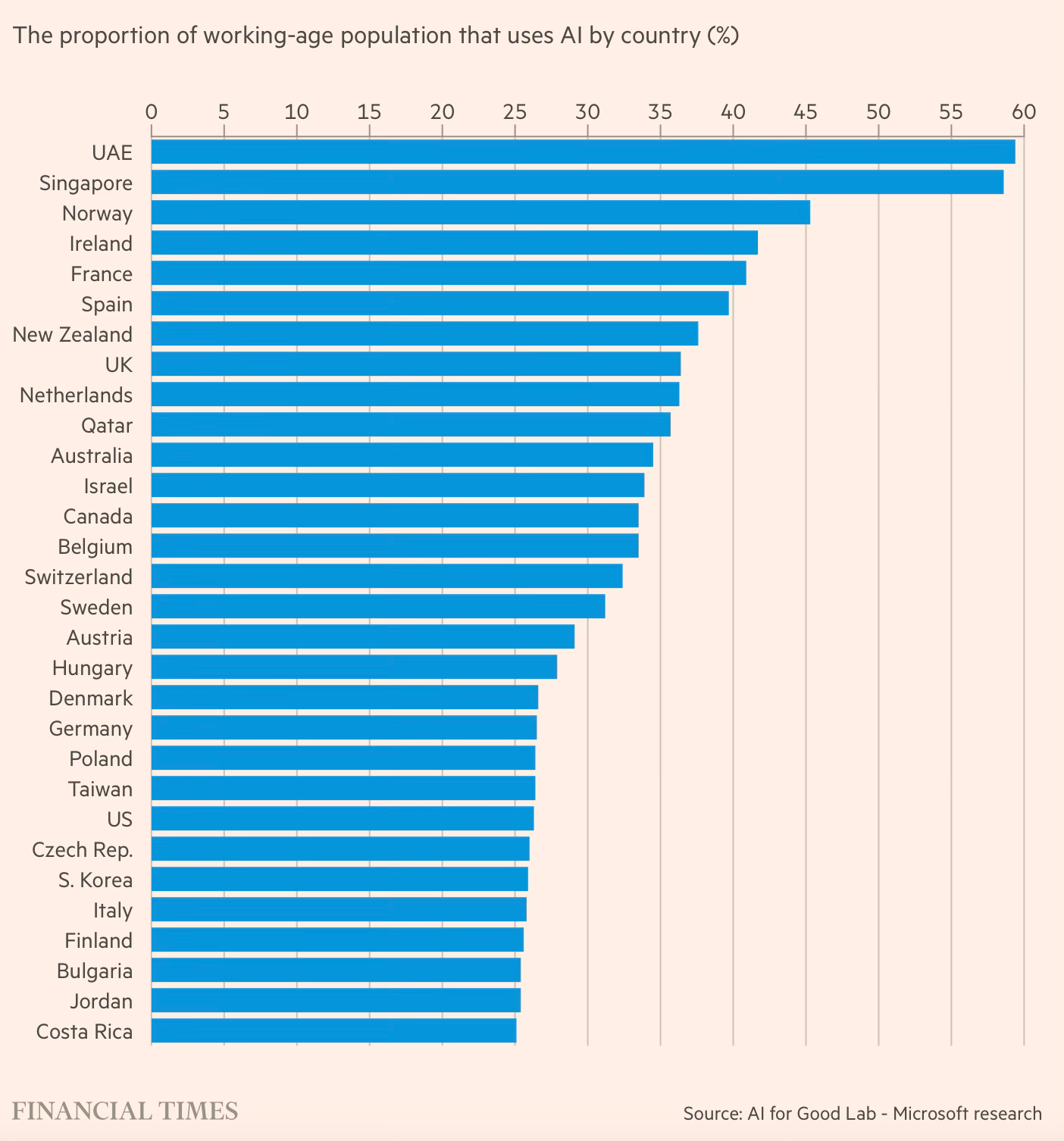
UAE and Singapore top in AI usage globally.

Interestingly, the FT feature also points to concerns about the impact of AI usage on people’s cognitive abilities, especially in their ability to think critically.

Data scientist Austin Wright likened it to the diminished sense of direction that has followed the widespread adoption of satellite navigation systems. A recent paper by Nataliya Kosmyna at MIT’s Media Lab assessed the impact of using an AI assistant for essay writing. The experiment split users into three groups: the first could use ChatGPT for assistance, the second could use a search engine (but with no AI overview) and the third could rely on nothing more than brain power. The findings concluded that using an LLM in an educational context could lead to the accumulation of “cognitive debt”and a “likely decrease in learning skills”. It also found that LLM users struggled to quote accurately from their work and often felt no ownership of the finished essay.

Generative AI is clearly in its early stages, and the debates about its impact in terms of economy-wide productivity increases, profit generation, and job displacement are natural. 

Two undisputed early trends on AI are that the technology firms have plunged headlong into massive AI-centred investments (semiconductor chips, cloud infrastructure, data centres, and LLMs), and these investments are propping up economic activity in the US. 

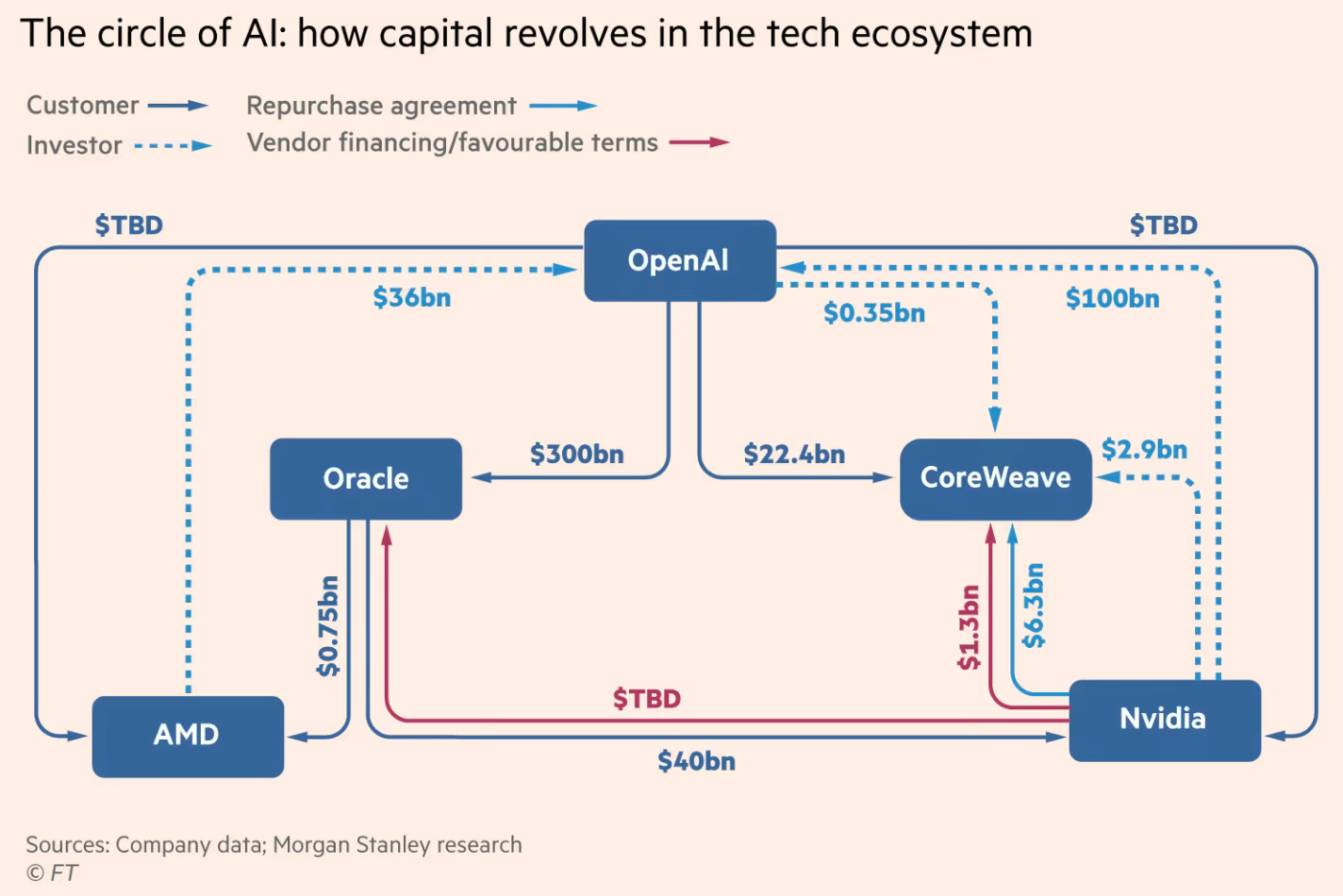
It is becoming clear that these investments are now in bubble territory. Nothing symbolises it more than the series of audacious deals announced by OpenAI over the last month. It amounts to more than $1 trillion of computing power. Sample this

Tapping into that much capital has led OpenAI to weave deals that draw on the financial resources of other Big Tech companies, adding to a growing web of financial dependencies across the AI world. In the process, it could be helping to create a new level of systemic risk in an industry that may already have entered bubble territory… the deal with chipmaker AMD… could eventually result in OpenAI buying enough chips to require six gigawatts of electric power, three times the capacity of the Hoover dam. Each gigawatt of new computing capacity is generally assumed to require capital investment of about $50bn, of which some two-thirds could flow to AMD to pay for chips. 

OpenAI, however, has only placed a firm order for the first gigawatt, and it is not clear how much of this deal — or other parts of its mammoth spending spree — will ever be fully realised. The arrangement also came with an unusual sweetener that could lead to AMD in effect giving OpenAI about 10 per cent of its stock, currently worth $36bn… One challenge has been weighing the odds that these and other megadeals will ever be fully consummated. Among the unknowns: whether demand for AI services will be strong enough to justify building all the data centres, whether the new facilities can be financed, built and equipped, and whether there will be enough electricity to power them.

And there are remarkable parallels with previous bubbles. 

Nvidia has become “the central bank of AI, they’re the lender of last resort”, says Charles Fitzgerald, a tech investor and former Microsoft executive. Taking equity from vendors, and using the money to support further borrowings, has made the AI boom dependent on a high level of convoluted financial engineering, he adds. The circularity has also prompted questions about how sustainable the revenues will turn out to be. It echoes arrangements that were a common feature of the dotcom bubble at the end of the 1990s, says Bill Janeway, a former chair of investment firm Warburg Pincus. Back then, an enterprise software company might have paid to advertise with a new internet media company, in return for the media company buying its software. That artificial arrangement would have created the illusion of stronger demand for both companies’ services, adds Janeway. In the closest parallel to today’s AI infrastructure boom, telecom equipment companies such as Lucent and Nortel advanced money to customers in the 1990s to buy equipment, only to face write-offs when a wave of bankruptcies hit the industry.

All these deals are now only on paper and in very nascent stages. The model will become operational when it can secure financial backers. And this will invariably create systemic risks in the financial markets. 

The nature of the investments in data centres and cloud infrastructure is such that they are medium to long-term in nature. Once built, the presumption must be that demand will materialise. But if demand does not or tanks over time, then the whole model will crumble. No amount of risk mitigation or ingenuity in financing structures can address this scenario. Not even the massive cash surpluses and strong balance sheets of the Big Tech firms and chip makers can insulate the economy from the impact of the shocks. And if this risk materialises, given the amounts involved, it’s certain to have very large financial market and economy-wide impacts. The biggest and most immediate disruption will be on the equity markets, which have bid up the prices of all the companies involved deep into bubble territory. And this disruption can cascade economy-wide through the balance sheets of corporates, financiers, and households. 

If we turn to the economic impact of AI, a Pantheon Macroeconomics report informs that the US GDP would have grown a mere 0.6 per cent annualised in the first half of 2025 if not for AI-related spending, half the actual rate. It also found that total private fixed investment, which rose by 3 per cent Y-o-Y in the second quarter, would have fallen by around 1.5 per cent if not for AI-related components. 

Ruchir Sharma captured the importance of AI in propping up the US economy, provocatively describing it as “one big AI bet”.

The hundreds of billions of dollars companies are investing in AI now account for an astonishing 40 per cent share of US GDP growth this year… AI companies have accounted for 80 per cent of the gains in US stocks so far in 2025… But without all the excitement around AI, the US economy might be stalling out, given the multiple threats… The main reason AI is regarded as a magic fix for so many different threats is that it is expected to deliver a significant boost to productivity growth, especially in the US. Higher output per worker would lower the burden of debt by boosting GDP. It would reduce demand for labour, immigrant or domestic. And it would ease inflation risks, including the threat from tariffs, by enabling companies to raise wages without raising prices. 

But there’s a growing chorus of opinion casting doubts on the impact of AI, at least for now. A recent McKinsey reportsaid, “GenAI is everywhere, except in company P&L”. The report points out that while nearly eight in ten companies have deployed gen AI in some form, roughly the same percentage reported no material impact on earnings. An MIT reportof July 2025 analysed 300 publicly disclosed AI implementations in 52 firms, found that just 5% of integrated AI pilots are extracting millions in value, while 95% had no measurable P&L impact. 

The McKinsey report made the distinction between horizontal and vertical use cases. 

Many organizations have deployed horizontal use cases, such as enterprise-wide copilots and chatbots; nearly 70 percent of Fortune 500 companies, for example, use Microsoft 365 Copilot. These tools are widely seen as levers to enhance individual productivity by helping employees save time on routine tasks and access and synthesize information more efficiently. But these improvements, while real, tend to be spread thinly across employees. As a result, they are not easily visible in terms of top- or bottom-line results.

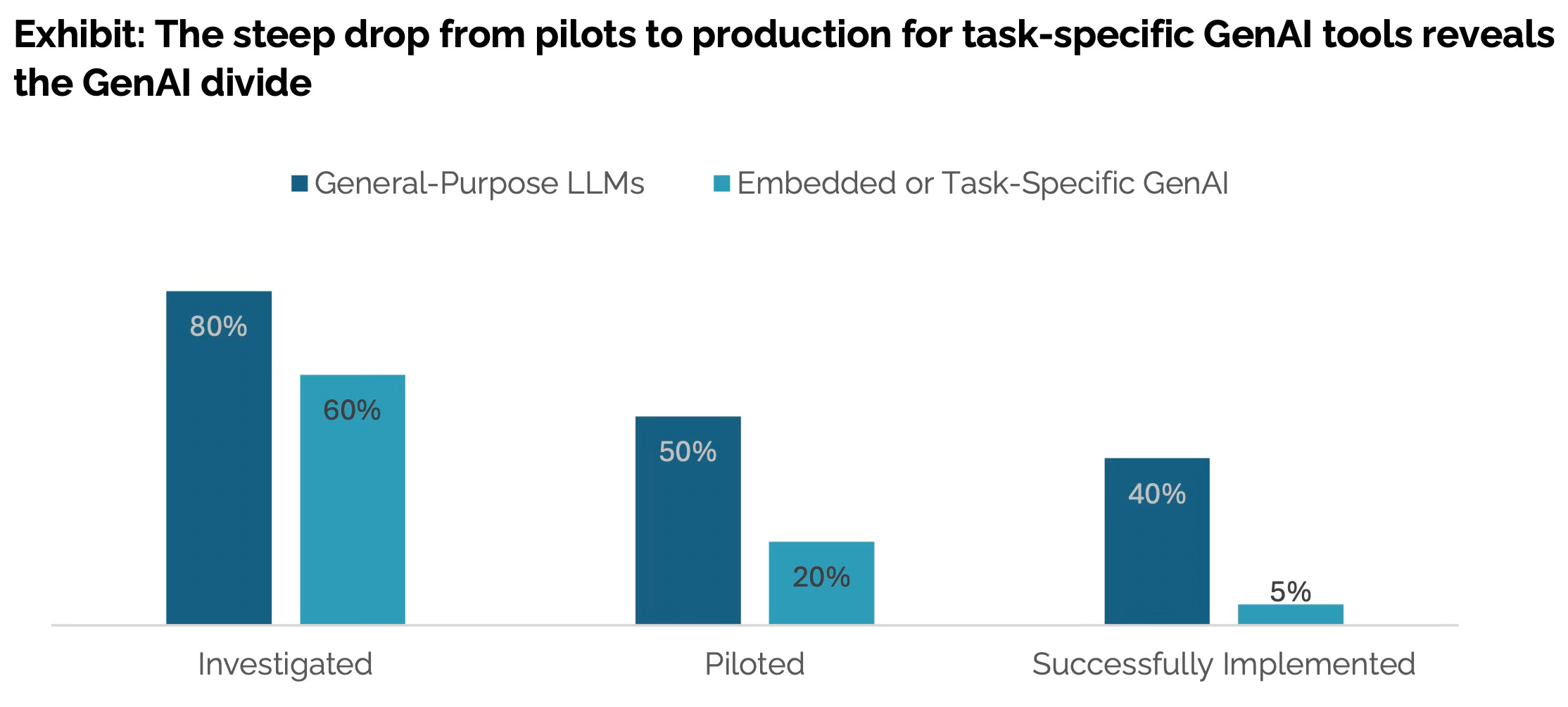
By contrast, vertical use cases—those embedded into specific business functions and processes—have seen limited scaling in most companies despite their higher potential for direct economic impact. Fewer than 10 percent of use cases deployed ever make it past the pilot stage, according to McKinsey research. Even when they have been fully deployed, these use cases typically have supported only isolated steps of a business process and operated in a reactive mode when prompted by a human, rather than functioning proactively or autonomously. As a result, their impact on business performance also has been limited.

Echoing the McKinsey report, the MIT report shows that while 60% of surveyed firms evaluated vertical use cases, just 5% reached production. 

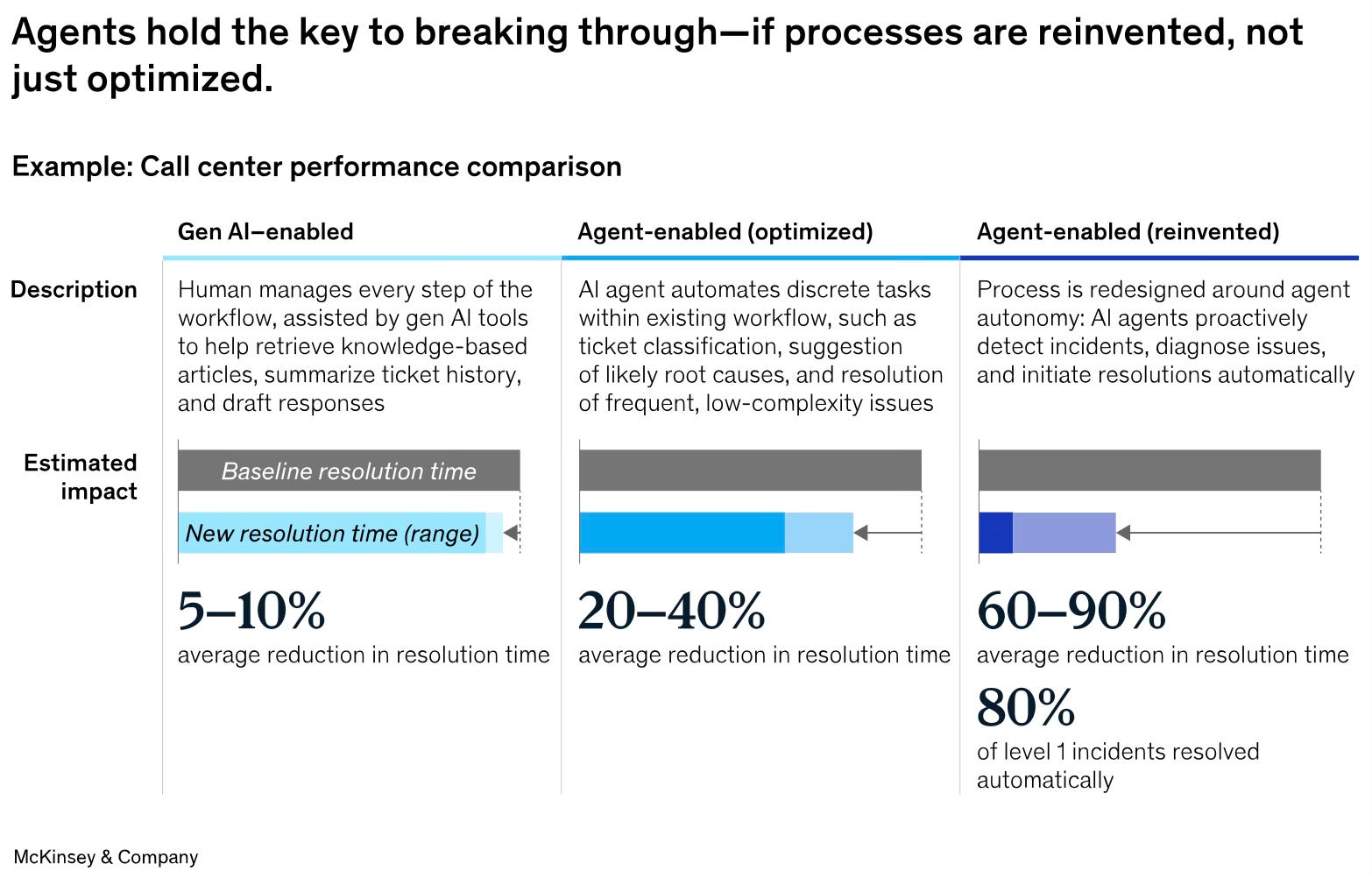
The McKinsey report points to the promise of Agentic AI in transforming processes. 

AI agents mark a major evolution in enterprise AI—extending gen AI from reactive content generation to autonomous, goal-driven execution. Agents can understand goals, break them into subtasks, interact with both humans and systems, execute actions, and adapt in real time—all with minimal human intervention… in the vertical realm, where agentic AI enables the automation of complex business workflows involving multiple steps, actors, and systems—processes that were previously beyond the capabilities of first-generation gen AI tools. 

The report points to five ways in which Agents transform processes. 

Agents accelerate execution by eliminating delays between tasks and by enabling parallel processing.Unlike in traditional workflows that rely on sequential handoffs, agents can coordinate and execute multiple steps simultaneously, reducing cycle time and boosting responsiveness. Agents bring adaptability. By continuously ingesting data, agents can adjust process flows on the fly, reshuffling task sequences, reassigning priorities, or flagging anomalies before they cascade into failures… Agents enable personalization. By tailoring interactions and decisions to individual customer profiles or behaviors, agents can adapt the process dynamically to maximize satisfaction and outcomes. Agents bring elasticity to operations. Because agents are digital, their execution capacity can expand or contract in real time depending on workload, business seasonality, or unexpected surges—something difficult to achieve with fixed human resource models. Agents also make operations more resilient. By monitoring disruptions, rerouting operations, and escalating only when needed, they keep processes running—whether it’s supply chains navigating port delays or service workflows adapting to system outages.

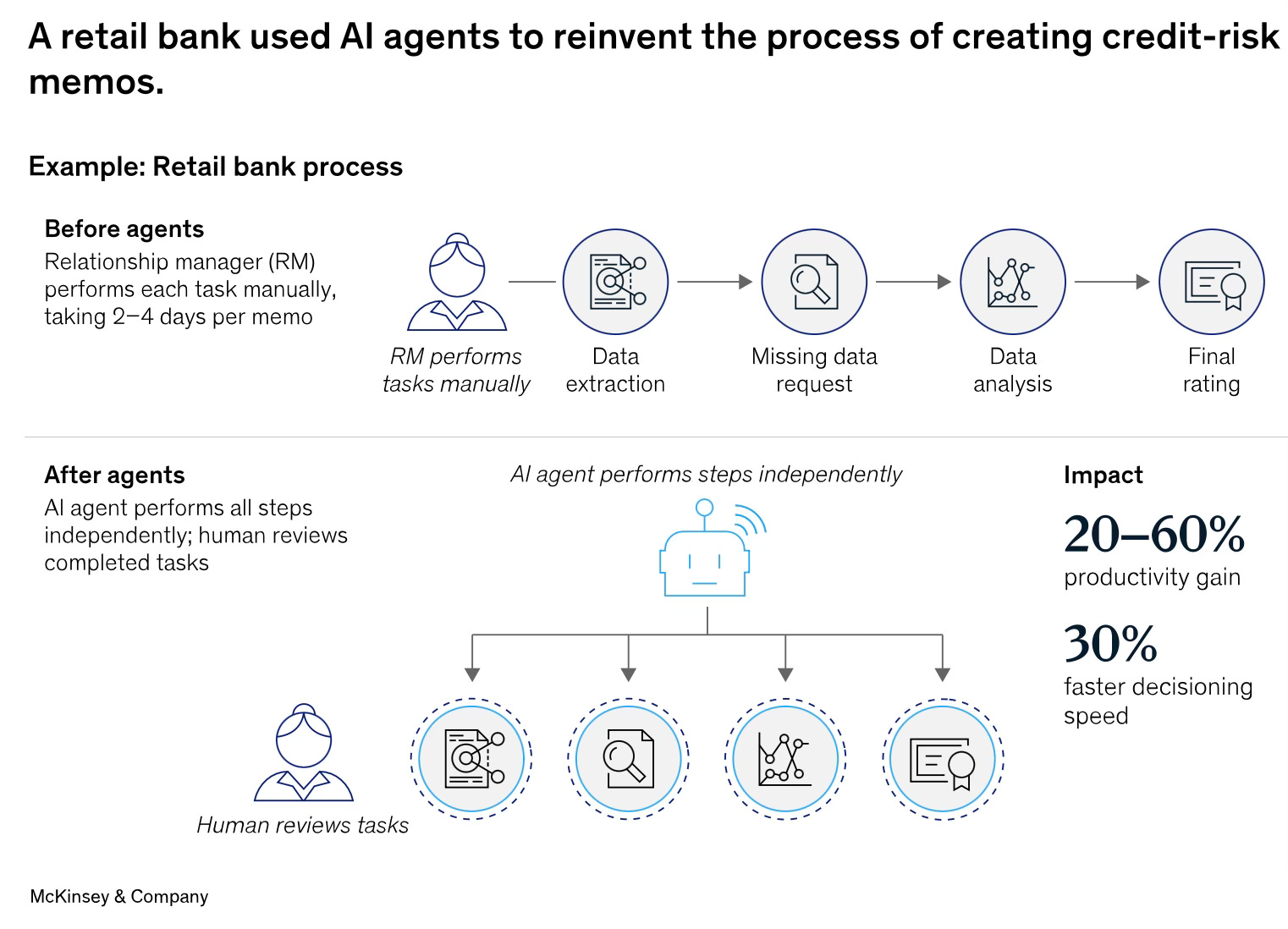
The report has illustrative case studies of vertical use cases. 

And this.

The challenge with the AI-based automation of vertical use cases is that it requires significant customisation through iterative adaptation to be ready for deployment in live settings with their business risks. The IT revolution over the last three decades was about figuring out business process automation. While it automated workflows, the larger business task (which consisted of several such processes) itself was managed by human workers and supervisors, who exercised judgment and made decisions in completing the task. Besides, they could step in an address deficiencies in the digitised workflows. 

Agentic AI now seeks to automate tasks itself. It outsources the decision-making to the Agents. Unlike logic-driven processes, decision-making involves the exercise of judgment that goes beyond logical processing. It is a far more complex task, even on mundane tasks. This requires a much higher order of accuracy and reliability, and embedding of much more rigorous safeguards and internal controls. 

As an illustration, the recent instance of Deloitte being forced to apologise and refund the Australian government after its 237-page report on the review of the government’s welfare compliance systems was found riddled with references to sources and experts that did not exist. The report was apparently written using AI, and raises serious questions about the credibility of AI-assisted consulting. 

Task automation, therefore, requires intense iteration and adaptation of the Agent over longer time frames, before its business deployment. This automation process, in turn, requires considerable human engagement of a very high quality, with significant domain experience, and over an extended period. Even the biggest firms will struggle to mobilise and concentrate such talent over long periods. And this requirement then raises questions about the economics of task automation. 

But it may only be a matter of time before at least some of these problems are overcome and vertical use cases of task automation emerge and become mainstream. But even then, it remains to be seen as to what proportion of human judgment can be outsourced and automated. I’m inclined to believe that all decisions other than simple logic-driven ones will continue to remain in the human realm. However, AI is likely to become an important contributor in helping their human managers become more effective in their decision-making. 

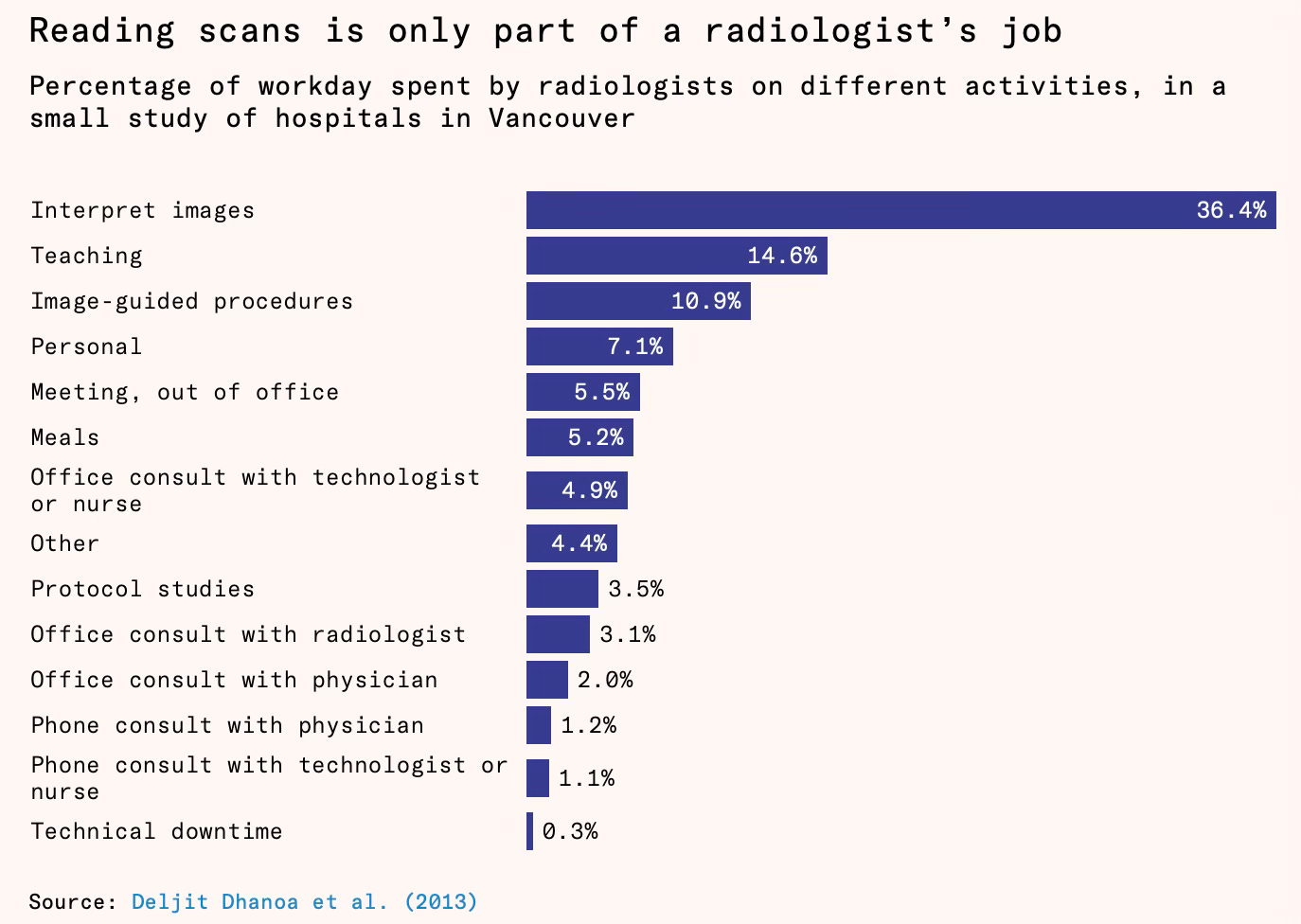
In this context, Deena Mousa examined the impact of AI on radiology, “a field optimised for human replacement, where digital inputs, pattern recognition tasks, and clear benchmarks predominate”. In fact, in 2016, Geoffrey Hinton, widely acknowledged as the father of AI, had declared that “people should stop training radiologists now”. However, in reality, the US diagnostic radiology residency programs not only offered a record 1208 positions in 2025, up 4% from 2024, but the field’s vacancy rates are at all-time highs, and radiology was the second-highest paid medical speciality in the US. 

Mousa concludes that far from being the canary in the coalmine, radiology shows that replacing humans with AI is harder than it seems. She highlights three reasons.

First, while models beat humans on benchmarks, the standardized tests designed to measure AI performance, they struggle to replicate this performance in hospital conditions. Most tools can only diagnose abnormalities that are common in training data, and models often don’t work as well outside of their test conditions. Second, attempts to give models more tasks have run into legal hurdles: regulators and medical insurers so far are reluctant to approve or cover fully autonomous radiology models. Third, even when they do diagnose accurately, models replace only a small share of a radiologist’s job. Human radiologists spend a minority of their time on diagnostics and the majority on other activities, like talking to patients and fellow clinicians…

Even with hundreds of imaging algorithms approved by the Food and Drug Administration (FDA) on the market, the combined footprint of today’s radiology AI models still cover only a small fraction of real-world imaging tasks. Many cluster around a few use cases: stroke, breast cancer, and lung cancer together account for about 60 percent of models, but only a minority of the actual radiology imagingvolume that is carried out in the US.

Multi‑task foundation models may widen coverage, and different training sets could blunt data gaps. But many hurdles cannot be removed with better models alone: the need to counsel the patient, shoulder malpractice risk, and receive accreditation from regulators. Each hurdle makes full substitution the expensive, risky option and human plus machine the default.

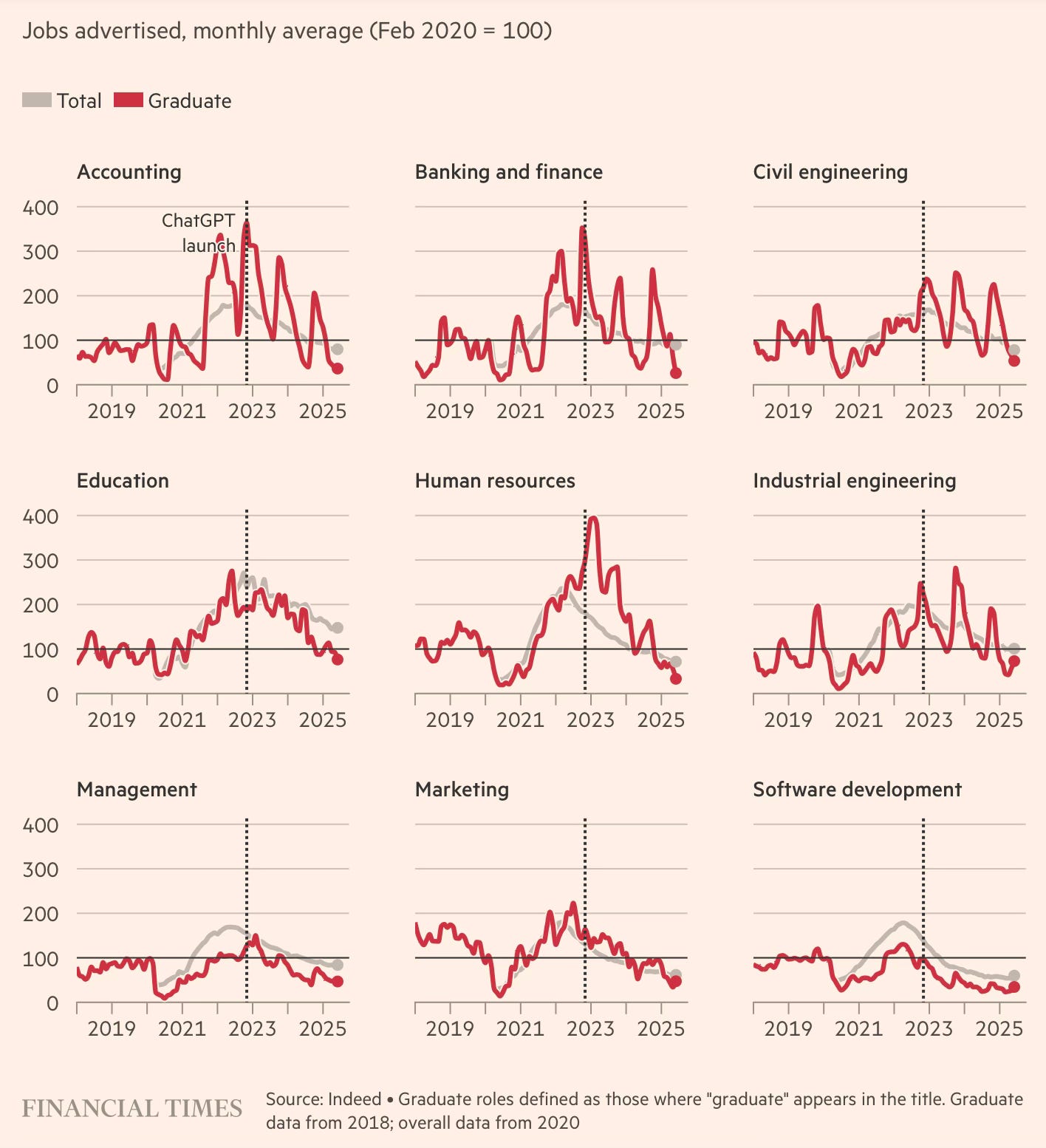
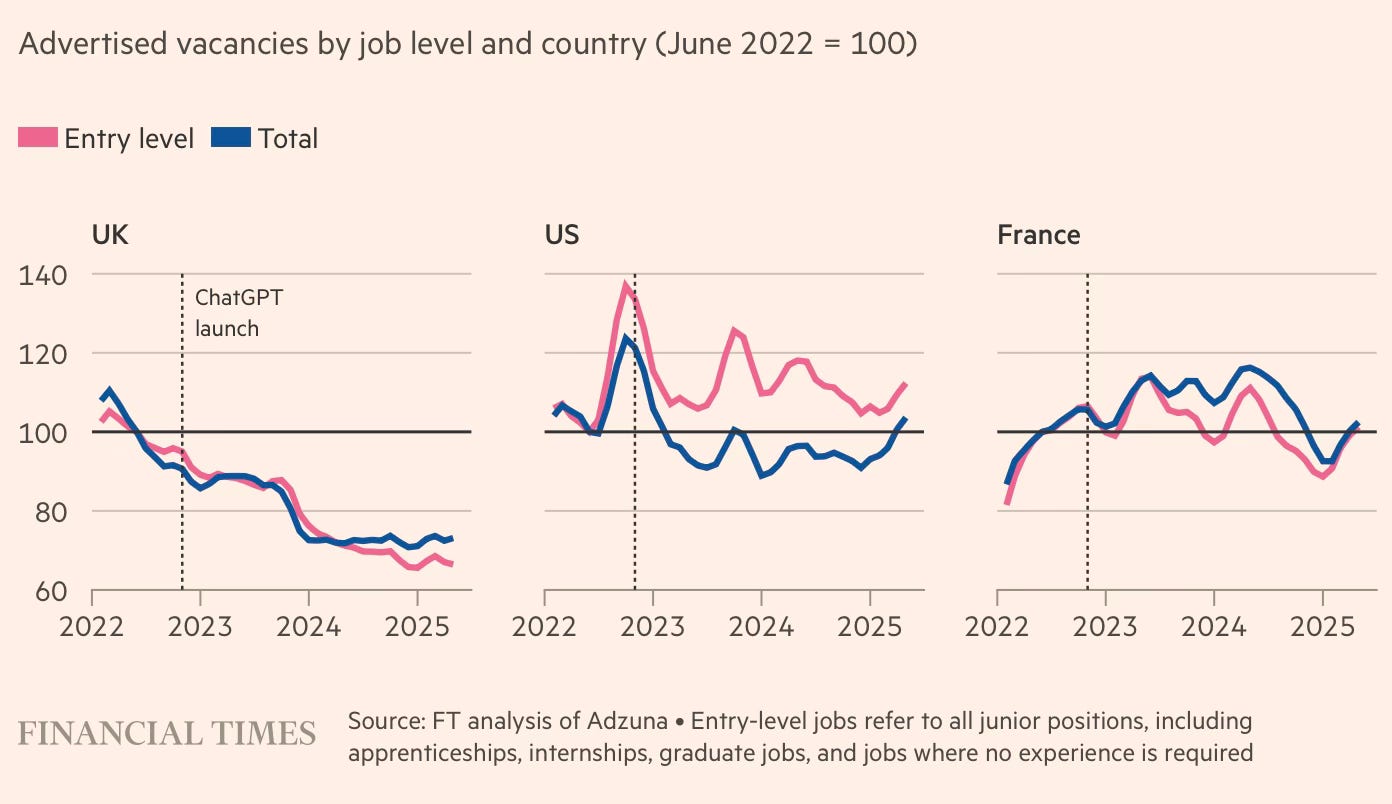
The impact of Gen AI on the labour market, too, is a matter of debate. A recent FT long read found that while job listings for graduate roles are down across sectors, the trend is secular and does not discriminate between sectors identified as being less and more vulnerable to Gen AI. This from UK job listings.

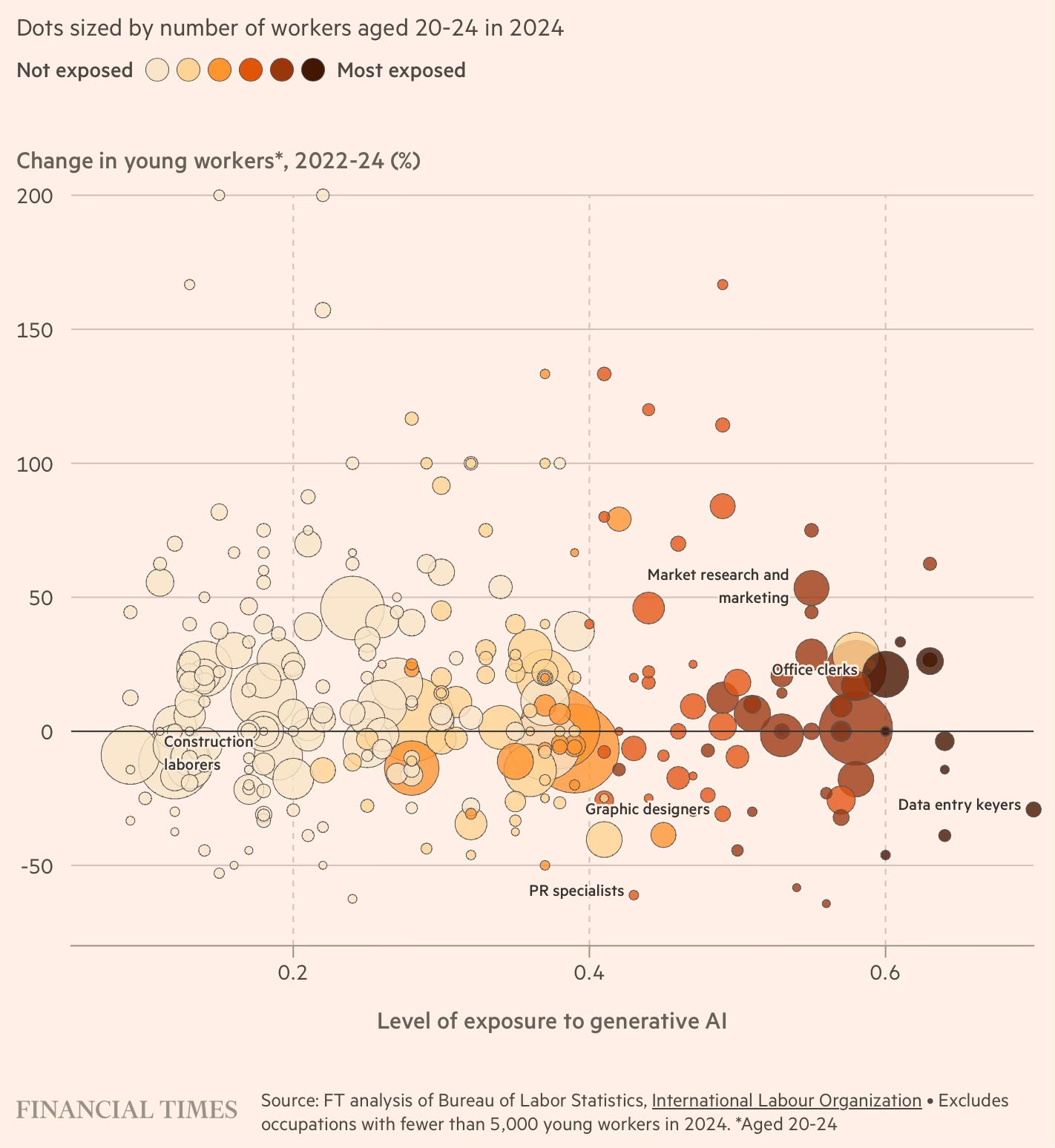
A similar analysis of US jobs at high risk from Gen AI does not show that they have shed young workers in a greater degree since the launch of ChatGPT in 2022. 

In general, entry-level jobs have tended to track the wider labour market trends. 

All these trends are likely to reverse in the coming years. But predicting the extent of reversal and the outcomes is a pure gamble. 

While the economic impacts are a matter of debate, it’s more likely that the social impacts of AI will be much more pronounced. The rise of the digital economy with the internet, communication tools, and social media platforms has transformed our social lives and increased convenience. AI will build on it and is likely to have similarly transformative impacts, for the better or worse. For example, the negative and positive possibilities with a video generator App like OpenAI’s Sora on society and politics are enormous. 

Tuesday, October 14, 2025

Joel Mokyr

The Nobel Prize in Economics this year was awarded to Joel Mokyr, Philippe Aghion, and Peter Howitt. I have blogged about his work here (why the Industrial Revolution happened in England), here (how expanded access to “technical literacy” promoted industrial development in Japan), here (useful R&D), and here (the importance of tinkering and microinventions). 

This post will be about Mokyr, whom I have earlier described as arguably the most important and profound social scientist of our times. His work shines light on arguably the most important question of political economy: what drives economic progress?

Mokyr is best known for studying the period from the mid-eighteenth to the early twentieth centuries, investigating the causes of the Industrial Revolution (IR) and its links to the Enlightenment, and showing that the causal link runs from the latter to the former. He argues that the latter fostered a belief in the possibility and desirability of human progress, scientific temper, and the culture of inquiry and problem-solving, all of which paved the path for the Industrial Enlightenment, which in turn, catalysed the conditions for the IR. 

He first explained why the Enlightenment happened in Europe. 

In Europe in 1500-1700, among the educated elite, there developed a culture and a set of institutions suitable for intellectual innovation and the accumulation of useful knowledge. Europe was lucky to stumble on an institutional solution that supported the market for ideas, actively encouraged innovation, and led to an exponential growth in useful knowledge. This institution was a transnational community of scholars, an intellectual commons resource (scientists, mathematicians, physicians, philosophers). It is described as the “commonwealth of learning” or the “Republic of Letters” (respublica literaria). 

It was a virtual pan-European community that shared, distributed, and evaluated knowledge. It was the “community” that resolved the common resource (of new ideas) problem. Its rules included an open community, which excluded none and where knowledge and data should be shared; which was egalitarian and non-hierarchical; all knowledge, both old and new, was contestable (with no sacred cows); and all new propositions were to be reproduced, checked, tested, and evaluated (reliability of new knowledge).

The Republic of Letters created “open science” as a transnational intellectual commons management device. It created norms that new knowledge would be placed in the public realm and accessible to anyone who wanted to build on it and use it for technological purposes. By 1700, the norms of “open science” were fully in place. By creating a pan-European institution linking intellectuals, it also created economies of scale for ideas. Europe enjoyed “intellectual unification amidst political fragmentation”. It allowed new knowledge and discoveries to diffuse quickly into a large market.

The community thrived because it was largely independent of religion and politics. The political fragmentation of Europe, the Protestant Reformation, etc., limited rulers and organised religion from controlling knowledge creation. Those with ideas could shop around across kingdoms. Another contributor was patronage, which was a competitive market where sellers (those with ideas) and buyers (rulers, universities, academies, etc.) competed intensely to attract smart people to their court as a matter of prestige, and a source of getting useful advice, the latest medical care, tutors for their children, etc.

In simple terms, Mokyr showed that the most important institutional change that explains IR is not better property rights, a decline in transaction costs, or the Glorious Revolution in England. Instead, it was the institutions that governed the accumulation and diffusion of “useful knowledge” and the solution to the “knowledge commons” problem that the Republic of Letters in Europe provided.

Why did the IR start in Britain as opposed to continental Europe?

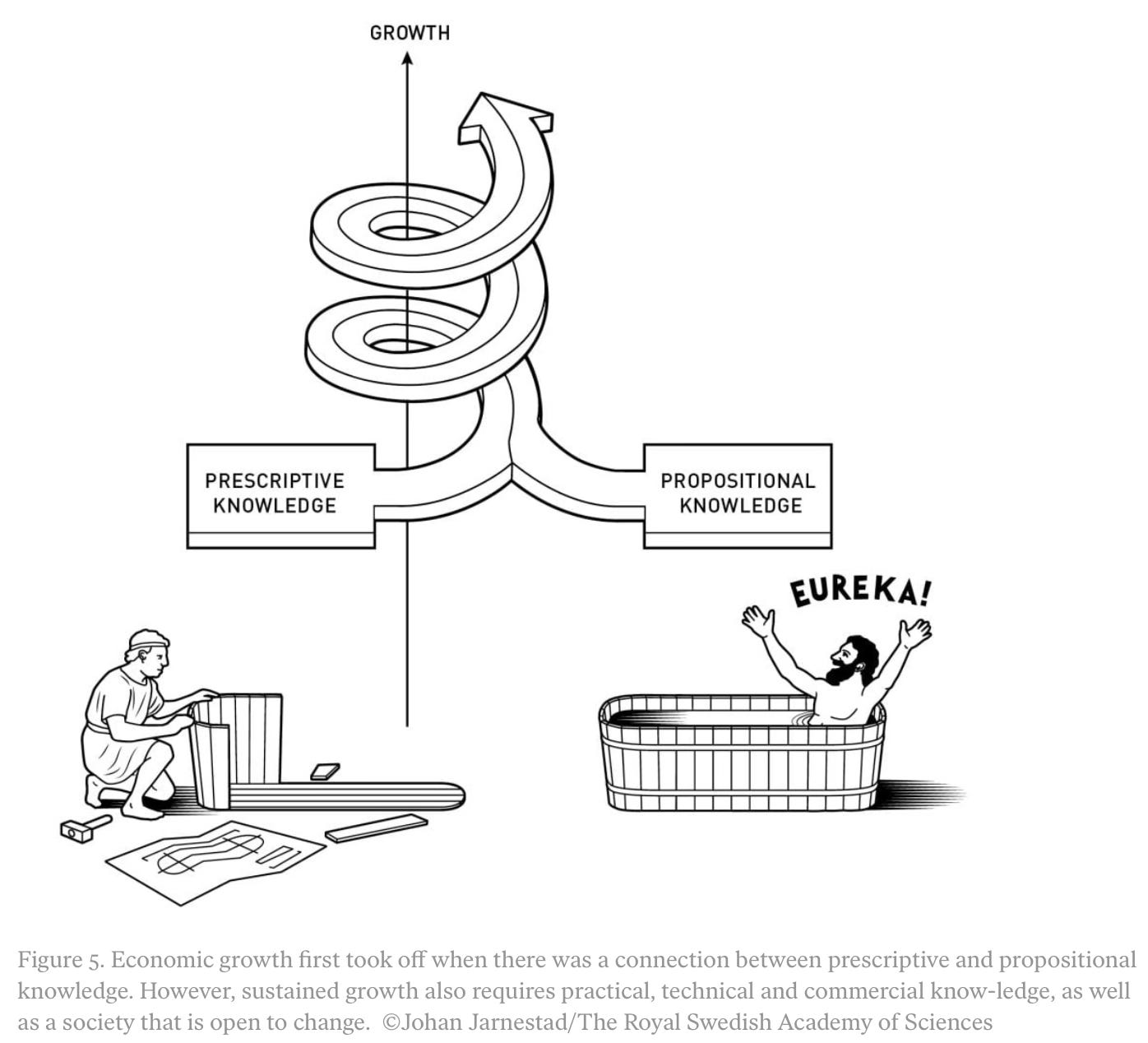
He uses the concept of useful knowledge to answer this question. He defines useful knowledge as that which promotes material progress. It consists of propositional knowledge (“what”) and prescriptive knowledge (“how”). The former describes the “regularities in the natural world that demonstrate why something works”, whereas the latter consists of “practical instructions, drawings or recipes that describe what is necessary for something to work”. It’s a distinction between people who know things (savants) and who make things (fabricants).

He described two aspects of the Age of Enlightenment that led to the deployment of useful knowledge to catalyse the IR and promote economic growth. One, the generation of useful knowledge by creating incentives (patents, awards, prizes, medals, pensions, memberships in Royal Societies, and generally higher social status, etc). 

Second, easier and cheaper access to existing knowledge through written compilations like libraries, book indexes, alphabetisation, compilations based on topic, etc. The Age of Enlightenment expanded access by promoting the codification of knowledge and establishing linkages between philosophers, industrialists, entrepreneurs, inventors and artisans, etc. This meant that savants communicated not only with one another but also with fabricants. 

All this created positive feedback mechanisms between propositional and prescriptive knowledge. He describes this fusion of scientific knowledge, technological know-how, and a culture that valued human progress as the Industrial Enlightenment. 

The Industrial Enlightenment focused on material progress and the growth of prosperity, and it believed that useful knowledge was the key to achieving this. This became the Baconian program. While the English and continental European Enlightenment thinkers shared the belief in the possibility and desirability of progress, there was a crucial difference between them.

The continental enlightenment thinkers focused on morality, government, justice, and what was wrong with society. In contrast, the English intellectuals were less concerned with political and social issues, and more with the kind of progress driven by practical, useful knowledge leading to material advances. The English Enlightenment thinking concerned nuts and bolts, pulleys and belts, cogs and springs. As Roy Porter said, “British pragmatism was more than mere worldliness: it embodied a philosophy of expediency, a dedication to the art, science and duty of living well in the here and now.”

Supplementing this, in his classic work, The Culture of Growth, he points to the different ways in which cultural beliefs create the conditions for the adoption of technology.

The most direct link from culture and beliefs to technology runs through religion. If metaphysical beliefs are such that manipulating and controlling nature invoke a sense of fear or guilt, technological creativity will inevitably be limited in scope and extent. If the culture is heavily infused with respect and worship of ancient wisdom so that any intellectual innovation is considered deviant and blasphemous, technological creativity will be similarly constrained. Irreverence is a key to progress… so, as Lynn White has pointed out, is anthropocentrism. In his classic work, White stressed the importance of a belief in a creator who has designed a universe for the use of humans, who in exploiting nature would illustrate His wisdom and power… social attitudes toward production and work (and leisure) are another major factor in determining the likelihood of innovation.

Technologically progressive societies were often relatively egalitarian ones. In societies dominated by a small, wealthy, but unproductive and exploitative elite, the low social prestige of productive activity meant that creativity and innovation would be directed toward an agenda of interest to the elite. The educated and sophisticated elite focused on efforts supporting its power such as military prowess and administration, or on such topics of leisure as literature, games, the arts, and philosophy, and not so much on the mundane problems of the farmer in his field, the sailor on his ship, or the artisan in his workshop… The agenda of the leisurely elite was of great importance to the lovers of music in the eighteenth-century Habsburg lands, but was not of much interest to their farmers and manufacturers. The Austrian Empire created Haydn and Mozart, but no Industrial Revolution. As McCloskey has stressed, the bourgeois societies of the Netherlands and Britain of the seventeenth century, in contrast, were prime candidates for technological advances.

Finally, Mokyr’s work points to the importance of relentless implementation over just ideas. He describes microinventions, or the incremental improvements needed to turn a new idea into a significant product. Tinkering, embodiment, and scaling are examples of microinventions, and are often more important than the original breakthrough itself. Making technology useful often means building it at scale. Mokyr says,

“Most major inventions initially don’t work very well. They have to be tweaked, the way the steam engine was tinkered with by many engineers over decades. They have to be embodied by infrastructure, the way nuclear fission can’t produce useful electricity until it’s contained inside a working reactor. And they have to be built at scale, the way Ford’s Model T came down in price before it made big difference to the country.”

Interestingly, the Nobel Committee describes all three as “having explained innovation-driven economic growth”. I’m not sure that microinventions are exactly innovations, or what we commonly perceive as innovations. I’m inclined to argue that the popular narrative generated by the innovations and innovators in the information and communication technology (ICT) sector in the US over the last three decades has led to the diminution of persistence and implementation, and elevated ideas and eureka moments as the defining values and skills. 

This narrative will most likely interpret Mokyr’s work as a nod to the importance of such innovation. But that may be misleading. 

It should be noted that Mokyr’s examples of microinventions are tinkering, embodiment, and scaling. This is a process of continuous iteration and adaptation. I’m inclined to describe this as a process of innovation (a structured process of creating new or improved products) driven forward by improvisation (spontaneous, on-the-fly creation of solutions to an immediate problem). As Mokyr writes, for inventions to materialise, the latter may be more important than the former. 

Extending this insight to the field of international development, I had blogged here.

The fundamental insight is that it’s not ideas that lead to development but their implementation, and that implementation is almost always far more daunting than the process of discovery of the idea itself. In fact, only a fraction of the pipeline of ideas ever finds its way into successful implementation… The most valuable individual and collective attributes for progress and development may be the desire and skills to tinker and embody (or institutionalise) to solve problems. In development in particular, they are far more important than the ability to ideate and innovate. Persistence and not mutation is what drives development (and much else in life)… It’s therefore apposite that development embraces and elevates the attributes, skills, and values of problem-solving through the process of tinkering, embodying, iterating, and scaling, instead of the current fetish with new ideas and innovation. 

All in all, the Nobel to Mokyr is a recognition for arguably the pre-eminent social scientist of our times.

Monday, October 13, 2025

Electrification in Africa is a global development failure

I had blogged here arguing that the availability of adequate and good-quality power is the biggest constraint to Africa’s sustained economic growth. 

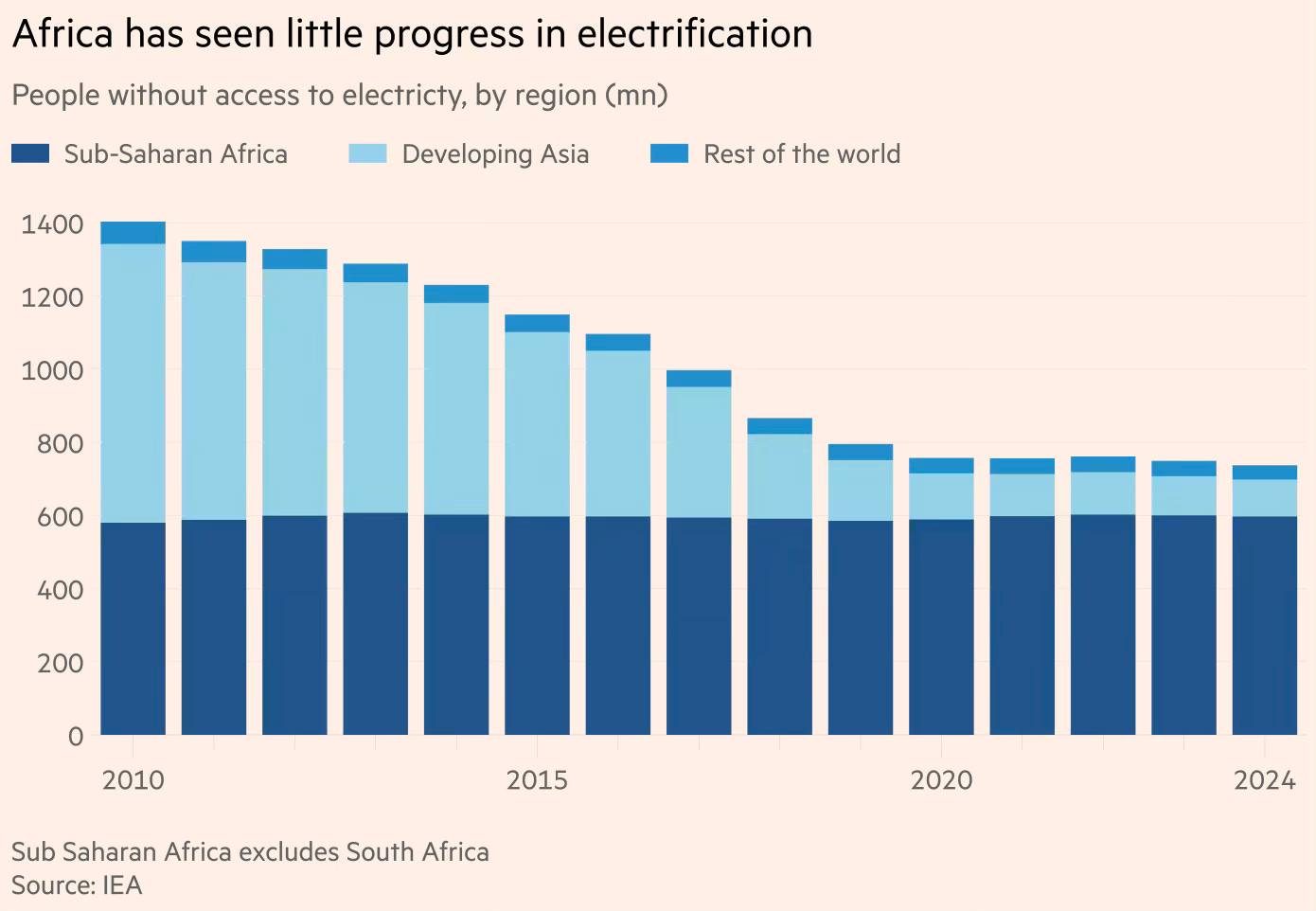
The graphic below is a powerful illustration of one of the biggest failures of global development efforts.

The number of people in Africa without access to electricity remains at 600 million, unchanged from 15 years ago. Among those without electricity globally, the share of Africans has risen from a third in 2010 to 80% in 2024. 

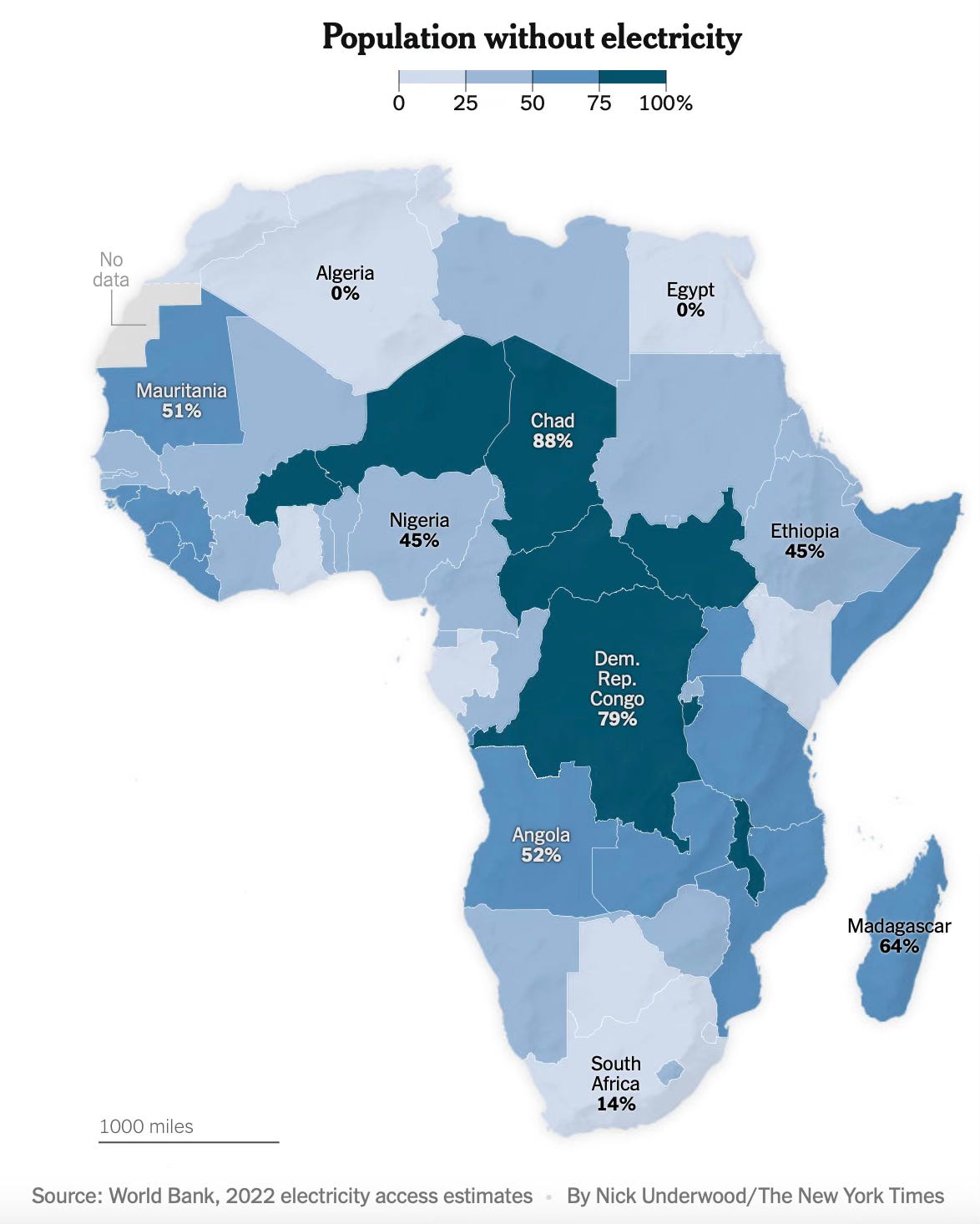
Africa’s electrification problem seems to be excessively concentrated in its hinterland areas, in the region sandwiched between the North and the South. 

In this context, it’s also useful to see the contrasting fortunes of South Asia and Sub-Saharan Africa in electrification. 

Africa has had a very low baseline of electrification. For example, SSA reached South Asia’s 1995 level of electrification only by 2020, despite its percapita GDP in 2020 being 2.34 times more than that of South Asia in 1995. East Asia and Latin America had a much higher baseline of electrification than even South Asia. This questions an oft-repeated argument that Africa will be able to afford high electrification rates only if its incomes rise enough to sustain a viable market. 

I’m inclined that a very big reason for the gap is the governance of the electricity supply. Through a series of reforms, South Asia, especially India, managed to restructure the sector, regulate it more effectively, improve operational efficiencies of state utilities, and gradually bring in consumer payment discipline. The industrial, commercial, and other higher consumption subscribers were able to ensure that the discoms could become viable entities even after subsidising the vast majority of residential consumers. All this, in turn, derisked the sector and opened the door for private investments in generation. 

The take-off point for electrification in India was the Electricity Act 2003, one of the least appreciated among India’s economic reforms. Today, almost all incremental generation capacity addition from all sources comes from the private sector, and it owns more than half the total installed capacity, from virtually zero at the turn of the millennium. Domestic promoters and capital, intermediated mostly by regular banks, have been the major financiers. 

Africa too must go through these reforms if it’s to derisk its electricity sector and make it viable enough for private investments into generation. In most African countries today, it appears futile to rely on private financing in any meaningful manner to meet power generation requirements. I had blogged here, highlighting the challenges with attracting private investments into power generation in Africa. Till then, public financing may have to do the heavy lifting on electrification in Africa. 

In the spectrum between public and private goods, electricity is an interesting outlier. While it’s a private good insofar as people pay for access, power itself has several positive externalities in human resource development and economic growth. In fact, reliable three-phase electricity is one of the most essential preconditions for economic growth. Public production and provisioning of electricity may, therefore, be an unavoidable necessity in Africa for the foreseeable future. 

In this context, South Africa’s recent success with reforming its electricity sector and reviving Eskom after numerous scandals and rolling power cuts for several years offers an encouraging sign. 

In the latest global endeavour to electrify Africa, the World Bank and the African Development Bank have launched a $90 billion scheme to bring electricity to 300 million people in Sub-Saharan Africa by 2030. About 30 countries have already signed ‘energy compacts’ under the Mission 300 initiative. 

A cursory reading of the Mission 300 plan reveals a mix of objectives thrown in under the broad umbrella of electrification - promotion of renewable energy, decentralised and distributed generation, supply through mini and micro-grids, private participation, complex financial instruments, partnerships between DFIs and philanthropic foundations, microentrepreneurs, etc. In simple terms, the objective of electrification is being pursued through private participation, foreign funding, and renewable energy generation. There are several problems with this approach.

For a start, it’s the classic “everything bagel” development, where multiple laudable objectives are being sought to be achieved in the guise of electrifying Africa. Each of these objectives is challenging by itself, and bundling them only makes the objective of electrification in Africa manifold and daunting. 

The involvement of several partners in the coalition, while laudable, also risks diffusing accountability and responsibilities. Given the scale of the problem, the role of philanthropies and impact investors is marginal. Even meaningful private investments will be difficult to realise in most countries, especially in the early stages. Given the requirements, small renewable energy units and mini grids are marginal compared to thermal generation and grid supply. As the long history of infrastructure financing in low-income countries shows, complex financial instruments will struggle to make any headway. 

Importantly, the opportunity cost of coal (and rivers) rich Africa foregoing thermal (and hydel) power and relying on intermittent solar or wind power is considerable. Besides, given the commercial risks involved, the total cost of renewable power generation by the private sector (including the cost of capital and storage) is likely to far exceed pithead thermal and hydel generation that’s possible in many African countries. In the first stage, it may be useful to prioritise projects with a demand mix that primarily serves industrial and other bulk consumers. The Mission 300 should prioritise all such projects.

The quantum of funds required means that the major share of financing must come from national governments and traditional bilateral and multilateral DFIs through grants and concessional loans. Unless this fundamental constraint is relaxed, the rest are only distractions in the serious endeavour of significantly increasing electrification in Africa.