Substack

Tuesday, July 30, 2019

Lessons for India from UK on PPPs

Here is my co-authored oped with Dr TV Somanathan which outlines the lessons for UK's PPP experience and offers some suggestions for India.

Update 1 (30.07.2019)

In the context of India, Ananth sends this Businessline editorial urging caution on the Railways decision to embrace PPPs. The global evidence on railways is voluminous and speaks very loudly. The government should avoid PPP for rail tracks - not only is there not even one example from anywhere that it has worked, there are plenty from everywhere that it unravels very quickly. 

But for rolling stock, PPPs offer promise. It is also a great opportunity for industrial policy - ensure that PPPs are single-mindedly aimed at attracting the best global players to "make in India"!

Monday, July 29, 2019

The SoftBank bubble keeps inflating, as does WeWork

SoftBank has announced the launch of a second Vision Fund that will raise $108 bn from investors including Japanese financial groups, Foxconn, Microsoft and Apple to invest in technology start-ups. It would seek to accelerate “the AI revolution through investment in market-leading, tech-enabled growth companies”.

Its first fund of $97bn, 60% backed by governments of Saudi Arabia and Dubai and launched in May 2017, had disrupted the global VC market. SoftBank said it would contribute $38 bn to the new fund, which surprisingly does not yet have any investment commitment from the Middle Eastern governments. 

The first fund was structured for the participants to hold some of their contributions as equity and the majority as preferred debt, with SoftBank being the only pure equity investor. In the second fund, reflecting the risks, the preference appears more skewed towards preferred debt and even less of equity. 
This is very interesting and communicates the essence of the first Vision Fund,
The Vision Fund has made 29 per cent annual returns for investors from May 2017 through March this year, SoftBank said, based on the higher valuations of the portfolio companies. The fund is notable not only because of its massive size but also because of its unusual structure. The Vision Fund is heavily leveraged, relying on an unconventional structure where 40 per cent of its capital is preferred securities that pay an annual coupon of 7 per cent. It remains unclear how the new fund will be structured. SoftBank recently raised cash through at least $4bn in loans against stakes in Slack, Uber and Guardant Health, which could be used to pay dividends to the first Vision Fund.
In simple terms, borrow using rising shares/valuations (itself based on questionable assumptions, as the names in the graphic above would show), use that as equity, and leverage more to construct a Fund. And furthermore, borrow using shares to even pay the dividends for the existing investments. Any different from a Ponzi. The triumvirate of low interest rates, rising equity valuations, and leverage underpin the Vision Fund. Each of the three are intimately dependent on the other. A shock on one, and the whole pack could unravel very quickly. 

And then there is also the issue of investment opportunities to deploy the capital raised,
“They’re starting to run out of runway. The scale they’re trying to invest in, billions of dollars per unicorn (a start-up valued at $1bn) — there’s not many of those deals globally. They’ve already had big exposure to a handful of them, and so a lot of it is just going to have to continue to fund their own deals.”
It is in this context that the case study of WeWork assumes significance. Ananth points to the latest developments at WeWork, an entity whose valuation is effectively backstopped by SoftBank, and which has become poster child for no-tech start-ups (though it is vigorously trying to show that it is as much tech as its tech peers). The company rents in long-term spaces, renovates and divides the offices, and rents them out on a short-term basis, thereby owning few properties. 

Ahead of its impending IPO, contrary to normal practice and raising questions, the company's founder, Adam Neumann, has cashed out more than $700 m for himself through stock sales and by taking on debt against his shares. Apart from this, the company itself is raising upto $4 bn in debt, with the possibility of going upto $10 bn, to finance expansion and thereby keep boosting its valuation. The company plans to use the cash flow from its individual buildings to finance the debt. 

Despite its spectacular growth, the company, with offices at 485 locations, has been losing money continuously, losing $3.5 bn since 2016. Its 2018 revenues of $1.8 bn was outstripped by its losses of $1.9 bn. Reflecting the concerns, a plan by Softbank to invest $16 bn, including $10 bn to buy out early investors, fell apart early this year, after Softbank's investors could not agree on a valuation. Softbank ultimately invested $5 bn at $47 bn valuation in January. To put its losses in perspective,
Since 2016 it has racked up a deficit of more than $3bn; last year it accumulated losses to the tune of $220,000 every hour of every day. Those narrowed slightly in the first quarter of 2019, to just under $219,000 an hour in the 12 months to March.
It is a reflection of what the market thinks of WeWork that its bonds were assigned junk ratings when it raised debt of $702 million last year at a high interest rate of 7.9%. And since then, those bonds have slid significantly, reflecting investor concerns. 

Interestingly, JPMorgan Chase has been helping him borrow personally against his WeWork stake as well as working with the company to structure the debt deal. 

While the exact stake is not known, Neumann's shareholding combined with the dual-class voting shares with owner's share having ten times the votes of the standard common stock means that he has voting control in the company. 

Neumann has been, separate from WeWork, personally accumulating properties. And in a very questionable practice which is pervasive in private equity, some of those properties have been leased to WeWork which is paying him millions a year in rent. After its IPO filing, in order to mitigate this conflict of interest, WeCompany, the parent company of WeWork, has announced that it would buy out from Neumann those properties of his where it is a tenant. Another exit pathway for the promoter?

Update 1 (23.08.2019)

Even as WeWork bleeds, sample the health of a competitor,
IWG, a landlord that has been renting flexible space to less groovy companies for decades, is on course to earn more revenue than WeWork this year and is profitable. Even so, it trades at about a tenth of WeWork’s private valuation.
Update 2 (03.11.2019)

NYT has this summary of the WeWork saga and excesses,
The last 80 days have seen an implosion unlike any other in the history of start-ups. WeWork filed for an initial public offering with a prospectus that was quickly ridiculed for its incoherence; investors learned of several red-flag financial arrangements by Mr. Neumann; the company’s valuation plummeted; Mr. Neumann was forced to resign; and the I.P.O. was withdrawn. Once estimated to be worth $47 billion, WeWork was reduced to $7 billion, after a rescue by the Japanese giant SoftBank. But WeWork’s astonishing downfall came with an even more astonishing exit package for Mr. Neumann: The 40-year-old could receive more than $1 billion after selling his shares to SoftBank and collecting a $185 million consulting fee. As the scope of the disaster comes into focus, the question on everyone’s mind... is how Mr. Neumann managed to fail up so spectacularly.


The answer has a lot to do with... an inexplicably persuasive charisma and a taste for risk... also had an uncanny ability to read people, from potential investors to reporters, gain their loyalty and then sell them on his vision of a “capitalist kibbutz” on a global scale... Crucially, Mr. Neumann was selling to an eager audience at the right time: WeWork’s rebranding of the office as an expansion of one’s personality made sense to a generation of the intermittently employed... It may have never reached the stratosphere, though, if Mr. Neumann had not found the perfect benefactor: SoftBank’s chief executive, Masayoshi Son.
And about the role of SoftBank funding,
Famously, in 2017, Mr. Neumann spent just 12 minutes walking Mr. Son around WeWork’s headquarters, prompting an investment of $4.4 billion...To WeWork insiders who know Mr. Neumann — most of whom spoke on the condition of anonymity because of nondisclosure agreements signed with the company — the SoftBank deal changed things precipitously. They talk about WeWork as existing pre- and post-Masa. The investment transformed the start-up from a mere unicorn into something with nearly unlimited ambition.
And interestingly,
Mr. Son and Mr. Neumann became acquainted in 2016 in India, during a gathering of start-up luminaries with Prime Minister Narendra Modi.
Update 3 (15.12.2019)

The realms of post-mortems about WeWork reveals that Adam Neumann excellent at selling dreams to investors and the company's Board. Now we all know that not only were those dreams were just that, dreams, and that he was also indulging in downright unethical corporate governance. Even ten years back, such a businessman would have been rightly called out as a con-man!

A good WSJ investigation about WeWork, and especially how its distinguished Board presided over one of the most spectacular corporate implosions.

This graphic of WeWork's heady valuation climb followed by even steeper downfall is instructive.
This graphic highlighting the divergence between WeWork's net income projects versus actuals is truly spectacular.
Update 4 (05.01.2020)

Matt Stoller describes WeWork as an example of counterfeit capitalism,
What predatory pricing does is to enable competition purely based on access to capital. Someone like Neumann, and Son’s entire model with his Vision Fund, is to take inputs, combine them into products worth less than their cost, and plug up the deficit through the capital markets in hopes of acquiring market power later or of just self-dealing so the losses are placed onto someone else. This model has spread. Bird, the scooter company, is not making money. Uber and Lyft are similarly and systemically unprofitable. This model is catastrophic not just for individual companies, but for their competitors who have to *make* money. I’ve written about this problem before. Amazon has created a much less competitive and brittle retail sector. Netflix’s money-losing business is ruining Hollywood.

Endless money-losing is a variant of counterfeiting, and counterfeiting has dangerous economic consequences. The subprime fiasco was one example. Another example was the Worldcom fraud in the late 1990s, which forced the rest of the U.S. telecom sector to over-invest into broadband. Competitors have to copy their fraudulent competitors. It’s a variant of Gresham’s Law, which says that "bad money drives out good.” If you can counterfeit something for cheap, the counterfeit will eventually take over the entire market and drive out the real commodity. That is what is happening in our economy writ large, a kind of counterfeit capitalism as ‘leaders’ like Neumann are celebrated and actual leaders who can make things and manage are treated like dogshit.

This kind of counterfeit capitalism is terrible for society as a whole. At first, with companies like Walmart and Amazon, predatory pricing can seem smart. The entire retail sector might be decimated and communities across America might be harmed, but two day shipping is convenient and Walmart and Amazon do have positive cash flow. But increasingly with cheap capital and a narrow slice of financiers who want to copy the winners, there is a second or third generation of companies asking Wall Street to just ‘trust me.’ As euphoria in capital markets takes hold, predatory pricing scheme come to entirely wastes capital on money losing enterprises, and eventually these companies become Soviet-style generators of white elephants and self-dealing. The men and women who run them have to be charlatans, because they are storytellers justifying losses. Powerful men like Dimon are sucked in, consultants start explaining to old-line economy companies how they too can become like WeWork, and eventually more and more of the economy just adopts counterfeit capitalism.

Saturday, July 27, 2019

Weekend reading links

1. Nice article on London's residential blue plaques which commemorate great people who lived in the same place. The scheme, founded in 1866, and administered by a society, English Heritage, fixes ceramic blue circular plaques on 12 residences, which are selected after a very competitive process of vetting by a committee of 12 eminent historians, artists, and other eminent people. Residents can make applications, and the subject must have died more than 20 years before and the surviving building must remain in a form that the commemorated person would have recognised and be visible from a public highway.

2. Megan Greene writes about the apparent decoupling of wages as a determinant of monetary policy.  Despite NAIRU being revised downwards multiple times and unemployment rate declining continuously, wage inflation remains elusive, pointing to a breakdown in the Phillips curve theory that trades-off inflation and unemployment. She points to the whole list of contributory factors,
Consumption patterns have shifted drastically over the past 70 years. In the 1950s Americans spent more on goods, and goods-producing sectors (manufacturing and construction) tend to be high-wage. Now a majority of our consumption is of services, and most services-producing sectors (such as retail, social assistance, and leisure and hospitality) are low-wage. A global oversupply of cheap labour also suppresses earnings. The fall of the Iron and Bamboo curtains roughly doubled the global work force over the course of two decades, a pattern that continues as other developing countries such as India and Indonesia urbanise and industrialise. The internet has only expanded globalisation. Other factors suppressing wages are more specific to this cycle. Workers in the gig economy usually earn less than those in full-time employment. And there has been a significant increase in market concentration over the past 10 years. As the late Alan Krueger pointed out last year at the Fed’s Jackson Hole conference, it is easier for companies to collude on suppressing wage growth when there are fewer companies competing for labour. Demographics play a role as well. Most economists focus on baby boomers retiring and being replaced by less experienced, cheaper workers. A number of business owners at the summit noted that the millennials they hire — the largest segment of the labour market — are more interested in the community and experience at work than in making as much money as possible. As with all things in economics, maybe the problem is partly one of measurement. The average hourly earnings data does not capture benefits such as days off or health insurance, nor the value employees put on things like flexible work hours or feeling a sense of purpose in a role.
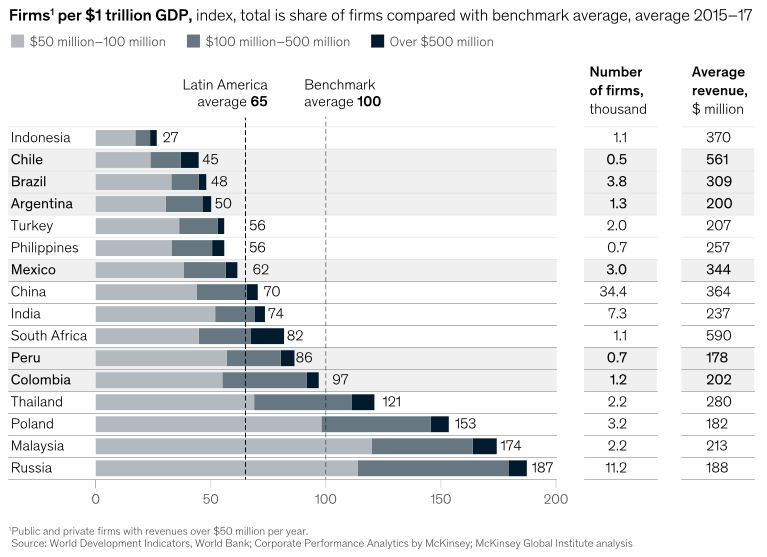
3. FT points to a very informative MGI report on Latin America,
One reason why Latin America is lagging behind is that the region lacks a solid tier of midsized companies able to create productive jobs and a robust middle class of consumers whose spending and saving could propel demand and investment, according to a report by McKinsey Global Institute. Addressing these twin gaps could increase annual growth to 3.5 per cent by 2030, McKinsey estimated; that would boost Latin America’s gross domestic product by $1tn, an extra $1,000 a year per capita... When measured relative to their GDP, Argentina, Brazil, Chile and Mexico only have about half as many firms with revenues above $50m as 10 other leading emerging economies that McKinsey used as comparators.
This is compounded by a triple-whammy of slow GDP growth, low productivity growth, and unequal distribution of the gains of growth.

4. Profiling Mariana Mazzucato.

5. Is the Government e Marketplace (GeM) among the good example of public policy successes of this government?

6. Fascinating picture of the battle for the top place in India's telecoms market between Vodafone and Jio,
For starters, Vodafone Idea, with the largest user base, made a net loss of ₹4,874 crore in the June quarter, while Jio made a profit of ₹891 crore. Both companies have priced mobile services at almost similar levels... Despite more subscribers, Vodafone Idea, which posted revenue of 11,269.9 crore, lags behind Jio which posted revenues of ₹11,679 crore in the June quarter... Vodafone Idea had 84.8 million 4G subscribers as of 30 June. However, in comparison, Jio has 331.3 million 4G subscribers. Then again, Vodafone Idea’s subscriber base is a mix of 2G, 3G and 4G while Jio is a 4G-only operator... While Vodafone Idea’s average revenue per user is steadily climbing, Jio’s is dropping... After Vodafone Idea rolled rout monthly minimum recharge plans for subscribers to stay on its network, its shrinking subscriber base has led to an improvement in average revenue per user (Arpu) to ₹108 in the June quarter, from ₹104 in the March quarter, ₹89 in December and ₹88 in September... Jio, on the other hand, has shown the opposite trend for the last 6 quarters. Jio’s ARPU for the June 2019 quarter was at ₹122, down from ₹126.2 in the March 2019 quarter and ₹130 in the December 2018 quarter. It was at its peak of Rs154 in the December 2017 quarter.
7. Two interesting snapshots of India's district and subordinate courts, which take up nearly 90% of all judicial case load pending. Land and labour cases have the worst pendency rates
And nearly three-fourths of the delays are due to administrative issues - nearly half due to stay orders issued by higher courts, and the remaining due to trouble securing witnesses.
This is shining light on the dark under-belly of India's judicial system. I have blogged on multiple occasions about the curse of stay orders, without any sunset and which can run interminably and is widely abused by litigants. It would be useful to explore how seriously have previous attempts at judicial reform considered this factor. 

8. The above Livemint article references this 2012 paper by Matthieu Chemin which used the 2002 CPC amendment to show that "speedier courts, defined as those with lower workload, were associated with small firms suffering fewer breaches of contract, investing more, and enjoying better access to finance".

9. As airlines squeeze more out of their planes, Livemint writes in the context of Philippines' Cebu Air,
Cebu doubled down in June with a $6.8 billion order for Airbus jets that includes 16 higher-capacity A330neos. Airbus says the plane is designed to fit 260 to 300 passengers in a typical layout that has first-class, business and economy cabins. For “higher-density configurations" -- code for bare-bones economy -- the planes fit as many as 440, the manufacturer says. Cebu is planning for 460, once the layout is certified... Less legroom is now the industry norm. In the early-2000s, rows in economy used to be 34 inches (86 centimeters) to 35 inches apart; now 30 to 31 inches is typical, though 28 inches can be found on short flights, according to Washington D.C.-based advocacy group Flyers Rights. Seats have narrowed, too, from about 18.5 inches to 17 inches on average... Seats on the Cebu Air planes are just 16.5 inches wide, less than the width of two hand spans and short of the 18-inch minimum that the manufacturer, Airbus SE, says is comfortable.
As this scramble for space continues, is this the new fault-line in airline safety? Are regulators watching?

Wednesday, July 24, 2019

Trends in globalisation, trade, and global value chains

Gillian Tett points to an insightful presentation by BIS Chief Economist Hyun Song Shin which explores the reasons for the current global economic slowdown. Shin starts off by describing the changes in global value chains (GVCs), which along with MNCs underpinned the current wave of globalisation and growth in trade, especially with the arrival of China.

The snapshot of network structure of goods and services trade in 2000 and 2017, where the hub-and-spokes link two economies if one is the largest trading partner of the other or if one accounts for more than 25% of the trade for the other, is illuminating. 
China's emergence as a hub and as connector between Germany and the US is remarkable. Shin then points to the trends in gross exports to GDP ratio, the numerator of which increases with complexity of GVCs since they generate multiple export sales of intermediate goods, all of which add up. It rose 16% from 2001 to 2008 as GVCs exploded in complexity, only to collapse during the Great Recession and has since 2010, pre-dating the current protectionist trend, been on a secular decline. 
Clearly, just as the GVC activity boosted global trade in the noughties, its unravelling has pulled down trade this decade.

While the growing share of services in global trade and technological innovation like automation making in-shoring more cost-effective are important contributors to the current secular decline, Shin point to another intriguing possibility, finance. He writes, pointing to an uncanny resemblance of the graph above to the global banking cycle,
Building and sustaining GVCs are highly finance-intensive activities that make heavy demands on the working capital resources of firms. When the financial requirements go beyond the firm’s own resources, the necessary working capital is dependent on short-term bank credit. The financing requirement for GVCs arises because firms need to carry inventories of intermediate goods or carry accounts receivable on their balance sheet when selling to other firms along the supply chain... As supply chains grow longer and the time period between shipments becomes more extended, the marginal financing needs grow at an ever increasing rate, so that very long GVCs are viable only with very accommodative financing conditions.  
If you will excuse a colourful metaphor, firms enmeshed in global value chains could be compared to jugglers with many balls in the air at the same time. Long and intricate GVCs have many balls in the air, necessitating greater financial resources to knit the production process together. More accommodative financial conditions then act like weaker gravity for the juggler, who can throw many more balls into the air, including large balls that represent intermediate goods with large embedded value. However, when the shadow price of credit rises, the juggler has a more difficult time keeping all the balls in the air at once.
When financial conditions tighten, very long and elaborate GVCs will no longer be viable economically. A rationalisation of supply chains through “on-shoring” and “re-shoring” of activity towards domestic suppliers, or to suppliers that are closer geographically, will help reduce the credit costs of supporting long GVCs. In its 2014... around 35% of trade was financed by the banking system. The rest – around 65% – was financed by the firms themselves, either by the seller in the form of “open account financing” or by the buyer paying upfront in a “cash-in-advance” purchase. Crucially, the CGFS found that around 80% of bank trade financing was denominated in US dollars, reflecting the prevalence of dollar invoicing in world trade... Among the many indicators of the availability of dollar- denominated bank credit, the dollar exchange rate plays a particularly important role as a barometer of the dollar credit conditions faced by firms. Lending in dollars tends to grow faster when the dollar is weak, and lending in dollars is subdued or declines when the dollar is strong... When combined with the fact that GVC activity tracks dollar financing conditions, the upshot is that the fluctuations in the trade-to-GDP ratio plotted in Graph 4 closely track the strength of the dollar, with a stronger dollar associated with subdued GVC activity... During periods when the dollar is strong, trade is low relative to GDP. During periods when the dollar is weak, trade is high relative to GDP. 
He also argues that this inter-twined nature of finance and trade could explain the persistence of the strength of the dollar despite the monetary accommodation in the US,
The relationship between financial conditions and the dollar will reflect many forces operating in the economy, but among these may be balance sheet channels involving non-financial firms that are linked through GVCs. Strong corporate balance sheets enable firms to meet the heavy working capital needs of being part of GVCs. However, higher corporate debt combined with currency mismatches on the firm’s balance sheet can undermine the firm’s ability to finance working capital, especially when credit conditions tighten. Firms weighed down by currency mismatches and excessive leverage will need to reduce debt and rebuild capital. Globally, high corporate leverage has emerged as a source of vulnerability for growth. Corporate leverage has remained high even as profitability has declined sharply in some jurisdictions, such as China and especially among small and medium-sized enterprises in the manufacturing sector. Within this broad context, the continuing strength of the dollar may reflect, in part, efforts at balance sheet repair by such firms. A stronger dollar would increase the urgency of balance sheet repair, as it would sharpen the incentives to repay dollar debt. Perhaps for this reason, recent moves in the currency market have overturned the usual rule of thumb that looser monetary policy in the United States is associated with a weaker dollar. The dollar has remained strong, especially against emerging market currencies.
On GVCs, this report by MGI is very informative,
Trade rose rapidly within nearly all global value chains from 1995 to 2007. More recently, trade intensity (that is, the ratio of gross exports to gross output) in almost all goods-producing value chains has fallen. Trade is still growing in absolute terms, but the share of output moving across the world’s borders has fallen from 28.1 percent in 2007 to 22.5 percent in 2017... The decline in trade intensity is especially pronounced in the most complex and highly traded value chains... In 2017, gross trade in services totaled $5.1 trillion, a figure dwarfed by the $17.3 trillion global goods trade. But trade in services has grown more than 60 percent faster than goods trade over the past decade. Some subsectors, including telecom and IT services, business services, and intellectual property charges, are growing two to three times faster... counter to popular perceptions, today only 18 percent of goods trade is based on labor-cost arbitrage (defined as exports from countries whose GDP per capita is one-fifth or less than that of the importing country)... Moreover, the share of trade based on labor-cost arbitrage has been declining in some value chains, especially labor-intensive goods manufacturing (where it dropped from 55 percent in 2005 to 43 percent in 2017)... In all value chains, capitalized spending on R&D and intangible assets such as brands, software, and intellectual property (IP) is growing as a share of revenue. Overall, it rose from 5.4 percent of revenue in 2000 to 13.1 percent in 2016... The share of trade in goods between countries within the same region (as opposed to trade between more far-flung buyers and sellers) declined from 51 percent in 2000 to 45 percent in 2012. That trend has begun to reverse in recent years. The intraregional share of global goods trade has increased by 2.7 percentage points since 2013, partially reflecting the rise of emerging-market consumption... Regionalization is most apparent in global innovations value chains, given their need to closely integrate many suppliers for just-in-time sequencing. 
As to the drivers of these trends,
The map of global demand, once heavily tilted toward advanced economies, is being redrawn—and value chains are reconfiguring as companies decide how to compete in the many major consumer markets that are now dotted worldwide... By 2030, developing countries are projected to account for more than half of all global consumption... The biggest wave of growth has been happening in China... by 2030, they are projected to account for 12 cents of every $1 of worldwide urban consumption... In 2016, 40 percent more cars were sold in China than in all of Europe, and China also accounts for 40 percent of global textiles and apparel consumption... Within the industry value chains we studied, China exported 17 percent of what it produced in 2007. By 2017, the share of exports was down to 9 percent. This is on a par with the share in the United States but is far lower than the shares in Germany (34 percent), South Korea (28 percent), and Japan (14 percent)... In 2002, India, for example, exported 35 percent of its final output in apparel, but by 2017, that share had fallen by half, to 17 percent, as Indian consumers stepped up purchases... The rise of domestic supply chains in China and other emerging economies has also decreased global trade intensity... As a group, emerging Asia has become less reliant on imported intermediate inputs for the production of goods than the rest of the developing world (8.3 percent versus 15.1 percent in 2017)... The decline in trade intensity reflects growing industrial maturity in emerging economies. Over time, their production capabilities and consumption are gradually converging with those of advanced economies... New technologies are changing costs across global value chains... Instant and low-cost digital communication has had one clear effect: lowering transaction costs and enabling more trade flows... the next wave of technology could dampen global goods trade while continuing to fuel service flows... 
In goods-producing value chains, logistics costs can be substantial. Companies often lose time and money to customs processing or delays in international payments. Three sets of technologies will continue to reduce these frictions in the years ahead. Digital platforms can bring together far-flung participants, making cross-border search and coordination more efficient. E-commerce marketplaces have already enabled significant cross-border flows by aggregating huge selections and making pricing and comparisons more transparent... Logistics technologies also continue to improve. The IoT can make delivery services more efficient by tracking shipments in real time, and AI can route trucks based on current road conditions. Automated document processing can speed goods through customs. At ports, autonomous vehicles can unload, stack, and reload containers faster and with fewer errors. Blockchain shipping solutions can reduce transit times and speed payments. We calculate that new logistics technologies could reduce shipping and customs processing times by 16 to 28 percent... 
Automation and additive manufacturing change production processes and the relative importance of inputs... The growing adoption of automation and advanced robotics in manufacturing makes proximity to consumer markets, access to resources, workforce skills, and infrastructure quality assume more importance as companies decide where to produce goods. Service processes can also be automated by artificial intelligence (AI) and virtual agents. The addition of machine learning to these virtual assistants means they can perform a growing range of tasks. Companies in advanced economies are already automating some customer support services rather than offshoring them. This could reduce the $160 billion global market for business process outsourcing (BPO), now one of the most heavily traded service sectors... Overall, we estimate that automation, AI, and additive manufacturing could reduce global goods trade by up to 10 percent by 2030, as compared to the baseline...
New goods and services enabled by technology will impact trade flows. Technology can transform some products and services, altering the content and volume of trade flows in the process. For example, McKinsey’s automotive practice estimates that electric vehicles will make up some 17 percent of total car sales globally by 2030, up from 1 percent in 2017. This could reduce trade in vehicle parts by up to 10 percent (since EVs have many fewer moving parts than traditional models) while also dampening oil imports. The shift from physical to digital flows that started years ago with individual movies, albums, and games is now evolving once again with streaming and subscription models... The advent of ultra-fast 5G wireless networks opens new possibilities for delivering services. Remote surgery, for example, may become more viable as networks transmit sharp images without any delays and robots respond more precisely to remote manipulation. In industrial plants, 5G can support augmented and virtual reality–based maintenance from remote locations, creating new service and data flows.
On the same topic, Economist has survey on GVCs which draws heavily from the MGI report. It writes,
The biggest declines in trade intensity were observed in the most heavily traded and complex gvcs, such as those in clothing, cars and electronics... talking to many firms in three industries reveals different patterns of fragmentation. The clothing sector is globally footloose; the car industry is coalescing around regional hubs; and the electronics business remains rooted in China.
This about the challenges facing India's ability to benefit from the disruption to GVCs caused by President Trump's actions on China is illuminating,
Mr Trump’s tariffs on China have pushed Big Auto’s supply chains to become even more regional. “We’re finally ready to leave China,” says a senior supply-chain executive at a global car maker. His firm is looking seriously at shifting its sourcing for the global market from China to India, but finds Indian vendors “unreliable”. It thought about dividing between India and Mexico, but saw that its supply base would lose economies of scale. The winner will be Mexico, he says.
This is a fascinating examination of how innovations by Amazon and Alibaba are contributing to shortening and expediting the GVCs,
China is leapfrogging from ropey logistics to supercharged supply chains, just as it did with e-commerce and mobile payments, in which it went from laggard to world-beater... Amazon leads in the use of ai-powered robots in logistics, but China’s entrepreneurs have the edge in speed. Mainland innovators are capable of cutting-edge inventions, for example in facial-recognition software. However, they are also good at frugal engineering, throwing together cheap solutions that can get to market faster than the gold-plated ones favoured by Western innovators.

Monday, July 22, 2019

India urban real estate facts of the day

Real estate speculation is among the greatest macroeconomic risks that developing countries like India should watch out for. Episodes of economic growth and credit booms are invariably accompanied by real estate booms, especially in developing countries. And financial market deregulation only exacerbates the risks. 

Joe Studwell's excellent book on Asia chronicles the South East Asian experience with real estate resource misallocation and how it adversely impacted economic growth and exposed those countries to macroeconomic instability from both internal and external sources.  

Sample a few snippets from an FT article on India,
30 per cent of real estate projects and half of all built-up space in Mumbai is under litigation, according to a 2019 Brookings India report, with projects taking an average of eight and a half years to complete.
And this is only the latest in inventory pile-up that has been a feature of India's metro property market for years now,
Property consultancy Anarock estimates that half of the luxury real estate in Mumbai’s downtown alone is unsold: 11,000 properties worth a total Rs590bn... Unsold inventory in the city rose 14 per cent in the first half of 2019 from the same time a year earlier, according to Knight Frank.
And the role of shadow banks,
Shadow banks grew to account for a fifth of all new credit last year, and became the largest source of funding for real estate thanks to loan growth of more than 20 per cent a year between 2013 and 2018.

Saturday, July 20, 2019

Weekend reading links

1. This is a long list of recommendations to reform the start-up eco-system in India. Two observations. One, the author seems to obsessed by reduction in taxes and provision of incentives. Almost all the proposals belong to either of these two categories. Two, the entire onus on creating start-ups is with the governments.

Reading articles like this, one almost gets the impression that start-ups are a new entrant into business landscape, start-ups are always about innovation, and economic growth is critically dependent on such innovative start-ups. This has almost become an entrenched narrative.

But in reality, all the three impressions are flawed. Business entry and exit are commonplace, and millions of new enterprises enter the market each year in India. The vast majority of them are not about any innovation, but plain simple trading, manufacturing, and services businesses, mostly self-employed or with a couple of employees. While these start-ups are critical for the long-term productivity trends in the economy, short- and medium-term economic growth is mostly about the plain vanilla economic activities.

2. Blackstone awaits an economic downturn in the winner takes all market,
The firm announced on Thursday that assets under management had reached a staggering $545bn, after taking in $150bn in the last 12 months. Firms like Blackstone do best when they can chase opportunities in an economic dislocation. In this respect, Blackstone may be eagerly awaiting a downturn... Blackstone’s fundraising haul once again reinforces the winner-take-all paradigm in alternative investments. It has raised money of late in private equity, credit, and real estate. The big pools of capital like sovereign wealth funds are putting more money in alternatives but working with fewer managers. One-stop-shops like Blackstone disproportionately benefit. In the past year, Blackstone took home $1.6bn in earnings from management fees before any incentive “carry” is accounted for. This year, Blackstone’s shares are up more than 50 per cent.
3. FT on why British civil service feels shaken by the politics surrounding Brexit. Brexiters feel that the civil service is putting up obstacles to an exit, and feel that it has become politicised. Surprising that a civil service often considered the touchstone for neutrality and has survived many such political cataclysms is becoming so embroiled in the Brexit politics.

4. Apollo Hospitals seeks foreign capital. As I have blogged earlier, this is in line with the trend of foreign capital entering India's tertiary care market with attendant undesirable commercialisation and profiteering in health care practices.

This intrigues me. In the landscape of economic activities, given the stage of India's economic development, tertiary health care has to be among the most promising of investment destinations. And Apollo is perhaps the leading healthcare brand in India. Why isn't Apollo able to attract Indian capital? Or do they want foreign capital for some reason? Or do the Indian investors realise that perhaps Apollo is not after all a good investment? Or does this convey the lack of depth of Indian capital available for investing in even areas like tertiary healthcare and a brand like Apollo? Or does this reflect corporate governance and management capabilities within Apollo itself?

5.  Nice article on the turmoil facing the US Federal Reserve.

6. Fascinating chronicle of the lives of millennial generation working-class people from different parts of the world in Bloomberg by Vauhini Vara - seamstress, street vendor, abalone poacher, marijuana grower care giver, warehouse picker, computer reseller, electronics maker, social media influencer, and call centre manager.
Decent jobs are flowing to big cities, with millions of workers leaving their ancestral towns in anxious pursuit, often slipping past national borders to do so. The internet is exposing people not only to opportunities that were once out of reach, but also to the unsettling knowledge that other people have many more. And the stories confirm that to be working class is, by and large, an insecure state. Superiors view labor as replaceable. Speaking publicly about one’s job can invite reprisal from an employer—or a government.
7. Global distribution of artificial intelligence talent shows India at third place, closely behind China.
8. Finally, ending with startups, Bloomberg compares the startup scenes in India and China. While China has 94 unicorns, India has just 19. The largest Chinese unicorns offers services with bitcoin, drones, and robots, whereas the four largest Indian unicorns are in consumer facing online payments, e-commerce, ride-hailing, and education. 
It’s not surprising, then, that nine of India’s top 10 unicorns by value are in the online-consumer space, according to data compiled by CB Insights. The outlier is ReNew Power, an independent wind and solar-energyproducer. In China, three of the top 10 are online consumer companies, two are bricks-and-mortar businesses, and the rest are a mix of hardware and B2B.
9. Finally, very good article on Novak Djokovic.
Novak Djokovic has a way of winning even when he’s losing. He has a way of patiently absorbing his opponent’s most devastating play, doing just enough to stay alive, and choosing precisely the right moment to strike back. He’ll lose a spectacular rally and then, while the commentators are still gushing about the other player, unspectacularly win the next point.. He’s as capable of spectacular dominance as any player who’s ever lived... He can hit shots that make you think your TV is a liar. But it’s that other mode, his dark mode of tactical endurance, that makes him the most fearsome tennis player of the past decade and possibly the most fearsome of all time. He’s a genius at operating within bad runs in such a way as to give himself the best chance of seizing key moments... In just about every category imaginable, Federer was the better player, and he lost... Federer dominated the game of runs but couldn’t keep Djokovic from seizing control of the game of moments... It was tight, brutal, unpoetic tennis with no margin for error, and he pulled it off.
This comparison of Federer and Djokovic,
Everywhere Federer goes, the crowd adores him; he’s played out the whole endless twilight of his career with a permanent home-court advantage such as no other player before him has ever experienced. When he’s winning, the crowd shares and magnifies his joy; when he’s losing, fans will him to come back. There’s a net under him as well as across from him; he plays every match with a buffer of emotional support. Now consider how things are for Djokovic. He wants that kind of love, and almost never gets it. When he wins Wimbledon, and struts forward, smirking, to make the crowd watch his excruciating grass-eating bit, the applause is … polite. Before then, nearly everyone in the stadium, and nearly everyone watching at home, millions of people around the world, were praying for him to lose. The player who most covets affection is the player from whom the crowd most stubbornly withholds its affection... He knows how to stay calm and play smart when he’s being outplayed because he’s used to feeling that things aren’t going his way. He knows how to capitalize on a match’s moments of crisis because he is in a perpetual state of micro-crisis. He’s learned to rely on himself because he can’t rely on the crowd.