Substack

Wednesday, November 12, 2025

Hard limits to China's growth model

Much of what is written in the media, including in this blog, about China is about its spectacular economic growth to catch up with the US, and its manufacturing dominance. 

Rana Faroohar has a contrarian piece which makes the rare bearish case on China. She points to three facts about China in support. 

First, despite new pledges to raise consumption, the mathematics and politics of doing so are as tricky as ever. Second, while global diplomacy is now Beijing’s game to lose, it has made many fewer gains than it should have so far, given the low-hanging fruit. And third, autocracy remains a hard sell globally, which will make it difficult for China to ever replace the US (or even Europe) in terms of soft power.

I had blogged here about post-peak China. 

On this track, there’s an important paradox about China. Even as it has assumed leadership positions in innovations across sectors, its economic productivity growth has been slowing down. Tej Parikh has a set of excellent graphics that tell the story. This blog will explore this in greater detail and see how it could potentially constrain the country’s growth prospects. 

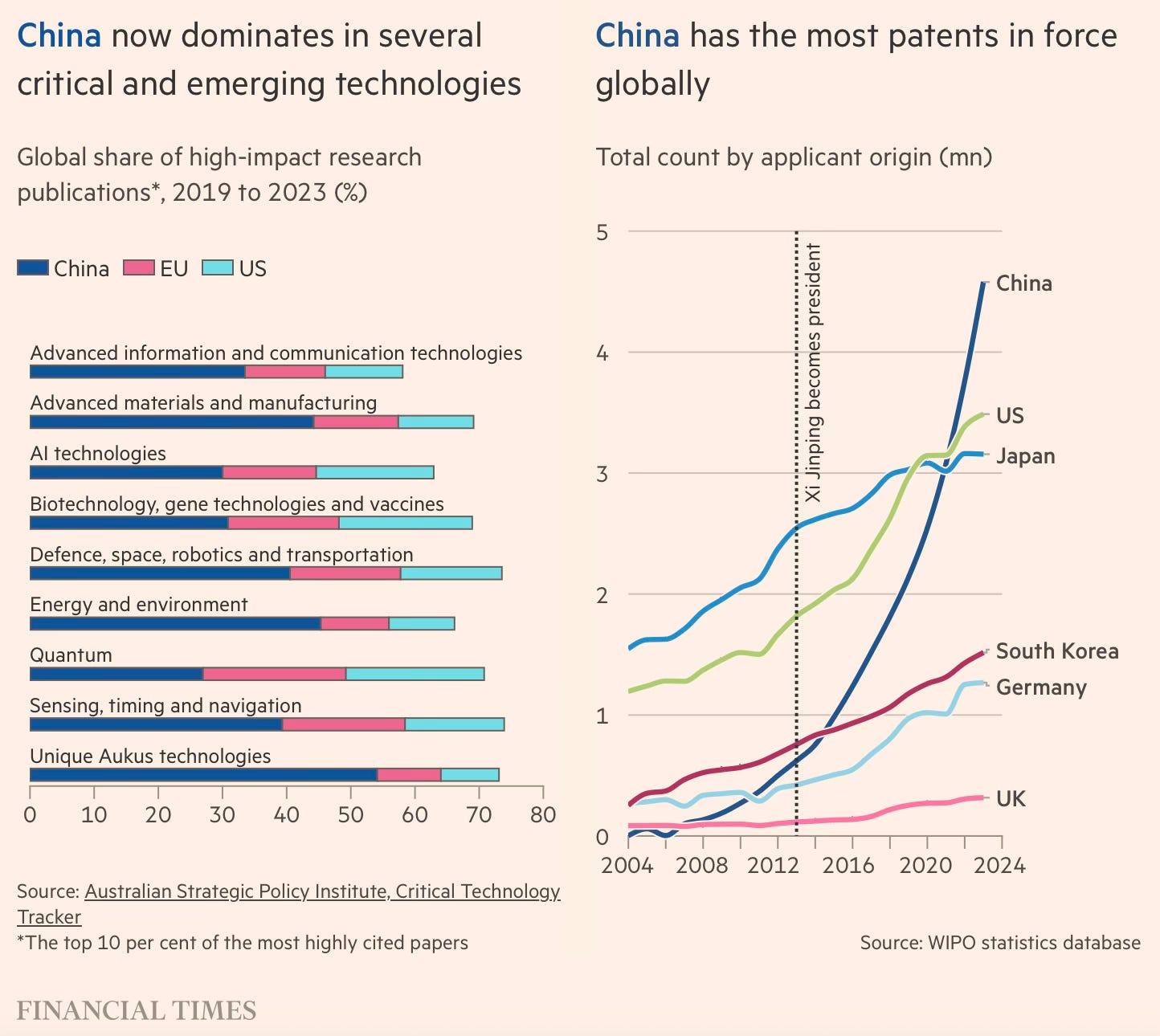
According to the Australian Strategic Policy Institute, China became the global leader in 57 out of 64 critical technologies between 2019-23, up from leadership in just 3 between 2003-07. It leads today not only in manufacturing EVs, batteries, renewables, etc., but has almost caught up with the West on AI, quantum technologies, and biotech. 
But this leadership in innovation and manufacturing has not translated into productivity growth, where its TFP has slowed down considerably and is now grossly underperforming the East Asian miracle economies. 
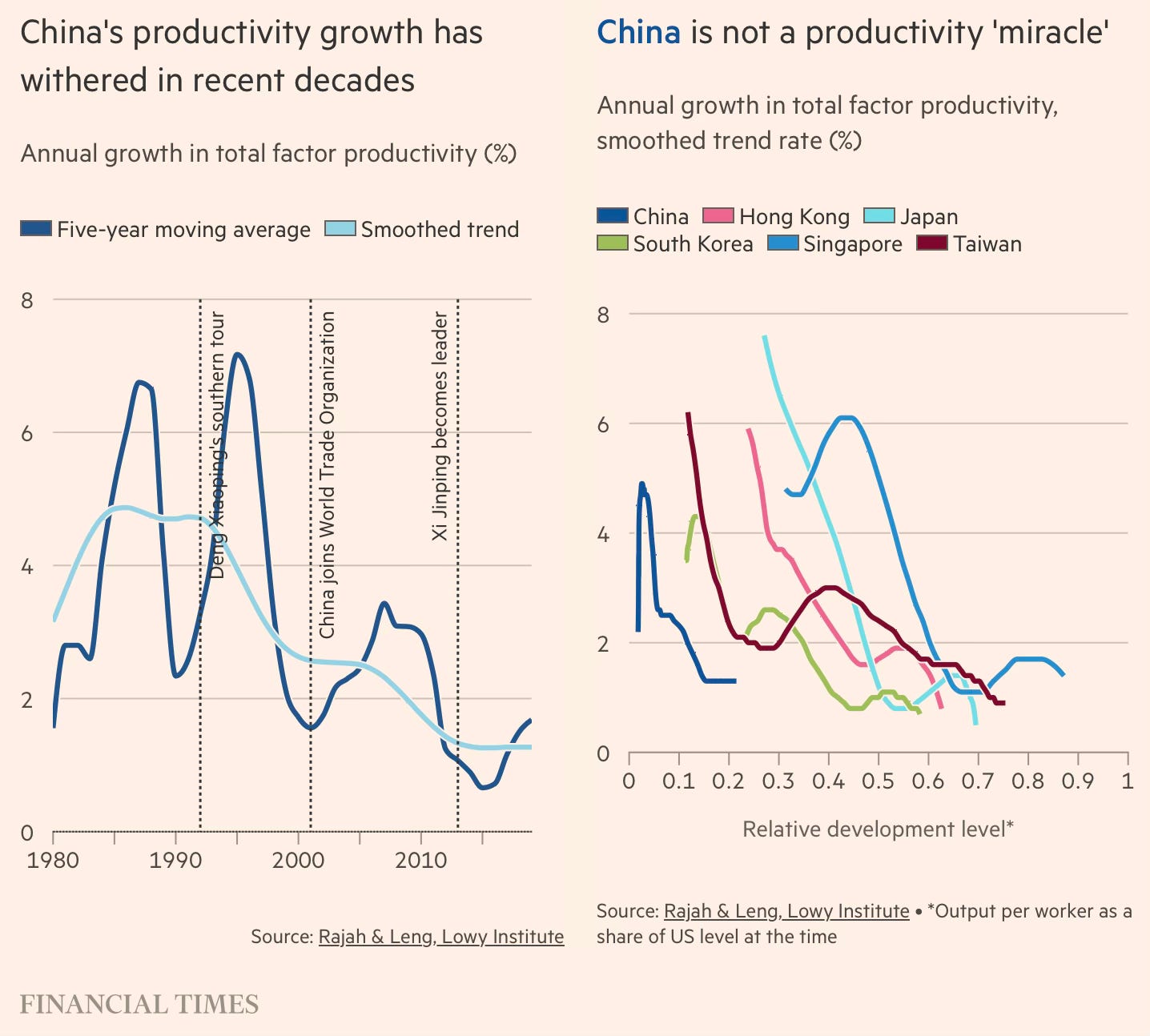
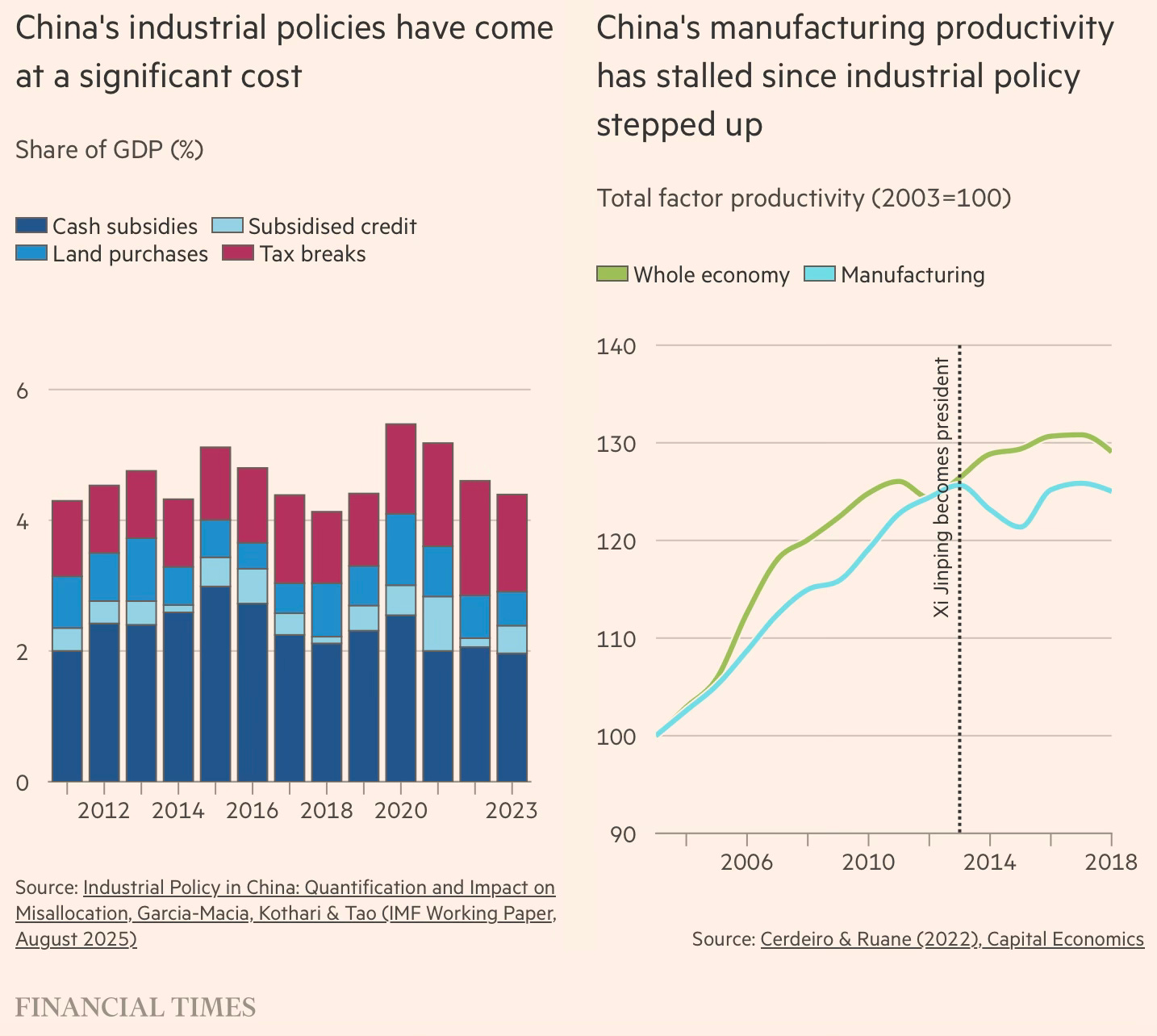
China’s industrial policies may have misallocated resources in a big way, thereby creating excess capacity, deflation, and keeping alive poor performers. IMF economists estimates that these subsidies, estimated at 4.4% of GDP in 2023, may have cut its TFP by 1.2% and GDP by 2%. They have tended to flow to better-connected firms, and raised entry barriers, thereby misallocating both talent and finance. 
For each success story like BYD or Huawei, there are countless others who are bleeding subsidies, making losses, and will collapse. Analysis by ASR finds that over 25% of listed non-financial firms had earnings before interest and tax-to-interest coverage ratio below 1 in 2024, up from around 10% in 2018. 
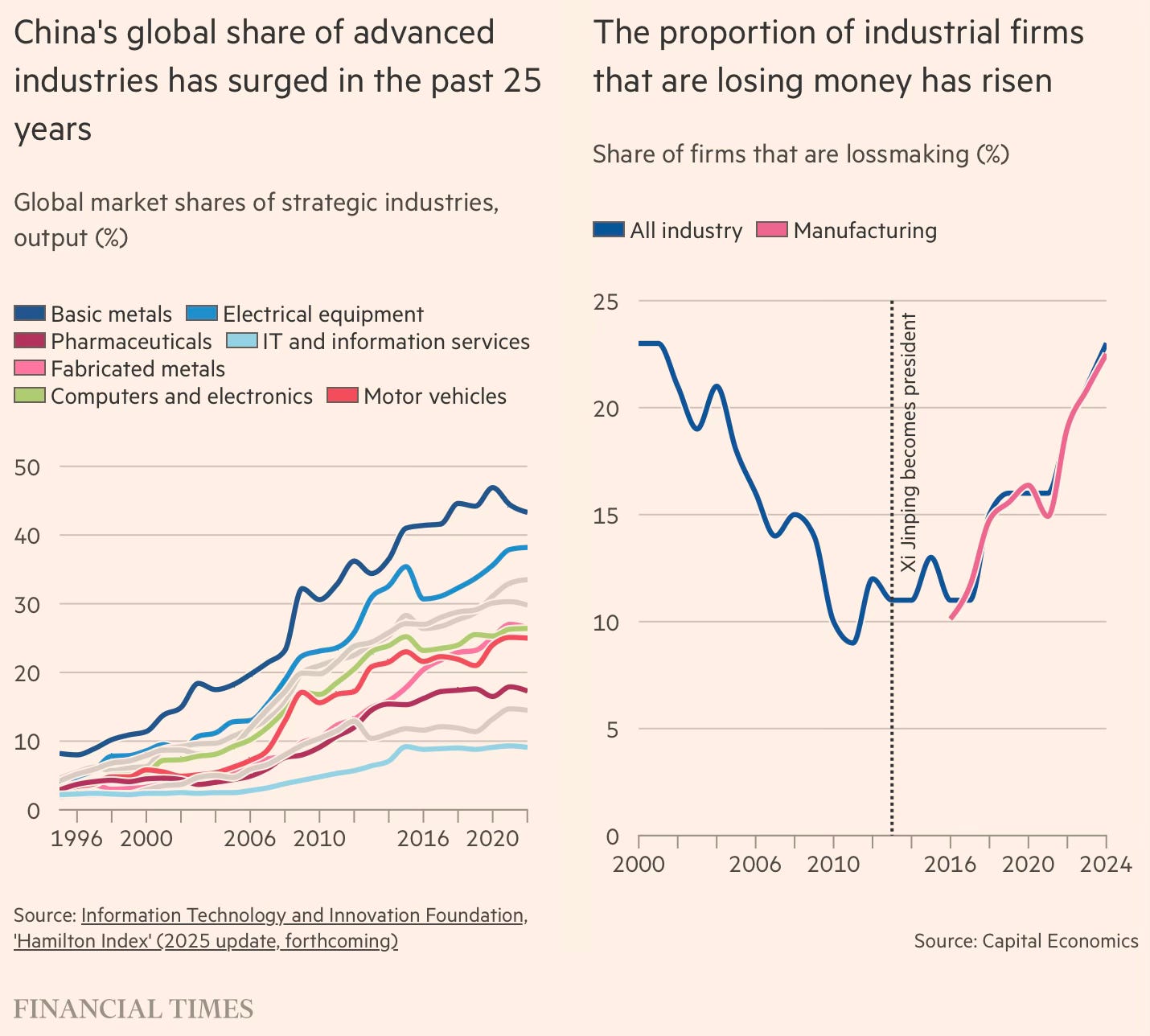
China’s paradox of the co-existence of excellence in manufacturing innovation with declining productivity growth is a reflection of the inefficiencies in its industrial policy. China’s much vaunted manufacturing dominance has come at a prohibitive cost in terms of misallocation of resources and talent. 

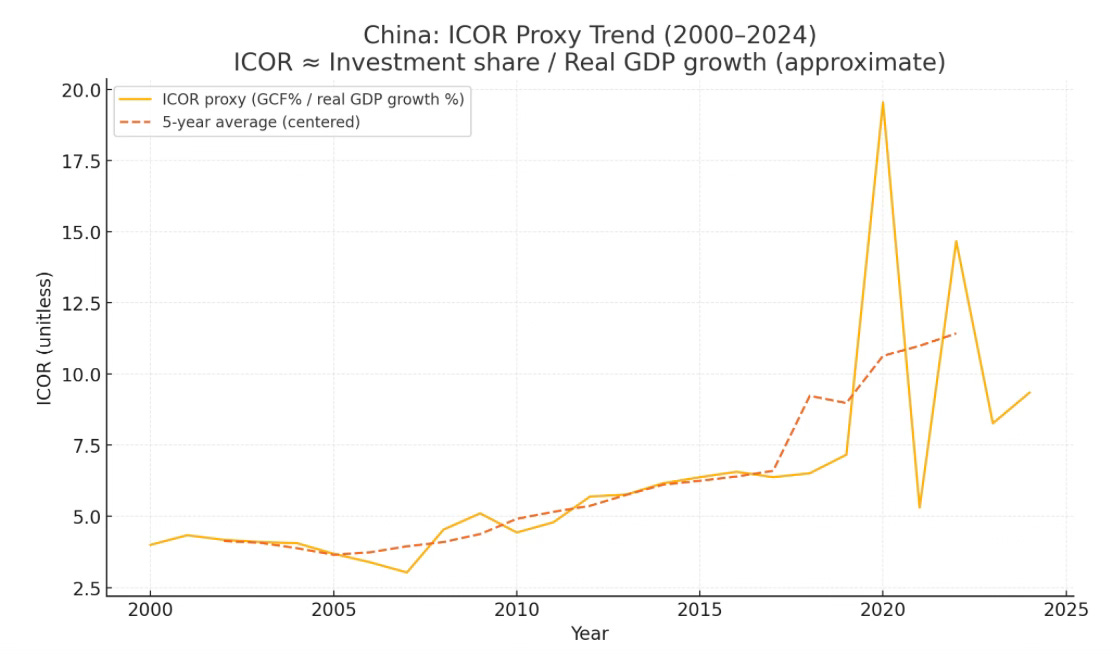
I have blogged here pointing to China’s sharply rising incremental capital output ratio (ICOR). Even as investment has been range-bound at 43-45% of GDP since before the global financial crisis, the ICOR has nearly tripled from below 3.5 to touch 10. This period has also coincided with economic growth declining precipitously from above 12% to just 4%. As the graphic shows, high investments rates brings ever less growth. 
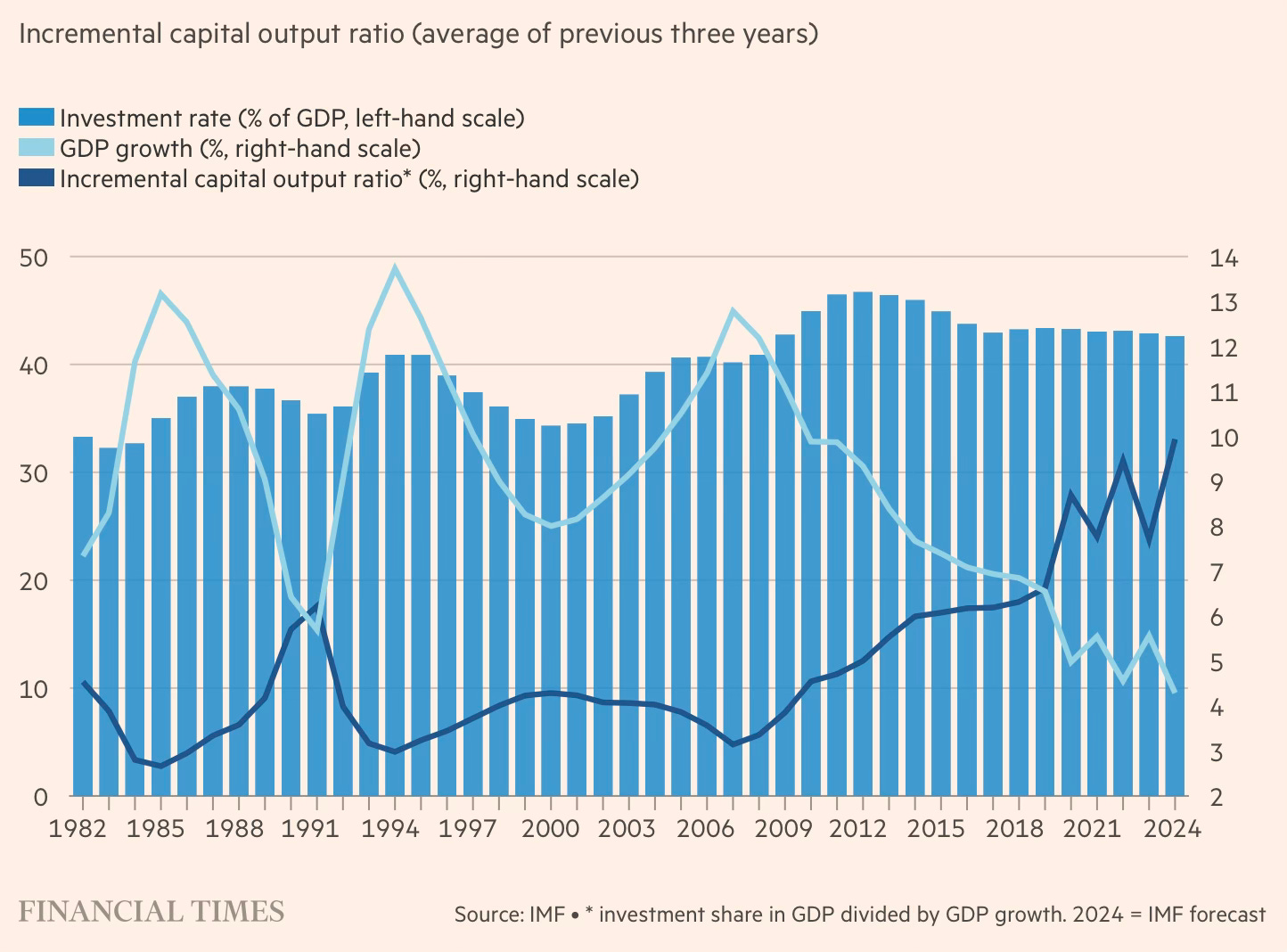
Here is an updated version of the ICOR trends generated from the WB WDI series for investments and GDP growth. 
This misallocation has led to the perpetuation of inefficient firms, the accumulation of massive excess capacity, and the excessive leveraging of local governments and firms. In general, it has also created an economic system that is primed to maximise output with little regard for demand, continuously capture and expand export markets in a beggar-thy-neighbour dynamic, and is oblivious to policies required to boost domestic consumption. This trend is also encouraged by the country’s politico-bureaucratic system, where leadership at provinces, towns, and counties are evaluated on performance (and promotion up the party hierarchy) based on expanding economic output.

There are at least three hard stops to this model. One is the importance of productivity growth in maintaining reasonable GDP growth in an economy faced with a shrinking labour force, an increasing share of the services sector in the economy, and declining efficiency of investment. An IMF working paper shows that China TFP compared to the technology frontier (US=100) in 2017 lagged even middle-income countries. 
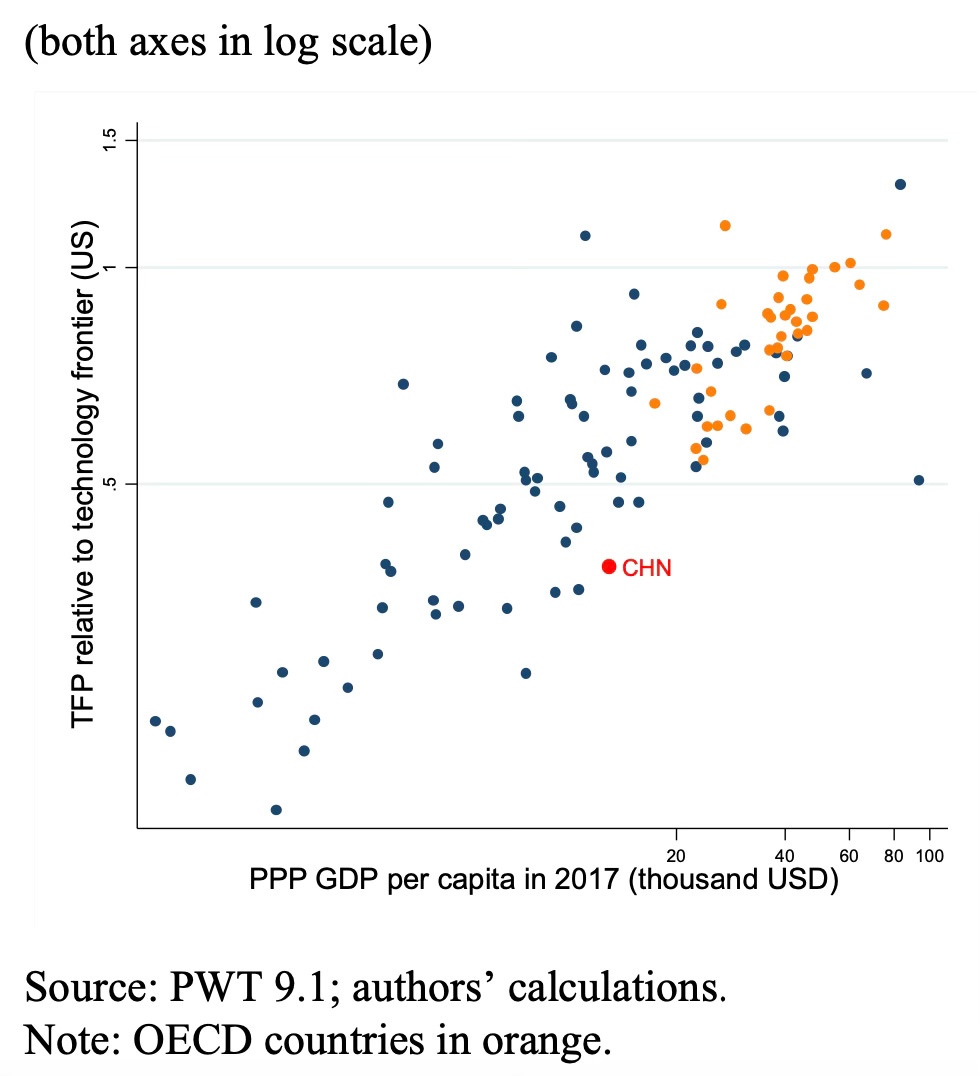
The paper points to a major problem of limited market entry and exit and lack of resource allocation to more productive firms in manufacturing. 

Over 1998–2013, most of the increase in productivity—two-thirds—came from the entry of new firms… The other primary source of growth was improving productivity of incumbents, which contributed 40 percent. Over the entire period, firm exit contributed negligibly to manufacturing productivity growth, reflecting one of several possibilities. Poorly performing firms either did not exit or exited but accounted for only a small percentage of aggregate output. Or the productivity of some firms that exited was average or better. Similarly, there were no gains from reallocating resources (labor, capital, and intermediate inputs) to more productive firms, which would have increased aggregate productivity, all else equal. In fact, the contribution was slightly negative. In advanced countries, this is the most important source of productivity growth, and thus stands out as a possible major source of future productivity growth in China. After 2007, average manufacturing productivity growth in China decreased almost by half. The most important reason for the decline was that the contribution of better entrants disappeared. In some sectors, the contribution of new entrants was actually negative, implying that these firms entered the productivity distribution lower than the sector average.

As I have blogged in China Updates, there are reasons to argue that these trends on exit have worsened in recent years, 

Eswar Prasad has highlighted China’s productivity problem. The country’s TFP growth (RHS) has been stagnant at about 1 per cent over the last decade.
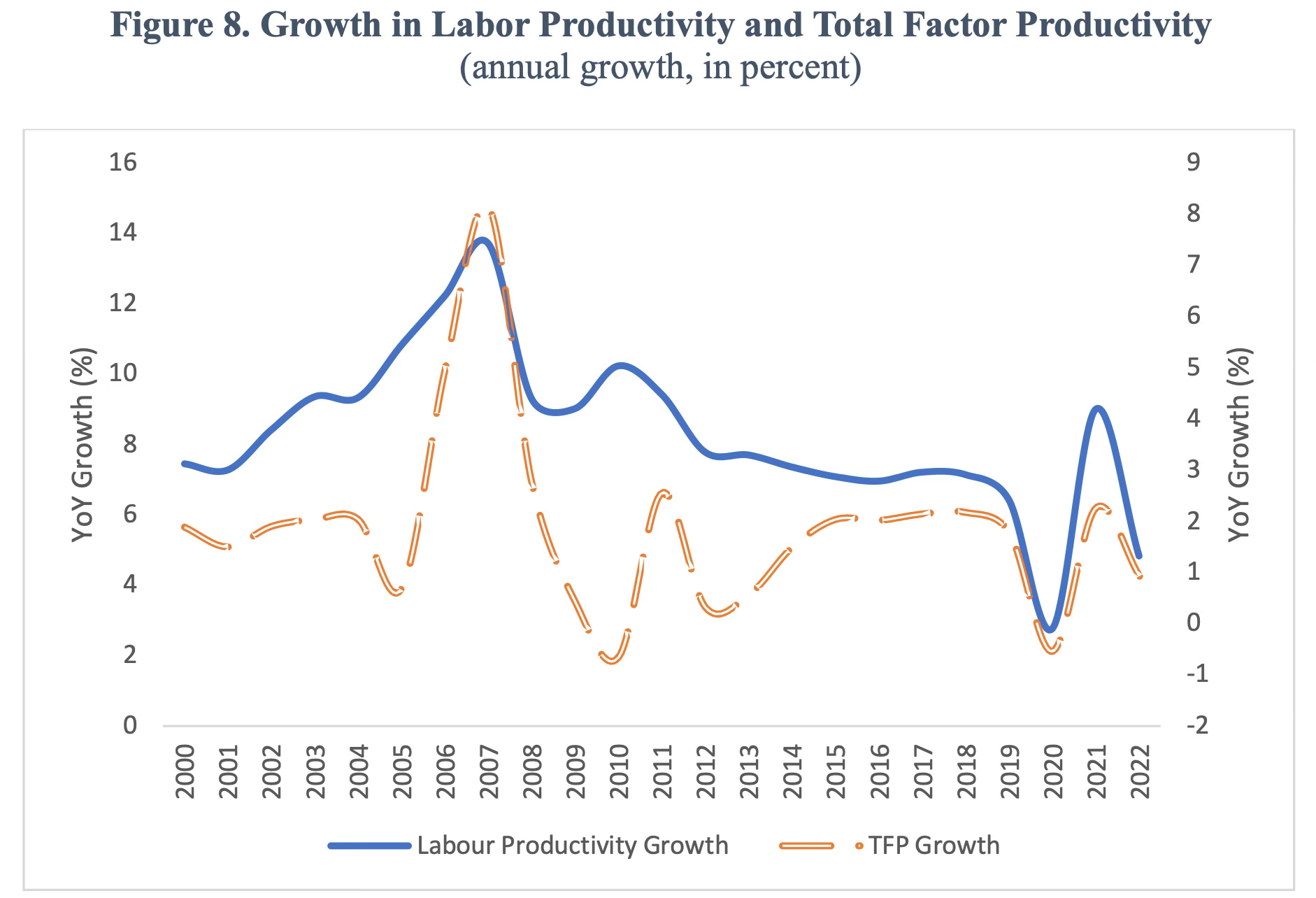
He has explained why this is a big problem.

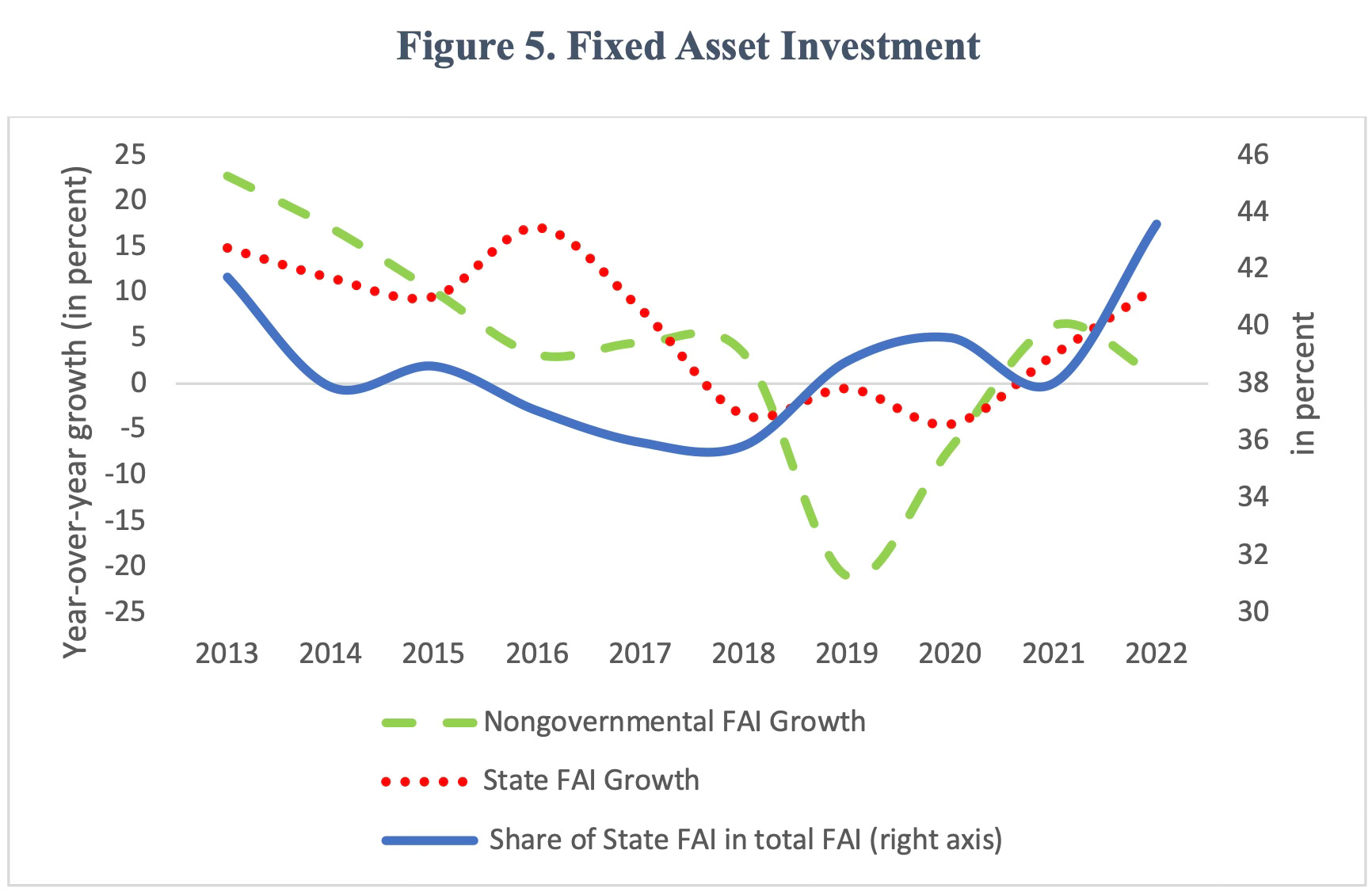
China’s capital to labor ratio is only about 28 percent that of the United States. However, recent investment has been driven by the public (state) sector rather than the nongovernmental sector. In 2022, for instance, state investment amounted to 44 percent of total fixed asset investment, a significant increase relative to the corresponding ratio of about 36 percent during 2017-2018… in China state-owned enterprises, which have collectively received a disproportionate share of bank credit, have typically not generated strong returns on those investments. The recent collapse in nongovernmental investment growth, with state investment accounting for nearly all of the growth in overall fixed asset investment in 2022, is a sign that private businesses might be wary of increasing investment when they see the economic and political environments as unfavourable. Moreover, China’s capital to output ratio is in fact about 50 per cent higher than that of the United States. This reflects lower levels of total factor productivity (TFP) and human capital in China relative to the United States. This implies that increasing investment might not be the optimal way to generate growth. 
This is another useful paper on China’s productivity paradox. 

Second is the ongoing backlash from export markets. Chinese exports to the US are already shrinking, and the same will be true for other advanced economies in the days ahead. As I have blogged on multiple occasions, and Arvind Subramanian and Shoumitro Chatterjee have written, China’s exports are now threatening to destroy the industrial bases of developing countries. 

Today, China’s manufacturing trade surplus stands at roughly $2 trillion, about $1.4 trillion of which comes from low-skill goods… Chinese imports still account for about 1.5 per cent of the West’s gross domestic product (GDP)… Accounting for almost 4 per cent of LMICs’ combined GDP, the import shock from China represents a larger (and growing) share of their economies than imports of high-skill goods do in developed countries… compare China’s share of low-skill exports among LMICs to its share of the global workforce… The wedge between China’s export share and its labour-force share — roughly 28 percentage points — suggests that China continues to occupy “excess” export space that could otherwise support tens of millions of manufacturing jobs in poorer economies.
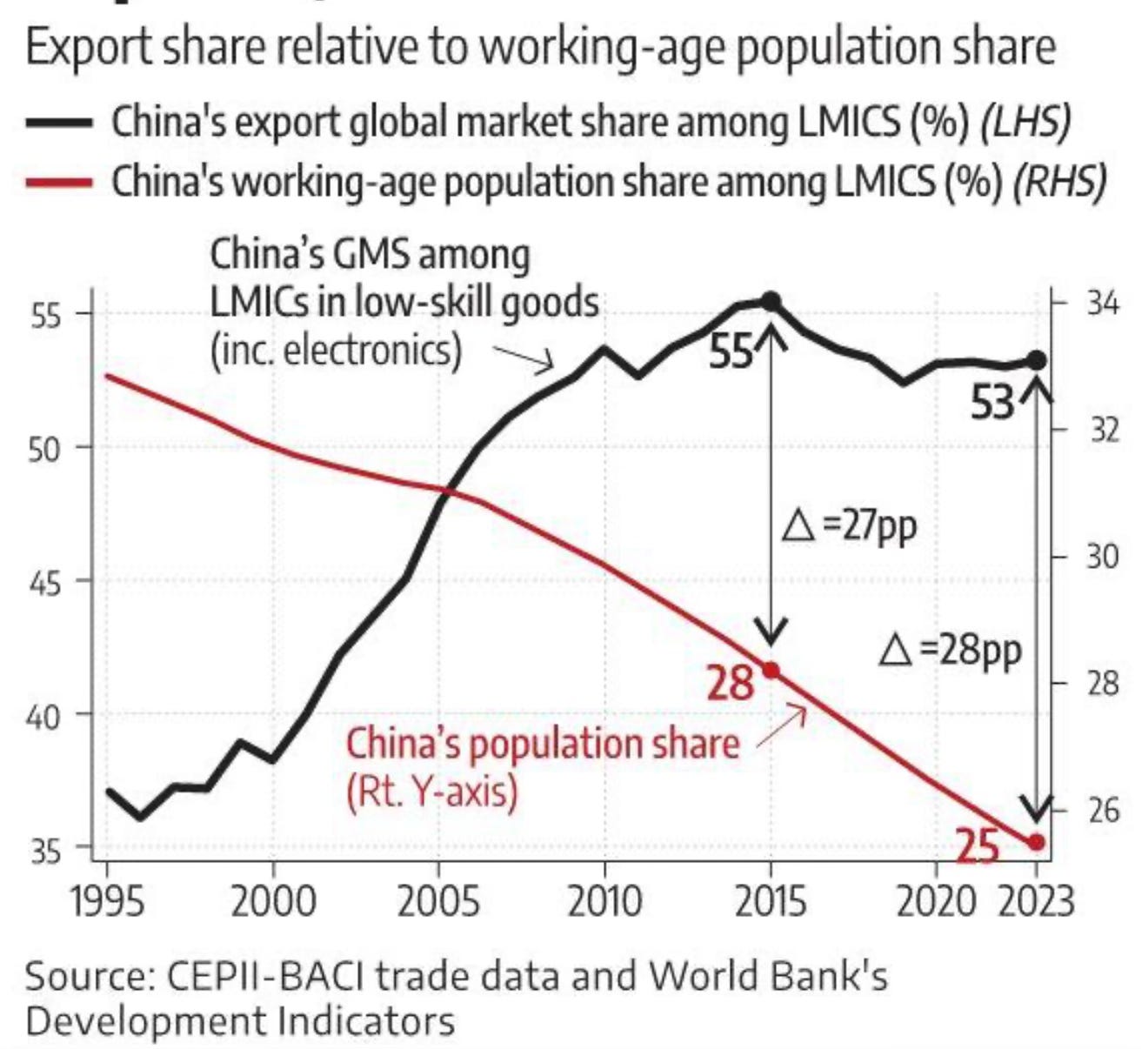
Finally, there is the investment model hitting the debt ceilings for corporates and local governments. Since 2010, government debt has risen from 34% of GDP to over 86% today, and this is most likely a gross underestimate given the large value of off-balance sheet debts of local governments in the form of local government financing vehicles (LGFVs). 

Household debt has risen from 18% in 2009 to 62.5% in 2024, and more than doubled over just the last decade. This is amplified by the fact that property accounts for nearly 60% of household wealth in 2019. These, coupled with restrictive regulations like the hukou system and deficient social safety nets, mean that household consumption, which is already low in China’s share of national output but whose growth is the only way for China to reach a sustainable growth path, is likely to remain subdued. 

The government somehow (perhaps more by luck and throwing the kitchen sink at the problem) managed to stave off a financial crisis from the popping of the real estate bubble in 2020-21. It has instead diverted the credit flows to manufacturing to build up capacity and capture foreign markets. 

The fact that most major banks are state-owned adds one more layer of distortion by allowing the government to keep infusing credit to failing firms to prevent systemic crises. This happened in the aftermath of the real estate bubble bursting, especially when the Evergrande crisis threatened spillovers and a meltdown. This is likely to recur with the manufacturing firms in green technologies and the like. 

It can be said with confidence that if we were talking about any other country, the macroeconomic indicators and their trends, and the dominant economic and political environments, would clearly point to an imminent economic slowdown or crash. The market would be full of shorts for the economy. As Eswar Prasad writes,

The underpinnings of China’s growth seem fragile from historical and analytical perspectives. Things that must end do often end suddenly and in unpredictable ways.

However, in the case of China, we need to take into account the government’s rich track record of adept handling of potential crises and vulnerabilities. But even expertise and luck have their limits.

Monday, November 10, 2025

The emerging market of mega batteries to serve electricity grids

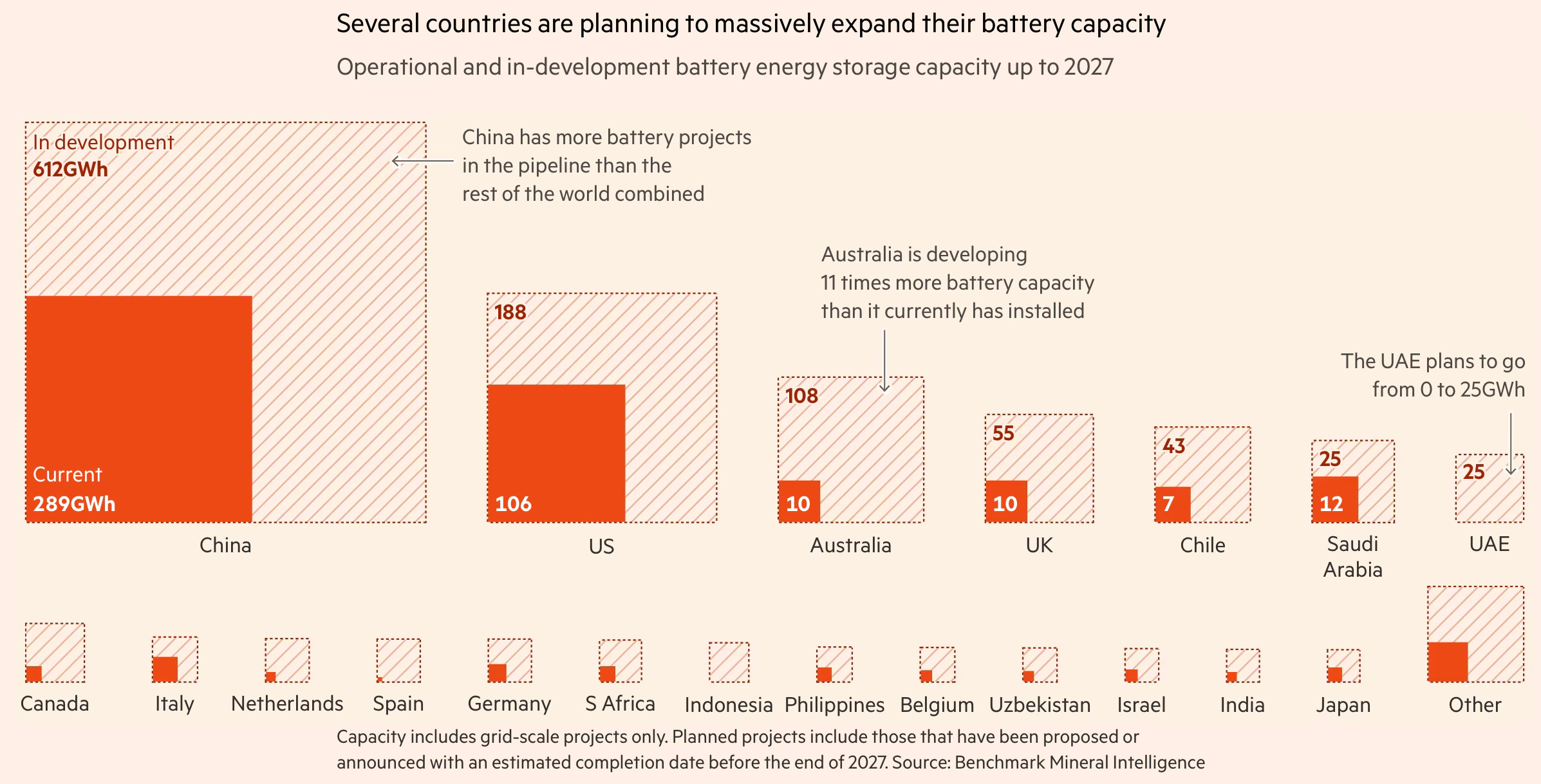
FT has an excellent interactive graphical feature on the growth of mega batteries that store electricity for grids. The growth in grid-scale batteries since 2021 has been spectacular. 

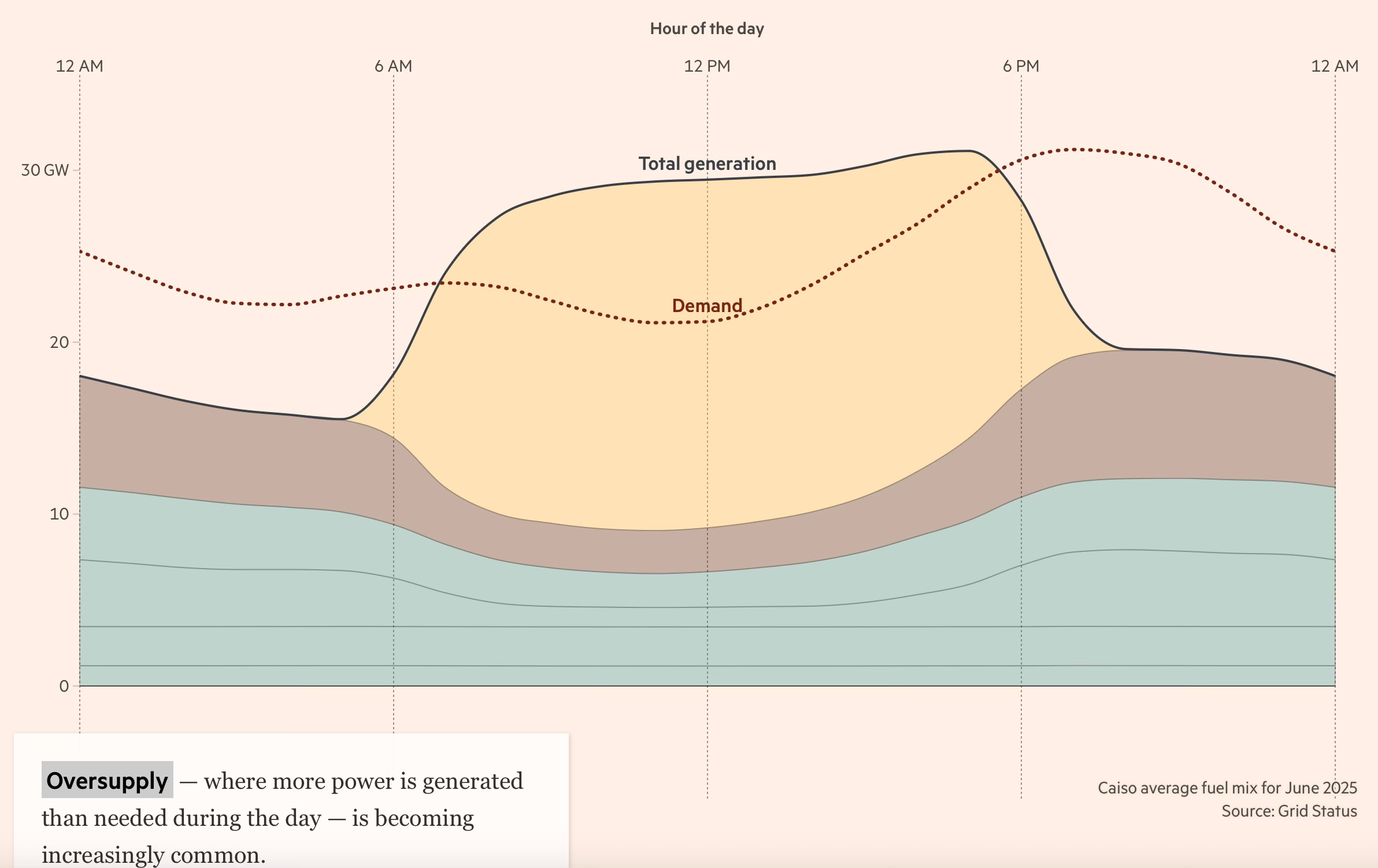
This graphic shows the load mix profile of California’s electricity grid on a typical summer day. 

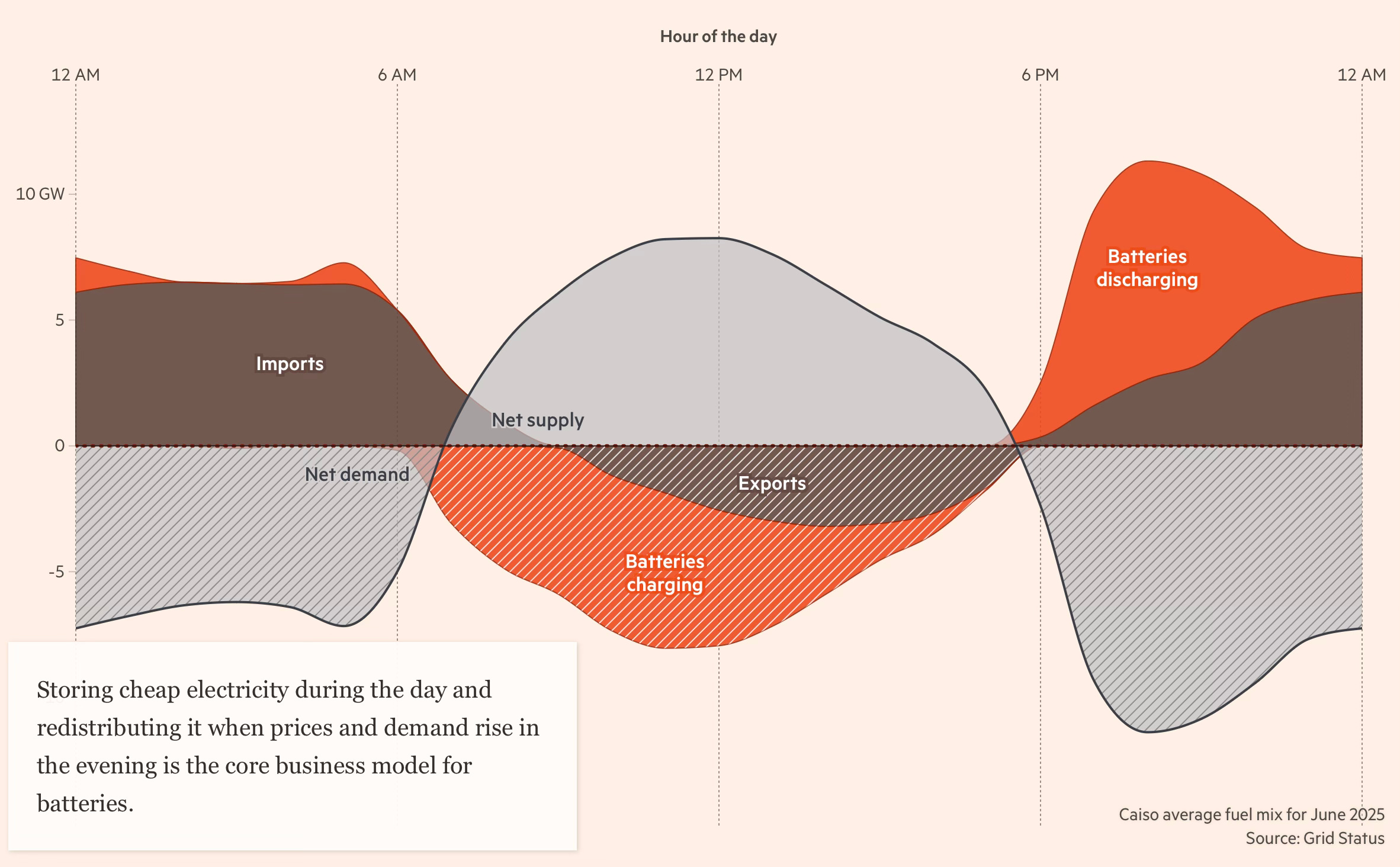
Enabled by state policies, California’s battery storage capacity has more than tripled to 13GW of power, with plans to add another 8.6GW by 2027. Now, as cheap, plentiful solar power floods the grid in the middle of the day, hundreds of battery installations bank the energy and discharge it in the evening when people return home from work and demand — as well as prices — spike. This has shored up the grid, extended the state’s use of renewable energy and reduced its reliance on fossil fuels.

The global battery storage market is dominated by China and the US, with over 70% of the projects by capacity. Most batteries in use today can discharge power for 2-4 hours.

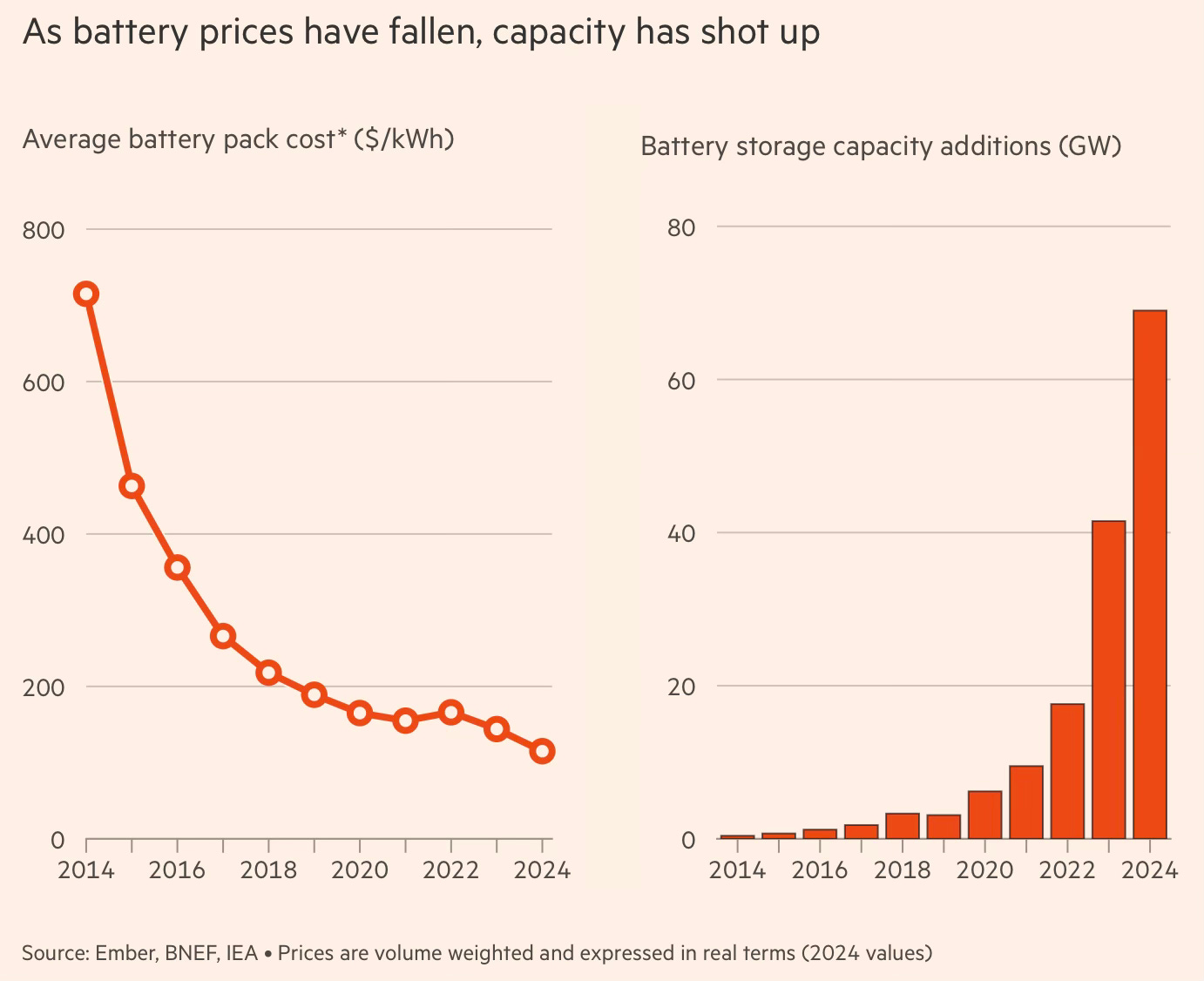
Global battery prices have fallen by more than half over the last two years.

Lithium-ion battery costs have also fallen — by 90 per cent since 2010 — a drop that Artem Abramov, deputy head of research at energy consultancy Rystad, says is likely to continue. Packed full of hundreds of powerful batteries, a standard 20-foot storage unit once provided 3-4 megawatt hours (MWh). Now they typically deliver 5-6MWh, with several suppliers developing 10MWh containers — enough to power around 30,000 UK homes for an hour.

There has been explosive growth in the number of 1 GW battery farms. 

In 2022, there wasonly a single gigawatt-scale facility — defined as having a capacity of at least1GWh, able to supply roughly 3mn UK households for an hour — inoperation worldwide. Today there are 42 such sites. Five times as many giga-projects are set to come online in the next couple of years, including in the UK, the Netherlands, Chile and the Philippines.

As in other clean technology segments, China is the undisputed global leader.

China, which produces over three-quarters of batteries sold globally, has played a crucial role in the energy storage boom. Chinese companies, supported by state backing, have brought down costs through mass production. Domestic demand in China is also skyrocketing, with Bernstein predicting a 90 per cent year-on-year rise to 335GWh by the end of 2025… Driven by both strong power consumption growth — from data centres, electric vehicles and air conditioning — and the country’s long-term replacement of coal with renewable energy, battery storage demand in China is expected to reach 652GWh by 2030, at a compound annual growth rate of 14 per cent, according to Bernstein data… China’s battery makers, benefiting from sustained policy support and amid fierce market competition, are investing in options which can store more energy, such as solid-state batteries. 

Mega batteries stabilise the grid by balancing supply and demand, restarting the system in emergencies, providing back-up capacity when required, etc. 

“What grid operators and utilities value from batteries is flexibility,” says Mark Dyson, a managing director at the Colorado-based nonprofit RMI. “They can be a ‘swiss army knife’ and do whatever is needed on the grid, when and where that is required.”

But the volatile nature of the electricity demand profile makes for a great trading opportunity for battery owners.

Battery owners can buy low when supply exceeds demand, and sell high when demand kicks in.

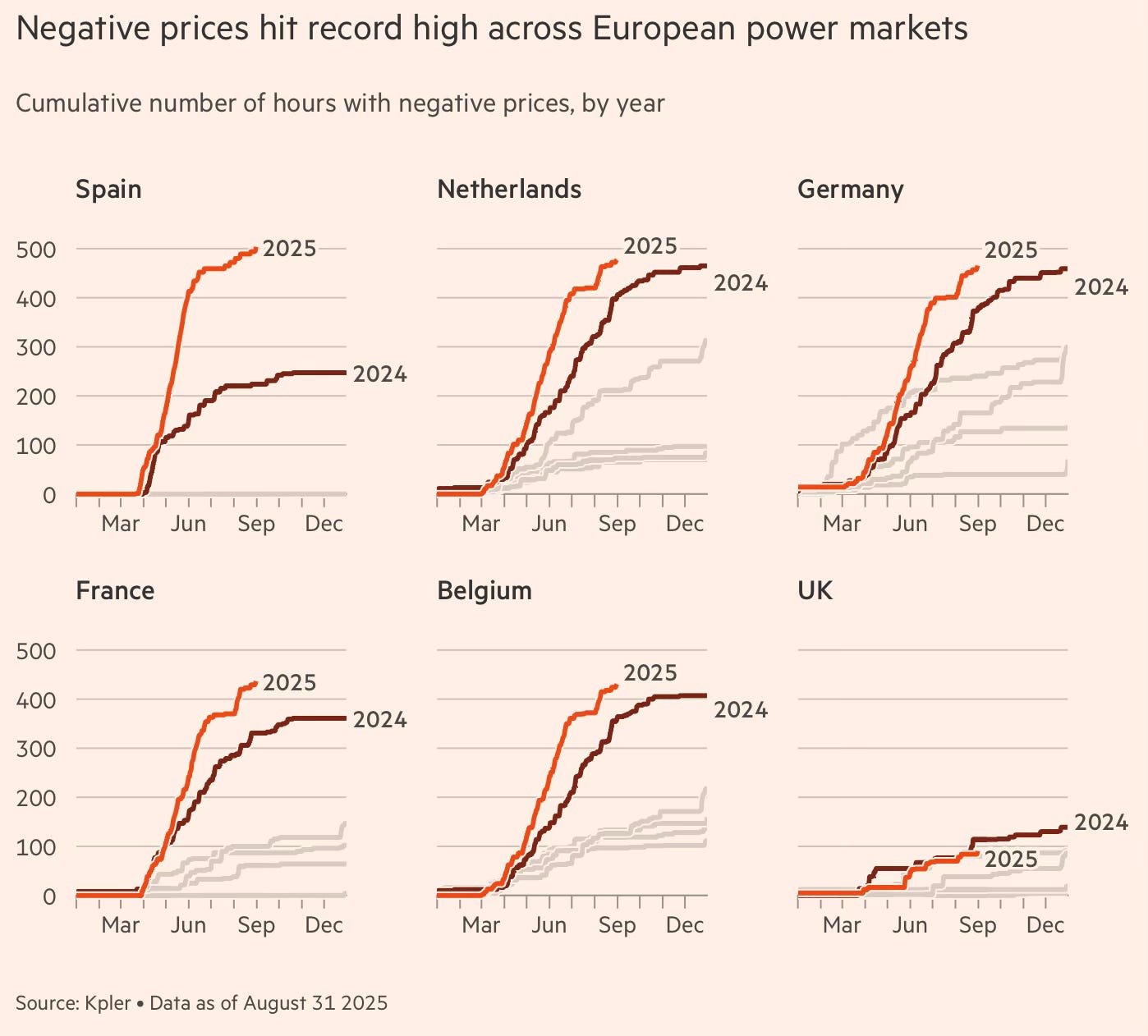
It is common for wholesale electricity spot market prices to fall below zero on especially sunny or windy days, forcing producers to either pay wholesale customers or storage operators to offtake the excess power, or switch off. 

Spain, where nearly a third of summer supply came from solar power, logged more than 500 hours of prices below zero this year, having never experienced them before 2024.

Battery operators can capitalise on this price volatility. 

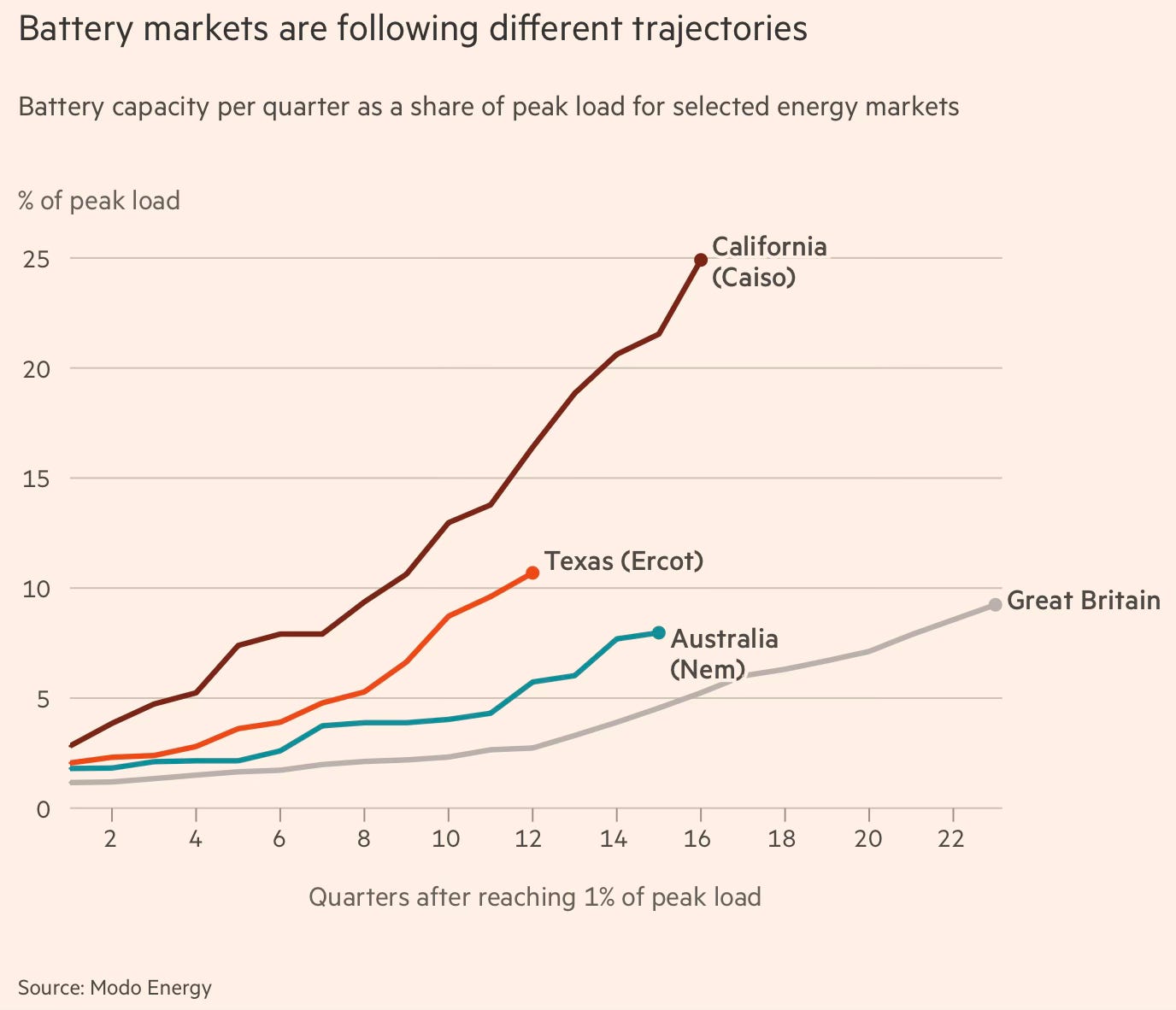
Outside of China, California has been at the forefront of battery storage. 

In California, batteries consistently supplied more than a quarter of electricity during this year’s spring and summer peaks, data from energy analytics platform Grid Status shows. In the first eight months of 2025, gas generation was down 37 per cent from 2023, according to climate academic Mark Jacobson of Stanford University. In Australia, several battery farms are being installed at the sites of retired coal plants. The country’s grid-scale battery storage power capacity has more than tripled since the start of 2024 and in early May, batteries contributed more than 5 per cent of power in the evening peak for the first time.

Batteries are especially likely to be useful for countries with abundant solar power.

Research by the Energy Transitions Commission (ETC) shows that in “sunbelt” locations — countries from India to Mexico with ideal conditions for solar power — batteries could meet almost all power balancing needs. In these regions, solar follows a predictable daily pattern and is relatively consistent between seasons, enabling batteries to play a role on a daily basis. This presents a “huge economic opportunity”, says Elena Pravettoni, head of analysis at the ETC, a global coalition of companies working towards a net zero economy by 2050. “The combination of solar and batteries means clean power costs in sunbelt regions could be 50 per cent lower than today’s fossil-based systems.” In countries more reliant on wind power — such as the UK, Germany and Canada — batteries alone will not suffice, according to the ETC. Wind is less consistent, and current battery technology cannot fill the gap over multiple days.

The feature also talks about an important requirement for investments in batteries - policy certainty.

“These projects aim to be online for around 15 to 20 years, but if you only know the policy for the next one to five years then that causes a big issue,” he says. “This creates a lot of uncertainty for investors and developers.” In some countries, batteries are subject to double-charging, having to pay fees to draw power from the grid as well as when injecting energy back into it. This illustrates the complicated regulatory and policy frameworks developers must navigate. The US has seven wholesale power markets, each with their own rules, policies and price signals, while the EU’s patchwork of regulations poses its own challenges.

It points to emerging business models.

To manage risk and lock in a stable source of income, some developers are turning to tolling agreements, particularly popular in Germany’s burgeoning market. Under these contracts, the developer effectively hands over control of the battery to a third party — typically a large utility or energy company with a broad portfolio of assets — in exchange for a fixed price.

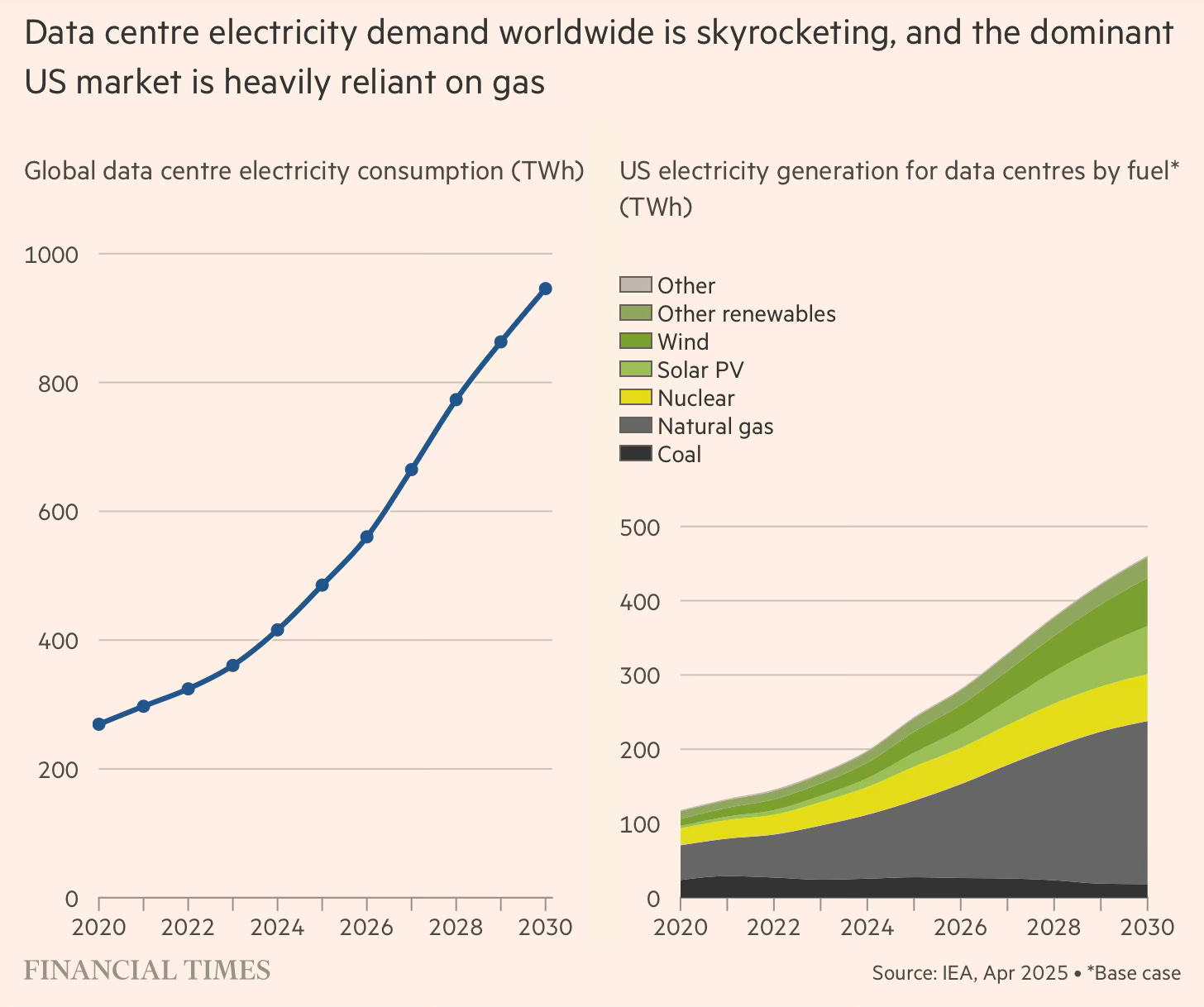
Battery storage assumes added importance given the explosive demand for energy-intensive data centres. As in the US, much of this new demand is being met with natural gas. The International Energy Agency estimates that globally, data centres’ electricity usage would double to 945 terrawatt hours by 2030. 

In this context, some observations of relevance for India’s power sector.

I can think of four aspects of grid-scale battery adoption in any market: battery manufacturing, installation by developers, business models for developers, and financing by investors. It is important to shape public policy to promote these aspects. 

India will need to depend on foreign battery manufacturers for some time. Also, given the dominance of China in the market, dependence on it is unavoidable. Like earlier with the BTG equipment for thermal plants, solar panels, and wind turbines, it will be prudent for India to rely on China in the early stages. 

But there are lessons from those earlier examples that India must incorporate into its battery manufacturing engagements. India missed the big opportunity to leverage its massive solar demand to force wafer and cell manufacturing in the country (in a phased manner from module to cell to wafers/ingots to polysilicon), and allowed developers to import even modules. The result is that Indian manufacturers still do only module assembly using imported cells. 

For a start, India must use the leverage of scale to negotiate with the likes of BYD and CATL to establish manufacturing facilities in India through joint ventures with Indian firms. These deals must include both a clearly defined trajectory of progressively increasing value addition in manufacturing, including battery R&D facilities, and the development of an ecosystem of Indian suppliers. These are matters of detail. The Indian JV partners should be supported to acquire the capabilities and strike out on their own gradually. Industrial policy incentives should be tailored accordingly, taking into account all these glide paths. 

As an illustration, Brazil raised tariffs on all car imports to compel Chinese automakers like BYD and Great Wall Motors to set up plants inside Brazil. Indonesia’s policies on capturing value from Nickel extraction by banning exports of unprocessed nicket and forcing refiners and processors to establish factories locally is another example.

The Government of India must engage actively behind the scenes to ensure that the developers contract with Chinese and other battery manufacturers only on these conditions. In this regard, the large thermal and renewable energy generators like Adani Power, Tata Power, JSW Energy, Renew, Azure, Greenko, etc., should be encouraged to take the lead in this effort and develop partnerships with potential Indian manufacturers who can collaborate with the foreign battery suppliers. 

Market dynamics and incentives on their own will not achieve the desired objectives. It will be required for the Ministry of Power to aggregate the battery demand on a continuing basis, bring together the foreign manufacturers and developers, and actively facilitate the negotiations. 

Power sector policies should be formulated to both facilitate and make it attractive for battery developers to contract long-term with power generators and distribution companies, captive users, and also sell in the power exchanges. If not already done, the Central Electricity Authority could formulate model purchase agreements with multiple tenures for Gencos and discoms to contract with battery developers. 

The industrial policy support should be tailored to achieve the manufacturing side objectives. Accordingly, it is important to target subsidies and other concessions in a manner that aligns the incentives of all sides. Given the need to progressively increase domestic value addition and build domestic manufacturing capabilities, the subsidies and concessions could be a combination of upfront (capex incentives) and recurring (supply-based) subsidies. 

It is also one more opportunity for India’s private sector, especially the large companies, to step up and build a globally competitive grid-scale battery manufacturing ecosystem. The Adani Group, the standout leader in such large infrastructure projects, and with the advantages of a conglomerate spanning the entire market segment from manufacturing to generation, is best placed to show the way.

There are two other important policy requirements that governments must keep in mind. One is that of policy predictability. The commercial risks for manufacturers and developers from state and central government policies should be identified and mitigated. 

For example, like renewables generation, battery costs will continue to decline in the years ahead, and there will also be technological obsolescence. This will create incentives among discoms and other contracting parties to resile from these contracts over time, as happened with solar and wind projects. Political considerations will always be around as governments change. It may therefore be useful for the Government of India to work out mechanisms to bind state governments and their contracting entities into these agreements. This will be a big risk mitigation measure for developers. 

The second risk is of commercial expropriation. The infrastructure sector, apart from national highways, is dominated by a few corporate groups. India is too big a country to be able to meet its massive and rising requirements from just them. It needs the presence of several large manufacturers and developers in the infrastructure sectors. But the experiences of sectors like airports, ports, power, etc., disincentivise the mid-level infrastructure entrepreneurs to bite the bullet and assume risks to grow if they believe that the conditions allow the behemoth incumbents to swallow them up if they become successful. This must change.

Saturday, November 8, 2025

Weekend reading links

1. Paul Krugman highlights that Trump tariffs are in practice, lower than the official rates. Tariffs on paper are the average tariff rate one would predict if we apply the announced tariff rates to what we were importing before the tariffs. The tariff rate in practice is the actual amount collected in tariff revenue divided by the value of imports. 

One illustration.
Imports from Canada are a case in point. Even under the Trump tariffs, most goods from Canada can enter duty-free if they’re “USMCA compliant” — that is, they qualified for zero tariffs under the free-trade agreement formerly known as NAFTA, rebranded but barely changed in practice during Trump’s first term. In 2024, only 38 percent of U.S. imports from Canada entered under the USMCA. That’s surprisingly low, but the main reason was probably paperwork: certifying that a good complies with the free trade rules requires a lot of documentation. For smaller exporters, in particular, that paperwork often wasn’t worth doing, because tariffs were low even for goods not certified as USMCA compliant. Now the tariffs are much higher, and there has been a rush to do the extra paperwork. In June 2025, 81 percent of imports from Canada entered duty free. Not incidentally, this points to a hidden cost of the tariffs: Companies are incurring significant administrative costs to deal with a vastly more complex tariff system.

2. Important point about Zohran Mamdani's victory in NYC.

More than 2mn New Yorkers cast ballots in the largest turnout in a mayoral race since 1969.

To put this in perspective, 1.1 million voters voted four years back! 

The Times has a very good account of this remarkable victory.

A backbench assemblyman who had immigrated to New York City at age 7, he had almost no citywide profile. Even fellow socialists thought his views on policing and Israel would put a hard ceiling on his support... Mr. Mamdani’s political rise may be remembered for what came first: the buoyant, flamboyant, rule-breaking primary run that united a new coalition of Brooklyn gentrifiers and Queens cabbies around the city’s growing affordability crisis and the birth of a megawatt talent... The arc of his success is nothing short of staggering. At the start of the year, Mr. Mamdani was polling at 1 percent, tied, as he likes to say, with the candidate known as “someone else.” Few New Yorkers recognized his name, and his own political team put the odds of winning as low as 3 percent. Now, at age 34, he will be New York City’s youngest leader in more than a century, amid a pile of historic firsts: the first Muslim mayor, the first South Asian and arguably the most influential democratic socialist in the country.

3. Nothing captures the essence of the first ten months of President Trump more than tariffs. The FT has a good graphic. 

The point to be noted is the difference between the notional tariff and the actual tariff.

4. European defence spending is on the rise, and is expected to be an important driver of economic growth and innovation. 
5. Japan's famed convenience stores, konbinis, are facing the consequences of the country's demographic problems.
FamilyMart, 7-Eleven and Lawson all rely on a franchise business model to operate stores, taking a cut of sales or gross profit as a royalty in return for store owners using their brand, products and supply chains. In 7-Eleven’s case, typically between 40 per cent to 70 per cent of gross profit — sales minus cost of goods sold — is paid to the company. 7-Eleven Japan does not recognise the Convenience Store Union because franchisees are not its employees... store owners were under pressure because they were struggling to hire more staff. They had little leeway to raise wages unless the companies share more of the profits... Japan’s big three convenience store chains are trying to introduce technology such as self-service tills, artificial intelligence-assisted ordering systems and cleaning robots to reduce the volume of work. If those efforts fall short, the companies could be forced to introduce new franchise contract terms in order to account for higher wages, said analysts. Or, if new franchisees cannot be found, they will have to close stores.

6. Venture capital fund returns

For many years, long-run venture capital returns reported by Cambridge Associates reflected the huge profits from the dotcom boom of the late 1990s, a time when the average VC fund returned more than 20 per cent a year. Last year, though, those funds finally faded into history. Cambridge’s 25-year view now only catches funds raised — and invested — as the 90s boom turned into a bubble. These showed an annualised return of only 8 per cent. For every other period measured by Cambridge since then, VC returns fall below returns from investing in companies trading on Nasdaq. These are averages, and the profits in VC have always been heavily skewed to a handful of successful firms, making it essential to get exposure to the right funds.

And the top VCs benefit from a Mathew Effect,

Startups struggling for attention are drawn to the investors with the best track records: winning the right financial backers acts as a strong signal for young companies with little else to validate their claims of future greatness. That means the most successful VC firms usually get first option on the smartest founders and the best deals.

7.  FT visual article on perhaps the grandest follies of our times, the Saudi Arabian futuristic city of Neom and its 170 km long 500 m tall mirror glass structure, The Line, conceived by Prince Mohammed Bin Salman.

The budget for The Line was $1.6tn, Neom executives were told in late 2021. But an updated internal estimate the following spring put the cost at around $4.5tn, according to a person familiar with the estimates. That is roughly the size of Germany’s annual economic output. Teams then began tackling the unprecedented design and engineering challenges raised: imagining what life would be like inside a 500 metre-high, 170km-long wall; sourcing the steel and cement that would consume much of global supply; and making water circulate in a manmade deepwater port with no current... Its staggering requirements for materials were enough to overwhelm both the capacity of its local infrastructure, and its pricing power... to make the concrete for the first 20 modules, the contractors would need a supply of cement every year that would be greater than France’s annual output. Each 800-metre module required, by design, about 3.5mn tonnes of structural steel, 5.5mn cubic metres of concrete and 3.5mn tonnes of reinforcement steel — the narrow steel bars twisted into cage forms to strengthen the reinforced concrete. “We were going to take something like 60 per cent of the global production of green steel [per year], which causes the price to go up,” said a senior design manager.

8. Ed Luce writes that peak Trump is over. He writes that the Democratic Party election victories owed significantly to their focus on rising prices, and that the deal with China postponing tariffs for one year may have won Trump some reprieve on the inflation front. 

Trump now has a strong incentive to declare similar wins on other trade wars. In that regard, Tuesday night was also a good one for Brazil, India, Canada and other targets of Trump’s ire. By a quirk of timing, the US Supreme Court on Wednesday held hearings on the legality of his tariff war. Was it coincidence that conservative justices sounded unusually bold in querying that? They too might possibly help Trump by striking the tariffs down.

9. John Burn-Murdoch points out that culture conflicts (and not economic differences) have been the drivers of political polarisation in the US.

In their pioneering paper The Business of the Culture War, published earlier this month, MIT and Harvard economists Shakked Noy and Aakaash Rao use second-by-second TV viewing data to show how the commercial incentives of cable news channels helped to sow discord not only among their viewers but across America more broadly.
Their key insights are that content relating to crime, immigration, race, gender and criticism of elites reliably increases viewing figures (while economics and healthcare cause people to switch away). This means there is a resulting shift in coverage towards more culture war issues and fewer socio-economic stories, which leads voters to rate these issues as more important. Politicians then respond by campaigning more on cultural hot button topics. All told, they estimate that the emergence and growth of cable news can account for fully one-third of the increase in US cultural conflict since 2000.
10. State capacity fact of the day, Competition Commission of India
It has exactly one active office. In New Delhi... CCI has no presence in Bengaluru, one small outpost in Navi Mumbai, and a “touch-and-go” office in Kolkata that lawyers say is barely functional. Markets regulator Sebi, by comparison, has 22 offices. The aviation regulator, DGCA, has around 20. When it conducts raids, it flies 25–30 officers to Mumbai. Every investigation means teams of lawyers and informants shuttling to Delhi for two years. “In India, such a large country, there is only one big agency for 28 states,” said Kumar. “Look at the US. There are competition agencies in all the states.” The costs add up. Filing a case itself can set a company back Rs 50,000 to Rs 6 lakh. Add multiple Delhi trips—three or four by the informant, three by lawyers, over a 2–2.5-year period—and justice becomes a luxury good... The Commission is still operating with roughly the same headcount it had in 2009. The Director-General’s office, sanctioned for around 20 officers, has seven. The merger-control team has six. Case disposals that once took three months now take six to eight—on a good day.
11. FT reports that the US has added "poison pill" termination clauses to recent trade deals with countries like Malaysia and Cambodia, which threaten to end the deals if either signs a rival pact that jeopardises "essential US interests" or "poses a material threat" to US security. This is a form of "loyalty test" for trade partners. 
Simon Evenett, professor of geopolitics and strategy at IMD business school in Lausanne, Switzerland, said the clauses were so broad that they handed the US unilateral powers to terminate the agreements, giving Washington fresh leverage across the region. The agreement with Malaysia also includes a provision requiring it to align with US sanctions and other economic restrictions. “Ultimately, poison pill provisions transform trade agreements from purely commercial instruments into tools for managing partner countries’ broader foreign economic policy orientation,” Evenett wrote in a paper this week. Although there is a partial legal precedent for poison pills in the 2020 US-Mexico-Canada Agreement, Evenett said the USMCA clause had legally defined triggers, in contrast to the broad conditions in the Malaysia and Cambodia pacts.

12. The rise and rise of US Government debt

Thursday, November 6, 2025

Next target for economic nationalism - capital flows?

The restrictions imposed on the inflows of people and goods into the US have ushered in a new era of economic nationalism. It’s unlikely that these trends will reverse even after President Trump demits office. 

Amidst this new wave of economic nationalism, it is only a matter of time before capital flows become the focus of attention and attract restrictions. This is already evident in President Trump’s policies that mandate foreign countries to make massive investment commitments in the US and directives to US multinationals to invest in the US. It’s only a small step to force US companies to restrict investments outside. Don’t be surprised if one of the high-profile investment commitments abroad by a US company triggers resentment and policy measures in this direction. Capital controls may well be the next big Trump policy action. 

This comes on top of growing restrictions on capital flows due to national security and strategic reasons, on the back of rising geopolitical tensions. US outbound investments in critical technologies like AI, quantum, and semiconductors are being subjected to scrutiny and permissions. The US, for example, tightly controls outbound sales of the latest Nvidia chips (and associated investments) that are a major part of the data centre boom. 

This is not a US phenomenon. The general reversal in the trend of offshoring will invariably reduce investments in developing countries. In addition, there are already signs of countries questioning the trend of their pension funds lowering domestic exposure while chasing returns outside. 

The Canadian Industry Minister, Melanie Joly, has called on its C$3tn (US$2.1tn) pension system to boost domestic investment as it seeks C$500bn in new finance to reboot the economy and lower its dependence on the US. 

The Canada Pension Plan Investment Board, the country’s largest fund with C$714bn of assets, revealed its total allocation to Canadian assets dropped to 12 per cent of the fund in March from 14 per cent two years earlier, although the total value of Canadian assets still increased… Last year more than 90 Canadian corporate executives signed an open letter calling on the government to amend rules which would allow them to increase domestic investments, saying the amount they allocated to Canadian equities had dwindled from 28 per cent in 2000 to 4 per cent by 2023. Ottawa in December lifted its 30 per cent cap for investments in Canadian entities at a time when Trump was threatening tariffs and trade wars against its major trading partner… CPP Investments has nearly 50 per cent of all its assets invested in the US, despite pressure from Ottawa to invest more in its home market. Similarly Omers, the pension fund for Ontarian municipal workers with C$141bn of assets, had 16 per cent invested in Canada and 55 per cent invested in the US at the end of June.

A similar trend is emerging in the UK for raising domestic equity allocations for British pension funds.

Targets of 5 per cent, 8 per cent and 10 per cent were discussed as reasonable thresholds to consider, and there was broad agreement that defined contribution schemes should be prioritised over defined benefit schemes… Pension funds are expected this month to sign a voluntary compact — an update of the 2023 Mansion House compact signed under the last Conservative government — to invest 10 per cent in private assets by the end of the decade, with half of that in the UK.

Chancellor Rachel Reeves has announced that she will create a “backstop” power to compel investment in British assets if voluntary efforts fall short. 

She vowed to unleash more than £50bn of investment in domestic infrastructure, housing and fast-growing businesses. The highly contentious move towards “mandation”… will feature in new pensions legislation later in the year. The chancellor hopes creating pension “megafunds” with more than £25bn in assets, coupled with a voluntary accord with industry to boost allocations to private assets, will reverse long-term falls in investment in the UK… It is the first time the Treasury has publicly confirmed it will legislate to create a backstop power to mandate pension funds on their investment strategy.

In both countries and elsewhere, there are growing pressures on pension funds to reduce foreign exposures and mandate higher domestic investment requirements. Australia’s National Reconstruction Fund and other infrastructure initiatives incentivise, in various forms, domestic institutional funds to direct capital into domestic projects. France and several other EU members have similar incentives and regulatory frameworks to direct insurance and pension funds into domestic projects, and these trends are on the rise. 

Given the massive infrastructure replenishment requirements across developed countries, there will be increased pressure on long-term funds to prioritise domestic deployments of capital. The already small share of long-term capital—institutional funds and private equity—flowing to infrastructure in developing countries will decrease further. 

This trend in finance squares with the broader shift towards protectionism elsewhere. There’s nothing about economic nationalism that ought to confine it to only goods and services, and people. Capital will inevitably join the list. Given these trends, we may well be at peak global financial integration, too. 

An IMF paper from 2024 finds empirical evidence indicating that capital controls on outflows (CCOs) are associated with crises and declines in GDP growth. Given the emerging situation of macroeconomic and financial distress in many developed economies, the likelihood of the implementation of CCOs is growing stronger. 

In the circumstances, developing countries like India should be prepared for a reduced flow of foreign direct investments (FDI). This is more likely to be pronounced in technology areas. While financial markets will always pursue returns, domestic political economy factors are likely to hold back outflows of long-term capital like pension funds and insurers.

Saturday, November 1, 2025

Weekend reading links

1. Subsea cable is fast becoming a sector of strategic importance. Globally, there are four major companies - Japan's NEC, New Jersey-based SubCom, France's state-owned Alcatel Submarine Networks (ASN), and China's HMN Tech, a former Huawei subsidiary. The last three own cable-laying shipping fleets, while the first charters its vessels and is now set to receive government support to buy ships to put them on a par with their counterparts. A subsea cable-laying vessel could cost about $300 million. 
It currently relies on a subsea cable-laying vessel leased from a Norwegian group in 2022 on a four-year charter, partnerships with other companies and on renting the specialist ships on an ad hoc basis to meet surging demand for fibre-optic cabling in the Indo-Pacific. NEC dominates installations in Asia and has laid more than 400,000km of cables globally. It also specialises in armoured cables that can better withstand sabotage. Globally, there are 63 cable-laying ships, according to the International Cable Protection Committee. ASN owns seven, while SubCom and HMN Tech are believed to own seven and two, respectively, but did not reply to requests for confirmation. Japanese telecoms groups NTT and KDDI own cable-laying vessels, which are rented out to NEC, but they are not the larger kind of vessels required to lay transocean cables.
This is a description of the challenges being faced by the industry.
A shortage of ships is one of the major bottlenecks to achieving the 26 per cent rise per year predicted for global data transmission to 2031, driven by video streaming and artificial intelligence services led by Big Tech groups such as Meta and Google, according to the TeleGeography telecoms data service... Up to 200 cables are damaged annually, primarily due to fishing or anchors, but also through sabotage, as seen in the disruption caused to two cables in the Baltic Sea last year. Chartering for an accurate period has become increasingly difficult due to the unpredictable timelines for securing the cables’ passage. There is now a two-to-three-year wait to get permissions from countries whose waters the cables pass through, up from six months to a year about a decade ago.

2. Salaries in India have not kept pace, even with inflation in the FY16-24 period.

More here

From Diwali 2023 onwards, Indian companies’ earnings growth has decelerated at a rapid rate. Underpinning this deceleration is a sharp conk-off in consumption growth, long the mainstay of the Indian economy. Key drivers of this consumption downturn are a sharp deceleration in white collar job creation alongside a reduction in real wages for white collar workers over the past eight years.

And here

This should be a matter of deep concern.

The weak consumption demand will constrain India's sustained high growth ambitions. It will restrict private investment, limit job creation, squeeze salary growth, and increase household indebtedness. The only solution is broad-based, equitable economic growth. But that, in turn, requires conditions that are far from 

3. Rhodium Group has a report on the challenges faced by foreign car manufacturers in China. The German car makers and Tesla have the largest China exposure, while the Japanese and Korean car makers have far smaller engagement. 

It is important to note that while Tesla is likely even more dependent on China for profits than German OEMs, the sources of those profits are fundamentally different. German automakers still earn most of their China income—though at shrinking margins—by selling vehicles to Chinese consumers, whether locally produced or imported. Tesla, by contrast, likely earns the bulk of its China profits from two sources: the sale of regulatory credits—its CFO disclosed that three-quarters of Tesla’s global credit sales in 2024 (Q1–Q3) occurred in China—and a highly profitable export business built on China’s low production costs. In short, German OEMs depend on Chinese consumers, while Tesla depends on Chinese workers and credits... The experience of Toyota, Hyundai, and Kia shows, however, that success in China is not a prerequisite for global competitiveness. Toyota has become the world’s largest carmaker despite a relatively modest China footprint. Hyundai and Kia, for their part, have grown despite running loss-making China operations after the 2017 THAAD dispute triggered consumer boycotts that cratered sales.

4. The US Congress has become ideologically polarised since the turn of the millennium.

And immigration has been at the forefront of the polarisation.
The proposed 2026 Budget outlines cuts of 34 per cent for basic research and 22 per cent for all research. It demands a 55.7 per cent cut for the National Science Foundation (NSF) — from $8.8 billion to $3.9 billion — and a 39.3 per cent cut for the National Institutes of Health (NIH) — from $46 billion to $27.9 billion. These two agencies are the primary sources for TRL 1-2 basic research. The story for TRL 3-6 applied research is also rough. The Department of Energy’s (DoE’s) Office of Science faces a 14 per cent cut, and Nasa’s science-research budget is slated for a 46.6 per cent reduction — from $7.3 billion to $3.9 billion... 

The Nazi government, which took charge in 1933, was a populist one, harnessing mass anger against the cosmopolitan elites. An estimated 25 per cent of all physicists in Germany, including 11 past or future Nobel laureates like Albert Einstein, Max Born, and Leo Szilard, fled Germany. The best research organisations of the world — like the University of Gottingen — were destroyed. It only took one year. In 1934, the great mathematician David Hilbert said to the Nazi education minister “mathematics in Gottingen? There is really no such thing any more”.

6. Comparing dotcom era telecom investments with AI investments today.

There were more than 80mn miles of fibre optic cable laid from the mid-1990s until the end of the dotcom boom, and much of that investment took years to pay off. US telecom companies spent $444bn in capital expenditure between 1996 and 2001. Still, compare this with the $342bn that will be spent this year alone in the US by the top investors in AI data centres and computing infrastructure, including Microsoft, Alphabet, Amazon and Meta. At the current rate of power consumption needed to fuel AI development, estimated investment will stretch to nearly $7tn by 2030.

7. Nvidia makes a $1 bn investment in Nokia to take a 2.9% stake in the Finnish telecom manufacturer, following which the shares in Nokia surged 21% and Nvidia by 5%. Nokia is seeking to diversify away from network infrastructure into AI and cloud services. 

This is part of the vendor-financing model of the emerging AI market. Is Ericsson next for Nvidia?

8. Two graphics that question the argument that we are in a bubble. One, the PE multiples of the Big Tech firms compared to those in earlier bubbles. 

The capex boom is largely (at least till now) being funded by free cash flows, unlike debt in earlier booms.
9. It's useful to keep in mind that much of the infrastructure in the West was built long ago.
In Britain we are using rail lines, bridges and sewers built by the Victorians, and even the Romans’ roads. It has taken over 150 years for London to need an expansion of the sewerage system begun by Joseph Bazalgette in 1859 (and largely finished within a decade). The US built its railroads in the 19th century, and interstate highways from the mid-1950s.

10. The reforms currently underway in the US to reverse safeguards in the banking sector in the name of deregulation may be an instance of bad deregulation. 

Last week, the Federal Reserve announced plans to overhaul its annual banking stress tests to make them less onerous. US banking watchdogs are widely expected to follow up with other changes to capital and leverage rules that could unlock $2.6tn in additional lending capacity, according to consultants Alvarez & Marsal. To backers, there is a logic to the Trump administration’s moves. Shackling banks with high capital requirements has not eliminated risky lending. Instead it has led to regulatory arbitrage that makes the danger harder to supervise, they say. As the IMF pointed out, banks now lend to private capital, which uses the funds to leverage investor money while making loans and buying securitised debt. In theory, the investors absorb the first losses, keeping bank deposits safe. In reality, layers of borrowing by companies like First Brands make it hard to tell who is on the hook and may lead to complacency. If banks lent directly, they say, they would do more due diligence and pick their borrowers more carefully... 

Another Trump administration initiative to allow ordinary investors to put their money in alternative assets, which have long been restricted to institutions and the super wealthy. Those changes are expected to channel floods of retail and retirement money to private capital groups, giving them bigger pots with which to make loans and buy asset-backed securities. These retail funds will be under particular pressure to deploy capital quickly because of the way they are structured... Bank of England governor Andrew Bailey said last week that “alarm bells” are going off around the rapid growth of structured products, and JPMorgan chief executive Jamie Dimon has proclaimed that the recent collapses of subprime auto lender Tricolor and car-parts maker First Brands are evidence of “cockroaches” in the credit market. The failures have uncovered complex webs of borrowing and allegations of fraud, leading Apollo chief Marc Rowan to warn that eroding lending standards are leading to “late-cycle accidents”.

11. Stock market concentration in the US is at all time high.

Eight of the 10 biggest stocks in the S&P 500 are tech stocks. Those eight companies account for 36 per cent of the entire US market’s value, 60 per cent of the gains in the index since the market bottomed in April and almost 80 per cent of the S&P 500’s net income growth in the last year... MSCI All World index, which comprises over 2,000 companies from more than 40 markets, currently has almost a quarter of its capitalisation in just eight US tech groups.

 On Tuesday afternoon, when US Stocks hit their latest highs, 397 stocks in the S&P 500 lost ground. In 35 years, the index never posted a gain on a day when do many of its components sold off. 

Since the launch of ChatGPT in November 2022, the US markets have been on a tear, underpinned by AI stocks.
This is an interesting snippet.
Since 1970, the total value of all publicly traded US stocks has averaged about 85 per cent of US GDP. Warren Buffett once described this as “probably the single best measure of where valuations stand at any given moment”. On Tuesday, the metric rose to a record 225 per cent.

12. More on the First Brands bankruptcy case in the US in this story of how a small Draper, Utah-based equipment finance specialist, Onset Financial, ended up with a $1.9 bn loan exposure to the Ohio-based automotive parts maker which borrowed close to $12 bn to finance acquisitions. 

First Brands’ reliance on Onset, which claims to eschew the “rigid” and “strict” approach of banks in favour of “speed” and “flexibility”, illustrates how unconventional corners of credit markets facilitated its borrowing binge, with many of the Ohio-based company’s lenders unaware of the true scale of its debts until it was too late... Onset’s corporate identity to date has been marked by promotional videos, a high-tempo sales culture and links to both prominent local investment firms and sports players. The fallout could ripple through the community in Utah, where Onset has built up an image of growth and glamour. Founded in the depths of the 2008 financial crisis in Draper, a small city 20 miles south of Utah’s state capital Salt Lake City, Onset’s triumph over stodgy rivals in a key area of business lending is a recurring theme of its corporate lore. Equipment leasing is a $1.3tn industry in the US that allows companies to rent machinery rather than sink large amounts of upfront capital into building or improving their facilities... People familiar with Onset’s operations describe a model fuelled by a direct and ambitious sales force. “What does our product do? We sell money, simple as that,” Taylor Weeks, Onset’s vice-president of sales, told a podcast in 2023. Weeks added that the company provides “rocket fuel” for “high-growth” businesses.

Equipment leasing is a $1.3 trillion industry!

13. FT writes about the rise of China's biotech firms, licensing technology and selling drugs outside the country. From having no biotech sector to speak of ten years back, in the first eight months of 2025, there have been 93 overseas licensing deals worth a total of $85 bn on drugs developed in China. 

China’s transformation from a copycat manufacturer of drugs developed overseas to a hub of homegrown research is exemplified by Jiangsu Hengrui. Founded in 1970, it spent the first two decades as a small-scale state-owned manufacturer of low-cost antiseptics. In the 1990s, it started developing generic anticancer drugs. It was privatised in 1997 and began investing in building its own research capabilities. Today, it has one of the most diversified pipelines in the country, spanning weight-loss therapies, oncology drugs and Alzheimer’s treatments...

Hengrui has struck licensing agreements with Merck, Braveheart Bio and Glenmark in the past year alone. In July, it agreed a deal with UK pharmaceutical company GSK to develop up to 12 medicines. “In China, you can scale and test medicines in human beings much faster than in the US or Europe,” said Loncar. “If you have an idea for a drug, you can get an answer about whether it works a year or two earlier in China.” For many Chinese biotechs, the surge in international partnerships has provided much-needed capital after a difficult few years marked by drug pricing reforms that squeezed profit margins on domestic sales... Hengrui’s international deals have highlighted a concern for Chinese pharma companies seeking to get international approval for new drugs. The US Food and Drug Administration has repeatedly rejected one of Hengrui’s cancer drugs, citing questions about quality control at its manufacturing sites.

US and European pharma companies are doing what their manufacturing counterparts elsewhere did by outsourcing to China, only to realise that they have been outmuscled by them over time. 

This also raises questions about where India's established pharmaceutical firms are. 

14. Finally, NYT has a good article on OpenAI's circular financing deals

Many of the deals OpenAI has struck — with chipmakers, cloud computing companies and others — are strangely circular. OpenAI receives billions from tech companies before sending those billions back to the same companies to pay for computing power and other services.