Substack

Thursday, December 15, 2016

More on crossing the river by feeling the stones...

The two less discussed characteristic features of China's spectacular economic growth have been its brute force state capacity as well as the strategy of innovative policy experimentation at the margins. The Economist has a nice article on the emergence of Shanghai as competitor to Beijing as the cultural capital of China in the space of less than a decade. It captures these two features,
The prospect of hosting Expo 2010 helped motivate Shanghai’s local government to encourage property developers to launch an ambitious urban-regeneration programme that would reframe the city as a cultural hub. At the heart of this renewal was West Bund, a 9.4km tract of Shanghai riverside, whose old industrial buildings and former airport were to be repurposed under the manifesto “Culture First, Industry Oriented”. The same year that Expo 2010 opened, the central government announced that it would build 3,500 new museums across the country within five years. It exceeded that figure three years early, in 2012. The call to action stimulated property developers to tag museums on to many of their projects in return for tax benefits and to curry favour with local authorities. West Bund was one of the most important beneficiaries of this policy. In 2014 two landmark contemporary-art museums opened there... 
The same year also saw the introduction of Le Freeport West Bund, a bonded warehouse built to help the tax-free import, export and storage of artworks. It allows collectors to sidestep the 17% value-added tax imposed on art and the customs duty on works brought into the country. A game-changer for freeing up the movement of artworks, it is a prime example of the city’s market-friendliness. 
The efficiency of a publicly directed museum construction and mobilisation campaign to generate world class outcomes is simply awesome. Similarly, the willingness to innovate at the margins with such disruptive tax concessions, similar to what preceded Shanghai's evolution as a financial market powerhouse, is worthy of emulation. 

These, rather than its brute force borrow and invest strategy, should attract the interest of policy makers elsewhere. 

Monday, December 12, 2016

The case for an "examined life"

Ananth points me to an absolutely fascinating conversation involving Princeton Professors Robert George and Cornel West which explores the merits of a liberal arts education. This from Robert George,
The point of liberal arts education is an examined life… The examined life is a life in which you are constantly questioning yourself. You’re subjecting yourself to self-criticism. Intellectual humility is a central virtue because in order to carry out the enterprise of self-criticism, you have to actually deal with the possibility that you might be wrong, and that’s hard, especially if changing your view would result in your being stigmatized, ostracized, isolated on your campus or in your community, whether your community is right, left, center, Protestant, Catholic, Jewish, Muslim — whatever your community is. Seeking the examined life can be a very dangerous thing if what you’re after in life is satisfaction and feeling good. It’s a probe. It’s a prod. It’s a disruptor.
And this from Cornel West,
And I think part of the problem with spiritual blackout these days in the United States, and it’s a kind of indictment in some ways of our educational system, is that we have not adequately prepared our fellow citizens, not just those who go to college. One reason why I’ve taught in prisons for 37 years is that the paideia that we’re talking about, this deep education that we’re talking about, has to be widely available. It can’t just be available to those that gain access to institutions of higher learning. About two-thirds of our fellow citizens never go to college. They’re going to get their education one way or the other. They turn on the television, not too high quality, listen to the music, and I listen to Stephen Sondheim. If they’d listen to Sondheim every day, it would be a different situation because that’s some serious paideia going on in his music. They listen to the flattened, narrow, parochial stuff for titillation and stimulation, not for self-examination.

And again from Prof George, this test of what is right or wrong,
If you want to figure out what you should be doing right now, imagine looking at your situation right now from the point of your death and look back on it. Will it look like this was worth your time and attention and effort from the perspective of your death? For many, many of our young people, especially our most gifted and advantaged young people, they care about what’s on their C.V. when they ought to be caring about what’s going to be on their tombstone. If you look at the question, what is going to be on my tombstone instead of what’s on my C.V., you might have a very different set of decisions. You might make very different decisions about what you’re going to do now and next week and next year and for the next five years.    
One of the problems with modern society is that prestige and desire for recognition (thymos), fundamental drivers of human nature, are intimately dependent on wealth and incomes. The individual’s access to any platform that helps satisfy these impulses are contingent on the outcome of the ovarian lottery. As a first order requirement, if somehow we could have a system where everyone has equal access to livelihood opportunities, then, maybe, the current tight relationship between money and prestige could be loosened. 

At a fundamental level, I think the elevation of the instrumental value of education, displacing its intrinsic value, is a reflection of the market’s incentive distorting features. In other words, it is a market failure. If we agree that the qualities imbibed with a liberal arts education (an examination of life that leads to an understanding of other people and different values) are valuable to society, a public good, and if we also agree that there is a market failure in its supply, then it is hard to deny that governments have to bear a share of the burden of higher education.

But as Prof West says, even this, if achieved, would cover only those who complete higher education. In a society where large numbers, even the vast majority, are unlikely to do higher education, the challenge of disseminating and internalising paideia is much greater. That would require a radical transformation from our present economic, political, and social equilibrium. 

Sunday, December 11, 2016

When intellectuals become apologists

I find Tyler Cowen's "economic" assessment (or rationalisation) of the impact of Trump's conflicts of interests appalling. Sample this (italics mine),
Standard political economy suggests that the worst forms of corruption usually are decentralized. If you have to pay off 13 different bureaucrats to get a project through, the chance that one of them will hold you up, or that the aggregate of the bribes is simply too costly, is pretty high. Conversely, a single payment at the top can be a way to grease the wheels for big projects, some of which may be beneficial for the nation as a whole (imagine simply passing cash to a president for him to fix the country’s airports). Or consider the value of domestic property as a potential source of conflict of interest. If Trump really put the value of his hotel properties before the national interest, that might encourage a lot of policies to foster urban growth, travel, and tourism. Those policies might not spread their benefits efficiently, but they are hardly the worst outcome imaginable... Note that congressmen currently hold stock and other asset portfolios and they are not required to put them into blind trusts. Maybe that’s not the best system, but it has not brought national ruin, and it is not responsible for most of the ailments facing our legislative branch, such as polarization and gridlock.
Does this mean that a corruption involving paying off just the President is to be condoned since it "may be beneficial for the nation as a whole"? Should we tolerate Trump's rational self-interest in promoting his hotel properties any more because it "might encourage a lot of policies to foster urban growth, travel, and tourism"? And should we not be any less concerned with Trump's conflicts of interest just because many Congressmen face similar conflicts and that has "not brought national ruin"? 

This is a slippery slope and the article is a very good illustration of intellectual compromises that contribute to the downward movement. Five years back, it would have been unthinkable, even looked upon with horror, that an American President could be a crony-capitalist-in-chief. Yet, now, as the moment has arrived, a leading economist uses economic logic to make this benign assessment of Trumpism's effect on US domestic politics and the economy. 

This is the problem when economists start using their rational calculus to offer judgements that are completely divorced from historical and ethical considerations. Sometimes, when facts are strikingly evident, and let's face the reality that Trump engenders shocking levels of conflicts of interest, it is best to acknowledge the same and get on with doing what can be done to address the contributors instead of seeking out silver-linings. 

Saturday, December 10, 2016

Weekend reading links

1. Martin Wolf captures Europe's lost decade starting first quarter of 2008,
In the third quarter of 2016, the eurozone’s aggregate real GDP was a mere 1.8 per cent higher than in the first quarter of 2008. Remarkably, real domestic demand in the eurozone was 1.1 per cent lower in the second quarter of 2016 than it had been in the first quarter of 2008... In the second quarter of 2016, eurozone nominal demand was only 6.9 per cent higher than in the first quarter of 2008. So what should it have been? Assume the trend rate of real growth is 1 per cent, while the inflation target is close to 2 per cent. Then nominal demand ought to grow at about 3 per cent a year. If policymakers had achieved that, nominal demand would have risen by about 28 per cent between the first quarter of 2008 and the second quarter of 2016... According to the Conference Board, a research group, between 2007 and 2016 real GDP per head at purchasing power parity rose 11 per cent in Germany, barely changed in France, and fell 8 per cent in Spain and 11 per cent in Italy... In the third quarter of 2016, Italy’s aggregate real domestic demand was 10 per cent lower than in the first quarter of 2008, while Spain’s was still close to 11 per cent lower, as it recovered from its post-crisis fall of nearly 19 per cent. Germany’s real demand has risen by 8 per cent over the same period. But its current account surplus has risen from 7 per cent of GDP in 2007 to a forecast of just under 9 per cent in 2016.
2. Latest work of Thomas Piketty, Emanuel Saez, and Gabriel Zucman finds that since the seventies, even as the US economy doubled and despite more than $5 trillion in annual transfers, the net incomes of those in the lower half have hardly grown. Their findings,
Since 1980, the share of total income going to the top 1 percent of earners has doubled, while the bottom half’s share has narrowed. Stagnant wages for many Americans are a major culprit. In three and a half decades, their incomes have barely changed while those at the top have tripled. The source of that income gain has also shifted at the top; more is coming from returns on investments rather than wages. That makes it harder for the bottom half, with much less capital, to catch up. 

The three graphics below capture the declining shares of pre-tax incomes of the bottom half, trends in real average pre-tax income, and the share of the income of the top 1% coming from wages and capital. The last one in particular underlines the importance of low capital gains taxes and how it disproportionately benefits the richest. 

3. Fascinating analysis by Upshot folks on Donald Trump's twitter activity. 
Their analysis of over 14000 tweets over the past two years finds that one in nine was an insult of some kind. They point to a two-pronged strategy. The primary focus is on identification of one or two main targets and vilifying them till they are no longer threatening enough. The second prong is a series of background attacks directed at a wider range of subjects.

4. Kritarchy in India is continues its disturbing march. The latest to attract the scarce time of an overburdened Supreme Court, the Chief Justice no less, is the government's demonetisation scheme. The government has rightly resisted the Supreme Court's over-reach claiming that fiscal policy is beyond judicial review. These queries and comments of the bench headed by the Chief Justice are, by any yardstick, hardly justiciable,
Can you put what you had estimated when you took the decision to scrap Rs 500 and Rs 1,000 notes? Did you make any estimation at all? Was there a plan? Or, did you take the decision just like that? If you had thought notes worth Rs 10 lakh crore would come back to the banks, did you take steps to urgently put in that much of new currency+ back in circulation? Can you produce the Cabinet note before the decision was taken... When you fixed the cap at Rs 24,000 per week on your own, you must have checked if the system can take that burden, haven’t you. See if you can fix a limit below, which the bank manager can’t send you away or ration currency. 
5. Niranjan makes an interesting point about the very low number of Indians who pay taxes and its consequence for India's democracy.
Around 48 million people file income tax returns in India; the actual number of people who pay tax is lower because of those who report zero tax liabilities. The number of people who were eligible to vote in the 2014 national election was 815 million. In other words, India has one direct tax payer for every 16 voters. The imbalance between the number of people who pay income tax on the one hand and the number of people who can vote on the other hand has profound implications for the Indian social contract. It creates political incentives for successive governments to borrow money to buy votes rather than build an effective tax system that will spur economic growth. Citizens are also less likely to put pressure on governments to spend wisely on public goods. 
Interesting given that democratic politics is intimately related to taxation. While liberals may decry this, the positive incentive effects of being part of a tax base and perverse incentives from not being part of the same should not be under-estimated.

6. Greg Ip has this on the plateauing of productivity improvements, 
The number of new drugs approved in the U.S. per dollar of research and development has fallen by half every nine years between 1950 and 2010. Approvals have risen since, though 40% are for “orphan” drugs which address diseases that afflict fewer than 200,000 people. The declining payoff to medical research is starkly illustrated by a new study by Charles Jones of Stanford University and three co-authors. It found that in the decade before 1985, years of life saved through breast cancer treatment rose steadily each year, along with the volume of research. But since 1985, improvements in mortality slowed. They calculate that each new published trial added 16 years of life per 100,000 people in 1985, and that fell to less than one year by 2006. They found the same pattern across agriculture and semiconductors: steadily declining productivity per researcher.
7. Finally, even as the debate rages on the merits of demonetization, oblivious to the difficulty of making credible judgements on such complex issues, the only thing definitive may be that it may have redefined the narrative surrounding black money. It has drawn attention to the role of black money and informal economy and their close intersection, benefits of financial inclusion, the potential of digital cash, and the need to stem the generation of future black money. And it has definitely provided a massive impetus in potentially ushering in a structural shift in the economy, in moving towards a less cash economy and shrinking the informal economy.

As far as I see there could potentially be three important debates about the scheme. Could the same benefits have been achieved without demonetization? Could the post-announcement planning and actions have been swifter and better co-ordinated? Finally, will the government follow up with the complementary measures to limit the future flow of black money? Unfortunately, none of the three have received the amount of attention and interest that they deserve.

Wednesday, December 7, 2016

The informality story has a demand side

I have blogged earlier about the challenges associated with shrinking informality. I therefore find this assessment, which is surprisingly commonplace, baffling,
Many units in the informal sector survive because they do not pay taxes. They conduct most of their business in cash. This is true not just for small repair shops and kirana stores but also for larger enterprises, including many small-scale manufacturing establishments. This cost advantage also helps these units compete effectively against their larger and more efficient counterparts in the organized sector, who not only pay taxes but have to comply with a plethora of rules and regulations. In fact, many brokerage reports have pointed out that the introduction of the Goods and Services Tax will be a big help to companies in the formal sector, as they will be able to take away market share from the unorganized sector. The demonetisation impact will be felt most acutely in the informal economy, which relies more on cash payments. This short-run impact, however, will be overshadowed by the long-run effect, which will see its share of the economy shrink rapidly, as the state rams through its vision of a cashless economy and forces them to pay taxes. Many units in the informal sector are likely to fail as a result. The hope is that the process will lay the base for the growth of a modern, capitalist state, instead of the ramshackle Third World petty production-cum-islands of modern industry model we see now. It will speed up the process of accumulation and will ensure the state has more resources at its command. 
It completely misses the demand side of the story. It assumes a seamless and fairly rapid substitution by the buyers of the goods and services produced in the informal sector with those from the formal sector, despite their significantly higher cost of production. In other words, national incomes have to rise rapidly. Since proportionate productivity improvements could not have been achieved on an economy-wide scale within a short time span, and since inputs (capital and labor) increase at the normal rate, it is not clear what would drive the income growth.  

Apart from deeply under-estimating the nature and scale of the informal economy, such optimists also fail to appreciate its role in a country's development trajectory. Informality is just a natural phase in an economy's development. 

None of this is to encourage, leave aside celebrate, informality. It is only a caution against raising excessive expectations, that leave governments fighting impossible battles. 

Saturday, December 3, 2016

Kritarchy again?

Livemint reports that the Supreme Court of India has issued a slew of directions on a Public Interest Litigation (PIL) on when the national anthem should be played,
The court has directed all movie halls and theatres to play the national anthem before the start of a play, movie or any other programme. The court ordered that those present in the auditoriums must pay respect to the national anthem, according to Prevention of Insults to National Honour Act, 1971. The national anthem cannot be commercially expropriated. The full version has to be played and not any abridged version. The national anthem cannot be used in any commercial activity like in an entertainment venture. The national anthem cannot be printed on any ‘undesirable object’ where its dignity can be compromised. The apex court also asked the states and union territories to implement the order within a week.
I am not sure as to what was the constitutional imperative that required the Supreme Court to admit this PIL and go beyond the Prevention of Insults to National Honour Act 1971 to create law. Not to mention several executive directions that cover most of these issues. If there were issues not covered under the law, it was the responsibility of the Parliament and the Central Government to clarify on the deficiencies. At best, the Supreme Court could have issued directions to the government to address them as best thought fit, either as amendments to the Act or revised executive instructions. 

I don't understand the constitutional imperative in directing that the national anthem be played before the start of a movie instead of its end. What if the movie's plot demands that the national anthem be played at the end? Similarly about the diktat that the national anthem cannot be used in any commercial activity - what if it is used in a film? I find it difficult to see beyond the very narrow prejudices of two individual judges, rather than any legal, leave aside constitutional, concerns. How would the society be affected or the constitutional provisions be infringed if the national anthem were played first or last in a movie hall?

About implementing the order within a week, the Honourable Court may be over-estimating the capacity of States and Union Territories to execute such decisions!

See also this by Nitin Pai who expresses concern at its cavalier dismissal of individual liberty in this context.

Update 1 (03.12.2016)

Pratap Bhanu Mehta, as always, is brilliant. This is at the heart of the matter,
Even if you happen to think that respecting the national anthem is a good thing, requiring that it be respected undermines the possibility of respect. For an act to be an act of genuine respect rests on the possibility that you could choose not to respect; if that choice is taken away what you are eliciting is an external performance, not respect. In short, the judges have, once again, displayed a minimal grasp of moral psychology that underlies respect and value. In fact, one reason you want not to make “respect” compulsory is because then you denude society from being able to distinguish genuine respect from the mere performance of it under the threat of coercion.
Do we see this as an example of a decision that crowds out pro-social behaviour like these? 

Thursday, December 1, 2016

Management as Technology and SME productivity

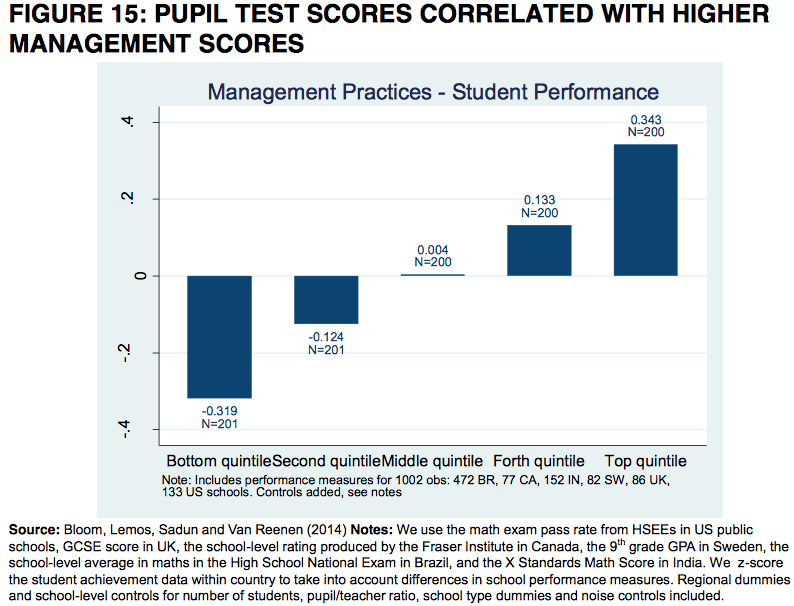
I am increasingly convinced about the public policy relevance of the work of Nick Bloom and co which focuses on marginal improvements in management practices of small enterprises to enhance their productivity. Their World Management Surveys have found that "about a quarter of cross-country and within-country TFP gaps can be accounted for by management practices". 

In particular, they find that focus on three simple issues - monitoring, targets, and incentives - can yield significant benefits. They find that these management practices are associated with higher productivity in manufacturing enterprises, and even increased learning and patient outcomes in schools and hospitals respectively.
They have sought to examine the role of management practices as akin to technology in the production function. An examination of the management practices from over 11,000 firms in 34 countries finds that "differences in management practices account for about 30% of cross-country TFP differences with the US". 
Consider this. It is now well acknowledged, through industrial statistics from across developed and developing countries, that the predominant source of job creation are firms which start small and formal and grow into medium scale enterprises. But the evidence from developing countries is that firm size distribution is bimodal, characterised by a "missing middle". It has been found that the vast majority of enterprises start small and informal and remain so. This has been so despite the vast amount of resources spent on the promotion of small and medium enterprises (SMEs) in all large developing countries. 

The conventional wisdom on promotion of such SMEs has largely revolved around fiscal concessions and subsidised credit and inputs. However, such incentives, by their very nature, exclude the overwhelmingly vast majority of enterprises which are small and informal. In other words, the current small industries promotion policies are designed to exclude the most eligible and maximise inclusion errors. The net result is that despite decades of pursuing such industrial policy, the business landscape in countries like India remain dominated by tens of millions of small and informal enterprises with abysmal levels of productivity. Even the small innovations away from fiscal measures have been confined to establishment of incubators and accelerators, which too perpetuate the same exclusions. 

It is in this context that focusing on improving management practices assume significance. If it were to become possible to deliver commoditised management practices support that becomes accessible to all small enterprises, then the potential benefits can be significant. Such support can range from resource persons offering guidance to geographically concentrated groups of enterprises to easily customisable smart phones based inventory, procurement, performance and human resource management softwares. Apart from public production, these services can also be offered commercially through models like freemium services with the basic versions being subsidised, to start with.

For example, it would be reasonable to expect non-trivial cost savings from a simple inventory management application that provides stocking decision support for even a mom-and-pop grocery (kirana) store. Its basic version can be offered as a public good, and more value added services offered on a fee per service basis. With appropriate levels of public support, entrepreneurs can be encouraged to embrace this business model and offer such services, both as software and extension service.  

It may therefore be useful for some governments, starting at sub-national levels, to repurpose a small share of their small enterprise promotion budget away from fiscal measures to the provision of such management support services as essential industrial public goods. The outcomes should be rigorously evaluated, the management support services refined to improve effectiveness, and the program gradually scaled up.