Substack

Showing posts sorted by date for query experts. Sort by relevance Show all posts

Wednesday, August 19, 2026

Leveraging the interdependence to combat China's industrial policy

There is an interesting asymmetry in the way China is covered by the Western media and commentators. 

China’s trillion-dollar and rising export surplus and its rapidly growing outward foreign direct investment (FDI) are seen as signs of deepening global dependency. This framing ignores the context of a weakening domestic economy and increasing dependence on exports to sustain jobs and growth (and the social contract between the Party and citizens). It also glosses over the risks to both exports and FDI posed by the rising backlash against China’s mercantilist policies. The Chinese vulnerabilities created by this dependence (on exports) and exposure (of FDI) are rarely discussed. 

This perspective stands in stark contrast to the view that bemoans the vulnerability of Western multinationals operating in China and completely ignores the buyer’s leverage on China with its importers. The same fact of deep interdependence is narrated as “strength” when it’s China exporting to the West, and as “vulnerability” to be endured when it’s the West transacting with China. For China’s trade partners, its $3.77 trillion export volume is as much a powerful bargaining chip as it is a dangerous dependence. 

In this backdrop, this post provides a framework to think about combating China’s manufacturing dominance. 

As I blogged here, experts and commentators ought to explore ways in which the leverage from China’s export dependence and FDI exposure can be used by its trade partners as bargaining chips to protect their interests. 

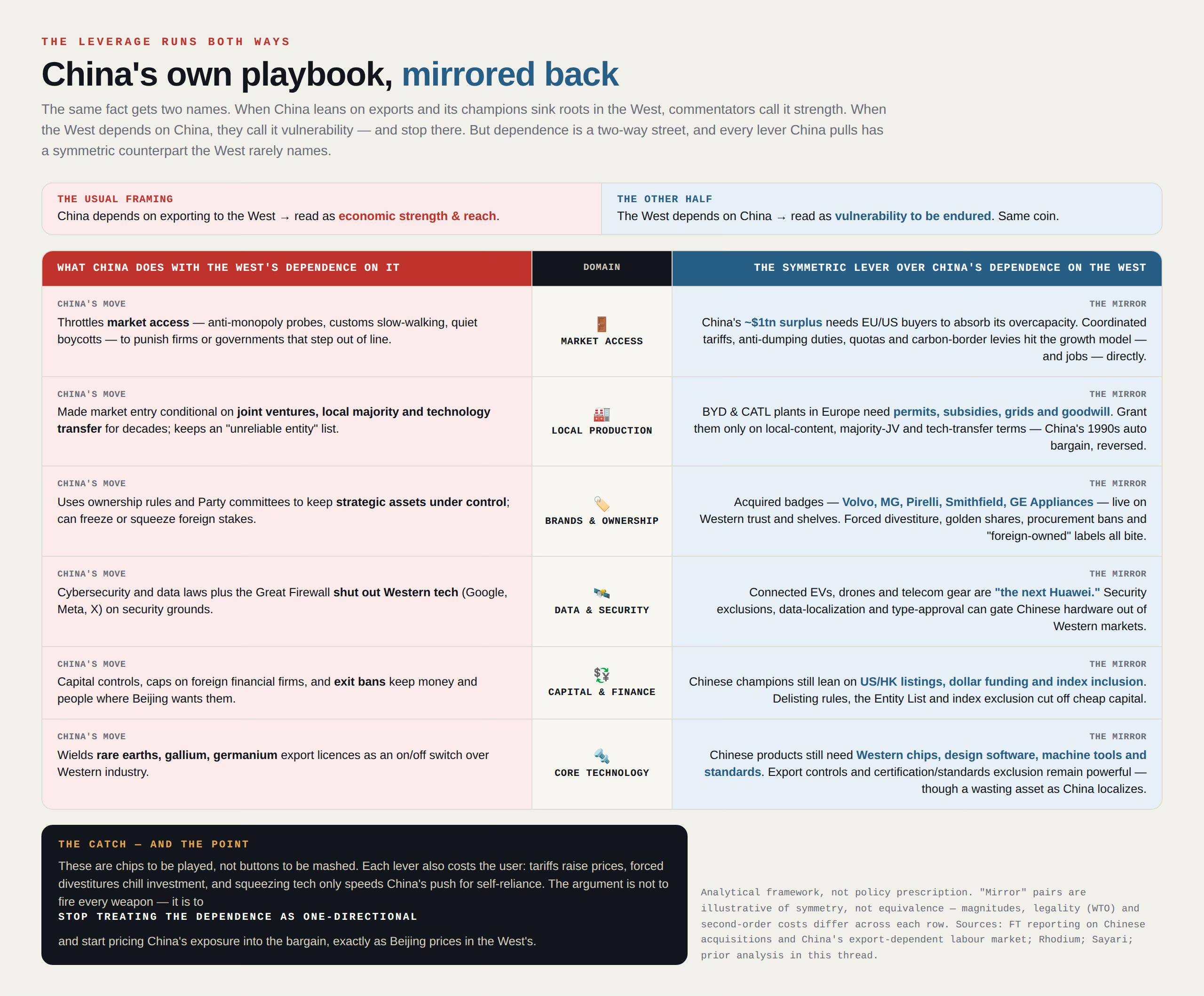
In this backdrop, I used Claude to develop an analytical framework to address this asymmetry. The matrix covers six domains where every lever Beijing pulls has a symmetric counterpart. 

The single most underused lever is market access. China’s $ 1tn-plus surplus exists precisely because Western markets absorb the overcapacity its own weak consumers can’t. This is what keeps the factories running and the post-1980 social bargain afloat. That makes access to EU/US demand a bargaining chip of the first order, not a favour to be lamented. 

Local production inverts China’s own auto playbook by making the likes of BYD and CATL now dependent on European permits, subsidies and goodwill, and leaving them vulnerable to imposition of the same local-content and tech-transfer conditions China once imposed on Volkswagen and GM. 

Brands and ownership are a bargaining chip that are almost entirely ignored. Volvo, MG, Pirelli, Smithfield and GE Appliances derive their value from Western consumer trust and shelf space, which divestiture orders, golden shares and procurement bans can all reach. Data and security concerns confer enough leverage to restrict Chinese hardware out of the Western markets. Capital access through US and HK listings and dollar funding is a vulnerability that delisting and Entity-List tools can throttle. And core technology is the rare-earth lever in reverse, as outlined here

These are chips to be priced into a bargain. Each carries a cost to the user, and the mirror pairs show symmetry, not exact equivalence in magnitude or legality. The central point is that the dependence is bilateral.

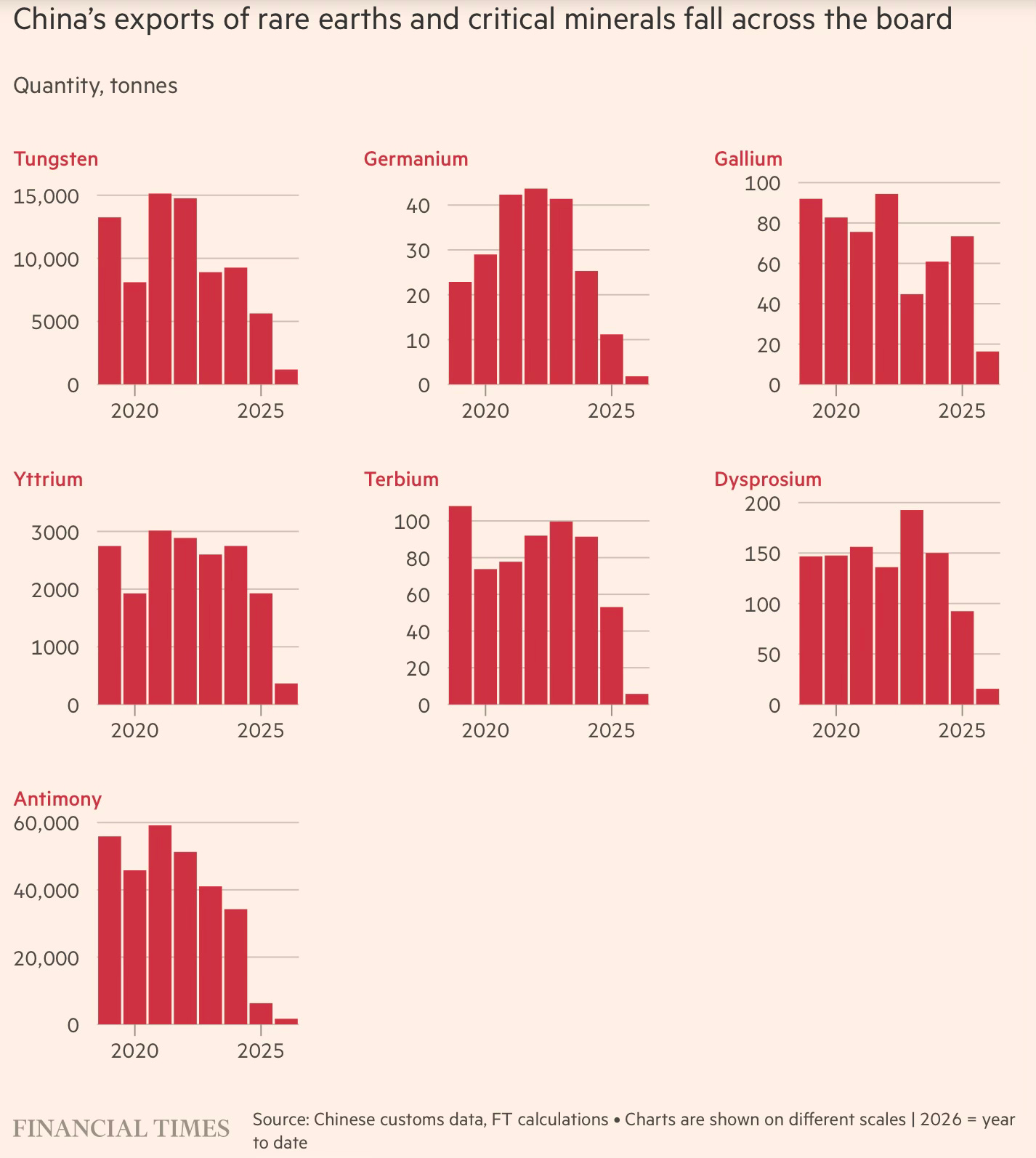
In their use of the bargaining chip, the alliance could emulate China’s rare earth playbook. An FT long read on China’s management of critical minerals trade is instructive. 

Cheaply produced Chinese metals are now embedded in the just-in-time supply chains that global industries rely on, but which buckle dramatically when interrupted — as the Covid-19 pandemic, Russia’s full-scale invasion of Ukraine and the closure of the Strait of Hormuz trade waterway have shown. That has given China leverage, which it has increasingly been willing to use: since 2023, it has imposed a series of export restrictions on a wide range of niche metals… Despite the export controls, metals flows have not ground to a halt. Instead, China has created a licensing scheme under which it decides who gets which minerals. The lengthy application process gives authorities detailed information about which metals overseas companies and their contractors are using, and why. Applicants must show that the material is going into civilian, rather than military, supply chains.

Companies, traders and analysts say material has been flowing but at unpredictable paces, with licence approval often slow. “The export control system has evolved from a crisis into a managed system”, though buyers still face “compliance and commercial” challenges, says Kyle Sullivan, vice-president of business advisory services at the US-China Business Council. This embeds new uncertainty into corporate supply chains and risks customers switching to Chinese component suppliers whose metals purchases are not being monitored and squeezed. One executive at a large Japanese user of rare earths says China wants to keep companies in a “neither alive nor dead” state, by supplying them with the minimum needed to avoid a supply chain collapse — which would hit Chinese companies that still rely on materials and components from Japan.

The big difference is China’s intentwillingness, and ability to use these chips in its strategic calculus. I’m not sure whether any of its counterparts in the West currently possess the same three at anything close to the degree present with China. The US can mobilise them if it puts its mind to the task. But it is most unlikely in the current dispensation. 

Another challenge is that no one country, including the US, has anywhere like the leverage China has across industries. This means that any meaningful application of a bargaining chip would require effective coordination among a group of countries. This is precisely the point that Rush Doshi and Kurt Campbell made when they argued in favour of America mobilising an alliance of like-minded countries to respond to China’s weaponisation of trade. 

Unfortunately, President Trump’s disruption of the Western alliance makes even a collaborative effort very difficult. The only option may be to wait out the regime before serious efforts in this direction.

Saturday, August 1, 2026

Weekend reading links

1. US equity markets fact of the week.

In the year to March 2026, the US received well over $600bn in net equity inflows. Not only was this a record sum, it was also double the flow into government and agency bonds. Net equity flows exceeded debt flows by the largest margin in history.

2. US utilities are shifting from net metering to net billing on rooftop and home solar installations.

Many utilities pay homeowners the same rate they charge for electricity, meaning the energy sent to the grid when the sun is out offsets the cost of the energy pulled from the grid at night. That’s called net metering, a system where the energy you send is worth typical U.S. prices of 10 to 30-plus cents per kilowatt-hour. Under newer policies, often called net billing, utilities buy the extra energy back at a lower rate, often 2 to 10 cents.
3. In a country ravaged by deflation (pork prices have hit a 16-year low), egg prices are rising in China.
Egg prices are up by more than 40 percent from a year ago, according to an index that tracks the top producing provinces. They recently hit a 10-year high by another benchmark that tracks prices at a wholesale market in Guantao, in northern China... Two years ago, farmers started expanding after several bumper years, adding more egg-laying hens from 2024 to 2025 than ever before, according to Aspen Li, an analyst who studies the egg market. Suddenly, there were too many eggs and the price plunged. Farmers then found themselves short of money to feed all their chickens. So they culled them, at a rate that experts considered excessive. Eventually, there were not enough egg-laying hens to meet demand, sending prices to levels that Mr. Li said were “even higher than my expectations.”

4. Japan's return to normalcy.

5. President Xi's flagship Belt and Road Initiative (BRI) projects hit a record $20.1 bn in green energy financing in the first half of 2026, topping its total value for the whole of 2025, 
Total BRI deals rose to a record high of $126.3bn in the first half of 2026, up from $123.3bn in the same period in 2025. The 2026 figure was composed of $49.8bn in investment and $76.5bn in construction projects.

A distinguishing feature of BRI projects is the increased share of the private sector.
The latest data highlighted how the BRI had become primarily driven by private companies rather than China’s state-owned enterprises. According to the University of Queensland data, the share of engagement from the private sector, as opposed to SOEs, reached 48 per cent in the first half, compared with 13 per cent in 2022.
6. The Great Divergence between labour productivity and wages. 

Labour's share of income has fallen sharply.
7. Tata Zudio is following in the footsteps of Zara.
Despite its bargain offerings, Tata said gross margins at Trent, which includes the more upmarket Westside clothing stores, stood at 44 to 45 per cent. “The playbook is you go end-to-end — you go from the source of the product to the customer and you do everything yourself in between,” he said. “That’s why we do our own transporting. We do our own warehousing. We have our own shops. The manufacturing units we use are more or less dedicated to us.”... Zudio eschews online retailing, believing that high return rates clog up the operation and generate too much extra cost.Rapid turnover is key to Zudio’s appeal. New lines are launched every Thursday and a team of social media watchers monitors fashion trends and feeds them to a design team.

8. The IPOs of SpaceX, OpenAI, and Anthropic could generate a massive flush of philanthropic capital.

Nan Ransohoff, the head of public goods at the payment processor Stripe, estimated in a Substack post, between $37 billion and $100 billion could become available to charities annually... And that doesn’t even include OpenAI’s employees. Or the newly rich created by SpaceX, whose I.P.O. spawned an estimated 4,400 millionaires (and some 400 employees now worth more than $100 million). Or the many other IP.O.s on the docket... Giving money away is a common maneuver to avoid taxes: Up to 74 cents of every dollar donated to charity would have been paid as taxes, according to the Institute for Policy Studies. It reported that charitable giving in 2022 alone had resulted in $73 billion in lost tax revenue.

9.  Debt service and defence make up two-thirds of Pakistan's budget expenditure.

10. On Europe's pensions problem.

Across the EU, 47 per cent of the bloc’s social protection expenditure is spent on old age and survivors’ benefits, ahead of 36.7 per cent spent on sickness and disability and 8.7 per cent on families and children. Even in the UK, where private provision plays a greater role, the country’s fiscal watchdog has forecast that spending on the state pension — the second-largest item in the government budget after health — will rise from almost 5 per cent of GDP to 7.7 per cent by the early 2070s. Italy has the EU’s highest pension costs at just over 15 per cent of GDP, according to statistics from the European Commission. France and Greece each spend over 14 per cent. In Germany, a third of all federal tax revenue will be spent plugging holes in the state pension system this year, according to an estimate by Munich economic think-tank Ifo... 

In France, the audit office estimated last year that the country’s pension deficit, currently around €1.7bn, could grow to €15bn by 2035 and balloon out to €30bn by 2045 if further reforms are not made. European countries have tried to tackle their surging pension costs since the 1990s, and have had some successes, with many lifting the state pension age from 65 to 67 or more. Italy has tied its pension age to life expectancy, while France has pegged annual pension increases to consumer price inflation rather than earnings. In some countries, spending on pensions as a percentage of GDP is set to fall in the long term as a result of such moves...

In most big European countries including Germany, France, Italy and Spain, the state provides the main earnings-related pension, paid for by contributions from current workers, which aims to replace a proportion of pre-retirement income. Such systems were modelled after the one created by Otto von Bismarck, who introduced national state pensions in 1889 to ward off surging socialism and strengthen loyalty to the authoritarian German monarchy... It paid up to 20 per cent of average salary to industrial workers when it became payable. It was designed to prevent destitution rather than facilitate a comfortable retirement. Other countries soon followed. In the UK, Prime Minister David Lloyd George ushered in old age pensions in 1909... A full UK state pension is currently close to a third of median earnings; private provision, usually through workplace schemes, is meant to provide additional security in retirement... Italy has one of Europe’s highest replacement rates, with pensions paying out close to 80 per cent of average earnings... Contribution rates, from workers and their employers, are correspondingly high at 33 per cent of earnings in Italy, 28 per cent in France and 19 per cent in Germany... That compares with an average of over 20 per cent in the UK — paid via national insurance — and just 11 per cent in the US.

11. Ramesh Chand argues for rationalising the PDS and moving to a nutrition security programme.

Between 2013-14 and 2025-26, India’s real per capita income (net national income at 2011-12 prices) increased by 78 per cent, from ₹68,572 to about ₹1.22 lakh... At the time of the NFSA’s enactment, around 22 per cent of the population lived below the poverty line. Both official estimates and independent studies now suggest that poverty had declined to around 5 per cent by 2022-23... In the early years of the NFSA, roughly one-third of the beneficiaries were poor and two-thirds were above the poverty line. By 2025-26, only about 10 per cent of those receiving free food grains were estimated to be below the poverty line while the remaining 90 per cent were non-poor... The latest UN report... estimates that the proportion of Indians unable to afford a healthy diet declined sharply from 59.8 per cent in 2017 to 35.5 per cent in 2025. In absolute terms, the number of such people fell from 759 million to 589 million. This indicates that about 170 million people crossed the affordability threshold for a healthy diet during this period as their purchasing power improved... The prevalence of undernourishment in India declined from 13 per cent in 2013-14 to 9.8 per cent during 2023-25, indicating progress but at a relatively slow pace.

12. The Fed under Kevin Warsh appears to be facing a credibility crisis as it grapples with rising inflation.

As Mr. Warsh spoke, longer dated Treasury yields rose sharply, with the 30-year bond closing in on its May peak of 5.2 percent. That was the highest level since 2007. The rise in the 30-year Treasury yield suggests some worry about Mr. Warsh’s ability to tackle inflation in the long run.

And this.

Long-term government borrowing costs shot higher as Mr. Warsh spoke, with the 30-year bond notching its largest one-day increase in more than a year. Trading around 5.22 percent, it is at the highest level since 2007. The 10-year Treasury yield, which serves as the benchmark for borrowing costs around the world, also rose alongside expectations about inflation over a longer time horizon.

13. FT has a long read describing the story of Situational Awareness, the $20 bn hedge fund of 24-year-old Leopold Aschenbrenner, which had racked up gains over 400 per cent on the back of massive leverage, and has now run into the wrong side of the AI sell-off. The fund sold its portfolio to Ken Griffin's Citadel in an almost distressed sale. Apart from being an alumnus of OpenAI, Aschenbrenner is also the husband of Avital Balwit, who now works as chief of staff to the CEO of Anthropic. 

What stands out in the entire article is the reluctance to call out the obvious contributor to Aschenbrenner's success: the strong likelihood of insider trading at a massive scale. It is hard to believe that the smart investors who were betting on Situational Awareness were betting on the expertise or competence of Leopold Aschenbrenner, and not on the insider information he possessed.  

14. Fascinating snippet on wealth creation in the equity markets.

Economic analyst Hendrik Bessembinder has shown that half of the net wealth creation in US stock markets over the last century flowed from just 46 public companies, out of a total of almost 30,000. Looking at his list of the greatest wealth creators, the knowledge companies dominate the top spots, and all the winners have high walls around them.

Monday, July 13, 2026

Workers and startups are helping train AI to replace them

Data annotation work is increasingly moving up the value chain, from tagging and labelling data to replicating the work of semi-skilled (on the factory floor) and skilled (consultants, analysts, lawyers, engineers, and doctors) workers. 

Startups sell data to AI labs, which use it to train and refine their AI algorithms and develop software products/solutions that replicate the work of these workers. In other words, the semi-skilled and skilled workers, or at least some among them, are feeding their time and skills into the AI algorithms that seek to replace them and their kind. Both the training startups and those workers offering their services to them are basically helping make themselves redundant. 

On this, the FT has a very good film about how Indian startups are paying factory floor workers and gig workers (and even people in their homes doing regular household chores) to use cameras and record their work. Data annotation is becoming the new BPO for India’s IT industry. 

The Ken has an article that raises the possibility that for all the attention and hype around robotics, Indian startups might remain stuck at the lowest end of the robotics value chain - data collection. 

India was the back office for the IT boom. It became the annotation and reinforcement-learning labour pool for the generative AI boom. It is now emerging as the behavioural data factory for the physical AI boom... Building the robot is only half the problem. Building the intelligence behind it is much harder. That requires data. Vast amounts of it. Unlike large language models, which were trained on the equivalent of hundreds of years of human reading scraped from the internet, robotics companies are working with barely a fraction of that in video... What they need is meticulous, first-person recordings of humans interacting with the physical world, carefully collected, annotated, and painstakingly structured. 

So the industry turned to India. Across the country, workers are recording themselves doing everyday chores for data-collection firms, which then sell that footage to companies such as Tesla, Figure AI, and Agility Robotics to train their humanoids. Indian startups see this as a moment to claim a seat in the global AI value chain. The country has over 260 robotics startups, and investors are beginning to pay attention... The footage being recorded by Indian workers becomes proprietary once it leaves the country. The datasets assembled from it are accumulating on foreign servers. The foundation models trained on them are owned by foreign companies.

The NYT has an article about how startups like Handshake, Mercor, and Surge in the US are paying skilled workers to collect data on their work. 

Mercor and a handful of similar start-ups are the primary middlemen in a supply chain of “human data” that may power the next generation of A.I. As OpenAI, Anthropic and other major ventures compete to become the industry’s dominant platform, the market for premium data that has been vetted by experts is exploding…They need mathematicians to annotate proofs, lawyers to mark up briefs and professors to grade essays… To use the parlance of the industry, data labeling has moved up the “value chain,” and the start-ups that offer this service have become some of the fastest growing in Silicon Valley… The data-training start-ups see a lucrative opportunity in recreating workplaces in miniature: controlled environments in which their gig workers can evaluate and reproduce emails, memos and slide presentations in context. The information emerging from such a setup, the companies boast, will help shrink the gap between what A.I. models can accomplish and what office workers actually do from one minute to the next, as ideas and instructions flow between meetings, documents and applications…

To keep improving their models — to make them more useful, more sophisticated, less prone to hallucination and mistakes — A.I. companies heavily refine what goes into them. That’s post-training, and it includes buying data from vendors like Handshake and its competitors… Deeptune, a start-up that makes “training environments” with simulations of the software programs, like Slack and Salesforce, that many workers toggle between all day long to get their work done. The idea is to painstakingly create a mirror image of, say, an investment bank so that A.I. can observe every interaction…

It may turn out that once OpenAI, Anthropic and others have taught their models to perform a certain job, their need for more training data in that area could sharply decline. In this way, Mercor, Scale, Handshake and their peers are much like the elite freelancers they employ: making money today, but in danger of being dropped tomorrow… People sign up for data-training gigs for a variety of reasons. The main one is, of course, money… Though the labor is unpredictable and rates vary… the workers who cobble together enough shifts can generate meaningful income. People might sign up because they have been laid off, or because they can’t find enough work in their field. They might do it because they’re eager to get “A.I.” on their résumé, or because they need extra cash in retirement… Many people who contract for these companies understand that this is a short-term opportunity, a brief chance to train the models to automate jobs before they themselves are automated out of the job of training models.

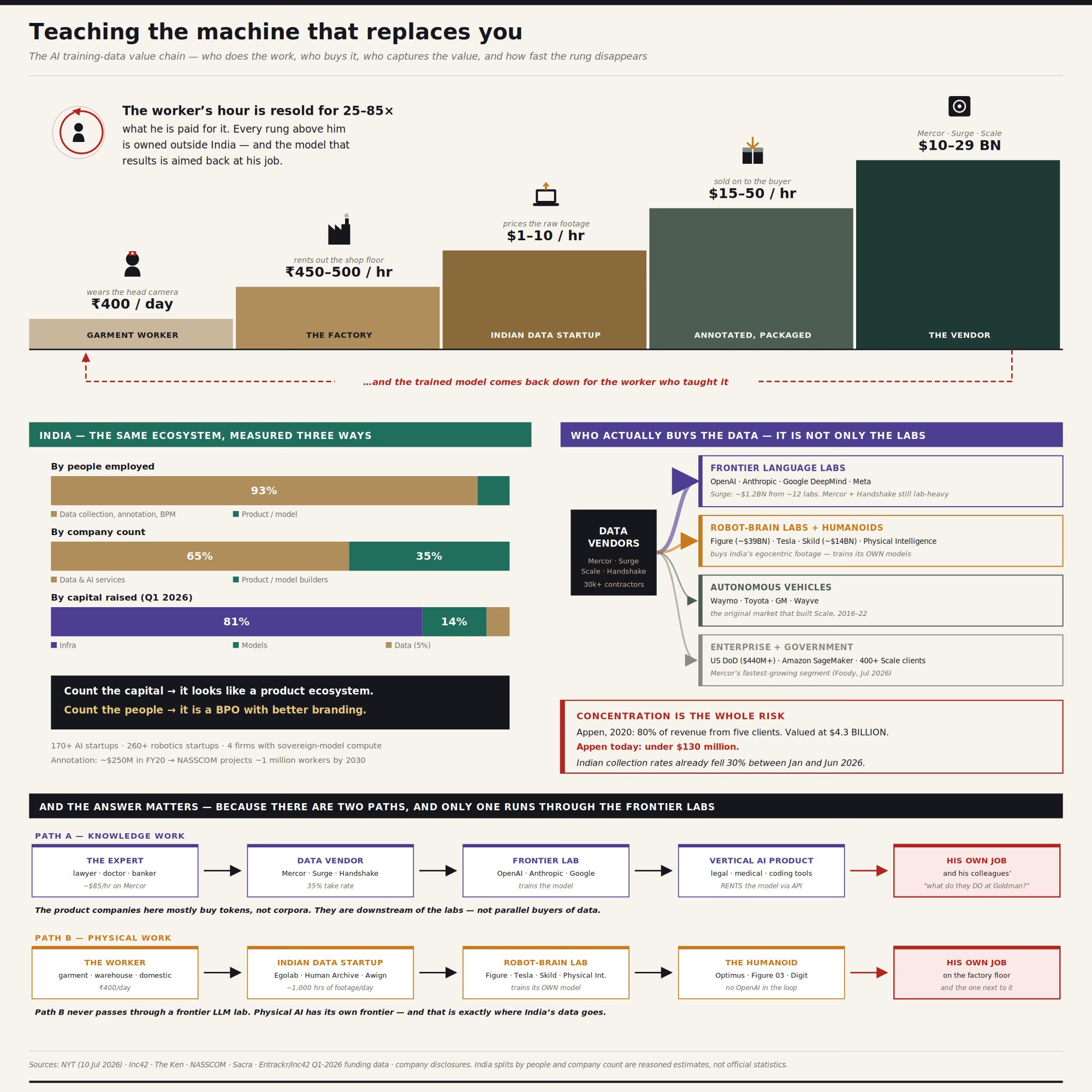
I asked Claude to generate a visualisation of this market landscape, including an assessment of the Indian landscape. The numbers are clearly estimates and must be validated (though at a ballpark they appear alright). 

The unit economics of the data chain shown below for a garment worker in India is instructive. She gets roughly ₹400 a day to wear the camera (or $0.60 per hour); the startup pays the factory ₹450–500 per hour; US-based startups like Human Archive price data at $1–10 per hour; and once annotated and packaged, it sells to global robotics labs at $15–50 per hour. That is a 25–85 times markup, and every rung above the worker is owned outside India.

The graphic also shows that the vast majority of AI workers are doing the BPO equivalent, whereas the vast majority of funding is going to those building the data centres. India has 170-odd AI startups that have raised $2.6 billion in total and over 260 robotics startups, but the genuine model/product builders are a tiny set, and the majority have rebranded annotation as an AI line of business (iMerit, Objectways, Awign, Karya, Deccan AI, Human Archive, Egolab, Neo Cambrian, Humyn Labs, RoBoEra, etc.). 

It must also be highlighted that in the majority of cases in India, the data goes from the garment worker to an Indian data aggregator to a robot-brain lab in San Francisco, and comes back as a robot/humanoid. The frontier LLM labs are not in that loop. This also means that none of the emerging governance conversations about frontier models - safety frameworks, export controls, model-access negotiations - touches the mainstream data collection work being done in India. India is negotiating hard for access to frontier language models while simultaneously handing over, for ₹400 a day, the training substrate for the physical models that will actually displace its manufacturing workforce. Those are two different conversations, and only one of them is being had.

Further, as the Times article highlights, while these annotation startups are flourishing now, they may not be sustainable ventures. Once experts teach the models to do something, their services are no longer needed in the same way, and the vendors themselves need the models to keep improving to show they add value, while needing them to remain imperfect so clients keep coming back. 

I asked Claude for historical precedents and got this:

Frederick Winslow Taylor’s explicit programme, from the 1890s, was for management to “gather in all of the great mass of traditional knowledge which in the past has been in the heads of the workmen.” Skilled machinists were stopwatched; the Gilbreths filmed them with chronocyclegraphs — a literal 1910s head-camera. Workers cooperated because they were paid piece-rate bonuses to do so. The tacit craft was decomposed into instruction cards and handed to cheaper, unskilled labour. Outcome: enormous productivity gains, the collapse of the craft wage premium, a machinists’ revolt, congressional hearings in 1911–12, and Taylorism banned in US government arsenals by 1915. It took roughly fifty years and the postwar labour accord before the gains were broadly shared… 

In the 1990s American hospitals routed physician dictations to transcriptionists in Bengaluru and Chennai; it was unglamorous work, but India was good at it. That corpus is precisely what trained speech recognition. The industry peaked and then largely evaporated. Compensation to the transcriptionists: zero… most startups in this space risk meeting the same fate as the transcription companies of the 1990s.

In this context, I am reminded of the claim made by Daron Acemoglu and Simon Johnson in their book Power and Progress that the trajectory of technological progress is a political choice made by society and should not be left to corporations and technocrats. Their central claim is that the direction of technology is a social choice, not a technical destiny, and that redirecting it requires countervailing power rather than better-intentioned technocrats. 

The problem, though, is that globally, and especially due to the Trump 2.0 regime, the rule makers have surrendered agenda-setting to Big Tech and AI Labs. Closer home, India has almost no leverage over the direction of frontier AI. Instead, its leverage is confined to the terms on which its labour and data enter the supply chain, and not to bending the technology’s arc. 

In the circumstances, what can a country like India do?

Here are some thoughts for consideration. One, a statutory floor rate for training-data contribution and an industry-led collective licensing body for data work are both administratively feasible and could increase value capture (from the worker’s current share of 1-2% of the value created) without banning anything. A comparator is the model of SoundExchange (US) or PRS (UK) in the music industry, which acts as a government-designated clearinghouse that collectively licenses music, collects usage fees, and distributes royalties to creators, effectively removing the burden of individual licensing. This model would also subtly frame the market in terms of treating data as labour, and not as mere raw material. 

Second, on the regulatory side, it may be useful to revisit the DPDP Act provision that permits employers to process worker data without explicit consent under “employment purposes”. Instead, there should be purpose limitation, or restrictions on repurposing training data for other activities, and consent requirements of all involved. 

Third, public spending on AI innovation and procurement preference could be made conditional on the recipient retaining licensing rights to datasets collected from Indian workers rather than doing work-for-hire. This would frame the collection of data as an input and not a product, and industrial policy could price it appropriately. Fourth, there is the argument about extending statutory instruments like the gig worker welfare boards or the Code on Social Security present in some states (Rajasthan, Karnataka, etc.) to cover data work. It could help build countervailing power. 

But pursuing these agendas can be costly. This being a global market, prohibiting or putting too onerous terms on value capture and the entry of data into the supply chain will backfire by moving the work to Vietnam, Ethiopia, or the Philippines. Besides, for the Indian workers, already facing an acute scarcity of jobs, the choice isn’t really on offer, and ₹400 a day is ₹400 a day. There is a collective action problem here which calls for multilateral engagement through a forum like the ILO. 

But this should not mean that we sit back helplessly and allow the market dynamics to play out. Instead, before enacting any of them, there must be a public debate on the merits or otherwise of these proposed measures. What are their respective costs, and what can be done to mitigate them? What versions, if any, of these measures should be enacted? Such debates are essential to make informed and collective social and political choices.

The public debate is important since the agenda-setting process here, like with any technology change, pushes certain considerations to the forefront while also marginalising certain others. Almost always, the former represents the interests of the corporations and elite beneficiaries of the change, and the latter represents those of the vulnerable and voiceless. Therefore, such agenda-setting debates are a purely political activity, with profound social implications. 

It is also important since there is the distinct likelihood that India could spend the next five years as the world’s back office for the third time, and when the juice has been sucked out and value captured, there could be nothing left standing that India owns. 

PS: In this context of collective action problems, it is worth taking inspiration from one very impressive and encouraging breakout (which has not received the level of attention it deserves) from South Korea. It is a tribute to the maturity and wisdom of the country’s corporate and political system and the robustness of its democracy that Samsung and SK Hynix agreed to share 10% of their windfall profits from memory chip sales, with no ceiling on payouts, with their employees for the next ten years. Sample this.

Samsung Electronics... agreed last month for employees to share the chipmaker’s blockbuster profits from an AI-led boom... SK Hynix... handed employees a similar profit-sharing deal last year... Samsung is also going to give Won500mn loans at low rates to employees... Samsung and SK Hynix together control much of the market for the advanced memory chips used in AI servers. Employees at both companies are in line for average annual bonus payouts of Won600mn, which compares with a national average salary of about Won50mn... district of Hwaseong... expected to gain corporate income tax receipts of Won1tn to Won1.3tn from Samsung alone this year, an extraordinary sum for a city authority whose annual budget is about Won3.5tn.
Wednesday, July 8, 2026

AI for organisational and bureaucratic reforms

The debate rages about the extent of AI’s likely impact on the economy and human lives. So far, there has been an apparent lack of commercial value creation to justify the gigantic and exponentially increasing volume of AI investments. 

I blogged here on the distinction between horizontal and vertical use cases of AI, with success on the latter being limited, here cautioning about the likely impact of AI on development and in developing countries, and here on some possible high-impact use cases for AI in lower-income countries. 

The most common horizontal use of AI is in personal productivity improvements. Claude, ChatGPT, etc., are already having large effects on personal productivity. But its translation into vertical use products is muted. 

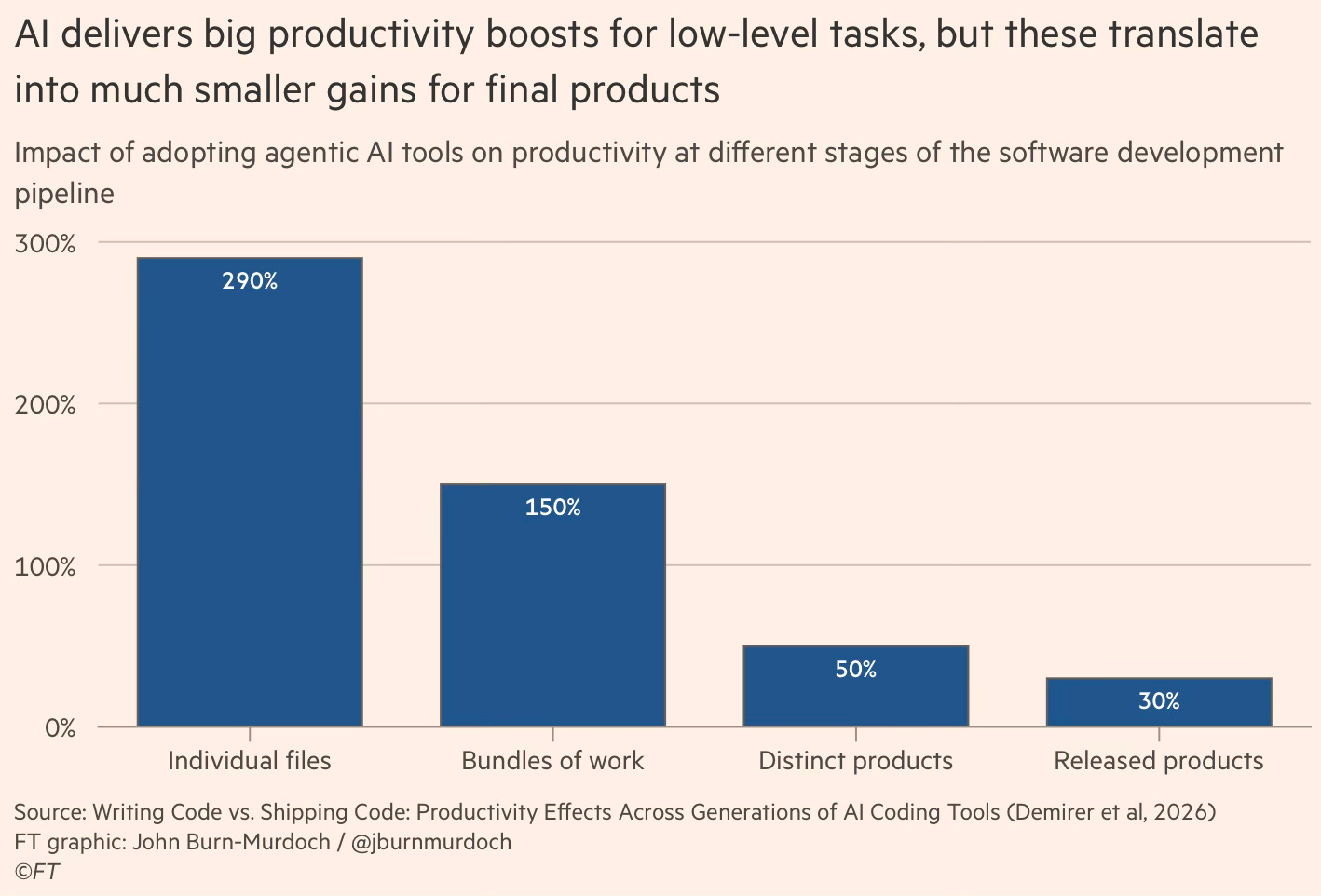
On this, John Burn-Murdoch points to the work of Mert Demirer, Leon Musolff and Liyuan Yang to make two important points. The first point is the “disconnect between reported increases in coders’ output and the apparent lack of a corresponding boom in product or value creation,” which creates a very steep funnel between inputs and outputs. 

The study by MIT’s Mert Demirer and co-authors tracked software developers’ work before and after they adopted AI tools. Importantly, they measured this at several different levels, from the amount of code written, to the number of discrete files edited, to the number of projects or features worked on, to actual releases of new software. They found an explosive impact at the top of this funnel — coders created or edited almost 300 per cent more files — but that boost was halved to 150 per cent by the time they got to the number of discrete pieces of work submitted for review, and that in turn shrunk fivefold to a roughly 30 per cent uplift in the number of full software releases.

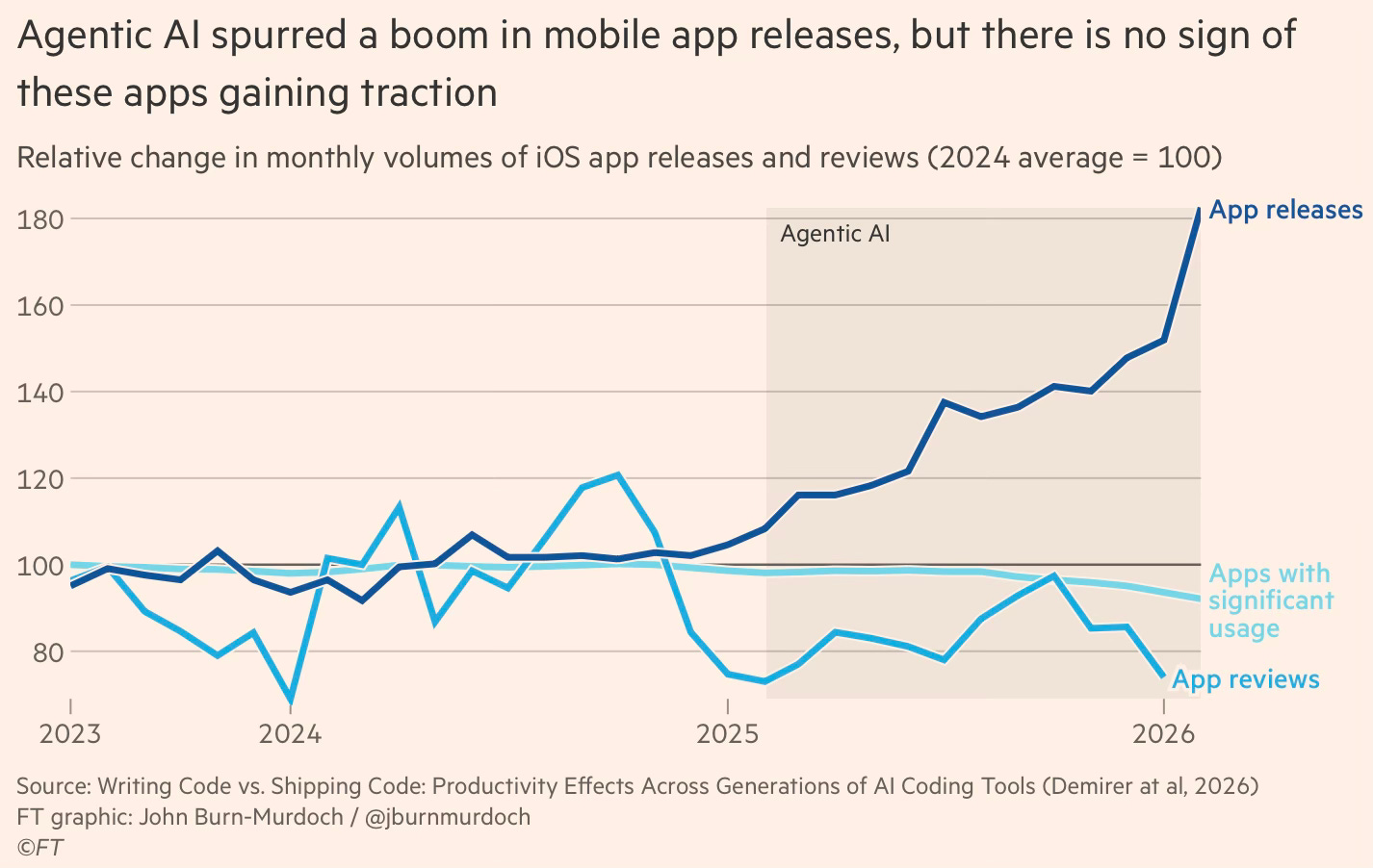
The authors also found little evidence of AI-assisted increases in software development, leading to increased consumption of Apps. 

This brings us to the second point made by the authors about AI’s impact - it is likely to be fully realised only when new organisational structures, markets, and business models emerge.

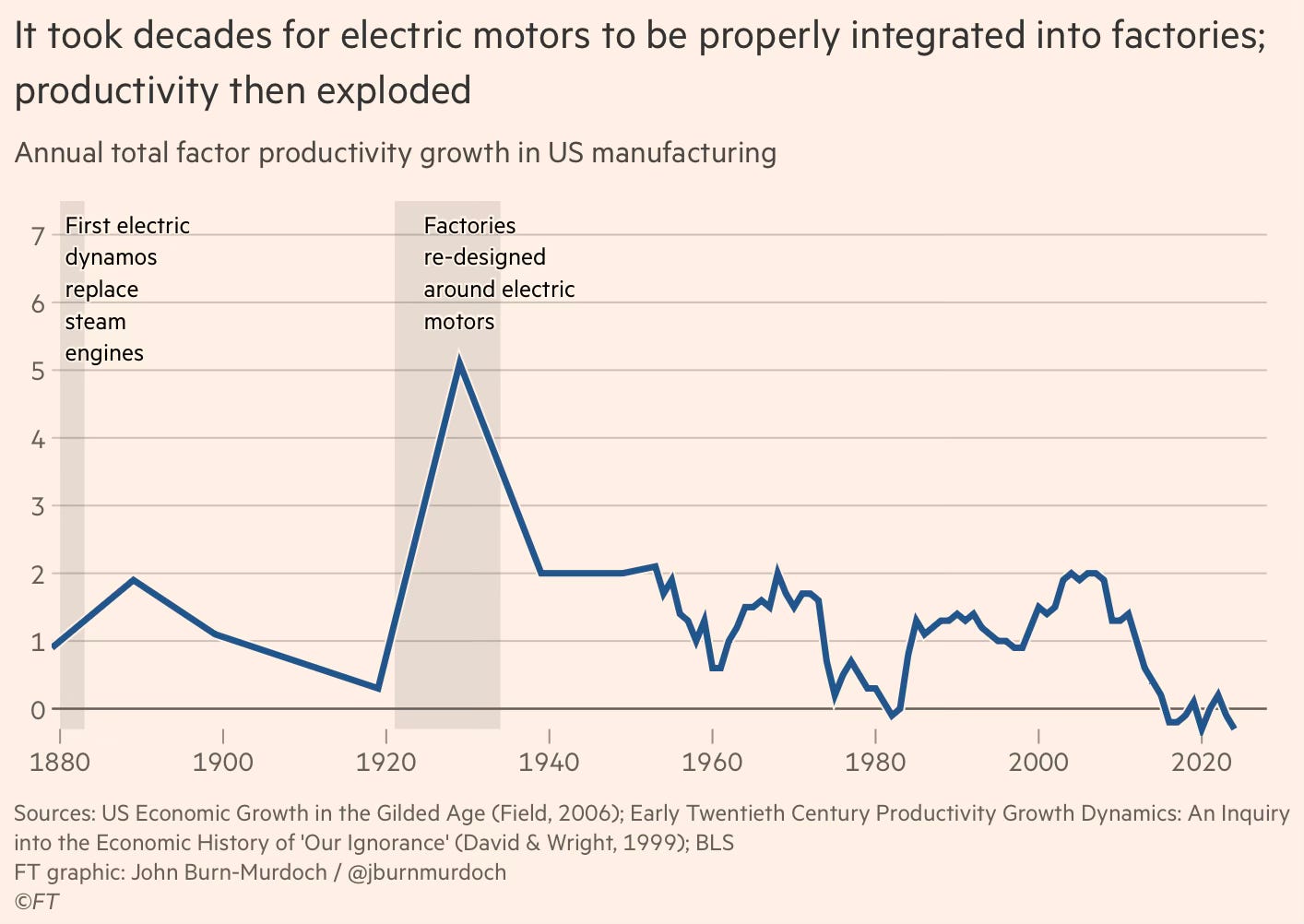
But Demirer and his co-authors feel the more likely explanation is that current organisational structures and marketplaces are not set up to take advantage of real underlying gains. That view is supported by the evidence from past technological revolutions, where the real jumps in productivity and job displacement came from new companies and processes rather than incumbents grafting new technology on to existing workflows. In the case of electricity in the late 19th and early 20th century, productivity gains were modest where factories simply replaced giant steam engines with giant electric motors but left the rest of the machinery and layout unchanged. The boom arrived decades later when engineers fitted individual workstations with their own small motors.

In this backdrop, Jack Dorsey and Roelof Botha have an insightful article on organisational impact. Specifically, they claim that AI’s productivity-enhancing value can address the fundamental coordination problem in large organisations that manifests in the form of a trade-off between span-of-control limitations (which add organisational layers) and speed of information flows. They argue that AI sharply increase people’s span of control, thereby reducing organisational layers and hastening decision-making. 

The first organisational models emerged in the military to organise large numbers of soldiers into a coherent and effective fighting unit. It involves a hierarchical chain of command that allows for a span of control and a seamless flow of information and instructions. The model then entered the corporate world through the US railroads in the 1840s and 1850s, which borrowed West Point-trained engineers from the US Army. They trace the evolution of the modern organisational form,

In the mid-1850s, Daniel McCallum of the New York and Erie Railroad created the world’s first organizational chart to manage a system stretching over 500 miles with thousands of workers… McCallum’s chart formalized the same hierarchical logic the Romans had used: layers of authority, defined reporting lines, structured information flow. It became the blueprint for the modern corporation… Frederick Taylor (1856-1915), often called the “Father of Scientific Management,” optimized what happened within that hierarchy. Taylor broke work into specialized tasks, assigned them to trained experts, and managed through measurement rather than intuition. This produced the functional pyramid organization - a structure optimized for efficiency within the information routing system that the military had pioneered and the railroads had commercialized… 

In 1959, McKinsey’s Gilbert Clee and Alfred di Scipio published “Creating a World Enterprise” in the Harvard Business Review, providing an intellectual framework for a matrix organization that combined functional specialties with divisional units. Under the leadership of Marvin Bower, McKinsey helped companies like Shell and GE implement these principles, balancing central standards with local agility. This became the “professional” or “modern” corporation that propelled the postwar global economy… The McKinsey 7-S framework, developed in the late 1970s by Tom Peters and Robert Waterman, distinguished the “hard Ss” (Strategy, Structure, Systems) from the “soft Ss” (Shared Values, Skills, Staff, Style). The core idea was that structural elements alone were insufficient. Organizational effectiveness required alignment across cultural traits and the human factors that determine whether a strategy actually succeeds.

They suggest that AI makes it possible to solve the fundamental coordination problem within large organisations that necessitate hierarchical formations. 

For the first time, a system can maintain a continuously updated model of an entire business and use it to coordinate work in ways that previously required humans relaying information through layers of management… In a traditional company, a manager’s job is to know what’s happening across their team and relay that context up and down the chain. In a remote-first company where work is already machine-readable, AI can build and maintain that picture continuously. What’s being built, what’s blocked, where resources are allocated, what’s working and what isn’t. That’s the information the hierarchy used to carry. The company world model carries it instead… 

In a conventional company, the intelligence is spread throughout the people and the hierarchy routes it. In this model, the intelligence lives in the system. The people are on the edge… The edge is where the intelligence makes contact with reality… the edge doesn’t need layers of management to coordinate it. The world model gives every person at the edge the context they need to act without waiting for information to travel up and down a chain of command… Everything else the old hierarchy did, the system coordinates, and everyone is empowered, with a role that’s much closer to the work and the customer.

They identify three roles - Individual contributors (ICs) who are deep specialists and experts who build and operate system capabilities; Directly Responsible Individuals (DRI) who own specific cross-cutting problems or opportunities and customer outcomes; and player-coaches who replace the traditional manager whose primary job was information routing, who do both building and handling people. 

All this makes great sense and points to how corporate organisational models are likely to emerge as the application of AI progresses. There will be frontier firms in a few sectors that will lead the way for others to follow. 

AI applications are a promising opportunity to address inefficiencies and coordination failures in public bureaucracies, too, and improve the quality of public administration. 

For a start, it has the potential to restore internal capabilities, which have eroded steeply. Over the years, thanks to practices like outsourcing all analytical and documentation work to consulting firms and the hiring of individual consultants (most notably now, the system of Young Professionals, YPs, in governments), there has been a complementary erosion of in-house expertise. The capabilities to articulate proposals for internal deliberations and file circulation have atrophied. Given that bureaucracies run on deliberations and files, this trend is an underappreciated aspect of state capability weakness. 

AI provides an opportunity to reverse these trends and develop internal capabilities. The primary reason for the reliance on external expertise is the extent of analytical work and documentation required during the deliberative process (everything from a concept note on the proposal to reports for appraisals, and Cabinet Notes). The bureaucratic leaders who are burdened with a multiplicity of tasks, work under tight timelines, face increased fetters from oversight agencies and courts, and must rely on an increasingly enfeebled internal bureaucracy. In the circumstances, they prefer to outsource the thinking and documentation to outsiders. I have blogged earlier on the perils of this approach

AI tools like Claude are excellent at analytical work and the generation of these documents in response to clearly articulated prompts. It becomes a simpler proposition if bureaucrats can quickly and easily obtain a draft concept and supporting documents, and then scrutinise, validate, and refine it before circulation for approval. AI tools can then become a force multiplier for bureaucratic leaders, who are now constrained by their limited bandwidth and acute dependencies. 

This would also empower bureaucratic leaders, or at least some among them, and could enhance the quality of their engagement with the decision-making process. Besides, by minimising the drudgery of the bureaucratic process, it would also allow bureaucratic leaders to apply their minds and exercise judgment more effectively, thereby improving the quality of decisions and policy design and implementation. It would also lower decision-making delays.

It should therefore become a priority of the National Informatics Centre (NIC) (or an AI division within it) to develop or license AI application that is embedded in the e-office software and enables officials to sift through large documents and generate proposals/presentations, circulation notes and reports using prompts. This has transformative potential for productivity improvements, not only stopping the erosion of internal capabilities but also helping rebuild them. 

If this can be done, it opens up opportunities for far-reaching administrative reforms. The current bottom-heavy pyramid can be rationalised to make it fit-for-purpose.

A major inefficiency is the presence of multiple layers within the administrative system. It is a widespread practice across governments to have YPs, and those recruited as data entry operators originate the note file (a task earlier performed by the clerical staff). The note then gets circulated across several layers, often seven or eight till the approver. This can be radically pruned down to no more than three or four, including the approving authority. 

Such de-layering is especially relevant for technical ministries and departments whose activities are more amenable to AI-based support. Such ministries should have a separate administrative staffing plan, one that takes into account the role that AI can play in generating documentation and considerably reducing any drudgery associated with analytical work. 

As a general illustration, there are perhaps three kinds of activities in any department - shared services (HR, procurement, establishment issues, statutory matters, etc.), administration of departmental programs, and analytical and technical work. There are significant low-hanging likely process-efficiency improvements in all three, and substantive value-addition potential in the third activity. 

This would also necessitate a reassessment of public recruitments. The advent of AI applications means that, unlike in earlier times, apart from merely documenting the issues in a note file, the case worker (the ASO or SO) can now be expected to do some analysis and provide comments. This also means that a smaller base can serve the clerical roles (the entire paraphernalia of clerical cadres can be collapsed into just two functional levels - maker and checker), and their educational qualifications and skills must reflect the requirements for the revised scope of work. I’ll blog separately on this. 

The increased use of AI applications to analyse and document, and a compact and delayered deliberative process captured in the file circulation can also increase the quality of collective engagement and ownership of the bureaucracy in decision-making. It lets (and nudges or forces) everyone contribute meaningfully to the process instead of being passive pass-throughs of instructions and note files. It presents the opportunity to shed reliance on outsourced expertise and build back state capabilities.

This is deep work and, even in the best case, is likely to be adopted only by a few units in the first phase. The objective should be to create the conditions that encourage the emergence of these lighthouses and channel them to diffuse change more widely.

Saturday, June 27, 2026

Weekend reading links

1. New research by Emma Harrington, Natalia Emanuel, and Amanda Pallais shows that remote work is adversely impacting mental health. They paraphrase Robert Putnam to argue that Americans "typing alone" brings serious social consequences

In 2024, nearly 80 percent of workers said they would be happiest if they could work remotely... Surveys of over half a million Americans from the last decade and a half revealed an uncomfortable truth: Despite its advantages, remote work has significantly deepened Americans’ isolation and distress. Our estimates indicate that remote work explains a third of the deterioration in mental health between 2011 and 2024... Our study compares workers in jobs that could be done remotely, such as finance and software engineering, with workers in jobs that must be done in person. People in remote-capable jobs worked from home three times as often in 2024 as in 2019. As they did, their days became far more solitary. Eighty-four percent of remote workers spend their workday entirely alone. Over half report feeling less connected to their colleagues. Even when communicating online, people working from home receive less feedback from their co-workers and contact fewer people outside their immediate teams.

These workers did not compensate by socializing more outside work. More days passed with no social contact of any kind... In one study, when commuters were instructed to connect with a stranger near them, they reported being happier than those who continued in silence as usual, much to their own surprise. With fewer social encounters, workers in jobs that can be remote saw steeper increases in distress, mental health visits and prescriptions for antidepressants than other workers did... The pain was not evenly shared. People who lived with their spouse and kids saw their mental health hold fairly steady, while those who lived alone experienced a 20 percent decrease in mental well-being. Overall, we found that the rise of remote work increased distress by 7 percent, which accounts for a third of the total increase over the 13-year period we measured.

They argue that face-to-face time with colleagues has no substitute.

2. Katie Martin points to the different ways in which bonds and equities are reacting to Trump policies.

US government bonds, or Treasuries, have never recovered from the drop in price they suffered around the start of the war. Investors in this market, who broadly consider themselves a more cerebral bunch than those in stocks, never bought the hints of a ceasefire with Iran. Bond prices have still not returned to square one, leaving borrowing costs markedly higher. With the prospect of interest rate rises ahead to douse inflation pressures exacerbated by the Iran war, and relentless more borrowing, this is likely to remain the case for some time.

3. As AI threatens to bring down India's tech sector, this is a good article.

On the whole, Indian IT companies spent around 3.7 per cent of their total revenue on R&D in the year that the report covered. This is minuscule compared to around 15 to 25 per cent that Silicon Valley companies spend on R&D. The top IT companies are laggards of first order. For example, in 2022-23, Infosys spent just 0.9 per cent of its total revenue on R&D. The figure for TCS was 1.30 per cent. For Wipro it was 0.5 per cent while for HCL it was 1.60 per cent. The other big companies don’t fare all too well. Reliance, a giant in every way, spent only 0.53 per cent of its total turnover on R&D in 2022-23. Tata Steel is at 0.67 per cent. Maruti Suzuki spent 0.65 per cent on R&D.

4. Indian markets have more to fall before they become competitive.

The FPI outflows have tracked the decline of rupee, feeding a self-fulfilling cycle.

5. The costs of RBI's FCNR (B) deposits and foreign currency borrowing schemes. 
If the scheme were to attract $50 billion of FCNR (B) deposits and $20 billion of foreign borrowing by banks and public-sector enterprises, the mark-to-market loss on the RBI’s swap position could approach ₹64,000 crore at current market prices, besides increasing the RBI’s balance-sheet risk. This is not merely an accounting cost. The subsidy is real and will be monetised by participating non-resident Indians (NRIs), banks and borrowers.   
Large Indian banks are raising five-year FCNR (B) deposits in dollars at 6 per cent. Their attractiveness is evident from the willingness of overseas banks to lend against the same deposits at around 5 per cent. This, in turn, will allow wealthy NRIs to achieve double-digit leveraged dollar returns against India cross-border risk. Indian banks can further transform the FCNR (B) deposits into clean five-year rupee funding at around 6.4 per cent, below comparable government bond yields.

Banks are being permitted to offer leverage to NRIs. The currency risk on such deposits will be borne by the RBI. As reported by this newspaper, State Bank of India is offering leverage of up to nine times on deposits of more than $1 million. Calculations indicate that this could translate into returns of over 14 per cent. Other banks are likely to come up with similar schemes for NRIs.

Banks are competing aggressively for FCNR (B), and are also offering leverage to increase returns.  

6. A new large-scale survey experiment of EU companies shows that firms substantially underestimate competitors' current AI investment, and when updated about their competitors' future AI investment plans they increase their own AI investment plans in a statistically significant manner. But this effect, while strong for domestic peers, is weak for information on foreign peers. 

We documented large underestimation of competitor AI investment, substantial belief updating in response to information, and a clear asymmetry in how firms react to domestic versus foreign competition... A 1 pp increase in the expected share of domestic peers investing in AI raises a firm's own expected AI investment rate by 0.570 pp. These complementarities are absent across borders: the effect of an increase in the expected share of foreign peers investing in AI on a firm's own expected AI investment rate is statistically insignificant... Firms update both domestic and foreign beliefs when informed, but their own expected AI investment rate responds primarily to domestic posterior beliefs. These findings suggest that strategic complementarities in innovation weaken with distance, broadly understood to include not only geography but also informational, cultural, and market frictions... This asymmetry helps explain why AI diffusion may remain geographically uneven, even within an integrated economic area like Europe. While firms may observe and learn from foreign competitors, their behavioral response to such foreign signals is much weaker compared to domestic competitors.

7. Aswath Damodaran makes a great point about hedge funds, private equity, and private credit - all niche businesses which had a role, but have vastly overextended themselves and set themselves up for failure. 

Each one began as a genuinely good niche business solving a real problem. Hedge funds 30 years ago produced positive alpha, beating passive investing by 3 to 5 percent annually. Today they look like expensive mutual funds, underperforming passive by roughly 1.5 percent. Private equity started as a focused, disciplined strategy for a small set of operators and has grown into a sprawling category that now struggles to deliver the returns that justified its emergence. Private credit had a legitimate original purpose, which was lending to borrowers that banks structurally could not serve. What killed each of these businesses was the same disease. Overreach. A $200 billion niche business gets sold as a $20 trillion opportunity. When that scaling happens, sloppiness follows, bad actors enter the space, and the average quality of every participant deteriorates. The original alpha disappears not because the strategy stopped working, but because too much money chased too few good deals. The danger with private credit is far more severe than the parallel problems in private equity and hedge funds. Equity investors take their losses and move on. Lending businesses, when they overreach, take others down with them. Banks. Pensions. Insurance companies. Sovereign wealth funds. The systemic linkages run far deeper than most participants understand, and the social costs of a real default cycle in private credit would extend well beyond the funds themselves.

8. Friedrich Merz initiates measures to address Germany's rising pension burden, which took up 41% of all federal government welfare spending in 2024. The proposals came from a bipartisan committee of MPs who were appointed to examine and make suggestions. 

Germany’s pay-as-you-go system is facing widening deficits, with 16.5mn baby boomers retiring by 2036 and only 12.5mn new workers joining the workforce, according to the Cologne Institute for Economic Research. The government in 2024 paid €118bn to plug holes in the system, or about a quarter of the total federal budget. That share could double to 50 per cent within the next two decades, according to economists... Under the proposal, a compulsory individual contribution of 2 per cent of salaries would “be managed centrally and invested in capital markets”... The move would be a novelty for risk-averse and cash-loving Germans, who have been more reluctant than European peers to embrace capital markets to invest their large savings... Other recommendations include linking the statutory retirement age — currently 67 — to the country’s life expectancy and withdrawing early-retirement incentives. For every year gained, people should work eight months longer, the commission proposed. The experts also suggested raising the age — currently 64 — at which people who have made contributions for 45 years are able to go into retirement with their full pensions. Unions are likely to oppose the measure.

9. India has been a laggard in attracting FDI.

10. Ten years on, Brexit has turned to 'Bregret'!
The Brexiteers persuaded a small majority — the vote was 52 percent to 48 percent — that Britain could throw out the austerity that had followed the 2008 global financial crash, reverse the hollowing out of well-paid manufacturing jobs and trade freely and profitably on international markets. Immigrants who had flocked to Britain from Eastern and Central Europe would be sent home. Europe merely held Britain back, and to choose to leave was to believe, as Britons had before, that the nation was meant for more... 

It was, of course, a fantasy... The economy has stalled and trade has shrunk. Britain is poorer than it might have been. Its gross domestic product is at least 4 percent — but could be as much as 8 percent — lower, according to independent calculations, while business investment is more than 10 percent lower. It added new frictions to the lives of Britons: new border checks when traveling to E.U. countries, stricter residency rules for living there, fewer opportunities for students to study abroad. Even just using a cellphone while “roaming” often costs more than it used to. There have been other costs, one of them a weakening of the glue between the nations of the United Kingdom itself. The referendum result was more a statement of English than of British nationalism — majorities in Scotland and Northern Ireland voted to remain. Forced to leave, Scottish nationalists claimed stronger cause to promote their case for full independence from England, and the complex political arrangements for Northern Ireland needed to protect the Good Friday peace agreement between Irish nationalists and British unionists in the province have weakened the cause of the unionists.

Rather than a newly independent Britain cutting a swath on the international stage, economic realities forced cuts in spending on foreign aid and diplomacy. The hopes among Brexiteers for a new Anglosphere, adding the English-speaking Commonwealth nations of Canada, Australia and New Zealand to Britain’s “special relationship” with the United States, turned to dust, and Britain’s privileged place in Washington was lost to Mr. Trump’s disdain for traditional alliances.

11. Fascinating graphic that maps the values of AI models.

The models’ answers, in English, on topics ranging from political petitions to God, suggest values that are different from those of most people. In fact, the models are often more extreme than the average respondent in every country included in the polling. On the survey’s “cultural map”, " AI models fall overwhelmingly into the quadrant populated by rich countries. The worldview of GPT models, created by OpenAI, is more secular than any country on earth (see chart 1). Gemini models, made by Google, place more weight on individual freedom (for example, “homosexuality is justifiable”) than people do anywhere. No model reflects the worldviews of most African or Muslim countries.

12. The Economist looks at the issue of popular backlash against AI. This scenario in particular is important.

Scenarios in which some countries give in to popular rage but others forge ahead are also worrying. If America succumbs, it could cede the global ai frontier, and the attendant cyber and military capabilities, to authoritarian China. Europe and Canada are more risk-averse than America. If they choked off ai while the rest of the world kept pushing forward, their losses could be unrecoverable. More than two centuries after the Industrial Revolution, few countries have managed to catch up with the first movers.

13. Rolex SA is a profit-making company with $12-13 bn in revenues and $3-4 bn in profits whose ultimate owner is a spiritual holding company (SHC), a charitable trust called the Hans Wildorf Foundation. Rolex SA has no public shareholders, investors, or owning family, and has been so since 1960. A similar example is Robert Bosch GmbH, the German engineering giant, which has 94% ownership by the Robert Bosch Foundation (SHC) holds 94 per cent and the Bosch family the rest. In both cases, the management and ownership have been clearly separated.