Substack

Friday, September 1, 2017

Automation facts of the day!

After the brick making machine, here comes two more job-killers.

This brick-laying robot, SAM, can potentially replace six workers!
And this sewing robot, LOWRY, can make as many shirts per hour as seventeen humans!
SoftWear Automation’s big selling point is that one of its robotic sewing lines can replace a conventional line of 10 workers and produce about 1,142 t-shirts in an eight-hour period, compared to just 669 for the human sewing line. Another way to look at it is that the robot, working under the guidance of a single human handler, can make as many shirts per hour as about 17 humans.

Wednesday, August 30, 2017

A healthcare reform agenda - focus on public health

Really good article by Jacob John that captures one of the fundamental problems with India's health care system. It is focused on disease care, to the exclusion of public health. In fact, apart from municipalities, we just do not have a professional public health system at all.

I cannot describe it any better,
Nearly all democracies use two modalities of modern medicine to keep citizens healthy—public health and disease-care. Public health is what the state does to prevent diseases and to protect health. In contrast, disease-care includes the different types of biomedical interventions that are carried out to restore health after an individual falls ill. Therefore, disease-care is popularly called “healthcare”. Healthcare is labour-intensive, given by one worker to one client at a time. Clinics and hospitals are visible infrastructure and sought after as a felt need in times of distress. Public health, on the other hand, is invisible infrastructure, working in society to mitigate social determinants of diseases and in the environment to mitigate environmental determinants of diseases. Usually, this is managed by a ministry of public health or at least a separate public health department under the health ministry...
To confuse the common man, the term “public health” has been misappropriated by policy leaders and medical professionals to mean healthcare in the public sector. Healthcare is not and cannot be called public health... Public health must be managed by professionals trained in public health and empowered to work for the health security of all people—urban and rural, poor and rich. Such professionals must be part of a cadre-like structure and career track...
In the absence of a public health framework that can supervise disease prevention, we vaccinate against Japanese encephalitis, but without controlling the disease; we vaccinate against hepatitis B, but without monitoring the benefit; meanwhile, measles continues to kill children even as we have a major measles vaccination thrust. Leprosy is being eliminated but new cases occur unabated. Monitoring of all disease burdens can be done only by public health. Without monitoring by public health, most of our disease-control projects are flying blind.
Not only do we not have a public health focus, we do not even make a pretension to have one. As a reflection, most states call their health departments either Health Department or Health and Family Welfare Department. What we call primary health care is disease treatment, maternal and child health activities, monitoring of various program verticals, and epidemic response either when one breaks out or there is a threat of one breaking out. This pretty much sums up all the activities of the entire health system and its professionals from district upwards. 

Note that there is nothing here about real public health, as defined above. There is no active focus on preventive care. Instead of preventive care, we have reactive scramble or fire-fighting. The medical officers in the Primary Health Centres (PHCs), the nodal field entity for all health care activities, spend the major share of their times either on disease treatment or epidemic response, with virtually not attention to active preventive care (apart from maybe the routine anti-malaria operations).

In some ways, this state of affairs is comparable with education. The preventive care activities are the primary school learning outcomes equivalent in education, with disease treatment being equivalent to the matriculation examinations and professional college entrances. Just as in education, the focus is skewed towards the latter. Naturally, learning outcomes and public health stand out as massive governance failures. 

These preferences are felt across the system. Public health specialty is a very poor and stigmatised cousin of other medical specialties, as reflected in the specialty preferences of candidates in the post graduate examinations. It is not incorrect to say that even within their graduate coursework, medical students largely sleepwalk through their public health courses as a necessary evil. In the marriage market, public health doctors struggle to find place as doctors. The only domain where there is a distinct public health focus is in urban governments, and in many states these are also among the least preferred posting options for doctors (except where the priority is to make money!).  

This misplaced priorities is understandable. Disease care can be reduced to a set of visible, monitorable, and logistics-type (so called "thin") activities. In contrast, preventive care involves invisible, less monitorable, and engagement intensive set of (so called "thick") activities. Systems with weak state capacity, as public agencies are in developing countries, just about manage to get "thin" activities done whereas they struggle with "thick" activities. In due course, such systems gravitate towards the former and marginalise the latter. It has happened with healthcare just as it happened with education. 

This demands, as Dr John argues, a whole new cadre of public health professionals. In fact, as I have blogged on several occasions, we actually do not need a full-fledged MBBS doctor in a PHC. Given the basic nature of primary medical care that is dispensed in PHCs, it is adequate to have them delivered by nurses under the supervision of the public health physician. The treatment doctor can be redeployed to fill the vacancies and supplement resources in our over-stretched secondary and tertiary hospitals. 

In fact, a treatment doctor in a PHC is a very bad use of scarce resource and ends up with worst of all worlds. He is not required to dispense treatment given the nature of primary care, and his focus on seeing out-patients displaces his more important role of co-ordination and management of various sub-centres and field activities. 

In the circumstances, as a practical agenda, it is useful to consider moving disease treatment doctors away from PHCs and replacing them with public health doctors, thereby also shifting the focus of PHCs away from disease treatments towards preventive activities. The public health doctor's major responsibilities should be active and comprehensive preventive care management, co-ordination of the vertical national programs and their integration into preventive care activities, maternal and child health care and related outreach activities, management of the sub-centre and PHC as effective referral centres, and epidemic response. 

Needless to say, there is no need to have a single model for the whole country, though the broad thrust and structure has to be same. In a few states, some of the PHCs do regular maternal deliveries, and it may be useful to have a pool of doctors who travel across a cluster of PHCs and attend to such deliveries. Other variations to accommodate local context would be necessary.

Update 1 (10.09.2017)

Good article in Indian Express highlighting the patient over-load problems faced by the polyclinics in Delhi.

Tuesday, August 29, 2017

Weekend reading links

1. If you thought Microsoft is an American company, then atleast its tax filings do not indicate that. Consider this about Microsoft's latest tax filing,
Microsoft’s latest annual report, released earlier this week, shows that over the past two years, the company enjoyed worldwide income of almost $43 billion. It claims to have earned just 0.3 percent of that—$128 million—in the United States... The company now discloses a total of $142 billion in “permanently reinvested” foreign earnings—an increase of $18 billion in the last year—and reports it would pay a tax rate of 31.7 percent if these profits were repatriated. This means that the company is currently avoiding a stunning $45 billion in taxes by holding its money offshore... Foreign profits are subject to the 35 percent federal corporate tax rate minus any taxes paid to foreign governments. This means Microsoft has paid a foreign tax rate of just over 3 percent on these offshore earnings... Collectively, corporations have at least $2.6 trillion stashed offshore. If these profits were repatriated under current tax rules, it could mean $700 billion in tax revenue.
What more evidence do you need to address such egregious tax evasion (it has long since crossed the line of avoidance)? Examples like these and the absence of even one criminal indictment of a Wall Street executive for the sub-prime mortgage crisis seriously erode the credibility of modern capitalism. 

2. The India-China stand-off at Doklam is finally over. The Ministry of External Affairs has put out a statement that conveys mutual disengagement and its verification. But the Chinese statements appear contradictory. I guess, there is intense logic-splitting here. 

As I have blogged earlier, a mutual disengagement should be taken as a victory for India. So if as the MEA statement is true, then the Chinese statements should be taken as understandable grandstanding for domestic audience. Did the forthcoming BRICS summit at Xiamen and the Chinese host anxiety to clear the ground help India push this settlement through? If this is true, it is a very significant victory for Indian diplomacy. 

3. The decision by the Railway Ministry in India to ask three very high ranking officials - Railway Board Chairman, General Manager, and Divisional Railway Manager - to go on leave for the derailment of the Puri-Haridwar Utkal Express at Khatauli in UP which killed 21 people, is a huge signal. But is this likely to have any of its intended effects? 

In brief, as the newspapers report, the derailment happened due to track maintenance work involving replacement of a small strip being done without having taken clearance from the station master. 

Now, this is evidently a very basic lapse, and accountability will have to be fixed and action initiated, among officials at the local level. And it has to go beyond mere suspension, with disciplinary proceedings done quickly and strong enough punishment meted out. But I struggle to find out how the DRM, much less the GM, and even much less the Railway Board Chairman should be accountable enough to be asked to go on leave.

At such senior levels, given the nature of the lapse, there can only be moral accountability and not functional accountability. And I am not for a moment saying there should not be moral accountability. But the question is who is the best positioned to assume moral responsibility and do so in a powerful enough manner? 

Without in any way condoning such lapses on first order requirements, we need to also appreciate the chronic conditions under which these things are done in India. While standards and protocols for everything may be clearly laid out, its compliance would require some basic requirements - adequate manpower, basic work materials, maintenance time slots, and so on. When these basic requirements are off by orders of magnitude, then it is not uncommon to see such omissions and lapses. Deaths of linemen in electricity discoms due to electrocution arising from undertaking line repairs (most often in case of emergencies or due to sudden interruptions) is another example. 

4. Nice article in FT which examines the request by new entrant Reliance Jio to the Telecom Regulatory Authority of India (TRAI) to lower interconnection charges.
Now Jio is pushing the government to slash the mobile termination charge — the fee that India’s mobile operators charge to offset the cost of handling incoming calls, which is paid by the caller’s network operator. A reduction would benefit Jio, largely because it has offered free calls to all subscribers, pushing up its ratio of outgoing calls to incoming ones... the hit to revenues would be a blow to other operators that had invested in infrastructure in the countryside, “because traffic is largely from urban to rural, with little call origination revenue in rural areas”. Jio’s subscriber base is “more urban-centric” than rivals’, according to analysts at India Ratings and Research... In a presentation to regulators last month, Jio claimed that the mobile termination charges have been kept unduly high for years, inflating sector revenues by more than Rs15tn ($235bn) over the past five years. “Incumbent operators are trying to coerce a rent from smaller operators due to their inefficiencies and lack of investment with flawed arguments,” Jio wrote in the presentation... the current mobile termination charge of Rs0.14 is already below the cost of handling incoming calls.
This is going to be one very interesting decision. TRAI will have to balance the interests of consumers and operators, by weighing the benefits of further lowering what are already one of the lowest telecom tariffs anywhere in the world against the costs inflicted on chronically indebted operators in an ultra-low margin business. I am inclined to the view that this may be one example where lower price is not always good for the long-term health of the sector.

5. If we thought India with 58 million entrepreneurs had too many of them, you haven't heard of Nigeria's,
In 2013 the National Bureau of Statistics found that Nigeria has nearly 37m firms employing fewer than ten people (most of them unregistered sole traders). Just 4,670 employed 50-199 staff. 
I suspect much the same holds true of other low income countries. The problem is not too little entrepreneurs, but too many of them, and the overwhelming majority of the wrong kind. These aspiring entrepreneurs should instead be encouraged to spend efforts acquiring skills that can help them access productive jobs. 

6. This blog has consistently urged caution on India's solar boom. The spectacular declines in tariffs over just a couple of years defied all business sense. Even in the most optimistic scenarios and with the cheap Chinese modules, it would have made sense only if none of the risks surfaced. And then too, only with the smallest of margins. 

Now those risks are surfacing one by one, and all even before the projects have been commissioned. First, faced with "buyer's remorse", State government distribution companies have started renegotiating on the initial rounds of higher tariff solar contracts. The surprising absence of any compensation for cancellation has encouraged state governments to pressure developers. A recent revision of the model contract document addresses this anomaly. 

Now comes news of rising Chinese module prices. Sample this,
Several developers and analysts Mint spoke to said that the record low tariff of Rs2.44 per per kilowatt hour (kWh) at the auction of 500 megawatts (MW) of capacity at the Bhadla solar park in Rajasthan in May was quoted assuming module prices will fall to around 23 cents per watt. With the module prices currently around 32 cents and the August delivery quoted at around 34 cents, developers are wary about the future tariff trajectory. Modules account for nearly 60% of a solar power project’s total cost and their prices fell by about 26% in 2016 alone. Module prices have, however, firmed up with China extending the feed-in tariff regime, which ensures a fixed price for power producers, for the third quarter and US developers placing advance orders to shore up cell and module supplies amid demands for a cap in prices of cheap imports to the US.
Suppliers realise that the operators are locked into long-term power purchase agreements with discoms and have deadlines looming, and therefore cannot afford to delay commissioning. They have been using this leverage to renegotiate higher module prices. 

With domestic manufacturers making up just 10.6% of the modules market, Indian developers are heavily dependent on the dominant Chinese suppliers.  

And we still have not seen the operational risks surface. And there are likely to be many of them ranging from uncertainty about realised output to maintenance and replacements!

7. Finally, The Economist has an interesting analysis of the impact of recent trends on airport operators. Globally, non-aeronautical revenues from shops, airport parking, car rental and so on formed two-fifths of airport operator revenues of $152 bn in 2015. But these revenues have been showing declining trends. This may be due to the ubiquity of nearly identical duty-free and luxury shopping at airports, the shifting demographics of passengers (who have less money to spend), increasingly better public transit connectivity of airports with city centres, and the popularity of ride-hailing companies.  
At the start of the year, AƩroports de Paris, Frankfurt airport and Schiphol airport, in Amsterdam, announced drops in spending per passenger in 2016 of around 4-8%.
These trends pose challenges for countries like India which have only recently set out on a path to develop airports on PPPs. 

Thursday, August 24, 2017

PPPs in infrastructure - finance operating assets

Finance 101 teaches us that life-cycle costs of infrastructure projects are optimised by financing them as end-to-end projects, from construction to operation and maintenance (O&M), since it aligns the incentives of the private operator to design and construct in the most efficient manner. Never mind the overwhelming evidence to the contrary. 

This blog has consistently taken the contrary view that the cleanest and most practical approach to leveraging private capital into infrastructure is to channel them into the O&M of commissioned infrastructure assets.

The reasons are simple. One, large infrastructure projects are exposed to very high constructions risks, mostly arising from factors that private operators cannot control. Only governments can control those risks. Two, construction risks induce delays and cost over-runs, which in turn add to the already higher cost of capital that private operators face when compared to governments. Three, post-construction, there are significant uncertainties associated with commissioning - e.g.. traffic realisation in transportation, tariff/user-fee realisation in utility services etc. Again, these risks are better managed by governments than private parties. Four, once constructed and commissioned, the O&M risks are far less and the revenue stream is more predictable. 

In simple terms, the risk allocation and financing terms for construction and commissioning, and O&M are qualitatively different. They demand different types of financing. Accordingly, it is better that construction and commissioning is done by one agency, preferably a government owned but autonomous entity, and a private concessionaire to do the O&M.

An acknowledgement of this comes from two of the most ardent upholders of free-markets and private participation, and that too highlighting the woes facing infrastructure projects on both sides of the Atlantic. 

The FT, which has featured several articles critical of PPPs in recent months, has this to say, in the context of UK's struggle with trying to attract funding to infrastructure projects,
“The big difficulty is in getting investors to take on the risk of major new standalone or bespoke projects”, says Andy Rose, chief executive of the Global Infrastructure Investor Association. “When people talk about a wall of money wanting to invest in infrastructure it is primarily for operating assets.”
And The Economist, in the context of declining infrastructure spending in the US, writes,
Anton Pil of J.P. Morgan points out that most large infrastructure projects in America need at least some federal funding to succeed. Unless the federal government leads the way, there is unlikely to be much new activity... It is easier, it seems, to raise money to invest in infrastructure than to spend it.
Finally, the FT's editorial view on PPPs is very clear,
To insist on the private sector stepping up to finance grand projects with huge construction risks and long-term pay-offs — beyond most investors’ time horizon — is a recipe for failure. There is undoubtedly a role for the private sector in financing smaller projects, those where assets are already in operation or where the future income stream is clear. But the government is the best risk-taker for long-term projects.
How long will it take for governments in countries like India to realise the need to exercise caution in relying on PPPs to stoke infrastructure spending?

Tuesday, August 22, 2017

Mid-week graphics link fest

1. The remarkable rise and stability in the US equity markets since the election of Donald Trump and the daily roller-coaster of uncertainty flies against conventional wisdom. The graphic below captures the Trump stability,

2. Talking about equity markets and widening inequality, John Mauldin points to this stunning graphic from BofA about the number of hours the average worker has to work to buy a notional share of the S&P 500.

3. This graphic, again from Mauldin, is even more stunning - the US has more indices today than there are stocks! ETFs are driving the equity markets, not stocks.  

4. The folks at GMO who forecast the 7-year asset class returns have dismal findings - US equities expected to decline by 4.2% annually and bonds by 1%. The only silver-lining being emerging market equities.


5. One of the major beneficiaries (and an amplifier) of this financialization have been the credit rating agencies, or the nationally recognised statistical rating organisations (NRSRO) in the US. 
The credit rating market is virtually consisting of just three firms!

6. It is well accepted that the Fed has played an important role in propping up the equity markets. This graphic of Fed balance sheet expansion and the rise of equity market from John Authers is pretty striking. 


7. This graphic shows that the Bank of England's lending rates are currently its lowest in its 323 year history! Since its founding in 1694, the BoE had never lowered its lending rate below 2 per cent till January 2009!

8. One of the most unfortunate things about the sub-prime mortgages induced crisis in the US has been the virtual absence of fixing accountability. This graphic shows that even as 324 Main Street mortgage lenders, loan officers, real estate brokers, developers and others have been convicted, US prosecutors have not been able to complete charges against even one Wall Street CEO. This despite over $150 bn having been realised in fines. 

9. I recently blogged about the declining interest in PPPs. The graphic below captures the sharp decline since 2007 in UK's pioneering Private Finance Initiative (PFI) to attract private investors to infrastructure deals. 
The decline should be an eye-opener for those mindlessly continue to hold up the PFI as an exemplar of best practice in PPPs.

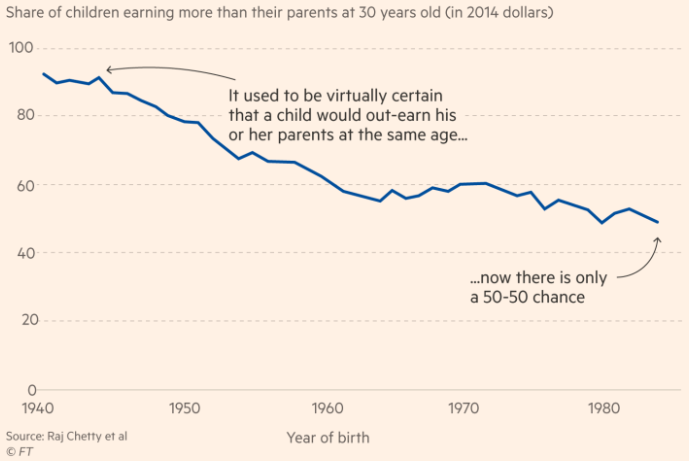
10. Finally, this is really stunning and sad. In the US, fewer millennials are employed or own homes than previous generations at the same age, the younger Americans have never shouldered a heavier student loan burden, and fewer millennials are out-earning their parents at the same age.

Monday, August 21, 2017

Assessing India's economic growth prospects

Ruchir Sharma offers a nice dose of realism about Indian economy, the relationship between economics and politics, government's contribution to growth and more. He makes some interesting points. 

1. Lower growth rates are the new global normal. There is not a single region in the world which is growing faster now than a decade back. Exports, which provided the boost for the last two decades of growth has been stagnant this decade. To that extent, any growth rate above 5 per cent should be good for India. 

2. India has been out-performing its emerging market peer basket by about two percentage points for 2-3 decades, and that out-performance is likely to continue. It helps that the country's GDP per-capita at $2000 is only a fifth or so of the peer basket average, and therefore the boost from low base is significant. 

3. Empirical analysis of state elections shows that even in the past decade, anti-incumbency has been the dominant trend in Indian politics, even when states deliver impressive economic performance. Anti-incumbency has only marginally declined from 65% to 58% in the past decade.

4. The findings of the World Values Survey over the past 2-3 decades show that among the major countries India shows the highest increase in public preference for authoritarian leaders (as against one more answerable to the Parliament and favours more democracy). 

5. Economic growth in recent years has been driven by consumption than investment, as reflected in the buoyant performance of consumer stocks as against the poor performance of manufacturing and infrastructure sector stocks. To the extent that the former is less dependent on government policies than the latter, the government role in contributing to the high growth rate is marginal. 

6. The arrival of a new leader in emerging economies is associated with elevated stock market performance for 2-3 years, with an out-performance of 20-30%. Over the past three years, Indian stocks have out-performed emerging market peers by 10-15%. 

7. The quality of private sector companies, in terms of having consistently delivered 15% or more earnings growth on a steady basis for more than five years, driving equity markets in India is the best in the world. This is encouraging sign both for the sustainability of the bull market as well as for future growth. 

He writes,
The path has been one of incrementalism for a very long period of time and that is the path that we should expect over the next few years and therefore... to pay attention to politics in India is, from an economic perspective, is really a waste of time... this is a country... that consistently disappoints both the optimist and the pessimist. And so, that realism is what we need. You can always be an optimist and always say that this is going to happen. But for me, that is a money losing strategy and that is one thing which is also, we have not appreciated that if you look at what has happened over the last three years, had you bet on the government to deliver, look at it from a pure stock market perspective, you would have been a loser... the evidence suggests that there is really no connection between politics and economics in this country. On the other hand, it is this sentiment of nationalism and you see this, you see this across social media, you see it across television channels, it is this sentiment towards nationalism and stride at hyper-nationalism at times, it is this sentiment which is what is buoying Modi and the current administration... 
if you look at what has worked in the stock market over the last three years, you will find that there is nothing to do with the government or politics. The best performing sector since May 2014 has been the consumer staples sector. This reflects the fact that what is really driving the Indian economy over the last three years has been consumption. As we know from instances across the world, that the government really doesn't have much of an impact on consumption as much it has on investment. Investment is what the government can really drive by creating the investment environment for investment to pick up or pushing that. Instead if you look at investment related stocks in India, those have done quite poorly on a relative basis especially over the last three years.
And this is interesting and I agree,
So, my simple point being here that the connection between politics and economics in this country is rather limited and the stock market's behaviour over the last three years since this government came to power has only reinforced that notion. If you look at both the internals of the market, in terms of what has done well and also the overall market, neither the pessimists nor the optimists on the Modi government would have made any money based on a political view. So, in this country if you want to do well you have tune out the politics and be an internal exile as far as politics is concerned because that only interferes with sort of making money in this nation.
But, in favour of the government, it has to be argued that the counter-factual is impossible to have. To its credit, the government has not done any harm, and has largely been pursuing stable fiscal and macroeconomic policies. This is more than can be said of governments, not just in India previously, but also globally in emerging markets. 

It is here that I disagree with Ruchir, 
There are countries like China, Korea, Taiwan which have been able to grow at 10 percent plus. But my point has always been that to expect big bang reforms in India, to expect that some major big bang reforms will take place in India has always been a bad bet because that never happens. Our culture is one of incrementalism. We do things in incremental steps and I think that is what should be the operating assumption.
I do not think that there are big-bang reforms in India's context. When we talk of big-bang reforms, we think of one-off decisions like deregulation, privatisation, promulgation of new laws, and so on.  Take a decision and you are done. The sort of stuff like privatisation of banks and public sector units, while necessary, on their own, are unlikely to unlock massive growth energies.

The real reforms in India's context, as we laid out in our book, Can India Grow?, are more in the nature of steady and focused accumulation of human, physical and institutional capital, whose base is astonishingly low for an economy of India's size. Deficiencies in these are the binding constraints to sustainable high growth rates. No amount of big-bang can make up for them. For sure, there are some big-bang stuff there, as we outlined, but those are not the stuff the markets associate with big-bang reforms. They are in the nature of pulling complementary levers and persistent follow-up for long periods to address deep-rooted problems.

They would include reorientation of school education single mindedly towards learning outcomes; restructuring of UGC, MCI etc; facilitating the development of financial savings  instruments and enabling access to them, so as increase the savings rate; transition to outcomes-based financing in health care, away from line-items health funding; policies to provide tenure stability and address politicisation of officials postings; across the board standardisation, e-procurements, and third party quality audits; reforms to address decision paralysis and so on. Not the sexy stuff like repeal of Section 25N of Industrial Disputes Act 1947 or the privatisation of Air India or Indian Railways!

Friday, August 18, 2017

Historical asset prices

Ananth points to the FT Alphaville article that features the new work of Oscar Jorda, Alan Taylor and Co that examines the relative rates of return for equity, housing, bonds, and bills for 16 countries over the 1870-2015 period. Their finding,
Over the long run of nearly 150 years, we find that advanced economy risky assets have performed strongly. The average total real rate of return is approximately 7% per year for equities and 8% for housing. The average total real rate of return for safe assets has been much lower, 2.5% for bonds and 1% for bills. These average rates of return are strikingly consistent over different subsamples, and they hold true whether or not one calculates these averages using GDP-weighted portfolios. Housing returns exceed or match equity returns, but with considerably lower volatility—a challenge to the conventional wisdom of investing in equities for the long-run.
A summary of their finding below shows that while returns on housing and equity have been relatively similar, the former has been much less volatile than the latter.
The relative performances of all assets with respect to bills for the period from 1870 and from 1950 are below.
FT though points to a wrinkle to this assessment, highlighting that contrary to conventional wisdom capital appreciation is a smaller share of wealth effect from housing and a significant share of the returns to housing has come in the form of rental yields, something unavailable to the typical homeowner. This coupled with the cost of mortgage taken to finance the purchase means that the real return to the homeowner from a housing asset would be far lower. 

And in a nod to Thomas Pikketty and Co, the authors find that r, the real rate of return to capital, has consistently exceeded g, the real GDP growth, in the aggregate sample, except during the wars,
A robust finding in this paper is that r ≫ g: globally, and across most countries, the weighted rate of return on capital was twice as high as the growth rate in the past 150 years... In fact the only exceptions to that rule happen in very special periods—the years in or right around wartime. In peacetime, r has always been much greater than g.
They also find that risky rates, a measure of profitability of private investment, have remained more or less constant over the past four decades, whereas risk-free rates have declined over the same period,
Both risky and safe rates of return were relatively high in the pre-WW2 era, with an obvious dip for WW1. The risk premium between risky and safe rates grew large with the Great Depression and through the Bretton Woods era. Safe real rates were especially low in WW2 up to the late 1970s. After spiking in the 1980s, the safe return has gradually declined, yet risky returns have remained relatively close to their historical average level, and the risk premium is approaching post-1980s highs... We find that the real safe rate has been very volatile over the long-run, more so than one might expect, at times even more volatile than real risky returns. 
An equally important finding is the remarkable rise in correlation of cross-country risky asset returns, in particular equity returns, and attendant risk-premiums
Historically safe rates in different countries have been more correlated than risky returns. This has reversed over the past decades, however, as cross-country risky returns have become substantially more correlated. This seems to be mainly driven by a remarkable rise in the cross-country correlations in risk premiums. This increase in global risk comovement may pose new challenges to the risk-bearing capacity of the global financial system, a trend consistent with other macro indicators of risk-sharing.
This is one more datapoint in the growing pile of evidence about the global interconnectedness and systemic risks posed by excessive financial market integration.