There are two important trends that are likely to impact cross-border capital flows for the foreseeable future. The first is the already high and increasing public debt burdens and persistently high budget deficits across the developed world. The second is the growing efforts to reshore manufacturing and reduce the dependency on China. The US is at the forefront of both these trends.
Both are having large and growing spillovers across the global financial markets, especially adversely impacting developing countries. The first trend is raising sovereign bond yields, forcing interest rate hikes, and weakening currencies. The second trend is triggering a rising competition to attract manufacturing investment and retain domestic savings.
I blogged here arguing that these trends will intensify the competition for capital, and most likely trigger capital wars. I had also discussed the possible implications for India.
These trends come at a time when India is continuing the opening up of its financial markets and actively courting foreign investment. What do these trends mean for the RBI’s monetary policy, the rupee, India’s foreign direct investment, foreign portfolio investment, external commercial borrowings, and bilateral and multilateral aid flows?
Finance 101 and historical experience tells us that rising US Treasury yields trigger capital flow reversals, puts pressure on the rupee, worsens the trade deficit, and reduces RBI’s monetary policy autonomy. And there is a self-reinforcing spiral associated with this cycle. On top come the squeeze on FDI inflows arising from the efforts to retain domestic savings and reshore manufacturing.
Globally, the rising stock and flows of public debt portend a long period of higher interest rates, also because of the inflationary pressures that are already on play and will remain so for the foreseeable future.
In this backdrop, this post will use data analysed with Claude to examine the consequences of India’s external exposure.
Arguably the biggest deterrent to foreign capital inflows into India today is the weakening trend of the rupee. A weaker rupee raises the hurdle rate that any investor, FDI or FPI, would demand for investing in India. The rupee depreciation, therefore, functions as a direct tax on foreign investors' dollar-denominated returns. Every 1% of depreciation eats roughly 1% of the foreign investor's return.
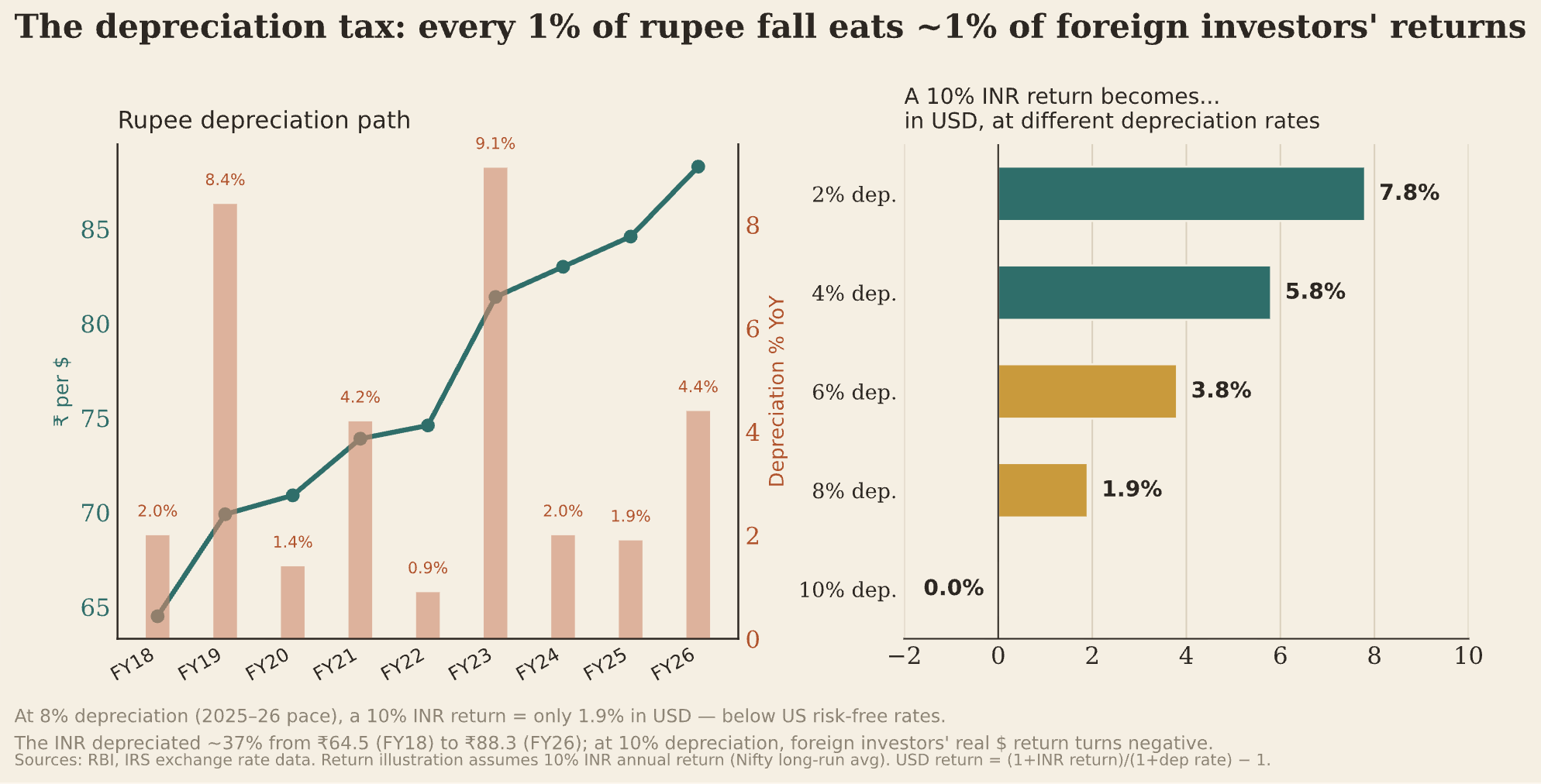
As an illustration, the rupee has weakened from ₹74/$ in 2021 to ₹96/$ in 2026, a cumulative decline of 30% over five years. This means that any foreign investors who remained invested in India should have earned an additional 30% returns to offset the depreciating currency.
So what drives rupee depreciation?
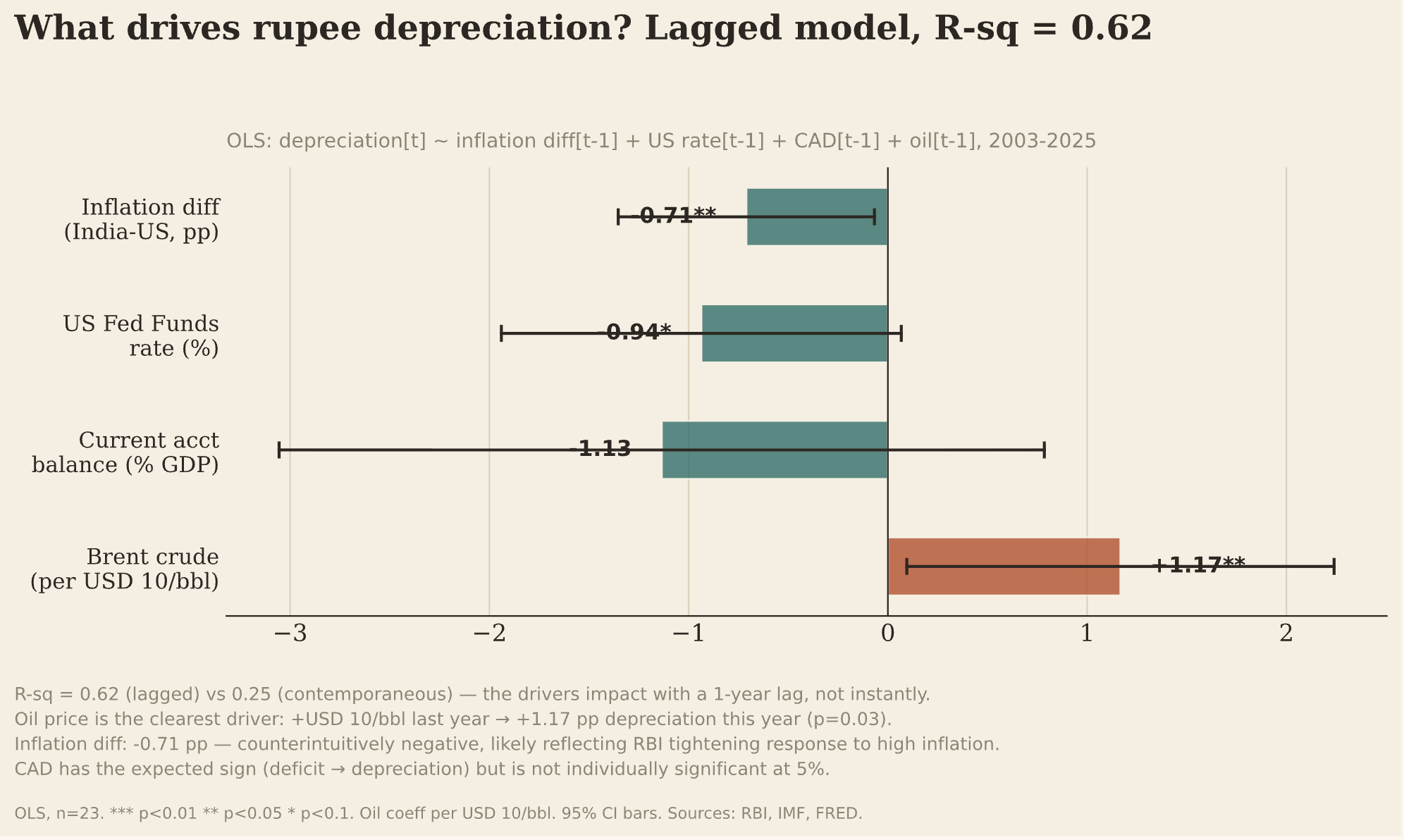
The obvious candidates are inflation differential, US Federal Funds rate, current account deficit, and oil prices. While a contemporaneous model OLS regression of annual rupee depreciation on these four structural drivers barely fits, a one year lagged model fits well (R-sq = 0.62, F-stat p = 0.001). The rupee depreciation correlates primarily with oil prices (the import-bill channel), the inflation differential (mediated by the RBI’s response), and the current-account balance, but with a one-year lag.
Going by this, given the prevailing global market conditions and with no signs of an end to the Iran war, the rupee is primed for further declines in the year ahead.
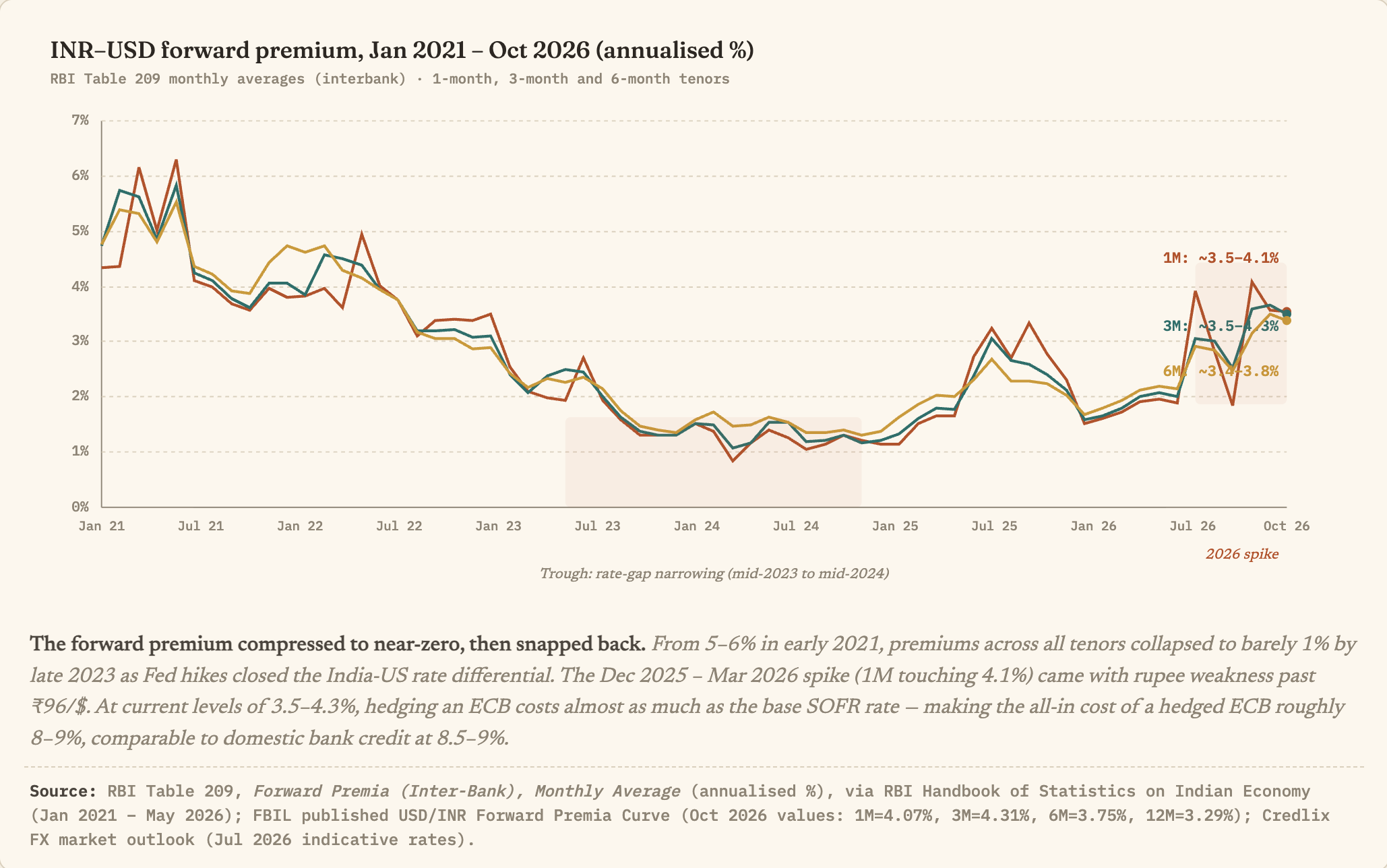
The prospects of further rupee weakening is reflected in the USD/INR forward premium, which compressed dramatically from ~5% in early 2021 to barely 1% by mid-2024 as Fed hikes narrowed the India-US rate gap, but has since been rising and is about 3.5-4.1% in October 2026. For ECB borrowers, the forward premium is the hedging cost.
What does all this mean for RBI’s monetary policy choices?
The Uncovered Interest Parity (UIP), which is an unobserved theoretical construct, states that the difference in interest rates between two countries should equal the expected change in exchange rates between their currencies, so that there is no arbitrage opportunity. The reality though is complicated by risk premiums and transaction frictions.
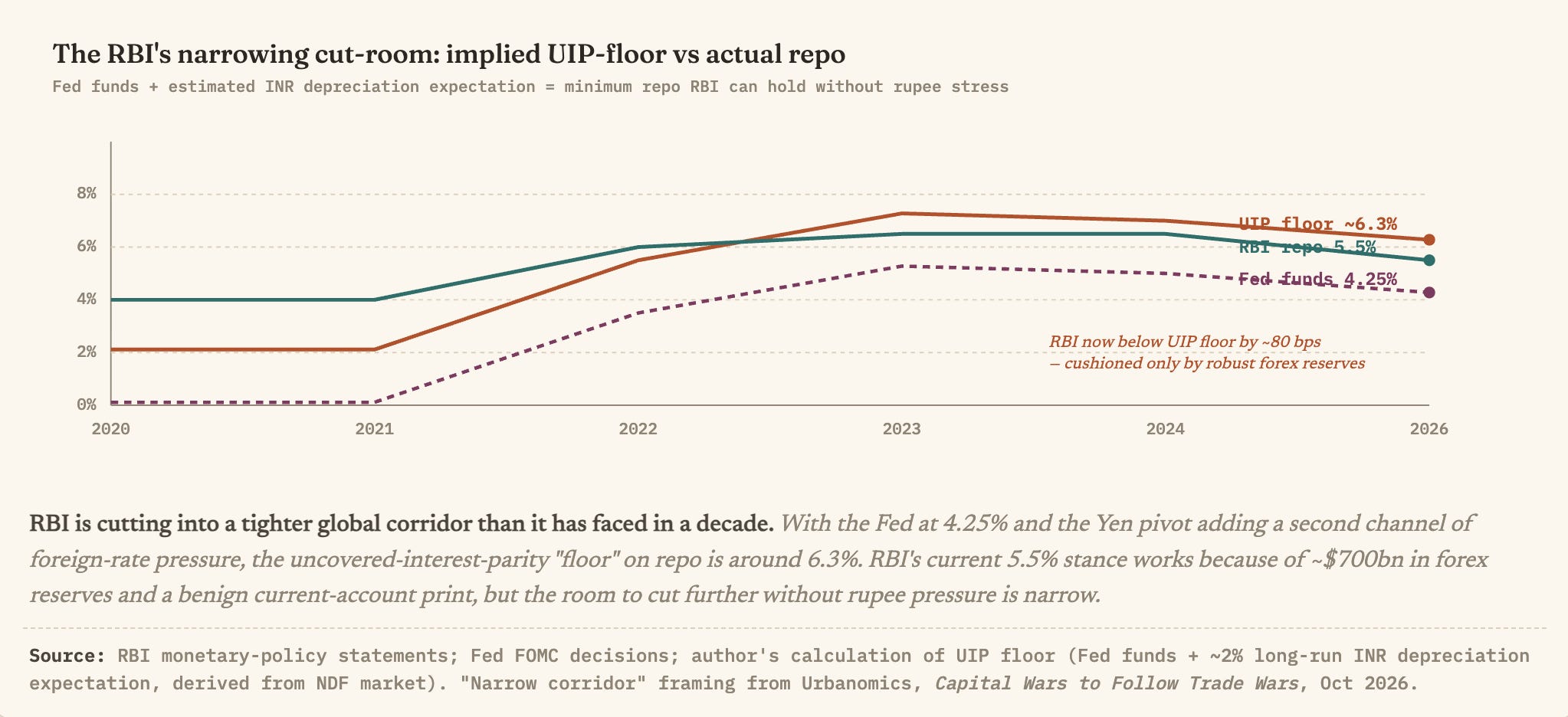
The higher-for-longer global interest rates narrow the monetary policy space to cut or even maintain neutral stance in India without triggering outflows and rupee depreciation. In an open-economy framework where India’s capital account is substantially open on the debt side, the UIP floor on the repo rate rises mechanically. And, as the graphic below shows, it has been rising since 2021. With the Fed at 4.25% and the BoJ no longer anchored at zero, the UIP floor on the repo rate is around 6.3%.
This has created a situation where the UIP floor today is above the RBI’s repo rate. This puts pressure on the rupee to depreciate, something backstopped only the RBI’s large reserves. In fact, the RBI’s 5.5% repo rate works today only because of the forex-reserve buffer.
However, now with US looking at the beginning of a rate hike cycle, the RBI’s room for monetary policy autonomy is considerably squeezed. It has little choice but to respond with raising rates.
The capital wars channel compounds the problem. A big risk is the US net Treasury issuance estimate of $2tn/yr through 2028. It will be a major sink for global savings, and will raise the hurdle rate for all EM sovereign and corporate issuance.
An associated signature of this squeeze is the narrowing of the spread between Indian and US 10 year sovereign bonds. It has more than halved since the beginning of 2021. Coupled with the currency hedging cost, the spread disappears, thereby eliminating any incentive among those pursuing carry trade opportunities.
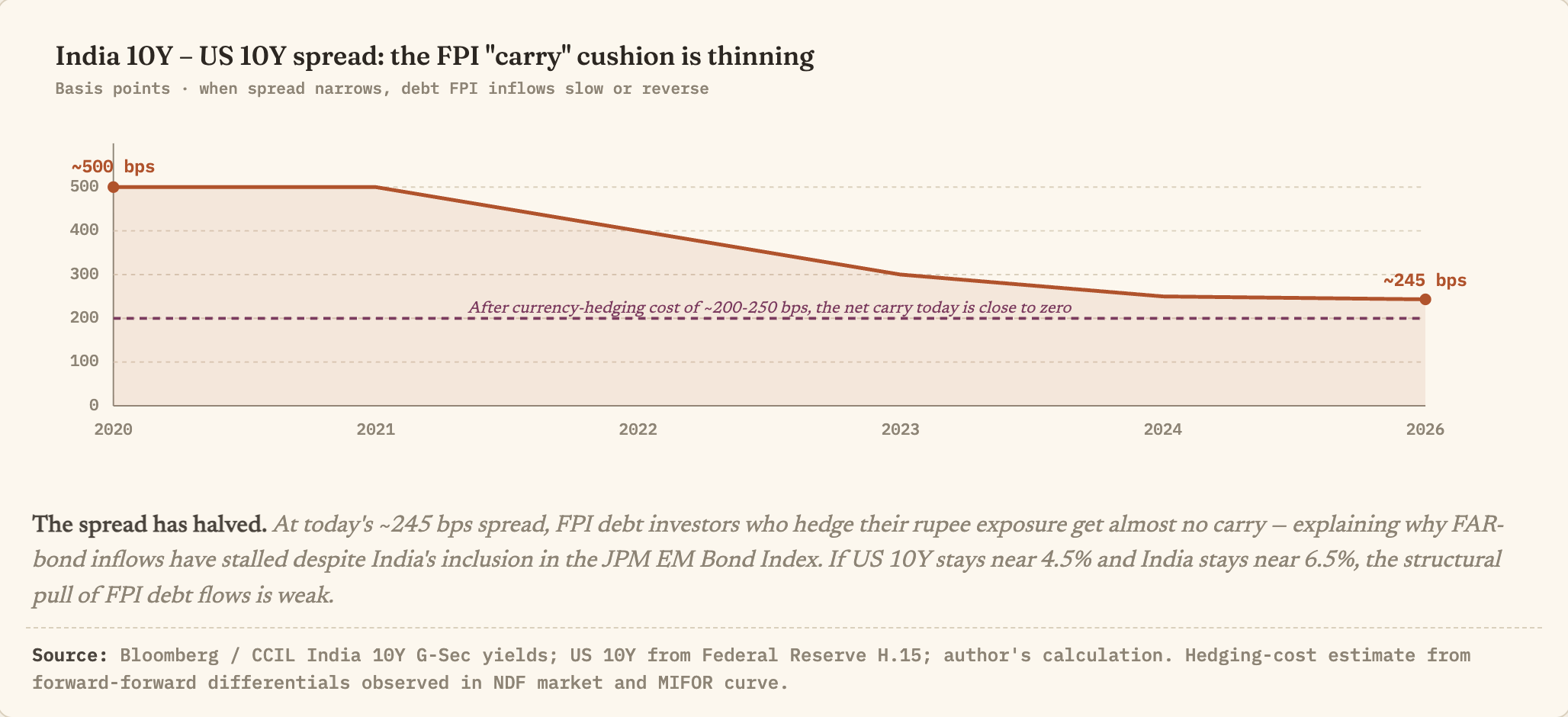
What does this imply for India’s external debt exposures?
In the aggregate, India’s external debt looks moderate at 20.8% of GDP. But there are two dimensions that need monitoring. The first is that the historical access to cheap, long-tenor, concessional fixed rate debt, primarily from bilateral and multilateral institutions, has now given way to floating rate loans benchmarked to SOFR/TONA/TORF (the transition from LIBOR happened by 2023). Of the $174.3 bn sovereign debt exposure (as of June 2026), 58% are now floating rate loans. More on this latter.
The second is the composition of external debt is now shifting away from the government to the private sector. This composition deserves closer monitoring given the rising share of External Commercial Borrowings (ECBs).
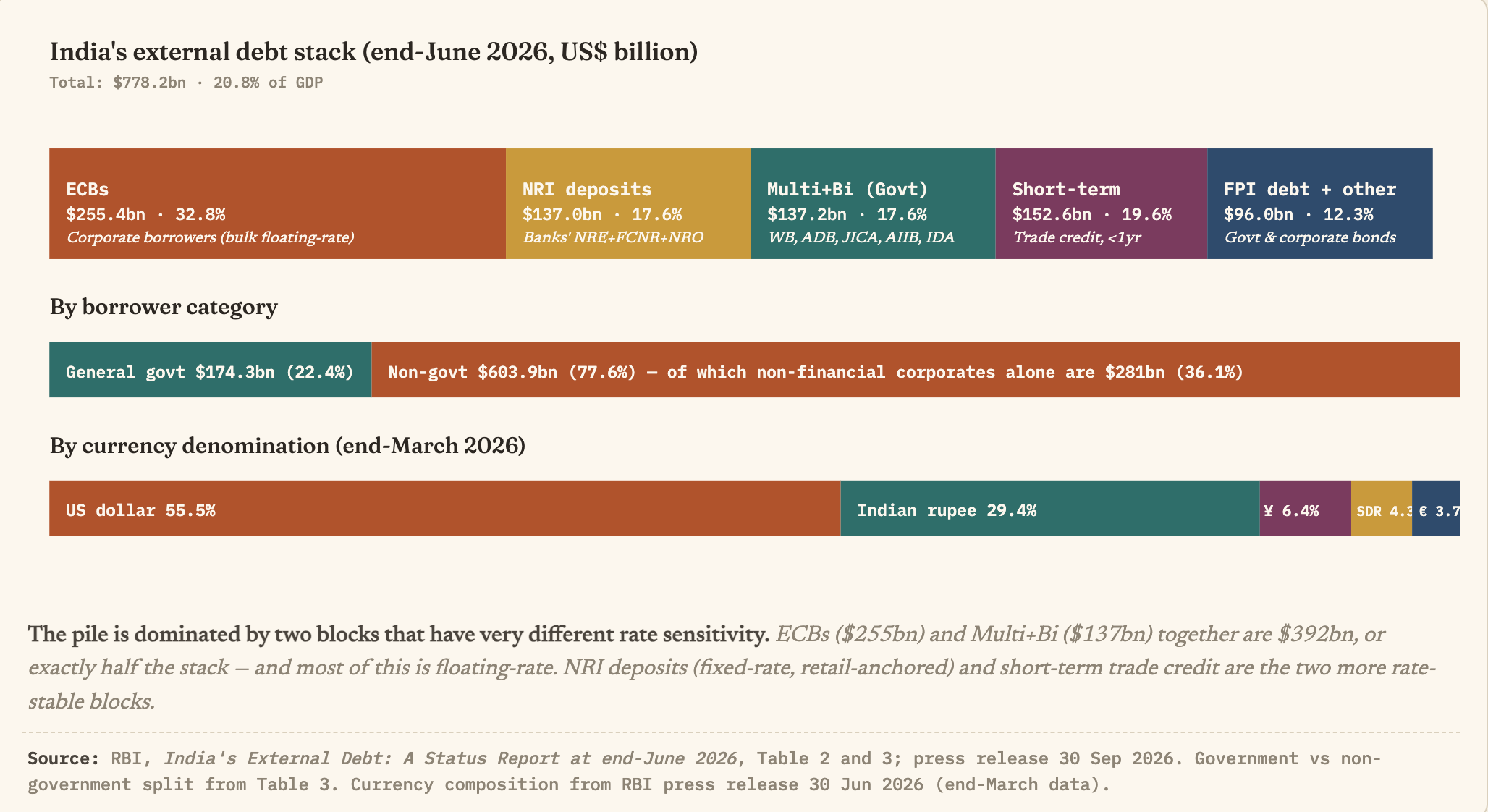
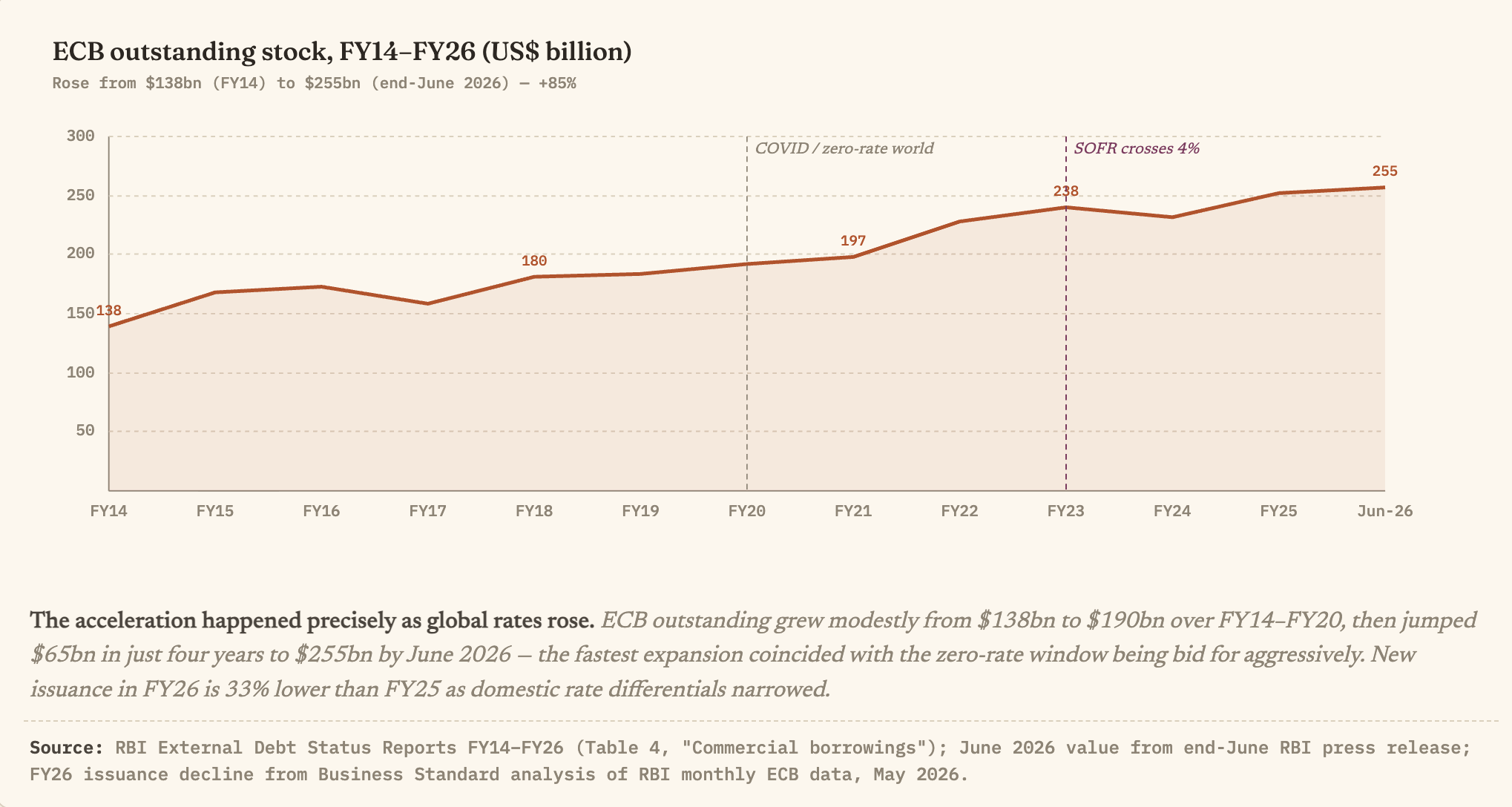
At 32.8% of India’s external debt, ECBs are now bigger than the combined value of multilateral and bilateral loans and NRI deposits. The downward pressure on the rupee is a major risk for ECBs. This risk is amplified by the rising rates globally since most ECBs are floating-rate (SOFR-linked).
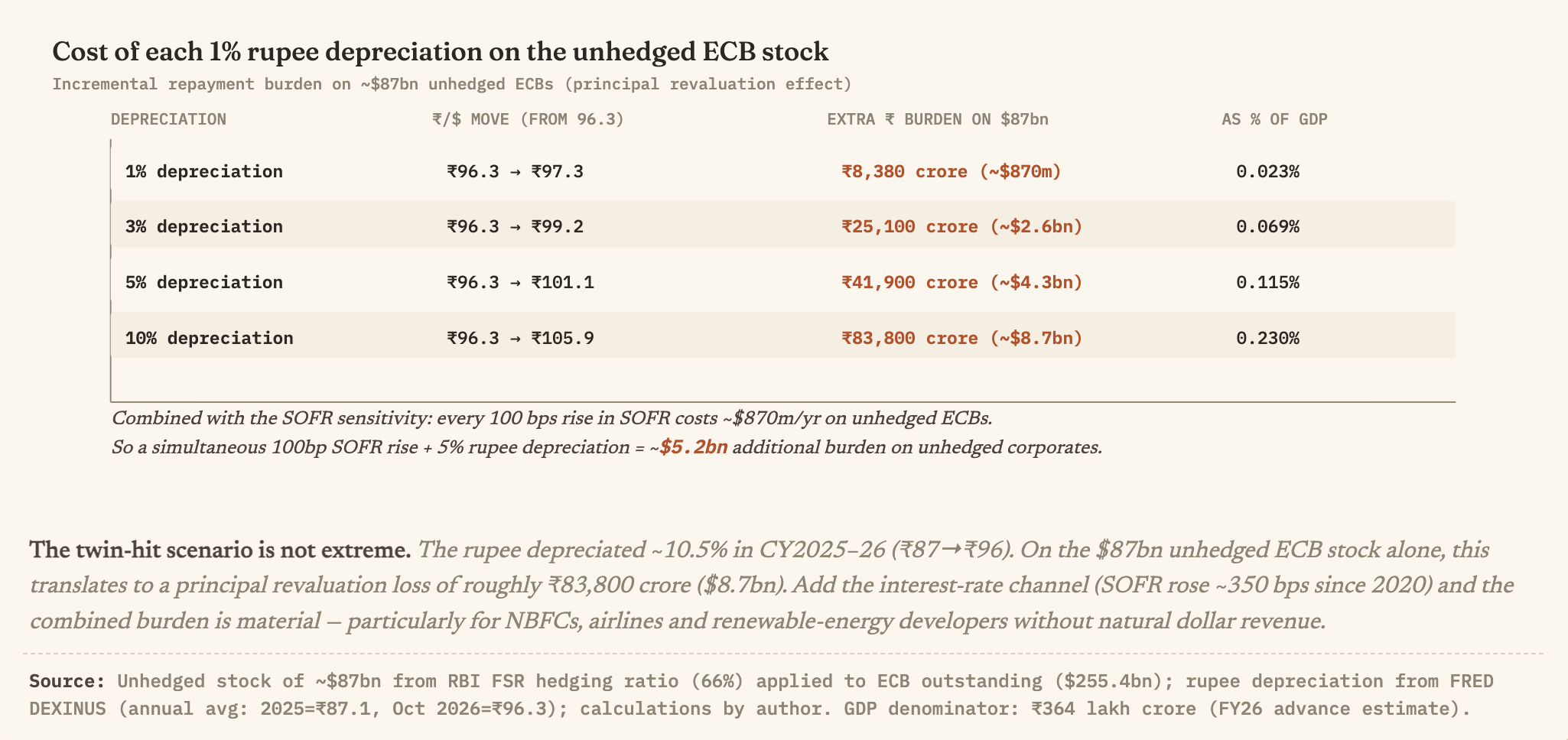
Of the $255bn outstanding ECBs, only 66% are hedged, and the remaining are direct, uninsured pass-through. The 34% unhedged slice ($87bn) is where the first stress will surface. It will fall most likely at NBFCs, airlines and renewable-energy developers that borrowed at low SOFR in 2021–22 and now must roll.
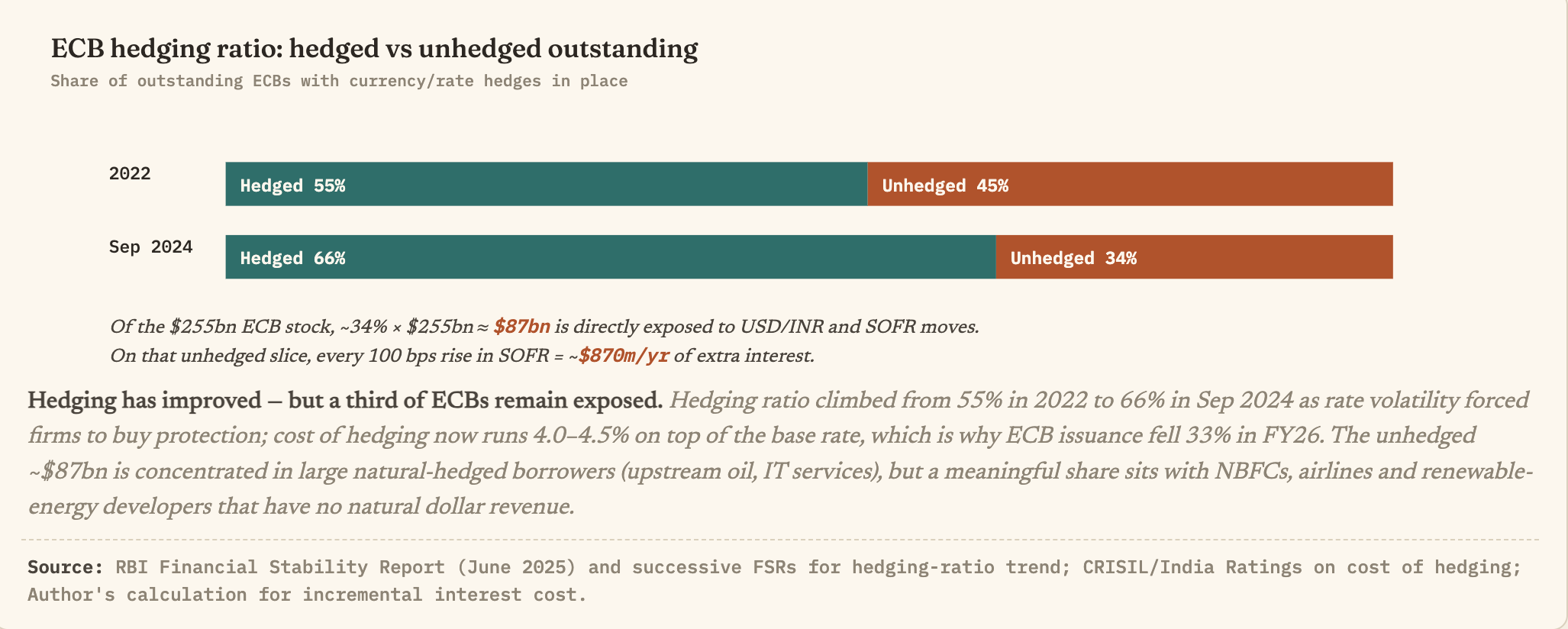
The impact of rupee depreciation on the $87 bn of unhedged ECBs is significant.
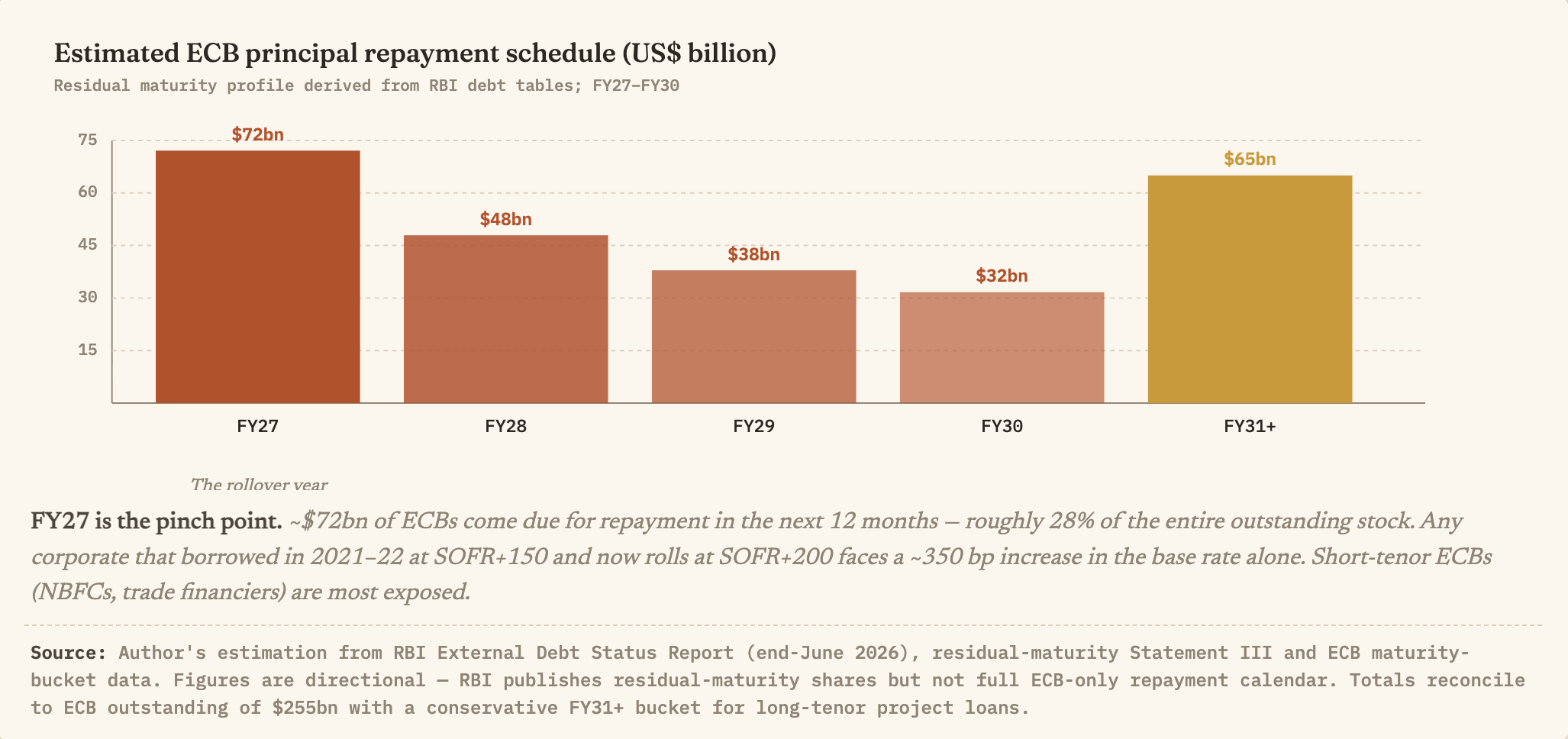
These risks are also serious also because of the shorter repayment schedules of the ECBs. About $120 bn are due for repayment till March 2028.
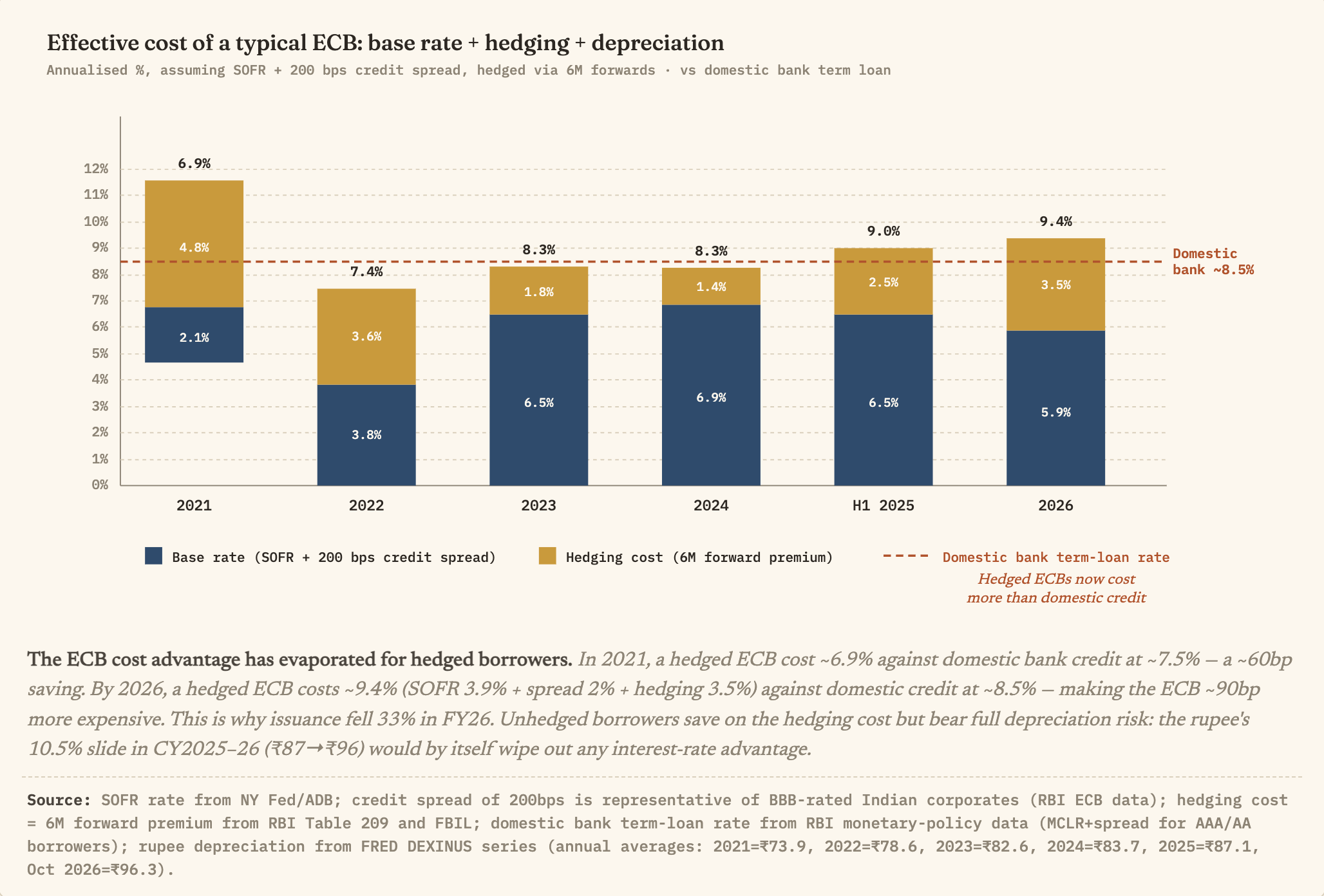
Another cause for concern may be the nature of ECB borrowers. An Indian corporate borrowing via ECB faces three cost layers - the base rate, currency depreciation, and the cost of hedging. The chart below shows that at least since 2023, ECBs should have been losing their attractiveness, especially for the higher rated borrowers. Nevertheless the ECBs have continued to rise, though issuance has fallen 33% in FY26. This raises a concern that some proportion of the ECB borrowers may be coming from the riskier market segments.
The rising ECB exposure necessitates greater RBI oversight and microprudential regulation. For example, it should mandate higher ECB hedging ratios for sectors where revenues are in rupees (airlines, renewables, NBFCs). It should keep a close watch on higher cost commercial borrowings by by systemically important corporates.
The impact of rising interest rates globally is also showing up on India’s bilateral and multilateral borrowing windows. The notion that multilateral and bilateral lending is cheap, long-tenor and insulated from financial-market cycles is no longer true. ADB, World Bank and JICA have all transitioned from LIBOR to the new overnight benchmarks — USD SOFR, Yen TONA and the newer TORF. Each is 300–350 bps above its 2020 floor.
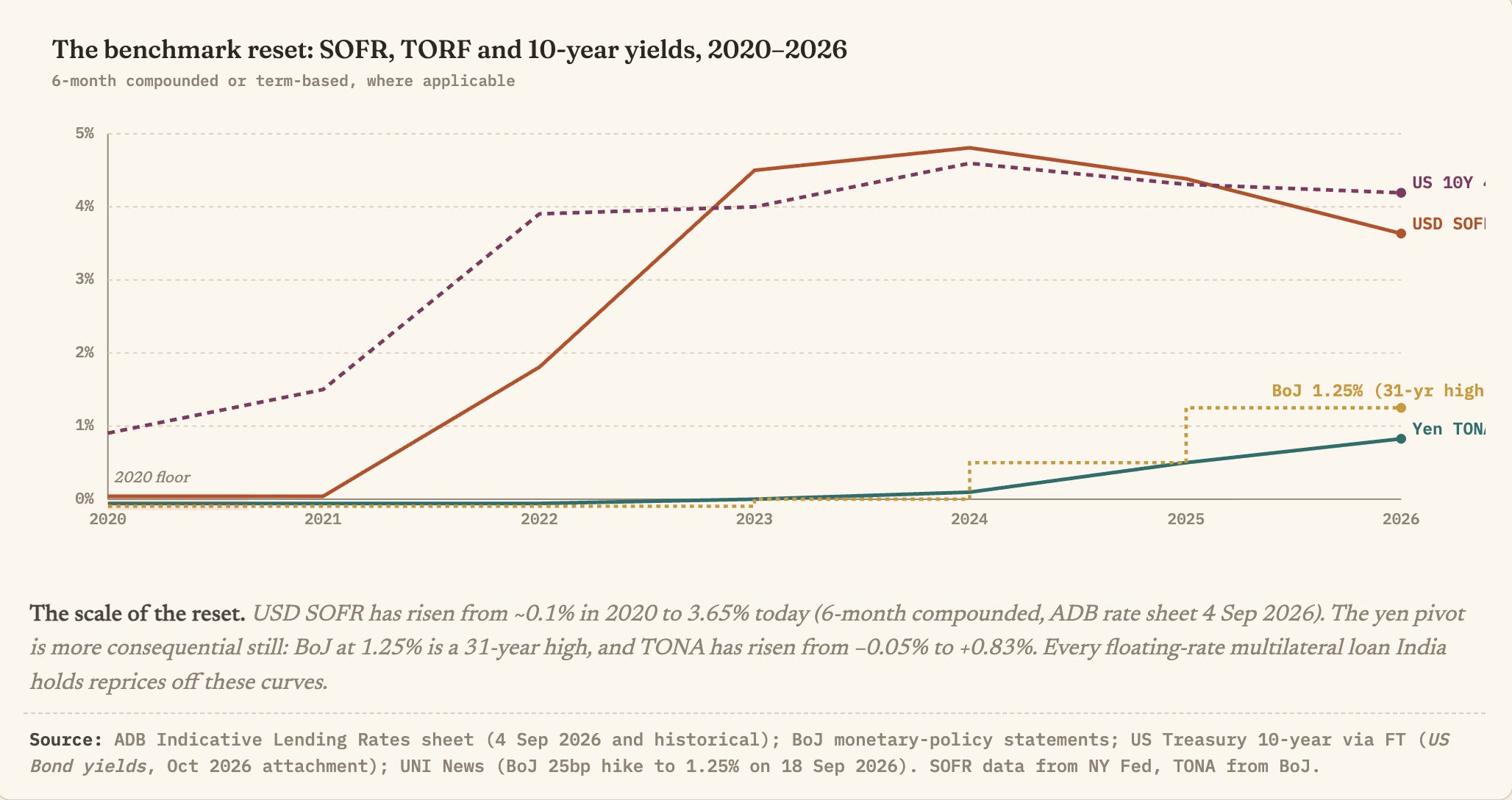
For four decades, yen funding has been India’s cheapest formal external finance. JICA has been the backbone of financing for Delhi Metro, Mumbai Trans Harbour Link, Delhi Mumbai Industrial Corridor (DMIC), Western Dedicated Freight Corridor (DFC) and the Mumbai-Ahmedabad bullet train. All of them were conceived when the all-in yen cost was below 1%. But BoJ’s rate hikes, at 1.25% in Sep 2026, has already taken interest rates to their highest since 1995, and much more is expected as Japan normalises its financial markets. India has roughly $50bn of yen-denominated external debt (6.4% of total).
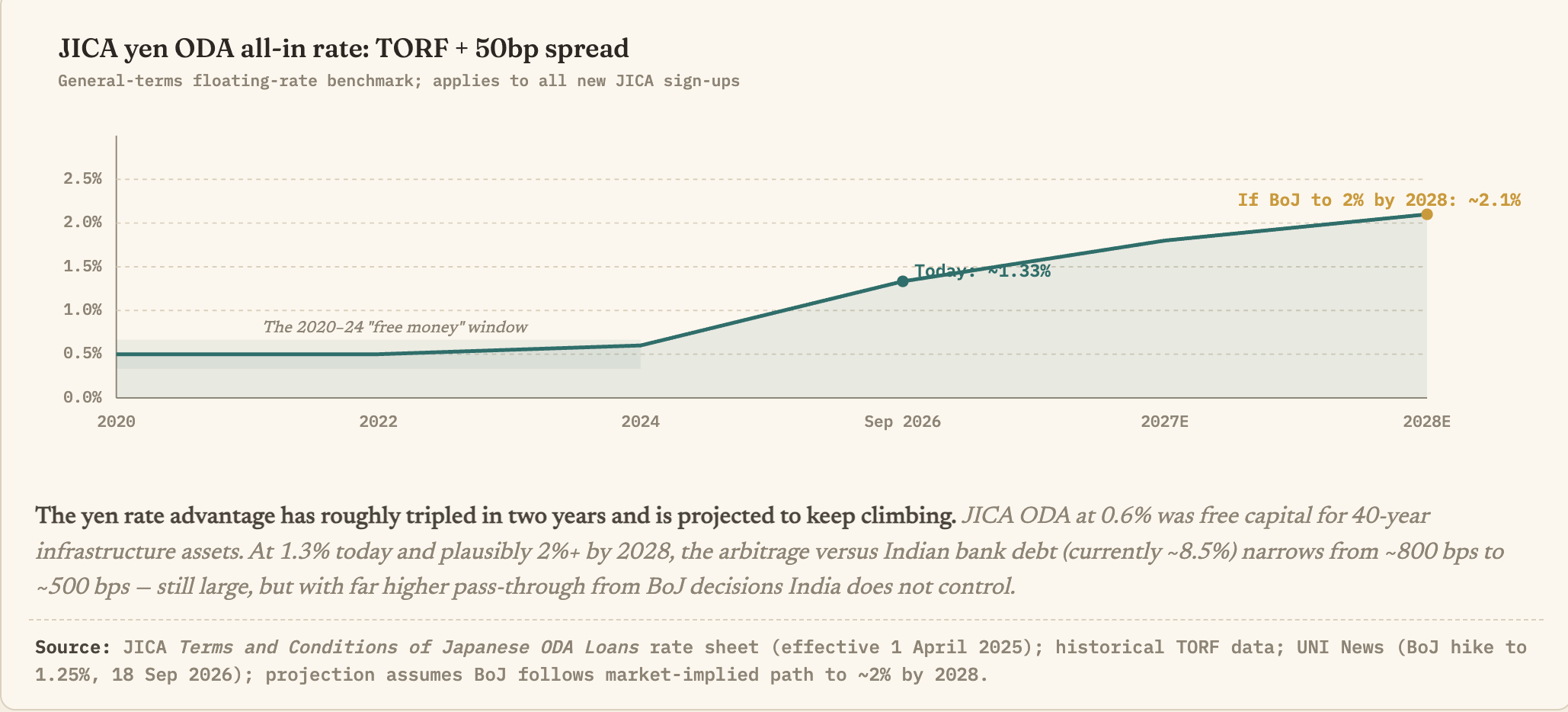
Each 100 bps of additional yen funding cost on a 30-year ¥1 trillion exposure is roughly ¥100bn in extra lifetime interest. This shifts the IRR calculus materially.
A JICA yen loan signed today has an all-in cost of about1.3–1.4%, still the cheapest money India can get, but roughly double the 0.6–0.8% that typical JICA loans carried in 2015–2022. More consequentially, as new BoJ hikes feed through, the TORF benchmark will keep rising.
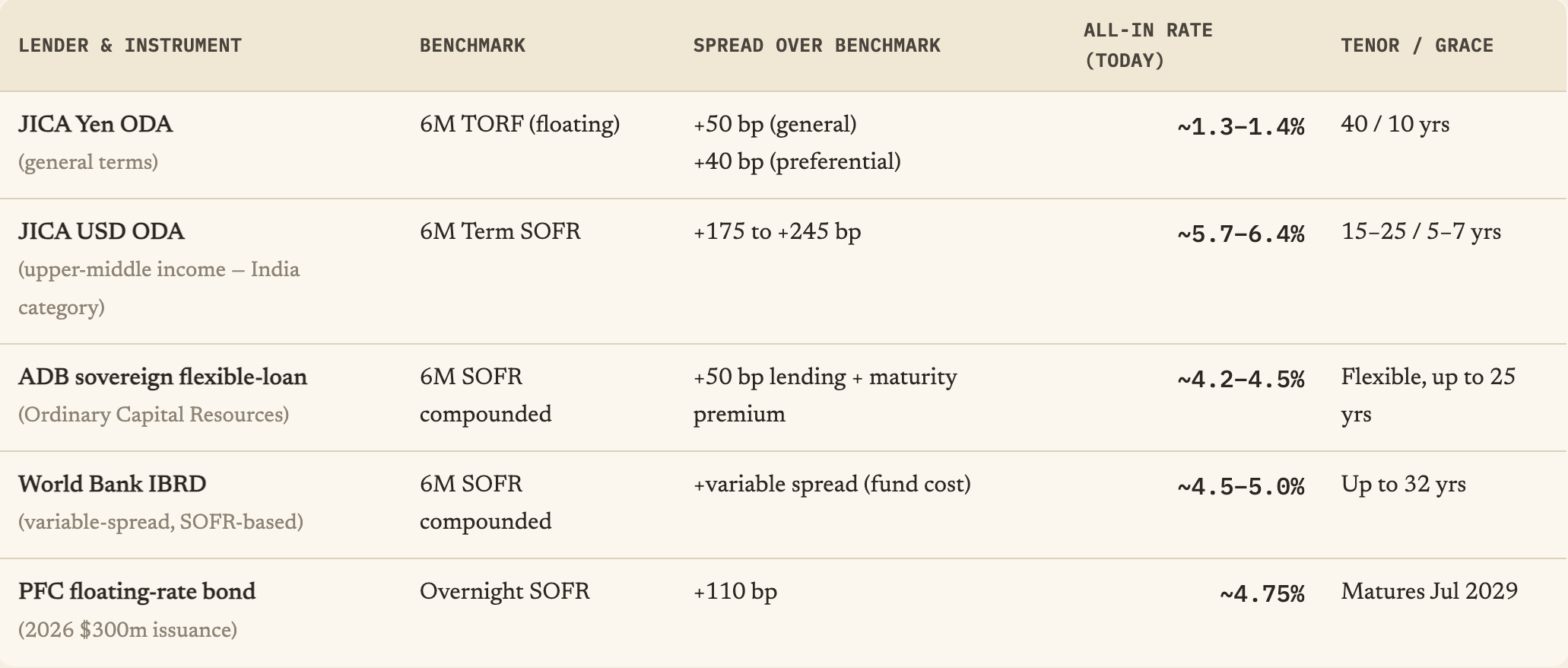
Put simply, India’s historical reliance on JICA for metro rail, DMIC, and large infrastructure is predicated on a yen funding cost that is quietly disappearing. This is not a cyclical shift, but structural one.
For the government, and including state governments, there is a need for a serious revisit of the external aided project (EAP) financing windows. Does it make fiscal sense to continue the same levels of such borrowings given the rate risks?
Beyond the direct interest cost, higher global rates reset India’s external exposure through three further channels. They are the foreign portfolio flows into Indian debt markets, the yield that must be offered on NRI deposits to retain the stock, and the capital-wars channel through which US issuance crowds out EM access.
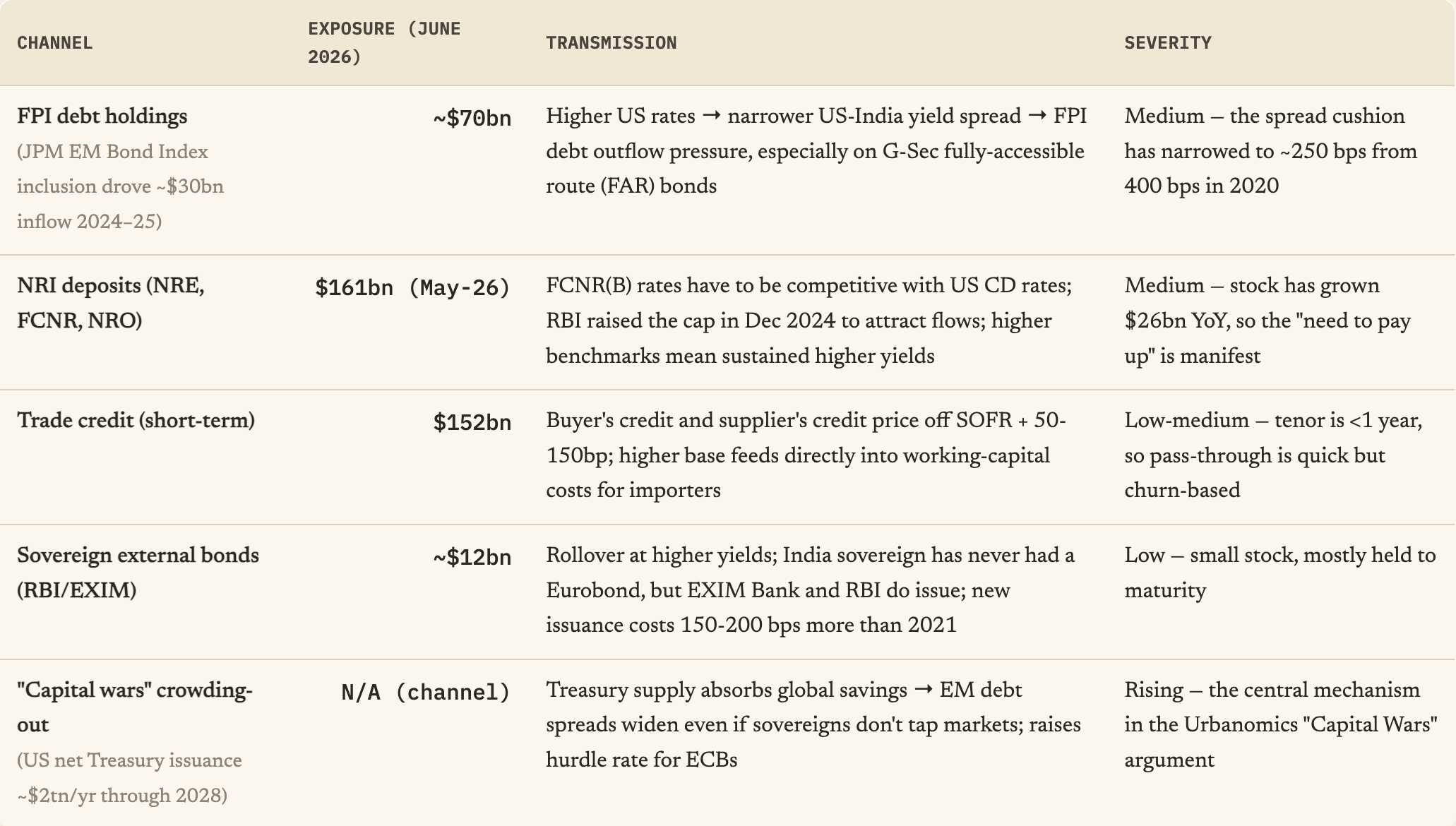
Finally, as we wrote in The Rise of Finance, thanks to the unavoidable spillovers from the dominance of the US economy and the dollar, the space available for developing countries to pursue autonomous monetary policy was already constrained. This is set to shrink further on the face of the trends discussed above.


No comments:
Post a Comment