Large urban agglomerations are engines of national economic growth. The fuels that power these engines are the transportation infrastructure and mass transit, supported with enabling land use and development control regulations, value capture and revenue sharing, and institutional architecture. This is the topic of the post.
Such urban agglomerations are characterised by clusters of dense, specialised nodes of employment connected to residential nodes by commuter networks. This is the classic model of metropolitan downtowns connected with densified suburban satellite towns that coordinates agglomeration economies at the centre for high productivity job creation.
Accordingly, the central parts of major metropolitan cities of the world are predominantly workplaces, with people commuting to work from suburban areas on commuter railway systems. Mumbai, London, and New York are great examples. This is in keeping with the economic logic of ensuring the most productive use of the highest value lands in the city.
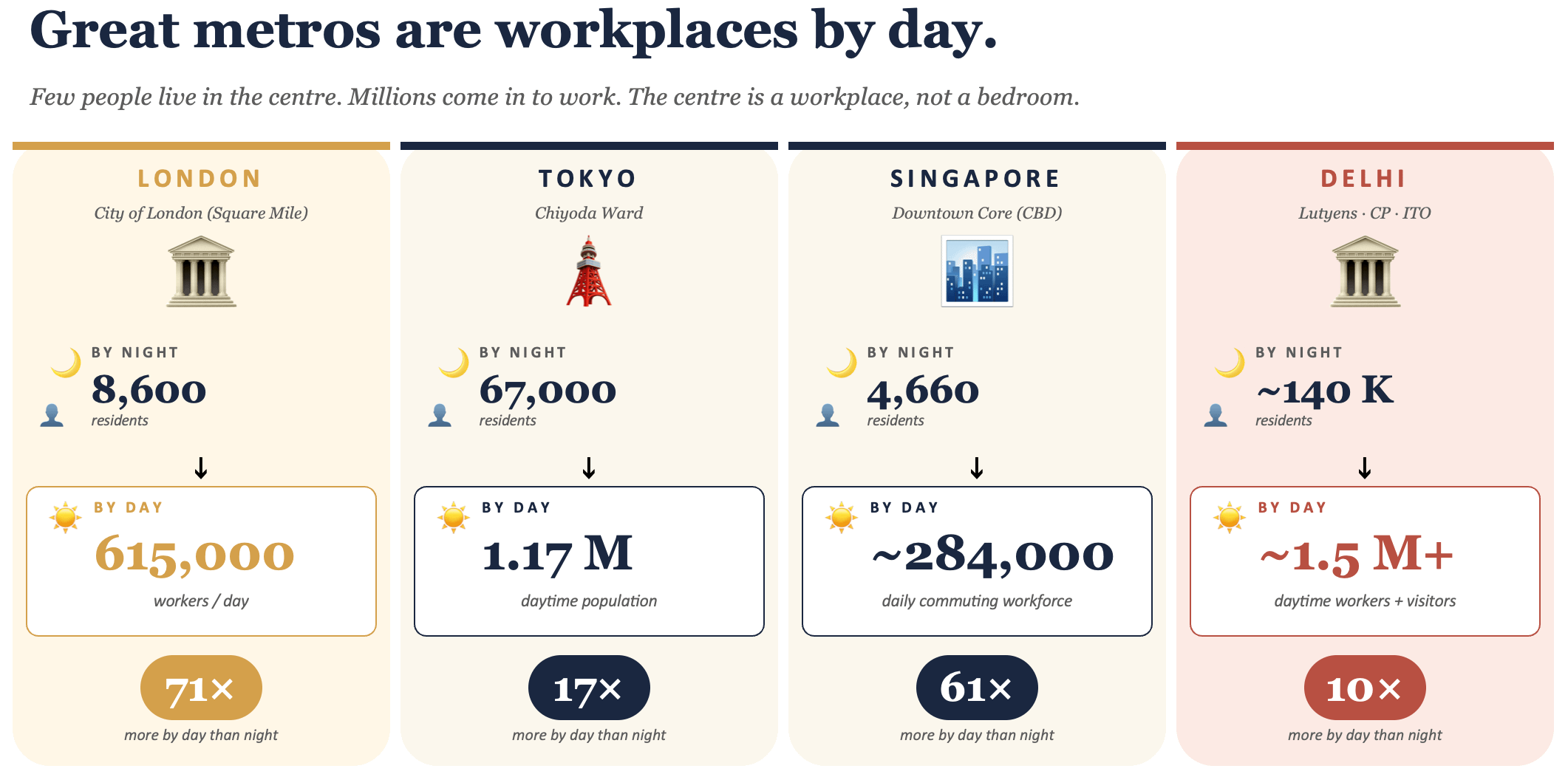
It also unlocks affordable housing supply by locating them predominantly in those areas with lower land prices, thereby relaxing the biggest constraint to affordable housing.
The ingredient that binds the nodes together and creates a dynamic regional cluster is a well-connected mass transit network. In cities globally, commuter and metro railway systems have played this role.
High-volume mass transit systems connect the nodes and bring people closer to jobs. They reshape the geography of what an hour reaches. This trip-shortening effect — making longer distance commutes faster than shorter car trips — is especially powerful in India, where the spatial mismatch between jobs in metropolitan cores and job-seekers in the hinterland has been found to be unusually large. They shrink the distances, thereby increasing the pool of jobs available for people in the hinterland, and expanding the talent accessible for employers in the core.
But evidence also informs us that merely laying the mass transit network is not sufficient. This study by Rana Hasan et albuilt a spatial model of Bengaluru and run the metro against alternative land-use policies and came up with the following quantified impacts.
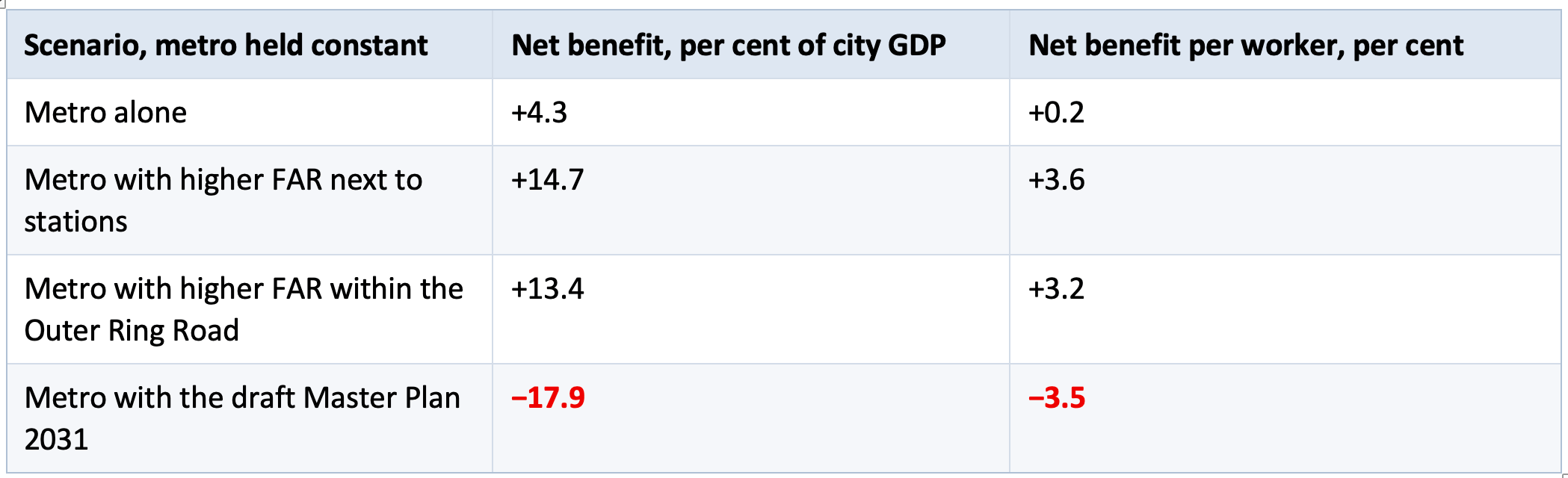
Holding the metro investment identical, the difference in net benefits between the best and worst land-use plans is roughly 32 percentage points of city GDP. In other words, the land-use plan determines whether the transit investment creates value or destroys it.
The requirement is to locate sufficient density of homes and workplaces within conveniently accessible distance from the stations, either through walk or feeder services. This is transit oriented development (TOD).
TOD is about commuting using mass transit by walking to/from station (to/from home and workplace) or feeder services. A big collateral benefit from TOD is that it avoids the use of cars, thereby decreasing traffic congestion, reducing productivity losses from long commutes, and lowering air pollution.
As I blogged here, TOD also increases the commercial viability of the massive investments made in mass transit systems (~ Rs 8 lakh Cr and counting, with 20-30% ridership realised, and massive debt repayment fiscal burden looming). It induces traffic by creating new trips (by locating more people within the transit zone influence area), shortening trip distances (thereby expanding the effective commute catchment), and mode shifts (from cars to mass transit).
Effective implementation of TOD requires addressing three constraints. One, relaxing development control regulations to make it attractive to build density in the vicinity of the stations, and creating the complementary pedestrian infrastructure. It also requires appropriate mixed land-use planning that allows the market to respond in the most efficient manner to order commute patterns and shape spatial growth.
Two, funding of the mass transit capex, especially by enabling with the right kind of value capture instruments, with the right sequencing, and also the appropriate revenue sharing between the rail company and the local government/UDA. Try to capture value too quickly, before value gets created, and the cluster remains still born.
Three, an institutional architecture that aligns the incentives between those constructing the transit system (and repaying the debt mobilised) and those responsible for the land use and other decisions that determine the commercial viability of the system. This could, for example, entail the radical change of making the urban development authorities the owner of metro railway systems in metropolitan areas.


No comments:
Post a Comment