The results of the latest round of the three-year OECD PISA school learning outcomes survey of 15-year-olds in 38 OECD countries and 53 other places provide firm evidence that what people have been suspecting is true — technology, turbocharged by AI, may be detracting from learning.
It finds scores declining worldwide, with fifteen-year-olds in high-income countries falling roughly 1.5 years behind their 2015 counterparts in literacy, knowledge, and reasoning skills. The declines are pronounced in literacy and numeracy.
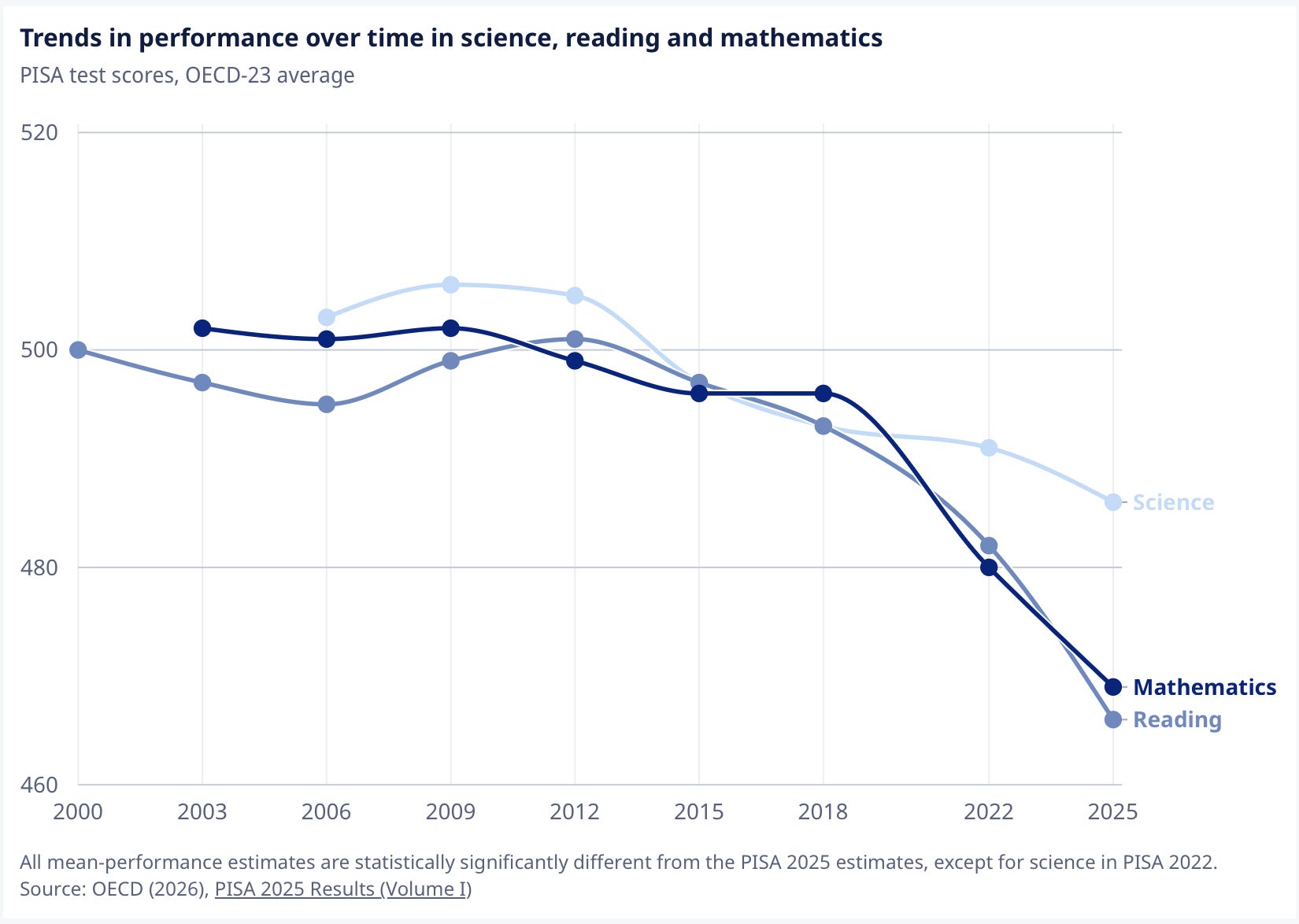
The East Asian countries remain at the top of the charts in all three subjects, as they have been since the beginning. Performance has declined across the board since 2015, with Turkey being an exception.
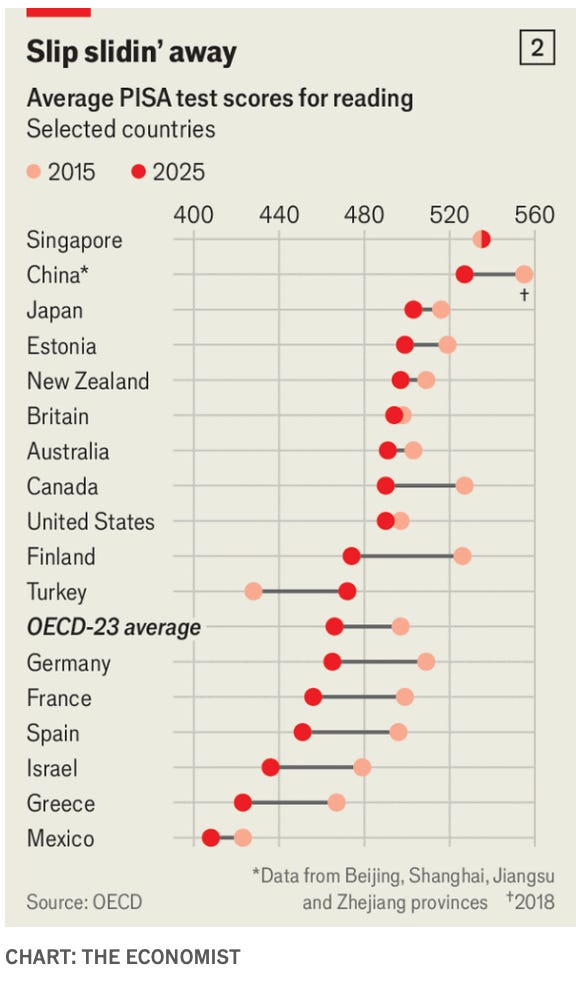
The Economist writes
The latest scores on PISA tests of reading, maths and science, released on September 8th, are the worstsince the tests, administered by the OECD, began in 2000… In 35 rich countries that take part in the tests, a typical 15-year-old now reads no better than a 14-year-old did a decade ago… PISA scores began drifting downwards around 2012. The evidence is growing that tablets, mobile phones and other such screens are distracting youngsters from their studies and diverting them from hobbies, like reading books, that instil the ability to focus… And precisely because AI will increase the temptation for people to outsource difficult cognitive tasks, schools have an extra duty to help pupils exercise their brains and acquire the hard habits of thinking. Failure to furnish them with the basic building blocks of a well-developed mind, such as literacy and numeracy, is inexcusable.
The report points to a decline in key skills like drafting or critically evaluating texts at the expense of skim reading and limited understanding.
The connection between passive technology consumption and lower scores was “compelling”, even though the study did not provide direct evidence of cause and effect, said Andreas Schleicher, director for education and skills at the OECD… Reliance on AI, the survey found, tended to produce worse scores in science for both pupils and education systems, with 37 per cent of students prioritising “common sense” over scientific reasoning… That will serve them ill in the AI age, when “reflection and complexity” will be all the more important… With those skills “declining rapidly”, young people now “read faster” than in 2018, but “less accurately”, he explained… Schleicher linked the decline in the latest scores to the dominance of distracting short-form videos on platforms such as Instagram and TikTok, as the report suggested that “digital distraction” is harming education across the world.
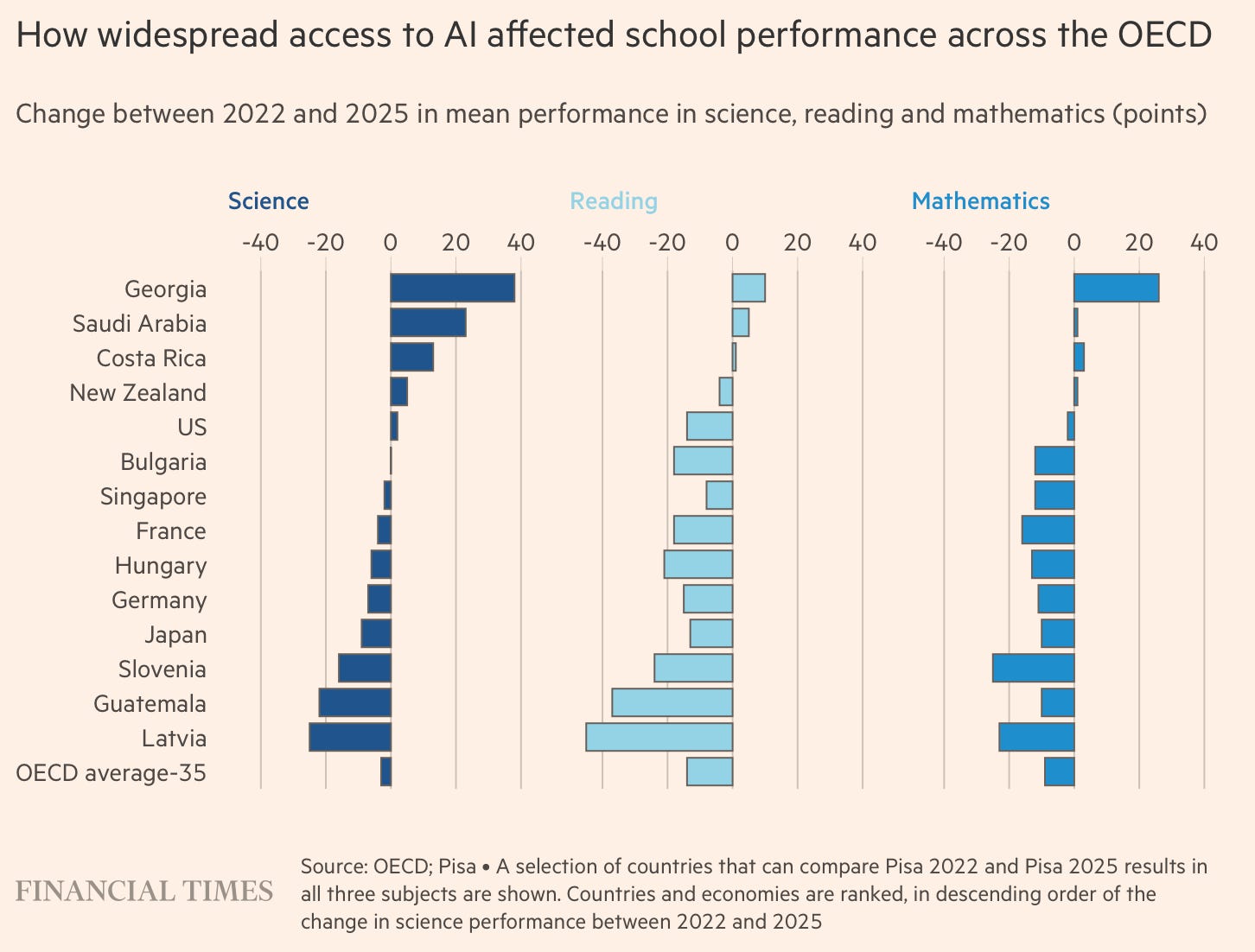
Andreas Schleicher, OECD’s long-standing Director of Education, points to possible explanations.
Reading, the gateway to all learning, has declined sharply. Between 2018 and 2025 performance fell in three-quarters of the countries. Across the OECD, it was down by 25 points—more than a year of learning. Much of this decline happened between 2022 and 2025. The biggest surprise is who fell furthest behind. It was not the most disadvantaged students, but those from wealthy families, which points to a much broader challenge than inequality alone…
Most troubling is the deterioration of the very skills that matter most in the AI age: evaluating information, making connections across multiple sources and thinking critically about what we read. Since 2018, the number of instances in which students rush through texts and give quick but incorrect answers has almost doubled… We cannot say for sure, but falling levels of reading for enjoyment and the shift towards digital reading—skimming social-media feeds and rapidly processing information—may be reducing the ability of students to engage with complex texts and data… when personal devices are used for leisure during school, student performance falls sharply. This raises questions about whether devices such as smartphones, designed to maximise a user’s attention, are compatible with sustained academic attention.
… students who use chatbots for tasks such as summarising texts tend to get lower scores than those who don’t, and are more likely to report lower levels of intrinsic motivation for learning… we do not get fit by watching sports, but by doing sports. In the same way, learning is always about cognitive struggle. Rather than make things easier, we need rigorous, focused and coherent learning environments that make students stronger. In PISA, both individuals and countries perform better when students believe that success is about hard work rather than talent, and when they see failure as an opportunity for growth.
Schleischer also points to an increase in the number of test-takers classed as “hasty readers” who blast briskly through the literacy assessment while getting many of the answers wrong.
The report found that those who used AI “almost every day” (and thereby effectively off-loading cognitive tasks to AI) were much less able to summarise or draft texts than those who “almost never” used it.
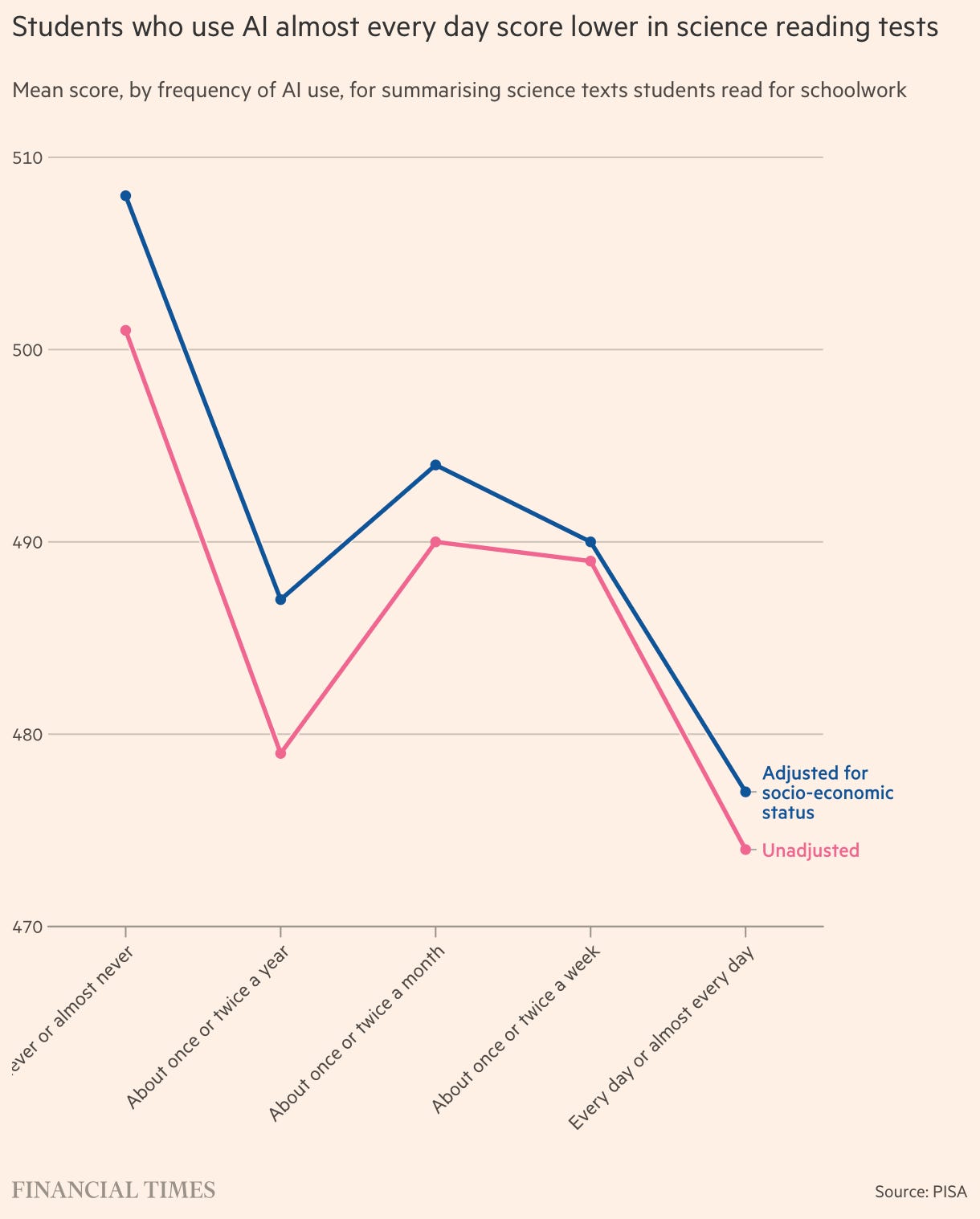
Conversely, students who used AI daily “to help me learn”, rather than replace thinking, do better than those who use it less frequently.
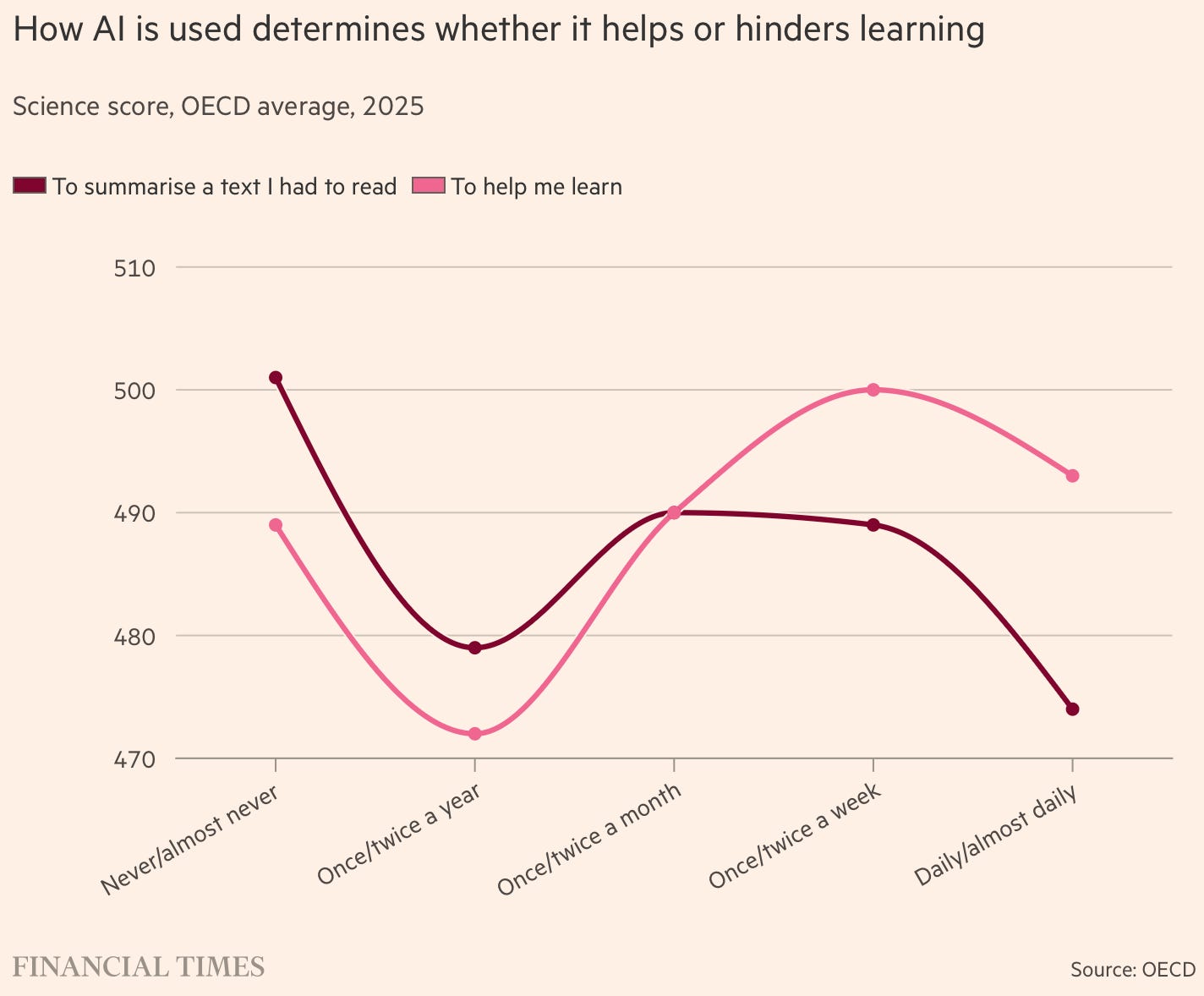
Schleicher makes important suggestions about better use of AI.
High-performing systems such as China, Estonia, South Korea and Singapore are leading that shift, deploying ai not to give students ready-made answers, but to help them think about the right questions, reason analytically and learn more effectively. Few countries would allow millions of children to receive a new vaccine without first demanding rigorous clinical trials. Yet in education we introduce new technologies into millions of classrooms with remarkably little evidence about their impact, turning students into unwitting crash dummies for tools we do not yet fully understand… Where smartphones and ai are part of the learning environment, their use must be intentional, not incidental. Schools need clear frameworks defining when, where and how ai should be used. For younger learners, it should not be treated like an oracle. That means strong filters. No emotional manipulation. No pretending to be a friend, a confidant or, worse, a replacement for social interaction.
However, there may be more factors at work in the declines than just AI or Covid 19 legacy. Given that the declines precede both, one argument blames the proliferation of smartphone use, with its endless content causing distraction and reducing mental bandwidth. There is a large body of well-established research on this. Jonathan Haidt has documented the problems of the anxious generation.
Another more structural explanation could be the changes in pedagogical aspects over the last couple of decades. In many countries, the disciplined processes of delivering content, rigorous assessments, standardised tests, and strict school governance have been relaxed in favour of less stressful and more joyful learning environments, lower-stakes testing, less insistence on attendance, and others like no-detention policies. Progressive ideologies have been a driving force behind many of these shifts.
Finland, once the top-performing poster child for school learning outcomes and a must-visit pilgrimage location for education policymakers, is an instructive example. Its top position in PISA for long was thought to be underpinned by its relaxed testing, limited testing, and play-based learning. But it has suffered among the steepest declines and has now fallen to the middle-rung.
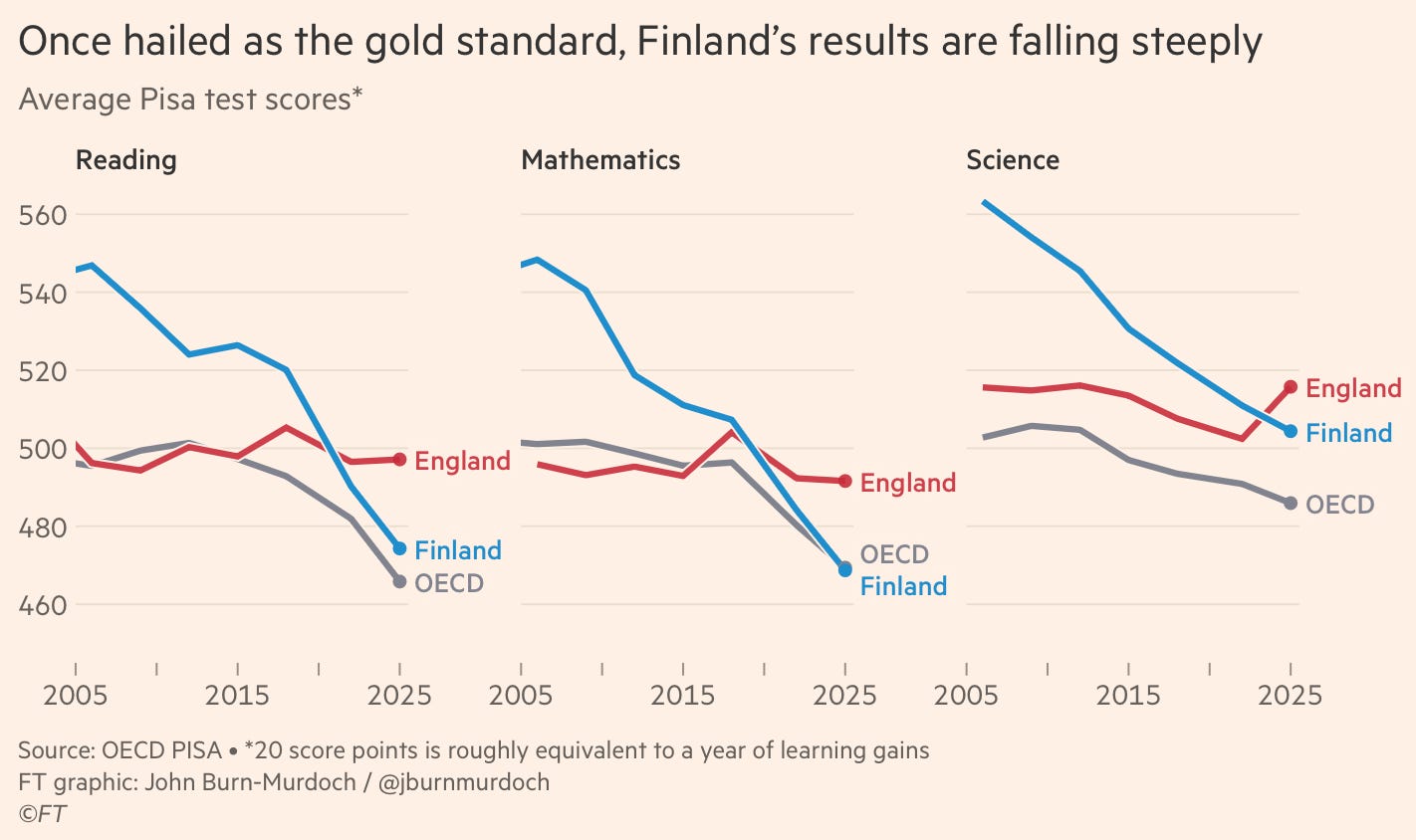
John Burn-Murdoch points to possible reasons.
During the 2000s education officials flocked to Finland — the top performer in Pisa scores of the day — to learn from what it was getting right. They saw a system that prized flexibility and autonomy for pupils and a curriculum prizing “transferable skills” like critical thinking while placing less emphasis on core subjects and standardised testing or performance rankings. Glowing reports were written, and the Finnish model spread. There was one problem: even as these visits were taking place, Finnish scores were in a sustained slide. Today, its results are little better than the average country, and many argue its exceptional performance — which peaked around 2000 — owed more to the conventional comprehensive approach it had used in previous decades.
Finland’s experience mirrors those in other countries with similar shifts to less rigorous teaching methods, like Sweden in the 1990s and Scotland’s Curriculum for Excellence of 2010.
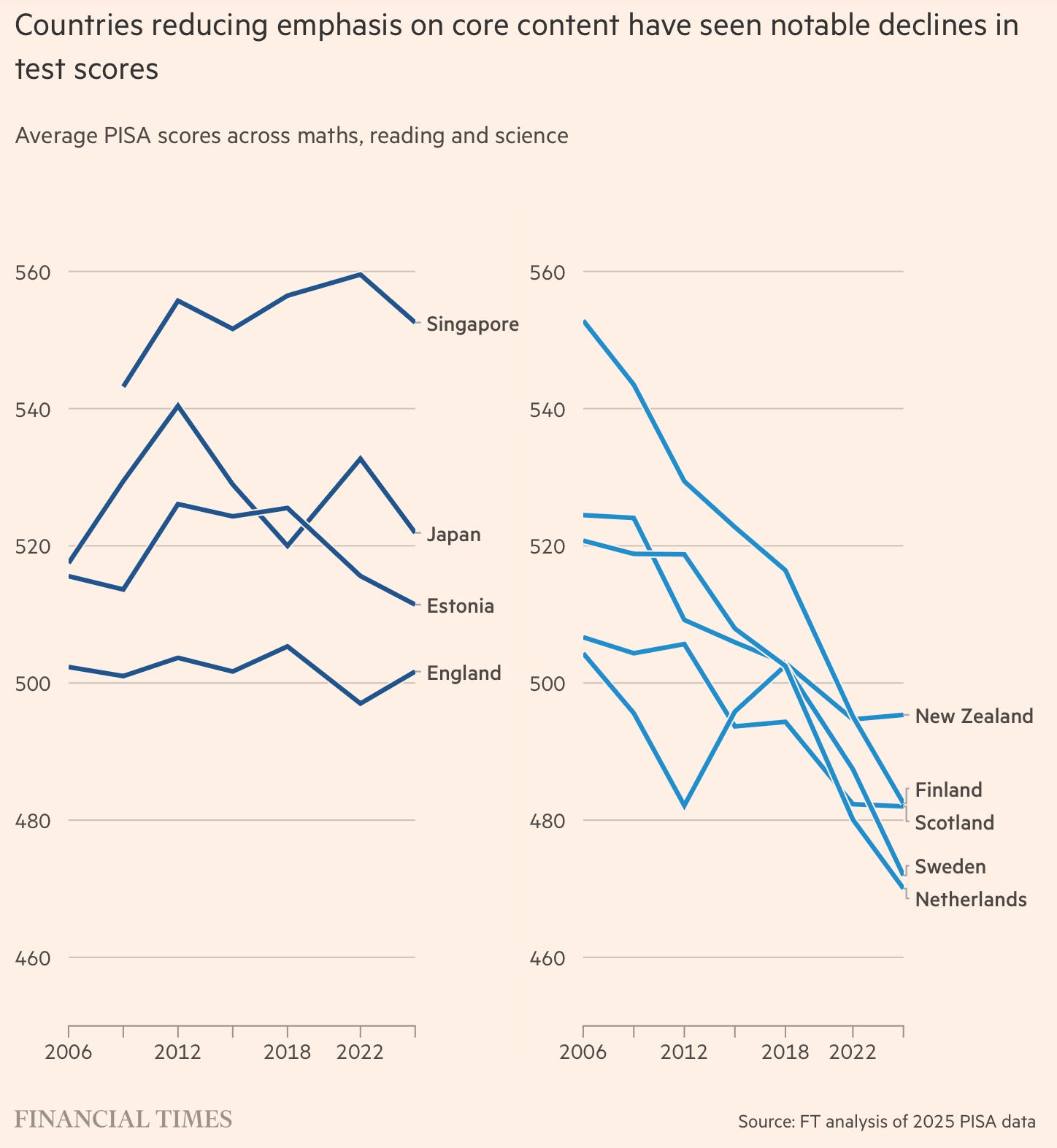
Progressives too easily dismiss the value of traditional teaching, but facts are the building blocks of critical thinking and tackling repeated algebraic problems, for instance, hones abstract reasoning.
These declines sit alongside the impressive performance of the UK, which held on to traditional methods and even improved on them.
Recent results in the UK support this theory. Scotland, Wales and Northern Ireland went down similar routes to Finland during the 2010s, shifting away from established curricula and towards more broadly defined learning outcomes, scrapping school league tables and some standardised tests. By contrast, England doubled down on the established curriculum with strict guidance on the content schools must cover in core subjects, alongside the use of league tables with performance measures that made the rankings harder to game. Fifteen years on, England’s results have held up, propelling it into the top ten internationally, while in Scotland, Wales and Northern Ireland they have plummeted… Schoolchildren in England report the same levels of happiness or pressure as those in Scotland and Wales, and no difference in mental health.
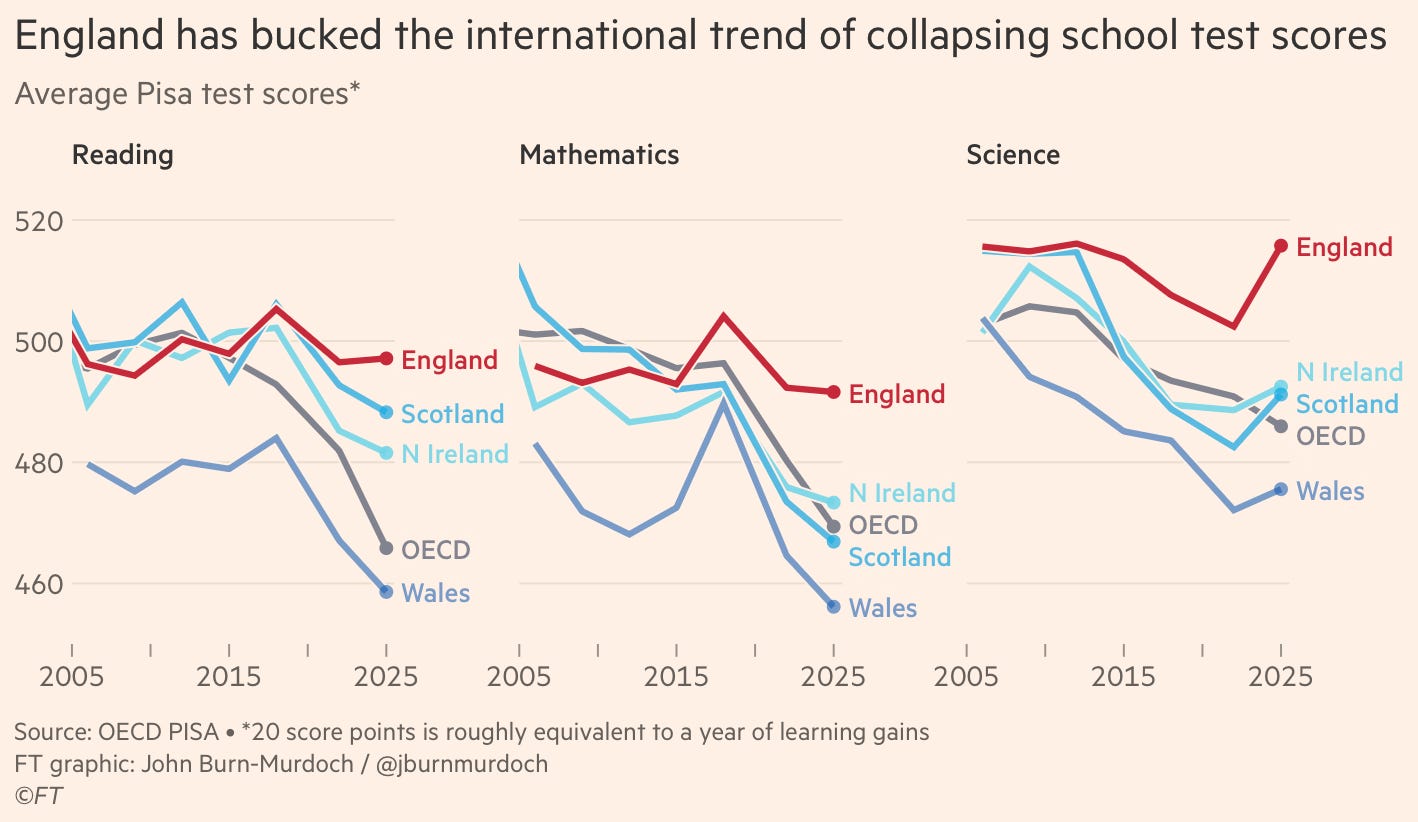
This is a good description of what the UK did right starting about 15 years back.
The nation made its curriculums more fact-filled (some prefer to say “knowledge-rich”) at a time when policymakers elsewhere had been waxing lyrical about instilling vague soft skills. It made exams more rigorous, deprioritised coursework (on which it is easy to cheat) and toughened inspections. Politicians also sought to steer schools away from newfangled styles of instruction that are fashionable but untested, and back towards methods that are more dyed-in-the-wool… Twenty years ago children in Scotland outperformed their peers south of the border. Now they tend to do worse—even though school spending per pupil is much higher. Scotland’s critics blame a modish curriculum, as well as a lax approach to discipline.
Echoing this, The Economist article calls for a return to the boring basics of schooling that were shed as abstract ideas of social justice and concerns about mental health took hold.
Places that have avoided declines deserve more attention. Britain is one. In 2009 its pupils scraped into the world’s top 30 in maths and reading. Now they sit in the top ten. Some of this stems from a return in England, under a previous Conservative government, to old-fashioned things such as rigorous exams, tough inspections and fact-filled curriculums.
Burn-Murdoch points to another example of a similar approach, from the poorer southern states like Mississippi in the US, which have overtaken their wealthy counterparts like California.
Improvements have been especially pronounced among the lowest-scoring children. There, as in the UK, the most common explanations are Mississippi’s adoption of evidence-based classroom methods including teaching phonics at an early age, and its emphasis on accountability, from school rankings to requiring that children be capable readers before they progress.
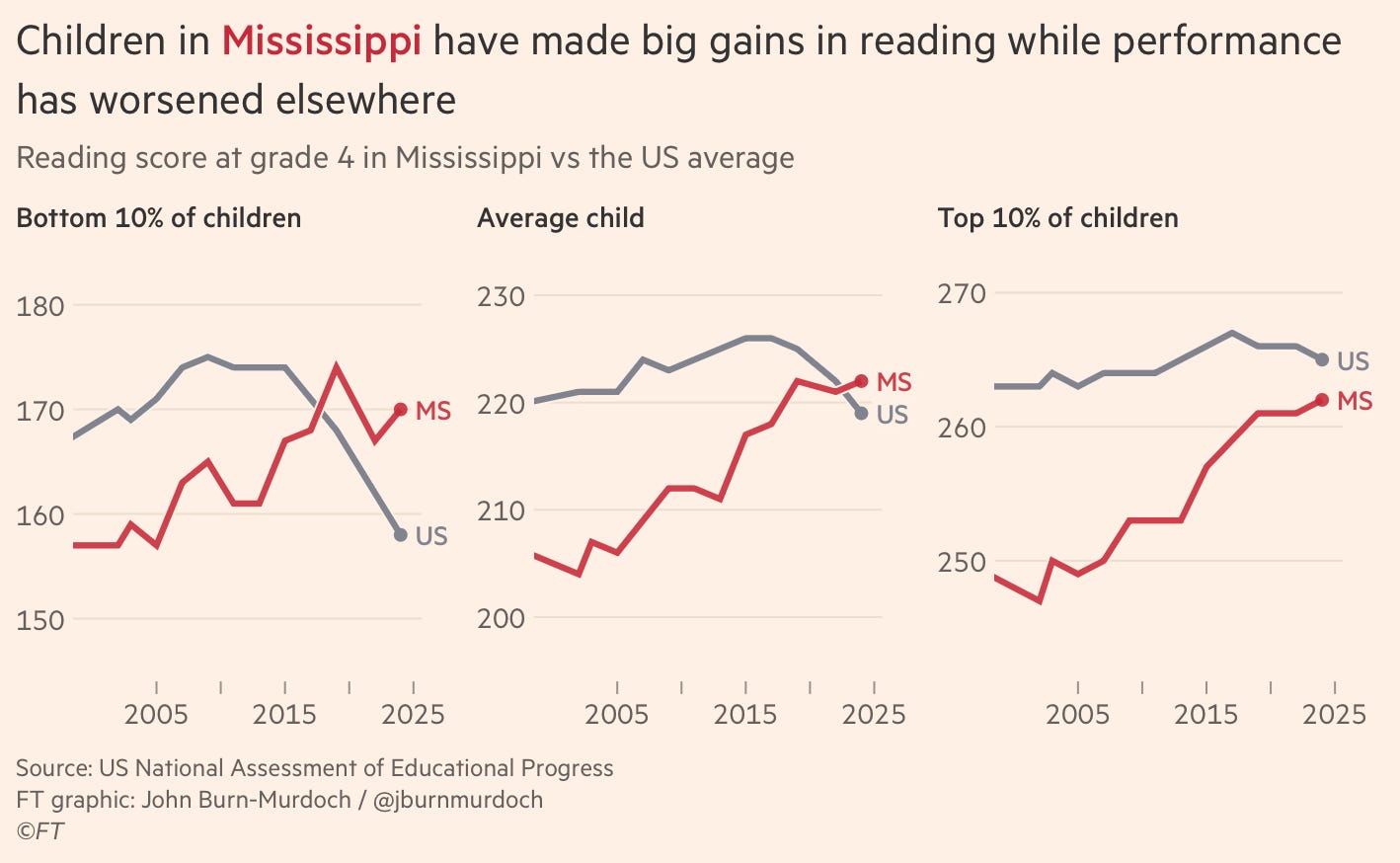
Burn-Murdoch’s summary of the confluence of factors is apt.
In many countries, the past decade has seen a dangerous combination of weakening standards and reduced rigour in education. This has happened just as the rise of digital distractions and shortcuts has made these skills especially important for young people to develop the knowledge and abilities they will need in an uncertain future.
All this is critically relevant for developing countries like India. There is a widely held perception that Edtech tools, now supercharged by AI, can be transformative in overcoming large antecedent foundational literacy and numeracy deficiencies. On one side, this is reflected in the proliferation of Edtech platforms that are sold commercially and their extensive use in coaching for competitive entrance examinations. On the other hand, there is the increased use of digital equipment and Edtech solutions in public schools, including in primary schools.
While there is at least some semblance of market testing (though its value may itself be questionable) in the case of the former, it is the latter that is vulnerable to the problems that the PISA scores highlight.
The New Education Policy (NEP) 2020's technology chapter advocates using technology to improve education quality, expand access, and offer personalised learning experiences, and introducing AI and coding from Class 6 onwards. However, it does not say anything about AI-governance frameworks — clear rules on when/how AI is used, the role of teachers in mediating the use of Edtech, no emotional-companion framing for children, and no evidence generation beforewide deployment. They say nothing about generative-AI use inside classrooms, screen-time limits, or the phone-ban-style rules that are now becoming the norm across the West. This is a big gap that must be filled at the soonest.
On the pedagogy, India dallied with the failing model before reverting to the boring conventional approach. First, the Right to Education Act had the controversial no-detention policy, which soon became politically appealing. Then the New Education Policy advocated several features of the progressive approach - competency-based assessment, reduced rote learning, “joyful” and flexible learning, holistic progress cards.
Fortunately, the operationalisation of the Foundational Literacy and Numeracy (FLN) program, NIPUN Bharat, has been more conventional in hard, timeline-based targeting of every child attaining foundational literacy and numeracy by the end of Grade 3. The decision in December 2024 to roll back the no-detention policy for Classes 5 and 8 is another step in the right direction. Interestingly, the ASER 2024 recorded the first broad-based improvement in rural reading and math in two decades, most likely an outcome of the FLN focus rather than any technology push.
Finally, the success of countries like the UK and the US states like Mississipi highlight the importance of doing the basics right. Mississippi and other southern states focused on reading, curriculum coverage, standardised tests, holding back children scoring in the lowest level at the end of third grade, remedial instruction, teacher and administrator trainings, and parental engagement. The UK did “rigorous exams, tough inspections and fact-filled curriculums”.
Interestingly, in all the several articles I have come across about these successes, I have struggled to find any mention of Edtech as a contributor. This tallies with Lant Pritchett’s four part smell test on the relevance of development interventions, and his argument that “none of the high performing educational systems in the world achieved their baseline greatness or resolved their learning crises through Edtech”. Instead, they focused exceptionally well on ensuring every child learns to read and do basic math early, aligning curriculum with actual student learning levels rather than overambitious and elitist standards, and supporting teacher capability, motivation, and practical accountability.
India’s focus on FLN is an important first step. But it must be implemented with rigour and quality, and sustained. This must be complemented with teacher capability development, building school management and leadership capabilities, and parental and school accountability. These are boring and hard stuff, where quality is of essence, and also demands long-drawn and persistent struggle.
As I have blogged here and here, Edtech, while useful to some limited extent, may actually be becoming a big distraction. It may be distracting both the policymakers from making the correct choices and implementers from putting in the hard yards on persistent engagement on the basics. It may also be distracting teachers from focusing on their core work.
I will argue that if school systems in India put in even a fraction of the efforts and resources it is putting into Edtech on improving teacher capabilities and school leadership through training and coaching, the results could have been transformational. We need a single-minded focus on these, including the adoption of innovative approaches, if we are to achieve significant improvements in learning outcomes.
A detailed and practical agenda for school education reform is laid out here.


No comments:
Post a Comment