Shashi Tharoor has a review of a new book, Decision Velocity: Rational Abdication, the Fear Tax, and the Road to Viksit Bharat, by retired IPS officer OP Singh. Singh describes a phenomenon of not taking decisions, or ‘rational abdication’, which imposes a “fear tax” that is extracted in the form of unconscionable delay. Tharoor writes
Singh’s “Fear Tax” is the price society pays when decision-makers conclude that the safest course is not to decide at all. It is the outcome of a sclerotic system where, for the desk-bound officer, the risk of a decisive signature far outweighs the perceived safety of a prolonged silence. As Singh so eloquently demonstrates, our current accountability frameworks audit the traceable action with inquisitorial rigour, yet remain blissfully indifferent to the absent decision. Hence, it’s safer not to act at all…
We have inherited, and subsequently ossified, a colonial-era machinery designed for control, not for velocity. In such a framework, a file that moves is a file that invites scrutiny; a file that rests in a dark corner of a cabinet is a file that poses no threat to its custodian. The result is a Kafkaesque reality where the paralysis of the pen is too often mistaken for the prudence of the professional. This is not merely an inconvenience; it is a profound failure of the social contract. When the state abdicates its responsibility to act, it does not merely delay a project or a permit; it stifles the latent potential of a citizenry waiting for the basic friction of governance to be removed.
Tharoor offers some suggestions.
We must move from an obsession with compliance to an obsession with outcomes… We must evolve our oversight mechanisms to distinguish between honest mistakes (the byproduct of necessary risk-taking in a complex environment) and true negligence. A system that does not tolerate the possibility of a wrong decision will rarely produce a right one.
Furthermore, we must incentivise administrative courage. This involves creating "safe spaces" for decision-making, where the rationale for action is documented and respected, and where the institutional culture shifts from "How can I avoid this?" to "How can this be made to happen?"
There cannot be any argument about these. The challenge is to operationalise tolerance of honest mistakes and creation of “safe spaces”.
The operationalisation of these cannot happen by diktat or homilies. Instead, it requires building them into bureaucratic routines and institutional processes. The former involves changing norms within the government on taking risks, accepting failures, and even celebrating risk-takers. The latter involves wiring the institutional processes to accommodate these.
I can think of three process safeguard reforms.
An important nudge in this direction would be to amend the Prevention of Corruption (PC) Act to clarify that no public servant shall be subjected to any enquiry, inquiry or investigation under this Act, nor prosecuted, solely based on an opinion, advice, recommendation or decision recorded or taken by him in the discharge of his official functions, unless there is independent material to show that the act was actuated by a corrupt motive or by the expectation or acceptance of an undue advantage. It should also be clarified that an error of judgment, or an unintended, unsuccessful, or sub-optimal outcome of such a decision, shall not constitute such material. This would go beyond the procedural safeguard provided by Section 17A of the PC Act (whose scope is currently not yet settled and awaiting a Supreme Court bench verdict) and provide a substantive threshold.
Another would be to amend the Right to Information Act and insulate the contents of deliberative processes (opinions, advice, recommendations, notings, drafts or inter se deliberations recorded by the public servant) from any investigation or be made inadmissible in prosecution proceedings, unless there is evidence that the act itself was done with a malafide or corrupt motive. The US Freedom of Information Act insulates the deliberative process as a safe space from any scrutiny. This would allow people to express opinions freely without hedging for future recriminations.
A third would be to amend the guidelines on performance audit by the Comptroller and Auditor General (CAG) of India to explicitly make the auditors accountable for examination of honest mistakes and unintended failures before making their performance audit comments. It should be clarified that audit shall assess a decision based on the information, circumstances and options reasonably available to the decision-maker at the time the decision was taken, and not with the benefit of hindsight or of facts that emerged subsequently. Where the decision was within the competence of the decision-maker, followed the prescribed process and consultations, was supported by reasons recorded at the time, and was one that a reasonable and prudent official could have taken on the information then available, the auditor should treat it as an honest exercise of judgment and let it rest.
These enactments must be complemented with efforts to change the norms on such decisions.
In this context, an important perspective is to view decision-making through the lens of public and private benefit. Many of the delayed decisions or undecided issues involve the likelihood of private benefit. Consider the following three norms and their implications:
1. There is a tendency to view public interest and private benefit as mutually exclusive and conflicting. Further, since the ethos of bureaucracy is the protection of public interest, any resultant private benefit is considered a matter of concern.
2. There is a belief that denial of private benefit equates to protection of public interest. However, in many cases, this is not true. On the contrary, it is the opposite - it ends up with a back-ended public loss.
3. There is also the instinctive association of private benefit with corruption. This naturally stigmatises any act that results in private benefit.
These norms overlook the reality that private benefit can co-exist with public benefit.
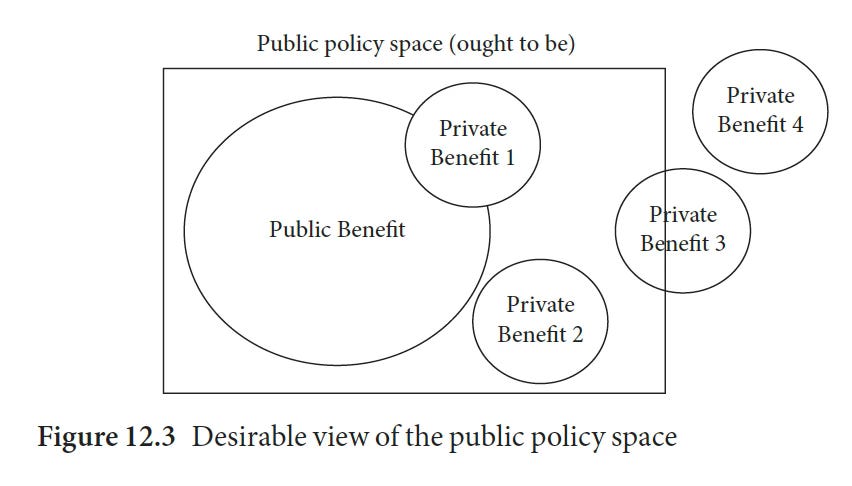
The aforesaid norms are most deeply entrenched among auditors and investigative agencies. They tend to view public actions resulting in private benefit with extreme suspicion.
For example, it is common to see decisions on procurements and contract management delayed due to these hesitations. Officers are regularly called upon to propose decisions on changes in technical specifications, qualification norms, condonation of delays and time extensions, waiver of liquidated damages, contract terms during renegotiations, and so on. All of them, even when justified, end up invariably benefiting some or other contractors, often also causing an increase in expenditure. This opens the decision to be scrutinised as having caused both private benefit and public loss.
These entrenched cultural norms are reinforced by the circumstances. Compromises on public interest and promotion of private benefit through corruption have become pervasive. This complicates matters and allows righteousness, biases, and prejudices to enter the audit, investigative, and prosecutorial processes.
In the circumstances, the challenge is to create a culture that destigmatises actions that confer private benefit, without letting it become permissive enough to encourage corrupt practices. This is hard! Most often, there are no shortcuts to doing the hard work of creating the conditions.


No comments:
Post a Comment