Are we entering an era where the competition for cross-border capital flows is no longer determined by market dynamics, but by the imperatives and whims of governments? More specifically, are we looking at capital wars? What does this mean for countries like India?
I blogged here last week arguing that financial repression and inflation will be a feature of advanced economies, especially the US, in the years ahead as they grapple with the massive stock of public debt. I also blogged here arguing that capital flows could be the next target for economic nationalism as countries compete to boost domestic investment and also keep rates low. Finally, I had written about the possibility of such a capital-flows squeeze while evaluating the early months of the Trump Presidency.
Consider the situation. On the one hand, countries are competing with each other to attract investments (domestic and foreign) in industry and services and mobilise capital for investing in infrastructure. This becomes even more important when faced with weakening economic growth. On the other hand, they must expand the pool of capital available to keep a lid on interest rates. The massive debt pile and the pressure on bond yields make this exigent.
This can have only one outcome — a tussle to retain capital at home and also compete aggressively for foreign capital. Monetary policy must invariably become subordinated to this objective. Capital wars are only a step away.
In fact, it may already have been triggered. Donald Trump has announced his intent to wage war against the bond markets, and his Treasury Secretary, Scott Bessent, has threatened traders betting against the yen, saying memorably, “I’m the house now”! These are clear clarion calls, and the pressure on the dollar and the US Treasury bonds can only rise in the years ahead.
While Trump 2.0 may have expedited these measures, there cannot be any doubt that these pressures were building up for a long time and have now come to a head. To this extent, the policy choices on financial repression are inevitable and will continue with any administration in Washington, albeit in subtler ways.
And this capital-focused nationalism is not unique to the US. Even sober countries like Japan, Canada, and the UK have called on domestic investors to keep capital at home.
Further, as Benn Steil has pointed out, another reason for the rising pressure on US bond yields is the changes in the profile of its holders. Whereas in 2007, 76% of the US Treasury Bonds were held by price-insensitive investors like central banks, today they hold just 43%, with the remaining being held by price-sensitive private investors like households and investment funds who demand greater returns as debt grows and inflation erodes purchasing power. The share of the latter will only grow over time, and the pressure will increase if Kevin Warsh goes ahead with his intention to further pare down the Fed’s securities holdings.
Martin Sandbu points to a very good analyst note by David Skilling of the Landfall Strategy Group on how the capital wars are likely to play out. He says that US fiscal challenges make financial repression and fiscal dominance increasingly likely, and the situation is complicated by the softening foreign purchases of US Treasuries and rise of US bond yields. He describes this as a regime shift in the international financial system.
There will be a US preference for imposing financing costs on foreign investors…Aggressive, transactional ‘America First’ measures to coerce foreign capital to finance US government borrowing are increasingly likely, an international form of financial repression… The US has required investment commitments as part of tariff negotiations with several countries. As US financing pressures grow, expect more coercive, scaled-up measures to be deployed, explicitly linking purchases of long-dated US Treasuries to US security guarantees, access to US tech, swap lines, and so on.
These US measures will cause tension with countries in Asia, Europe, and the Gulf that are implementing policy measures to deploy more domestic capital at home. Capital wars are the consequence, as increased US demand for capital intersects with a constrained supply. Coerced foreign investment is the likely near-term direction of US policy travel.
He points to three illustrative scenarios that highlight the uncertainty on the effectiveness of these measures.
Consider three illustrative scenarios: A ‘US-led tribute system’ scenario in which the US creates a financial/security/technology bloc, securing significant inflows into long-dated Treasuries that reduce yields materially. A ‘ruptured alliances’ scenario in which US partners resist US coercion and actively diversify, including reduced purchases of Treasuries. In ‘global fragmentation’, other countries (e.g. BRICS+) also reduce US exposure, causing higher yields and a weaker USD.
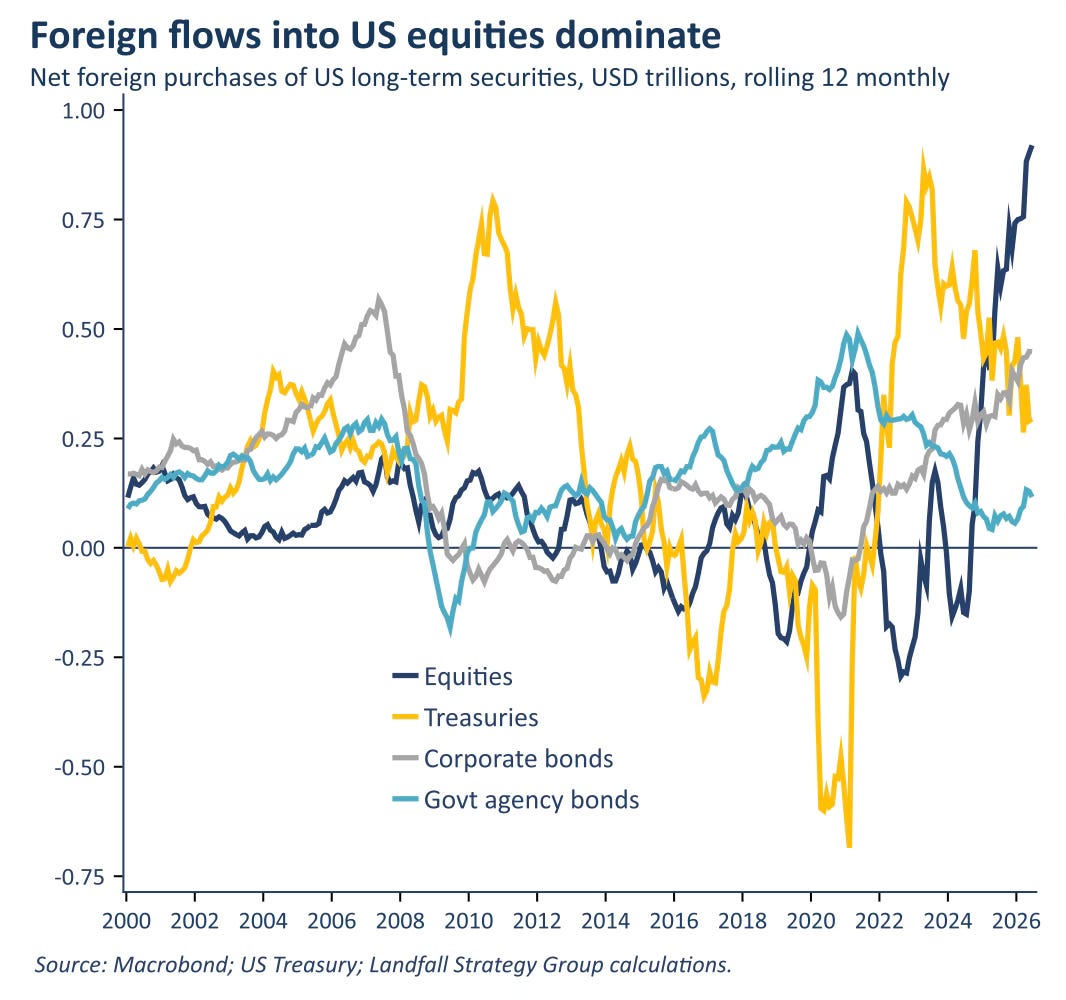
The graphic below is instructive insofar as, even as foreign Treasury purchases have declined sharply, US equities and corporate bonds have remained very attractive and have been sucking in foreign capital.
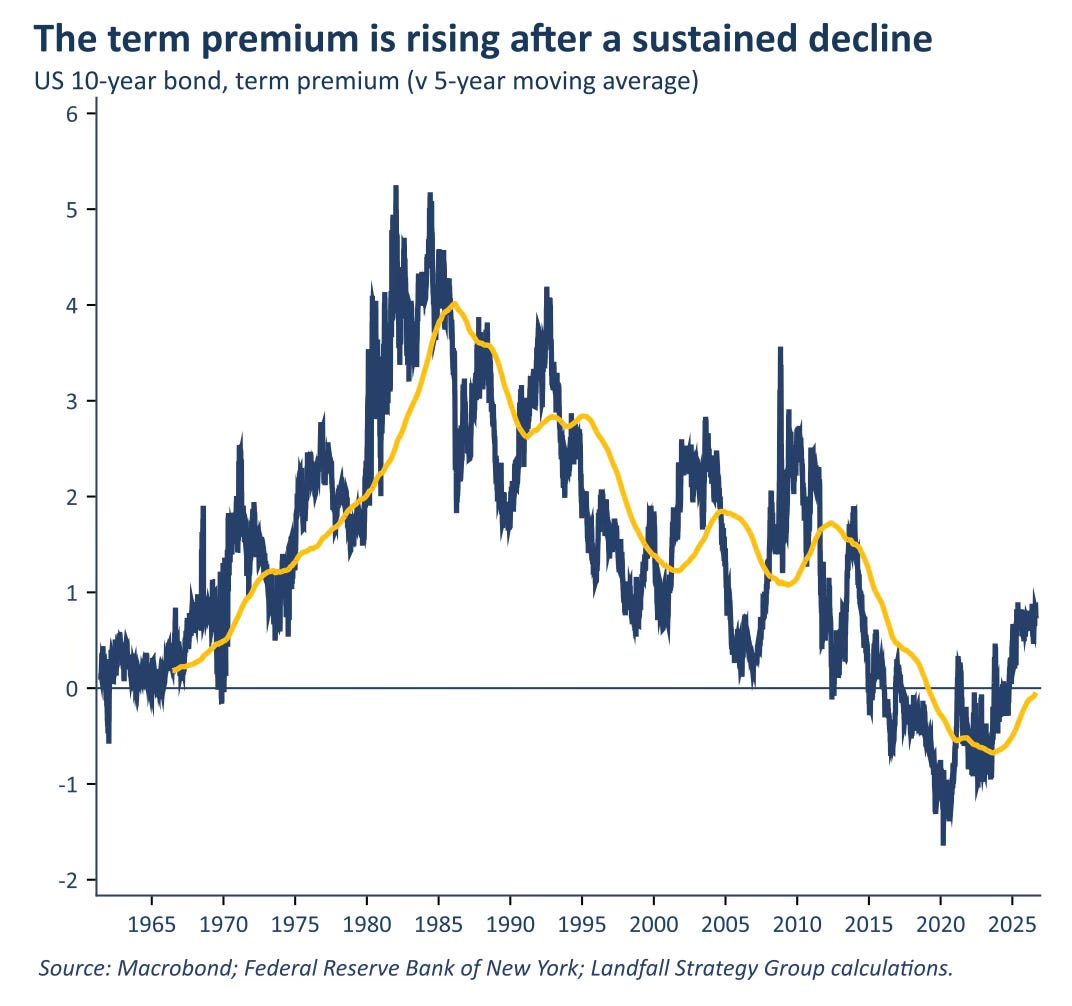
Further, as the US debt surges, investors are revising the unambiguous safe haven status of US Treasuries. This is reflected in the rising term premiums, the extra return demanded to hold long-term bonds instead of rolling over short-term bills.
So what does all this mean for India?
It goes without saying that all this poses formidable challenges to the Reserve Bank of India (RBI) and policymakers in India. India, being a capital-deficit country reliant on foreign capital to meet its capital needs for both investment and to achieve balance of payments, is especially vulnerable.
For one, the competition for capital means that there is likely to be a smaller pool of FDI available. This would be as much true of mature direct investments as of venture capital flows. In the case of the former, the wave of reindustrialisation and reshoring will be the imperative, and in the case of the latter, strategic considerations in a geopolitically hostile world will assume significance.
Second, foreign portfolio investments (FPI) are likely to become more fickle than earlier, with the added threats of recurrent ad hoc measures to restrain capital at home. The ambush sales of European bonds engineered by the US Treasury to mobilise resources (without selling US Treasuries) to prop up the yen are only a teaser. While Indian markets are already gradually integrating with the global financial markets and are vulnerable to sudden stops and capital flights, what makes the future different and more challenging is that now these episodes can be triggered by conscious policy choices of decision-makers in places like Washington.
Third, the result of any reductions in FDI and FPI will invariably be felt in the domestic bond markets in terms of rising cost of capital. As Skilling writes and the graphic on the rising term premium above shows, the reduced foreign demand for US Treasuries will put upward pressure on US yields and increase the global risk premium. The higher risk-adjusted returns on long-term US debt mean that investors will demand a higher return for investing in India and elsewhere. This will have a cascading spillover pressure on India’s domestic cost of capital and interest rates.
Fourth, all this will not make RBI’s monetary policy any easier. It will now have one more constraint to deal with, thereby eroding its policy autonomy. The US domestic policy actions, which are already having significant spillovers globally, will now have an even greater impact. Even strong domestic economic fundamentals cannot insulate India from the contagion of sudden stops and capital flight in response to US actions. RBI may have to keep defensive measures during these episodes.
Fifth, capital flows are certain to become another instrument of economic diplomacy, one where India has fewer levers. The US is likely to use this extensively, even weaponise it. At the least, there will be episodes of high activity, to the detriment of capital-deficit countries like India. Imagine a trade negotiation or a bilateral geopolitical support that is tied to India buying and holding a defined amount of US Treasuries. Holding US Treasury Bonds will now compete with purchases of Boeing aeroplanes and defence equipment as forms of diplomatic coercion, direct or subtle. The Mar-a-Lago Accord proposal, mooted by Stephen Miran and Robert Lighthizer to swap foreign holdings of US Treasuries for some form of perpetual bonds, must be seen as a precursor.
In a world where foreign capital becomes constrained, boosting domestic savings will become a matter of highest priority. This must be tied to the deepening and broadening of India’s financial markets. In this context, the resilience of the Indian stock markets in the face of a massive exodus of FPIs in the last three years, due to the robust inflows from the sharply increased pool of domestic investors, is a case in point. This will raise the bargaining power of domestic capital. Policy actions on both areas will be important.
On a positive note, the capital wars also provide India an opportunity to become an attractive alternative investment destination for the foreign capital that seeks to avoid the US for strategic reasons. This attractiveness will rise and make India stand out provided it gets its act in order and is able to sustain high growth rates. India could emerge among the few large, relatively fast-growing economies with deepening domestic capital markets.
India must also strive to move gradually from being a country that needs foreign savings to one that generates enough productivity and external earnings to finance an increasing share of its own investment. This means shifting from the cheap labour focus to one which aims at boosting capital productivity by delivering more of the same with less capital. This must be supplemented with significant expansion of exports.
In other words, capital wars increase the premium on countries that can mobilise domestic savings, attract the right foreign capital, and deploy both at high productivity. India’s focus should be to convert its enormous household savings pool into productive domestic capital formation while simultaneously building an economy capable of generating more external savings through exports.


No comments:
Post a Comment