The return of industrial policy to the top of the global development agenda has been formalised with a new World Bank report on the topic. The summary is here. I blogged earlier on this here.
Notwithstanding the standout success of the East Asian economies in using industrial policy to drive economic growth, for long the WB and others had sought to minimise its role and explain it away by pointing to their unique circumstances. Specifically, their high educational attainment, high savings rate, low inequality, and the capability of the governments to implement such policies. At best, they were targeted to address specific problems in the functioning of markets. These conditions, it was said, did not exist in other countries.
The report admits that industrial policy is now more replicable. It points to increased capabilities due to higher education levels, political support for delivering development objectives, and greater global trade integration. On their own, none of these is compelling enough for a re-examination. It is most likely that the widespread adoption of industrial policy by developed countries in response to Chinese competition is behind this change of mind within the Bank.
Two comments in this context. It would have been more appropriate for the WB to acknowledge that its assessment was incorrect and to revise its views. Two, given their own market dominance in manufacturing, it was in the interests of developed countries to then oppose industrial policy in developing countries. Now that China has assumed dominance, it has reverted to the same set of policies that allowed it to become dominant in the first place.
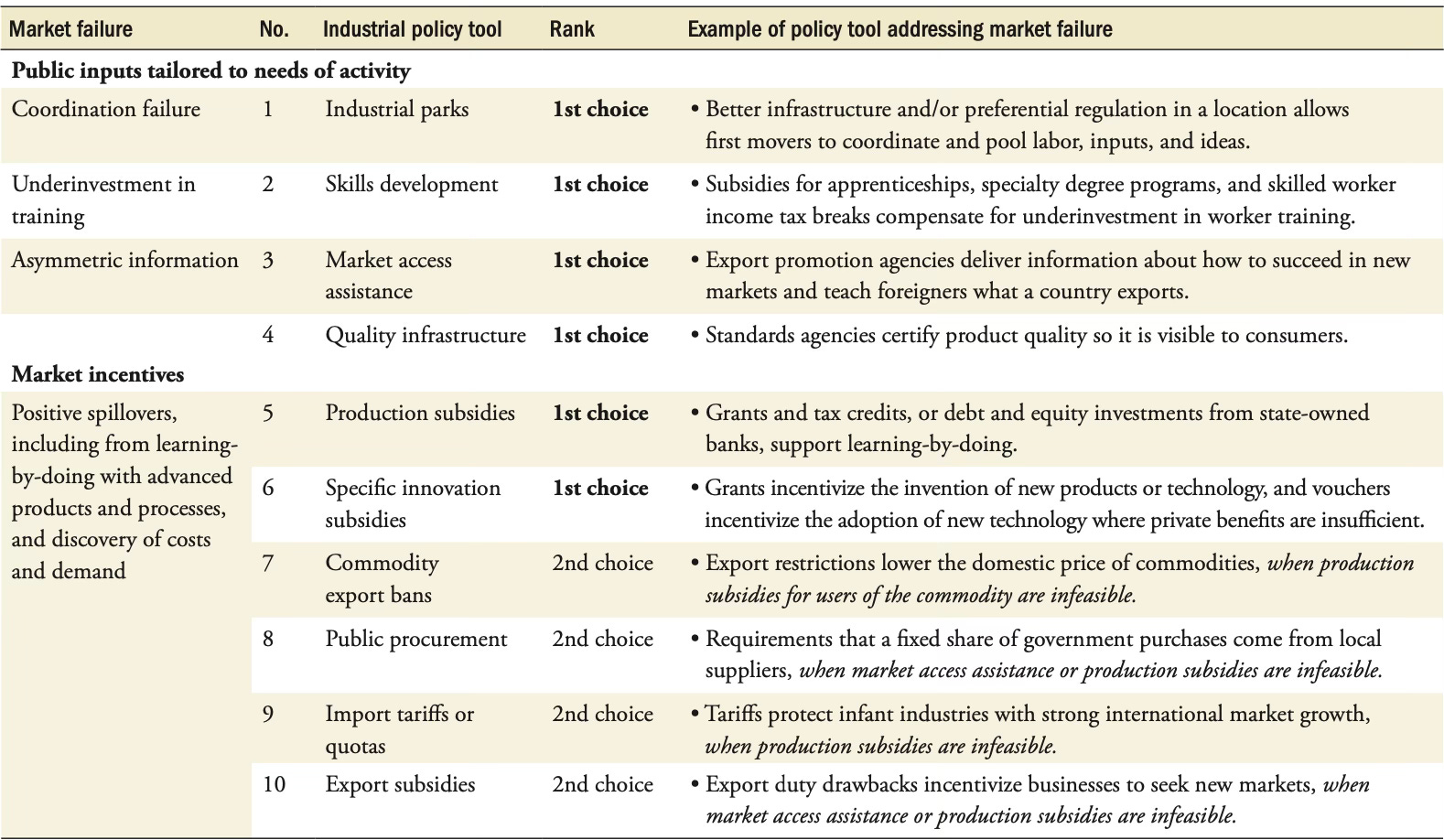
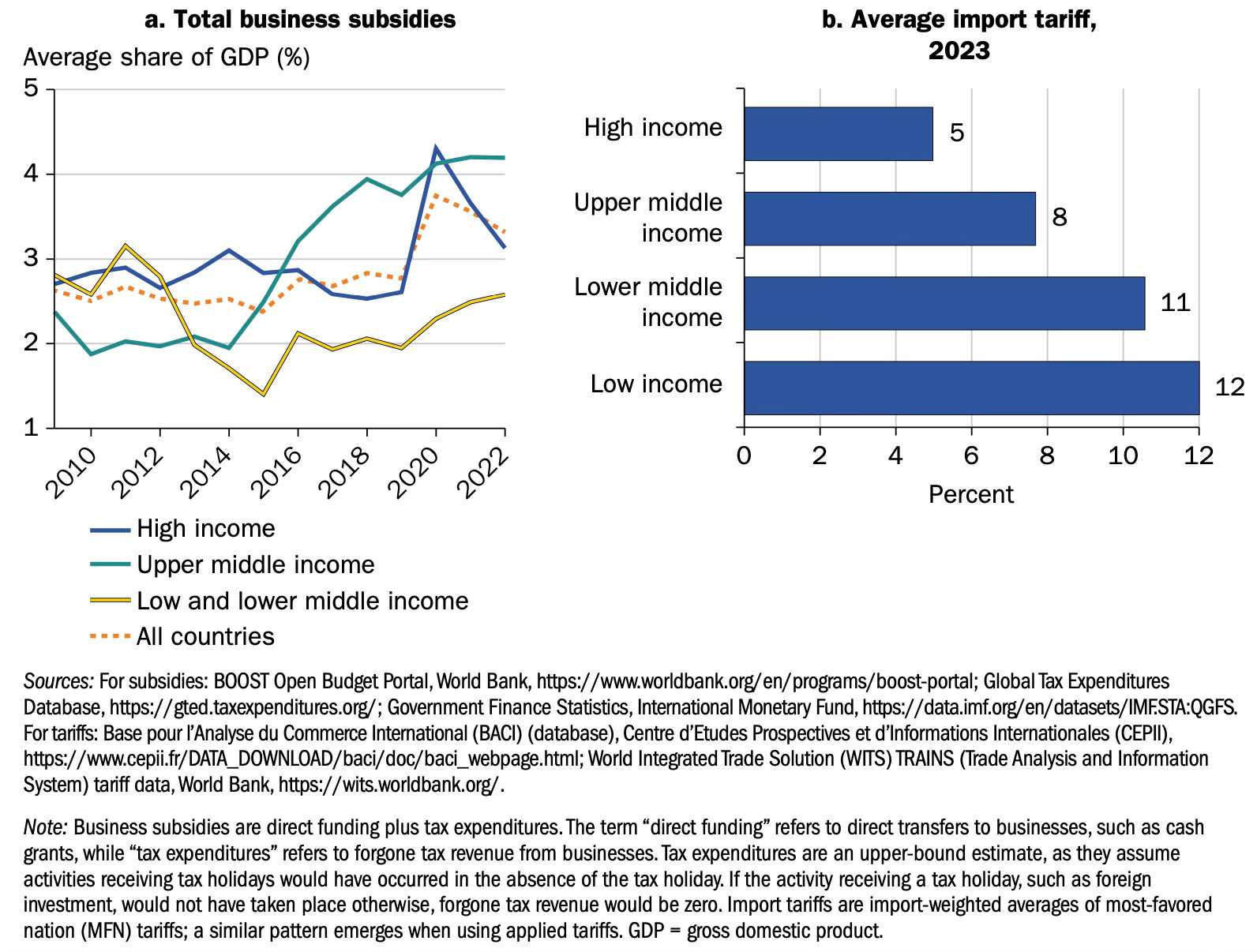
The WB report defines industrial policy as “the range of policy tools that governments use to shape what an economy produces rather than leave it to the discretion of markets alone”. It says that upper-middle-income countries now spend a record 4.2% of GDP on business subsidies. Low-income countries target growth of 13 industries on average, more than twice that in high-income countries.
It identifies 15 industrial policy tools and categorises them, as in the table below.
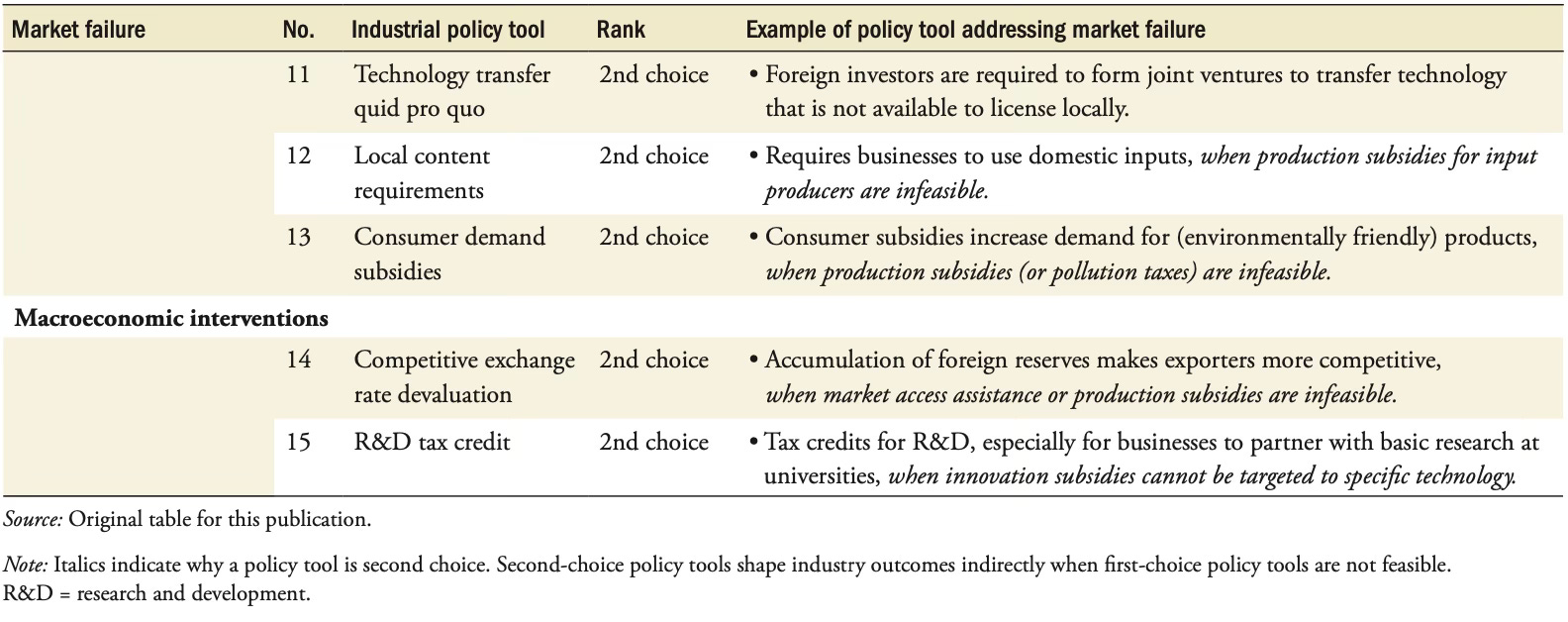
It analyses the minimum requirements for their adoption. The cells marked large indicate the tool needs a large fiscal space, market size, or government bandwidth, and vice versa for those marked small.
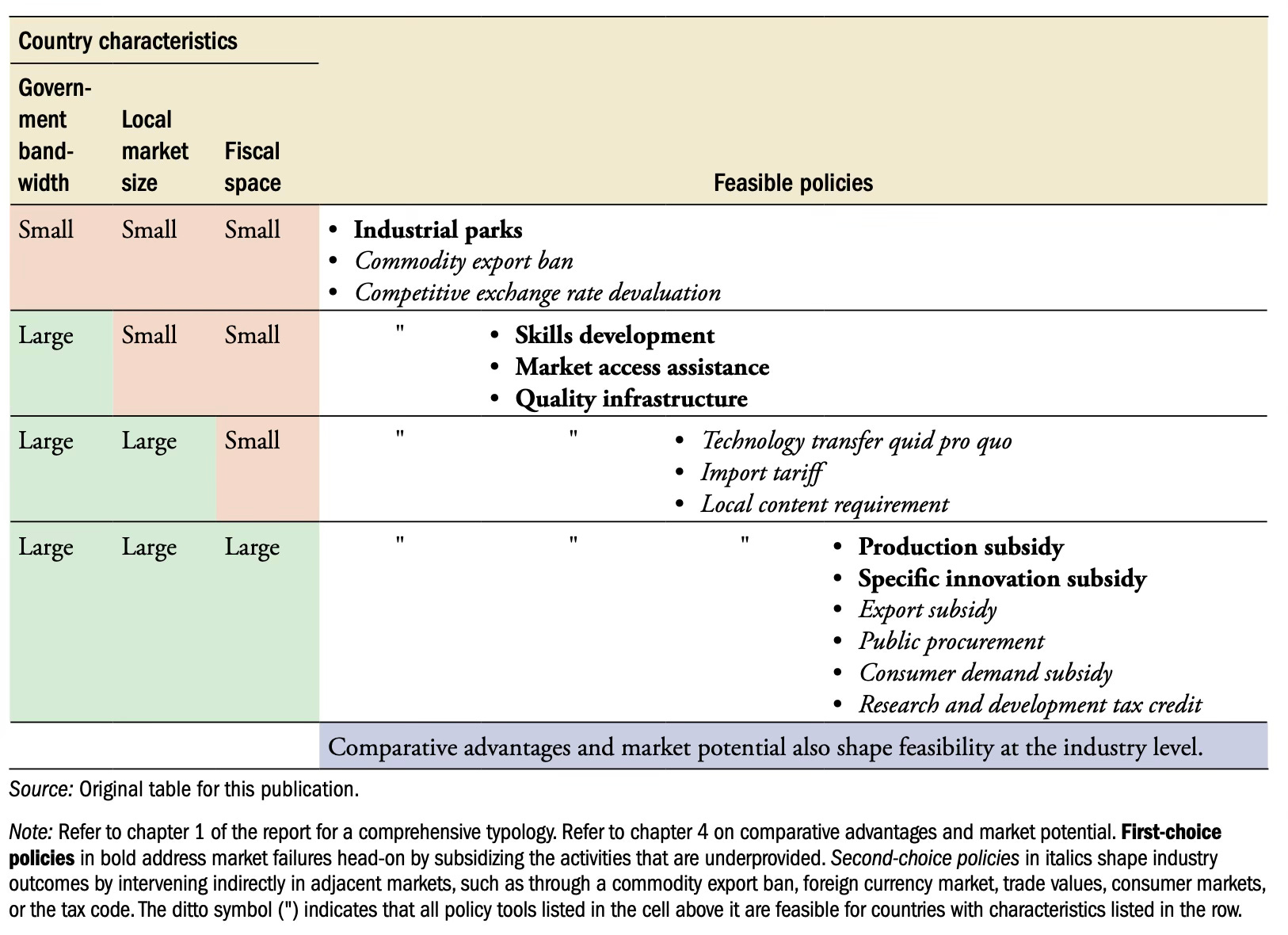
In general, when government capacity is small, local market size is small, and fiscal space is also small (as in the case of most low-income economies still), industrial parks constitute the best industrial policy tool. When all three of those advantages are large (as in the case of the world’s biggest economies), then import tariffs, innovation subsidies, local content requirements, and many other policy tools can be effective... These countries enjoy the widest range of opportunities to experiment with industrial policy for development… this report finds that low-income economies—usually characterized by small market size—tend to be the heaviest users of import tariffs, which require a large market size to be effective. Upper-middle-income countries, for their part, go big on business subsidies.
The report has the latest glowing impact assessment on one of South Korea’s industrial policy decisions, 33 years later.
They found that the impact of the government’s big push for heavy and chemical industry (in the 1970s) caused the economy’s GDP to be 3 percent larger each year in the long run. This benefit far exceeds the economic cost of the government’s “large subsidies,” estimated by the World Bank’s 1993 report at 2.4 percent of GDP in only one year.
While all 15 policy tools are well known, the report provides a very broad but widely-known framework for understanding and applying industrial policy, and has a good compilation of case studies. Beyond this, I’m not sure how relevant or useful the report is for policymakers and implementers struggling to make decisions on their industrial policy.
The framework presented in the report can perhaps be reduced to three different instruments of industrial policy - regulatory restrictions (restrict access to foreign firms/investors/imports), regulatory enablers (preferential treatment to domestic firms/investors), and fiscal support (tax concessions, input subsidies, capex incentives).
In theory, mandates (regulatory tools) appear simpler than subsidies since they seek to directly target the required change. For example, domestic content or technology transfer mandates or commodity export bans (Indonesia’s ban on nickel and now bauxite exports) are easier to adopt compared to subsidies for production, innovation, consumption, or exports. But mandates create the risk of suboptimal outcomes - poor quality, capture by vested interests, constraints on production (e.g., due to limited supply), poor uptake, etc. Compliance with the mandates becomes even more of a challenge when the manufacturing supply chain is so utterly dominated by China.
An underlying assumption behind advisorial policy prescriptions by entities like the World Bank, consulting firms, or research experts is that they are actionable and can be readily applied by practitioners without much effort and existing capabilities. This assumption is most often incorrect.
Assuming the objective (say, building local manufacturing capabilities) and the target industry (say, electronics devices), a practitioner who is preparing a proposal for financial appraisal and subsequent approval by the competent authority generally struggles with the following five questions.
1. What combination of instruments is adequate to achieve the objective?
2. What should be the degree or extent of incentivisation or regulation? Specifically, how much is just about enough to trigger the market response? More likely, is the proposed measure sufficient to trigger the supply response?
3. What should be the implementation design of the chosen policy tool (especially relevant for tools like skill development, market access assistance, innovation subsidies, R&D tax credits, etc.)?
4. How to know that the industrial policy is having its expected impact, and what revisions and course corrections are required?
5. What are the likely distortions from these interventions, including abuses during implementation, and how can they be mitigated?
The policymaker or implementer must make choices in constrained conditions - information, time, resources (financial and physical), acceptance, and capabilities.
For one, there is the absence of good data to assess, prioritise, and make choices. Second, the theories of change are complicated, especially given the multiple confounding factors. Third, the problem-solving required to figure out the combination of choices is often a challenging exercise that does not get done well. Fourth, given fiscal constraints, the sponsoring departments often end up being forced to compromise substantively on the unit rates for any fiscal support (like the percentage of concession or extent of subsidy). The fiscal support ends up being below the threshold and fails to generate the market response. Fifth, there are the deficient state capabilities that weaken effective implementation. Sixth, there’s no way to know whether the policy combination is meeting the intended objectives, beyond some headline numbers which are often deceptive and misleading. And so on.
To illustrate the points made above, the table below captures the uncertain elements. The tools and frameworks outlined in the WB report cannot be of much help in resolving the uncertainties and making decisions. The details of these elements matter, and are generally the difference between success and failure. Getting these details right is hard.
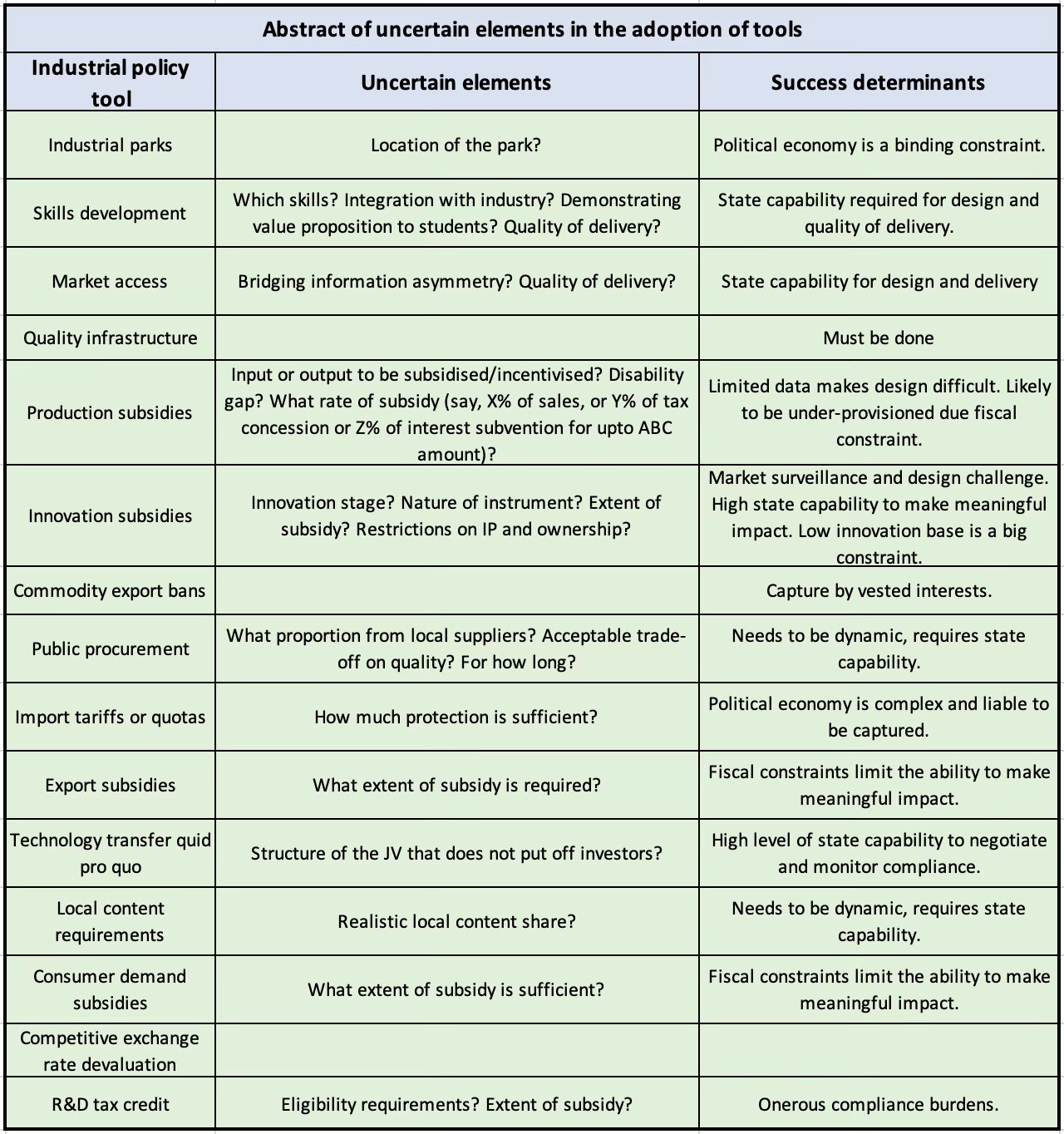
In this context, there may be some useful principles for resolving the aforementioned uncertainties and formulating an industrial policy that is likely to succeed.
In responding to a policy problem, it is advisable to start with a combination of instruments that are identified and prioritised using internal institutional judgment (and this is the way it happens in practice). But there should be rigorous monitoring systems that use administrative data (and targeted rigorous surveys, as required) to generate feedback on performance and impact, mainly to assess the directionality and order of magnitude of impact. Almost always, it is the absence or inadequacy of the latter that is a far bigger problem than the rigour of the choice and design of the former (combination of instruments). Surprisingly, the report overlooks this aspect completely.
It is typically the case that the extent of subsidy depends on the fiscal envelope available and/or the priority accorded to the objective or target industry by the government. If the primary objective is a national priority, then compromising on the unit rates (or the extent of subsidy) should be strictly avoided. The same risk is there with mandates - how much restriction is sufficient? The feedback loop mentioned above is critical for getting the details of both subsidies and mandates right.
Once the higher-level choices are made, it is essential to avoid constraining implementation with onerous eligibility, access, documentation, compliance, and general procedural requirements that are typically put in place to eliminate abuse and fraud. There should be less invasive and onerous mechanisms to achieve the objective of abuse elimination. Further, the system should condone some level of slack or abuse, like false positives (Type I errors).
Most importantly, competition is critical to ensure that industrial policy is not captured by vested interests. Just as the performers should be rewarded, the non-performers should be progressively excluded. As Joe Studwell has written, export competition was critical to the success of the Northeast Asian economies. Other arrangements/metrics of competition are therefore critical for the success of industrial policy. It shapes the overall expectations and aligns incentives for the policy to play out for the long-term.


No comments:
Post a Comment