I have blogged here outlining nine low-hanging fruits in urban planning, here on the use of land value capture instruments, and here on TDR trading platforms. This one examines why transit-oriented development (TOD) has not worked in India and what could be done.
TOD is about densifying a defined neighbourhood around a transit station to minimise commute times. It would encourage people to use the mass transit system to commute between their offices and homes. TOD is especially relevant in the context of railway stations.
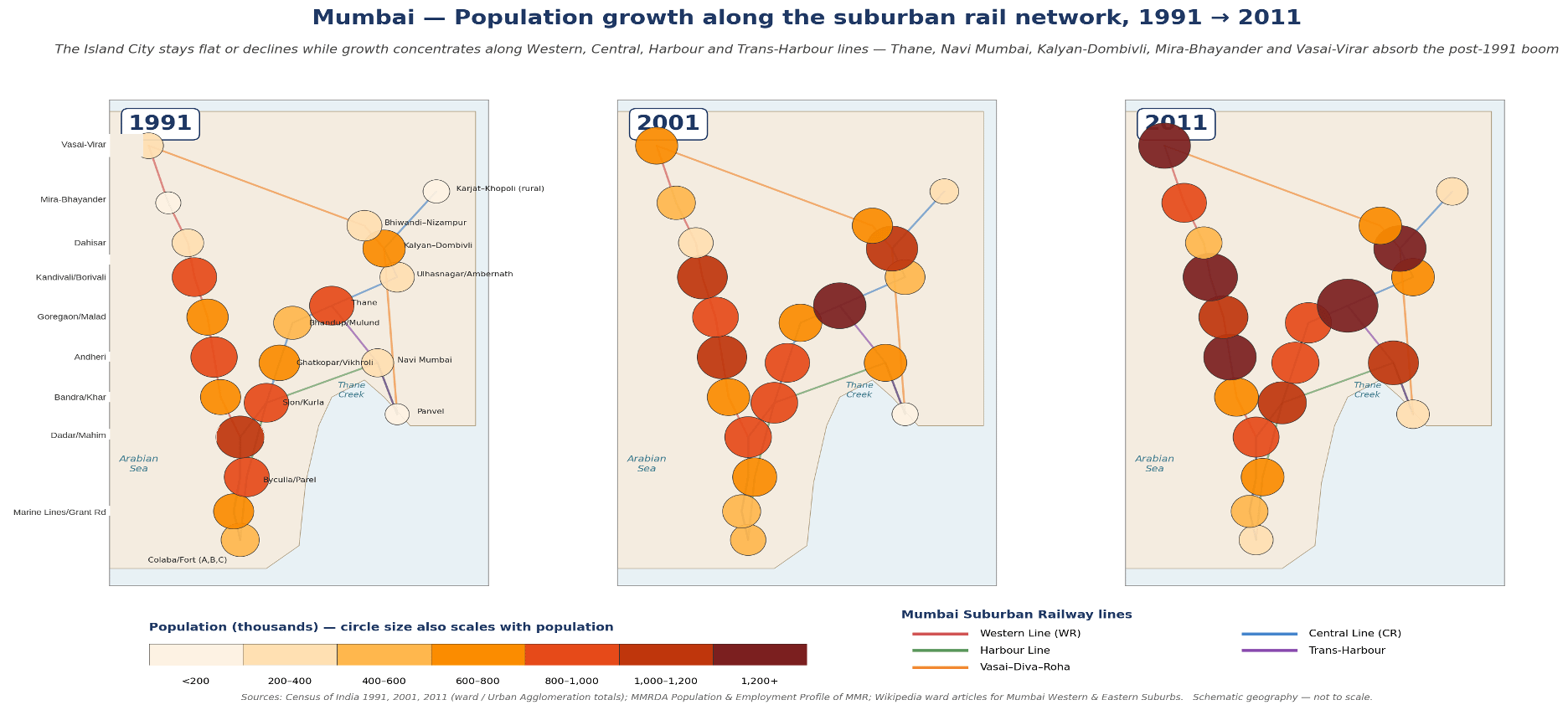
Globally, many cities owe their expansion to TOD. London and Mumbai are good examples. I used Claude to extract the schematic maps conveying TOD developments in commuter railway stations around London and Mumbai over the 1991-2011 period.
This is the London map for a longer 1991-2021 period.
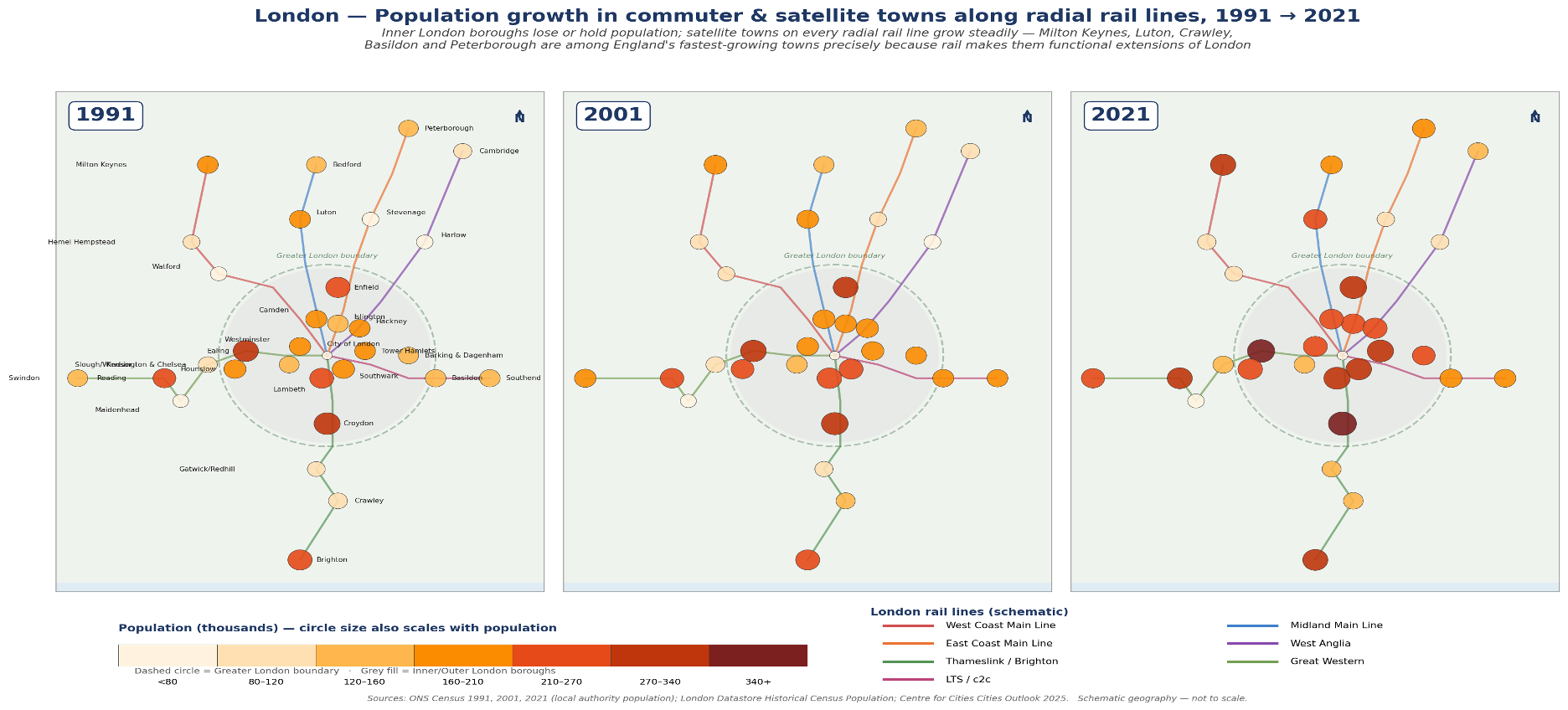
The Mumbai map draws from the Marron Institute’s Atlas of Urban Expansion, and the London map uses the ONS census visualisations.
Despite several efforts for nearly two decades, Indian cities have struggled with TOD. The only genuine integrated mixed-use station-centric development in India is Gurgaon’s DLF Cyber City + Cyber Hub + Rapid Metro (125 acres, ~15 million sq ft of office, 400,000 sq ft of F&B). The Gurgaon Rapid Metro is itself a private TOD example (built by IL&FS/DLF), covering 12.85 km and 11 stations. Both were built privately by DLF and IL&FS, predating the 2016 TOD policy by years, and the Rapid Metro became financially unviable and had to be taken over by HMRTC in 2019. The MGF malls at MG Road station, Sector 29 at HUDA City Centre, and the Golf Course Road density are all pre-existing development that happens to lie near a metro — co-location, not coordinated TOD.
A fundamental problem with TOD Policy formulation is the assumption that higher FAR, coupled with the benefits of living or working adjacent to a station, will by themselves translate into utilisation. In other words, it is assumed to be sufficient enough incentive for builders and home buyers to choose the TOD zone over its neighbourhood and elsewhere. Unfortunately, this is rarely the case.
Worse still, governments tend to view TOD as also a large revenue generation opportunity from the flush of property developments. The combination of registration fees (in case of purchases), layout development fees, purchaseable FAR rate, building permission fees, etc., adds prohibitive cost layers for developers and buyers. They prefer to develop and buy elsewhere. The normalised expectation of high revenues also prevents governments from considering providing concessions. A gridlock ensues.
So how do other countries promote TOD?
The Tokyo region offers double or even triple FAR in TOD zones, and allows FAR transfer from adjacent lower-value land parcels. Most importantly, the zones have no development fees, with local governments recovering value through land appreciation and property tax growth, not upfront levies. MTR in Hong Kong also offers much higher FAR and does not levy any development charge, and even gives the land to the developer at pre-rail land values. Singapore has URA White sites where land use is left flexible, apart from a much higher FAR. The purchasable FAR rates are waived or significantly reduced. Additional FAR and no parking minimums in the US allow developers to build significantly more in the zones, especially for affordable housing. Australia allows FAR several multiples higher, fast-tracks permissions, waives off infrastructure levies for affordable housing, and even has lower property tax assessment.
The common thread across all of these is that governments provide a package of benefits in the TOD zone. It always combines higher FAR (making more revenue possible per unit of land cost) with lower upfront charges (reducing the cost stack) and faster approvals (reducing holding cost and uncertainty). The Japanese and Hong Kong models go furthest by making the TOD zone not just more permissive but more profitable than any suburban alternative.
So what can cities in countries like India do?
Fundamentally, the objective of any TOD Policy should be to ensure that it makes building in the TOD zone more attractive than outside or elsewhere.
Apart from higher land values, the TOD zone suffers from several other disadvantages - less likely to have larger vacant plots, more likely to be congested, noisier, and so on - that make them less attractive compared to their surroundings or the suburban areas. Besides, the surroundings of stations are not perceived as desirable residential locations.
In the circumstances, there must be a significant incentive to crowd-in development into the TOD zone. Such incentives come from both urban planning instruments and fiscal concessions. Apart from additional FAR, the former could include a higher base FAR, a lower price for purchasable FAR, higher TDR loading, and a more generous TDR conversion rate. Fiscal concessions could include lower stamp duty, layout development fees, building permission fees, and property taxes. If there is a betterment levy or impact fees, the same may also be discounted for those desirable developments (like high-rise buildings). These benefits could be limited to developments initiated within a certain period.
This would also require a shift in the way governments view TOD. They should prioritise the development of the zone over the maximisation of revenues. In fact, foregoing current revenues to harvest future revenues should be the mantra. The foregone revenues would be offset within a few years by those from the economic activities triggered by the developments.
In other words, the strategy should be to first crowd-in a critical mass of developments that is sufficient to sustain future development. Till this happens, revenue realisation should be strictly subordinate. This is especially required in the large Indian cities, which have poor urban planning and a culture of sprawling suburbs.
The timing of TOD adoption is also important. The best time to initiate TOD is just before the project work starts, when land values are lower, and the market is being catalysed. The marginal response to incentives is likely to be much greater in the initial stages when property prices too have not gone over the roof.
It may be useful to experiment in a few bigger cities by picking one or two locations (those with sufficient developable land) and providing a package of incentives for a period of 3-5 years. At the risk of repeating, the package should be designed keeping in mind the need to make the TOD zone significantly more attractive than its surroundings.


No comments:
Post a Comment