This is the latest in the series on affordable housing. Affordable housing supply is arguably one of the top policy challenges facing cities across the world.
This graphic by John Burn-Murdoch is a good illustration.
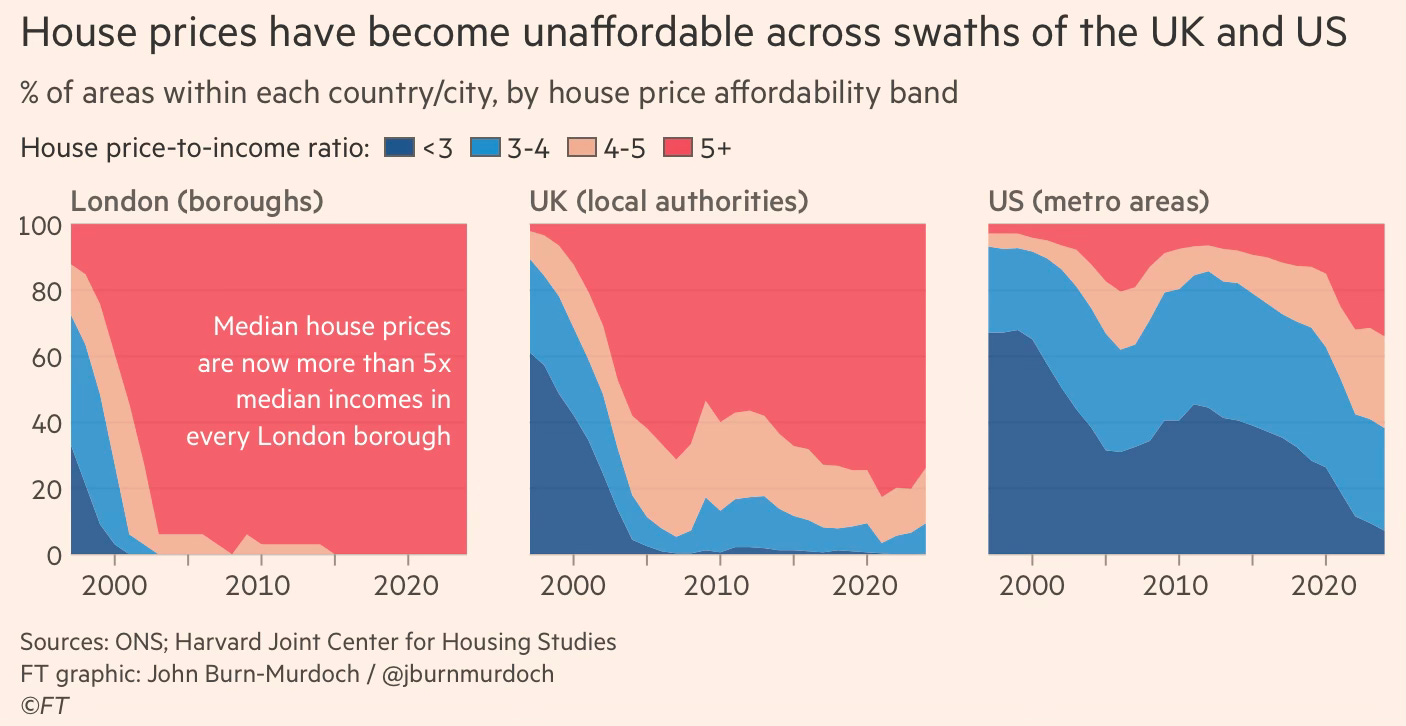
Here’s more evidence.
Home prices have risen more than 50 percent since the pandemic. About a third of Americans households now spend more than 30 percent of their income on housing. In 2014, the median age of a first-time home buyer was 31. In 2025, it was 40 — the highest on record.
Burn-Murdoch also points to research that links some of the commonly observed GenZ behaviours (like not making an effort or splurging on luxuries) to the housing affordability problem.
In a pioneering study published last week, economists at the University of Chicago and Northwestern University used detailed data on the card transactions, wealth and attitudes of Americans to demonstrate that reduced work effort, increased leisure spending and investment in risky financial assets (including crypto) are all disproportionately common among young adults who face little to no realistic prospect of being able to afford a house. By contrast, Seung Hyeong Lee and Younggeun Yoo’s research finds that those for whom home ownership is a more realistic possibility in the medium term, or who have already attained it, take fewer risks and strive harder at work.
I have extended their analysis to the UK and find a similar picture. Young British renters who have little hope of cobbling together a deposit are much more likely to take financial risks — with online betting, for example — than their contemporaries who are on or within reach of the housing ladder… Lee and Yoo use time series data and local house prices to show that the link between unaffordable housing and economic behaviour appears to be causal. Recent upticks in financial risk-taking, leisure spending and reduction in work effort respond to changing economic incentives. As housing affordability deteriorates, those who come to believe they are locked out of home ownership resort to a mixture of high-risk bets and what US economic commentator Demetri Kofinas calls “financial nihilism” — why strive and save when it won’t be enough to make it anyway? — while their better-placed counterparts tighten their belts.
Fundamentally, as Ezra Klein points out with this graphic, the housing affordability problem is a housing supply problem.
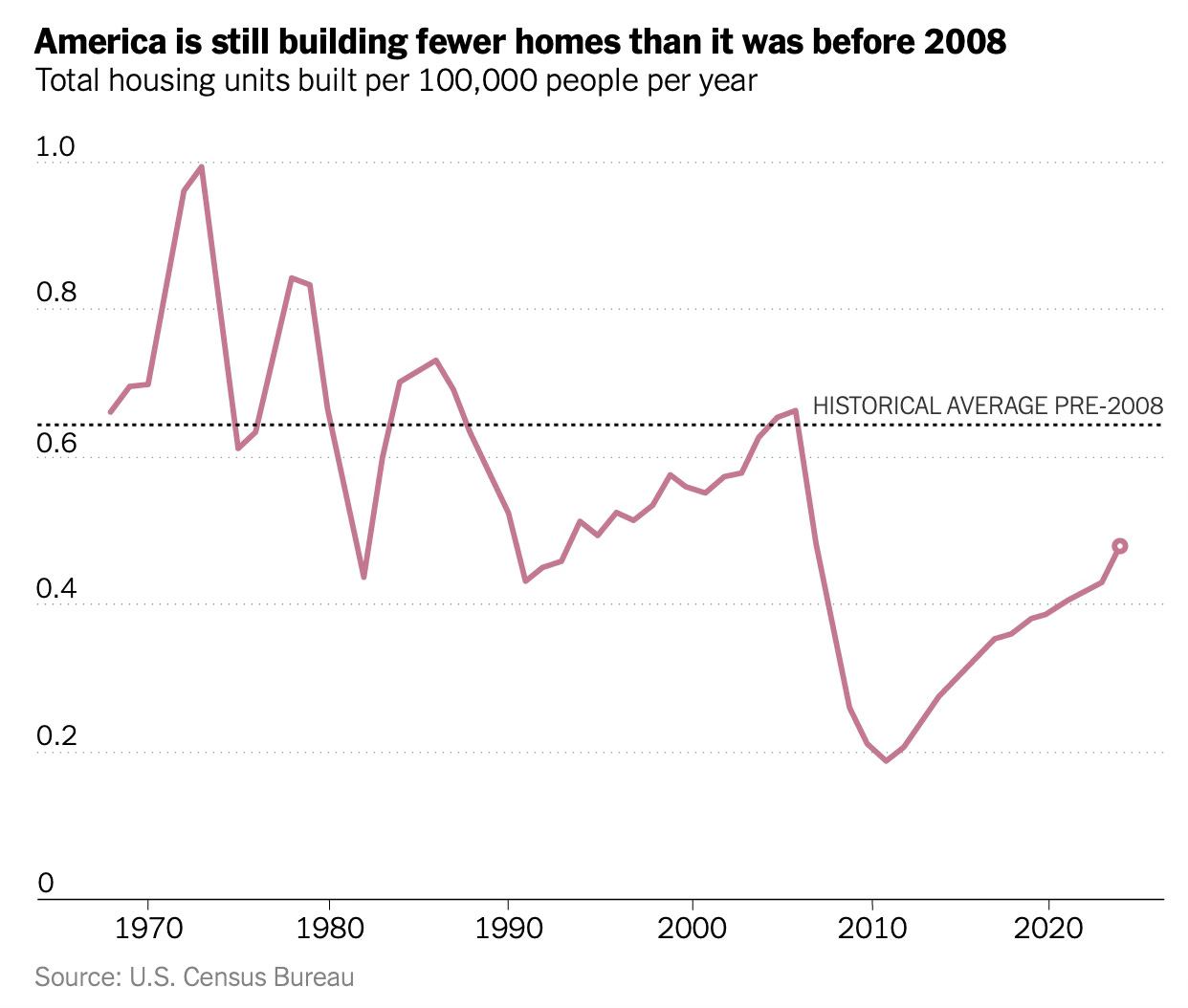
In 2025, America built fewer homes per 100,000 people than it did in 2005, 1995, 1985 or 1975.
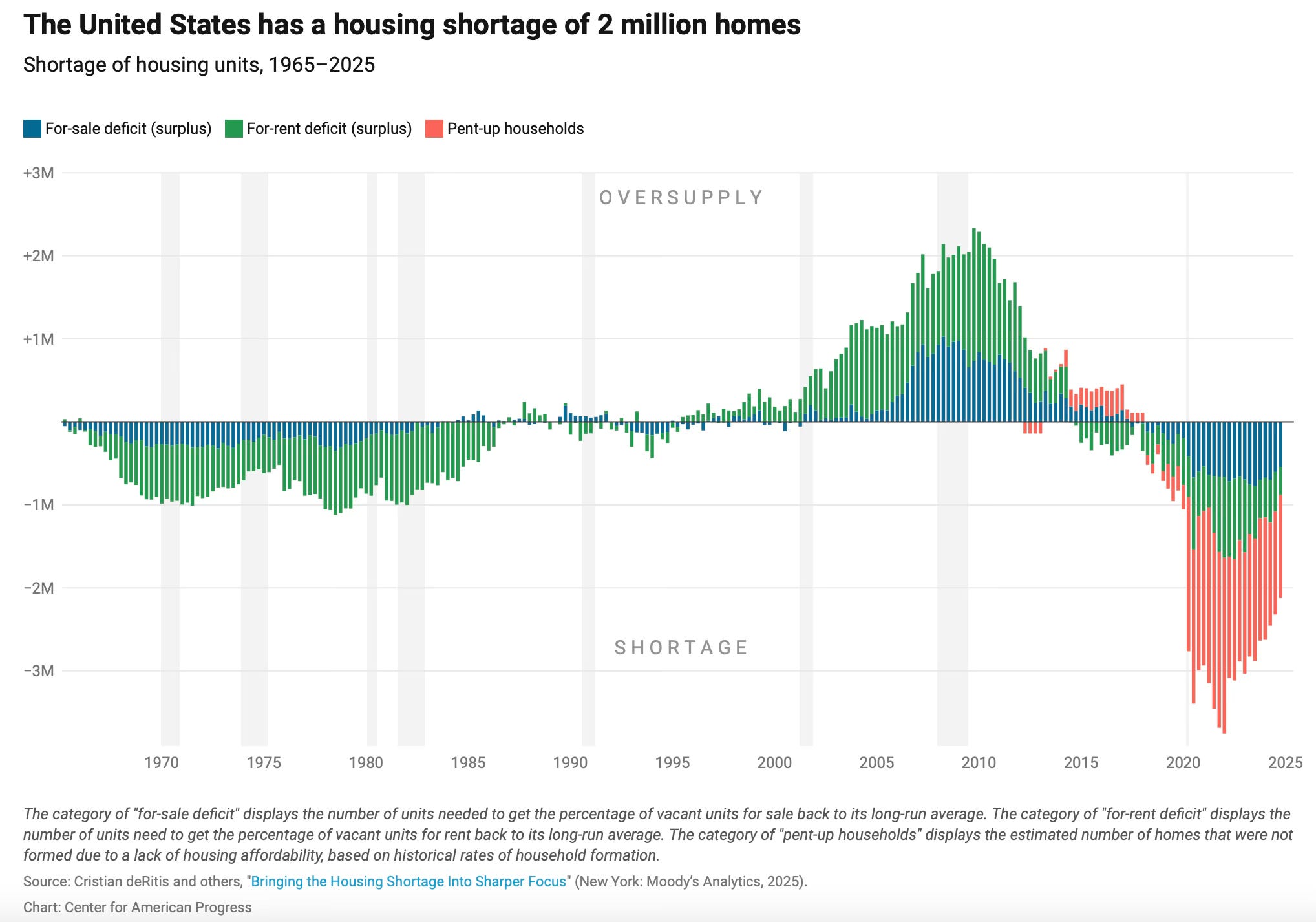
Housing supply in the US has slipped into the negative territory since 2017.
Governments in cities across the world have been exploring various approaches to address the housing affordability crisis. I have blogged about several of them in my earlier posts on the issue.
The report by the Centre for American Progress, linked in the above article, offers a three-pronged plan: take down barriers that make it harder to build homes; build more affordable homes at a lower cost; and protect consumers and lower other housing costs. It seeks to address the problem of opposition to house-building in high-cost/rent areas by paying people living in such areas if their areas build more housing. Klein writes,
Places with a housing shortage — and that’s a lot of them — get a choice. Build the housing and the federal government will give all the renters in the city up to $1,000 off their rent — or don’t build the housing and lose access to certain federal grants. The Searchlight Institute, a new Democratic think tank, recently proposed a similar idea. In that version, cities and other places that hit ambitious housing targets would qualify for a federal rebate that would give every household — so both homeowners and renters — a check equal to the average increase in rent over the last year. In other words, build enough housing and the federal government will give the people who live near that housing money…
The other proposal is to lower housing construction cost
Between 1950 and 2020, productivity in the manufacturing sector — how much you could produce with the same number of workers — rose by more than 900 percent. That’s a big part of why everything from tables to televisions are cheaper today than they were decades ago. But over the same period, productivity in the construction sector has fallen… But you can manufacture housing — constructing homes in an off-site factory much the way we construct cars and then shipping them for final assembly. This is technology pioneered in the United States when George Romney, Mitt Romney’s father, served as secretary of housing and urban development during the Nixon administration. But the United States never figured out the rules nor the financing to make an industry out of it. Instead, it’s taken hold elsewhere. In Sweden, for example, more than 40 percent of new homes — and more than 80 percent of single-family homes — are fabricated off-site.
The Center for American Progress’s plan proposes a slew of projects to take this industry America invented and make it one where America is a leader. They want the government to seed a major research program to fund innovation in housing construction. They want to have the federal government leverage its purchasing power to become an initial buyer for modular housing — one idea here would be to have the Department of Defense upgrade its military base housing using modular construction. They want to modernize building codes to make modular easier — removing, for instance, an outdated federal requirement to attach a permanent steel chassis to all modular construction — and updating federal insurance and financing rules to make sure modular production qualifies.
A longstanding problem with urban planning in the US and the UK is the discretion allowed to local communities and planners in planning decisions. This has spawned NIBYism trends in the guise of conditions spanning environmental protection, preservation of historical areas, energy efficiency considerations, etc. Sample this illustration from the UK by Sam Dumitriu.
A fourteen-flat development in Walthamstow, less than 10 minutes walk from the Victoria Line, required a 1,250 page planning application. Its developers produced more than 70 separate documents and still have waited over a year for a decision from the local authority. This isn’t just a Walthamstow problem either. One SME housebuilder recently revealed that Croydon required them to produce over forty separate validation documents to get planning permission. In the PM’s backyard, Camden, a major brownfield development was delayed because planners were not satisfied that the project was ‘exemplary’ in terms of ‘the circular economy and whole life carbon impacts’. In Cambridge, one of the most unaffordable parts of Britain, all new developments (10 units or more) must spend at least 1 per cent of their capital costs on public art.
The UK, under the Labour government, has been exploring various policy proposals to ease zoning regulations and promote densification to increase housing supply. The Chancellor Rachel Reeves has announced the Brownfield Passport, which would make “yes” the default answer for new denser housing on previously developed land. However, its success would depend on the details of implementation. Dumitriu writes that the Levelling Up and Regeneration Act (LURA) contains the power to create National Development Management Policies (NDMPs), which could declare basic standards for embedded carbon, flood protection, access to light, etc., to supersede any local planning policies. However, its effectiveness could be blunted by the non-binding nature of NDMPs. Another proposal by the Labour Government is the New Towns policy to develop new greenfield towns.
California has been experiencing a serious housing affordability crisis, largely due to restrictive housing development norms like this.
Land is expensive, labor is expensive and NIMBYism — the not-in-my-backyard sentiment that exists everywhere — is particularly strong. The city’s zoning rules discourage projects that are tall and bulky and that might anger the owners of single-family houses nearby. Five stories is the tallest allowable height for a multifamily residential building — and those are permitted on only a few blocks of the city.
In early October, California took a major step to address this problem when the state legislature approved Senate Bill 79 (SB79) that overrides local zoning laws to promote transit-oriented development through higher-density housing. It allows developers to build up to nine storeys high within a half-mile of major public transit stops. The law would be phased in gradually, taking full effect by the start of 2030.
In brief, the law would prevent local communities from blocking new mid-rise housing in well-connected locations under the cover of community review, environmental safeguards, etc. It expedites approvals by imposing strict timelines and penalties on the cities for non-compliance with its provisions. This is a good primer.
California is emulating reforms that have been undertaken far away in New Zealand. The country has emerged as a pioneer in urban planning reform. In 2016, the city of Auckland upzoned three-quarters of its residential land through the Auckland Unitary Plan to allow dense development near transport by-right, which kept rents 30% lower than the counterfactual. The reform was rolled out nationwide, and New Zealand has seen a construction boom. The new Housing Minister, Chris Bishop, is taking the policy even further and removing anti-supply red tape.


No comments:
Post a Comment