Substack

Showing posts with label Governance. Show all posts

Wednesday, April 16, 2025

Making best use of the smart meter opportunity

I have blogged here about the installation of smart meters by electricity utilities across India. Now that smart meters are a reality, this post offers a few suggestions to make the best use of them.

Before that some updates on the status of smart meter installations. Till March 2025, 222.3 million smart meters have been sanctioned, of which 138 million have been tendered and awarded, and nearly 22.9 million have been installed. 
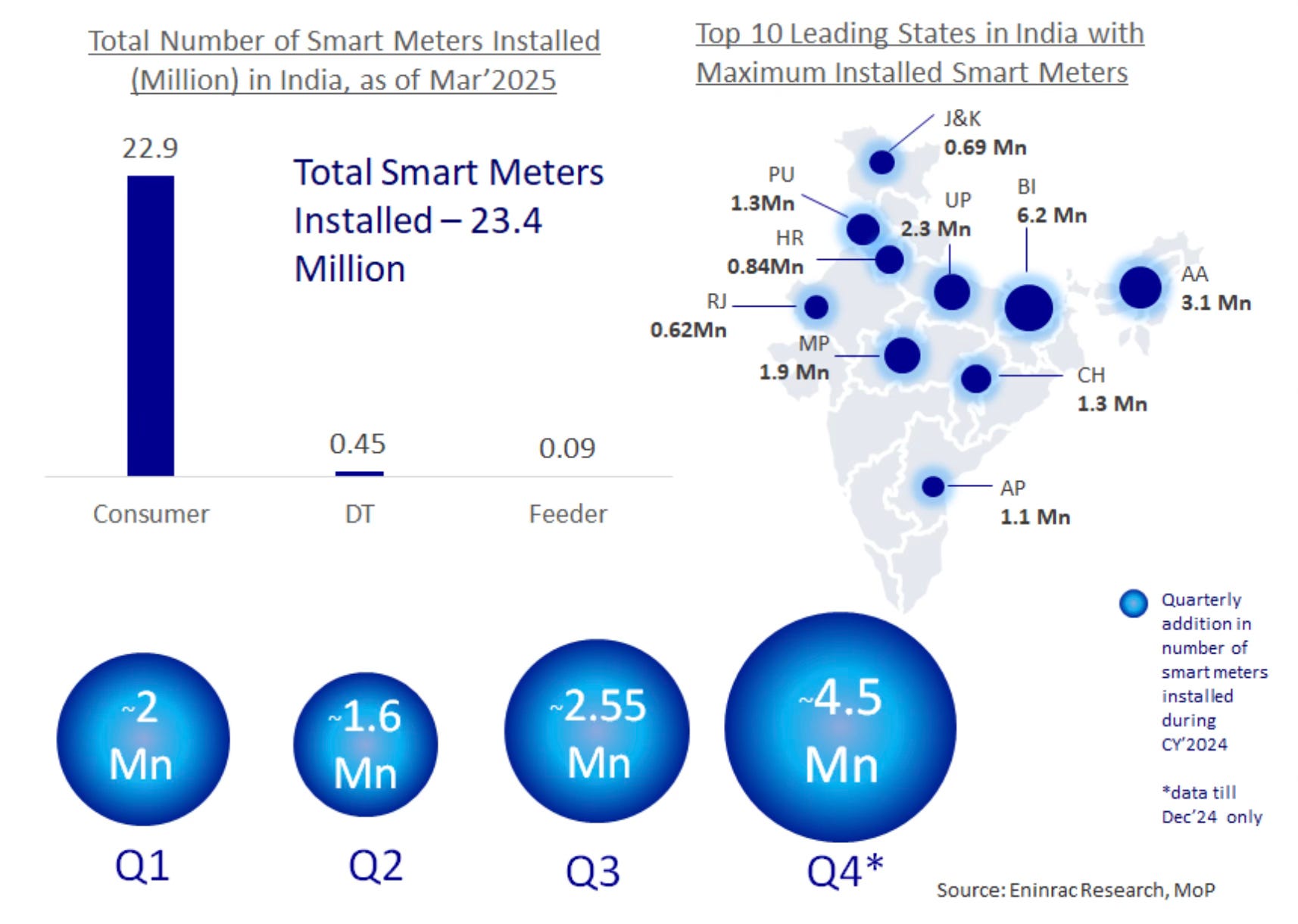
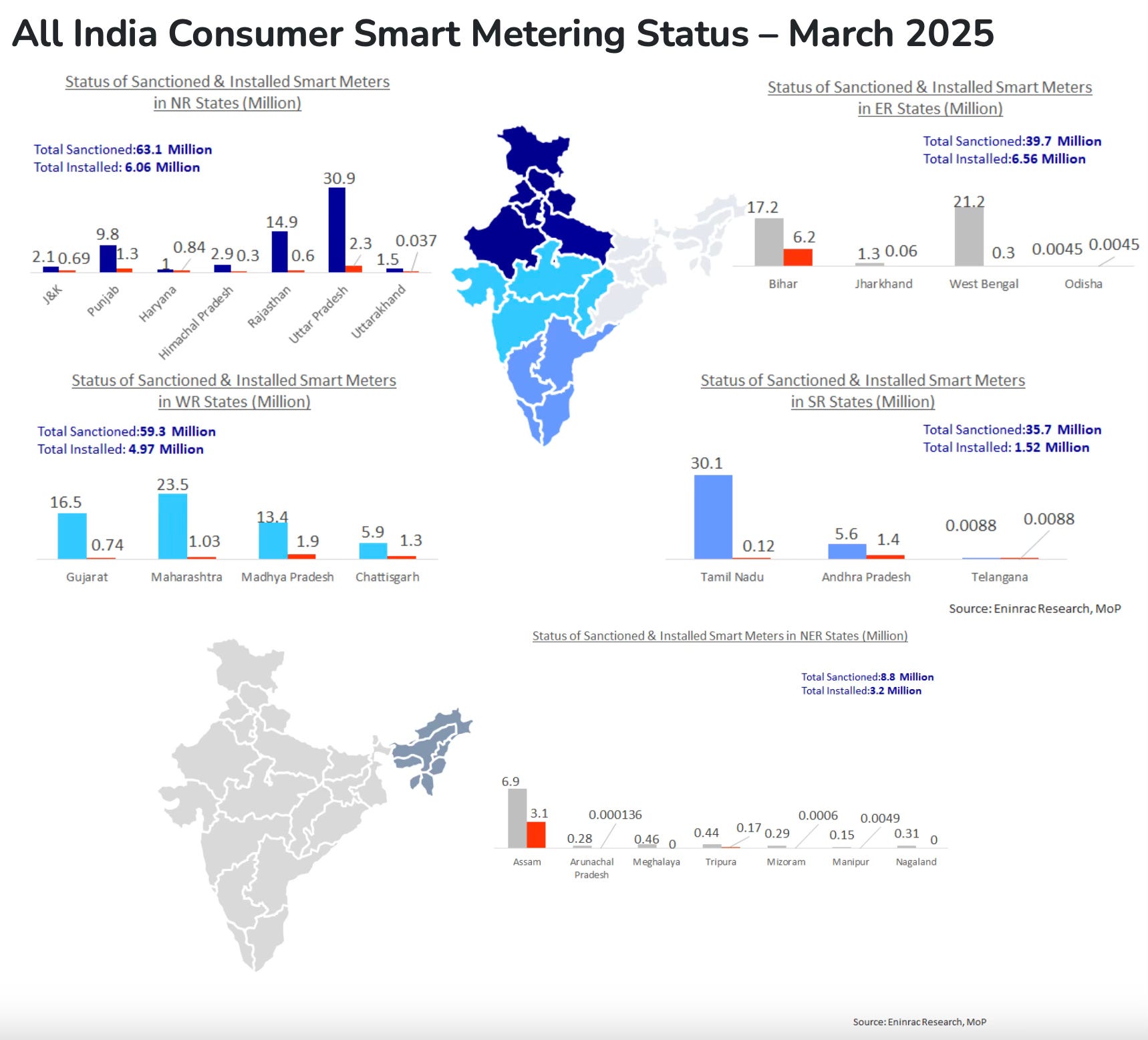
The state-wise sanctions and installations show that the uptake has been surprisingly weakest among those states with the better discoms. 
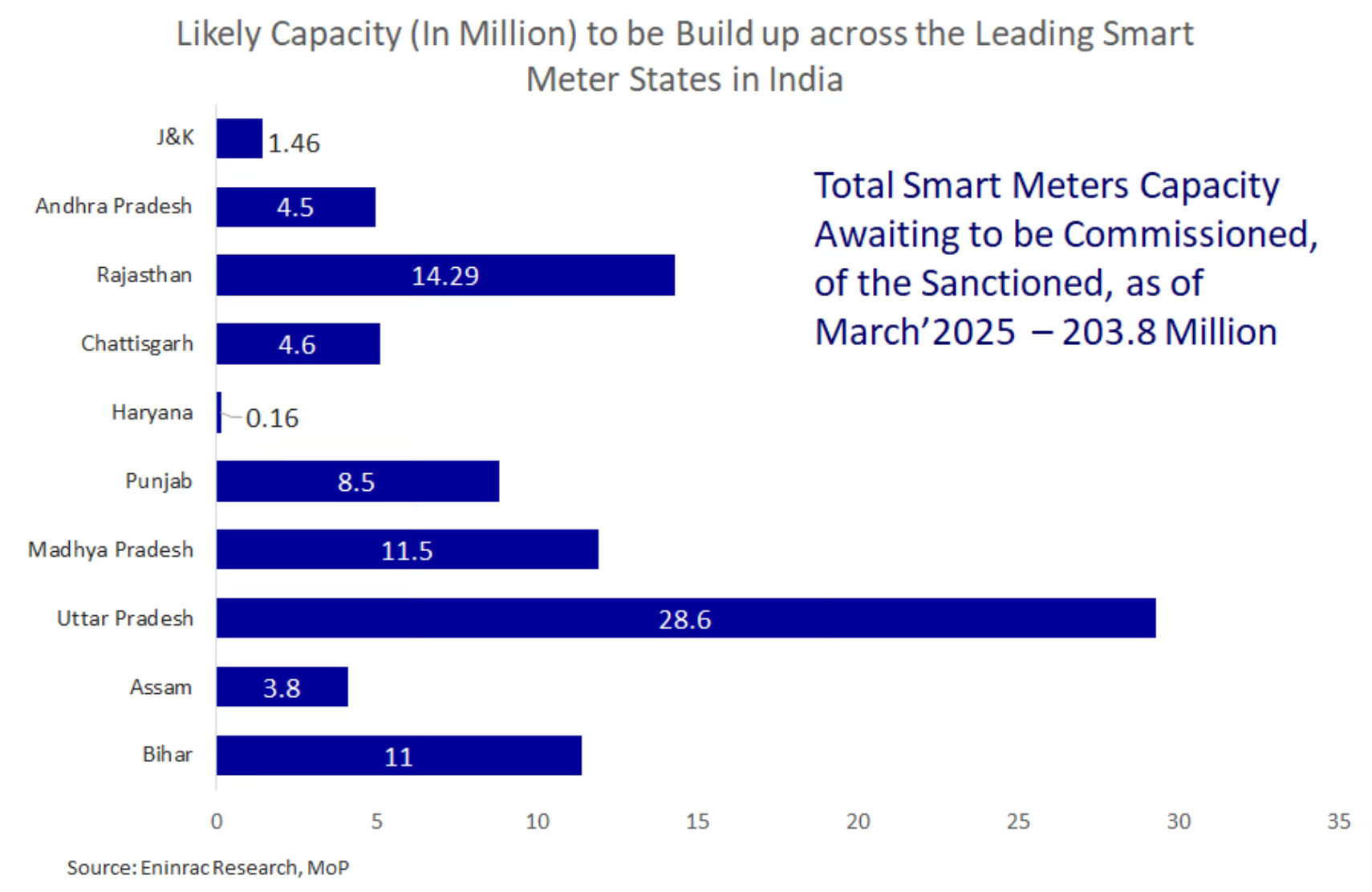
The target is to install 250 million smart meters by 2027.
India has adopted the TOTEX (total cost of ownership) model in smart meters, whereby the private firm invests upfront in the entire smart meter infrastructure (meters, communication and telemetry system, software etc.) and the utility makes monthly payments, including for billing. In this model, infrastructure contractors like Adani, GMR, GPIL etc., contract with smart meter manufacturers like Schneider, Secure, HPL etc., and deliver metering as a service for the contract period (60-96 months). 

Now that smart meters are on us, some observations on ensuring their effective installation and utilisation.

1. The value of smart meters comes from comparing the energy input and billing for each feeder before and after their installation. It allows discoms to identify energy losses, feeder-wise, and take remedial action to lower them. Accordingly, smart meters can help reduce aggregate technical and commercial (AT&C) losses in distribution. 

In order to achieve this objective, it’s important to ensure that smart meters are installed feeder-wise in a manner that covers all services (including the distribution transformers) under an 11 kV feeder so that it becomes possible to conduct reliable end-to-end energy audits. Like with unmetered agricultural services, scattered smart metering of services within a feeder makes accurate energy audit difficult, if not impossible. 

Another level of prioritisation would be to cover the highest energy-consuming feeders. This will ensure that in the initial stages, the implementation bandwidth is focused on a few high-value supply centres instead of being spread out wide and thin. Besides, it will also ensure that the discoms start to realise meaningful financial benefits from the implementation.

2. I blogged about the assumptions behind the installation of smart meters to reduce energy losses and improve the quality of supply. 

One, the smart meter's telemetry is always synchronised to the grid and it reliably delivers information. Two, the smart meter itself is operational and does not suffer from technical problems and failures. Three, the smart meter is not tampered with or even bypassed at the consumer level. Four, even if the data is acquired and processed to make available actionable decision support, the discoms have the capabilities to undertake rigorous energy audits and monitor and enforce them. Five, the discoms are able to disconnect errant connections.

There is daunting state capability and political economy challenges to be overcome to meet these assumptions. Therefore, these assumptions should be salient and prioritised considerations during the installation of smart meters. They should be monitored closely and rigorously for compliance. 

If these assumptions are not complied with, there’s a strong risk that the smart meter will end up like using an expensive computer to do the functions of a typewriter. 

3. The nature of electricity distribution and energy audit makes it ideally suited for a technology intervention like smart metering. If, even after its implementation, the discoms are unable to substantially reduce losses, it would point to failures in either enforcement (not able to disconnect services despite knowing the sources of leakages or pilferages) or implementation (bad installation, poor telemetry, tampering with the smart meter etc.) failures. 

There’s a strong risk of such failures. The speed and scale of this roll-out must be calibrated with the capabilities of the systems on both the supply and discom sides. Careful thought and effort must go into testing and iterating the robustness of the smart meters themselves, their installation requirements (safeguards like earthing and other protections, network connections etc.), stabilising the telemetry, and billing and accounting systems of the smart meter network. 

The worst outcome would be for the vendors to erect the meters without the requisite safeguards and auxiliaries and claim their first bills. The poor quality of installation will invariably result in various kinds of meter failures. Given the difficult and widely dispersed contexts coupled with the speed of the roll-out, the vendors will have enough excuses to blame the government and get away. It’s a recipe for contractual failures. 

For these reasons, it may be useful for each discom to test and refine the installation in a few feeders for a few months before scaling them up. Such a stabilisation pilot approach should be made a mandatory requirement before full-scale roll-out. 

4. I’m not sure about how effective smart meters will be in serving as a service control device, i.e., in disconnecting services. Their primary value will be in communicating information about energy flows and consumption. This means making available the right kind of actionable information for different levels within the discom and government. 

Unfortunately, there are too many examples of technology experiments in development that have struggled at the last mile by failing to provide actionable information. Given this and the common institutional contexts and problems, it may be useful to standardise the reporting formats for energy audits across 3-4 levels to ensure that the system provides the basic first-order actionable information for each level. 

5. The 250 million smart meters offer a great opportunity to create an invaluable end-to-end domestic manufacturing ecosystem. Apart from the product itself, there’s a big opportunity to promote the emergence of an Indian System on Chip (SoC) that drives the smart meter. Given the biggest constraint to breaking into the tightly controlled chip design market is access to deployment use cases in large volumes, smart meters are an unmatched market-making opportunity. 

This requires very high-level coordination involving different Ministries of the Government of India, to integrate this strategy with public procurements, mandate product standards, expedite regulatory enablers and permissions, etc. For example, in the case of smart meters, the meter supply and O&M contractors (6-9 year TOTEX contracts) could be mandated to supply domestically designed and manufactured meters. This mandate could be phased in over time, with the initial supply being restricted to 10% of all installations and going up each year. The support provided by the Ministry of Power for smart meter installations under the Atmanirbhar Bharat Scheme could be leveraged to catalyse domestic chip and meter design. The government coordination could bring together the OEM/contract manufacturer, and chip and product design firms. 

At the least, this public policy mandate on smart meters must create a couple of globally competitive and competing domestic smart meter manufacturers. 

6. The smart meters also offer a great financial market opportunity. It presents a low-risk, long-term, assured revenue-generating regulated asset. Accordingly, in Europe, with its deregulated supply market, smart meters have been attractive investment destinations for private equity firms. In the existing TOTEX contracts, the financial risk is borne on the balance sheet of the discom in so far as it directly commits to repaying the meter costs (even if recovered through the monthly bills). In forthcoming tenders, as the market gets derisked, contracts could be structured to distinguish between the capex (meter) and opex (billing) risks, with only the latter being fully borne by the discom. 

Thursday, January 30, 2025

The elusive promise of e-governance

There’s a widespread impression that persistent and deep-rooted problems and deficiencies in public systems can be addressed by digital solutions. It’s almost an article of faith that workflow automation of the kind that’s now pervasive in the private sector can be easily applied to public systems for similar uses.

Accordingly, over the last two decades, software applications with telemetry systems to manage and monitor transactions have been thought to have transformative potential in public policy and governance. Experts and tech optimists have extolled the benefits of these e-governance applications and projected them as low-hanging fruits with transformative potential. 

Doubtless, there have been some notable successes with e-governance. The biggest and most salient have been with the online processing of applications for statutory services like municipal services, permits and licenses, property registration, birth and death registration, and most iconically, the passport seva kendras. 

But there are numerous examples of evidently digitisable logistical activities where success has proven elusive. Consider the following tasks that involve services offered by or activities within governments and those which suffer from serious problems (leakages, inefficiencies, etc.).

1. Procurement of drugs, vaccines, and other consumables by state governments, indenting of requirements by field units from Primary Health Centres to tertiary care facilities, distribution of drugs to the field units, and inventory management at all levels (from central and district drug stores to field units).

2. Workflow automation of the procurement of paddy at procurement centres, conversion to custom milled rice (CMR) by rice millers, and distribution of CMR to state government stock points and then to Fair Price Shops, and the distribution by FPS as part of the Public Distribution System (PDS). And the settlement of the food subsidy accounts associated with each transaction from procurement to distribution. 

3. Allotment of rice and other items to mid-day meal programs and residential education schools and hostels, indenting by these institutions, and inventory management at all levels.

4. Monitoring of attendance of thousands of officials across schools/hostels, hospitals, anganwadis, and other widely dispersed facilities. 

5. Monitoring maternal and child health outcomes of pregnant and lactating women and infants through the four ante-natal checkups, delivery, seven post-natal checkups, and all the 10-12 immunisation doses. 

6. Recording of the bill of quantities of work executed in case of infrastructure works on the statutory Measurement books (M-Book). More generally, the processes of bid management, tender awarding, work agreement documentation, bill recording, check measurements, payment processing, other administrative actions (time extensions, quality control checks etc.), and work closure. 

7. Data acquisition systems that track and render on dashboards real-time information on the flow of water from the treatment facility along trunk lines to intermediate reservoirs (ground-level or overhead), and downstream to smaller distribution areas. Similarly, systems that track and render the flow of electricity from upstream 132/33 kV and 33/11 kV substations to distribution feeders and downstream to distribution transformers. 

8. Digitisation of post-harvest activities like assaying and grading, contracting between buyers and sellers, delivery of produce, and accounts settlement at notified agriculture marketplaces (implementation of e-NAM). 

In each case, there are serious implementation deficiencies or failures associated with the underlying transactions. There are either substantial subsidy leakages or monitoring challenges. And in theory, the digital solution has the potential to address them effectively. 

They are also areas where several rounds of e-governance applications have been experimented over the last two decades. Governments at central, state, and local government levels have responded with applications covering a vast range of sectors. They have been supplemented with similar efforts by aid agencies and philanthropies. 

Over nearly two decades, successive generations of officers at each level have experimented with applications spanning all these activities. At best, and that too very rarely, they have succeeded partially, but most have not survived the official or politician who implemented it. 

Despite these long-drawn series of efforts, I don’t think there’s even a single instance in any of these areas where the digital solution has solved the underlying problem at least in one state or city or agency. The underlying problems have remained just as persistent. 

Note that there will be several claims of successful IT applications involving the aforesaid problems and awards bestowed on them. We must go beyond the headlines and scrutinise the actual outcomes of those claims (whether the IT solution has actually resolved the underlying problems in any meaningful manner or not). 

There are several reasons for these failures. I have blogged here, here, here, and here, examining some of the reasons. The point of this post is less to examine the reasons and to draw attention to this headline reality of consistent failure to address the problems despite the numerous attempts. 

My big concern, therefore, and a reason for urging caution with digital solutions (as articulated here), is that the mere adoption of these solutions invariably instils a sense of complacency in the system that detracts from the good old-fashioned problem-solving of these issues that are essential for their meaningful resolution.

For all their apparent simplicity, each of these involves realigning a powerful set of entrenched vested interests that are impervious to technological innovations alone. Such applications face daunting technical and implementation challenges. On the technical side, they require very careful and thoughtful design and iterative adaptation once rolled out. On the implementation side, they require stakeholder ownership and change management. The technical aspect must be complemented with robust governance and strong stakeholder engagement for the solution to stand any chance of success. 

Thursday, February 15, 2024

Three thoughts on public policy

This is a distillation of several posts in this blog on development and public policy. 

The narrative often races far ahead of the reality. This creates several problems apart from adversely impacting the realisation of outcomes. Public issues are especially prone to this disease. 

It's therefore required to recalibrate the narrative. In that spirit, this post will highlight three dominant trends in public policy that I believe have become detrimental to the realisation of policy objectives and to public interest. 

They are the pervasive use of management consultants to design policies and monitor their implementation, the application of technology solutions to solve intractable policy challenges, and the adoption of evidence-based policy approaches to solve policy failures. 

1. The use of management consultants in policy and program design and their implementation:

Policy makers substitute their own officials for management consultants to appraise projects/programs, prepare Notes, documents, and presentations. Most often these management consultants have limited understanding of the domain and the context, both critical for effective decision-making. What emerges from such consulting are logically appealing but half-baked ideas, superficial prescriptions, and often distortionary and conflicts-ridden policies. 

An appropriate recalibration would be to junk the approach of indiscriminate hiring consultants for everything and instead restrict their use for purposes as outlined in this post. They should not be used for formulation of policies (except in the support tasks of collecting information and processing them), delivery of statutory services, and any task that's strategically important. Instead, they should be used only for non-strategic purposes. 

2. The embrace of the mantra of evidence-based policy making that's inclined to particular kinds of evidences.

Edward Deming, the American engineer and management consultant, famously said, "In God we trust, all others must bring data." This has come to become a cardinal principle of modern management theories. New public management and the economicisation of public policy has led to the extrapolation of this principle to public policy formulation. 

As I have blogged earlier, this has serious problems. Many public issues are wicked problems and the remaining are atleast complex problems, and these cannot be diagnosed, explained, and resolved primarily using generalised theories and techniques that rely on data. There are far too many counterfactuals and contextual issues that make modelling and quantitative estimation impractical and impossible. 

An appropriate recalibration would be to subordinate quantitative evidence to good judgement and wisdom. Data and empirical evidence is important, but only as one of several inputs. The scope of evidence should be expanded to include ethnographies, qualitative aspects, cross-disciplinary (outside of economics) insights etc. The policy maker should be able to use all these different evidence inputs, draw on experiential wisdom, and then exercise personal judgment to make a determination on the causes and prescriptions. The answers that emerge from this combinatorial exercise should prevail over purely evidence-based policies. 

3. The adoption of technology as a solution to persistent public policy challenges. 

For policy makers and politicians struggling with the frustrations of solving intractable problems that are also exacerbated by acute state capability deficiencies, technology solutions are convenient crutch. Apart from offering the hope of a solution within a defined time, they also sync with the dominant narrative of the time that sees technology as a solution to all the world's problems. Political economy problems, state capability deficiencies, and poor governance get glossed over. Technology comes to be seen as almost a magic pill. At the least, once technology is adopted the associated work is seen as marginal and manageable (think Edtech, where the struggle has been to get the technology solution right and little has focused on equipping the teacher to effectively utilise the technology solution). 

From this perspective technology is most often a deeply damaging distraction. It induces complacency and false comfort among all stakeholders. It allows stakeholders from having to face up to the reality and undertake the struggles required to address the problems. It comes in the way of the hard toil required to address the underlying concerns. 

A recalibration would necessitate the policy maker taking a more sceptical view of technology solutions and being selective about the choice of the right kinds of technologies. Even where used, given both the low baseline and the state capability and other deficiencies and constraints, the most basic versions of technology are often sufficient. And the technology intervention cannot be a substitute for governance.  

Wednesday, March 15, 2023

Certifications and accreditations are no substitute for governance

I have been a sceptic of the efficacy of the increasingly common use of certifications and accreditations as a means to assure service quality of public services. Such certifications are done by both the government directly or through arms-length agencies and by the industry themselves. I'll argue that such certifications cannot be a substitute for governance, and in the absence of good governance even the best certifications are ineffective. Worse still, band-aid solutions like these induce false confidence and detract from serious engagement from the problem itself thereby worsening things. 

Indian Express has in recent days carried two investigations highlighting the problems faced by the industry certification of the forest produce, and government certification of universities and colleges in India. 

The first concerns certification of the forest produce not being linked to afforestation or illegal activities
Forest certification is a sunrise industry, driven by a growing preference to avoid any product that can be linked to deforestation or illegal logging. In India, the forest certification industry is growing at 8 to 10 per cent every year, mainly catering to exporters wanting to tap the US and European markets that have strict regulations to ensure the legality of wood products coming in. Only processed wood is allowed to be exported from India, not raw wood... The investigation revealed that certifications in India were mainly a tool to bypass regulatory requirements in Europe and the US, where India’s forest-based products have an export market worth Rs 4,000 to Rs 5,000 crore every year. “It is easy to obtain forest certifications in India, if you are willing to pay the fees. There are several unscrupulous operators who are willing to make a quick buck. In fact, because of the intense competition amongst certification bodies, it is largely a buyers’ market. If you negotiate hard enough, you can drive down the costs of certification considerably,” said an executive of the India-based office of a foreign certification body... 

The main seekers of certifications have been exporters of wood products and other forest-based goods... Forty per cent of all certificates issued in India by two of the largest global certification systems – FSC or Forest Stewardship Council, and PEFC or Programme for Endorsement of Forest Certifications – have not been renewed... FSC and PEFC, and others like them, are developers and owners of certification standards, much like the International Organisation of Standardisation (ISO) or the Bureau of Indian Standards (BIS). The actual work of evaluation, recommendation of certifications, and monitoring of compliance is carried out by certification bodies and their subcontracted auditors.

The forest certification system has spawned an industry in green-washing.  

The second concerns a recent report of a panel appointed by the National Assessment and Accreditation Council (NAAC), which grades India's 43,796 colleges and 1113 universities, into its own functioning has thrown up several alarming signals,
According to the review panel’s report... the process of selection of experts who comprise peer teams that are sent to assess applications for accreditation is “neither random nor sequential”. It points out that nearly 70 per cent of experts from the pool of assessors do not appear to have received any opportunity to conduct site visits while some others have had multiple such visits. According to an NAAC official, there are 4,000 experts, who are mostly academics attached with higher educational institutions, serving as members of peer teams in NAAC. Sources involved in the process said only about 30 per cent of these experts are involved in the accreditation process, which was a “clear indicator” of the “extent of rot” due to “allotment through manual interventions without valid reasons”. Sources said the other “glaring” gaps highlighted in the report include the presence of multiple “super admins” who have full access to the NAAC’s internal system and the power to allot experts; and, “non-maintenance of logs which may have adverse fall outs”... Under NAAC’s accreditation process, the first step involves an applicant institution submitting a self-study report (SSR) based on quantitative and qualitative metrics. The data is subjected to validation by expert teams of NAAC, with quality reviewed during site visits by peer teams.

The Chairman of NAAC Mr Bhushan Patwardhan who has resigned in frustration has alleged "vested interests, malpractices, and nexus among the persons concerned". In simple terms, as governance of the colleges and universities themselves and that of state and central higher education regulatory authorities have weakened, the certification process which provided the fig leaf of credibility appears to have been completely captured. 

In India from the days of ISO certifications of all kinds of government facilities from Tahsildar offices to citizen service centres to electricity sub-stations, in recent times certifications have been used to declare villages open defecation free (ODF), rank cities for their cleanliness, and accredit skilling centres. This has been a questionable strategy. Worse still, they have detracted attention from the real painstaking and long-drawn struggles required to bring about sustainable change. In sum, the recent mindless expansion of certifications in both scope and scale does much more harm to the cause than good. 

The underlying belief that a one-time certification process can, like with outcomes-based financing (see this, this, this, and this), discipline a weak and unruly system into complying with processes and generating outputs is deeply questionable. This comes from the ideological belief in the efficacy of new public management approaches to public systems. 

The results are always the same - the innovation (certification or outcomes-based financing) gets captured and slowly discredited. There is also the difficulty of creating the supply-side (trained auditors/certifiers, monitoring systems etc) to rapidly expand such activities to serious scale and across activities or sectors. They are no substitute for the hard task of efforts at governance and capability improvements.

Update 1 (17.03.2023)

Two points about the NAAC accreditation process. One, if you set impossibly ambitious goals, failure is inevitable. To get a sense of the gap between the scale of ambition and reality,

The National Education Policy (2020) has set an ambitious target of getting all higher educational institutes to obtain the highest level of accreditation over the next 15 years. However, according to information shared by the Centre in Lok Sabha in February, out of the 1,113 universities and 43,796 colleges in the All India Survey on Higher Education Report 2020-21, only 418 universities and 9,062 colleges were NAAC-accredited as on January 31, 2023... According to current and former officials of the NAAC, the fear of obtaining poor grades holds institutes back from applying... Its parameters include curriculum, faculty, infrastructure, research and financial well-being. The grades issued by NAAC range from A++ to C. If an institution is graded D, it means it is not accredited.
Two, it's difficult to maintain the fidelity of any process which involves evaluating institutions on a number of parameters through physical visits assigned to individuals and that too at a nation-wide scale and involving a high-stakes decision which determines the fate of the institution.
Under NAAC’s accreditation process, the first step involves an applicant institution submitting a self-study report (SSR) based on 137 quantitative and qualitative metrics covering seven broad areas. The data is subjected to validation by DVV partners, which is followed up by site visits by peer teams drawn up from a panel of over 4000 assessors. The Joorel panel, which submitted its report last September, also flagged that the NAAC’s internal system has several super admin users (who enjoy full rights in terms of access and bringing changes) who are “no more employees” of the council... In its report, the committee flagged 13 cases, where grades between A++ and A+ were issued, having “anomalies” “which may be tip of the iceberg”, the source quoted the report as having observed. In one such case, the committee found, one university was graded A+ despite “over 50% of metric values entered by it in its SSR found to be wrong”.

Monday, December 20, 2021

Limits to technologies in public policy - policing edition

This blog has written to exercise caution in our expectations from the application of digital and other technologies in the public policy realm. This, this, this, this, and this are posts on the issue. This post is about the use of technology in policing to spot gun shots and prevent crimes. 

The Economist has an article assessing the impact of the microphones-based gunshot detection technology used by ShotSpotter which, since its inception 25 years back in Chicago, is now being in over 100 cities across US. For a technology which has been around long enough to have matured, the article paints a damning picture,

According to the Chicago Office of the Inspector General (OIG), a city watchdog, of just over 50,000 alerts generated by the system between January 2020 and May 2021, only about 2% led to the police stopping somebody. Only 0.4% of alerts resulted in arrests and even fewer the recovery of weapons. A separate study by the MacArthur Justice Centre, a civil-rights law firm affiliated with Northwestern University, found that in just 10% of cases generated by the system could police find evidence of a shooting, such as spent cartridge cases or bullet holes... But there is little independent evidence that it reduces crime overall. One study, published in April in the Journal of Urban Health, found that “implementing ShotSpotter technology has no significant impact on firearm-related homicides or arrest outcomes”. Microphones on street-lights are all very well, but they are no substitute for information gathered from humans.

Much the same could be said about the use of body cameras to deter aggressive behaviours by policemen. 

The point is that despite their irresistible appeal, such fancy technology solutions, with their logical neatness, are no substitute for human intelligence and other regular information collection systems. Worse still, such technologies engender two practical problems which might worsen the situation. 

One, there is a moral hazard from the introduction of such high profile technologies. It introduces a sense of complacency and slacking on other routine gun shot prevention measures within the system as a whole. This is amplified by the general sales pitch of the leadership which introduced the technology as something which would solve the persistent problem. 

Second, implementation of such new technologies take up significant administrative and supervisory bandwidth of officials. In capacity constrained systems, this displaces scarce administrative and supervisory bandwidth away from the arguably more important task of focusing on the routine policing measures to prevent gun shot incidents. 

These trends are likely to be more pronounced in weaker state capacity environments of developing country cities. 

Application of technologies have resonance in other areas like use of smart meters in billing electricity and water, Supervisory Control and Data Acquisition (SCADA) systems in managing water and electricity supply, GIS mapping in utilities network management and property tax assessments, and biometric devices and facial recognition in attendance monitoring in schools and hospitals. In each of these areas, the outcomes have proved far from satisfactory, even verging on failure. 

This is not to reject the use of technologies in these areas. It's about figuring out where and how to use them, based on the context. 

So, smart meters are great at monitoring supply on sub-station feeders and for high value high voltage consumers. SCADA systems should eschew supervisory control and be replaced with simple Data Acquisition Systems (DAS) that can provide information as decision-support. GIS mapping is useful in upstream network management. Simple software applications that can be deployed on smartphones of teachers and health staff are far more likely to bear results in attendance tracking than dedicated biometric devices or stand-alone cameras.

These are all cheaper second-best uses of the respective technologies. But they stand far better chance of success than their costlier first-best versions. 

There is a political economy to these technology choices. They serve the interests of both politicians and bureaucrats who can present them as solutions to persistent problems, and thereby both fend off criticism and also get acclaim from opinion makers. Also, the design of these choices are most often made at the behest of consultants, whose contextual understanding and practical knowledge is limited. More importantly, they are an integral part of the larger coalition that promotes these technologies. 

Monday, October 18, 2021

A perspective on the EoDB ranking controversy

The World Bank's Ease of Doing Business (EoDB) survey, perhaps the most famous of any WB product or service (though of deeply questionable technical merit), is at the centre of a high profile governance scandal. An independent investigation has found that the rankings of China and Saudi Arabia were manipulated at the behest of the Bank's senior management. There have been calls for the removal of Kristalina Georgieva, the current head of IMF, who as the CEO of the World Bank is alleged to have been personally involved in manipulating China's rankings. 

Without holding a brief for anyone whatsoever, this post seeks to offer some thoughts that can perhaps help place the incident (purely on its own, and independent of other things that may have been going on) in a better perspective. 

Complicating any effort to separate the wheat from the chaff and make an objective assessment of the situation is the politics surrounding the issue. As Justin Sandefur has written, everything from the 'independence' of the investigation, the relative under-examination of similar actions involving Saudi Arabia, the Washington polarisation surrounding China and ex-President Donald Trump's appointees, raises at least as many questions as those about Georgieva's actions.

Any dispassionate view of the controversy is difficult, especially for those once involved with the Bank or IMF or currently engaged with the Washington development aid ecosystem. And much of the commentary has been by these people. In these extremely polarised times, it's most likely that views of those involved with the issue on these lines become skewed towards one side or the other.

This is not to deny that there are some deeply questionable findings. For example, it has to be said that Georgieva's visit to the House of a junior EoDB staffer on a weekend to collect the China report raises deep suspicions. But is it also possible, from whatever information is available on the public domain and without being judgemental, that Kristalina Georgieva was merely doing what any pragmatic leader would do to protect the larger interests of her organisation?

In this context, as a complete outsider, let me offer two alternative perspectives from the private and public sectors. In both these cases, in their own respective contexts, the relative stakes are much higher for all sides involved than with either China or its alleged supporters like Georgieva. 

Let's first do the private sector. In recent years, there have been several similar controversies involving the most reputed consultants, financial institutions, audit firms and so on. They have been accused of either directly or indirectly supporting or indulging in corrupt or manipulative practices, most of which could not have happened without the complicity of the leadership. The stake in each case is much, often by orders of magnitude, higher than the one involving the EoDB survey rankings, for all sides. 

If we take the view of those calling for Georgieva's head, Lloyd Blankfein and David Solomon of Goldman Sachs and Dominic Barton and Kevin Sneader of McKinsey should have resigned many times over. They have been associated with allegations of much more serious nature, involving fraud and bribery (perhaps even murders and genocide), especially with governments. The same applies to the several Wall Street chief executives whose firms actions in short-changing, even defrauding, their investors and clients could not have been done without at least the tacit approval from the top. All the Big Four major accountancy and audit firms have been accused (and some even found guilty) of having helped manipulate accounts or cover-up large bribery and corruption cases, or massage corporate accounts through arguably illegal practices that have helped evade billions in taxes. 

And, in common with the EoDB issue, it's possible to trace at least one instance involving most of these companies and their leaders where their actions in support of China or Chinese interests could be questioned on grounds of violating corporate governance standards, with some even bordering on corrupt practices. Is it at all possible that all those Chinese princelings were hired on preferential basis by venerated Wall Street institutions and consulting organisations without the approval of the top leadership?

The second perspective is from the public sector. Consider the following examples from an Indian context. One, a Municipal Commissioner deals with several Councillors, most of them with entrenched links with local preferred contractors and lobbying to further their interests. Two, a District Collector often comes across decisions requiring the selection of housing colonies or roads or other works or locations for an economic establishment from among competing ones, and with strong political interests behind many of them. Three, a Head of Department (HoD) or the Managing Director (MD) of a public Corporation deals with requests for postings, transfers and deputations of officials at various levels, often involving intense pressure from political representatives and employee unions.

Consider also in each case that the Commissioner or Collector or HoD/MD has to deal with the China equivalents - a very powerful Mayor or local Parliament representative or legislator or Department Minister. They also have to deal with slightly less powerful other interests - certain Councillors, other legislators, and other Ministers. 

There are two simplistic perspectives on viewing such situations, one involving compromise and another refusal to accommodate. One, compromise and get on the bed with the political interests. Once on this slippery slope, also compromise with all the other less powerful interests. Two, reject all such requests and not accommodate even one bit. The fate of the former is easy to predict. He or she is likely to be both corrupt and weak administrator. But the latter is a much misunderstood creature. While being completely honest, given the complex contexts and the challenging nature of public responsibilities, the rigidity is most likely to constrain effectiveness. 

Accommodation can provide the space and flexibility necessary to not only administer effectively but also rein in vested interests and push through bitter and contested reforms. It can be the critical difference between being successful with your initiatives and hitting the wall and failing on your endeavours. It has to be said that this is no universal recipe and such accommodation is not possible with certain Mayors or legislators or Ministers. But in many, if not most, cases, there are spaces for accommodation. 

Accommodation would involve even simple things like prioritising on addressing the problems or issues raised by the powerful interest purely on merits, or greater application of mind or spending more time on references made by them, or even a slight preference in razor-thin margin decisions involving exercises of judgements. In all these cases, the mindset of a complete non-accommodater can generate significantly different outcomes from that of even the only slight accommodator. 

So a third perspective is a mesonic accommodation, but one inclined more towards the second perspective. The very powerful interest has to be accommodated, but only to just the least possible extent. There has to be clear red lines of accommodation, known to both sides. And, especially in case of individuals holding high public office, they will have to hold him or herself accountable for not only adhering but also seen to be adhering to those red lines. Yes, I admit there are several judgement calls, and all of them have very slippery slopes. But, we must all admit that even the most saintly life or unblemished career itself are too complex to be algorithmized or to be sanitised from judgement calls.  

There is something about seeing the big picture without also not losing sight of the small pictures. Accommodating without compromising. Accommodating only to the least possible extent required. Drawing lines and walking the talk with those lines. This path is difficult to straddle for the individuals themselves and the idea is even more difficult for outsiders to comprehend. 

A simple test around this conundrum is the personal integrity test. As long as the individual did not benefit financially from the incident and the actions were motivated purely by organisation's best overall interests, there's a case for condoning the actions. But here too the simplicity can be deceptive. A slightly more accommodative official can benefit from future employment and other opportunities, which ultimately confer financial benefits on the individual. 

Another test in such cases is take the long view. Instead of judging the individual actions as an isolated incident, it's better to judge the actions in the backdrop of the individual's career track record on personal integrity. This is exactly what Sandefur, for example, does, when he takes Shanta Devarajan at his word in his (Devarajan's) judgement of Georgieva's instructions involving China. 

I hold no brief for either Georgieva or World Bank, much less the EoDB ranking. I have little idea of Georgieva's track record of professional and personal integrity. But, given the information in the public domain, there are enough grounds for us to at least pause and reflect before indicting based on commentary which may in theory be at least as flawed as Georgieva's motivations. Having said all this, I'm open to the possibility that Georgieva did indeed cross a line and should be sacked. It's also very much possible that, given the politics of the current circumstances (read China's aggressive bullying and wolf-warrior posturing and appeasing it), her actions have crossed a line too far and it may therefore be appropriate to remove her. 

But it's important for us to have a more accurate perspective on the current accusations so as to not only be balanced about our views on the EoDB scandal, but also focus our collective consciousness on the important and critical governance problems in both the public and private sectors. 

I'm also inclined to believe that even in a ranking of all the countless questionable and corrupt practices (including those trying to placate or protect the interests of their main funders) indulged by the leadership of the World Bank and IMF over the years, the actions currently under discussion would struggle to register anywhere in even the top half. 

Saturday, September 18, 2021

Weekend reading links

1. The big news late last week was the ruling of the US District Judge Yvonne Gonzalez Rogers in the case between Apple and games maker Epic, that directed Apple to give developers in the US bypass the App Store's in-app payment tool by including links or directions to "purchasing mechanisms" outside of the platform. This deprives Apple off the monopoly position in the  very high margin (15-30%) and more than $60 billion of App Store transactions per year. Apple made $6.3 bn last year from in-app purchases and subscriptions. 

Epic Games CEO Tim Sweeny has expressed his disappointment, saying that this is not a victory for either developers or consumers. Apple has proclaimed victory. It will be a relief to Apple that the judge has not inviolated the prevailing anti-trust paradigm by ruling that "Apple is not a monopolist under 'either federal or state antitrust laws'". Besides, the Judge also said that, "Apple provides a safe and trusted user experience on iOS, which encourages both users and developers to transact freely and is mutually beneficial."

The judge also didn’t force Apple to change its fees or let third-party app stores on its platform, which would have been a far larger blow to the company’s revenue. The ruling states that Apple must let developers communicate with customers “through points of contact obtained voluntarily from customers through registration within the app.” Last month, as part of minor concessions designed to settle a class-action lawsuit with app makers in the U.S., Apple had already agreed to allow those direct communications between developers and end users. The ruling in the Epic trial only applies to the U.S., while Apple’s previous App Store changes — relating to communications and reader apps — were designed to be global... The ruling is believed to mean that users would be able to make purchases via the web, rather than having a competing payment system in apps themselves. That means Epic would need to build a website to let users make purchases and include a link to that site in Fortnite in order to comply with the rules. That’s something Sweeney appears to be implying that Epic doesn’t want to do. Epic wants a built-in payment system, not the option to steer to the web.
This is what Epic wanted,
What it really wanted was a frictionless in-app payment mechanism that deprived Apple of its cut, rather than the ability to hyperlink to a payment website outside of the app. Epic also wanted to skirt around the App Store entirely and allow people to download its game to their devices much as they do on a PC. And it wanted the judge to declare Apple an illegal monopoly. It lost both arguments.

2. Andy Mukherjee has a story on the less reported but more important part of India's e-commerce market - the B2B aggregation between brands and wholesalers with the millions of small stores in more than 660,000 villages and over 8000 cities and towns of India. 

The wholesalers rely on their knowledge of (and trust in) retailers in their vicinity. But these relationship-oriented networks are small and expensive. Throwing them wide open with digitization is the big opportunity. Leading the charge is Udaan, a startup that in five years has taken 80% of the business-to-business e-commerce market, delivering goods it stocks in 200 warehouses nationwide to more than 1.7 million retail stores in 900 cities every day. Suppliers receive their cash on time after Udaan takes their products. Retailers get credit they would have otherwise obtained at high interest rates from wholesalers. Everything happens on a smartphone app, which helps small shopkeepers build a history of reliability in payments. Banks and financiers gain the confidence to lend the required working capital, and brands get less convoluted access. From manufacturers and millers to farmers, pharmacists, hotels, restaurants and grocers, the platform has 3 million registered buyers and sellers... (Udaan) isn’t looking to fundamentally alter behavior. (They are) simply removing inefficiencies to speed up the flow of capital. This is crucial for retailers who work on 10% to 12% margins, half of what their peers in the West make. The business-to-consumer side of retail is both deeply political and booby-trapped with regulatory minefields.
This, like Rivigo, is a rare example of a start-up which has identified an important market failure unique to Indian context, figured out a business model, demonstrated value proposition and acquired customers, and scaled up. 

3. Livemint long read on the problems with the Poshan tracker smartphone application being used by the Government of India to monitor the activities of Anganwadi workers (including attendance of themselves and beneficiaries, details of nutrition services rendered, uploading images of activities etc).

Like with other e-governance endeavours this too has struggled with issues of poor connectivity, inadequate smartphones, lack of tech literacy, excessive information upload requirements, trying to capture too much information etc. 

4. Is China going to buck the too big to fail (TBTF) theory by allowing its largest property developer Evergrande fail? The developer is faced with more than $300 bn in debt, nearly 800 unfinished residential buildings, angry suppliers who have shut down construction sites, nearly 1.2 million buyers many of whom who have partially paid for their properties have filed lawsuits.
In its glory days a decade ago, Evergrande sold bottled water, owned China’s best professional soccer team and even briefly dabbled in pig farming. It became so big and sprawling that it even has a unit that makes electric cars, though it has delayed mass production... The company, which was founded in 1996, rode China’s epic property boom that urbanized large swathes of the country and resulted in nearly three quarters of household wealth being tied up in housing... 

Evergrande might have been able to keep going if it weren’t for two problems. First, Chinese regulators are cracking down on the reckless borrowing habits of property developers. This has forced Evergrande to start selling off some of its sprawling business empire... Second, China’s property market is slowing and there is less demand for new apartments.

Investors and institutions financed companies like Evergrande because they believed that Beijing would step in to rescue if things got shaky. But that now looks likely to be upended as the government has shown greater willingness to let companies fail and have talked tough on Evergrande. 

But this can be dangerous, especially in a country where three-fourth of household wealth is locked up in housing and where property market is critical to sustain activity in several sectors of the economy. 

5. Denmark becomes perhaps the first country to lift all Covid related restrictions as it returns to complete normalcy after more than 75% of its population has been vaccinated twice. 

6. Washington Post has a nice set of graphics on the US pandemic stimulus plans. 

7. Livemint points to a study by Anarock Property Consultants about the property market in 2020-21,

Among the top seven cities, Bengaluru, Hyderabad, and Chennai saw their combined share of office leasing increase to 66% in 2020-21, compared to 47% in 2017-18... The net office absorption in 2020-21 in the top cities was 21.32 million sq. ft and these three southern cities absorbed roughly 14.06 million sq. ft. The Mumbai Metropolitan Region (MMR) and Pune absorbed 4.56 million sq. ft (21%) and the National Capital Region (NCR) took up 2.3 million sq. ft (11%). In 2017-19, 31.15 million sq. ft of office space was leased in the top seven cities. Of this, cities in the southern region accounted for 47% net absorption, the western region 33%, and the northern region 17%. In terms of new office supply too, Bengaluru, Chennai, and Hyderabad have continued to ramp up their share from 40% in FY18 to nearly 63% in FY21. Of the total new office space completion of 40.25 million sq. ft in FY21 across the top seven cities, the southern cities had a 63% share, with about 25.55 million sq. ft. The office supply share of the main western markets shrank to 19% in FY21 from 40% in FY18.

8. Interesting snippet about the composition of stock market in India and China,

As per CLSA, China’s largest firms in most industries are SOEs. Further, 91 of the 124 Chinese companies that are part of the Fortune Global 500 are government-owned enterprises. Over a one-year and two-year time frame, the top SOEs of China have gained 11 per cent and 18 per cent, respectively. The private firms, on the other hand, have soared 42 per cent and 233 per cent. Moreover, the market cap split between SOE and non-SOE in the top 50 is 45 per cent and 55 per cent, highlighting how dominant government undertakings are... To put the number in context, in India, listed SOEs (called public sector undertakings, or PSUs in domestic parlance) account for 10 per cent of India’s market cap, while private firms account for 90 per cent.

9. Latest data from the Periodic Labour Force Survey (PLFS) is disturbing news about the Indian economy,

A close look at the PLFS data is disquieting since the implication of the sectoral trends is that there has been a decline in good-quality employment opportunities since the last PLFS and workers have been forced into less remunerative and less secure jobs. The share of regular salaried workers has been declining for some years, reflecting problems with the much-touted formalisation of the economy. The proportion of the non-agricultural workforce working in the informal sector rose to almost 70 per cent. There has also been a sharp rise of 2.6 percentage points in the proportion of people working in household enterprises who receive no compensation. Women are working more, apparently — but not necessarily out of choice, since most of the increase is as unpaid family workers in agriculture. These facts are worrying enough, but the most problematic data point is surely that there has been a more than three percentage point increase in the share of workers in agriculture — the first time that this has happened in the modern statistical era. By all accounts, therefore, the PLFS indicates that India — far from modernising and formalising its economy — seems to be moving backwards in terms of the employment available.

The data should also be validated to ensure it's right. If true, it's very disturbing.

10. Data summary of the National Infrastructure Pipeline and National Monetisation Pipeline. Public finance is expected to make up 43% with state governments the highest, and with a very small share for private capital. 

Interestingly, hardly any road identified for monetisation may be able to meet the benchmark of Rs 6 Cr per km.

The GoI's roads monetisation benchmark of Rs 6 Cr per km is arrived at based on the Rs 8262 Cr (Rs 6500 Cr upfront and balance over three years) bid for the 140 km Mumbai-Pune corridor over a period of 10 years. 

Assuming there is a benchmark figure indicated formally for monetisation, and this figure is Rs 6 Cr perk km, it's most likely to haunt NHAI and state government agencies as they go about monetising roads. Very few roads are likely to attract traffic that meets anywhere close to this benchmark. The presence of the benchmark would be a big deterrent to officials and agencies to awarding tenders. Many would repeat tenders and time could be wasted. 

This is a good example of how governments pursuing private participation as a means to enhance public revenues could struggle to meet their objectives. 

11. Gurbachan Singh points to an interesting snippet about public finance in India,

In 2020-21, the taxes on oil for the GoI were about Rs 3.4 trillion, the so-called dividend income from the RBI was about Rs 1.33 trillion on an annualised basis, and the taxes on income were about Rs 4.59 trillion, according to the revised estimates. So, the collection for the GoI from the oil tax and the so-called dividend income from the RBI were together more than the entire income tax collection! With so much regressive tax being collected from the public, it is hardly surprising that the consumption has been substantially affected.
Obviously, this says little about the other factors contributing to consumption squeeze. I was initially ambivalent, even favourable, to the use of oil taxation to bridge the deficit. Now, perhaps the degree of taxation and its duration may have gone too much and too long to be starting to hurt. So, is it possible that the fuel taxes may have been a non-trivial contributor to the economic stagnation since the middle of last decade? 

12. Australia, US, and UK announce a new defence agreement AUKUS which will help Australia deploy eight nuclear powered submarines and tomahawk cruise missiles. This marks a definitive departure for Australia in declaring its intent to contain China in the South China Sea. And China may have none but itself to blame for having brought about this turn by Australia, which till three years back had maintained that it would not choose between US and China and would closely with both. 
Some security analysts argued that China’s recent retaliation against Australia over its harder line — slashing imports of coal, wine, beef, lobsters and barley, along with detaining at least two Australian citizens of Chinese descent — appeared to have pushed Australia in the Americans’ direction. In response, China may extend its campaign of economic sanctions. Australia seems to have calculated that Beijing has little interest in improving relations. “I think the fear of doing this would have been much more palpable even three or four years ago, maybe even two years ago,” said Euan Graham, an Asia-Pacific security analyst at the International Institute for Strategic Studies who is based in Singapore. “But once your relationship is all about punishment and flinging of insults, frankly, then that’s already priced in. China doesn’t have the leverage of fear, of being angry, because it’s angry all the time.”

Monday, December 7, 2020

Limits to digitisation in development II

Digitisation and online application processes have been promoted as a cure to the problems of weak program administration. But, underlining the limitations of this view, it is reported of a scam involving fake claimants to the PMFBY in Tamil Nadu.
The miscreants have allegedly used the login and password details of officials from the agriculture department to upload around five lakh fake entries in the portal, and collected the funds for each fake entry. Earlier, district collectors would approve the process, after checking all relevant documents such as land records, ration cards, etc. The Centre started the online application system to make the process easier.

An Indian Express investigation exposed a scam in the disbursement of Government of India's scholarships for minorities in Jharkhand (and Bihar). On the face of it, all the ingredients of digital governance are in place - National Scholarship Portal, schools with their enrolment login, Aadhaar-based enrolment, and Aadhaar-based bank accounts, and DBT platform intermediated disbursals. 

This is a brief account of how the scam plays out,  

In a typical case, middlemen convince a school owner to provide the login ID and password on the NSP, or use a fake school letter pad to obtain them. Then, they involve banking correspondents to open accounts of prospective beneficiaries using their Aadhaar cards and fingerprints before applying for scholarships on their behalf. “Once the scholarships are credited, the next step depends on the deals these middlemen strike, either with the beneficiaries or schools. Sometimes, the beneficiaries remain unaware and the money is split between the agents, banking correspondents, and school staff. Sometimes, the schools are unaware,” said a school official, speaking on condition of anonymity.

And this about the challenges with effective administration of a program like this,

Norms for the scheme, which was launched by the UPA Government in 2008, state that applications need to be verified first by designated nodal heads in schools who are registered with district welfare officers. The applications are then checked by the district and state nodal officers before being sent to the Minority Affairs Ministry, which verifies and uploads them on the NSP before disbursal through DBT. On paper, the system is fairly foolproof. But on the ground... the process being subverted at the first step itself.

In several cases, middlemen either convinced school owners or nodal officers to provide the NSP login IDs and passwords or used fake school letter pads to obtain them. They involved banking correspondents to open accounts of prospective beneficiaries using their Aadhaar cards and fingerprints before applying for scholarships on their behalf. Officials point to a number of reasons why the scam slipped under the radar — from connivance at the local level to staff shortage to difficulties in handling the NSP... "Many schools are not verified by the district. That is where the problem lies. The forms are accepted or rejected by the district administration. First, the school owners themselves need to verify, then at the district level, and finally it comes to me. I do random checks but that is not sufficient. I am also overburdened. We need a more robust system. We have often alerted the concerned district but there is no action," said Raj Kishore Xaxa, the state nodal officer. At the district level, officials pointed to a staff shortage. “In Ranchi, there are only two Block Welfare Officers when there are 16 more required. The rest of the work is seen by the supervisors. We do check the authenticity and reject forms when we find any discrepancies,” said Sangeeta Saran, District Welfare Officer, Ranchi. According to Xaxa, who is also project manager (administration) at the Jharkhand State Minorities Finance and Development Corporation (JSMDC), the implementing agency, “the scholarship portal is not very robust”... “technical” problems of the NSP that did not allow for cross-verification at the state level. “We are not able to see the account numbers of beneficiaries, leaving little scope for cross verification,” Xaxa said.

Even with the most water-tight work-flow and validations, coupled with data analytics, there will always remain weak spots which will get gamed by enterprising scamsters. There is no substitute for physical verifications.

In theory, it is possible to have tight data capture process, rigorous and multi-layered digital approvals of both registration and payment releases, and sophisticated data analytics to spot fraud. This would require the data capture/entry process to be digital (or without human discretion), the approvals processes to be reducible to checklists which can then be incorporated into a work-flow algorithm, the work-flow to be water-tight, and the availability of sophisticated data analytics solutions. None of these are actually possible in practice to make a meaningful enough difference, not even remotely close. 

Take the attractive idea of data analytics. It's a widely held view that any large data can be easily analysed to tease out discrepancies and frauds. This is true only to an extent. The example from India's banking sector here and here shows, even with much larger volumes of more standardised data, there are serious limits to data analytics and there is no substitute to human verification and physical inspections. These problems will be much greater with less standardised and more problematic data sources.

Following the exposure of the scandal, the Jharkhand government is reported to have changed the process making physical verification mandatory for all schools/colleges and applications. That's a step in the right direction. The challenge though is with its effective administration.

Wednesday, May 27, 2020

Heisenberg's Uncertainty Principle and performance management

Heisenberg's Uncertainty Principle states that it is impossible to simultaneously measure with precision the position and velocity of a particle. Intuitively, say, once a light is shined on a particle to expose its position, the associated energy invariably has the effect of displacing the particle, thereby changing its velocity. And so on. Smaller the particle, more pronounced the dissonance effect.

There is an remarkable similarity between this Principle and to the monitoring of performance data, especially for many types of activities where credible performance measurement is difficult. While this is true in general, it is pervasive in governments since the outcomes of many activities of public agencies are dependent on human engagement intensity or quality and thereby struggle with quantification.

In such cases, as the stakes associated and complexity of data capture increases, the reliability of the data collection decreases. Or, higher the stakes, lower the accurate informational content of the data. 

It is because once managers start looking at data to monitor performance, those being monitored start manipulating the data being collected. The extent of manipulation only increases with rising stakes and intensity of monitoring.

In other words, in many cases involving quality, it is extremely difficult to both accurately capture data and use that data to credibly assess performance. And to do this at scale and sustainably is an even bigger challenge.

Ironically, the use of technology makes this even more challenging. One, it increases the opportunities for gaming data management, besides making it easier too. Two, the associated information overload can end up crowding-out critical and relevant information. Finally, the elegance and neatness of a Dashboard creates an illusion of control that lulls users into complacency about the problems that accumulate. In the words of people who have used them all their professional lives, even if the quality of the data is good, they "confer limited control", "defocus issues", "put too much not the plate". Most tellingly, "they drive people away from performing to looking good"!

This is not an argument against not measuring performance data, but being conscious about the serious limitations of such data. It is a note of caution against those who believe that chronic state capacity failures can be overcome by data analytics and Dashboards. 

One of the strategies often suggested is to have the data extracted from a work-flow management solution. This is obviously a better alternative to the strategy of direct collection and capture of data only for the purpose of monitoring (as against also work-flow management). This is bread and butter stuff in businesses, where both work-flow management and monitoring dashboards are integrated. But the neatness disappears for many government activities for a variety of reasons. Further, once this is adopted, the incentives get diverted to gaming the work-flow itself. And given the less-than-neat nature of work-flow in public systems, the process of subverting is relatively easier. Furthermore, once you fix a node in the work-flow, the subversion merely shifts to another node. And given the limited time and patience to persist and iterate, we end up with deeply compromised work-flow management and monitoring Dashboards. But there are limits to its application in most development settings. 

None of this is to say we should eschew Dashboards nor to suggest that it is impossible to develop reasonably effective Dashboards. There are design choices and mechanisms available to develop satisfactory enough Dashboards. But they are far more nuanced and iterative than what pretty much all the prevailing attempts at making Dashboards employ. And then there is the Heisenberg's Principle to be overcome. 

Wednesday, September 25, 2019

The debate about bank privatisation

In the context of the future of banking in India, one of the unquestioned narratives is that of privatisation. Do some big bang privatisation of banks and everything will be alright. Government have no business to be running banks. Even the most reputed experts hold that view.

TT Rammohan takes a contrary view in a very good article on the issue of privatisation of banks. Thoughtful and balanced assessment, thinking through the entire chain of consequences associated with various actions. Also, nicely structured. 

This is a very perceptive analysis of the NPA crisis,
India’s economic boom in 2004–08 was driven by private investment, especially by private investment in infrastructure and related sectors. As the Economic Survey of 2016–17 pointed out, the boom in private investment was financed substantially by PSBs. Is it suggested that PSBs should have limited their exposure to infrastructure and allied sectors as the private sector banks did and focused instead on retail assets? Had they done so, the boom in private investment and the resultant economic boom would not have happened. Second, the problems in the five most stressed sectors have risen largely on account of factors extraneous to management. Mining has been impacted by adverse court judgments. Steel has suffered because of dumping by China and the absence of reliable fuel linkages. Infrastructure sectors such as power and roads have faced setbacks because of unforeseen delays in land acquisition and environmental clearances. Telecom was thrown out of gear by the cancellation of 2G licences. In general, projections of cash flows for infrastructure proved over-optimistic, consequent to the global financial crisis. Third, the creation of basic infrastructure is primarily the responsibility of the government. Given the fiscal constraints, the government chose to use PSBs to finance infrastructure creation by the private sector. The NPAs that have arisen—and that have necessitated recapitalisation of PSBs—may be seen as deferred financing of infrastructure on the part of the government.
And on possible reforms, 
One, we need better directors on PSB boards. The compensation of independent directors of PSBs must be raised. The RBI can lay down more stringent “fit and proper” criteria for all board members of PSBs, including government appointees. Two, the quality of appointments of managing directors (MDs) at PSBs also needs to be improved, and some improvement has already happened under the auspices of the BBB. Three, delays in the appointments of MDs and executive directors (EDs) at PSBs must be avoided through proper succession planning. The RBI can help here too by introducing penalties for undue delays in senior appointments. Four, succession planning at PSBs must involve some opportunities for internal promotion to the posts of MD and ED; all appointments do not have to be from outside. Five, variable pay for top management at PSBs can be introduced along the lines of those that obtain at PSEs. In other words, there is ample scope for improving performance within the framework of government ownership.
I'll add one more thing as a reform - ring-fence the government's use of banks for welfare initiatives by calculating its actual costs and reimbursing the differential over cost recovery. 

And as a problem, if we privatise now, given the prevailing dominant foreign ownership trend (something which Dr YV Reddy had pointed out in early 2018) in the private sector banks, we also run the risk of putting our entire banking sector under foreign control. The only major economy to have foreigners controlling its banking sector.

I have never understood the case for privatisation as a solution to the banking sector's problems or to bring in greater efficiency in them. Nor the argument that public ownership is reason for these problems and private ownership would eliminate it. There is no evidence to this effect.

Note that I am not saying privatisation itself is bad. Nor that we should have such a public sector dominated banking system.

In this context, I believe that far too often, we search for 'new' and 'big bang' solutions when all that is required to move the system from satisfactory to good is plain simple good governance - hold governments accountable for simple good governance rather than put pressure on it to try out new things.

The point is this - "hold governments accountable for simple good governance" (maximum governance). And this means merit-based appointments to executive positions in the Banks, succession planning, sagacious Board, restraint by government nominees, reimburse welfare costs, good regulatory oversight - all things TT Rammohan points out. Is anyone even talking about these things? 

Ironically, the demand for new initiatives and big bang reforms allow governments to cop out and not be held accountable on the most basic requirement for development and economic growth - good governance. Without these, given the track record of corporate India and the rising frequency of banking crises across countries, a private sector dominated banking sector will likely impose far greater costs than the present dispensation.

The argument that if governments do not have control over banks, they will not be able to do loan mela or loan waivers or force welfare programs on banks is not compelling. This is the classic argument for privatisation elsewhere - if governments do not own power companies, then there will be no free farm power, and so on. It is backed neither by evidence nor history. 

And given that the issues governments seek to address through loan melas and bank-based welfare measures will not disappear with privatisation, how are we to say that the net economic costs of those actions to address them (in a world without public sector banks) will be lower than what is the case now with public sector banks. 

The issue for discussion should not be about whether we should have public sector banks or not. It should be about the balance in distribution of the two types of banks in the country's banking landscape.