Substack

Showing posts with label Judiciary. Show all posts

Wednesday, April 22, 2026

The idea of mandatory pre-litigation mediation

I blogged here and here about litigation involving the government in India.

Analysis of the data from the National Judicial Data Grid (NJDG) shows that Indian courts have around 5.58 Cr pending cases as of March 2026, which clog the judicial system and delay the delivery of justice. Worse still, the numbers continue to mount as the inflows far exceed the outflows. The case clearance ratio (ratio of cleared cases and registered cases) is 55-59% for the Supreme Court, 28% for High Courts, and 40% for subordinate courts.

The primary proposed solution to address the problem is to increase the number of courts and judicial officers. However, while required, this is unlikely to meaningfully address the problem. Like with Parkinson’s law, which is evident across sectors, cases are likely to expand to fill up the increased number of courts and judges. 

Here, it’s useful to bear in mind a central insight from the judicial process. Once a case is admitted, it takes years to close. For example, simple suits often take 2–5 years, property or corporate cases often take over 7–10 years, and the average High Courts’ pendency per case in 2022 was 5.47 years. 

In the circumstances, the best efforts should be made to settle the case at the admission stage itself, albeit without compromising the interests of the litigants. In other words, how can the pre-litigation process, in the form of an institutionalised mediation process, become more effective in screening and settling cases? This should become a major focus of the courts and governments. 

This is especially important since a major share of disputes that enter the formal legal system could be resolved outside it, at lower cost and with greater speed, if a credible, accessible, and abuse-resistant pre-litigation mechanism were in place. In this context, how about a digitally enabled, third-party delivered, court-overseen pre-registration screening and mediation (PRSM) framework that intercepts eligible disputes before they are formally filed and routes them through certified mediation?

On this, Italy, Turkey, and the US offer very good examples. Since 2010, Italy has had a mandatory pre-litigation mediation mechanism, which is delivered through private mediation centres, and has a settlement rate of 50%. It covers broad categories of civil disputes. The mediators are accredited, undergo mandatory training, and the settlements are enforceable as a court decree. Turkey has successfully adopted mandatory pre-litigation mediation since 2018, first for labour disputes and then for commercial and consumer disputes. In the US, there’s a mandatory court-annexed Alternative Dispute Resolution (ADR) framework, which is implemented through court-contracted private mediators and magistrates. It has a striking 70-85% settlement rate. 

There are some important takeaways from these successful examples. One, voluntary-only is insufficient, and where mediation is optional, uptake is less than 5%. Two, to avoid coerced settlement, the mandatory requirement must be for attendance at a first session. Three, in all the successful examples, third-party delivery works. Neither courts nor government agencies need to conduct the mediation; they need only set standards and enforce compliance. Fourth, to make it attractive, mediation must be measurably faster than litigation. Fifth, the binding constraint is mediator quality. In the absence of a rigorously monitored credentialing system, mediator quality can be a big failure node. 

Finally, the entire process must be done on a transparent digital workflow. This should include the random allocation of a certified mediator from the accredited registry, immediate scheduling of sessions, conduct of sessions in person or online dispute resolution (ODR) channel, digitally signed agreement (or opt-out, if the party prefers this) with the mediation log captured through an AI tool and automatically attached to the case file to be filed for orders that are enforceable under the Mediation Act 2023. 

Unfortunately, India’s current pre-litigation model, revolving around the district legal services authorities (DLSA), fails on all these counts — poor credibility, under-resourced, slow, untrained, and without a digital backbone.

This prelitigation mediation system should benefit from a diverse ecosystem of certified third-party providers. Apart from private professional firms, there should be bar-affiliated mediation centres, NGO or civil society institutions, industry/sector bodies, and the existing DLSAs. The mediators must be mandated to satisfy some minimum requirements, regardless of type - some minimum number of trained mediators per office, integration with the mediation workflow, financial audit, and other disclosures and safeguards. There should be zero tolerance for abuse and manipulation by mediators. The accreditation should be for 3-5 years and done through a combination of performance parameters drawn from its digital trails in the workflow, and through qualitative evaluation. 

The governance architecture should be three-tiered, covering the national, state, and district levels. There should be a single national digital platform that generates a unique Mediation Reference Number (MRN) for each dispute, links to the NJDG for court reference, and provides real-time dashboards accessible to all oversight tiers.

A big threat to the success of this endeavour will come from the political economy, specifically the legal ecosystem that currently benefits from protracted litigations and an ever-expanding pool of cases. Counsels will naturally find ways to throttle mediations. 

The critical success determinant will be the value that litigants see in adopting this path. This, in turn, depends on its efficiency and effectiveness. The fairness and quality of mediation are central to establishing the requisite credibility before litigants. This brings us to the earlier-mentioned binding constraint, the quality of mediators. Unfortunately, we cannot quickly develop a supply of good-quality mediators. It must evolve, especially in systems where human resource capabilities are weak. 

Without having a pipeline of good-quality mediators, mandating mediation requirements runs the risk of bad implementation and thereby tarnishing the idea itself. An illustration is the set of challenges associated with the insolvency resolution process, where inadequate capabilities and abuses by insolvency resolution professionals are major problems. Accreditation systems across facilities (clinics and hospitals, schools and colleges, ITIs and training institutions, and so on) have become compromised due to deficient capabilities and capture of accreditors. 

One solution would be to start small in a few locations (districts) and that too for a few selected categories of cases, coupled with intense training and other capabilities-building support. The initiative could be expanded gradually thereafter. It would also be useful to identify ways to align counsel's interests with the mediation process. One way would be to even pay the counsels a fee for successful mediation settlements.

Saturday, March 21, 2026

Weekend reading links

1. Private equity has outperformed public markets.

2. The Karnataka government has announced the implementation of an Alcohol-in-Beverage (AIB) based excise duty. As per this, the globally recognised practice for alcohol taxation, percentage of alcohot in a liquor brand will determine the duty levied. 
In Karnataka, alcoholic products currently fall under 16 slabs. A product was designated to a particular slab based on the Declared Price, the selling price determined by the distiller. The Additional Excise Duty levied by the government was dependent on the price per litre of the product, due to which the price of the premium liquor segment was on the higher side... Over the next four years, the government plans to abolish the slab system of excise duty collection completely. For FY 2026-27, the government will merge multiple slabs and reduce their number from 16 to eight... Currently, the duty levied for a bulk litre of say, McDowell’s – which is at the lower end, and Blue Label – which is at the higher end, is different and is based on the Declared Price. Both have 42% alcohol. Under the new system, both drinks will attract the same percentage of additional excise duty irrespective of the declared price

3. Japan lifestyle facts of the week.

The nation’s stock of 2.2mn drinks vending machines is down 23 per cent from its bubble-era peak in 1985, according to the Japan Vending System Manufacturers Association... Japan loved vending machines for their convenience despite higher prices. But three years of rising inflation has driven consumers to greater thriftiness. Well-known brands of tea and coffee can be 20 per cent cheaper in nearby convenience stores, which have also stepped up sales of freshly brewed coffee, while drugstores and supermarkets sell discount private-label brands. In 2024 just 42mn cases of drinks were sold via vending machines, down from 72mn at the 1997 peak, according to data from Inryo Souken, a Tokyo-based research institute. Vending machines also still need people to keep them stocked — and Japan has a chronic shortage of truck drivers.

4. Global crude landscape (HT: Adam Tooze)

As the war rages on, and the blockade of the Strait of Hormuz bites, oil prices are becoming a binding constraint on the world economy. Oil demand is highly inelastic.
Oil demand is, on average, highly inelastic in the short run because most end uses have few immediate substitutes — factory boilers rely on fuel oil, aircraft require jet fuel, and most cars still run on gasoline. Our estimate of the short‑run price elasticity of global oil demand is −0.024, implying that a roughly 40% price increase above 12‑month highs is needed to reduce total consumption by 1%. The response, however, varies materially by product. Naphtha is most sensitive because petrochemical plants can partially substitute ethane in cracking operations. Jet fuel is also relatively responsive, as airlines can cancel lightly loaded flights when fuel costs spike. By contrast, fuel oil is least elastic given its role in essential services like home heating, marine transport, and power generation.
The worst impacted by the 20% reduction in oil supply and 15% in LNG supply is Asia
Most crude shipments through the Strait of Hormuz are bound for Asia, with China, India, Japan, and South Korea as the principal buyers. In total, Asia takes about 11.2 mbd of crude and 1.4 mbd of refined products that transit the Strait. As a result, the immediate physical shortfall is concentrated in Asian markets, where reliance on Gulf barrels is greatest. Early signs of demand destruction are emerging in Asia as product prices surge and spot barrels become prohibitively expensive. Timing effects further reinforce this divergence. A typical voyage from the GCC to Asia takes approximately 10-15 days, while shipments to Europe require closer to 25-30 days via the Suez Canal, or even 35-45 days if rerouted around the Cape of Good Hope. As a result, the impact of disrupted Gulf flows will hit Asian markets earlier and more acutely, whereas Atlantic basin benchmarks such as Brent and WTI will remain cushioned for longer by inventory overhangs and slower supply adjustments.

India's dependence on Strait of Hormuz is especially acute.

Almost 50 per cent of the LPG and 30 per cent of the natural gas that India consumes comes from the Strait of Hormuz.
5. Gideon Rachman writes that Iran may have achieved a major strategic leverage going forward by demonstrating the chokehold that any restrictions on the Strait of Hormuz can have on the world economy. 
The strait’s closure creates both an immediate crisis and a long-term strategic quandary. The current problem is that the longer it is closed, the greater the threat of a global recession. The future dilemma is that Iran now knows that control of the Strait of Hormuz gives it a stranglehold over the world economy. Even if it relaxes its grip in the short term, it can tighten it again in future.

6. A measure of how much Israeli politics has become radicalised.

Israel should destroy all Iran’s oilfields and flatten the energy infrastructure on the island that functions as Tehran’s main oil export hub... the demands... came from Yair Lapid, the silver-haired former premier and television host who heads the centrist Yesh Atid party, and draws much of his support from liberal bastions such as Tel Aviv. Lapid’s message reflects how the fight in Israeli politics, for all Zionist parties in government and opposition, is not over whether to confront Iran but over who will prosecute the war better than Netanyahu. Israel’s offensive has higher public support than almost any other issue in the country’s fractious politics — even after two and a half years of multifront fighting that has disrupted daily life for millions of Israelis. Although Israel’s Arab parties staunchly oppose the war with Iran, polls suggest more than 90 per cent of Jewish Israelis back it, and the country’s Zionist opposition groups have fallen in behind it in unison.

7. Canadian pension funds' PE bets are souring, losing money on their PE investments.

Ontario Teachers’ Pension Plan, which manages C$279bn ($206bn) of assets, and the C$145bn Ontario Municipal Employees Retirement System reported returns of minus 5.3 per cent and minus 2.5 per cent respectively for their private equity portfolios in 2025. For OTPP, it was the worst performance for this asset class since 2008 and for Omers since 2020. La Caisse, Quebec’s C$517bn state pension fund, also reported weak private equity results. The group said its PE portfolio returned 2.3 per cent last year, well below the 12.6 per cent gain in its benchmark index, half of which is made up of listed stocks. The Healthcare of Ontario Pension Plan, which published results this week alongside OTPP, reported private equity returns of 3.6 per cent in 2025. Its broader private markets portfolio returned 2.1 per cent, compared with 11.7 per cent for its listed holdings.
8. Thames Water gets new offer from its senior creditors to take over the struggling utility, committing up to £6.55bn of debt and £3.35bn of equity. It is now with Ofwat for regulatory approval. 
Lenders including hedge fund Elliott Management and private capital group Apollo Global Management are locked in negotiations with the regulator as they attempt to take formal ownership of the UK’s largest water provider. The creditors have proposed a new management plan, which could lead to a stock market listing as soon as 2030... The creditor’s £6.55bn debt figure is made up of £3.25bn that will be made available to Thames Water on day one of their ownership, up from £2.25bn previously proposed, and up to an extra £3.3bn that will be made available to the utility over the funding period. The new debt would come in addition to £3bn of emergency financing approved last year to prevent Thames from being renationalised under the government’s special administration regime... The increased debt offering would come on top of an equity injection that has been revised upwards to £3.35bn from £3.15bn... Under the terms of the new proposal, Thames Water’s class A creditors would take a 30 per cent writedown on their existing debt, on top of “a write-off in full of the Class B Debt and any subordinated debt or equity held by existing shareholders”.

9. TJXX is the fourth-largest retail chain in the US and the fourth most profitable global fashion retailer.

10. Rana Faroohar writes about the concierge economy in the US, where the rich can get to the front of the que and buy convenience at a price. She points to the gold-plated subscription healthcare service that comes with minimal wait times for specialists, 24/7 access to physicians, longer sessions with doctors, and which is a $20 bn global business with roughly 40% in the US. 
The market for personal travel planners, high-end club memberships, private wealth managers and educational consultants has in recent years grown by high single to double digits. Fractional aviation subscription services (think NetJets) are growing by about 10 per cent a year. Those with Clear (the airport service that speeds you through security if you must fly commercial) have tripled since 2022. It’s all part of a burgeoning “concierge” economy that caters to affluent consumers who don’t wait — or want — for anything. The global “lifestyle concierge” services market — that’s the part of the business that gets you the right hotel, colourist, Pilates instructor or front-row tickets to the must-see football game — is expected to grow from $16bn to about $36bn by 2035. It’s about saving time, yes, and it’s also about making sure the rich get to speak to human beings who can fix problems and meet high expectations, rather than dealing with search algorithms, AI bots and monotone-voiced teleworkers, like everyone else. Concierge services are about convenience and access, but they are also about bringing ease and luxury to areas that have become digital commodities or suffer from high levels of consumer dissatisfaction, such as healthcare or financial services.
11. India's AIF market is surging.
From about 160 AIFs in 2015, with less than Rs 28,000 crore in commitments, they’ve grown to over 1,740 in number as of January, spread across three categories and with nearly Rs 15 lakh crore in committed capital, according to Sebi... Category-II funds, which include private-credit, real-estate, venture-debt, and private-equity funds, had become the default recommendation... The Indian alternative-investments industry has grown at a compound annual rate of 49% in ten years to September, according to data from PMS Bazaar. Category-II, III funds have grown at over 50% growth rate... category-II funds account for about two-thirds of the total Rs 15 lakh crore commitment... the US, where hedge funds (category-III funds in Sebi parlance) dominate the alternative-investment space... In India, though, a majority of AIF investors come from family-business backgrounds... A mutual fund would deliver 12–14% returns on a long-term basis, and here, AIFs were promising close to 25% internal rate of return for funds in which investor capital was locked-in for eight to 10 years... Reportedly, two-thirds of the money raised by Indian AIFs comes from domestic investors.
12. Global LNG market.
13. Italian judicial reforms face a referendum.
To insulate judges from political pressure, the constitution established the Supreme Council of Magistrates as an autonomous, self-governing body, comprised of two-thirds serving magistrates, elected by their peers, and one-third parliamentary appointees. The council handles the selection, postings, promotions and disciplinary proceedings of all Italy’s magistrates, now numbering around 10,000... In Italy, resolving contentious civil cases through all three levels of the justice system currently takes an average of 2,217 days — six years and one month. That is better than a decade ago, when it took about eight years but still far slower than the EU average of 795 days, or two years and two months... 

Under the proposed reforms, the magistrates’ council would split into three distinct bodies: one supervising prosecutors, one supervising all other magistrates, and a disciplinary court for all. It is a change that many legal experts — and politicians across the spectrum — have long advocated... the reform also envisions a more controversial change: magistrates would no longer be elected by their colleagues to serve on the self-governing bodies but would instead be chosen by lottery. Critics see this as a device to erode judicial autonomy vis-à-vis the political system.

14.  Softbank's spectacular free lunch in the US-Japan trade deal.

SoftBank was set to earn ¥1tn ($6.3bn) in fees... to build and operate a $33bn gas-fired power station in Ohio... It will earn the payments over 15 to 20 years if it can reach the target capacity of 9.2 gigawatts. The idea of a fee arose because SoftBank would otherwise earn nothing for its role as developer of the project. It has no equity in the power station, which will be financed entirely by Japan and owned 50/50 by the US and Japan via a special-purpose vehicle, set up as part of the trade deal... Under the trade deal, profits from the investments made are supposed to be split 50/50 between Japan and the US until Tokyo has recouped its money. After that, the US gets 90 per cent... SoftBank has already placed large-scale orders to begin construction of the power plant in Portsmouth, Ohio, including $10bn for close to 170 turbines from GE Vernova. As developer, SoftBank plans to sell the electricity to data centres it will also operate, say people familiar with the matter. The data centres will serve customers such as OpenAI, in which the Japanese group is a significant shareholder. Japan’s funding comes from both the Japan Bank for International Cooperation and commercial lenders. Nexi, Japan’s export credit agency, will guarantee 90 per cent or more of the commercial portion.

15. Among the several negative externalities of the Trump administration is the resurgence in interest in going nuclear. 

Britain’s Liberal Democrats... now want the nation to build a nuclear deterrent that is less reliant on the US... France, whose force de frappe is truly sovereign, said this month that it would increase its stockpile of warheads. In Poland, a rare point of agreement between the prime minister and the president is their openness to going nuclear. In South Korea, public support for a deterrent has gone up to 70 per cent in recent years. Saudi Arabia, which has said that it would get one if Iran did, might not wait for such a cue now that it and other Gulf states are under conventional attack from that quarter anyway. Even the original nuclear powers are chafing at old taboos. As of last month, there is for the first time in over half a century no binding agreement to limit nuclear arms between America and Russia, which have the world’s two largest arsenals.

Janan Ganesh writes about how Ukraine, Iran, and Trump's weaponisation of the US security umbrella, especially the last, has revived nuclear bomb acquisition.

One is the ordeal of Ukraine. In 1994, it gave up the Soviet nuclear weapons that were then on its soil in exchange for certain assurances about its security. Two decades later, Moscow began its long and ongoing war against Ukraine with the annexation of Crimea. The lesson, for some, is obvious. A country with dangerous neighbours should retain or acquire the ultimate deterrent. Another salutary tale is that of Iran. It seems that an unfinished nuclear bomb is the worst of all worlds: a provocation to other states but not a deterrent. A rational government would either abandon all ambitions of that kind or realise them in full. On balance, given Ukraine’s experience, observers around the world will regard the second course as the more prudent. On top of all this is the endless unpredictability of the US. Until now, countries with the expertise and resources to build the bomb, such as Japan and several European countries, have chosen to duck under America’s nuclear umbrella instead. As Donald Trump casts doubt over whether he would ever honour those mutual defence treaties, some of which were signed a human lifetime ago, this “nuclear latency” doesn’t seem so clever.

16. Shan Jin-Wei, Kun Li, and Kelly Liu suggest that S&P index inclusion may be up for sale by showing that if you purchase a S&P ratings then the company is more likely to get listed in S&P 500 index.

Firms that had recently obtained an S&P rating were significantly more likely to gain admission to the S&P 500. For non-member firms, the unconditional likelihood of being added to the index was 15.5 per cent; for firms that had recently purchased an S&P rating, it was 21.4 per cent. One possible explanation is that S&P tends to favour fast-growing firms, and that such companies are naturally more likely to issue debt and seek credit ratings. But if that were the whole story, we would expect to see the same pattern among firms that purchased ratings from Moody’s, and we did not. If rating purchases simply reflect firm quality or growth prospects, the effect should not be specific to S&P.

Firms’ behaviour further suggests that they see a link between rating purchases and index inclusion. When mergers among S&P 500 firms create openings for new additions, large non-member firms disproportionately increase their purchases of S&P ratings. Conversely, after a 2002 rule change that made foreign firms ineligible for inclusion, non-US firms listed on US exchanges sharply reduced their purchases of S&P ratings relative to Moody’s. The implication is clear: When the prize disappears, so does demand. Taken together, these patterns suggest that firms believe purchasing S&P ratings increases their chances of joining the index.

17.  Of the 937,876 candidates who took the civil services exams in 2025, just 0.1% got selected.

The situation is not much better if we take all the UPSC examinations, where of the 3.3 million candidates in 2022, the pass percentage was 0.18%.
Tokens... are the most basic units of output from large language models: it takes about 1,300 tokens to generate 1,000 words of text... When OpenAI launched GPT-4 two years ago, for instance, it charged $33 for 1mn tokens. Today, it charges only 9 cents for 1mn tokens produced by its cheapest model.

Monday, March 2, 2026

Courts as co-designers of public policy in India

The Supreme Court of India has delivered two highly consequential judgments in the first two months of the year. 

This is in the long list of judgments in the last decade-and-half, some of which have clarified and stabilised the law, and others have introduced deep uncertainties. These judgments have made courts virtually co-designers of policies on critical aspects of the economy, like resource management and taxation, and co-regulators of important sectors. 

In the first judgment, on January 15, 2026, the Supreme Court ruled that the US private equity firm Tiger Global must pay tax in India on its 2018 sale of its 17% stake in e-commerce giant Flipkart to Walmart for $1.6 billion. It overturns a 2024 Delhi High Court decision that allowed Tiger Global to claim tax relief under the old India-Mauritius double-taxation avoidance treaty. The High Court had agreed with Tiger Global’s claim that its gains were shielded from Indian tax because the investment was held through entities that had tax residency status in Mauritius. The government had changed the Indo-Mauritius double-taxation treaty in 2016 through the General Anti-Avoidance Rules (GAAR) which made gains from the sale of Indian shares taxable even under treaties if they were “impermissible avoidance arrangements”. However, it exempted investments made before April 1, 2017. Tiger Global’s investments predate the change. 

Indian tax authorities rejected the claim and argued that the Mauritian firms served as conduits and were used only to avoid taxes, with no real business purpose. The Supreme Court… ruling that tax certificates alone do not guarantee treaty benefits and that the investment structure lacked real commercial substance. It held that foreign investors cannot rely on complex offshore set-ups when those entities don’t carry out genuine business activities of their own. JB Pardiwala, one of the two judges, wrote: “Taxing an income arising out of its own country is an inherent sovereign right. Any dilution of this is a threat to a nation’s long-term interest.”… 

India and Mauritius signed a protocol in 2024 amending their tax treaty to benefit only companies with legetimate businesses and not shell companies set up to avoid tax… India had long tried to attract foreign capital by encouraging investments from companies with structures in countries such as Mauritius, Singapore and the Netherlands, signing treaties to help investors avoid paying taxes twice… Between 2000 and March 2025, Mauritius alone accounted for about $180bn (£133.9bn), nearly a quarter of all foreign direct investment into India, according to official figures.

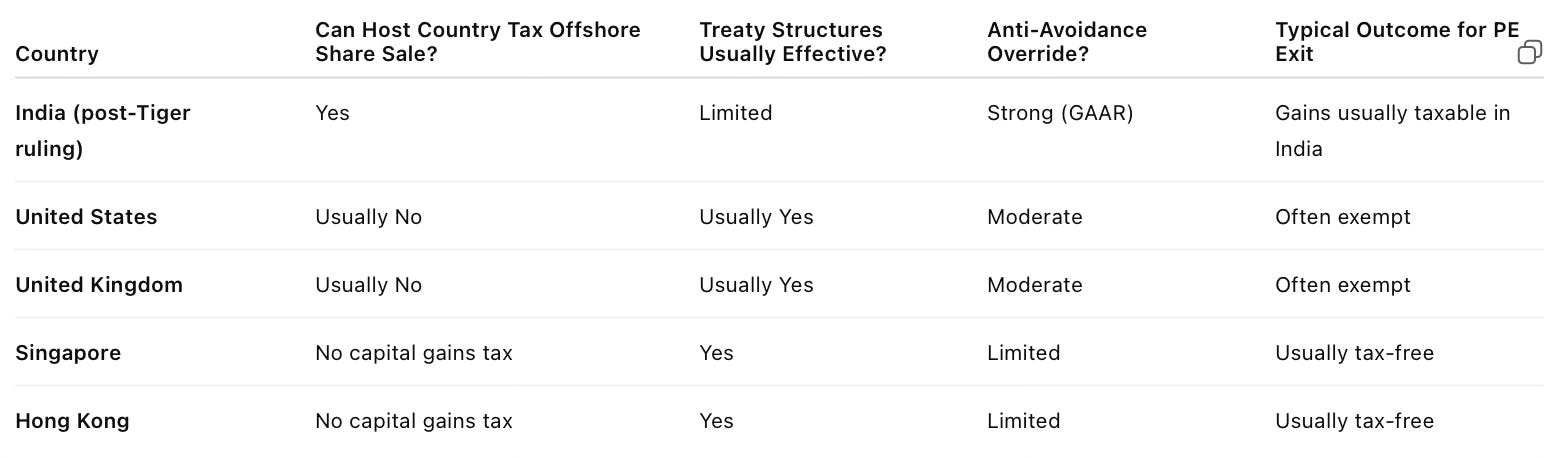
This effectively means that GAAR’s look-through of treaty structures overrides any treaty claims in the cases of transactions lacking any commercial substance or made solely to avoid taxes. In this backdrop, how does India compare with other jurisdictions in the taxation of gains from share sales?

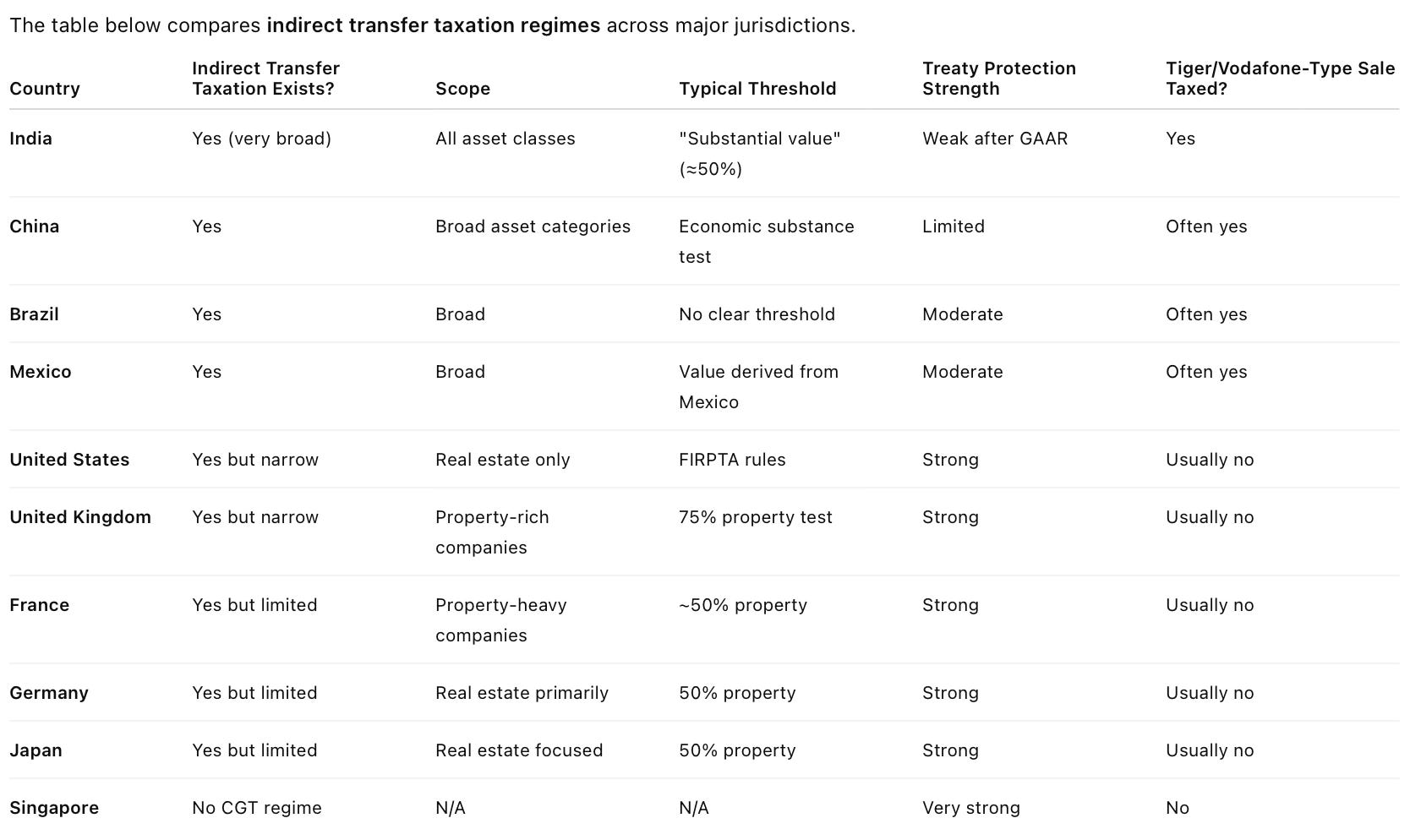
After the Vodafone case, the government had, in 2012, retrospectively legislated for taxation of offshore share transfers in a foreign company where the underlying shares derive “substantial value” from India. While this is the legal foundation underlying the Tiger Global ruling, it overrides the grandfathering provision in the legislation for prior deals. See below the indirect transfer taxation regimes across countries, which show that indirect transfer taxation is confined to real estate in most developed economies. 

In conclusion, the ruling, which could reshape how foreign investors exit their Indian investments, sets out a tougher interpretation of tax treaties. It allows authorities to deny treaty benefits if offshore investment structures are deemed sham entities with little commercial substance, even when investors hold valid documentation. The judgement gives India wide powers to scrutinise any offshore corporate deal. It also operationalises the Vodafone legislation. 

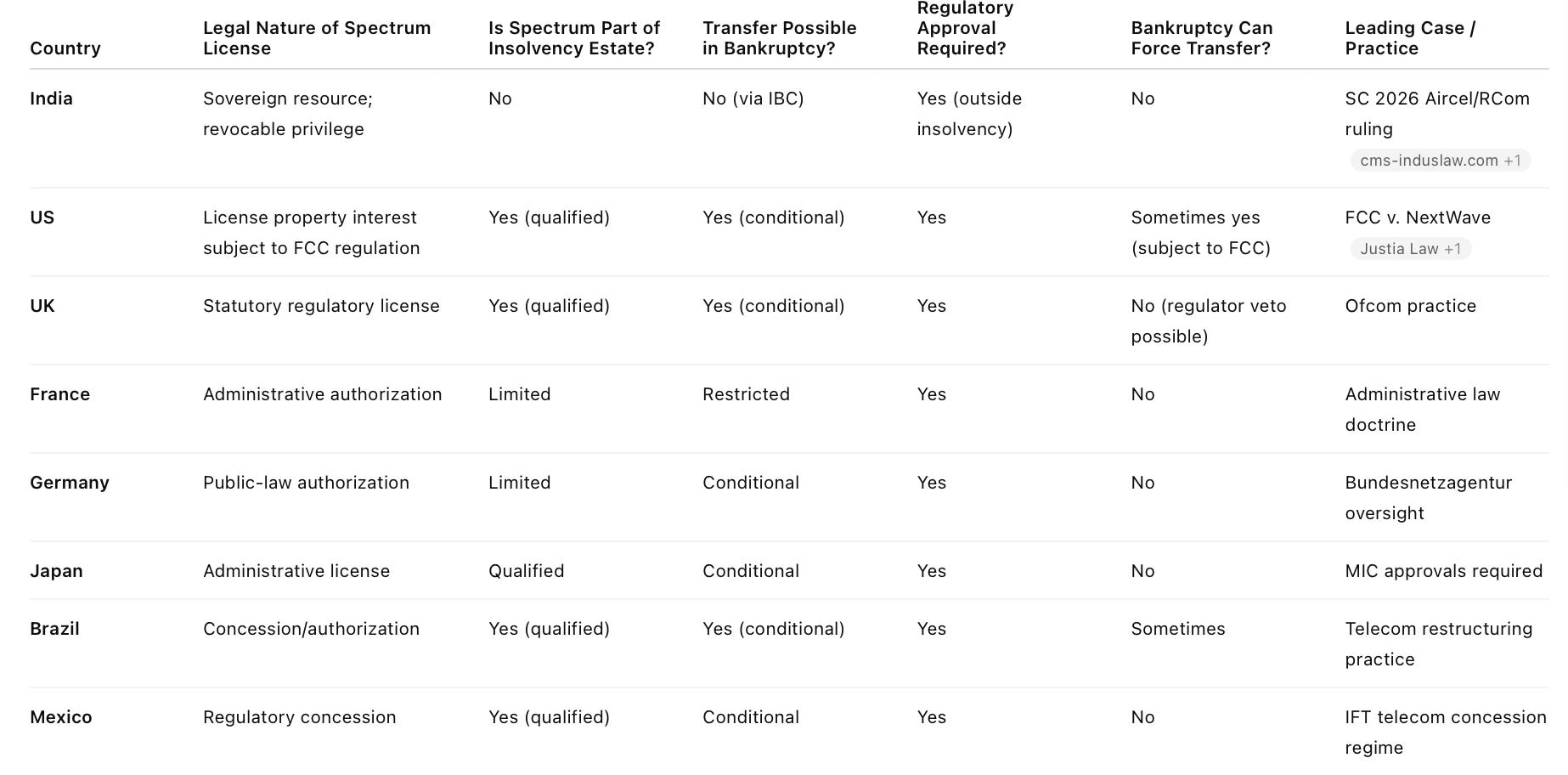
In the second judgment, on February 13, 2026, in the State Bank of India Vs Union of India, it ruled that telecom spectrum is a natural resource held in public trust and the right to use it does not form part of the insolvency estate of a telecom service provider (TSP). Given that the spectrum (and associated license) is the bedrock for TSP’s business, it forms the basis of TSP’s bankability. MS Sahoo and Raghav Pandey write,

This ruling effectively places the most valuable asset of a TSP beyond the reach of a resolution plan. The likely consequence is the liquidation of stressed TSPs and the fragmentation of the insolvency framework, contrary to legislative design… the ruling rests on a conceptual overextension. The Public Trust Doctrine (PTD) is applied without sufficient regard to the evolution of the modern regulatory state and market economy… The PTD emerged to protect communal access to resources such as air and water, as a check against the privatisation of the commons… In telecommunications, the state has translated the PTD into a detailed statutory and contractual framework of auctions, licences, and contracts. That framework explicitly permits the allocation, trading, and transfer of spectrum-usage rights. 

When the state auctions spectrum, it does not abandon the public trust; it operationalises the use through market mechanisms. A sovereign resource is converted into a regulated, tradeable economic entitlement, juridically embodied in the licence. For the Insolvency and Bankruptcy Code (IBC), 2016, it is this statutory-contractual construct that matters, not the doctrine in abstraction. The judgment does not fully distinguish between sovereign ownership of spectrum and the contractual licence conferring the right to use it. These operate at distinct juridical levels. Spectrum remains vested in the state at all times, while the licence is a statutorily recognised intangible right, acquired for valuable consideration… In accounting and economic terms, the money paid to acquire the licence exits the balance sheet and is replaced by an intangible asset of corresponding value… Banks and financial institutions lend money to TSPs secured against these licences; that security ought not to be diluted by invoking the PTD.

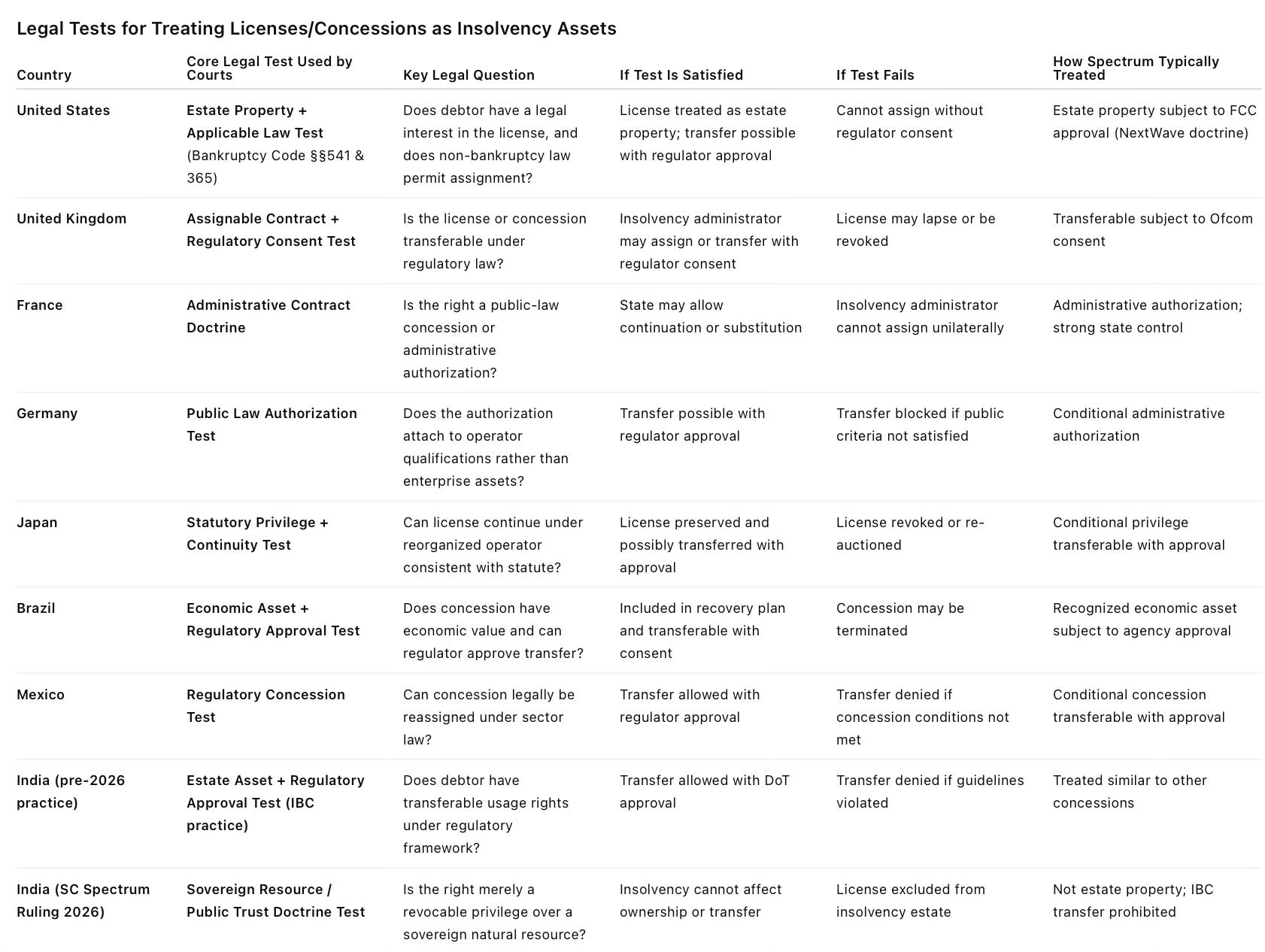
This decision makes India an outlier in the treatment of spectrum in insolvency proceedings. The US, UK, EU, Japan, Brazil, and Mexico treat telecom like other sectors in bankruptcy proceedings. 

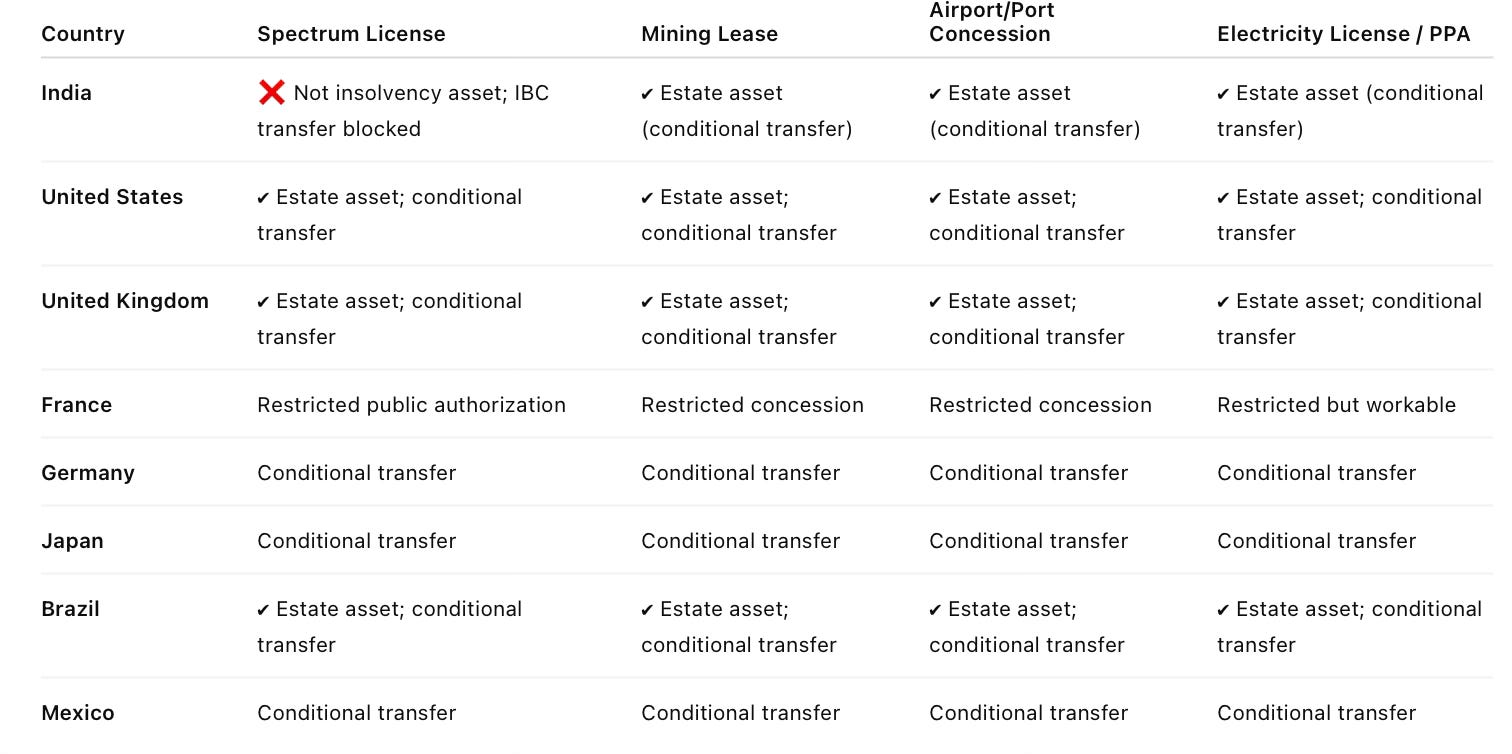
Not only does this ruling make India an outlier in telecom spectrum treatment in insolvency proceedings, but it also makes telecom an outlier among other sectors, even in India.

While mining leases, airport, port, and road concessions, and electricity PPAs can be transferred with regulatory approval, the same is now prohibited for telecom spectrum. This is despite telecom having similar features - time-bound lease, competitive allocation, revenue sharing, and regulated transfer - as the others. 

While all countries recognise public ownership of resources, with this ruling, India now diverges from others in the legal test to decide whether a government-granted license or concession is part of the insolvency estate and therefore transferable or usable in resolution. 

The ruling effectively reduces regulated asset values, raises the cost of telecom finance, weakens restructuring scope, and makes telecom concessions riskier than other infrastructure concessions, all this due to an avoidable regulatory interpretation. 

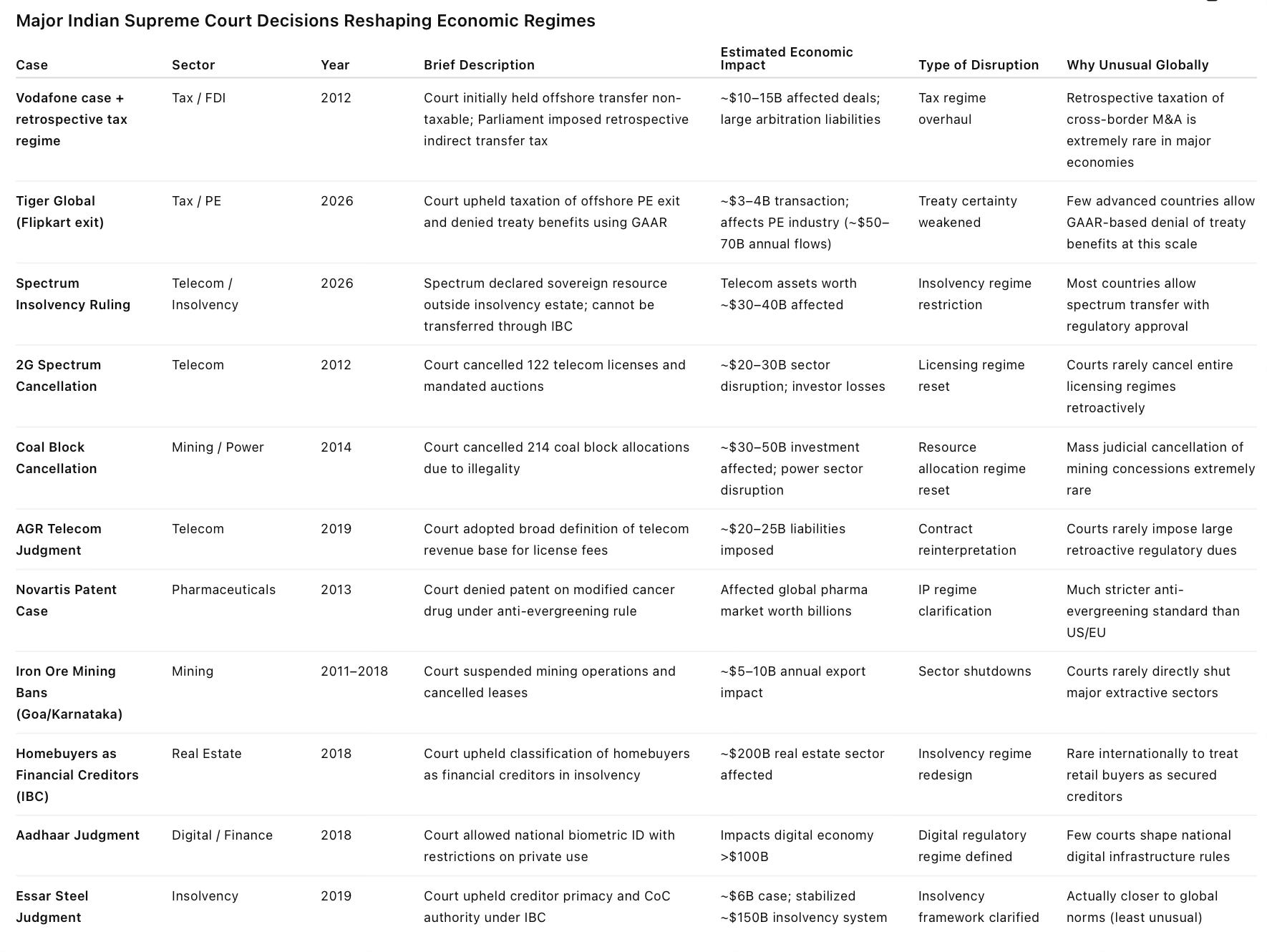
ChatGPT has this compilation of the Court decisions in India that have reshaped economic regimes in their respective sectors. The estimates are unverified and can be significantly off. 

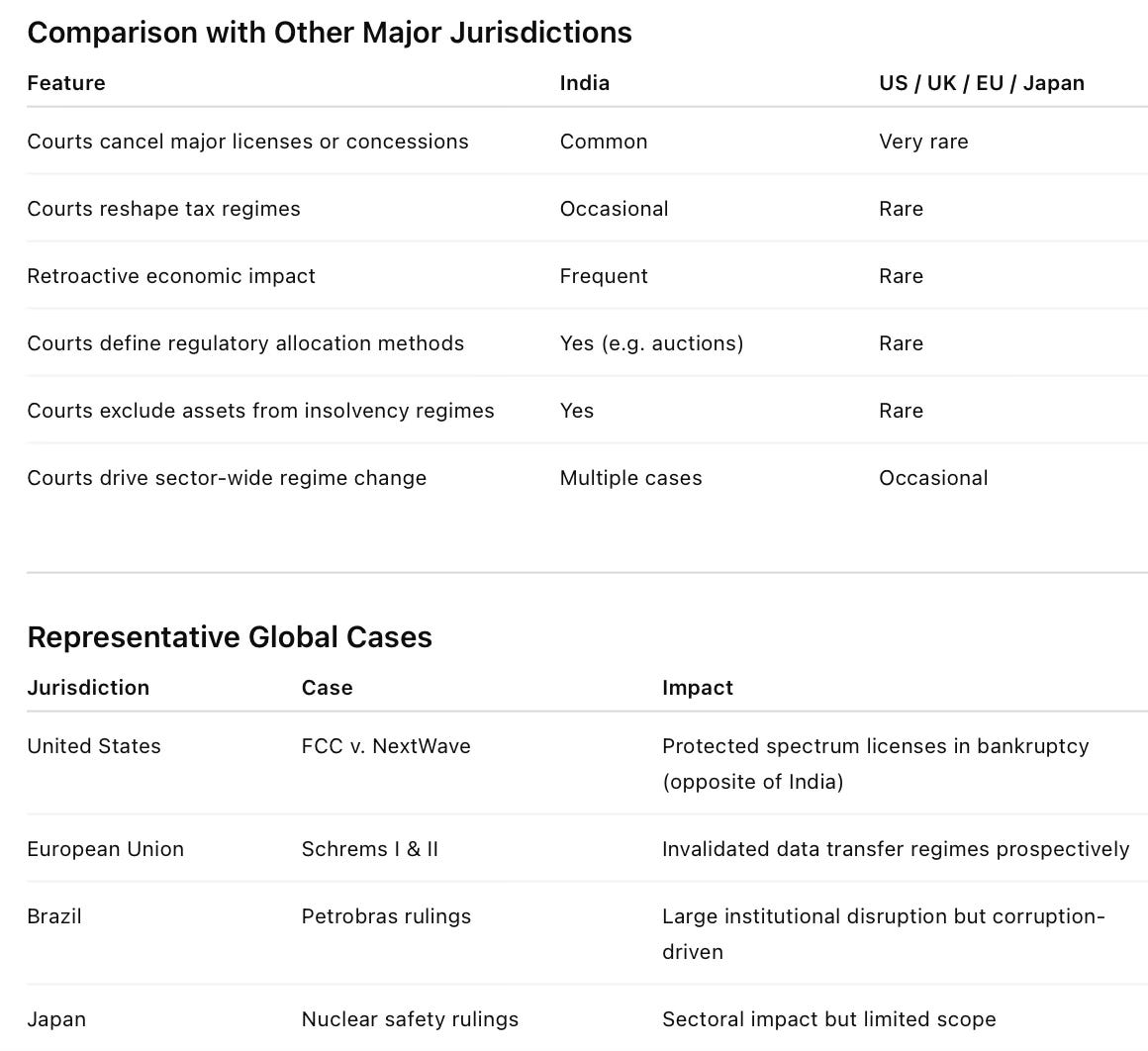
Of these, the cancellations of the coal blocks and 2G licenses, and the spectrum insolvency are major deviations from global norms. Also, on a global comparison, India has a relatively large number of Supreme Court decisions that rewrote regulatory frameworks, applied law retrospectively, and changed business models. 

In countries like the US, UK and EU, courts rarely cancel licenses or concessions, retrospective orders are uncommon, and regulatory regimes are usually shaped by legislatures and agencies. Courts in these countries leave policy design and regulation largely to administrators, legislatures, and independent regulators, and prefer to only interpret statutory frameworks. 

In contrast, Indian courts have taken an absolute view on public trust doctrine (without regard for its economic dimensions), favoured substance-over-form in taxation, and assumed the powers of broad and unconstrained scope in the judicial review of allocation processes. India remains distinctive in the scale and frequency of judicially driven economic restructuring, with courts almost acting as co-designers of policies on public resource management and taxation.

The concern here is not so much with the nature of the decisions per se. After all, some of these decisions are clearly progressive - substance-over-form in taxation, stricter ever-greening standards on patents, homebuyers as financial creditors - and should be adopted more widely globally.

Instead, there are two important concerns. One, at a fundamental level, should courts be making such definitive policy decisions? The argument that courts have stepped in where governments have abdicated cannot be taken as an answer. This is a slippery slope that risks destabilising the constitutional checks and balances. 

The second concern is about the economic uncertainty induced by rulings that upend economic regimes (or rules of the game) based on which business decisions were taken. If investment decisions were taken based on a prevailing interpretation of the regime and the same was widely accepted (governments gave permissions, financial institutions gave loans, rating agencies did not consider them risks, auditors audited statements, tax authorities generally overlooked them, etc.), then a subsequent substantive (logical, ethical, etc.) interpretation should not form the basis for reversing it with retrospective effect. The only exception to this should be if it is established that there was a malafide intent in the decision made by the government entity. 

The economic damages are exacerbated by the consequential decisions forced upon government entities. For example, the cancellation of one license immediately leads to the cancellation of all similarly placed ones. The rejection of a tax avoidance claim immediately triggers tax officials across the country to scout for similarly placed cases and issue notices to them. 

I’m not sure whether the legislative or executive can do anything to address these concerns. Its answer lies in the judicial realm itself, in the form of restraint while courts take such decisions. The Supreme Court could use the opportunity presented by something like a Public Interest Litigation (PIL) or a case to lay down certain judicial principles that should guide judicial rulings on cases with sectoral policy impacts.

Monday, January 5, 2026

Thoughts on civil litigation involving governments

Civil litigation involving the government is about half the massive backlog of civil cases pending before various courts in India. These cases mainly cover four broad areas: property-related claims and disputes, taxation-related matters, employee service matters, and contractual issues. This post will offer some suggestions on addressing the litigation load from such cases. 

Given the government’s role as the biggest litigant, and also the large numbers of cases continuously being added to the already massive pile of cases pending before the Courts, there must be a policy focus on what can be done to limit the incremental case load. Such measures should complement measures at the court system level to expedite the processing of pending cases. 

In theory, litigation arises when a party disputes an order or direction issued by a government official or entity. Such litigation can be triggered either by a genuine dispute that necessitates judicial intervention or by largely avoidable actions by the government or a private party. This post concerns the latter. While there are no estimates of such cases, I am inclined to argue that they would form the major share of litigation involving governments. 

I can think of five categories of such litigation:

1. Litigation involving procedural lapses and poor quality of orders by public officers is perhaps the largest source of litigation. This kind of litigation arises mostly due to the apathy and incompetence of frontline officers. They are commonplace in land, taxation, and government employees’ service matters. 

2. A small set of cases (which are also likely high stakes, involving large amounts) involves needless cascading litigation, where the government’s claim is tenuous. In such defensive litigation, government officials prefer to exhaust the full process of appeals to pre-empt vigilance inquiries. Land and taxation cases are examples. 

3. Litigation provoked by the abusive practices of government officials or entities that belong to two categories. The commonly known are malafide orders in favour of some vested interests (over other genuine claimants). A lesser-known one, perhaps bigger than the first, is that arising from actions of self-righteous (denial of rightful land title claims on so-called government lands) or overzealous (issue of bulk notices to taxpayers) officials. These are pervasive in land and taxation matters.

4. Collusive litigation by private parties, especially in taxation and contractual disputes, to avoid payment of rightful dues or cover up defaults on contractual obligations or force contract renegotiations. They include wrongful admissions, interminable stay orders, cases not being listed by court registries, etc. All such cases involve collusion by the judicial system. 

5. Administrative litigation by employees arising from delays in concluding long-drawn disciplinary cases, disputes in promotion seniority lists or in actual promotions, and disputes in the interpretation of service rules. This will include genuine cases of injustice due to administrative deficiencies and lapses. However, there is also a fair share of litigation done with the intent to obstruct or delay the due process. In each of the latter, courts contribute their fair bit to complicating matters by issuing conflicting orders and setting questionable precedents (most often forced on governments) that are selectively invoked by employee litigants.

So what can be done to address these cases?

Procedural lapses and poor quality of orders could be significantly addressed through process and technology solutions. Workflow automation and checklists could be useful in the case of the former, while the use of AI applications (trained on a template and a repository of orders) to prepare draft orders is emerging as a very promising area to control the quality of orders issued by public officials. Specifically, there’s a strong case for public investments and efforts on the latter front.

Defensive litigation could be addressed by solutions like explicitly forcing the consideration of the strength of the government’s case during the administrative decision-making process and placing accountability thereon, routing appeal decisions through Committees, and placing annual limits on the number of cases that can be appealed.

This kind of litigation is pervasive and is a big administrative and economic inefficiency. I blogged earlier, indicating that the government’s track record of recovering dues (in terms of ensuring payment into the Treasury) is abysmally poor. 

Abusive practices could be curbed by explicit restrictions on those, like the issue of bulk notices, except in extraordinary instances, to be clearly and sufficiently justified and issued by an appropriately higher authority.

Such abusive practices emerge from an administrative environment where the loss caused to the public exchequer attracts far greater scrutiny and punishments than the denial of the rights of citizens. One reason for this equilibrium is the administrative ease of identifying and documenting the former and the difficulty in doing the same for the latter. It may therefore be useful to formulate appropriate guidance that covers the latter in explicit terms, and force the consideration of the same while making decisions. More generally, a practical approach to revising undesirable administrative norms is to explicitly acknowledge the problem and then directly force its consideration into the decision process. 

The onus of limiting collusive litigation should, to a large extent, lie with the courts. Courts should exercise restraint with admissions and follow the process before admission, except in those cases demanding immediate remedy. Stay orders should have a sunset and mandatory listing. Further, the process of listing cases should be made transparent, even automated. Finally, the government agencies concerned should have a capable and responsive legal team that can represent their side promptly, accurately, and effectively through their counsels. The last is clearly dependent on state capability. 

In the case of administrative litigation, the judicial system must become aware of its own central role in contributing to the problem. The common types of such cases can be identified, and the Supreme Court could consider issuing guidance on such matters to prevent their recurrence and also clear the existing stalemates. Is there a way to clear up conflicting judgments on service matters, at least at the level of High Courts? However, notwithstanding these efforts, the fourth and fifth arise respectively from the political economy and pervasive state capability weaknesses, and therefore are perhaps unavoidable to some extent. 

In any case, it would be useful to analyse a sample of litigation in any state based on this framework to help prioritise actions along the lines discussed above.

Saturday, September 6, 2025

Weekend reading links

Thailand’s Prime Minister Paetongtarn Shinawatra has been removed from office... The country’s constitutional court on Friday found Paetongtarn guilty of ethics violations over a phone call with Cambodia’s former leader Hun Sen, in which she criticised the Thai military in the run-up to the border violence... she is now the fifth holder of that office to be removed by the constitutional court in the past 17 years... Paetongtarn, a political novice, assumed office last year after her predecessor, property tycoon Srettha Thavisin, was dismissed by the constitutional court for appointing a previously jailed lawyer as a cabinet member, an ethical violation... The constitutional court has dissolved more than 100 political parties over the past 30 years, including Move Forward, which received the most votes in the last nationwide election in 2023.

2. Boeing and Airbus

The success of the A320 family has been the driving force behind Airbus’s ascendancy in its five-decade rivalry with its US competitor. For years, the two companies had a roughly 50:50 split of the market for commercial single-aisle aircraft. But by the end of last year, Airbus held a market share of 61 per cent measured by order backlog and 72 per cent by deliveries... Boeing delivered 348 jets in 2024, fewer than half the 766 that Airbus managed, as 737 Max output remained subject to a 38 per month cap pending improvements to quality control. A shortage of engines has been one of the most persistent challenges for both companies. CFM International, a joint venture between France’s Safran and GE of the US, and Pratt & Whitney have struggled to keep up with demand. Both companies’ engines for the A320neo have also had durability issues.

3. India uses half the capital to raise output by one unit compared to China.

4. FT effectively calls out corporate America as a bunch of bullies who flaunt their muscle before the weak and prostrate when they are in turn bullied.

When Zohran Mamdani resoundingly won the Democratic mayoral primary for New York in June, Wall Street and Silicon Valley erupted in outrage at his promises of free buses, rent freezes and city-run groceries. Hedge fund billionaires Bill Ackman and Dan Loeb, Jamie Dimon of JPMorgan Chase and tech entrepreneur Brian Armstrong of Coinbase all warned about the risk of heavy-handed interference in the city’s economy. David Solomon, chief executive of Goldman Sachs, took to LinkedIn to slam Mamdani’s proposal to freeze city-controlled rents. “When New York tried it in the 1920s and 1960s, it limited affordable housing, narrowed investment in new housing, and made housing outside the control area more expensive,” he wrote. The reaction over the past few weeks as US President Donald Trump has unveiled a series of blunt interventions into the workings of both the financial system and the operations of private companies has been very different... 
Yet as Trump has stepped up his attacks on the Fed, Wall Street’s leading figures have offered only limited criticism. And while many of his corporate interventions amount to the sort of European-style dirigisme that the US business elite once loved to deride, the response to Trump’s agenda has been near silence. Indeed, some business leaders have offered praise of the president’s attempts to direct the economy... The juxtaposition with Mamdani is striking: vociferous criticism of the frontrunner to be New York’s mayor from business leaders, but calculated restraint as the president reshapes the rules of free enterprise in America... the principal explanation lies in fear. Criticising Trump, they argue, is risky business. “They’re more afraid of the guy in power in Washington than of the potential mayor of New York,” says Ilya Somin, a law professor at George Mason University and scholar at the libertarian Cato Institute. “Even if Mamdani does become mayor of New York, he will not have the kind of power that the president of the US has.”... Jamie Dimon, who last month dismissed Mamdani’s economic views as “the same ideological mush that means nothing in the real world” and criticised “idiots” in the Democratic party, has stopped short of criticising Trump directly.  

5. India is now becoming a more expensive mobile services market. 

6. The Ken has a nice story on how India’s private sector is making UAE as a choice investment destination.

Personal-care and pharmaceutical company Himalaya Wellness; electric-vehicle maker Omega Seiki Mobility (OSM); electric-bus manufacturer (and subsidiary of commercial-vehicle giant Ashok Leyland) Switch Mobility; and iron-and-steel-pipe manufacturer Jindal Saw. These are just a few among Indian companies who’re planning to set up fully-operational manufacturing bases across free-trade zones in the UAE. Others, such as consumer-goods company Dabur, eyewear company Lenskart, and conglomerate Tata already have operations there. Tata’s presence, in particular, is sprawling—from hospitality ventures such as Taj Exotica and The Palm Dubai, to Tata Steel Middle East’s downstream facility to manufacture steel flooring in Jafza. Of the total 11,000 companies in the Jafza free-trade zone, 2,300 are Indian… While India currently has 276 operational SEZs with around 6,300 companies, the UAE—which is smaller than the state of Bihar in area—has 40 free-trade zones boasting over 200,000 companies… The incentive comes in the form of financial backing from UAE’s sovereign-wealth funds, joint ventures, or loans. For instance, before Lenskart’s Dubai factory became operational in 2024, it had received $500 million from the sovereign wealth fund Abu Dhabi Investment Authority (ADIA)… Similarly, Himalaya Wellness secured $80 million in loans in 2023 from the Emirates Development Bank for its upcoming plant in Dubai’s free-trade zone. Spanning 225,000 sq ft, it is expected to create jobs for 250 professionals and produce 3 billion tablets, 15 million syrup bottles, and 3 million ointment units a year by 2030.

The numbers are truly disturbing. There are 2300 Indian companies in just one UAE FTZ, compared to 6300 firms in all of India’s 276 SEZs! Even with all the obvious attractions of UAE - tax-free zones, ports and logistics facilities, and access to international institutional finance - this scale of exit should be a matter of concern. 

7. Gartner's annual "digital automaker index" which compares carmakers on their potential to monetise their software has the following line up. 

Clearly, the traditional car makers have fallen behind, being overtaken by the new American and Chinese firms focusing on electric vehicles. 
Ultimately, analysts warn that the auto industry is likely to go in the same direction as smartphones and PCs, with a small number of operating systems like iOS and Android eventually dominating the software space. They add that the transition will fundamentally tilt the industry’s modus operandi away from designing, building and selling cars — a business model characterised by mechanical engineering and relatively thin profit margins — and towards software and services. Toyota and its peers are aiming to use these to create new sources of revenue as the industry shifts to autonomous electric cars. Investment across the industry is already shifting from superior engines and external design to the computer systems that will control everything from batteries to safety features and, eventually, self-driving functions.

8. Unit economics of food delivery e-commerce.

Both Swiggy and Zomato typically charge restaurants a commission ranging from 15-30%, depending on the scale of the business, with smaller businesses often paying higher commissions. Most restaurants say nearly half the order value disappears before it even reaches them. Explaining the math, restaurateurs indicated to Mint that on an order of, say, ₹300, about ₹75- ₹90 goes to the aggregator as commission, while about ₹60- ₹90 is lost in discounts; ₹15- ₹30 goes towards marketing on the platforms just to stay visible. In the end, a restaurant is left with only ₹150- ₹90 out of an order worth ₹300. This is a generalized estimate and the actual numbers can be higher or lower depending on each restaurant’s commissions and ad spends. “Pre-covid, commissions were as low as 8-12%. Now, the base commission is 33% and with payment gateway charges, marketing costs, taxes, the sky's the limit. Cost-per-click (the cost a restaurant pays when a user clicks on the ad listing by a restaurant) used to be around ₹1.25 but now it is more than ₹7," the owner of a restaurant chain based in Assam told Mint... Spiralling costs aren’t the only concern for restaurants. Owners are also upset over arbitrary discounts, hidden features and a near-total lack of communication from the platforms. Several restaurateurs allege that Swiggy and Zomato launch discounts or even enable dine-in reservations without their consent.

9. Ajai Srivastava of GTRI points to how Quality Control Orders (QCOs) worsens the business environment in India. Sample this.

A recent example is the steel ministry’s June 13 order. It requires not only finished and semi-finished steel products, but also the raw materials used to make them, to have a BIS quality certificate. The rule took effect with barely one working day’s notice, causing shipments to be stuck at ports, contracts to be cancelled, and court cases to be filed... Now, every upstream raw material supplier — even if located in a third country — must also be BIS-certified... This policy imposes a double-certification requirement. The first certification — the one that matters — is for the final product, which is already in place under FMCS. The second, newly mandated certification is for upstream raw material suppliers, often in third countries far removed from the Indian market. Getting BIS certification takes 6 to 18 months, involves substantial fees, and requires performance guarantees and compliance audits. Small overseas mills producing modest volumes for an intermediary exporter have no incentive to invest the time and money needed for certification. This means limiting the number of foreign suppliers for Indian buyers...
Additional licensing for raw material suppliers adds no meaningful quality assurance. Existing safeguards — mill test certificates, port-level Positive Material Identification (PMI) tests, and customs inspections — already prevent substandard imports... No major steel-producing economy — the United States, European Union, or Japan — requires separate raw material certification if the final product meets national standards. Instead, they rely on traceability through Mill Test Certificates, accredited third-party testing, and mutual recognition agreements. India’s double-certification model diverges sharply from these norms and risks being classified as a non-tariff barrier (NTB) under World Trade Organization (WTO) rules... By forcing upstream suppliers with no commercial interest in India to undergo a burdensome certification process, the government has added avoidable costs, and jeopardised India’s reliability as a manufacturing partner.

10. Interesting that Cantor Fitzgerald, an investment bank run by the sons of Howard Lutnick, has been buying up tariff refund rights in the expectation that the US courts will finally rule the tariffs illegal and force the government to refund them. 

11. Palantir may be the most over-valued firm in history!

Palantir’s market value has already soared to $430bn, more than 600 times its past year’s earnings and nearly triple the equivalent multiple for Cisco (or, indeed, Nvidia) at its peak. Software firms often prefer to express their valuation in terms of underlying sales, which puts Palantir’s multiple at around 120. For comparison, in 2005, the year before the Oxford English Dictionary added the verb “Google”, Google’s price-to-sales ratio peaked at 22... Adam Parker of Trivariate Research, an investment firm, has published a note entitled “Could Palantir be the best short idea?” Writing in late May, he examined the ratio of enterprise value (which adjusts market value to account for debt and cash on the balance-sheet) to forecast sales for the coming year. On this measure Palantir then scored 73 and now scores 104. Mr Parker looked for other listed companies that had hit a multiple of 70 since 2000. Excluding financial firms and those with annual revenue of less than $50m, he found 14, the largest of which has a market value around a quarter of Palantir’s... To reduce its price-to-sales valuation to “only” Google’s at its peak in 2005, while maintaining its current share price, Palantir needs to multiply its revenue by 5.6—substantially more than the barnstorming progress it has made over the past five years. Doing this over the next five would require an annual growth rate above 40%.

12. Staggering statistic about electoral support for Trump.

According to Gallup, just 1 per cent of Democrats approve of Trump’s job performance, while 93 per cent of Republicans do — equalling the biggest split since this survey started in 1979.

13. Fascinating graphic that shows the over-representation of extreme views in social media.

Recent work by US researchers Claire Robertson, Kareena S del Rosario and Jay van Bavel among others… find that social platforms’ inbuilt tendency to reward indignant and hostile content creates incentives that systematically reward the production of simplistic messages and extreme positions, while rendering moderate views less visible… with social media we essentially have a plethora of fiercely anti-establishment and ruthlessly eyeball-chasing broadcasters, and they’re reaching much larger and broader swaths of the population. This proliferation of views and narratives formerly considered beyond the pale, spread via individuals and platforms outside the control of erstwhile political and media powers, has shattered norms that previously kept radicals on the fringe... 

A 2019 study found that communities in Italy and Germany that received broadband internet access earlier than others also saw earlier upticks in support for populist parties. In his 2024 book The Normalization of the Radical Right, Vicente Valentim shows that support for many populist positions and politicians has long been higher than widely appreciated, and that the discovery that many others share these views — a process facilitated by the internet and social media — has led to them being voiced more confidently, and embodied at the ballot box.

14. Excellent article about the rise of high-bandwidth memory (HBM) chips as the "new frontier of the AI revolution" and how SK Hynix has become the dominant maker of such chips. 

For decades, memory chips were the unglamorous end of the semiconductor industry, overshadowed by the logic or processor chips designed and produced by companies such as AMD, Qualcomm, Nvidia and TSMC to conduct calculations and control an electronic device’s operations. But HBM designs, such as the HBM3E produced at the Icheon factory, are transforming the memory industry. Joon-yong Choi, vice-president and head of HBM business planning at SK Hynix, notes that whereas in conventional dynamic random-access memory (Dram), “cost was prioritised by customers over power and performance, with HBM power and performance are prioritised over cost”. They are helping developers of so-called large language models alleviate the effects of the “memory wall” — where limitations in storing and retrieving data are an impediment to improving performance — as well as boosting efficiency and lowering costs at thousands of data centres under construction around the world...
Intel began life in the 1960s as a memory chip company, but exited the Dram sector in the 1980s under pressure from Japanese rivals Toshiba and NEC. They, in turn, were supplanted in the 1990s by Samsung and the chip division of Hyundai Electronics, or Hynix, which would later be acquired by the SK conglomerate. The two Korean groups and Micron, of the US, have dominated the sector ever since. Samsung was until recently the undisputed leader of the heavily commoditised market in Dram chips, which are powered and store data temporarily while a processor is running. It used its superior scale to invest in production capacity during the cyclical industry’s regular downturns...
HBM chips, which Hynix began developing in 2013... involved stacking layers of Dram units connected by copper wires a tenth of the thickness of a human hair, like a multistorey library with lifts to quickly transport piles of books between floors. That means HBM chips can offer 1,024 pathways for sending data to and from a processor, Choi explains, compared with 64 for conventional advanced Dram chips. “Think of it like the number of taps filling a water tank, or the number of lanes on a highway,” he says. “When it comes to the memory requirements of AI, nothing comes close to HBM.”... Hynix’s early adoption of an advanced bonding technology called mass reflow-molded underfill, or MR-MUF, as key to its HBM success. It involves the use of a special resin-based insulation material to prevent overheating, crucial when stacking up to 16 Dram chips on top of each other...
HBM chips offer profit margins of about 50-60 per cent, compared with about 30 per cent for conventional Dram units. Because each HBM chip needs to be designed to fit the specific AI graphics processing unit to which it is paired, orders must be placed a year before production, typically on one-year contracts... while compute performance is more important for training AI models, memory is widely considered more important for deployment, also known as inference.