Substack

Showing posts with label History. Show all posts

Saturday, June 20, 2026

Weekend reading links

1. PE firms sitting on $4 trillion of unsold assets, on investments largely made between 2020 and 2022 when rates were slashed to zero, are finding creative ways to offload them. Sample this

Blackstone is marketing a so-called collateralised fund obligation that will bundle more than $2bn of stakes in leveraged buyout funds into bonds to sell to investors and insurers, according to people familiar with the matter. The deal would provide an infusion of cash to investors in a Blackstone Strategic Partners fund, the firm’s unit that invests in other private equity groups’ funds. It is unclear if Blackstone will ultimately go ahead with the securitisation or seek to sell the stakes in a secondary transaction, one person briefed on the matter said... The vehicles, which are sliced and diced to give investors exposure to different levels of risk and return, have boomed. Issuance of CFOs soared to a record of $25.9bn last year from a modest $4.8bn in 2021, according to credit rating agency KBRA.

2. This is a brilliant articulation of the problem with articulating something purely in terms of absolute numbers and aggregates.

In his novel Hard Times, Charles Dickens described a girl called Sissy, who was having a terrible time in her lessons. Her schoolmaster told her to imagine that her schoolroom was a nation in possession of “fifty millions of money”. Wouldn’t that mean it was a prosperous and thriving state? “I said I didn’t know,” she relayed afterwards to a friend. “I thought I couldn’t know whether it was a prosperous nation or not, and whether I was in a thriving state or not, unless I knew who had got the money, and whether any of it was mine. But that had nothing to do with it. It was not in the figures at all.”

3. Interesting story about how old companies are reinventing themselves to profit from the AI-boom.

AI servers must be more tightly linked together, increasing the need for advanced cabling and optics. Shares in Corning, the 175-year-old inventor of Pyrex glass that also supplies screens for Apple’s iPhones, have increased by more than 270 per cent in the past year after it signed deals with Meta and Nvidia to supply optical fibre cabling to AI data centres. The vast amounts of electricity needed for AI training are also fuelling demand for specialised power management, high-voltage electronics and cooling technologies. This has led to big interest in traditional suppliers of electrical equipment, typically deployed in residential and industrial projects. Eaton, an Ohio-based power management company, received 240 per cent more data centre orders in Q1 this year...
 
French electrical equipment maker Legrand has doubled its revenues this decade with half of the growth coming from data centres, which now make up more than a quarter of its turnover. Air conditioning and liquid cooling — using water to stop chips from overheating — are in demand too. Shares in AC maker Comfort Systems USA have shot up 260 per cent over the past year, while Schneider Electric bought a stake in data centre liquid cooling specialist Motivair for $850mn last year. Utilities are rushing to supply AI companies with power — including Spain’s Iberdrola, a leading supplier of power contracts to tech groups in Europe, according to Pexapark data, and Entergy in the US, whose share price hit a record high after a $10bn deal with Meta... Several generator and engine companies have also pivoted to supplying data centres, including Caterpillar, Boeing supplier Howmet Aerospace, Finnish ship engine maker Wärtsilä and Baker Hughes, which formerly focused on oilfield services.

4. China demographics facts of the week.

This year’s cohort of gaokao-takers were mostly born in 2008, a year of 16.1m births. By 2025 births had more than halved, to just 7.9m. The demographic cliff is already visible in nurseries, which saw pupil numbers plummet from 46m to 32m between 2022 and 2025. Numbers in primary schools have also started to thin. Inevitably, over time, secondary schools and then colleges will follow.

And technology adoption

A survey of 322,000 students last year by the China National Academy of Educational Sciences, a state-affiliated think-tank, found that 85.6% of them had already tried using AI to complete their homework. On popular apps such as Zuoyebang (“Homework Help”) and Yuanfudao (“Ape Tutoring”), pupils snap photos of questions and ai walks them through the solutions. (Teachers are using similar technologies to help mark homework.)

5. Public moods on the role of government in the UK - 70% support nationalising energy and 82% water.

Rail subsidies have been rising, £12bn in operational support in 2024-25, up in real terms from £2bn in 2000-01. 
6. Indian economy facts of the week.
The World Trade Organization data show that for non-agricultural goods, the share of tariff lines in the category 10-15 per cent increased sharply from 1.4 per cent to 33.5 per cent between 2014 and 2024 and for the tariff category 15-25 per cent from 1.7 per cent to 14.9 per cent, while the share of tariff lines in the category 0-10 per cent fell steeply from 90.5 per cent to 42.5 per cent over the same period.

7. From Thomas Astbridge's book on the Black Death 

In its most intense phase, from 1347 to 1353, the Black Death killed more than 100mn people, or about half the population in the areas infected, Asbridge estimates. This makes it more lethal than two other great pandemics — the 6th-century Plague of Justinian in the Mediterranean and the pestilence that swept across Asia from the mid-19th century until the aftermath of the second world war — and far worse than Covid-19 in our times... Asbridge demonstrates that the Black Death was probably more devastating in cities such as Cairo and Damascus than in, say, Constantinople or Florence. In Cairo, a metropolis of 500,000 people, almost 10 times larger than London’s population, perhaps 250,000 died, Asbridge suggests.

8. On the role of luck in football tournaments.

According to one study of historical matches, the chances of the team with the worse record winning was 45 per cent in football, compared with just 36 per cent in America’s National Football League. (Yes, this pep talk has statistics. Bite me.) The knockout structure raises the role of chance, as just one dodgy penalty can crash a team out of the competition. According to numbers crunched by James Tozer of Prospect, a sports analytics company, betting odds gave the top four teams in the most recent Premier League a combined 89 per cent chance of winning (after adjusting for bookies’ ability to take advantage of fans’ optimism that their team would win). In the World Cup an upset is more likely, as that figure is only 48 per cent.

9. Aldi effect, as the discount grocery retailer seeks to expand aggressively, as it envisages 4000 stores at an investment of $9 billion in a US market where consumers are facing higher prices due to persistent inflation.

Credit card data analysed by the bank found that when an Aldi store opened, it shaved an average of one percentage point off annual sales from competitors within a 10-mile radius... Aldi prospered in postwar Germany under brothers Karl and Theo Albrecht before a disagreement led to a split in the 1960s. One offshoot, Aldi Süd, oversees Aldi’s US business after opening the first store in Iowa in 1976. The other, Aldi Nord, owns the quirky US grocer Trader Joe’s. The discounter’s stores are austere places with only about six staff on duty. They are designed for maximum efficiency: groceries are shelved without leaving their cardboard shipping trays and oversized bar codes are printed on packing so checkout operators can scan at pace. Customers must deposit a coin to obtain a shopping trolley, which is refunded if they return it. Operating cost savings fund the chain’s low prices... Aldi’s compact stores, which stock only about 2,000 product lines, are often located near competitors such as Walmart, whose large-format stores carry about 120,000 products, including low-priced groceries.

10. Andhra Pradesh shrimp production facts.

India exports approximately 8 lakh tonnes of shrimp a year, with Andhra Pradesh accounting for over 60 percent of production. The state accounts for 80 percent of the country’s shrimp exports and 34 percent of marine exports, valued at around Rs 21,246 crore annually. The state has 2.5 lakh aqua farmer families, of which 2 lakh are small and medium farmers. Another 30 lakh people depend on allied sectors. According to the Union Ministry of Commerce and Industry, India exported a record 17,81,602 MT of seafood worth US$ 7.38 billion (Rs 60,523.89 crore) in 2023-24, of which frozen shrimp alone accounted for 92 percent — a significant share from Andhra Pradesh.

11. India's PPP pioneers

GVK’s 216-megawatt (Mw) Jegurupadu plant became an early proof-of-concept under a power purchase agreement. IL&FS built a 12-km toll road between Rau and Pithampur in Madhya Pradesh, marking India’s first private toll concession.

12. This is a true success story for the Indian economy.

Between 2020 and 2026 the number of Indian retail investors rose from around 40m to 130m.

Monday, January 12, 2026

Restoring the balance in politics, economics, and beyond

A recurring underlying aspect of many problems that we see today in the economy, polity, and society is that of imbalance in the pursuit of ideas and ideologies. 

In public discourses, we see it in the prioritisation of individual rights over the social and the collective. This manifests in the dominance of liberalism on social issues and free-market principles on economic issues. 

In recent years, especially in the US, woke liberalism has been squeezing out conservative views. The resultant tensions manifest in the political realm on issues like family values, transgender rights, and most prominently in debates on immigration. It has resulted in the near-complete polarisation between the liberal and conservative political camps, with almost no meeting ground. The political centre stands egregiously vacant. 

In economics, it’s about the pursuit of free market and efficiency-maximising ideologies gone too far. I have blogged hereabout 25 economic orthodoxies that conflict with reality. Generally, in Western economies (again, especially the US), it is about consumption marginalising production, and the elevation of virtual innovation (software or digital) over physical innovation. The near deification of AI and the complete neglect of the (perhaps more important) emerging electro-industrial-tech stack is an illustration. 

In international trade, trends like tariff reduction, trade liberalisation, globalisation of value chains, and offshoring have clearly gone too far. The most striking manifestation of this trend is China’s stranglehold on the world economy in manufacturing, and the associated destruction of manufacturing bases and loss of manufacturing jobs across countries.

Nowhere is the loss of balance as salient as in finance. It manifests in the disproportionate and growing importance of private (venture capital and private equity) over public markets (banks and capital markets) in financial intermediation. I have written here about the problems and consequences of financialisation going too far. It is evident even in the preference among youth for liberal arts education over STEM courses in colleges. 

In important areas of global concern like climate change, this imbalance has led to a headlong plunge into renewable energy sources and electric vehicles and wholesale abandoning of fossil fuels and traditional industries. It has swept aside daunting transition challenges like financing sources, sunk costs of legacy systems, unsustainable mitigation and adaptation costs for developing countries, technical problems of integrating energy systems, and so on. 

This imbalance is also stark in our engagement with emerging technologies like Artificial Intelligence (AI). The agenda on automation and the application of AI is almost exclusively framed and driven by Big Tech companies. The public narrative is framed in terms of innovation and human progress, the most desirable of all objectives. But the driving force behind the race to adopt these technologies is efficiency maximisation and cost reduction, which enhance business competitiveness and increase profits. Its larger consequences are never a consideration, and adoption is done without any public debate.

On this issue, as I blogged here, Daron Acemoglu and Simon Johnson have shown how ideas and technologies have deep political significance and how agenda-setting shapes the nature of the “progress” arising from these ideas and technologies. The agenda framing makes certain aspects of the issue salient while obscuring certain others. This process is deeply political. The political power balance determines what’s made salient and what’s obscured.

Another imbalance surrounds the marginalisation of the role and importance of governments and the elevation of the private sector. For example, the ever-expanding use of consultants and outsourcing of services has enfeebled government capabilities and left the state open for capture by vested interests (see this and this). It has amplified the self-fulfilling dynamic of governments are inefficient and therefore should deregulate and exit. There’s a real risk that the new movement of deregulation will add to this enfeeblement without achieving anything substantial in its original objective. 

In development, it is about neglecting plumbing issues, such as state capability, in favour of innovation, management theories, and the application of IT solutions. For example, in school education, the fundamental issue of improving classroom instruction quality (and therefore teacher capabilities, motivation, pedagogical techniques, and teacher-student engagement, among others) is often overshadowed by the pursuit of smart classrooms, digital content, and blended learning, among other initiatives. I have blogged here on ten things in development orthodoxy that deviate from reality. 

The common thread in all these examples is that of an idea or ideology being taken to its extremities, sweeping aside counter-views. The resultant common deficiency is that of balance. Any idea or ideology unrestrained by countervailing views and unmoderated by reason and prudence becomes unbalanced and verges towards fanaticism. 

The Greeks had a word for balance, meson, or the middle. At a philosophical level, the Bhagavad Gita refers to the highest state of balance, or equipoise. In physical and social systems, this balance is achieved in a state of equilibrium (it is a different matter that there might be multiple equilibria). The essence of stability in any system is this balance. 

However, the innate dynamic of ideas and phenomena generates a gravitation or swing to the extreme. This is just as true of social systems as it is of physical systems. Any trend - capitalism, socialism, statism, globalisation, liberalisation, privatisation, deregulation, financialisation, automation, etc - if left to itself, follows a self-reinforcing feedback loop that ends up destroying countervailing forces and spawns its excesses. 

I blogged here about a universal dynamic to how ideas evolve and play out. They trigger interest and get gradually adopted, with their degree of adoption increasing over time. This, in turn, creates distortions that cause a backlash against the idea. The backlash strengthens over time and results in a correction of the excesses that had seeped into the idea. 

A simple framework to explain this is the Hegelian dialectic, wherein as a thesis (idea) evolves, it conflicts with its emerging antithesis to generate a synthesis, often a better state of affairs. As Hegel wrote, thesis begets anti-thesis, both of which undergo a struggle to generate a synthesis, and so on it goes.

In their highly influential book, The Fourth TurningNeil Howe and William Strauss describe a cyclical trend in history. Their century-long cycle encompasses four phases, or turnings as they call it - High, Awakening, Unravelling, and Crisis. Each turning lasts a social generation of about 20-25 years. 

The work of Howe and Strauss has resonance in other similar interpretations of history. In this essay from 1976, Sir John Bagot Glubb, the former Commander of the Arab Legion, describes history in terms of cycles of around 250 years, or 10 generations of 25 years each. Peter Turchin, an expert in cliodynamics, uses maths to model historical changes and find historical cycles.

Be that as it may, this imbalance has inevitably forced backlashes across fields - politics, economic policies, trade, financial markets, public systems, etc. Across them, orthodoxy is on the retreat. Populist politics, anti-immigrant sentiments, protectionism, revival of manufacturing, retreat of globalisation and offshoring, support for fossil fuels, etc., are a result of this backlash. 

In the circumstances, the challenge for us is to identify and acknowledge the imbalance within systems, and then figure out ways to deal with the problem. There’s a need to consciously cultivate or encourage countervailing forces to achieve a dialectical balance. Only open systems can engage meaningfully through such a process to achieve balance. 

In this context, it is also useful to draw from a concept formulated by Aristotle, phronesis, or practical wisdom. It is the ability to exercise good practical judgement, as the highest intellectual virtue. Unlike theoretical knowledge or technical skill, it is about knowing how to act rightly in specific situations by balancing general rules with context, ethics, and experience to achieve good outcomes. Its critical value is underlined by Albert Hirschman, describing the ability to exercise good judgment as the binding constraint in development.

This is important since a related theme associated with the imbalance is the supremacy of expertise and technocracy, and the marginalisation of prudence and politics. This trend must be acknowledged and reversed for any meaningful effort to restore balance in these realms.

Tuesday, November 5, 2024

Infrastructure construction, power generation in Africa, and demography

This post will be about some articles from Works in Progress that discuss the growth-hindering consequences of progressive regulation, the conundrum facing the electricity sector in Africa, and France's premature demographic transition. 

1. How much regulation is too much? Specifically, what level of environmental and other safeguard permissions are required for infrastructure projects in developed countries?

Consider this on the prohibitive costs of environmental and other safeguards documentation required in developed countries to obtain permissions for large infrastructure projects,

1,961. That’s the number of documents contained within a single planning application for a wind farm off the northeast coast of England – capable of powering around 1.5 million homes. The environmental impact assessment and environmental scoping documents alone totalled 13,275 pages. To put that into context, that’s 144 pages longer than the complete works of Tolstoy combined with Proust’s seven volume opus In Search of Lost Time... EDF Energy had to produce 44,260 pages of environmental documentation for Sizewell C, a new nuclear power station to be built on the same site as two existing nuclear power stations in Suffolk, England.... a Freedom of Information request from New Civil Engineer magazine recently revealed that the UK’s National Highways agency spent £267 million preparing a planning application to build a 23-kilometer road. The planning application, which featured 30,000-plus pages of environmental documentation, was the longest ever prepared... 
It takes, on average, ten years for an electricity transmission project to be completed. But before you get to that point, it can take as long as 13 years just to get approval for the project. For example, Harvard’s Belfer Center cites the case of the 732-mile Transwest Express high-voltage transmission line. It applied for its permit in 2007, but did not receive full approval for construction to begin until 2020. It’ll come online in 2026, 19 years after that first permit application was filed... Using the average environmental page count from a sample of 18 projects (11,756) gives us an average per-project cost of £98 million. And that’s before the projects have put a single spade in the ground and before any spending on environmental mitigations has taken place. Think what could be achieved with even half of that nearly £100 million cost per project.

In stark contrast, sample this from history

France responded to the oil shock of 1973 with the beautiful slogan: ‘In France, we do not have oil, but we have ideas’. Over the next 15 years, the French built 56 nuclear reactors. To this day, France gets more than two thirds of its electricity from nuclear power... consider the construction of Britain’s national electricity grid in the 1920s–1930s. In the space of three years, Britain devised a plan to connect over 100 of the UK’s most efficient power stations into seven local grids across the country, and passed legislation needed to enable the plan and begin work on it. It took five more years for the project to be completed, with 4,000 miles of cables running across 26,000 pylons around the country. A year after the seven local grids were built, a group of impatient and rebellious engineers decided it was easier to ask for forgiveness than permission, and switched on the connections between the seven grid areas themselves to form a single national system. That national system remains to this day. It is hard to imagine projects of similar scale taking place today at similar speeds.

In this context, Ezra Klein points to an ideological basis for this trend of regulatory excess seen in developed countries.

When faced with a problem of overriding public importance, government would use its awesome might to sweep away the obstacles that stand in its way. But too often, it does the opposite. It adds goals — many of them laudable — and in doing so, adds obstacles, expenses and delays. If it can get it all done, then it has done much more. But sometimes it tries to accomplish so much within a single project or policy that it ends up failing to accomplish anything at all. I’ve come to think of this as the problem of everything-bagel liberalism. Everything bagels are, of course, the best bagels. But that is because they add just enough to the bagel and no more. Add too much... and it becomes a black hole from which nothing, least of all government’s ability to solve hard problems, can escape. And one problem liberals are facing at every level where they govern is that they often add too much. They do so with good intentions and then lament their poor results....

The challenge of the everything-bagel approach to governing is that sometimes, it’s exactly the right thing to do. On-shoring the supply chain for renewable energy makes real sense. Making sure jobs in semiconductor factories are good jobs is worthwhile. But there is a cost to accumulation. How many goals and standards are too many? And why is subtraction so rare? It is impossible to read these bills and guidelines and not notice that the additions are rarely matched by deletions. Process is enthusiastically added but seldom lifted. The result is that public projects — from affordable housing to semiconductor fabs — aren’t cost competitive, and that makes them vulnerable when a bad economy hits or a new administration takes over and the government cuts its spending. Liberalism is much better at seeing where the government could spend more than at determining how it could make that spending go farther and faster.

Everything bagel liberalism has strong resonance in developing countries like India. In many areas, developing countries tend to adopt state-of-art regulations from their developed counterparts. In fact, they are actively encouraged to do so by multilateral lending agencies and commentators. This has consequences that adversely impact their growth. 

For example, we have regulations that have conditions on labour standards, safety, gender, corruption, small business promotion, domestic content requirements, environmental protection, consumer protection, affordability, inclusivity, and so on. Many of them are a staple requirement of all legislation. And, for sure, some of them should rightfully be included. But others are merely included for purely ideological (or political correctness) reasons. Further, those included have excessively aspirational standards that impose prohibitive costs as to make the underlying activity being proposed unviable. 

Historical trajectories of economic growth of today's developed economies point to a Maslowian hierarchy of values. The early development pathway of all these countries, including that of China recently, has been characterised by considerable externalisation of costs by all economic agents. While gains have generally been privatised, environmental and social costs have been externalised to society. Looser regulations and their enforcement, corruption, crony capitalism, etc., are inevitable accompaniments to rapid economic growth from a low baseline. Once countries reach a certain income level and command adequate tax revenues, they venture into the higher levels of the values hierarchy. This is a messy reality of development. 

2. Arguably the single most important economic growth constraint facing African countries is the availability of uninterrupted and good-quality power.

According to Nigeria’s National Bureau of Statistics, the country’s national grid is only fully up and running for seven hours a day, and according to the World Bank’s survey of 2,916 Nigerian firms, there are 32 outages per month, each averaging 11.6 hours... On average, African firms deal with over a week of outages a month, and 40 percent of businesses across Africa identify lack of electricity as a major constraint to growth. In Ghana, where the problem is less acute, companies still have had to send their workers homefire their most expensive employees, and suspend production in response to frequent power outages. Outages have meant that grocery storeshotels, and restaurants can’t reliably keep food refrigerated and sometimes have to throw out what they had planned to sell... 
A 2014 World Bank survey estimated that 71 percent of Nigerian firms use generators, as do nearly half of households... In order to expand access to electricity, African governments have tried to make it very cheap, usually through a government-owned energy company... And state-owned companies are largely responsible for transmission and distribution as well... The price that electricity utilities are allowed to charge is not sufficient to cover the cost of generating and distributing electricity. For instance, in 2014, Nigerian energy companies only collected about $0.06 for every kilowatt hour they provided, even though they spent around $0.20.

So firms use generators, with their set of competitiveness and other problems,

Powering a business by running a diesel generator is expensive. It costs about $0.44 to generate one kilowatt-hour of electricity with a small diesel generator in Nigeria. Not only is that many times the grid price in Africa, it is more expensive than the retail price of grid electricityanywhere in the world... They pay that when the grid is up; for the rest of the time, when they’re running a generator, they are paying about $0.44/kWh, plus the cost of the generator. The think tank Energy for Growth estimates that Nigerian firms run generators 59 percent of the time, so the average price they pay is thus a whopping $0.24/kWh across the workday. This is not only almost three times the official price, it is almost double what the average American business pays... In Liberia, the reliability-adjusted price for power that includes the cost of generator-produced energy is $0.45/kWh, nearly three times what an American would pay. In Ghana, it’s $0.22/kWh; in Kenya, it’s $0.17/kWh. So businesses in some of the poorest countries in the world pay considerably more for electricity than they would in one of the richest – and, of course, business owners in sub-Saharan Africa have considerably lower revenues with which to pay these high bills. Business owners often then pay their staff less so that they can still pay their electricity bills – leaving employees worse off than they otherwise might be.

This pretty much sums up the challenge 

The demand for power in Nigeria is at least four times what is available at the current price – but at that price, the four companies that provide Nigerian power don’t have the money (or the incentive) to build four times their current capacity. Indeed, they’re already losing so much money they require periodic bailouts; they can hardly invest in any new equipment at all... But in Africa, the opposite is true. Every new customer, every village that is connected to electricity for the first time, is a liability to the utility. They have no incentive to expand coverage; indeed, they would lose less money if their customer base shrank. They do not want to increase the number of hours of electricity supplied; that, too, just increases their losses. They are less ‘companies’ that attempt to provide a service and more ‘endless money pits’ that are better off the less electricity they actually provide.

While not as bad, the situation was not much better in India three decades back. Power generation was entirely in the public sector, tariffs were low, distribution losses high, utilities were losing money on each unit sold, load-shedding was pervasive, unreliable power was the biggest problem for industries, and so on. Things have changed dramatically since in terms of the supply-side, despite the less-than-required improvements on the distribution side on tariff setting and distribution loss reduction. The single biggest contributor has been the privatisation of the power generation sector. From being a government monopoly, it's been paradigm redefining for the government to have become a marginal player in incremental generation capacity expansion. 

If there is one thing that the India experience and Eskom mess in South Africa shows, it's just that there may be a low-hanging fruit in promoting large-scale private participation in power generation in Africa. The only challenge will be to get investors into power generation. And this, in turn, is dependent on tariff increases and the distribution side loss reduction. While private generators can take care of the latter, tariff increases is a difficult political economy problem. It will be a long haul before Africa transitions to a regime of reliable and uninterrupted supply. For industries, especially the large ones, one solution would be to allow captive power plants. 

In the meantime, it'll require generous commitments by governments to get private investors into generation. In the absence of cost-recovery tariff pricing, governments will have to guarantee some form of floor tariff for a few years like the feed-in-tariffs that were a feature of the initial days of renewables generation. For those in India, it's also a reminder that while the government power purchase commitments given in the infamous Dabhol Power Plant may today appear a sell-out, it would not have been so when it was given (as would be the case with a similar PPA in Africa). Africa might require a few such sell-outs.  

3. A third essay tracks the reasons for France's relative decline, its premature demographic transition.

If we were to condense all of human history into one short telling, it would look like this: millennia of stagnation, then the industrial revolution (in the eighteenth century), then the demographic transition (in the nineteenth century), then sustained economic growth – the dramatic leap forward experienced by humanity in the past few centuries... 

France’s emergence as a major global power spanned several centuries, from the foundation and expansion of the Kingdom of the Franks under Clovis and Charlemagne in the fifth and ninth centuries to Napoleon. During the Hundred Years’ War in the fourteenth century, the population of Rouen, only France’s second city, was 70,000 inhabitants – almost double London’s. By the seventeenth and eighteenth centuries, under the long-lived Louis XIV France boasted the continent’s largest population and the world’s second largest colonial empire, after Spain... The historical decline in fertility took hold in France first, in the mid-eighteenth century and more than a century earlier than in any other country in the world. At the time, there were 25 million inhabitants in France and 5.5 million in England. Today, there are 68 million inhabitants in France and 56 million in England. Had France’s population increased at the same rate as England’s since 1760, there would be more than 250 million French citizens alive today... I estimate that the decline in fertility took hold in France in the 1760s, more than a century earlier than in any other country. The average number of children per woman declined from more than 4.5 to 3.5 in less than 40 years. In the meantime, the average English woman was bearing six children.

The reasons for this premature transition,
In my research, I argue that the diminished sway of the Catholic Church, nearly 30 years before the French Revolution, was the key driver of the fertility decline... Whether it was dechristianization, secularization, or simply a loss of influence of the clergy is hard to say, but the data shows that attitudes toward life and death changed radically in the course of the eighteenth century... With the loss of influence of the Church, the clergy could not oppose fertility controls anymore. In the eighteenth century, Casanova resorted to condoms... The regions that secularized experienced a much earlier decline in fertility than those that did not. The difference between Provence, a stronghold of dechristianization, and Brittany, a stronghold of Catholicism, is almost as large as that between France and England.

... the French regions where the Counter-Reformation was strongest are those which secularized the most, suggesting that secularization might have been a backlash against religious powers closely connected to absolutism... French historian Fernand Braudel argued that ‘the entire course of French history since then has been influenced by something that happened in the eighteenth century’, and asks, ‘did France cease to be a great power not, as is usually thought, on 15 June 1815 on the field of Waterloo, but well before that, during the reign of Louis XV when the natural birth-rate was interrupted?’

This is an interesting contrast between England and France.

While England was the cradle of the industrial revolution and developed with innovations and industrialization, France developed by challenging the authority of the Church and decreasing fertility and population growth, achieving growth in income per capita equivalent to that of England after 1760. Income per capita is, by definition, total income divided by population. In a nutshell, England increased the numerator while France limited the growth of the denominator – a radically different, but very effective, path of development... The decline of Catholicism, and fertility, in eighteenth-century France turned it from a demographic powerhouse – the China of Europe – to merely a first-rank European power among several, but also allowed it to keep up with British living standards without an industrial revolution.

On a similar note, Jared Rubin and Mark Koyama in their excellent book on national economic growth highlight two examples of demographic disruptions.

The Black Death, the bubonic plague which ravaged Europe and elsewhere during the mid-fourteenth century and wiped out 20-50% of the population in European countries, had several consequences. One of its lasting consequences was that it brought about an end to serfdom in Western Europe. In England, where half the rural population were serfs who owed labour and other dues to their feudal lords, the nearly 55% decimation of the population led to massive labour scarcity, which made it impossible for feudal lords to impose servitude among their erstwhile serfs. Serfs could flee to another manor or urban areas. Serfdom declined sharply in England from the 1350s. Much the same trends played out in many parts of Europe. The collapse of serfdom allowed the flowering of agrarian capitalism, where landholdings were consolidated and leased out to tenants. This increased agricultural productivity and created the conditions for the Industrial Revolution.

It’s estimated that the transatlantic slave trade (from Africa to work in the plantations in the New World) transported over 12 million slaves to the New World, excluding those who died in the slave raids or during the journey to the port. It's estimated that by 1850, Africa’s population was only half of what it would have been had the slave trade never taken place.

Saturday, January 20, 2024

Weekend reading links

1. FT writes about Vienna's co-housing model,

Vienna has several innovative affordable housing schemes aimed at different social groups. The co-housing model is popular with middle-class families who have some capital but can’t afford to buy and want to bring up their kids in the city. To make sure the property is never sold on the private market, residents of Gleis 21 do not own their flats. Instead, they own shares in the building company they formed. Their monthly “rent” is their share of the mortgage repayment. At the start, each member of the co-housing group must pay €580 per sq m as a deposit (some flats are bigger than others). If they sell, they get that money back plus a bit more depending on how long they have lived there and how much money they have put in to pay off the loan... 

Denmark was the first European country to adopt this co-housing model in the late 1960s and early 1970s. Most of the communities were formed by families with young children who wanted to share the burden of childcare. Since then, it has evolved to include single parents, empty nesters and older people. From the 1980s onwards, the Danish government has supported co-housing groups with low-interest government loans... Most co-housing groups draw up their own rules on how to live together and how to share responsibility but this does mean being prepared to sit through long meetings with your fellow residents as you talk through difficult issues.

It highlights the example of Gleis 21

Gleis 21 is an award-winning, intergenerational co-housing project in Vienna that the residents own, operate and manage collectively. Plant-filled terraces encircle the four-storey building, built almost entirely from wood apart from four central concrete pillars. Unlike a 1970s commune, residents have their own separate apartments as well as access to the communal spaces on the 700 sq m rooftop. There are 38 units in all, including a two-bedroom guest apartment that can be booked for visiting friends and family. The residents, who range in age from 27 to 72, came up with the concept, raised the money and oversaw the construction of the building. The core group was formed in 2015. By 2017, they had the architect’s plans and the funding in place. The building was completed in 2019 and they all moved in shortly before lockdown. The total cost of the project was almost €10mn. The group found €2mn themselves, the rest came from the bank in the form of a 30-year mortgage and they also received subsidies and a loan from City Hall... All the residents have their own flat in the building and for this they pay an average of €600 a month.

2. The Economist has a long read on the state of scientific research in India.

At 31%, a larger proportion of its graduates studied stem subjects than in America (20%) or even Israel (27%). But many students graduate with a poor education because of inadequate facilities, mediocre teaching and outdated curriculums, and many of the most talented go abroad... Last year India became the largest source of overseas graduate students in America, ahead of China. Including undergraduates, Indians now make up a quarter of all foreign university students in America. Of the roughly 2.5m immigrant stem workers in that country, 29% are Indian. In AI, India is the source of 8% of the world’s top researchers; the proportion who work in India itself rounds to zero.

India's R&D problem is predominantly a problem of corporate India's failure.  

3. Manufacturing's share of Indian GDP has continued to decline, even with all the efforts to support it. 

Faced with headwinds in manufacturing, some countries are falling back on their natural resources to drive growth by attracting industries that use those resources. 
Governments in Latin America are keen. So are the Democratic Republic of Congo and Zimbabwe. But it is Indonesia that is leading the way, and doing so with striking heavy-handedness. Since 2020 the country has banned exports of bauxite and nickel, of which it produces 7% and 22% of global supply. Officials hope that by keeping a tight grip they can get refiners to move to the country. They then want to repeat the trick, persuading each stage of the supply chain to follow, until Indonesian workers are making everything from battery components to wind turbines.

Officials are also offering carrots, in the form of both cash and facilities. Indonesia is in the midst of an infrastructure boom: spending between 2020 to 2024 ought to reach $400bn, over 50% more a year than in 2014. This includes funding for at least 27 multibillion-dollar industrial parks, including the Kalimantan Park, constructed on 13,000 hectares of former Bornean rainforest at a cost of $129bn. Other countries are also offering sweeteners. Firms that want to install solar panels in Brazil will receive subsidies to also build them there. Bolivia nationalised its lithium industry, but its new state-owned conglomerates will be permitted to enter into joint ventures with Chinese companies.

4. Section 144 of the Companies Act in India bans accountancy firms from offering non-audit services to their audit clients. To skirt around this the big Four firms have created their Indian audit entities - BSR& Company (KPMG), Deloitte Haskins & Sells, SRBC & Company (EY), Price Waterhouse Chartered Accountants. 

But a recent report by the National Financial Reporting Agency who's in charge of regulating accounting and audit firms found that these firms were still closely tied to their non-audit parent and there were other serious conflicts of interest.

The NFRA, when examining these big accountancy firms, their portfolio of businesses, and their relations with a larger group of businesses, noted this principle of independence might have been violated. The regulator’s concern is that if an accounting firm or a company in the accountant’s network earns income from consulting with a firm in other capacities, then its incentives for independence as an auditor are misaligned... The grey area is what happens immediately before and after an accountancy firm becomes an official auditor to some client, and whether other companies in their network group can offer such non-audit services instead... In the case of BSR, for example, the NFRA has specifically said that its claims to being an entity separate from those parts of the KPMG India network do not stand up to scrutiny. The regulator’s observations and some of the auditors’ reactions suggest there is scope for improving regulatory and legal clarity.

5. New Infrastructure Investment Trust (InvIT) transaction in the highways sector

KKR-backed Highways Infrastructure Trust (HIT) will acquire 12 road projects from PNC Infratech and PNC Infra Holdings at an enterprise value of Rs 9,005.7 crore. This will be one of the biggest acquisitions in the road and highways sector... The road portfolio comprises 11 hybrid annuity concessions from the National Highways Authority of India (NHAI) and one toll road concession from the Uttar Pradesh State Highways Authority (UPSHA)... The total projects represent about 3,800 lane kilometres in Rajasthan, Uttar Pradesh, Madhya Pradesh, and Karnataka... Of the 12 projects, 10 are currently operational and rest are under-construction, and will be acquired after operations begin.

6. The Bain & Company's annual report on private equity sees India emerging as the leader in Asia Pacific. The main investment areas were provider and related services, contract research organisations (CROs), contract development and manufacturing organisations (CDMOs), biopharma, and healthcare information technology. Biopharma and related services make up the largest share. Some graphics.

Global PE activity in healthcare is largely a US and Europe phenomenon, with Asia-Pacific being a small share. And health care itself is a tiny share of the overall PE market. 

India is emerging a major destination for PE deals in health care.
The reports attributes this rise to three factors - greater expenditure on private and public healthcare, booming pharma manufacturing and services, and an evolving healthcare technology ecosystem. 
In 2023 India is expected to host 22 deals, a slight decline from 26 in 2022, and the deal value is expected to be $4.6 bn below $4.7 bn in 2022. 
7. MS Sahoo has an excellent educative oped that provides a different perspective to look at the performance of the IBC. He argues that traditional assessments inflate claims and liabilities and overlook realisations. 
For such appraisers, recovery tends to overlook realisations from equity holdings post-resolution, the reversal of avoidance transactions, and the insolvency resolution of guarantors. Additionally, the claims include written-off non-performing assets (NPAs) and penal interest on such NPA, encompassing both loans and guarantees against those loans. This results in a distorted recovery rate of 32 per cent against claims, a figure at odds with the World Bank’s estimate of recovery of 72 per cent from the IBC process... It makes sense to link realisation of creditors to the tangible assets on the ground rather than their claims, as the market offers a value for the assets a company has, and not what it owes to creditors. The IBC process is realising a remarkable 169 per cent of the value of the assets of companies. Any alternative option would at best realise 100 per cent minus the cost of such realisation. The excess realisation of 69 per cent is a bonus from the IBC for creditors while rescuing viable companies for the economy...
The metric and methodology for appraising the IBC should align with its objective, which is the resolution of stress. The primary parameter for assessment should be whether the IBC is resolving stress irrespective of the mode of resolution. On this critical parameter, the answer is an unequivocal “yes”. Out of the 7,000 stressed companies that entered the IBC process, 5,000 have successfully exited, while the remaining 2,000 are in different stages. The secondary parameters are the efficiency and efficacy of such resolution. The IBC envisages two efficiency parameters, namely, resolutions to be time-bound and to maximise the value of stressed assets. The performance on these efficiency parameters is less encouraging. During April-September 2023, 127 resolution processes concluded, taking an average of 867 days for completion, compared to the intended 180 days. Similarly, the resolution plans are realising only 86 per cent of the fair value of the companies, suggesting a gap in achieving the desired value maximisation. An efficacy parameter is the quality of resolution. A recent Indian Institute of Management (Ahmedabad) study finds it to be good. Post-resolution, the companies have witnessed significant improvements: Turnover increased by 76 per cent, profitability ratios converged with benchmarks, and market capitalisation tripled.

8. This is quite a stunning graphic which shows that the share of affordable housing loans  in the total number of housing loans given out by banks has fallen spectacularly from 71.5% in April 2007 to 28.5% in November 2023!

The affordable housing loans are the priority sector loans - upto Rs 35 lakh in million plus cities and Rs 25 lakh elsewhere, with overall cost not exceeding Rs 45 lakh and Rs 30 lakh respectively. Banks make up 80% of all home loans, and housing finance companies the rest. The report also informs that over a period of five years, close to four-fifths of incremental outstanding homes loans are non-priority. 

9. Very good interview of Joseph S Nye. At 86 years, he's old enough and seen enough to take the longer-view, and his views should come as a reminder to be worried, even alarmed, at global developments without being excessively so. He gives examples of threats to democracy in the US in the 1930s and to Harvard in late 1960s. On US and China, he says,
Nye gives five reasons why the US will not necessarily be eclipsed by China: geography and friendly neighbours; domestic energy supplies; the dollar-based financial system; demographics; and tech leadership... he argues that China, despite 20 years of investing in Confucius Institutes to promote its perspectives, lags behind on soft power too... “Why is China unpopular in its own region? Because it is seen as a threat. It’s very difficult to develop soft power in New Delhi by establishing a Confucius Institute if your troops are killing Indian troops on the Himalayan border. “From a strategic point, it’s equally mistaken to underestimate and overestimate your opponent. And right now what’s popular in Washington is overestimation [of China].” He identifies not with the hawks (who, he argues, overestimate the Chinese threat), or the doves (who underestimate it), but as an “owl”. War between China and the US is not probable, he argues.

This is actually so true of high table decision making. Wish more people said this. 

Under Clinton, he chaired the National Intelligence Council, and was “surprised to find how much of [the president’s daily brief] I could have learnt by reading The Economist, the Financial Times, or the Washington Post”.

10. Climate change or not, economics and politics will out. FT writes about the surge of LNG terminal construction in the US Gulf Coast

The US became the world’s largest LNG exporter in 2023. Its seven existing terminals can produce as much as 86mn tonnes a year, according to the Energy Information Administration — enough to satisfy the combined gas needs of Germany and France. Five more projects under development will add another 73mn tonnes a year and the energy department is reviewing proposals for at least another 16.
The US should understand that developing countries far stronger, even existential considerations, in their fight to scale up climate change investments. 

Reinforcing this point, it emerged this week that Hertz will sell 20000 Tesla EVs, or a third of all EVs in its fleet, and replace it with petrol vehicles since damage costs for EVs were much greater. 

11. Simon Kuper has a counter-intuitive take that electric cars are not likely the future but e-bikes, e-mopeds, and e-scooters. 

Friday, January 12, 2024

What caused Industrial Revolution?

There are several arguments put forth to explain Industrial Revolution. Why did IR take-off in Europe and not elsewhere, and more specifically in UK and not elsewhere in Europe itself? The more common arguments concern Britain’s commercial successes, its more advanced institutional developments, and its greater urbanisation compared to European peers. 

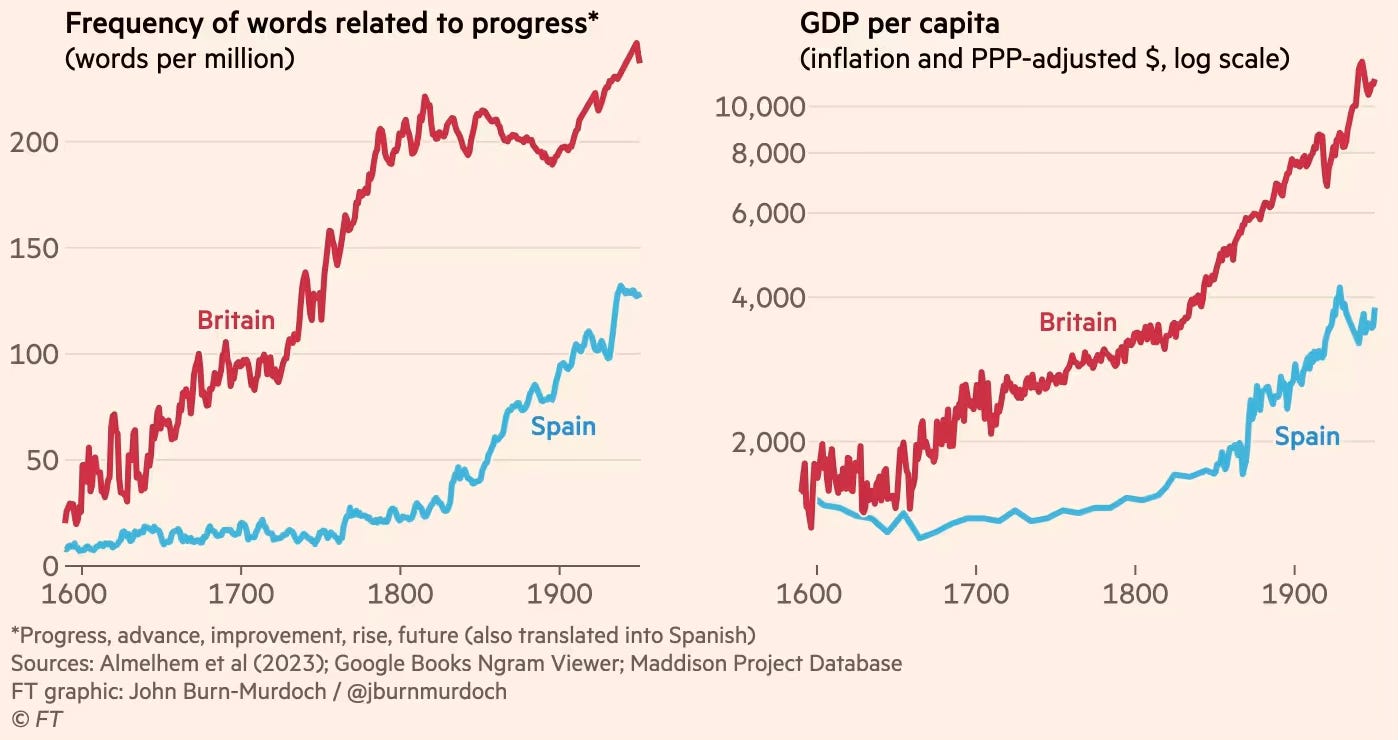
John Burn-Murdoch points to Joel Mokyr’s argument that it was broader cultural change that made Britain the pioneer of IR. The Enlightenment thinking’s rationalism and empiricism, science and experimentation, and a progress-oriented view of the world are held as drivers behind this cultural transformation. 

Burn-Murdoch points to a recent IZA working paper by Ali Almelhem, Murat Iyigun, Austin Kennedy, and Jared Rubin

The researchers analysed the contents of 173,031 books printed in England between 1500 and 1900, tracking how the frequency of different terms changed over time, which they use as a proxy for the cultural themes of the day. They found a marked increase in the use of terms related to progress and innovation starting in the early 17th century. This supports the idea that “a cultural evolution in the attitudes towards the potential of science accounts in some part for the British industrial revolution and its economic take-off”. 

To explore whether this holds for other countries, I have adapted and extended their analysis to include Spain, which was economically competitive with Britain well into the 17th century, but then fell behind. Using data from millions of books digitised as part of the Google Ngram project, I have found that the upsurge in discussions of progress in British books occurs about two centuries before the same uptick in Spain, mirroring trends in the countries’ economic development.

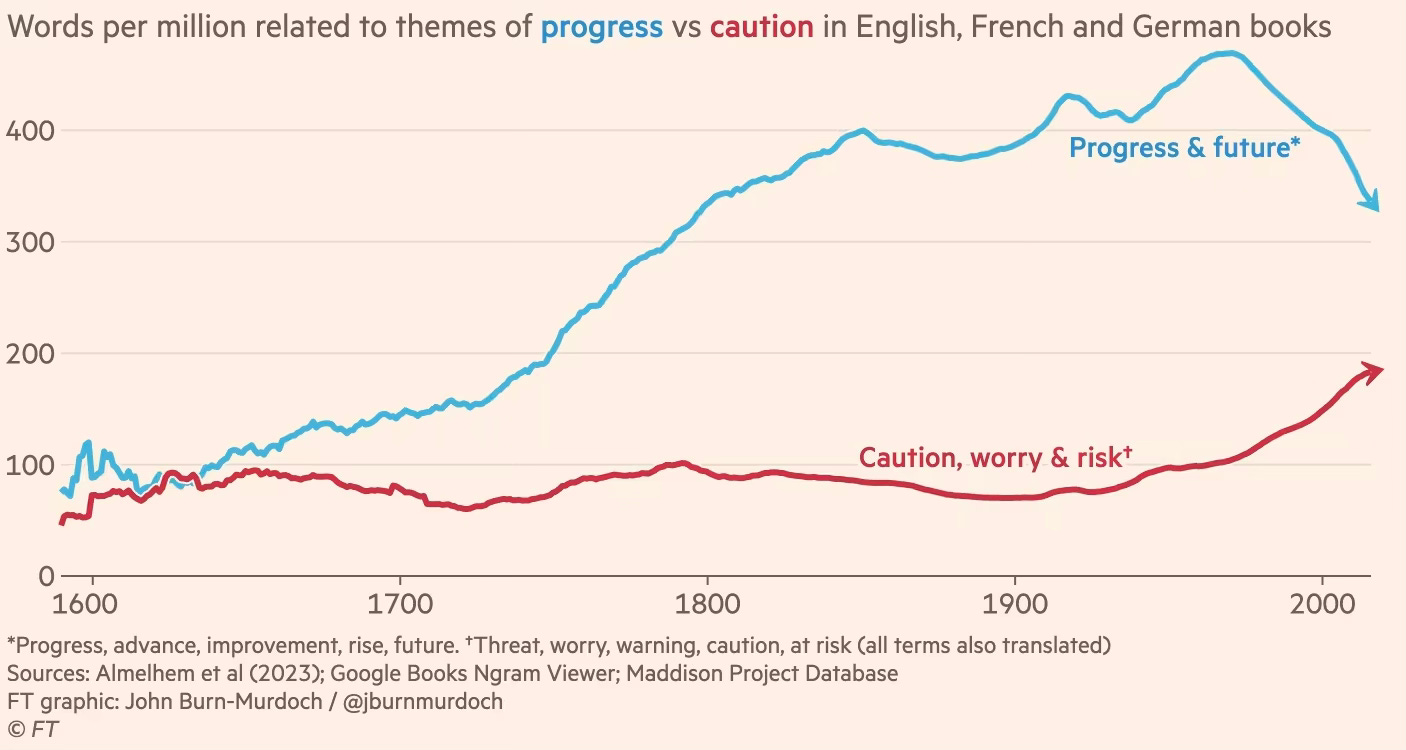
Burn-Murdoch goes further and finds that in contrast the language and culture of today appears to be regressive,

Extending the same analysis to the present, a striking picture emerges: over the past 60 years the west has begun to shift away from the culture of progress, and towards one of caution, worry and risk-aversion, with economic growth slowing over the same period. The frequency of terms related to progress, improvement and the future has dropped by about 25 per cent since the 1960s, while those related to threats, risks and worries have become several times more common.

That simultaneous rise in language associated with caution could well be not a coincidence but an equal and opposite force acting against growth and progress. Ruxandra Teslo, one of a growing community of progress-focused writers at the nexus of science, economics and policy, argues that the growing scepticism around technology and the rise in zero-sum thinking in modern society is one of the defining ideological challenges of our time.

The authors of the IZA paper have three findings,

First, there is little overlap in scientific and religious works in the period under study. This indicates that the “secularization” of science was entrenched from the beginning of the Enlightenment. Second, while scientific works did become more progress-oriented during the Enlightenment, this sentiment was mainly concentrated in the nexus of science and political economy. We interpret this to mean that it was the more pragmatic works of science—those that spoke to a broader political and economic audience, especially those literate artisans and craftsmen at the heart of Britain’s industrialization—that contained the cultural values cited as important for Britain’s economic rise. Third, while volumes at the science-political economy nexus were progress-oriented for the entire time period, this was especially true of volumes related to industrialization. Thus, we have unearthed some inaugural quantitative support for the idea that a cultural evolution in the attitudes towards the potential of science accounts in some part for the British Industrial Revolution and its economic takeoff.

Joel Mokyr has written about the sudden and miraculous explosion of science and technology in one part of the world and the creation of conditions for long-term economic growth, a development that cannot be explained by institutions alone. He points to the importance of culture - beliefs, values, and preferences that can change behaviour - in laying the foundations (in the 1500-1700 period) for the scientific advances and pioneering inventions that would instigate explosive technological and economic development.

I concentrate primarily on the one element in cultural beliefs that economists have so far neglected almost entirely, namely the attitude toward Nature and the willingness and ability to harness it to human material needs. Ultimately the relations with makom, or the physical world around us in the end determine the growth of useful knowledge and eventually that of technology-driven growth. 

Technology is above all a consequence of human willingness to investigate, manipulate, and exploit natural phenomena and regularities, and given such willingness, the growth of the stock of knowledge that underpins and conditions the exploitation of knowledge. The willingness and ability to acquire, disseminate, and harness such knowledge are themselves part of culture and thus determine the intensity of the search for knowledge of nature, the agenda of the research, the institutions that govern the community doing the research, the methods of acquiring and vetting it, the conventions by which such knowledge is accepted as valid, and its dissemination to others who might make use of it. 

It is in this general area that the roots of modern economic growth should be sought—specifically in events and phenomena that precede the eighteenth-century Enlightenment and Industrial Revolution in the centuries that are known, for better or for worse, as “early modern Europe,” roughly speaking between the first voyage to America by Columbus and the publication of the Principia Mathematica by Newton. It is the basic argument of this book that European culture and institutions were shaped in those centuries to become more conducive to the kind of activities that eventually led to the economic sea changes that created the modern economies.

He points to the different ways in which cultural beliefs create the conditions for adoption of technology.

The most direct link from culture and beliefs to technology runs through religion. If metaphysical beliefs are such that manipulating and controlling nature invoke a sense of fear or guilt, technological creativity will inevitably be limited in scope and extent. If the culture is heavily infused with respect and worship of ancient wisdom so that any intellectual innovation is considered deviant and blasphemous, technological creativity will be similarly constrained. Irreverence is a key to progress… so, as Lynn White has pointed out, is anthropocentrism. In his classic work, White stressed the importance of a belief in a creator who has designed a universe for the use of humans, who in exploiting nature would illustrate His wisdom and power… social attitudes toward production and work (and leisure) are another major factor in determining the likelihood of innovation. 

Technologically progressive societies were often relatively egalitarian ones. In societies dominated by a small, wealthy, but unproductive and exploitative elite, the low social prestige of productive activity meant that creativity and innovation would be directed toward an agenda of interest to the elite. The educated and sophisticated elite focused on efforts supporting its power such as military prowess and administration, or on such topics of leisure as literature, games, the arts, and philosophy, and not so much on the mundane problems of the farmer in his field, the sailor on his ship, or the artisan in his workshop… The agenda of the leisurely elite was of great importance to the lovers of music in the eighteenth-century Habsburg lands, but was not of much interest to their farmers and manufacturers. The Austrian Empire created Haydn and Mozart, but no Industrial Revolution. As McCloskey has stressed, the bourgeois societies of the Netherlands and Britain of the seventeenth century, in contrast, were prime candidates for technological advances.

I’ll blog longer about Mokyr’s book that I just finished reading in another post. His analysis, coupled with that of Tirthankar Roy, have interesting implications if we examine India’s historical industrial development pathway.

Saturday, December 2, 2023

Weekend reading links

1. As it hosts the CoP summit, the environmental costs of Dubai's desalination of sea water are worth remembering, 

Experts say Dubai’s reliance on desalination is damaging the Persian Gulf, producing a brackish waste known as brine which, along with chemicals used during desalination processing, increases salinity in the Gulf. It also raises coastal water temperatures and harms biodiversity, fisheries and coastal communities... If no immediate action is taken to counter the harm, desalination, in combination with climate change, will increase the Gulf’s coastal waters temperature by at least five degrees Fahrenheit across more than 50 percent of the area by 2050, according to a 2021 study published in the Marine Pollution Bulletin on ScienceDirect, a site for peer-reviewed papers... The construction of Dubai’s artificial islands also strains the Gulf’s water resources. One study found that the average water temperature around Palm Jumeirah island, designed by HHCP Architects, increased by roughly 13 degrees over 19 years. Another study cited land reclamation, along with brine and industrial waste, as a cause of the excessive growth of microscopic algae in the Persian Gulf, known as algae blooms or red tides. Some of these harmful blooms have forced desalination plants to reduce or shut down operations... 

The Dubai Electricity and Water Authority supplies water to more than 3.6 million residents along with the city’s active daytime population of more than 4.7 million visitors, according to a 2022 sustainability report... The city desalinated approximately 163.6 billion gallons of water last year, according to the sustainability report. For each gallon of desalinated water produced in the Gulf, an average of a gallon and a half of brine is released into the ocean... In Dubai, the Jebel Ali Power and Desalination Complex — the largest facility of its kind in the world — pipes water from the sea, sending it through a series of treatment phases, then to the city as drinkable water. But Jebel Ali’s 43 desalination plants are powered by fossil fuels. The U.A.E. produced more than 200 million tons of carbon in 2022, among the highest emissions per capita worldwide.

2. The Turkish Central Bank raises interest rates by 5 percentage points to 40% to combat inflation which is running at 61.36%. 

An interesting observation here. Unlike any other developing country India has never had an episode of such runaway inflation nor a sovereign default. Among all developing country, its track record of maintaining macroeconomic stability should count as exemplary, comparable with those of developed countries. But for the rating agencies, it's bracketed with the likes of Turkey and Brazil, neither of whom can claim anywhere close to such macroeconomic stability. 

3. Simon Schama has a long read on Napoleon. His failings

The liquidation of a free press; the emasculation of any meaningful representative institutions; contempt for intellectuals; the ego-fetish of the will in action; the presumption that national glory must necessarily be forged in the carnage of war, and its logical corollary, an insatiable lust for military expansionism; the habit of treating humans instrumentally as grist to his glory mill; the chilly indifference to the loss of millions of lives, especially those of his own troops; an invariable tendency to blame everyone other than himself when things went awry.

He's one of the most widely chronicled people in history

Napoleon ranks third behind Jesus and Hitler in the number of books written about him but outdoes them both in the number of films — about 1,000 — made for cinema and television. No sooner had the Lumière brothers invented the motion picture than in 1897 they gave the world Napoleon Meets the Pope. By 1914, there were already 180 films devoted to Bonaparte.

4. Bloomberg points to the promise of infrastructure and industrial stocks in India over the coming decade.

Andy Mukherjee points to the frothy equity market valuations in India with the example of Relaxo Footwear. 
India now accounts for more than 15% of the MSCI Emerging Market Index, up from 10% two-and-half years back. 

5. Bloomberg highlights five countries that have benefited from the reshuffling of supply chain in response to the US-China tensions - Vietnam, Mexico, Poland, Morocco, and Indonesia. 
It says that these countries have emerged as important connectors in the global economy
As a group, these countries logged $4 trillion in economic output in 2022... their geographic location and ability to grease trade has set them up as crucial middle grounds. These guys punch above their weight: They represent 4% of global gross domestic product, yet they’ve attracted slightly over 10%, or $550 billion, of all so-called greenfield investment since 2017. (The term describes outlays for new plants, offices and other facilities by a foreign company establishing or expanding operations in another country.) All have seen their trade with the world accelerate above trend in the past five years, according to an analysis by Bloomberg Economics.

Morocco has taken a leaf out of Indonesia's Nickel-industrial policy to leverage its phosphate deposits and the importance of the mineral in Lithium-iron-phosphate (LFP) battery, a growing variety of recharageable batteries used in EVs. Poland has leveraged its traditionally strong automobile manufacturing base to become the preferred destination for EV battery manufacturing in Europe, and the second largest battery manufacturer outside of China. 

While India's manufacturing exports have grown by 16% relative to global trend since 2017, its share of global greenfield investment has reduced by 1% in 2013-22 over the 2003-12 period. The corresponding figures for Vietnam, Mexico, and Indonesia were 60% and 29%, 11% and 58%, 32% and 10% respectively.

One of the important insights from an examination of global value chains is the slow nature of the re-alignment and the positioning of countries like Vietnam and Mexico as intermediaries in the US-China trade.
This year, Mexico eclipsed China as the biggest exporter of goods to the US. But that doesn’t tell the whole story of how its economic relationship with the colossus next door—and the rest of the world—is changing. Since 2017, the value of Mexico’s imports from China has been growing faster in nominal terms than that of its exports to the US. That’s because many of the manufacturers opening plants in Mexico’s border states these days are Chinese companies, selling everything from car parts to furniture, with a focus on the US market. The Mexican Association of Private Industrial Parks surveyed its members earlier this year and learned that they expect that over the next two years, one in five of the new businesses setting up shop will be Chinese.
6. On a related note, the BIS used global firm level data on suppliers and customers to map the global value chains (GVCs). The maps illustrate cross-country linkages, network distances between firms, and density metrics such as the average number of supplier and customer linkages at the firm level. They compared the maps between December 2021 and September 2023 to see how the GVCs have realigned. Their findings,
First, the reliance on cross-border suppliers has fallen markedly between the two snapshots. When set against the backdrop of the intricate web of relationships in GVCs, a corollary of declining direct cross-country links is an increase in the indirect cross-country links, as new firm nodes interpose themselves into existing supply chains. The upshot is that distance between firms in the network (as explained below) has risen since December 2021... Lengthening of supply chains is especially significant for supplier-customer linkages from China to the United States, where firms from other jurisdictions, notably in Asia, have interposed themselves in the supply chain... This increase in distance has not been accompanied by a rise in network density – an attribute that arguably indicates greater diversification of supplier relationships. The latest changes are taking place in the context of the long running trend toward greater regional integration of supply chains, especially in Asia. So far, there is no evidence that this trend has reversed itself, but the issue merits close attention.
7. There are reasons to temper making policy on EV to suit Tesla, as this Business Standard editorial suggests. For one, Elon Musk is unlikely to invest anything meaningful in India without significant fiscal concessions, beyond the tariff reductions. That's the way he works and his track record consistently proves the point. Second, Musk cannot be trusted to keep any promise of investment after concessions are given. Three, Tesla's high-end vehicles will serve a tiny sliver of the market, and are not likely to be what will drive EV penetration in the country. 

8. Goldman Sachs research finds that Indian equities, closely followed by Indonesia, are the Asian economies least impacted by developments in China. 

9. Tamal Bandopadhyay has a very good oped on the market for long-term bonds. India last week issued its first 50 year bond, with the Rs 10000 Cr 2073 bond being priced at 7.46% in the auction. 
Some long-term papers carry call and put options — after a certain period, the issuer can call back the paper, paying off the investors. The investors, too, can get out of it. For instance, the 100-year corporate bond issued by Walt Disney Company in 1993 will mature in 2093, but the company can redeem the bonds any time after 30 years (2023). Coca-Cola, too, has issued a 100-year bond. Even 1,000-year bonds exist. The Canadian Pacific Corporation has issued such a bond. There are also bonds with no maturity date. These are called perpetuities. In such papers, the issuer continues to pay coupon payments forever. The UK government has issued such bonds, called “consols”.

10. Ola Electric is only the latest example highlighting the perils of growing too fast 

Ola Electric is zipping towards a stock-market listing after going from zero to 338,000 e-scooter sales in about two years... the company, already valued at $5.4 billion, would quadruple its annual production capacity to 2 million e-scooters by early new year. Yet Ola's rapid ride faces a few potholes. 
Parts of the company's nationwide network of over 400 service hubs which maintain and repair its EVs are showing signs of strain after the surge in sales, according to Reuters visits to 35 centres in 10 states between July and October, plus interviews with 36 Ola service staff and 40 customers. Staff at more than half of those centres, mainly sites in the big metropolitan areas of Mumbai, Chennai and Bengaluru, said they had significant backlogs, with demand outstripping their workforce or their supply of spare parts, and repair waiting times ranging from three days to two weeks. At an Ola workshop in Thane, among the biggest of the 14 centres in the Mumbai region, more than 100 e-scooters awaiting repairs were visible outside in a clearing, many parked in a muddy clearing gathering dust and littered with bird droppings.

11. Corruption and thuggery are a feature of mining and many infrastructure sectors globally, both in developing and developed countries. Besides, in these sectors, local businessmen and companies will always exercise dominance and do everything underhand to thwart foreigners. FT points to the examples of Gina Reinhart's Hancock Mining and Chris Ellison's Mineral Resources who both have recently thwarted foreign efforts to take stakes in Lithium mines in Australia. Both US Albemarle and Chile's SQM had to retreat from efforts to buy Lithium mines in Australia, both being nixed by Reinhart who took blocking stakes in the respective mines. 

In the meantime, Australia is also exploring investments to process Lithium ore and make Lithium Hydroxide which is used in EV batteries. Australia currently makes up half the global raw Lithium. Incidentally Lithium prices have collapsed 70% since beginning of the year. 

12. China has already slipped from being the US's largest trade partner to being only the third largest.

And the same is happening with imports too.
13. FT points to a new paper by two US Treasury economists Gerald Auten and David Splinter that finds that US inequality at the top did not worsen as much as is widely believed. 
The upshot is that they find before-tax income inequality did rise, with the top 1 per cent share rising from 9.8 per cent to 12 per cent between 1960 and 2019. This was, however, offset by a more progressive transfer system, particularly in health benefits for US households, with the top 1 per cent’s share of after-tax income pretty stable over 60 years.

14. Underlining the challenges associated with energy transition, an FT report has this graphic that captures the contrasting fortunes of renewable and conventional energy stocks this year.

The S&P Global Clean Energy index, which includes the 100 largest clean energy-related businesses, is down 31 per cent since the start of this year, compared to a less than 1 per cent decline for the fossil-heavy S&P 500 Energy index.

15.  Important trends from Thanksgiving weekend retail sales in the US

US online shoppers have busted through forecasts, shelling out a record $38bn for the post-Thanksgiving period. The $12.4bn spent on what is known as Cyber Monday made it the biggest US digital shopping day of all time, according to Adobe, which tracks online spending. This spree — up nearly 8 per cent on last year — has raised hopes of a bumper festive season... Some of the jump is due to the rapid spread of shopping apps and websites optimised for mobile use. Customers who once had to go to a store or fire up a desktop can now shop while watching TV. Mobile devices accounted for more than half of November sales for the first time this year. Another boost stems from the rapid growth of buy now, pay later programmes that let shoppers defer their payments across several months. BNPL spending was up 17 per cent year on year to $8.3bn for November to the end of Monday.

16. Interesting international sovereign bond market trend

Back in 2016, international investors owned an average of around 21 per cent of local-currency bonds in emerging markets. Now that figure is just 13 per cent.

17. Times has a portrait of Henry Kissinger  

When China’s leaders wanted to send a message to the Biden administration last summer, they did what came naturally. They called Henry A. Kissinger... for as long as anyone could remember, the Chinese had venerated him as the secretary of state who forged the landmark diplomatic opening to Beijing. They had used him as a channel to Washington ever since. Knowing him as they did, the Chinese played to his sense of self regard during his visit in July. They feted and flattered him. They put him up in the same guest quarters he had occupied during his historic visits in the 1970s. They hosted meetings in the same building where he had met their predecessors. And President Xi Jinping told Mr. Kissinger that his initial visits had led to 50 years of mostly stable relations and that he hoped this trip would usher in another 50 years.

That last part was the point. After months of friction over a spy balloon and other provocative actions, Mr. Xi was trying to make clear to President Biden’s administration that he wanted to put the tension behind them and repair ties with the United States. Mr. Kissinger returned home and dutifully filled in Secretary of State Antony J. Blinken by phone; met with William J. Burns, the C.I.A. director; and passed along his impressions to Jake Sullivan, the national security adviser... When Donald J. Trump came to power, Mr. Kissinger advised nervous German officials seeking reassurance about the new president to meet with Jared Kushner, his son-in-law and senior adviser. But unknown to the Germans, Mr. Kissinger had told Mr. Kushner that the allies were nervous about Mr. Trump and that he should use that to his own advantage. Don’t reassure them, he advised — keep them on edge... his continuing prominence and access was helpful to his geopolitical consulting business.

Vijay Gokhale has an excellent oped about Kissinger's unscrupulous actions during the 1971 conflict with Pakistan. 

In July 1971, during his visit to India on the eve of his secret visit to China, he told P N Haksar, Principal Secretary to the Prime Minister, that the US would “under any conceivable circumstances” back India against Chinese pressure. He never disclosed that he intended to visit China only days later to normalise relations. He also told External Affairs Minister Swaran Singh that the US had only “disinterested concern in the balance of national or political forces within South Asia”. In reality, he was doing everything possible to sustain the Pakistani genocide in future Bangladesh and assist Pakistan in dealing with India... When the war began, Kissinger, on the one hand, routed military equipment to Pakistan through its middle-eastern allies and on the other, suspended all economic assistance to India. His instructions were specific — a case was to be made, technically and legally, to differentiate between the aid given to India from the aid given to Pakistan.

His most perfidious actions were his efforts to put pressure on India through the Chinese. Even before the conflict started, Kissinger met the Chinese Ambassador to the United Nations, Huang Hua, on November 23, 1971, to propose that they coordinate action in the UN Security Council on the India-Pakistan issue so that the US “not move too far away from you (China) on this issue”. It was also at this meeting that Kissinger (and George H W Bush, later the President of the United States) shared the specific location of Indian military units deployed along the frontier with East Pakistan, as well as crucial information that India had diverted two mountain divisions from the China front to East Pakistan. He even offered to send further specific information “in a sealed envelope to the hotel if you want us to”. This was but a prelude to Kissinger’s subsequent actions during the Bangladesh war... In his meeting with the Chinese on December 10, 1971... Kissinger conveyed that “if the People’s Republic of China were to consider the situation on the Indian subcontinent a threat to its security, and if it took measures to protect its security, the US would oppose efforts of others (Soviet Union) to interfere with the People’s Republic.” It was as direct a suggestion as could possibly be made by a high-ranking political figure to the Chinese to open a third front when India was already fighting Pakistan on two fronts.

This about his role in mainstreaming China is apt,

In a sense, Kissinger was harnessed by Mao Zedong and his successors to pull the Chinese cart into the 21st century and has contributed, perhaps more than any other single individual, to helping China emerge as a true challenger to American power. 

One gets the impression of an unscrupulous, perfidious, racist and immoral networker with a hollow moral core and an insatiable vanity to occupy the top table. Realpolitik gone rogue! 

Pratap Bhanu Mehta describes him as a confidence trick pony - 

Pakistani writer and activist Eqbal Ahmad argued, Kissinger was a... confidence man... He has the ability to size up a situation, is hard to resist, even if you have the nagging feeling that he has a hollow moral core. The confidence man makes himself appear utterly indispensable. Kissinger made himself utterly indispensable to the power structure of the world for a career spanning close to 80 years... After retirement, he went into consulting for almost 50 years, again pulling off a confidence trick of presenting the selling of services as statesmanship in disguise... Kissengerian diplomacy works by ruthlessly sacrificing the most expendable... The list of crimes he explicitly or tacitly condoned is long: He was instrumental in delaying the Peace Agreement in Vietnam to help the Nixon campaign and the brutal bombing of Cambodia that continued till 1973 and paved the way for genocide. Against the judgement of diplomats on the ground, he ignored the impending genocide in East Pakistan. He gave the go-ahead for the brutal invasion of East Timor, the horrific repression by the Argentine junta, and the overthrow of Salvador Allende. The list could go on. The historian Greg Grandin estimates roughly four million deaths to these decisions.

He was also a Board member of the now infamous Theranos.