Substack

Showing posts with label consultants. Show all posts

Saturday, July 11, 2026

Weekend reading links

1. FT long read on how senator Deborah O'Neill, as chair of the Parliamentary joint committee on corporations and financial services, has single-mindedly exposed and brought the knees the Big Four auditing and consulting firms in Australia. 
Deborah O’Neill has led the charge against KPMG in Australia over a client confidentiality scandal that prompted the departure of the firm’s chair, chief executive, chief operating officer, audit leader and a senior partner over the past month... comes on the heels of a similar implosion at PwC. The rival Big Four firm came unstuck when a data leak led to the exit of senior management... An EY employee was charged with accessing the bank details of Prime Minister Anthony Albanese while working on contract at Australia’s biggest bank. Meanwhile, Deloitte partially refunded the Australian government after admitting that it used AI to compile a report...
In 2023, the Labor senator forced the publication of emails that implicated PwC partners in the tax leaks scandal. PwC partners were caught sharing secret government tax plans that one of them had obtained from his work on an advisory board in Canberra, in the hopes of winning business in the US. This year O’Neill used parliamentary privilege to air allegations made by a KPMG whistleblower that had been inadequately investigated by the firm. KPMG has now been exposed as having used confidential information from existing audit clients to try to win new business from rivals — some from PwC as its audit customers looked to switch in the wake of that firm’s woes...

She entered parliament in 2010 having spent her career in education. O’Neill soon discovered that some Big Four consultants acted like some of her former pupils — copying the answers from the back of the book and then marking their own work, as she puts it — and used her role to put the leaders of the firms under pressure.
2. Soumaya Keynes points to a fascinating study by Rebecca Diamond of Harvard University of the use of GLP drugs that appears to show increased confidence and employment rates among women in the US. The study finds, using data gathered between 2021 and 2023, that the poorest third of women in the US suffered an obesity rate 14 percentage points higher than the richest third, whereas the gap was negligible for men. 
The study's main findings:
After 18 months, women using GLP-1 drugs who start off without a job enjoy employment rates 27 percentage points higher than otherwise similar non-users. Women who start off with a job see their employment rate fall slightly, and although the data is too noisy to pick out effects on their earnings, it looks like their household income rises by 10 per cent. That second effect is a bit surprising, and possibly explained by parallel developments in these women’s love lives. Diamond estimates that GLP-1 drugs give single women a dramatic 29 percentage point increase in their chances of coupling up. On average, their new partners are richer than them, giving their household income a bump. Which could explain why a few of the women losing weight then feel able to drop out of work.
The study also points to a more disturbing consequence.
So far at least, GLP-1 drugs are disproportionately used by the rich. In Diamond’s study two-fifths of the women paid for the drugs out of pocket, at a median cost of $275 a month. Research based on Voy prescriptions shows how, adjusting for relative obesity rates, uptake is skewed towards more affluent areas. If obesity becomes an even stronger signal of economic disadvantage, the stigma attached could grow.

3. The rise of London's King's Cross area as perhaps Europe's AI capital.

Two decades ago, King’s Cross was central London’s most neglected district. Today, it is home to the main foreign outposts for several of the world’s wealthiest companies, from Big Tech giants Google and Meta to their richly funded AI challengers including OpenAI, Anthropic and Jeff Bezos’ Prometheus. AI researchers and entrepreneurs are packing out the area’s canal-side cafés so densely that venture capitalists prowling for their next deal are struggling to prevent their coffee meetings from being overheard by rivals.
For many, this resurgence can be traced back to one individual: Sir Demis Hassabis, the DeepMind co-founder and Nobel laureate who stayed in London to build his AI lab following its sale to Google in 2014 for £400mn. “Demis keeping DeepMind in London and resisting the gravitational pull of [America’s] West Coast is the most important thing that has ever happened to the London tech ecosystem,” says Tom Hulme, a tech investor at Alphabet’s GV venture capital unit... Just as PayPal helped launch the careers of a generation of Silicon Valley founders and investors including Elon Musk and Peter Thiel, a “DeepMind mafia” in London is pulling in billions of dollars to AI start-ups founded by Hassabis’s former lieutenants, including David Silver’s Ineffable Intelligence and Tim Rocktäschel at Recursive Superintelligence...
It was Hassabis’s pursuit of an “artificial general intelligence” capable of scientific research and a wide range of human tasks that in many ways kick-started the current AI boom. DeepMind’s sale to Google prompted Elon Musk to set up a research lab to counterbalance the internet group’s dominance of AI; that lab was OpenAI. DeepMind went on to make a series of AI breakthroughs including AlphaGo, which in 2016 beat the board game Go’s world champion Lee Sedol, and AlphaFold, which used deep learning to predict protein structures with superhuman speed.

King's Cross has emerged as the Canary Wharf of tech in UK, and this description is apt and underlines the continuing importance of personal interactions and connections. 

The density of AI talent in King’s Cross was why the government’s scientific research agency Aria took a “very conscious decision” to base itself there rather than Whitehall, says Pippy James, its deputy chief executive. “We were definitely inspired by Kendall Square in Boston,” she says, referring to the area surrounding MIT where Google, Microsoft and Amazon, as well as biotech companies Moderna and Novartis, have offices. “Value creation comes from those serendipitous collisions.” In recent weeks there has been a steady stream of American AI companies announcing moves into the area. OpenAI and Anthropic have signed leases for tens of thousands of square feet in King’s Cross. Others moving in include Bezos’s “physical AI” company Prometheus, Cursor, the AI coding company that recently agreed a $60bn sale to SpaceX, AI agent group Perplexity and open model developer Reflection. Google, which already has many researchers and engineers in the area, plans to start moving staff into its vast new “Platform 37” office this summer after almost a decade in development.

4. This is a striking factoid about the importance of chips now. 

With SpaceX going public, the list of the 10 most valuable US public companies is entirely made up of tech companies for the first time. Of those, three are semiconductor specialists. But with chips a key ingredient in AI, the other seven are also now all designing their own chips.

Some stats about the global chip squeeze.

... Elon Musk’s xAI to rent out spare capacity in its data centres. In recent weeks, Anthropic, Google and start-up Reflection AI have agreed to pay a total of around $2.3bn a month — or $28bn a year. This looks like a big return on Musk’s data centre investments. As of March this year, xAI’s total capital spending over its lifetime totalled $26.5bn... this surge in demand has already prompted a huge increase in supply, both of planned chipmaking capacity and newly minted chip stocks. One sign is the $600bn that memory chipmakers Samsung and SK Hynix said this week they plan to invest in Korea. Another is the $29bn that SK Hynix hopes to raise when its American depositary receipts begin trading in the US next week... TSMC has said it will boost its capital spending by as much as 37 per cent this year, as it did in 2025. But those increases follow two years of retrenchment and would leave 2026 capex only around 50 per cent higher than 2022. Contrast that with the biggest buyers of AI chips. Seven of the largest data centre operators are planning to spend an astounding $848bn this year, at least five times what they spent in 2022, according to a calculation by the newsletter Exponential View.

5. On the new bonds issued by SpaceX.

The bonds enjoyed very robust demand at the point of issuance, but some see that as a problem in itself. Allianz’s chief investment officer has described the market’s willingness to hand money over to Musk as a clear sign that we have moved from “a healthy boom, a stretched boom . . . into bubble territory”. Ominously, the bonds have weakened since they launched.

6. The AI LLMs scorecard

Where will Sarvam stand?

Also national scorecard.
7. The low-margin business of mobile phone assembly. Amber Industries which makes air conditioners for eight of the top 10 brands and more than a quarter of all ACs made in the country, now proposes to assemble smartphones for Oppo. 
Now, the company plans to sub-lease a part of Oppo India’s factory in Noida, set up SMT lines, and start assembling phones there... But smartphone assembly is one of the toughest businesses in electronics manufacturing... The target is to eventually assemble about a fifth of Oppo India’s volumes, scaling from roughly 8 million handsets in the first year to nearly 15 million in the second... Amber expects Ebitda margins of 1.5–2%, excluding benefits from the government’s production-linked incentive (PLI) scheme. That’s well below the 8.8% Ebitda margin generated by its broader electronics business in FY26, and the 7.1% operating margin recorded by its AC-heavy consumer-durables segment... Take Dixon, for instance. The company already accounts for nearly one-fifth of India’s smartphone output. Even at that scale, smartphone assembly, aided by PLI incentives, generates Ebitda margins of only about 3%.

8. AI boom compared with historical episodes.

9. On the rise of non-compete clauses in OECD countries and their adverse impact on productivity.
About 30 per cent of employers surveyed by the OECD said they had increased their use of the clauses in the past five years... It estimates that a 10 percentage-point increase in the prevalence of non-compete clauses in an industry was associated with a 1.9 per cent decline in the level of labour productivity, with workers stuck in sub-optimal jobs and firms less able to gain new skills. In many countries, non-competes have spread into parts of the labour market where the original justification of protecting sensitive information and firm-specific information is “weak or absent”, the research found, pointing to their use among entry-level fast-food staff in the US, manual workers in Italy and childcare workers or yoga instructors in Australia.

10. The market concentration in DRAM chips.

A market in which a monopolist owns 100 per cent gets an HHI of 10,000, a duopoly scores above 5,000, and a perfectly competitive market approaches zero... The US DoJ considers anything between 1,000 and 1,800 points to be “moderately concentrated”. Per Counterpoint Research, as of the first quarter of 2026 the memory market is 38 per cent Samsung (South Korea), 29 per cent SK Hynix (South Korea), 22 per cent Micron (US), 8 per cent CXMT (China), 2 per cent Nanya (Taiwan), and 1 per cent everyone else. This gives us an HHI of 2,838... Both Samsung and SK are two of Korea’s largest conglomerates (the so-called chaebols) which benefit from cosy relations with the state, so viewing them as fierce competitors in the same memory market might be wrong-minded in this case... And if the two companies function as a single economic entity in the global DRAM market, we should probably count them together for HHI purposes. And doing this we get a much higher HHI reading of 5,042. That’s above 5,000 —the HHI of a perfect duopoly.
11. China’s excess capacity in manufacturing requires something similar to what was done by the former Prime Minister Zhu Rongji

In the late 1990s and early 2000s… under Zhu’s slogan of “zhua da, fang xiao” or “grasp the large, let go of the small”, Beijing retained its grip on key strategic industries while relinquishing control of a vast sea of smaller companies and factories…Thousands of mines, steel mills and other industrial sites were shut for good. An estimated 30mn to 40mn workers lost their jobs. The process was deemed painful but necessary: not only in setting up China’s accession to the World Trade Organization in 2001, but in freeing Beijing from supporting uneconomic industries… 

Over the past 15 years, as China’s share of global manufacturing surged to around one-third, the share of lossmaking industrial businesses jumped from about 10 per cent in 2010 to nearly 25 per cent last year, according to the MERICS China Overcapacities Monitor. This dynamic exists across everything from steel and cement to cars, computer chips and robots. Take the automotive sector for example. Domestic car sales last year totalled 23.9mn against estimated production capacity of 45mn to 50mn. Sales are highly concentrated among a clutch of leading companies. According to HSBC, more than 70 per cent of EV sales — including plug-in hybrids — are being soaked up by 10 brands, leaving 47 others jostling for the remainder. In the shrinking market for petrol and diesel cars, 10 brands have about 70 per cent of sales and 73 others compete for the rest.

12. South Korean capitalism and windfall profits sharing - SK Hynix and Samsung edition.

Soaring global demand for high-bandwidth memory chips used in AI systems has propelled SK Hynix and Samsung Electronics to record earnings. This week Samsung announced quarterly operating profit of Won89.4tn ($59.7bn). The windfall is being shared with employees. Last September, SK Hynix agreed to pay workers 10 per cent of annual operating profits for a period of 10 years. Samsung followed with a similar arrangement in May after its union threatened strike action. With both firms expected to earn hundreds of billions of dollars this year, average bonus payouts per memory chip worker could reach about Won600mn ($400,000) at Samsung and even more at SK Hynix. Such amounts are staggering in a country where the average worker earns Won50.6mn per year, according to Korea Enterprises Federation data. 

The Bank of Korea has warned of potential inflationary pressure as a result, and towns where many semiconductor workers live are undergoing property price jumps. Competition is intensifying for places at universities offering semiconductor “contract” programmes that guarantee jobs at Samsung Electronics or SK Hynix upon graduation. Admission scores required for some such courses now exceed the average for natural sciences at Seoul National University, the country’s top-ranked university, and are just below those needed for medicine... The boom is also reshaping Korea’s marriage market. Matchmaking agencies, which are known for using meticulously harsh metrics to rank clients, are now giving higher points to chip workers.

13. Data centres are consuming massive amounts of power and water.

Data hubs already devour more electricity globally than all but 10 countries. About 448 terawatt hours last year if you’re interested. The AI boom means that amount is on track to roughly double within four years... By 2030, they could be using enough water to meet the basic needs of all 1.3bn sub-Saharan Africans for a year, UN researchers estimate.

And it is provoking backlashes. Sample this from the US.

An unprecedented 75 US data centre projects worth around $130bn were blocked or delayed in the first three months of this year, nearly as many as in the whole of 2025, says the Data Center Watch research group. It reckons active opposition group numbers have grown from 396 at the end of 2025 to 833 by the end of March.

14. The Strait of Hormuz squeeze was not as bad as earlier episodes. 

15. Transformers are at the heart of power transmission, distribution, and use. Thanks to the AI and data centre boom, transformer prices have gone over the roof.
Specialist electrical steel — essential for transformer cores — is produced by only a handful of global suppliers, many of whom are struggling to keep up with the surge in demand. Market growth, price volatility and limited mining capacity have also strained supplies of copper, crucial to the conductivity of windingsaround a device’s core. But one of the most acute bottlenecks is the shortage of skilled workers needed to carry out complex, labour-intensive manufacturing tasks...
With up to 80,000 different designs, most transformers still have to be built largely to order, taking three to six months to make. The most demanding stage is the windings, when copper wire is applied around a transformer’s core — a “beautiful” process, according to Bruno Melles, an engineer now leading Hitachi’s global transformer business. Each winding is unique and is “still a human manual activity that we’re very proud of”, he says. The number and pattern of these windings dictate voltage — fewer turns lead to lower voltage while higher-voltage devices can have multiple windings stretching hundreds of kilometres. Once complete, the assembly is placed in a protective outer metal shell, where oil acts to insulate and cool the device...

The world’s biggest transformer manufacturers have reported tens of billions of dollars in backlogs in the first quarter of 2026... US developers are turning to imports. The EU, Mexico, South Korea and Brazil are the biggest suppliers of power transformers to the US, together accounting for more than three-quarters of imports by value last year.

Into this mix come innovations in the form of modular solid-state transformers that use modern power electronics and respond dynamically to changing power needs, enabling real-time monitoring and control (which legacy transformers with their steel and copper cannot do). 

Saturday, May 30, 2026

Weekend reading links

1. This captures the big problems with Chinese exports to Europe.
In the early 1970s workers at Dongfeng, or “East Wind”, imported American trucks to inform their early attempts at making off-road vehicles destined for the People’s Liberation Army. Nearly 60 years later Stellantis, the European owner of the Jeep brand, is partnering with Dongfeng to produce a new battery-powered version of the iconic American light utility vehicle for consumers in China, the Middle East and south-east Asia... International carmakers, struggling for survival amid an expensive transition to electric vehicles, are turning to China’s technologically advanced and cost-efficient factories as manufacturing bases for their global businesses. Foreign companies already account for around two-fifths of China’s car exports to Europe, when joint ventures with local groups are included, according to the Rhodium Group, a US consultancy... Indeed, Volkswagen, BMW, Nissan, Hyundai and others are increasing exports from Chinese factories with spare capacity to markets other than Europe and the US.

2. A new approach to making clean hydrogen

Most of the hydrogen the world uses today — mainly for fertilizer and refining — is produced using natural gas in a process that creates lots of emissions. In recent years, the United States and other countries have invested billions of dollars trying to make “green” hydrogen with wind and solar power, but it has proved difficult and expensive. Now a growing number of companies think a better answer could lie underground. Dozens of start-ups are trying to find large reservoirs of natural hydrogen thought to exist below the surface. Others, like Vema, are trying to stimulate the processes that generate that hydrogen, without any emissions. It’s a field often referred to as “geologic hydrogen.”...
Hydrogen is the most abundant element in the universe, and it gets made naturally in the Earth’s crust when certain iron-rich minerals react with water and rust. This process, known as serpentinization, often leaves behind rocks with a mottled green color. For a long time, many geologists believed that any natural hydrogen produced this way was unlikely to accumulate in large underground deposits because the tiny molecules would slip away through cracks in rocks. Lately, that conventional wisdom has been upended... By the 2020s, scientists were publishing papers estimating that natural hydrogen deposits underground could supply the world’s needs for hundreds of years. One promising location was North America’s Midcontinent Rift, an enormous formation of iron-rich basalt that stretches 1,200 miles from Kansas to Michigan... The Energy Department has estimated that geologic hydrogen could be produced for less than $1 per kilogram. That would be cheaper than hydrogen made from fossil fuels and one-sixth the current cost of making hydrogen from wind and solar power.

It has started attracting private capital.

Companies are racing to find the fuel. One of the best-funded start-ups, Koloma, has raised $400 million from investors including Amazon and United Airlines and has drilled exploratory wells in Iowa. HyTerra, an Australian firm, is searching for hydrogen and helium in Kansas and Nebraska. Not everyone thinks the best strategy is to search for natural deposits underground. A better idea, some say, is to create them. In Quebec, a startup called Vema Hydrogen plans to spend the rest of the year injecting water into its underground test wells to see if it can speed up the process of serpentinization that creates natural hydrogen underground... Vema has already raised $15 million and is working to raise more. There are ophiolites all over the Earth, including a ridge stretching from Costa Rica to Alaska, and the company is looking at sites in Oregon and California as well. Other start-ups, including one out of M.I.T. called GeoRedox, are developing their own approaches.

3.  Semiconductor chips are one area where China lags badly.

Chinese companies will most likely make just 2 percent as many A.I. chips as foreign firms do this year, said Tim Fist, a director at the Institute for Progress, a think tank in Washington. The production gap between Chinese and foreign manufacturers is especially big for memory chips, which are essential for the large calculations done by A.I. Companies outside China will make 70 times as much memory storage capacity this year as Chinese chip makers will, Mr. Fist said...The inability to get essential tools from ASML has been a major chokehold for Chinese chip makers. Since U.S. officials led an effort to lobby the Dutch government to block shipments to China, no Chinese company has been able to buy ASML’s most advanced tools. Instead, Chinese chip makers have recruited engineers with experience using those machines at TSMC, the world’s top chip maker. And now, Chinese start-ups are trying to make their own chip manufacturing equipment... China’s A.I. companies are trying to get the computing power they need by strapping together numerous less powerful chips. Huawei has taken such an approach... The chips Huawei does produce are prone to defects and use more electricity than cutting-edge foreign ones.

4. This is one of the greatest messages from a student to a teacher, Albert Camus to his elementary school teacher Louis Germain after he won the Nobel Prize.  

5. Japanification in demographics.
And this impact of smartphones is striking.
6. Soumaya Keynes has a good read on the history of export restrictions and their impact, and why trade wars will endure. 

7. Southeast Asian economies struggle on the face of rising inflation from the War.
Their currencies have weakened.
The Philippines and Indonesia have already raised interest rates. 

This is a good illustration of the extent of damage from the Strait of Hormuz closure.
In a sign of Bab el-Mandeb strait’s strategic importance, Djibouti – whose coastline runs along the waterway – is home to military bases of several major countries, including the US, Italy, France, Japan, and the sole People’s Liberation Army base outside China. The Bab el-Mandeb strait is among several trade chokepoints that, when blocked, require vessels to travel more than 8,000 miles. These also include the Strait of Gibraltar and the Suez and Panama Canals...
The knock-on effects of a blockage can be much more significant where there is no alternative route to fall back on, as with the Strait of Hormuz, the Øresund between Denmark and Sweden, and the Turkish straits, comprising the Dardanelles and the Bosphorus, which act as the gateway between the Black Sea and Mediterranean. With the Hormuz strait, says Jasper Verschuur, co-author of a study into the risks of the world’s 24 narrow straits, “there is no alternative for 80 per cent of the trade”.

This is India's exposure to various maritime routes

9. Sajjid Chinoy writes that India's economic problem is less of a current account and more a capital account problem, arising from the sharp decline in FDI and FPI inflows. In the circumstances, he argues that demand compression can be counterproductive by slowing growth. He suggests a combination of depreciation and augmentation measures for foreign capital inflows.
The objective must be to attract a large-enough quantum of near-term capital inflows across multiple avenues — even if it involves a subsidised swap — to change exporter, importer and investor behaviour, and prevent a destabilising overshooting of the Rupee.

I am not sure how this is at all possible precisely when capital is flowing the other direction.  

10. For all talk of private participations and efficiencies, the long-distance railway networks in continental Europe is largely state-owned - Deutsche Bahn (Germany), Ferrovie dello Stato (Italy), Renfe (Spain), SNCF (France), and SBB (Switzerland). The Economist writes about how Italo, the private high-speed rail operator co-founded by Luca Cordero di Montezemolo, is trying to disrupt the German network. 

11. Securitisation and deepening of financial intermediation in Europe. 

The securitisation market in Europe remains moribund, comprising around 0.3 per cent of GDP compared with 4 per cent in the US.

12. SpaceX's IPO prospectus takes the widest liberties with US securities law. 

13. K-shape in US economy.

And now in wage decline
14. Ukraine's drones are inflicting massive damage and casualties on Russia as the country forces its way into its most favourable situation since the war began.
Some intelligence reports indicate that a staggering 1.2mn Russian soldiers have been killed or wounded since February 2022, a casualty figure no major power has suffered in a single conflict since the second world war... Backed by some €90bn in EU loans, Kyiv is pouring resources into domestic arms production in a bid to reduce dependence on western weapons and the political constraints that often accompany them. It has moved at breakneck speed to scale up the manufacture of land, sea and air drones, artillery systems, electronic warfare equipment, and even ballistic and cruise missiles.

15. The consulting industry is threatened by AI.  

Few industries are debating AI’s implications more intensely than consulting, whose core work of research, summarising data and producing neatly designed PowerPoint presentations is highly automatable. Richard Susskind, co-author of The Future of the Professions, says consultants are more vulnerable than other mainstream professions in part because the work of junior staff “can now be taken on, with mild supervision, by increasingly capable AI systems”. The sector now has two new competitors, he adds: “the AI-empowered client and disruptive start-ups. Both challenge the conventional model.”... AI also threatens one of professional services’ foundational economic models: billing by time. When a bot can review thousands of contracts in minutes and draft complex documents in seconds, the relationship between hours worked and value delivered begins to break down. Increasingly, clients are demanding pricing linked to outcomes rather than labour inputs.

16.  

Friday, August 15, 2025

Weekend reading links

1. McKinsey is facing new challenges following the expansion of its digital practice.

In the 2010s, as many chief executives grew increasingly nervous that their companies would be the next victims of digital disruption, McKinsey invested to broaden its offerings. Between 2013 and 2023 it acquired at least 16 specialist technology consultancies, giving it the ability to assist clients not only with their digital strategies, but everything from developing prototypes of new products to building whizzy data-crunching tools. That points to the final source of the firm’s recent expansion, as it has pushed more widely into implementing its own advice. Having counselled a client to spruce up its technology, sharpen its operations or squeeze its suppliers, McKinsey will often now hold their hands through the process. That has meant muscling in on a segment of the consulting market traditionally dominated by Accenture and the “big four” professional-services giants, which charge considerably lower rates, notes Tom Rodenhauser of Kennedy Intelligence. To compete, McKinsey has had to rethink how it charges clients (fees are now often tied to the results of a project) and whom it hires (focusing less on generalists, more on geeks and grizzled executives).

And there's the threat from the newbies like Palantir.

As bosses look to AI to transform their businesses, they are asking McKinsey and other consultancies for help. But they are also turning to less conventional partners. Palantir, an analytics firm, offers tools to feed enterprise data into AI models, and embeds its so-called forward-deployed engineers with its clients to get them up and running. Its revenue is still small (just under $3bn in 2024) but is growing at a blistering pace (48%, year on year, in the second quarter of 2025). Although it began by serving governments, it now makes over two-fifths of its revenue from businesses. Its market value has septupled over the past year, to more than $400bn. Analysts at UBS, a bank, describe Palantir as “McKinsey meets Databricks”, alluding to a software firm whose tools also help enterprises connect their data with AI models. That sounds a lot like QuantumBlack, McKinsey’s own AI unit and the crown jewel of its digital practice. Other AI companies are taking inspiration from Palantir, too. OpenAI, maker of ChatGPT, has begun offering a consulting-like service to help businesses deploy its models.

2. Impact of Trump tariffs on India's $86.5 bn exports to the US.

3. Taiwanese public opinion on integration with China.

4. Naushad Forbes writes about India's corporate R&D landscape.
We invest 0.3 per cent of gross domestic product (GDP) in in-house R&D to a world average of 1.5 per cent. Our 10 most successful non-financial firms (highly profitable firms in refining, information technology services and consumer goods) invest 2 per cent of profit in R&D; whereas their 10 most successful peers in the United States, China, Japan and Germany invest between 29 and 55 per cent. And Indian firms are completely missing in five of the 10 most technology-intensive industrial sectors worldwide… Our hundredth largest spending firm invested about ₹97 crore in R&D in 2022–23; our two-hundredth largest, about ₹33 crore; and our three-hundredth largest, about ₹16 crore. These are small numbers relative to the world’s leading firms.

5. China seeks to consolidate its semiconductor chip making industry.

Consolidation in the chip equipment space would help boost China’s bid to build a self-sufficient semiconductor supply chain and replace equipment from US groups such as Applied Materials and Lam Research, said Edison Lee, semiconductor analyst at Jefferies. Currently, a Chinese fab buying local equipment has to use multiple vendors, whose technology is not well integrated. “In the equipment industry, it is difficult to be very successful as a single-product company. Fabs prefer to buy multiple machines from the same vendor, which makes it easier to use,” he added. By consolidating, Beijing also hopes to better direct funding to firms deemed strategically significant... Little progress has yet to be made in consolidating China’s sprawling network of foundries — a segment that remains highly fragmented and politically sensitive. The past decade saw a surge in foundry projects backed by local governments, many of which built capacity in parallel, resulting in a glut of supply of mature chips and steep price competition. Chip experts note that China could also benefit from streamlining its advanced fabrication market, to concentrate talent and the most advanced chip equipment machinery in one place instead of being spread across disparate projects.

6. Some details of where Apple will source its US components from

For example, Apple said that all of its cover glass for iPhones and Apple Watches would be made by Corning in Kentucky, and that it would spend $2.5 billion on that effort... Apple also highlighted its partnership with Coherent, a longtime supplier of lasers for Apple’s facial recognition hardware, which is made in Texas... The iPhone maker said it expanded a partnership with Texas Instruments to make chips in Texas and Utah. Texas Instruments has long supplied chips for the iPhone, such as circuits to control USB interfaces or power displays... Other partnerships are with Applied Materials, a tooling company, GlobalFoundries, a chip foundry, and GlobalWafers America, which is supplying Taiwan Semiconductor Manufacturing Co. and Texas Instruments with made-in-USA wafers, the starting point for a batch of chips. GlobalFoundries manufactures chips for Broadcom, which supplies wireless chips for iPhones. Both will work with Apple to develop and manufacture 5G components in the U.S. Meanwhile, Apple will buy millions of advanced chips made by TSMC in Arizona, where it will be the factory’s largest customer... Apple said it would invest in and become a customer at an Arizona Amkor facility, which packages and tests chips, the final stage before installation in a computer. Apple also said it would expand existing data centers for artificial intelligence in North Carolina, Iowa, Nevada and Oregon.

This is a break-up of Apple's spending a year

In Apple’s fiscal 2024, the company spent $210 billion globally on cost of goods sold, $57.5 billion on operating expenses and $9.45 billion in capital expenditures for nearly $275 billion in global spending during the period.

7. Global rice prices plunge to an eight year low on the back of record harvests and India's resumption of exports. 

Indian refiners had gained $16bn in extra profit from importing discounted Russian oil, with almost $6bn of that going to Reliance... Before Moscow’s full-scale invasion of Ukraine in February 2022, India imported a minimal amount of Russian seaborne crude. Indian government data shows it has since bought discounted Russian oil worth nearly $140bn, which Ambani’s Reliance and others have processed into petrol and diesel for sale in both domestic and international markets... the country’s refineries operate by the book and that oil from Russia, unlike Iran and Venezuela, has not been subject to direct sanctions. Washington previously made no objection to the trade, as long as purchases were priced below the $60-a-barrel G7 price cap intended to limit Russian revenues while keeping oil flowing into the global market... Energy Aspects estimates that since the start of the war in Ukraine, India has received an average discount of $11 for each barrel of Russian oil compared with the international price of crude, though the discount has fluctuated and is now about $2 before freight costs.

See also this

9. Fascinating discussion about towns in France and England.
Yet it is shocking to realise that the medieval feudal lords had more of a stake in ensuring their new towns were sustainable than most property developers today. “The private sector has no financial interest in the sort of heavyweight placemaking you need to build at scale,” argues Hugh Ellis, director of policy at TCPA. “Even mining companies in the 1920s cared more about providing a decent home for their workforce than modern property development does.” Thrift adds: “If you look at the private sector housebuilding model, their necessity is to get the highest possible price for that house on the day they sell it. If it all goes downhill afterwards, it really doesn’t matter, because they’ve gone somewhere else by then.”

By contrast, the postwar new towns had a strong stewardship model of “owning the shops in the town centre and the business premises in the industrial area, having that money coming back in and being able to reinvest it for the good of the town and its maintenance,” says Congreve. But Ellis adds that the model “was deliberately broken in the 1980s by an ideological decision to basically vandalise the programme by forcing a fire sale of most of their assets to the private sector”. One reason why Milton Keynes — often held up a model new town — still has such good green spaces is that when its development corporation was wound up in 1992, a trust was created with an endowment to continue to manage the parkland.

10. Turmoil in the Chinese military as Xi replaces officials accused of corruption.

Three of the seven seats on the Central Military Commission — the Communist Party council that controls the armed forces — appear to be vacant after members were arrested or simply disappeared... Mr. Xi has set a 2027 target for modernizing the People’s Liberation Army, or P.L.A... In the first years after Mr. Xi came to power in 2012, he launched an intense campaign to clean up corruption in the military and impose tighter control, culminating in a big reorganization... The most jarring absence in the military leadership is that of Gen. He Weidong. The second most-senior career officer on the Central Military Commission, General He has disappeared from official public events and mentions, an unexplained absence that suggests he, too, is in trouble and may be under investigation. Another top commander, Adm. Miao Hua, who oversaw political work in the military, was placed under investigation last year for unspecified “serious violations of discipline,” a phrase that often refers to corruption or disloyalty. He was among around two dozen, if not more, senior P.L.A. officers and executives in the armaments industry who have been investigated since 2023, according to a recent tally by the Jamestown Foundation. Both men had risen unusually quickly under Mr. Xi’s patronage...
Since Mao Zedong’s era, the military has served not only as a fighting force but also as a lever of political control for Chinese leaders, as their ultimate protection against potential rivals or popular uprisings... Mr. Xi is the only civilian party leader who sits on the Central Military Commission, which ensures his singular power over the military. That also means that he cannot turn to other civilian officials to help him... The purges are likely to disrupt coordination, weaken confidence in commanders and prompt Beijing to be more wary of considering an amphibious assault on Taiwan

11. Excellent NYT editorial video advocating a change in the air ticket tax to fund the Federal Aviation Authority (FAA) that ends up as a case of taxing the regular air travellers to subsidise private jets. 

12. How the surge in gold exports provoked Trump's 39% tariff on Switzerland.

America’s trade deficit in goods with Switzerland was just over $38 billion last year. In the first six months of this year, the deficit ballooned to nearly $48 billion... In recent months, two-thirds of Switzerland’s exports to the United States were accounted for by various forms of gold. These bars of gold are often sent from London, a trading hub, to Switzerland, a refining hub, where the metal is forged into bars sized for the standards required by U.S. warehouses and then shipped across the Atlantic. Surging demand for gold in the United States as Mr. Trump threatened to upend the global trading order fueled a spike in Swiss gold imports — and greatly expanded the U.S. trade deficit with Switzerland. Excluding gold, Switzerland’s mammoth pharmaceutical industry accounts for half the value of Swiss products shipped to America. In 2024, Swiss drug companies, which include the pharma giants Roche and Novartis, exported around $35 billion worth of medicines, cancer treatments, vaccines and other drugs.

13. Some facts and observations about GCCs.

There are over 1,000 global organisations that collectively operate over 1,700 GCCs across India. They employ over 2 million professionals. They generate over $40 billion in annual value, set to surpass $100 billion in another five years. So, what’s the problem? Well, most GCCs are technically doing work that could have been outsourced to Indian outsourcers like Infosys, TCS, Wipro, HCL, etc. In fact, GCCs are so successful a strategy that they’re growing much faster than Indian outsourcers. And as if taking away potential revenue from Indian outsourcers weren’t enough, GCCs are now also taking away talent. That’s right. They’re hiring experienced and talented professionals using higher salaries, better brands and the promise of better work.

It's time somebody analysed the nature of the work done by in-house GCCs and that done by outsourced service providers like the Indian software firms. Is it significantly a case of the multinational firm (a) vertically integrating its activities and bringing them in-house, or (b) identifying more outsourceable work and relocating them to India, or (c) doing non-outsourceable, higher-skilled work in India? 

14. Fascinating statistic from Ruchir Sharma on wealth-creating companies.

Since 2015, the world has generated a total of 444 companies with average annual returns in dollar terms of more than 15 per cent, and a market cap that today exceeds $10bn. A solid majority of these — 248 — emerged outside the US... Countries such as Japan, Canada, Taiwan, Switzerland and Germany have their fair shares but the big numbers are in China, with more than 30 such compounders and... India has produced 40 steady compounders in that time. Most of the compounders have arisen in manufacturing, tech or finance... More than 50 — and thus more than one in five — of the steady compounders are European. And after a long slumber, signs are emerging of an entrepreneurial awakening: the number of tech start-ups in Europe more than quadrupled in the last decade to 35,000... Since 2015, the global billionaire population grew by 1,200 to over 3,000, and seven out of 10 new ones surfaced outside the US. While the number of names on the Forbes list grew by 70 per cent in America, it grew by 90 per cent or more from India and China to Canada, Israel and even Italy... Another cloak obscuring wealth creation worldwide is the market for private equity, credit and other assets, also widely seen as a US preserve. Nearly half of the $13tn in these private assets, and more than half in categories such as venture capital and infrastructure projects, is held outside the US. Unicorns — private firms valued above $1bn — are not an exclusively American species either; roughly 40 of the top 100 are based in other countries.

15. In a remarkable arrangement, the first such one, Nvidia and AMD have agreed to pay 15% of the revenues from chip sales in China to the US government in return for export licenses for their chips.

The two chipmakers agreed to the financial arrangement as a condition for obtaining export licences for the Chinese market that were granted last week, according to people familiar with the situation, including a US official. The US official said Nvidia agreed to share 15 per cent of the revenues from H20 chip sales in China and AMD will provide the same percentage from MI308 chip revenues... According to export control experts, no US company has ever agreed to pay a portion of their revenues to obtain export licences... Nvidia tailored the H20 for the Chinese market after President Joe Biden imposed tough export controls on more advanced chips used for artificial intelligence.
Trump has basically converted the US into a country where the rule of law has been replaced with the rule by law (made by Trump himself personally)! Talk about institutions!

16. India's exports to the US and their share of the country's exports of those products.

17. Europe rearms.

EU defence commissioner Andrius Kubilius told the FT that since Moscow’s invasion, Europe’s annual capacity to produce ammunition had increased from 300,000 to reach about 2mn by the end of this year Rheinmetall’s expansion will account for a big part of this growth: the company said its annual production capacity for 155mm rounds was set to rise from 70,000 in 2022 to 1.1mn in 2027.
18. In order to overcome deflationary pressures and stimulate household spending, China announces an interest subsidy of 1 percentage point on consumer loans (typical consumer loan interest rates are 3%) for purchases up to Rmn 50,000 ($7000). The subsidy will be borne 90% by the central government and 10% by local governments. This shift away from investment subsidy to consumer subsidy comes on top of a "trade-in" scheme whereby buyers can receive subsidised prices when they upgrade old goods like smartphones, air conditioners, and rice cookers. 

Saturday, June 21, 2025

Weekend reading links

No-frills airlines, of which Indigo is one of the world’s best examples, accounted for half the total seat capacity in 2014. A decade later, their share had shot up to over two-thirds, helped in no small measure by full-service carrier Jet Airways’ collapse in 2019... China has seen a bigger decline in airfares since 2011—45%—than India. That’s partly a function of how competitive the market is. China has 146 operating airlines, including global ones, compared with 91 in India. The latter had over 100 pre-Covid. Go First, formerly Goair, was the last prominent airline to bite the dust when it declared bankruptcy in 2023. Over 15 Indian airlines have failed in the past two decades, according to IATA.

2. The Ken has a story on Indian automaker's rare earths dependence.

India imported about 2,270 tonnes of rare earth minerals in FY24, up 15% from the previous year. According to Volza, a platform that tracks import data, there were 42 Indian buyers in 2024, sourcing from 43 suppliers around the world.

Rare earths have a critical role in EV manufacturing

Rare earth elements (REEs) include 17 elements, mostly placed on one side of the periodic table. These are what make permanent magnet synchronous motors (or PMSMs) go. PMSMs are the de facto standard for EVs, especially in two- and three-wheelers. Other REEs like Yttrium and Lanthanum quietly show up in your battery cathodes and electrodes... Electric vehicles are powered by lithium batteries. But to actually move, they need magnets. Not just any magnets—rare-earth permanent magnets made from things like neodymium and praseodymium. They sit inside motors and quietly make everything spin... the rare-earth permanent magnet is the invisible hero of modern mobility—sitting inside motors, power steering systems, infotainment units, even automatic window mechanisms. Basically anything that makes EVs feel like tomorrow’s tech instead of just today’s transport.

General Electric. Procter & Gamble. IBM. For years, those companies and a handful of others were held aloft as “CEO Factories,” admired for their ability to recruit and mold corporate chiefs. Over a 20-year span, just three dozen companies produced one-fifth of the chief executives in the entire S&P 1500 index... the dominance of the traditional CEO factories is fast becoming a thing of the past. The companies most notably taking their place: consulting firms. Alumni of Accenture, Deloitte, PwC, EY and even little-known Swiss staffing firm The Adecco Group have all grabbed a bigger share of global CEO roles over the past 15 years, according to an exclusive analysis of the career paths of the CEOs at more than 4,300 global public companies. Meanwhile, the influence of storied CEO factories like GE and IBM has diminished, according to the analysis by Live Data Technologies.
According to the Reserve Bank of India’s (RBI’s) projections, a 10 per cent increase in oil prices from the baseline assumption can push up the inflation rate by 30 basis points and reduce the growth rate by 15 basis points. A substantially higher increase in oil prices would inevitably have a bigger impact. The RBI’s Monetary Policy Report in April had a baseline assumption for crude oil (Indian basket) at $70 per barrel for 2025-26.

5. India's use of anti-dumping duties (ADD) to combat "material injury" to domestic industries arising from dumping.

From 1995 to 2023, India initiated over 1,100 investigations — more than the US or European Union — targeting not only China but also the EU, Switzerland, South Korea, Japan, and others. In 2024 alone, India launched 47 trade remedy investigations — 37 aimed at Chinese products like aluminium foil, vacuum flasks, and steel... In the past five years, India has imposed 133 anti-dumping measures on 418 products, many in the chemicals sector. Firms that rely on these chemicals as inputs face a constant threat of sudden duties, resulting in price volatility and supply disruptions.

6. Indian economy facts

Private final consumption expenditure (PFCE), which makes up nearly 60 per cent of India’s GDP, fell from a growth rate of 6.8 per cent in the pre-Covid years to 4.1 per cent in 2019-20 (FY20). After a brief post-pandemic recovery, it fell again: To 5.6 per cent in FY24, according to the RBI, and an even weaker 4.4 per cent, according to the National Statistics Office... Since mid-2023, growth in personal loans has fallen off the cliff — from 22 per cent then or 10 per cent or so now — reducing consumption... merchandise exports, which fell 12.8 per cent in FY24 and are expected to grow by only 2 per cent in FY25... According to the Forward-Looking Survey of the Ministry of Statistics and Programme Implementation, actual intended private-sector capex will fall from ₹6.56 trillion in FY25 to ₹4.9 trillion in FY26, a fall of 26 per cent... According to the government data, net payroll addition under the Employee Provident Fund was -5.1 per cent in FY24 and -1.3 per cent in FY25. The Naukri Jobseek Index of white collar jobs has flattened since FY23.

7. Disturbing data on a surge in Chinese exports despite all the trade war restrictions.

This year so far, China’s trade surplus with the world is nearly $500 billion — a more than 40 percent increase from the same period last year... China has made 45 percent more electric vehicles this year, even as Chinese companies are engaged in a vicious price war at home because of flagging consumer appetite. Exports of electric vehicles have soared 64.6 percent this year, according to the Chinese Association of Automobile Manufacturers.

Monday, May 12, 2025

Public policy's gatekeeping problem

This post will examine the rise of an important but less-discussed trend in public policy, the emergence of a category of entities as gatekeepers in the form of agents who accredit, certify, validate, or authorise the quality or efficacy of specific tasks or entities. In short, gatekeepers signal compliance of a third party with some benchmark. 

Such gatekeepers are pervasive in the market economy. Their examples include credit rating agencies, process and financial audit firms, product certification entities, third-party authorisers for insurance claims, asset valuation entities, etc. In the context of public policy, such gatekeepers include institutional certification agencies, standards certification firms, infrastructure works quality certification, licensed professionals (like architects, town planners, surveyors, etc.), rankings, and so on. Each performs the roles of assessment/evaluation and/or certification/validation.

I’ll skip the role of gatekeepers who operate in well-established markets and whose problems are widely known. Instead, this post will focus on the role of these firms in public services and development sectors. Some observations:

1. Gatekeeping is a specific form of outsourcing, since it involves the parcelling and contracting out of a distinct activity hitherto done in-house. It has its basis in the private sector, where activities can be neatly parcelled out, quantification of performance is possible, accountability can be fixed, and contractual incentives are aligned. The same cannot be said about the public sector.

A critical difference between the use of gatekeeping in the private sector and the public sector is the absence of any market test in the latter. Specifically, since users don’t pay for these services (or pay only a small part of the cost), there’s no competitive pressure to ensure good quality. 

In this context, it would be useful to keep in mind the example of the Ease of Doing Business (EoDB) rankings. While the rankings have doubtless triggered policy measures to simplify procedures and reduce hassles for businesses, the absence of a complementary attitudinal and cultural change management focus has reduced it to a performative exercise. Now that it has played out, I’m not sure about its signalling value for prospective investors. 

2. In keeping with the theory of scaling in the private sector, it’s a widely held view that state capability constraints to rapid expansion can be overcome by the likes of standardisation, outcome-based financing, and targeting. Accordingly, enlisting gatekeepers has become a prop to skirt around state capability deficiencies and rapidly scale activities. 

A good example is cleanliness programs like the Open Defecation Free (ODF) scheme. Another example is the certification of various kinds of educational, vocational training, skilling, and healthcare institutions. Similarly, with the certification of self-help groups, farmer producer organisations, and co-operatives. The Government of India enlisted the services of the Quality Council of India to undertake many of these activities. 

Poor service or institutional quality exists due to fundamental constraints arising from personnel capabilities and resource deficiencies. No gatekeeper or ranking can help systems leapfrog these deficiencies and overcome those fundamental constraints. They require sustained accumulation of capabilities and allocation of resources. 

For this reason, the ISO certification that had become a fad in the 2000s among government offices in many states has since fallen out of favour. The ISO 9001 certified offices had the form of quality without its substance. It was classic isomorphic mimicry. A tickbox exercise of cosmetic infrastructure upgrades, procedural changes, and role clarifications cannot be a substitute for state capability improvement and good governance. 

3. Ironically, the very state capability deficiency that necessitated the reliance on gatekeepers is generally also the reason for the failure of the gatekeeping solution. In the absence of monitoring, gatekeepers are vulnerable to being captured by the same interests they are supposed to evaluate or certify. 

4. Certifications can add layers of costs to the total price of the product or service. Certification comes with additional compliance requirements. A green certification often comes with the need for solar panels, water harvesting structures, new lighting fixtures, and so on, which add significant incremental costs compared to business as usual. The value of at least some of these requirements, especially their universal application, can be questionable. For example, the requirement of backup power sources like a diesel generator and solar panels to meet certain standards adds considerable incremental costs.

These cost layers can become a problem in an emerging market. The higher cost shrinks affordability, reducing the market size needed for these nascent markets to emerge and grow. This is best seen in the affordable housing market, where the restrictive zoning regulations, when supplemented with desirable features like sustainability, add several layers of cost that make the struggling market even less likely to emerge. It’s the classic everything bagel liberalism

5. On a related note, there’s a possibility that gatekeeping, by differentiating the certified/validated products, results in a distortionary market evolution. Let’s take the example of a star rating, where a product or a building is rated from 1 to 5 stars. Since people are less likely to buy the 1 or 2-star rated products, the sellers are more likely to invest in the higher-rated products. This results in perverse incentives like cutting corners on compliance and distorting the market with the lemon problem. Further, the higher cost of the higher-rated products also shrinks the addressable market. 

It’s, therefore, important to weigh the pros and cons before embracing gatekeepers. One strategy would be to confine gatekeeping to the higher market segments where signalling is valuable and where affordability is not a concern. 

6. Finally, in weak disciplining environments, like in the case with public sector institutions, gatekeepers are amenable to being captured and becoming handmaidens of vested interests. This distorts the gatekeeping signals and offers misleading information. 

There are several examples of this. Independent engineers and third-party quality audit firms becoming captured by the work contractors is not an uncommon feature in engineering works, especially in lower and mid-value works. Perhaps the most common are the several examples of rankings (of individuals in functional roles, institutions, administrative units, etc.) that are supposed to convey quality and performance. They have unfortunately become captives of unhealthy quid pro quos between the ranking agencies and those ranked. 

The Insolvency and Bankruptcy Code (IBC) in India triggered a new market for insolvency resolution professionals (IRPs), one that grew at a pace faster than the supply side could keep up with. The result is a system with a surfeit of poor-quality IRPs who have contributed to the lowering of the credibility of the process itself. The recent Supreme Court judgment in the case of the IBC-intermediated takeover of Bhushan Steel by JSW is a case in point (it’s perhaps more about the incompetence of the IRP than capture). 

For this reason, policymakers must be cautious and gradual in the adoption of gatekeeping in any sector.

Saturday, March 15, 2025

Weekend reading links

1. Globalised nature of supply chains is captured in the form of the supply chain of the Chevrolet Silverado.
The high-margin General Motors model, which costs roughly $40,000-$70,000, relies on one of the most complex, international and interconnected automotive supply chains, making it particularly vulnerable to the US president’s threat to impose 25 per cent tariffs on Canada and Mexico. Of the 673,000 Silverados produced last year, 31 per cent were built at GM’s factory in the Mexican city of Silao and 20 per cent at its plant in Oshawa, Canada. But even for the roughly half manufactured at three US plants in Michigan and Indiana, it is likely that the power steering and door trim panels were built in Mexico; the rear lighting in Canada; the airbag module in Germany; and the centre stack display in Japan, according to S&P Global Mobility data... Data compiled by Export Genius shows that key components in Silverados are heavily dependent on parts imported from Mexico. The country’s exports of parts for the vehicle were worth almost $30bn last year, with braking systems alone accounting for $4.3bn.
2. Russia was the biggest beneficiary of the increased natural gas price from its invasion of Ukraine. The other beneficiary was Norway!
In 2022 and 2023 (until European gas-importing countries were able to build LNG import terminals) Norway received excess natural gas export revenues of €109bn, according to estimates by the Norwegian Ministry of Finance. Norway’s 78 per cent marginal tax on profits in the oil and gas sector, along with returns on the government’s direct investments in oil and gasfields, and dividends from its ownership share in its parastatal oil company Equinor, ensured that the lion’s share of this windfall went into the country’s coffers while a much smaller share was retained by the companies that produced the gas. Oil and gas companies operating in Norway responded to the rise in prices by increasing production. Markets did their job of allocating scarce gas supplies to their most efficient use, in many cases mitigated by energy subsidies... But Norway’s government has not recognised its windfall as profits from the war. This year it allocated a measly €3bn to support Ukraine’s desperate war effort... The value of Norway’s war windfall is almost equivalent to all US military and civilian support for Ukraine to date... Any increase in Norway’s support for Ukraine, they argue, should be subject to the national spending rule that stipulates no more than 3 per cent of the value of its sovereign wealth fund can be spent each year.

3. Steve Bannon and Donald Trump are not being whimsical when seeking closer ties with Russia, but are merely following the attitudes of their electoral base

Similarly, a large share of Republican voters support ending aid to Ukraine.
4.  Excellent tribute by Tim Harford to the late Donald Shoup, the father of "parking" economics. Some insights
Shoup reckoned that in a small Los Angeles neighbourhood — just 15 blocks — drivers collectively drove an extra million miles a year in their hunt for a good spot. “Shoup concluded that nearly one-third of all the cars in parking-scarce neighbourhoods were looking for a place to park,” writes Grabar... An apartment parking lot would be vacant during the day, while the office and retail would be empty at night. Regulatory parking minimums did not allow for sensible ideas such as the idea that an apartment building might share parking with a neighbouring mall... given that each new parking space cost thousands of dollars to provide, and given that there were at least three spaces per vehicle, the value of all the parking spaces in the US exceeded the value of all the cars... Shoup suggested solutions: abolish regulatory parking minimums, introduce parking meters and set the prices sufficiently high that people don’t have to waste time looking for a space — although they may instead walk, cycle, switch to public transport or drive at a less busy time. But the game-changing idea was to propose that parking revenue from kerbside meters should be invested in local improvements to the streetscape such as litter collection, tree-planting or pleasantly paved sidewalks. This, says M Nolan Gray, one of Shoup’s many acolytes, was his “greatest contribution”. Locals stopped opposing parking meters, and started demanding them.

5. Stanley Druckenmiller, founder of Duquesne Capital Management hedge fund and formerly George Soros's right hand man, may be the most influential Wall Street personality in the Trump administration through his two proteges - Scott Bessant, Treasury Secretary, and Kevin Warsh, the most likely successor to Jay Powell.

7. Amidst the extreme polarisation in US politics, the one area where the Republicans and Democrats may be converging is in anti-trust. This is borne out by the bipartisan consensus on the nomination of Oxford-educated and business concentration wary Gail Slater to succeed Jonathan Kanter and head the Justice Department's anti-trust division. 

Slater embodies the unlikely alignment of progressives who support tough antitrust enforcement and a new generation of populist conservatives helmed by vice-president JD Vance, who has called for the break-up of Google. While the motivation of the two groups differ — progressives look to curb anti-competitive behaviour and corporate power while Maga populists also aim to clamp down on platforms and companies they accuse of censoring conservative voices — the unlikely bipartisanship has spooked Wall Street.

6. As tariffs rise, here's a summary of the trade-weighted tariffs of major countries.

The trade-weighted US tariff of 2.2 per cent is lower than that of any of its trading partners, except Japan at 1.7 per cent. The European Union’s stands at 2.7 per cent, China at 3 per cent, Canada at 3.4 per cent, Mexico at 3.9 per cent, Vietnam at 5 per cent, Brazil at 6.7 per cent, South Korea at 8.4 per cent, and India—labelled by Trump as the “tariff king”—at 12 per cent.

7. Maurice Obstfeld makes some important points.

The trade balance equals what an economy produces minus total spending on consumption and investment. It is therefore linked to manufacturing output and employment. This is not because importing more lowers GDP. Rather, when demand rises beyond output in an economy close to full employment, as in the US today, part of that higher demand is for non-tradeable goods. As supply expands to meet demand, production inputs including labour are drawn away from tradeable sectors like manufacturing. Demand for tradeable goods is thus satisfied by imports — the trade deficit grows and manufacturing shrinks. Tariffs do not necessarily push the balance between income and spending in one direction or the other, which is why they don’t improve the trade balance or manufacturing employment. Tariffs will cause the currency to strengthen... This both raises imports and harms exports. Tariffs also hurt exports by raising the prices of critical intermediate goods... Tariff talk distracts us from the appropriate economic policies to help America. Better targeted policies could include a more redistributive tax system, limits to corporate market power, further healthcare reform, and workforce development. The Trump administration is offering none of these.

8. American corruption fact of the day  

Mr. Trump’s post-election fund-raising... inaugural committee, which is a separate entity, brought in more than $170 million in private donations as of early January, a record... Among them are the technology companies Amazon, Meta, Google and Microsoft, each of which donated $1 million. Kraken, a cryptocurrency exchange that was sued by the Securities and Exchange Commission in 2023, put in $1 million as well. On Monday, the S.E.C. said it was dropping the case voluntarily. Last week, it dismissed a suit against another cryptocurrency exchange, Coinbase, which also donated $1 million to Mr. Trump’s inauguration.

9. DOGE takes the chainsaw to consulting firms working with US federal government agencies. 

10. Indonesia's middle class is shrinking, even as the new President, Probowo Subianto, seeks to turn Indonesia to a developed country by 2045 with an annual growth rate of 8%.

The number of Indonesians in the middle class had fallen to 47.9mn by March 2024, down from a peak of about 60mn in 2018, according to the most recent government data. Indonesia defines its middle class as those who spend Rp2mn-Rp9.9mn ($122-$605) a month. In the four years to 2018, the middle class grew by 21mn. The middle class accounted for 17 per cent of the population last year, down from as much as 23 per cent in 2018. Indonesia has also seen an increase in the number of people in the “aspiring middle class” and “vulnerable” categories, indicating a reversal in economic progress, said analysts. At the same time, employment in the informal sector — typically poorly paid and insecure — has risen to 59 per cent in 2023 from 57 per cent in 2018, according to government data...
“The culprit for this is the inability to produce jobs in the formal sector,” said Chatib Basri, a former finance minister who is now advising the government on the economy. “From 2019, most of the jobs created were basically in the informal sector.” Such growth results in weaker consumer spending and lowers tax collection, said Eko Listiyanto, vice-director of the Institute for Development of Economics and Finance. Manufacturing, a mainstay of middle-class jobs, as a contributor to GDP has dropped steadily over the past two decades. Instead, resource-rich Indonesia has focused on developing its commodities sector.
11. FT reports that Chinese competition and high electricity prices annihilated the US aluminium industry. President Trump has raised tariffs on aluminium imports from 10% to 25%.
The downturn in the US industry is being driven above all by high energy costs. And they show no sign of abating... “For aluminium, everything comes down to electricity,” said Annie Sartor of Industrious Labs, a non-profit focused on the decarbonisation of heavy industry. “There’s a phrase that aluminium is electricity in solid form.” New Madrid is no exception. “This smelter uses more electricity in 24 hours than the whole city of Springfield, Missouri,” said Lester. That is why the recent rise in power prices has been so painful for producers. The average cost of electricity for US smelters is expected to rise to $36 per megawatt hour in 2025, up from $33/MWh in 2024, according to CRU Group, a commodity data company. An industry veteran, Lester has had a ringside seat at the decline of American aluminium. When he started out, the US had 34 smelters — now it has four. It produced 30 per cent of the world’s aluminium in 1980 — now it accounts for just 1 per cent.

12. Aid facts of the day.

Rich countries spent $256bn (or 0.4% of GDP) on foreign aid last year—enough to provide sub-Saharan African governments with a sum as large as their total tax revenues. Only a sliver of the spending will have gone to cultural causes, funding the sort of pro-democracy charities and independent newspapers that maga types despise. Around a quarter will have been humanitarian aid (covering disaster relief and refugees) and health funding (such as hiv treatment, vaccines and so on)... Development spending accounts for almost three-quarters of all aid. It most often subsidises favoured industries, frequently funds infrastructure construction and sometimes pays the salaries of teachers. The average Malawian has had more money spent on them by international agencies than by their own government every year since the country gained independence from Britain in 1964... 

In 2004 William Easterly of New York University and co-authors found that, from 1970 to 1997, aid was just as likely to shrink the world’s poorest economies as to help them grow. A year later the World Bank produced a post mortem on two decades of development aid, poring over the history of its recipients. The researchers concluded that its grants and loans did not move the needle on growth. In 2019 the IMF reached a similar conclusion. As Charles Kenny of the Centre for Global Development, a think-tank, notes: “There is no country that has really grown from aid.”... In 2005 David Dollar and Jakob Svensson, both then of the World Bank, and Dani Rodrik of Harvard University, looked at disbursals tied to political reforms—and could not find a country where they had produced better policy... In 2015 Axel Dreher of Heidelberg University and Steffen Lohmann, then at the University of Göttingen, looked at local economic activity after the building of schools, social housing and other projects in a range of locations, and found no increase in the amount of electric light, their proxy for economic growth... And instead of strengthening recipient countries’ ability to provide public services, aid often weakens it. The IMF has found that more development spending tends to result in lower taxes. Last year Avi Ahuja of New York University concluded that it produces less competitive political systems, as incumbents wield the cash to win votes.

And more here

In 2023, the latest year for which there are comparable data, rich Western countries spent $60bn on aid in Africa, which is 27% of global aid spending by these countries. For the median African country aid accounts for about 4% of gross national income (gni), though it ranges from less than 0.5% in fairly rich countries like South Africa to 27% in very poor ones such as Central African Republic (see map).
A study published in 2023 by academics at Lund University in Sweden found that aid led to weaker fiscal capacity in African democracies, suggesting it got in the way of social contracts between the taxed and the taxer. “In effect, aid-dependent democracies become more autocratic,” say the authors.

Also Martin Wolf on aid.  

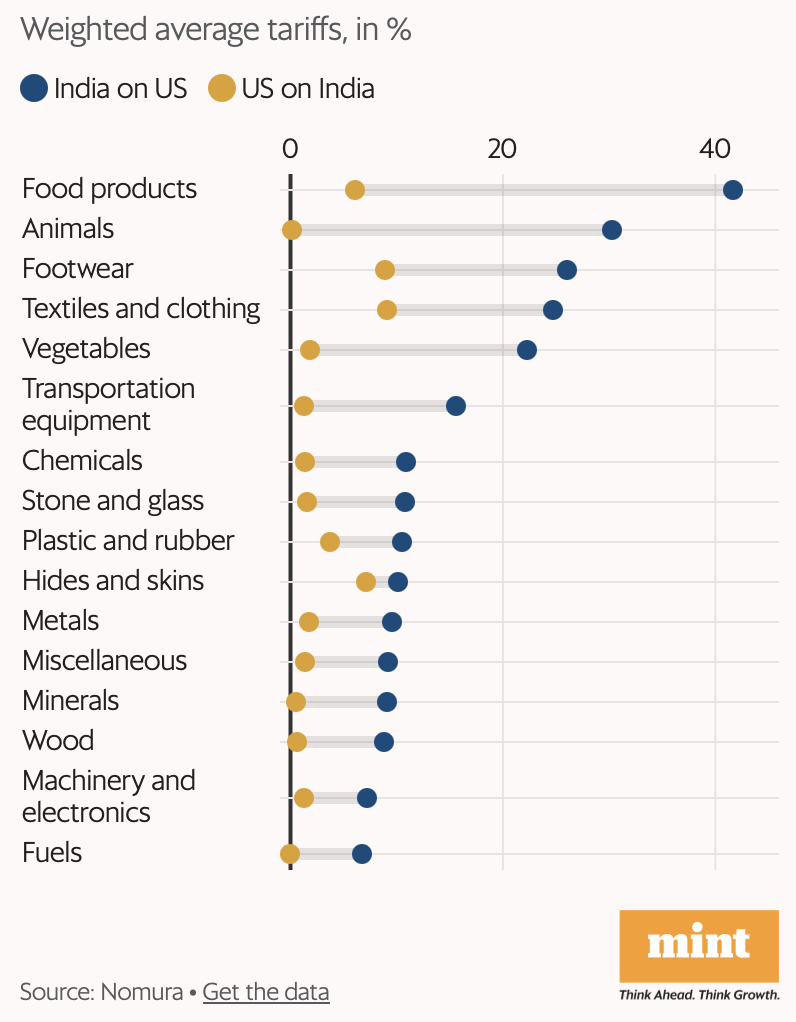
13. Livemint points to the differences between tariffs imposed by India and US. At the aggregate level, weighted average tariff gap has declined sharply from 22.9 percentage points in 2000 to just 2.5 percentage points in 2022.
At the broad sectoral level.
And at the product level.
14. Fascinating long read about the complex financial structure of the Canadian PE firm Brookfield Corporation, especially on its related party transactions where it's both the buyer and seller. The article describes the sale of One Liberty Plaza in Manhattan. 
A rare transaction in a moribund market for office towers, it received little publicity because the building’s ultimate owner, Canada’s Brookfield Corporation, was both the buyer and the seller. One of the world’s largest and most complex financial conglomerates, Brookfield sold property to itself like this dozens of times in 2024, using $1.4bn from its insurance arm to finance transactions that supported its “distributable earnings” — a non-standard measure of profit that underpins the corporation’s $90bn stock market valuation. These earnings were then recycled back into the portfolio in a circular flow of cash that is attracting scrutiny of both the relative opacity of Brookfield’s accounting practices and how it juggles its vast global portfolio of real estate...
Such trades support an expansive but lossmaking portfolio of more than 200 malls and offices dotting skylines around the world, including London’s Canary Wharf, One Manhattan West and the Las Vegas Fashion Show mall. The transactions pose questions about the quality of Brookfield Corporation’s earnings, and the valuation of assets held to pay annuity policies at the Brookfield-owned insurance businesses that trade with other parts of the conglomerate. They also raise the question of whether Brookfield and chief executive Bruce Flatt are presenting a sufficiently transparent picture of the organisation — a labyrinth containing thousands of entities, the interconnected funds, partnerships, trusts and companies that control $1tn of assets. Flatt, an accountant by training, owns a third of the Bermuda trust that appoints half the board of Brookfield Corporation in Toronto, the topmost of six listed companies operating in real estate, private equity, infrastructure, green energy, insurance and asset management. Brookfield also exercises control over a wide range of businesses and investment funds even though it often owns only a small part of them... Brookfield is a fiduciary that manages assets and money for public sector and union pension funds, annuity holders and investment funds. It runs critical infrastructure, is responsible for huge sums in long-term liabilities, and operates regulated businesses in many jurisdictions.
15. The size of the US Treasury market has doubled in the last decade!

In a comprehensive study, Andrew Fieldhouse and Karel Mertens classify major changes in non-defence R&D funding by the DoE, Nasa, NIH and NSF over the postwar period. They estimate implied returns of as much as 200 per cent — raising US economic output by $2 per dollar of funding. This is substantially higher than recent estimates of returns to private R&D. According to the Congressional Budget Office, the high returns to public funding are more than 10 times that on public investment in infrastructure. With the higher tax revenue generated from additional GDP, an increase in R&D funding more than pays for itself. In aggregate, productivity gains from federal R&D funding are substantial. Indeed, Fieldhouse and Mertens estimate that government-funded R&D amounts to about one-fifth of productivity growth (measured as output growth less all input growth) in the US since the second world war.

17. Business Standard points to a new study by ICAR-National Institute of Agricultural Economics and Policy Research which finds limited outreach of MSP operations. 

The findings indicate that only 15 per cent of paddy and 9.6 per cent of wheat farmers engage with the procurement system. Moreover, it remains confined to mostly large farmers. Small and marginal farmers, despite producing 53.6 per cent of paddy and 45 per cent of wheat, have low participation in public procurement. The direct relationship between participation in the MSP-backed procurement system and farm size arises because small and marginal farmers are likely to have low awareness about the procurement system, and are often constrained by their limited scale of production.