Substack

Showing posts with label capitalism. Show all posts

Monday, January 19, 2026

The rule of law and predictability underpins effective markets

The US invasion of Venezuela and capture of Nicolas Maduro is the signature intervention under the emerging Donroe Doctrine. However, Venezuela’s oil reserves, precisely the reason the US intervened, may end up complicating matters. For a start, despite the President’s exhortation to US oil majors to line up and invest in the country, they appear to bereluctant

Ricardo Hausman hits the nail on the head with this brilliant articulation of the paradox - the manner in which the whole thing has been executed undermines the credibility of the objective itself.

Capitalism is not simply private ownership. It is voluntary exchange under predictable rules — rules that bind the powerful as well as the weak, and that survive electoral transitions. Those rules are what make long-horizon investment possible. Predation is what happens when power writes the rules opportunistically, then demands they be treated as law. That distinction matters most when it comes to oil. Reviving Venezuela’s energy sector would require large, frontloaded capital spending to repair and expand infrastructure. Those expenses would have to be followed by many years of positive cash flows to repay sunk costs and earn a return. 

Oil is the opposite of a quick-turn business. Its economics hinge on whether rights will be respected long enough to recover the initial outlays. These rights do not emanate from threats. They come from a legitimate state: a government that can claim consent; a legislature that can authorise commitments; regulators and courts that can enforce them; and a political system that investors believe will honour yesterday’s deal tomorrow. Unpredictability may occasionally be an asset in international affairs, but trust is the real strategic currency. And trust is precisely what a coercive interim arrangement cannot supply. Delcy Rodríguez, Venezuela’s interim president, has no electoral mandate and inherits institutions whose legitimacy is contested. Contracts signed now — especially if shaped under foreign pressure — will be politically and legally fragile. A future democratic government would have reasons to revisit them, if not repudiate them outright. In anticipation, US oil majors will not invest. 

Investors can price commodity risk. They can hedge operational risk. What they cannot hedge is foundational illegitimacy: the risk that the very basis of a contract will later be judged void because it did not emanate from an authorised government. If Washington’s message is that legality follows power rather than constraining it, capital will rationally assume that every deal is hostage to the next shift in power, whether in Caracas or Washington. The political sequencing is also backwards. It is not prosperity that creates legitimate government; it is legitimate government — namely, democracy and the rule of law — that empowers people to create prosperity. With these foundations, markets can do what they do best: decentralise initiative, mobilise investment and reward productive effort rather than proximity to power.

This is brilliant and has resonance elsewhere. Two markets in particular come to mind: infrastructure and technology. 

Predictability arising from the sanctity of the rule of law is the most important requirement for the functioning of private markets. It is this confidence that allows investors to invest their money, and just as importantly, entrepreneurs to put their efforts. Predictability extends not only to business creation and ease of doing business, but also to retaining control of their businesses. The latter is important given trends in industries like emerging technologies and infrastructure, where a dominant industry leader swoops in to forcibly take over a promising emerging firm. 

Ambitious entrepreneurs are driven by their belief in scaling their businesses and leading their industries. And in many sectors, especially but not only infrastructure, these are also long-drawn journeys spanning decades. In other words, building one enduring and dominant business is an endeavour of a lifetime. 

In this backdrop, any threat of being forcibly ousted and taken over can be a serious, if not prohibitive, deterrent to entrepreneurship. Why would an ambitious entrepreneur put in his sweat and toil to build a business if he runs the imminent threat of being forced out by a dominant rival precisely at the time his business starts to show promise and reaches the scaling pathway? Similarly, why should investors put their money in such risky and long-drawn projects when they know that they run the risk of seeing the entrepreneurs they backed being ousted and their upside being capped? 

Thanks to network effects and resultant market structures, the commanding heights of the digital technology industries are oligopolies or monopolies. Therefore, in the technology industry, once a promising startup comes up with a new or disruptive idea in any of the frontier areas like AI, chip design, or robotics, they run the risk of being harried and bullied into being absorbed by the Big Tech firms. Apart from snuffing out any potential competitor, Big Tech firms want to deepen their moats by capturing all innovations in their ecosystem. These pressures and threats are triggered through multiple channels - product development ecosystem, market access, investors, legal notices, and so on. 

Infrastructure sectors, being deeply enmeshed in the political economy and where the dominant incumbents formulate the rules of the game, are rife with crony capitalism and regulatory capture. Therefore, in the infrastructure industry, once a firm builds up a good portfolio of projects after several years of hard work and persistence, they run the risk of the dominant market leader swooping in and taking over by ousting the management. 

The new entrants are vulnerable to being coerced off their assets, even without a fair return or compensation, and often with the active support of the governments. In addition, in the context of Indian states, it is not uncommon to find the ownership of prime infrastructure assets changing hands (or shareholding patterns shifting) from the contractors preferred by the previous government to those favourable to the incoming government. 

All these act as significant deterrents for investors and entrepreneurs. Sectors like infrastructure and information and communications technology (ICT) are critical drivers of economic growth, and incentive distortions that discourage investors and entrepreneurs can be binding constraints on economic growth. 

Monday, July 14, 2025

Business concentration - airport services edition

A feature of the efficiency-maximising (American version) capitalism is the trend of business concentration at the extensive and intensive margins. The former involves horizontal integration, whereby a handful of firms make up an increasingly major market share in their respective industries. It’s a phenomenon that spans industries and countries in varying degrees. The latter refers to the trend of vertical integration, where the dominant firm tends to capture an increasing share of value addition within the industry. This feature is pervasive in certain sectors like IT, healthcare, infrastructure, etc.

The Ken has a story on the rapid changes in business models in the airport services industry due to the increasing dominance of the Adani Group. The predominantly outsourced model of services in the airport industry in India is giving way to a more vertically integrated model. 

Traditionally, the various non-aeronautical services in the airport, like lounges, food and beverages (F&B), retail, etc., were outsourced to specialised service providers who in turn contracted with aggregators who brought together brands (like banks for lounges, retail brands for F&B and retail space, etc.). This is now giving way to a strategy where the real-estate concessionaire (Adani Group) is seeking to maximise value capture from airport services by creating its own service companies and squeezing out the outsourced service providers. 

The article narrates the story of Dreamfolks Services.

Dreamfolks Services, a publicly traded company that has quietly built a 90% monopoly in the lucrative business of getting Indian credit-card holders into airport lounges. It sits in the middle of a four-way handshake among banks, card networks, lounge operators, and travellers… TFS and Encalm ran the physical lounge spaces. But it was aggregators like Dreamfolks that unlocked access by bundling lounge networks and partnering with banks and credit-card issuers. If a lounge visit costs Rs 100, the aggregator might charge Rs 115, pass Rs 5 back to the operator, and keep the rest. Banks liked the convenience. Aggregators liked the margins… Around them, a cottage industry of brands and partners grew…

Liberatha Peter Kallat, the company’s founder and chairperson, appeared on CNBC TV-18 and accused Adani Airport and the second-largest airport operator, GMR Airports—without naming them directly—of pressuring banks like ICICI and Axis to abandon aggregators like hers in favour of themselves… Travel Food Services (TFS) and Encalm Hospitality, both prominent lounge operators, have since cut out Dreamfolks and signed directly with Adani. Banks are following suit… As tech infrastructure improved, there was no longer a strong reason to maintain the middle layer… every airport and lounge operator is now building its own backend.

It describes how in-sourcing is happening across service verticals.

Unlike Adani’s other airports, where retail concessions are often managed by third parties, in the Mumbai airport, Adani directly runs the non-aero business… Adani Airport has moved to a franchisee model—a shift from the earlier system, where brands paid rent (fixed or revenue-linked) to concessionaires who had won competitive bids for spaces. Now, instead of paying rent, they are licensing their brand to the airport and letting it run the show… 

In Mumbai, three large players—TFS, Lite Bite Foods, and Devyani International—used to dominate F&B. That has changed. Last March, Adani acquired a majority stake in Semolina Kitchens, a TFS subsidiary. TFS, now aligned with Adani, is emerging as the primary F&B operator at the airport. Lite Bite’s share has reportedly fallen from 50% to under 20%, said F&B operators in the know. Both it and Devyani are expected to exit entirely once their contracts expire later this year… 

Of the eight lounges at the Mumbai airport, at least five are now managed by TFS. Through Semolina, TFS has lounge and Quick Service Restaurant (QSR) concession rights at six Adani-operated airports, as well as Goa (operated by GMR), according to its pre-IPO documents. The roles are consolidating. The partners are getting fewer. The integration is getting tighter… So if a brand is trying to operate at the airport, they can’t be surprised if the space goes to TFS’s in-house brands like Caffecino, Curry Kitchen, or Dilli Streat instead… 

Over the past 18–24 months, categories like watches, apparel, cosmetics, salons, and even convenience stores have seen a shift in how business is done at Adani-run airports. The model is familiar by now: migrate the old setup into a new one, run by a close partner. In this case, that partner is April Moon Retail, claimed multiple brand owners. Stores at these airports still carry their logos and branding, but the backend has moved, they said. Employees are now on April Moon’s payroll. Bills carry the brand’s name, but the GST number belongs to April Moon… 

April Moon has begun launching in-house formats across categories. Stores like Bon Voyage, which sell everything from snacks and books to travel accessories, now operate across multiple Adani Airports… What’s really taking off is the retail-cloning strategy. When something sells well at the airport, it doesn’t take long for a lookalike to show up—all run by April Moon. A luxury watch counter resembling Ethos or Helios? That’s Meridiem. A beauty and cosmetics outlet that looks like Nykaa? Meet Amara Luxe. Something that feels like Lenskart or Titan Eye+? It’s probably Vue De Luxe. Handicrafts à la Rare Planet? That’d be Pravasi. There’s even talk of a Hamleys knockoff said to be in the works.

This trend, in turn, creates several disturbing concerns.

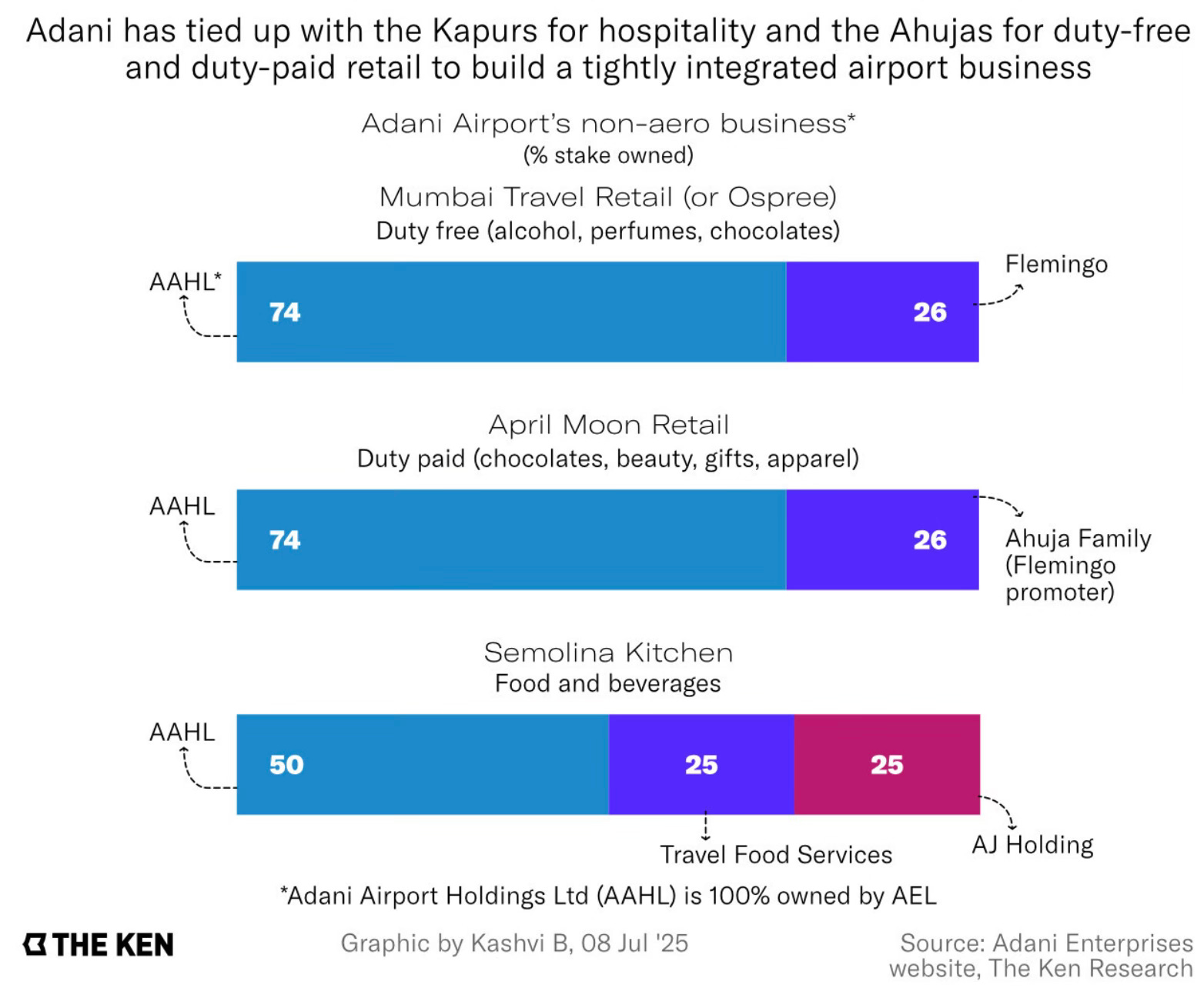
TFS, whose IPO opens on 7 July, was founded by the Kapur family—the same folks behind Copper Chimney, Bombay Brasserie, and The Irish House… TFS could eventually be replaced, too. Adani is reportedly talking to Plaza Premium, the global lounge operator, for future airport lounge ops… 

April Moon began appearing around 2021. Its role was to take over the duty-paid retail at airports. That September, Adani acquired a 74% stake in Flemingo Travel Retail—a global duty-free operator founded by Atul Ahuja—for just Rs 2.8 crore. This, for a company that had clocked nearly Rs 900 crore in revenue in FY19. The deal, struck mid-pandemic when travel retailers were reeling, came at a throwaway price. And it gave Adani near-total control over both duty-free and duty-paid retail. For brands, that left little room to negotiate: either go through April Moon, or lose access to airport shelves… “If we made Rs 15 lakh in monthly sales at a store, we’d only be allowed to record Rs 5–6 lakh,” said one retailer. After costs, they say, the effective take-home margin is 5–6%. “Retailers who spent decades building these brands are now effectively just vendors.”

Strong financial incentives are driving these trends

At AAI airports, non-aeronautical revenue makes up maybe 10% of the pie. At private airports like Mumbai or Delhi, that jumps to 62%, per data cited by Crisil in TFS’s IPO documents. And within that, F&B alone account for as much as 40%. For instance, the top five Starbucks outlets in India by revenue are all located at airports, according to an F&B operator. A single store can bring in Rs 1.5 crore a month; that’s 3–4X more than a high-street outlet. And margins are nothing to sneeze at. A Rs 400 latte at an airport (Rs 350 at other outlets) contains roughly Rs 20 worth of ingredients.

Business concentration through horizontal and vertical integration may be inherent to the dynamic of capitalism with its profit-maximising firms. And there are doubtless efficiencies to be realised from both these trends. 

But the case of the airport sector in India, representative of trends across several sectors, raises questions about the stifling of entrepreneurship and innovation, and business dynamism in general. 

For example, what’s the incentive for entrepreneurs to start something like Dreamfolks Services, or April Moon Retail, or TFS, if there’s an imminent threat of being squeezed out of the market or being taken over by the dominant airport operator? Wouldn’t such trends deter investors from putting their money behind entrepreneurs whom they would otherwise have supported? More generally, is business concentration at the extensive and intensive margins likely to scare risk capital away from these sectors?

In addition, there’s a compelling argument that vertical integration under a corporate behemoth would lower innovation, service quality, and sector-wide dynamism. There’s a strong likelihood that once these services are taken in-house, like with all monopolies, the airport operator will have diminished incentives to pursue innovation and service quality and instead will have increased incentives to maximise profits. 

In any case, it’s unlikely that large infrastructure groups or their subsidiaries will be as innovative or driven to improve service quality (say, cater to all market segments), expand service portfolios (including interoperability with similar services globally), explore adjacent market synergies, and so on. This has been the global experience from across sectors, especially but not only in the infrastructure sector, over time.

It’ll be easy for the airport industry in India to become entrapped in a sub-optimal equilibrium of a horizontally and vertically integrated market dominated by a couple of operators. Given the inevitable growth in traffic due to economic growth starting from a low baseline, the associated inefficiencies can be papered over for a long time. But its opportunity cost can be considerable. 

Vertical integration also creates problems with the transparency of accounting for all those involved. Being part of the same corporate group means that there will be incentives to indulge in manipulation of accounts to minimise statutory payments and taxes, besides also maximising leverage. The operator can show lower revenues by over-invoicing and shifting profits to subsidiaries. Entities within a corporate group can do tax arbitrage by shifting profits among themselves. 

There’s also the case that horizontal integration creates the incentives for vertical integration. Adani Airport will have the incentive to in-source hitherto outsourced airport services only if it enjoys the economies of scope and scale from operating multiple airports. This underlines the importance of controlling market shares in such technically monopolistic markets (which also include those in IT, which benefit from network effects).

However, concerns about business concentration must be balanced with the need for large capital, a high risk appetite, and business ambition, especially if the objective is to scale big and rapidly. The country’s rapid and high growth ambitions require massive investments. The government is expanding airports at a rapid pace, and the airline industry is expected to grow fast for several years. Given their long gestation and deep exposure to the business cycle, only businesses with a high risk appetite and access to patient capital will invest in these sectors. 

Take the example of smart meters. The Government of India wants to install bi-directional smart meters in all 250 million households by the end of 2026. Even at a very conservative Rs 10,000 per smart meter (and its allied components), this would require a staggering investment of Rs 2500 billion (or about $28 bn). Given that regulatory conditions would restrict the discoms from recovering the cost of these new meters from existing metered customers, this cost must be borne by the government or the discoms. 

Since mobilising upfront capex of this scale would have been impossible, a totex model was adopted where the major share of capex would be borne by the concessionaires who would recover it over the eight years of the contract. This also means that the concessionaires would have to bear the significant risks (technology obsolescence, political economy of electricity tariffs, policy shifts, and local politics) involved and carry them in their balance sheets over the contract period. Only a few firms with the deepest pockets and highest risk appetites can assume such risks and make money from these contracts.

In conclusion, business concentration poses a dilemma for policy-making in many sectors. Its harms are well-known and often salient in a bad way, but its benefits are less known. When it unleashes a dynamic that confines an increasing and dominant share of the benefits in the hands of a few corporate groups, then there will be problems. 

Econ 101 would have it that such monopolistic trends should be formally regulated. But regulation is fraught with problems, given its inefficiencies and the political economy. Besides, there are limits to the extent of regulation required to control these business dynamics. 

From another perspective, the reliance on large corporate groups to drive high-growth aspirations is essentially a legitimate political economy choice that many countries, including those in the West, have made in their growth trajectories. Therefore, it’s only natural that a recognition of the problems that accompany the pervasiveness of large corporate groups be met with a similar political economy choice to force some form of restraints on their overreach.

Saturday, February 8, 2025

Weekend reading links

1. The US Government under Donald Trump is rapidly degenerating into a lawless one. Sample this from the happenings in the Treasury Department
Treasury Secretary Scott Bessent gave representatives of the so-called Department of Government Efficiency full access to the federal payment system... The new authority follows a standoff this week with a top Treasury official who had resisted allowing Mr. Musk’s lieutenants into the department’s payment system, which sends out money on behalf of the entire federal government. The official, a career civil servant named David Lebryk, was put on leave and then suddenly retired on Friday after the dispute, according to people familiar with his exit. The system could give the Trump administration another mechanism to attempt to unilaterally restrict disbursement of money approved for specific purposes by Congress, a push that has faced legal roadblocks... Mr. Bessent granted access to the payments system to a handful of staff members affiliated with DOGE, including Tom Krause, the chief executive of a Silicon Valley company, Cloud Software Group, according to one of the people familiar with the change. Access to the system has historically been closely held because it includes sensitive personal information about the millions of Americans who receive Social Security checks, tax refunds and other payments from the federal government... In a process typically run by civil servants, the Treasury Department carries out payments submitted by agencies across the government, disbursing more than $5 trillion in fiscal year 2023.

Besides, this also poses serious conflicts of interest since it will allow Musk to access the details of payments being made to his competitors and in theory even control it.

With the likes of Robert Kennedy Jr heading the Health Department, Pete Hegseth leading the Defence Department, and Kashyap Patel heading the FBI, it's hard to not feel that the US government has become a banana republic where the President selects his Cabinet based purely on loyalty with no concern for any merit. 

Crony capitalism without any pretensions is invading US with vengeance, in a manner that would put to shame even those developing countries that Americans once scorned upon.

America’s largest companies are cutting deals with Elon Musk’s businesses or touting links with the world’s richest man as he solidifies his power within Donald Trump’s administration and begins to radically restructure the US government. A rush of announcements in recent days included Visa finalising a payments processing deal with Musk’s social media site X and United Airlines accelerating a plan to use Musk’s Starlink satellites for in-flight WiFi. Amazon has also boosted marketing spending on X... On Monday, Apple updated its iPhone operating system, allowing T-Mobile users in the US to connect to Musk’s Starlink satellites. Boeing’s chief executive Kelly Ortberg said he had been working with Musk... to accelerate delivery of two Air Force One planes that are over budget and years late. Oracle, the enterprise software company run by Trump supporter Larry Ellison, also announced a Starlink collaboration, while Intel touted a “growing media partnership” with X before broadcasting a live event together with Microsoft on the platform. Separately this week, roughly $3bn of debt tied to Musk’s purchase of X, held by banks including Morgan Stanley for more than two years, began to move, with investors including Apollo interested in a tranche... Following Trump’s win in November, JPMorgan dropped a three-year lawsuit against Tesla, in which it was seeking $162mn over alleged breaches of a stock warrants contract... Since the election, Musk has been a near-constant presence at the president’s side and been involved in everything from cabinet appointments to AI, defence and economic policy discussions.

State capture by plutocrats. 

2. Mexico, China, and Canada made up 42% of US imports in 2024.

These are the main imports of the US from the three countries. 

President Trump has signed executive orders imposing tariffs on the three largest US trade partners - 25% each on Canada and Mexico (though only 10% of Canadian oil exports), and 10% on China. It covers all US imports from these three countries.

Collectively, EU has the largest share of US imports

The FT has an editorial pointing to the absurdity of the trade war.

The harm to American diplomatic power is no less profound. From the 1980s, both Canada and Mexico set aside decades of scepticism to make a strategic bet on free trade with the US, culminating in the Nafta deal of 1994. The economic benefits, especially to Canada, have been plentiful. Both were coerced by Trump in his first term to renegotiate that deal. That the president is now riding roughshod even over the revised deal, the USMCA, sends a message America’s word cannot be trusted.

Janan Ganesh makes some important observations of the Trump era of deal making, describing it as one of "aggressive soft touch".

Because Trump is so quick to quarrel, people tend to miss that he is also quick to settle. He almost never drives as hard a bargain as his belligerent manner seems to promise. In 2020, China bought some peace with a vague and hard-to-enforce pledge to cut the two countries’ trade imbalance... Likewise, he didn’t abandon Nafta so much as pass off a revised version of it as a personal coup. Being an egoist, not a fanatic, what he cares about is his reputation as a maker of deals. To keep it going, he needs a regular flow of them. And so their content becomes secondary. We can mock, but the lesson here for countries faced with Trump is an encouraging one: give him something that he can call victory. The concession needn’t be huge, and he will in fact co-operate in talking up its significance. 

Nor does he seem to mind all that much which coin he is paid in. Trump is open to what Henry Kissinger called “linkage”. If he is upset about one thing, he can be mollified with a gesture on something apparently unrelated. Want to avoid a trade war, Europe? Spend more on defence. Want to prevent the betrayal of Ukraine? Soften the regulation of the tech sector. It is hard to know what is more telling about Trump’s truce with his northern and southern counterparts: the smallness of their concessions (Justin Trudeau is appointing a fentanyl “czar”) or the fact that economics and drug policy are mixed up like this in the first place. So yes, Trump threatens to displace industrial investment from Europe to the US. But Europe is spoilt for things to offer him, precisely because his grievances are so numerous. In that sense, he might be easier to defang than Joe Biden, who didn’t think Nato was a club of free-riders or the EU a conspiracy against Silicon Valley. There was nothing Europe could offer him on those fronts that would make him ease up on the America First industrial plan. With Trump, there might be. The very paranoia of his worldview — in which the US is being ripped off by almost everyone, almost all the time — means there are lots of entry points for a negotiation.

3. Alan Beattie makes an important point about the possible unintended effects of Trump's policies.

Currently, as trade has recovered from the initial shock of the Ukraine war, US imports have increased far faster than the world as a whole, while Chinese import growth has fallen... As for other sources of final demand, emerging economies themselves, particularly in Asia, have been consuming more as they get richer. But east Asian countries are typically net exporters: Malaysia, Singapore, Thailand and the Philippines have generally run current account surpluses since the Asian financial crisis in 1997-98, as have South Korea and Japan. Meanwhile, the EU, struggling to raise growth while Germany remains obsessed with exports, is also unlikely to pick up the consumption baton. This may add up to trouble ahead for countries exporting to the US, especially heavily exposed economies like Canada and Mexico.

Trump’s economic policies will encourage a wider US trade deficit, the opposite of what he wants. His planned sweeping tax cuts will increase consumer demand and suck in imports. His tariffs will make US exporters less competitive by strengthening the dollar, which import taxes tend to do. It will not be pretty if Trump starts deploying tariffs all round to stop the US being a consumer of last resort while implementing policies that will ensure it remains so. Exporters will be hunting round the world for scarce demand. As I’ve said before, the real threat to the global economy is not the rejigging of supply chains. It’s the danger that the most reliable market for global exports decides to crunch economic growth to get its trade deficit down and there’s not enough demand elsewhere to replace it.

The article has an important snippet that conveys the extent of China's predatory trade policy.

In terms of volume, Chinese exports rose at an annual rate of 13 per cent in the third quarter of last year, far faster than world import growth at less than 1.5 per cent.

It has a graphic on the estimates of trade growth between various categories of countries. 

4. Trump effect on US-China trade

One sector where the impact will be concentrated and immediate will be in the agriculture sector and in the US mid-west.

The opening salvo of a new trade war has sent a chill through the Midwest. Canada, Mexico and China together account for half of all American agricultural exports. Just last year, the US sold more than $30bn in farm products to Mexico, $29bn to Canada and $26bn to China, according to American Farm Bureau statistics. Suddenly, farmers were facing the spectre of retaliatory tariffs and the prospect of a full-scale conflict that some fear could decimate America’s rural heartland. Farmers in an area of the country that has become a bedrock of support for Trump now worry that the president’s tariffs, though suspended at the last minute, have permanently damaged the image of the US in the eyes of its most important trading partners...

Few US states better embody the agricultural wealth of the Midwest than Iowa. It is a land of vast corn fields stretching as far as the eye can see, the landscape broken by the occasional grain silo, hay bale or low-slung barn. Hogs outnumber people more than seven to one. It is also Trump country. Although Iowa voted for Democratic presidents Bill Clinton and Barack Obama, it backed Trump in 2016, 2020 and 2024 in ever greater numbers. More than a fifth of Iowa’s economy — or $53.1bn — is tied to agriculture, from crop and livestock production to food processing and manufacturing. It is the country’s largest producer of corn, hogs, eggs and ethanol and a top-three grower of soyabeans. That makes it particularly vulnerable to any downturn in agricultural exports. 
This article explains how the tariffs will impact automobile imports into the US.

5. Bloomberg reports that China's muted and largely symbolic response to Trump's 10% tariff on $525 bn of Chinese exports is a reflection of China's weak bargaining hand. China exports to the US three times as much as the US does to China. 

Apart from retaining the 10% tariff on China, for at least now, Trump has also scrapped the "de minimis" rules exempting shipments under $800 from duties. This loophole had been a major contributor to the growth of Chinese online sellers Temu and Shein. This will sharply increase the cost of the 4 million parcels a day arriving in the US under this exemption, of which 30% come from the two ecommerce groups. 

6. Richard Baldwin points to a possible four stage trade war scenario arising from Trump tariffs. 

American cars are not really made in America. They are assembled in America from parts produced in the US, Canada, and Mexico. I coined the phrase “Factory North America” 14 years ago to describe the tightness of the industrial integration. Nowadays, production processes are so interwoven that an engine could cross US-Canada and US-Mexico borders seven times before it ends up in a finished, US-made car. With each border crossing into the US, a 25% tariff will be applied, so the cost of the engine will soar. And costs will jump for all the other parts from Mexico and Canada and China. That’s step 1: The tariffs will raise the cost of US-made cars.

All cars made in Factory North America will become less attractive to US buyers. That will trigger Step 2. Before Trump’s tariffs, about half the cars sold in the US were imported. Mexico and Canada were big suppliers, but their competitiveness will be hobbled by the 25% tariffs. About half of US imported cars come from Japan, Germany, and Korea. They have not been subjected to the 25% tariffs... Cars made in the US, Canada, and Mexico will get more expensive inside the US, but German, Japanese and Korean cars will not... Almost surely, many US buyers will switch to German, Japanese and Korean cars that the tariffs made relatively cheaper. That’s step 2: A flood of imports from Germany, Japan and Korea. 

And how do you think President Trump will react to this import surge? My guess is that the US president will view it as unfair competition that he has to counter. He has a couple of time-honored options. He could lay a 25% tariff blanket on all imported cars, or negotiate “voluntary” export restrictions with Japan, Germany, and Korea. Given his love of tariffs, I’ll put my chips on option 1. Soon, it’ll be the “presidential all-you-can-eat tariff buffet.” That’s step 3: The US expands its war on trade to include its main trade partners in Asia and Europe... These US trade partners will retaliate against US exports. That’s step 4: The main US trade partners retaliate against US exports... When he sees US exports hit with new tariffs, which he will surely blame someone else for, he is very likely to impose counter retaliation tariffs. And that, ladies and gentlemen is how future historians will say that the World Trade War started.

7. A natural experiment in the works from the Indian government's Income Tax policy change of increasing the limit for tax rebates from Rs 7 lakh to Rs 12 lakh

While those earning up to Rs 12 lakh a year will have zero tax liability under NTR, the tax outgo would shoot up to Rs 61,500 if the taxable income breaches Rs 12 lakh by just Rs 10,000. Thus, an employee having an annual taxable income of Rs 12.1 lakh would actually take home Rs 51,500 less than the one earning Rs 12 lakh. A back-of-the-envelope calculation shows that parity is achieved only at the income level of Rs 12.71 lakh in terms of take-home salary. At Rs 12.71 lakh, the tax is Rs 70,500, which means the take-home salary at that level would be almost equal to Rs12 lakh.

8. Paul Krugman makes an important under-appreciated point about the value of FTAs in bringing predictability that in turn promotes business investments. He points to the example of NAFTA which did not as much as lower tariffs (which were already low when it kicked into effect in 1994) as it reduced uncertainties and allowed businesses do long-term planning and investments. 

9. Airline reward points 

In 1987... American Airlines partnered with Citibank to launch a co-branded credit card offering users air miles for every dollar spent. This scheme of selling frequent-flyer points to financial institutions transformed mileage programmes into complex but highly profitable businesses in their own right. In theory at least, it seems like a near-perfect business model: airlines can create as many points as they like out of thin air, and then sell them on to banks and credit card companies. They can also sell miles to partner hotels, car rental companies or shops, in effect becoming the central banks of a lightly regulated financial ecosystem. While airlines can enjoy instant revenue from selling air miles to banks and other third parties, the cost of customers redeeming their points through booking seats is deferred into the future, says John Grant, an executive at airline data company OAG.
Many never spend them at all. In 2018, the consultancy McKinsey estimated there were 30tn unredeemed air miles in passenger accounts, enough for almost every airline passenger in the world to take a free one-way flight. These asset-light businesses are particularly attractive to airlines. The actual work of operating flights is capital intensive, exposed to economic downturns and has high fixed costs, some of which such as fuel are out of airlines’ control. The reliance of airlines on their loyalty businesses became clear during the pandemic, when the four biggest US carriers put up their customer loyalty schemes as collateral to help them raise new debt. At the time, the valuations put on the loyalty schemes far exceeded the market capitalisations of the ailing airlines, suggesting they were worth more than the flight operations. Even at the height of the disruption in July 2020, American Express paid £750mn to extend its partnership with BA owner International Airlines Group, a significant part of which was to pre-purchase Avios frequent-flyer points. IAG Loyalty, the home of Avios, reported an operating profit of €321mn in 2023, more than Aer Lingus, one of the group’s airlines, and up by 14 per cent from the previous year. Its operating margin in 2023 — 21 per cent — was more than double that of Aer Lingus or BA.

10. DeepSeek has thrown egg at the faces of everyone, including the Chinese government.

DeepSeek’s achievements did not emerge from one of China’s myriad government-backed research institutes or state-controlled companies. Mr Liang seems to control most of the shares in DeepSeek, and has steered clear of China’s state-dominated venture-capital industry.

11. India's tariffs

India’s average import tariff stands at 17 per cent, while the trade-weighted rate is lower at 12 per cent, according to the World Trade Organization’s 2024 report.
12. FT has a good read on Paul Kagame's support for the Tutsi militia M23 in Eastern Congo. After its successful takeover of Goma last month, the rebels have been conquering other towns in the mining rich Eastern part of Congo. Rwandan troops are reportedly providing ground support for the invasion. Kagame argues that he's only providing protection for Tutsis against the DRC-backed Hutu FDLR militia who have been terrorising Tutsis in the area. The UN has reported that in a single year, 150 tonnes of coltan, used in electronics were fraudulently exported to Rwanda and mixed with Rwandan production, thereby benefiting Rwanda at least $1 billion. 

13. The fourth quarter results of Big Tech companies point to spending on CapEx to top $300 bn in 2025.
Microsoft, Alphabet, Amazon and Meta have reported combined capital expenditure of $246bn in 2024, up from $151bn in 2023. They forecast spending could exceed $320bn this year as they compete to build data centres and fill them with clusters of specialised chips to remain at the forefront of AI large language model research... On Tuesday, Google’s Sundar Pichai said in defence of his plan to spend $75bn in 2025 — up 42 per cent from $53bn last year... Microsoft’s Satya Nadella said... going to spend $80bn building out Azure... And on Thursday, Amazon CEO Andy Jassy topped Google and Microsoft by forecasting more than $100bn in capital expenditure this year, up from $77bn in 2024 and more than double the $48bn of the previous year. The vast majority will go towards data centres and servers for Amazon Web Services... Meta... pledged to spend “hundreds of billions” more on AI, on top of the $40bn invested in 2024.

Such spending is opening up a widening gulf between the Big Tech and the rest.

Spending among the “Magnificent Seven” — which also includes Apple, Nvidia and Tesla — dwarfs the rest of the US benchmark S&P 500. Their capital spending rose 40 per cent in 2024 compared with 3.5 per cent among the remaining 493 companies, according to Société Générale. Profits among the elite group soared by a third in the same period, versus 5 per cent among the rest.

14. In another reflection of the issues with US capitalism, it's being pointed out that US defence contractors are spending their surpluses on share buybacks instead of modernising their weapon sytems.

In 2023, Lockheed Martin and RTX spent a combined total of $18.9 billion on stock buybacks, compared with just $4.1 billion on capital expenditures, according to data compiled by Bloomberg.
15. In a reflection of the problems with climate transition, NYT reports that US "utilities have extended the life of nearly a third of coal units with planned retirement dates, either through delays or by reversing course and canceling retirements entirely, between 2017 and today".

Thursday, December 5, 2024

Market failures from profit maximisation in US healthcare

A Bloomberg series (this and this) chronicles US hospital chains' widespread use of Nurse Practitioners (NPs) in primary care to emergency rooms. NYT has a two-part series (this and this) on how pharmacy benefit managers (PBMs) are driving up drug prices and forcing out independent drug stores across the US. 

The four articles are a case study on how profit maximisation incentives in sectors like health care distort incentives, erode service quality, hurt consumer welfare, and inflict pain on customers and communities. 

The Bloomberg series illustrates the example of Hospital Corporation of America (HCA), a $84 billion for-profit, which is the largest hospital chain in the US, with its over 180 network hospitals across the country having treated over 1.9 million patients in 2022 alone. 

It has gone the farthest in using NPs to maximise efficiencies

Busy ERs are constantly triaging, determining where the physicians on duty are most needed. And nurse practitioners have significant responsibility and authority—perhaps more than many patients realize. In important respects, they’re now at the center of health care in the US… There are already more than 300,000 nurse practitioners, and that figure is rising far faster than the number of doctors. In 2014 there was 1 NP for every 5 physicians and surgeons in the US, according to the Bureau of Labor Statistics. Last year the ratio was 1 to 2.75. The gap is going to shrink further still: Nurse practitioner is the fastest-growing profession in the country, and the ranks are expected to climb 45% by 2032.

After getting an advanced degree—typically a master’s or doctorate in nursing—and an additional license, nurse practitioners are allowed to treat patients in many of the same ways medical doctors do, including diagnosing ailments and prescribing medications. The shift has many benefits. For patients, more clinicians means getting care sooner. (The average wait time for an appointment with a physician is at an all-time high of 26 days.) For health-care organizations, NPs are cheaper to employ than physicians, and under some circumstances the organizations can bill insurers for their time at physician rates. The NPs themselves can get more pay, more prestige and a better work-life balance than registered nurses, which many NPs formerly were.

Such demand creates its own supply albeit with serious distortions

The problems result from the surging number of programs, which graduate thousands of NPs a year without adequately preparing some of them to care for patients. The former director of the largest NP program in the country says she can’t recall denying acceptance to a single student. More than 600 US schools graduated students with advanced nursing degrees in 2022, according to US Department of Education data. That’s triple the number of medical schools training physicians. More than 39,000 NPsgraduated in the 2022 class, according to the AANP, up 50% from 2017.

Unlike the training program for physicians, education for NPs isn’t standardized. Some candidates attend in-person classes at well-regarded teaching hospitals, but a much larger number are educated entirely online, sometimes via recorded lectures that can be years old. Interaction with professors is often limited to emails and message boards. These circumstances make the required clinical portion of an NP’s education even more important—but compared with doctors’ residencies, those stints are brief, and students say they’re of wildly variable quality. In 2022 the advanced nursing programs that awarded the most degrees were offered by institutions that deliver the classroom portion of instruction primarily over the internet…

Early waves of NP students were often experienced registered nurses seeking to increase their skills and responsibilities. But as demand spiked, more schools began offering “direct entry” programs that accepted students with a bachelor’s degree in unrelated fields. Today the fastest among them can prepare students for NP licensure exams in three years of education that encompasses a bachelor’s in nursing, registered nursing licensing (all NPs have to become RNs, even if they haven’t yet worked in the field) and a master’s in nursing. In 27 states, licensed graduates are allowed to treat patients and prescribe drugs with no physician oversight, even if they have no prior nursing experience… With a separate license from the Drug Enforcement Administration, NPs can also prescribe controlled substances. This license has made NPs particularly attractive to telemedicine companies… Students must obtain 500 clinical hours to graduate. That’s less than 5% of the amount required of medical doctors before they can practice medicine.

Fundamentally, the demand for NPs is driven by unit economics

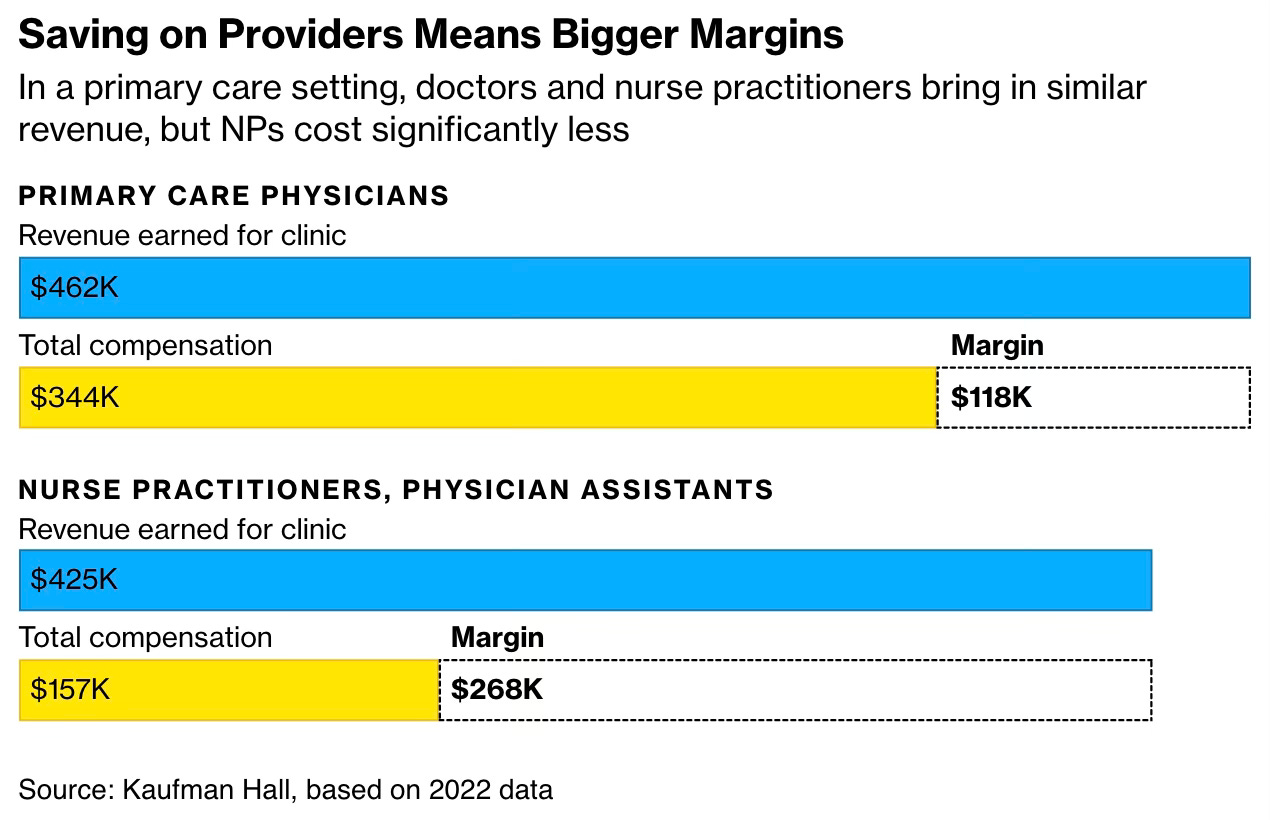
Physicians are in short supply, and NPs can fill the gap. There’s also a financial motivation. A primary care physician costs $344,308 a year, whereas a primary care NP costs about $156,546, according to 2022 data compiled by Kaufman Hall, a health-care consulting company. Yet primary care NPs can generate $424,979 of direct revenue a year, only $37,000 less than a physician. Put another way, NPs are twice as profitable.

The largest US hospital chain, HCA, a for-profit firm, is illustrative of the extreme dependence on NPs.

This staffing pattern has soundly rewarded HCA’s shareholders.

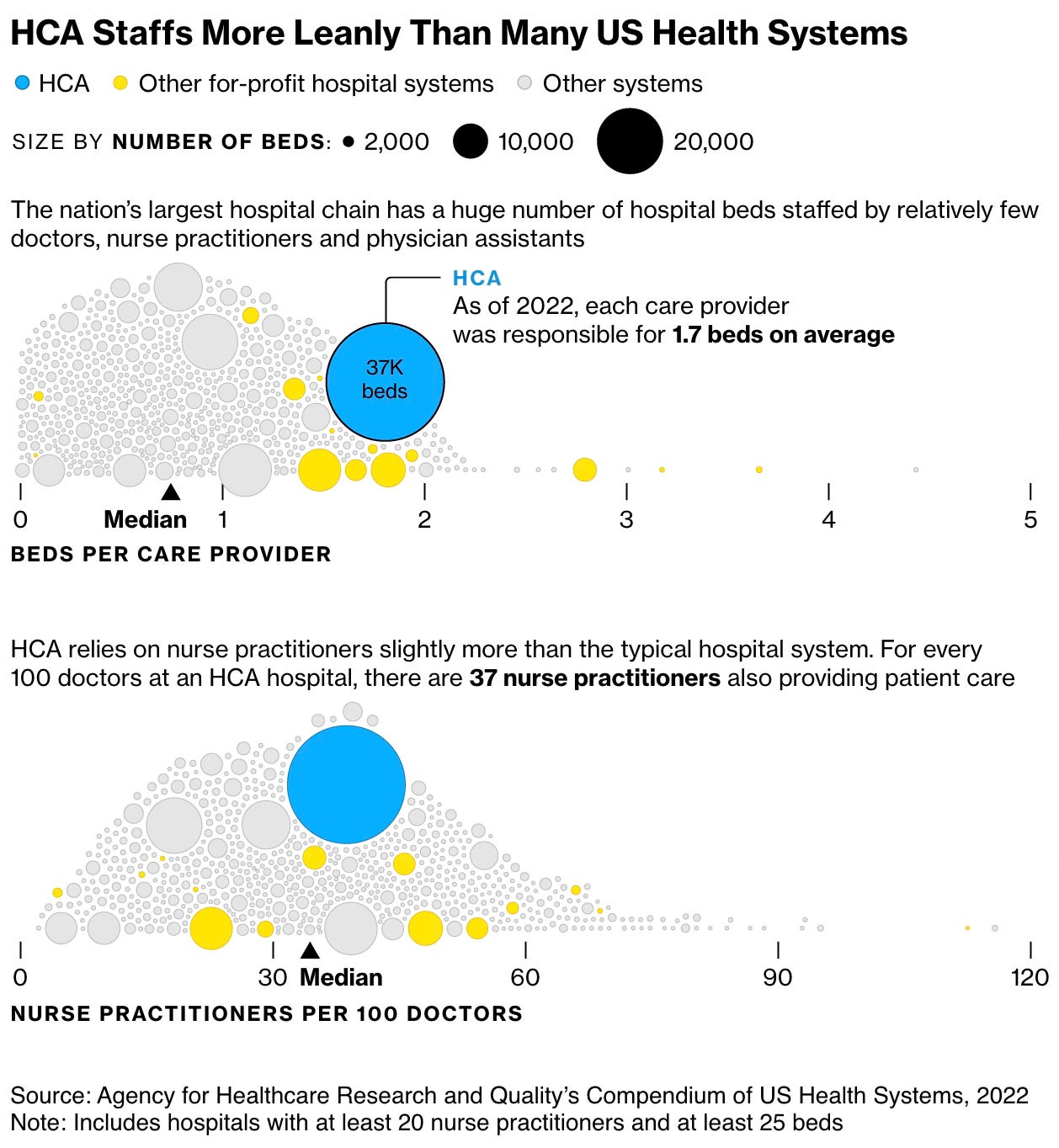
The company has one of the lowest ratios of physicians and advanced practice providers (a catchall term for nurse practitioners and physician assistants) per bed among more than 600 US health-care systems that the federal government tracks. Registered nurses and other support staff aren’t included in that tally, but other government data that accounts for a wide range of roles also show HCA tends to staff leanly. It’s one reason HCA is widely regarded as one of the most efficient operators in its industry, with the largest profit margins of any American hospital chain that trades on the stock market. Shares have returned fivefold in the past decade, even after falling recently amid concerns about reduced Affordable Care Act subsidies.

With the advances in technology and data analysis, it has now become possible, in theory at least, to disaggregate the job of doctors and parcel many parts out to NPs and others.

Some HCA staff say the company is merely going where the data is taking it—a future with fewer medical doctors. This trend has been evident for years in primary care: Fewer physicians are pursuing it, and NPs have filled that role for many Americans. HCA staff who spoke to Businessweek said that shift is now underway in other practice settings. In many of them, “we will get to a point where there will be no physicians left,” says one executive who recently left HCA after several years at its Nashville headquarters and asked for anonymity to speak on the sensitive topic. “You just won’t have physician oversight, because we won’t have the supply.

The power of economies of scale and search for cost-minimisation has been a big driver of the historical evolution of HCA.

The Hospital Corp. of America was co-founded by Dr. Thomas Frist Sr. more than a half-century ago in Nashville. Frist, a cardiologist and internist, complained he had trouble getting his patients into nearby hospitals, so he opened his first for-profit hospital, a squat, five-story facility called Park View, as a remedy. Frist’s son Thomas Jr. saw the power in economies of scale, and the company started gobbling up more facilities. American health care has been bending Frist’s way ever since, and HCA’s value has soared. Thomas Jr. has become the world’s 56th-richest man, with a $30 billion fortune largely derived from his HCA shares. His younger brother, Bill, became majority leader in the US Senate, where he helped pass the Medicare Modernisation Act of 2003, allowing retirees to receive benefits through private insurers. The company’s gravitational pull has turned Nashville into the world’s unofficial headquarters of for-profit health care, drawing more than 900 companies to the area. Its own holdings have exploded, too, with more than 180 hospitals across several states, and a toehold in the UK. 

Within that portfolio, Chippenham and its affiliated facilities are a powerhouse, the company’s fifth-largest by revenue, federal data show. Closely watched from corporate headquarters, Chippenham executives have frequently been plucked for bigger roles, charged with running dozens of hospitals in HCA’s system. Big revenue doesn’t necessarily mean big resources. In Richmond, Chippenham’s emergency room has a troubling reputation. Current and former employees describe limited staffing and resources that guarantee they’ll be caring for patients in hall beds and in the waiting room on a nightly basis. Patients describe waits stretching for several hours amid blood smears and vomit bags… traveling nurses who have worked at several facilities told Businessweek that Chippenham stands out for its chaos and lack of resources and staff. Nurses in the hospital’s intensive care units describe getting “tripled” multiple times a week—being responsible for three patients at a time. The standard is two… Some of the nurses said they’d worked at nonprofit facilities that never tripled them. The problems were so well known that even some community members were wary. 

HCA’s acquisitions are good illustration of how its practices have transformed the healthcare sector for the worse (in this case dramatically worsening the quality of a highly reputed non-profit).

HCA’s makeover of Mission Health in Asheville, North Carolina, offers a vivid example of how the company’s staffing strategies can affect caregivers, patients and the company’s bottom line. In 2019, HCA paid about $1.5 billion for Mission Health, a nonprofit system with several facilities and a reputation as one of the Southeast’s premier health-care centers. HCA executives promised to preserve Mission’s quality while boosting profits by using the corporation’s size to deliver better “purchasing power and back-office efficiencies.” 

Soon, HCA began drastic staff reductions at the system’s flagship facility, Mission Hospital, and conditions deteriorated rapidly, according to a lawsuit filed by the state attorney general. Wait times in the emergency room swelled, nurse-to-patient ratios in ICUs often fell to half the state minimum, and surgeons reported they frequently lacked sterile medical instruments because of cuts to the cleaning staff, the lawsuit said. When HCA executives brushed aside complaints from Mission board members and employees, two-thirds of its physicians left, according to a research paper published by Mark Hall, director of the Health Law and Policy Program at Wake Forest University. Mission’s emergency room was so severely understaffed that it jeopardized patient safety, a federal investigation concluded…

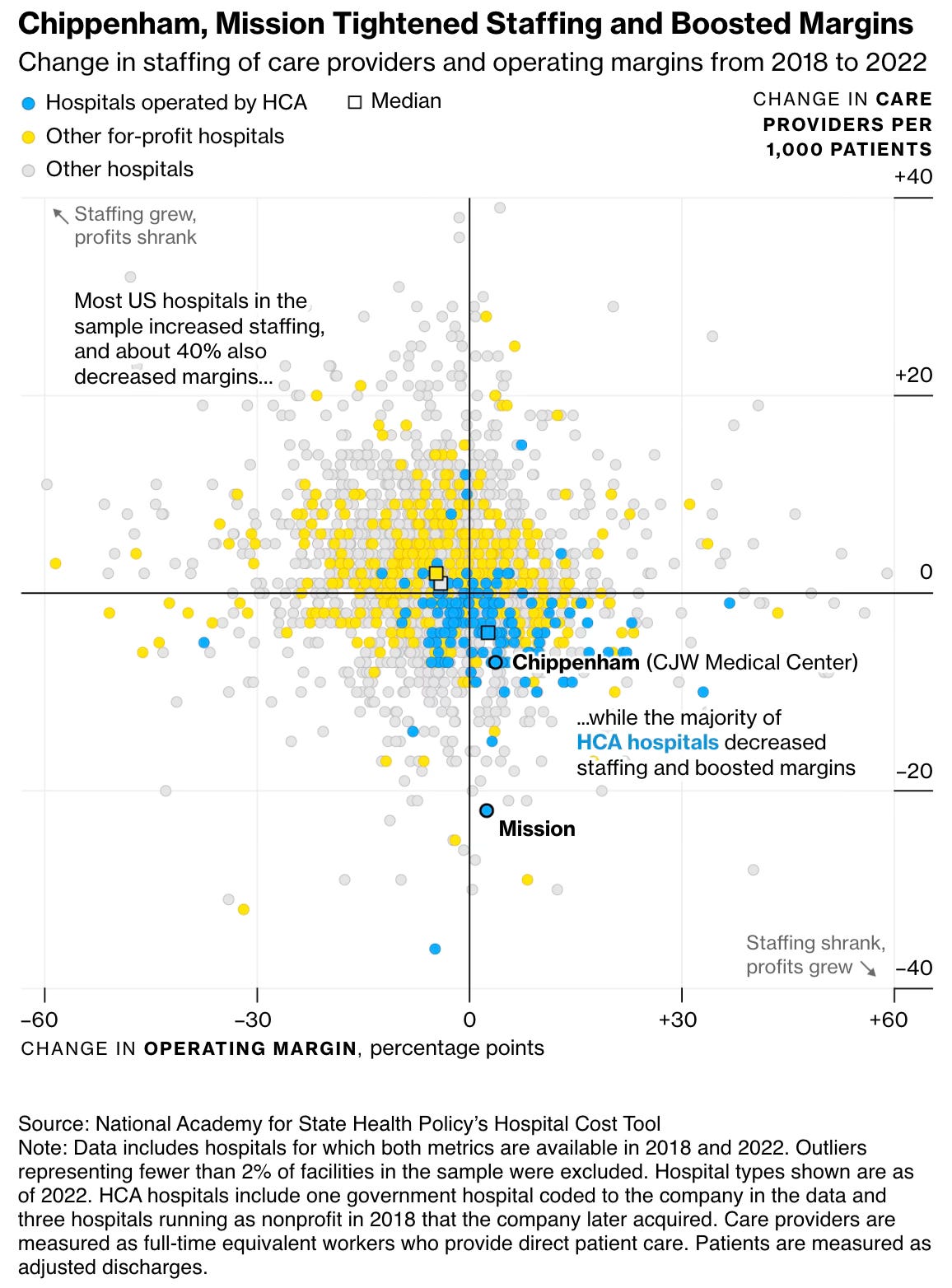
The drastic reductions in Mission’s labor costs were a boon to the hospital’s finances. In the four years before the sale, Mission earned an average of $38 million in profit from patient care. In 2022, Mission’s profit reached $96 million, driven primarily by “sharply reduced staffing for patient care under HCA,” according to Hall’s research.

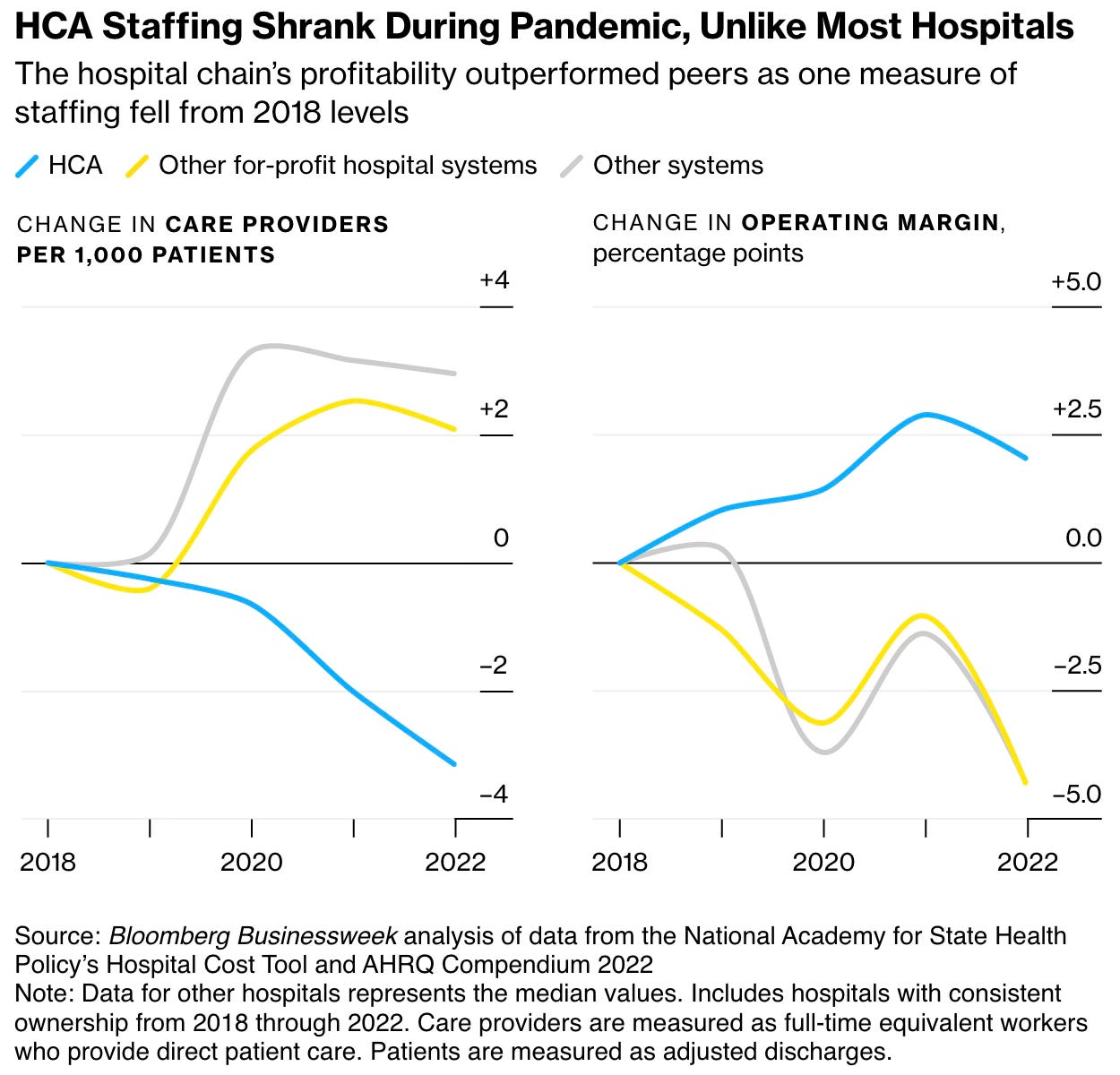
This graphic captures how HCA increased profitability across its network hospitals using these practices. 

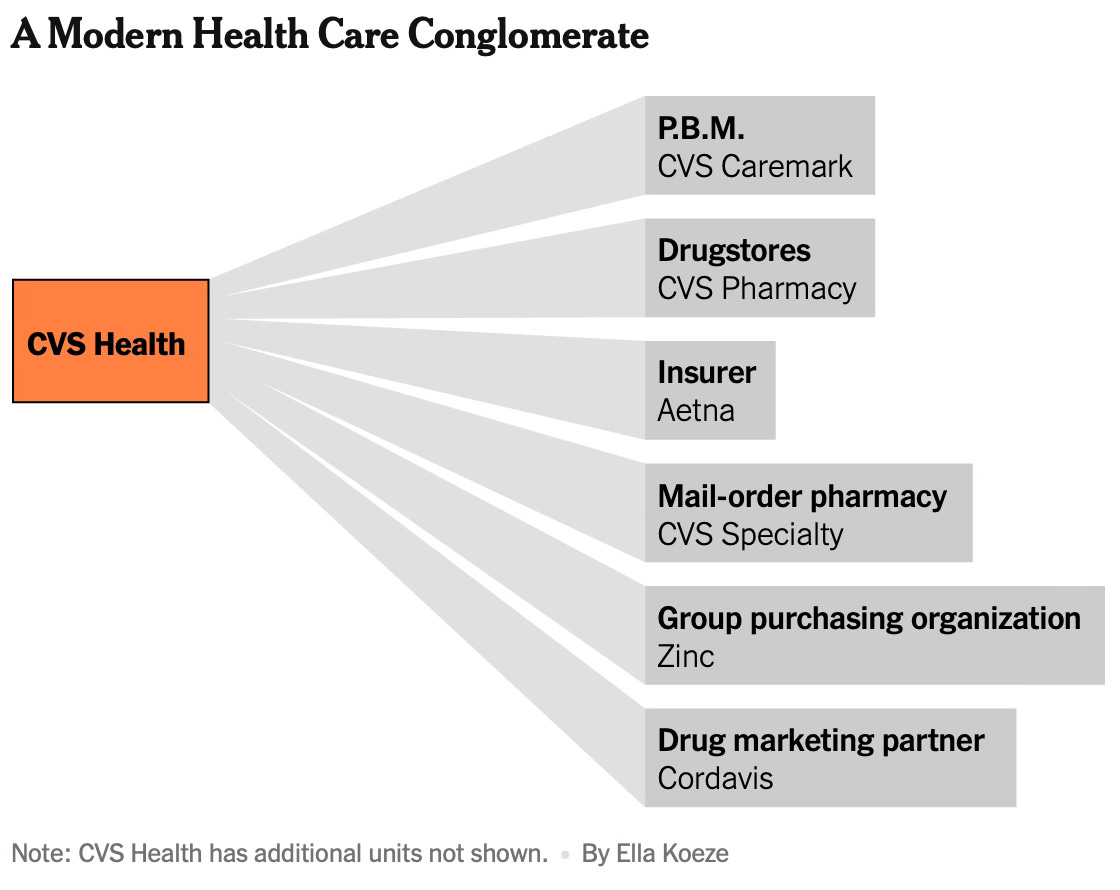
The PBMs intermediate the insurance for prescription drugs by negotiating with drug companies, paying pharmacies, and helping decide which drugs patients can get at what price. The three largest ones - CVS Health, Cigna and UnitedHealth Group - oversee prescriptions for more than 200 million Americans and control nearly 80% of the market, up from less than 50% in 2012

P.B.M.s sometimes push patients toward drugs with higher out-of-pocket costs, shunning cheaper alternatives… Even when an inexpensive generic version of a drug is available, P.B.M.s sometimes have a financial reason to push patients to take a brand-name product that will cost them much more… They often charge employers and government programs like Medicare multiple times the wholesale price of a drug, keeping most of the difference for themselves. That overcharging goes far beyond the markups that pharmacies, like other retailers, typically tack on when they sell products. The largest P.B.M.s recently established subsidiaries that harvest billions of dollars in fees from drug companies, money that flows straight to their bottom line and does nothing to reduce health care costs. 

The P.B.M.s, which are responsible for paying pharmacies on behalf of employers, are driving independent drugstores out of business by not paying them enough to cover their costs. Small pharmacies have little choice but to accept these lowball rates because the largest P.B.M.s control an overwhelming majority of prescriptions. The disappearance of local pharmacies limits health care access for poorer communities but ultimately enriches the P.B.M.s’ parent companies, which own drugstores or mail-order pharmacies. P.B.M.s sometimes delay or even prevent patients from getting their prescriptions. In the worst cases, patients suffer serious health consequences… Even people who don’t take prescription drugs end up paying higher insurance premiums and taxes as a result of inflated drug costs… If they were stand-alone companies, the three biggest P.B.M.s would each rank among the top 40 U.S. companies by revenue.

This description of the evolution of PBMs is instructive.

P.B.M.s have been around since the late 1950s. They initially handled requests mailed in by pharmacies and patients seeking reimbursement for the costs of prescription drugs. Over the decades, P.B.M.s have had different owners, including drug makers and large chains of pharmacies… The modern P.B.M. emerged in 2018. The giant health insurers Aetna and Cigna were trying to achieve the growth demanded by Wall Street. They sought to merge with the P.B.M.s, whose profits were soaring. Aetna and CVS combined. Cigna bought Express Scripts. (UnitedHealth had built its own P.B.M.)

It would turn out to be a seminal moment, one that would rapidly and radically change the American health care system by further shifting power into the hands of giant conglomerates and away from employers and patients. Today, P.B.M.s feed off a system where everything is extraordinarily complicated — including how much a drug actually costs.

The PBMs have evolved business models that allow them to obsfuscate and capture a significant share of the discounts obtained from drugs manufacturers. They have set up subsidiaries to negotiate discounts with drug manufacturers.

The creation of the subsidiary, Emisar, has allowed UnitedHealth to retain billions of dollars of those savings, without having to share them with employers. Emisar and similar subsidiaries established by Express Scripts and Caremark are known as group purchasing organizations, or G.P.O.s. They were created, starting in 2018, amid growing pressure from employers to share with them more of the manufacturers’ discounts. In response, the P.B.M.s altered their business model. The new subsidiaries still received rebates from drug companies, and they passed on those rebates to the P.B.M.s, which in turn sent the savings to employers. But the G.P.O.s also began imposing new fees on drug manufacturers. 

Because those were fees, not rebates, and because the fees were technically collected by a different company, the P.B.M.s weren’t contractually obligated to share them with their clients. And the P.B.M.s could truthfully say that they were returning to employers almost all of the drug companies’ rebates. They didn’t have to mention the fees… In 2022, P.B.M.s and their G.P.O.s pocketed $7.6 billion in fees, double what they were bringing in four years earlier, according to Nephron, a consulting firm… Emisar operates mainly in Ireland, and Express Scripts’ Ascent is in Switzerland, which means their profits are taxed at much lower rates than if they were generated in the United States… When drug companies paid more in fees, they offered less in rebates… Employers… receive rebates. But they can’t see the billions of dollars in fees that the G.P.O.s take for themselves…

The conglomerates that own the big P.B.M.s also own pharmacies. CVS has thousands of drugstores. And all three operate warehouse-based pharmacies that send prescriptions to patients through the mail. The three P.B.M.s push, and sometimes force, patients to use their pharmacies, whether mail-order or, in CVS’s case, the physical drugstores. One common strategy is to not allow patients to receive 90-day supplies of drugs if they fill prescriptions at outside pharmacies… One surefire way for the P.B.M. or its in-house pharmacy to profit is to charge thousands of dollars more than what a drug costs… The steepest markups often involve generic versions of expensive medications for conditions like cancer.

This article shows how PBMs have been systematicallt underpaying small pharmacies (how much the drugstores are reimbursed for medications), driving them out of business. This, in turn, benefits the largest PBMs who also run competing pharmacies. 

In every state, The Times identified at least one example since 2022 in which an independent drugstore closed and the pharmacist blamed P.B.M.s. In some states, like Pennsylvania, such closings have become routine. They have disproportionately affected rural and low-income communities, creating so-called pharmacy deserts that make it harder for residents to get prescriptions and medical advice.

One study, paid for by a pharmacy association, found that the markup that P.B.M.s were charging on brand-name drugs was 35 times higher when the drugs were sold through their own mail-order pharmacies than when the drugs were sold by independent drugstores. Government studies have identified a similar phenomenon… The benefit managers decide which pharmacies are available to patients through their insurance. To be included, a pharmacy must agree to a contract with the P.B.M. that details the formula for how much the pharmacy will be reimbursed for drugs… Because the top P.B.M.s collectively control the overwhelming majority of prescriptions, pharmacies that forfeit their business could not survive.

The closure of small pharmacies have left communities without any drug stores.

Nearly 800 ZIP codes that had at least one pharmacy in mid-2015 now have none, according to an analysis of pharmacy data by Luke Slindee, a consultant who has been tracking pharmacy closings around the country… When small drugstores close, communities can be harmed in ways that are hard to measure. Getting your flu shot becomes less convenient. As residents grow accustomed to traveling long distances for their medications, they do more of their other shopping far away from home, draining revenue from local businesses. Relying on mail-order pharmacies deprives customers of an easy way to get advice from a trusted local pharmacist… Research has found that after pharmacies close, their older customers are less likely to consistently fill their prescriptions and end up missing doses… Even when a small pharmacy stays in business, low reimbursement from P.B.M.s can make it harder for its customers to get their medications. Many small drugstores sidestep their contracts with P.B.M.s and decline to dispense certain medications — especially high-cost brand-name products for conditions like diabetes and obesity — because they lose money on them. Customers must go elsewhere.

Some observations 

1. The evolution of PBMs from being small payment-handling intermediaries to mega-firms with interests all along the prescription drug supply chain has not only not delivered the promised benefits in terms of efficiencies and value sharing across the chain but has also left patients, employers, and insurers with higher costs. Similarly, the emergence of massive hospital networks, far from transmitting benefits across stakeholders from economies of scale, has engendered perversions like substituting away from higher-cost doctors towards lower-cost NPs, besides seriously worsening the quality of care. 

2. There’s a fundamental problem with the pure financial metrics-driven business growth strategy in sectors where quality of service delivery is critical. The exclusive and obsessive focus on financial metrics will invariably lead the management down the path of cost-cutting and revenue maximisation. In this efficiency maximisation drive, and especially in large systems and where quality of service is critical, it’s hard not to avoid skimping on things that are central to quality. 

The example of the increased use of NPs across hospital networks in the US is yet another example on the perils of such efficiency maximisation. As the articles show, the disaggregation of the doctor’s work and parcelling some parts of it out to NPs ends up seriously eroding the quality of care delivered. Besides, the sharp differential in the costs of doctors and NPs will invariably incentivise pushing the boundaries on substituting the doctor with the NP.

3. Firm size in itself (and the associated detached and impersonal management) is a problem in services where quality is critical. In such services, personalised care and engagement is a critical value proposition. No technological innovation or business structure can be a substitute. The small hospital networks and independent pharmacies bring attributes critical to the effectiveness of service quality that the large firms cannot replicate. 

4. A market dominated by a few large conglomerate firms will invariably distort incentives and engender dynamics that will hurt consumer welfare. Vertical and horizontal integration with opaque ownership and accounting disperses costs and accountability across the conglomerate. It engenders market failure and is a recipe for perversions like price gouging, cross-selling, profit maximisation etc. 

In general, the ownership and management structure of massive PBMs and hospital networks will tend to generate excessive efficiency and profit-maximisation impulses that detract from quality and consumer welfare. It’s very difficult, even impossible, to achieve the balance between shareholder and stakeholder value maximisation, and the latter invariably falls aside with time. It’s almost the inexorable logic of capitalism, one which gets exacerbated by private equity ownership. 

5. The rapid expansion of the supply side in any sector where service delivery quality is critical is fraught with problems. It resonates with the troubled examples of multiple instances when state and central governments in India have sought to rapidly increase the institutions (and seats) offering engineering, medical, nursing, and other professional courses. 

When done at scale and too quickly, blended learning and online instruction approaches are likely to struggle to meet the fidelity requirements. Baumol’s cost disease is real in sectors like education and there are hard limits to the application of technology to address the problem.

6. The example of HCA should serve as a cautionary tale for those who preach the ideology of the superiority of for-profit companies. The degeneration in the quality of service of Mission Health, a reputed non-profit hospital network, after being bought by HCA and turning for-profit is an apt case study. 

It’s an oft-repeated ideological argument in countries like India that its education system can be improved by permitting for-profit institutions. The US for-profit hospital networks and Nursing Colleges are good examples of the problems with the introduction of profit incentives to sectors like healthcare and education.