Substack

Showing posts with label Arab-Israel conflict. Show all posts

Saturday, August 29, 2026

Weekend reading links

1. Good long read in the Indian Express about the ridership deficit facing metro railway systems in India. This is a good website for network maps.
Radhika Shenoy, 28, a working professional in Hyderabad’s Secunderabad, points out that last-mile connectivity is a major challenge when she uses the Metro. “Neither my house nor my office is close to a Metro station. So, taking public transport becomes more expensive than using my own scooter or hiring a cab or auto,” she says... Manvika Shivhare, a 29-year-old lawyer based in Lucknow, says most people she knows never use the 23-km-long city Metro to get round the city, preferring to travel in an auto or two-wheeler instead. “The Metro is useful for going to the Airport, for which it would cost Rs 70, while the auto would take Rs 400. But none of us uses it for our daily commutes, since Lucknow is such a small city.” Shivhare says this won’t change even with the upcoming 11-km-long Line-2, connecting Charbagh Railway Station and Vasant Kunj in Lucknow.

2. India's crude oil imports from Russia rise to more than 2.6 million barrels per day in June and July.

For decades, South Korea’s brightest students gravitated towards medicine, and private tutors focused on helping students gain admission to elite universities. Now, some semiconductor departments sponsored by Samsung and SK Hynix — which guarantee employment after graduation — are attracting growing interest, and cram schools are catering to job seekers pursuing lucrative chipmaking careers. In the 2026 admissions cycle, SK Hynix-linked semiconductor programmes at several leading universities recorded higher application rates than medical schools, whose applicant numbers fell by nearly a third to a five-year low. 

Kwon Seok-joon, an engineering professor at Sungkyunkwan University, said generous chipmaker bonuses had altered how students viewed the trade. “For 20 years, medicine was the only path that guaranteed both wealth and prestige in Korea,” he said. “The Hynix bonus broke that monopoly. For the first time, chip engineers are in the same league as doctors when families discuss a safer future.”... In May, Samsung reached a landmark profit-sharing agreement with its 78,000 semiconductor employees, with average payouts expected to approach $400,000 in the memory chip division. Rival SK Hynix agreed last year to distribute 10 per cent of operating profits to workers over the next decade, implying average bonuses of about $500,000 this year based on projected earnings.

4. More evidence of lagging salary growth amidst rising sales growth.

Growth in net sales of 3,057 non-finance companies in the June quarter was 22.18 per cent year-on-year, according to a Business Standard analysis of the numbers from the Centre for Monitoring Indian Economy... Salaries in the June quarter went up at less than half the pace at which sales have grown — at less than 9 per cent... The starkest contrast was in the mining sector, where sales grew 40.83 per cent and salaries and wages 1.04 per cent. Lower growth in wages has likely he­lped operational profits, where margins had come under pressure because of higher costs of raw materials.

5. Labour market expectations from the PLFS 2023 survey data.

Our job seekers expect up to 40 per cent higher salary than actual earnings reported in the PLFS for the same occupation. Male job seekers, in particular, show greater over-optimism in salary expectations relative to women, expecting almost Rs 8,000 more per month than the actual average earnings for these jobs and Rs 8,500 more per month for salaried jobs. Altogether, salary expectations diverge from reality by more than 30 per cent. When we assess the job aspirations and expectations of job seekers who are below 25 years of age in our sample, we find that expectations are even more skewed – again, more so for young men than young women... 

So we set out to inform and expose a random subset of our 3,000 job seekers to the real world and re-surveyed both the informed and the non-informed a year later. Twelve months after receiving information, we find that providing accurate information about job opportunities significantly dampened job seekers’ labour-market expectations of landing their ideal job relative to those who were not informed. Men, in particular, were less likely to report that they were on their ideal career path. This disillusionment is accompanied by a decline in men’s job-search intensity. Thus, as preferred job offers fail to materialise, job seekers adjust their expectations downwards and either remain in the same jobs or drop out of the labour market and enrol at educational institutions.

6. Is fusion energy, the process that energises stars and sun, about to become a reality?

Privately held fusion companies raised $4.5bn over the past year alone, according to the Fusion Industry 2026 report. There are now more than 50 such companies. Last month, General Fusion, a Canadian outfit backed by Jeff Bezos, became the first publicly listed fusion company. These signals hint at an important shift: fusion energy is gradually being perceived less as a scientific challenge and more as an economic one.

7. Made in Switzerland.

Switzerland, where manufacturing still accounts for almost 19 per cent of GDP, twice the contribution from its celebrated financial services industry. The white cross on a red background, emblazoned on products from Heule precision tools to Caran D’Ache pencils, is both a guarantee of quality that is understood worldwide, and a valuable marketing device for Swiss manufacturers... Switzerland has the highest proportion of high-tech manufacturing of any of the OECD’s 38 member countries...
A landlocked country of 9mn people, with few natural resources and some of the world’s highest wages, is not an obvious starting point for a manufacturing success story. But the Swiss made it work. Companies responded to high wages and an appreciating currency by becoming more productive, more specialised, more sophisticated and more expensive, while focusing on global markets rather than their small pool of domestic consumers. “Swiss Made” became shorthand for the result: watches, machinery and precision tools good enough that customers around the world would pay extra for them. One of the results is an economy unusually rich in relatively small companies that dominate particular niches. A study published this summer identified 100 such Swiss businesses, together generating more than SFr40bn in annual revenues. They range from VAT, a maker of vacuum valves used in semiconductor production, to Burckhardt Compression and specialist manufacturers such as Rondo, whose machines shape dough into pastries in bakeries around the world...
That strength is underpinned by an unusually deep apprenticeship system. About two-thirds of young Swiss pursue vocational education and training, most learning partly inside companies — supplying manufacturers with generations of machinists, technicians and other skilled workers. Bern pushed its commitment to open markets still further in January 2024 when it unilaterally abolished all tariffs on imports of industrial goods. The government argued that such protection had become counter-productive: cheaper imported components would reduce costs for Swiss factories embedded in global supply chains... at least 60 per cent of manufacturing costs must generally be incurred in Switzerland and an essential manufacturing step must take place there for the product to qualify as “Swiss Made”.  

But protectionism and the appreciating franc are denting the country's competitiveness and manufacturing base. 

8. The changing face of economics research. First, the dominant fields of research are changing.
Second, it is reaching out to other disciplines.
A research paper by Tom Harris, an economics PhD student at the London School of Economics, bears this out. Aggregating the literature published in 24 leading economic journals between 2000 and 2025 and NBER working papers between 2021 and 2025, he found the share of papers written by teams spanning different fields had jumped 16 points to 35 per cent between 2000 and 2025, while solo-authored papers fell as a proportion of the literature from 34 per cent to 15 per cent.
Third, economics research is becoming more empirical.
Research from Prashant Garg, a postdoctoral researcher at Bocconi University, and Thiemo Fetzer, economics professor at Warwick University, finds causal claims in economics have jumped. In 1990, 7.7 per cent of claims made in the literature were causal. In 2023, that hit 32.6 per cent. Additionally, papers with more causal claims are more likely to receive citations and wind up in top five journals, the research suggests.
And this turn to empiricism has had not so good consequences.
Results derived from real-world data and experiments are hard to replicate under the same conditions and methodology, with research suggesting that up to 70 per cent of recently examined economics papers contain some results that cannot be reproduced. Sometimes this is simply because the data is broken or otherwise unavailable to other researchers, although other theories abound: pressure to publish, data manipulation, patterns of funding and structural incentives in the academy, for instance. There are also cynical explanations, such as questionable research practices or fabricated data sets.
9. Israel's economic squeeze on Palestine is less reported but adds one more dimension to the genocide.
Israel quickly canceled permits for tens of thousands of Palestinian laborers to reach their workplaces in Israel... Since the start of the Gaza war, unemployment in the West Bank has skyrocketed to 28 percent, more than double the rate before the conflict... Then, in May 2025, Israel started confiscating hundreds of millions of dollars per month in import taxes that it collects on the Palestinian Authority’s behalf. This revenue stream accounts for about two-thirds of the West Bank government’s budget for 2026 of about $6 billion, according to Palestinian officials. That deficit has forced the Palestinian Authority to lower the salaries of 140,000 civil servants and security officers, shorten school weeks to three days and accumulate billions of dollars in debt... 

Israel has also erected new roadblocks across the West Bank, stifling the movement of goods within the territory... Israel has also limited the amount of shekels that Palestinian banks are allowed to send to Israeli banks, a crucial process that helps enable Palestinian merchants to buy goods from Israel and the rest of the world. The Netanyahu government permits quarterly transfers of about $1.5 billion from Palestinian to Israeli banks — far less than previous administrations allowed. The restrictions have resulted in about $5.7 billion languishing in bank vaults in the West Bank, according to Palestinian government and banking officials.

10. The public sector dependency in the UK

In Britain 50-60 per cent of the electorate works in the public sector or gets benefits or a state pension, suggesting a tipping point has been hit.

11. India's labour market facts of the week.

A new NITI Aayog report notes that about 87 million people aged 15-29 are outside education, employment or training, while only 8.25 per cent of graduates are employed in jobs aligned with their qualifications.

12. The Economist has an excellent article that points to research about the impact of AI on students. David Stromberg of Stockholm University and Victor Lei and Wu Yanhui of the University of Hong Kong tracked 27,000 pupils aged 12-18 in China, where AI adoption has been fast. Around 80% reported using models such as Doubao and DeepSeek, and the other 20% formed the control group.  

After six months, pupils using AI saw their average homework score rise by 18% across all subjects. The time they took to complete each assignment fell from an average of 64 minutes to 45. But come exam time, the same students scored 20% below their classmates who had not called on AI’s help. Homework scores once predicted exam performance; now those who score highest are, perversely, more likely to do worse in exams.
The drop in exam scores was concentrated among students who rushed their homework. Those who used AI but spent as long on assignments as non-users paid little penalty. What matters, then, is how pupils use the technology. Those whose exam results remained strong were not simply copying and pasting answers to save time. More likely they used the chatbots as a personal tutor, perhaps to explain difficult concepts or help solve specific problems.
John Burn-Murdoch says this finding underlines the importance of conscientiousness (or self-discipline) in this modern digital age with all its distractions and access to shortcuts. 

Saturday, August 15, 2026

Weekend reading links

1. The solutions proposed by Andy Haldane to address housing supply in the UK is universally valid.

Public land developed for public purpose but privately operated; co-financing by municipal bonds and private capital; a bespoke planning regime; and a transformative method of new construction — these are the base elements needed to ease the constraints suffocating the UK’s housing market and to tackle the housing crisis in every postcode.

2. Talk about a company mobilising debt for others to buy its products, and look no further than Nvidia.

The world’s largest financial groups are working with Nvidia to assemble a funding package of more than $500bn for AI infrastructure development, in one of Wall Street’s most ambitious lending efforts to date. A consortium of groups including Apollo Global, Blackstone, BlackRock, Brookfield Asset Management, Goldman Sachs and KKR is entering a partnership with Nvidia to invest in the AI build-out... Nvidia said on Monday afternoon that it has signed memorandums of understanding with the six Wall Street firms to “mobilise over $500bn of third-party capital for the build-out of AI infrastructure over time”. Under the deal, which is still subject to final agreement, the firms will create dedicated pools of capital to finance Nvidia’s AI ambitions “at attractive rates for Nvidia customers”... Morgan Stanley projects so-called hyperscalers will spend $3.5tn between 2026 and 2028.

3. India manufacturing output trends.

But services exports have doubled in less than four years.

Weeks into the latest conflict, defence minister Israel Katz invoked a different approach, one used with devastating consequences after Hamas’s October 7 2023 attack: the “Rafah and Beit Hanoun model”, a reference to Israel’s wholesale levelling of cities in Gaza. “All homes in Lebanese villages near the border will be destroyed,” Katz said. By July, Katz claimed his threat had been carried out. “Twenty-four Lebanese villages, hundreds of years old, we destroyed all the buildings,” he said, boasting that up to 20,000 homes had been demolished. “Not house by house, but entire villages.”...

Israeli evacuation orders forcibly displaced some 1.2mn people in the war’s first 10 days, the vast majority from Hizbollah-dominated southern Lebanon, as Israeli forces advanced. Fighting raged for weeks, but most of the destruction documented by the FT and Lighthouse came after an initial Israel-Lebanon ceasefire on April 17. While the truce did not hold and some clashes have continued even past the latest ceasefire in June, Israeli forces — who had already established control over many emptied villages — continued to lay waste to the south through air strikes, controlled detonations, bulldozers and the use of white phosphorus. Israel’s occupation is now deeply entrenched, the area under its control demarcated by what it calls “the yellow line”. The zone covers about 6 per cent of Lebanese territory and stretches roughly 10km inland from the two countries’ informal border...

Israel has also done extensive damage to historic monuments and Unesco-listed sites, including 16th-century mosques, 19th-century libraries, religious shrines, ancient Roman ruins and Crusader castles. “It is an attempt to make the areas unrecognisable . . . to sever people’s connection to their land and their history,” said Joanne Farchakh Bajjaly of Biladi, an organisation dedicated to preserving Lebanon’s cultural heritage. “How can they rebuild their communities if everything is gone?”... Lebanon’s environment ministry and rights groups have documented Israel’s widespread use of white phosphorus — an incendiary chemical that triggers fires and can leave contamination in soil and water — in both populated and agricultural areas. Israel says it uses white phosphorus lawfully to clear brush and create smokescreens, but use over populated areas can violate international law.

5. Janan Ganesh is on to something.

If a politician could decouple socialism from the set of cultural ideas known as “woke”, he or she would be difficult to stop... The one place that might have produced a culturally conservative or at least culturally neutral socialism is continental Europe, but even the French left has absorbed American woke jargon, perhaps recognising in it the authorial stamp of Michel Foucault. And so capitalism glides on, never quite facing what would be its sternest political test. The question is why the left allows it to happen... Woke has been such a godsend for capitalism — making its enemies look ridiculous — that it can seem almost engineered for that purpose.

6. Purchase commitments of the hyperscalers jumped from a trillion dollars to 1.5 trillion from Q1 to Q2 of 2026. These are debt in another form. 

7. Guy Chazan describes elite capture of the political system in the US.

In America’s Gilded Age, millionaire robber barons operated from the shadows, bribing pliant lawmakers to do their bidding. Under President Donald Trump, billionaires have gone one better. Some are in his cabinet... No longer content to lobby from afar, ultra-rich tycoons — especially from Silicon Valley — have infiltrated the capital’s ecosystem, taking on advisory roles in government, cultivating ties on Capitol Hill and weighing in on the most important issues of the day, from AI to industrial policy. They attend glitzy dinners, donate millions to White House fundraising projects and are photographed with Trump promising eye-popping investments in the US. Many have enjoyed regulatory relief, policies that benefit their businesses and, in some cases, lucrative government contracts worth billions of dollars. But unlike the robber barons of the past, who were often charitably minded and gave generously to public institutions, the tech billionaires of the present show a “complete indifference” to any kind of “social contract” and any need to “compensate people for the disruption they have brought into their lives”, says Quinn Slobodian, a historian of capitalism at Boston University...
If there was a trigger for the growing influence of the ultra-rich in America’s political system, it was the Supreme Court’s 2010 Citizens United ruling, which held that independent political spending on elections by business was protected by the First Amendment. The judgment opened the floodgates to big money in politics. America’s rich had spent $31mn in the 2010 elections, according to liberal advocacy group Americans for Tax Fairness (ATF). In the 2024 election cycle, the 100 largest billionaire donor families gave $2.6bn. A huge proportion of that came from just a handful of individuals. Three billionaires — Elon Musk, Miriam Adelson and Timothy Mellon — accounted for more than a third of the roughly $1.5bn spent to elect Trump.

8. C Thi Nguyen has a brilliant essay on the value of doing something for its own sake or as labour of love (play, as he describes it), and doing something as part of a requirement (work, as he describes it). He channels Aristotle (through Bernard Suits' The Grasshopper) to describe it as the core of a meaningful life. 

For Suits, play is not just a side dish for the main meal of work. Play is at the core of a meaningful life. Underneath the hood, Suits’ argument is Aristotle to its bones. For Aristotle, a good life — a truly meaningful life — lay not in the creation or accumulation of stuff or the achievement of outcomes, but in the process of doing itself, in the rich exercise of our full human capacities. Suits found the deepest illumination of Aristotle’s point in the simplest human activity: playing games. Suits provides, and defends, his definition. To play a game, he says, is to voluntarily take on unnecessary obstacles to make possible the struggle to overcome them. To play a game, therefore, is to be inefficient on purpose. When you run a marathon, you are trying to get to a particular spot in space, but you avoid the most efficient ways to get there. You do not take a subway or a taxi or a bicycle. You force yourself to run, and you try to run as quickly as possible. Which means, for Suits, that the struggle must be an essential part of the true value. What you care about can’t just be the bare outcome by itself. You can’t just care about being at that spot in space. Otherwise you’d just take the most efficient path. But if you took the subway then it doesn’t count — not for the game of marathon-running, anyway...

To understand games, distinguish between two things: the goal of a game and your purpose for playing it. The goal is what you pursue inside the game; the purpose is why you played it... For some people, the goal and purpose are one. They want to win, period. Call those people achievement players. The Olympic runner wants to win the marathon by running it — but they do truly care about winning it. But for other people, goal and purpose come apart. We try to win because we are interested in the struggle, and it is the struggle itself that we truly care about. Call us striving players. It’s all right if we try and we lose, if the attempt was beautiful. In ordinary, practical life, we take the means for the sake of the ends. In striving play, we take the ends for the sake of the means. What is the point of life? Is it to make stuff? Or is it to take difficult actions, think rich thoughts, weigh subtle decisions? Is it having a pile of stuff — or does the stuff just support our quest for interesting action?... Suits argues... that play itself is the point, and that we work in order to survive so that we might play...

Rephrase Suits’ definition this way: play is wasting resources for fun. But also: the whole point is that, deep down, it’s not a waste. A truly wasted life would be one spent working hard, stockpiling goods like the ant and never using them to support joyous play. And to truly waste humanity would be to push people so hard to work productively, to make more stuff, to the point where nobody had time to play. Let me try my own fusion of these two definitions. “Work” isn’t distinguished from “play” by difficulty, suffering or practicality. You can make pottery, knit scarves or grow a garden as play. The true difference between work and play is the reason you have, and the control you have, over what it is you’re doing and why. Here’s my suggestion: to “work” is to perform activities to create outcomes that are set by something external. When you work, you are making what the world tells you to make. Maybe you’re gathering food, because biology tells you you have to eat. Maybe you’re earning money, because the world says you need money to buy food and shelter and medicine. Maybe you’re making products, because the world wants something specific from you — planks of wood, a ride to the airport. But “play” is different. You still have goals and struggles, but your goals are up to you.

9. Two important graphics on the Chinese economy. One, the great job squeeze resulting in the rise of the gig economy, whose workforce has increased by 10 million in just two years.

Second, the persistence of negative household sentiment for the fifth successive year.

10. Andrew Puzder, the US ambassador to the EU, draws attention to the substantive equivalence between US tariffs (50% tariffs on primary steel) and the EU's CBAM on their respective steel and aluminium imports. 
Protesting against US national security measures while erecting protectionist barriers reveals a striking double standard... The US approach is direct and transparent. Primary steel faces a 50 per cent tariff (with some rates recently increased), and aluminium a comparable duty. To stop circumvention through finished goods, the tariffs extend to derivatives... CBAM differs in form but not in substance. Importers of iron, steel, aluminium and related products must report embedded emissions and relinquish a corresponding number of CBAM certificates priced at the EU’s carbon price — currently around €80 per tonne of CO₂... At root, both policies are adjustments to protect domestic producers from unfair competition, whether from lax environmental rules or subsidised excess capacity. US Section 232 tariffs address foreign overcapacity that threatens to hollow out its metals sector; CBAM is designed to combat carbon leakage, when production shifts to jurisdictions with less stringent climate standards... In both cases, the measures raise the cost of imports to safeguard local production. The parallels are unmistakable. A shipment of steel-containing machinery faces extra US duties based on metal content. In the EU, the same goods face fees based on production emissions under CBAM. One is framed as security policy; the other as climate policy. Both increase the price of targeted imports relative to domestic options.

11. The US equity market today in perspective. 

Saturday, May 2, 2026

Weekend reading links

1. China's beggar-thy-neighbour trade policy, titanium dioxide edition.

LB Group produced titanium dioxide at $1,500 a tonne in China, including subsidies, nearly half the estimated $2,800 a tonne cost to produce in the UK... China became a net exporter of titanium dioxide after 2010, with exports rising from just 48,000 tonnes that year to more than 1.7mn tonnes in 2025, creating a global glut of excess production that coincided with a wave of factory closures outside China. Over that 15-year period, factories with a combined capacity of nearly 1.3mn tonnes were shut down in Asia, Europe and the US, according to data compiled by industry analyst Reg Adams, who has tracked titanium dioxide markets since 1993. Chinese capacity hit 5.7mn tonnes at the end 2025.

2. John Burn-Murdoch points to the aspiration gap among today's youth, or the gap between their actual incomes and their expectations. 

Even though today’s young adults, and graduates in particular, are over-represented in the top quartile of the earnings distribution, they are also far more likely to be at the bottom than the top for earnings relative to reasonable expectations. In both the UK and US, even though only 10 percent of graduates are in the lowest earnings quartile, one in three is in the bottom bracket for earnings relative to expectations.
The average thirty-something university graduate in the UK today sits at the same rank of the earnings ladder as the average high school graduate did in 1995 and the average high school graduate today sits at the same rank as someone who never completed school in 1995.
Are today’s twenty- and thirty-somethings earning more than their parents did at the same age? Yes. But their relative position in society is lower than their parents’ was, and their position relative to their peers and expectations is significantly lower. Since it’s the latter that drives satisfaction, young adult malaise should come as no surprise.
3. The US AI spending estimates pale in comparison to the money spent on railways in the late nineteenth century. 
By 1890 railway companies in the US alone had issued about $5bn worth of bonds. Adjusting for inflation that equates to about $180bn in today’s money. However, this understates the enormous scale of the undertaking, because the US economy was much smaller then. In 1890, $5bn was about one-third of America’s GDP, so the investment spree was arguably the equivalent of spending over $10tn today. It also resulted in an epic, generation-defining crash. In 1873, Jay Cooke & Co, the premier investment bank run by America’s dominant financier at the time, suddenly collapsed under the weight of unsold railway bonds. This caused a giant financial crisis and ushered in what was long known as the Great Depression, until the even larger one in the 1930s.

4. McKinsey Global Institute have identified 18 future arenas of growth.

Their performance over the 2022-25 period validates their prioritisation.
They added about $18 trillion in market capitalisation in the last three years.
5. The 2 hour mark in a marathon is broken as Sebastian Sawe of Kenya wins the London marathon.
Both Sawe and Assefa were wearing Adizero Pro Evo 3 shoes, which were only unveiled a few days before the race. Known as “supershoes”, such ultralight, high-tech trainers cost hundreds of dollars a pair, but are worn only once in competition races by elite runners. Since the release of the Nike Vaporfly, the first supershoe, in 2017, the number of men and women breaking new time barriers has risen sharply. Based on a UK size 8.5, the new shoes worn on Sunday by Sawe and Assefa weigh just 97 grams, according to Adidas, making them 30 per cent lighter than the German sportswear company’s previous design. They also cost $500 a pair.

Also this

6. Power subsidy facts of the week.

7. Ajay Shah points to an important opportunity in the Gulf as the post-war reconstruction starts.

The region of the Persian Gulf will have capital expenditure for massive construction and engineering projects, expanding to perhaps $150 billion annually. Simultaneously, the geopolitical environment dictates investment in military capability. Procuring new defence systems to protect against drone and missile attacks will require approximately $100 billion annually. We may then envision this combination of engineering and defence procurement as a new pathway for demand of $250 billion a year into the global economy from the GCC... A lot of the projects in West Asia will be done by global firms, using Indian workers. Remittances from Indian workers will do well. Renewables, drones and missiles, oil and gas engineering: These three areas are important in export markets. The domestic environment in these areas is relatively subdued. Indian firms will do well by trying to obtain revenues from the coming engineering boom in the West Asia, and from the global boom in renewables and defence.

8. So far Apple has ploughed back its massive cash surpluses to buyback more than 40% of its outstanding shares!

This is an important moat for Apple (its profit after tax is set to touch $125 bn this year!).

Around 40 per cent of Apple’s profits now come from services, led by App Store commissions and Apple’s cut of the revenue Google makes on its gadgets. This makes it look less like an innovative tech leader and more like a powerful gatekeeper able to extract tolls from those who want to reach the estimated 1.5bn people with iPhones... Apple’s shares are still close to their all-time highs, reflecting the market’s generally sanguine view that it doesn’t need to join the ruinously expensive AI race that is consuming much of the tech world. Instead it can just sit back and take a cut from distributing the AI services of others to its massive user base.

9. Xiaomi is trying to compete with Tesla et al in the European premium brand market. 

Just two years after building its first car, China’s largest smartphone maker has already delivered 650,000 electric vehicles — on par with the number of Tesla vehicles sold last year in the world’s largest automotive market. Xiaomi founder Lei Jun, who has earned comparisons with Steve Jobs, now aims to take on Elon Musk’s company in Europe with its premium EVs known for their breakneck acceleration and advanced features... Since Lei announced his plan to build a car in 2021, Xiaomi stunned the global car industry with the launch of its first model — the Speed Ultra 7 sports sedan — just three years later... After the SU7 became one of China’s best-selling cars, its second model, the $35,000 YU7 that rivals Tesla’s Model Y with designs resembling Ferrari’s Purosangue model, received 200,000 pre-orders in just three minutes at last year’s launch... 

Xiaomi established an EV research and development centre in Munich last year, hiring more than 75 engineers. Many Chinese brands have rapidly expanded into Europe with prices roughly double those in China, yet they remain affordable due to advanced software... At its only EV factory in China, Xiaomi has deployed its own manufacturing methods and materials to bring down production costs while strengthening the durability of its vehicles. The plant, which produces a car every 76 seconds, has a 91 per cent automation rate with hundreds of robotic arms to assemble the cars while “autonomous mobile robots” carry car parts around the factory.

10. Announced Vs actual Trump tariffs.

11. EV prices are falling and ranges are rising.
Prices for lithium-ion batteries, the primary type used for E.V.s, have fallen to around $100 per kilowatt-hour in 2025, from $1,000 in the early 2010s, according to BloombergNEF. Battery density has gone up too. As battery costs fell and manufacturers built more E.V.s, ranges rose and prices fell. Tesla’s cheapest Model 3 climbed to a range of 321 miles this year, up from 220 when it was launched in the late 2010s, while its inflation-adjusted price decreased. Or consider the Leaf, which debuted 15 years ago. By 2016, the cheapest Leaf had 84 miles of range and cost around $30,000, the equivalent of $40,000 today. Nissan’s $32,000 2026 Leaf has a range of more than 300 miles.

12. Facts about German rearmament.

After loosening its constitutional debt brake last year to unlock virtually unlimited spending on the sector, Berlin intends to allocate €779bn to defence between 2026 and 2030 — more than double the previous five years. By the end of the decade — more than five years ahead of the 2035 target date — the country would surpass Nato’s goal of spending 3.5 per cent of GDP on the military, with an annual budget reaching almost €190bn.

The loss of oil supply is the highest in history.
And it has impacted the prices of several commodities.
14. Microsoft, Meta, Alphabet and Amazon are set to invest $700 bn this year on AI infrastructure.
15. Nice illustration of the conflict of interest problem that bedevils health care.

Saturday, April 18, 2026

Weekend reading links

 1. Net FDI from India has been negative for several months now.

2. WSJ graphics on US health care system. Cost of inpatient procedures are much higher than elsewhere.


Cost of pharmaceuticals too are much higher.
3. The rise and rise of iPhone manufacturing in India
The company assembled about 55 million iPhones in India in 2025, up from 36 million a year earlier, people familiar with the matter said, asking not to be named because the numbers aren’t public. Apple makes about 220 million to 230 million iPhones a year globally, with India’s share of the total increasing rapidly.

4. For those advocating currency depreciation as the response to a sharp increase in oil prices, Sachidanand Shukla has a cautionary note pointing to the importance of stability and credibility of the rupee.  

The allure of a depreciating exchange rate lies in its simplicity: It makes ones’ goods cheaper for foreigners. However, this is often a Faustian bargain. For many emerging and developed markets alike, the reality of a currency in freefall is not a boom in exports, but often a harsh blow to purchasing power and investor confidence. Imagine yourself in the shoes of a big global financial investor. How confident will you be in investing a billion dollars if you lose 9-10 per cent in a year due to depreciation?

On a related note, as the RBI deploys an expansive toolkit to stabilise the rupee, Rajeswari Sengupta writes that RBI has engaged strongly in the forex markets, selling over $30 bn in the spot markets in March. Its other actions were intriguing. 

It imposed regulatory restrictions —barring banks from taking positions in the offshore non-deliverable forward (NDF) market and capping their daily onshore FX exposure to $100 million each... The RBI did not merely restrict new positions; it required banks to unwind existing ones, reportedly at a cost of ₹4,000–5,000 crore. In effect, banks were penalised for actions that were fully legitimate at the time. Such retrospective costs risk undermining confidence and making banks more cautious in FX markets. Lower participation could reduce liquidity. And when liquidity dries up, currencies tend to become more volatile, not less.

5. The human cost of Israel's bombings of Lebanon.

On the day the cease-fire came into shaky effect — and most civilians across the region began to breathe a sigh of relief — Israel proceeded to launch one of the deadliest strikes on Lebanon ever, including in the heart of densely populated Beirut, without any warning. The operation, which the Israel Defense Forces sayattacked Hezbollah command centers, hit 100 targets in 10 minutes, killed over 350 people and wounded well over 1,000, many of them civilians... over the past six weeks, Israeli strikes in Lebanon continue, and have forced more than a million people from their homes and have left over 2,000 people dead and multiple villages in ruins.

6. The rise of China's export control measures.

China announced restrictions on exports 30 times between 2021 and 2025, the report by the EU Chamber of Commerce in China found, up from just 11 in the previous five years. Since 2020, Beijing had turned to “geoeconomic” controls — measures aimed at achieving geopolitical goals, it said. These include 10 that made use of global chokepoints in supply chains, such as China’s rare-earths exports, and 10 others aimed at coercing other countries using economic measures.
China has also announced sweeping new regulations to punish foreign companies that are trying to decouple their supply chains from China by increasing reliance on non-Chinese suppliers. These measures are part of the government's efforts to counter rising protectionism and decoupling from China. 
The 18-point regulations, described in state media as an effort to “prevent security risks in industrial and supply chains,” supplement the already formidable authority afforded to Chinese regulators to investigate multinational corporations for moving supply chains out of China. Under the new rules, regulators can question employees and examine corporate records during investigations. The regulations also allow authorities to bar companies and individuals from leaving China if they are suspected of moving supply chains elsewhere under foreign pressure... The State Council, China’s cabinet, justified the measures as necessary to protect the country’s economic stability and national security — a rationale it has previously used to expand its ability to pressure companies. China has also adopted sweeping state secrets laws to prevent information from leaving the country.
During the pandemic, Beijing vowed to invest $400 billion in the country in the coming decades in exchange for a steady supply of oil. In 2024, it purchased 90 percent of Iran’s oil exports, according to the International Energy Agency. China also accounted for roughly a quarter of Iran’s non-oil exports from 2019 to 2024, according to data compiled by Harvard University’s Atlas of Economic Complexity, purchasing billions of dollars of Iranian chemicals and metals.
Payments are made in renminbi, China’s currency, avoiding the use of dollars and the need to involve American banks, which are often the primary entities used to help enforce sanctions violations. China, in return, appears to provide nearly 30 percent of the commodities that Iran imports, selling everything from furniture to sunflower seeds. There is another crucial layer of trade between the nations not recorded in official statistics. Both countries have engaged in a complicated barter system that involves secret financing channels. Iran ships oil to China and in return, Chinese state-backed construction companies have built airports and other infrastructure.

8. The new fragile European countries - Britain, Italy, and France (or Bifs).

Europeans still trust the EU over their national political systems, and the margin is wider than it has been since the noughties. (More on this later.) Support for the euro, which was as low as 51 per cent in 2013, has grown to a record high of 74 per cent in the EU, and 82 per cent in the Eurozone. To repeat, that is a near-consensus in favour of the single currency at a time of economic malaise in much of the continent. As for the country-by-country findings, 21 per cent of Austrians think membership is a bad thing. That makes them the most Euro-sceptical people in the union.

10. India reached peak college education premium in 2011?

11. Jason Bordoff makes the important point that, unlike earlier, the risk of oil shocks is a less restraining factor on US supplies.

In 2012, the US was far less equipped to absorb even a small disruption. US crude production averaged just 5mn barrels a day in 2009; last year it approached 14mn. Two decades ago, the US imported about 60 per cent of its oil consumption. Today it is a net exporter and the world’s largest exporter of liquefied natural gas.
12. The data centre construction boom in the US is being held back by construction and other delays, with almost 40% of those due this year at risk of falling behind schedule

13. Finally, excellent description of the regressive nature of income taxation especially for the richest Americans.
In 2021, ProPublica published an investigation built on a bunch of leaked tax documents revealing what the richest Americans really pay — or don’t. Warren Buffett had a true tax rate of 0.1 percent; Jeff Bezos had 0.98 percent; Michael Bloomberg had 1.3 percent... Let’s focus on Jeff Bezos because he’s much more of a classic case. Jeff Bezos started his own business. He owns a dominant amount of the stock. And over the course of the years, he has taken a salary that is no higher than $82,000. It’s been more than 20 years now, and his salary is always capped at $82,000.

You might say: Well, why would it be? He started the company — he’s the man. Why isn’t he taking a huge salary to reflect all that he put into the company? The reason is: Salaries are for suckers. When people take a salary, they’re subject to high income taxes and payroll taxes, and Jeff Bezos and a lot of our other multibillionaires have no interest in paying those taxes.

So instead, they take their benefits through the growing value of their stock — and their stock has grown enormously. And that massive growth of stock happens entirely tax free — with no time frame under our current system in which that stock will ever be subject to tax. That is because we only impose a tax if the stock is sold, and Bezos never has to sell the stock because he can simply borrow against the stock and use that money to support his lifestyle and to pay any interest that’s due on the loan... you’re just taking out one loan after another, sometimes paying one loan back with another, and you’re just doing this again and again.

The interview also makes a reference to Andrew Mellon's views on capital gains (or investment returns) taxation.

The fairness of taxing more lightly incomes from wages, salaries and professional services than the incomes from business or from investments is beyond question. In the first case, the income is uncertain and limited in duration; sickness or death destroys it, and old age diminishes it. In the other, the source of income continues; the income may be disposed of during a man’s life, and it descends to his heirs.

Monday, April 13, 2026

Some takeaways from the Gulf War

Now that we are past the first phase of the Gulf War and a ceasefire has taken hold (though with the breakdown of the talks and more sabre rattling by President Trump, it now looks tenuous), it may be a good time to list out a few takeaways from the war. It is also important because, at a broader level, the Trump 2.0 administration, generally and the Gulf War in particular, may have reshaped the world economy and geopolitics in many ways. 

Here are some observations:

1. Arguably, the biggest takeaway from the Gulf War is one more reminder about the deeply interconnected nature of the world economy, with dependencies flung far and wide across industries and countries/regions, and associated risks and vulnerabilities. The Covid 19 pandemic was a rude awakening about the risks posed by a globalised supply chain and the extreme dependency on China’s manufacturing prowess. The Russian invasion of Ukraine exposed Europe to an energy market shock that rippled through the economy and unsettled a decades-long dependency. The Gulf War has reignited and amplified the deep energy market vulnerabilities in particular and global economic dependencies in general.

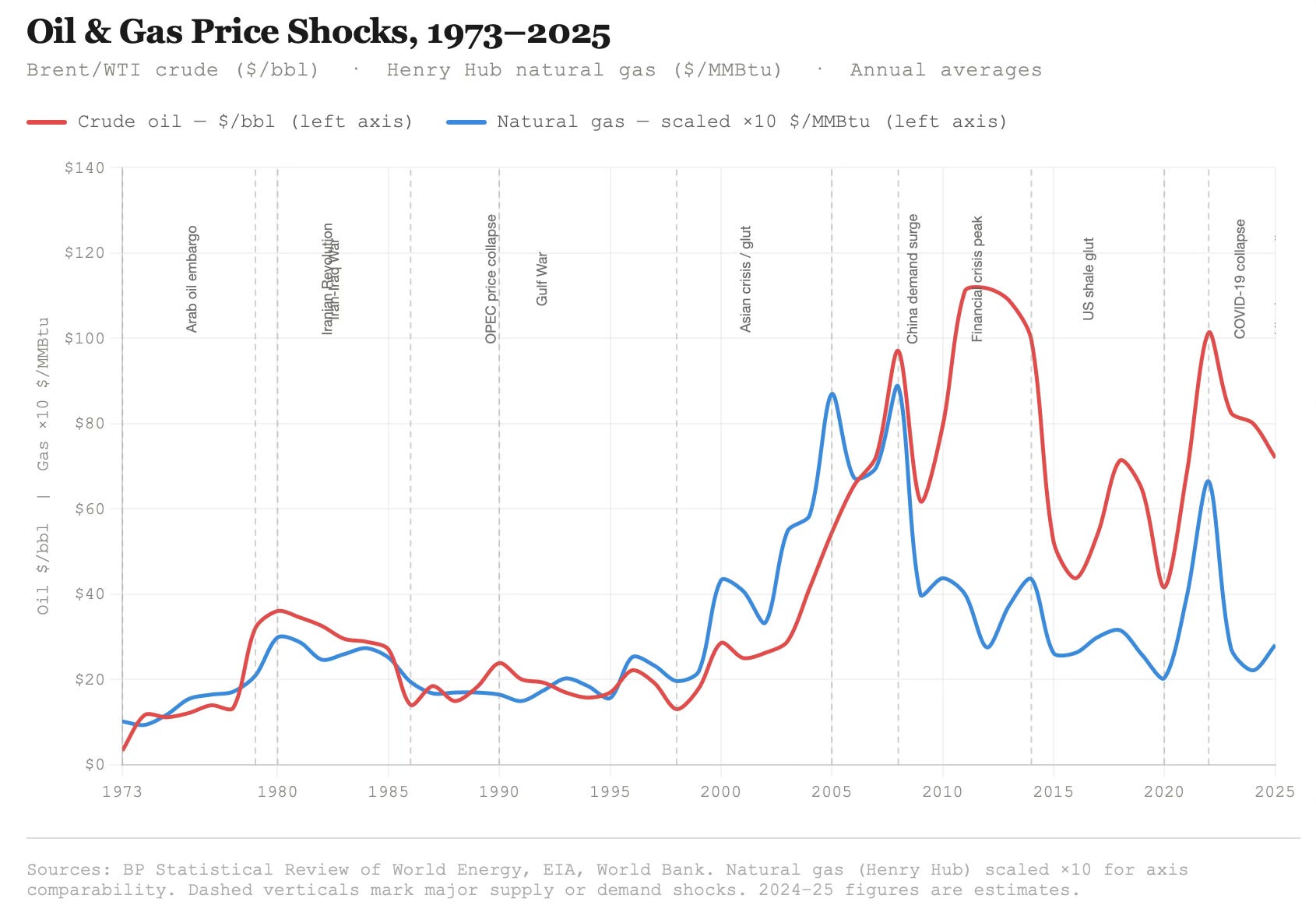
2. The world economy has been witnessing increased volatility in the oil and natural gas markets since the millennium. 

Consider this about how the Gulf War may have a long-term negative shock on the global LNG markets.

Iran carried out a retaliatory missile strike on Ras Laffan, Qatar’s vast energy complex. That target produces roughly a fifth of the world’s liquefied natural gas, a transportable fuel used to heat homes, cook food, power factories and generate electricity throughout Asia and Europe… Officials and workers are still picking through the rubble, and the full extent of the damage has not been assessed. Even so, Saad Sherida al-Kaabi, Qatar’s energy minister, said Thursday that it would take up to five years to repair and would reduce the country’s export capacity 17 percent.

And more generally on the global energy markets.

Critical Gulf energy infrastructure that was presumed to be safe is now seen as vulnerable, he said. A precedent has been set. “Buyers will price that risk for longer than the initial outage itself,” Jan-Eric Fahnrich, a senior analyst at Rystad Energy, wrote in an analysis. Countries in Asia and Europe, which depend on L.N.G., are likely to face more expensive gas prices long after the Strait of Hormuz reopens.

The extensive damage suffered by oil and gas infrastructure across the Gulf means that recovery to pre-war production levels is unlikely even if the war ends now. FT Alphaville points to JP Morgan analysts who document the extent of damage, listing the roughly 50 energy infrastructure assets in the Gulf that have suffered varying degrees of damage in drone and missile strikes. Qatar’s Ras Laffan oil and gas complex, for example, may require years of repairs to restore 17% of its damaged capacity. 

Even if the war ends now, a big uncertainty will be how long it will take to restore oil and gas supplies to the pre-war status quo. 

3. The dependencies are not confined to energy markets. For example, it threatens to adversely impact agricultural production.

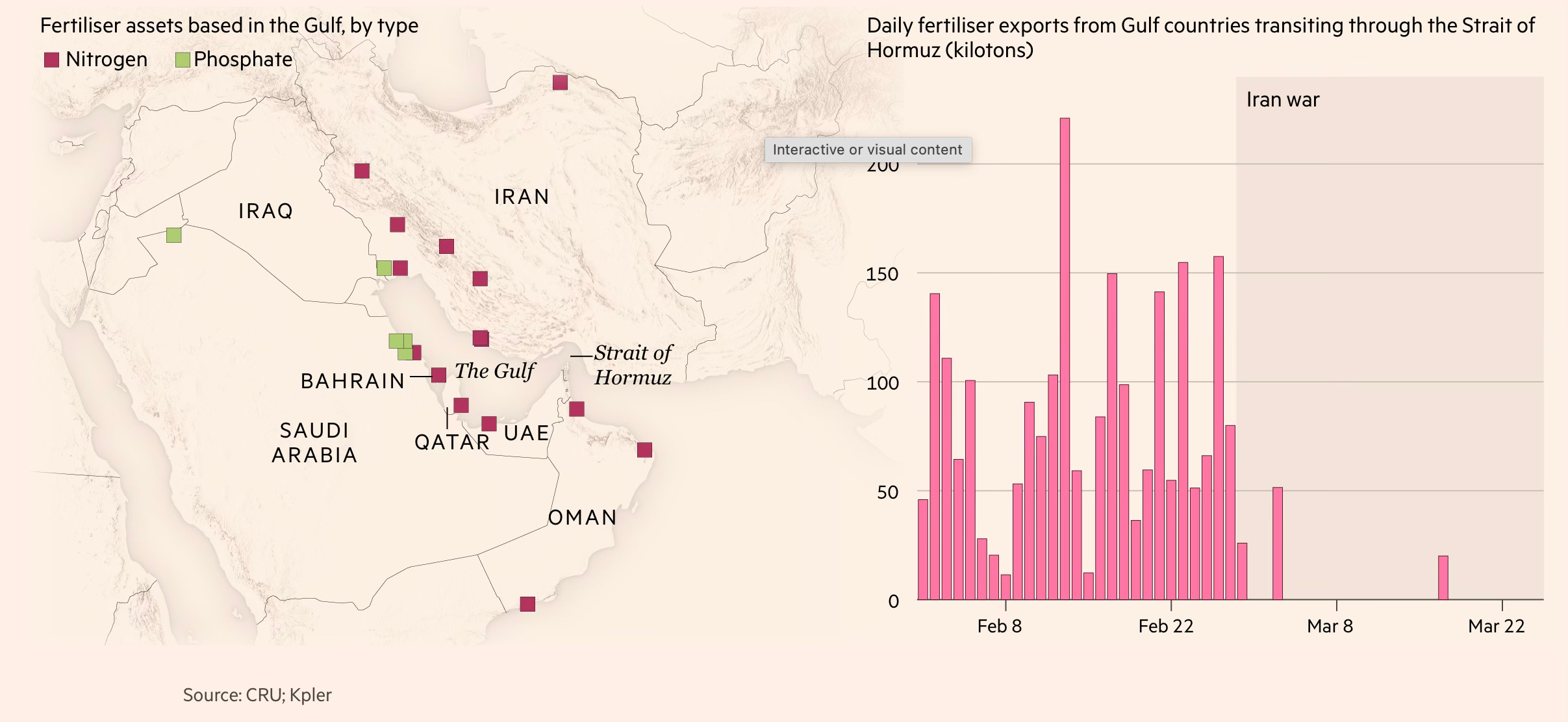
Gulf states account for 49 per cent of globally traded urea and 30 per cent of ammonia, perishable contributors to the nitrogen cycle that makes high-yield agriculture possible. When that supply chain stops, the effects accumulate quietly in soil chemistry and planting decisions over the months that follow… Before the first strike on Iran, the global food system was already running on reduced redundancy — Ukraine and Russia still represent about a quarter of global wheat trade, and some 400mn people across the Middle East and east Africa have been absorbing that supply shock for three years.

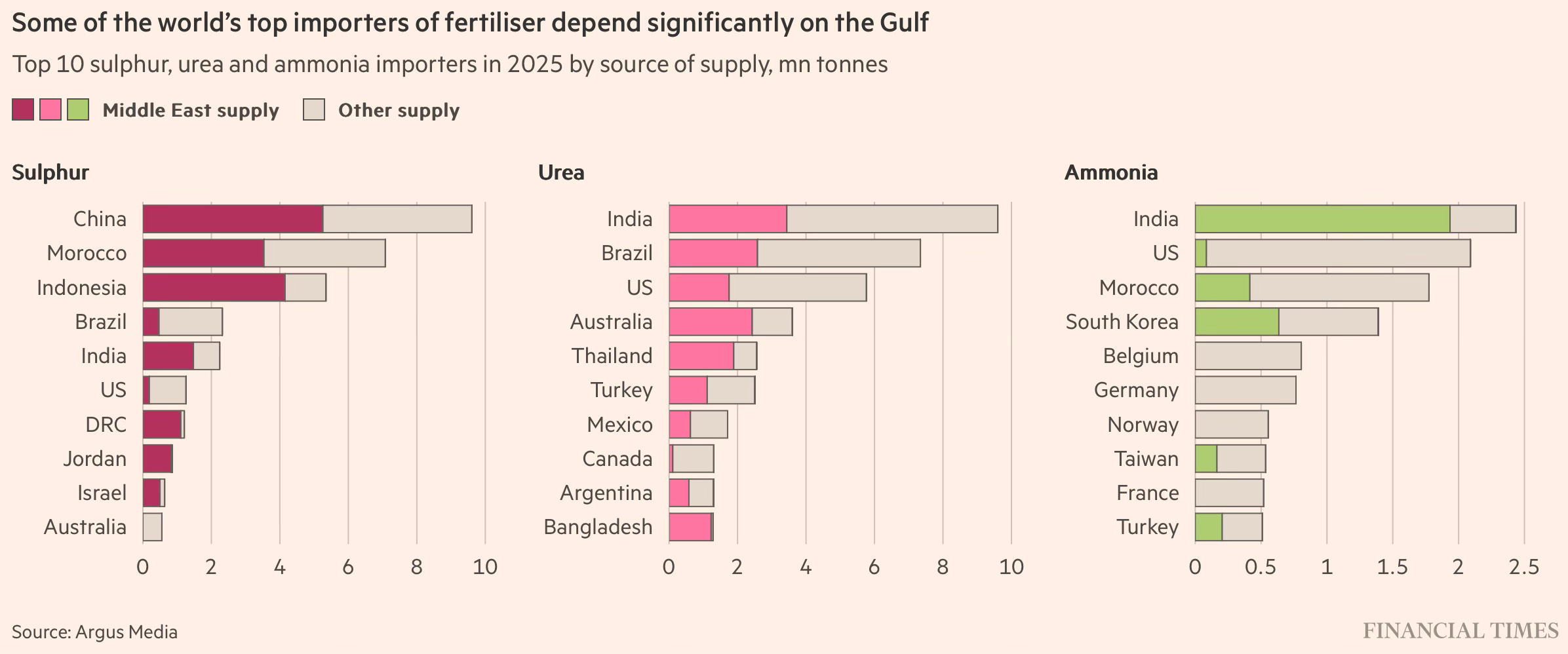
In fact, it is estimated that the impact of the Gulf War on food prices could be bigger than that due to the Ukraine war, with the channel of impact being fertiliser supply. Agriculture depends on three core nutrients - nitrogen, phosphorus, and potassium. Nitrogen fertilisers like ammonia and urea are produced from natural gas, and phosphorus depends on sulphur, a by-product of oil and gas refining. 

The level of dependence on the Gulf for sulphur, urea, and ammonia is very high.

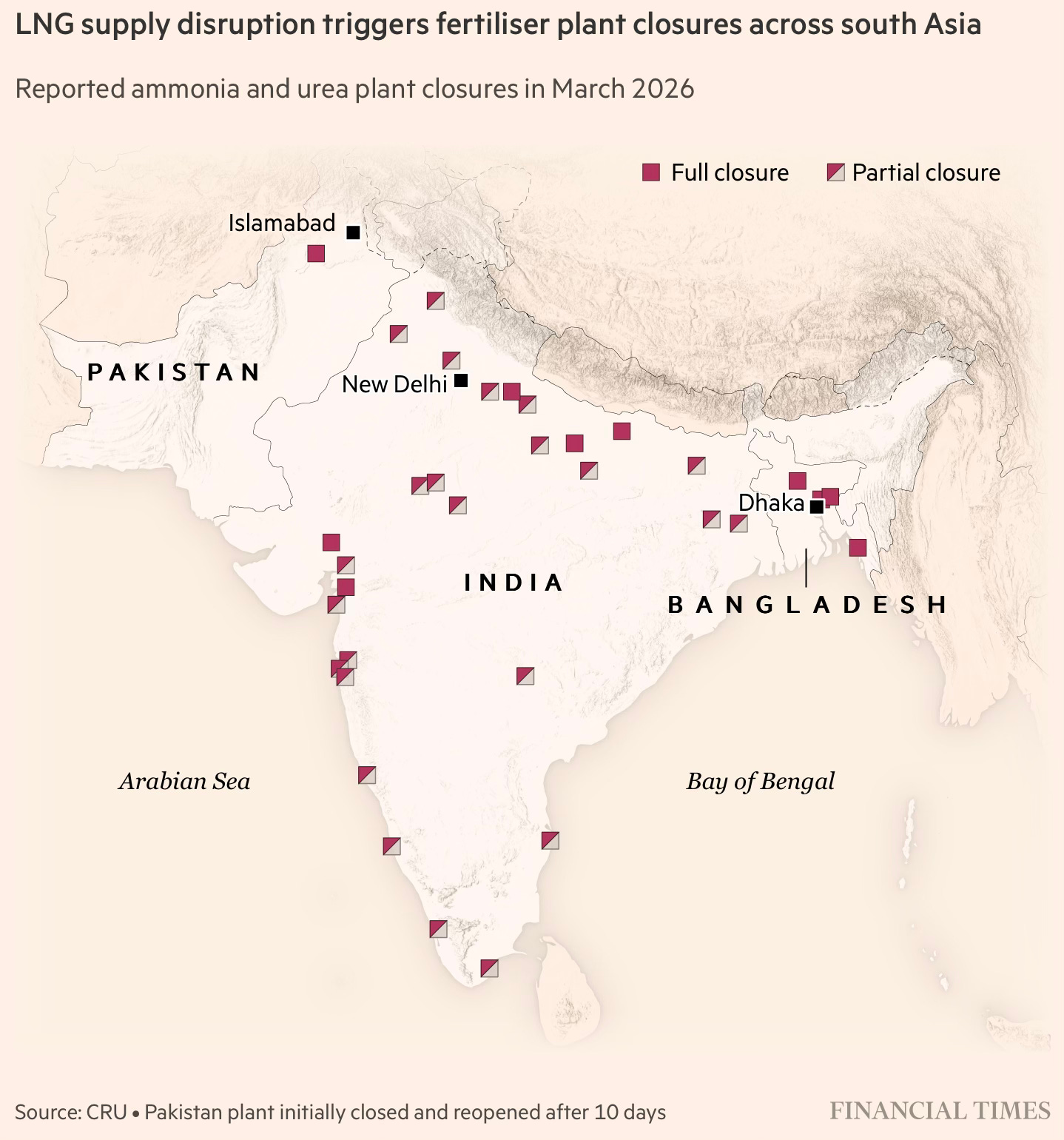
This is a striking illustration of how LNG supply disruption has triggered fertiliser plant closures across India in March 2026.

Tej Parikh has a good illustration of the vulnerabilities in the global semiconductor industry, where a chip production line can cross over 70 boundaries before reaching the consumer. The level of risk concentration is extreme and perhaps unavoidable. 

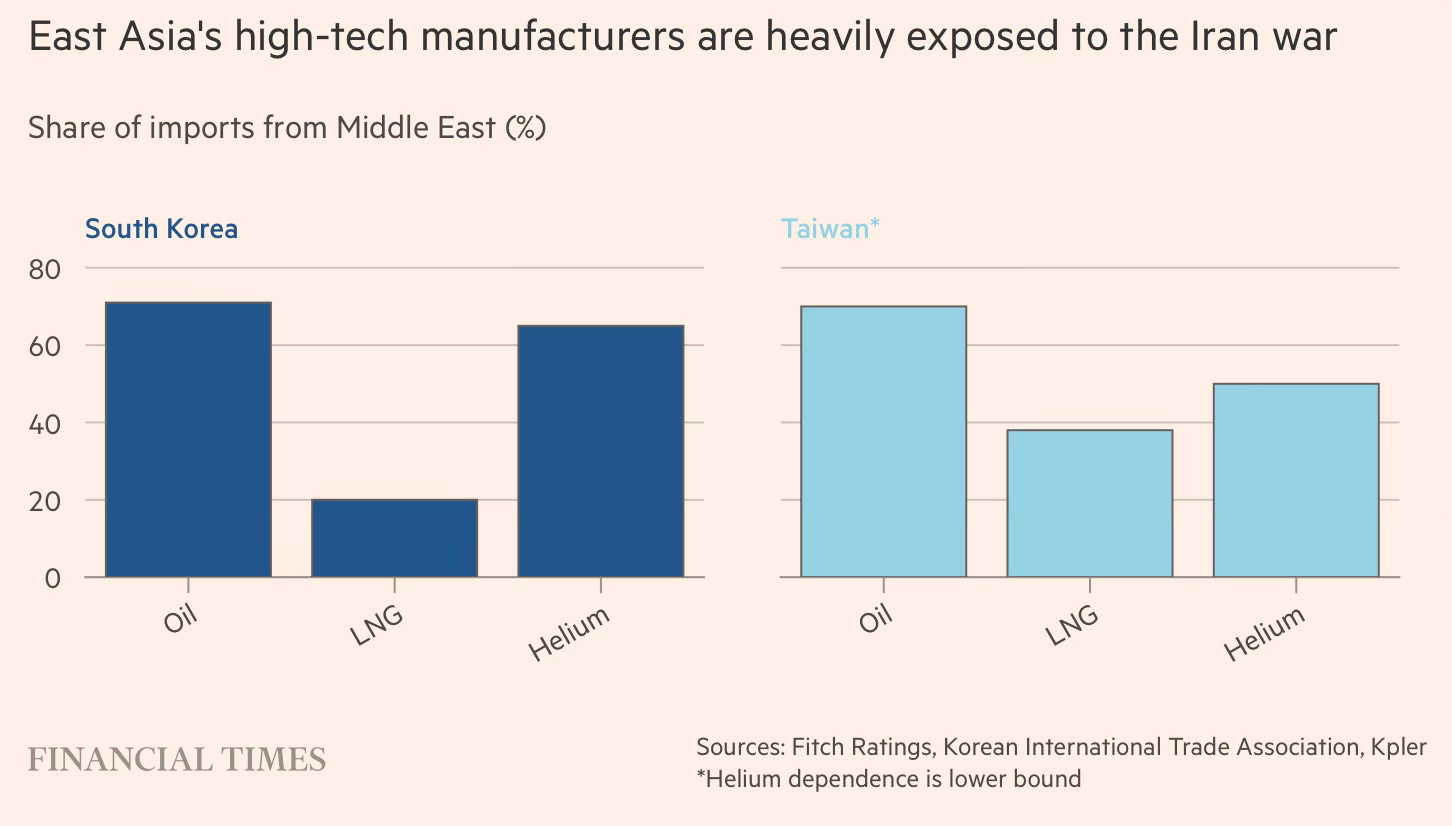
South Korea’s Samsung Electronics and SK Hynix dominate memory chip manufacturing, together accounting for 80 per cent of high-bandwidth memory and nearly 70 per cent of dynamic random-access memory… Taiwan’s TSMC makes 90 per cent of advanced semiconductors and virtually all of the high-end AI chips designed by Nvidia, the world’s most valuable company. Both South Korea and Taiwan depend on fossil fuels for energy, which almost entirely come from imports particularly via the Strait of Hormuz. The latter relies on the Middle East for more than one-third of its liquefied natural gas needs.

Asia’s chip industry is reliant on the Middle East for chemicals too. About one-third of global helium supply — a byproduct of natural gas processing that is used to cool silicon wafers — is from Qatar. South Korea and Taiwan get the majority of their helium from the Gulf country, which is a dominant provider of the hard-to-substitute, high-purity variety. Roughly half of global seaborne sulphur — an element used for chip cleaning and etching — transits the strait. Even before the war broke out sulphur was facing a supply squeeze, owing to high demand from the tech and electric vehicle industries. The Dead Sea is also the world’s largest source of bromine, a chemical that helps score patterns on to silicon wafers. South Korea imports virtually all of its supply from Israel.

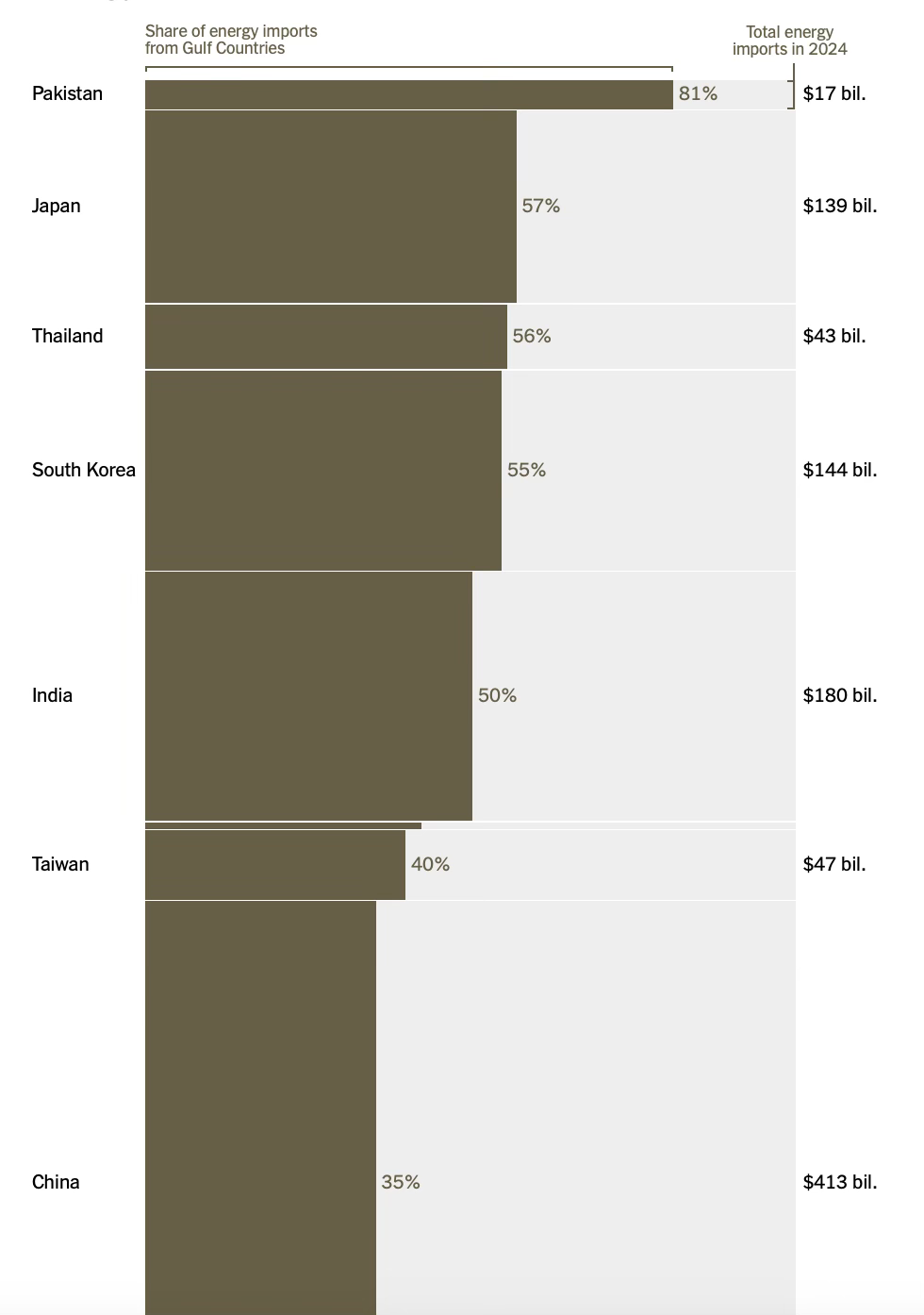
4. The War has also shown how vulnerable the Asian economies are to global oil shocks. Hoarding, price caps, tapping reserves, restrictions on exports, rationing, and other demand management measures have become commonplace across Asia. While Gulf produces a fifth of global oil supplies, Asian countries are among the most dependent

In 2024, nearly 21 million barrels of oil a day crossed through the Strait of Hormuz, the narrow passageway connecting the Persian Gulf to the world. Four-fifths of that supply went to Asia. China has long been the biggest purchaser of oil and gas from Persian Gulf nations. And with more than a third of its total supply coming from the region, the disruption is significant for Beijing. But other countries are almost entirely reliant on the region for their energy needs.

India’s dependence is especially acute.

Almost 50 per cent of the LPG and 30 per cent of the natural gas that India consumes comes from the Strait of Hormuz.

5. Chokepoints have become the game in global geopolitics. China’s weaponisation of its dominance in the processing and refining of critical minerals and manufacturing of rare earth magnets has single-handedly given it an insurmountable chokehold over the US. It has also clearly demonstrated its intent and success in weaponising its general dominance in manufacturing. 

Geopolitically, one of the most important outcomes from the Gulf War is the realisation that the Strait of Hormuz is arguably one of the biggest global economic chokepoints. The Strait is the only passageway out of the Persian Gulf, carries 25% of the world’s seaborne oil and 20% of its natural gas, and the land pipelines can carry only a small share of the oil and gas carried through tankers. Local geopolitical concerns also deter countries from laying pipelines through another country to export their oil products. 

Badr Jafar has this description of the vulnerability.

Thirty per cent of global seaborne oil flows and a fifth of the world’s liquefied natural gas trade normally transit a waterway that is 21 nautical miles wide. A third of seaborne traded fertiliser and nearly half the world’s seaborne sulphur exports depend on the same passage, with direct implications for global food security. So do significant volumes of aluminium and helium — the latter essential to semiconductor manufacturing and the global AI supply chain. The concentration of so much global commerce through a single contested corridor is an anomaly the world has tolerated for decades.

This is a good compilation of how the weaponisation of the Strait of Hormuz has impacted important supply chains. 

The War has shown Iran that it has a powerful weapon in the form of the Strait of Hormuz, which it can squeeze or close whenever required. This may well also be Iran’s biggest win from a war that has reduced large parts of the country to rubble. As Gideon Rachman has written, “the future dilemma is that Iran now knows that control of the Strait of Hormuz gives it a stranglehold over the world economy. Even if it relaxes its grip in the short term, it can tighten it again in future.”

6. But chokeholds are not permanent, and there may be nothing more powerful than activating the chokehold in triggering efforts to overcome it. By exercising its chokehold over Europe’s energy markets and forcing a rapid shift towards LNG and other energy sources among Europeans, the Russians have lost one of their most important strategic levers over Europe. 

As Badr Jafar writes, a similar realisation is emerging among energy producers in the Gulf region about the need to reduce reliance on the Strait and build resilience in the energy supply chain. 

Saudi Arabia’s Red Sea ports and expanded pipeline capacity offer an alternative energy corridor. The UAE’s east coast provides deep-water ports and pipeline routes connecting Gulf producers to the Indian Ocean. Oman’s developments at Duqm and Sohar sit well outside the chokepoint. Goods and energy are already moving along these routes — in some cases through cross-border land bridge arrangements that would have seemed improbable just months ago. The Middle East also holds a largely untapped inheritance: pipeline infrastructure built in previous crises and mothballed for decades, road and rail corridors, cross-border electricity grids and water systems that stretch beyond established networks. With renewed co-operation, these assets could deepen regional connectivity to global markets. The crisis is doing what years of summitry could not — creating the conditions for genuine intraregional economic integration. States whose ties were strained only weeks ago are now finding common cause.

This is a repeat of what happened in the early days of the Ukraine war when the Europeans realised the chokehold Russia had on its natural gas supplies. On the same lines, the realisation of the fickleness of the US security umbrella has sent the US allies scrambling to shore up their own defence preparedness and strengthen their non-US alliances. In the long arc of history, the events of the last year may have been just the right impetus to push the Europeans (and Japan) into the pursuit of independent defence strategies. 

7. In the grand scheme of things, historians may well come to regard the Gulf War as one with only losers. Iran has been devastated, and its economy has surely been put back several years, if not at least a decade. For all the outward bravado and bluster, it is hard to believe that the loss of a whole generation of leaders has not seriously impacted the country’s politics. Its proxies in Syria and Lebanon have been defanged. 

This war, coming on the back of the sustained Gaza bombings, has left an Israeli society that is radicalised to a scary degree, even evoking comparisons with Weimar Germany. Polls suggest that more than 90% of Jewish Israelis back the war, and the country’s political parties have been trying to outbid each other in calling for the extermination of its enemy. History tells us that these trends will not end well for Israel and the world at large. 

It has also surely alienated a generation and more of people globally, especially in Europe, including those sympathetic to its cause, who are horrified by the barbarity of the Gaza and Iran attacks. The most lasting damage may well be in the US, where the public opinion against Israel, even among the traditional support base, has suffered sharp declines

The long period of geopolitical calm and stability that allowed the Gulf economies, especially the UAE, to prosper and become global magnets has been rudely unsettled. It is likely to be a long time before they can aspire to reclaim their pre-war status, if ever. 

The fickle and whimsical nature in which President Trump conducted the war allowed Israel to dictate the agenda and subordinate the US interests to its own, and browbeat its own allies, which have all contributed to undermining the US's credibility. It does not help that it has not managed to achieve its primary objective of regime change in Iran, despite eliminating a whole generation of Iranian leadership and the massive bombardment of the country. 

To this extent, the Gulf War Trump 2.0 administration may have rung the bell on the definitive decline of the post-war US hegemony in international politics. The US security umbrella is now punctured beyond repair. 

8. While it cannot be said to have emerged as a winner, by staying quiet and allowing its main competitor to make all its mistakes, China may have enhanced its power at least in relative terms. However, due to its own political limitations, it may not have the sagacity to seize the moment. 
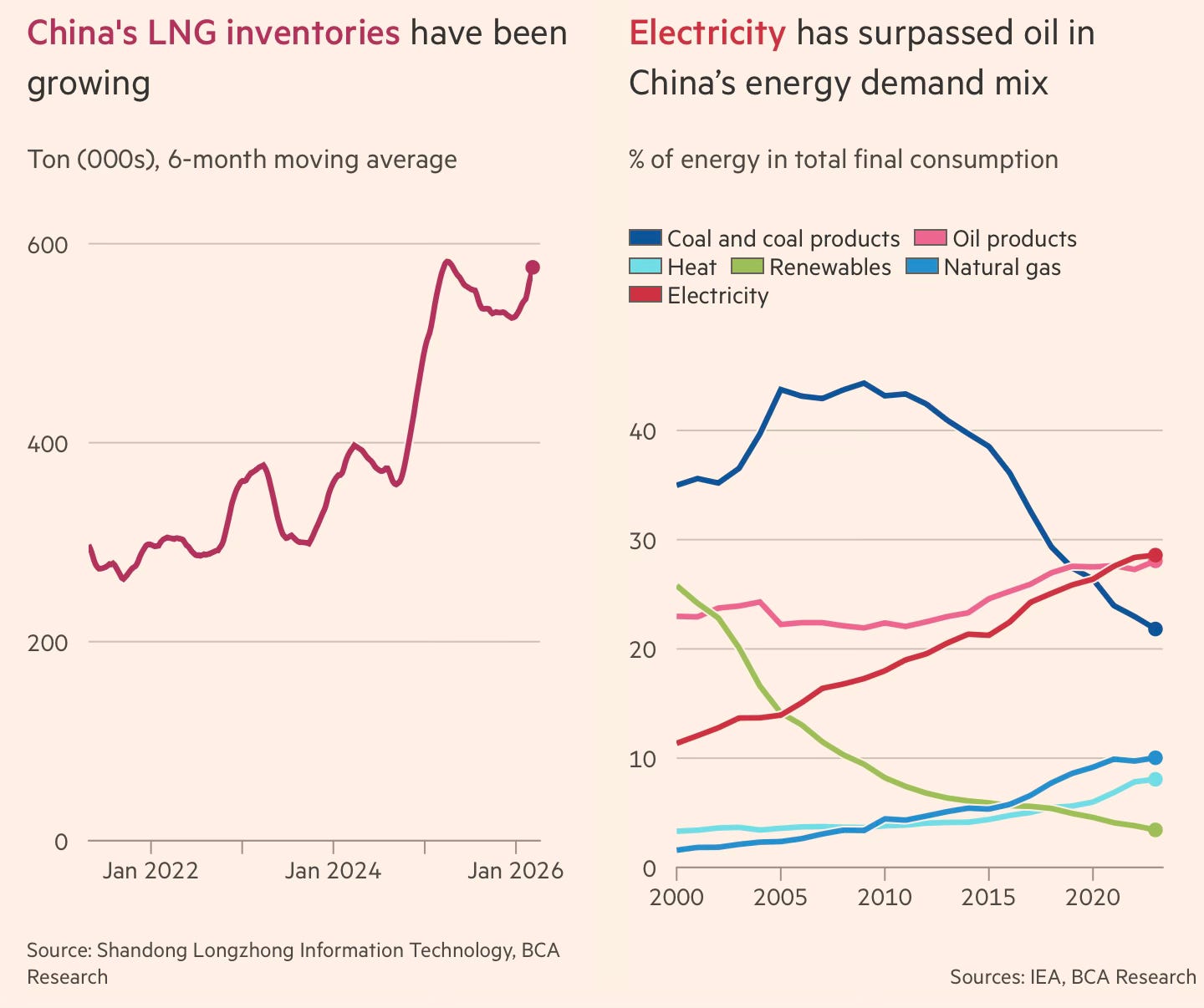
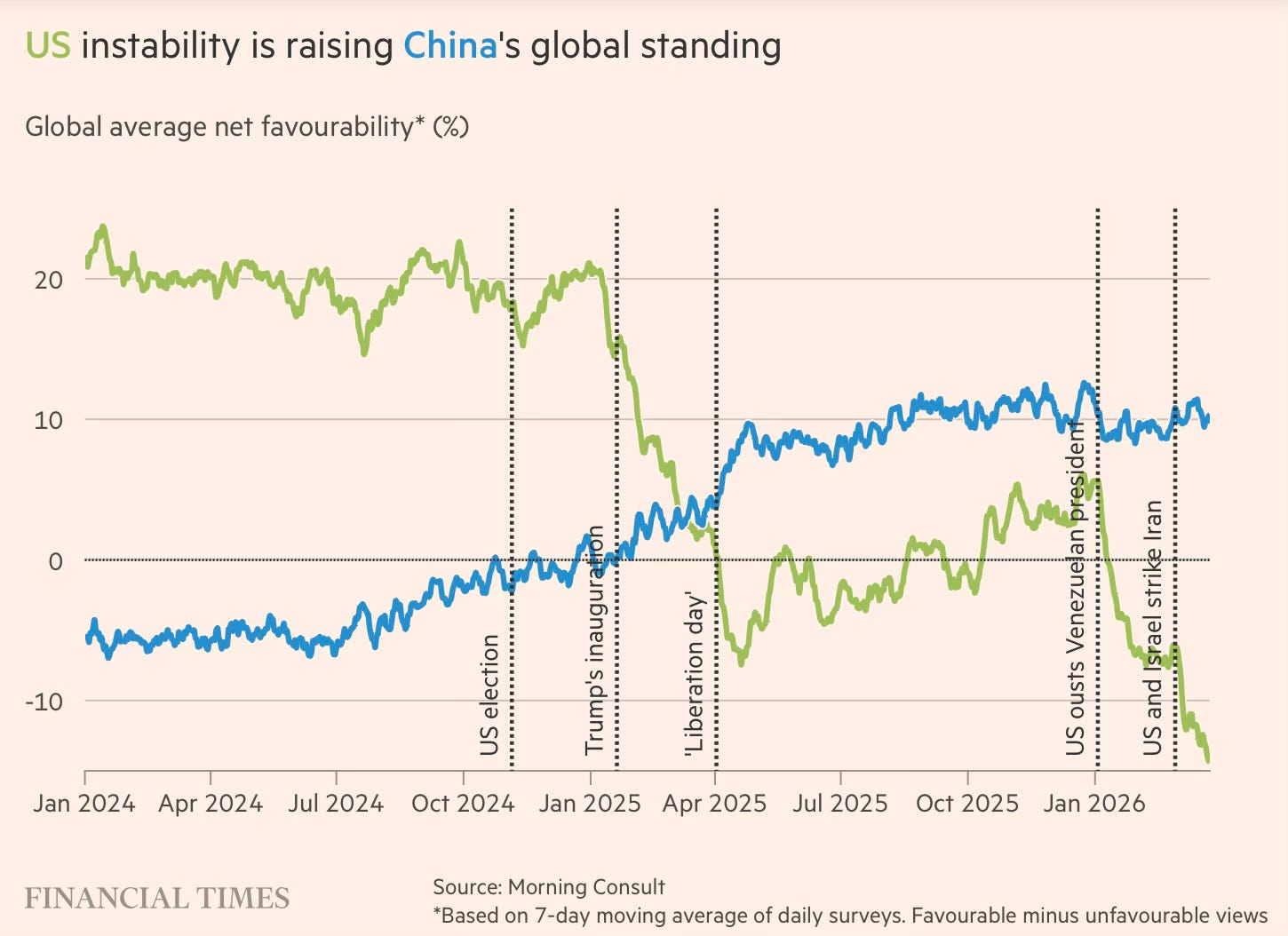
The war highlighted China’s economic resilience and how it boosts its superpower status. It holds the world’s largest emergency reserves of petroleum, totalling a staggering 1.3 bn barrels. With electricity accounting for 30% of the country’s energy consumption, about 50% higher than the US or Europe, it is significantly insulated from oil shocks. Its firms account for at least 70% of global manufacturing capacity for major green technologies like solar, battery, and EV components, besides also dominating the extraction and refining of rare-earth elements that go into them. 
This may well be the most definitive illustration of the declining image of the US and the rising one of China, with the reversals coinciding strikingly with the Trump inauguration. 

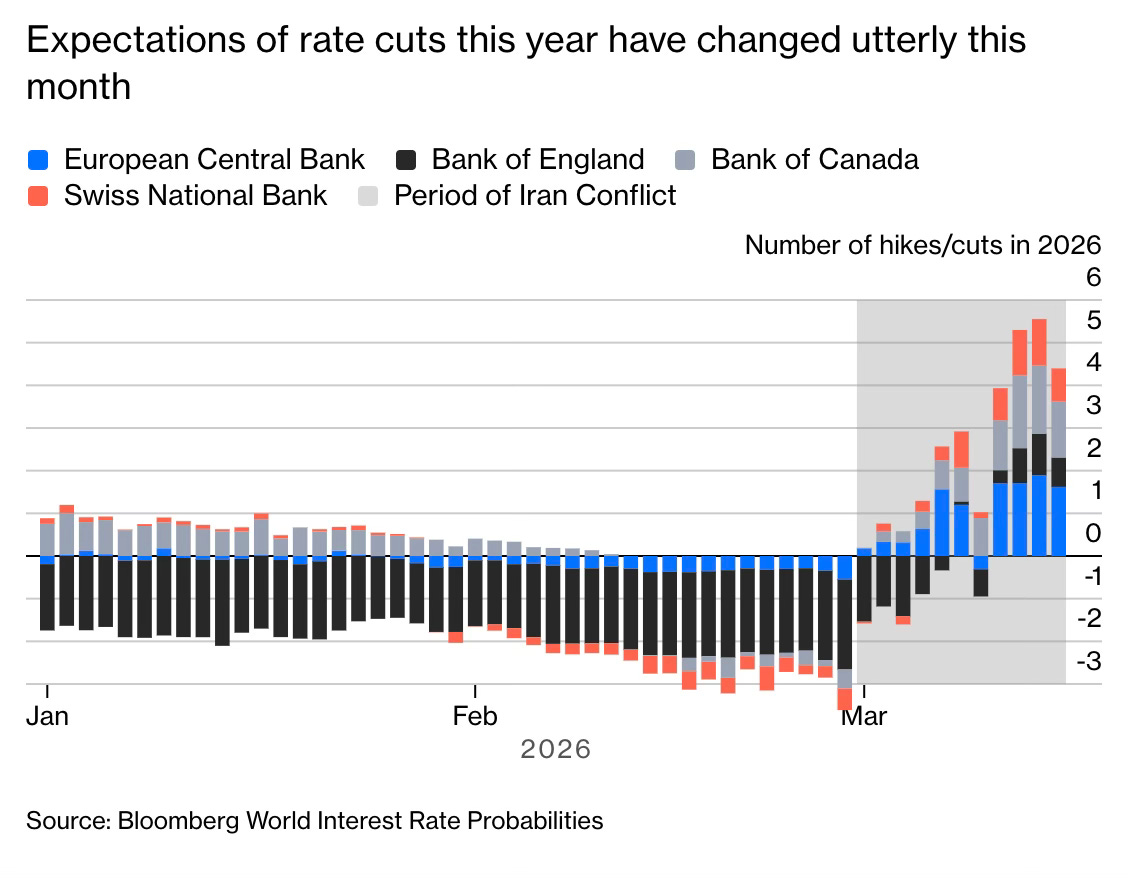
9. On the economic side, the medium-term impact of the war will be on inflation and interest rates globally. The war comes on the back of supply shocks imposed by the Covid 19 pandemic and the Russian invasion of Ukraine. It had taken more than three years for the resultant surge in inflation to decline to normalcy. This process has now been reversed, and with no certainty on what lies ahead (also given the risk that the ceasefire will not hold). 

In the US, expectations for at least two rate cuts have declined to just one rate cut. And if the ceasefire is broken and the supply squeeze continues, oil prices will remain elevated, and inflation will surely rise. Instead of rate cuts, the Fed may have to respond with rate hikes. In fact, in Europe, the expectations now are for rate hikes

10. If one were to look for silver linings, the sheer unpredictability, the staggering hubris, and the utter disregard for all diplomatic norms, the Madman nature of Trump may serve as a deterrent to potential opponents and aggressors. This, coupled with the frightening display of US military prowess and its projection capabilities, is a very important signal. It would be especially relevant to China and any plans it might have to invade and annex Taiwan.

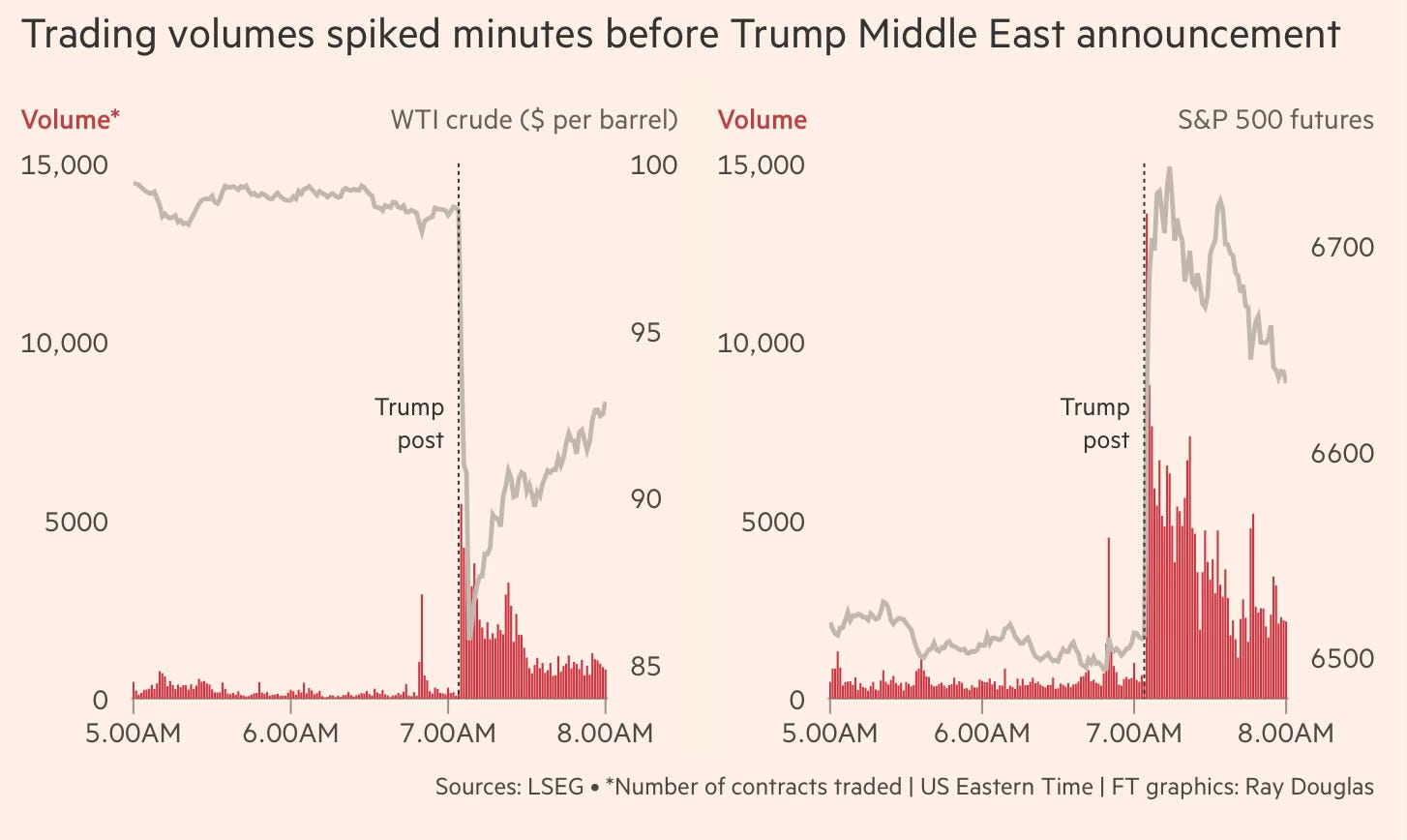
11. The Gulf War has confirmed that the surest test of the TACO (Trump always chickens out) trade is the stock market. Gillian Tett has written, “Donald Trump views equity prices as a key — if not the key — barometer of his success, more than any president before him.” The other TACO triggers are the cascading impact of energy prices on domestic gas prices and inflation. On multiple occasions during the War, including the latest ceasefire, Trump pulled back from the brink as the (equity and bond) markets roiled and threatened to unravel. So much so, one could have predicted with some degree of confidence that the deadline to “wipe out a civilisation” was extreme brinkmanship to extract the maximum concessions before the inevitable pullback. 

It is another matter that these Taco episodes may have been used for market abuse and profiteering by those close to the powers that be.

12. The Gulf War offers a reminder that wars have returned to being more common. Conflict zones grew by nearly two-thirds between 2021 and 2024, with 2023 witnessing more violent conflicts than any time since World War II, and over 130 armed conflicts being recorded in 2024, a total that has doubled in just 15 years. There is a greater inclination to use military power to expand national boundaries. This also comes at a time when the Trump administration’s actions have raised serious doubts about the US security umbrella. The Europeans and Japanese, who most benefited from the alliance with the US, are now the most disturbed by the new normal. 

All this is unlikely to be lost on countries that the possession of nuclear weapons may offer protection against blackmail and aggression by enemies. It has naturally reignited a wave to go nuclear.

France, whose force de frappe is truly sovereign, said this month that it would increase its stockpile of warheads. In Poland, a rare point of agreement between the prime minister and the president is their openness to going nuclear. In South Korea, public support for a deterrent has gone up to 70 per cent in recent years. Saudi Arabia, which has said that it would get one if Iran did, might not wait for such a cue now that it and other Gulf states are under conventional attack from that quarter anyway. Even the original nuclear powers are chafing at old taboos. As of last month, there is for the first time in over half a century no binding agreement to limit nuclear arms between America and Russia, which have the world’s two largest arsenals.

In 1994, Ukraine gave up the Soviet nuclear weapons that were then on its soil in exchange for certain assurances about its security. Two decades later, Moscow began its long and ongoing war against Ukraine with the annexation of Crimea. The lesson, for some, is obvious. A country with dangerous neighbours should retain or acquire the ultimate deterrent. Another salutary tale is that of Iran. It seems that an unfinished nuclear bomb is the worst of all worlds: a provocation to other states but not a deterrent. A rational government would either abandon all ambitions of that kind or realise them in full.

13. The US-Israeli bombings have clearly been intended at destroying the Iranian economy, achieve through warfare where sanctions have failed. Over 13,000 targets, going beyond military infrastructure, and covering oil and gas facilities, industrial sites, universities, transportation infrastructure have been destroyed in the bombings.

Israeli air strikes forced Iran to shut down its two largest steel plants. One of Iran’s biggest pharmaceutical manufacturers, Tofigh Darou, which produced important cancer treatments, was also destroyed by air strikes last week, the health ministry said. By striking at the heart of Iran’s industrial base, Israel has hit a vital source of non-oil export revenue for the Islamic republic. In the first 10 months of the last Iranian year, which ended in March, non-oil exports totalled $51.6bn, compared with total imports of $58.1bn, according to Iran’s customs administration. Petrochemicals account for nearly half of Iran’s non-oil exports, followed by minerals and industrial goods such as steel… On Monday, Iran accused Israel of striking Sharif University, the country’s most prestigious engineering institute. Last week, Israel bombed Tehran’s more than 100-year-old Pasteur Institute, one of its leading medical research facilities.

This has clearly put the Iranian economy back by decades. The brunt of the economic impact will be on the poor and vulnerable, thereby setting the stage for social discontent at a time of diminished resources and a weakened political system. In the circumstances, any economic recovery cannot begin without some relaxation of the sanctions. It is hard to believe that after such devastation, a country as large as Iran, with 90 million people, can continue to be left as a pariah and squeezed with sanctions, without the political instability spilling over across the region. 

14. As the first round of talks has shown, there’s little wiggle room available for both sides in any negotiations. The Iranians cannot settle for anything other than at least some relaxation in the sanctions, at least some assurances in this direction. Further, in light of what has happened, they will find it difficult, even impossible, to now give up on the nuclear deterrent. These are existential issues for the regime. It has chosen to endure the 38 days of bombings instead of acceding to the US demands on the nuclear issue. It is highly unlikely that they will now climb down significantly on this issue after all the losses - over 3500 lives lost, elimination of an entire generation of leadership, and tens of billions of dollars of economic devastation. 

This circumscribes the window for negotiations. For one, it would have to be something short of Iran giving up its nuclear option. But Iran will have to concede more than it has so far. The other point concerns the extent of sanctions relaxation. The negotiations cannot move forward if there is disagreement on these basic assumptions. If there’s mutual agreement on the assumptions on both issues, the negotiations would revolve around what would be an acceptable enough climbdown for the two sides.

15. Finally, there are important warfare lessons. The foremost takeaway, reinforcing the impressions from the Ukraine war, is that drones and low-cost ammunition necessitate a reexamination of conventional military strategies. Second, however, this must be contrasted with the importance of advanced technologies in establishing the near-complete air superiority of the US in the two-week war in 2025 and the current war. Third, the reasonably long drawn-out war has given the US armed forces invaluable experience of wartime action, especially compared to the Chinese. 

Fourth, the use of AI has reshaped decision-making in wars. The use of Palantir’s Maven Smart System and Anthropic’s Claude model has helped the armed forces rapidly sift through voluminous intelligence data from multiple sources to plan and generate strike options in near real-time. As an illustration, the Pentagon struck more than 2000 targets in the first four days, compared to the six months taken to strike a similar number of targets in Iraq and Syria during the campaign against ISIS. Fifth, the controversy and the tiff between the US Government and Anthropic on the use of AI-generated information to make military decisions highlights the important concern with the use of AI, one that will only increase over time.