Substack

Showing posts with label Aid. Show all posts

Monday, October 13, 2025

Electrification in Africa is a global development failure

I had blogged here arguing that the availability of adequate and good-quality power is the biggest constraint to Africa’s sustained economic growth. 

The graphic below is a powerful illustration of one of the biggest failures of global development efforts.
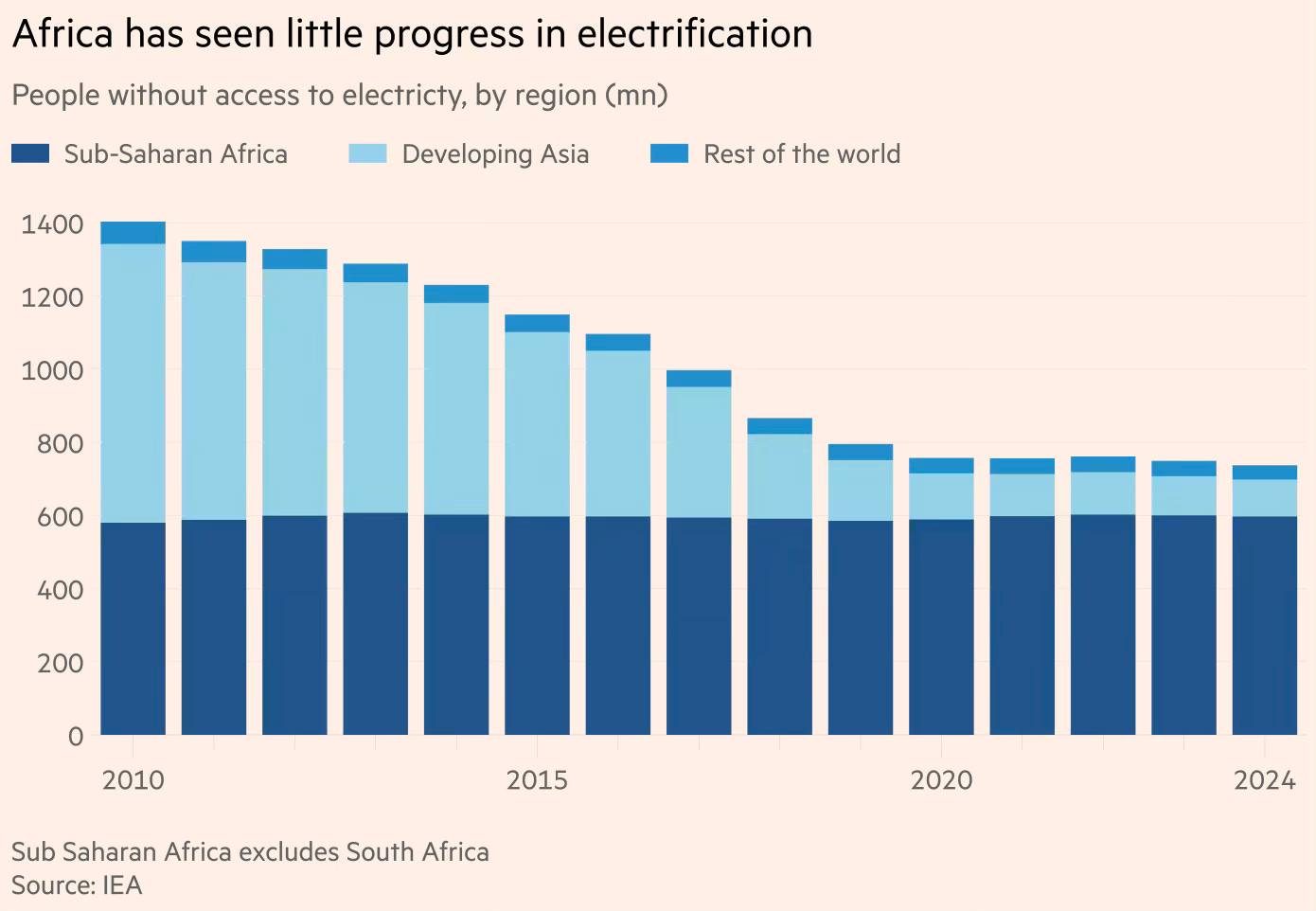
The number of people in Africa without access to electricity remains at 600 million, unchanged from 15 years ago. Among those without electricity globally, the share of Africans has risen from a third in 2010 to 80% in 2024. 

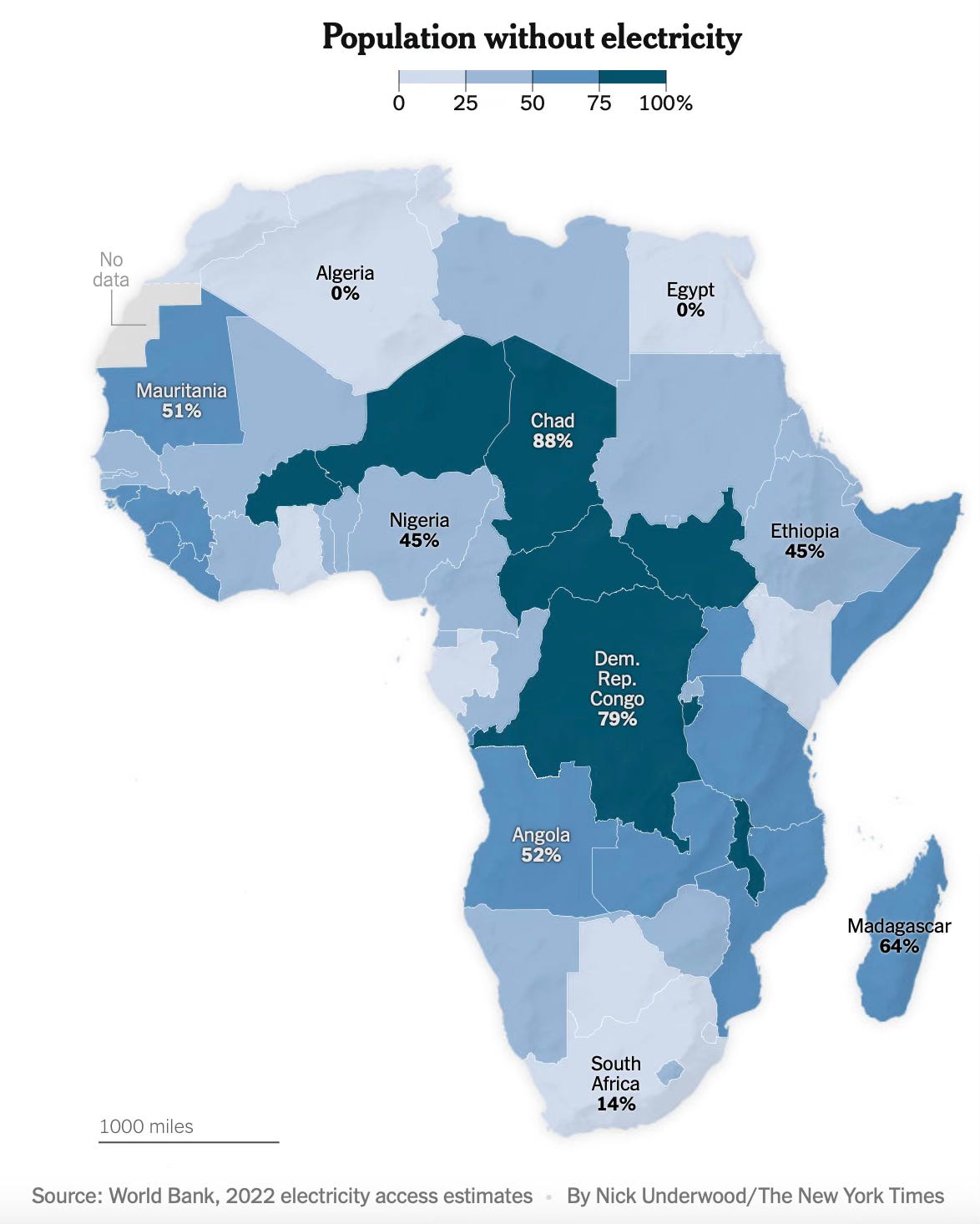
Africa’s electrification problem seems to be excessively concentrated in its hinterland areas, in the region sandwiched between the North and the South. 
In this context, it’s also useful to see the contrasting fortunes of South Asia and Sub-Saharan Africa in electrification. 
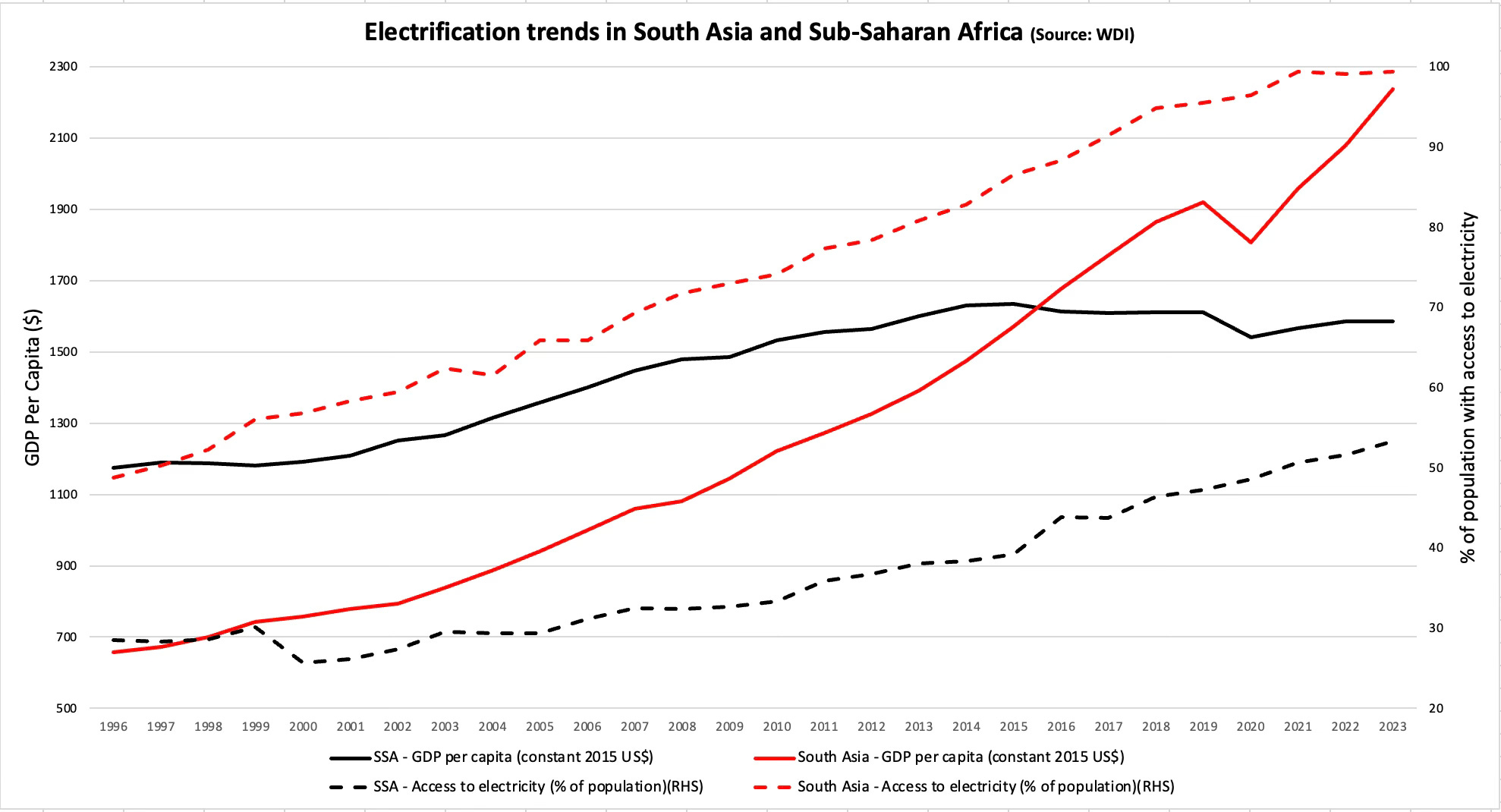
Africa has had a very low baseline of electrification. For example, SSA reached South Asia’s 1995 level of electrification only by 2020, despite its percapita GDP in 2020 being 2.34 times more than that of South Asia in 1995. East Asia and Latin America had a much higher baseline of electrification than even South Asia. This questions an oft-repeated argument that Africa will be able to afford high electrification rates only if its incomes rise enough to sustain a viable market. 

I’m inclined that a very big reason for the gap is the governance of the electricity supply. Through a series of reforms, South Asia, especially India, managed to restructure the sector, regulate it more effectively, improve operational efficiencies of state utilities, and gradually bring in consumer payment discipline. The industrial, commercial, and other higher consumption subscribers were able to ensure that the discoms could become viable entities even after subsidising the vast majority of residential consumers. All this, in turn, derisked the sector and opened the door for private investments in generation. 

The take-off point for electrification in India was the Electricity Act 2003, one of the least appreciated among India’s economic reforms. Today, almost all incremental generation capacity addition from all sources comes from the private sector, and it owns more than half the total installed capacity, from virtually zero at the turn of the millennium. Domestic promoters and capital, intermediated mostly by regular banks, have been the major financiers. 

Africa too must go through these reforms if it’s to derisk its electricity sector and make it viable enough for private investments into generation. In most African countries today, it appears futile to rely on private financing in any meaningful manner to meet power generation requirements. I had blogged here, highlighting the challenges with attracting private investments into power generation in Africa. Till then, public financing may have to do the heavy lifting on electrification in Africa. 

In the spectrum between public and private goods, electricity is an interesting outlier. While it’s a private good insofar as people pay for access, power itself has several positive externalities in human resource development and economic growth. In fact, reliable three-phase electricity is one of the most essential preconditions for economic growth. Public production and provisioning of electricity may, therefore, be an unavoidable necessity in Africa for the foreseeable future. 

In this context, South Africa’s recent success with reforming its electricity sector and reviving Eskom after numerous scandals and rolling power cuts for several years offers an encouraging sign. 

In the latest global endeavour to electrify Africa, the World Bank and the African Development Bank have launched a $90 billion scheme to bring electricity to 300 million people in Sub-Saharan Africa by 2030. About 30 countries have already signed ‘energy compacts’ under the Mission 300 initiative. 

A cursory reading of the Mission 300 plan reveals a mix of objectives thrown in under the broad umbrella of electrification - promotion of renewable energy, decentralised and distributed generation, supply through mini and micro-grids, private participation, complex financial instruments, partnerships between DFIs and philanthropic foundations, microentrepreneurs, etc. In simple terms, the objective of electrification is being pursued through private participation, foreign funding, and renewable energy generation. There are several problems with this approach.

For a start, it’s the classic “everything bagel” development, where multiple laudable objectives are being sought to be achieved in the guise of electrifying Africa. Each of these objectives is challenging by itself, and bundling them only makes the objective of electrification in Africa manifold and daunting. 

The involvement of several partners in the coalition, while laudable, also risks diffusing accountability and responsibilities. Given the scale of the problem, the role of philanthropies and impact investors is marginal. Even meaningful private investments will be difficult to realise in most countries, especially in the early stages. Given the requirements, small renewable energy units and mini grids are marginal compared to thermal generation and grid supply. As the long history of infrastructure financing in low-income countries shows, complex financial instruments will struggle to make any headway. 

Importantly, the opportunity cost of coal (and rivers) rich Africa foregoing thermal (and hydel) power and relying on intermittent solar or wind power is considerable. Besides, given the commercial risks involved, the total cost of renewable power generation by the private sector (including the cost of capital and storage) is likely to far exceed pithead thermal and hydel generation that’s possible in many African countries. In the first stage, it may be useful to prioritise projects with a demand mix that primarily serves industrial and other bulk consumers. The Mission 300 should prioritise all such projects.

The quantum of funds required means that the major share of financing must come from national governments and traditional bilateral and multilateral DFIs through grants and concessional loans. Unless this fundamental constraint is relaxed, the rest are only distractions in the serious endeavour of significantly increasing electrification in Africa.

Saturday, April 5, 2025

Weekend reading links

1. The F-35, the Joint Strike Fighter, the backbone of the western air forces, and developed by Lockheed Martin in collaboration with several companies from the western alliance, is facing uncertainty arising from concerns that the Trump administration could kill the program. 
It's already deployed by several governments and has large order book.
2. The US statistical system faces uncertainties due to DOGE cuts.
3. Indians are second only to the Chinese in purchases of gold.
4. India IT services off-shoring facts of the day
As of 2024, there were about 1,800 offshore corporate offices in India, owned by hundreds of foreign-based multinational companies — most of them American. There are 1.9 million people in India working for foreign companies, with 600,000 to 900,000 more expected to join them by 2030. Together, the offshore business centers in India earned about $65 billion last year, more than the value of American imports to India. By 2030, they are expected to earn $100 billion or more... Across India, these foreign-owned offices are now the primary driver of commercial real estate. An estimated 50 new ones were established over the past year. The expectation is that 100 more will join them during 2025... these offshore subsidiaries are no longer providing only low-value services. They are full-fledged branches of American headquarters, not just outposts, let alone temporary offices that provide outsourcing for information technology services. In fact, that sector announced a reduction of 64,000 jobs in 2024... 

While salaries have gone up over the years, they are still about a quarter to a third of their dollar-adjusted equivalent in the United States. Managers of these offices, known as global capability centers, acknowledged the savings, but they said multinational companies were just as drawn to the quality and abundance of potential Indian workers. “Where else can you scale up with 2,000 engineers, or marketing professionals, within a year?” exclaimed one executive, who asked not to be named because he was not authorized to speak publicly.

5. Automobile trade with the US

For Japan and South Korea, automobiles are the top export to the United States. Mexico, in addition to cars, produces tens of billions of dollars worth of automobile parts each year that are exported to its northern neighbor. In Canada, auto manufacturing and auto parts are the country’s second-biggest export by value... In recent years, Japanese and South Korean automakers, as well as European brands — which account for 18 percent of U.S. car imports — have become increasingly reliant on the American market. That is in part because of stagnant demand in their home countries, but also because they are facing heightened competition from local competitors in the world’s biggest car market, China... Japanese brands shipped 1.37 million vehicles to the United States last year, while South Korean automakers exported 1.43 million. In addition, 821,000 light vehicles sold in the United States last year were assembled in the European Union, according to JATO, a research firm. Conversely, U.S. automakers have a minimal presence in Japan, South Korea and Germany — a reality that has vexed Mr. Trump since his first term as president.

6. In six years, China's trade surplus has nearly tripled!

President XI Jinping recently hosted 40 global business leaders in the Great Hall of People in Beijing and made an impassioned plea in defence of the global trading system. He decried some countries "weaponising" trade and "forcing companies to take sides and make choices that go against economic principles". He said, "We must jointly maintain the multilateral trading system, jointly maintain the stability of the global industrial chain."

China's defence of the world trading system is purely borne out of self-interest. It's acutely dependent on exports for growth.

As their consorting with President Xi shows, the Western business leaders have clearly not learnt anything from the countless recent incidents of high-handedness by Chinese authorities and experiences of difficulties of doing business in China.  

7. Grim assessment of the development aid scenario

Not only has the US shut down USAID and the UK slashed development aid, but there have also been cuts to the French, Belgian and Dutch budgets. The latest warnings come from Berlin, where the new coalition has put the development budget on the chopping block. In a worst-case scenario, global aid budgets could be slashed by a staggering $74bn in 2025 alone. That would be 30 per cent or so of total overseas development assistance, or ODA.

8. Gautam Mukunda makes a very good case for freedom on expression in academic campuses. 

But why can’t universities innovate while getting rid of that irritating tendency to annoy and even offend... They provide a home for people too contrarian, difficult or just downright odd to function in the rest of society. Colleges welcome people who reject the mainstream consensus. They’ve even created structures like tenure to protect and encourage those people. There’s good reason to do so. The most important discoveries are the ones that tell us that something important that we thought we knew is wrong. Most research is what the great philosopher of science Thomas Kuhn called “normal science.” It works within established paradigms. That’s valuable work. Doing it well is rewarded with the esteem of your peers. Revolutionary research, in contrast, overturns old paradigms. It destroys accepted consensus. That’s hard. People, even scientists, tend to react poorly when someone tells them they’re wrong, and they often reject the ones who do it.

9. The length of tasks AI is doing is doubling every seven months.

John Burn-Murdoch summarises the paper's findings

It finds that LLMs’ ability to perform a given task is a function not so much of how intellectually challenging the same job would be for you or me, nor of the level of specialist skill required, but of how long it would take a human and how “messy” or unstructured the workflow. So carrying out the duties of an executive assistant, travel agent or bookkeeping clerk — all computer-based jobs requiring entry-level skills — is still beyond the capabilities of even cutting-edge AIs. They struggle to keep track of multiple streams of information, respond to a dynamic environment, work with unclear or changing goals and multitask. These unstructured workflows are a far cry from coding tests and essay questions.

10. Amidst all the credentially and virtue signalling on climate change, America continues its commitment to fossil fuels. In the last few years, it has not only emerged as the largest oil producer, but now has become the largest LNG exporter. 

It's estimated that by the end of the decade, almost 1 in every three tankers carrying the super-chilled fuel will originate in the US. This is a good summary of the transformation of fortunes of the US gas industry.
Twenty years ago, the idea that natural gas would play an even more important role than crude oil in US diplomatic calculations would have been preposterous. At the turn of the millennium, the US was short of gas. It generated less than 15% of the country’s power, outflanked by nuclear and coal, and Federal Reserve Chairman Alan Greenspan called for a major expansion of imports to address the shortfall in domestic supply. Horizontal drilling and hydraulic fracturing, or fracking, which picked up in the early aughts, changed all that. The two techniques unlocked previously inaccessible oil and gas reserves from North Dakota to New Mexico. The US more than doubled its natural gas production, to more than 100 billion cubic feet per day, and it now fuels 41% of the country’s electricity... US natural gas prices have averaged $3.55 per million British thermal units over the past five years, about 70% lower than the European average, providing the economy with a major competitive advantage and helping to underpin both Biden and Trump’s policies to bring US manufacturing back from overseas.

11. Affordable housing crisis in Spain.

Since 2015, nearly one-tenth of the country’s housing stock has been plucked by investors or converted to tourist rentals. The scarcity has helped drive up prices much faster than wages, making affordable homes out of reach for many... The problem is complex, perhaps no more so than in Barcelona, which has become ground zero for Spain’s housing dilemma — and a crucible for the challenges of trying to fix it... Barcelona’s woes mirror the pain lashing European cities: Residential real estate has increasingly been turned into financial assets by investors. A surge in global tourism and workers crossing borders has landlords favoring short-term rentals over protected long-term tenants... 

The affordability problem has become one of the biggest drivers of inequality in Europe. Rents in the European Union rose 20 percent in 10 years, and house prices have surged by half, according to Eurostat. In 2023, one in 10 Europeans spent 40 percent or more of his or her income on housing... But rental prices have increased 57 percent in the country since 2015 and home prices 47 percent, while household income has grown just 33 percent, according to PwC. In Barcelona alone, rents surged 68 percent in a decade... Barcelona will become the first European city to end licenses for Airbnb homes, requiring owners by 2028 to offer them as long-term lodging at capped rents or put them up for sale.

12. India trade facts

India’s exports of merchandise and services from $465.9 billion in 2013-14... to be around $780 billion and their share in global exports around 2.8 per cent. In 11 years, that is a compounded aggregate growth rate of 4.79 per cent... The merchandise exports in 2019-20 were lower at $313.361 billion compared to $314.405 billion in 2013-14... This financial year merchandise exports are likely to be around $435 billion, which means a CAGR of 3.1 per cent in 11 years. Our share in global merchandise exports remains around 1.8 per cent... The services exports grew from $167 billion in 2013-14 to only around $206 billion in 2020-21, a CAGR of 3.04 per cent. Thereafter... the services exports have grown smartly and in FY25, it is expected to be around $380 billion, a CAGR of about 7.76 per cent over 11 years. Our share in global exports of services has also gone up to about 4.3 per cent. In 2013-14, our goods imports were about $450 billion. This financial year, total imports are likely to be around $855 billion, a CAGR of about 6.01 per cent over 11 years. Since 2014, our average industrial tariffs have gone up from about 13 per cent to about 18 per cent.

13. Long read on Tamil Nadu's success with attracting non-leather footwear contract manufacturers to invest in the state. Today all the major global contract manufacturers - Feng Tay, Pou Chan, Hong Fu, Shoe Town, and Dean Shoes (all Taiwanese) - have established factories in the state. 

Feng Tay Enterprises, one of the largest contract manufacturers for Nike, which had entered Tamil Nadu in 2006 with a factory at Cheyyar (northern Tamil Nadu), has recently expanded its operations by setting up factories at Bargur in Krishnagiri district and at Tindivanam (northern Tamil Nadu). Feng Tay employs over 37,000 workers and is estimated to produce about 25 million pairs of footwear annually.

Proactive engagement by the TN government in wooing these manufacturers, the state's track record in manufacturing, and the abundance of cheap and skilled labour have been important contributors. 

14. The supply-driven solar contracting by SECI is engendering perverse incentives.

India issued a record 73 GW of renewable energy (RE) tenders in 2024, far exceeding its annual target of 50 GW. But, 8.5 GW of capacity was under-subscribed, five times higher than the previous year, said a report from the Institute of Energy Economics and Financial Analysis (IEEFA), released earlier this month. Worryingly, the cumulative unsigned power sale agreement (PSA) capacity now exceeds 40 GW. This means while companies are willing to set up renewable energy (RE) projects, there aren’t enough buyers. Another report by the Delhi-based Centre for Science and Environment (CSE), released in January, underlined the sluggish pace of commissioning of RE projects. For 34.5 GW of solar, wind, and hybrid projects, power purchase agreements (PPA) have been signed but projects are yet to be commissioned. PPA’s are signed between project developers, or companies which produce solar power, and agencies which issue tenders like the Solar Energy Corporation of India (SECI). This implies a lack of interest from state-owned discoms to purchase renewable power. 

As I have written earlier, it may be time to wind down SECI, or at the least restrict it from solar and focus on green hydrogen and the likes.  

15. DMart is the most efficient grocery retailer in the world!

India’s textile and apparel (T&A) exports have grown steadily from $11.5 billion in FY2001 to $34.8 billion in FY24, accounting for only a 4 per cent share in global exports of $774.4 billion... The apparel segment (HSN codes 61 and 62) within overall T&A exports comprises about 42 per cent. It rose from $5.5 billion in FY2001 to $14.5 billion in FY24. Its share in global apparel exports has remained stubbornly around 3 per cent over this entire period. Meanwhile, competitors like Bangladesh and Vietnam have surged ahead. Bangladesh’s global share has grown from 2.2 per cent to 9.6 per cent, while Vietnam’s share jumped from 1 per cent to 5.8 per cent between 2000 and 2023 (see infographics). A significant portion of this shift occurred post-2010 when China’s global market share slipped from 34.8 per cent to 29.8 per cent, partly due to its trade war with the US.

Here are some striking facts about its declining cotton production and how India became a net cotton importer

Between 2002-03 and 2013-14, India’s cotton production almost trebled from 13.6 million to 39.8 million bales (mb; 1 bale=170 kg). During the three marketing years (October-September) ended 2002-03, its average imports of 2.2 mb exceeded exports of not even 0.1 mb. That completely changed in the three years ended 2013-14, with imports halving to 1.1 mb and exports surging well over hundredfold to 11.6 mb. Cut to 2024-25, when India’s output is projected at 29.5 mb, the lowest since the 29 mb of 2008-09. Also, imports at 3 mb would surpass exports of 1.7 mb. In short, we are back to being a net importer of the natural fibre. A country that had turned the world’s no 1 producer in 2015-16 and a close second biggest exporter to the US by 2011-12 has today been “inundated” by American, Australian, Egyptian and Brazilian cottons... India’s cotton production has been on a downward slope from the peaks scaled in 2013-14, falling to an average of 33.8 mb during the last five years and below 30 mb in 2024-25. National lint yields, too, have plunged to sub-450 kg per hectare.

The reason is the reluctance of successive governments to adopt genetically modified cotton.  

Saturday, March 15, 2025

Weekend reading links

1. Globalised nature of supply chains is captured in the form of the supply chain of the Chevrolet Silverado.
The high-margin General Motors model, which costs roughly $40,000-$70,000, relies on one of the most complex, international and interconnected automotive supply chains, making it particularly vulnerable to the US president’s threat to impose 25 per cent tariffs on Canada and Mexico. Of the 673,000 Silverados produced last year, 31 per cent were built at GM’s factory in the Mexican city of Silao and 20 per cent at its plant in Oshawa, Canada. But even for the roughly half manufactured at three US plants in Michigan and Indiana, it is likely that the power steering and door trim panels were built in Mexico; the rear lighting in Canada; the airbag module in Germany; and the centre stack display in Japan, according to S&P Global Mobility data... Data compiled by Export Genius shows that key components in Silverados are heavily dependent on parts imported from Mexico. The country’s exports of parts for the vehicle were worth almost $30bn last year, with braking systems alone accounting for $4.3bn.
2. Russia was the biggest beneficiary of the increased natural gas price from its invasion of Ukraine. The other beneficiary was Norway!
In 2022 and 2023 (until European gas-importing countries were able to build LNG import terminals) Norway received excess natural gas export revenues of €109bn, according to estimates by the Norwegian Ministry of Finance. Norway’s 78 per cent marginal tax on profits in the oil and gas sector, along with returns on the government’s direct investments in oil and gasfields, and dividends from its ownership share in its parastatal oil company Equinor, ensured that the lion’s share of this windfall went into the country’s coffers while a much smaller share was retained by the companies that produced the gas. Oil and gas companies operating in Norway responded to the rise in prices by increasing production. Markets did their job of allocating scarce gas supplies to their most efficient use, in many cases mitigated by energy subsidies... But Norway’s government has not recognised its windfall as profits from the war. This year it allocated a measly €3bn to support Ukraine’s desperate war effort... The value of Norway’s war windfall is almost equivalent to all US military and civilian support for Ukraine to date... Any increase in Norway’s support for Ukraine, they argue, should be subject to the national spending rule that stipulates no more than 3 per cent of the value of its sovereign wealth fund can be spent each year.

3. Steve Bannon and Donald Trump are not being whimsical when seeking closer ties with Russia, but are merely following the attitudes of their electoral base

Similarly, a large share of Republican voters support ending aid to Ukraine.
4.  Excellent tribute by Tim Harford to the late Donald Shoup, the father of "parking" economics. Some insights
Shoup reckoned that in a small Los Angeles neighbourhood — just 15 blocks — drivers collectively drove an extra million miles a year in their hunt for a good spot. “Shoup concluded that nearly one-third of all the cars in parking-scarce neighbourhoods were looking for a place to park,” writes Grabar... An apartment parking lot would be vacant during the day, while the office and retail would be empty at night. Regulatory parking minimums did not allow for sensible ideas such as the idea that an apartment building might share parking with a neighbouring mall... given that each new parking space cost thousands of dollars to provide, and given that there were at least three spaces per vehicle, the value of all the parking spaces in the US exceeded the value of all the cars... Shoup suggested solutions: abolish regulatory parking minimums, introduce parking meters and set the prices sufficiently high that people don’t have to waste time looking for a space — although they may instead walk, cycle, switch to public transport or drive at a less busy time. But the game-changing idea was to propose that parking revenue from kerbside meters should be invested in local improvements to the streetscape such as litter collection, tree-planting or pleasantly paved sidewalks. This, says M Nolan Gray, one of Shoup’s many acolytes, was his “greatest contribution”. Locals stopped opposing parking meters, and started demanding them.

5. Stanley Druckenmiller, founder of Duquesne Capital Management hedge fund and formerly George Soros's right hand man, may be the most influential Wall Street personality in the Trump administration through his two proteges - Scott Bessant, Treasury Secretary, and Kevin Warsh, the most likely successor to Jay Powell.

7. Amidst the extreme polarisation in US politics, the one area where the Republicans and Democrats may be converging is in anti-trust. This is borne out by the bipartisan consensus on the nomination of Oxford-educated and business concentration wary Gail Slater to succeed Jonathan Kanter and head the Justice Department's anti-trust division. 

Slater embodies the unlikely alignment of progressives who support tough antitrust enforcement and a new generation of populist conservatives helmed by vice-president JD Vance, who has called for the break-up of Google. While the motivation of the two groups differ — progressives look to curb anti-competitive behaviour and corporate power while Maga populists also aim to clamp down on platforms and companies they accuse of censoring conservative voices — the unlikely bipartisanship has spooked Wall Street.

6. As tariffs rise, here's a summary of the trade-weighted tariffs of major countries.

The trade-weighted US tariff of 2.2 per cent is lower than that of any of its trading partners, except Japan at 1.7 per cent. The European Union’s stands at 2.7 per cent, China at 3 per cent, Canada at 3.4 per cent, Mexico at 3.9 per cent, Vietnam at 5 per cent, Brazil at 6.7 per cent, South Korea at 8.4 per cent, and India—labelled by Trump as the “tariff king”—at 12 per cent.

7. Maurice Obstfeld makes some important points.

The trade balance equals what an economy produces minus total spending on consumption and investment. It is therefore linked to manufacturing output and employment. This is not because importing more lowers GDP. Rather, when demand rises beyond output in an economy close to full employment, as in the US today, part of that higher demand is for non-tradeable goods. As supply expands to meet demand, production inputs including labour are drawn away from tradeable sectors like manufacturing. Demand for tradeable goods is thus satisfied by imports — the trade deficit grows and manufacturing shrinks. Tariffs do not necessarily push the balance between income and spending in one direction or the other, which is why they don’t improve the trade balance or manufacturing employment. Tariffs will cause the currency to strengthen... This both raises imports and harms exports. Tariffs also hurt exports by raising the prices of critical intermediate goods... Tariff talk distracts us from the appropriate economic policies to help America. Better targeted policies could include a more redistributive tax system, limits to corporate market power, further healthcare reform, and workforce development. The Trump administration is offering none of these.

8. American corruption fact of the day  

Mr. Trump’s post-election fund-raising... inaugural committee, which is a separate entity, brought in more than $170 million in private donations as of early January, a record... Among them are the technology companies Amazon, Meta, Google and Microsoft, each of which donated $1 million. Kraken, a cryptocurrency exchange that was sued by the Securities and Exchange Commission in 2023, put in $1 million as well. On Monday, the S.E.C. said it was dropping the case voluntarily. Last week, it dismissed a suit against another cryptocurrency exchange, Coinbase, which also donated $1 million to Mr. Trump’s inauguration.

9. DOGE takes the chainsaw to consulting firms working with US federal government agencies. 

10. Indonesia's middle class is shrinking, even as the new President, Probowo Subianto, seeks to turn Indonesia to a developed country by 2045 with an annual growth rate of 8%.

The number of Indonesians in the middle class had fallen to 47.9mn by March 2024, down from a peak of about 60mn in 2018, according to the most recent government data. Indonesia defines its middle class as those who spend Rp2mn-Rp9.9mn ($122-$605) a month. In the four years to 2018, the middle class grew by 21mn. The middle class accounted for 17 per cent of the population last year, down from as much as 23 per cent in 2018. Indonesia has also seen an increase in the number of people in the “aspiring middle class” and “vulnerable” categories, indicating a reversal in economic progress, said analysts. At the same time, employment in the informal sector — typically poorly paid and insecure — has risen to 59 per cent in 2023 from 57 per cent in 2018, according to government data...
“The culprit for this is the inability to produce jobs in the formal sector,” said Chatib Basri, a former finance minister who is now advising the government on the economy. “From 2019, most of the jobs created were basically in the informal sector.” Such growth results in weaker consumer spending and lowers tax collection, said Eko Listiyanto, vice-director of the Institute for Development of Economics and Finance. Manufacturing, a mainstay of middle-class jobs, as a contributor to GDP has dropped steadily over the past two decades. Instead, resource-rich Indonesia has focused on developing its commodities sector.
11. FT reports that Chinese competition and high electricity prices annihilated the US aluminium industry. President Trump has raised tariffs on aluminium imports from 10% to 25%.
The downturn in the US industry is being driven above all by high energy costs. And they show no sign of abating... “For aluminium, everything comes down to electricity,” said Annie Sartor of Industrious Labs, a non-profit focused on the decarbonisation of heavy industry. “There’s a phrase that aluminium is electricity in solid form.” New Madrid is no exception. “This smelter uses more electricity in 24 hours than the whole city of Springfield, Missouri,” said Lester. That is why the recent rise in power prices has been so painful for producers. The average cost of electricity for US smelters is expected to rise to $36 per megawatt hour in 2025, up from $33/MWh in 2024, according to CRU Group, a commodity data company. An industry veteran, Lester has had a ringside seat at the decline of American aluminium. When he started out, the US had 34 smelters — now it has four. It produced 30 per cent of the world’s aluminium in 1980 — now it accounts for just 1 per cent.

12. Aid facts of the day.

Rich countries spent $256bn (or 0.4% of GDP) on foreign aid last year—enough to provide sub-Saharan African governments with a sum as large as their total tax revenues. Only a sliver of the spending will have gone to cultural causes, funding the sort of pro-democracy charities and independent newspapers that maga types despise. Around a quarter will have been humanitarian aid (covering disaster relief and refugees) and health funding (such as hiv treatment, vaccines and so on)... Development spending accounts for almost three-quarters of all aid. It most often subsidises favoured industries, frequently funds infrastructure construction and sometimes pays the salaries of teachers. The average Malawian has had more money spent on them by international agencies than by their own government every year since the country gained independence from Britain in 1964... 

In 2004 William Easterly of New York University and co-authors found that, from 1970 to 1997, aid was just as likely to shrink the world’s poorest economies as to help them grow. A year later the World Bank produced a post mortem on two decades of development aid, poring over the history of its recipients. The researchers concluded that its grants and loans did not move the needle on growth. In 2019 the IMF reached a similar conclusion. As Charles Kenny of the Centre for Global Development, a think-tank, notes: “There is no country that has really grown from aid.”... In 2005 David Dollar and Jakob Svensson, both then of the World Bank, and Dani Rodrik of Harvard University, looked at disbursals tied to political reforms—and could not find a country where they had produced better policy... In 2015 Axel Dreher of Heidelberg University and Steffen Lohmann, then at the University of Göttingen, looked at local economic activity after the building of schools, social housing and other projects in a range of locations, and found no increase in the amount of electric light, their proxy for economic growth... And instead of strengthening recipient countries’ ability to provide public services, aid often weakens it. The IMF has found that more development spending tends to result in lower taxes. Last year Avi Ahuja of New York University concluded that it produces less competitive political systems, as incumbents wield the cash to win votes.

And more here

In 2023, the latest year for which there are comparable data, rich Western countries spent $60bn on aid in Africa, which is 27% of global aid spending by these countries. For the median African country aid accounts for about 4% of gross national income (gni), though it ranges from less than 0.5% in fairly rich countries like South Africa to 27% in very poor ones such as Central African Republic (see map).
A study published in 2023 by academics at Lund University in Sweden found that aid led to weaker fiscal capacity in African democracies, suggesting it got in the way of social contracts between the taxed and the taxer. “In effect, aid-dependent democracies become more autocratic,” say the authors.

Also Martin Wolf on aid.  

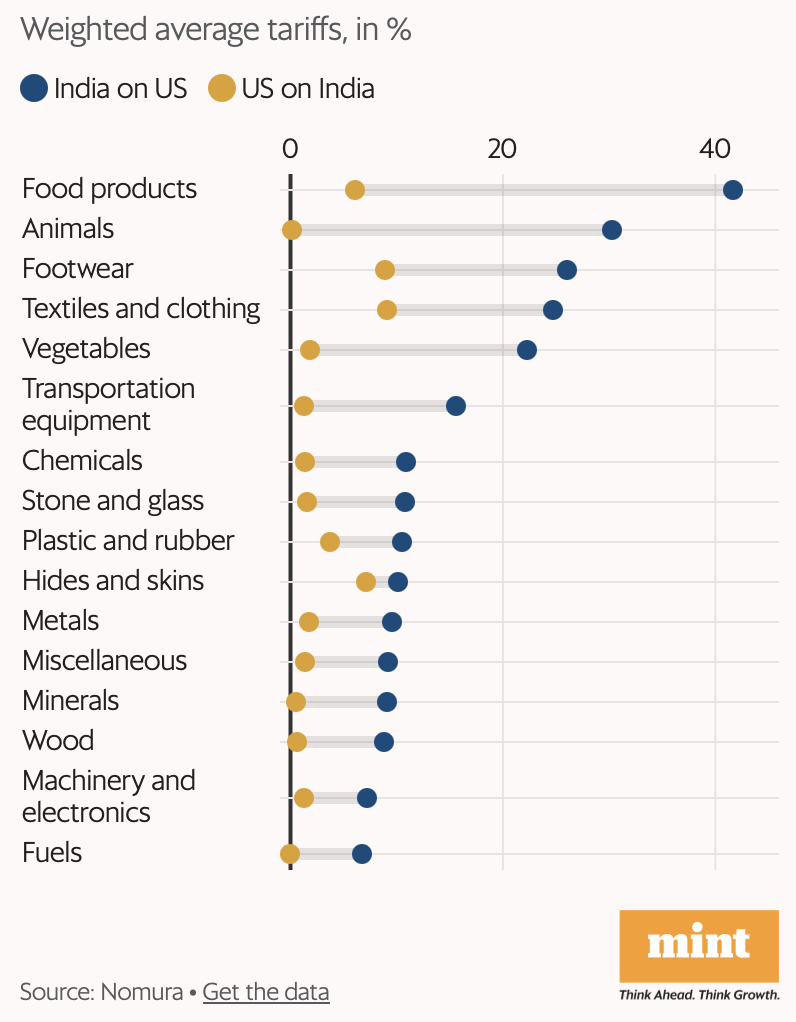
13. Livemint points to the differences between tariffs imposed by India and US. At the aggregate level, weighted average tariff gap has declined sharply from 22.9 percentage points in 2000 to just 2.5 percentage points in 2022.
At the broad sectoral level.
And at the product level.
14. Fascinating long read about the complex financial structure of the Canadian PE firm Brookfield Corporation, especially on its related party transactions where it's both the buyer and seller. The article describes the sale of One Liberty Plaza in Manhattan. 
A rare transaction in a moribund market for office towers, it received little publicity because the building’s ultimate owner, Canada’s Brookfield Corporation, was both the buyer and the seller. One of the world’s largest and most complex financial conglomerates, Brookfield sold property to itself like this dozens of times in 2024, using $1.4bn from its insurance arm to finance transactions that supported its “distributable earnings” — a non-standard measure of profit that underpins the corporation’s $90bn stock market valuation. These earnings were then recycled back into the portfolio in a circular flow of cash that is attracting scrutiny of both the relative opacity of Brookfield’s accounting practices and how it juggles its vast global portfolio of real estate...
Such trades support an expansive but lossmaking portfolio of more than 200 malls and offices dotting skylines around the world, including London’s Canary Wharf, One Manhattan West and the Las Vegas Fashion Show mall. The transactions pose questions about the quality of Brookfield Corporation’s earnings, and the valuation of assets held to pay annuity policies at the Brookfield-owned insurance businesses that trade with other parts of the conglomerate. They also raise the question of whether Brookfield and chief executive Bruce Flatt are presenting a sufficiently transparent picture of the organisation — a labyrinth containing thousands of entities, the interconnected funds, partnerships, trusts and companies that control $1tn of assets. Flatt, an accountant by training, owns a third of the Bermuda trust that appoints half the board of Brookfield Corporation in Toronto, the topmost of six listed companies operating in real estate, private equity, infrastructure, green energy, insurance and asset management. Brookfield also exercises control over a wide range of businesses and investment funds even though it often owns only a small part of them... Brookfield is a fiduciary that manages assets and money for public sector and union pension funds, annuity holders and investment funds. It runs critical infrastructure, is responsible for huge sums in long-term liabilities, and operates regulated businesses in many jurisdictions.
15. The size of the US Treasury market has doubled in the last decade!

In a comprehensive study, Andrew Fieldhouse and Karel Mertens classify major changes in non-defence R&D funding by the DoE, Nasa, NIH and NSF over the postwar period. They estimate implied returns of as much as 200 per cent — raising US economic output by $2 per dollar of funding. This is substantially higher than recent estimates of returns to private R&D. According to the Congressional Budget Office, the high returns to public funding are more than 10 times that on public investment in infrastructure. With the higher tax revenue generated from additional GDP, an increase in R&D funding more than pays for itself. In aggregate, productivity gains from federal R&D funding are substantial. Indeed, Fieldhouse and Mertens estimate that government-funded R&D amounts to about one-fifth of productivity growth (measured as output growth less all input growth) in the US since the second world war.

17. Business Standard points to a new study by ICAR-National Institute of Agricultural Economics and Policy Research which finds limited outreach of MSP operations. 

The findings indicate that only 15 per cent of paddy and 9.6 per cent of wheat farmers engage with the procurement system. Moreover, it remains confined to mostly large farmers. Small and marginal farmers, despite producing 53.6 per cent of paddy and 45 per cent of wheat, have low participation in public procurement. The direct relationship between participation in the MSP-backed procurement system and farm size arises because small and marginal farmers are likely to have low awareness about the procurement system, and are often constrained by their limited scale of production.

Saturday, March 1, 2025

Weekend reading links

1. Shang Jin-Wei makes some important suggestions on how countries can mitigate the Trump trade shock.

First, they must devise effective retaliation strategies. The European Union’s (EU’s) Anti-Coercion Instrument provides a useful model for applying economic pressure without directly harming domestic industries. For example, these measures could allow the bloc to suspend intellectual-property protections for US software and streaming services or restrict US banks and financial-service providers from operating within EU markets. Developing countries might find such measures especially attractive, because the US tends to run large trade surpluses in intellectual property and financial services.

China’s mineral-export restrictions offer another example... A number of other countries have market power in some key products they export, and might explore a similar approach. Governments must also consider the indirect yet significant impact of interest-rate and exchange-rate fluctuations from Mr Trump’s tariffs. For emerging markets and developing economies, this means keeping short-term foreign debt at sustainable levels. Globally, companies must prepare for the possibility that interest rates will remain elevated for longer than anticipated... Strengthening regional economic integration by removing trade and investment barriers within existing trade blocs would be much more productive than raising tariffs on US goods.

2. Important emerging threat, the security of undersea cables and pipelines

In October 2023, the Chinese-owned container ship Newnew Polar Bear performed a mysterious trip during which several undersea installations in the Baltic Sea were damaged. First, the Balticconnector gas pipeline connecting Finland and Estonia lost pressure, then a cable sustained mysterious damage. Authorities discovered that another cable had been damaged hours earlier.

A few months after that, the Joint Expeditionary Force — a regional military grouping comprising the UK, the Nordic nations, the Baltic nations and the Netherlands — announced a new initiative to track precisely such threats to Baltic Sea infrastructure. Last month, after a further string of suspicious cut cables, the group announced it was activating the initiative, called Nordic Warden. Just a week later, Nato unveiled Baltic Sentry, an operation with naval vessels patrolling the waters above undersea cables and pipelines. Although Baltic Sentry is a Nato operation, it was conceived by Baltic Sea leaders at a meeting in Helsinki. Like Nordic Warden, it is an entirely European undertaking.

This has an important implication at a time when the US has been actively disassociating itself from European security

The Baltic Sea countries have cobbled together a Baltic Sea maritime presence that — while not yet large enough — doesn’t depend on America... on a daily basis, the nations look after their waters. Making America redundant was never their intention; they just knew that constabulary services in their region were not a top US Navy priority. If Trump were to announce tomorrow that America is pulling out of the Baltic Sea, little would change. One might even ask whether anyone would notice. This approach is likely to extend elsewhere as allies assemble enough resources (and some form of nuclear umbrella extended by Britain or France) to render the US good-to-have rather than need-to-have.

3. BYD is upending the extant business models in the global car market by providing advanced driver assistance systems a standard feature across most of its models at no additional cost. 

For years, carmakers have looked to driver assistance software as the key to offsetting declining hardware margins. This held promise as a cash cow, much like tech companies monetise cloud services, a high-margin add-on that would generate billions in new revenue. Tesla, for example, charges $8,000 for its driver assistance software in the US as of April. Mercedes-Benz and GM are among many carmakers banking on monetising assisted driving technology. There are inherent risks to self-driving software, from technology failures to potential cyber security threats. But unlike fully autonomous vehicles, which remain controversial and unproven at scale, advanced driver assistance systems — which enhance rather than replace human control — have already demonstrated their value. 

Studies suggest that these systems, which include highway and traffic assist systems, automatic emergency braking and forward collision warnings, could significantly improve road safety. Research from the Insurance Institute for Highway Safety has shown that cars with these features can reduce rear-end collision involvement rates by up to 50 per cent. Wider adoption could reduce accident frequency by around a quarter, according to research in the UK, while the most common types of accidents would be reduced by 29 per cent with full deployment. Assuming a conservative 30 per cent adoption rate and a $5,000 fee per vehicle, a carmaker selling 10mn cars annually could potentially generate $15bn in revenue a year from self-driving features alone. Some carmakers have introduced subscription models: Tesla, for example, charges $99 a month, which helps generate recurring revenue long after a car is sold. Scale that adoption further — as technology advances and consumer scepticism declines — and the financial potential becomes even more compelling. That explains why automakers have been so eager to monetise the technology. Safety sells. 

The question now is: can it still be sold? BYD is making that question harder to answer. By including advanced driver assistance systems as standard across its line-up — even on its $9,500 Seagull EV — BYD is challenging the pricing strategy that rivals have relied on. Automakers will find it increasingly difficult to justify charging for software in markets where BYD is offering it as standard. The longer-term consequences could be even more disruptive. If BYD’s move forces rivals to slash software prices — or abandon paid models entirely — the industry’s vision of AI-powered, high-margin profits may never fully materialise... Now, with each new market it enters, BYD won’t just be selling more cars, it could start to redefine industry expectations. History suggests that once a technology becomes indispensable, the premium disappears. Power windows, anti-lock brakes, rear-view cameras — all were once luxury features that have become standard. Once consumers get used to something as standard, there is no turning back. Just like seatbelts.

4. Meanwhile, amidst increased competition from Chinese EV makers and delays in the mainstreaming of EV's, European car makers are returning focus on ICE vehicles

Global new model launches of ICE and hybrid vehicles are expected to rise 9 per cent this year from 2024, according to S&P Global Mobility. Carmakers are expected to introduce 205 petrol models, down 4 per cent from 2024, while hybrid launches are predicted to rise 43 per cent to 116 models.

5. Germany faces an erosion in manufacturing, especially pronounced among car makers, industrials, and chemicals.

The contraction of Germany’s industry is evident in the fall of market value in the sector. Together, Dax constituents Volkswagen, Thyssenkrupp and BASF have lost €50bn, or 34 per cent, in market capitalisation over the past five years. From 2010 to 2014, carmakers on the Dax index were more valuable on average than their peers in any other sector, but valuations have slipped as demand has started to falter. VW’s deliveries to customers last year slumped by nearly a fifth compared with the pre-pandemic year of 2019. In other industrials, steelmaker Thyssenkrupp has announced plans to reduce its production capacity by up to a quarter and cut 40 per cent of jobs. BASF is looking to cut costs at its Ludwigshafen headquarters, the world’s largest chemical site, by €2bn a year.

An important contributor is the high electricity prices, higher than in competitors.

Production in energy-intensive industries is 20% below pandemic levels, with the country's world-leading chemicals industry being among the worst hit..
According to Destatis data, roughly 40 per cent of jobs and more than half of revenues in Germany’s chemical industry are tied to so-called base chemicals, most of which are derived from gas and crude oil. Producers of the materials, used in plastics, fertilisers and coatings, rely on cheap energy to maintain narrow margins in a highly competitive market... And the sector, which supplies other industries, has long been a bellwether for industrial demand. 
6. Good graphical summary of the problems facing Germany's railways. Deutsche Bahn's intercity service is now less punctual than the continent's worst operator in Britain.
About 72 per cent of Deutsche Bahn’s intercity trains arrived within 10 minutes of their scheduled arrival time in the year to January 2025, compared with 78 per cent of British long-distance trains, according to the FT analysis. Any interaction with the German rail network is also one of the biggest factors affecting the punctuality of long-distance rail travel in central Europe. Services from Germany to Amsterdam, for instance, are delayed by an average of almost 13 minutes, while trains coming to the city from elsewhere are typically within two minutes of their scheduled arrival time... The analysis is based on more than 1.9bn train arrivals at stations that were tracked by the websites from February 2024 until the end of January 2025, amounting to more than 5mn a day... The performances of the rail networks in both the UK and Germany lag far behind some of their European peers. In Austria, Switzerland and the Netherlands, punctuality consistently exceeds 90 per cent. Germany’s neighbours also suffer from Deutsche Bahn’s patchy performance, as its delayed trains have knock-on effects for timetables across central Europe.
In Basel’s central station, trains originating in Germany arrive with an average delay of more than 12 minutes — 12 times higher than those coming from elsewhere. The Swiss network, renowned for its punctuality, has resorted to stopping some late-arriving German services at the border to prevent them disrupting local operations. Deutsche Bahn told the FT that infrastructure was “the key to more punctual railways”, adding that 80 per cent of all delays were caused by the poor state of its network. The company described its infrastructure as “too crowded, too old and too prone to disruptions”... For decades, Germany skimped on maintenance and infrastructure upgrades as successive governments put a higher priority on fixing roads and balancing budgets. According to data by Pro-Rail Alliance, a German railways lobby group, the German government in 2023 spent just €115 per citizen on railway infrastructure, compared with three times that amount in Austria and four times in Switzerland. Andreas Geissler, a transport policy expert at Pro-Rail Alliance, told the FT that investment surged to €190-€210 per citizen in 2024. Over the past 15 years on average the investment stood at just €73 per citizen. 
Deutsche Bahn has labelled 16 per cent of all German railways infrastructure as “poor”, “deficient” or worse. The investment backlog that needs to be dealt with grew by €2bn in 2023 to €92bn, according to Deutsche Bahn estimates.
Elon Musk's cutting of the traditional consulting firm contracts may well result in their replacement by those like Palantir.
Palantir, an analytics firm chaired by Peter Thiel, who worked with Mr Musk at PayPal, has gained a foothold in the Department of Defence and is spreading quickly across the federal government. Among other things, it helps organisations feed their data into artificial-intelligence (ai) tools. In the final quarter of 2024 its revenue from America’s government grew by 45% year on year. Its share price has been on a remarkable ride, more than doubling since Mr Trump’s election in November. Booz Allen Hamilton’s has fallen by a third. Unlike most other software providers, Palantir embeds teams of engineers with its clients to help them make use of its technology. For now, it works on many projects alongside firms such as Accenture and Deloitte. But some also view it as a potential competitor to the big consultancies, particularly when it comes to ai. Mr Thiel has described conventional consulting as a “total racket”.

8. Impact of US aid freeze on Kenya is severe.

Business at hotels, car rentals and shops — even a nail bar — in aid-dependent areas of Kenya has fallen in the weeks since Donald Trump suspended funding to USAID... Hotels were refusing bookings for NGO workers, fearing they wouldn’t be able to settle their bills... Staff working on US-funded projects had begun pulling children from school, abandoning rental properties and heading elsewhere, she added... Hundreds of expatriate aid workers, either directly or indirectly employed by USAID, are languishing without pay, uncertain about schooling for their children, and in some cases poised to leave the country. Estate agents are anticipating a dip in rental markets in leafy neighbourhoods of Nairobi, while financial analysts predicted a slight softening in the value of the shilling. In 2023, the last year for which official data is complete, Kenya received $850mn in US aid, backing more than 230 projects to varying degrees. Projects in higher education, hospitality training for orphans, drought mitigation and water sanitation, all stalled at the stroke of Trump’s pen. Banks are declining to provide emergency loans, uncertain if the tap will ever be turned back on. The agency subcontracted a growing proportion of its work to Kenyan organisations, many of which are not equipped to survive three months without core funding. Please use the sharing tools found via the share button at the top or side of articles. Hardest hit has been healthcare, which at $402mn received nearly half of the US funding.

9. India holds just 0.23% of the world's AI patents.

India ranks 13th globally in AI talent concentration, with 0.42 per cent of LinkedIn members saying they have skills in the technology. The rank positions it behind smaller but technologically advanced nations of Israel, Singapore and South Korea. Despite its vast population and network of science and engineering colleges, India's AI talent pool is not as deep as one might expect... India is experiencing the biggest AI talent exodus in the world, with a net migration rate of -0.76 per 10,000 LinkedIn members who have AI skills, according to the Stanford report.
10. Thanks to shale oil and Canadian imports, US oil imports from Saudi Arabia has been on continuous decline and has now hit its lowest since 1985. 

11. US Treasury Secretary Scott Bessent makes an economic partnership proposal to Ukraine.
Ukraine is endowed with natural resources and other national assets that can drive its postwar economic growth, but only if its government and people are armed with sufficient capital, expertise and the right incentives. The terms of our partnership propose that revenue received by the government of Ukraine from natural resources, infrastructure and other assets is allocated to a fund focused on the long-term reconstruction and development of Ukraine where the US will have economic and governance rights in those future investments... The terms of this partnership will mobilise American talent, capital, and high standards and governance to accelerate Ukraine’s recovery and sends a clear message to Russia that the US is invested in a free and prosperous Ukraine over the long term... The proceeds from future revenue streams would be reinvested back into key sectors focused on unlocking more of Ukraine’s growth assets. The terms of this agreement would also ensure that countries that did not contribute to the defence of Ukraine’s sovereignty will not be able to benefit from its reconstruction or these investments... The US would not be taking ownership of physical assets in Ukraine. Nor would it be saddling Ukraine with more debt. This type of economic pressure, while deployed by other global actors, would advance neither American nor Ukrainian interests. In order to create more value over the long term, the US must be invested alongside the people of Ukraine, so that both sides are incentivised to gain as much as possible.

12. Signatures of reversing consensus on climate change forged at the Paris Agreement 2015

Friedrich Merz... warned that German economic policies had been “almost exclusively geared towards climate protection”, and that “we will and must change that”. Decommissioning coal and nuclear power plants without an adequate replacement in place would “massively jeopardise Germany as an industrial location”, and thus was “out of the question”... the US may abandon climate action at the federal level altogether... (in China) the construction of new coal-fired thermal power plants on the mainland reached a 10-year high in 2024, with almost 100 gigawatts of additional capacity being added to the pipeline. Fewer plants are being shut down as well; about 13 gigawatts of capacity went offline in 2020, as compared to 2.5 gigawatts in 2024... The premium for green bonds — which represents how much extra investors are willing to pay for environmentally-sustainable investments — almost vanished in 2024. Meanwhile, issuances of green bonds from US-based sources are half of what they used to be, and dollar-denominated green bonds now represent only 14 per cent of the global green bond market.

13. Janan Ganesh writes that the pendulum on the anti-woke movement may have swung too far.

Until recently, conservatives put forward a case that had lots of voters nodding: that woke-ism is illiberal dogma; that liberals themselves are too weak to stand up to it. Now, having prevailed, this argument is sliding into free speech absolutism, scolding of the insufficiently patriotic and a general obsession with culture for which the public appetite is smaller... Having rejected woke, voters will be increasingly protective of other liberal gains. Misreading this, and high on themselves, conservatives will end up weirding people out in a major way. We can’t predict the exact form of the over-reach — the right’s equivalent of Defund the Police — but some fatal gilding of the lily is coming. These people don’t know how to take Yes for an answer. It is a wonder that such enthusiasts for western culture should ignore one dictum of it, inscribed on the Temple of Apollo as an eternal warning. “Nothing in excess.”

14. More on the K-shaped recovery facing the Indian economy. On SUV sales

SUV sales grew 14 per cent in 2024, more than double the overall passenger vehicle market’s 5 per cent, according to GlobalData. They accounted for 56 per cent of the car market, up from 51 per cent the previous year.
15. Rana Faroohar has an important point about the Trump administration.
There is a notable silence on these topics from Republican senators and business leaders alike. Plenty of people will say privately that they are worried about Doge’s slash-and-burn techniques. But no one wants to run afoul of Musk or Trump in public for fear of retribution (indeed, I will say that in my 33 years of journalism, I’ve never had as many sources want to speak only on background as they do now).

Max Hastings echoes 

The fear — and it is indeed fear — that suffuses much of the world after these first weeks of the Trump presidency derives from a belief that the great engines of American democracy are being shut down. A supine Congressional majority and a partisan Supreme Court decline to check Trump’s absolutism, and he marches roughshod over the law. He aspires to be a Sun King — contemporaries’ name for France’s Louis XIV (1638-1715) — making all those around him captives of his rays, and doomed if his warmth is withheld.
16. Germany presents a fascinating political experiment in so far as it contains two parts which were in opposing ideological and political factions before the Berlin Wall collapsed. The FT has a good graphic that captures the divide.
This also shows that if this were a first-past-the post voting system, the CDU/CSU would have swept the West and Afd the East. As Times writes, in the recent elections, the two parts voted as different countries.  
If East Germany were still its own country, the hard-right Alternative for Germany, or AfD... would have scored a convincing win in the elections on Sunday, with nearly one in three voters there casting ballots for it. Only two of 48 voting districts outside of Berlin in the former East Germany were not won by the AfD. In a handful of districts in the east, the AfD got nearly 50 percent of the vote... The vote tally in the east mirrored state elections in three eastern races in September... That division... has become a persistent feature of Germans’ voting habits... only 42 percent of Germans in the east voted for traditional West German parties... In the former East, the AfD is increasingly visible. Many members are active in civil society — including several mayors — which means even people who do not vote for the party come in regular contact with it.
And this may owe to the persisting differences between the two parts even after nearly 35 years of reunification.
The vote also signalled the sharply contrasting fortunes of AfD and SPD (which did its worst performance since 1887).
The youngest voters shifted sharply to the Left and AfD.