Substack

Showing posts with label Protectionism. Show all posts

Saturday, August 29, 2026

Weekend reading links

1. Good long read in the Indian Express about the ridership deficit facing metro railway systems in India. This is a good website for network maps.
Radhika Shenoy, 28, a working professional in Hyderabad’s Secunderabad, points out that last-mile connectivity is a major challenge when she uses the Metro. “Neither my house nor my office is close to a Metro station. So, taking public transport becomes more expensive than using my own scooter or hiring a cab or auto,” she says... Manvika Shivhare, a 29-year-old lawyer based in Lucknow, says most people she knows never use the 23-km-long city Metro to get round the city, preferring to travel in an auto or two-wheeler instead. “The Metro is useful for going to the Airport, for which it would cost Rs 70, while the auto would take Rs 400. But none of us uses it for our daily commutes, since Lucknow is such a small city.” Shivhare says this won’t change even with the upcoming 11-km-long Line-2, connecting Charbagh Railway Station and Vasant Kunj in Lucknow.

2. India's crude oil imports from Russia rise to more than 2.6 million barrels per day in June and July.

For decades, South Korea’s brightest students gravitated towards medicine, and private tutors focused on helping students gain admission to elite universities. Now, some semiconductor departments sponsored by Samsung and SK Hynix — which guarantee employment after graduation — are attracting growing interest, and cram schools are catering to job seekers pursuing lucrative chipmaking careers. In the 2026 admissions cycle, SK Hynix-linked semiconductor programmes at several leading universities recorded higher application rates than medical schools, whose applicant numbers fell by nearly a third to a five-year low. 

Kwon Seok-joon, an engineering professor at Sungkyunkwan University, said generous chipmaker bonuses had altered how students viewed the trade. “For 20 years, medicine was the only path that guaranteed both wealth and prestige in Korea,” he said. “The Hynix bonus broke that monopoly. For the first time, chip engineers are in the same league as doctors when families discuss a safer future.”... In May, Samsung reached a landmark profit-sharing agreement with its 78,000 semiconductor employees, with average payouts expected to approach $400,000 in the memory chip division. Rival SK Hynix agreed last year to distribute 10 per cent of operating profits to workers over the next decade, implying average bonuses of about $500,000 this year based on projected earnings.

4. More evidence of lagging salary growth amidst rising sales growth.

Growth in net sales of 3,057 non-finance companies in the June quarter was 22.18 per cent year-on-year, according to a Business Standard analysis of the numbers from the Centre for Monitoring Indian Economy... Salaries in the June quarter went up at less than half the pace at which sales have grown — at less than 9 per cent... The starkest contrast was in the mining sector, where sales grew 40.83 per cent and salaries and wages 1.04 per cent. Lower growth in wages has likely he­lped operational profits, where margins had come under pressure because of higher costs of raw materials.

5. Labour market expectations from the PLFS 2023 survey data.

Our job seekers expect up to 40 per cent higher salary than actual earnings reported in the PLFS for the same occupation. Male job seekers, in particular, show greater over-optimism in salary expectations relative to women, expecting almost Rs 8,000 more per month than the actual average earnings for these jobs and Rs 8,500 more per month for salaried jobs. Altogether, salary expectations diverge from reality by more than 30 per cent. When we assess the job aspirations and expectations of job seekers who are below 25 years of age in our sample, we find that expectations are even more skewed – again, more so for young men than young women... 

So we set out to inform and expose a random subset of our 3,000 job seekers to the real world and re-surveyed both the informed and the non-informed a year later. Twelve months after receiving information, we find that providing accurate information about job opportunities significantly dampened job seekers’ labour-market expectations of landing their ideal job relative to those who were not informed. Men, in particular, were less likely to report that they were on their ideal career path. This disillusionment is accompanied by a decline in men’s job-search intensity. Thus, as preferred job offers fail to materialise, job seekers adjust their expectations downwards and either remain in the same jobs or drop out of the labour market and enrol at educational institutions.

6. Is fusion energy, the process that energises stars and sun, about to become a reality?

Privately held fusion companies raised $4.5bn over the past year alone, according to the Fusion Industry 2026 report. There are now more than 50 such companies. Last month, General Fusion, a Canadian outfit backed by Jeff Bezos, became the first publicly listed fusion company. These signals hint at an important shift: fusion energy is gradually being perceived less as a scientific challenge and more as an economic one.

7. Made in Switzerland.

Switzerland, where manufacturing still accounts for almost 19 per cent of GDP, twice the contribution from its celebrated financial services industry. The white cross on a red background, emblazoned on products from Heule precision tools to Caran D’Ache pencils, is both a guarantee of quality that is understood worldwide, and a valuable marketing device for Swiss manufacturers... Switzerland has the highest proportion of high-tech manufacturing of any of the OECD’s 38 member countries...
A landlocked country of 9mn people, with few natural resources and some of the world’s highest wages, is not an obvious starting point for a manufacturing success story. But the Swiss made it work. Companies responded to high wages and an appreciating currency by becoming more productive, more specialised, more sophisticated and more expensive, while focusing on global markets rather than their small pool of domestic consumers. “Swiss Made” became shorthand for the result: watches, machinery and precision tools good enough that customers around the world would pay extra for them. One of the results is an economy unusually rich in relatively small companies that dominate particular niches. A study published this summer identified 100 such Swiss businesses, together generating more than SFr40bn in annual revenues. They range from VAT, a maker of vacuum valves used in semiconductor production, to Burckhardt Compression and specialist manufacturers such as Rondo, whose machines shape dough into pastries in bakeries around the world...
That strength is underpinned by an unusually deep apprenticeship system. About two-thirds of young Swiss pursue vocational education and training, most learning partly inside companies — supplying manufacturers with generations of machinists, technicians and other skilled workers. Bern pushed its commitment to open markets still further in January 2024 when it unilaterally abolished all tariffs on imports of industrial goods. The government argued that such protection had become counter-productive: cheaper imported components would reduce costs for Swiss factories embedded in global supply chains... at least 60 per cent of manufacturing costs must generally be incurred in Switzerland and an essential manufacturing step must take place there for the product to qualify as “Swiss Made”.  

But protectionism and the appreciating franc are denting the country's competitiveness and manufacturing base. 

8. The changing face of economics research. First, the dominant fields of research are changing.
Second, it is reaching out to other disciplines.
A research paper by Tom Harris, an economics PhD student at the London School of Economics, bears this out. Aggregating the literature published in 24 leading economic journals between 2000 and 2025 and NBER working papers between 2021 and 2025, he found the share of papers written by teams spanning different fields had jumped 16 points to 35 per cent between 2000 and 2025, while solo-authored papers fell as a proportion of the literature from 34 per cent to 15 per cent.
Third, economics research is becoming more empirical.
Research from Prashant Garg, a postdoctoral researcher at Bocconi University, and Thiemo Fetzer, economics professor at Warwick University, finds causal claims in economics have jumped. In 1990, 7.7 per cent of claims made in the literature were causal. In 2023, that hit 32.6 per cent. Additionally, papers with more causal claims are more likely to receive citations and wind up in top five journals, the research suggests.
And this turn to empiricism has had not so good consequences.
Results derived from real-world data and experiments are hard to replicate under the same conditions and methodology, with research suggesting that up to 70 per cent of recently examined economics papers contain some results that cannot be reproduced. Sometimes this is simply because the data is broken or otherwise unavailable to other researchers, although other theories abound: pressure to publish, data manipulation, patterns of funding and structural incentives in the academy, for instance. There are also cynical explanations, such as questionable research practices or fabricated data sets.
9. Israel's economic squeeze on Palestine is less reported but adds one more dimension to the genocide.
Israel quickly canceled permits for tens of thousands of Palestinian laborers to reach their workplaces in Israel... Since the start of the Gaza war, unemployment in the West Bank has skyrocketed to 28 percent, more than double the rate before the conflict... Then, in May 2025, Israel started confiscating hundreds of millions of dollars per month in import taxes that it collects on the Palestinian Authority’s behalf. This revenue stream accounts for about two-thirds of the West Bank government’s budget for 2026 of about $6 billion, according to Palestinian officials. That deficit has forced the Palestinian Authority to lower the salaries of 140,000 civil servants and security officers, shorten school weeks to three days and accumulate billions of dollars in debt... 

Israel has also erected new roadblocks across the West Bank, stifling the movement of goods within the territory... Israel has also limited the amount of shekels that Palestinian banks are allowed to send to Israeli banks, a crucial process that helps enable Palestinian merchants to buy goods from Israel and the rest of the world. The Netanyahu government permits quarterly transfers of about $1.5 billion from Palestinian to Israeli banks — far less than previous administrations allowed. The restrictions have resulted in about $5.7 billion languishing in bank vaults in the West Bank, according to Palestinian government and banking officials.

10. The public sector dependency in the UK

In Britain 50-60 per cent of the electorate works in the public sector or gets benefits or a state pension, suggesting a tipping point has been hit.

11. India's labour market facts of the week.

A new NITI Aayog report notes that about 87 million people aged 15-29 are outside education, employment or training, while only 8.25 per cent of graduates are employed in jobs aligned with their qualifications.

12. The Economist has an excellent article that points to research about the impact of AI on students. David Stromberg of Stockholm University and Victor Lei and Wu Yanhui of the University of Hong Kong tracked 27,000 pupils aged 12-18 in China, where AI adoption has been fast. Around 80% reported using models such as Doubao and DeepSeek, and the other 20% formed the control group.  

After six months, pupils using AI saw their average homework score rise by 18% across all subjects. The time they took to complete each assignment fell from an average of 64 minutes to 45. But come exam time, the same students scored 20% below their classmates who had not called on AI’s help. Homework scores once predicted exam performance; now those who score highest are, perversely, more likely to do worse in exams.
The drop in exam scores was concentrated among students who rushed their homework. Those who used AI but spent as long on assignments as non-users paid little penalty. What matters, then, is how pupils use the technology. Those whose exam results remained strong were not simply copying and pasting answers to save time. More likely they used the chatbots as a personal tutor, perhaps to explain difficult concepts or help solve specific problems.
John Burn-Murdoch says this finding underlines the importance of conscientiousness (or self-discipline) in this modern digital age with all its distractions and access to shortcuts. 

Friday, February 13, 2026

The emerging dilemmas of the new wave of industrial policy

Industrial policy measures are taking shape in all forms across Europe and the US. And they are creating challenges and incentive distortion risks. 

The European Commission is in the process of finalising its industrial policy strategy to prioritise domestic manufacturing in public contracts and to access public subsidies across sectors. 

The Industrial Accelerator Act will set targets for the amount of European-made parts that specific strategic technologies, including renewables, batteries and cars, must have to benefit from government subsidies — a vast redirection of the bloc’s €2tn worth of public procurement towards its own industry. It will also establish conditions for foreign direct investors to transfer intellectual property and employ local workers. Proponents of these Buy European rules argue that they are the only way to prevent the steady erosion of the EU’s €2.58tn manufacturing industry amid high energy prices, competition from cheap Chinese and south Asian products and US President Donald Trump’s volatile trade agenda…

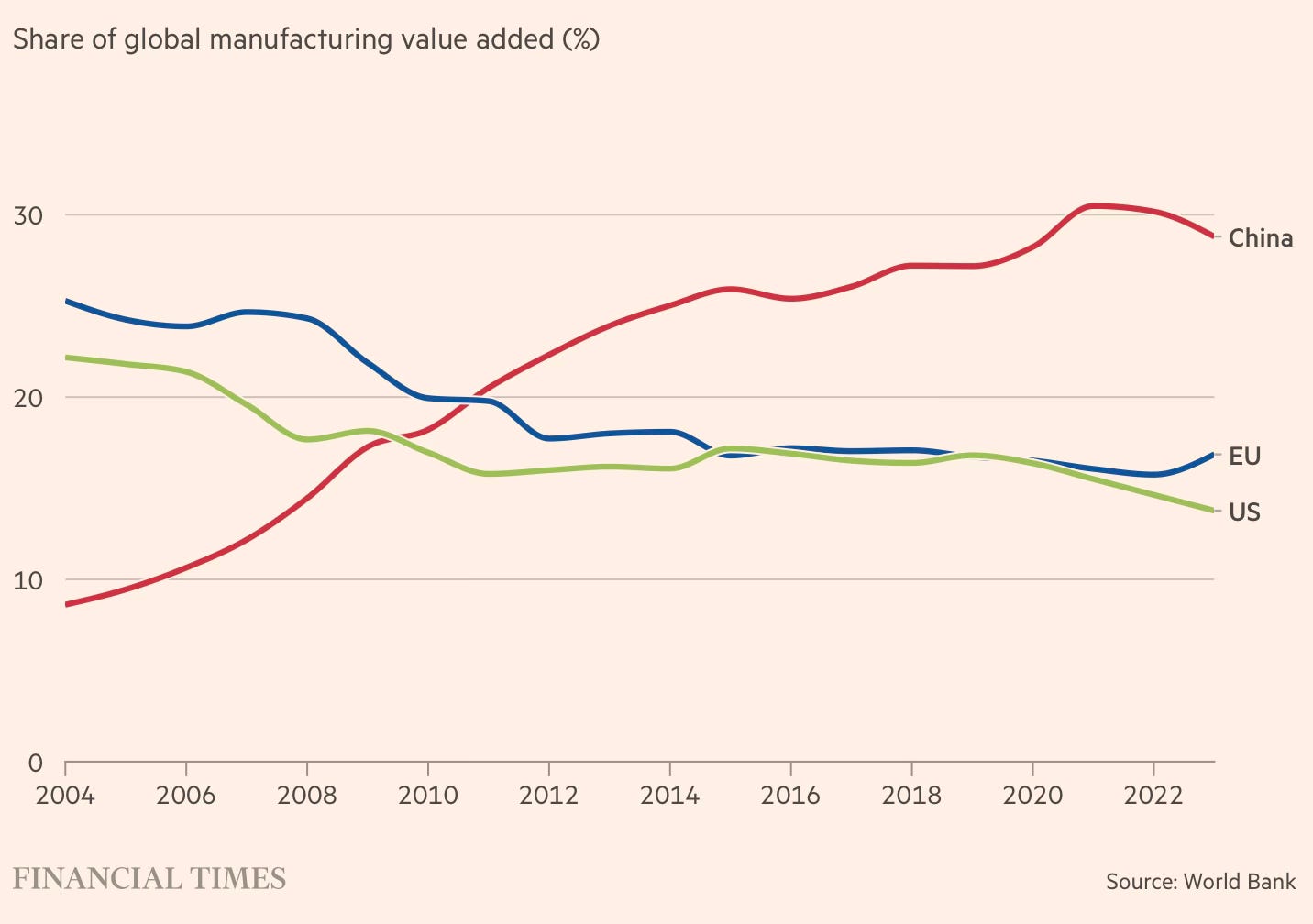
The aim of the act is to ensure that the EU’s manufacturing industry accounts for at least 20 per cent of its industrial output by 2030, according to a recent leaked draft, up from about 16 per cent today. Some officials say the policy bears some resemblance to China’s industrial policies “Made in China 2025” and “China Standards 2035”, which aimed to boost China’s self-sufficiency in strategic sectors and pushed foreign companies towards joint ventures with Chinese businesses to access its market.

The policy has triggered intense debates between supporters, led by France, and those, especially in Germany, who prefer freer trade. 

The debate centres on what “Made in” and “Europe” really mean — whether certain sectors should be prioritised, what countries should be included in its definition and how to avoid pushing costs up too high… The idea of “buy European” clauses to boost domestic industries has percolated in France for more than a decade. In contrast to Germany’s more export-oriented industry, French companies have traditionally relied far more heavily on domestic demand, driven by its sizeable public sector. A “Buy European Act” announced in 2012 by then French president Nicolas Sarkozy never materialised… 

The Commission’s outwardly focused departments such as trade and economy and international development have also been pushing back hard against the most radical plans, fearing that rigid rules would alienate partners and stymie investment… There are also signs of a geographical rift emerging. A person close to discussions on the subject within BusinessEurope, the bloc’s largest business group, describes a “very clear difference of views” with companies from France, Spain, Italy and the Netherlands backing more European preference and those in Germany, Sweden and Denmark pushing back.

Critics have argued that far from promoting domestic industry, excessively restrictive local content requirements will handicap the growth of European manufacturers. They point to the globalised supply chains in sectors like electronics and automobiles, where many critical inputs are dispersed globally, and all of them cannot be competitively produced in any one country. There’s also the fear that such measures will provoke retaliatory measures by others, especially the US, and also conflict with the spate of Free Trade Agreements signed by the EU in recent times. 

Supporters point to the risks of not responding to the market dominance and domestic manufacturing base erosion threat posed by China.

“The way things are now, in eight to 10 years we could be totally reliant on China for EVs,” William Todts, director of the NGO Transport & Environment, says, adding: “If you think you can compete with China without intervention you’re wrong”… There is no doubt, even among supporters of the policy, that it could raise costs. ClĂ©ment Beaune, Macron’s Europe adviser between 2017 and 2020, says that European companies are “producing in a more expensive and constrained way because we have more rules around environment, climate and social standards”. Europe cannot both protect its industry and compete with Asia on price, he warns. “You have to choose and you have to be explicit.” 

Figures from the International Energy Agency suggest that the cost of manufacturing a battery in Europe could be as much as 60 per cent more than in China, yet the difference to the sticker price of the end product may not always be so great. A study by Deloitte in September shows that… low carbon steel increases the price of the end product, for example a mid-sized Toyota, by 0.7 per cent... Elvire Fabry, director of trade and economic security at the Jacques Delors Institute think-tank, warns that if the Made in Europe provisions are not targeted “it would be not only short term and high cost but also mean a loss of competitiveness”. Georg Riekeles, associate director at the European Policy Centre and a former Commission official working on the internal market, argues that with Chinese overcapacity reaching unprecedented levels, Europe must be bold. If not, it risks introducing more protection of its market too late.

China has displaced the EU as the world’s leading industrial producer. 

The imperative to respond swiftly and strongly to the decline in Europe’s manufacturing prowess also owes to recent geopolitical and other developments.

Russia’s 2022 invasion of Ukraine catalysed the shift in Europe’s trade-oriented mindset. The reliance of the bloc on Russian gas exposed Europe’s dependencies at the same time as the rapid development of Chinese industry underscored the continent’s vulnerabilities. The combination of rocketing energy prices and fierce competition plunged much of its industrial sector into crisis. Covid-19 has also contributed, officials say. EU governments realised they were dependent on imports for everything from drug ingredients to rubber gloves. Brussels proposed last year a Critical Medicines Act to incentivise domestic drug production and mandate stockpiling. The return to the White House of Trump, who has repeatedly threatened the EU with higher tariffs for not bending to his will… and castigated the bloc for its lack of defence spending, has intensified calls for Europe to revive its industry and support its own autonomy.

These measures are nothing new, and only part of a rising trend of raising barriers to trade. In October 2025, the EC announced a decision to halve steep import quotas and impose a 50% tariff on steel imports above a quota set at 2013 levels.

In a novel measure, the US announced this week that it plans tariff carve-outs to chip makers like TSMC that make investments in the US.

The size of the potential rebate programme would be linked to the recent US-Taiwan trade agreement. The White House has agreed to slash tariffs on imports from the island to 15 per cent in exchange for a $250bn investment in the chip industry in the US. Under the deal, Taiwanese companies including TSMC that invest in the US will be exempt from the forthcoming tariffs in proportion to their planned US capacity. The White House said it would allow Taiwanese companies building semiconductor plants in the US to import 2.5 times the new facilities’ planned capacity tariff-free during the construction period, according to an outline of the trade deal released by the commerce department. Taiwanese companies that have already built plants in the US will be allowed to import 1.5 times their capacity. TSMC would be able to allocate the exemptions it earns under the trade deal to its Big Tech clients in the US, allowing them to import chips from the company tariff-free. The size and scope of the rebates for US hyperscalers depend on the production capacity that TSMC forecasts it can reach in the US in coming years.

As part of efforts to in-shore processing and refining activities in critical minerals, the US has unveiled several extraordinary measures, including investments in rare earth processing firms and long-term advance market commitments, and development of strategic reserves on a public-private partnership model. 

Early this year, the US government announced a $1.6 billion investment in USA Rare Earth, a listed Oklahoma-based miner that controls significant US deposits of heavy rare earths.

One person said the government would get 16.1m shares in USA Rare Earth and warrants for another 17.6m, both at a price of $17.17. The government agreed to pay $277mn for the equity, giving it an implied gain of $490mn for the equity and warrants based on the current share price of $24.77. USA Rare Earth will also receive $1.3bn in senior secured debt financing at market rates from the government. The money will come from a finance facility created for the commerce department as part of the CHIPS and Science Act passed in 2022... A condition of the government investment in USA Rare Earth was that the company raise at least an additional $500mn from investors. It is on track to raise more than $1bn because of high demand for the financing deal, which uses a mechanism known as a private investment into a public equity, often called a “Pipe”...

USA Rare Earth, which has a market value of $3.7bn, is developing a huge mine in Sierra Blanca, Texas that it says contains 15 of the 17 rare earth elements underpinning production of cell phones, missiles and fighter jets. It also plans to open a magnet production facility in Stillwater, Oklahoma... Last year, the Trump administration invested in at least six minerals companies, including MP Materials, Trilogy Metals and Lithium Americas. Some of the investments overlapped with the financial interests of people associated with the administration. The government did a funding deal with Vulcan Elements, a rare earths start-up three months after the president’s son Donald Trump Jr’s venture capital group invested in the company... USA Rare Earth has separately tapped Cantor Fitzgerald, the Wall Street firm previously owned by commerce secretary Howard Lutnick and now run by his sons, to raise more than $1bn in fresh equity financing, the people said.

It also announced Project Vault, a $12 bn US program to procure and develop a reserve of critical minerals for civilian and other purposes through a public-private partnership involving the US federal government and US companies.

Project Vault is a public-private partnership that will buy and store critical minerals and rare earth elements. These include gallium and cobalt, which are essential for modern technology and defence equipment. It will combine $1.67 billion in private seed funding with another $10 billion from the US government’s Export-Import Bank... Companies will make an initial commitment to buy materials later at a fixed inventory price. They will also pay some upfront fees. Based on these commitments, companies can give Project Vault a list of the materials they need. The project will then purchase and store those materials. Manufacturers will pay a carrying cost that covers loan interest and storage expenses.

The widening gap with China, the weaponisation of trade, and the growing geopolitical tensions necessitate active and expansive industrial policy measures. In the months and years ahead, the toolkit of industrial policy is likely to continue to expand with ever more novel (and invasive) measures. They will include both domestic market making and (especially in the case of the US) measures that leverage trade to drive foreign investment, a feature of all the trade deals signed by the Trump administration. Sample this with Japan

Proposed projects are screened for “strategic and legal considerations” by a committee of US and Japanese members, according to a joint MOU and a document prepared by Japanese officials. Projects are then sent to an investment committee headed by US commerce secretary Howard Lutnick, who chooses which proposals to send to the US president for approval. Donald Trump has the final say on which projects are “deemed to advance economic and national security interests”. Japan and its state-backed bank can delay or refuse to proceed but face potential penalties, including higher tariffs. Funds for approved projects — from JBIC or with guarantees from Japan’s insurance corporation — then flow into an SPV alongside “the provision of land, water, power, energy, offtake agreements, regulatory support, etc” from the US. Free cash generated by projects will be split equally until the Japanese loans are paid back, according to officials. After that, the US will receive 90 per cent... The way the agreement with the US is structured also means that if Japan delays or refuses to fund a project recommended by Trump, it could be liable for “catch-up” payments or an increase in tariff rates.

All these measures invariably run the risk of capture by vested interests and a gradual slide into protectionism and autarky, not to mention economy-wide distortion of incentives. However, inefficiencies and capture by vested interests are unavoidable to some extent with even the best designed and managed industrial policy. The challenge is to manage the trade-offs and limit such risks while pursuing the primary objective of building domestic manufacturing capabilities. 

These endeavours raise several trade-offs and related policy questions. How do we balance the trade-offs between domestic content requirements and ensuring quality in public procurements? How do we balance the trade-offs between promoting domestic content and autarkic capture by domestic vested interests? How do we balance the trade-offs between the pursuit of self-reliance and resilience with competitiveness and quality? More broadly, how can policy signal definitively that building domestic manufacturing capabilities is not equivalent to protectionism?

How do we signal to foreign businesses and investors the policy objective of building and expanding the domestic manufacturing industry, but at world-class competitiveness and quality? How can large multinational firms get the confidence to undertake gradual technology transfers and commit to going up the value chain? How can governments signal policy predictability and stability that are required for firms to commit large investments? 

A simple answer lies in Joe Studwell’s classic How Asia Works. Tightly managed export competition was central to the difference between the industrial policy measures of the countries of North East Asia and South East Asia. Fundamentally, to avoid capture and distortions, any policy should pass the test of competition. And to shape expectations for investors and firms, it should have clear forward guidance on the policy trajectory going forward.

Monday, March 3, 2025

Levelling the playing field - incentivising exports

In the context of China’s stifling dominance across manufacturing supply chains, and as industrial policy interventions proliferate globally and the WTO is rendered comatose due to the dysfunction of its Dispute Settlement Body (DSB), it may be time for India to re-assess its industrial policy instruments, especially concerning export promotion. 

The WTO’s Subsidies and Countervailing Measures (SCM) Agreement categorises two kinds of “prohibited” subsidies - those “contingent on export performance” (Article 3(1)(a)), and those “contingent on the use of domestic over imported goods” (Article 3(1)(b)). It allows for subsidies that are specific to enterprises, industries, and regions. 

When the SCM and other WTO Agreements were being negotiated in the nineties, it was thought that only the subsidies contingent on export performance would be trade-distorting in any significant manner. It was thought that the subsidies specific to enterprises, industries, and regions (or the economy as a whole) could not be sustained at the scale required to distort trade in particular products much less global trade in general. 

Nobody anticipated China’s extraordinary scale of economy-wide industrial policy subsidies. It’s estimated that China spends 5% of GDP annually on its industrial policy, compared to 0.4-0.6% of GDP for US, Japan, and France and 0.9% of GDP for South Korea. India’s annual expenditure on its flagship production-linked incentive (PLI) scheme is a modest 0.15% of GDP. In the 2000-18 period, Chinese Government Guidance Funds have given over $1 trillion in capital and guarantees to more than 28,000 companies. As part of the Made in China 2025 initiative, the government committed nearly $300 bn in 2018 with an additional $1.4 trillion after Covid 19 to achieve technological self-sufficiency and global leadership in critical sectors. All told, in sectors like semiconductors, steel, and aluminium, China makes up 80-90% of all global subsidies.

Its domestic policies artificially suppress business costs and give its firms an unmatched competitive advantage. Its financial repression keeps the cost of capital suppressed, the hukou system has depressed wages, and intense competition by local governments has kept land and utility costs low. Add to this all the direct state support of the kind mentioned above and the massive economies of scale, and it becomes almost impossible to compete with Chinese firms. Further, the scale and scope of these subsidies have allowed even loss-making firms to expand production and flood the market at deeply discounted prices. 

Accordingly, Chinese firms have built up production capacities in steel, cars and electric vehicles, EV batteries, solar panels, metro railways, heavy equipment etc., that are far in excess, often in multiples, of domestic demand. In many of these sectors, they make up 50-90% of the global production capacity. Finally, with the domestic economy slowing and demand weakening, these firms have come to rely even more on exports and further discounting to capture foreign demand. There cannot be any doubt that China’s excess capacity and discounted sales that render its trade partners uncompetitive should be treated as “prohibited subsidy”. 

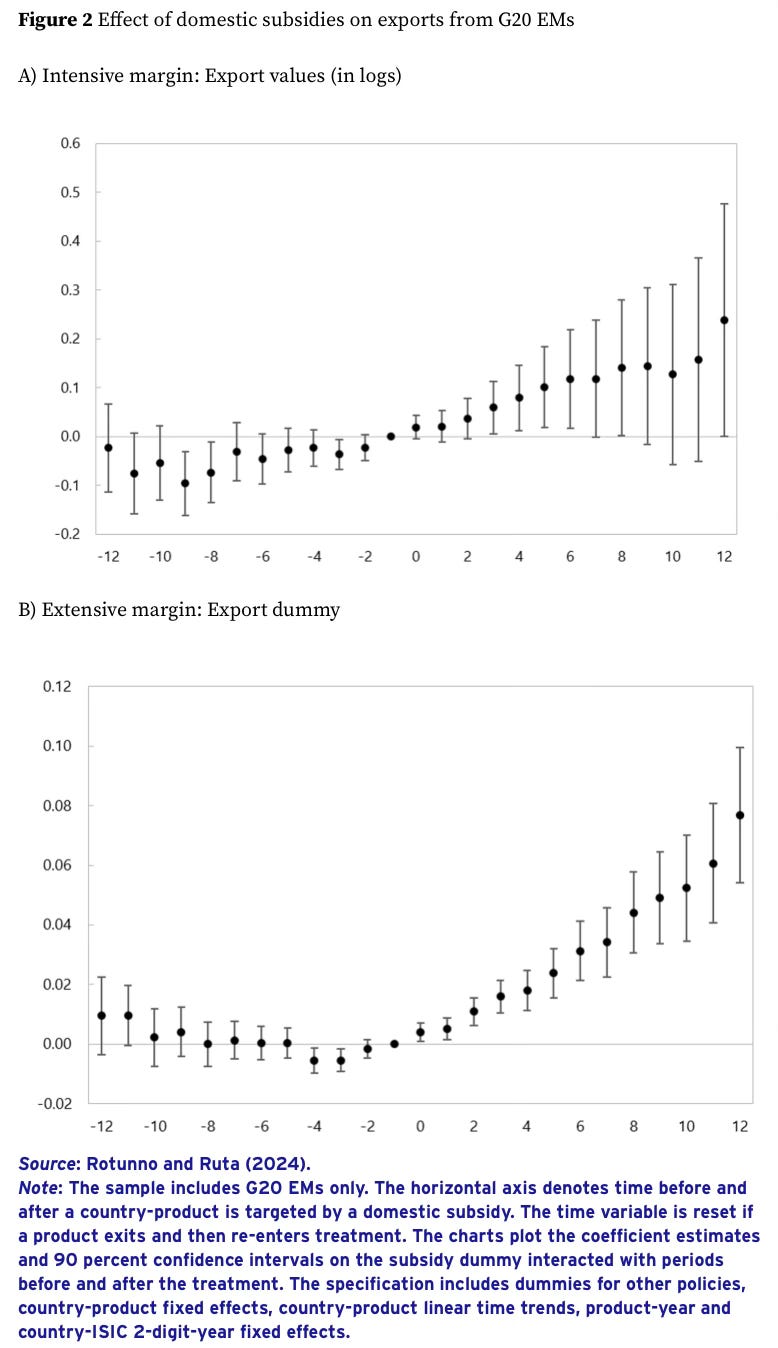
In this context, two IMF papers by Lorenzo Rotunno and Michele Ruta examined the trade spillover impacts of domestic subsidies generally and specifically by China. They quantify the significant impact of domestic subsidies on exports from G20 EMs. Exports of subsidised products increased for eight years since its introduction relative to exports of other products, whence the growth rate of exports of subsidised products is 15% higher. Similarly, at extensive margin (new products being exported), domestic subsidies increase the probability of a new product being exported by 3 percentage points relative to other products. 

They also quantify the impact of Chinese subsidies.

Our results point to significant effects of China’s subsidies on its trade flows. On the export side, exports of subsidized products are 0.9% higher (relative to non-subsidized products) after China’s subsidies… This average effect masks significant heterogeneity across destination markets and sectors. Our estimates suggest that exports of subsidized products from China to other G20 emerging economies (G20 EMs) are 2.1% higher after the subsidy than exports of other products to the same destinations. Furthermore, the export effects of China’s subsidies vary considerably across sectors. Within electrical machinery – one of the new ‘strategic’ sectors – for instance, exports of subsidized products are found to be 7% higher than exports of other products after China’s subsidies.

On the import side, China’s subsidies are found to depress imports of targeted products relative to imports of non-subsidized products – an effect that is not found for other countries. Across origin countries, the implied effect on imports of subsidized products is stronger for Advanced Economies (AEs) – a 3% and 4.8% decrease in imports of subsidized products from G20 AEs and other AEs, respectively. Electrical machinery and metals are among the sectors where China’s subsidies have strong import-substitution effects. Our estimates therefore suggest that China’s subsidies have increased the country’s share in export markets and reduced its share in import markets of subsidized products.

The effects of China’s subsidies are amplified by supply-chain linkages… the exposure of downstream sectors to subsidies in upstream industries (through cost shares) and the exposure of upstream sectors to subsidies in downstream industries (through sales shares)… The results reveal strong effects of subsidies propagating from upstream industries. More subsidies given to supplying industries are associated with higher exports in the buying industry… consider the case of subsidies provided to the steel industry, which is the main supplier of inputs to the automotive industry (10 % of its total costs). The empirical results imply that increasing subsidies to steel by the number observed over 2015-2022 is associated with a 3.5% increase in exports of autos from China. These indirect effects are concentrated on exports to G20 AEs. The findings on the indirect effects of subsidies are consistent with upstream industries expanding supply and lowering their prices following the deployment of subsidies. This upstream effect allows industries downstream to become more competitive in export markets. Results from import regressions point to a negative effect of upstream subsidies on imports in downstream sectors. This result suggests that upstream subsidies allow downstream industries to also expand domestically and substitute for imports.

Subsidies form the overwhelming share of Chinese industrial policy instruments, representing 95% of all trade-distorting policies implemented in the 2009-22 period. This compared with 60-65% for other emerging economies in G20. Further, 98% of subsidies are monetary transfers to firms - state aid and grants.

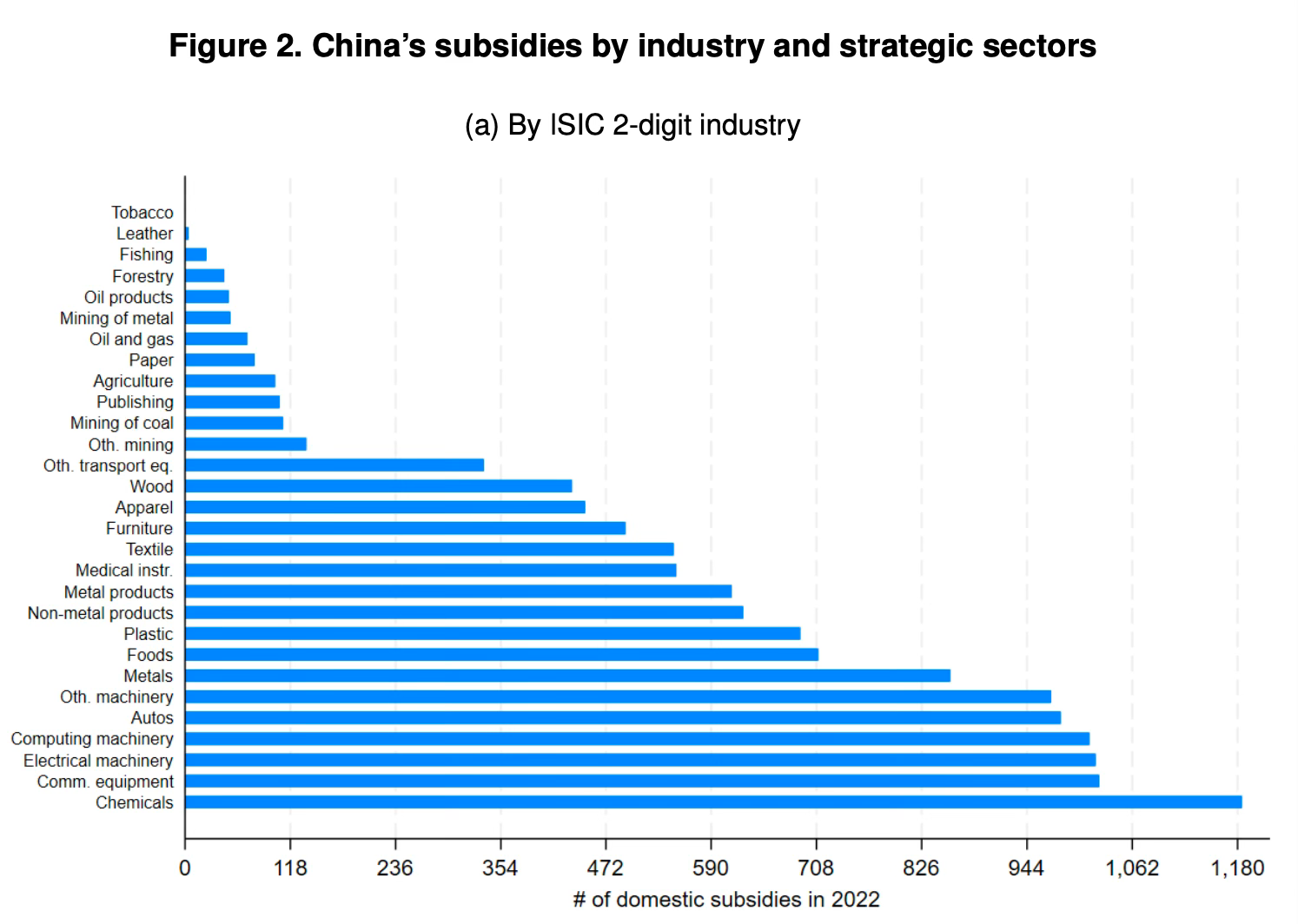
Chinese subsidies are focused on the manufacturing sectors.

The significant impact of domestic subsidies on exports in general (for all subsidising countries) and the especially higher impact of domestic subsidies observed in case of China is a reminder on the limitations of the SCM Agreement and WTO provisions in containing trade-distorting subsidies. As industrial policy interventions proliferate and as China exports its excess capacity aggressively, fixating on a narrowly defined set of subsidies that are “contingent on export performance” is meaningless. Other trade-distorting subsidies are allowed to expand without infringing on any WTO provision. 

This is a matter of great significance for developing countries like India with limited fiscal space to provide subsidies at anything remotely close to China, and also especially because the Chinese subsidies are having a greater impact on exports to G20 EMs and imports from them. 

As it seeks to expand its manufacturing base, India faces an onerous challenge across sectors. Competing with Chinese manufacturers requires significant levelling of the playing field to balance the massive subsidies that its exporting firms receive. This may no longer be confined to competition with exports coming directly out of China, but even those from countries like Vietnam. As FT reports, Vietnam is rapidly becoming an off-shore site for Chinese manufacturers, fuelling a third of all new investments in the country. 

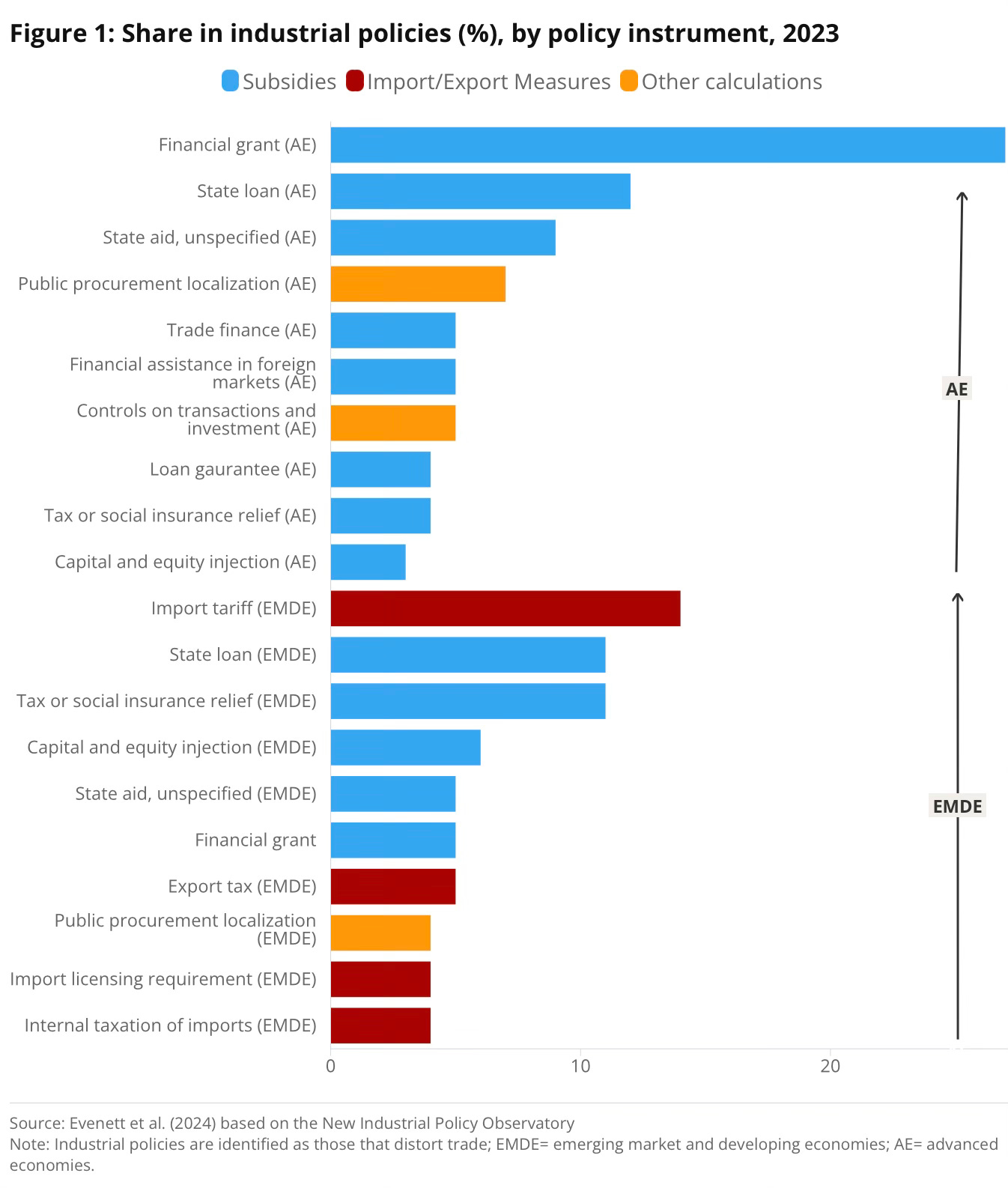
India’s industrial policy response has been to support its domestic manufacturers with its own subsidies, mainly through the PLI scheme and Basic Customs Duty (BCD) tariffs on imports. 

But this has its limitations for at least two reasons. One, given the extent of the competitiveness gap, these subsidies and tariffs may not be adequate in many industries. Two, shorn off the BCD support, Indian firms fall behind even further in the export markets.

The first can be bridged to some extent by increasing the domestic value addition. This can help domestic manufacturers lower costs and increase their competitiveness. However, given the limited component manufacturing ecosystem, this can only be done in a phased manner. A possible strategy in this regard would be to target a handful of products with high domestic demand volumes and double down on the creation of a component ecosystem, thereby maximising domestic value addition. It might be required to provide a higher level of incentive than currently provided under the PLI for products to encourage component ecosystems to relocate. Once a critical mass of the component manufacturing ecosystem emerges, it may become possible to expand the base faster. 

The second point on levelling the playing field on exports is equally important. Like maximising domestic value addition, another channel to improve the competitiveness of Indian manufacturers is economies of scale. Here, the small size of the Indian domestic market is a problem. For all its population size, India does not have the domestic market size to be able to generate the scale of demand required to reap the benefits of large economies of scale in most export market segments. This means that capturing export markets is an essential requirement. But the competitiveness gap is even higher in the export markets. 

It is, therefore, essential that these domestic firms have some form of export subsidies. An option is to provide a higher level of incentives such that they are enough to match the competitiveness gap after excluding the BCD. But that would require a higher fiscal allocation and would also entail giving excess incentives for domestic sales. Another option would be to provide concessional trade finance or reimburse taxes on exports. Other instruments from the Table above could be considered. 

In conclusion, for domestic industrial policy to be effective in expanding the domestic manufacturing base, it must necessarily include both some form of import protection and export incentives. Notwithstanding their WTO commitments, this choice is unavoidable for any country.

Saturday, February 8, 2025

Weekend reading links

1. The US Government under Donald Trump is rapidly degenerating into a lawless one. Sample this from the happenings in the Treasury Department. 
Treasury Secretary Scott Bessent gave representatives of the so-called Department of Government Efficiency full access to the federal payment system... The new authority follows a standoff this week with a top Treasury official who had resisted allowing Mr. Musk’s lieutenants into the department’s payment system, which sends out money on behalf of the entire federal government. The official, a career civil servant named David Lebryk, was put on leave and then suddenly retired on Friday after the dispute, according to people familiar with his exit. The system could give the Trump administration another mechanism to attempt to unilaterally restrict disbursement of money approved for specific purposes by Congress, a push that has faced legal roadblocks... Mr. Bessent granted access to the payments system to a handful of staff members affiliated with DOGE, including Tom Krause, the chief executive of a Silicon Valley company, Cloud Software Group, according to one of the people familiar with the change. Access to the system has historically been closely held because it includes sensitive personal information about the millions of Americans who receive Social Security checks, tax refunds and other payments from the federal government... In a process typically run by civil servants, the Treasury Department carries out payments submitted by agencies across the government, disbursing more than $5 trillion in fiscal year 2023.

Besides, this also poses serious conflicts of interest since it will allow Musk to access the details of payments being made to his competitors and in theory even control it.

With the likes of Robert Kennedy Jr heading the Health Department, Pete Hegseth leading the Defence Department, and Kashyap Patel heading the FBI, it's hard to not feel that the US government has become a banana republic where the President selects his Cabinet based purely on loyalty with no concern for any merit. 

Crony capitalism without any pretensions is invading US with vengeance, in a manner that would put to shame even those developing countries that Americans once scorned upon.

America’s largest companies are cutting deals with Elon Musk’s businesses or touting links with the world’s richest man as he solidifies his power within Donald Trump’s administration and begins to radically restructure the US government. A rush of announcements in recent days included Visa finalising a payments processing deal with Musk’s social media site X and United Airlines accelerating a plan to use Musk’s Starlink satellites for in-flight WiFi. Amazon has also boosted marketing spending on X... On Monday, Apple updated its iPhone operating system, allowing T-Mobile users in the US to connect to Musk’s Starlink satellites. Boeing’s chief executive Kelly Ortberg said he had been working with Musk... to accelerate delivery of two Air Force One planes that are over budget and years late. Oracle, the enterprise software company run by Trump supporter Larry Ellison, also announced a Starlink collaboration, while Intel touted a “growing media partnership” with X before broadcasting a live event together with Microsoft on the platform. Separately this week, roughly $3bn of debt tied to Musk’s purchase of X, held by banks including Morgan Stanley for more than two years, began to move, with investors including Apollo interested in a tranche... Following Trump’s win in November, JPMorgan dropped a three-year lawsuit against Tesla, in which it was seeking $162mn over alleged breaches of a stock warrants contract... Since the election, Musk has been a near-constant presence at the president’s side and been involved in everything from cabinet appointments to AI, defence and economic policy discussions.

State capture by plutocrats. 

2. Mexico, China, and Canada made up 42% of US imports in 2024.

These are the main imports of the US from the three countries. 

President Trump has signed executive orders imposing tariffs on the three largest US trade partners - 25% each on Canada and Mexico (though only 10% of Canadian oil exports), and 10% on China. It covers all US imports from these three countries.

Collectively, EU has the largest share of US imports

The FT has an editorial pointing to the absurdity of the trade war.

The harm to American diplomatic power is no less profound. From the 1980s, both Canada and Mexico set aside decades of scepticism to make a strategic bet on free trade with the US, culminating in the Nafta deal of 1994. The economic benefits, especially to Canada, have been plentiful. Both were coerced by Trump in his first term to renegotiate that deal. That the president is now riding roughshod even over the revised deal, the USMCA, sends a message America’s word cannot be trusted.

Janan Ganesh makes some important observations of the Trump era of deal making, describing it as one of "aggressive soft touch".

Because Trump is so quick to quarrel, people tend to miss that he is also quick to settle. He almost never drives as hard a bargain as his belligerent manner seems to promise. In 2020, China bought some peace with a vague and hard-to-enforce pledge to cut the two countries’ trade imbalance... Likewise, he didn’t abandon Nafta so much as pass off a revised version of it as a personal coup. Being an egoist, not a fanatic, what he cares about is his reputation as a maker of deals. To keep it going, he needs a regular flow of them. And so their content becomes secondary. We can mock, but the lesson here for countries faced with Trump is an encouraging one: give him something that he can call victory. The concession needn’t be huge, and he will in fact co-operate in talking up its significance. 

Nor does he seem to mind all that much which coin he is paid in. Trump is open to what Henry Kissinger called “linkage”. If he is upset about one thing, he can be mollified with a gesture on something apparently unrelated. Want to avoid a trade war, Europe? Spend more on defence. Want to prevent the betrayal of Ukraine? Soften the regulation of the tech sector. It is hard to know what is more telling about Trump’s truce with his northern and southern counterparts: the smallness of their concessions (Justin Trudeau is appointing a fentanyl “czar”) or the fact that economics and drug policy are mixed up like this in the first place. So yes, Trump threatens to displace industrial investment from Europe to the US. But Europe is spoilt for things to offer him, precisely because his grievances are so numerous. In that sense, he might be easier to defang than Joe Biden, who didn’t think Nato was a club of free-riders or the EU a conspiracy against Silicon Valley. There was nothing Europe could offer him on those fronts that would make him ease up on the America First industrial plan. With Trump, there might be. The very paranoia of his worldview — in which the US is being ripped off by almost everyone, almost all the time — means there are lots of entry points for a negotiation.

3. Alan Beattie makes an important point about the possible unintended effects of Trump's policies.

Currently, as trade has recovered from the initial shock of the Ukraine war, US imports have increased far faster than the world as a whole, while Chinese import growth has fallen... As for other sources of final demand, emerging economies themselves, particularly in Asia, have been consuming more as they get richer. But east Asian countries are typically net exporters: Malaysia, Singapore, Thailand and the Philippines have generally run current account surpluses since the Asian financial crisis in 1997-98, as have South Korea and Japan. Meanwhile, the EU, struggling to raise growth while Germany remains obsessed with exports, is also unlikely to pick up the consumption baton. This may add up to trouble ahead for countries exporting to the US, especially heavily exposed economies like Canada and Mexico.

Trump’s economic policies will encourage a wider US trade deficit, the opposite of what he wants. His planned sweeping tax cuts will increase consumer demand and suck in imports. His tariffs will make US exporters less competitive by strengthening the dollar, which import taxes tend to do. It will not be pretty if Trump starts deploying tariffs all round to stop the US being a consumer of last resort while implementing policies that will ensure it remains so. Exporters will be hunting round the world for scarce demand. As I’ve said before, the real threat to the global economy is not the rejigging of supply chains. It’s the danger that the most reliable market for global exports decides to crunch economic growth to get its trade deficit down and there’s not enough demand elsewhere to replace it.

The article has an important snippet that conveys the extent of China's predatory trade policy.

In terms of volume, Chinese exports rose at an annual rate of 13 per cent in the third quarter of last year, far faster than world import growth at less than 1.5 per cent.

It has a graphic on the estimates of trade growth between various categories of countries. 

4. Trump effect on US-China trade

One sector where the impact will be concentrated and immediate will be in the agriculture sector and in the US mid-west.

The opening salvo of a new trade war has sent a chill through the Midwest. Canada, Mexico and China together account for half of all American agricultural exports. Just last year, the US sold more than $30bn in farm products to Mexico, $29bn to Canada and $26bn to China, according to American Farm Bureau statistics. Suddenly, farmers were facing the spectre of retaliatory tariffs and the prospect of a full-scale conflict that some fear could decimate America’s rural heartland. Farmers in an area of the country that has become a bedrock of support for Trump now worry that the president’s tariffs, though suspended at the last minute, have permanently damaged the image of the US in the eyes of its most important trading partners...

Few US states better embody the agricultural wealth of the Midwest than Iowa. It is a land of vast corn fields stretching as far as the eye can see, the landscape broken by the occasional grain silo, hay bale or low-slung barn. Hogs outnumber people more than seven to one. It is also Trump country. Although Iowa voted for Democratic presidents Bill Clinton and Barack Obama, it backed Trump in 2016, 2020 and 2024 in ever greater numbers. More than a fifth of Iowa’s economy — or $53.1bn — is tied to agriculture, from crop and livestock production to food processing and manufacturing. It is the country’s largest producer of corn, hogs, eggs and ethanol and a top-three grower of soyabeans. That makes it particularly vulnerable to any downturn in agricultural exports. 
This article explains how the tariffs will impact automobile imports into the US.

5. Bloomberg reports that China's muted and largely symbolic response to Trump's 10% tariff on $525 bn of Chinese exports is a reflection of China's weak bargaining hand. China exports to the US three times as much as the US does to China. 

Apart from retaining the 10% tariff on China, for at least now, Trump has also scrapped the "de minimis" rules exempting shipments under $800 from duties. This loophole had been a major contributor to the growth of Chinese online sellers Temu and Shein. This will sharply increase the cost of the 4 million parcels a day arriving in the US under this exemption, of which 30% come from the two ecommerce groups. 

6. Richard Baldwin points to a possible four stage trade war scenario arising from Trump tariffs. 

American cars are not really made in America. They are assembled in America from parts produced in the US, Canada, and Mexico. I coined the phrase “Factory North America” 14 years ago to describe the tightness of the industrial integration. Nowadays, production processes are so interwoven that an engine could cross US-Canada and US-Mexico borders seven times before it ends up in a finished, US-made car. With each border crossing into the US, a 25% tariff will be applied, so the cost of the engine will soar. And costs will jump for all the other parts from Mexico and Canada and China. That’s step 1: The tariffs will raise the cost of US-made cars.

All cars made in Factory North America will become less attractive to US buyers. That will trigger Step 2. Before Trump’s tariffs, about half the cars sold in the US were imported. Mexico and Canada were big suppliers, but their competitiveness will be hobbled by the 25% tariffs. About half of US imported cars come from Japan, Germany, and Korea. They have not been subjected to the 25% tariffs... Cars made in the US, Canada, and Mexico will get more expensive inside the US, but German, Japanese and Korean cars will not... Almost surely, many US buyers will switch to German, Japanese and Korean cars that the tariffs made relatively cheaper. That’s step 2: A flood of imports from Germany, Japan and Korea. 

And how do you think President Trump will react to this import surge? My guess is that the US president will view it as unfair competition that he has to counter. He has a couple of time-honored options. He could lay a 25% tariff blanket on all imported cars, or negotiate “voluntary” export restrictions with Japan, Germany, and Korea. Given his love of tariffs, I’ll put my chips on option 1. Soon, it’ll be the “presidential all-you-can-eat tariff buffet.” That’s step 3: The US expands its war on trade to include its main trade partners in Asia and Europe... These US trade partners will retaliate against US exports. That’s step 4: The main US trade partners retaliate against US exports... When he sees US exports hit with new tariffs, which he will surely blame someone else for, he is very likely to impose counter retaliation tariffs. And that, ladies and gentlemen is how future historians will say that the World Trade War started.

7. A natural experiment in the works from the Indian government's Income Tax policy change of increasing the limit for tax rebates from Rs 7 lakh to Rs 12 lakh. 

While those earning up to Rs 12 lakh a year will have zero tax liability under NTR, the tax outgo would shoot up to Rs 61,500 if the taxable income breaches Rs 12 lakh by just Rs 10,000. Thus, an employee having an annual taxable income of Rs 12.1 lakh would actually take home Rs 51,500 less than the one earning Rs 12 lakh. A back-of-the-envelope calculation shows that parity is achieved only at the income level of Rs 12.71 lakh in terms of take-home salary. At Rs 12.71 lakh, the tax is Rs 70,500, which means the take-home salary at that level would be almost equal to Rs12 lakh.

8. Paul Krugman makes an important under-appreciated point about the value of FTAs in bringing predictability that in turn promotes business investments. He points to the example of NAFTA which did not as much as lower tariffs (which were already low when it kicked into effect in 1994) as it reduced uncertainties and allowed businesses do long-term planning and investments. 

9. Airline reward points 

In 1987... American Airlines partnered with Citibank to launch a co-branded credit card offering users air miles for every dollar spent. This scheme of selling frequent-flyer points to financial institutions transformed mileage programmes into complex but highly profitable businesses in their own right. In theory at least, it seems like a near-perfect business model: airlines can create as many points as they like out of thin air, and then sell them on to banks and credit card companies. They can also sell miles to partner hotels, car rental companies or shops, in effect becoming the central banks of a lightly regulated financial ecosystem. While airlines can enjoy instant revenue from selling air miles to banks and other third parties, the cost of customers redeeming their points through booking seats is deferred into the future, says John Grant, an executive at airline data company OAG.
Many never spend them at all. In 2018, the consultancy McKinsey estimated there were 30tn unredeemed air miles in passenger accounts, enough for almost every airline passenger in the world to take a free one-way flight. These asset-light businesses are particularly attractive to airlines. The actual work of operating flights is capital intensive, exposed to economic downturns and has high fixed costs, some of which such as fuel are out of airlines’ control. The reliance of airlines on their loyalty businesses became clear during the pandemic, when the four biggest US carriers put up their customer loyalty schemes as collateral to help them raise new debt. At the time, the valuations put on the loyalty schemes far exceeded the market capitalisations of the ailing airlines, suggesting they were worth more than the flight operations. Even at the height of the disruption in July 2020, American Express paid £750mn to extend its partnership with BA owner International Airlines Group, a significant part of which was to pre-purchase Avios frequent-flyer points. IAG Loyalty, the home of Avios, reported an operating profit of €321mn in 2023, more than Aer Lingus, one of the group’s airlines, and up by 14 per cent from the previous year. Its operating margin in 2023 — 21 per cent — was more than double that of Aer Lingus or BA.

10. DeepSeek has thrown egg at the faces of everyone, including the Chinese government.

DeepSeek’s achievements did not emerge from one of China’s myriad government-backed research institutes or state-controlled companies. Mr Liang seems to control most of the shares in DeepSeek, and has steered clear of China’s state-dominated venture-capital industry.

11. India's tariffs

India’s average import tariff stands at 17 per cent, while the trade-weighted rate is lower at 12 per cent, according to the World Trade Organization’s 2024 report.
12. FT has a good read on Paul Kagame's support for the Tutsi militia M23 in Eastern Congo. After its successful takeover of Goma last month, the rebels have been conquering other towns in the mining rich Eastern part of Congo. Rwandan troops are reportedly providing ground support for the invasion. Kagame argues that he's only providing protection for Tutsis against the DRC-backed Hutu FDLR militia who have been terrorising Tutsis in the area. The UN has reported that in a single year, 150 tonnes of coltan, used in electronics were fraudulently exported to Rwanda and mixed with Rwandan production, thereby benefiting Rwanda at least $1 billion. 

13. The fourth quarter results of Big Tech companies point to spending on CapEx to top $300 bn in 2025.
Microsoft, Alphabet, Amazon and Meta have reported combined capital expenditure of $246bn in 2024, up from $151bn in 2023. They forecast spending could exceed $320bn this year as they compete to build data centres and fill them with clusters of specialised chips to remain at the forefront of AI large language model research... On Tuesday, Google’s Sundar Pichai said in defence of his plan to spend $75bn in 2025 — up 42 per cent from $53bn last year... Microsoft’s Satya Nadella said... going to spend $80bn building out Azure... And on Thursday, Amazon CEO Andy Jassy topped Google and Microsoft by forecasting more than $100bn in capital expenditure this year, up from $77bn in 2024 and more than double the $48bn of the previous year. The vast majority will go towards data centres and servers for Amazon Web Services... Meta... pledged to spend “hundreds of billions” more on AI, on top of the $40bn invested in 2024.

Such spending is opening up a widening gulf between the Big Tech and the rest.

Spending among the “Magnificent Seven” — which also includes Apple, Nvidia and Tesla — dwarfs the rest of the US benchmark S&P 500. Their capital spending rose 40 per cent in 2024 compared with 3.5 per cent among the remaining 493 companies, according to SociĂ©tĂ© GĂ©nĂ©rale. Profits among the elite group soared by a third in the same period, versus 5 per cent among the rest.

14. In another reflection of the issues with US capitalism, it's being pointed out that US defence contractors are spending their surpluses on share buybacks instead of modernising their weapon sytems.

In 2023, Lockheed Martin and RTX spent a combined total of $18.9 billion on stock buybacks, compared with just $4.1 billion on capital expenditures, according to data compiled by Bloomberg.
15. In a reflection of the problems with climate transition, NYT reports that US "utilities have extended the life of nearly a third of coal units with planned retirement dates, either through delays or by reversing course and canceling retirements entirely, between 2017 and today".