Substack

Showing posts with label financial market crisis. Show all posts

Friday, July 10, 2026

The loss of financial market discipline

This post will provide a framework for thinking about the erosion of financial market discipline. 

The FT has an article on an inflating earnings bubble in the financial markets. 

Analysts are now forecasting a 25 per cent increase in S&P 500 company earnings for the coming year, according to Bloomberg data… Ben Inker, co-head of asset allocation at GMO, said forecasts for the next two years were “rising at an exceedingly high rate, nothing we have seen outside of a crisis recovery”. Consensus estimates for coming-year profits have risen by almost 20 per cent in six months, the biggest such jump since 2021…

Capital Economics analysts warned this week that “AI-related equity markets may be approaching a point where earnings expectations and capital expenditure assumptions become difficult to sustain” and a correction in these could “trigger a broad equity market pullback”. Michel Lerner, head of UBS’s investment analytics platform HOLT, said “shares in the AI food chain are priced to maintain supernormal profits” and warned of an “earnings bubble” forming in the market. While exceptional profits appear likely to keep being delivered in the immediate future, he said, “the likelihood of sustaining these levels of profitability and growth is incredibly low”.
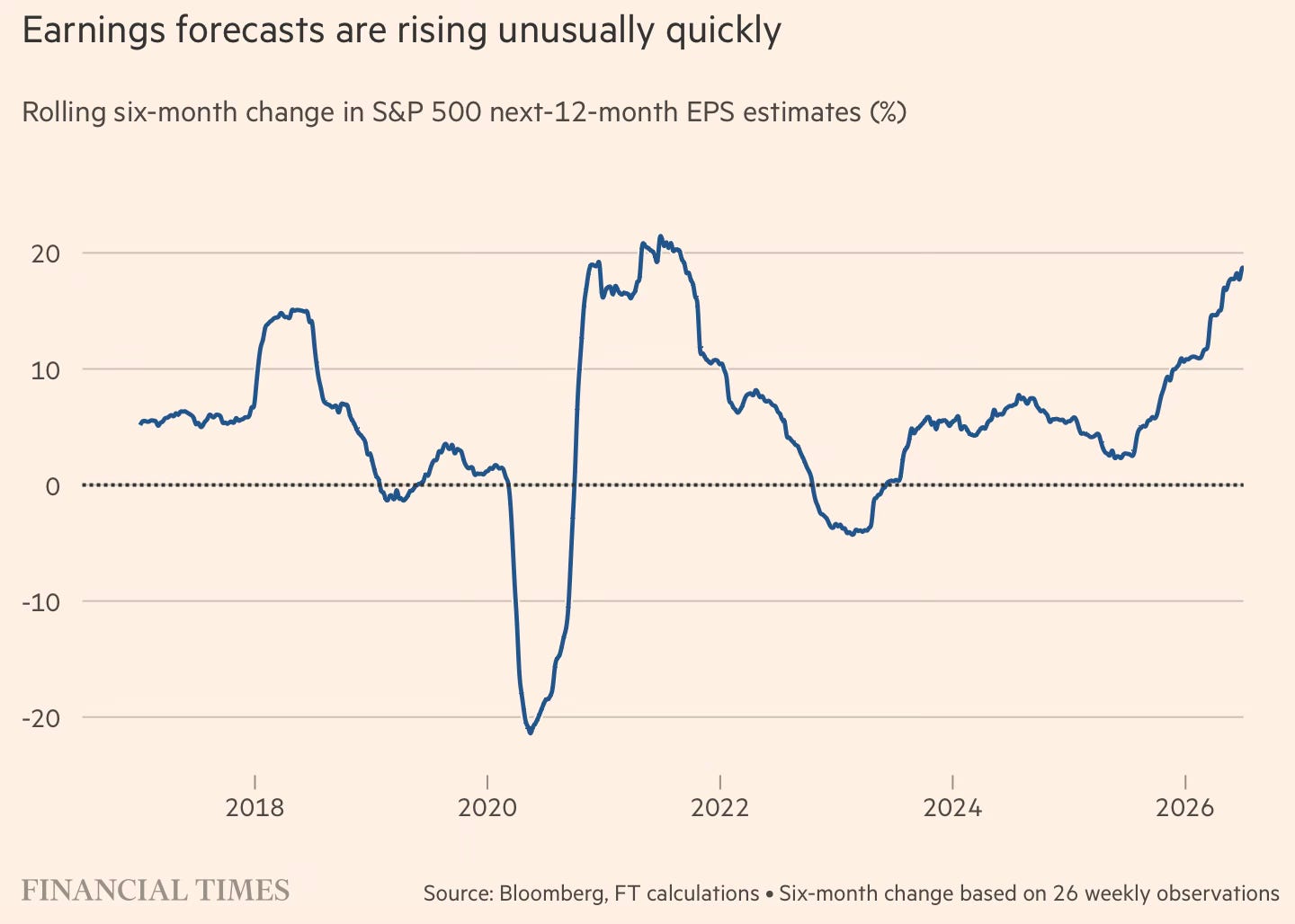
This earnings bubble supplements an already inflated valuations bubble

The BIS Annual Report has an excellent graphic that shows that stocks are pricing an earnings bubble, underpricing risk, and household exposure has increased sharply.
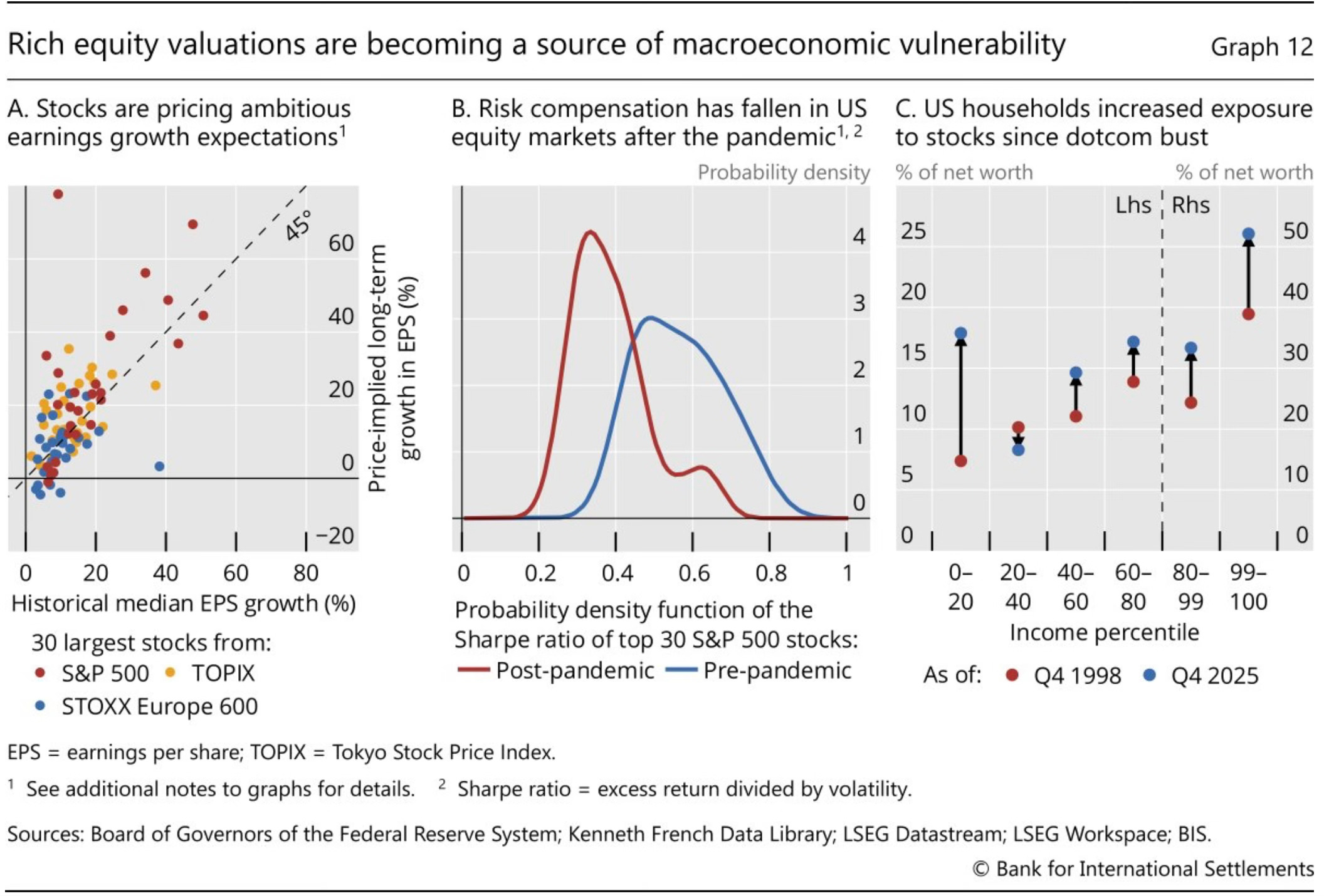
The implied long-term earnings growth for the largest corporations sits well above recent historical benchmarks, with US stocks often trading at large premia to peers in other major markets. These implied rates often exceed even the elevated growth that some of the technology firms have delivered in their relatively short lifetimes. As these firms mature and command a larger share of the market, sustaining such high growth could become increasingly challenging… Risk premia on the largest US stocks have compressed markedly since the COVID-19 pandemic, with the distribution shifting clearly to the left. This points to growing investor complacency and reduced compensation for risk-bearing… A major equity market correction could have larger macroeconomic consequences today than in the past. Household equity exposures have grown over the past few decades, both relative to total wealth and income. A large correction in valuations could have more pronounced wealth effects and sharper consumption pullback than in the past. And with US stocks accounting for an outsized share of global equity markets – about 64% of the MSCI Global index – the wealth impact from a US-led repricing could propagate globally.

And, the report says, all this is fuelled by a complex web of private circular transactions involving hyperscalers, chip makers and AI labs. 

Chip makers and hyperscalers take equity stakes in AI labs or neocloud providers, who in turn commit to multi-year purchases of chips or computing power. Data centre construction is increasingly outsourced to third parties that lease facilities back to hyperscalers on long-dated contracts with embedded exit clauses. The terms of such deals are typically poorly disclosed, with risks of the same asset being pledged multiple times. Together, such arrangements account for a sizeable share of sector-wide financing and forward revenue. A sharp repricing of equity risk could prompt a reassessment of corporate credit risk and lead to tighter credit conditions more broadly… 

Any tightening in credit conditions could expose existing vulnerabilities in the less transparent private credit space, whose reach has expanded among middle market and small firms… A larger shock, whether from a renewed inflation surge or a sharp AI-led repricing, could trigger a more widespread credit crunch… The growing role of private credit also raises concentration risks. Direct lending funds, dominant players in the private credit ecosystem, have quadrupled their lending to the AI and information technology (IT) sectors in the past five years, to about 15% of their portfolios. These loans tend to be larger than those in other sectors, while their terms such as tenor and pricing remain broadly similar, raising questions about lending standards and risk pricing. 

In this backdrop, it is useful to ask the question whether financial markets have lost their disciplining powers. What is it about modern financial markets that makes them underprice risk? 

For sure, greater access to information has bridged information asymmetries, increased transparency, and reduced uncertainties and risks. And this has, in turn, lowered price discovery frictions and increased market efficiency. However, this has gone alongside trends in the opposite direction. Already, the complexity of financial instruments obscures risks and distorts price discovery. But other market practices have emerged in the last two decades that distort incentives and erode the market discipline. Some of them are consequences of the aggressive expansion of central bank monetary policy toolkits in the aftermath of the Global Financial Crisis. 

There is a moral hazard created by the market participants’ internalising the belief that too-big-to-fail institutions or industries will always be bailed out. The institutions themselves come to view this as an insurance against their risk-taking. Well-intentioned actions of central bankers like forward guidance and commitments to backstop against shocks (Greenspan Put and Draghi’s “whatever it takes”) create similar moral hazard across markets. The gradual erosion of gatekeeping standards (ratings inflation, audit failings, index inclusion - e.g., for SpaceX) distorts incentives and leads to underpricing of risks. Excessively bullish market guidance, like with AI stocks now, fuels a cycle of irrational exuberance that amplifies bubbles. Finally, the inherent dynamics of financial markets bake in the fear of missing out among the institutional investors. 

The fundamental basis for any efficient market is that information flows facilitate price discovery, and the costs of the actions of market participants are internalised. Based on this, an analytical framework on financial market discipline can be built on three pillars - information quality (participants must get accurate signals); price discovery (prices reflecting the underlying value); and skin in the game (losses must fall on risk takers). All three must hold simultaneously for market discipline. 
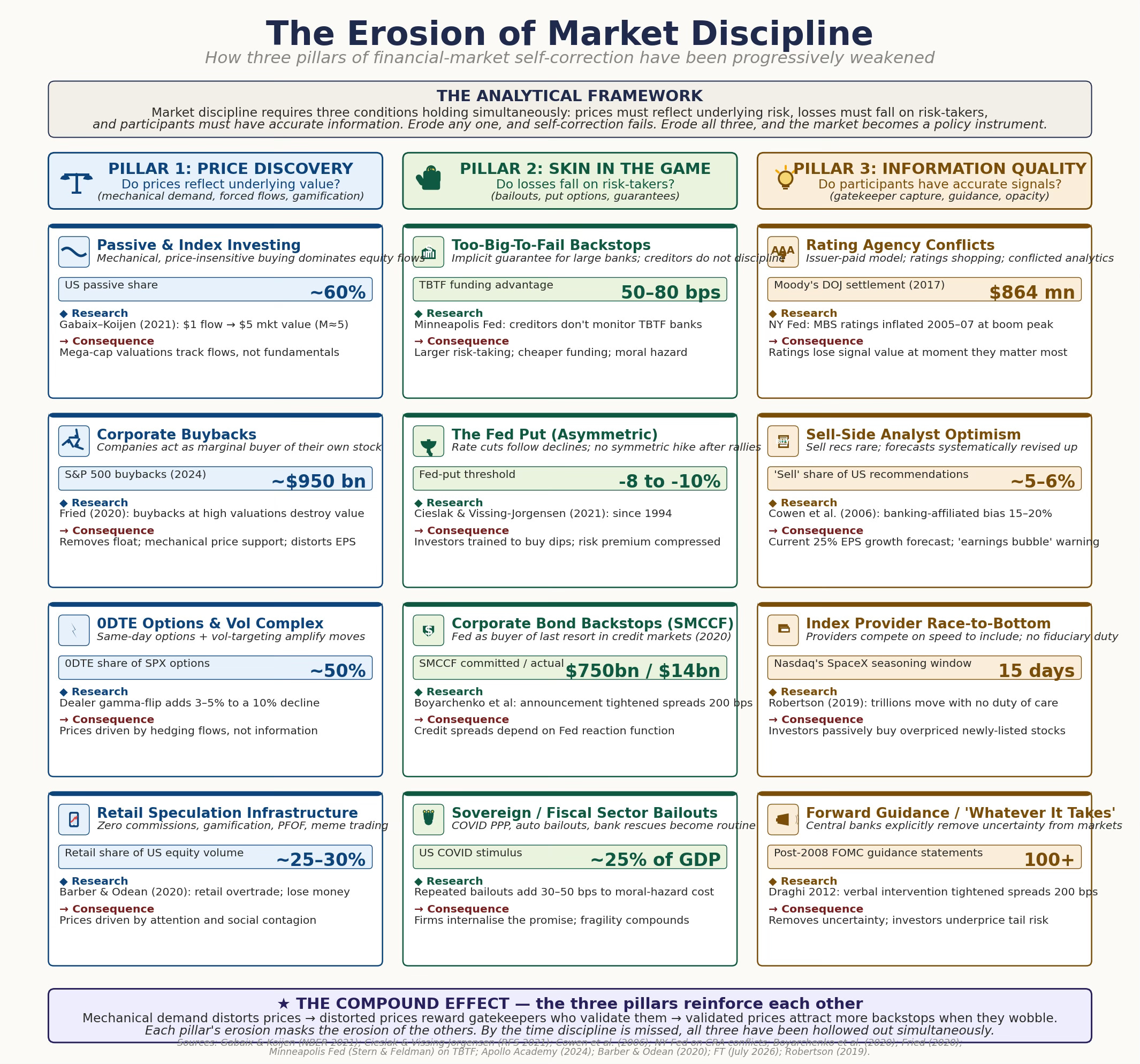
The three erosions are not independent. Mechanical demand distorts prices; distorted prices reward gatekeepers who validate them; validated prices attract more backstops when they wobble. Each pillar’s erosion masks the erosion of the others. By the time discipline is missed, all three have been hollowed out simultaneously. This is why the current market environment can display record-high valuations (Price Discovery pillar broken), narrow risk premia (Skin in the Game pillar broken), and record-optimistic analyst forecasts (Information Quality pillar broken) - all at the same time, without triggering any traditional warning system. The system that would normally catch such a configuration has been progressively disassembled.

Interestingly, each erosion channel began as a reasonable response to a specific problem. Deposit insurance solved bank runs. Forward guidance solved communication ambiguity. Passive investing solved active-fund underperformance. Rating agencies solved information asymmetry. None of them is wrong in isolation. The problem is what happens when all the individual protections are stacked simultaneously, and all of them are pursued to their extremities. The system loses its balance.

The market’s self-correcting machinery is gradually replaced by a suite of external supports, and the participants who set prices become smaller and smaller relative to the participants who follow rules. At some point, arguably reached, the market is no longer a disciplinary mechanism at all. It is a policy instrument with an ambiguous owner. That is why the current earnings-bubble concern is qualitatively different from previous bubbles in that there is no obvious mechanism left through which the market disciplines its own excess.

So what can be done to restore the disciplining powers of the market?

Quite simply, it should be about restoring accurate price signals, consequences and costs of risk taking, and the trustworthiness of information, and all by going back to first principles. 

The restoration of price discovery requires both thickening the market (a high concentration of buyers and sellers) and increasing liquidity (allowing assets to be transacted without significantly impacting the price). The internalisation of the costs of risk-taking demands rolling back moral hazard-inducing backstops and bailouts, or at the least ensuring these interventions are priced appropriately. Finally, restoring the quality and credibility of information requires separating information provision from the transactions side of financial intermediaries, and letting the market guide with information. An agenda is outlined below. 
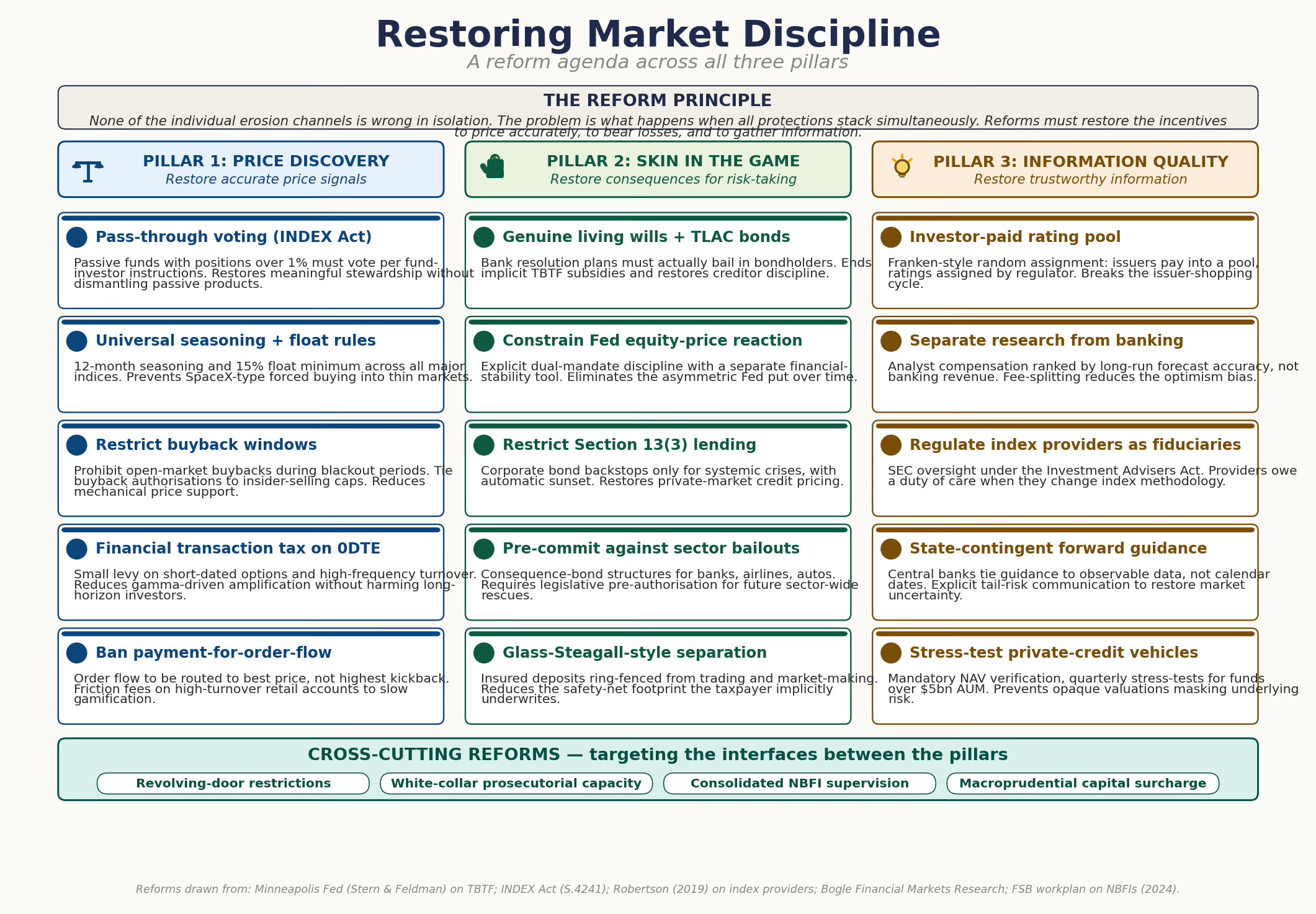
This must be complemented with cross-cutting reforms such as restrictions and greater oversight on revolving-door personnel movements, enhancing the white-collar prosecutorial capabilities of regulators, enhancing the supervision of non-bank financial institutions (NBFI), macroprudential capital surcharges for risk concentration, etc. 

The problem, though, is that these are all very difficult reforms even at the best of times, but particularly difficult now. The silver lining is that a big crash can create the conditions for such reforms.

Friday, June 19, 2026

The quartet of global imbalances

President Donald Trump’s single-minded pursuit of rebalancing the US economy using tariffs is unlikely to yield much without addressing fundamental distortions that have crept into the US economy and financial markets. Trade surpluses are a mere symptom of deeper malaises. I had blogged about the global twin structural imbalances, arguing that an American economy skewed towards consumption and a Chinese one skewed away from consumption are two sides of the same coin. 

Helene Rey (see also this report to G7) has a very nice summary of global imbalances, where she locates it within the dynamics of saving and investment, and questions the focus on tariffs.

A country that saves more than it invests lends abroad and runs a current account surplus; one that invests more than it saves borrows and runs a current account deficit. It is the collective saving and investment decisions of a country’s households, companies and government that drive imbalances. There is now some agreement — crystallising in the G7 discussions — that the sources of imbalances are linked to unbalanced growth models and mostly made at home: chronically weak consumption in China, feeble productive investment in Europe and outsized fiscal deficits in the US. Tariffs are not an effective mechanism to change any of those and issuing an international currency is no justification to run current account deficits. 

She also proposes the solutions in terms of complementary actions. 

China rebalancing towards consumption, Europe lifting productive investment and America repairing its public finances are not three grudging favours. They are parts of a single, mutually reinforcing policy. One country’s exports are another’s imports; one country’s capital outflow is another’s inflow. When all three move at once, each adjustment cushions the others: the deficit country that consolidates finds external demand waiting as surplus countries spend more at home, and the surplus country that stimulates demand finds a market at home rather than a protectionist wall… The IMF’s scenario of simultaneous rebalancing raises global output by around 0.8 per cent and narrows medium-term imbalances by half a percentage point of world GDP.

I think this analysis misses a critical fourth leg of the imbalance, financialisation. It cannot be seen as merely a symptom of US borrowing. As evidence, there are two natural experiments. The last two episodes of US fiscal deficit reduction (in the late nineties and mid-2000s) were accompanied by financial market bubbles (the dot-com bubble and housing and mortgage market bubble). 

Underlining this, Ricardo Caballero, Emmanuel Farhi, and Pierre Olivier Gourinchas have shown that if the financial markets do not work well, the economy might accommodate investments that deliver a rate of return that is below the growth rate of the economy. In this situation, both stock market bubbles and government debt can play the useful role of displacing inefficient investments. 

Foreign savings flowing into the US must find a US asset to absorb them - either Treasury debt (the fiscal deficit channel) or private financial assets (the financialisation channel). These two are substitutes, not complements. Squeezing fiscal deficits without restraining private credit pushes the same global savings glut into asset bubbles. So US fiscal consolidation alone is not sufficient, and must be paired with financial-sector reform that prevents the likes of private credit from filling the void.

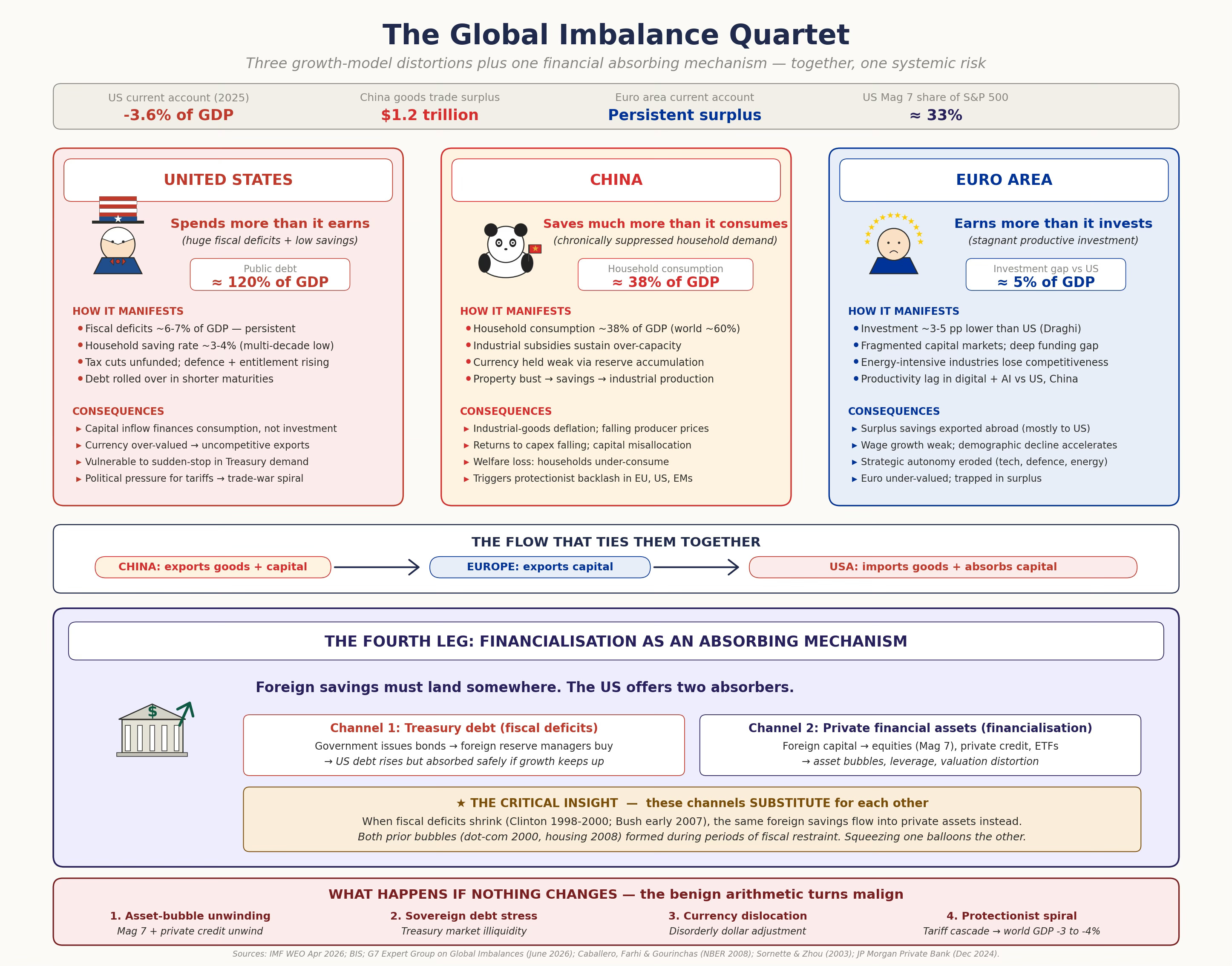
I asked Claude to generate a graphic that describes the global imbalances quartet. 

So, how to address these imbalances?

The rebalancing would require global diplomacy and coordination to mobilise support from all key stakeholders. This looks onerous in a deeply polarised world, of rising tensions between the West and China and the unpredictable and whimsical nature of the Trump Presidency. 

In fact, among the four adjustments required, interventions pertaining to the much-derided Euro area appear to be the most promising and likely to materialise. In fact, on investments, the train has already started. 

It is possible that a deep crisis on the economic front, a very likely near to medium-term possibility in either case, may force both China and the US to rebalance towards consumption and consolidation, respectively. However, there are daunting political economy challenges to be overcome in both countries, especially the US. 

It is the fourth leg that might prove the most challenging. The financial markets are where the power of entrenched interests is so strong that it might require a counter-revolution to upend the order and regulate financial markets more tightly. This will also require global coordination and collective action, and not mere reforms at the US front. 

Saturday, June 14, 2025

Weekend reading links

1. Toyota fact of the day

Toyota... the world’s largest auto manufacturer by volume. The company’s annual revenues now account for roughly 8 per cent of Japan’s nominal GDP.

2. AI is supercharging weather forecasting, which has become very accurate over the years.

A committee under the Department of Consumer Affairs has designed a Repairability Index for the mobile and electronic sector based on six criteria: Disassembly depth, repair information, availability of spare parts within a reasonable timeline, software updates, tools, and fasteners (types and availability). A scorecard of a product would be asked to be displayed at the sales counter, on the e-commerce platform, or on the package itself. On May 2, Belgium became the second country in Europe after France to implement a Repairability Index. The Belgian index is mandatory for pressure washers and laptops (excluding tablets). It also assigns a score from 1 to 10 to products like dishwashers, vacuums, and lawnmowers, allowing buyers to make a conscious choice based on a product’s repairability. The country is also expected to extend the index to bicycles — especially electric ones — as well as electric scooters in the future.

4. What Tesla stands to lose from the Big Beautiful Bill?

The bill would eliminate tax credits of up to $7,500 for people who buy electric cars. It would quickly phase out subsidies for battery factories and lithium refineries, and end financial support for electric vehicle charging stations. The bill imposes an annual fee of $250 on electric vehicle owners that environmental groups say is punitive. Those measures would hurt all carmakers that sell electric vehicles. But the Trump administration and Republicans in Congress are also trying to kill regulations that are especially beneficial to Tesla. Those rules allow Tesla to sell clean air credits to other carmakers that fail to meet environmental standards. During the first three months of the year, Tesla sold regulatory credits worth $595 million, which was more than the company’s net profit of $409 million. In other words, without the credits, Tesla would have lost money...
The Republican measures would result in sales of 7.7 million fewer electric vehicles by 2030 than would be the case if Biden administration policies remained in place. Tesla would sell 3.4 million fewer electric vehicles, or almost two years’ worth of sales, assuming it maintained its current U.S. market share of 44 percent of all new electric cars sold. Republican legislation would also eliminate programs that subsidize the cost of large battery storage projects, which has been a growth business for Tesla.

More here

5. Vietnam's spectacular manufacturing success is not translating into much value addition and risks the middle income trap. 

Annual foreign direct investment (FDI) reached $19bn in 2023. Foreign enterprises accounted for a fifth of GDP that year, up from 6% in 1995. The biggest is Samsung, whose complex in Pho Yen, a factory town near Hanoi, employs some 160,000 workers, who assemble the bulk of Samsung’s smartphones. The FDI boom, in turn, has produced a surge in exports, which have risen eight-fold since 2007, to $385bn a year. Foreign firms account for just 10% of employment and 16% of investment, but 72% of exports. Samsung alone accounts for 14%. Yet Vietnamese workers are simply assembling parts made, by and large, in China or South Korea. Even as export volumes have ballooned, the average unit value has stagnated. Vietnam adds less value to its exports than do nearby Malaysia and Thailand. Because final assembly is labour-intensive, productivity is low. Vietnam’s output per hour worked is 37% below the average for upper-middle-income countries in Asia. Over 90% of jobs in manufacturing require few or no skills...
Multinationals in Vietnam source the lowest share of local inputs of any country in East and South-East Asia. Despite Samsung Electronics’ huge presence in Vietnam, none of its core suppliers is a homegrown Vietnamese firm, noted a recent article in Guancha, a Chinese news outlet, that was widely read among the Vietnamese elite. The small number of Vietnamese firms that do supply global manufacturers mainly provide simpler materials, such as cardboard and plastics.

Meanwhile, Vietnam has reached the “Lewis turning point”, at which developing economies exhaust their rural labour surpluses and wages begin to rise swiftly. Between 2014 and 2021, over 1m agricultural jobs disappeared each year despite a growing labour force; in 2022-23 the pace decelerated to 200,000. Labour costs in manufacturing are already higher than in India or Thailand and are set to climb by a further 48% by 2029, according to the Economist Intelligence Unit, our sister company. Vietnam could soon end up too expensive for labour-intensive manufacturing yet too technologically unsophisticated to do much else—a classic middle-income trap.

This low value addition is something India should guard against. This sounds impressive reform by President To Lam.

Mr Lam has been boldest. He has abolished five ministries and eliminated an entire layer of the bureaucracy, at the level of Vietnam’s 705 districts. He is reducing the number of provinces from 63 to 34. All this is eliminating 100,000 jobs from the civil service. He has decreed that there should be a 30% reduction in red tape. At the same time Mr Lam wants to build administrative capacity. He has called for higher pay for capable civil servants. Some of his changes seek to reverse the legacy of “blazing furnace”, an anti-corruption campaign initiated by his predecessor. Over 330,000 party members were prosecuted or punished and tens of thousands resigned. The effect was to make bureaucrats drastically risk-averse. Mr Lam has instead sought to engender an atmosphere of tolerance of mistakes.

6. China's EV dominance in two graphics. First, its share of major global markets

Second, the competitiveness gap between its battery manufacturers and the rest of the world. 

What we’ve been seeing in recent months, with interest rates and the dollar moving in opposite directions, doesn’t look like what we normally see in the United States, or for that matter advanced nations in general. Instead, it’s the kind of thing one sees in emerging markets, where big market moves often reflect crises of confidence: International investors lose faith, pulling their money out, and capital flight causes both a falling currency and rising interest rates.
8. Reshoring manufacturing to the US faces daunting challenges. For most products, manufacturing in the US is more costly than for its largest trading partners.
Manufacturing costs in the United States are significantly higher.
9. If the tariffs on China were intended to gain leverage in negotiating a trade deal for the US, then it appears to have handed back all that leverage with the two rounds of negotiations that have been held to date. It appears that China has succeeded in linking its restrictions on rare earth exports to the US's restrictions on high technology exports
The US has accused China of not honouring its pledge in Geneva to ease restrictions on rare earths exports, which are critical to the defence, car and tech industries, and dragging its feet over approving licences for shipments, which has affected manufacturing supply chains in the US and Europe. Beijing has accused the US of “seriously violating” the Geneva agreement after it announced new restrictions on sales of chip design software to Chinese companies. It has also objected to the US issuing new warnings on global use of Huawei chips, and cancelling visas for Chinese students. On Monday, a senior White House official indicated that Trump could ease restrictions on selling chips to China if Beijing agreed to speed up the export of rare earths. That would amount to a significant policy shift from former president Joe Biden’s administration, which implemented what it called a “small yard, high fence” approach designed to restrict Beijing’s ability to obtain US technology that could be used to help its military.

Instead of building on President Biden's successes in restricting high-technology exports, President Trump appears to have allowed the Chinese to place on the negotiating table their easing in return for similar easing of their recently imposed export controls on rare earths. Here is Hal Brands,

China wants few things more than a relaxation of curbs on its access to high-end semiconductors; so do corporate players and analysts who argue that they do more harm than good. Although the details are hazy, the Trump administration reportedly agreed to lift some recent controls as part of a deal to deescalate the trade war. Let's hope the administration doesn't go much further than that. Ditching or dramatically rolling back the measures that preserve American's technological advantage — and that have been imposed, with bipartisan backing, over the past several years — would be strategic self-sabotage of the highest form.
The export controls at issue pertain to the most advanced computer chips and the inputs, both hardware and software, required to make them. During Trump’s first term, the US hit specific Chinese firms, namely Huawei, with targeted bans. Under President Joe Biden, Washington went big: It intensified the tech war by expanding their application to cover China as a whole. Since then, Washington and Beijing have been playing cat-and-mouse, as China has sought to evade tech controls while the US gradually tightens them... The goal, as then-National Security Adviser Jake Sullivan said in 2022, was to maintain “as large a lead as possible” in key sectors like AI and advanced computing, because those sectors will shape the future economic and military balance... if Trump's deal with Xi entails an agreement not to impose new export controls in the future, it will — thanks to the cat-and-mouse dynamic — severely erode America's ability to keep even its existing restrictions effective and up to date.

10. Samsung appears to have done a better strategy of geopolitical risk diversification than Apple.

A research by S&P Global shows that Samsung’s share of global final assembly volume of smartphones in India in 2024 was at 25 per cent compared to only 15 per cent of the Cupertino-based Apple Inc in the same period. For Samsung, its biggest exposure is smartphone assembly in Vietnam, which is more than double of India at 55 per cent, and Brazil is in the third spot at 12 per cent. These account for the top three assembly markets. In the case of Apple Inc, its exposure to different countries is very different — China still dominates with 83 per cent, a market from where Samsung had withdrawn assembly years ago in phases, preferring to shift to Vietnam and India. And apart from China and India, Apple has a small exposure of 2 per cent in Brazil and some other countries... one commonality in both Samsung and Apple is that they don’t assemble their phones in the US.
11. Are private credit and hedge funds the likely sources for the next financial crisis? TT Rammohan writes
The Economist says, “The five top players in private credit manage $1.9trn of credit assets across funds and insurance balance-sheets. Assets of the five biggest multi-manager hedge funds sit at $1.6trn, including huge leverage.” Moody’s Analytics warns that private credit’s linkages with banks and insurers could make it a “locus of contagion” in the next crisis. It warns that private credit could amplify a future financial crisis even if it’s not the source of one... after the GFC, bank ownership or sponsorship of hedge funds in the US has come to be heavily restricted under the Volcker Rule. Data on bank exposure to hedge funds in the US must be made public... Bank failure during the GFC was pervasive due to the combination of three factors: Excessive leverage, inadequate liquidity and mark-to-market losses on the proprietary trading book (and not losses on loan exposures). All three have come to be addressed by regulation. Banks are better capitalised. The Liquidity Coverage Ratio ensures that banks are better covered for liquidity. Stiffer capital requirements have discouraged proprietary trading. These measures may need to be augmented by bringing systemically important entities among hedge funds and private credit under the ambit of regulation if required. The Financial Stability Oversight Council in the US has the authority to do so.

12. Which is the world's largest packaged food company? JBS, a Brazilian company started in 1953, had revenues of $78 bn in 2024 with half its sales in the US.  

13. The Print has a good article on Gujarat’s potato revolution

The growth of the fast-food industry and increasing consumer cravings for fries, hash browns, and ready-to-cook frozen products kicked off this change. Homegrown companies like HyFun, Falcon Agrifriz, Iscon Balaji, and McCain started investing in processing technologies and an expanding network of high-end cold chain facilities crystallised. Scientists did their part as well. The Central Potato Research Institute (CPRI), under the Indian Council of Agricultural Research (ICAR), developed varieties with low sugar and high dry matter—qualities that make for crispier fries that soak up less oil. Now, India is not only meeting its own demand but shipping frozen potato products internationally.

Sunday, April 30, 2023

Weekend reading links

1. Shein and Zara facts of the week

Shein launches almost 6,000 designs a day across the world; in contrast, Zara does 2,000 designs a year.

Some counter-intuitive lessons on e-commerce from Newme, India's equivalent of Shein,

The typical e-commerce wisdom is that more options will drive more sales. We had a similar hypothesis and were pushing in the same direction, but while interacting with our consumers, we realized Gen Z buyers need enough options, but don’t want to be bombarded with designs. They prefer curation with a healthy mix of designs. If you show them too many options, it confuses them, which leads to them not making a purchase. So, we reduced our styles from 50,000 to 5,000, but increased our curation.

Another conventional e-commerce belief is, the more reviews on a product, the more sales it can drive. But Gen Z don’t want to purchase products that have a very high number of reviews because it signals that many others have purchased the same style, which puts them off. They’re always looking for statement pieces at an affordable price.

2. Gillian Tett points to a 2020 paper by Lily Bailey and Gary Gensler in 2020 which highlights three stability risk concerns from generative artificial intelligence (AI).

One is opacity: AI tools are utterly mysterious to everyone except their creators. And while it might be possible, in theory, to rectify this by requiring AI creators and users to publish their internal guidelines in a standardised way (as the tech luminary Tim O’Reilly has sensibly proposed), this seems unlikely to happen soon. And many investors (and regulators) would struggle to understand such data, even if it did emerge. Thus there is a rising risk that “unexplainable results may lead to a decrease in the ability of developers, boardroom executives, and regulators to anticipate model vulnerabilities [in finance],” as the authors wrote. 

The second issue is concentration risk. Whoever wins the current battles between Microsoft and Google (or Facebook and Amazon) for market share in generative AI, it is likely that just a couple of players will dominate, along with a rival (or two) in China. Numerous services will then be built on that AI base. But the commonality of any base could create a “rise of monocultures in the financial system due to agents optimizing using the same metrics,” as the paper observed. That means that if a bug emerges in that base, it could poison the entire system. And even without this danger, monocultures tend to create digital herding, or computers all acting alike. This, in turn, will raise pro-cyclicality risks... The third issue revolves around “regulatory gaps”: a euphemism for the fact that financial regulators seem ill-equipped to understand AI, or even to know who should monitor it. Indeed, there has been remarkably little public debate about the issues since 2020 — even though Gensler says that the three he identified are now becoming more, not less, serious as generative AI proliferates, creating “real financial stability risks”.

3. The Bank of Japan under its new Governor Kazuo Ueda has started to take steps to normalise its monetary policy after decades of ultra-low rate accommodation. After the first BoJ Board meeting since taking over, Ueda forecast that inflation would drop from its 3.1% high of March 2023 and is likely to remain close to its 2% target for the next two fiscal years.

The BoJ held overnight interest rates at minus 0.1 per cent and maintained its yield curve control policy, saying it would continue to allow 10-year government bond yields to fluctuate by 0.5 percentage points above or below its target of zero. Following in the footsteps of the US Federal Reserve and the European Central Bank, the BoJ dropped a part of its forward guidance that previously said it “expects short- and long-term policy interest rates to remain at their present or lower levels”. The removal of this clause, which was originally aimed at supporting the economy after Covid-19, could make it easier for the BoJ to scrap yield curve control.

4. Andy Mukherjee raises a cautionary note on Reliance's green energy ambitions

Ambani might hit his goal of making blue hydrogen from syngas — a combination of hydrogen and carbon monoxide — at a competitively priced $1.2 to $1.5 per kilogram. But large-scale production of green hydrogen by using renewable energy to split water molecules, and realizing Ambani’s vision of “1:1:1,” a price of $1 for a kilo over a decade, looks like a tall order. Globally, green hydrogen costs between $6 and $7. That renders it uncompetitive as an industrial feedstock and fuel against both gray and blue variants. The only way it comes up ahead is with rising carbon prices in Europe — and then, too, by only 2035, according to the CRU Group, a commodity research firm. Reliance is aiming for 100 gigawatts of solar-power installations by 2030. That’s a big chunk of India’s overall goal of 450 gigawatts, a sevenfold increase from last year. It’s also investing in electrolyzer manufacturing, fuel cells and energy storage, including a sodium-ion technology that could work out cheaper than the lithium-ion batteries used in electric vehicles.

5. Ruchir Sharma argues that the rising gold prices as also arising from increased demand from emerging market central banks to diversify away from dollar. 

The prime example right now is gold, up 20 per cent in six months. Surging demand is not led by the usual suspects — investors large and small, seeking a hedge against inflation and low real interest rates. Instead, the heavy buyers are central banks, which are sharply reducing their dollar holdings and seeking a safe alternative. Central banks are buying more tons of gold now than at any time since data begins in 1950 and currently account for a record 33 per cent of monthly global demand for gold. This buying boom has helped push the price of gold to near-record levels and more than 50 per cent higher than what models based on real interest rates would suggest. Clearly, something new is driving gold prices. Look closer at the central bank buyers, and nine of the top 10 are in the developing world, including Russia, India and China. Not coincidentally, these three countries are in talks with Brazil and South Africa about creating a new currency to challenge the dollar. Their immediate goal: to trade with one another directly, in their own coin...

Thus the oldest and most traditional of assets, gold, is now a vehicle of central bank revolt against the dollar. Often in the past both the dollar and gold have been seen as havens, but now gold is seen as much safer... why are emerging nations rebelling now, when global trade has been based on the dollar since the end of the second world war? Because the US and its allies have increasingly turned to financial sanctions as a weapon. Astonishingly, 30 per cent of all countries now face sanctions from the US, the EU, Japan and the UK — up from 10 per cent in the early 90s. Until recently, most of the targets were small. Then this group launched an all-out sanctions attack on Russia for its invasion of Ukraine, cutting off Russian banks from the dollar-based global payment system. Suddenly, it was clear that any nation could be a target. Too confident in the indomitable dollar, the US saw sanctions as a cost-free way to fight Russia without risking troops. But it is paying the price in lost currency allegiances. Nations cutting deals to trade without the dollar now include old US allies such as the Philippines and Thailand.

6. The Federal Reserve Board, in an internal investigation, has finally confirmed what everyone knew as the reasons for the SVB crisis

Silicon Valley Bank’s failure last month stemmed from weakened regulations during the Trump administration and mis-steps by internal supervisors who were too slow to correct management blunders, the US Federal Reserve said in a scathing review of the lender’s implosion. The long-awaited report, released on Friday, had harsh words for the California bank’s management but also pinned the blame directly on changes stemming from bipartisan legislation in 2018, which eased restrictions and oversight for all but the biggest lenders. SVB would have been subject to more stringent standards and more intense scrutiny had it not been for efforts to scale back or “tailor” the rules in 2019 under Randal Quarles, the Fed’s former vice-chair for supervision, according to the central bank. 

That ultimately undermined supervisors’ ability to do their jobs, the Fed said. “Regulatory standards for SVB were too low, the supervision of SVB did not work with sufficient force and urgency, and contagion from the firm’s failure posed systemic consequences not contemplated by the Federal Reserve’s tailoring framework,” Michael Barr, the Fed’s vice-chair for supervision who led the postmortem, said in a letter on Friday. More specifically, the Trump-era changes that led to a “shift in the stance of supervisory policy impeded effective supervision by reducing standards, increasing complexity, and promoting a less assertive supervisory approach”, he said... “The Federal Reserve did not appreciate the seriousness of critical deficiencies in the firm’s governance, liquidity, and interest rate risk management,” the review said. Part of the problem was “a shift in culture and expectations” under Quarles, the Fed found. Citing interviews with staff, supervisors reported “pressure to reduce [the] burden on firms, meet a higher burden of proof for a supervisory conclusion, and demonstrate due process when considering supervisory actions”.

This is a good report of how bad management, poor supervision, and dominant culture derailed the Silicon Valley Bank, and the problems were hiding in plain sight but was overlooked by everyone concerned. 

The crisis that brought down the bank had been hiding in plain sight. More than a year before the bank failed, outside watchdogs and some of the bank’s own advisers had identified the dangers lurking in the bank’s balance sheet. Yet none of them — not the rating agencies, nor the examiners from the US Federal Reserve, nor the outside consultants that SVB hired from BlackRock — was able to coax the bank’s management on to a safer path.

7. Charles Kenny has some interesting numbers on the size of Africa's private sector

In all of Sub Saharan Africa outside of South Africa there are only approximately 183 firms with revenues greater than $500 million and about 87 with revenues greater than $1 billion (in the US there are about 7,000 firms with revenues over $500 million and 3,908 with revenues over $1 billion). An ‘Enterprise Map’ by John Sutton suggests Ethiopia only has 43 firms which employ more than 500 employees. In Tanzania, the Enterprise Survey sample frame suggests there were just 244 firms countrywide with more than 100 employees. For comparison, the US has 19,000 firms with over 500 employees and 107,000 with over 100 employees. There are even fewer internationally competitive firms. Sutton suggests that just 13 firms account for three quarters of Mozambique’s exports, 22 firms for about one half of Tanzania’s, 27 firms for 62 percent of Ghana’s exports, and 31 firms for about half of Ethiopia’s.

The challenge of catalysing private sector led growth in Africa is immense.  

Saturday, April 8, 2023

Weekend reading links

1. Harish Damodaran writes about the contrasting fortunes of two-wheeler and tractor sales in India. Given that 55-65% of two-wheeler sales are in rural areas, and given non-farm rural sector which has not been doing well compared to agriculture sector and they also form a significant share of the rural economy, is the distress in non-farm rural sector contributing to keeping down two-wheeler sales?

The article has an interesting point about how deferral of implementation of stricter emission standards may have contributed to higher tractor sales,

The government had originally planned to introduce new Bharat Stage TREM IV emission standards for tractors with above 50 horsepower engines from October 1, 2020. That would have entailed replacing mechanical pumps for fuel injection with semiconductor-based common rail direct injection (CRDI) engines. But following representations from tractor makers, the implementation of the revised emission norms was deferred and made effective from January 1, 2023. Companies were also given six months’ additional time to sell their existing stock of tractors based on TREM III A standards.

2. The rise of venture debt

Debt was around 30 per cent of all venture capital raised in European tech in 2022, according to figures from Dealroom, compared with around 16 per cent in the previous six years. Cleantech and fintech companies were among the biggest borrowers...
The Silicon Valley Bank was the pioneer and linchpin of a venture debt market that gave start-ups an alternative source of funding, without the need to sacrifice equity stakes or swallow a much lower valuation. Across the US, SVB was responsible for roughly a tenth of all venture debt issued in the year so far. But on its home turf in California, the bank was behind more than 60 per cent of all deals this year, according to data from Preqin.

3. It turns out that many popular Italian cuisine dishes are not after all Italian. In fact, the migration of South Italians in the late nineteenth and early twentieth centuries into the US led to the emergence of a fusion cuisine which has today come to dominate as Italian cuisine in popular imagination. From an FT article,

Panettone is a case in point. Before the 20th century, panettone was a thin, hard flatbread filled with a handful of raisins. It was only eaten by the poor and had no links to Christmas. Panettone as we know it today is an industrial invention. In the 1920s, Angelo Motta of the Motta food brand introduced a new dough recipe and started the “tradition” of a dome-shaped panettone. Then in the 1970s, faced with growing competition from supermarkets, independent bakeries began making dome-shaped panettone themselves... Tiramisu is another example. Its recent origins are disguised by various fanciful histories. It first appeared in cookbooks in the 1980s. Its star ingredient, mascarpone, was rarely found outside Milan before the 1960s, and the coffee-infused biscuits that divide the layers are Pavesini, a supermarket snack launched in 1948... 

Parmesan, he says, is remarkably ancient, around a millennium old. But before the 1960s, wheels of parmesan cheese weighed only about 10kg (as opposed to the hefty 40kg wheels we know today) and were encased in a thick black crust. Its texture was fatter and softer than it is nowadays. “Some even say that this cheese, as a sign of quality, had to squeeze out a drop of milk when pressed,” Grandi says. “Its exact modern-day match is Wisconsin parmesan.” He believes that early 20th-century Italian immigrants, probably from the Po’ region north of Parma, started producing it in Wisconsin and, unlike the cheesemakers back in Parma, their recipe never evolved. So while Parmigiano in Italy became over the years a fair-crusted, hard cheese produced in giant wheels, Wisconsin parmesan stayed true to the original. 

In the story of modern Italian food, many roads lead to America. Mass migration from Italy to the US produced such deeply intertwined gastronomic cultures that trying to discern one from the other is impossible. “Italian cuisine really is more American than it is Italian,” Grandi says squarely. Pizza is a prime example. “Discs of dough topped with ingredients,” as Grandi calls them, were pervasive all over the Mediterranean for centuries: piada, pida, pita, pitta, pizza. But in 1943, when Italian-American soldiers were sent to Sicily and travelled up the Italian peninsula, they wrote home in disbelief: there were no pizzerias. Before the war, Grandi tells me, pizza was only found in a few southern Italian cities, where it was made and eaten in the streets by the lower classes. His research suggests that the first fully fledged restaurant exclusively serving pizza opened not in Italy but in New York in 1911. “For my father in the 1970s, pizza was just as exotic as sushi is for us today,” he adds. 

Like pizza, mozzarella was fast-tracked to global fame through the funnel of mass migration to America from the Italian south. Comparing her recollections with those of my grandmother, it’s clear that Sicily’s elevated “Sunday” dishes (aubergine parmigiana, cannoli, pasta con le sarde) were the ones that went mainstream, thanks to the south’s contribution to the Little Italys of the US. My grandmother, on the other hand, grew up eating tordelli alla massese (large fresh tortelli with a meat filling, cooked in a ragú sauce) and cappelletti in brodo (fresh tortelli in chicken broth), dishes that are almost entirely unknown outside the region.

4. Martin Wolf has some suggestions on how to avoid the next banking crisis. This is an important and under-appreciated aspect,

The best protection against occasional huge banking crises is frequent smaller ones. Fear works. We have seen, for example, some unwise deregulation. That of smaller banks in the US in 2019, which contributed to the recent crisis, is a powerful example. Pressure for deregulation has also been growing in the UK. A shock like this should make mindless deregulation less appealing to politicians and mindless risk-taking less appealing to bankers. Both lessons might have been learnt in the US and elsewhere, for a while.

5. Charles Goodhart argues that bank managers must face personal financial liability

The main cause of moral hazard is limited liability, especially when this applies to bank managers’ large shareholdings, mostly from bonuses. We cannot go back to the pre-Victorian approach of unlimited liability for all, because it would mean that banks could never get equity capital from outsiders. But there is no reason why we could not require senior bank management to face multiple liability, and in the case of chief executives possibly to have unlimited liability. If senior management faced a really serious loss when their bank failed, there would be far less need for shed loads of restrictive regulations.

6. Rana Faroohar points to a potential fault line from the impact of higher rates on real estate holdings of private equity,

Consider, for example, the trouble brewing in commercial property loans, and private equity real estate funds. This is where the shadow bank and small bank stories meet. Small banks hold 70 per cent of all commercial real estate loans, the growth of which has more than tripled since 2021. Following the easing of Dodd-Frank rules for community banks, smaller financial institutions have also invested more in riskier assets owned by private equity and hedge funds (as have other institutions looking for better returns, including pension funds). Small bank funding to commercial real estate is now tightening. This, along with interest rate rises, is putting downward pressure on commercial property values, which are now below pre-pandemic levels. That will curtail capital flows, derail investments and put pressure in turn on private equity funds with loans that are maturing, or which need equity injections... This means asset managers may be forced to go to investors for more capital (which will be a tough negotiation at the moment) or sell property out of their portfolio to cover loans. This has the feel of a doom loop to me. Big real estate indices had already turned negative in 2022... Consider, for example, how rich non-bank asset managers such as Blackstone, Apollo, Carlyle and others became on both residential and commercial real estate in the wake of 2008. This was partly because they were able to make deals that more regulated banks couldn’t. Private equity players have also made new investments in utilities, farmland, transportation and energy.

7. Apple and Microsoft make up 7.1% and 6.2% of S&P 500, making them disproportionately influential drivers of the index. Tech sector itself has more than doubled to 29% of the index by 2021 since 2001.

8. India's interesting services exports growth story
The binding constraint to growth in IT services exports is the deficiency of quality manpower.

9. Tesla may be about to upend the global EV batteries market,
Most of the world’s electric car batteries are now made in China. Accounting for more than 70 per cent of market share by shipments... But Tesla’s new batteries are set to upend the hierarchy of the industry for good. Panasonic and LG Energy Solution have long been the leading suppliers. But in recent years, Chinese makers such as CATL and BYD have steadily won market share away from Korean and Japanese rivals and have grown to dominate the world’s supply. 

Electric car batteries have undergone rapid technological change in recent years. Until now, the priority has been on improving energy density — for longer driving range — by changing the composition of battery materials. The shape of the battery cells has been less of a focus. Currently, most electric car batteries are designed and moulded in the shape and form that ensures the most efficient use of space. That has meant batteries that are shaped like flat pouches or stackable rectangular boxes have been the leading standards for electric cars until now. Cylindrical battery cells, the third type on the market, have long been considered the less attractive option because empty gaps between the round cells when stacked together was seen as wasted space. These made up just a fifth of the global market last year. Yet Tesla is betting big that these will become the future industry standard. Its cylindrical 4680 battery cells, named after their size, with a diameter of 46mm and length of 80mm, have been developed to have energy density of up to five times that of the batteries currently used in most Tesla cars. For both electric car buyers and for Tesla, the cost advantage is clear. The new cells are cheaper to produce than previous versions. They use new material which includes aluminium, a relatively abundant and lower cost metal, and less raw materials overall. Upgraded technology means the batteries are made using fewer parts — also meaning less weight. They are easier to mass produce as they do not have to be customised to fit different car shapes and designs.

This vertical integration would be a shift for Tesla from its practice of relying on an ecosystem of suppliers. But it has its set of advantages. Further, Tesla is also expanding its Nevada plant to make 2 million 4680 cells a year, up from 1000 cells a week in December. And, this indigenisation will also help the company benefit from the incentives under the Inflation Reduction Act.

10. To the list of Martin Skhereli of Turing Pharmaceuticals, Elizabeth Holmes of Theranos, and Trevor Milton of Nikola, comes Charlie Javice, 31, a Wharton alumni, who falsified the number of subscribers of her student finance website, Frank, and sold it to JP Morgan to pocket $45 million in profits.

Javice represented to JP Morgan that Frank had 4.25 m customers when in fact it had only 300,000. This is a standard practice in the startup world where the headline number on users are a signal of growth potential. Founders are not forced to disclose whether these are mere free downloads or registrations, or one-off subscribers, or active subscribers, and several other categories in between. This can be described as subscriber-washing.

11. Martin Wolf has two graphics about global trade. The first points to the progressive downward recalibration of the trajectory of global trade.

The second points to the increasing rise in global trade restrictions.

12. Gillian Tett compares the current bank run with that in 2007-08 and 1997-98 in Japan. The big difference was the speed with which the information spread, depositors pulled out $42 billion, and the bank collapsed. And the contagion spread rapidly across others. As a metric, the share of US households using internet or mobile banking rose from 39% to 66% between 2013-21.

Until now, the models used in finance do not seem to have taken account of the fact that consumer behaviour online might be different from that in the old-fashioned, physical banking world. But one striking feature about American banks, even before the March panic, was that consumers were moving money out of low-paying deposit accounts into better-yielding money market funds at a dramatically faster pace than at similar points before in history.

That might imply that greater information transparency accelerates consumer reaction to news, even outside crises, increasing the risk of “herding”. Either way, we urgently need some behavioural finance analysis, since American banks will stay healthy only if they hang on to deposits — and digital herding could increase the risks of turmoil in other markets, such as Treasury bonds, if shocks emerge there too... The dangerous weakness of fractional banking is that if nobody has a reason to panic, banks are safe; but if everyone runs, a bank can collapse, even if it previously passed tests on issues such as capital adequacy — unless a government steps in. And while the government never used to worry about smaller banks collapsing, now they fear the digital domino effect.

This raises the issue of how fractional reserve banking can survive in the era of rapid and real-time information flows.

In the context of SVB, Morgan Housel writes,

Controlling your behavior amid uncertainty can be hard enough. Controlling your reactions to other people’s behavior is way harder. Fear is more contagious than any virus, and can instantly push people to react in ways that would have seemed unthinkable a moment prior... Bank runs have been happening for centuries. SVB was unique because it had the social web of a tiny town but the balance sheet of a big, disparate, bank. When one person yelled fire, every other deposit holder instantly heard it, and $50 billion rushed out the door.

Tuesday, March 14, 2023

Observations on the Silicon Valley Bank

The spectacular implosion of Silicon Valley Bank (SVB) has occupied headlines since the weekend. This is a good summary of the sequence of events
In 2021, at the height of an investment boom in private technology companies, SVB received a flood of money. Companies receiving ever larger investments from venture funds ploughed the cash into the bank, which saw its deposits surge from $102bn to $189bn, leaving it awash in “excess liquidity”. Searching for yield in an era of ultra-low interest rates, it ramped up investment in a $120bn portfolio of highly rated government-backed securities, $91bn of these in fixed-rate mortgage bonds carrying an average interest rate of just 1.64 per cent. While slightly higher than the meagre returns it could earn from short-term government debt, the investments locked the cash away for more than a decade and exposed it to losses if interest rates rose quickly. When rates did rise sharply last year, the value of the portfolio fell by $15bn, an amount almost equal to SVB’s total capital. If it were forced to sell any of the bonds, it would risk becoming technically insolvent. The investments represented a huge shift in strategy for SVB, which until 2018 had kept the vast majority of its excess cash in mortgage bonds maturing within one year, according to securities filings...
A sale by SVB of $20bn of securities to mitigate a steep drop in deposits had focused investors’ attention on vulnerabilities in its balance sheet. They dumped its stock, wiping $10bn off its shares and crashing the market value of the bank — worth $44bn just 18 months earlier — to below $7bn... Customers had initiated withdrawals of $42bn in a single day — a quarter of the bank’s total deposits — and it was unable to meet the requests. The Federal Deposit Insurance Corporation — the US bank regulator that guarantees deposits of up to $250,000 — moved into the bank’s Santa Clara, California, headquarters, declared it insolvent and took control.

This and this are very good articles that point to all the important issues. Noah Smith has two very good posts here and here

This gives a good sense of SVB's importance to the Silicon Valley economy
SVB provided banking services to half of all venture-backed tech and life sciences companies in the US and played an outsized role in the life of entrepreneurs and their backers, managing personal finances, investing as a limited partner in venture funds and underwriting company listings.

This article by Michael Moritz of Sequoia Capital captures the importance of SVB to the Silicon Valley economy. 

It's reported that around 10,000 startups with deposits more than $250,000 have exposure to SVB, thereby putting their daily operations at risk. At the end of 2022, it held $157 bn of deposits across just 37000 accounts. 

The Fed has quickly stepped in with a new lending facility to provide extra funding to eligible institutions to prevent bank runs.

The so-called Bank Term Funding Program will offer loans of up to one year to lenders that pledge collateral including US Treasuries and other “qualifying assets”, which will be valued at par. The programme will eliminate an institution’s “need to quickly sell those securities in times of stress” and would be enough to cover all uninsured US deposits, the Fed said. The facility is backstopped by the Treasury, which put up $25bn. The discount window, where banks can access funding at a slight penalty, remained “open and available”, the central bank added.
SVBs problems today are a mix of illiquidity and insolvency. It took deposits and invested a lot in bonds and loans, whose prices kept going up when the rates were low. Now that rates are rising, the prices of these fixed income assets have fallen, thereby sharply eroding the asset value of SVB. This exposes the Bank to the classic bank run risk, whereby its assets are neither adequate nor liquid to meet the sudden surge in deposit redemption requests. But it's likely that with greater liquidity support, the Bank can manage the current situation. The question is who should bear the costs?

The Silicon Valley Bank (and others like Signature) were effectively a captive saving and lending institution for Silicon Valley startups. Start-ups used to raise capital from venture capital funds and deposit the proceeds with SVB to draw them down as per requirement. Besides, the presence of the deposits also meant that, unlike other banks which don't lend to startups, SVB offered them loans. SVB also invested as a limited partner a part of its rising deposits into the same VCs which were funding its startup clients. Finally, SVB ended up managing the personal finances of many tech entrepreneurs and VC investors. This was a mutually beneficial partnership for all concerned - startups, VCs, and SVB. 

Needless to say, there are already loud self-serving demands for government bailouts from the same stakeholders who are also among the most vociferous opponents of government regulation. Garry Tan, the President and CEO of Y-Combinator, described this as an "extinction-level event for start-ups and called for government help to make sure "American tech industry is not set back by a decade and we can save thousands of workers jobs". He also asked tech entrepreneurs to write to their local Congressman for immediate government help. Bill Ackman has warned of a run on all but the biggest banks if the government does not guarantee all of SVB's deposits or if the lender is not acquired by JP Morgan, Citigroup of BofA. Michael Moritz makes the veiled threat that if "adequate steps aren't taken to ensure that tens of thousands of entrepreneurs can meet their payrolls and other obligations, the US hold on any number of groundbreaking technologies will be substantially weakened"!

John Thornhill summarised the hypocrisy surrounding the episode and its aftermath,
It may stick in some throats that the US and UK financial authorities have had to engineer an emergency rescue for an institution, and an industry, that is so fond of railing against government intervention and lobbying against stricter regulatory oversight... Janet Yellen, Treasury secretary, had invoked a “systemic risk exception” to justify the support... The SVB fiasco also shines an unforgiving spotlight on the hypocrisy of some of the biggest venture capital players on both sides of the Atlantic, who privately urged their portfolio companies to pull their money from the bank and then later publicly called for government support. SVB collapsed on Friday as a result of a classic bank run after customers withdrew $42bn of deposits. Just like many of the banking titans after the global financial crisis of 2008, tech tycoons appear to favour the privatisation of profits and the socialisation of losses. There are few libertarians in a financial foxhole.
The first-level losers in case depositors are forced to take haircuts on their deposits are the depositors, primarily the lenders. To the extent that the main investors in startups are the venture capital firms, the largest losers from a startup going under are the VCs. It's therefore only natural that VCs bear the costs of any liquidity support for SVB. Government bailouts are effectively a bailout of the VCs and their investors. 

It's therefore only appropriate that the VCs should be encouraged to step in and provide temporary credit backstops to the startups who have made deposits to SVB. Alternatively, the VCs with the largest exposure to SVB should be brought together to provide liquidity support to SVB. Instead of being nationalised with taxpayer bailouts, SVB should be taken over by these exposed VCs. The US government has already announced that no losses from the resolution of SVB or Signature will be borne by taxpayer and the shortfall would be funded by a levy on the rest of the banking system. 

This is also a teachable moment to all those who oppose regulation of private capital markets. When the volumes of money involved become in the order of tens or even a few hundreds of billions, then contagion becomes inescapable. The interconnections in public and private markets start to become evident and pose systemic risks. 

The VC industry has benefited from externalisation of several social costs and appropriation of all private benefits. Fundamentally, as John Thornhill has written, the SVB "provided services for risky, collateral-light tech start-ups that were far from ideal customers for traditional financial institutions". Never mind the risks, which if materialised could be socialised. Another is the absence of a debt counterpart to the VC equity capital, which meant that entities like SVB and Signature stepped in to meet the felt need. This allowed startups to raise leverage and thereby further boost the returns to VC investors. Then there is the non-trivial cost of treasury management of the VC capital flooding into the startups. Instead of structuring and managing the flows into the start-ups, the VC managers are incentivised to push out as much of their dry-powder and leave the treasury management concerns to the startups, who invariably go with the herd. It's only appropriate that these social costs are internalised.  

On a related note, regulators have several lessons from this episode. There are several points of disturbing regulatory failures.  

It's now known that at the end of last year 96% of SVB deposits were not covered by the FDIC's deposit protection coverage. This is in contrast to 30-40% for the major Wall Street banks. Such excessive build up of deposit protection risk was  well known to all concerned, including the regulators. 

A major source of failure of a bank is correlatedness. SVB suffered from multiple layers of correlatedness risks. One, SVB took deposits from and also lent out to startups. This meant that once the startups started to struggle, their debt servicing abilities got squeezed and they has to draw on their cash runway parked as deposits faster than expected. Two, a disproportionate share (atleast in value) of their depositors being startups also meant that SVB was exposed to risk of a reversal of the credit boom squeezing VC credit flows to startups. Another correlatedness risk which was ignored concerned SVB's disproportionate exposure to loans made to startup firms, which meant a high likelihood of concentrated withdrawals if startup funding dried-up. Finally, there is the commonplace herd-like behaviour associated with both startups and VCs.
The run on the bank that laid SVB low has been held up as an example of the herd-like behaviour often displayed by tech investors. A number of venture capital firms urged companies they had invested in to take their cash out of SVB after the bank said it was seeking to raise more capital.
Then there is the colossal failure of the SVB management. Its management did not think anything amiss when it assumed such massive correlatedness risks - taking deposits from and lending to a group of borrowers whose valuations were already heavily stretched, and all this at a time when rates were ultra-low and a reversal on the interest rate cycle was inevitable. Sample this
“It turned out that one of the biggest risks to our business model was catering to a very tightly knit group of investors who exhibit herd-like mentalities,” said a senior executive at the bank. “I mean, doesn’t that sound like a bank run waiting to happen?”
The failure of SVB mimics the several problems with VC industry in general. In particular herd mentality. The startups herded into SVB with their deposits, the VCs encouraged the trend, and SVB management kept buying those bonds and taking deposits.

Update 1 (14.03.2023)

After all the brave talk of no bailouts, the US authorities finally bowed to pressure and fears of systemic spillovers, and have announced that all SVB depositors would be fully repaid through an emergency lending facility. 
The so-called Bank Term Funding Program will offer loans of up to one year to lenders that pledge collateral including US Treasuries and other “qualifying assets”, which will be valued at par. The programme will eliminate an institution’s “need to quickly sell those securities in times of stress” and would be enough to cover all uninsured US deposits. The facility is backstopped by the Treasury, which put up $25bn. The discount window, where banks can access funding at a slight penalty, remained “open and available”, the central bank added. The regulators said all depositors of SVB would have access to their money on Monday, as would those of Signature, which was closed by the New York Department of Financial Services before being placed under FDIC control and marketed for sale. Officials on Sunday said no losses stemming from the resolution of either SVB or Signature’s deposits would be borne by the taxpayer. Any shortfall would be funded by a levy on the rest of the banking system. They added that shareholders and certain unsecured debtholders would not be protected... The senior Treasury official denied that the move represented a bailout because shareholders and bondholders of the two banks had been “wiped out”. 

The decision to cover the entire deposit is a crossing the rubicon moment of moral hazard for deposit insurance. Roger Lowenstein writes in NYT

Federal deposit insurance was introduced 90 years ago during the heart of the Great Depression. Ever since then, small depositors within the F.D.I.C. limit of coverage have slept soundly. Now, in light of the bank failures of the last few days and the F.D.I.C.’s extension of coverage, why will any depositor worry about risk? Having bailed out depositors of two banks in full, how will the government refuse others?... Until the 1970s, the F.D.I.C. limit on deposit coverage increased only slowly. But in 1980, as banks came under pressure from soaring inflation, Congress raised the cap to $100,000, over the objections of the F.D.I.C. itself. In the 2008 crisis, the limit was raised to $250,000. And after the failure of IndyMac in 2008, the F.D.I.C., when possible, quietly protected uninsured depositors. In the rescue of S.V.B. on Friday and of Signature Bank in New York two days later, the F.D.I.C. overtly ignored the cap and rescued all depositors, irrespective of size. This is a breathtaking leap.

This from former FDIC Chair Sheila Bair

Preventing “systemic risk” was repeatedly used as a rationale for bailing out Wall Street during the 2008 financial crisis. The 2010 Dodd-Frank Act was supposed to have fixed all of that by strengthening regulation and banning government bailouts. Yet, banking regulators have now decided that the failure of two midsized banks, Silicon Valley Bank and Signature, pose systemic risk, requiring the Federal Deposit Insurance Corporation to pay off their uninsured depositors. At combined assets of $300bn, these two banks represent a minuscule part of the US’s $23tn banking system. Is that system really so fragile that it can’t absorb some small haircut on these banks’ uninsured deposits? If it is as safe and resilient as we’ve been constantly assured by the government, then the regulators’ move sets dangerous expectations for future bailouts. The uninsured depositors of SVB are not a needy group. They are a “who’s who” of leading venture capitalists and their portfolio companies. Financially sophisticated, they apparently missed those prominent disclosures on the bank’s websites and teller windows that FDIC insurance is capped at $250,000.

From Ken Griffin of Citadel, the hedge fund

The US is supposed to be a capitalist economy, and that’s breaking down before our eyes... There’s been a loss of financial discipline with the government bailing out depositors in full. It would have been a great lesson in moral hazard [to leave the uninsured depositors exposed to risk. Losses to depositors would have been immaterial, and it would have driven home the point that risk management is essential.

Meanwhile in the UK, the government convinced HSBC to take over SVB UK with 3300 startup clients for £1.

Update 1 (19.03.2023)

This is a very good article on the hypocrisy of the VC and start-up industry in loathing government when times are good but calling for government help when things go wrong. 

SVB is the latest example that highlights the reality that being "cool" in banking is being "risky". This about some of the risks,

Its client base — which was concentrated among companies or entrepreneurs typically with large deposits — was always higher risk in a bank run than a diversified bunch of retail customers. Meanwhile the lending side of SVB’s strategy — the money making part of it — had some related problems. The bank did not have a lot of leverage to impose higher rates on its borrowers, partly because it relied on them so much for their deposits. Neither was it well-positioned to lend to other industries, given its focus on one single ecosystem...

Another problem was that the bank overlooked the important but boring job of risk management. At a time of low rates, its decision to invest in long-dated held-to maturity securities to boost profit was not irrational. But a more anxious and less cool bank might have paid more attention to the mismatch risk on the balance sheet. They could have used swaps to hedge the portfolio against higher interest rates, or invested in more suitable securities, a former European bank executive remarked. Another red flag was SVB’s spectacular growth, the European bank veteran added: “Banks rarely grow much faster than their peers. When one does, it means they are taking more risks.”

Scott Galloway has this to say about the moral hazard with deposit insurance,

I am a founder, director, or investor at four firms that have approximately $20 million in deposits at SVB. We did not pull out a dollar. We didn’t keep our deposits at SVB because we’re moral or felt an obligation to save the bank, but because I went to the FDIC site and found that 73 banks have failed in the last 10 years, and all had their deposits backstopped. I didn’t lose a minute of sleep.

Martin Wolf has two graphics which capture the scale of challenges faced by banks. The first is about the the massive spike in unrealised losses in the banking system due to the rising interest rates.

And the second is about SVB's erosion of its Common Tier equity due to the unrealised losses in its assets.