Substack

Showing posts with label Monetary Policy. Show all posts

Friday, July 31, 2026

Forward guidance and Kevin Warsh

The market reaction to Kevin Warsh’s second FOMC meeting decision to stay the course on interest rates despite rising inflation has triggered a debate on the Fed’s credibility in fighting inflation. 

This is how the $31 trillion US Treasury market reacted.

Long-term government borrowing costs shot higher as Mr. Warsh spoke, with the 30-year bond notching its largest one-day increase in more than a year. Trading around 5.22 percent, it is at the highest level since 2007. The 10-year Treasury yield, which serves as the benchmark for borrowing costs around the world, also rose alongside expectations about inflation over a longer time horizon.

Warsh has made it clear that he does not agree with the policy of forward guidance, and intends to discontinue it. He has argued that forward guidance distorts market incentives and comes in the way of market discipline. This blog is in agreement with it. 

The reversal of forward guidance comes abruptly, at a time when market expectations of the Kevin Warsh era are vitiated by the circumstances surrounding his appointment. Markets clearly think that Warsh may buckle down to pressure from the White House or prefer to please it and delay raising interest rates. 

In this context, I created the table below that evaluates forward guidance and central bank credibility. 
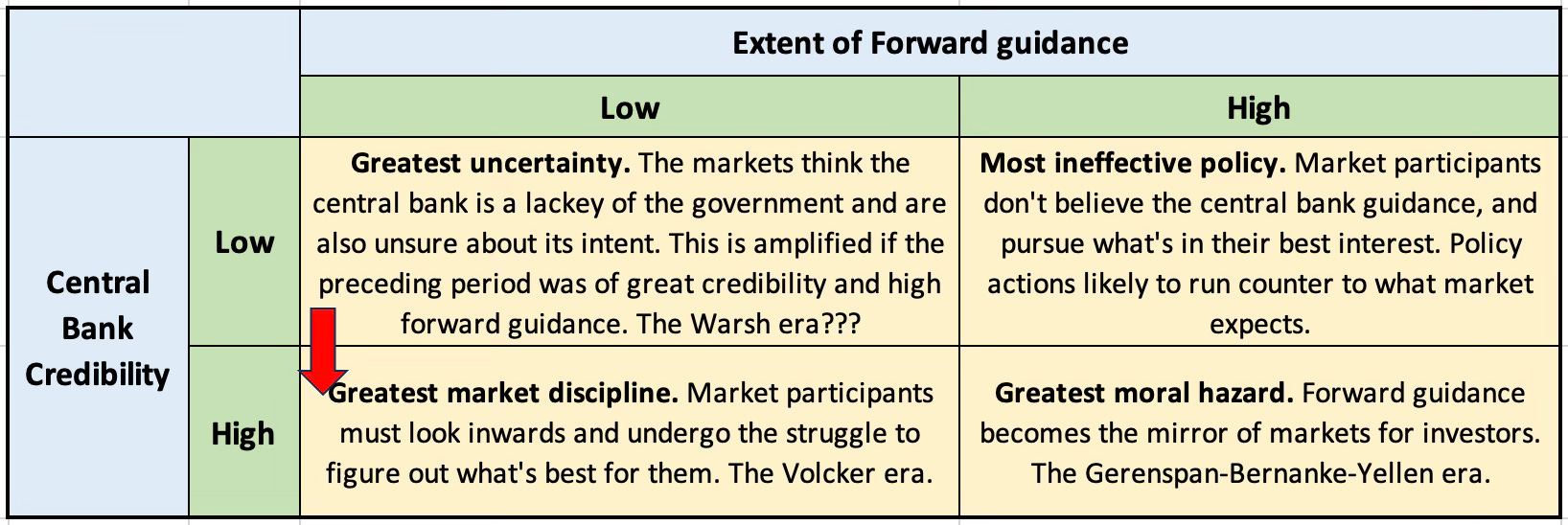
The high credibility and low forward guidance Volcker era is the golden quadrant. The central bank has earned trust through demonstrated willingness to act decisively, but it doesn’t tell you what it’s going to do next. Participants must do their own work to assess fundamentals, price risk properly, and build in uncertainty premia. Volcker’s Fed famously targeted money supply, not interest rates, and didn’t telegraph moves. The result was that markets had to think for themselves, and the discipline that emerged was real. Risk was priced because nobody could assume a backstop.

The Bernanke-Yellen era of high credibility coupled with a high degree of forward guidance ensured that the latter became the market’s mirror. When participants believe the central bank will do what it says, and the central bank tells them exactly what it will do, the rational strategy is to front-run the guidance rather than analyse fundamentals. The “dot plot” era, the “considerable period” language, the “whatever it takes” formulation created a world where the trade was to decode the Fed rather than decode the economy. The moral hazard is structural insofar as investors are rewarded for taking risk they don’t understand because the central bank has told them the floor exists.

The worst combination for policy effectiveness is that of low credibility and high forward guidance. The central bank issues guidance but nobody believes it. Participants pursue their own interests, and policy actions run counter to market expectations. This produces whipsaw where the central bank says one thing, markets price another, and when the policy actually arrives it dislocates rather than stabilises. One could argue the late-stage BOJ falls here (decades of forward guidance that markets progressively stopped believing).

Finally, the Warsh era tries to limit forward guidance but in a period of low central bank credibility, inducing a period of “greatest uncertainty”. Worse still, the transition itself amplifies the shock - moving from a regime of high credibility andhigh forward guidance (the post-2008 consensus) to one where both are removed simultaneously. The question to analyse is whether the Warsh Fed currently sits in the fourth quadrant.

There are four points to be noted.

First, the transition path matters enormously. Moving from the Bernanke-Yellen quadrant (high-high) to the Volcker quadrant (high-low) requires maintaining credibility while withdrawing guidance. This means the central bank must demonstrate through actions (not words) that it will do the right thing even when it doesn’t tell you what the right thing is. The Warsh challenge is that he has withdrawn guidance and may not yet have established credibility through a demonstrated willingness to act decisively against inflation. The risk is that he lands in the bottom-left quadrant (low-low) rather than the top-left (high credibility, low guidance).

Second, while I had blogged here listing forward guidance as an important channel in eroding market discipline, it must be noted that it’s not forward guidance per se that erodes discipline, but forward guidance combined with high credibility. Low-credibility forward guidance is merely useless. And high-credibility forward guidance is actively dangerous because it works too well, by substituting the central bank’s judgment for the market’s own.

Third, there’s a temporal asymmetry in credibility. Credibility is earned slowly (Volcker needed 2-3 years of painful rate hikes) but lost quickly (a single capitulation can destroy it). Warsh’s current position - rates unchanged while prices rise - coupled with the circumstances of his appointment (and the credibility problem it engenders) risks a credibility test analogous to Arthur Burns in 1972-73. If inflation accelerates and the Fed is seen as having waited too long, the move from “low guidance with emerging credibility” to “low guidance with low credibility” could be swift and self-reinforcing.

Fourth, this also highlights the less discussed aspect of policy making that involves shaping expectations. Once collective beliefs are formed and incentives aligned, it is very hard to reshape them. The Bernanke-Yellen response to the market tumult during and after the Global Financial Crisis, guided by the research works of Gauti Eggertsson and Michael Woodford, and Paul Krugman, may well have been required in its immediate aftermath. The mistake was to continue and institutionalise it as part of the regular central bank policy toolkit. Bernanke or Yellen, with their credibility, ought to have exited forward guidance once normalcy was restored. But instead, they chose to please the markets with this new crutch. It is a bit like subsidies - once offered, there’s no sunset. 

Monday, February 16, 2026

Preventing small recessions risks big recessions

It is said that periodic episodes of small forest fires prevent the big ones, and smaller avalanches prevent the big ones. On the same lines, it can be argued that periodic episodes of equity market corrections and small recessions prevent the bigger crashes and recessions. In each case, the small episodes clear out the excesses and fault lines that continuously develop in any system and prevent their accumulation.

However, for a variety of reasons, over at least the last two decades, central banks and governments in the developed economies, especially the US, have pursued policies that have sought to prevent even such small episodes. This has led to an accumulation of excesses in the dark corners of the financial markets and the economy, whose implosion may be only a matter of time. The likes of an AI-led investment boom can only postpone the inevitable. 

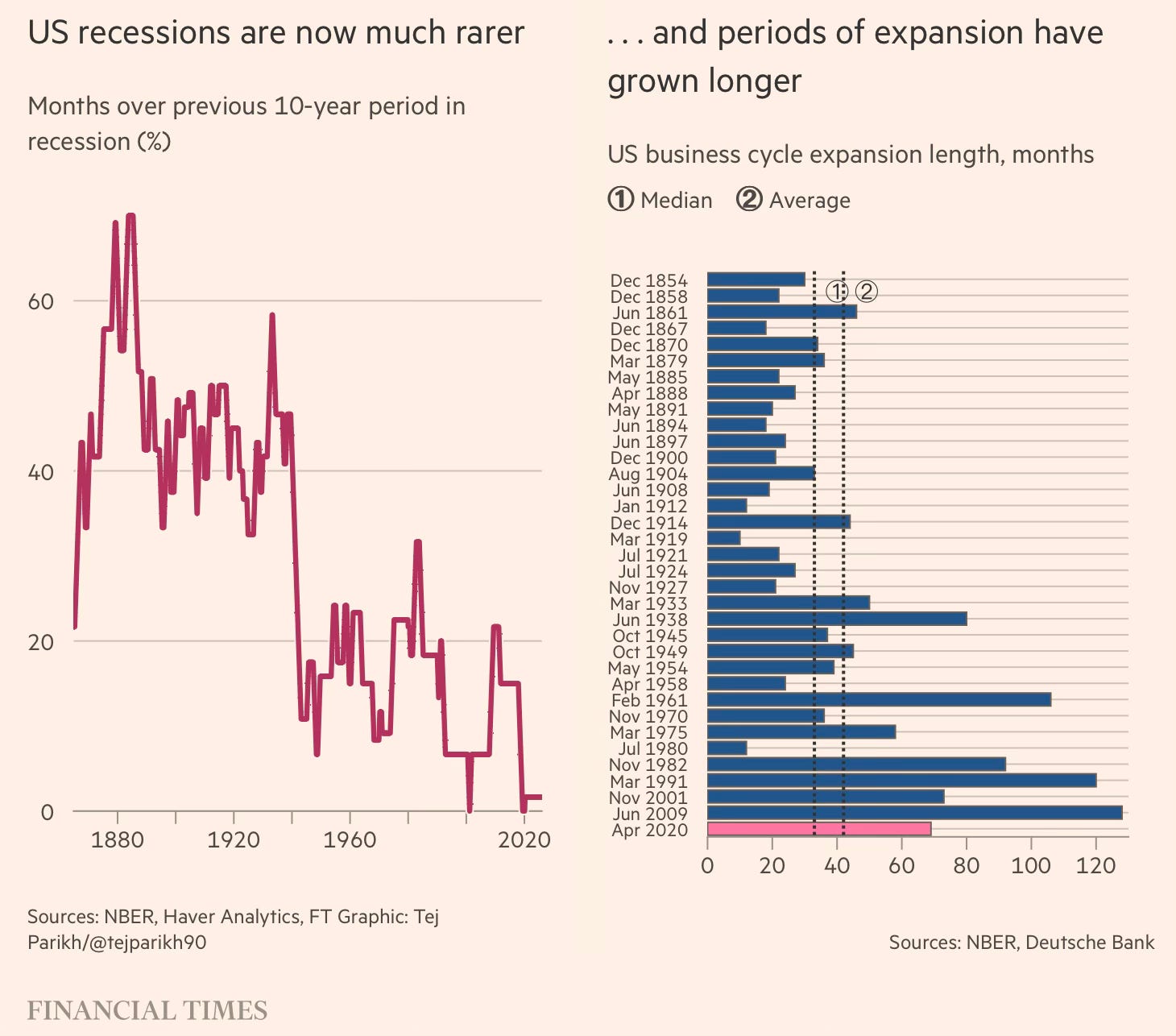
Tej Parikh has an excellent column which explains how an extended period of monetary and fiscal accommodation has contributed to plentiful cheap financing, eroded financial market discipline, kept zombie companies going, lowered business entry and exit, delayed recessions, and led to the accumulation of ever-increasing risks across the economy. 

Sample these statistics about the trends with US recessions. 

The US has only seen four recessions since 1982. But over the previous 40 years there were nine, and over the 40 years before that there were 10… The US economy was in recession for 58 months over the past five decades compared to 143 in the equivalent period prior, based on data beginning in the 1850s from the National Bureau of Economic Research… The past five cycles of US economic expansion — including the current one that began in the aftermath of the Covid-19 lockdowns — have averaged more than eight years, which is close to triple the average length of cycles before.

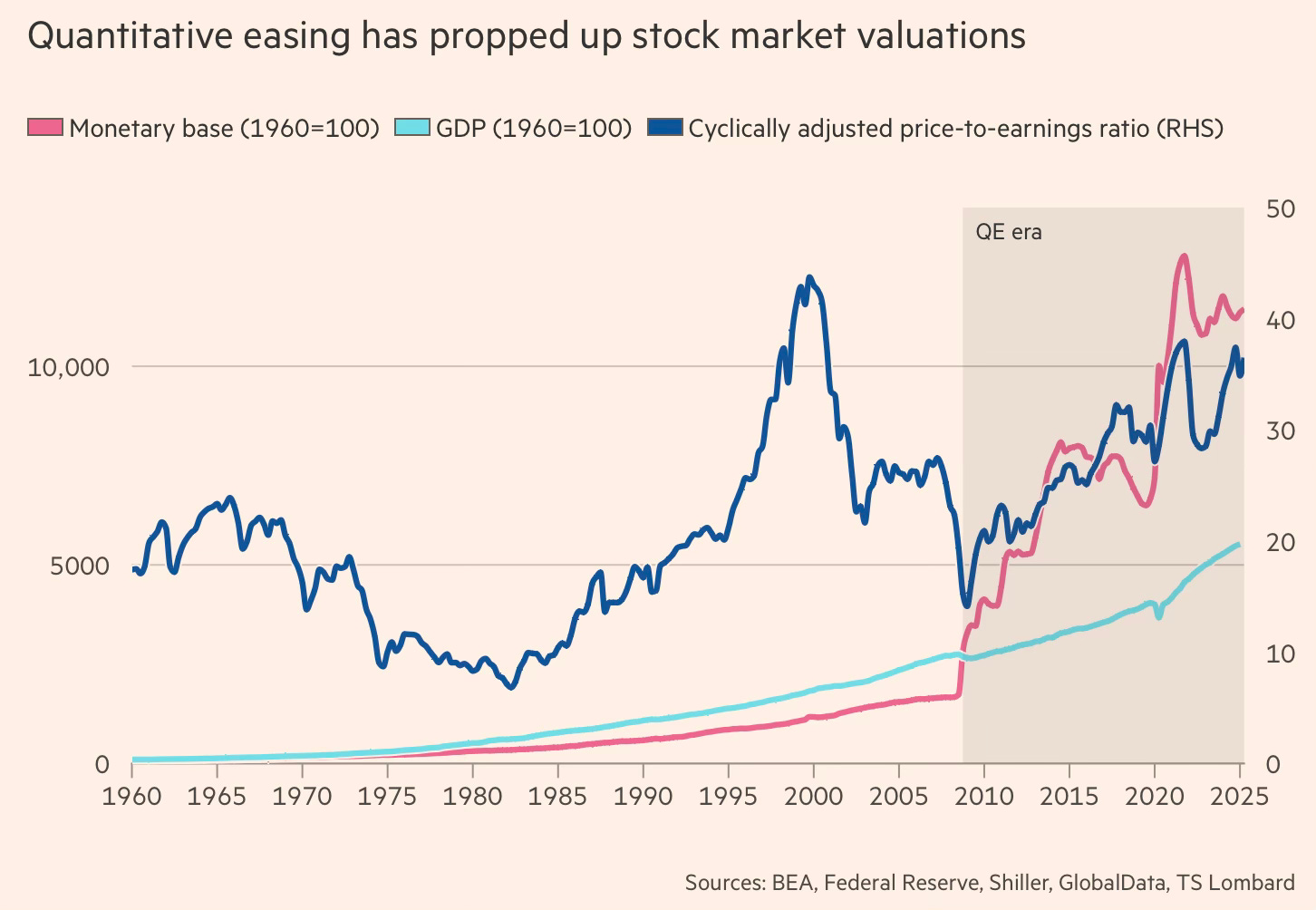
Thanks to quantitative easing, the US monetary base has expanded dramatically since the GFC, and equity market valuations have continuously soared. 

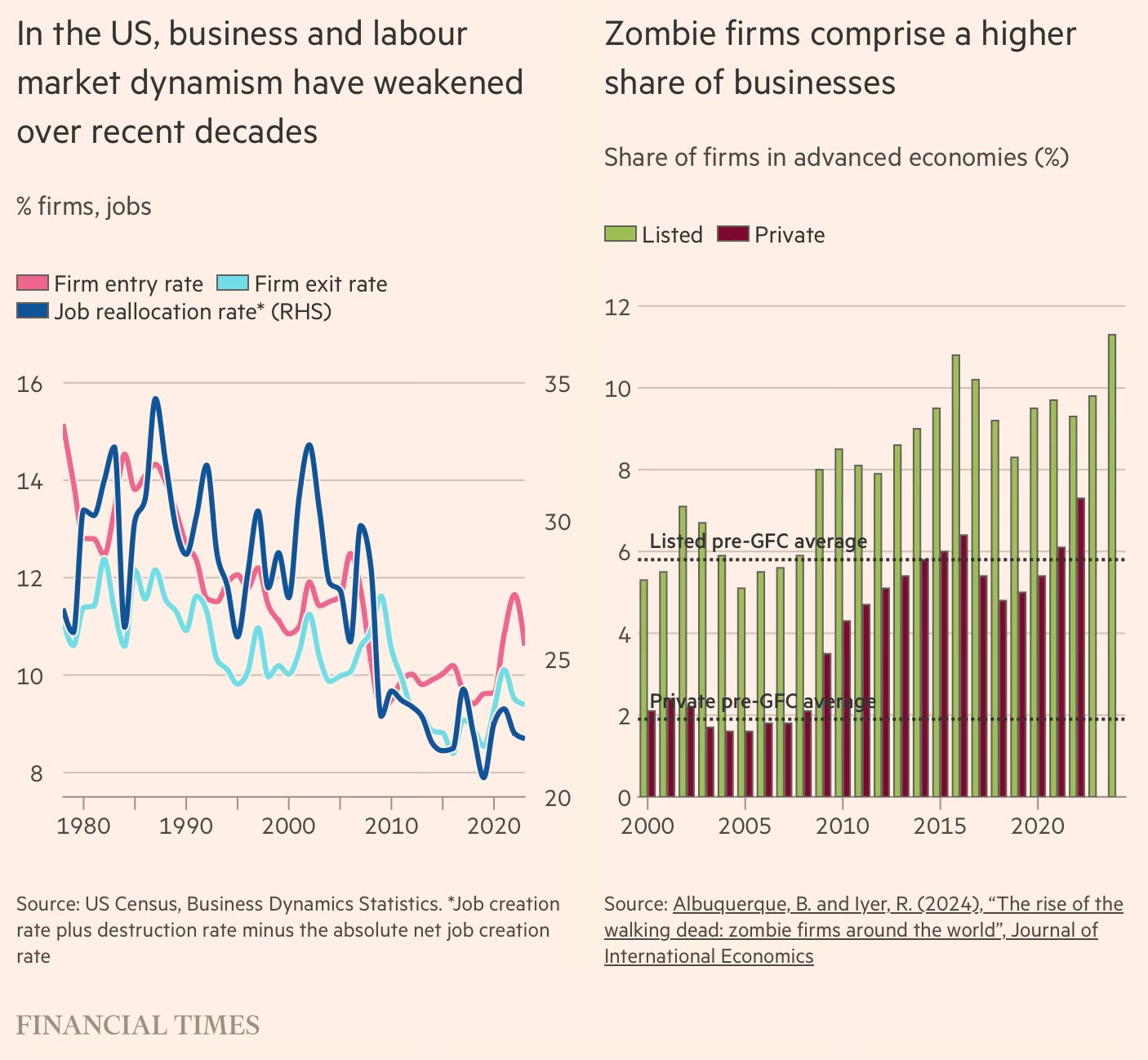
The extended period of cheap money has distorted incentives by misallocating resources, keeping capital and people locked up in less productive parts of the economy, keeping alive zombie firms and funds, and weakening economic dynamism. 

See also this graphical feature from Parikh on how economic dynamism is impeded by “statism, easy money, and risk aversion”.

It is useful here to step back and reflect on the role played by economic thinking. Economics has doubtless contributed to a better understanding of macroeconomic issues and the formulation of policies to address problems. In fact, it has played an important role in shaping the extraordinary period of human development and economic prosperity since the War. 

However, economic thinking has also resulted in many undesirable trends and distortions. Arguably, the most important trend of relevance to our times is the regime shift in monetary policy from one that sought to control inflation to one that balances inflation control with backstopping the financial markets and economic growth

While this regime shift in monetary policy is associated with the global financial crisis (GFC), it may have had its origins in the Greenspan put that emerged in the aftermath of the 1987 stockmarket crash. Since then, through a series of instruments, the scope and breadth of monetary policy actions have expanded continuously. It has been the big triumph of technocracy in economic policymaking. 

Interest rate changes have come to be supplemented with central bank balance sheet expansion through liquidity injection windows, quantitative easing, macroprudential measures, yield control actions aimed at long-term sovereign bond rates, direct purchases of corporate bonds, and forward guidance actions. 

What started as measures to ensure financial stability has now morphed into an institutionalised set of tools to backstop financial market declines, and thereby economic growth itself. There has been a wholesale reshaping of expectations among a generation of investors and market participants. This has resulted in a sharp erosion of the disciplining powers of the financial markets in capital allocation.

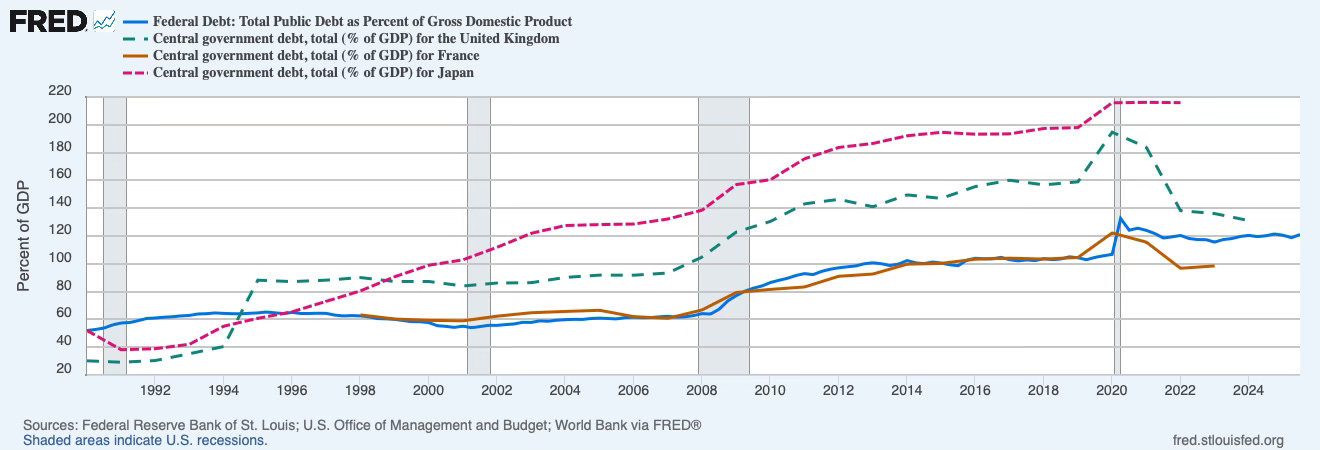
Economic thinking has emboldened governments on fiscal policy, too. The result has been the dramatic fiscal expansion, especially but not only since the GFC, as governments have run persistent large fiscal deficits to sustain economic growth. The US public debt to GDP ratio has nearly doubled since 2008. 

Worryingly, these actions have engendered perverse incentives among politicians and policymakers. A generation has come to believe that fiscal and monetary policy offers an unlimited arsenal of options to stabilise equity markets and prevent recessions. The ideological cover provided by economists, coupled with the rising applications of these tools with little apparent costs, has emboldened them. 

This is most evocatively captured in the unqualified “whatever it takes” assurance given by Mario Draghi, the President of the European Central Bank, at the height of the Eurozone crisis in 2012. It was followed up by the ECB in the 2012-15 period with its ‘Big Bazooka’ measures involving aggressive QE, liquidity windows, and reduction of rates to negative territory. He was merely following in the footsteps of Ben Bernanke during the GFC, and was followed subsequently by Jerome Powell during the pandemic meltdown.

Donald Trump’s arguments for lower rates must be seen against this backdrop. As a democratically elected leader, he is making a legitimate political choice of wanting to sustain high economic growth rates and continue the equity market boom. Further, never mind its consequences, he’s probably right in arguing that lower rates can help both political objectives, even if only for some time. Alan Greenspan, Ben Bernanke, Janet Yellen, Jerome Powell, and Mario Draghi made similar choices, especially in continuing monetary expansion far beyond what was required, to much acclaim and little pushback. Their decisions were accepted as technically correct choices. Donald Trump cannot be faulted for being upset at the apparent hypocrisy. 

The political pressures to keep rates low are supplemented by the emerging high stakes of the big technology firms leading the AI charge. The two have become intertwined, also because of the outsized role of the surging AI investments in economic growth in the US. Nobody wants monetary policy to rock the boat in these euphoric times of impending transformative change. 

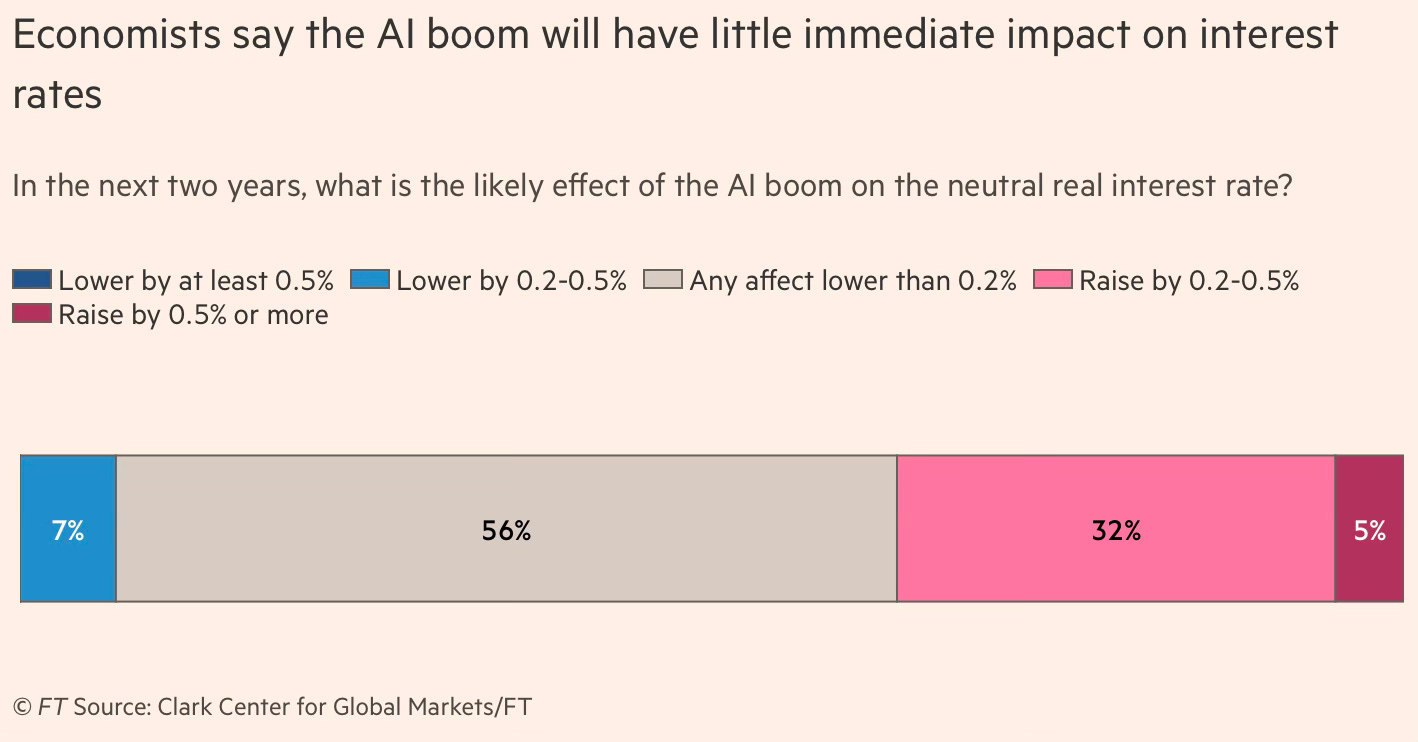
It is therefore unsurprising that Kevin Warsh, the incoming Chairman of the US Federal Reserve, has already indicated his bias towards monetary accommodation, arguing that the productivity boom likely from AI adoption will create the space for interest rate cuts. Warsh has claimed that AI will trigger “the most productivity-enhancing wave of our lifetimes — past, present and future”. Never mind that his fellow economists think otherwise, and argue that it could raise demand and price pressures, at least in the short-term.

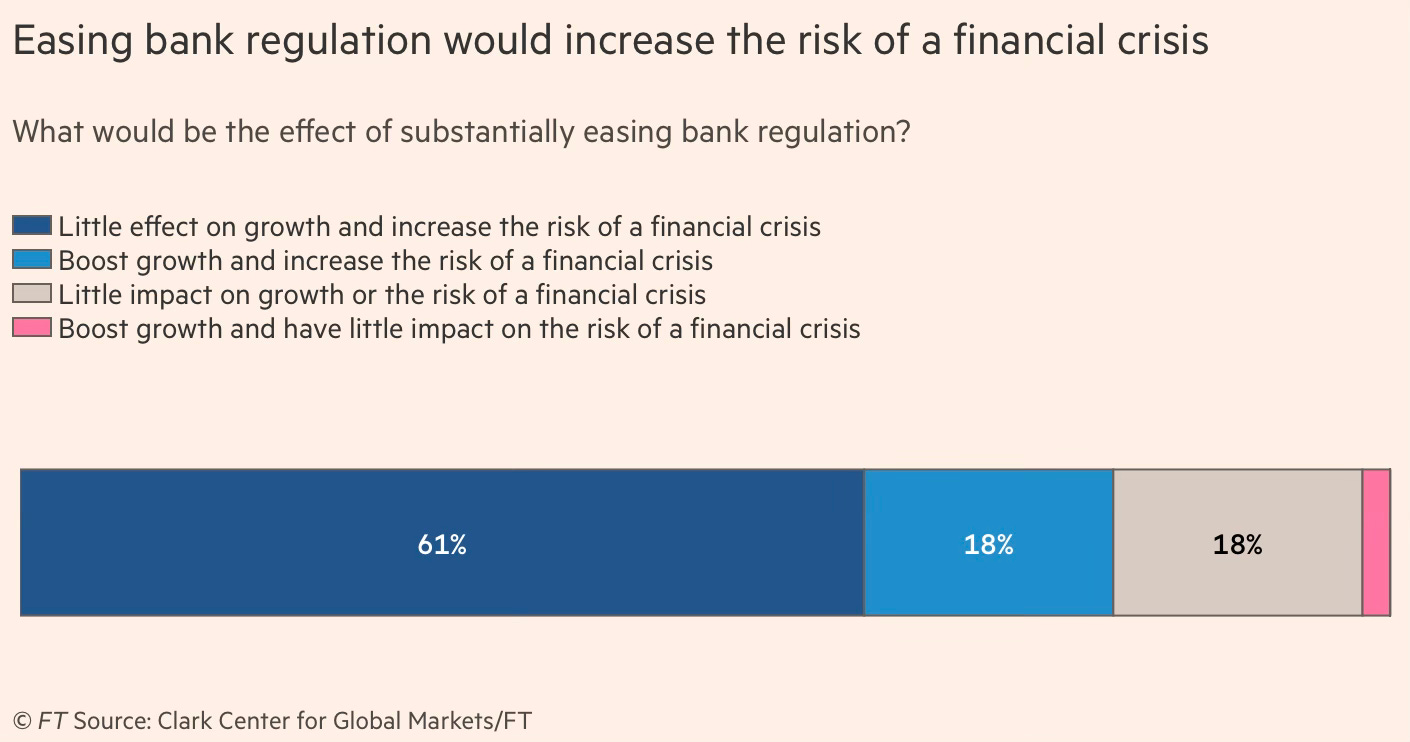
Interestingly, Warsh also argues in favour of easing bank regulation, another policy favoured by President Trump, whereas his colleague economists feel that it would increase the risk of a financial crisis. 

John Maynard Keynes famously said, “Practical men, who believe themselves to be quite exempt from any intellectual influences, are usually the slaves of some defunct economist.” It is equally likely that “defunct economists” are the slaves of “practical men” of the political variety. Kevin Warsh appears to be a likely candidate. 

A problem with economic arguments is that the discipline allows one to make conflicting arguments grounded in theory. It is not surprising that a frustrated Harry Truman famously demanded a one-handed economist. Sample this on the likely impact of the AI-boom highlighted by Robert Barbera of Johns Hopkins University.

“The AI boom may generate a booming economy, shrinking budget deficits, higher neutral interest rates and comfortable shrinkage of the Fed’s balance sheet. Or we may experience a financial market crack-up, a deep recession, a dramatic rise for deficits, eliciting a return to zero short rates, a swoon for the dollar, and demands for another big dose of [balance sheet expansion].”

Jason Furman writes about the complicated nature of the relationship between productivity and inflation.

Over the long run, productivity growth does not determine inflation. Productivity reflects the economy’s real productive capacity; inflation reflects monetary policy choices. But sustained faster productivity growth does raise the economy’s neutral real interest rate. To prevent inflation, central banks must therefore maintain higher nominal rates. The mechanism is straightforward. Faster productivity growth allows households to save less because they anticipate higher future income, while prompting businesses to invest more because expected returns rise. Both of these boost demand and push up real interest rates. In the short run, an unexpected acceleration in productivity can influence inflation, but the direction is ambiguous. 

Greenspan’s hypothesis was that higher productivity allowed nominal demand to grow faster without igniting inflation. Because wages adjust less frequently than prices, this initially showed up as slower price growth rather than faster wage growth. That dynamic may well have characterised the early years after productivity began accelerating in the mid-1990s. But there is a competing short-run effect that runs in the opposite direction. Anticipation of a sustained productivity boom can itself be inflationary, by lifting equity prices and household spending and by spurring business investment. At bottom, this is a timing race: does demand surge ahead of supply, or does supply expand fast enough to accommodate demand without inflation? In the late 1990s — just as today — there was no clear way to know in advance which would dominate.

Another Warsh preference is likely to be to steepen the yield curve by lowering short-term rates through lowering repo rates and raising long-term rates by winding back the Fed’s balance sheet. Martin Sandbu describes how the same set of policies can have contrasting effects.

It is not at all clear whether a steeper yield curve will by itself amount to a looser or tighter overall monetary policy stance. That depends on the relative moves at the different maturities, and how strongly they affect the economy — through exchange rate movements, market valuations and government borrowing costs at the short end, and through “real economy” financing costs such as mortgage rates at the long end. Warsh himself has intimated that the long benchmark Treasury rates are more consequential than short-term policy rates. I share this view. But it is clear that short-term rates matter a lot too. So the macroeconomic effects of a yield curve steepening go in both directions and it’s hard to be confident of the overall impact.

The larger point here is that in the US (and maybe elsewhere), the political acceptability of even small shocks has diminished significantly; economists have come to embrace hitherto unorthodox fiscal and monetary policy measures; and equity markets have become very high-stakes bets. The consequence of these trends is the postponement of smaller recessions and the accumulation of vulnerabilities that increase the risk of bigger recessions.

Saturday, February 14, 2026

Weekend reading links

1. Gig economy may create over a million jobs in FY26, taking the total workforce to 14 million.

According to data from TeamLease Services, ecom and qcom are likely to add nearly 1 million jobs this year, followed by the logistics and warehousing sector. Balasubramanian A, senior vice president, TeamLease, said: “Qcom and ecom are estimated to generate 900,000 to 1 million jobs as they expand into Tier-II, -III cities; logistics and warehousing are expected to create nearly 500,000 roles driven by new multi-modal parks and electric vehicle fleets.” A similar trend was evident last year (CY25) when ecom and qcom firms created 600,000 jobs, logistics players generated 400,000, and the banking, financial services, and insurance (BFSI) sector added nearly 200,000 new gig roles for field sales and digital verification. Similarly, data from jobs and career platform Apna, for financial year 2026-27, said that hiring is expected to be driven largely by qcom expansion into Tier-II and Tier-III cities with around a million jobs. Kartik Narayan, chief executive officer of jobs marketplace at Apna, said: “The top three sectors— qcom, retail, and logistics — will continue to dominate the space. Qcom would add nearly 1 million jobs and logistics may generate approximately 500,000-700,000 jobs.”

On wages

On whether an increase in demand will lead to a rise in salaries or incentives of gig workers, Apna said, “Salaries are variable payout given the job but are approximately between ₹12,000-₹25,000 with the mean being ₹15,000 for nearly 40 per cent of these employees. Gig worker payouts might remain flattish due to intense competition and any increase would be attributed to incentivising festival period delivery and other holidays than the actual pay-out per delivery.”

2. Sanae Takaichi wins the largest majority for the LDP in the 465-seat Japanese lower house since its formation in 1955, securing 310 seats in the snap polls. The result saw the Nikkei rise sharply and bond yield climb in expectation of increased borrowings to fund Takaichi's committed spending program. 

3. Contrary to all the talk of a declining US economy, investors are flocking to US assets.

Last year foreigners poured around $1.6tn into US financial assets, including nearly $700bn into stocks, both new records and significantly higher than the levels of recent years. The story is much the same for US corporate bonds, with foreign purchases up sharply... From Singapore to Seoul, they are staying up all night to trade on increasingly popular after-hours US trading platforms. Among the few foreigners sitting out this buying spree were central banks, which have been moving money from the dollar into gold... Foreign institutions alone now own nearly 15 per cent of US stocks, a record share and up by half from the level a decade ago... Notwithstanding all the America bashing, foreigners now own nearly $70tn in US assets, double the level a decade ago. And in the last year, most of those flows arrived as “hot money”. Foreign direct investment in factories and businesses, which cannot withdraw quickly, was much weaker than portfolio flows into assets such as stocks and bonds, which can reverse in an instant.

4. US plans tariff carve-outs to chip makers, especially the likes of TSMC, who make investments in the US. 

The size of the potential rebate programme would be linked to the recent US-Taiwan trade agreement. The White House has agreed to slash tariffs on imports from the island to 15 per cent in exchange for a $250bn investment in the chip industry in the US. Under the deal, Taiwanese companies including TSMC that invest in the US will be exempt from the forthcoming tariffs in proportion to their planned US capacity. The White House said it would allow Taiwanese companies building semiconductor plants in the US to import 2.5 times the new facilities’ planned capacity tariff-free during the construction period, according to an outline of the trade deal released by the commerce department. Taiwanese companies that have already built plants in the US will be allowed to import 1.5 times their capacity. TSMC would be able to allocate the exemptions it earns under the trade deal to its Big Tech clients in the US, allowing them to import chips from the company tariff-free. The size and scope of the rebates for US hyperscalers depend on the production capacity that TSMC forecasts it can reach in the US in coming years.

5. China is treating data as an asset.

In 2024, China became the first country to allow enterprises to classify data as intangible assets on their balance sheets. Beijing had already declared data a “factor of production” alongside land, labour, capital and technology. The National Data Administration now oversees dozens of data exchanges. China Unicom, one of the world’s largest mobile operators, reported Rmb204mn ($29mn) in assets in its first filing under the new rules. The motivation isn’t purely philosophical. Local government financing vehicles — the off-balance-sheet entities Chinese municipalities use to fund infrastructure — are drowning in debt. Some use data as collateral for fresh loans.

6. The rising Apple margins

7. Mirroring the changing trends, as EV sales slump across the US, EV battery plants are being converted into energy storage systems (ESS) for the surging demand to power data centres. Sample this
Tesla, which incorporates batteries from a range of suppliers including CATL and LG into its Megapack and Powerwall energy storage systems, reported that energy and generation storage revenues grew 27 per cent year-on-year to $12.8bn — up from $2.8bn in 2021, while its revenues from EV sales fell 9 per cent to $64bn. The shift to ESS has been accelerated by weakening government support for EVs, after the Trump administration slashed tax credits established in the Biden-era Inflation Reduction Act and moved to cut tailpipe emission rules and state clean-air standards intended to encourage drivers to switch to EVs... These policy rollbacks led analysts at BloombergNEF to revise down their forecast for EVs’ total share of 2030 car sales from 48 per cent to 27 per cent. EVs currently account for about 8 per cent of US new car sales. Stellantis is selling its 49 per cent stake in a battery plant just over the Detroit River in Windsor, Ontario, to Korean battery giant LG for just $100, after the European car group announced a €22bn writedown last week tied to its aggressive expansion into EVs. It had invested $980mn in the Windsor facility...
While the administration has cut consumer tax credits for EVs, President Donald Trump’s flagship One Big Beautiful Bill Act passed last year retained generous production credits for battery manufacturers. They include a $35 per kilowatt-hour manufacturing credit for battery production, and a 30 per cent investment tax credit for energy storage that will be phased out starting in the 2030s. The credits, along with US tariffs on Chinese energy storage batteries of close to 60 per cent, mean ESS cells can be produced in the US at prices close to parity with the Chinese imports that dominate the market.

8. Migrants make a disproportionately large share of successful US startup founders. 

Some 44 per cent of the 1,078 founders who created a US tech start-up valued at more than $1bn between 1997 and 2019 were born outside the country, according to a Stanford Graduate School of Business study. The top five grey matter exporters to the US were India, Israel, Canada, the UK and China.

9. AK Bhattacharya points to some facts about the Government of India's capital expenditure trends. 

Between 2005 and 2020, a period of 15 years, capital expenditure crossed 2 per cent of GDP only twice — in 2007-08 and in 2010-11... Between 2020-21 and 2024-25, she grew capex by 26 per cent on average every year... As a percentage of GDP, capital expenditure rose from 1.67 per cent in 2019-20 to 3.2 per cent in 2024-25... Interest-free 50-year loans to states... in 2020-21... accounted for only 2.8 per cent of the total capex outlay of the Centre. Over the years, this share has gone up and, in 2025-26, it was 13 per cent and is set to go up to 15 per cent in 2026-27... Almost 41 to 52 per cent of the government’s capital outlay is allocated to PSUs. In other words, the Union government depends not just on the states for executing its capex plan, but also on PSUs... almost half of the government’s capex is dependent on providing equity and loans to PSUs.

10. Martin Sandbu points to Michael Sandel's prophetic warning in 1996 in his book, Democracy's Discontent.

“To the extent that contemporary politics puts sovereign states and sovereign selves in question, it is likely to provoke reactions from those who would banish ambiguity, shore up borders, harden the distinction between insiders and outsiders and promise a politics to ‘take back our culture and take back our country’, to ‘restore our sovereignty’ with a vengeance.”

11. London has the lowest new housebuilding among all major cities in the world!

London has been set a target of building 88,000 new homes per year over the next decade. Last year construction started on just 5,891 — 94 per cent below target, a 75 per cent year-on-year decline, the steepest drop in the country, the lowest tally since records began almost 40 years ago and the lowest figure for any major city in the developed world this century... New starts by private developers were down 79 per cent over the past two years, compared with collapses of 85 and 94 per cent for affordable and council housing respectively, with work started on just 100 council-funded homes in 2024-25 by one estimate.

And rising costs due to regulatory changes are behind this. 

This is a good example of how well-intentioned policies to discourage foreign investors from buying up properties in London (and thereby squeeze out the local residents) may have had a perverse impact. 
Such investors are frequently blamed for worsening affordability, but a 2017 report led by the LSE’s Kath Scanlon found that these investors “had a positive net effect on the availability to Londoners of new housing, both private and affordable”, warning that “there would be real costs to the London housing market if overseas investment . . . began to feel unwelcome”. That is precisely what has happened over a decade of increased charges on owners of second homes and foreign investors.

This about the regulatory layers added in response to the 2017 Grenfell Tower fire. 

This has taken two forms: significant costs of upgrading existing homes to new standards, and the introduction of a new body — the Building Safety Regulator (BSR) — which has added a lengthy and exacting step between planning approval and starting construction, with inadequate resources quickly creating a logjam. This has placed a particular squeeze on the finances of affordable housing providers, who cite “additional costs and delays as a result of new building safety regulations” as a key reason for low build rates, leaving £120mn worth of council-funded homes on hold. Tens of thousands of provisionally approved homes in the capital are waiting on supplementary review by the BSR, which green-lights only a third of cases and takes an average of eight months to do so. These delays — at a point when developers have typically already poured large sums into a project — add huge financing overheads, in some cases expanding projects’ overall cost by more than 15 per cent. Adding to these are enhanced environmental regulations that are far more stringent than those in other European countries and levies requiring developers to invest in local infrastructure.
12. Tej Parikh has an excellent graphical summary that explains how the combination of an extended period of monetary and fiscal accommodation has led to plentiful cheap financing, eroded financial market discipline, kept zombie companies going, lowered business entry and exit, delayed recessions, and led to the accumulation of ever-increasing risks across the economy. 

Sunday, September 29, 2024

Weekend reading links

1. Changes in interest rates from June till 20th September 2024.

2. The long US equity market run.
3. This is the graphic on how inflation was tamed.
And this is the graphic on how monetary policy responded.
This raises two questions. How much did monetary policy contribute to taming the post-pandemic bout of inflation in developed economies? If inflation is tamed without pushing the economy into a recession, is it a success of the practice of monetary policy by the central banks?
Inflation across advanced economies exceeded 7 per cent in 2022 while nearing 10 per cent in emerging markets. As official interest rates surged in 2022, the World Bank was among the institutions flagging the risk of a global downturn. Analysis by Oxford Economics shows that of 42 rate raising cycles since the 1950s in the US, UK, Germany or the Eurozone, and Japan, those associated with recessions outnumber those without by two to one. Instead, the US has helped the world economy weather the synchronised rate-raising cycle unexpectedly well, with the IMF predicting global growth of a respectable 3.2 per cent this year. “This is a very different easing cycle than most other ones,” says Seth Carpenter, the global chief economist at Morgan Stanley who spent 15 years at the Fed. “Most other easing cycles happen because of recession.” The US economy is expanding at a solid clip, with the Atlanta Fed estimating this week that GDP growth will rise to about 3 per cent for the third quarter. The US labour market has lost some momentum as inflation has collapsed from a peak of about 7 per cent in 2022 to 2.5 per cent as of July, measured by the personal consumption expenditures price index. Demand for workers has cooled off at the margins as the unemployment rate has risen, but much of that increase has been driven by higher supply from rising immigration, economists say... 
Yannis Stournaras, governor of the Bank Of Greece notes that Eurozone inflation has fallen from 10.6 per cent in October 2022 to 2.2 per cent now. “We brought it down in just 18 months and managed to have a soft landing in the economy.” The fact that the ECB from mid-2022 could raise interest rates by an unprecedented 450 basis points within 14 months without pushing the economy off a cliff is remarkable, says Piet Haines Christiansen, a ECB strategist at Danske Bank. “Two years ago, most economists would have said that such a dramatic increase would result in a deep recession.” 
4. Fourteen countries and the European Commission have come forward under a Minerals Security Partnership (MSP) to finance critical minerals projects and thereby break the Chinese stranglehold on the market. 
The Minerals Security Partnership, a coalition of 14 nations and the European Commission, will unveil a new financing network at an event in New York on Monday as they try to ramp up international collaboration and pledge financial support for a huge nickel project in Tanzania, backed by mining company BHP. A joint statement due to be published on the margins of the UN general assembly says the network will “strengthen co-operation and promote information exchange and co-financing”. It lists 10 critical minerals projects that have already attracted support from MSP partner governments. Representatives of BlackRock, Goldman Sachs, Citigroup, Rio Tinto and Anglo American are scheduled to attend the meeting, amid a push to attract private investors and miners to invest further in the sector. Jose Fernandez, US under-secretary of state for economic growth, said a further 30 critical minerals mining projects are being evaluated by the MSP, as western governments race to secure the raw materials needed to make everything from electric vehicles to advanced weapons... The US, Australia, Canada, Estonia, Finland, France, Germany, India, Italy, Japan, the Republic of Korea, Norway, Sweden, the UK, and the EU are members of the MSP.

5. An important part of Candidate Trump's Maganomics 

A second term of Trump would see levies on imports supercharged to levels last seen during the 1930s following the passing of the landmark protectionist Smoot Hawley Tariff Act. After initially saying he wanted to impose 10 per cent tariffs on all imported goods, Trump has recently said they could be up to 20 per cent. For Chinese imports, he has talked about imposing a 60 per cent tariff. This month he said countries that planned to reduce their dependence on the dollar would also be hit with 100 per cent tariffs as punishment. Trump hopes the trade barriers will not only raise revenues, but lead to the restoration of US manufacturing...
If enacted, they represent a return to an era where substantial chunks of government revenue came from trade tariffs, rather than from taxes on people’s incomes and the profits of businesses... The Peterson Institute for International Economics think-tank in Washington calculates that 20 per cent across-the-board tariffs combined with a 60 per cent tariff on China would trigger a rise of up to $2,600 a year in what the average household spends on goods... PIIE senior fellows Obstfeld and Kimberly Clausing think that the maximum amount of additional revenue the administration can raise — by applying a 50 per cent tariff on everything — would be $780bn.

The Indian corporates have been deleveraging and their debt levels have fallen. But this does not mean investment will be forthcoming. The important thing for investment is expectations of market demand. 

Chinese officials are now combining the heft of state spending and financial support with top-down directives to buy local tech, particularly in semiconductors. Late last year state buyers were directed to phase out computers powered by American processors. Since implementing the directive in March, central agencies have transitioned from exclusively purchasing laptops running on Intel and AMD processors last year to now acquiring three-quarters of their devices with chips from Chinese companies such as Huawei, Shanghai Zhaoxin and Phytium, according to public records. Huawei’s Qingyun L540 has won a majority of the orders. What kicked off as a campaign to cut foreign tech products out of the offices of governments and state-owned groups has gradually expanded into a wider array of products. Automakers, including major European groups that produce cars in joint ventures with Chinese state-owned firms, have been directed to step up their use of domestic semiconductors, according to four people familiar with the matter. Two of the people said they had been given a target to use Chinese chips for 25 per cent of the total by next year, though there were not yet consequences for failing to do so.

8. A debate rages in Australia on a Parliamentary vote to reform the Reserve Bank of Australia and establish a dedicated monetary policy Board within it to decide on interest rates. The vote has left parties sharply divided with the Greens' demand being the most interesting. 

But the Greens said this week they would only support the bill if the government used its powers to override the RBA and force it to cut interest rates — or if the bank did so of its own volition — arguing that monetary easing was necessary to help renters and mortgage holders. Both major parties derided the Greens’ proposal, saying that forcing the RBA to cut rates would undermine its independence. “They’re economic terrorists and you can quote me on that,” Taylor said at the prospect. Prime Minister Anthony Albanese said on Monday that acceding to the Greens’ demand would amount to undermining the independence of the central bank in order to pass legislation strengthening its independence. But the Greens questioned why the central bank should be treated as “above politics”. “The RBA board are not infallible high priests of the economy who are above criticism,” said Nick McKim, a Greens senator. On Tuesday, the RBA board kept its key cash rate at 4.35 per cent for the tenth straight month, saying it maintained its view that inflation was not yet under control.

9. Interesting article on the topic of walkability-workability from metro to office in Tokyo.

In a September 10 note to clients, Goldman’s real estate analyst, Sachiko Okada, took a look at office relocation trends within central Tokyo, overlaying that with a calculation of average walking distances between offices and the nearest station — a metric commonly used in Japan’s commercial and residential real estate markets and pivotal in a metropolis where the overwhelming majority of commuters travel by rail. Okada’s analysis comes at a time when the five innermost wards of Tokyo have never looked so frenetic, with Godzilla-scale office construction in prime locations. Around 1.2mn square metres of new space is due to come on to the market in 2025, she says... But the issue, as ever, is location. For offices within Tokyo’s five central wards, the average walk from a station is a breezy three minutes 42 seconds, with 64 per cent within the four-minute walk zone that even the heaviest-footed sloth cannot grumble about. But a significant amount — roughly 7 per cent — lies outside an eight-minute walk. Back in the days where Japanese companies were routinely able to make staff feel grateful to have a job, and surveys showed far higher ratios of people prioritising their work over everything else, that was less of an issue.  But now, with priorities shifting, labour more willing to quit and companies increasingly unable to meet their staffing targets, proximity to stations is yet another battleground in the war to attract and keep good staff.

Just 7% of work commutes in Tokyo falls outside the 8 minute walking time from metro to office!

10. Global EV sales have stagnated this year.

11. Coffee chains in India.

Monday, September 2, 2024

Thoughts on India's inflation targeting debate

There’s a debate in India on whether food prices should form part of the inflation index that the Reserve Bank of India uses for its inflation-targeting monetary policy regime. The current IT regime has a CPI (Combined) inflation target of 4% with a band of 2-6%. 

There are at least two reasons for arguing against keeping food out of the headline index. One, food inflation is caused mostly by supply-side factors like rainfall and other weather patterns that demand-side measures cannot influence. Worse still, monetary policy tightening in response to such supply shocks can compound the problem by acting as a pro-cyclical measure. Two, keeping interest rates high in response to inflationary pressures driven by food prices has adverse economy-wide impacts. 

These are universally valid arguments and have been made for long by those who oppose having food prices included in the CPI index. In general, there has always been a well-founded concern that interest rate hikes are blunt when faced with price increases resulting from supply shocks like weather, pandemics, wars etc. 

A nuanced reason for keeping out food components is that it betrays a bias against farmers. While higher prices hurt consumers, it must be acknowledged that it does benefit farmers as producers. To this extent, the presence of food prices in the index (and consequent actions to bring them down) ends up hurting farmers. There’s an asymmetricity in this response given that monetary policy does nothing to stabilise the prices upwards if food price inflation is negative. 

There’s merit in this argument since there’s enough evidence that the Indian farmers suffer from adverse terms of tradewhich is exacerbated by government policies like bans on imports, exports, open market sales etc. And now monetary policy adds to the set of such policies. This becomes especially relevant to agriculture crops which are prone to very high price volatility over the years. 

However, there are several reasons to take these arguments with caution. For a start, there’s a large body of evidence that points to the strong causal link between inflation 

A very good case against any modification to the inflation index used by RBI is made here by the RBI economists themselves, and here. In fact, the RBI report shows how food inflation has come to have an increasingly high role in inflation expectations. 

Besides, there are other empirical arguments to stay the course. Consider this analysis by Tulsi Jayakumar of the monthly CPI and food inflation data for April 2014 to July 2024.

We found that CPI inflation exceeded 6% in 34 of the 124 months studied (27% of the time), while in two months it was less than 2%. On the other hand, in 52 of the 124 months (42% of the time), food inflation was above 6%. Notably, in 20 months, food inflation was below 2%, of which seven months recorded negative inflation, while 13 months recorded positive but under 2% inflation… A more granular analysis reveals that food inflation was actually below the CPI-C rate in 64 of the 124 months, while in one month both were the same. Thus, in 52.4% of the months, food inflation remained equal to or below the retail rate, with the peak negative deviation taking a value of (-)4.01 percentage points; and 59 of the 124 months had food inflation exceeding the general rate, with a peak positive deviation of 4.8 points.

These figures show that food inflation has not been wildly distorting the CPI inflation data. It also underscores the tight relationship between CPI and food inflation. 

The analysis also points to the dissonance between inflation and inflation expectations (median three-month ahead and median one-year ahead between December 2015 and July 2024) in India and how it could widen further if the food component is removed from the inflation index used in IT.

Interestingly, even in the months when food inflation was negative, inflationary expectations (for both time spans) were significantly higher than actual inflation. For instance, in June 2017, when current inflation was 1.46% and food inflation was -1.17%, inflation expected three months ahead was 7.5% and one-year ahead was 8.6%—5.1 and 5.9 times the actual rates. From December 2015 to July 2024, the average three-month ahead inflationary expectation has been twice the actual inflation, while the average one-year ahead expectation has been 2.2 times actual inflation… While inflation has moved away from the 2-6% target band’s upper limit set under India’s inflation-targeting framework only 27% of the time, inflationary expectations have remained ‘unanchored’ throughout this period, with expectations hovering above 7.2% and 7.9% respectively on both time-ahead scales. Over the span of December 2015 to July 2024, peak inflationary expectations for the three-month ahead and one-year ahead period touched 12.3% and 12.6% respectively. A central bank monetary policy that disregards food inflation, which so clearly drives inflationary expectations, will not be seen as credible, which could lead to those expectations getting unanchored even more. This would risk setting off a vicious cycle of high inflationary expectations followed by higher trend inflation.

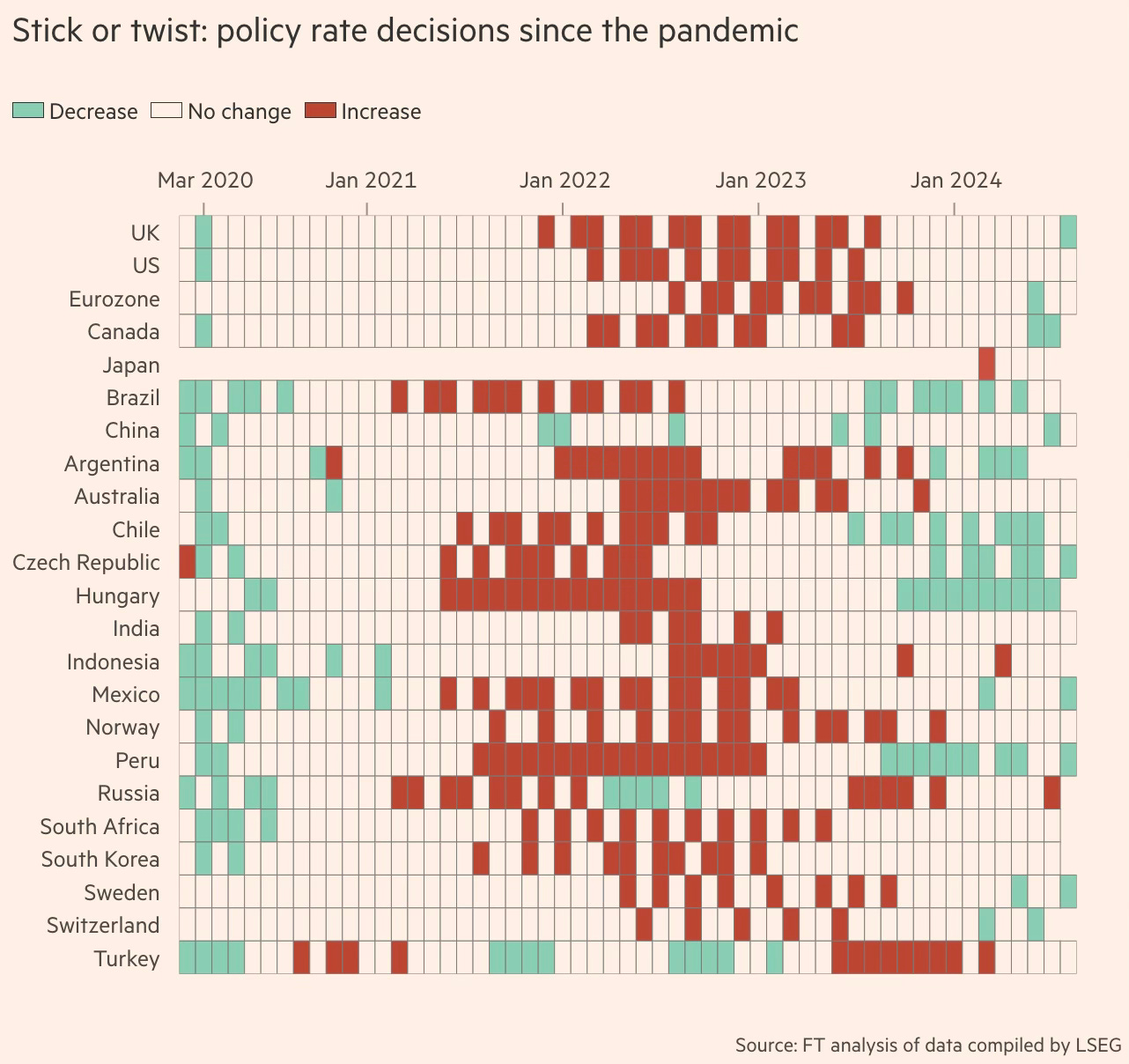
A second illustration shows that since the pandemic, apart from the Bank of Japan and the Swiss Central Bank, the RBI has undertaken the least number of interest rate changes. And rate hikes too. 

While it’s arguable as to what’s responsible for such strongly anchored inflation, clearly the RBI’s current IT regime has been associated with remarkable monetary policy stability during the tumultuous period during the pandemic and its aftermath. 

In addition, there are a few other points worth considering in favour of retaining the food components in the inflation index used for IT. 

1. In a lower middle-income country like India where the vast majority of people survive at subsistence incomes, where at least 40% of the consumption basket consists of food, it’s important that governments keep food prices stability as a top priority. And the CPI inflation index is the salient indicator of inflation that feeds into public debates on price trends. 

It’s therefore important for the political economy that that component of price level trends that impacts people the most is captured in the central policy framework that engages on the issue of inflation. 

2. The theory of adaptive expectations informs that current inflation (and other macroeconomic trends) shape people’s expectations about future inflation. The increasing price levels as felt by consumers, irrespective of their source, will feed into inflation expectations. And if the price levels rise on the largest component of the consumption basket, it inevitably shapes expectations.

3. The classic pathway for inflationary expectations to take hold is the wage-price spiral. People feel the pinch of the rising costs of their consumption basket and demand higher wages. Irrespective of whether the CPI index consists of food or not, if the consumption basket feels inflated then it sets the stage for the wage-price spiral. 

The reasons posited in the second and third points are empirically borne out in the vast body of research that explores the links between food prices and core inflation. In conclusion it can be argued that food consumption being essential is inelastic, and also forms a very large share of the Indian consumer basket, and therefore any food price increase invariably leaks out as economy-wide inflation.

It’s important to eschew any quick fixes and wish away the challenging struggle for price stability. A lower inflation figure achieved by stripping out the food component cannot overlook the reality of rising prices impacting the major part of the consumption basket for the vast majority of Indians. Likewise, it cannot also be used as the fig leaf by the central bank to lower rates. Any temporary relief achieved by such means is only likely to create bigger problems ahead. 

In any case, the RBI is a professional technocratic institution. It clearly understands the limitations of using interest rates to dampen price rises arising from supply shocks. It does not pursue monetary policy based on a mechanistic application of headline rates into an objective function. It uses the collective judgment of the MPC on its interest rate decisions. It considers the contributors of inflation and its impact on the economy-wide aggregate prices, and whether interest rate decisions can influence those contributors (like with inflation arising from supply shocks). 

For this reason, there is a distinction already existing between headline and core inflation levels. Central banks like the RBI consider the trends on both inflation indices while making decisions. 

None of the arguments here should be taken to mean that there’s nothing wrong with the current IT regime nor it should not be tweaked at the margins. The short point is that deleting the food components from RBI’s IT regime may not be advisable.