Substack

Showing posts with label Debt. Show all posts

Wednesday, September 2, 2026

Resolving the public debt pile facing the developed world

Public debts have soared among advanced economies, with the US leading the way. Their sustainability is now a big risk and casts strong headwinds on economic growth. 

The repercussions are already being felt in the sovereign bond markets, including in the safest of assets, the impregnable US Treasury markets. 
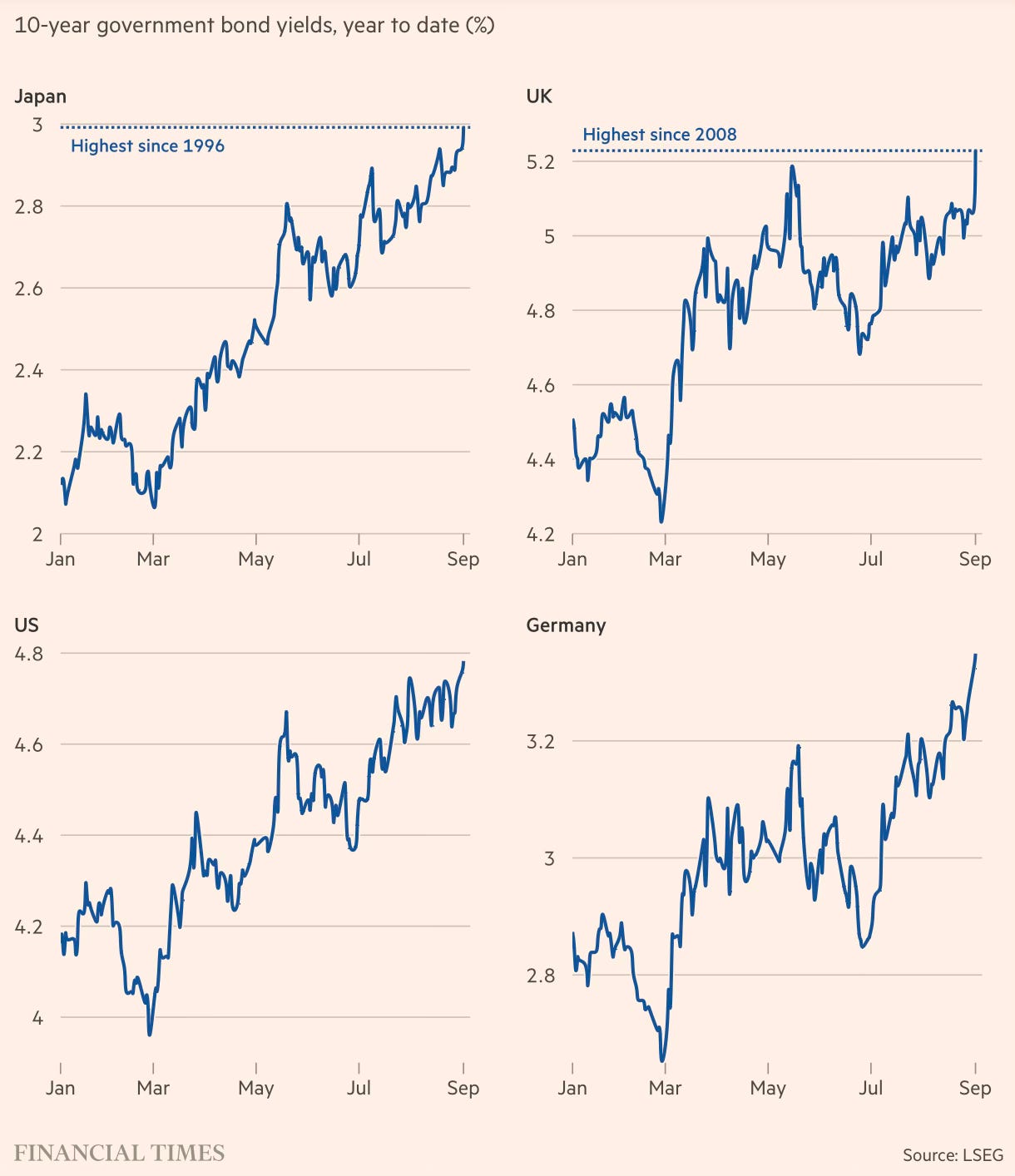
The response, especially the recent actions of the US Treasury, arguably even encroaching into the Fed’s domain, to prevent bond yields from rising are extraordinary. It first announced a temporary swap of the Bank of Japan’s Treasury holdings for dollar cash to pre-empt any liquidation to generate the dollars required to prop up the Yen, and followed up with an announcement to double the purchases of Treasury bonds. More are likely to follow in the months ahead, especially with a President who has announced his intent to wage war against the bond markets

Chris Giles has an excellent description of America’s ongoing debt surge.

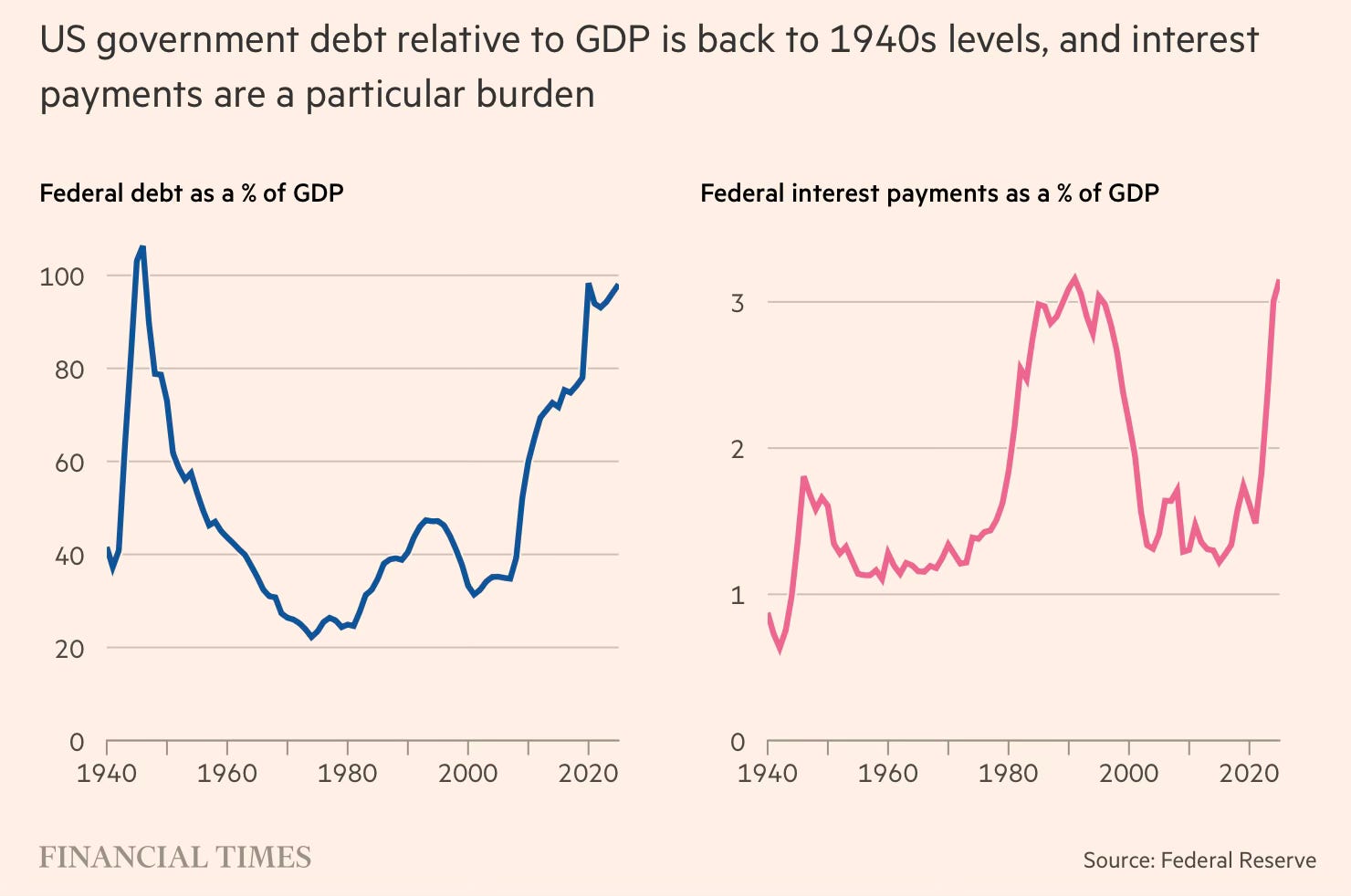
The most relevant measure of US federal government debt, that held by the public, has risen from $3.4tn in 2000 to $32.3tn now, or a rise from 33.7 per cent to more than 100 per cent of GDP in just over 25 years. More importantly, the burden of servicing that debt has doubled, from 11 per cent of tax revenues in 2000 to 21.5 per cent in the first 10 months of the current fiscal year… With the US on a path to continue running deficits close to 6 per cent a year, even at full employment, the debt-to-GDP ratio is set to rise every year, increasing the call on tax revenues to service that debt and the pressure on the Fed to lower interest rates… 

Since 2000, when the federal government ran a surplus of 2.3 per cent of national income, primary public spending (excluding net debt interest) has risen from 15.5 to 19.9 per cent of GDP. All of this increase can be accounted for by spending on services for an ageing population — social security, Medicare and veterans’ programmes. On the tax side, revenues have fallen from 20 per cent to 17.2 per cent of GDP over the same period, partly a result of a cyclical peak in revenues at the end of the last millennium and partly the result of tax cuts. First came the Bush tax cuts, which were made permanent on a mostly bipartisan basis during the Obama administration, and then came the 2017 Trump tax cuts… It does not need to eliminate the deficit, but does need to put debt back on a downward path, which almost certainly requires a balanced primary deficit — a metric that excludes net interest costs — something the US has not achieved since 2007 and not on a sustained basis since the 1990s.

The combined debt held by the public and federal agencies in the US now touches $36 trillion. The US interest bill has doubled to more than 3% since 2021, and the fiscal deficit is running at nearly 6% of GDP with little prospect of declining anytime soon. 
America does not stand alone. Since the Second World War, as welfare states took hold, public spending as a share of GDP has risen steeply across the developed countries. Further, since the seventies, public debt as a share of GDP has been on a similar upward trend. 
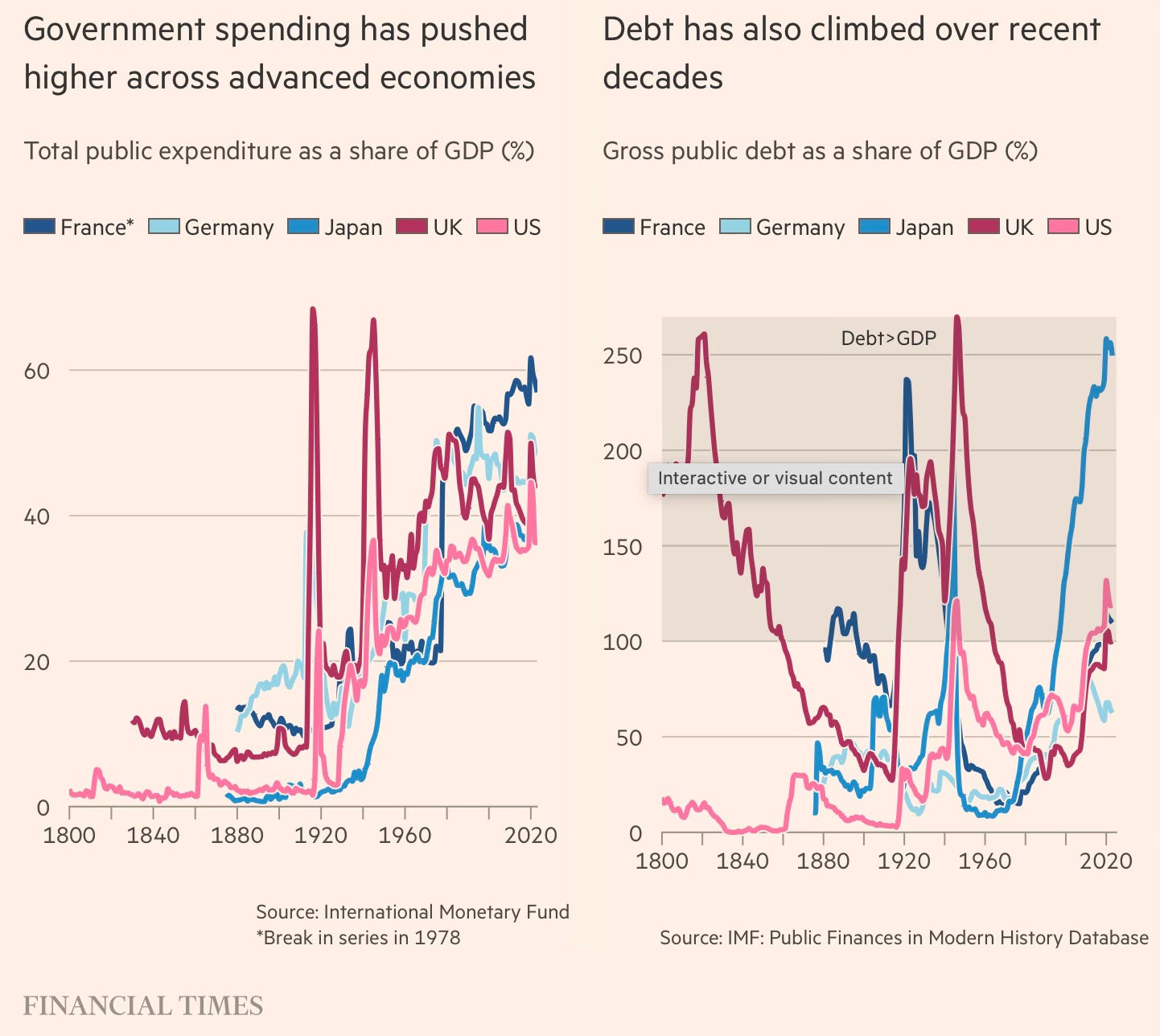
Welfare spending has been rising, and subsidy policies have ratcheted up since the global financial crisis. 
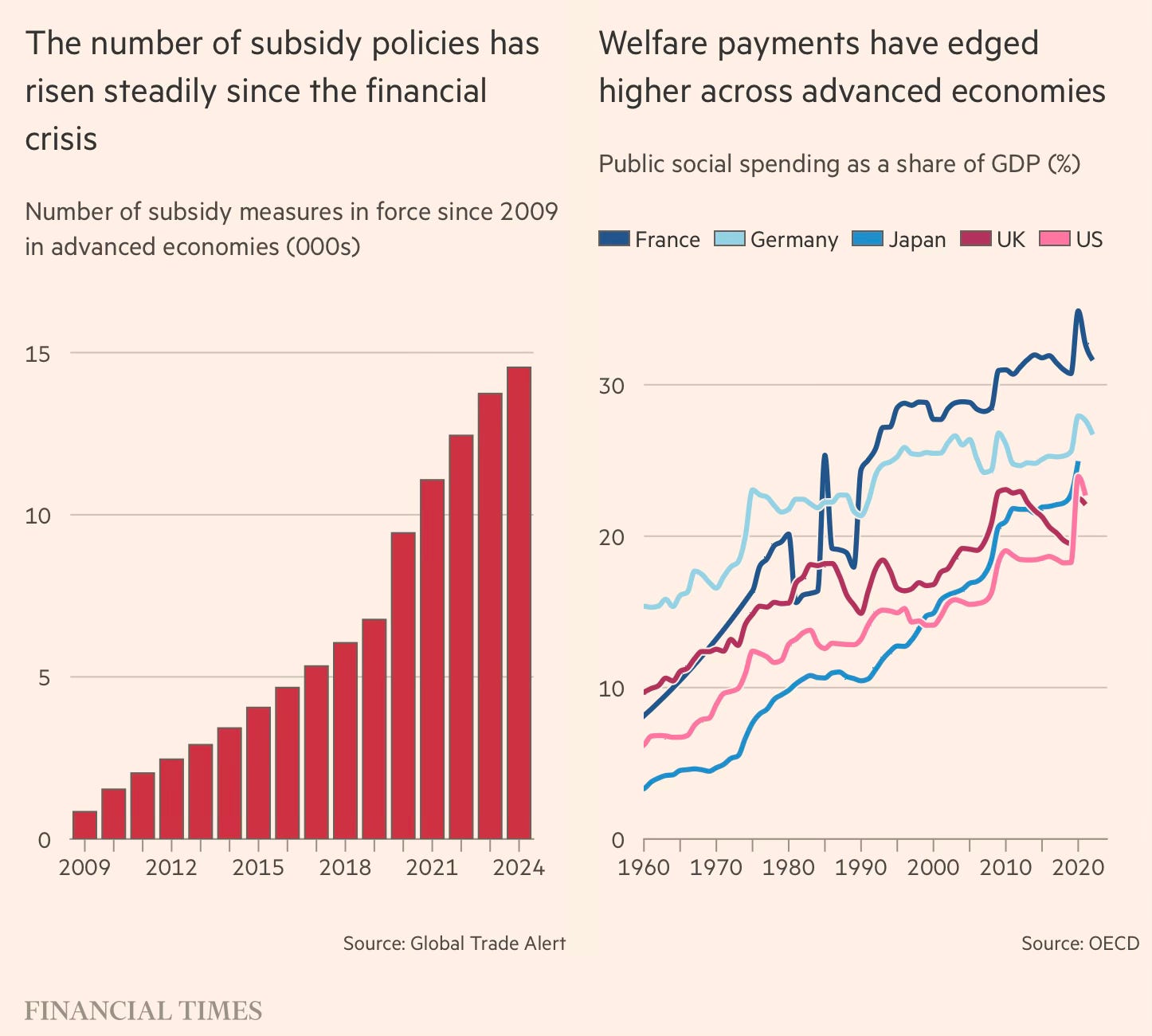
This increase in public spending and borrowings is a political choice made in response to rising expectations from governments among the electorate. 

For measure, in the US, net positive mentions of government support — covering welfare and protectionism — in Democratic and Republican party manifestos have trended higher since the early 1970s, based on calculations from the Manifesto Project’s database. In particular, these mentions have surged since the GFC. This suggests politicians are increasingly pitching policies that extend state assistance to appeal to voters. In the UK, the National Centre of Social Research reported in 2023 that expectations for government to keep prices under control, reduce income differences and provide industry with the help it needs to grow all reached a record, based on the British Social Attitudes survey. Indeed, curbing support hasn’t been easy for governments either. Britain’s Labour party was forced to reverse over £5bn of planned cuts to welfare spending. French politicians are also struggling to agree on how to cut expenditure, given the inevitable pains on the public.

A similar expectation cycle has been set off in the financial markets on monetary policy under the watch of technocratic central bankers like Ben Bernanke and Mario Draghi. These cycles have come to reinforce each other. 
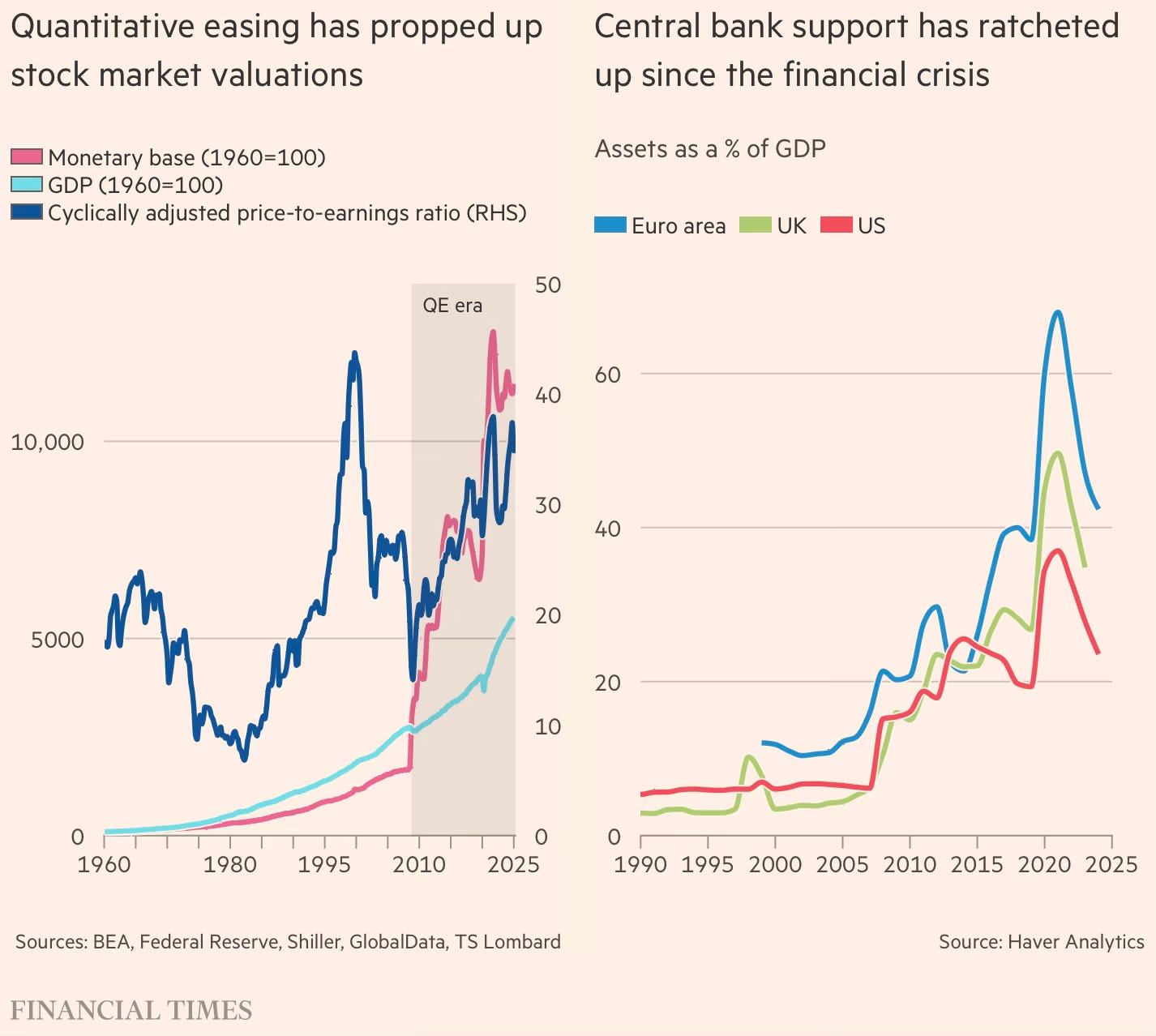
A May 2024 paper by John Cochrane and Amit Seru, senior fellows at the Hoover Institution, concurs. It argues that the expectation of central bank support whenever conditions deteriorate inflates stock prices, fuels leverage and, in turn, raises risks of a self-reinforcing monetary policy intervention and taxpayer-funded bailouts. Central banks have also been cautious about unwinding their QE holdings too quickly, fearing market convulsions. This has left their balance sheets elevated, creating a structurally higher liquidity base in the financial system that props up valuations and market activity today.

The rising indebtedness has close historic parallels. In an FT interview, Thomas Piketty pointed to the experiences of European countries in the 19th and 20th centuries. 

We have a long history of public debt in France and Britain. Britain had more than 200 per cent of GDP of public debt in the 19th century. In the case of France . . . after each of the world wars, it was between 200 per cent and 300 per cent. The good news is that we’ve always found ways to get rid of it, and in each of the three instances I’m referring to, through different mechanisms, it went down to very little — less than 20 or 30 per cent GDP in a few years. It was never repaid, in effect, as opposed to the British solution in the 19th century, where it took basically one century of budget surplus between 1820 and 1914 to reduce the public debt coming from the Napoleonic War period… 

The British approach of the 19th century corresponded with a very aristocratic political system where basically one tier was in power and they wanted taxpayers to reimburse them. Was it the best way to prepare the country for the 20th century? I’m not completely sure, because in effect there was more money put into interest payments than money invested in education. And Britain lagging behind in education with respect to the US or even with respect to Germany or France in the 20th century is the number one explanation for a British decline. I would not recommend doing the same in the future… The most successful experience with large public debt is probably Germany after [the] second world war, where they had this exceptional tax on private wealth which raises a lot of money. This contributes a lot to the reduction of the public debt without any inflation. Of course they were traumatised by inflation in the 1920s, so they didn’t want inflation anymore. The other way, of course, is through inflation, which is a wealth tax on the poor, typically.

A major reason for the surging debt stock since the turn of the millennium has been external wars. It has been estimated that the total cost and future obligations of the post-9/11 wars are about $8 trillion in 2021 dollars, excluding future interest costs on the debt. To put all this in perspective, “the US defence budget in 2025 was over $900bn, equivalent to 35 per cent of total global defence spending and more than three times the defence budget of China, the next most powerful military actor.”
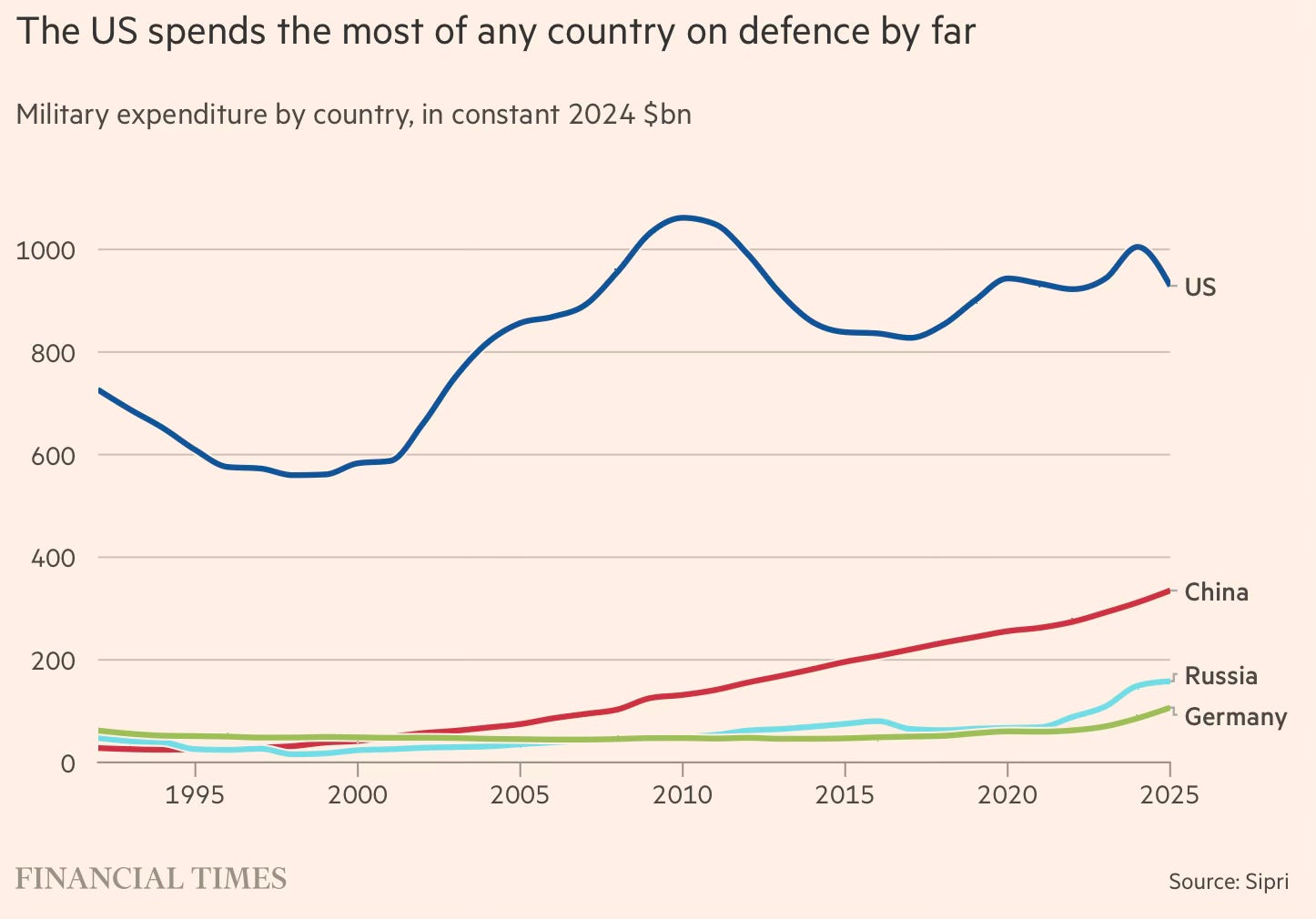
Despite this, the dollar has continued to hold reasonably steady. The exorbitant privilege has ensured the dollar's status as the world's pre-eminent reserve currency and the Treasury market's role as the world's safest haven asset, thereby allowing the US access to unlimited global capital at a low cost. While there are no competitors to the dollar on the horizon, the Treasury's safe-haven status is facing competition. 

For one, the central banks, which accumulated reserves by buying up 63% of the extra debt issued by G-7 governments in 2008-21, are now unwinding their balance sheets by running down the dollar component of their reserves. They are instead pursuing alternatives like gold, commodities and the more liquid currencies of smaller developed countries like Switzerland. As William White has pointed out, this has created vulnerabilities

Indeed, a report by the European Central Bank showed this week that gold had now replaced US Treasuries as the world’s top reserve asset. By the end of last year bullion accounted for 27 per cent of all global central bank reserve assets, up from 20 per cent a year before. Treasuries fell from 25 to 22 per cent over the same time. This leaves a gap that has been substantially filled by hedge funds, mainly American owned but often counted as foreign investors because of their bases in tax havens such as the Cayman Islands. Many own Treasuries as part of highly leveraged “relative value trades”, financed by short-term borrowing that has to be constantly rolled over. 

William White, former chief economist of the Bank for International Settlements, points out that this works well — until it does not. White argues that the purchase of government debt by non-bank institutions such as hedge funds depends in turn on their access to short-term financing such as the repo market. He adds: “Should any disturbance interrupt that access, as in March 2020 [during the Covid-19 pandemic] or April 2025 [when Trump announced swingeing tariffs], an intense deleveraging spiral could easily follow.” Recent shocks from hedge fund margin and collateral calls have made the Treasury market more fragile and a potential source of systemic risk.

And there’s more. 

White also worries about fiscal dominance — a phenomenon in which the central bank cannot raise interest rates to meet its inflation target because of the punishing servicing cost of high, short-term public debt. This in turn undermines price stability. Another possible concern is financial repression, where the government forces banks and other financial institutions to buy its IOUs at below-market interest rates.

And with bond yields rising, the debt service costs are increasing. One estimate puts an additional $34 bn in financing costs by the end of the first quarter of next year for G7 nations. And this will only rise. 

Debt reduction can be achieved, as has happened in the post-war era in the UK, France, the US, etc., and more recently in Greece (more on it later). 
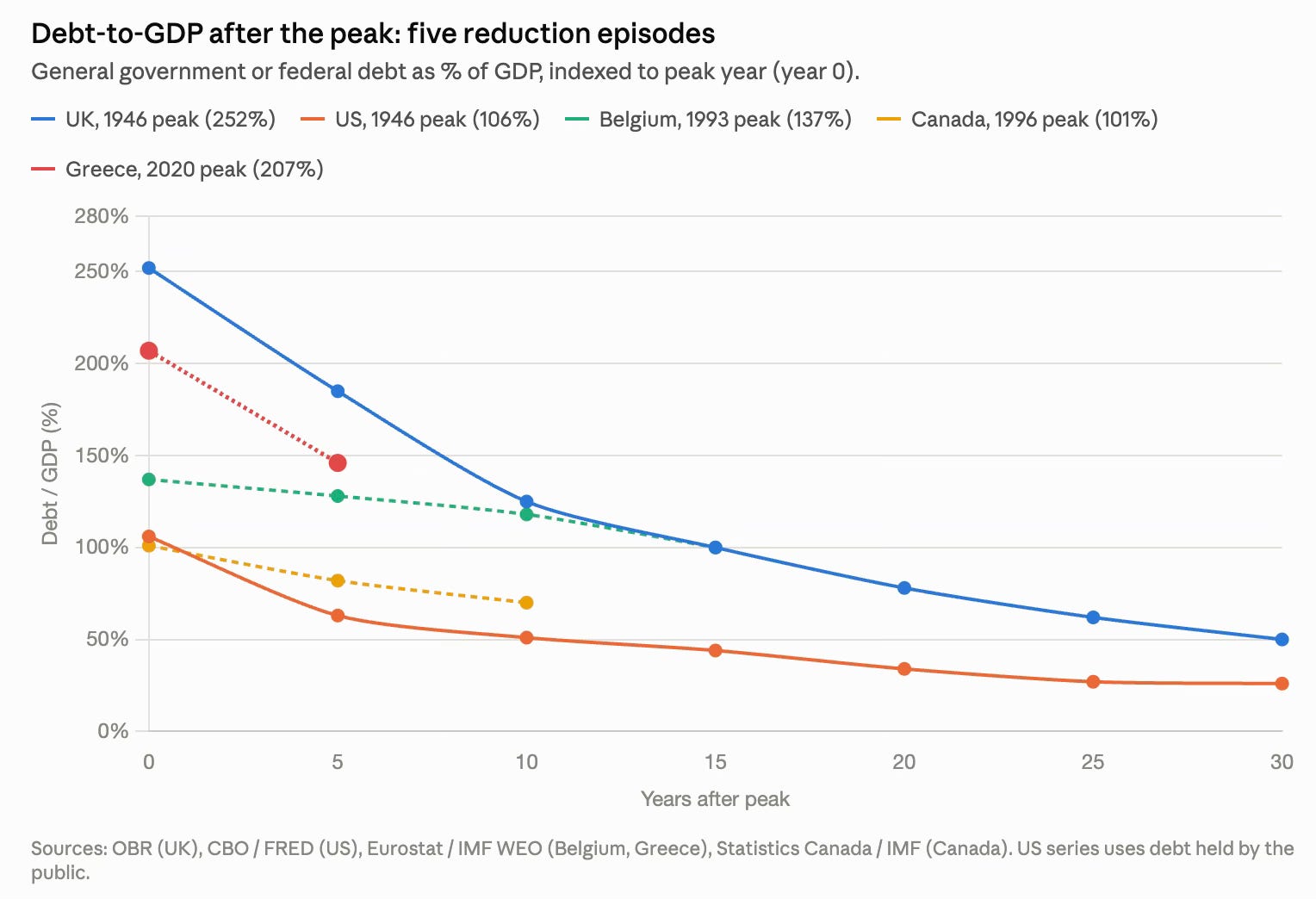
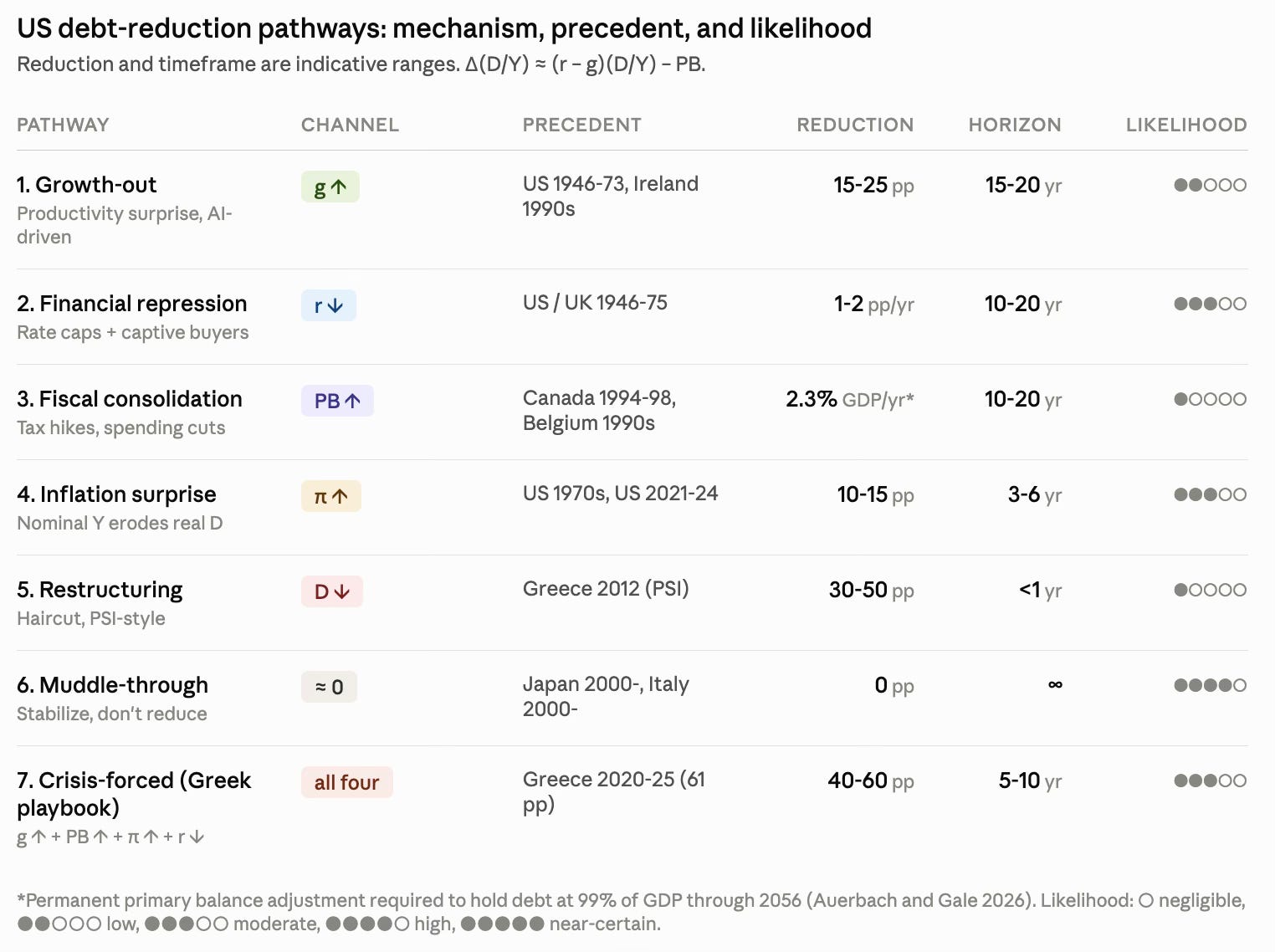
It requires that both the stock and flow of debt must be brought down. The former requires that the rate of economic growth (g) must exceed the rate of growth of debt (or the interest rate, r) for a long period, and the latter requires ensuring that the primary balance is positive. 

One can think of some scenarios under which the debt reduction can materialise. The ideal scenario of growth driven by a productivity surprise (say, AI) may be too optimistic, given the need to sustain real GDP growth (g) in the 3-4% range against a real interest rate (r) at 1-2% and the ageing demographics and falling labour force participation rates. Fiscal consolidation resulting in primary surpluses is another possibility, though the very high mandatory spending plus interest (now at 75% of the budget and heading to 80% by 2036) means that austerity alone can only be a marginal contributor. 

There is no historical precedent of grow out of debt at this debt level without either financial repression or fiscal consolidation alongside. The 1990s US surpluses under Clinton were a one-off combining Bush’s 1990 and Clinton’s 1993 revenue measures, the peace dividend, and the dot-com boom’s capital gains windfall. 

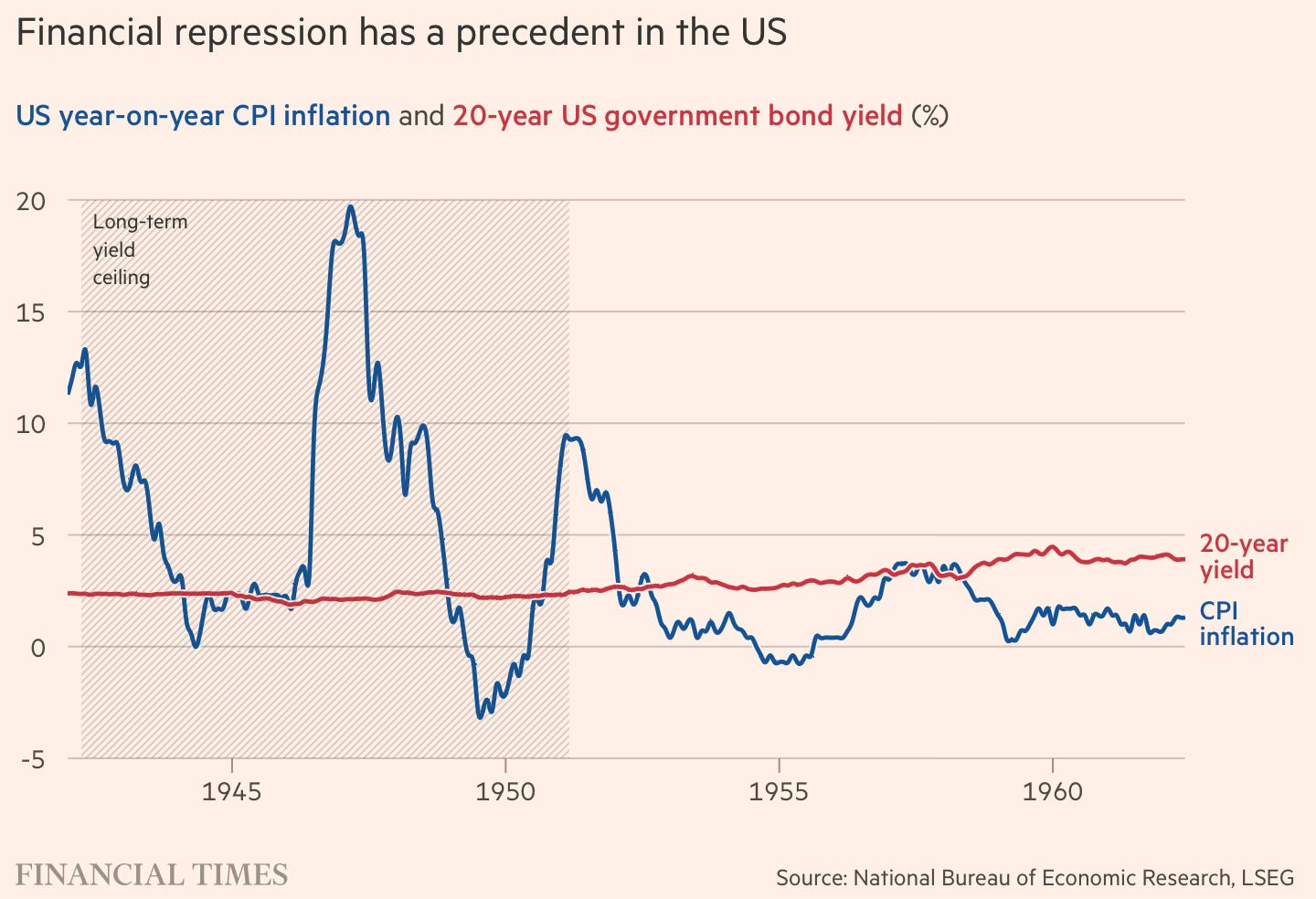
Then there are the scenarios of Fed-led financial repression, with moderate or high inflation. However, the inflationary path requires that the debt is long duration, new issuance reprices only slightly, and the social and political consequences are managed. But the US Treasury’s weighted average maturity is only about six years, which sharply limits this pathway to debt reduction, and there may be no political tolerance for sustained inflation beyond, say, 3.5%. In any case, repression and inflation will be important factors eventually in the years and decades ahead. 

They were important contributors to bringing down the debt-to-GDP ratio after the War, and the recent increase in bond buybacks announced by the US Treasury Secretary Scott Bessant are the early steps in a long period of financial repression. 
This brings us to debt restructuring and haircuts, which are unthinkable for the US given that the US dollar is the reserve currency. There is also the possibility of a consolidation forced by a crisis (à la Greece), though it looks unlikely for now and may lie 10-15 years ahead. 

Finally, the option of muddling through, stabilisation without meaningful reduction, is a very strong likelihood for the foreseeable future. Through a combination of mildly negative r-g through soft repression, containing primary deficits, and occasional tailwinds and reforms, debt-to-GDP can stabilise at 110-130%. Japan has run this combination for over two decades with 220-260% of GDP without any crisis, and Italy has done so at 130-140%. 
For debt reduction, the US and others may find Greece an unlikely example. From a peak of 212.6% in 2021, by the end of 2025, Greece reduced its debt-to-GDP ratio to 146.1%, and it is estimated to decline to 125% by the end of the decade. 
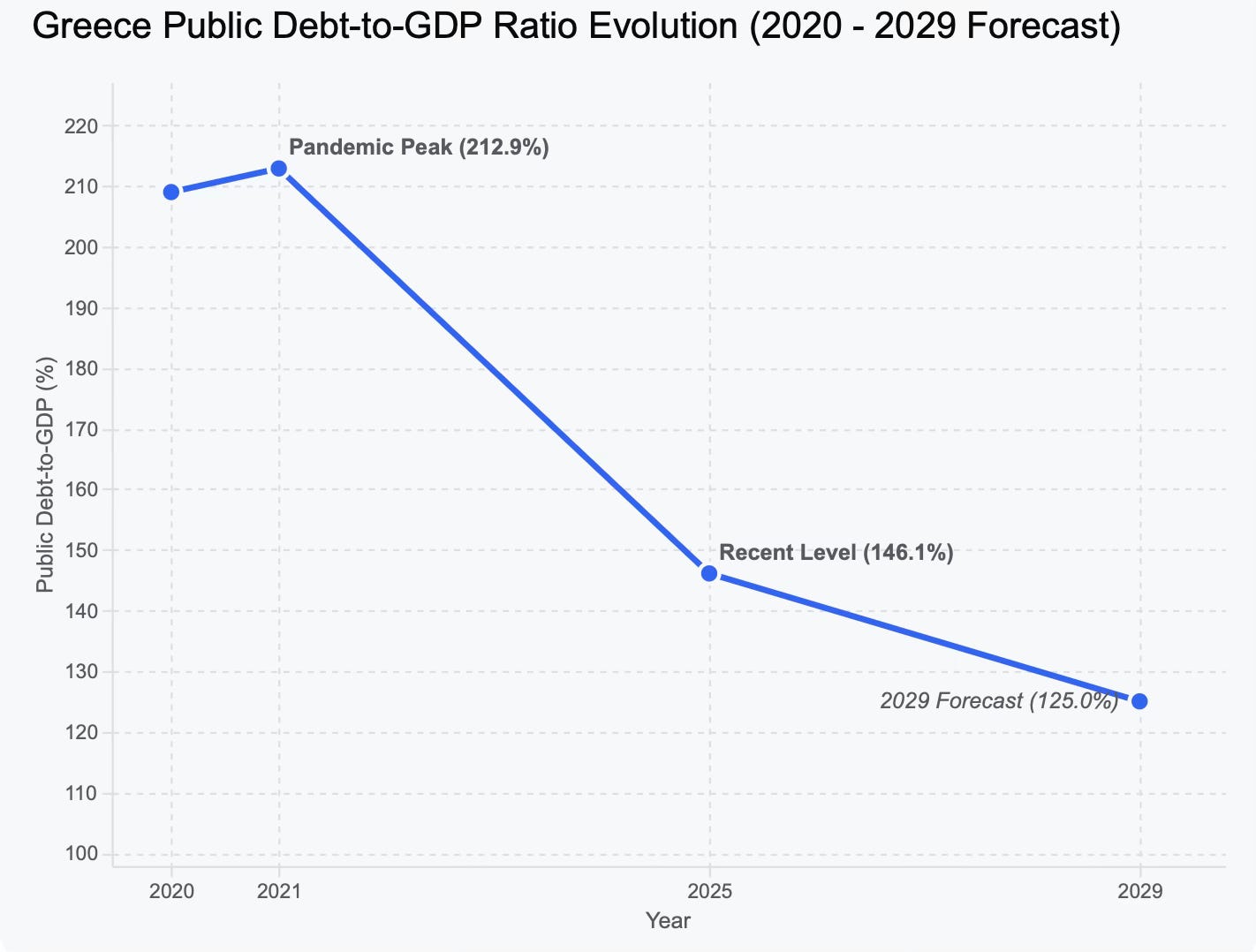
This spectacular record-breaking drop of nearly 67 percentage points within a four-year window has been achieved through a combination of strong GDP growth post-pandemic (4-5% real growth), early repayment of its financial rescue packages, negative real rates from the inflation shock, maintaining a primary budget surplus of above 2%, and concessional EU financing. 

This combination of factors is unlikely for advanced countries like the US. In the circumstances, the best hope is a trend of moderate inflation (say, 3%), repression to keep interest rates down, some reversal of the accumulated tax cuts, and some expenditure reduction, all of which will only stabilise the debt at about 120-130%. This would create the conditions for deeper reforms on both the revenues and expenditure sides after a forced crisis sometime in the later part of the next decade.

A scenario which cannot be dismissed is one where the erratic policies of the Trump administration, combined with rising inflation, a supply shock (of the kind in Iran), and an AI-equity market meltdown, spook the bond markets, resulting in a significant spike in bond yields. This could, in turn, force the US Treasury into biting the bullet on revenue and expenditure-side reforms. 

In the meantime, the bare minimum to calm the markets would be to at least ensure that the debt-to-GDP ratio is stabilised by bringing the fiscal deficit under control. But wars and Trump 2.0 policies work in the opposite direction.

Monday, August 24, 2026

Derisking the financing of infrastructure sector segments

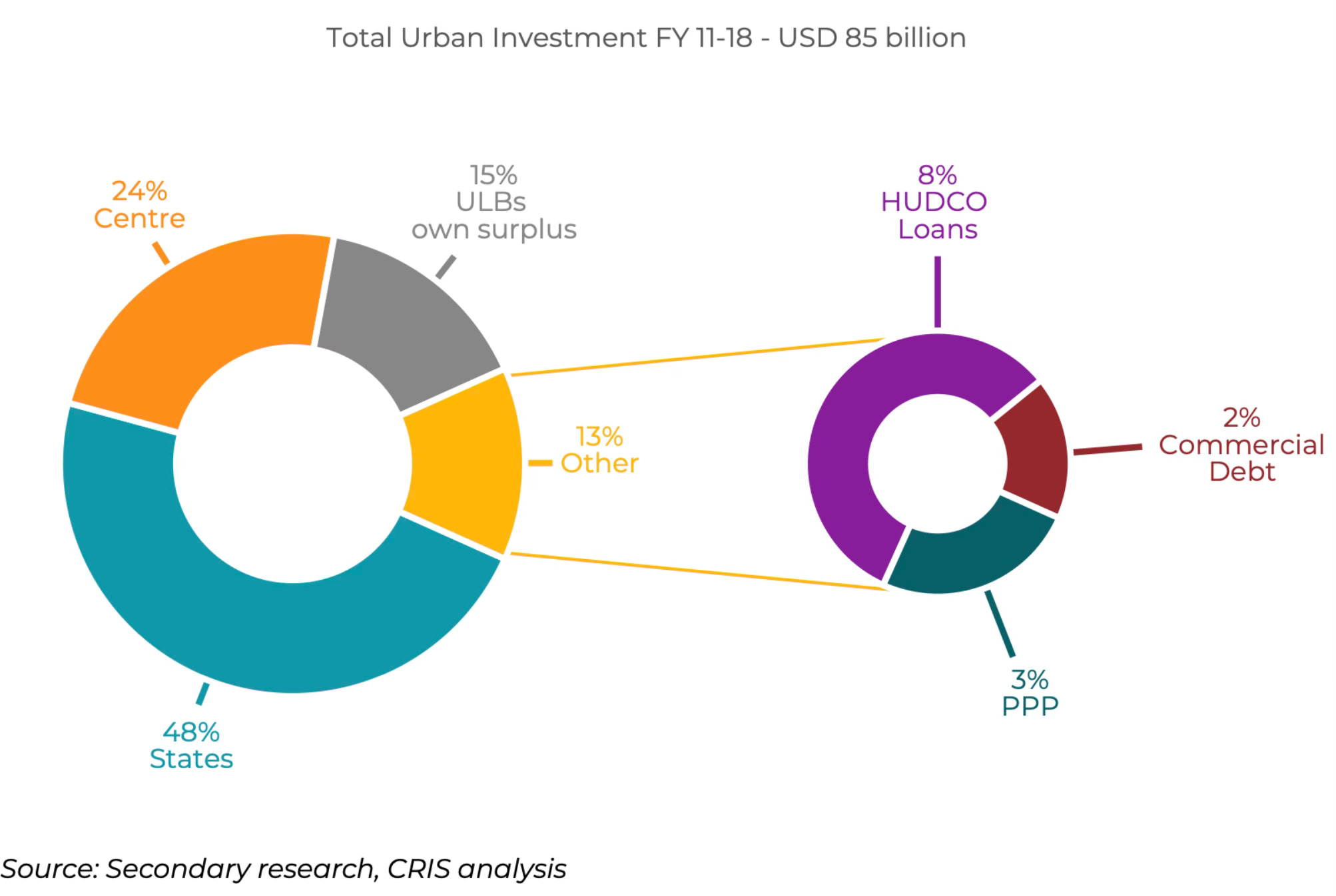
A striking feature of urban infrastructure financing in India is the negligible role played by debt, especially bank loans. It should be a policy priority to significantly increase the mobilisation of debt prudently and sustainably for urban infrastructure projects. 

In this context, I have blogged here with a proposal to leverage the viability gap funding (VGF) scheme of the Department of Economic Affairs, Government of India, to mobilise bank loans and other debt. The idea is to use VGF to transform the project economics to make it commercially viable for banks to lend to municipalities without a sovereign guarantee and against project revenues. This would be an incentive-compatible form of desirable debt, and also provide a pathway to boost the uptake of the struggling VGF window. 

The newly announced Urban Challenge Fund (UCF) of the Government of India is a step in this direction. The ₹1 lakh crore scheme seeks to transition cities toward market-based financing by providing central assistance up to 25% of the total project cost for projects that are able to mobilise at least 50% of the project cost from market sources like commercial bank loans or municipal bonds. The remaining 25% is to come from state and municipal governments. 

The UCF should avoid the kind of incentive-misaligned recourse debt mobilised against the municipal general funds and/or with state government guarantees. Instead, it should try to ensure that the debt is non-recourse, mobilised against project revenues and without any sovereign guarantee. This kind of debt ensures fiscal discipline and a sustainable pathway to financing urban infrastructure. The UCF guidelines are silent on this important distinction. In fact, there is a case for a substantial incentive within the scheme itself to nudge cities in this direction.

However, initiatives like the UCF and VGF are unlikely to generate adequate uptake if they are implemented as a regular government scheme, and directly between the central and state governments. For one, the rigid and bureaucratic nature of project appraisals, approvals, program administration, and payment tranche releases is unsuited to finance projects involving private capital. Further, the operationalisation of such financing will require getting a few things right on both the demand and supply sides, which requires a market-making role. 

On the demand side, it requires the creation of a shelf of projects that can be structured to access project finance. Developing a good quality pipeline of ready-to-finance projects entails a non-trivial cost and requires a project development fund. The category of projects, like those in water and sewerage, solid waste management, bus transit, electricity distribution, etc., are best placed to benefit. 

On the supply side, it requires derisking and increasing banks' appetite, in particular, to finance such projects. Nothing is more effective than a few successful demonstrations of project finance for municipal projects. Today’s commercially attractive infrastructure sectors like national highways, thermal and renewable power generation, parking, etc., got derisked over time through a handful of successes.

This facilitation of the demand-side and easing of supply-side concerns requires active market-making. The infrastructure development finance institutions (DFIs) like National Infrastructure and Investment Fund (NIIF) and National Bank for Financing Infrastructure and Development (NaBFID) are well placed to act as infrastructure investment banks to make this happen by providing technical assistance to develop the project and structure project financing (without recourse to general municipal funds or state government guarantees), mobilising lenders to help achieve financial closure, and contributing the derisking financing layer. 

Accordingly, at least a part of the grant allocation for schemes like VGF and UCF could be made available for these DFIs to build a pipeline of projects and finance them. A proportionate share of the Project Preparation and Capacity Building Fund (PPCBF) under the UCF should also be transferred to them. This should be part of an explicit mandate for these DFIs to derisk projects clearly specified sectors for bank and bond finance. 

If successful, it would be a powerful example of market catalysis of the kind that is central to the mandate of DFIs.

Saturday, August 22, 2026

Weekend reading links

1. Germany used to be the unquestioned global leader in chemicals, machinery, and automobiles. Now, thanks to the onslaught from China, it has fallen on bad times. Sample this on automobiles.
When German companies expand or build factories, it is often in places like Hungary, China or Mexico. The number of cars produced in Germany has fallen 28 percent since 2016, according to the VDA, the German automakers’ association, putting the country well behind China, the United States, Japan and India. Germany could soon also be overtaken by South Korea and Mexico... The German carmakers face an assault on two fronts. In China — the world’s largest car market — sales of foreign car brands are plummeting. And Chinese automakers are making big strides in Europe. In June, Chinese carmakers outsold Japanese carmakers in Western Europe for the first time, according to figures compiled by Schmidt Automotive Research.

China was once a lucrative market for the Germans, accounting for 37 percent of Volkswagen sales in 2019. But after Chinese automakers learned how to manufacture cars through joint ventures with foreign carmakers, the tables turned. BAIC Group, an automaker owned by the Chinese government, has become Mercedes’s largest shareholder, with a stake of almost 10 percent. Chinese companies like BYD and Geely Auto were quicker to develop electric vehicles that were heavily promoted by the Chinese government and are selling briskly in Europe. The Germans took too long to offer appealing electric vehicles. Volkswagen sold 26 percent fewer cars in China in the first six months of the year compared with a year earlier, while Mercedes reported a 28 percent decline and BMW a 20 percent slump.

2. The latest on AI's limitations on vertical use cases, explained with three illustrative use cases.

While A.I. can excel regularly at complex tasks, it can be unreliable when put in charge of an entire job. It can certainly add value to certain areas of the work force, but for now, A.I. still needs a human boss... In our experiment, we deployed A.I. “agents” to act as office workers and found that they were capable of performing some of the tasks we assigned, but not all of them. The agents, which can act autonomously and make decisions based on detailed instructions, excelled at problems they could solve by writing computer programs. But they struggled with understanding the nuances of human language and at navigating user interfaces like the Chrome web browser.

3. Important point about how wealth inequality has come to dominate income inequality as the reason for social discontent.

While wealth inequality has not changed much, the relative importance of wealth compared to income has. The median household’s disposable net worth (net property and financial wealth excluding pensions) in the UK, US, Germany and France has roughly doubled in real terms since the mid-1990s; incomes have grown by only around 30 per cent. The result is that where a generation ago it would have taken about 20 years of savings from the average salary to earn your way from the bottom quarter of the UK’s wealth distribution to the top quarter, it now takes 40. There are similar or even larger upward extensions to society’s economic ladder elsewhere.
This is all the more pernicious since the growing role of passive wealth gains (whether gifted by an asset price boom or one’s parents) relative to income in determining someone’s economic status is mirrored by their growing importance for wellbeing. In the 1990s income rank mattered more than wealth rank for life satisfaction or avoiding distress. Since then wealth has become steadily more influential and is now the larger driver. 

4. Ukraine has run out of Patriot air defence systems to shoot down incoming Russian ballistic missiles. 

5. Chrystia Freedland on Baumol's disease and public services.
Baumol’s assignment was to determine why in-person classical music performances seemed harder to fund. He found that the snag wasn’t that the musicians were getting worse — it was that the rest of the economy was getting better. It took four musicians one hour of work to perform a Schubert string quartet, exactly the same as it always had done. But four hours of human labour would produce roughly a hundred times as much wheat as it did in the pre-industrial era. For manufactured goods, the multiple is even greater. The same insight applies to taking a two-year-old on a walk in the park, or supporting a mother as she gives birth. As such, Baumol’s disease poses a knotty challenge for the state in liberal democracies because so much of what governments do is more like playing the violin than manufacturing a car.

6. Two points from John Burn-Murdoch's latest on the crisis of social isolation among youth. First, the share of those without any in-person contact during a typical day rose sharply during the pandemic and has not returned back to normalcy.

The least socially connected are increasing their disconnectedness. 

7. Rent controls are back as housing prices rise.
Rent controls, where a government sets price limits on rents or annual rent increases for certain types of housing, tend to be effective in their primary objective. A 2024 review of dozens of studies on the policy published globally between 1967 and 2023 found controls were effective in capping rents. The quid pro quo, say their critics, is that they increase rents on unregulated properties and reduce the overall supply and quality of housing in the long term... Of the 38 members of the OECD club of mostly richer nations, 23 already have some form of rent control. Ireland and Austria widened the scope of existing rules this year... In practice, rent regulation can encompass a wide range of measures. Outright freezes, such as in New York, tend to be temporary. More enduring limits can apply to existing or new tenancies, or both, and may apply nationwide or be focused on areas of high rental demand. There are often exemptions, such as for newly built properties, and a variety of yardsticks are used to determine the size of permitted increases... 
New Yorkers are the most burdened tenants in the US. Despite decades of regulation, new renters in the city spend an average of 40 per cent of their income on rent. Rent stabilisation — where annual increases are set by a city board based on its assessment of the market, inflation and other variables — is the main mechanism, applying to almost a million units. Households living in rent-stabilised apartments tend to have median incomes lower than overall renter households... In Berlin about 700,000 households, or a third of the total, spend more than 45 per cent of their income on rent, according to the Berlin Tenants’ Association. Like several hundred other high-demand areas in Germany, Berlin is subject to the Mietpreisbremse, or rental brake, a 2015 law that applies to new leases, and the Kappungsgrenze, introduced two years earlier, which limits rises on certain types of existing tenancies. Despite these guardrails, rents have risen almost 70 per cent over the past decade. 

Scotland has come up with new rent controls which have evoked interest globally.

The new controls are more precisely calibrated than before; they will apply only to specific areas, last for a maximum term of five years, and limit rent increases for both new and existing tenancies to consumer price inflation plus 1 per cent, up to a 6 per cent maximum. There are some exemptions, for instance properties that are coming to the rental market for the first time.

8. China's investment slump deepens in July.

Industrial output expanded 4.5 per cent in July on a year earlier, official statistics showed on Monday, short of the 4.8 per cent forecast by a Reuters analyst survey and growth of 5.3 per cent in June. Retail sales rose just 0.6 per cent last month, compared with analyst forecasts of 1.5 per cent growth and 1 per cent in June, as the waning effects of consumer goods trade-in subsidies weighed on household spending. Fixed asset investment declined 6.7 per cent for the first seven months of the year on the same period in 2025, deepening from a 5.7 per cent drop in the year to June. 
Over the last 10 years, across spot and forward markets, the RBI’s net annual currency intervention has averaged about $60 billion, or 2 per cent of gross domestic product (GDP). During FY21 and FY22, when India’s balance of payments generated surpluses, the RBI net purchased $157 billion. That effectively put a floor on the exchange rate. In contrast, the RBI sold a significant $118 billion in FY25, helping restrict the rise in USD/INR from 83.50 to 85.50. Between April 2025 and February 2026, the RBI sold another $37 billion, even as USD/INR moved up to 91. Following the outbreak of the Iran war, the RBI sold a further $37 billion in March 2026 alone, with USD/INR eventually ending the month around 93.50... Such interventions were not necessarily incorrect. But when sustained at this scale and over such timeframes, it inevitably influences currency levels, not just volatility...
The RBI also intervenes in bond markets and modulates banking liquidity to facilitate monetary-policy transmission. During FY26, India’s net government debt across central and state government bonds and Treasury bills grew by ₹17.8 trillion. About ₹10.6 trillion was net purchased by banks, insurers, and pension and provident funds, which have regulatory obligations to buy such bonds. The RBI’s own holdings net increased by the remaining ₹7.2 trillion, thus accounting for a substantial 40 per cent of the incremental government debt... The RBI’s large bond purchases and liquidity operations helped keep rupee-denominated interest rates below levels that might otherwise have been required to attract discretionary savings.

10. Israeli national security minister Itamar Ben-Gvir, a hardline settler previously convicted of incitement to racism, advocates killing Gazans each night. 

“I think we should be doing 30 to 40 targeted assassinations per night,” Ben-Gvir said. “Not just those who pose an immediate threat. There are people there who don’t deserve to live . . . They are not even people.” Ben-Gvir also called for the re-establishment of Jewish settlements in the Palestinian territory, saying he envisaged “all Gaza” belonging to Israel and reiterating his previous calls for Palestinians to “emigrate”. “I imagine settlements not just in Gush Katif but throughout Gaza, and encouraging emigration, the more the better,” he said, referring to settlements that were dismantled by Israel in 2005. “And for the terrorists, there should be no emigration. We should just kill them one by one.”

11. Fear of AI is uniting American politics.

Almost three quarters of Americans do not trust businesses to use AI responsibly, according to Gallup. More than 70 per cent oppose having data centres built in their area because of fears about water and electricity inflation. Eighty per cent or more distrust AI for driving, medical advice and corporate hiring decisions. As The New York Times recently put it, fear of AI is the “most bipartisan issue since beer”. That feeling is as strong in the centre as it is on the Maga right and the democratic socialist left. That such fears are often conspiratorial should be no surprise. Paranoia is a natural response to the unknown. Maga’s Steve Bannon calls data centres “weapons labs”. Marjorie Taylor Greene, the former pro-Trump lawmaker, refers to Big Tech as “Skynet” after the self-aware computer system that triggers nuclear holocaust in the Terminator movies. Progressives talk of AI killing US democracy and ushering in a Blade Runner-style dystopia.

12. The big economics story of the recent months is the return of interest rates.

13. For long the World Bank and IFC have tried to get African countries to capture value by investing in the processing of their natural resources. Nigerian billionaire Aliko Dangote is doing exactly that by constructing the world's second-largest petroleum refinery, which has allowed Nigeria to export refined oil to Europe and elsewhere, while also ensuring that Africa's largest crude producer does not need to import refined oil. 
His new $20 billion oil refinery in Lagos, which has seen a spike in demand for petroleum products — both in Africa and elsewhere — since the war began in February. Despite having abundant crude oil, Africa still relies heavily on imported fuel... Jet fuel shipments from the Dangote Refinery reached the U.S. market for the first time ever this year, according to the company. The Dangote Refinery was “the world’s single largest exporter of jet fuel” in April and May, said Daniel Evans, a vice president of S&P Global Energy, a market-research firm. Last month, the refinery was Europe’s largest supplier of jet fuel and diesel, according to Devakumar Edwin, a vice president of Dangote Industries. On Tuesday, Dangote Refinery said it had secured $1 billion in financial backing from a Dubai-based investment group to go public on the Nigerian stock exchange. If the listing goes through, it will be Africa’s largest-ever public offering.

14. The rise and rise of America's public debt.

The US’s national debt has hit a record $40tn as borrowing rises at a historic pace... It has grown by $3tn over the past year, its fastest ever pace outside the pandemic era... America’s national debt has surged over the past two decades, rising from less than $6tn (about $12tn in 2026 dollar terms) at the turn of the century as vast public spending during the financial crisis and Covid pandemic exacerbated yawning budget deficits. In the past 10 years alone, the overall debt burden has doubled. Debt held by the public — a key metric monitored by markets that excludes intragovernmental holdings — now exceeds $32tn, roughly equal to the size of the US economy. The Congressional Budget Office, a non-partisan watchdog, expects the debt held by the public to exceed the high of 106 per cent of GDP reached in the aftermath of the Second World War by the end of the decade and hit 120 per cent by 2036.

15. The moderation of Meloni...

As prime minister, Meloni’s cautious pragmatism has dismayed hardline Maga purists such as Bannon, who told Italian media she was “a total globalist” who had betrayed her “fundamental beliefs”. Meloni has paired tough measures to curb irregular migration with higher quotas for legal migrants, helping Italian businesses cope with labour shortages. She has also softened her anti-EU rhetoric and forged effective working relations in Brussels.

... and fall out with Trump.

After Trump’s return to the White House in 2025, Meloni — the only EU leader to attend his inauguration — sought to cast herself as Europe’s bridge to Washington, hoping it would strengthen her hand in Brussels and at home. Instead, Meloni has been tarnished in the eyes of many Italian voters by her close association with an unpopular US president. Trump has imposed high tariffs on EU imports, pressed Nato allies to sharply increase defence spending and attacked Iran — policies deeply damaging to Italian interests. “Her proximity to Trump has failed to give her any appreciable results,” said Riccardo Alcaro, research director at Rome’s Institute of International Affairs, calling her erstwhile friendship an “electoral albatross” as Meloni gears up for a bruising re-election campaign... analysts say Meloni’s difficulties with the White House reflect not only Trump’s personality but a Maga world view that appears to expect near-total subservience from its allies... Maga’s deep-rooted antagonism towards the EU as a political project also made it hard for any leader with a pan-European outlook “to cosy up” to the administration for long.

16. One of the biggest innovations of the 20th century, container shipping.

Seventy years ago it would take at least 10 days for a ship at London Docklands to be emptied and reloaded by around 50 dockers. Pilfering was rife, accidents were commonplace and port business was vulnerable to labour strikes. Then came the shipping container, an 8ft x 20ft steel box that needed increasingly vast vessels to carry an ever-expanding volume of goods... it takes cranes roughly 40 hours to empty and reload a large container ship — around 20,000 steel boxes lifted by 146-metre-high computerised cranes that move two containers every three to four minutes. That efficiency and scale is testament to the unglamorous steel container, an invention that has driven down shipping costs to such a low fraction of total manufacturing value that it has enabled the rapid expansion of global trade over the past 70 years... The box’s dimensions were standardised from 1968 — a step that is “frequently overlooked”, says Brian Slack, a professor in geography and planning at Concordia University, Montreal. Without it, “containerisation would not have been as revolutionary as it turned out to be”...
More than 280mn journeys were made by containers between world markets last year. They bear around two-thirds of global seaborne cargo — about 60 per cent of total world trade, according to UN Trade and Development. More than 7,000 container ships are currently operating. The largest can carry cargo equivalent to a 44-mile-long freight train with, for example, around 120,000 bananas or 10,000 pairs of jeans per box. The average size of the ships has more than doubled since 2000, according to the WSC... To service the demand for goods, shipping lines have ordered larger and larger ships. The current record size for a container ship is the so-called ultra-large container vessel MSC Irina, which has a carrying capacity of 24,346 twenty-foot equivalent containers, or TEUs. The number of new container ships on order is equivalent to around 40 per cent of the current sailing fleet — a record high.

17. Circular trading in China's humanoid robots industry.

China’s humanoid robot makers are generating much of their revenue from selling machines to government-backed training centres — which then collect and sell training data back to the robot makers, raising concerns about actual demand in an industry Beijing is keen to promote.

18. Data centre job creation facts.

At the peak of construction, according to a November 2025 study by the University of Southern California, a data centre in the US needs between 0.7 and 2 workers per megawatt. To build India’s targeted capacity of 10 GW by 2030, that works out to a peak construction workforce of 26,000... In direct employment, a 100 MW data centre supports 120–150 jobs. Take the generous end of that range and India’s 10 GW target yields 15,000 full-time, sustainable jobs. And these aren’t, for the most part, gold-collar jobs. A handful of C-suite roles rake in Rs 1 crore a year. Design and engineering workers make Rs 30–40 lakh. The staff who actually keep the lights on—on-site security and hands-on hardware engineers—earn around Rs 10 lakh. A recent study from the US—the world leader in data centres with an installed capacity of 55 GW—examined the employment records of 770 server farms going back two decades and concluded that the industry overstated their job impact by a factor of three at least. Apply the cut to India’s job-creation estimate and the promise wilts before a single server is switched on.

And who will use it.

Of the 10 GW capacity India intends to build by 2030, only a sliver is meant for the country. The industry estimates that 90–95% will be leased by foreign firms such as AWS, Microsoft Azure, Google Cloud, Oracle, and Meta. Even now, of the roughly 2 GW already installed, barely 30% is used by Indian players.

Saturday, August 15, 2026

Weekend reading links

1. The solutions proposed by Andy Haldane to address housing supply in the UK is universally valid.

Public land developed for public purpose but privately operated; co-financing by municipal bonds and private capital; a bespoke planning regime; and a transformative method of new construction — these are the base elements needed to ease the constraints suffocating the UK’s housing market and to tackle the housing crisis in every postcode.

2. Talk about a company mobilising debt for others to buy its products, and look no further than Nvidia.

The world’s largest financial groups are working with Nvidia to assemble a funding package of more than $500bn for AI infrastructure development, in one of Wall Street’s most ambitious lending efforts to date. A consortium of groups including Apollo Global, Blackstone, BlackRock, Brookfield Asset Management, Goldman Sachs and KKR is entering a partnership with Nvidia to invest in the AI build-out... Nvidia said on Monday afternoon that it has signed memorandums of understanding with the six Wall Street firms to “mobilise over $500bn of third-party capital for the build-out of AI infrastructure over time”. Under the deal, which is still subject to final agreement, the firms will create dedicated pools of capital to finance Nvidia’s AI ambitions “at attractive rates for Nvidia customers”... Morgan Stanley projects so-called hyperscalers will spend $3.5tn between 2026 and 2028.

3. India manufacturing output trends.

But services exports have doubled in less than four years.

Weeks into the latest conflict, defence minister Israel Katz invoked a different approach, one used with devastating consequences after Hamas’s October 7 2023 attack: the “Rafah and Beit Hanoun model”, a reference to Israel’s wholesale levelling of cities in Gaza. “All homes in Lebanese villages near the border will be destroyed,” Katz said. By July, Katz claimed his threat had been carried out. “Twenty-four Lebanese villages, hundreds of years old, we destroyed all the buildings,” he said, boasting that up to 20,000 homes had been demolished. “Not house by house, but entire villages.”...

Israeli evacuation orders forcibly displaced some 1.2mn people in the war’s first 10 days, the vast majority from Hizbollah-dominated southern Lebanon, as Israeli forces advanced. Fighting raged for weeks, but most of the destruction documented by the FT and Lighthouse came after an initial Israel-Lebanon ceasefire on April 17. While the truce did not hold and some clashes have continued even past the latest ceasefire in June, Israeli forces — who had already established control over many emptied villages — continued to lay waste to the south through air strikes, controlled detonations, bulldozers and the use of white phosphorus. Israel’s occupation is now deeply entrenched, the area under its control demarcated by what it calls “the yellow line”. The zone covers about 6 per cent of Lebanese territory and stretches roughly 10km inland from the two countries’ informal border...

Israel has also done extensive damage to historic monuments and Unesco-listed sites, including 16th-century mosques, 19th-century libraries, religious shrines, ancient Roman ruins and Crusader castles. “It is an attempt to make the areas unrecognisable . . . to sever people’s connection to their land and their history,” said Joanne Farchakh Bajjaly of Biladi, an organisation dedicated to preserving Lebanon’s cultural heritage. “How can they rebuild their communities if everything is gone?”... Lebanon’s environment ministry and rights groups have documented Israel’s widespread use of white phosphorus — an incendiary chemical that triggers fires and can leave contamination in soil and water — in both populated and agricultural areas. Israel says it uses white phosphorus lawfully to clear brush and create smokescreens, but use over populated areas can violate international law.

5. Janan Ganesh is on to something.

If a politician could decouple socialism from the set of cultural ideas known as “woke”, he or she would be difficult to stop... The one place that might have produced a culturally conservative or at least culturally neutral socialism is continental Europe, but even the French left has absorbed American woke jargon, perhaps recognising in it the authorial stamp of Michel Foucault. And so capitalism glides on, never quite facing what would be its sternest political test. The question is why the left allows it to happen... Woke has been such a godsend for capitalism — making its enemies look ridiculous — that it can seem almost engineered for that purpose.

6. Purchase commitments of the hyperscalers jumped from a trillion dollars to 1.5 trillion from Q1 to Q2 of 2026. These are debt in another form. 

7. Guy Chazan describes elite capture of the political system in the US.

In America’s Gilded Age, millionaire robber barons operated from the shadows, bribing pliant lawmakers to do their bidding. Under President Donald Trump, billionaires have gone one better. Some are in his cabinet... No longer content to lobby from afar, ultra-rich tycoons — especially from Silicon Valley — have infiltrated the capital’s ecosystem, taking on advisory roles in government, cultivating ties on Capitol Hill and weighing in on the most important issues of the day, from AI to industrial policy. They attend glitzy dinners, donate millions to White House fundraising projects and are photographed with Trump promising eye-popping investments in the US. Many have enjoyed regulatory relief, policies that benefit their businesses and, in some cases, lucrative government contracts worth billions of dollars. But unlike the robber barons of the past, who were often charitably minded and gave generously to public institutions, the tech billionaires of the present show a “complete indifference” to any kind of “social contract” and any need to “compensate people for the disruption they have brought into their lives”, says Quinn Slobodian, a historian of capitalism at Boston University...
If there was a trigger for the growing influence of the ultra-rich in America’s political system, it was the Supreme Court’s 2010 Citizens United ruling, which held that independent political spending on elections by business was protected by the First Amendment. The judgment opened the floodgates to big money in politics. America’s rich had spent $31mn in the 2010 elections, according to liberal advocacy group Americans for Tax Fairness (ATF). In the 2024 election cycle, the 100 largest billionaire donor families gave $2.6bn. A huge proportion of that came from just a handful of individuals. Three billionaires — Elon Musk, Miriam Adelson and Timothy Mellon — accounted for more than a third of the roughly $1.5bn spent to elect Trump.

8. C Thi Nguyen has a brilliant essay on the value of doing something for its own sake or as labour of love (play, as he describes it), and doing something as part of a requirement (work, as he describes it). He channels Aristotle (through Bernard Suits' The Grasshopper) to describe it as the core of a meaningful life. 

For Suits, play is not just a side dish for the main meal of work. Play is at the core of a meaningful life. Underneath the hood, Suits’ argument is Aristotle to its bones. For Aristotle, a good life — a truly meaningful life — lay not in the creation or accumulation of stuff or the achievement of outcomes, but in the process of doing itself, in the rich exercise of our full human capacities. Suits found the deepest illumination of Aristotle’s point in the simplest human activity: playing games. Suits provides, and defends, his definition. To play a game, he says, is to voluntarily take on unnecessary obstacles to make possible the struggle to overcome them. To play a game, therefore, is to be inefficient on purpose. When you run a marathon, you are trying to get to a particular spot in space, but you avoid the most efficient ways to get there. You do not take a subway or a taxi or a bicycle. You force yourself to run, and you try to run as quickly as possible. Which means, for Suits, that the struggle must be an essential part of the true value. What you care about can’t just be the bare outcome by itself. You can’t just care about being at that spot in space. Otherwise you’d just take the most efficient path. But if you took the subway then it doesn’t count — not for the game of marathon-running, anyway...

To understand games, distinguish between two things: the goal of a game and your purpose for playing it. The goal is what you pursue inside the game; the purpose is why you played it... For some people, the goal and purpose are one. They want to win, period. Call those people achievement players. The Olympic runner wants to win the marathon by running it — but they do truly care about winning it. But for other people, goal and purpose come apart. We try to win because we are interested in the struggle, and it is the struggle itself that we truly care about. Call us striving players. It’s all right if we try and we lose, if the attempt was beautiful. In ordinary, practical life, we take the means for the sake of the ends. In striving play, we take the ends for the sake of the means. What is the point of life? Is it to make stuff? Or is it to take difficult actions, think rich thoughts, weigh subtle decisions? Is it having a pile of stuff — or does the stuff just support our quest for interesting action?... Suits argues... that play itself is the point, and that we work in order to survive so that we might play...

Rephrase Suits’ definition this way: play is wasting resources for fun. But also: the whole point is that, deep down, it’s not a waste. A truly wasted life would be one spent working hard, stockpiling goods like the ant and never using them to support joyous play. And to truly waste humanity would be to push people so hard to work productively, to make more stuff, to the point where nobody had time to play. Let me try my own fusion of these two definitions. “Work” isn’t distinguished from “play” by difficulty, suffering or practicality. You can make pottery, knit scarves or grow a garden as play. The true difference between work and play is the reason you have, and the control you have, over what it is you’re doing and why. Here’s my suggestion: to “work” is to perform activities to create outcomes that are set by something external. When you work, you are making what the world tells you to make. Maybe you’re gathering food, because biology tells you you have to eat. Maybe you’re earning money, because the world says you need money to buy food and shelter and medicine. Maybe you’re making products, because the world wants something specific from you — planks of wood, a ride to the airport. But “play” is different. You still have goals and struggles, but your goals are up to you.

9. Two important graphics on the Chinese economy. One, the great job squeeze resulting in the rise of the gig economy, whose workforce has increased by 10 million in just two years.

Second, the persistence of negative household sentiment for the fifth successive year.

10. Andrew Puzder, the US ambassador to the EU, draws attention to the substantive equivalence between US tariffs (50% tariffs on primary steel) and the EU's CBAM on their respective steel and aluminium imports. 
Protesting against US national security measures while erecting protectionist barriers reveals a striking double standard... The US approach is direct and transparent. Primary steel faces a 50 per cent tariff (with some rates recently increased), and aluminium a comparable duty. To stop circumvention through finished goods, the tariffs extend to derivatives... CBAM differs in form but not in substance. Importers of iron, steel, aluminium and related products must report embedded emissions and relinquish a corresponding number of CBAM certificates priced at the EU’s carbon price — currently around €80 per tonne of CO₂... At root, both policies are adjustments to protect domestic producers from unfair competition, whether from lax environmental rules or subsidised excess capacity. US Section 232 tariffs address foreign overcapacity that threatens to hollow out its metals sector; CBAM is designed to combat carbon leakage, when production shifts to jurisdictions with less stringent climate standards... In both cases, the measures raise the cost of imports to safeguard local production. The parallels are unmistakable. A shipment of steel-containing machinery faces extra US duties based on metal content. In the EU, the same goods face fees based on production emissions under CBAM. One is framed as security policy; the other as climate policy. Both increase the price of targeted imports relative to domestic options.

11. The US equity market today in perspective.