Substack

Showing posts with label Dollar. Show all posts

Thursday, June 25, 2026

Why it's hard to see beyond the dollar?

A recurrent theme in international economics is the debate on the role of the dollar. As the global reserve currency, the dollar confers on the US an exorbitant privilege to borrow in its own currency, thereby allowing it not only to run large current account deficits but also to finance its fiscal deficit. The exorbitant privilege means that the normal rules of fiscal and monetary policies and capital flows management do not apply to the US in running its twin deficits. 

As the US-China tensions intensify, there have been debates on whether the renminbi can emerge as an alternative to the US dollar. China has taken several measures to internationalise its currency. Today, some estimates suggest that 40% of its trade is settled in renminbi. 

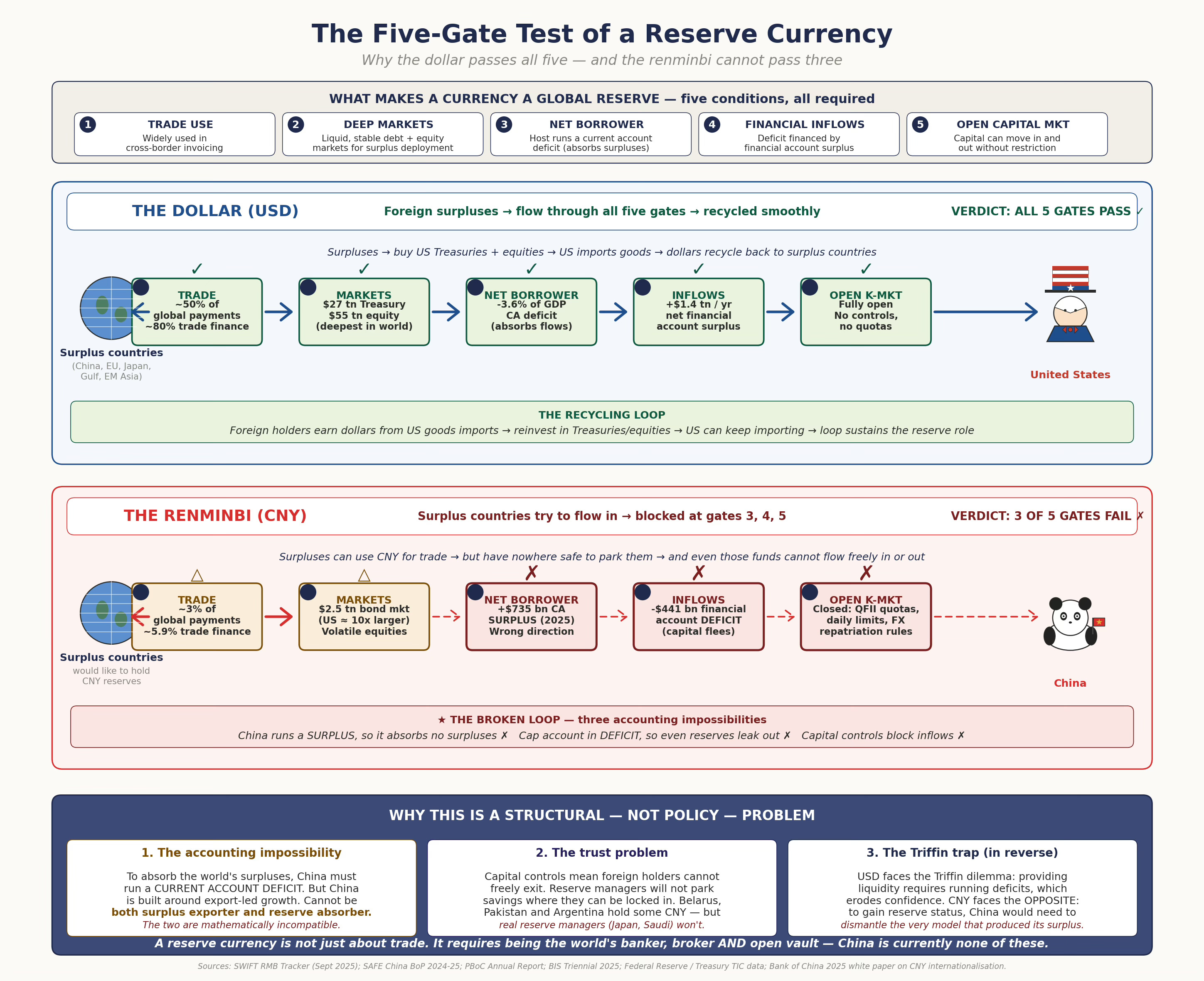
But there's a fundamental problem with China's efforts to prop up the renminbi as a global reserve currency. A currency can be a global reserve not only if it becomes used in cross-border trade transactions, but also, perhaps more importantly, if it has a deep, liquid, and stable market for investing the surpluses generated. In other words, countries should have confidence not only in transacting in this currency but also in retaining and investing their surpluses in it. What use is a foreign currency surplus when there are limited options to deploy it?

Such investments can be in the debt and equity markets in the host country of the reserve currency. This brings into play a third and fourth dimension, which are an accounting reality: the host country must be a net borrower (or run a current account deficit) and must be able to finance it with a financial account surplus. Both in turn require an open capital market (into which capital can be brought in and taken out with ease), the fifth dimension. In the absence of the last three dimensions, the host country will be unable to absorb and deploy the surpluses, and foreigners will not have the confidence to plough their surpluses into this currency.

China is very far from being in a position to offer the renminbi as a credible reserve currency. In fact, the Euro stands a far better chance of being an alternative.

This graphic captures what can be called a five-gate test of a reserve currency. 

While the exorbitant privilege may have allowed the US to overcome the Triffin paradox (the only way to be a reserve currency is to run a trade deficit, which will, in turn, erode its status as a haven currency), the burgeoning US public debt and persistently high budget deficits (both of which debase the dollar) threaten this ability.

However, this must be seen against the reality of a world with surpluses that must primarily be parked in some credible currency asset and the absence of any alternative, there are three possibilities: the dollar continuing to be the reserve currency, the euro emerging as an alternative, and the global imbalances getting corrected

The second option is more feasible than renminbi because Europe already has deep, liquid, and stable financial markets and an open capital account. However, it would also require Europe to run deficits. While Europe has traditionally run surpluses, there are signs that it might be declining. Besides, the European governments, especially Germany, have shown greater willingness in recent times to borrow and undertake fiscal expansion to invest in infrastructure and defence. 

The third option is perhaps the most desirable and sustainable insofar as it addresses the distortions in international economic relations. But it would require the US to rebalance towards fiscal consolidation and reduce consumption, China to abandon its beggar-thy-neighbour trade policy and embrace domestic consumption, and Europe to shift towards public investment. The first two are deeply problematic political economy challenges and are unlikely without crises and convulsions. 

This leaves us with the conclusion about the dollar’s continued dominance, not because Americans are clever or the Federal Reserve is wise, but because of an unusual coincidence of architecture: a large enough economy, a deep enough financial system, a current account deficit large enough to absorb the world’s surpluses, an open capital account that lets capital exit, and political institutions stable enough to make the open vault credible. No other country currently has all five, and China is structurally prevented from acquiring three of them without abandoning its development model.

Whether you like it or not, for the foreseeable future, the dollar is likely to remain the Hobson’s choice.

Saturday, February 7, 2026

Weekend reading links

1. Dame Sarah Mullally, 63, becomes the 106th Archbishop of Canterbury, the first woman to serve as the senior-most bishop of the 85 million-strong Anglican Communion since the role's creation for Augustine of Canterbury in 597 AD!

2. Kevin Warsh as Fed Chairman may pursue significant changes to the way the Fed sets monetary policy.

The Fed’s vast bond-buying programmes, which Warsh initially supported as a Fed governor during the financial crisis, are at the centre of the Trump administration’s allegations that the central bank is acting far beyond its remit to keep prices in check and maximise employment. The... quantitative easing, expanded the Fed’s balance sheet from less than $900bn in 2008 to a peak of almost $9tn. The balance sheet now stands at $6.6tn, following a three-year reversal of QE — dubbed “quantitative tightening” — that the rate-setting Federal Open Market Committee has recently paused amid signs banks were falling short of reserves. Warsh has said he would like to shrink it much further... Warsh in April said successive QE programmes meant politicians found it “considerably easier appropriating money knowing that the government’s financing costs would be subsidised by the central bank”... 

Warsh’s claims that the response to the pandemic “was the biggest monetary policy error in 45 years”... Along with shrinking the balance sheet, Warsh would like to change the Treasury-Fed Accord, a 1951 agreement seen as the foundation for the US central bank’s freedom to set interest rates free from political pressure. Warsh has said he wants a “recommitment” to the accord that would entail a smaller, less powerful central bank, with some control of its balance sheet handed to the Treasury... Trump’s nominee will push the Fed’s staff to gather more “real-time information” to rely less heavily on official government data that comes on a longer lag... He could also deploy economists to find out whether his view is right that an AI-led productivity boom can boost US workers’ pay without stoking inflation — a move that could potentially pave the way for more interest rate cuts.

This is Warsh's WSJ op-ed of March 2023, where he called for an "economic regime change", including stopping the practice of providing forward guidance and stopping the provision of forecasts of the path of interest rates. The expectation now is that Fed may dispense with its widely followed dot plot showing the interest-rate projections of each participant of the FOMC, and end the tradition of press conferences by Fed chair following every FOMC meeting. 

3. Soumaya Keynes points to new research that links commerce and markets to the shaping of cultural norms.

One 2010 study ran money-sharing experiments across a diverse mix of communities, including smaller ones where people foraged or hunted for food. In those less marketised societies, norms around fairness towards strangers seemed weaker... A new study by Max Posch of the University of Exeter and Itzchak Tzachi Raz of Hebrew University takes a different approach, exploring the US economic transformation between 1850 and 1920. Thanks in part to a vast expansion of railroads, internal commerce became much easier. Mail-order catalogues served remote communities with items including shoelaces, suitcases and booze. The researchers compared places and people gaining more and less market access. Unsurprisingly, they found that in the places that enjoyed juicier connections, work shifted to involve co-operation with more distant partners...

Compiling many metrics, they found that on at least three dimensions, new markets did seem to affect culture. First, commercial opportunities made people more outward-looking. In places that became more connected, Americans became more likely to marry someone outside their local community and parents more likely to pick out nationally common names for their children. Second, access to markets raised tolerance levels, as measured by higher religious diversity and greater variation in family size, as well as mothers’ ages at their first birth. (The logic being that more dispersion should reflect more of a “you do you” attitude.) Third, greater market access came with higher trust towards others, as extracted from language in local newspapers. This measure wasn’t perfect, but reassuringly matched trends in more recent survey data, and fell during wars... Instead, they emphasised a story of rapid cultural adaptation among people who were most engaged with impersonal, anonymous exchanges. The changes in naming practices, for example, were concentrated among migrants working in industries that were more exposed to trade with other parts of the country. For those working in construction and entertainment, the market access had no effect.

4. Paul Blustein questions claims about the dollar's dethronement. 

Participants in this market are international banks, securities firms, multinational corporations, insurance companies and pension funds — the biggest private actors in the financial system. Their globe-girdling operations require the movement of immense amounts of money across borders on a constant basis. They use the market to hedge themselves against currency fluctuations by trading a pair of currencies (say, the dollar and Japanese yen) twice, first at the current exchange rate and then swapping back later at an agreed rate. Japanese life insurance companies, for example, invest their portfolios heavily in US Treasuries and other dollar securities. Because they have obligations in yen to their policyholders, they need to protect themselves against movements in the yen-dollar rate and they use swaps to do so. These sorts of transactions occur at such a huge scale that, according to data from the Bank for International Settlements, the amount of outstanding swaps currently stands above $100tn. Some 90 per cent involve the dollar, reflecting the myriad ways it is used. Unwinding all of this activity and subbing in another currency would be staggeringly costly and difficult.

The $12.6 trillion European holdings of US Treasuries confer less leverage to the Europeans than they appear.  

Europe’s US government debt holdings don’t translate into usable leverage, because most of them can’t be politically co-ordinated and selling would be self-defeating. The reason is simple. “Europe” may hold a lot of US assets, but that doesn’t mean Europe can control them or deploy them as a co-ordinated political tool. Much of Europe’s exposure actually sits in private portfolios — pension funds, insurers, banks, and asset managers — not in a single public balance sheet that can be mobilised strategically.

But while a deliberate and coordinated weaponisation is difficult, "a slow, decentralised buyers' strike, as investors gradually stop adding to US assets" is a distinct possibility.

5. Singapore's acclaimed public housing model.

More than three-quarters of its citizen and permanent resident population live in 1.1mn government-built flats, bought at subsidised rates... Rising property costs, notably in the resale market, have sparked concern over affordability, while the lottery system for allocating flats, which favours traditional nuclear families, is being tested by changing social norms. Over the longer term, property values are also being eaten away by the 99-year leases on which they are sold. “The main thing that worries me is that . . . as the lease clock ticks down and as the stock ages, housing equity drops to zero,” Gee added...

When Singapore introduced national service after gaining independence in 1965, home ownership was also encouraged as an incentive for conscripts to fight for their country. Today, more than 90 per cent of Singaporeans live in an owner-occupied home — among the highest rates in the world. Properties are allocated to would-be buyers via a lottery system to applicants who are typically required to be married, engaged or older than 35. Prices are eased through a raft of government subsidies based on personal circumstances. Singaporeans can also dip into their mandated savings and pension plans and obtain mortgages and loans from the HDB directly. But critics have said that the lottery system is unfair to singles and non-traditional families, for whom it is harder to get a flat. Singapore’s marriage rate has been steadily falling in recent decades, dropping from 57 per 1,000 unmarried males in 1994 to 42 in 2024. The HDB system has also been used by Singapore’s government to promote multicultural integration by setting limits on the proportion of different ethnic groups in the same estate. However, this policy has caused problems for some in the resale market by restricting potential buyers... Construction ground to a halt during the Covid-19 pandemic... Wait times to move into a property rose from three years to as many as six. As a result, more buyers turned to the resale market, where HDB owners can sell properties after five years of occupancy. This led to a sharp rise in resale prices, especially in more desirable estates.

6. FT has a long read on Latin America's rightward turn.

“Crime and violence is clearly the top concern of Latin Americans today,” says Jean-Christophe Salles, Latin America chief executive at pollster Ipsos. “It is the biggest concern in almost every country.” Some 55 per cent of Latin Americans name crime and violence as their prime worry, according to Ipsos data, against just 34 per cent worldwide. In Chile, the figure rises to 62 per cent. Fear of crime propelled arch-conservative José Antonio Kast to a landslide presidential election victory last month in Chile over a Communist opponent, Jeannette Jara. His broader rightwing message had failed in two previous elections, but this time he won by focusing on pledges to erect border fortifications, deport illegal migrants and reduce crime...
El Salvador’s President Nayib Bukele is the inspiration for many rightwing challengers across the region. His extraordinary success in transforming El Salvador from one of Latin America’s most murderous countries to one of its safest — albeit through mass incarceration and authoritarian rule — is firing up anti-establishment conservatives across the region just as it enters a major election cycle... Bukele’s newly built giant prison, the Centre for Confinement of Terrorists (Cecot), which has capacity to hold about 40,000 inmates, many detained indefinitely... Even Costa Rica, a country so peaceful that it decreed the abolition of its army in 1948, has been shaken by record levels of drug-related murders. Ahead of elections on February 1, its outgoing president, Rodrigo Chaves, appeared with Bukele to lay a foundation stone for Costa Rica’s own version of Cecot, a $35mn maximum security jail project with capacity for 5,100 prisoners... In Peru, which is set to go to the polls in April, leading presidential contender and former mayor of Lima Rafael López Aliaga is promising to fight what he calls “urban terrorism” with life sentences for serious crimes... In Mexico and Uruguay, leftwing incumbents are cracking down on violent crime to curry favour with voters.

7. The rising share of debt raising by hyperscalers (companies like Alphabet, Amazon, Meta, Microsoft, and Oracle) to finance their AI infrastructure rollouts.

8. What does the India-EU FTA mean for Europe?
9. Ed Luce has this description of the breadth of the Jeffrey Epstein network.
This includes the sitting US president and a previous one, big Wall Street figures, a network of Ivy League luminaries, Silicon Valley entrepreneurs, foreign government officials, Democrats, Republicans, a Maga influencer, a far left scholar, British and Norwegian royals, wives and girlfriends of powerful men, government lawyers, heads of law firms, movie directors and endless celebrities. Epstein’s network is an MRI of the establishment. The idea that anyone did not know about Epstein’s conviction as a sex abuser is absurd. Some people spurned his social approaches. Having been invited in 2010 to an Epstein dinner with Woody Allen and then Prince Andrew in New York, the magazine editor, Tina Brown, replied: “What the fuck is this . . .? The paedophile’s ball?” Brown’s reaction should have been everyone’s. So should that of Melinda Gates, the now ex-wife of Bill Gates, who stepped into Epstein’s home once and immediately regretted it. Alas, their reaction was all too rare.

10. Fascinating account of the egregiously one-sided US-Japan trade deal.

Proposed projects are screened for “strategic and legal considerations” by a committee of US and Japanese members, according to a joint MOU and a document prepared by Japanese officials. Projects are then sent to an investment committee headed by US commerce secretary Howard Lutnick, who chooses which proposals to send to the US president for approval. Donald Trump has the final say on which projects are “deemed to advance economic and national security interests”. Japan and its state-backed bank can delay or refuse to proceed but face potential penalties, including higher tariffs. Funds for approved projects — from JBIC or with guarantees from Japan’s insurance corporation — then flow into an SPV alongside “the provision of land, water, power, energy, offtake agreements, regulatory support, etc” from the US. Free cash generated by projects will be split equally until the Japanese loans are paid back, according to officials. After that, the US will receive 90 per cent. Officials believe Japanese companies outside the project can also make agreements with it separately, with terms negotiated that are different from the US-Japan split of cash flow... The way the agreement with the US is structured also means that if Japan delays or refuses to fund a project recommended by Trump, it could be liable for “catch-up” payments or an increase in tariff rates.

11. Elon Musk may have pulled off the biggest bluff of the century by merging SpaceX with xAI to create the most valuable private company at a combined valuation of $1.25 trillion. xAI, which had revenues in the low hundreds last year and is burning through $1 billion a month, was bought by SpaceX at an eye-popping valuation of $250 billion. Musk says that the move was needed to launch data centres into space, build factories on the moon and colonise Mars. Musk controls both the private companies, whose combined valuation has increased by over $1 trillion in 18 months. To pay for the deal, SpaceX will issue $250 bn in new shares, thereby diluting the existing shareholders.

This from the comments section sums up the deal

You set your own price for a company you own, sell it to another you own and, miraculously you can then leverage the hell out of it.
South-east Asia’s second-largest economy has been stuck at about 2 per cent growth for the past five years, with its pivotal drivers of consumption, manufacturing and tourism all in decline... Making matters worse are prolonged political instability and frequent changes in leadership. The royalist-military establishment has been locked in a stand-off with reformist parties that have won the past two elections but have been blocked from power. Thailand has had three prime ministers in as many years... Signs of economic malaise are increasing. Banks worried about defaults are lending less, the property market is in its worst slump in three decades and headline inflation turned negative last year, signalling weak demand. Thailand’s stock market has been the worst performer in Asia over the past 12 months, declining 10 per cent in 2025 in local currency terms. The government has projected 2 per cent growth this year, but the IMF has forecast just 1.6 per cent, the slowest among major south-east Asian economies...
Manufacturing has been on the decline for years, weighed down by weak domestic demand, an influx of cheaper Chinese goods and intense competition from newer manufacturing hubs such as Vietnam. That has also taken a toll on Thailand’s once mighty auto sector. The country was a regional hub for car manufacturing but Nissan, Honda, Suzuki and others have shut down factories or scaled back production in recent years... Household debt-to-GDP is close to 90 per cent, among the highest levels in Asia, as wages have remained stagnant. And Thailand’s population has been shrinking for four years, with the birth rate hitting a 75-year low in 2025... Tourism, another economic engine, is sputtering and this has had a knock-on effect on retail, agriculture and hotel construction... Thailand recorded 32.9mn foreign visitors in 2025, a 7 per cent fall from the previous year and still below the pre-pandemic peak of 40mn tourists in 2019.

13. US federal debt is at pre-war highs.

14. With the purge of General Zhang Youxia and Gen Liu Zhenli, Xi Jinping has removed all the six members of the Central Military Commission (apart from himself), 35 out the 43 generals in leadership positions of the PLA.
While the Ministry of Housing and Urban Affairs recommends 40-60 buses per 100,000 people, India’s cities together have only about 47,650 buses, nearly 61 per cent of which are concentrated in just nine mega cities.

16. Primer on Project Vault, the $12 bn US program to procure and develop a reserve of critical minerals for civilian and other purposes through a public-private partnership involving the US federal government and US companies. 

Project Vault is a public-private partnership that will buy and store critical minerals and rare earth elements. These include gallium and cobalt, which are essential for modern technology and defence equipment. It will combine $1.67 billion in private seed funding with another $10 billion from the US government’s Export-Import Bank... Companies will make an initial commitment to buy materials later at a fixed inventory price. They will also pay some upfront fees. Based on these commitments, companies can give Project Vault a list of the materials they need. The project will then purchase and store those materials. Manufacturers will pay a carrying cost that covers loan interest and storage expenses.

16. Mihir Sharma has an excellent op-ed that raises the questions about the emerging international order arising from the US National Security Strategy released in December and the more recent National Defence Strategy. Both are anchored around an America First approach that narrowly defines its interests in terms of drug trade, energy security, immigration, etc. 

The rest of the world matters only as a market or as a source of certain raw materials that are not specifically available in the US. This is not a status-quoist view of the world, nor is it radical or aggressive. It is essentially defensive. US interests are defined far more narrowly than earlier, and are more localised. But they will be as aggressively and unilaterally defended as ever, perhaps more.

I'll blog on this in due course.

17. Some staggering numbers in the Big Tech capex plans announced this week, along with their quarterly earnings which have spooked the markets. 

Big Tech stocks sold off heavily after unveiling plans to spend $660bn this year on AI, as investors fret that the “breathtaking” capital expenditures are outpacing the earnings potential of the new technology. Amazon, Google and Microsoft are set to lose a combined $900bn in market value since filing their quarterly earnings over the past week... Along with social media giant Meta, their proposed outlay on data centres and specialised chips needed to train and run advanced AI models would mark a 60 per cent rise from the $410bn they spent in 2025 and a 165 per cent increase from $245bn in 2024... Even a 14 per cent boost to their combined annual revenue to $1.6tn was not enough to overcome the pessimism.
18. Big infrastructure deal in the UK, as Canadian pension fund majors CPPIB and Omers announced sale of their 34% and 33% stakes in Associated British Ports (ABP) in a deal estimated to value the UK's biggest port operator, owning 21 ports in the UK, at more than £10bn. ABP was taken private in 2006 by a group of investors including Goldman Sachs' infrastructure arm and Omers, for £2.8bn. Ownership has chaged over the years, with CPPIB taking stake in 2015, along with others like Singapore's GIC and Kuwait Investment Authority's Wren House Infrastructure. CPPIB manages C$777.5bn ($568bn) of assets and Omers manages C$141bn of assets.
Saturday, July 5, 2025

Weekend reading links

According to World Bank data, the share of R&D in GDP in India was 0.64 per cent in 1996, rose to 0.86 per cent by 2008, and has steadily fallen since, reaching 0.65 per cent in 2020. The same database shows a steady rise in China —from 0.56 per cent of GDP in 1996 to 2.56 per cent in 2022... In 2020-21, corporate sector accounted for 36.4 per cent of the total R&D expenditure. If one includes the public sector corporations, the share goes up to 40.8 per cent... Corporations in India do not appear to treat R&D as a major factor in their advancement. A detailed 2024 study on R&D by the 1,000 largest listed companies, conducted by the Office of the Principal Scientific Adviser to the Government, offers revealing insights. According to this report, in 2022–23, R&D spending amounted to over 6 per cent of turnover in defence and pharmaceutical companies, around 3–4 per cent in automobiles and healthcare, marginally over 1 per cent in auto-components and heavy electrical equipment, and well below 1 per cent in the remaining 24 sectors covered in the study.

2. Public funded research laid the foundation for Ozempic and Wegovy.

Today, millions of Americans take Ozempic, Wegovy, Mounjaro or one of the other new blockbuster diabetes and weight-loss drugs. Thank Uncle Sam — and a slow, venomous lizard that can survive on just a few meals a year. In 1980, Dr. Jean-Pierre Raufman, a researcher studying insect and reptile venoms at the National Institutes of Health, discovered that venom from the Gila monster had a pronounced effect on the pancreas, prompting it to release a digestive enzyme. This piqued the interest of Dr. John Eng, an endocrinologist at the Veterans Affairs Medical Center in the Bronx, who worked with Dr. Raufman to isolate and identify a novel compound, exendin-4, in the lizard’s venom. A synthetic version of the compound, which stimulates insulin production and slows stomach emptying, was approved for the treatment of diabetes in 2005. It was the first drug in the now booming class of medications known as GLP-1 receptor agonists, which are being studied for their potential to treat a wide range of conditions, including kidney disease, Alzheimer’s and alcohol use disorder.

The article has eight other examples of public funded innovations that have transformed our lives today. 

3. Are Chinese brands now going global?

From Stockholm to Sydney, the electric car gliding silently by is increasingly likely to be Chinese. Mixue, a purveyor of ice-cream and cold drinks, has dethroned McDonald’s as the world’s largest fast-food chain by number of outlets. It is expanding in South America, as is Meituan, a Beijing-based delivery app. Chagee, a chain of tea shops, is on track to have at least 1,300 stores outside China by the end of 2027, mainly in South-East Asia; a few years ago it had barely any. And Pop Mart, a Chinese toymaker, has created a buzz worthy of Disney around its strange grinning (or are they grimacing?) nine-toothed dolls, called Labubus. Fans include Rihanna, a pop star, and Sir David Beckham, a retired footballer.

4. Ruchir Sharma points to three ways in which the US stock market run may be stopped.

There are however three ways this buoyancy might break: the AI narrative shifts again, given that companies are investing hundreds of billions of dollars in AI infrastructure, without quite knowing who will profit, or when. Economists prove uncharacteristically more right than the market about the threat of lower growth and higher inflation from tariffs. Or investors come to realise that the apparent strength of US consumers and corporations is a mirage — the flip side of the massive and rising US government deficit.

5. Martin Sandbu points to the return of financial repression, or the process of steering financial flows to where the government (and not the market) wants them to flow.

Rumours of a “Mar-a-Lago accord”, which would manage the dollar’s value down while forcing global investors to discount and lock in lending to Washington, has produced shocked disbelief by other countries. But it is not just Mar-a-Lago: several policy proposals have surfaced recently that can fairly be grouped together as measures of financial nationalism. These include a tax on remittances, levies on foreign investment stakes by nations with policies Washington disapproves of, and the promotion of dollar-denominated stablecoins and looser bank leverage regulations... China... has retained a non-convertible currency and manages its exchange rate. It uses a network of state-controlled or state-influenced banks, corporations and subnational governments to steer the flow of credit to outlets indicated by various economic development doctrines favoured by Beijing over the years... 

The influential reports of former Italian prime ministers Enrico Letta and Mario Draghi have emphasised that the EU sends several hundred billion euros abroad every year when there are huge domestic funding gaps. This invites policymakers to adopt measures to redirect financial flows. So does the agenda to unify national financial markets. The aim of making the euro a more attractive reserve and investment currency has also been invigorated by Trump’s seeming disdain of the dollar’s role. A big EU-level borrowing programme suddenly looks at least conceivable, and an official digital euro is on the way. In parallel, the UK is trying to coax pension funds to put more savings in the hands of British businesses.

6. Tamal Bandopadhyay charts the impressive 70 years of State Bank of India.

On June 30, 1955, the last day of the Imperial Bank, it had ₹210.94 crore of deposits and ₹116.24 crore credit. The size of the Indian economy at the time was ₹10,977 crore. By March 2025, India’s GDP has risen 3,000 times – ₹330.68 trillion. During this period, SBI’s deposit portfolio has grown 25,000 times, to ₹53.82 trillion, and advances, 35,800 times, to ₹41.63 trillion. In the past 70 years, the bank’s income has risen from ₹8.50 crore to ₹5.24 trillion, and profit, from ₹1.36 crore to ₹70,901 crore. In 1955, it had paid ₹90 lakh as dividend; for FY25, the figure is ₹14,190 crore. The number of employees, too, has risen – from 14,388 to 236,226; profit per employee has grown from ₹90,000 to ₹29,91,000, and branches from 469 to 22,397... 

The SBI has the largest mutual fund under its belt; boasts the second-largest credit card portfolio; and its life insurance arm is among the largest in the private sector. Two of its 18 subsidiaries are listed. On an investment of ₹6,200 crore, the current valuation of the subsidiaries is at least ₹3.5 trillion. Its share in bank deposits is 22.5 per cent and credit, 19.5 per cent. In different business segments, such as retail loans, home loans, et al, its market share varies between 20 and 30 per cent. And, its share in the Pradhan Mantri Jan Dhan Yojana, the world’s largest financial inclusion scheme, is around 30 per cent... with a ₹15.06 trillion retail book, it has at least 25 per cent market share. Ditto for home loans. While it entered the mortgage business late, with a ₹8.3 trillion mortgage book, it is now breathing down the neck of HDFC Bank Ltd, which holds the portfolio of HDFC Ltd following the merger of the home lender with it.

7. Amidst all its industrial prowess, China has lagged behind in high quality industrial products which require precision and engineering excellence, like ball bearings and carbon fibre. 

High-end ball bearings are crucial for reducing friction in everything from high-speed trains and tunnel boring machines to electric vehicles, humanoid robots and drones... for machinery like offshore wind turbines — which are now being built close to 200-metres tall and need to last for around 25 years — bearing manufacturers face “incredible reliability requirements” as their products must withstand “huge” amounts of weight and pressure. While China is by far the biggest single ball bearing market in the world, the $53bn global bearing industry is dominated by Sweden’s SKF along with Germany’s Schaeffler, US group Timken and Japanese companies NSK, NTN and JTEKT... carbon fibre composite cascades, which are used in an engine’s casing to help aircraft land safely. Japanese group Nikkiso has a market share of 90 per cent.

8. Ravaged by the uncertainties induced by Trump policies, the dollar has had its worst first half year since 1973!

9. Another Trump legacy, NSF grants have declined by 51% on a ten-year average, falling below a billion dollars in the first half of the year.
10. Adam Tooze links to this important graphic, about the falling employment in America's biggest companies over the years.
11. Luis Garciano has a great tweet thread (HT: Marginal Revolution) that points to possible limitations of AI in creating very high incremental growth.
The more successful a technology becomes, the less it matters economically. Revolutionary technologies shrink their own importance precisely through their success... Consider history's greatest productivity miracle: artificial light. In 1800, one hour of reading light cost more than a day's wages. By the 1990s, we produced the same light using 1/3,000th the energy. The price fell 40,000x. Modern homes flood with light that would seem miraculous to anyone from 1800. We leave lights burning carelessly, illuminate entire cities all night. Yet lighting is now a trivial fraction of the economy. Total victory made it economically irrelevant. When productivity crushes prices, quantity must rise proportionally to maintain economic weight. But we don't use 40,000x more light than in 1800. Maybe 100x. Human demand has limits. griculture tells the same story. In 1900: 38% of workers, 15% of GDP. Today: 1% of workers, under 1% of GDP. We produce far more food with 98% fewer workers. But we don't eat proportionally more just because food is cheap.

This reveals AI's first constraint: demand inelasticity. When AI makes something essentially free, we don't suddenly want infinite amounts. There's only so much text to generate, images to create, routine tasks worth automating. Second constraint: Baumol's Cost Disease. As AI makes some tasks hyperproductive, wages rise everywhere. But nursing, teaching, therapy, plumbing can't be automated. These sectors must match rising wages without productivity gains. They grow expensive and dominate the economy. Third: O-Ring (named after Challenger). Modern services depend on weakest human link. A restaurant with AI-optimized everything fails if the waiter is terrible. An AI-designed building collapses if contractors mess up. Humans remain the bottleneck.

This explains why technologists and economists can't agree. Epoch sees engineering problems to solve with better AI. Economists see structural forces. You can't engineer away the limits of human demand or the need for human judgment in critical roles. The question isn't "Can AI substitute for humans?" It's "What happens when it does?" History's answer: Automated tasks become economically trivial while the economy reorganizes around what remains human. Growth is constrained by what's hard to improve, not what we do well.

Like electric light, AI will generate massive consumer surplus - the gap between what we'd pay and what we actually pay. But consumer surplus doesn't show up in GDP. The lighting revolution transformed civilization yet its economic footprint nearly vanished. Steam, electricity, computers delivered enormous benefits while their economic importance shrank through success. AI will transform society profoundly. But 20% GDP growth? History says no.

Garciano has a full post here.

12. The impact of the Big Beautiful Bill in the US.

It imposes steep cuts on Medicaid for America’s poorest to partly fund tax cuts for its wealthiest. Between 11mn and 16mn would lose health insurance. Millions more would lose food assistance. The bottom 10th of Americans would sacrifice $1,600 a year while the top 10th would gain $12,000... Depending on the estimate, Trump will be adding between $3tn and $4tn to the US national debt over the next decade... His budget robs tomorrow to help the rich today.

On the definitive event of the week, the passage of the Big Beautiful Bill (BBB) in the US. Its impact.


13. Luring manufacturing back to the US is facing a labour market problem.

The pool of blue-collar workers who are able and willing to perform tasks on a factory floor in the United States is shrinking... About 400,000 manufacturing jobs are currently unfilled, according to the Bureau of Labor Statistics... Difficulty attracting and retaining a quality work force has been consistently cited as a “top primary challenge” by American manufacturers since 2017... Many Americans aren’t interested in factory jobs because they often do not pay enough to lure workers away from service jobs that may have more flexible schedules or more comfortable working environments... Attracting motivated young people to manufacturing careers is also a challenge when high school guidance counselors are still judged by how many students go on to college. College graduates, on the other hand, often do not have the right skills to be successful on a factory floor. The country is flooded with college graduates who can’t find jobs that match their education, Mr. Hetrick said, and there are not enough skilled blue-collar workers to fill the positions that currently exist, let alone the jobs that will be created if more factories are built in the United States... the number of young people going to vocational schools and community colleges... is dropping, not growing.

14. More on China's weaponisation of its manufacturing prowess.

In a setback to Apple’s India expansion plans, Foxconn Technology Group has been sending hundreds of its Chinese engineers and technicians back home from its iPhone factories in India, it is learnt... According to sources in the electronics industry, the Foxconn move may have been prompted by the Chinese government’s focus on strengthening its supply chain. They also point out that some Chinese equipment makers, which had identified land for smartphone plants in the country, have shelved their plans. There’s signalling from the Chinese side that technology for making machines for new products should remain within their country. Also, there are reports of the Chinese Customs indefinitely holding key machines, which are required to be retrofitted on the assembly lines to make iPhone 17 in India.

15. An important sub-plot in the US-Vietnam trade deal which imposes 20% tariffs on Vietnamese imports and double that on those transshipped from there. 

Tran Quang, an executive at a home fragrance company that exports nearly all of its products to the United States said that he supported the steeper duty on transshipment because it could help Vietnamese businesses facing unfair competition from Chinese companies that have invested in Vietnam to escape tariffs. “There are a lot of small Chinese guys who come to Vietnam just to relabel their products before exporting to the U.S.,” he said. Trade and investment from Chinese companies have helped bolster economic growth in Vietnam and the region, but Southeast Asia is struggling to beat back the torrent of goods from China that are putting domestic companies out of business...

The lack of information so far released about the Vietnam deal makes it impossible to fully gauge its impact, experts said. Transshipment could refer to products that originate in China. It could also include things that are made in Vietnam but have a certain percentage of Chinese parts. But if the limits on Chinese components end up being strict, American companies could move their production out of Vietnam, said Matt Priest, chief executive of the Footwear Distributors and Retailers of America, a trade group. “If it’s too onerous or difficult to comply, companies won’t use the opportunity to grow sourcing in Vietnam,” he said. “They may even head back to China if it’s price competitive.” ... The restrictions on the amount of Chinese content in exported products also place a burden on local customs officials who have never been asked to scrutinize exports so closely, raising questions about how effective they will be. Some countries have even discussed setting up entirely different supply chains for the United States.

16. Finally, declining reading levels across countries.

Research published in June by the UK’s National Literacy Trust (NLT) shows that children’s reading enjoyment has sunk to its “lowest point in two decades”. While 62.7 per cent of children aged 5 to eight said they enjoy reading, only 32.7 per cent of children between eight and 18 said they gained “very much” or “quite a lot” of pleasure from it. This is 18.7 percentage points lower than 20 years ago and 1.9 percentage points down from 2024. The decline in the UK is emblematic of a global trend seen across the western world. In the US, according to the National Assessment of Educational Progress, 14 per cent of children reported reading for fun almost every day in 2023, down 3 percentage points from 2020 and 13 from 2012.

Saturday, June 14, 2025

Weekend reading links

1. Toyota fact of the day

Toyota... the world’s largest auto manufacturer by volume. The company’s annual revenues now account for roughly 8 per cent of Japan’s nominal GDP.

2. AI is supercharging weather forecasting, which has become very accurate over the years.

A committee under the Department of Consumer Affairs has designed a Repairability Index for the mobile and electronic sector based on six criteria: Disassembly depth, repair information, availability of spare parts within a reasonable timeline, software updates, tools, and fasteners (types and availability). A scorecard of a product would be asked to be displayed at the sales counter, on the e-commerce platform, or on the package itself. On May 2, Belgium became the second country in Europe after France to implement a Repairability Index. The Belgian index is mandatory for pressure washers and laptops (excluding tablets). It also assigns a score from 1 to 10 to products like dishwashers, vacuums, and lawnmowers, allowing buyers to make a conscious choice based on a product’s repairability. The country is also expected to extend the index to bicycles — especially electric ones — as well as electric scooters in the future.

4. What Tesla stands to lose from the Big Beautiful Bill?

The bill would eliminate tax credits of up to $7,500 for people who buy electric cars. It would quickly phase out subsidies for battery factories and lithium refineries, and end financial support for electric vehicle charging stations. The bill imposes an annual fee of $250 on electric vehicle owners that environmental groups say is punitive. Those measures would hurt all carmakers that sell electric vehicles. But the Trump administration and Republicans in Congress are also trying to kill regulations that are especially beneficial to Tesla. Those rules allow Tesla to sell clean air credits to other carmakers that fail to meet environmental standards. During the first three months of the year, Tesla sold regulatory credits worth $595 million, which was more than the company’s net profit of $409 million. In other words, without the credits, Tesla would have lost money...
The Republican measures would result in sales of 7.7 million fewer electric vehicles by 2030 than would be the case if Biden administration policies remained in place. Tesla would sell 3.4 million fewer electric vehicles, or almost two years’ worth of sales, assuming it maintained its current U.S. market share of 44 percent of all new electric cars sold. Republican legislation would also eliminate programs that subsidize the cost of large battery storage projects, which has been a growth business for Tesla.

More here

5. Vietnam's spectacular manufacturing success is not translating into much value addition and risks the middle income trap. 

Annual foreign direct investment (FDI) reached $19bn in 2023. Foreign enterprises accounted for a fifth of GDP that year, up from 6% in 1995. The biggest is Samsung, whose complex in Pho Yen, a factory town near Hanoi, employs some 160,000 workers, who assemble the bulk of Samsung’s smartphones. The FDI boom, in turn, has produced a surge in exports, which have risen eight-fold since 2007, to $385bn a year. Foreign firms account for just 10% of employment and 16% of investment, but 72% of exports. Samsung alone accounts for 14%. Yet Vietnamese workers are simply assembling parts made, by and large, in China or South Korea. Even as export volumes have ballooned, the average unit value has stagnated. Vietnam adds less value to its exports than do nearby Malaysia and Thailand. Because final assembly is labour-intensive, productivity is low. Vietnam’s output per hour worked is 37% below the average for upper-middle-income countries in Asia. Over 90% of jobs in manufacturing require few or no skills...
Multinationals in Vietnam source the lowest share of local inputs of any country in East and South-East Asia. Despite Samsung Electronics’ huge presence in Vietnam, none of its core suppliers is a homegrown Vietnamese firm, noted a recent article in Guancha, a Chinese news outlet, that was widely read among the Vietnamese elite. The small number of Vietnamese firms that do supply global manufacturers mainly provide simpler materials, such as cardboard and plastics.

Meanwhile, Vietnam has reached the “Lewis turning point”, at which developing economies exhaust their rural labour surpluses and wages begin to rise swiftly. Between 2014 and 2021, over 1m agricultural jobs disappeared each year despite a growing labour force; in 2022-23 the pace decelerated to 200,000. Labour costs in manufacturing are already higher than in India or Thailand and are set to climb by a further 48% by 2029, according to the Economist Intelligence Unit, our sister company. Vietnam could soon end up too expensive for labour-intensive manufacturing yet too technologically unsophisticated to do much else—a classic middle-income trap.

This low value addition is something India should guard against. This sounds impressive reform by President To Lam.

Mr Lam has been boldest. He has abolished five ministries and eliminated an entire layer of the bureaucracy, at the level of Vietnam’s 705 districts. He is reducing the number of provinces from 63 to 34. All this is eliminating 100,000 jobs from the civil service. He has decreed that there should be a 30% reduction in red tape. At the same time Mr Lam wants to build administrative capacity. He has called for higher pay for capable civil servants. Some of his changes seek to reverse the legacy of “blazing furnace”, an anti-corruption campaign initiated by his predecessor. Over 330,000 party members were prosecuted or punished and tens of thousands resigned. The effect was to make bureaucrats drastically risk-averse. Mr Lam has instead sought to engender an atmosphere of tolerance of mistakes.

6. China's EV dominance in two graphics. First, its share of major global markets

Second, the competitiveness gap between its battery manufacturers and the rest of the world. 

What we’ve been seeing in recent months, with interest rates and the dollar moving in opposite directions, doesn’t look like what we normally see in the United States, or for that matter advanced nations in general. Instead, it’s the kind of thing one sees in emerging markets, where big market moves often reflect crises of confidence: International investors lose faith, pulling their money out, and capital flight causes both a falling currency and rising interest rates.
8. Reshoring manufacturing to the US faces daunting challenges. For most products, manufacturing in the US is more costly than for its largest trading partners.
Manufacturing costs in the United States are significantly higher.
9. If the tariffs on China were intended to gain leverage in negotiating a trade deal for the US, then it appears to have handed back all that leverage with the two rounds of negotiations that have been held to date. It appears that China has succeeded in linking its restrictions on rare earth exports to the US's restrictions on high technology exports
The US has accused China of not honouring its pledge in Geneva to ease restrictions on rare earths exports, which are critical to the defence, car and tech industries, and dragging its feet over approving licences for shipments, which has affected manufacturing supply chains in the US and Europe. Beijing has accused the US of “seriously violating” the Geneva agreement after it announced new restrictions on sales of chip design software to Chinese companies. It has also objected to the US issuing new warnings on global use of Huawei chips, and cancelling visas for Chinese students. On Monday, a senior White House official indicated that Trump could ease restrictions on selling chips to China if Beijing agreed to speed up the export of rare earths. That would amount to a significant policy shift from former president Joe Biden’s administration, which implemented what it called a “small yard, high fence” approach designed to restrict Beijing’s ability to obtain US technology that could be used to help its military.

Instead of building on President Biden's successes in restricting high-technology exports, President Trump appears to have allowed the Chinese to place on the negotiating table their easing in return for similar easing of their recently imposed export controls on rare earths. Here is Hal Brands,

China wants few things more than a relaxation of curbs on its access to high-end semiconductors; so do corporate players and analysts who argue that they do more harm than good. Although the details are hazy, the Trump administration reportedly agreed to lift some recent controls as part of a deal to deescalate the trade war. Let's hope the administration doesn't go much further than that. Ditching or dramatically rolling back the measures that preserve American's technological advantage — and that have been imposed, with bipartisan backing, over the past several years — would be strategic self-sabotage of the highest form.
The export controls at issue pertain to the most advanced computer chips and the inputs, both hardware and software, required to make them. During Trump’s first term, the US hit specific Chinese firms, namely Huawei, with targeted bans. Under President Joe Biden, Washington went big: It intensified the tech war by expanding their application to cover China as a whole. Since then, Washington and Beijing have been playing cat-and-mouse, as China has sought to evade tech controls while the US gradually tightens them... The goal, as then-National Security Adviser Jake Sullivan said in 2022, was to maintain “as large a lead as possible” in key sectors like AI and advanced computing, because those sectors will shape the future economic and military balance... if Trump's deal with Xi entails an agreement not to impose new export controls in the future, it will — thanks to the cat-and-mouse dynamic — severely erode America's ability to keep even its existing restrictions effective and up to date.

10. Samsung appears to have done a better strategy of geopolitical risk diversification than Apple.

A research by S&P Global shows that Samsung’s share of global final assembly volume of smartphones in India in 2024 was at 25 per cent compared to only 15 per cent of the Cupertino-based Apple Inc in the same period. For Samsung, its biggest exposure is smartphone assembly in Vietnam, which is more than double of India at 55 per cent, and Brazil is in the third spot at 12 per cent. These account for the top three assembly markets. In the case of Apple Inc, its exposure to different countries is very different — China still dominates with 83 per cent, a market from where Samsung had withdrawn assembly years ago in phases, preferring to shift to Vietnam and India. And apart from China and India, Apple has a small exposure of 2 per cent in Brazil and some other countries... one commonality in both Samsung and Apple is that they don’t assemble their phones in the US.
11. Are private credit and hedge funds the likely sources for the next financial crisis? TT Rammohan writes
The Economist says, “The five top players in private credit manage $1.9trn of credit assets across funds and insurance balance-sheets. Assets of the five biggest multi-manager hedge funds sit at $1.6trn, including huge leverage.” Moody’s Analytics warns that private credit’s linkages with banks and insurers could make it a “locus of contagion” in the next crisis. It warns that private credit could amplify a future financial crisis even if it’s not the source of one... after the GFC, bank ownership or sponsorship of hedge funds in the US has come to be heavily restricted under the Volcker Rule. Data on bank exposure to hedge funds in the US must be made public... Bank failure during the GFC was pervasive due to the combination of three factors: Excessive leverage, inadequate liquidity and mark-to-market losses on the proprietary trading book (and not losses on loan exposures). All three have come to be addressed by regulation. Banks are better capitalised. The Liquidity Coverage Ratio ensures that banks are better covered for liquidity. Stiffer capital requirements have discouraged proprietary trading. These measures may need to be augmented by bringing systemically important entities among hedge funds and private credit under the ambit of regulation if required. The Financial Stability Oversight Council in the US has the authority to do so.

12. Which is the world's largest packaged food company? JBS, a Brazilian company started in 1953, had revenues of $78 bn in 2024 with half its sales in the US.  

13. The Print has a good article on Gujarat’s potato revolution

The growth of the fast-food industry and increasing consumer cravings for fries, hash browns, and ready-to-cook frozen products kicked off this change. Homegrown companies like HyFun, Falcon Agrifriz, Iscon Balaji, and McCain started investing in processing technologies and an expanding network of high-end cold chain facilities crystallised. Scientists did their part as well. The Central Potato Research Institute (CPRI), under the Indian Council of Agricultural Research (ICAR), developed varieties with low sugar and high dry matter—qualities that make for crispier fries that soak up less oil. Now, India is not only meeting its own demand but shipping frozen potato products internationally.

Friday, April 18, 2025

Weekend reading links

The basis trade focuses on the price difference between Treasury bonds and futures contracts tied to those same bonds. Sometimes the price of a bond futures contract rises above the underlying bond price because of heavy futures purchasing by pension funds, insurance companies and other institutional investors. These asset managers often prefer to buy bond futures instead of the bonds themselves because futures require less cash upfront. To take advantage of the price discrepancy, a hedge fund will sell Treasury futures and simultaneously buy the corresponding lower-price bonds. By buying cheaper bonds in one market and selling expensive ones in the other, traders can profit from the small price differences, whether bond prices go up or down. 

The profit from these price differences is so tiny — as little as a small fraction of a penny — that traders typically borrow a lot of cash to multiply their bets. What makes this strategy risky is the combination of hedge funds’ heavy borrowing to execute the trades — as much as $50 borrowed for every $1 of their own capital that they’re investing — and a heavy reliance on short-term borrowing in particular. US Treasury bonds are normally considered low-risk investments because they are backed by the full faith and credit of the US government. But a sudden disruption to financial markets could cause short-term borrowing costs to skyrocket. When that happens, hedge funds are forced to repay the loans and dump Treasuries to unwind the basis trade. That could cause Treasury markets to seize up, and the resulting higher bond yields could ripple through the financial markets, raising the cost of everything from corporate borrowing to home mortgages.

2. Three graphics that capture the challenges that the US will face in rapid decoupling from China. This shows the US dependency on imports from China.

This shows the high level of dependency on China for electronics.
Abrupt decoupling will be painful.

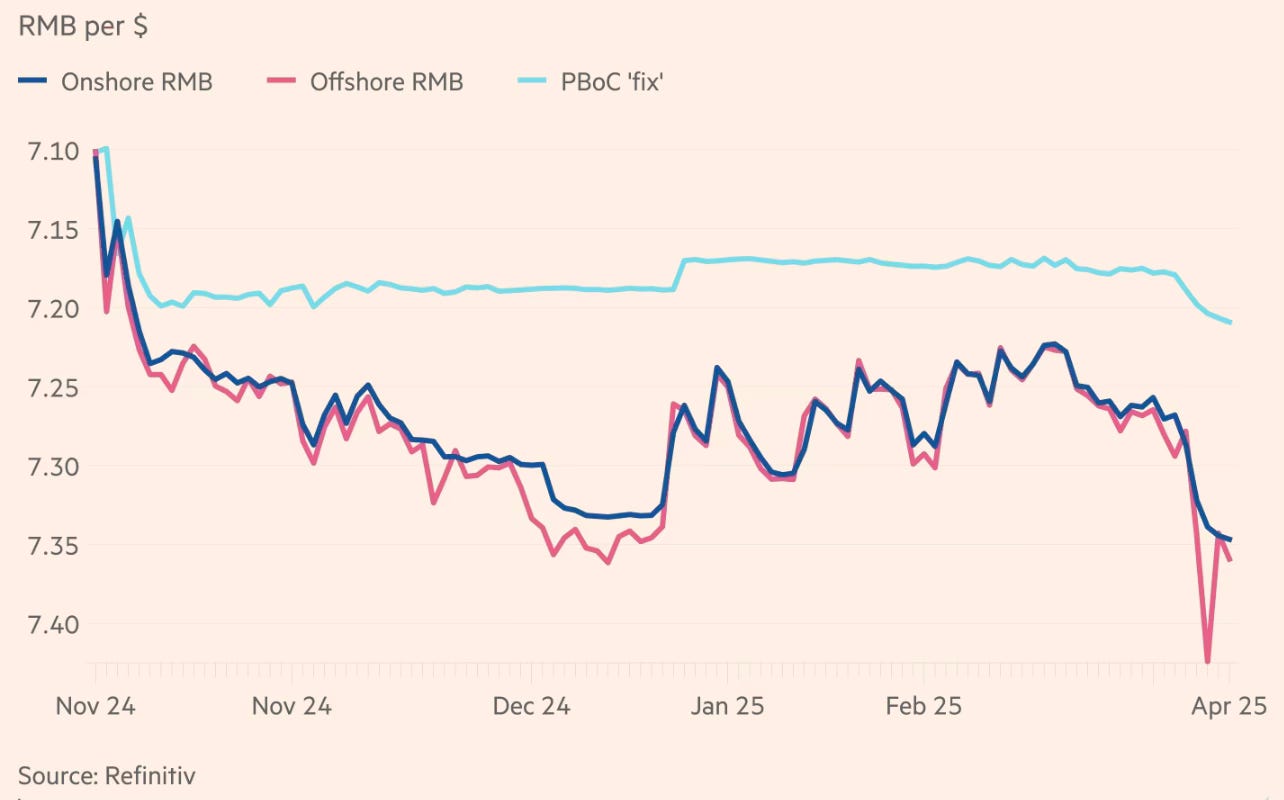
3. China has responded to the Trump tariffs with its tit-for-tat retaliatory tariffs. Apart from this, it has also opened the door on exchange rate response, allowing the renminbi to weaken against the dollar. The offshore renminbi has hit a 18-year low. The onshore renminbi is subjected to a band that restricts moves beyond 2% per day. 

4. Meanwhile, Stephen Miran has expanded on his proposal for an accord with trade partners where they agree to pay for the US security umbrella and access to the large US domestic market. He has outlined five options available with other countries for burden sharing. 

First, other countries can accept tariffs on their exports to the United States without retaliation, providing revenue to the U.S. Treasury to finance public goods provision. Critically, retaliation will exacerbate rather than improve the distribution of burdens and make it even more difficult for us to finance global public goods.

Second, they can stop unfair and harmful trading practices by opening their markets and buying more from America;

Third, they can boost defense spending and procurement from the U.S., buying more U.S.-made goods, and taking strain off our servicemembers and creating jobs here;

Fourth, they can invest in and install factories in America. They won’t face tariffs if they make their stuff in this country;

Fifth, they could simply write checks to Treasury that help us finance global public goods.

5. Michael Moritz makes some important points on the basis of China's manufacturing prowess.

Since the 1970s, China and countries in south-east Asia have perfected a formidable triple axle comprised of the command of raw materials, mastery of component manufacturing and packaging, and now — by dint of drive, creativity and a formidably well-educated cadre of scientists and engineers — an array of products that put the west to shame. Just look at the manufacturing knowhow of Foxconn and TSMC and the product line-up of companies such as Huawei, BYD and Xiaomi — the last of which is only 15 years old. They are enough to make Americans weep. And that’s before you calculate the size of their workforces or contemplate that about 450,000 cars were built in China in 1987 compared with 31mn in 2024.

6. Italian cheese facts of the day

The US imported €7.8bn worth of Italian cheese, olive oil, wines and other delicacies last year... parmesan cheese... is produced in regulated quantities in Italy’s Emilia-Romagna region. Producers there must adhere to 17-pages of strict rules that even dictate what cows can eat — and where their fodder is grown. The Parmigiano-Reggiano consortium allocates coveted cheese quotas to local dairies, polices the process and has to certify cheese as genuine and up to standard.

7. Important graphic on Indian middle class incomes.

8. India's manufacturing is a very big outlier in declining as the economy grows. 


9. Wall Street is also worried because the Trump trade wars may deal a fatal blow to the march of American financial institutions
For the past 15 years, the big US banks and money managers have been on the march... Goldman Sachs, JPMorgan, Morgan Stanley and Bank of America each captured at least 5 per cent of last year’s global investment banking fees. The top European bank, Barclays, pulled in just 3.3 per cent... In some quarters, BlackRock has recorded more inflows than the entire European asset management industry combined. Americans also dominate the custody market, holding four of the top five slots. All of them benefited from a vibrant US economy, deep capital markets, and the fundamental appeal of American equities and bonds to international buyers... 

But just when American finance was looking unstoppable, Trump pulled out the rug. His aggressive “liberation day” tariffs, followed by a partial 90-day pause, sent the markets into a tizzy. Other belligerent policies, including threats by his advisers to weaponise finance, are forcing overseas companies and governments to question their dependence on US financial institutions and their use of Treasuries as a standard risk-free asset. Foreign firms are reconsidering their US ties, looking for local service providers and making contingency plans to issue debt in home currencies rather than the now-less stable dollar. Governments are shedding their laissez-faire attitude to US dominance in technology and banking... The lack of European alternatives to Google, Microsoft and the like make it hard to reduce dependence on US technology, but financial services are a different story. European banks are not as big or as globally feared as the Wall Street beasts, but their top employees are experts at raising funds and closing mergers. Even before Trump set world markets on fire, Swiss lawmakers had raised concerns about the wisdom of using a US bank as custodian for SFr46bn in social security funds.

10. One more article on how the US is more dependent on China than the other way round, harping on the substitutability of US agricultural exports compared to the Chinese technology exports.

While the exposures may be so, there's so little discussion on the  job losses for the 10-20 million Chinese workers who are exposed to US-bound exports, whose re-routing will be extremely challenging in this hostile environment of protectionism globally. 

The one thing that the Chinese have a clear upper hand is in that the trade wars will most likely galvanise the country into becoming united despite the suffering to fight the US, a sentiment that's unlikely with the US.

11. The first quarter of 2025 economic data from China has some interesting insights. The headline growth of 5.4% has a good share of front-loaded exports to beat the Trump tariffs. This is reflected in the 12.4% rise in exports in Match. Disturbingly, industrial production and fixed investment rose sharply in March reflecting the continued expansion of manufacturing capacity, even as imports fell 4.3% for the the month. 

12. As we rail at China, it's an opportune moment for everyone to reflect on how they have been complicit in allowing China to become so dominant in manufacturing, none more so than the US.

China shook the world in 2010 when it imposed an embargo on exports of crucial rare earth metals to Japan... The embargo, prompted by a territorial dispute, lasted only seven weeks... When the embargo was over, China took forceful control of its mineral bounty... and consolidated the industry under state control... The mines were later nationalized and consolidated into a single state-run company, China Rare Earth Group... The world was put on notice, especially Japan and the United States, two of China’s biggest customers for rare earth metals used in everything from cars to smartphones to missiles. Governments from both countries drafted detailed plans for how to mitigate their dependence on China. Japan has largely followed through on its plans and today can source the minerals from Australia. Not the United States. Even after 15 years, the country is still almost entirely reliant on China for the processing of rare earth metals. As a result, American automakers, aerospace companies and defense contractors have been left vulnerable.

Angry about President Trump’s tariffs, China has suspended all exports of certain rare earths, as well as the even more valuable magnets made from them. These small yet powerful magnets — no bigger than a ring for a person’s finger, yet with 15 times the force of a conventional iron magnet — are an inexpensive and often overlooked component of electric motors. They are used in electric and gasoline-powered cars as well as robots, drones, offshore wind turbines, missiles, fighter jets and many other products... China now produces 90 percent of the world’s magnets. Further construction was underway at two of Ganzhou’s largest magnet factories last week...

China’s top leader, Xi Jinping, said in a speech in 2020 that it was important for China’s national security that the West’s supply chains remain dependent on his country. “We must build up our strengths and consolidate our international lead in industries where we have an advantage,” he said a few months after visiting Ganzhou’s most advanced magnet factory. He called for “intensifying the dependence of international industrial supply chains on China, forming a powerful capacity to counter and deter deliberate supply cutoffs by foreigners.”

More on rare earths and China's dominance

China dominates the mining and processing of rare earths, a collection of 17 elements that are essential to the auto, semiconductor, aerospace and defense industries. While abundant in the Earth’s crust, they are difficult to extract and separate, and the United States and other Western nations have largely left the work to China. For some critical “heavy” rare earths — named because they have higher atomic numbers on the periodic table — China is essentially the only country that can separate and process them. Rare earths have become so coveted because they help make the powerful magnets needed for new cars, missiles and drones. While “light” rare earths make up far more of those magnets, heavy rare earths are also needed to keep the magnets from weakening or being destroyed at high temperatures. Heavy rare earths have overwhelmingly come from mines in China and Myanmar, which has sold its output to its powerful neighbor, because those countries have natural clay deposits rich in the elements.

Japan has been alert to the dependence on China for critical minerals and has responded strategically. In response to export controls imposed by Beijing in 2010, Japanese companies and government agencies stockpiled these minerals and developed alternative sources, cutting their dependency on China from 90% to 58%. 

13. Talk of cutting the branch on which you are sitting, the case of Trump tariffs on Lesotho.

Lesotho is the largest African garments exporter to the US and a rare success story born out of Washington’s 25-year-old African Growth and Opportunity Act (Agoa), introduced under then-president Bill Clinton to offer tariff-free access to the world’s poorest continent. All that is now at stake... the US president has threatened to impose on Lesotho, one of the highest rates on any country. At $240mn of exports, Lesotho accounts for less than 0.02 per cent of the US’s trade deficit. Yet even without Trump’s higher “reciprocal” tariffs, which have now been paused for 90 days, executives and officials say the new blanket tariff rate of 10 per cent could still destroy an industry built on razor-thin margins and the US’s own decades-old trade policy. The duties “make a mockery of Agoa, which was intended to help developing economies grow”, said Nkopane Monyane, a businessman and former ambassador who for years ran a major garment factory... 

Faced with catastrophic economic consequences, Lesotho has been forced to join the queue of countries seeking to appease Trump with economic concessions... Lesotho this week granted Trump adviser Elon Musk’s Starlink a 10-year operating licence... foreign minister Lejone Mpotjoane also offered to greenlight the construction of a Marriott hotel and consider importing corn and wheat from the US. Lesotho is also considering accepting third country national deportees from the US and deploying soldiers to protect US companies in mineral-rich DR Congo...

In 2002, following Agoa’s implementation, more Asian investors saw an opportunity to use their knowhow and global garment connections to tap the pact’s benefits. Taiwanese multinational Nien Hsing, which also runs operations in Mexico and Vietnam, built its largest operation in Lesotho, where it makes some 600,000 units of clothing monthly for brands including Levi’s. A fifth of its exports go to neighbouring South Africa, while the rest is US-bound. The apparel sector is the southern African country’s biggest private sector employer, with 30,000 direct jobs and tens of thousands more people working indirectly, according to the country’s main business chamber. The reams of cotton being stretched, cut and sewn at Nien Hsing’s factory are a testament to the global nature of the business: cotton sourced from Egypt and West Africa is spun into denim, which then travels to South African ports before landing in the US.

14. Importance of the dollar, or the "burden of being the reserve currency" as per the Trump administration. 

Nowadays, the US only accounts for about a quarter of the global economy, but more than 57 per cent of the world’s official foreign currency reserves are in dollars, according to the IMF... There are many other pots of sovereign and quasi-sovereign money that are not captured by the IMF’s data on foreign exchange reserves, and whether you are a bank in Mongolia, a pension plan in Chile, a European insurance group or a Singaporean hedge fund, dollars are the ultimate reserve asset. The dollar is equally central in trade, with 54 per cent of all export invoices denominated in dollars, according to the Atlantic Council. In finance, its dominance is even more total. About 60 per cent of all international loans and deposits are denominated in dollars, and 70 per cent of international bond issuance. In foreign exchange, 88 per cent of all transactions involve the dollar. Even physical US bank notes are widely held abroad, thanks to the dollar’s broad acceptance. In fact, about half of the more than $2tn worth of US bank notes in issue are held by foreigners, according to the Federal Reserve. This enormous international demand for dollars translates into an embedded premium to US assets and means that the US borrows more cheaply than it would otherwise do — what France’s former president, Valéry Giscard d’Estaing, once famously referred to as America’s “exorbitant privilege”. It also gives the US the power to sabotage another country’s financial system through sanctions.

The effect of the Trump tariffs

Last week the DXY dollar index — which measures the strength of the currency against a basket of its biggest peers — fell 2.8 per cent. This was its seventh-worst week in the past three decades. It has kept dipping this week, extending its 2025 decline to 8.2 per cent... Most notably, the dollar has been particularly weak against other “haven” currencies that typically strengthen when markets are turbulent, such as the Swiss franc and the Japanese yen, and against gold. That the greenback is seemingly being excluded from this select club of currencies is a shocking development to many analysts and investors.

But there are no alternative to the dollar and it's still far from its lows. Despite the April declines, the DXY dollar index is 12% higher than it was its lows in 2020 and 40% over its lowest in early 2008. 

15. Alan Beatie points to the incentive distortions facing US car manufacturers. The US production of light-trucks, including poc

The EU import duty on standard cars such as hatchbacks and minivans is indeed 10 per cent versus the US’s 2.5 per cent. But the US production of light trucks, including pick-ups, has long sheltered behind a 25 per cent tariff wall. The duty is known as the “chicken tax” after Lyndon B Johnson imposed it in 1964 in retaliation for European levies on American poultry. Industry experts say the Big Three car companies in Detroit — Ford, General Motors and Chrysler (now part of the Stellantis group) — have accordingly increasingly focused their innovation on making pick-up trucks and used the same platforms and components to develop gas-guzzling large sport utility vehicles (SUVs). Felipe Munoz, senior analyst at the market intelligence company Jato Dynamics, told me that while pick-ups and heavy SUVs were only 17 per cent of US light vehicle sales, “it’s where the Big Three US manufacturers make most of their money in the American market”. The rest of the world, however, tends to have narrower roads and higher fuel taxes than the US. “The protection has made the US car manufacturers less competitive globally,” Munoz told me. Japanese companies make family cars popular around the world: Detroit does not... It’s not EU protectionism that hurts American carmakers abroad. The European Commission has long had an open offer to the US to cut all industrial goods tariffs including cars to nil, which the US has failed to take up.

16. OpenAI facts of the day

No other company has ever built a consumer internet empire so fast. It took Google 13 years to reach 1bn users, while Facebook reached the same milestone in eight. Thanks to the viral success of ChatGPT, OpenAI looks on track to get there in three... chief executive Sam Altman said last week that its audience had doubled in a matter of weeks and now comprises a tenth of the world’s population. This is mind-boggling — ChatGPT only passed 200mn weekly visitors last August. Rapid growth has left the company little time to address some of the most fundamental questions for any consumer internet company.

17. Semiconductor chip supply chain 

Those supply chains cross so many borders that “no one [country] is self sufficient — not even close,” Chris Miller, a Tufts professor, added, noting that while Japan dominates the wafer business (with a 56 per cent market share), the US has a 96 per cent share in electronic design automation software and Taiwan controls more than 95 per cent of advanced chipmaking. Meanwhile, China processes more than 90 per cent of many critical minerals and magnets needed to make digital goods.