Substack

Showing posts with label Social Security Cards. Show all posts

Sunday, April 23, 2023

Weekend reading links

1. The Economist has an article on the distortions in the UK's direct and indirect taxation system. This about exemptions from VAT for smaller firms is interesting,

Companies with a turnover of less than £85,000 a year do not have to register for VAT at all. Such exemptions are forecast to cost the exchequer £67bn in the 2022-23 tax year, about half the total actually raised through VAT... the threshold incentivises companies to stay below a certain size. They are duly piling up at the £85,000 mark, which has been frozen in cash terms since 2018. By the time the freeze ends in the 2025-26 tax year the OBR expects the number of firms remaining just below the threshold to have nearly doubled, from 23,000 in 2018-19 to 44,000. This is not only bad for the public purse, which misses out on VAT receipts payable by larger firms, but for the economy as a whole, since bigger businesses tend to be more productive. A lower threshold would make staying small a less viable option. It would also move Britain more into line with the European norm—German companies only need revenues of €22,000 ($24,050), for instance, to start paying VAT.
This has resonance with the composition scheme in the GST, which exempts firms with less than Rs 1.5 Cr from filing monthly returns.

2. Another article points to Britain's problem with affordable housing shortage, attributed to restrictive regulations,
Strict planning rules, which protect the green belt around cities, are effective at stopping urban sprawl. Too effective: just 6% of the land in Britain has been built on. The Countryside Charity claims there are enough vacant or derelict brownfield sites in London to build nearly 400,000 homes there. But brownfield sites can be unappealing places to live and often require costly clean-ups.
Another one concerns affordable housing quotas
Affordable housing quotas also weigh on developers’ profits. In 2021 London’s mayor, Sadiq Khan, unveiled targets calling for 50% affordable housing on all new sites, higher than the 35% threshold set in 2016. Greater numbers of residential sites are being turned over to commercial uses (such as warehouses) as a result, says Emily Williams of Savills, or are concentrated in areas with higher property values such as Canary Wharf. Where high-rise projects succeed, they often do so by sidestepping affordability targets in favour of cash handouts to local communities or promises to build cheap homes elsewhere. Nearly 200 new towers have been built in London over the past decade but many of them have been filled with luxury flats, and boast gyms, private cinemas and rooftop lounges. Buyers are often investors; apartments are frequently left empty... New schemes in London must adhere to stringent restrictions on height and must not obstruct certain views of landmarks such as St Paul’s Cathedral. There is often resistance to high-rise developments from local residents: planning applications for new schemes have been dismissed for being too bulky, too strange or just plain ugly.
3. Is America the biggest wealth generation entity the world has ever seen?
In 1990 America accounted for a quarter of the world’s output, at market exchange rates. Thirty years on, that share is almost unchanged, even as China has gained economic clout. America’s dominance of the rich world is startling. Today it accounts for 58% of the G7's GDP, compared with 40% in 1990. Adjusted for purchasing power, only those in über-rich petrostates and financial hubs enjoy a higher income per person. Average incomes have grown much faster than in western Europe or Japan. Also adjusted for purchasing power, they exceed $50,000 in Mississippi, America’s poorest state—higher than in France... America has nearly a third more workers than in 1990, compared with a tenth in western Europe and Japan. And, perhaps surprisingly, more of them have graduate and postgraduate degrees... American firms own more than a fifth of patents registered abroad, more than China and Germany put together. All of the five biggest corporate sources of research and development are American; in the past year they have spent $200bn. Consumers everywhere have benefited from their innovations in everything from the laptop and the iPhone to artificial-intelligence chatbots. Investors who put $100 into the S&P 500 in 1990 would have more than $2,000 today, four times what they would have earned had they invested elsewhere in the rich world.

This is important pointing to increasing generosity of US social safety nets,

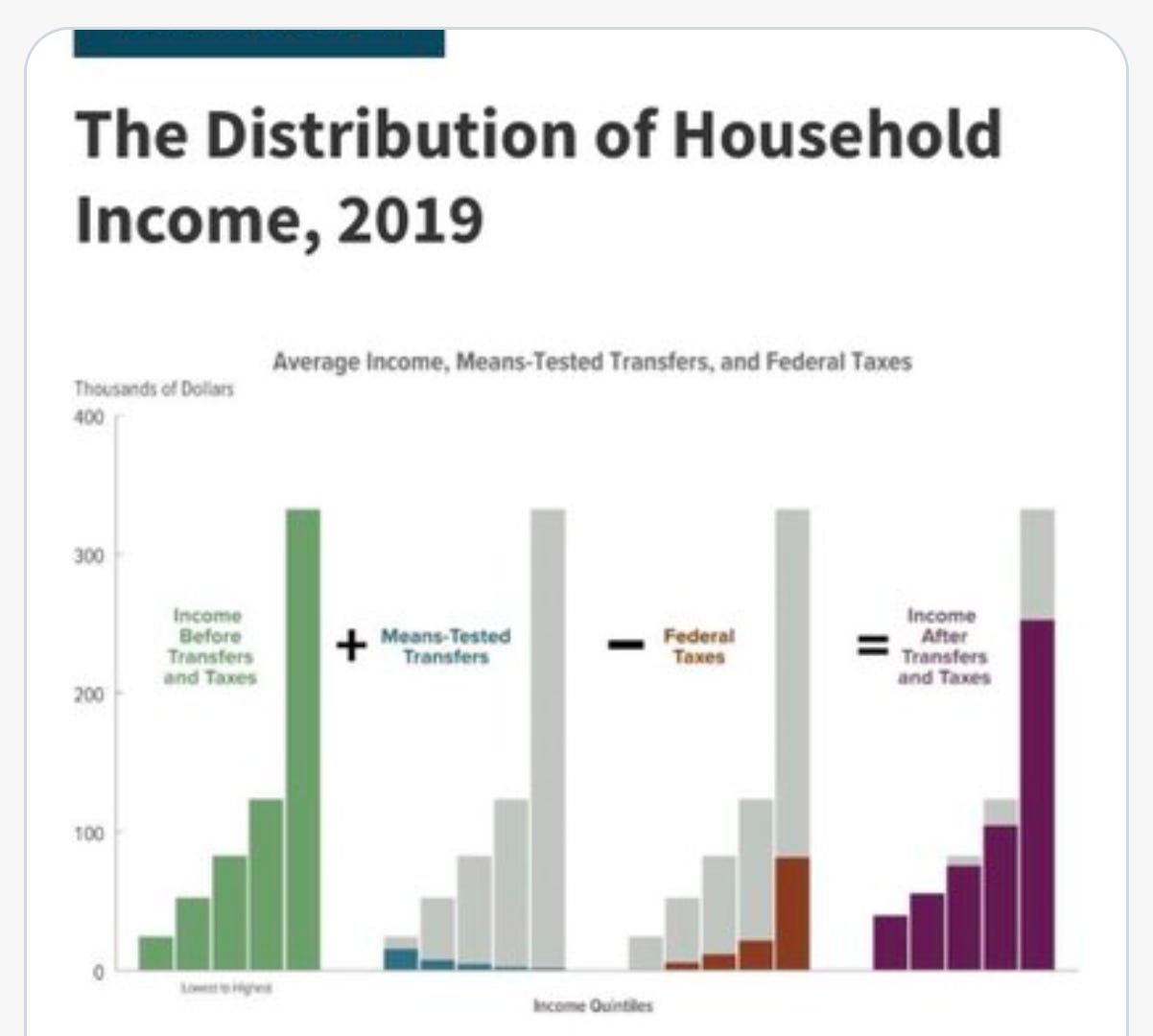
America’s spending on social benefits, as a share of GDP, is indeed a great deal stingier than other countries’. But those benefits have become more European and, as the economy has grown, they have grown even faster. Tax credits for workers and children have become more generous. Health insurance for the poorest has expanded, notably under President Barack Obama. In 1979 means-tested benefits amounted to a third of the poorest Americans’ pre-tax income; by 2019 these came to two-thirds. Thanks to this, incomes for America’s poorest fifth have risen in real terms by 74% since 1990, much more than in Britain.

On this point, this is a distribution of household income in the US in 2019 after transfers

4. Amidst all the Chinese grandstanding, what do the Taiwanese people think about independence? How have their views changed over time? Sample this

Fewer than 6% want reunification immediately, and less than 12% want it at all. And both these trends have been stable or declining for the last three decades. In contrast, there has been a sharp spike in those wanting independence in some form or other. 

5. From MR, striking fact on New York shoplifting incidents
Nearly a third of all shoplifting arrests in New York City last year involved just 327 people, the police said. Collectively, they were arrested and rearrested more than 6,000 times, Police Commissioner Keechant Sewell said. Some engage in shoplifting as a trade, while others are driven by addiction or mental illness; the police did not identify the 327 people in the analysis. The victims are also concentrated: 18 department stores and seven chain pharmacy locations accounted for 20 percent of all complaints, the police said.

6. Rana Faroohar writes that immigration into the US is back to pre-Trump trends

In the US, immigration accounted for about half of the growth in the working age population between 1995 and 2014 according to Pew Research... Over the course of four years, according to a February paper from the San Francisco Federal Reserve, the Trump administration took 472 executive actions aimed at reducing immigration, from increasing immigration enforcement to freezing refugee admissions to moving away from family immigration. Between 2016 and 2019, the number of new permanent residents dropped 13 per cent and the number of student F1 visas declined 23 per cent... The two trends together fuelled a strong tightening in the labour markets, according to the San Francisco paper. The authors found that the drop in immigration from 2017 onwards resulted in a 5.5 percentage point increase in the vacancy to unemployment ratio in the US. But happily, the recent uptick has resulted in a 6 percentage point reduction to that ratio. More than 900,000 immigrants became US citizens during 2022 — the third highest level on record and the most in any fiscal year since 2008, according to Pew.

This underlines the importance of immigration to US economy,

While immigrants represent 13.6 per cent of the US population, they start a quarter of new businesses. Indeed, a study by the American Immigration Council last year found that 43.8 per cent of the Fortune 500 companies were started by immigrants or their children. 

7. TN Ninan points to how important Suzuki's entry into the Indian car market in the early eighties was for India's manufacturing and asks whether the same would be the case with Apple.

Suzuki entered in partnership with the government, and enjoyed special benefits and protection from competition for an extended period, whereas benefits offered to Apple and its suppliers are also available to competitors. Suzuki introduced contemporary cars to Indians (alongside Japanese companies that entered the motorcycle and commercial vehicle markets at about the same time), and has enjoyed dominance in the small-car market ever since. Apple is entering a bitterly competitive market that is already used to the best as well as the cheapest products on offer. Importantly, Suzuki brought with it a slew of Japanese vendors to set up shop in India and become suppliers for its Maruti cars. The result is India’s internationally competitive auto component industry. Since a car factory is largely an assembly unit, it is the vendor ecosystem created by Suzuki that has proved to be crucial. Part of that ecosystem is the steel industry itself, which had to start making special grades like deep-drawing steel.

8. The hollowing out of American cities,

The weekly average number of passengers arriving by train at Embarcadero station, which serves the downtown area, has fallen by about 70 per cent since 2019, according to the body that runs rapid transport. By contrast, the number of passengers commuting into New York’s central subway stations is down between 30 and 40 per cent, per official state figures... Vacant office space in San Francisco now totals more than 21mn square feet, according to real estate agency Cushman & Wakefield, while rents have fallen more than 15 per cent from pre-pandemic peaks. Vacancy rates have surged to 30 per cent, compared with 16 per cent in Manhattan and 8 per cent in London, according to real estate agency JLL. 

Amidst the gloom of the hollowing out, there is the silver lining it presents in terms of putting downward pressure on rents. This is perhaps the way in which these cities will become more affordable and thereby attractive newer people. 

9. A fascinating profile of Ursula von der Leyen, the former German Defence Minister and now European Commission President. 

Von der Leyen told me she had been aware that her vaccination strategy would take a bashing in Germany, because EU-wide procurement meant doses were spread among member states, rather than going to countries with the deepest pockets. “It was of existential importance for the EU — if you are big or small or rich or not so rich — that you have the same access to the vaccine. Otherwise it would have torn Europe apart,” she said. “In hindsight, it was right.” Instead of breaking von der Leyen’s presidency, the episode marked a turning point. In spring 2021, vaccines started flowing far more freely, and the commission emerged from the crisis with its powers enhanced. It is now working on plans to replicate the model of common EU procurement to increase the production of weapons and ammunition for Ukraine. 

Von der Leyen helped set another important precedent when member states agreed on €800bn of joint borrowing in 2020 to pay for Covid recovery. It was a major expansion of the commission’s fiscal power and a potential blueprint for future collective action. It also conferred a PR opportunity, as von der Leyen toured European capitals blessing local recovery plans and lining up multibillion-euro cheques. “We have learnt that if the situation is serious and requires European-wide action, it will be tackled rapidly at an EU level,” says Welle, the retired European parliament official.

For all its criticism, the European Union is a truly remarkable project. It's strong living proof that countries will give up their sovereignty, but only if backed with sufficient history. It's also remarkable that a long-serving German minister has managed to set aside her German nationality and put the interests of Europe at the front in managing the affairs of EU, even when the latter conflicts with the former.

10. Finally, a good snapshot of the sources of debt of emerging and developing countries.

Thursday, June 13, 2019

At what cost progress?

Excellent article in Quartz (HT: Ananth) about the decline of physical bank branches in remote areas of Scotland as banks embrace the digital revolution and the problems it creates for local communities. The article covers the spate of branch closures by RBS, a bank rescued with tax payer bailout during the financial crisis, and currently 60% owned by the UK government. 
It’s one more way this century has favored the young, urban, and digitally minded, concentrating power in capital cities (where nobody has heard of a bank van) and destabilizing communities that were already losing jobs and people. It draws a sharp contrast with a time, decades ago, when the bank branch manager mattered in Britain. “They had a place in society, they knew what was going on, they knew everybody who was worth knowing,” Derek French, who started working at National Westminster Bank in 1957 and spent the next 38 years there, said in an interview. But that system, where the local branch manager made key lending and banking decisions, began disintegrating before the internet came along, during the 1970s and 80s. As credit scoring and algorithms caught on, authority was sucked out of the provinces and concentrated in London. The business model proved cost efficient and unstoppable, not unlike the rise of internet banking now.
As their autonomy declined, branches were “de-skilled” and became little more than sales outposts. Their decor matched their new role. “The previously dark and imposing banking halls were redesigned into brightly coloured, open-plan retail spaces,” Pål Marthon Vik, a research fellow at the University of Salford, wrote in a PhD thesis titled The Demise of the Bank Branch Manager. The digital revolution supercharged the shift in algorithmic, automated authority that was already underway. To be sure, there are benefits beyond fattening banks’ bottom lines. The patriarchal branch manager was almost always a man and more likely to make loans to other men, with the same color of skin (that is, almost always white). Credit scoring makes lending more efficient, precise, and profitable.
But banking also became less personal, and the real-world connection of a banker who is embedded in a community was lost. While the old system could be unfair, people seem to trust the algorithms even less: The percentage of Brits who think banks are well run fell from 90% in 1983 to 19% in 2009. Another worry is that big data and better algorithms could exclude some parts of society from getting financing, according to Mick McAteer, co-director of the Financial Inclusion Centre, a not-for-profit policy group. Providers are getting better at identifying the most profitable and most risky consumers. While some, maybe even most, people will get better deals on loans and insurance than ever, those who can least afford it will pay more financial services, he said.
This about the changed role of banks is important,
The government’s role goes deeper when it comes to modern banking. Commercial banks operate in an unusual sphere, where they rely on government subsidies (access to central bank lending and money, and cheaper funding costs from the implicit expectation that big banks will get bailed out in emergency), yet exist as for-profit entities with an obligation to enrich shareholders... the underlying principle that banks are for-profit entities that derive much of their earnings from government support remains. (But) they’re designed to benefit private shareholders rather than society as a whole. 
The article is a great case study about the double-edged sword that is progress and development. Conventional wisdom would have it that digital banking and fintech constitutes technological advance and economic progress. It lowers transaction costs, access barriers, and expands opportunities, and thereby enhances economic efficiency. But amidst all these benefits, its social costs most often get glossed over.

The biggest problem with such progress is that while its benefits accrue disproportionately to the non-poor, its costs are borne disproportionately by the poor (and those living in backward areas). Like with other common signatures of progress - farm mechanisation, e-commerce, cross-border trade, immigration, globalisation, and so on - the asymmetry in their impact is the big challenge to overcome. Given that markets will not address these (at least in the short-run, and in the long-run, as Keyenes said, we are all dead), it is essential that public policy assume an important role.

While there may be specific public policy levers available for each problem, the political economy challenges associated with redistribution and other mitigating actions make them difficult to implement. In the circumstances, perhaps the only practical response may be to have a reasonable enough social safety net that cushions the vulnerable from the inevitable adverse effects of such trends that accompany development and progress. 

Monday, April 15, 2019

PPPs for social protection?

Killing off bad ideas is important. Uncharacteristically Ejaz Ghani gets this on the relevance of PPPs in social protection for India wrong big time.

The article's premise is just so plain wrong (empirically),
Targeted credit, livelihood interventions, crop insurance, new healthcare facilities, education, and low-income targeted public housing are examples where social protection can be scaled up through increased PPP.
This blog has several posts exploring each of these and showing why they would require public provisioning. This is perhaps one of the best illustrations of how narratives and reality diverge big time, 
The PPP model transfers operational risks from the state body to the private partner and forces the private sector to take a long-term social view of the project... There is a huge potential for maximising finance for social protection through increased public and private partnerships (PPPs), as it broadens the pool of potential financing to maximise social protection.
Really! Whether we like it or not, you cannot escape the reality of hard fiscal requirements and hoping that private sector can bear the burden is not supported by any evidence. In fact, the latter is equivalent to transferring certain basic welfare services, education and healthcare, and social safety nets to the citizens themselves. 

How many developed countries of today have any of these done through PPPs, much less successfully at that, during their early stage of development or even today? 

In fact, on social safety nets, I think the present government has done a decent job. The JDY and the three pension/insurance programs, Pradhan Mantri Shram Yogi Maandhan pension scheme for unorganized sector workers, Ayushman Bharat scheme, PMFBY etc are all very good steps in the direction of laying the foundations of a robust social safety net. Going forward the administration of these programs should be more integrated (using Aadhaar etc) and perhaps try to capture the set of benefits each household is drawing on education scholarships, health insurance, pensions, life insurance, NREGS, other DBT cash transfers etc. That would be the starting point for rationalising  these individual programs and making the social safety net more targeted and effective.

Saturday, March 2, 2019

Weekend reading links

1. No surprises that the plumbing of Indian capital markets is of dubious quality. Sample this about credit ratings of Indian corporates,
While India has 70-odd companies that are rated highest quality, only two companies in the US enjoy this distinction. No company in Germany and UK enjoys AAA rating. Among emerging countries, China has only 14 AAA-rated entities. This implies a gulf between credit standards in India and elsewhere. The exacting standards observed in other countries are missing among domestic agencies.
2. Economist on African countries building up cash transfers based social protection programs,
From 2010 to 2015 the countries of sub-Saharan Africa launched an average of 14 schemes per year, up from seven per year between 2001 and 2009. These countries spend an average of 1.2% of GDP per year on social safety-nets, using a broad definition that includes pensions as well as support for children and the poor. That is only a little less than the average for developing countries (1.6%).
In countries where state capacity is chronically weak and public provisioning of services of appalling quality, cash transfers may not be a bad idea. And in any case, as a social safety net, it is a good idea. The only question is whether these countries have the fiscal space to provide this as well as the regular public goods.

3. Tax avoidance, Amazon edition,
The company, with nearly $11 bn in earnings in 2018 paid nil corporate tax. Unlike others who transfer profits to off-shore subsidiaries or undertake reverse mergers, Amazon takes advantage of Section 162 (m) of US tax code by expensing stock-based compensation.

4. The Adani Enterprises has bagged the 50 year concession for operating all the 5 currently AAI operated airports - Lucknow, Jaipur, Ahmedabad, Trivandrum, and Mangalore - which were put up for auction.  They quoted the highest per-passenger fee for all the five airports, bidding "aggressively" to bag the contracts in a very competitive race. The tender also includes rights for developing real estate projects and operating retail within the airports. Adani Enterprises, which has no experience of running commercial airports, also becomes the largest airport operator in India.
I am not sure this is a good turn of events for multiple reasons. Is the bid motivated by the secondary activity of real estate and commercial development of the airport assets or development of the airports themselves? Does the Adani group have the ability to develop the financial strength over the next 3-4 years to ensure that is effectively delivers on its short to medium-term contractual obligations (almost Rs 12,500 Cr investments in next five years), given their already big commitments on new ports, gas distribution, power transmission, and now airports, not to speak of its already over-leveraged (Rs 1.2 trillion group debt) legacy businesses? Finally, while perhaps too early, are competition authorities not concerned by the Group's dominance (or likely dominance) in several sectors?

Just 43 per cent of trade in textiles and apparel was based on labour-cost arbitrage in 2017 (defined as exports from countries whose GDP per capita is a fifth or less than that of the importing country), compared with 55 per cent in 2009, as the first chart shows. For furniture, toys and other labour-intensive goods, there has been a decline from 43 per cent to 35 per cent over the same period.... McKinsey calculated that trade intensity (the ratio of gross exports to gross input) rose rapidly from 1995 to 2007, when it peaked at 28.1 per cent. It has since fallen back to 22.5 per cent. In addition to this, trade has become more regional. The share of goods traded within the same region fell from 51 per cent in 2000 to 45 per cent in 2012, MGI said, but has rebounded to 47.7 per cent, led by Asia and Europe. This reduces the scope for emerging countries to sell to the rich west.
6. The International Court of Justice rules 13-1, in a non-binding judgement, that Britain's occupation of its 'last colony in Africa', the Chagos Islands in the Indian Ocean, is illegal. As FT writes,
In a non-binding opinion delivered in The Hague on Monday, the court said the UK’s half-a-century of rule over the islands, including expelling 1,500 inhabitants and hosting a US military base, was a “wrongful act” and not “based on a free and genuine expression of the people concerned”. “The UK is under an obligation to bring an end to its administration of the Chagos Archipelago as rapidly as possible"... Although advisory, the ruling will increase pressure on Britain to cede the islands to Mauritius, from which it split the territory... In what the court on Monday called an “unlawful detachment,” London split the Chagos Archipelago from Mauritius in 1965, three years before the end of colonial rule. From 1968 to 1971 UK authorities forced Chagossians to leave — gassing their pets — to make way for a US base on the largest island, Diego Garcia. At the time a British diplomat dismissed the islanders as “some few Tarzans or Man Fridays whose origins are obscure and who are hopefully wished on to Mauritius”.
7. David Leonhardt examines the trends associated with incomes of different income segments of the US population.
The incomes of the upper middle class have grown at the same rate as per capita income growth. His recommendation,
Politicians should recognize that there are three broad income groups, not just two. The bottom 90 percent of Americans does deserve a tax cut, to lift its stagnant incomes. The top 1 percent deserves a substantial tax increase. The upper middle class deserves neither. Its taxes should remain roughly constant, just as its share of economic output has.
8. MSCI announces an increase in China's weighting in its flagship $1.9 trillion EM index from 0.71% to 3.3% by November 2019, a decision that is expected to see an estimated $125 bn of offshore funds flowing into Chinese equities this year. 

9. Finally, a fascinating Simon Kuper peek inside the great Barcelona football club and how, through its Innovation Hub, the club is creating not just the "future of football" but an entire innovation eco-system focused on sports. Sample this,
Barça field men’s, women’s and children’s teams in sports from basketball to roller hockey. The start-ups or universities with which Barcelona are partnered can test their findings on athletes. Sometimes Barça’s staff help co-develop a product. If any of this work results in a breakthrough in, say, treating hamstring injuries, then Barça’s athletes will benefit first. After that, though, the club hope to spread any new products throughout global sport... If a company can market a product as “tested at FC Barcelona”, the club will charge royalties. And if the product is in sleep or nutrition, areas in which elite athletes and ordinary mortals have similar needs, revenues could be large. Now Barça plan to launch investment funds, with initial outside capital of €125m, to invest in tech and sports projects worldwide.
In terms of a match objective, this is stunning,
The team’s basic playing style barely changes from match to match. They aim to play a passing game in the opponent’s half and to lose the ball in dangerous positions no more than six times a match, allowing the opposition about three threatening attacks. More than six, and Barça aren’t playing well.
The remarkable thing is how much value is being attached to data analytics, at least for now, in the club's successes. In fact, given this, such humility of coach Ernesto Valverde stands out,
“This is a game where the coach has less margin than any coach in another sport, because I’m shouting to the player over there, and he doesn’t hear me, and the one by my side doesn’t either. This is a continuous sport in which the coach has barely any influence, or at least much less than in basketball: we only have three substitutions, the game never stops [for time-outs]. So, football belongs to the players. For 45 minutes at a time, non-stop, the player takes his own decisions. I have to say that the great players analyse the game better than I do.”
Sample this on the limitations of data analytics,
Attacking in football is about creating superiorities. These can be numerical (two of your players against one of theirs), positional (your player controls a space) or qualitative (Messi dribbling against an inferior opponent). Barça hope that tracking data can uncover ways to create superiorities. For now, the club’s analysts can barely help the players do that. On the contrary: the analysts learn about football by observing the most intelligent players. For instance, Barça’s midfielder Sergio Busquets, the team’s pivote, knows just how to draw an opponent towards him and then release a teammate into the space the man has left. No coach shouting instructions at him through an imaginary earpiece could advise him better. How to identify intelligent footballers? A Barcelona official fantasises about one day tracking players’ brains. For now, though, the analysts suspect that the most intelligent players — Busquets, Andrés Iniesta or Messi — are those who almost always face the right way on the field.
This is brilliant sports writing. Do read the whole article.

Wednesday, December 19, 2018

Use-cases for aid spending

Lant Pritchett makes the case that extended periods of economic growth and cross-border labour migration trumps any kind of targeted development intervention in reducing poverty.

Two thoughts

1. I am inclined to agree that getting people out of poverty is best done by the dynamics of economic growth than by targeted interventions. I struggle to find one example of a targeted development intervention that can be applied as a de-risked instrument to lift people out of poverty.

When thinking about poverty elimination, the international development community has tended to view it in terms of interventions that can act directly to increase the incomes of the poor. Unfortunately, there are no such silver bullets to do that in any reasonable scale. Sustainable increase in incomes require active support from the eco-system in which the poor person lives and works. Call it whatever you like - markets, institutions, state etc - it cannot be denied that such support systems are weak, unstable, and not mature enough to support the human and physical capital formation required to realise high incomes. In fact, aid agencies should spend more effort and resources supporting the development of such "invisible" infrastructures including foremost state capacity.  

The vast majority of self-employment schemes like providing cattle or small grocery stores or sewing machines are mostly poverty alleviation efforts. The so-called Graduation programs, cash transfers etc are also just the same. The best that can be said about all these are that they take people to the starting line in being able to meaningfully engage with opportunities that are likely to come their way. But in countries where those opportunities themselves, like productive formal sector jobs, are limited, there is only so much to be had with this privilege.

2. Two more appropriate areas for targeted interventions would be poverty alleviation and preventing people at the margins from falling back into poverty.

Poverty alleviation interventions of the kind discussed above are well known. This leaves us with preventing fall-back into poverty.

Take the arguably three biggest sources of reversal to poverty - catastrophic medical illness, natural disasters, and larger credit defaults. Governments could underwrite these risks for all but those well-off (market solutions are already available for the middle class and above) through health insurance, disaster relief and rehabilitation, and some form of credit insurance against certain risks. Some form of means tested social safety nets would be required. Notwithstanding the challenge of implementing, and that too in scale, such safety nets, this presents a distinct area of engagement.

There is scope for innovation, especially with financial instruments which are supported with public subsidy. I have blogged earlier (see this, this, and this) about how the extant debates about financial inclusion is entrapped in the quest for expanding access to existing financial instruments (which service people like you and me) without realising that the poor may actually need very different sets of financial instruments. Bar micro-finance, the landscape is barren and littered with quackery.

Fintech offers opportunities to offer multi-tier accounts and other solutions which address human cognitive failures. Or, what would it take to have credit insurance for loans given to farmers and micro-entrepreneurs? 

Saturday, November 3, 2018

Globalisation graphics

PIIE have an excellent feature on globalisation.

1. Global trade has skyrocketed since about the 1950s, and especially since the nineties.
2. This has coincided with steep declines in tariffs across major economies.
3. Four-fifths of world trade is driven by supply chains of multinationals. Trade in intermediate goods is double that of final goods.
4. US had an overall trade deficit of $447 bn in 2017, with a very large deficit in goods offset partially by a smaller surplus in services.
5. Since the war, the share of jobs in US manufacturing has declined steadily, with that of services rising from just over half to 84% from the fifties to 2018. But strikingly, even as the absolute number of employees in manufacturing have declined, the value of output has increased significantly.
6. The balance sheet of post-war global trade expansion on the US economy is unambiguous.
7. But the aggregate hides concentrated particulars. This about the very localised displacement effects of globalisation on population clusters is central to the backlash against it,
Certain manufacturing and industry workers in specific geographic regions lost out, such as those in furniture, apparel, steel, auto parts, and electrical equipment industries in Tennessee, Michigan, and the mid-Atlantic states... The problem is compounded because policymakers have done little to help workers and communities adjust at a time when the wealthiest Americans have gained the most in recent years.
The answer to this problem is well known,
Instead of sacrificing trade gains, many economists recommend domestic policies like wage insurance, expanded tax credits, better unemployment benefits, and subsidies for health insurance for all displaced workers regardless of the cause. Such policies could reduce worker anxiety about job turnover across the board, whether it be from trade or other bigger factors. Currently, there is government support through a program called Trade Adjustment Assistance (TAA), though it only helps workers directly impacted by trade and the amounts paid are limited... Broader domestic policies can also help workers adapt to the continuously changing job market, such as access to higher education and health care, but Americans remain conflicted about the government’s role in these social safety net programs. Other advanced economies have generally increased the size of government programs as they opened up to trade.
But the challenge is with walking the talk with actual policy actions,
The United States spends only a fifth of what other advanced economies spend on average to help people find new jobs through education, training, job search assistance, and other active labor market programs.
The relevance of economy-wide social safety nets to cushion those impacted and vulnerable to various trends assumes even greater importance in light of technology and globalisation induced practices like automation and production unbundling and offshoring. No country, including developing ones, is immune to these forces. 

Saturday, June 30, 2018

The off-balance sheet debt problem in the US

John Mauldin has a series of US debt crisis. The ticking bomb is the unfunded social security and health care unfunded liabilities, which sits atop the $21.2 trillion federal government debt (105% of GDP) and $ 3.1 trillion (15% of GDP) of state and local government debt. Consider this,
These estimates of when the trust funds run out depend on a slew of assumptions. To estimate revenue, they must know how many workers the US has, their wages, and at what rates those wages will be taxed. To estimate expenses, they mustknow how many retirees will be drawing benefits, the amount of those benefits, and how long the retirees will live to receive them. They also have to assume an inflation rate on which thecost-of-living adjustment is based. A small deviation in any of those can have huge long-term consequences. For what it’s worth, then, Social Security says it has a $13.2 trillion unfunded liability over the next 75 years. That’s the benefits they expect to pay minus the revenue they expect to receive. Medicare projections require even more assumptions: what kind of treatments the program will cover, how much treatment senior citizens will need, and what those treatments will cost. Allthese could vary wildly but the “official” assumptions put Medicare’s 75-year unfunded liability at $37 trillion. It could be vastly more or, if we all get healthier and healthcare costs drop, could be less... 
Larry Kotlikoff estimates the unfunded liabilities to be closer to $210 trillion. That’s a far cry from the $50 trillion official estimate. So, at a minimum, we can probably assume Social Security and Medicare are at least another $50 trillion in debt on top of the $21.2 trillion (and growing) on-budget federal debt. And then you come to the scary part. This doesn’t include civil service or military retirement obligations, or federal backing for some private pensions via the Pension Benefit Guaranty Corporation, or open-ended guarantees like FDIC, Fannie Mae, and on and on... CBO numbers show that by 2041, Social Security, health care, and interest expenditures will consume all federal tax revenue. All of it. Everything else the government does (including defense) will require going into more debt.
The article nicely lays down how these are most likely the best case scenario given the uncertainties associated with making such estimations as well as the headwinds that would have to be overcome.

Monday, June 11, 2018

Social protection programs and impact on poverty

A recent article in the Economist pointed to success of Ethiopia's social safety net programs. It said that social safety net programs formed 1.5% of GDP in Sub-Saharan Africa. It writes,
Ethiopia’s rural scheme is widely regarded as a success. It has reduced rural poverty and helped the poor buy food during a severe drought in 2016 that might have led to famine.
Now this is deceptive. What do we mean reduced poverty? Does it mean that people's lives have undergone a significant change? I guess all this goes back to the artificial minimalistic thresholds that we have constructed around per capita incomes to define poverty levels. 

The World Bank defines Social Protection (SP) programs as consisting of social insurance (mainly public pension schemes covering old age and disability), social assistance (cash and in-kind transfers and workfare schemes, often targeted to the poor), and labor market programs (training, entrepreneurship support, unemployment benefits).

Martin Ravallion and Co explore the impact of social protection programs on the poorest, the floor level of incomes,
The bulk of the impact of SP in developing countries is due to public pensions, which lift the floor by $0.38 a day. This too is below the mean spending on such pensions, which is $0.67 per day. Social assistance on its own only raised the floor by $0.015 per day on average—merely 8% of the (already low) level of average spending on social assistance. The bulk of the impact of SP on the headcount index (5% points) is also due to contributory pensions. Social assistance on its own reduced the poverty rate by 2% points. Countries that spend more on social protection tend to have a higher floor. The correlation coefficient is 0.751. Mechanically, this relationship reflects both differing levels of SP spending and differing transfer efficiencies. Transfer efficiency in reaching the poorest varies greatly. We see that very few countries attain a value of FTE of unity or more. (Recall that this is the ratio of the gain in the floor due to SP to mean spending.) For the bulk of countries (87% of the sample), the gain to the poorest is less than mean SP spending. FTE tends to be better for social assistance on its own, for which the median value is 0.934, as compared to a median of 0.630 for all SP; 43% of countries have FTE for social assistance greater than unity. In addition to FTE, we measure the efficacy of SP in reaching the poorest 20%, giving our second measure of transfer efficiency, GTE. The two measures are correlated (r = 0.505), but certainly not perfectly; some countries are better than others at reaching the poorest people given their efficacy in reaching the poorest 20%. GTE is positively correlated with spending per capita (r = 0.656), but that is not true for FTE (r = -0.021). As countries spend more on social protection, a larger share of that spending tends to reach the poorest 20% but not the poorest.
Now the takeaways in English. We need to make the distinction between poverty alleviation (allows people to have three meals a day compared to two) and poverty eradication (allows people to have meat twice a week, or a more dignified human existence). SP programs in almost all the developing countries help address the former. It will keep people meaningfully above the biological poverty line. It does little, on their own, to help the poorest transition to any meaningfully higher income level. This is just stating the obvious - social safety nets are for poverty alleviation, and not elimination.

If this is the case, then how appropriate is to use indicators like increase in savings or increase in aggregate consumption to measure the impact of social assistance programs like cash transfers? A more relevant measure of impact would be just the change in food consumption - having enough to eat three meals against the typical one or two, or eating meat once a week, or something like those.

This is a bit like the debate about the role of women self-help group movement. It is often confused as an instrument of economic empowerment, when its more relevant utility may be as a tool of social empowerment

Monday, September 4, 2017

The rise of contracting

Neil Erwin has a fantastic article that shines light on the labour costs minimising contract jobs creating nature of modern capitalism.

It compares the lives of a janitor in two of the leading companies of their respective times, Eastman Kodak in the early eighties and Apple today. The former started out as a full-time employee of the company, with all the attendant benefits, and rose up to become a full C-suite executive there and elsewhere. In contrast, the latter is a contractual employee of an outsourced service provider, with few benefits, and with limited prospect of moving up the labour or income ladders.

This contrast is reflected in their respective employers,
Eastman Kodak was one of the technological giants of the 20th century, a dominant seller of film, cameras and other products. It made its founders unfathomably wealthy and created thousands of high-income jobs for executives, engineers and other white-collar professionals. The same is true of Apple today. But unlike Apple, Kodak also created tens of thousands of working-class jobs, which contributed to two generations of middle-class wealth in Rochester. The Harvard economist Larry Summers has often pointed at this difference, arguing that it helps explain rising inequality and declining social mobility. “Think about the contrast between George Eastman, who pioneered fundamental innovations in photography, and Steve Jobs,” Mr. Summers wrote in 2014. “While Eastman’s innovations and their dissemination through the Eastman Kodak Co. provided a foundation for a prosperous middle class in Rochester for generations, no comparable impact has been created by Jobs’s innovations” at Apple...
But when Kodak and similar companies were in their prime, tens of thousands of machine operators, warehouse workers, clerical assistants and the like could count on steady work and good benefits that are much rarer today. When Apple was seeking permission to build its new headquarters, its consultants projected the company would have 23,400 employees, with an average salary comfortably in the six figures. Thirty years ago, Kodak employed about 60,000 people in Rochester, with average pay and benefits companywide worth $79,000 in today’s dollars. 
Job creation is increasingly detached as a priority for successful business enterprises of our times,
Part of the wild success of the Silicon Valley giants of today — and what makes their stocks so appealing to investors — has come from their ability to attain huge revenue and profits with relatively few workers. Apple, Alphabet (parent of Google) and Facebook generated $333 billion of revenue combined last year with 205,000 employees worldwide. In 1993, three of the most successful, technologically oriented companies based in the Northeast — Kodak, IBM and AT&T — needed more than three times as many employees, 675,000, to generate 27 percent less in inflation-adjusted revenue. The 10 most valuable tech companies have 1.5 million employees, according to calculations by Michael Mandel of the Progressive Policy Institute, compared with 2.2 million employed by the 10 biggest industrial companies in 1979. Mr. Mandel, however, notes that today’s tech industry is adding jobs much faster than the industrial companies, which took many decades to reach that scale.
Many of the professional jobs from those companies in the 1980s and ’90s have close parallels today. The high-paying positions setting corporate strategy, developing experimental technologies and shaping marketing campaigns would look similar in either era. But a generation ago, big companies also more often directly employed people who installed products, moved goods around warehouses, worked as security guards and performed many of the other jobs needed to get products into the hands of consumers. In part, fewer of these kinds of workers are needed in an era when software plays such a big role. The lines of code that make an iPhone’s camera work can be created once, then instantly transmitted across the globe, whereas each roll of film had to be manufactured and physically shipped.
Apart from not creating jobs, these enterprises also pride on enhancing business efficiency and value for money by contracting out every possible service, without any concern for the social negative externalities that follow.
But major companies have also chosen to bifurcate their work force, contracting out much of the labor that goes into their products to other companies, which compete by lowering costs. It’s not just janitors and security guards. In Silicon Valley, the people who test operating systems for bugs, review social media posts that may violate guidelines, and screen thousands of job applications are unlikely to receive a paycheck directly from the company they are ultimately working for. And the phenomenon stretches far beyond Silicon Valley, where companies like Apple are just a particularly extreme example of achieving huge business success with a relatively small employee count. The Federal Express delivery person who brings you a package may well be an independent contractor; many of the people who help banks like Citigroup and JPMorgan service mortgage loans and collect delinquent payments work for contractors; and if you call your employer’s computer help desk, there’s a good chance it will be picked up by someone in another state, or country.
Apple claims that it creates far more jobs, more than 2 million jobs in the US itself, through all the economic activities associated with the Apple products eco-system. However this line of reasoning overlooks not only the similar eco-system effects associated with all products and with Apple's own competitors in the modern economy. And mind you, it still does not address the fact that the overwhelming majority of these jobs are exactly the minimal protection, temporary contract jobs that impose massive social costs. 

Its social effects are corrosive,
But it is also clear that, across a range of job functions, industries and countries, the shift to a contracting economy has put downward pressure on compensation. Pay for janitors fell by 4 to 7 percent, and for security guards by 8 to 24 percent, in American companies that outsourced, Arindrajit Dube of the University of Massachusetts-Amherst and Ethan Kaplan of Stockholm University found in a 2010 paper. These pay cuts appear to be fueling overall inequality. J. Adam Cobb of the Wharton School at the University of Pennsylvania and Ken-Hou Lin at the University of Texas found that the drop in big companies’ practice of paying relatively high wages to their low- and mid-level workers could have accounted for 20 percent of the wage inequality increase from 1989 to 2014... In interviews, tech industry contractors in Silicon Valley describe a culture of transience. They can end up commuting to a different office park that houses a new company every few months; in many cases 18 months is the maximum a contractor is allowed to spend at one company. “I would rather have stability,” said Christopher Kohl, 29, who has worked as a contractor at several Silicon Valley companies, including a stint doing quality assurance on Apple Maps. “It’s stressful to find a new job every 12 to 18 months.”
For Silicon Valley’s contracting class, there are reminders large and small of their second-class status. Contractors generally do not receive the stock options that have made some midlevel Silicon Valley workers wealthy over the years, nor the generous paid time off for vacation, illness or the birth of a child. The health insurance plans tend to be stingier than those that the tech giants they serve provide for their direct employees... The problem with contracting is, you could walk in one day and they could say, ‘You don’t need to come in tomorrow.’ There is no obligation from the companies.
This is a very nice analogy that captures the way employers view labour,
When an automaker needs a supplier of transmissions for its cars, it doesn’t just hold an auction and buy from the lowest bidder. It enters a long-term relationship with the supplier it believes will provide the best quality and price over time. The company’s very future is at stake — nobody wants to buy a car that can’t reliably shift into first gear. But when that same automaker needs some staplers for the office supply cabinet, it is more likely to seek out the lowest price it can get, pretty much indifferent to the identity of the seller.
Labor exists on a similar continuum. The right product engineer or marketing executive can mean the difference between success or failure, and companies tend to hire such people as full-time employees and as part of a long-term relationship — something like the transmission supplier. What has changed in the last generation is that companies today view more and more of the labor it takes to produce their goods and services as akin to staplers: something to be procured at the time and place needed for the lowest price possible.
And this lies at the heart of the matter and is telling,
There’s no inherent reason that work done through a contractor should involve lower compensation than the same work done under direct employment. Sometimes it goes in the other direction; when a company hires a law firm, it is basically contracting out legal work, yet lawyers at a firm tend to be paid better than in-house counsel. But as more companies have outsourced more functions over more time, a strong body of evidence is emerging that it’s not just about efficiency. It seems to be a way for big companies to reduce compensation costs. Firms in the United States are legally required to offer the same health insurance options and 401(k) match to all employees — meaning if those programs are made extra generous to attract top engineers, a company that doesn’t outsource will have to pay them for everyone. More broadly, there are a whole set of social pressures and worries about morale that encourage companies to be more generous with pay and benefits for employees who are on the same payroll. 
Nice article. Wish there were similar articles on the effects of the use of robots in Maruti or Volkswagen's Pune car factory or the widespread use of contract labour by our manufacturing firms.

This highlights the difficult choice for governments in countries like India in the area of labour market reforms. Whether we like it or not, flexibility in labour markets is an important contributor to business competitiveness in a globalised market. Outsourcing services to specialised labour contractors is central to this flexibility. The natural policy response should have been to mandate that contract labour too enjoy all the same benefits and social protections. But, as we read above, if the primary objective of contracting is to reduce compensation costs, then such policies run counter to them. But perpetuating this arrangement, apart from its political risks, also creates an unsustainable economic system.

A strong social safety net that goes beyond just the poorest and covers a majority of citizens is a possible solution. But this, in turn, raises the troubling question of fiscal sustainability.

These are really difficult challenges and representative of many social or economic issues, with no satisfactory answers. Governments often make judgement calls, which are always likely to be perceived as sub-optimal, in directions based on the political imperatives that motivate the decision. It is very easy to miss the big picture and criticise governments when passing judgement on policies.

Friday, December 30, 2016

Mid-week reading links

1. The world according to Trump

2. Buoyed by cheap capital, bond market capital raising hit a new high of $6.62 trillion in 2016, with corporate bonds contributing nearly half. 
Eight of the ten largest bond offerings this year were by corporates, who competed to take advantage of the cheap borrowing to finance a wave of mergers and acquisitions. 

The flip side to this is the risks it engenders as interest rates appear to be one the cusp of an upward cycle. Reflecting this, US 10 year bond yields have surged from a record low of 1.36 per cent in July to 2.57 per cent. The impact of a steep enough rise on the indebted corporate balance sheets can be devastating. 

3. Another study finds no evidence of link between executive compensation and company performance. The FT has a report on the study commissioned by the CFA Society of UK and done by the Lancaster University Management School. 
In a study of more than a decade of data on the pay and performance of Britain’s 350 biggest listed companies, Weijia Li and Steven Young found that remuneration had increased 82 per cent in real terms over the 11 years to 2014. Much of the increase was the result of performance-based pay. But, the report’s authors say, the metrics used to assess performance — such as total shareholder return and earnings per share growth — are unsophisticated and short-termist, acting against the interests of long-term investors. The research found that the median economic return on invested capital, a preferable measure, was less than 1 per cent over the same period... A separate research study, by Vlerick Business School’s Executive Remuneration Centre earlier in December found that the median UK chief executive earned €6.175m last year, 50 per cent more than the average counterpart in Germany, the next best paying country.
This really is getting so egregiously embarrassing in a world which increasingly claims to be evidence-based. The brazenness with which such claims are made is shocking. Worse still, instead of being stamped down on, the world continues to be tolerant of the evidence-free claims of the supporters of corporate compensation.  

4. Gavyn Davies has got this spot on. This will be one of the dominant themes of economic and political debates not just in 2017 but in the years ahead. 
How should we compensate the losers from globalisation?
Maurice Obstfeld, the IMF Chief Economist, has called for "trampoline policies" that act as springboard to new jobs as against just the conventional "safety net" policies. 

It is also a teachable moment in intellectual dishonesty and duplicity among the so called "economists" and "public intellectuals" in the west like Mr Davies. For at least three decades, developing markets, or at least significant population groups there, had been at the receiving end of the trade liberalisation agenda. Though the country as an aggregate may have gained, trade liberalisation and globalisation have destroyed local markets and livelihoods, disrupted their social fabric, and engendered political instability. Now, with the shoe in their feet and "economic nationalism" threatening to disrupt social and political status quo, the same worthies in developed economies who then insensitively waxed eloquent about the benefits of unfettered free-trade, have now suddenly turned sceptics. They argue for policies that protect local communities from cheap Chinese exports. 

Worse still, this revisionism cannot be construed as a matter of late realisation due to a mistaken analysis. The same people still support harmonisation of policies especially in labor standards and environment, despite its same consequences on developing country markets. 

Anyways, the issue by itself assumes equal or greater significance for developing countries, where population categories adversely affected by trade are even bigger and public resources required to mitigate much higher proportion of public spending. The challenge is compounded by the weaknesses in markets and state capacity to effectively administer such redistribution.

5. After this, Manas Chakravarthy swings to the other extreme in urging caution on informality. He's as much spot on this time as he was off the mark last time. He writes,
A 2014 paper by Rafael Porta of the Tuck School of Business and Andrei Shleifer of Harvard University, published in the Journal of Economic Perspectives, concluded thus: “we are skeptical of all policies that might tax or regulate informal firms. Rather than encourage informal firms to become formal, such policies may have the effect of driving them out of business, leading to poverty and destitution of informal workers and entrepreneurs. The recognition of the fundamental fact that informal firms are extremely inefficient recommends extreme caution with policies that impose on them any kind of additional costs.”
In other words, shock therapy such as demonetisation could very well turn out to be counter-productive. Instead, Porta and Shleifer say the cure for informality is economic growth. The evidence shows that informality declines, albeit slowly, with development. An 2009 OECD paper on Informality and Informal Employment also came to the conclusion that policies that make it more difficult for informal firms to carry out their activities and stricter enforcement of laws and regulations “have contributed to increased poverty and vulnerability by pushing already vulnerable groups of people into even more difficult situations.” What the government should instead aim for is expanding the formal sector, by making it easier for firms to operate there.
I am in complete agreement. To repeat, my concern with the debate on informality is that it is mistakenly seen through the lens of tax evasion. That is completely missing the point, since informality and tax evasion are inevitable because firms cannot become formal and stay competitive in an extremely price sensitive market where the vast majority of consumers are very poor.

6. Ajit Ranade makes a very strong case for raising income tax rates on capital gains. He advocates treatment of short-term capital gains as similar to regular taxes and taxing long-term capital gains, especially given the Government's decision last year to amend the Mauritius tax treaty.
(This) was a relatively unsung but revolutionary tax reform. Opponents had warned that there would be hell to pay as foreign investors would flee India if deprived of the freebie Mauritius route. Nothing of that sort happened... The amount of tax foregone because of tax-free LTCG can be gauged from data released by the tax authorities this year. In assessment year 2014-15, the total amount that escaped the tax net due to LTCG was Rs 64,521 crore. A recent research report published in the Economic And Political Weekly estimates the loss to the exchequer due to capital gains tax exemption at Rs 45,000 crore. Just by way of comparison, in the US, all short-term gains are taxed as regular business income, and long-term gains are taxed at a rate of 15%. It must also be remembered that most foreign investors (FII) who come into India are long-only funds, with a minimum time horizon of three years. So for these investors, gains made in one year are immaterial. Hence it is inconsequential to them if gains beyond one year are made tax-exempt. It, of course, matters a lot for the exchequer. So, ideally, the LTCG tax exemption should kick in after completing three years. Anything shorter, the capital gains should be like regular income. Such a non-discriminatory and transparent tax regime will do away with arbitrage between gains in listed versus unlisted stocks and also foreign versus domestic investors.
7. Finally, the foreign policy victor of 2017, Vladimir Putin and Russia. Consider this from David Gardner,
The Kremlin seems to be getting away with its cyber intervention in the US election. It is having some success in dividing Europe and erecting an illiberal democratic pole inside the EU. And President Putin has a new admirer in US president-elect Donald Trump. President Recep Tayyip Erdogan of Turkey and President Abdel Fattah al-Sisi, the former army chief who rules Egypt, are already Putin fans. Benjamin Netanyahu, Israel’s rightwing premier, has cultivated the Russian leader. Mohammed bin Salman, the young deputy crown prince in de facto charge of Saudi Arabia, has developed what one Arab official calls “a functional relationship” with Mr Putin.

Thursday, September 15, 2016

The recalibration of the pensions privatisation debate

It is a natural tendency of human beings, especially as a social collective, to seek out simple solutions to complex public policy problems. What if there are no simple solutions to complex public policy initiatives?

Consider the example of pension schemes. The conventional wisdom since the early eighties has been that pension plans are best administered by private fund managers. As part of the Reagan-Thatcher axis and later the Washington Consensus, countries were encouraged to move from defined benefit to defined contribution schemes as well as privatise the management of their pension funds. Chile was cited as the poster child of such reforms.

Now, three decades later, Chile is revisiting its pension model. The Times has a nice article,
The options being considered include creating a state-run pension administrator, raising the retirement age, instituting a 5 percent contribution from employers and adopting stronger regulations for the pension fund administrators. “After going from a totally public system to the other extreme in 1981, now we are moving towards a middle ground that combines individual savings, state spending and contributions from employers,” said Mr. Bravo, of the Catholic University of Chile. “Another option is tearing down the A.F.P. system, but it’s too costly. We don’t have the privilege of starting from zero anymore.”
Clearly, the privatised pension model overlooked the messy realities of managing a system with too many moving parts, which cannot always be either regulated or incentivised into conformity. It also mistook a certain demographic and global development moment to be representative of all times to come. 

A pension account requires contributions to be made into individual accounts with a defined periodicity. It is no surprise that poor people, suffering from real financial constraints and amplified behavioural biases, struggle to meet this requirement. The example of unutilized bank accounts from India is an example of such serious last mile gaps. And now, there is growing evidence from everywhere that employers, more due to fiscal and unscrupulous reasons, too renege on contributions.  The article mentions that in Chile, a study found that only a quarter of those who retired last year had paid into the pension scheme for more than 25 years and 62% of women contributed for less than 15 years. So, it appears that the private providers are not well positioned to bear these risk all by themselves. 

Then there are structural issues. The demographic pyramid has slowly changed shape, leaving an increasing share of subscribers exiting the labor market. The age of double-digit or high single digit returns on portfolios looks most likely a thing of the past as we peer into a long period of low interest rates. In fact, as the management and other fees extracted by fund managers rise as a proportion of net returns, pension funds are left clutching at the straws. This has naturally re-iginted the debate on whether the contributions of the workers are in the first place adequate enough to sustain a pension scheme which can give reasonable payouts at the time of retirement. 

All this naturally questions the priors about the neat outsourcing of pensions management responsibilities to private providers. At a more fundamental level, this should be one more in the long list of reminders that the quest for simple, neat, outsourced, start-up driven solutions to complex problems is most likely to be futile.

Update 1 (18.09.2016)

Times has a nice story on the calculation of pension liabilities. The actuarial measurement, which uses a discount rate of 7-8 per cent (the expected investment return), vastly understates the actual liabilities. In contrast, if the risk free rate is taken as the discount rate, the net present value of the liabilities would have to be discounted by closer to 2-3 per cent, which would in turn be a much larger liability. Pension funds prefer to state the former and keep the latter confidential.

Monday, December 1, 2014

The case for immigration, and social protections

Noah Smith makes the case for liberalized immigration which is as simple as anything I've read on the issue,
Tech companies want cheap labor. Tech workers -- or prospective tech workers -- want expensive labor. So they fight over whether to let in more skilled immigrants. Letting in more skilled immigrants will expand the industry (and the overall economy) a bit faster, but more of the revenue will flow to the owners and top-level managers of the companies. Letting in fewer immigrants will slow growth a bit for the industry and the economy, but will give a bigger piece of the pie to native-born skilled workers.  
Ignored in this argument are the rest of the people in the economy, the grocery clerks, cab drivers and landscapers who don’t have tech skills... The skilled immigrants will shop at the grocery stores, take cab rides and get their lawns landscaped, thus putting money into the pockets of the low-skilled American workers. 
Meanwhile, some native-born tech workers will be put out of a job, but since the number of jobs in the world isn’t fixed, they will find new jobs at new companies -- possibly for a bit less money than they earned before, but they will be OK. And with the creation of those new companies, the economy will grow... Some Americans might lose out, but more will gain, and the people who gain will be working-class laborers, not highly trained engineer types.
I agree with him completely. But the argument is incomplete without invoking the second welfare theorem and compensating the losers, atleast those badly affected, with lump-sum redistributions. In other words, liberalization of immigration rules (and similarly of trade itself) has to be complemented with social protections that cushion those worst affected and most vulnerable against the adverse consequences of the liberalization policy.

It is for this reason that the next round of reforms in India, essential for moving up a sustainable high growth trajectory, and invariably involving further liberalization of trade, has to be preceded by steps that lead to the creation of a basic social safety net that at the least cushions those worst affected by the reforms.