Substack

Showing posts with label Elections. Show all posts

Sunday, September 29, 2024

Weekend reading links

1. Changes in interest rates from June till 20th September 2024.

2. The long US equity market run.
3. This is the graphic on how inflation was tamed.
And this is the graphic on how monetary policy responded.
This raises two questions. How much did monetary policy contribute to taming the post-pandemic bout of inflation in developed economies? If inflation is tamed without pushing the economy into a recession, is it a success of the practice of monetary policy by the central banks?
Inflation across advanced economies exceeded 7 per cent in 2022 while nearing 10 per cent in emerging markets. As official interest rates surged in 2022, the World Bank was among the institutions flagging the risk of a global downturn. Analysis by Oxford Economics shows that of 42 rate raising cycles since the 1950s in the US, UK, Germany or the Eurozone, and Japan, those associated with recessions outnumber those without by two to one. Instead, the US has helped the world economy weather the synchronised rate-raising cycle unexpectedly well, with the IMF predicting global growth of a respectable 3.2 per cent this year. “This is a very different easing cycle than most other ones,” says Seth Carpenter, the global chief economist at Morgan Stanley who spent 15 years at the Fed. “Most other easing cycles happen because of recession.” The US economy is expanding at a solid clip, with the Atlanta Fed estimating this week that GDP growth will rise to about 3 per cent for the third quarter. The US labour market has lost some momentum as inflation has collapsed from a peak of about 7 per cent in 2022 to 2.5 per cent as of July, measured by the personal consumption expenditures price index. Demand for workers has cooled off at the margins as the unemployment rate has risen, but much of that increase has been driven by higher supply from rising immigration, economists say... 
Yannis Stournaras, governor of the Bank Of Greece notes that Eurozone inflation has fallen from 10.6 per cent in October 2022 to 2.2 per cent now. “We brought it down in just 18 months and managed to have a soft landing in the economy.” The fact that the ECB from mid-2022 could raise interest rates by an unprecedented 450 basis points within 14 months without pushing the economy off a cliff is remarkable, says Piet Haines Christiansen, a ECB strategist at Danske Bank. “Two years ago, most economists would have said that such a dramatic increase would result in a deep recession.” 
4. Fourteen countries and the European Commission have come forward under a Minerals Security Partnership (MSP) to finance critical minerals projects and thereby break the Chinese stranglehold on the market. 
The Minerals Security Partnership, a coalition of 14 nations and the European Commission, will unveil a new financing network at an event in New York on Monday as they try to ramp up international collaboration and pledge financial support for a huge nickel project in Tanzania, backed by mining company BHP. A joint statement due to be published on the margins of the UN general assembly says the network will “strengthen co-operation and promote information exchange and co-financing”. It lists 10 critical minerals projects that have already attracted support from MSP partner governments. Representatives of BlackRock, Goldman Sachs, Citigroup, Rio Tinto and Anglo American are scheduled to attend the meeting, amid a push to attract private investors and miners to invest further in the sector. Jose Fernandez, US under-secretary of state for economic growth, said a further 30 critical minerals mining projects are being evaluated by the MSP, as western governments race to secure the raw materials needed to make everything from electric vehicles to advanced weapons... The US, Australia, Canada, Estonia, Finland, France, Germany, India, Italy, Japan, the Republic of Korea, Norway, Sweden, the UK, and the EU are members of the MSP.

5. An important part of Candidate Trump's Maganomics 

A second term of Trump would see levies on imports supercharged to levels last seen during the 1930s following the passing of the landmark protectionist Smoot Hawley Tariff Act. After initially saying he wanted to impose 10 per cent tariffs on all imported goods, Trump has recently said they could be up to 20 per cent. For Chinese imports, he has talked about imposing a 60 per cent tariff. This month he said countries that planned to reduce their dependence on the dollar would also be hit with 100 per cent tariffs as punishment. Trump hopes the trade barriers will not only raise revenues, but lead to the restoration of US manufacturing...
If enacted, they represent a return to an era where substantial chunks of government revenue came from trade tariffs, rather than from taxes on people’s incomes and the profits of businesses... The Peterson Institute for International Economics think-tank in Washington calculates that 20 per cent across-the-board tariffs combined with a 60 per cent tariff on China would trigger a rise of up to $2,600 a year in what the average household spends on goods... PIIE senior fellows Obstfeld and Kimberly Clausing think that the maximum amount of additional revenue the administration can raise — by applying a 50 per cent tariff on everything — would be $780bn.

The Indian corporates have been deleveraging and their debt levels have fallen. But this does not mean investment will be forthcoming. The important thing for investment is expectations of market demand. 

Chinese officials are now combining the heft of state spending and financial support with top-down directives to buy local tech, particularly in semiconductors. Late last year state buyers were directed to phase out computers powered by American processors. Since implementing the directive in March, central agencies have transitioned from exclusively purchasing laptops running on Intel and AMD processors last year to now acquiring three-quarters of their devices with chips from Chinese companies such as Huawei, Shanghai Zhaoxin and Phytium, according to public records. Huawei’s Qingyun L540 has won a majority of the orders. What kicked off as a campaign to cut foreign tech products out of the offices of governments and state-owned groups has gradually expanded into a wider array of products. Automakers, including major European groups that produce cars in joint ventures with Chinese state-owned firms, have been directed to step up their use of domestic semiconductors, according to four people familiar with the matter. Two of the people said they had been given a target to use Chinese chips for 25 per cent of the total by next year, though there were not yet consequences for failing to do so.

8. A debate rages in Australia on a Parliamentary vote to reform the Reserve Bank of Australia and establish a dedicated monetary policy Board within it to decide on interest rates. The vote has left parties sharply divided with the Greens' demand being the most interesting. 

But the Greens said this week they would only support the bill if the government used its powers to override the RBA and force it to cut interest rates — or if the bank did so of its own volition — arguing that monetary easing was necessary to help renters and mortgage holders. Both major parties derided the Greens’ proposal, saying that forcing the RBA to cut rates would undermine its independence. “They’re economic terrorists and you can quote me on that,” Taylor said at the prospect. Prime Minister Anthony Albanese said on Monday that acceding to the Greens’ demand would amount to undermining the independence of the central bank in order to pass legislation strengthening its independence. But the Greens questioned why the central bank should be treated as “above politics”. “The RBA board are not infallible high priests of the economy who are above criticism,” said Nick McKim, a Greens senator. On Tuesday, the RBA board kept its key cash rate at 4.35 per cent for the tenth straight month, saying it maintained its view that inflation was not yet under control.

9. Interesting article on the topic of walkability-workability from metro to office in Tokyo.

In a September 10 note to clients, Goldman’s real estate analyst, Sachiko Okada, took a look at office relocation trends within central Tokyo, overlaying that with a calculation of average walking distances between offices and the nearest station — a metric commonly used in Japan’s commercial and residential real estate markets and pivotal in a metropolis where the overwhelming majority of commuters travel by rail. Okada’s analysis comes at a time when the five innermost wards of Tokyo have never looked so frenetic, with Godzilla-scale office construction in prime locations. Around 1.2mn square metres of new space is due to come on to the market in 2025, she says... But the issue, as ever, is location. For offices within Tokyo’s five central wards, the average walk from a station is a breezy three minutes 42 seconds, with 64 per cent within the four-minute walk zone that even the heaviest-footed sloth cannot grumble about. But a significant amount — roughly 7 per cent — lies outside an eight-minute walk. Back in the days where Japanese companies were routinely able to make staff feel grateful to have a job, and surveys showed far higher ratios of people prioritising their work over everything else, that was less of an issue.  But now, with priorities shifting, labour more willing to quit and companies increasingly unable to meet their staffing targets, proximity to stations is yet another battleground in the war to attract and keep good staff.

Just 7% of work commutes in Tokyo falls outside the 8 minute walking time from metro to office!

10. Global EV sales have stagnated this year.

11. Coffee chains in India.

Monday, July 8, 2024

What the UK elections tell us about the limits of centrism for political parties

I blogged here on how narratives create a dissonance between perception and reality. I had also written that centrist parties, especially those that try to achieve the balance between capital and labour, struggle to retain any ideological mooring and end up alienating their core support base. 

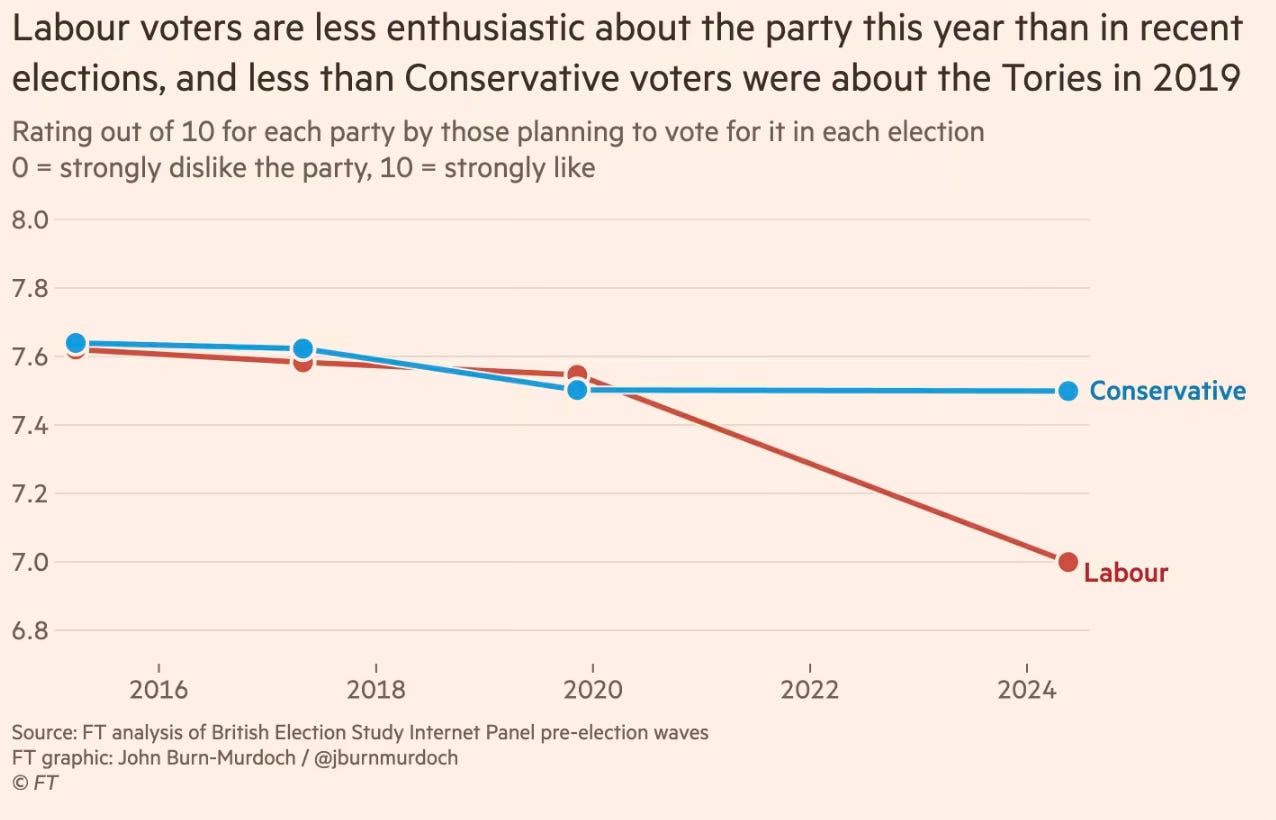
The Labour Party in the UK under Sir Keir Starmer may turn out to be a good example of this. As John Burn-Murdoch has shown brilliantly with data, the Labour victory is built on very shaky foundations. It received half a million fewer votes than its wipeout in 2019, just 34% of the votes, more than doubled its seat share!

Despite their party bagging its second-highest seat tally in history, the lack of enthusiasm among Labour voters is striking.

Consider this about how Starmer reshaped Labour after Jeremy Corbyn’s extremism alienated voters.

Starmer, who won the Labour leadership on a leftwing manifesto offering tax rises and the nationalisation of key industries, now struck different themes. Attempting to win back core working class, social conservatives who had deserted the party during the Brexit years — and middle Britain’s moderate voters — he pulled the party back to a left of centre position. Corbynites were purged, antisemitism was ruthlessly stamped out, the party machine was retooled… During the long months running up to the snap election, Starmer rarely appeared in interviews without the union jack in the background, he adopted tougher language on migration and crime and… he put fiscal discipline and a pro-business agenda at the heart of Labour’s pitch… Starmer, whose previous costly promises to scrap university tuition fees or to bring private companies back under state control were ditched, “fully bought in” to the need for an iron grip on tax and spend policies… Starmer’s transformation of Labour from a leftwing protest party to a centrist government-in-waiting prompted claims that either he does not believe in anything, or that he is a closet leftwinger waiting to unleash a concealed socialist agenda on Britain.

… unlike many members of his incoming cabinet, Starmer is not a career politician. Instead he became a successful human rights lawyer and ended up in charge of the Crown Prosecution Service. He did not enter parliament until his fifties… his time running a big public service made him interested in making bureaucratic machines work. “He’s interested in how, not just what,” says one close ally, arguing that Starmer took a keen interest in turning Labour into an organisation that could deliver change in government. “He’s very professional,” McFadden says. “He likes things to be done right. He expects people to show up with their homework done. He chairs meetings well. He makes sure people know what has been agreed.”.. Sunak has also been among those who claim that Starmer stands for nothing, that he “flip flops” from one position to another; that he was a leftwinger while standing for his party’s leadership, where now he is posing as a fiscal ironman. In essence, the country has no idea what it is getting.

In keeping with centrism, Labour’s manifesto offered very little by way of meaningful reform.

For all the talk of change, Labour’s manifesto was one of the thinnest and centrist in its history. It had little new to say about such core issues as education and skills, public service reform and local government financing. It was largely silent about how both tax rises and austerity could be avoided without breaching its fiscal rules.

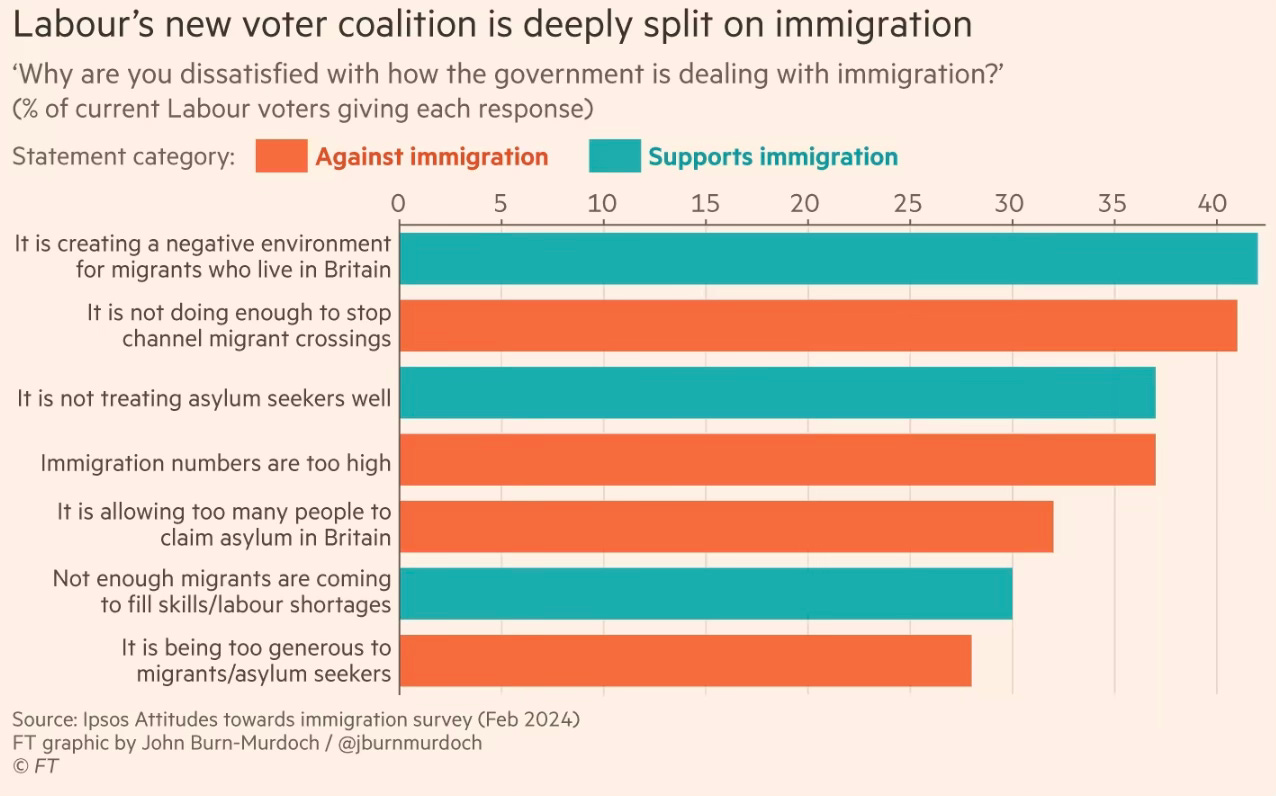
The contradictions in such non-ideological pragmatism is best exemplified in the Labour Party’s views on immigration and asylum.

The clearest illustration of the tightrope Starmer will have to walk here is the way Labour supporters are split into diametrically opposed factions. About a third are angry that the Conservative government created a negative environment for migrants already in the country and want Britain to take in more immigrants. But another 40 per cent identify the problem as too much immigration and too many people allowed to claim asylum.

Almost any position Starmer takes will anger one of these groups. More than 100 Labour MPs now represent constituencies where the right, should the Conservatives and Reform UK unite or ally, would unseat them at the subsequent election. This means that the progressive voters’ side of the debate is likely to be the one that loses out. Nobody should be surprised if the very same split that we’ve seen on the right is mirrored on the left by the next election, with Labour voters peeling off to the Greens and independents.

The short story is this. Keir Starmer was smart enough to apply his technocratic skills and professionalism to opportunistically stitch together a coalition that relied on shifting Labour to the centre and appealing to pragmatism while benefiting from the disillusionment and divisions among the conservative voters. For how long will this balancing act survive?

The problem with such moderation, as I blogged earlier, is that it leaves the party vulnerable to being captured by the interest groups that prefer the status quo. Change of the kind required to reset the balance between labour and capital; arrest widening inequality; roll back the capture of rule-making institutions, especially by Big Finance and Big Tech; break the stranglehold of financial interests; improve the prospects for the next generation, etc., will invariably get pushed to the side. It’s hard to imagine Starmer’s Labour undertaking the kind of measures that would meaningfully upend the status quo in these areas. It’ll tinker at the margins. Expect no more. Disillusionment can quickly set in and the core base will get alienated. The inevitable backlash can threaten liberal democracy and capitalism.

Starmer’s technocratic professional background and limited experience as a politician, coupled with decisions like the handing over of economic management to an out-and-out technocrat like former Bank of England official Rachel Reeves, means that we can expect the Labour government to be one more experiment with technocracy to resolve what are essentially political decisions. Such experiments are unlikely to succeed. 

In this regard, Starmer and the Labour Party only need to look across the channel to France where similar centrism and technocracy by Emmanuel Macron and The Republicans have paved the path for the rise of the far-right populist Rassemblement National (RN) and Marine Le Pen. Esther Duflo writes,

Seven years of Macron but also five years of Socialist president François Hollande (under whom he was economy minister) have shown that whatever it is that the centrist politicians, always intent on demonstrating their reasonableness, keep on offering is now a losing proposition for most French voters. In 2022, it was largely the better off who voted for Macron and his party. The urban poor and the middle class mostly went for the left, and the rural poor and middle class for the RN. In 2024, the wealthier French started to peel off to the RN as well.

In this context, a recent article by the philosopher John Gray is instructive,

Rule by technocrats means bypassing politics by outsourcing key decisions to professional bodies that claim expert knowledge. Their superior sapience is often ideology clothed in pseudo-science they picked up at university a generation ago, and their recommendations a radical political programme disguised as pragmatic policymaking. Technocracy represents itself as delivering what everyone wants, but at bottom it is the imposition of values much of the population does not share… Populism is, among other things, the re-politicisation of issues the progressive consensus deems too important to be left to democratic choice. Immigration was one such issue, climate policy another. Both have stormed back into the political realm. The next will be the declining free market model to which all mainstream parties are committed…

Part of the reason Farage evokes such horror in polite society is that it has forgotten how traditional politicians used to behave… No one knows what Keir Starmer means by “mission-led government”, or remembers the five – or is it six– points of Sunak’s “clear plan”. More to the point, no one cares. Voters are turning to Farage because – like Thatcher, and Blair before he began rhapsodising on the wonders of AI – he tells a story that gels with what they feel about their lives… Farage is speaking to a section of the public – Brexiters who aim to punish the government for reneging on the promise to take control – that he is using to exact his own revenge on the Tories. Beyond this group, he is reaching many who are exhausted and angered by their daily battles to get by. The economic policies set out in Reform’s manifesto are unserious and undeliverable, but they connect with the inchoate sense of a hard-pressed multitude that the market-liberal regime is foundering…

In functioning democracies, technocracy rarely works for long. Relying on scraps of academic detritus, its practitioners struggle to keep up with events. Even when their theories are sound, they do not legitimate their policies… While the populist revolt is gathering momentum, Labour is going all in for technocratic management. Rachel Reeves proposes to give the Office for Budget Responsibility a greater role in approving fiscal policies.

The liberal parties that shift to the centre are especially vulnerable to such technocratic capture. To explain, let me use the framework illustrated by Jonathan Haidt with its six moral foundations - care, fairness, liberty, loyalty, authority, and sanctity. While the liberals are sensitive to the first three foundations, the conservatives are sensitive to all the six. 

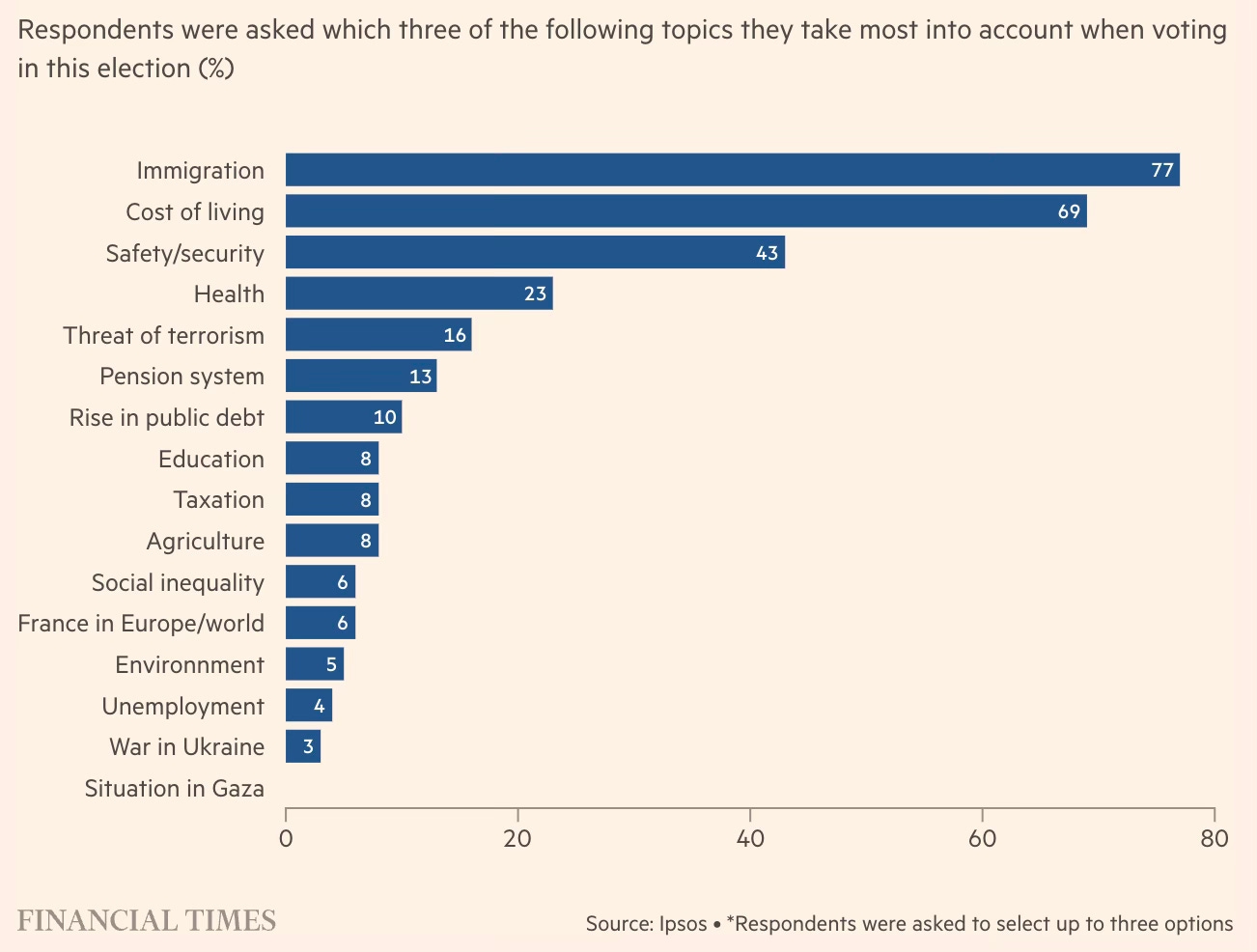
An illustration of this difference is this nice graphic that captures the priorities of the typical supporter of the French right-wing party, Rassemblement National (RN).

Note the low priority attached to typical concerns like inequality or the environment. 

It can therefore be argued that voters with all six values will struggle to embrace a liberal party. Conservative voters will be put off by the narrow value base of liberal coalitions. Similarly, it’ll be difficult for people deeply sensitive to loyalty, respect for authority, and tradition and sanctity to be part of conservative coalitions. This is a blessing in disguise for conservative parties in so far as limits the scope for their ideological dilution. 

In contrast, liberal parties are vulnerable to ideological dilution and capture. Unlike earlier eras, the moneyed interests of today do not owe their income and wealth to traditional sources. The beneficiaries of the managerial movement and shareholder capitalism (with its separation of ownership and management, and the power wielded by the executive class), and technological revolutions, are more likely liberals but with strong vested interests in maintaining the status quo. They are cohorts in the same schools, colleges, clubs, and residential colonies with intellectuals, ideologues, and opinion-makers in the academic, consulting, and journalistic worlds. This confluence tends to edge out the concerns of the working class from the priorities of the liberal parties and prioritise the preservation of the status quo.

Opportunistic pragmatism can mobilise convenient coalitions, but cannot be a substitute for ideological coherence. It’s hard to see Labour succeed in making any meaningful changes. 

Saturday, July 6, 2024

Weekend reading links

1. Larry Summers is Exhibit A of how the Democratic Party has been captured by the elite interests, both Wall Street and Big Tech. His views about Open AI is representative.

OpenAI board member Larry Summers says the recursive self-improvement aspect of AI will have a "transcendent" impact and any attempt to slow or stop development will play into the hands of America's enemies.

It's the unqualified embrace of AI (and specifically as a spokesperson of a private company with several questionable corporate governance concerns) that's a matter of deep concern. 

2. Good primer that describes India's entry into the JP Morgan Emerging Markets Bond Index (EMBI) from June 28.

India will gain a 10 per cent weight in the GBI-EM Global Diversified Index in phases, with 1 per cent added each month, reaching the limit by March 2025... Launched in June 2005 as the first comprehensive global local emerging markets index, GBI-EM tracks local currency bonds issued by emerging market governments. It took a long time for India’s $1.3 trillion government bond market, the largest among emerging economies after China and Brazil, to enter the global index... the trigger for the inclusion is more to do with Russia’s exclusion from the index... Russia had around an 8 per cent weight in the GBI-EM index. After its exclusion, Indonesia, Mexico, China, Malaysia, and Brazil – five of the 18 countries in the index – each have a 10 per cent weight. India, the 19th nation with access to the index, will be the fifth member of the 10 per cent-club by March 2025. India will eat into the shares of Malaysia and Brazil, apart from Thailand, South Africa, Poland, Czech Republic, Colombia, and others. Serbia, Uruguay, and the Dominican Republic have the least share – less than 1 per cent each... 

In 2020, the RBI removed limits on foreign ownership in certain bonds by introducing the Fully Accessible Route (FAR). Eligible bonds for JP Morgan indices must have a notional outstanding amount of at least $1 billion and two-and-a-half years to mature. So, only those government bonds that are designated FAR and maturing after December 31, 2026, will be eligible to enter the GBI-EM global index suite. There are currently 29 such bonds... Along with the GBI-EM Global Diversified Index, India is also expected to enter other JPMorgan bond indices such as the Asia (ex-Japan) local currency bond index called JADE Global Diversified Index, Jade Broad Diversified Index, and other aggregate suite of local currency indices. In these indices, India’s weight will be close to 15-20 per cent over the 10-month period until March 2025. Overall, JPMorgan government bond indices for emerging markets have $236 billion in assets under management (AUM)... foreign investors have used just 14.17 per cent of their allowed limit in the general category. Their investment in state development loans (SDLs) is 2.41 per cent of the limit. The aggregate holding of foreign investors in the FAR category is also very low – around Rs 1.86 trillion out of an outstanding portfolio of Rs 40.56 trillion...

One can expect $23-24 billion in foreign funds to flow in over the next 10 months – around Rs 17,000 crore a month. Once Bloomberg and FTSE Russell follow JPMorgan, the flow will increase. The inclusion will also facilitate passive flow to the Indian bond market, similar to index fund investment in Nifty, where every stock of a particular index gets investment according to its weight in the index.

3. Indonesia's EV industrial policy on the back of its vast nickel reserves is starting to bear results. FT reports that Hyundai and LG Energy Solutions have opened a $1.1 bn battery cell plant in Indonesia, the country's first, and with an annual production capacity of 10 GW hours. China's BYD and Vietnam's VinFast have already announced that they will begin making EVs in the country, and China's CATL, the world's largest EV battery maker, has already started construction of a battery plant. 

Hyundai and LG will invest a total of Rp160tn ($9.8bn) in Indonesia’s EV ecosystem in stages, he added. Investment minister Bahlil Lahadalia said the South Korean companies would begin constructing the second phase of the battery cell factory, which will have an annual production capacity of 20 gigawatt hours, with an investment of $2bn. The battery cells from the Indonesian plant will be used in Hyundai and Kia’s EV models. Indonesian officials have also said about 90 per cent of the factory’s products will be exported to South Korea and India...

Widodo’s ban on nickel ore exports in 2020 forced foreign companies to invest onshore. The bulk of that investment has come from Chinese companies into the nickel processing sector. But Indonesia has been offering incentives such as tax breaks to woo nickel and EV-related investments from around the world. Hyundai said in 2021 that the Indonesian government had agreed “to offer various incentives and rewards to support the stable operation” of its battery cell plant.

This graphic captures Indonesia's nickel market dominance.

4. The staggering and disturbing rise of futures and options trading in India

Nithin Kamath, founder of stockbroking firm Zerodha, said on X: “We are in the middle of a period of excess in options trading. Volumes in index options have gone up from Rs 4.6 lakh crore (Rs 4.6 trillion) in 2018 to Rs 138 lakh crore (Rs 138 trillion) in 2024, and, more importantly, the share of retail has gone up from 2 per cent to 41 per cent.

5. Climate change is deeply impacting foodgrain yields and thereby leading to food price inflation.

Over the next decade, some of the world’s most globally important crops may be in short supply as rising temperatures and more frequent extreme weather events hamper harvests. Wheat yields, for example, are drastically reduced once spring temperatures exceed 27.8C, yet a recent study found that the major wheat-growing regions of China and the US were experiencing temperatures well in excess of this increasingly frequently. Heatwaves that were expected to occur once every hundred years in 1981 are now expected every six years in the Midwestern US and every 16 years in northeastern China, according to the research by the Friedman School of Nutrition Science and Policy at Tufts University. Rice, soyabeans, corn and potatoes are among other staples that could see yields plummet. For many crops, higher temperatures mean lower yields...
The changes in climate and weather patterns are also altering growing seasons and creating new pressures from pests and diseases. In Ghana and Ivory Coast, which produce two-thirds of the world’s cocoa beans, heavy rainfall last summer created the humid conditions perfect for black pod disease — a fungal infection which rots cocoa pods — to thrive. This, coupled with other diseases and poor weather, knocked yields and led to a global crop more than 10 per cent smaller than the year before... The ECB researchers, for example, found that temperature increases prompted a sharp decline in productivity and rise in inflation once they exceeded a certain threshold. Depending on the crop, a temperature increase of 5C, from 20C to 25C, might have less impact on yields and inflation than one of 2C, from 34C to 36C, for example.

6. The new-found love for stock market investing among Indians shows no signs of letting up.

7. Shein and Temu the low-cost Chinese clothing and home items retailers who have built their e-commerce business models by selling cheap Chinese imports to households in the US and elsewhere and have captured a rapidly expanding market share may be staring at an end-game. 

Temu and Shein are able to charge low prices partly by shipping items in small packages direct to consumers, thereby avoiding customs duties. The EU, US, and UK apply “de minimis” rules which set a monetary threshold below which imported items are able to avoid duties. The allowances are designed to avoid placing onerous costs on small businesses and households for low-value consignments. Customs procedures for such items are often uneconomical. The European Commission is now exploring scrapping its €150 threshold. American politicians have been considering lowering or removing its generous $800 ceiling too... The strategy gives consumers — especially at a time when they are stretched by a cost of living crisis — access to cheaper products and wider choice... Indeed, while the Chinese retailers compete well on price, deliveries take longer, and the products are not always the most durable... A European toy industry body recently found that 18 out of 19 toys it test-bought from Temu posed a real safety risk for children. “De minimis” rules should not be a back door for unethically sourced items to enter western markets. Shein has faced allegations of forced labour in its supply chain, which the company denies.

And this about sustainability

Shipping $10 dresses from China to the US for free adds up. One estimate puts Temu’s cost of shipping and handling per package at around $11. Between that and the billions spent on marketing, Bernstein thinks Temu made an operating loss of $4.6bn last year. This does not look sustainable.

Instead of letting the two companies burn themselves out, Amazon has announced plans to compete with them by launching its own direct from China retail service.  

8. The UK elections once again highlighted a wildly problematic issue with first-past-the-post voting systems.

Four and a half years ago, Jeremy Corbyn’s Labour party received just over 10mn votes in the UK’s 2019 general election — a third of all that were cast. This performance resulted in Labour winning 202 seats in the House of Commons, its lowest tally since the 1930s. Wind forward to yesterday and Sir Keir Starmer’s Labour party received half a million fewer votes than in 2019, again a third of the popular vote. This performance has been rewarded under our first-past-the-post electoral system with a huge majority and 412 seats so far, the second-highest tally in the party’s history.
As John Burn-Murdoch writes, Labour's sweep should not be mistaken as a conclusive verdict for Labour.
A huge 48 per cent of those who intended to vote for Starmer’s party said the main reason was to get rid of the Tories, with far fewer giving a positive motivation relating to Labour and its policies. Seat counts have dominated the narrative of this election more than any before it, facilitating comparisons to Tony Blair’s 1997 landslide. Look deeper, though, and the similarities with 1997 fade. Starmer has much less public goodwill than the incoming Blair, and is inheriting a country in a far worse state.
This is an apt conclusion.
Labour’s towering majority is capturing attention for now, but it is built on weak foundations. As James Kanagasooriam, chief research officer at polling firm Focaldata puts it, the coalition of voters that has put Starmer in 10 Downing Street is better understood not as a skyscraper but a sandcastle. As the tide comes in over the next few years, it could well be washed away, just as the Conservative party’s has been this week.
“Over the past 20 or 30 years, [geopolitics] has been deflationary, created lower risk and made it easier to invest,” says Ali Dibadj, chief executive of Janus Henderson, the British-American investment group that manages about $280bn in assets. “Going forward it is the complete opposite: it is probably inflationary; it is probably going to create more risk; and it is going to make it harder to invest.” An industry that over the past two decades has been hoovering up mathematicians to devise new trading strategies is now leaning on political scientists for guidance... Last year BlackRock, the world’s largest asset manager, added “geopolitical fragmentation” to its list of the most important trends impacting on global growth and markets, putting it on a par with new technology, global demographic shifts and climate change. When Optiver, the market making firm, kicked off 2024 with a list of “top tail risks” for financial markets, more than half were focused on politics, from a contested US presidential election result to escalation in the war between Russia and Ukraine... Theodore Bunzel, head of geopolitical advisory at Lazard, says the firm set up a dedicated political unit in 2022 as clients were increasingly demanding advice on how to navigate investments in regions such as China... Goldman Sachs followed suit last year with a geopolitical advisory unit.

As to why investors seem to shrug off geopolitical risks and keep pouring money, blame it on the industry's incentive structure.

If the entire market tanks in response to a sudden event, an individual portfolio manager probably would not suffer reputational damage for missing a risk that few people noticed. But if their caution causes the fund to miss out on a marketwide rally, they will be blamed. 

10. Interesting factoid about the rise of manufacturing and women's labour force participation rate

In many Asian economies over the last half-century, the rise of manufacturing has been a powerful force of upward mobility. Incomes rose, poverty lessened and working opportunities opened. Women were at the center of this transformation. In Vietnam, where a factory boom has been especially momentous, more than 68 percent of women and girls over 15 are working for some form of pay, according to data compiled by the World Bank. In China, the rate is 63 percent; in Thailand, 59 percent; and in Indonesia, 53 percent. Yet in India, less than 33 percent of women are engaged in paid work in jobs counted in official surveys.

Sunday, March 5, 2023

Weekend reading links

1. The pace of diffusion of ChatGPT
Artificial intelligence chatbot ChatGPT has become speedily popular, amassing 1mn users within five days of its launch according to the company itself. A UBS study found that two months after its launch, ChatGPT had reached 100mn active users.
2. FT points to a big concern with the transition from IC engine to EVs, job losses.
Though built in England, the petrol engine of a Mini is a map of Europe: engineered in Germany, containing an alternator from France, an ignition coil from Italy and a coolant pump from Austria. Each step in this process involves a person, if not several. Yet not one of them will be required in as little as seven years when the brand goes fully electric. The same is true of those who supply engines for Volvo Cars, Mercedes-Benz, Jaguar, Ford or any of the brands that have set end dates for engine-car sales in Europe. That electric vehicles take fewer people to make and design is well documented... Ford this month announced plans to cut 40 per cent of its entire European engineering team... Today, Europe’s auto industry employs 3.5mn people directly in manufacturing. Ford chief executive Jim Farley estimates that EVs require 40 per cent fewer people to make — the equivalent of 1.4mn jobs if applied across the industry. These are high-skilled, high-productivity, well-paid positions that are often in geographic areas that would otherwise be economic backwaters. Just look at Nissan’s Sunderland plant or in Slovakia, which has four plants that turn out one car for every five people living in the country annually.
3. Singapore is benefiting from Hong Kong's inward turn
... though much catch remains to be done.
4. The rise and rise of Indian Americans,
In 2013, the House of Representatives had a single Indian American member. Fewer than 10 Indian Americans were serving in state legislatures. None had been elected to the Senate... Ten years later, the Congress sworn in last month includes five Indian Americans. Nearly 50 are in state legislatures. The vice president is Indian American. Nikki Haley’s campaign announcement this month makes 2024 the third consecutive cycle in which an Indian American has run for president, and Vivek Ramaswamy’s newly announced candidacy makes it the first cycle with two... By and large, Indian Americans have been elected on the Democratic side of the aisle. All five Indian Americans in Congress, and almost all state legislators, are Democrats... Indian American voters are overwhelmingly Democratic: 74 percent voted for Joseph R. Biden Jr. in the 2020 presidential race, more than voters of other Asian backgrounds, according to a survey by AAPI Data, APIAVote and Asian Americans Advancing Justice.

5. The changing contributors to inflation in the US (HT: Adam Tooze)

As the supply shocks have eased, the demand side pressures have been rising. 

This on the different contributors to inflation in the US and Europe, 
The inflation problems facing the Fed and ECB are different, however. In the US, inflation has been driven chiefly by a stimulus-fuelled surge in demand after the end of lockdowns and the question for policymakers is whether higher wages can be justified by improved productivity. In the eurozone and UK, the dominant issue is the energy price shock caused by Russia’s invasion of Ukraine. Dramatically higher spending on energy has made societies poorer overall, and the question is how that cost is shared between companies, workers and taxpayers. In this context, even if wages lag behind inflation, they could still be too high for companies to bear without raising prices further.

Wage growth in the US has been declining.

6. Just 25 million of Nigeria's population of 220 million voted in the just concluded Presidential elections, a voter turnout of just 27%. The winner, Bola Tinbu of the ruling party won with 8.8 million votes. 

China has two main kinds of health insurance: employee hospitalization insurance and so-called residents insurance. The employee hospitalization insurance is the better of the two and used by a quarter of the country’s population. It covers the urban employees and retirees of state-owned enterprises, as well as the current employees of some private-sector businesses. In contrast to the United States, employee insurance in China is not managed by companies. Instead, a municipal government typically forms an employee insurance pool to cover hospitalization and a few outpatient expenses. Companies typically contribute to the pools an amount equal to as much as 9.8 percent of a worker’s salary. Employees do not contribute to the insurance pools themselves.

In addition, those who qualify for employee plans typically have what are called personal health accounts. The money in them can be spent on medicine and further outpatient treatments. The employee insurance pools currently forward about a third of the money they receive from employers to personal health accounts, and spend the remaining two-thirds on hospitalizations and other expenses. Employees also put about 2 percent of their paychecks into their health accounts until they retire.

The less fortunate three-quarters of China’s 1.4 billion people have urban or rural residents insurance. Residents insurance is for farmers and migrant workers, as well as for children, who are seldom covered by their parents’ health insurance plans. It is also for the many workers whose private-sector employers are not making contributions for them... People with residents insurance generally do not get personal health accounts. Less than 4 percent of China’s population has no health insurance at all. This portion tends to be migrant gig workers who live at the fringes of society... Chinese health insurance plans have narrow restrictions on what is covered, high co-payments and very low coverage maximums... Chinese law says that when a municipality’s pooled employee insurance fund runs a deficit, the city government has to cover the shortfall... 

While the pooled employee funds in many cities are depleted, personal health accounts across China have accumulated more than $130 billion. So the central government wants municipalities to put less money into personal health accounts and redirect some of that money to hospitalization funds. At the same time, the employee pooled hospitalization plans are taking responsibility for more outpatient expenses for serious illnesses and covering more purchases of medicine.

The three year of zero-covid have depleted the employee insurance pool and left the municipalities with growing liabilities. 

Demographic changes in China have complicated the task. The number of births each year has dropped by nearly two-thirds since the late 1980s. Fewer young workers support more and more retirees who require ever more health care. Cities are now cutting how much money their hospitalization plans transfer to the personal health accounts of retirees. Wuhan’s reduction of transfer amounts by a little more than two-thirds is particularly steep. Local governments are also introducing or increasing deductibles. Wuhan has begun requiring retirees to pay the first $75 of expenses each year and current workers to pay the first $100.

8. Manufacturing's share of value add has been declining in India and that too from a low base, in contrast to the trends in other major peer competitors.

When China and Vietnam began their textiles and clothing export booms, respectively in the mid-1990s and the mid-2010s, foreign inputs made up more than 40 per cent of their exports. For India in 2015 the equivalent number was just 16 per cent.

An example of the challenge faced,

At a casings factory in Hosur run by Indian conglomerate Tata, one of Apple’s suppliers, just about one out of every two components coming off the production line is in good enough shape to eventually be sent to Foxconn, Apple’s assembly partner for building iPhones, according to a person familiar with the matter. This 50 per cent “yield” fares badly compared with Apple’s goal for zero defects. Two people that have worked in Apple’s offshore operations said the factory is on a plan towards improving proficiency but the road ahead is long.
9. Good graphic on the prices of Starbucks Tall Latte across different countries
10. This from an article about the recent high-profile jury conviction of Alex Murdaugh for the murder of his wife and son in Hampton County in South Carolina's Lowcountry, does not seem out of place for several parts of India or other developing countries.
They have enormous sway because, it turns out, the Murdaughs are like royalty in Hampton. For nearly a century, a Murdaugh has been the chief criminal prosecutor for the surrounding district. At the same time, the family has operated Hampton’s biggest civil law firm. In essence, the Murdaughs are the law in Hampton. They are also fantastically wealthy, with multiple homes, boats, their own 1,700-acre hunting estate, an arsenal of guns, and other baubles.

11. Finally, from an Indian Express investigation on the forest produce certification system in India about green-washing of such certifications

Forest certification is a sunrise industry, driven by a growing preference to avoid any product that can be linked to deforestation or illegal logging. In India, the forest certification industry is growing at 8 to 10 per cent every year, mainly catering to exporters wanting to tap the US and European markets that have strict regulations to ensure the legality of wood products coming in. Only processed wood is allowed to be exported from India, not raw wood... The investigation revealed that certifications in India were mainly a tool to bypass regulatory requirements in Europe and the US, where India’s forest-based products have an export market worth Rs 4,000 to Rs 5,000 crore every year. “It is easy to obtain forest certifications in India, if you are willing to pay the fees. There are several unscrupulous operators who are willing to make a quick buck. In fact, because of the intense competition amongst certification bodies, it is largely a buyers’ market. If you negotiate hard enough, you can drive down the costs of certification considerably,” said an executive of the India-based office of a foreign certification body... 

The main seekers of certifications have been exporters of wood products and other forest-based goods... Forty per cent of all certificates issued in India by two of the largest global certification systems – FSC or Forest Stewardship Council, and PEFC or Programme for Endorsement of Forest Certifications – have not been renewed... FSC and PEFC, and others like them, are developers and owners of certification standards, much like the International Organisation of Standardisation (ISO) or the Bureau of Indian Standards (BIS). The actual work of evaluation, recommendation of certifications, and monitoring of compliance is carried out by certification bodies and their subcontracted auditors.

This is a good reminder about the limitations of industry self-regulation. 

Wednesday, August 19, 2020

Political preferences of classes and liberal democracy

This is in continuation of posts here and here, from Francis Fukuyama's Political Order and Political Decay. Barrington Moore was one of the leading interpreters of democracy coming from the Marxist tradition of explaining political systems based on the underlying social order. His central argument was that democracy requires a bourgeoisie that could displace the old aristocratic order. 

Liberal democracy has two dimensions. One liberal rule of law, which enshrined certain individual and property rights. Two, universal adult suffrage which allowed mass political participation and therefore political accountability.

The upper economic classes are clearly concerned about the rule of law, on both individual and, especially, property rights. It cannot be denied that they have a non-trivial concern about universal suffrage, in so far as it can lead to demands for economic redistribution. Ideally, their interests are best met by a liberal oligarchy.

The lower income classes are concerned about earning enough to live a dignified life. To this extent, they are interested in the political rights that can support demands for economic redistribution. Such redistribution would include not only subsidies but also certain livelihood protections and safeguards. Assuming a minimal set of individual rights, their material interest in broader individual and property rights are secondary.

The interests of the remaining classes fall somewhere between these two extremes. An illustration of a typical set of preferences in a developing country context is shown in the table below.
Note: I am referring to preferences for formal trappings of individual and property rights. Further, the preferences are also reflexive with the status quo.  

On the interests of the aristocrats, bourgeoisie, and proletariat, Francis Fukuyama wrote,
Each of these three classes wanted a different political outcome: the traditional landowning class wanted to preserve the old authoritarian order; the bourgeoisie wanted a liberal (i.e., rule of law) regime protecting their property rights that might or might not include formal electoral democracy (they were always more interested in the rule of law than in democracy); and the proletariat, once it achieved consciousness of itself as a class, wanted a dictatorship of the proletariat, which would in turn socialize the means of production, abolish private property, and redistribute wealth.
Highlighting the real motivations of the progressives in different era, Fukuyama wrote,
It is important to note that the two components of liberal democracy—liberal rule of law and mass political participation—are separable political goals that initially tended to be favored by different social groups. Thus the middle-class authors of the French Revolution were not, as many historians have pointed out, committed democrats in the sense that they wanted immediate expansion of the franchise to peasants and workers. The Rights of Man were conceived as legal guarantees that would protect the property and personal freedoms of the bourgeoisie limiting the power of the state but no necessarily empowering the mass of French citizens. Similarly, the Whigs, who forced the constitutional settlement on the English king during the Glorious Revolution in the previous century, were largely wealthy taxpayers that included part of the aristocracy, the gentry, and the upper middle classes. Their ranks were joined in the succeeding two centuries by the growing numbers of commercial and industrial bourgeoisie, as well as by middle-class lawyers, doctors, civil servants, teachers, and other professionals set off from the working classes by their education and property ownership. These groups constituted the base of support for the British Liberal Party during the nineteenth century. The main interest of the Liberals tended to be rule of law much more than democracy—that is, legal protection for private property and individual rights, as well as policies such as free trade, meritocratic civil service reform, and public education that would make possible upward mobility.
It is no different in modern times. For example, take the case of America. The liberals never accepted the electoral verdict in favour of Trump and have used every opportunity to overturn it. And the dominant proportion of Trump supporters belong to the lower class, the "basket of deplorables" as Hillary Clinton famously described them. Put the two together, and one could see the support for an argument in favour of a limited democracy among liberals.

While there are several competing explanations for what contributes to the emergence of democracies, the reasoning which points to the importance of the bourgeoisie is compelling.

Liberal democracy emerged as the preferred political order in western countries as a result of the interactions among the different economic classes. The collective political preference of a country will depend on the prevailing distribution of the different economic classes and the nature of their interactions. The emergence of a collective preference appropriate for democracy is both evolutionary and, as I blogged here, path dependent. 

Tuesday, February 5, 2019

India state capacity fact of the day

Is the Election Commission of India (ECI) the most efficient bureaucracy, public or private, anywhere in the world?

As of January 2014, the ECI had a sanctioned strength of just 641, of which 276 posts were vacant. In other words, the ECI conducts the world's largest democratic elections, perhaps one of the largest logistical exercises in the world, with a mere 365 people! And this number has hardly changed over time - 327 and 319 respectively in January 2006 and 2010. 

Yes, it relies on the entire central and state government machinery to conduct the electoral process. But given the highest fidelity in execution required, zero-defect as they say, this is truly a staggering achievement. And the electoral process is not just about holding the elections itself, it is about the always-on preparatory process like updation of electoral rolls. 

This is perhaps the most efficient leveraging of bureaucratic resources. 

It is an example of the paradox of India's state capacity that it can execute well-defined tasks like elections, census, disaster relief etc with unparalleled proficiency and do the simplest things like running mid-day meal kitchens in the most appalling manner.

Saturday, March 4, 2017

The US-Russia relationship is a hostage to Trump-bashing

Arguably one of the two most important international strategic relationship, between the US and Russia, has become a hostage to US domestic politics. 

Even liberals, who otherwise would have supported efforts to improve relations, are now blinded by their hostility to the President and are likely to see red in anything that is conciliatory and aimed at improving relations. Egged on by the media, all sides in the debate have boxed themselves into corners from where compromise looks very difficult. As President Trump has himself said, it is now virtually impossible for his administration to make any effort to improve relations. Or as Edward Luce writes, "Donald Trump is never likely to emerge from the Russian shadow". 

The debate has now degenerated into one where even the mere contact with designated Russian diplomats, a normal course of activity, has come to be viewed with extreme suspicion. The travails of Sergey I Kislyak, the Russian Ambassador in Washington, is symptomatic,
He has told associates that he will leave Washington soon, likely to be replaced by a hard-line general... For Mr. Kislyak, Washington is no longer the place it once was. It has become lonely, and he has told associates that he is surprised how people who once sought his company were now trying to stay away.
This is really unfortunate. It is difficult to not get the impression that Kislyak is a victim of his own success. He has done exceptionally well what every diplomat ought to be doing, expand your country's influence by cultivating important contacts in your host country. 

I am certain that Russia tried to influence the elections. But is there anything odd about that? Russia must have tried to influence every US election and vice-versa. It is no secret that US has supported the likes of Anatoly Chubais and Yegor Gaidar and theirs and other dissident political formations for years. Just recently, President Obama lent his weight behind the No campaigners in the Brexit vote in UK. The CIA has a very long history of trying to influence elections across the world from Philippines to Iran to Panama. Other countries do the same in countries with strategic interests. Real politik dictates that there is nothing unusual about this. 

Where the story can become poisonous is if the influence was used to campaign for their preferred candidate, the attempt succeeded, and the successful candidate is now willing to do Russia's bidding. In other words, Russia used its influence to instal their proxy in the White House. 

This means that despite candidate Trump's low electoral prospects, the Russians had enough conviction and backed him to pull it off. And that Trump is effectively a Russian stooge, at the least willing to compromise US interests in return for personal factors or succumb to blackmail. Even with Buzzfeed and other salacious stuff going around, I am not yet willing to buy this story.

I am inclined to believe that only a small proportion of people go this far, in suspecting their President of being a stooge. The vast majority feel indignant at Russian attempt to influence the elections. These two are qualitatively different positions, though lumped together and conflated by media characterisation. This is unfortunate since the latter, indignation, while understandable is ill-informed, and ought not to be a cause for holding the Russia-US relationship hostage.

Saturday, November 12, 2016

Weekend reading links

1. From among the reams of coverage on Donald Trump's victory, this WSJ video story draws attention to the breakup of the two largest categories of the electorate.
And among each of these categories, those without college degrees, regular church goers, living in small towns and rural areas etc, may have swung the vote for Trump. It is unsurprising that these voters are among the worst affected by the consequences of the elite hegemony

2. Bibek Debroy has a very good article on the problems faced by the Indian judiciary. He zeroes in on the massive 33 million (March 2016) case backlog as the central challenge. Of the three dimensions of challenges - supply-side (more courts/judges); productivity (better procedures, work norms, shift systems); and demand-side (alternative dispute resolution, curb on government litigation) - he advocates focussing on the last. He digs up some very interesting statistics about the Indian Supreme Court's demand management, 
On appeals, the US Supreme Court receives 7,000 to 8,000 petitions a year and hears (for oral evidence) 80. This is around one per cent. There are serious data issues. However, a comprehensive paper by Nick Robinson found the Indian Supreme Court accepts between 15 per cent and 26 per cent of petitions(the exact figure depends on the year, let’s say an average of 20 per cent). This is too high and represents a hollowing out of the lower judiciary.
Well said!

3. The just concluded Single's Day sales in China, considered to the largest online shopping day in the world, has amassed $18 bn in sales for Alibaba, 32% higher than last year's $14.3 bn. As a perspective, the last year's sale itself was more than double the combined sales clocked in the US during the Black Friday and Cyber Monday combined. 

Supporting these sales is the logistics management of delivering those orders, which numbered a staggering 540 million over the 24 hours last year. Accordingly, the country's express delivery, or courier, services market has been booming. Here too, like with everything else China, the numbers are staggering,
The average freight rate for two-day ground delivery between distant cities in America is roughly $15 per kg, whereas in China it is a measly 60 cents, according to research by Peter Fuhrman of China First Capital, an advisory firm.
4. How much impact will the demonetisation have on the fight against black money and corruption? Not much if this graphic is correct - cash is the least preferred source of storing unaccounted for money.