Substack

Showing posts with label Externalities. Show all posts

Thursday, May 14, 2026

The myth of ring-fenced "private" markets

One of the biggest enduring myths in the financial markets is the distinction between public and private markets, and the article of faith that private markets should be lightly regulated. The time may have come to question this article of faith. 

The issue has become a topic of interest in light of the turbulence being faced in the private credit markets, and also the steps in the US and elsewhere to allow public funds to invest in alternative assets. It is also important, given the growing share of private capital markets, amplified as it is by the secular decline in interest rates (in turn a consequence of several factors, including ageing populations, financial market integration, and globalisation). 

On the former (private credit markets), the FSB has just published a report on private credit, pointing to several vulnerabilities arising from complex interlinkages with banks, borrower credit quality concerns, and valuation opacity. 

This activity has grown rapidly, to an estimated $1.5-2.0 trillion in assets at end-2024 and is heavily concentrated in a few jurisdictions… Banks and private credit funds are connected through financing arrangements and strategic partnerships. Across FSB members, the available data captures direct exposures of around $220 billion of drawn and undrawn bank credit lines to private credit funds, while some commercial estimates range from $270-$500 billion… there are also potential vulnerabilities from a range of other indirect exposures including through banks providing revolving credit facilities to companies that are simultaneously borrowing from private credit funds and the growing use of synthetic risk transfers.
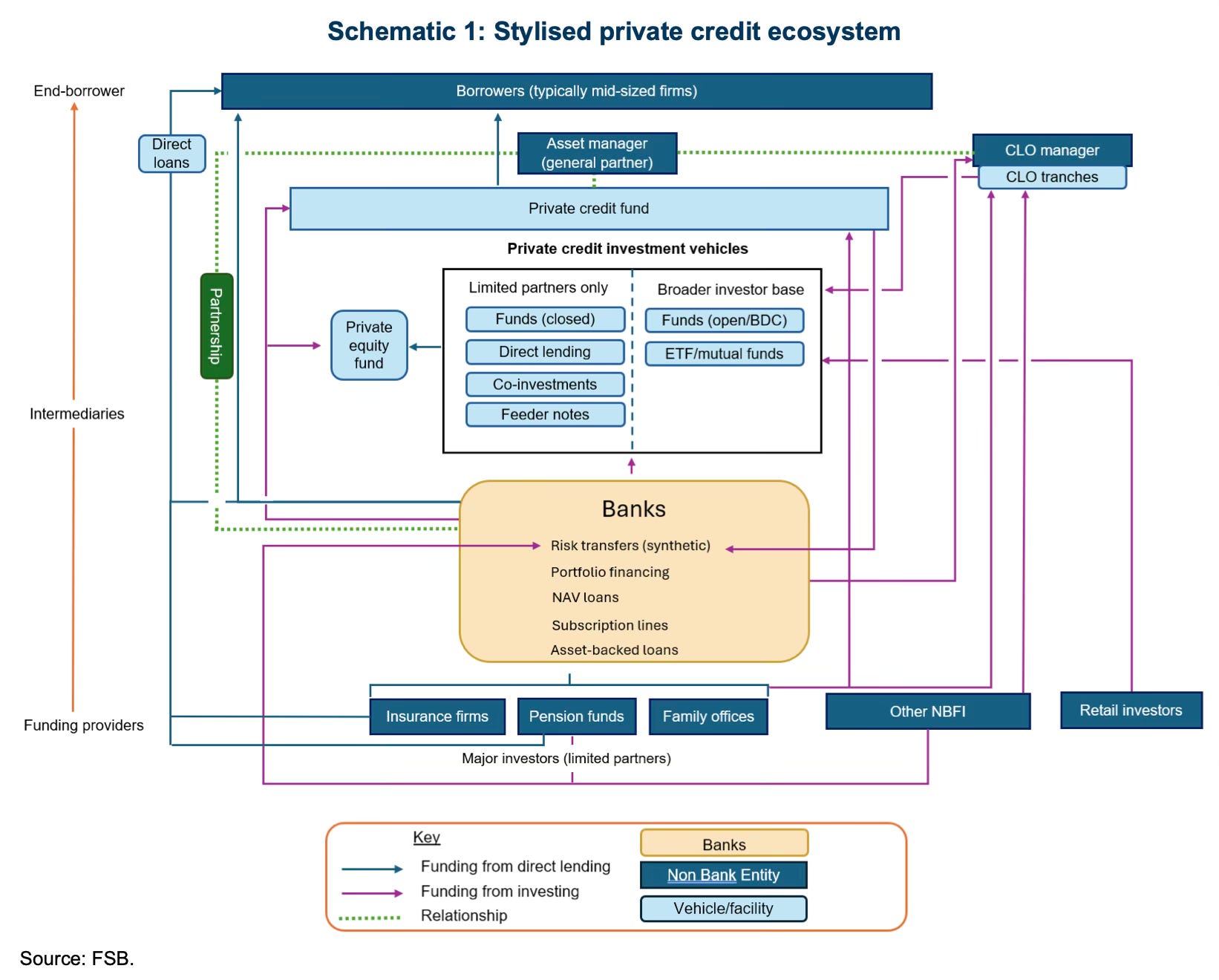
The former Bank of England Governor, Andrew Bailey, writes,

Private credit has significant interlinkages with banks, asset managers, insurers and private equity. These multiple layers of leverage across the ecosystem deserve deeper scrutiny. While direct bank exposure to private credit funds may be limited, indirect connections are extensive. Banks are establishing partnerships with asset managers that have a credit focus and often provide revolving credit facilities to companies simultaneously borrowing from private credit funds. Insurers actively invest in private credit markets while also establishing indirect connections to private credit through participation in reinsurance arrangements. Private equity managers increasingly own the insurance companies. These interlinkages can be difficult to detect, assess and manage — and so can the related risks.

On the latter (public financial institutions’ exposure to private markets), in August 2025, President Trump signed an executive order directing regulatory agencies to reexamine existing regulations and open the $9 trillion US retirement market to cryptocurrency, private equity, and other assets like property. Following this, on March 30, 2026, the US Department of Labour issued orders allowing 401(k) plans easier access to alternative assets. 

So why are private capital markets lightly regulated?

The standard response is that they are targeted at sophisticated, institutional investors who are presumed to have the ability to conduct their own due diligence and bear the risks, including high illiquidity. To this extent, it is argued, they do not pose the kind of negative public externalities and systemic risk that is associated with institutions that are public-facing (which take deposits, savings, premiums, etc., from retail investors). Any losers are those well-heeled investors who have the ability to absorb their losses. 

Is it really the case? What does the evidence inform us?

The reality is, as the following figures and statistics show, that retail investors are increasingly participants, both directly and indirectly, in the private capital markets. Here is a simple illustration of the channels of exposure of public-facing financial institutions to the private capital markets.
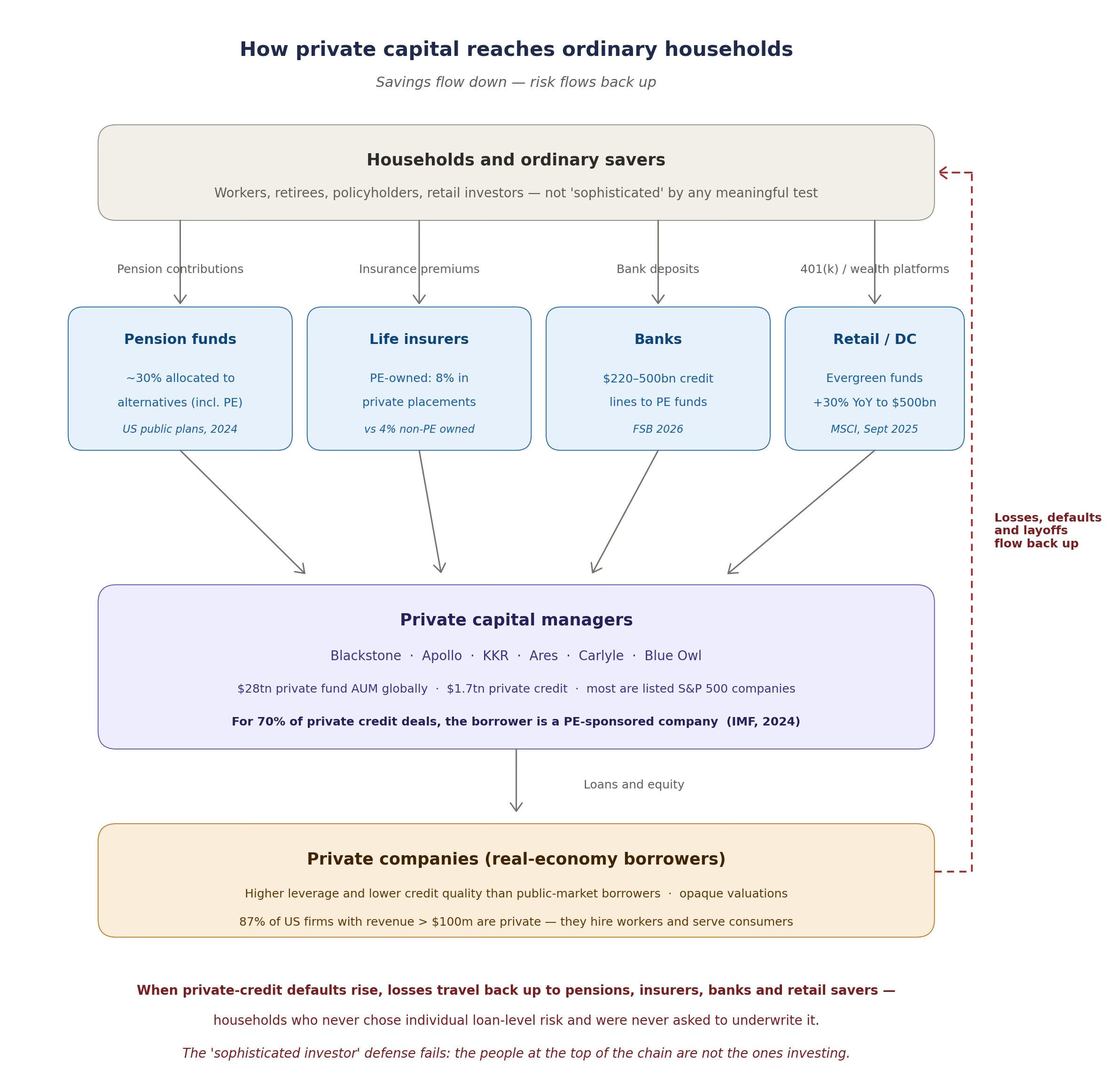
What makes this arrangement questionable is that the people at the top of the chain, the actual end-bearers of the investment risk, are not the ones doing the investing. Whatever counts as "sophistication" sits with the agents in the middle layer, not the principals at either end. However, the costs and consequences are borne primarily by the capital providers.

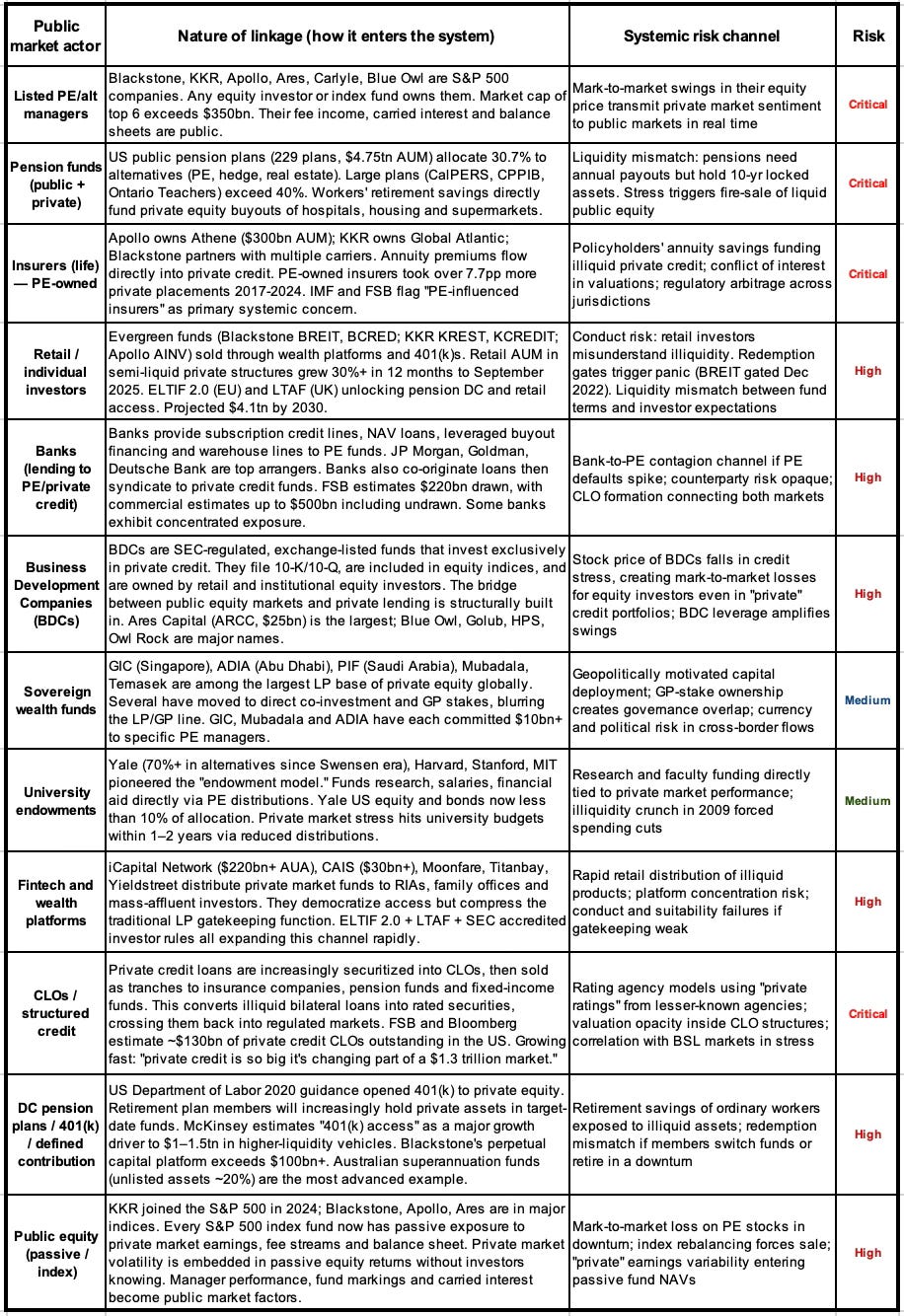
The table below is a summary of the various institutional investors, their respective linkages to the private capital market, and their systemic risk channel. 
The table below is a summary of these investors and the extent of their exposures to private capital markets.
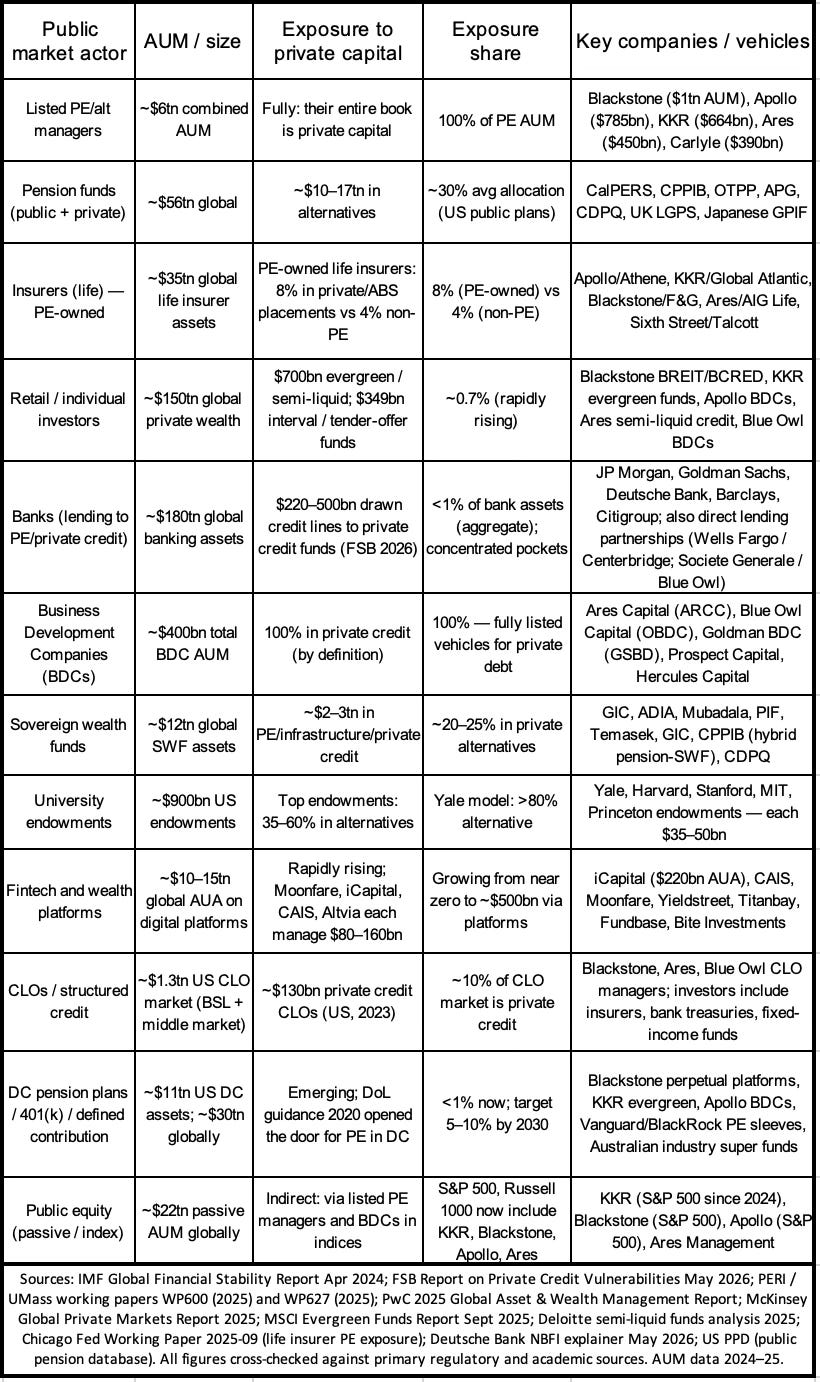
The sheer volume of private funds is staggering. Between 2020 and 2023, assets in private funds grew by 34%, from $20.8 trillion to nearly $28 trillion. This is only slightly less than the just under $31 trillion in assets held by public investment vehicles (mutual funds, ETFs, and closed-end funds). In 2024, 87% of companies with revenue greater than $100 million are private, and private funds have approximately tripled in size in the last decade to $26 trillion in gross assets, comparable to the $23 trillion US commercial banking industry. But their capital comes overwhelmingly from public institutions. 

US public pension plans have allocated 34% of their holdings into alternative assets, including private equity, hedge funds, real estate, and commodities. The channel runs directly from workers’ retirement savings into PE buyouts of companies, hospitals, and infrastructure, with liquidity terms that have no resemblance to the pension’s own annual payout obligations. Similarly, the assets of private equity-influenced insurers have grown significantly in recent years, with these entities owning significantly more exposure to less-liquid investments than other insurers. By 2024, financial and ABS private placements reached 8% of assets for PE-owned insurers, while they were only 4% for non-PE-owned insurers. Apollo’s Athene, KKR’s Global Atlantic, and Blackstone’s insurance partnerships route annuity premiums, the most conservative class of retail savings, into direct lending. 

The numbers alone make it abundantly clear that private capital cannot be a ring-fenced ecosystem of alternative assets with little public externalities. Private markets have become too big to be ring-fenced. Given the linkages discussed above, any stress in the private capital markets will immediately cascade across to public stakeholders and the markets as a whole. 

It is now the hidden layer of the public financial system. Its debts appear in pension statements, its managers appear in index funds, its loans back annuities, and its performance propagates through bank balance sheets and university budgets. The “private” part is increasingly a regulatory and disclosure category, not an economic one.

There’s also the political economy that perpetuates the fiction around a ring-fenced private market. For one, private market intermediaries and investors benefit from favourable taxation regimes like carried interest and a lower capital gains taxation rate. There’s also the trend of diminishing public markets and expanding private markets, with its implications on access and equity, given the entry barriers for retail investors to access private markets. 

Both these dynamics threaten to create two distinct financial systems, with one serving retail investors and the other serving those well-off. Worse still, while the latter can access the former and benefit from it without bearing the proportionate costs, the former must bear disproportionate costs and consequences of excesses arising from the activities of the latter. 

The time has come to view private markets as no longer confined to sophisticated high-net-worth and institutional investors, but ones with deep interconnections with the public financial markets, and therefore demanding greater oversight and regulation. The matter for debate should only be the extent of regulation. 

Unfortunately, such a regulation as a preemptive process is unlikely given the political economy dynamics. However, it is only one big crisis away from such regulation. This painful learning pathway may be unavoidable and the only route to private market regulation.

Friday, April 1, 2022

Prices and demand response fact of the day - petrol prices in the US

FT points to demand substitution among commuters in the US in response to rising fuel prices, as people shift away from private vehicles to mass transit. People are overcoming their pandemic time hesitations and taking to public transport as petrol prices have gone by 57% in the last two years. 

This is also a much needed boost to mass transit systems which have been devastated by the pandemic. However it remains to be seen as to how many of these commuters stay on after fuel prices regain normalcy. 

High prices are equivalent to a tax on petrol. It's a reminder about the role of taxes to generate demand response to curb negative externalities and also encourage positive externalities.

Historically, a spike in gasoline prices has pushed more people on to public transport. A study conducted by Bradley Lane at the University of Texas examined US cities from 2002 to 2009 and found that for every 10 per cent increase in petrol prices, rail saw an increase of 8 per cent in ridership while bus use increased 4 per cent on average.

This is the study. 

Monday, February 11, 2019

Weekend reading links

1. FT points to 'fauxtomation', coined by Canadian activist Astra Taylor, the gulf between the myth of workless future and reality,
Take McDonald’s. I can now order my burger using giant touch screens, pay for it on the contactless card reader and then saunter up to the counter to collect it. This could be thought of as automating the work of a waiter; in reality, though, the company has convinced me to become an unpaid member of staff. The tasks I do — inputting an order into the system, sorting payment and then collecting the food from the kitchen — are all jobs that would normally be done by someone earning at least minimum wage. It’s the same when I use a self-service checkout at the supermarket, or check myself in and print out my own ticket for a flight. Technology has facilitated a shift in who is working, not eradicated it... Technology, Taylor argues, contributes to an illusion that human effort can be simply substituted by machines — like the famous “ Mechanical Turk” machine that could supposedly play chess but in reality contained a hidden chess master, or the dumbwaiters in Thomas Jefferson’s mansion that relied on hidden slaves.
And its impact on measured productivity,
“Fauxtomation” fits into a tradition of unpaid work being overlooked — work such as caring for the elderly or children, often done by women, that does not appear in official measures of economic output. The economist Diane Coyle argues that some of the extraordinary economic growth in the middle of the past century was probably due to women doing more paid work and less unpaid; if the latter had been valued properly in the first place, the postwar boom would not have been as large as it appears in the official figures. Similarly, the recent slowdown in productivity growth may be due to a move the other way, as everyone starts producing more outside working hours, whether on laptops at home or at supermarket checkouts. And then there’s what Coyle calls “do-it-yourself digital intermediation” — online platforms acting as our bank tellers, estate agents and insurance brokers. The benefits of these services getting cheaper ought to be reflected in higher spending elsewhere. But, Coyle argues, official measures of economic output are missing the value of our unpaid work, meaning the slowdown in productivity growth may not be as bad as it appears.
2. The collapse of the tailing dam in southeastern Brazil owned by mining giant Vale which killed at least 157 people, with 182 missing, is a classic case of socialising costs and privatising the benefits and one where criminal culpability should be traced right up to the top of the mining behemoth.

Vale knows that it can contain its costs by avoiding the construction of strong tailing dams and relying on shoe-string mud structures. The costs can be externalised and the savings can be appropriated privately. And when you add up several such externalities, it all begins to assume significant proportions. In simple terms, Vale, and other multinationals know that it can get away with a mud-dam and its attendant risks. 

What can be easily predicted is what will follow. There will be righteous indignation everywhere for the coming few weeks. Some junior employees on government and Vale's side will be sacrificed. And then everyone will forget and go on with life till the next incident happens. Incidentally, a similar accident on a tailing dam co-owned by Vale killed 19 people in 2015!

3. Some snippets about unemployment trends in India,
Instead of dropping out at a very early age, the percentage of women in the education system is very high until the age of 23-24. Earlier, it used to be only up to 17 years. So, there is a five-year shift; these people are no more in the labour force because they are still in the colleges. So that will reduce the labour force to some extent because they are out of the labour force. And earlier, the unemployment used to start at 20 onwards, now basically it is 24 onwards, so 20-24 they are in colleges and all that. So there’s a shift in the employment pattern from the report. Once they come out from the colleges, they are no more prepared to work on their father’s farm or looking after something and then get married and become housewives... This immediately will pick up the unemployment ratio because they are not showing up in the unemployment-numerator.
4. Livemint graphic on the unemployment problem among the educated,
A recent report by the Centre for Sustainable Employment at Azim Premji University, State Of Working India 2018, noted that unemployment among the well-educated is thrice the national average. There are roughly 55 million people in the labour force who hold at least a graduate degree, and about 9 million of them are estimated to be unemployed, the report added.
5. Nice Economist article on the extra-territorial reach of American policies that seek to penalise global companies for violating American domestic rules. 
Since the turn of the century, America has ramped up judicial programmes whose reach is not restricted by its borders. Focused on enforcing its sanctions, reducing corruption in poor countries and fighting money-laundering and terrorism financing, it has found ways of prosecuting companies and their executives far beyond its shores... Most of the companies caught in its legal net are foreign, often European. Some come from countries in which doing business with Iran, for example, would be no problem were it not for America’s stance... There are instances where America’s long legal reach may have given an edge to its own firms over foreign rivals, as in the case of General Electric’s purchase of Alstom of France in 2014... 
Several elements tie together America’s various legal forays abroad. The first is their creeping extraterritoriality. American law starts with a presumption against application of its statutes beyond its borders. But prosecutors have wide authority over how the laws are interpreted. They have adopted an ever-more-expansive interpretation of who is subject to American law, lawyers say. A banking transaction that ultimately passes through New York—as many do, given the centrality of American dollars to global trade—can give prosecutors a toehold to inspect it. If two executives outside America use Google’s Gmail to communicate about a bribe, say, American prosecutors can claim that the Americanness of the email provider can make it their business. The global banking system also gives America an advantage. Lenders have been hit hard by American prosecutors, notably BNP Paribas, a French lender walloped in 2014 with an $8.9bn fine for facilitating trade with Sudan, Cuba and Iran. Deutsche Bank was fined $425m in 2017 for helping launder $10bn from Russia...
It seems plain to foreign critics that America disproportionately targets foreign companies. Over three-quarters of the $25bn it has exacted in fines for money-laundering, sanctions-busting and related offences has been against European banks, 15 of which have paid over $100m each, according to Fenergo, a consultancy. American banks have been fined less than $5bn over such misdeeds. Anti-corruption probes also fall disproportionately on foreign firms. Of the ten biggest FCPA fines, only two have fallen on American companies.
6. Finally, an article on the decline of bus commuters across UK,  
Since 2009 the number of bus journeys in Manchester has fallen by 14%. Austerity has played a role. Councils in England and Wales have slashed bus subsidies by 45% since 2010, resulting in 3,347 routes being cut back or closed... The average delay caused by congestion in Britain’s cities has increased by 14% in the past three decades... Manchester is badly affected: the 43 bus now takes nearly 80% longer to cover its route in rush hour than it did 30 years ago. The average speed of Stagecoach’s buses fell by 4.9% in 2014-16; one route which took just nine minutes seven years ago now takes 27, according to the company.

Sunday, August 19, 2018

Weekend reading links

1. The power of being Amazon, and how economic heft invariably spills over into political capture,
On May 14th the Seattle city council passed a “head tax” of $275 per employee for firms with more than $20m in annual revenue, in order to fund services for homeless people. Amazon, which employs more than 40,000 people in Seattle, promptly halted construction on one office tower and suggested it would sub-let another. A month later the city council tucked tail and repealed the tax.
2. Another less discussed feature of Chinese capitalism is its tolerance of ambiguous arrangements. The most classic example is property, which while legally owned by the government, is virtually vested with private individuals. Transactions of various kinds which effectively transfer the leases are common place, and though questionable is tolerated. Another example concerns Variable Interest Entities,
Variable interest entity (VIEs) are ubiquitous, especially among the country’s internet firms, which have a total market capitalisation of over $1trn. The structure dates back to the early 2000s, when Chinese technology companies wanted to tap global capital markets in New York and Hong Kong and to set up international holding companies domiciled outside of mainland China. Yet their sensitive internet assets, such as licences, may not be owned by foreign entities, according to Chinese law. To get around this, tech firms opted to avoid owning these mainland assets outright, and instead to bundle them into legal entities called VIEs, in turn owned by individuals in China (usually the bosses of the firms and their associates). The VIEs and these individuals sign contracts with the international holding company, handing over to it control of the VIE as well as its profits... There are three problems with VIEs. First, key-man risk. If the people with nominal title die, divorce or disappear, it is not certain that their heirs and successors can be bound to follow the same contracts. Second, it is not clear if the structure is even legal. China’s courts have set few reliable precedents on VIEs and the official position is one of toleration rather than approval. Third, VIEs allow China’s leading tech firms to be listed abroad, preventing mainlanders from easily owning their shares and participating in their success.
3. Richard Baldwin has contrasts rising inequality in developing and developed countries, 
It’s true that China is one of the places where inequality rose most rapidly, depending upon how you measure it. But it’s a totally different thing when average incomes are going up by 10 percent. The poorest people are going to be able to buy their parents’ houses. Here in America, middle-class people can’t afford the house they grew up in. That’s a completely different type of inequality. I do think inequality in the developing world will rise, but it will be all boats rising. Just some people have bigger boats.
As this blog has repeatedly pointed out, the concern is not so much the widening inequality per se, but the consequent inevitable capture of political power. 

And he has this very insightful point about the likely persistence of political-economy based resilience,
I think what people who don’t follow trade very deeply, or they follow it too theoretically, they think that tariffs are something abstract. Instead, there are always people wanting higher or lower tariffs inside every single country. The agreements we have are its balance of power. That balance of power is not fragile. It’s based on long-term, slow-moving things, and that’s what I’m confident will prevail.
4. The Economist draws attention to an unsustainable boom in property prices in developed country cities. It compares house prices with rents and median household incomes,
If prices rise faster in the long run than the revenue a property could generate or the earnings that service mortgages, they may be unsustainable. Or, at least, incomes or rents will eventually have to rise. Taking the average ratio over the past 20 years (or more if data exist) as “fair value”, national house prices in Australia, Canada and New Zealand have been more than 20% above fair value compared with income and 30% above fair value compared with rents for the past three years. They have now hit 40% above fair value for both metrics. Data for rents at the level of cities are lacking. But compared with long-run median incomes, prices appear even bubblier at city level than nationally.
5. In this context land value tax becomes attractive,
House prices there are 34% higher, on average, than five years ago, freezing young people out of home ownership. Windfall gains should be an obvious source of revenue, yet property taxes have stayed roughly constant at 6% of government revenues in rich countries, the same as before the boom.
This is the briefing article on LVT. Here is one of my first opeds making the case for Land Value Tax for India. 

6. Negative externalities from Amazon second head quarters,
Later this year Amazon is due to announce the site of its second headquarters. Cities have been competing to attract the firm. But local residents who do not own property could be forgiven for hoping that Amazon goes elsewhere. Its headquarters will employ perhaps 50,000 rich workers, who will bid up rents and land values, all the while crowding local public services and infrastructure. The chosen city will need to invest to accommodate the workers, but the costs of doing so will be unfairly spread across existing residents, because in their bid to lure the firm, cities are offering Amazon discounts on local business taxes.
7. Shang Jin-Wei and co-authors examine US imports from China and questions the conventional wisdom (David Autor etc) about its negative effects on job creation in the US,
US imports of intermediate inputs from China rose from about 1⁄4 of total imports in 2000 to more than 1/3 in 2014. Those US firms using imported inputs can improve efficiency and potentially expand their employment. Firms that use these imported inputs (e.g., computers, printers, telecommunication equipment, and parts and components of various office machinery) include those in what are traditionally labeled as “non-tradable sectors” such as banks, business services, research and educational institutions... 
this paper explicitly considers downstream and upstream effects of imports from China, and uses more precise information on how imported intermediate inputs from China are allocated across US sectors... Using a cross-regional reduced-form specification but differing from the existing literature, this paper (a) incorporates a supply chain perspective, (b) uses intermediate input imports rather than total imports in computing the downstream exposure, and (c) uses exporter-specific information to allocate imported inputs across US sectors... 
In contrast to the existing literature, we find strong evidence that the downstream effect is positive (i.e., the use of imported Chinese inputs raises US employment) and the effect is greater than the combined negative impact of a direct import competition channel and an indirect upstream channel. In addition, the US labor market is flexible enough that non-manufacturing employment is systematically stimulated by trading with China. The net employment effect from trading with China is found to be positive. As important, once a supply chain perspective is applied, we find that American workers as a group experience an increase in real wage from trading with China. The effect is not the same across all workers; most college educated workers gain substantially, whereas many non-college- educated workers experience a decline in real wage. Still, even without redistribution between capital owners and workers, every worker can be made better off if the total wage bill can be redistributed.
8. Finally, a stunning graphic which shows that the global equity market is shrinking at the fastest pace in two decades on the back of a continuing surge in share buybacks.

Even as buybacks are expected to top a record $1 trillion this year, their volume exceeds new issuances.

Monday, September 11, 2017

Arbitrage and efficiency - externalising costs and capturing gains

This post is triggered by Neil Irwin's fantastic article that I blogged here.  

Consider these. Robots replacing human workers to reduce defects and increase output. Companies focusing on their core-competencies by outsourcing non-core activities. Companies that either outsource or off-shore their production facilities to lower costs. Executives and companies that cut costs by aggressive reduction of their workforce and hiring contract labour, all in the name of competitiveness. Internet-based companies that reduce market frictions by bringing together buyers and sellers of goods and services. Constructing complex ownership structures that enable cross-border shifting of profits so as to minimise tax obligations. Supercomputers that connect to the exchanges through dedicated optic fibre cables over the shortest distance to promote high frequency trading that claim to increase market liquidity and thickness. 

The common thread in all these stories is the search for efficiency and value for money, both in turn aimed at maximising profits, even if, and often because so, at the cost of jobs or the quality of jobs. These trends are considered essential and desirable attributes in today's capitalism, in fact even the ultimate objective of the business enterprise. But this has not always been the case.

The traditional idea of a good business firm was of one which created jobs, productive jobs. Apart from being socially responsible, this was also sound economics. After all jobs provided the demand that sustained businesses, the economy itself. In other words, the firm's actions contributes to the creation and sustenance of the market itself. It is capitalism which generates a win-win equilibrium of private and social gains. It also involves both the firm and the workers accepting trade-offs to create a mutually beneficial system.  

Fast forward to today and the conception of a good business firm has changed dramatically. Ironically, today's good business firm is one which maximises shareholder value, even if by inflicting unacceptable social costs. This in most cases, translates to cutting costs, by among other things, reducing the expenses on labour. The embrace of labour-displacing robots is only the most direct and extreme manifestation of this trend. In other words, today's business firm is an entirely private entity, with limited social responsibility and aimed at maximising private gains. Sustenance of the soil on which the enterprise itself grows, the market, is the least of considerations.

Whereas annual reports of companies earlier took pride at highlighting the number of jobs created that year, today it is all about the bottom-line, even proudly mentioning the savings from lay-offs and tax avoidance. 

In the pursuit of individual business models that rely on realising returns through arbitrage and externalising the associated costs while appropriating all the benefits, capitalist enterprises are collectively chipping away at the sustainability of the market, and thereby capitalism, itself.  

In the cases mentioned at the beginning, it is debatable as to how many of them would be sustainable if all the social costs are internalised. In many of them, far from directly improving the net productivity (across markets) by way of inventing a new technology or a new business model, the efficiency gains arise from arbitraging across markets. These arbitrage opportunities arise from differences in input costs (outsourcing, offshoring, contracting) arising significantly from failures to internalise costs, regulatory standards (digital commerce, tax avoidance), information access (HFT), and so on. The gains from these arbitrages are privately captured, whereas their costs are borne by the society at large. In simple terms, where possible, today's business enterprise seeks to privatise gains and socialise costs.

This is not to decry all arbitrage opportunities. In fact, all economic transactions involve some form of arbitrage, including the mother of all arbitrages, comparative advantage in the natural order of things. Accordingly, labour wages in developing countries are lower than in developed ones, or farm produce is cheaper in villages than in the cities, and so on. Outsourcing and off-shoring can be legitimate productivity enhancing business models. Where these and others become less benign is, as aforementioned, when the private party appropriates all the gains in the arbitrage transaction and externalises all costs. 

It is disturbing when arguably some of the most exciting business opportunities of our times - e-commerce and sharing economy firms - is in making money pursuing activities whose competitiveness lies in regulatory arbitrage that allows externalisation of the negative social and other costs inflicted by them. It is equally disturbing sign when the most admired business leader and company of our times, Steve Jobs and Apple, have made their staggering fortunes not by fulfilling market "needs" but almost exclusively by creating market "wants". Finally, it is disturbing that both these cases are considered today's touchstones of a shift towards a higher trajectory of economic progress.

Saturday, April 29, 2017

Weekend reading links

1. Nick Bloom has this explanation for increasing inequality,
The real engine fueling rising income inequality is “firm inequality”: In an increasingly winner-take-all or at least winner-take-most economy, the best-educated and most-skilled employees cluster inside the most successful companies, their incomes rising dramatically compared with those of outsiders. This corporate segregation is accelerated by the relentless outsourcing and automation of noncore activities and by growing investment in technology... studies now show that gaps between companies are the real drivers of income inequality. Research I conducted with Jae Song, David Price, Fatih Guvenen, and Till Von Wachter looked at U.S. employers and employees from 1978 to 2013. We found that the average wages at the firms employing individuals at the top of the income distribution have increased rapidly, while those at the firms employing people in the lower income percentiles have increased far less. In other words, the increasing inequality we’ve seen for individuals is mirrored by increasing inequality between firms. But the wage gap is not increasing as much inside firms, our research shows. This may tend to make inequality less visible, because people do not see it rising in their own workplace. This means that the rising gap in pay between firms accounts for the large majority of the increase in income inequality in the United States.

2. Fascinating series of graphics in Citylab that captures the evolution of urban planning.

3. The Economist has a nice graphic from the work of Zhang Qiang et al which tries to capture the deaths due to global air pollution arising from physical transport of particles and trade of goods and services. 

The headline takeaway,
Rich countries are exporting air pollution, and its associated deaths, as they import goods.
Countries like India are importing air pollution related deaths as they export products! Or when Trump talks next time about what other countries should do to reimburse America, he should be asked what US will pay to compensate the victims from its consumption.

4. Fascinating study by Wendy Williams and Stephen Ceci about how perceptions cloud opinions, in the context of the liberal opposition to a speech by Charles Murray (of "Bell Curve" fame) at Middlebury College, Vermont,
So we transcribed Mr. Murray’s speech and — without indicating who wrote it — sent it to a group of 70 college professors (women and men, of different ranks, at different universities). We asked them to rate the material on a scale from 1 to 9, ranging from very liberal to very conservative, with 5 defined as "middle of the road"... American college professors are overwhelmingly liberal. Still, the 57 professors who responded to our request gave Mr. Murray’s talk an average score of 5.05, or "middle of the road"... No one raised concerns that the material was contentious, dangerous or otherwise worthy of censure. We also sent the transcript to a group of 70 college professors who were told that the speech was by Mr. Murray. The 44 who responded gave it an average rating of 5.77. That score is significantly more conservative, statistically speaking, than the rating given by the professors unaware of the author’s identity (suggesting that knowing Mr. Murray was the author colored the evaluation of the content). Even still, 5.77 is not too far from “middle of the road.” Finally, we divided Mr. Murray’s speech into 10 portions and got ratings on each portion from a paid sample of 200 American adults via Amazon’s Mechanical Turk, an online marketplace for jobs and tasks. These participants identified themselves as having an average political orientation of 4.21, or leaning slightly liberal. When their ratings for the 10 sections were averaged, they too gave the talk a centrist score: 5.22. (Average ratings for the 10 portions ranged from 4 to 6.)
5. So the "build and they will come" approach to opening bank accounts may after all have been an effective strategy. A new paper disaggregates various confounders and find evidence of rising active transactions (cash deposits or ATM withdrawals as against interest debits or DBT transfers) for the period Aug 2014 to Nov 2016,
We find that the number of active transactions per account transacted by PMJDY account holders starts off slow but increases with the age of the account... Active transactions initiated by account holders represent nearly 45% of all transactions... account balance grows steadily with time. This shows that PMJDY accounts are also used for accumulating savings... Finally, in line with the national numbers, we find a steady decline in the number of zero-balance accounts... Simply opening the gates of the formal sector seems to bring in the excluded.
The low baseline access surely helps. But instead of sitting on the laurels, the challenge now is to increase utilisation.

6. The extend and pretend continues with the stalled projects, and things are getting worse. Livemint reports that while the proportion of stalled private sector projects climbed to a 52 quarter high of 20.2% in the March quarter, the growth of new project announcements hit a 10 quarter low.
The breakup of the reasons for stalling show this.
But, as I blogged earlier, these stats conceal more than they reveal. A very significant proportion of these projects are fundamentally unviable projects which need to be scrapped and losses apportioned among all concerned. Extend and pretend will only keep increasing the final cost.

7. How about something similar to this for India?
The Paperwork Reduction Act in the US requires the government to justify any information it seeks, explain how it will be used, and to estimate how much effort it would take for a person to provide this. No form can be introduced until it has been approved by a specialist agency with expertise in process design. The US government publishes an estimate of the total time required by citizens to fill its forms and strives to reduce this.
At the least a first order costs-benefits analysis before any form is notified or issued by a government agency?

8. Livemint has a very good story of why increased production of tur dal in 2015-16 has led to demand for farm loan waivers for farmers in Maharashtra. While the two preceding years were drought hit, it led to central drought relief measures as well as loan reschedules, the combined effect of which significantly mitigated the suffering. In contrast, in 2016-17, the distress has been market-driven,
Both the centre and state appealed farmers to plant more pulses, oilseeds, and move away from sugarcane and cotton. Farmers responded by producing a bumper crop of pulses, especially tur... Maharashtra is estimated to have produced 1.1 million tonnes of tur this year as compared to only 440,000 tonnes in 2015-16. The MSP for tur has been fixed at Rs5,050 per quintal but farm activists and experts say farmers are being forced to sell for Rs3,000-3,500 to traders since the government procurement agencies claim they do not have the infrastructure to store tur on this scale. An official at the state’s agriculture marketing department said the various government agencies had managed to procure only 340,000 tonnes so far for Rs1,600 crore, of which dues worth Rs300 crore are yet to be paid to farmers. Farmers don’t have holding capacity and so, they are forced to sell to traders at a lower price if the state procurement agencies refuse to buy.
9. The defeat of AAP in the Delhi municipal election results have ensured that property taxes will not be abolished in the City. Important, because of this,
Property tax is the single most important source of revenue for municipal corporations and municipalities. It accounts for 30 per cent of “own” municipal revenues in India... Total municipal revenues in India declined from 1.08 per cent of the GDP in 2007-08 to 1.03 per cent in 2012-13, the latest year for which this information is available. The same ratio is 6 per cent in South Africa and 7.4 per cent in Brazil. What is more, the transfers from the state governments in India are neither guaranteed nor predictable. In South Africa, the transfers are determined and announced at the time of the annual budget.
10. FT reports that emerging markets have overtaken developed economies in filing of patents.
The 12 leading EM nations applied for 1.49m patents in 2015, outstripping the 1.48m in developed market countries, according to figures from the World Intellectual Property Organisation, collated by Comgest, a Paris-based asset manager... The figures are a far cry from 2004, when the 12 emerging market countries, which account for the vast majority of developing world filings, made just 372,000 applications, 29 per cent of the 1.3m made by the advanced world.

11. The latest in urbanisation from China is the announcement of the development of Xiongan New Area as a greenfield city in Hebei province, two hours from Beijing, with the objective of decongesting the capital. The project is backed by President Xi Jinping. It is expected that this sleepy backwater with agriculture will house many universities and other institutions to be relocated from Beijing

It’s also intended to ease the pressure on Beijing, the capital city that plans to cap its population at 23 million by 2020. Morgan Stanley expects the investment in infrastructure and relocation to run about 2 trillion yuan ($290 billion) in the first 15 years... It spans three counties. The infrastructure build-out will cover 100 square kilometers initially, expand to 200 square kilometers and eventually occupy a space of about 2,000 square kilometers, similar to Shenzhen in the south now, the government says. It will have 5.4 million people in 15 years and boost China’s investment growth by 0.33 percentage point and its gross domestic product by 0.13 percentage point to 0.19 percentage point per year, according to Morgan Stanley’s base-case estimate.

12. Finally, good FT report on London property market which points out that it is cheaper to buy than rent, as reflected in the lower mortgage payments. But any significant dent on the affordability problem can come only from freeing up more land for construction,   
According to a 2015 report from the Adam Smith Institute, building on just 3.7 per cent of London’s greenbelt would free up enough land for 1m new homes — supply which could end the affordability crisis for many young Londoners.

Thursday, October 6, 2016

Internalizing externalities in Solar Power

As the share of solar and renewable power, especially roof-top and other forms of captive generation, rises, one of the less discussed concerns revolves around its impact on the existing distribution utilities. Consider this story about the impact on the electricity distribution companies from the massive investments in solar and bargain hunting in power procurements by the large Las Vegas casinos,
While corporations are motivated to “go green,” their push to be more energy efficient leaves the utility with less revenue to maintain the grid and can lead to rate increases. This can cause what energy market observers call the “death spiral.” “If people are consuming less electricity, revenue for the company is going down, so they raise rates on others. That forces more of them to defect.” says Bill Ellard, an energy consultant and chair of economics for the American Solar Energy Society. “Soon, they won’t have enough money to keep gear, power lines, transmission stations working,” Ellard adds. “We have an old, ancient grid. A lot of power companies are just duct-taping and band-aiding things. Now monopolies like NV Energy are competing with free market innovation, and innovation is not their mantra. You don’t have to innovate when you’re a monopoly.” Meanwhile, corporations that have the wherewithal to move forward without the utility are doing so. This year, MGM expanded the solar array at Mandalay Bay Resort and Casino, making it one of the largest rooftop systems in the country. The 8.3 megawatt array can power the equivalent of 1,340 single-family homes, and can handle up to 25 percent of Mandalay Bay’s energy needs when fully active during the day... 
While MGM and Wynn will buy their electricity from a brokerage, they still need to use NV Energy’s transmission lines and other equipment, and will remain customers of the utility in that regard... NV Energy, the state-regulated energy monopoly, has to serve a diverse group of energy users and makes plans on how to meet demand years in advance. Confronted with increased use of solar power as the systems become more affordable, the company has moved to stabilize revenue. Earlier this year, NV Energy decreased the amount it pays residential owners of solar arrays for excess electricity they send into the grid, causing a public outcry. Eventually existing solar users were grandfathered into the original rate.
There are three problems here. One, consumers who use renewables during sometime of the day and rely on grid power during peak hours pose grid management problems for the utility. Furthermore, they also sell power back to the grid. Two, there is an investment management problem that distribution companies face with planning their future investments in distribution and transmission networks. Then there are also the investments required to support the unknown amounts of potential sales into the grid. Three, the power tariffs, both consumption and sales back to the grid, do not reflect these externalities imposed in grid and investment management. 

It is only a matter of time, as the scale of such transacted power rises, that the commercials of the current business models on roof-top solar and large-scale captive power become questionable. Give-aways like net metering will have to end and replaced with more tariffs that internalise the costs of fixed investments and grid management requirements. 

But distribution utilities cannot afford to relax. This could change with another disruption, that in storage. If it becomes possible to store power at commercially viable price points, as looks likely to happen in the medium-term, then the bargaining power of the utility's consumers increase enormously. 

Leaving aside all these details for a moment, an underlying subtle message that I draw from the churn that is happening in this market is that cost recovery in utility services essentially rests on cross-subsidy. The larger and richer consumers provide both the economies of scale and higher tariff increments that can support commercially viable network-wide distribution. In other words, cross-subsidy in inherent to universal supply of such services. So how will governments respond to this emerging scenario where the richer and larger consumers move away from utilities? 

Wednesday, July 16, 2014

The value capture problem with greenfield projects

The new government in New Delhi has announced an ambitious urban development program, including the establishment of 100 smart cities to be financed mainly through Public Private Partnerships (PPPs). This may be an appropriate time to step back and examine the challenges with such greenfield investments.

Consider the development of a private township in the sparsely inhabited outskirts of a large city. Once the township develops, the positive externalities from the development drives up property prices in the neighborhood. The property owners in the neighborhood capture most of these externalities and reap windfall gains. In contrast, the township developer, despite being responsible for the value creation, gets little or nothing. Worse still, since he makes most of his sales in the initial stages, the developer captures very little of the massive value creation that comes with the development. In simple terms, he creates value, only to be captured by all others.

Econ 101 teaches us that this is true of most positive externalities. It also tells us that, when faced with such a situation, there will be an under-supply of the activities that create the positive externalities. In the instant case, the developers will be loath to invest in such developments, or in any case unwilling to invest substantial amounts in such projects.

In the circumstances, such socially beneficial projects are most unlikely to emerge from predominantly private investments. Governments are best positioned to undertake such activities. This is all the more so since, unlike the private investors, governments can capture a large share of the value from their investments. And it takes time for the valuations to be realized. Such value capture takes place directly through more property tax revenues, levy of impact fees etc, or indirectly in the form of general tax revenues from the economic activities triggered in the neighborhood. In fact, most often, such revenues are large enough to recover the investments within a very short time.

However, this attractive logic conceals one flaw. Governments do a bad job of project execution as well as capturing value. A purely public procurement based execution is generally badly designed, poorly executed, and badly delayed, thereby raising project costs. Weak or inadequate policy frameworks, exacerbated by lax enforcement, severely limits the value capture from such investments. So what is the way out?

There are no easy answers. Among all flawed models - public procurement, private development, and PPPs - an iterative hybrid appears to be the least distortionary. Front-loaded and progressively declining public investments, strategic partnerships with private developers (not the conventional PPPs), enabling policy frameworks and its rigorous enforcement, and a reasonable sharing of value capture between governments and private partners are some principles that should underpin such endeavors. 

Thursday, August 15, 2013

A framework for classifying public officials

The suspension of a young IAS officer in Uttar Pradesh has generated considerable angst and indignation in India. Sub-divisional officers and town planners across the country demolish tens of compound walls each month, under much more communally sensitive conditions, and face commendation of their superiors. For those aware of the working of the bureaucracy, that this demolition has resulted in a suspension is more an indictment of the highest echelons on the bureaucracy (itself consisting of only IAS officers, albeit very senior ones) in the state than of its trigger-happy politicians.

But this incident, and the debate surrounding it, provides an appropriate context to examine the various management styles, personal preferences, and organizational impact of different kinds of officials. The simplest classification and description of officials is based on the honest/dishonest and effective/ineffective framework. I am inclined to believe that with small qualifications, the same holds for all kinds of public officials, not just in India but elsewhere. The matrix below tries to capture it, admittedly in a highly simplified manner, and is self-explanatory.


My three observations from this matrix. One, honest and ineffective officer is as much a liability as the honest and effective officer is an asset. Two, the dishonest and effective officer is the most difficult one to manage, since he is not only helpful and like-able at a personal level but is also growth promoting. Three, while in a second best world, stationary bandits may be the best we can hope for, the scarce positive externality generating official needs to be protected and promoted. 

Saturday, May 29, 2010

Externality taxes should be large enough to be an effective enough deterrent

A tax on substances producing negative externalities is a well-established strategy to control its adverse effects. Accordingly, cigarettes and alcohol, have for long been the focus of attention of fiscal authorities, albeit more as a soft source of raising revenues than as an effort to curb adverse health and social externalities.

Amidst this, one of the less discussed issues have been the extent of taxes required to exercise a sufficient enough deterrent against their excess consumption. Econ 101 teaches us that if the price elasticity of demand for the product is low, then taxation will do little to reduce consumption and will only increase the prices paid by the consumers (since the incidence of taxation is higher on the price inelastic consumer). In the circumstances, for taxes to make a substantial dent on consumption, they need to be raised by a large enough percentage.

In this context, a recent RAND study that estimated the potential effect of soft drink taxes on 7300 children's individual-level consumption and weight by examining differences in existing sales taxes on soft drinks between states, and explored whether small or large taxes were more effective, comes to similar conclusions. They find that "existing taxes on soda, which are typically not much higher than 4 percent in grocery stores, do not substantially affect overall levels of soda consumption or obesity rates". They also find that "reducing consumption for all children would require larger taxes". The authors conculde that "Soda taxes do have the potential to help reduce children's consumption of empty calories and have an impact on obesity, but both their size and how they are structured are key to whether they create measurable impact."

Therefore as David Leonhardt writes in a Times article, "So a small soda tax could actually have a worse impact on some families’ budgets than a substantial one — by raising the price of soda without affecting consumption." He also has this superb graphic, which shows that soda prices have been declining since 1978 relative to overall inflation, as measured by the Consumer Price Index, with prices of carbonated drinks falling 34% relative to all other prices, largely because its cost of manufacturing has fallen dramatically. In contrast, the prices of the average real cost of fruits and vegetables has risen more than 30%.


This finding could have echoes in India too. Have prices of the median variety of cigarettes and alcohol risen slower than that of foodstuffs? Have the costs of producing the former fallen faster than that of producing food? If either are true, and my guess is that they are, then taxes on cigarettes and alcohol should be raised even more so as to exercise a large enough deterrent impact on its regular consumers.

Update 1 (6/6/2010)
Greg Mankiw does not support soda taxes, citing the slippery slope arguement (that such paternalism that seeks to protect us from ourselves can lead to undesirable outcomes).

Update 2 (18/6/2010)
David Leonhardt points to a study published in the American Journal of Public Health which finds sales of sugary soft drinks declined by 26 percent following a price increase of 45 cents — or 35 percent of the baseline price, a clear indication that when the price of soda goes up, consumption goes down. The same has been found true for both tobacco and alcohol.

Update 3 (23/6/2010)
Freakonomics points to a study by Tammo H.A. Bijmolt, Harald J. van Heerde, and Rik G.M. Pieters that have found that consumption of all goods in general drops by about 2.6 percent for every 1 percent increase in price. However, in view of its addictive power, alcohol use is much less responsive to prices, as shown by this review of 132 papers on the topic by Craig A. Gallet, who reported the average study showed that alcohol consumption, over the long term, drops only 0.82 percent for every 1 percent increase in prices. Cigarettes sales are even more insensitive to price hikes.

Update 4 (24/8/2012)

Kevin Callison and Robert Kaestner examined recent, large tax changes, which provide the best opportunity to empirically observe a response in cigarette consumption, and employed a novel paired difference-in-differences technique to estimate the association between tax increases and cigarette consumption. They find,
Estimates indicate that, for adults, the association between cigarette taxes and either smoking participation or smoking intensity is negative, small and not usually statistically significant. Our evidence suggests that increases in cigarette taxes are associated with small decreases in cigarette consumption and that it will take sizable tax increases, on the order of 100%, to decrease adult smoking by as much as 5%.

Wednesday, September 23, 2009

"Sin" taxes Vs "Yuck" ads!

Public health experts across the world have been concerned at the increasing consumption of sugary soft drinks and holds it partly responsible for the increased incidence of obesity, high blood pressure and heart diseases. Accordingly, policy makers have been relying on two main approaches to reduce the consumption of these beverages - awareness creation through ("Yuck") advertisement campaigns and soda (or sin) taxes.

I have already posted earlier here and here about the benefits of an obesity tax on such foods. The New York City has been running high-visibility anti-soda advertisements that repulsively illustrates the harmful effects of these sugary beverages. And taking cue from how cigarette taxes have helped curb smoking, the Obama administration is considering imposing a soda tax on soft drinks, energy drinks, sports beverages and many juices and iced teas.


While public health specialists support these efforts, economists have been more ambivalent in their responses. Liberatarian paternalists, following the lessons from behavioural psychology, strongly advocate such ad-campaigns and taxes as efforts to nudge people away from consuming these beverages. There are others who argue that taxes will help internalize the external costs imposed by obesity and other harmful effects on health - increased burden on government health care systems (Medicare/Medicaid), social contagion effects of obesity etc. However, libertarian opponents, who favor respect for individual decision-making, argue that people drink beverages because of the utility and pleasure they derive from its consumption. Accordingly, they strongly oppose any government intervention in advising them about what is good for their health.

The case in favor of atleast some form of restraints on consumption of beverages is well established and needs no reiteration. In any case, whatever the arguements against public paternalism and protection of individual's right to indulge himself (to destruction and death if he so desires), the net economic cost inflicted on the society by these individual actions are too large to be ignored. One man's liberty stops where it starts adversely affecting another man's (or society's) liberty.

In the scale of liberty, awareness campaigns are surely on the liberatrian side while taxes would appear to verge on paternalism. However, I am inclined to side with Edward Glaeser in favoring paternalism as the more efficient form of controlling consumption of sugary beverages. Both taxes and instrusive and unpleasant ads seeks to internalize the external costs of consuming these beverages by making it costlier for the consumer. But while the former involves collection of the costs in the form of tax revenues, the latter option ends up dissipating the costs.

In other words, as Prof Glaeser writes, "An effective ad that makes drinking soda less psychologically pleasant is essentially a tax without revenues... The case for taxes and against ads is that if we are going to impose costs on cola drinkers, it is better to get some revenue back." And also, from the experience of the efforts to curb smoking, the "bigger decreases in smoking followed big increases in the tax on cigarettes".

Sunday, September 20, 2009

Internalize energy efficiency costs

The proliferation of consumer electronic devices over the past few years has considerably increased electricity usage in houeholds across the world. It is estimated that Americans now have about 25 consumer electronic products in every household, compared with just three in 1980, and that consumer electronics which now represents 15% of global household power demand is expected to triple over the next two decades.


This dramatic increase in the use of electricity consuming devices makes it imperative that there be stricter energy efficiency standards on newer electrical devices. Presently, many of the newer generation of electronic products like flat screen TVs and video game consoles, which are energy guzzlers, have no efficiency standards anywhere.

These are examples of classic negative externalities - in so far as these new generation devices impose a disproportionately larger burden on global energy reserves and the environment. In the absence of regulatory controls, such devices will continue to proliferate and expand at the same or faster pace. Therefore, as with any such negative externality, the solution lies in getting the producers to internalize the full external costs of these devices.

Manufacturers of these devices, who oppose stricter standards on the grounds that it would increase costs and stifle innovation, and its users should be made to fully internalize the external costs by spending resources to improve the energy efficiency and by paying higher prices comensurate with use of cleaner technologies, respectively.