Substack

Showing posts with label Social Capital. Show all posts

Wednesday, February 12, 2025

Long reads - fish market, airplane parts, North Vietnam, BYD, and social capital

This post is a compilation of a few good long reads.

1. A fascinating article on Tokyo’s Toyosu, the “world’s greatest fish market”, employing 42000 people, transacts more than a quarter of all fish sold in Japan, and with an average daily sales of ¥2bn ($12.9m). The market, which opened in 2018 to replace the old Tsukiji market, aggregates the finest fish from all over the world and conducts auctions where chefs from across the world are bidders. 

Many assume that tuna bought from Japan is superior because of the species, or where they are caught. That is partly true: bluefin tuna, which tend to be fattier than other species, fetch higher prices than the leaner bigeye and yellowfin, while skipjack and albacore often end up in cans. But holding species equal, the way a fish is caught and processed matters immensely to how it tastes—and therefore to its value. 

Expert tuna fishermen avoid nets, which make the creature thrash around in fear, producing lactic acid and adrenaline that mar its taste and texture. Instead, they reel it in slowly, and then begin a process called ikejime. First, they drive a spike into its brain, killing it instantly to avoid a stress reaction that ruins the meat. Then they remove the tail fin and slice beneath the gills to bleed the fish while its heart is still beating. Blood contributes to spoilage through bacterial growth; properly bled fish will last longer… With the tail fin removed, they run a long, stiff wire into the fish to destroy its spinal cord and prevent rigor mortis. Once killed, bled and paralysed the fish goes into the freezer—or, if sold fresh, is submerged in an ice-and-water slurry.

This is a nice description of the auctions process

Before the auction, the floor is a hive of silent activity… Atop each frozen tuna sits a sticker detailing provenance and weight, as well as a thick slice cut from the tail so buyers can see the colour. Some use hooked picks to dig out small chunks of flesh, kneading it as they walk around to determine the fat content through feel. Most carry clipboards; some acknowledge each other with a brief nod. Mekiki, experts in fish evaluation, set the floor price for each fish. 

Around 5.30am an auctioneer rings a bell and sales begin. Fresh bluefin tuna fetch the highest prices: an average of $25 per kilo between January and August 2024, with the priciest fish fetching $750,000 on January 5th. Auctioneers chant rhythmically, keeping up a patter as buyers show interest with idiosyncratic hand signals and, because two houses often hold auctions simultaneously right next to each other, with eye contact. Buyers wear baseball caps with plastic plackets bearing the names of their firms; officials from Tokyo’s government, which owns the market, wear blue caps and watch out for collusion. The action is hard to follow, relying on subtle gestures and clues… By 7am the auction floor is mostly empty and being hosed down… By 8am the tuna has been butchered and sent on its way: some to restaurants across Japan; some, still frozen, stuffed into styrofoam boxes and flown to New York, Sydney or Singapore. But some, perhaps, will find its way upstairs, to the first-rate sushi joints on the fourth floor, which open just after the tuna auction ends and close by mid-morning.

This is about the market participants, which makes it a form of managed capitalism. 

Only five companies are allowed to sell, and only certain species are flogged. Wholesalers are quick to say that they do not want to put their rivals out of business. Threats to their livelihood come not from neighbours, but from retailers bypassing the market and buying directly from fishing firms. Many outfits at Toyosu stretch back generations, often linked through kinship and marriage. Good behaviour and bad are remembered, and in time rewarded and punished.

In his magnificent book “Tsukiji: The Fish Market at the Centre of the World”, Ted Bestor, an anthropologist, argued that intermediate wholesalers “define much of the character of the marketplace”. The seven big wholesalers deal with shippers and suppliers; intermediates sell to restaurant groups, supermarkets and chefs. Many are family firms. The smallest may have just two employees: the husband or son who handles the fish, and the wife or mother who keeps the books. (Toyosu remains very male; book-keeping is the only job mostly held by women.)

The number of intermediate wholesalers has fallen from nearly 1,700 in the mid-1960s to 457 today. Many small firms refused, or were unable, to move to Toyosu. Others have merged. They are laid out on what look like streets that line their building’s ground floor: cheek by jowl, with some large enough to have hefty fish tanks, a dozen workers and butchering tables big enough for an entire tuna and an arm-size knife to cut it. Some specialise, selling just tuna or eel, but many are generalists… Relationships between wholesaler and buyer can last years, even generations. The former’s success depends not just on expertise in choosing fish, but on knowing clients’ tastes and anticipating their needs… most chefs have long relationships with specific wholesalers, and the former would no more desert the latter to save a few yen than the latter would overcharge the former.

This is similar to the traditional relationships that exist in many settings in India, none more so than that of the Arhatiyas, traders, and farmers in Punjab and Haryana. While mainstream discourse tends to demonise Arhatiyas for exploiting farmers, it glosses over a more nuanced and layered set of relationships and the useful roles performed by them.

2. On the after-life of retired airplanes.

A Boeing 747 has 6m parts, many of which can be reused. Parts need to be certified and have a comprehensive maintenance history, or else their provenance becomes suspect and value plummets. The robust-looking outer covering is in fact a millimetre-thin “skin” of aluminium alloy covering a metal frame, insulated with foam. That skin is harvested by firms such as Planetags, which turns it into keychains and other keepsakes. The most valuable part is the engine, usually the first thing to be harvested… Cockpit instruments can be removed and reused in other aircraft of the same type. Sometimes the entire cockpit is repurposed as a simulator for pilot training… Higher-class seats may be sold to other airlines or hobbyists but economy seats are, on the ground as in the air, the least desirable things on a plane.
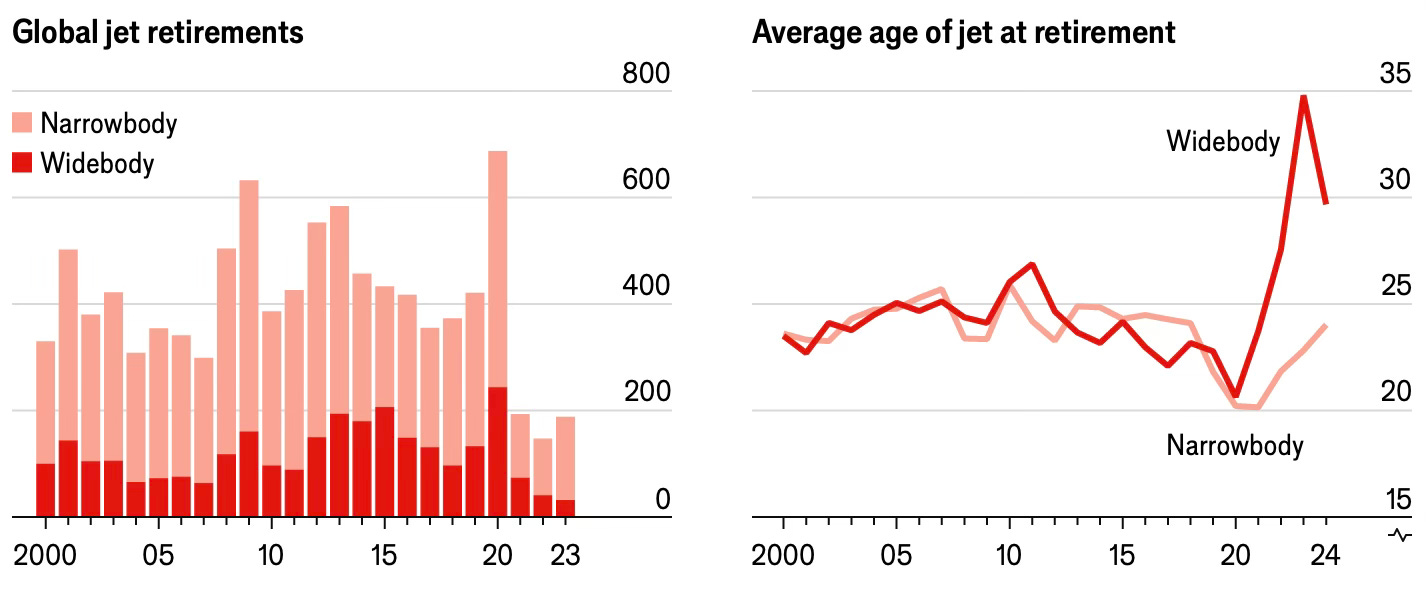
Consider the Boeing 777. It has 132,500 unique parts and some 3m in total, including bolts and rivets. Beneath the soft, rounded surfaces of the passenger cabin is a bewildering tangle of sensors, radars, pumps, pistons, cylinders and drums. Miles of wires connect avionics to the cockpit. Hydraulic systems move the rudder or wing flaps or brakes. Airlines need a reliable supply of all these bits and pieces. The global aviation industry would grind to a halt without them… The industry’s insatiable appetite for parts is fed by retired planes…

The first things to come off when a plane arrives in Arizona are the engines. Next to go is the landing gear. Avionics, instruments, hydraulics and other components are either harvested and stored or removed gradually on the basis of need. Cockpits are sometimes removed to be converted into flight simulators for pilot training. Luxurious seats at the front of the plane find new homes with second- or third-tier airlines or in the basements and garages of aviation aficionados… Once everything—engines, components, interiors—has been stripped out, the metal structure is all that remains. Made of high-quality aluminium alloy, it commands premium prices in scrap. Airbus and Boeing both estimate that around 90% of their aircraft by weight is recycled or reused in some form. 

On modern aircrafts

The latest generation of long-haul planes—Boeing’s 787 “Dreamliner” and the Airbus A350—is less noisy and more stable in turbulence. The new jets can manage higher humidity levels, lowering the chances of dehydration for travellers, and maintain higher cabin pressures that feel closer to conditions on the ground… New planes are also more efficient. Fuel is the single largest cost for any airline. Engines and weight are major factors in determining consumption. The biggest modern aircraft have just two engines compared with four on the 747 or the enormous Airbus A380 double-decker, and much of the airframe is made of light composite materials, such as carbon fibre, instead of heavier aluminium alloys. Airbus boasts that the A350 consumes 25% less fuel per seat than its predecessors, producing comparably fewer emissions. 

3. By any yardstick, Vietnam should count as one of the most remarkable economic successes in history. The New York Times has an excellent article that describes how North Vietnam broke away from the prosperous and industrialised South to lead the country’s spectacular economic success over the last two decades. 

This is a very good description of the transformation

In 1954, after separating from France to become an independent nation, it was one of the poorest and least-developed countries in Asia, relying almost entirely on subsistence farming. Haiphong, the north’s main port, was pounded by the U.S. military with some of the heaviest bombing raids of the war, and in the decade after unification in 1975, all of Vietnam became what one scholar called “a poverty-stricken society beset by a stagnant economy.” Today, double-digit growth rates in the north are the norm, and Haiphong is a modern metropolis of two million people connected to Hanoi by a new highway. Cranes swing like weather vanes above more than a dozen construction sites. New bridges cross a river twisting through the city, where piers at industrial parks help ships move to one of the busiest ports in the world.

The election of Donald Trump in 2016 and his tariffs on Chinese imports and other trade restrictions were triggers for North Vietnam’s take-off. Now, with the re-election of President Trump, the wheel may have turned the full circle.

Six years ago... President Donald J. Trump hit China with tariffs, igniting a global search for alternatives to Chinese manufacturing. Few nations, if any, have benefited more than Vietnam from the scramble that followed — especially north Vietnam, historically an economic laggard compared to the more cosmopolitan south. Around Haiphong, a few hours’ drive from China, factories bloomed. The LG plant expanded exponentially; the industrial park nearby filled up with Chinese companies adding production abroad. Rural hamlets... grew almost overnight into boom towns of 30,000... Mr. Trump has vowed to punish countries that have large trade surpluses with the United States, and Vietnam now ranks third on that list, behind only China and Mexico. Officials in Hanoi say they worry... that Vietnam will be singled out for tariffs while competitors avoid Mr. Trump’s blacklist. South Korean companies (including LG and Samsung) are Vietnam’s biggest foreign investors, and some have already paused expansion plans, waiting on Washington... No matter what happens next, America’s once-and-future president can safely say he helped make north Vietnam great again.

Vietnam’s worry comes from a graphic that drives most of President Trump’s foreign and trade policy actions 
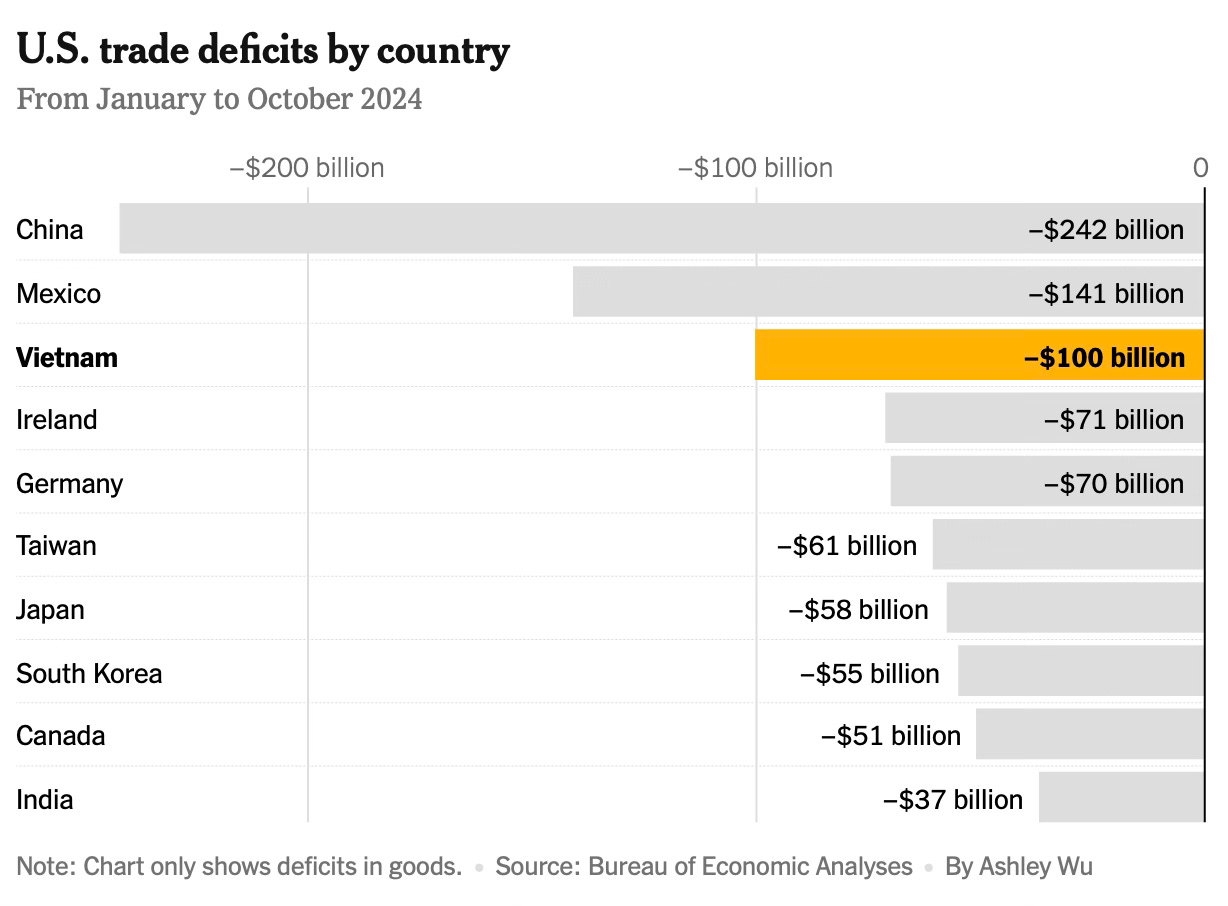
While Vietnam may have become a victim of its success, it may be simplistic to lay the blame on the relabeling of Chinese products. 

Between 2017 and 2023, foreign investors committed $248.3 billion to Vietnam for 19,701 projects, according to an analysis by Le Hong Hiep, coordinator of the Vietnam studies program at the ISEAS-Yusof Ishak Institute in Singapore. That’s more than half of all foreign investment since Vietnam opened its economy in the late 1980s. Vietnam’s growing trade surplus with the United States — reaching $104 billion last year, up from $38 billion in 2017 — has led to accusations that China uses Vietnam as a warehouse, rerouting its products to avoid tariffs. Chinese imports and investment have soared... Of the roughly 120 Japanese companies using government diversification subsidies, over 50 claimed them for Vietnam, more than any other country, according to Japanese officials... 

But in a country as wary of its neighbor as Vietnam, where 1,000 years of Chinese colonization lingers in national memory, the boom is by no means owned or operated by Beijing... A recent Harvard Business School study showed that illegal tariff avoidance was more rare than the trade imbalance might suggest — representing between 1.8 and 16.1 percent of exports to the United States in 2021. Researchers found that most exporters were making new products with inputs from many locations and local investment, not just relabeling Chinese products as Vietnamese.

What explains the success of the North?

Bruno Jaspaert, chairman of the European Chamber of Commerce in Vietnam and the chief executive of DEEP C, which runs industrial parks around Haiphong, said the waterway was just one regional advantage. Northern provinces have also had leaders better connected to Hanoi, yielding more infrastructure investment, plus more open, affordable land. Compared to the south, where an industrial base left over from the war made it easier for companies like Nike to get going in the 1990s, Mr. Jaspaert said the north “started later, they can plan better and they are also much faster.”

Pointing out the window of his office to Haiphong’s new city hall, surrounded by new apartment complexes, he emphasized that none of that was there when he moved to Vietnam in 2018. Northern Vietnam was already growing then, in a country that lifted 40 million people out of poverty from 1993 to 2014. But American tariffs became an economic accelerant — lighter fluid poured on a steady flame. And in the north, an epicenter of ancient Vietnamese civilization and Communist revolution, government officials’ quick action coincided with foreign investors’ own sense of capitalist urgency. Mr. Jaspaert said production decisions that once took 18 to 24 months now take six to nine. And while the south stagnates somewhat (Ho Chi Minh City’s subway line remains incomplete after 20 years of construction), the north races on. DEEP C’s revenues and profits have quintupled since the Trump tariffs…

Villages like Mr. Van Thinh’s have been transformed. When the LG plant expanded in 2019, the narrow streets of nearby hamlets quickly turned into commercial strips with restaurants and bold-colored barbershops for workers who make a solid local wage of around $400 to $550 a month. Every spare piece of land has been turned into worker housing. Mr. Van Thinh now manages 35 rooms with his family. Nearby, Pham Thi Cham, 55, drained a backyard pond where she raised fish to build eight rooms that she rents out for about $60 a month. Many of the workers come from central Vietnam. Instead of going south, they came north.

4. Bloomberg has a long read on the spectacular rise of Chinese automaker BYD, Build Your Dreams.

After increasing its annual sales in China 15 times over, to 3 million cars in only three years, BYD is now exporting to roughly 95 markets, including 20 new ones this year. The company is building, has recently opened or has announced plans for assembly plants outside China in 10 countries on three continents. The speed and scope of this expansion have caught the global auto industry off guard and triggered protectionist tariffs in the US and EU… BYD’s electric and hybrid vehicle car sales rocketedfrom just under 180,000 in 2020 to 1.86 million in 2022, giving (it)… the cash to fund a new overseas push… 

BYD, which stands for “Build Your Dreams,” is the brainchild of Wang Chuanfu, a 58-year-old battery scientist who in the 1990s saw an opportunity to start a rechargeable battery company to challenge Japan’s hold on the industry. It began by focusing on batteries for mobile phones and power tools, but in 2003 it decided to pursue cars. Wang’s battery and manufacturing innovations, cushioned by China’s EV-friendly government policies and the scale of its domestic auto market, have helped BYD do what Tesla Inc., Ford Motor Co. and the rest of the auto industry haven’t: build an affordable electric car for the masses and make money doing it. Since introducing a new battery technology in 2020, BYD has gone from being an also-ran in China’s crowded car market to cracking the top 10 automakers in the world…

It also wants to do what no Chinese carmaker has ever done: become a globally recognized consumer brand. It’s hoping to transcend geopolitics through the appeal of a plug-in hybrid sedan that can go 1,200 miles without stopping at a pump or a charger. Stella Li, BYD’s executive vice president and the face of its global expansion, says she wants consumers to see BYD as “a technological pioneer in changing the world.”… a playbook she has used whenever entering a new market: Do intensive market research; win hearts and minds on the ground; then tap BYD’s vast product portfolio to deliver whatever the locals want. One city might want a rail transit system, another an electrified municipal bus fleet. In London she started out with electric city buses to introduce the brand, then moved on to passenger cars. She did the same in Jakarta. In Brazil the playbook was jobs… As in Brazil, Li formed a partnership with taxi drivers through a ride-hailing app in Mexico City. She sold electric work trucks to Mexican conglomerates such as Grupo Bimbo SAB de CV and Cemex SAB de CV, and cut a deal with El Puerto de Liverpool, Mexico’s ubiquitous luxury department store chain, to sell EVs and at-home chargers at the mall.

The stories of Wang and Li are inspiring

Wang was thinking about cars as early as the 1990s. To him, BYD had always been more than just a low-cost battery manufacturer. It was a research and development machine that would use rechargeable batteries as a launchpad for products that could change entire industries. The orphaned son of farmers in rural Anhui province, he was raised by his siblings and earned an undergraduate degree in metallurgical physical chemistry in 1987, then a master’s from the Beijing Non-Ferrous Research Institute, where he became a government researcher… Wang started BYD in 1995 with a $350,000 loan from his cousin. He reasoned he could replace expensive automated Japanese manufacturing systems with one that made use of an abundance of low-cost Chinese workers to assemble batteries manually. But cheap labor was just a piece of the puzzle; the goal was to be as vertically integrated as possible, making not only batteries but also the components, tools and equipment necessary to produce and test them… In 2023, UBS AG did a teardown of the BYD Seal sedan, a challenger to the Tesla Model 3, and found that about 75% of the parts were made in-house, giving BYD a 25% cost advantage over American and European carmakers.

The company got its first big break thanks to a young saleswoman named Li Ke, known outside Chinese-speaking circles as Stella Li. If Wang is the visionary engineer guiding BYD’s elaborate skunkworks, Li, the company’s No. 2, is the driving force behind its expansion, representing BYD in meetings with customers such as Apple Inc. or leaders including the president of Brazil. She graduated from China’s prestigious Fudan University with a degree in statistics and joined BYD in 1996 as a marketing manager for global exports. Wang sent her to Europe and the US to set up offices, and her efforts in that role are the stuff of company lore. In her mid-20s and with a rough grasp of English, Li showed up with a box of battery samples and spent months courting the procurement team at Motorola’s battery R&D campus in the Atlanta suburbs. Motorola executives thought she was a pest, according to one who dealt with her at the time, but the cost savings she was promising were so great and Li was so persistent that they eventually agreed to test BYD’s battery cells. It took two years of evaluation to win the contract. At one point Motorola was so impressed with Li that the company tried to hire her for its sales team…

A year after taking BYD public in 2002, Wang bought a majority stake in a failing state-run car company, Xi’an Qinchuan Auto Co. Angry investors called BYD, appalled that it was wading into a market it knew nothing about—Wang didn’t even know how to drive at the time. But he saw cars as a natural extension of BYD’s battery business. In 2004 he gave a speech at the Beijing auto show declaring his intention to use batteries to change the future of the auto industry. It took almost 20 years for Wang to prove he was right. In 2008, BYD became the first company to produce a plug-in hybrid at commercial scale… Wang continued to pour money into product development, eventually building 11 R&D centers and a vertically integrated company that made everything including batteries, solar panels, printed circuit boards and semiconductors… BYD has equity stakes and long-term agreements with lithium miners, refiners and makers of cathode material, a key battery component… 

If the Motorola deal transformed BYD once, the Blade battery, unveiled in 2020—and now powering all of the company’s cars—would do it again. Most researchers outside China were trying to improve EV range by experimenting with nickel-based batteries. Wang chose lithium iron phosphate, or LFP, which was cheaper and less fire-prone but had been largely dismissed because it lacked energy density. Using LFP allowed Wang and his team to streamline the battery pack, do away with some of the clunkier fire-prevention components and fuse cells directly to the chassis. These improvements proved LFP could be harnessed for longer-range EVs, drastically reducing overall cost. It was so competitive that Toyota uses it in its cars in China, as do many Chinese carmakers.

5. One of the great paradoxes of our times is the co-existence of historically high levels of interconnectedness (trade, finance, migration, idea flows, social media etc.) amidst the growing economic, social, political, and geopolitical polarization. 

Andy Haldane finds an explanation in the work of Robert Putnam whose book at the turn of the millennium, Bowling Alone, sought to document the weakening of community ethics among Americans since the Second World War. He explained it in terms of the loss of social capital - an erosion of the social networks of trust and relationships and the fraying of the social fabric, within and between communities. Haldane writes ,

Putnam’s recent documentary, Join or Die?, shows that these patterns have worsened over the course of this century — and not just in the US. Unravelling of the social fabric has become an international norm. Research has shown just how large and lasting are the costs of bowling alone. From sub-par growth to stalling social mobility, from the epidemic in loneliness to the crumbling of communities, the erosion of social capital goes a long way to explaining some of our greatest scourges. 

He writes about the importance of social capital, compared to the conventional capitals, at individual, community, social, and even national levels.

At the national level, cross-country evidence points towards a strong, causal link between social capital and growth, even once the other “capitals” more often focused on by economists (human, physical and, infrastructure) are taken into account. A 10 percentage point boost in trust raises an economy’s relative economic performance by 1.3-1.5 per cent of GDP. If the UK could achieve Scandinavian levels of trust, this could add £100bn per year to our growth. One key mechanism through which social capital boosts growth is by unlocking opportunity. Recent research by Harvard economist Raj Chetty et al suggests social connectivity may be the single most important determinant of social mobility. Providing a poor (typically disconnected) child with the network of a rich (connected) child boosts their lifetime income prospects by 20 per cent, according to Chetty’s estimates. Few, if any, policy interventions, education or otherwise, yield so high a life-long return. 

These effects are just as large and lasting for non-financial measures of health. Century-long US studies tell us that the single best predictor of someone’s longevity and happiness is the quality of their relationships or social capital. As US Surgeon-General Vivek Murthy has observed, bowling alone is the equivalent of smoking 15 cigarettes a day, shortening lifespans and eroding mental health and wellbeing. What is true for individuals and nations is also true for communities. In the poorest, security and solidarity sit at the top of residents’ hierarchy of needs, Maslow-style. Social cohesion and connection are known to reduce crime and antisocial behaviour and build pride in place and belonging. That makes social capital an essential foundation in making successful places. Without it, they atrophy or, worse still, riot. The depletion of social capital matters in one further key dimension — the effectiveness of government. Government legitimacy and effectiveness requires public trust. This is currently in short supply.

Haldane advocates a focused endeavour to develop social cohesion and capital. 

Our current education systems are more often a recipe for social stratification than mixing. That calls for a radical rethink of curricula and extracurricular activities, and educational access criteria, to make social connection a fore rather than afterthought. Next, unplanned urban sprawl has contributed significantly to the Balkanisation of communities. In future, social cohesion should be at the heart of spatial planning. LSE professor Richard Sennett has proposed sociable housing, connecting disconnected communities through mixed tenure residences, communal spaces and an improved public realm… Social capital is built on strong social infrastructure — faith-based institutions, youth clubs, community centres, parks, sports and leisure facilities, libraries and museums. Yet investment in social infrastructure is meagre relative to physical and digital infrastructure. Reprioritisation and reinvestment are overdue. 

If citizen trust is to be rebuilt, new models of governance are needed too. Citizen panels and juries are effective in building trust and cohesion in diverse communities. Yet they are far from the democratic mainstream. In a return to the original Greek model of democracy, community-led coalitions could play a central role locally. In addition, mainstream and social media are a key conduit for both social connection and, increasingly, social division. Many countries are legislating to avoid online harm. But too little is being done to support online good where it nurtures social cohesion. Public service broadcasters and regulators have a vital role to play in doing so.

Sunday, November 21, 2021

Weekend reading links

1. Fascinating account of the social debates taking place in Canada's Atlantic coast areas like villages and towns in New Foundland,

Until recently, Canada’s Atlantic provinces were suffering from so much outward migration that some towns started offering free land to lure workers. But as urban life across the world has been upended by the coronavirus, with lockdowns, shuttered bars and socially distanced gyms, the picturesque region is experiencing the largest inward migration in nearly 50 years. Desperate to escape pandemic doldrums and soaring housing prices, and energized by a global shift to remote working, the newcomers are flocking to Atlantic Canada, where they have been largely welcomed. But in the distinctive coastal region — shaped by the traditional values of its Indigenous peoples and Irish, Scottish, English and French settlers — the migration of moneyed urbanites is also fanning some tensions.

Though housing prices remain low compared with bigger urban centers, in Bonavista, population 3,752, they are exploding, and some local residents bemoan the higher property taxes that come with them. The social fabric of the town has also been changing. Traditional craft shops and restaurants offering fish and brewis, a starchy local dish of cod and bread, have been gradually giving way to designer sea salt companies and to purveyors of cumin kombucha and iceberg-infused soap...

According to Statistics Canada, about 33,000 people from other provinces migrated to the region of 2.5 million people in the first half of this year alone, compared with about 18,500 in the same period in 2005. Many of the new arrivals are millennials... Reg Butler, a crab fisherman, whose family has been in Bonavista for five generations, credited the newcomers for rejuvenating the local economy after the town emptied in the 1990s following a moratorium on cod fishing. But he said a housing shortage was stoking some resentment.

2.  South Korea hallyu facts of the day,

In the last few years alone, South Korea shocked the world with “Parasite,” the first foreign language film to win best picture at the Academy Awards. It has one of the biggest, if not the biggest, band in the world with BTS. Netflix has introduced 80 Korean movies and TV shows in the last few years, far more than it had imagined when it started its service in South Korea in 2016, according to the company. Three of the 10 most popular TV shows on Netflix as of Monday were South Korean... In September, the Oxford English Dictionary added 26 new words of Korean origin, including “hallyu,” or Korean wave... It wasn’t until last year when “Parasite,” a film highlighting the yawning gap between rich and poor, won the Oscar that international audiences truly began to pay attention, even though South Korea had been producing similar work for years.

3. Upshot has this summary of how the pandemic stimuluses have benefited American labour,

Workers have seized the upper hand in the labor market, attaining the largest raises in decades and quitting their jobs at record rates. The unemployment rate is 4.6 percent and has been falling rapidly. Cumulatively, Americans are sitting on piles of cash; they have accumulated $2.3 trillion more in savings in the last 19 months than would have been expected in the prepandemic path. The median household’s checking account balance was 50 percent higher in July of this year than in 2019, according to the JPMorgan Chase Institute... Over the 12 months that ended in September, those in the top quarter of earners experienced 2.7 percent gains in hourly earnings, compared with 4.8 percent for the lowest quarter of earners. For lower earners, that follows years leading up to the pandemic in which pay gains exceeded inflation rates.

4. Barry Eichengreen and Poonam Gupta, along with another, have a reprise of their earlier paper comparing emerging economies during the taper tantrum. Their headline finding on EM vulnerability is on the public debt and fiscal deficit fronts, and India leads on both.

Where emerging markets are weaker is in terms of public-sector indebtedness... interest rates in the U.S. are poised to begin moving up, which will make for higher interest rates in India, as we have shown above. Even without these unfavorable growth and interest-rate developments, it would have been necessary to cut the government’s primary budget deficit to prevent the debt-to-GDP ratio from moving higher. With these developments, larger cuts will be required... What happens when public debt relative to the resources that the government is able to mobilize rises even higher? Either taxes have to be raised or public spending must be cut to generate additional revenues for debt service. If this proves politically impossible, governments have responded, historically, in two ways. When the debt is held externally, they restructure. When it is held internally, they inflate.

The paper is full of graphs comparing EM economies on various indicators. This one is the most disturbing one from India's perspective, even though most government debt is internal (external is just 4% of GDP).

It draws attention to the differential between real interest rate and real GDP growth. 

Since the turn of the century, the real-growth-rate-real-interest rate differential has averaged around 5 percentage points. This means that India can run a primary deficit of 4.5 percent of GDP without seeing its debt/GDP ratio move higher...This follows from the standard equation for debt dynamics: Δb = d + (r – g)b, where the change in the debt b is the sum of the primary budget deficit d and the existing debt multiplied by the difference in the real interest rate r and the real GDP growth rate g. With a value for r-g of 5, as posited in the text, and value for b of 0.9, the product yields a value for d of 4.5 percent of GDP in a steady state... if interest rates now go up owing to global factors, the real-interest- rate-real-growth-rate differential could turn even less favorable... yields on the Indian government’s 10-year securities co-move with US 10-year Treasury yields. The elasticity with respect to U.S. rates approaches unity; this is true in both nominal and real terms. If U.S. yields are now going up, this suggests that even stronger steps will be needed to stabilize the debt/GDP ratio. With a growth rate of 6 percent and a real interest rate of 2 percent, the deficit would have to be cut to roughly 3.6 percent of GDP to stabilize the debt/GDP ratio.

5. The Ken has an investigative report on abusive practices by baby food manufacturers,
On 18 October, Union health Secretary Rajesh Bhushan received an unusual letter. It was a complaint penned by an employee of Nutricia International, the Indian arm of French food-products conglomerate Danone. The employee, one of 216 sales executives tasked with pushing the company’s infant milk substitutes and baby food, accused Danone India of a host of illegal and unethical practices in order to garner better sales in the baby food category. Danone had, according to the letter, sponsored overseas trips for doctors under the garb of an education grant, hosted liquor-fuelled parties for them, arranged for their transport, and even offered them financial inducements and gifts. If true, Danone would be in blatant contravention of India’s Infant Milk Substitutes (IMS) Act. The Act prohibits companies involved in manufacturing baby milk formula and food for babies upto two years of age from indulging in promotional activities. The allegations against Danone are damning... between January 2019 and May 2021, the Ministry of Health and Family Welfare (MoHFW) received 33 complaints about violations of the IMS Act. That’s more than one complaint a month. The alleged offenders included baby food manufacturers such as Nestle, Abbott, Mead Johnson, Danone, and Amul, but also extended to Apollo Pharmacy, Amazon, and even YouTube.

6. The surge in tech IPOs in Indian equity market - tech listings in India has so far raised $2.6 bn in 2021, a jump of 550% compared to last year's total! 

From an FT long read about the Chinese crackdown benefiting India,

For every dollar invested in Chinese tech in the quarter that ended September, $1.50 went into India, according to the Asian Venture Capital Journal.

This is a good indicator of the growth potential of Indian markets,
While listed “new economy” companies account for 60 per cent of China’s MSCI index, they make up only 5 per cent of India’s, according to Goldman Sachs.

And this about what's happening now,

Analytics platform Venture Intelligence says 35 Indian start-ups have become “unicorns” worth over $1bn this year, more than every year since 2013 combined.
7. Scott Galloway has a stunning graphic which shows that the middle 60% of Americans now own less wealth than the top 1%.

In 1989, the middle class in the US owned 36% of wealth, compared to just 17% for the top 1%. 

8. The recent break-ups of GE, Toshiba, and Johnson&Johnson have triggered a debate on the demise of the conglomerate model. In the context of India, Shyamal Majumdar writes
Though the aggregate financial ratios of some of the conglomerates still look respectable, that’s primarily because one company usually makes up for all the other underperforming businesses in the group. For example, Tata Consultancy Services accounts for 67 per cent of the combined market capitalisation of all listed Tata group companies and over 90 per cent of the group holding company Tata Sons’ dividend income. TCS has virtually funded the group’s growth for over a decade now. Similarly, Aditya Birla group’s financial ratios would look less impressive if Ultratech Cement and its parent Grasim Industries are excluded.

9. Putting the PayTm fiasco in perspective,

10. Are low valuations of industrial companies a cause for inflation? Merryn Somerset Webb writes,
In a letter to investors last year, David Einhorn of Greenlight Capital suggested that the low valuations of industrial companies might in themselves be inflationary. If traditional industrial companies have low valuations, and hence an implicitly high cost of equity, it makes sense for holders of the stock to demand that dividend payouts and share buybacks take priority over capacity expansion: if the market attributes little value to your business, why expand it? That leads to continued under-investment and, due to lack of new supply, to “sustained higher prices in a number of industries”, wrote Einhorn.

11. The rise and rise of private equity giants,

12. John Authers points to the poor performance of emerging economy equity markets. 

The BRIC markets are still below their Halloween 2007 peak.
Since 2011, the fates of equity markets of BRIC and developed markets have decoupled.
Authers points to the possibility of an interesting trend - decoupling of EM equity markets from that of China.

13. The ASER 2021 is out. An interesting graphic is the sharp rise in student enrolment in government schools, shifting away from private schools. 

The share of private schools has been rising for a long period, and now the trend appears to have reversed. It's hard to believe that the quality of government schools have improved across India and that of private schools have similarly declined across to warrant this near universal trend since 2018. Is it a proxy for economic distress translating into parents forced to exit private schools and fall back on government schools.

This is the full report.

14. Finally, on Udaan, a B2B online retailer which may be more sensible bet for investors than the other inflated unicorns,
Currently Udaan has 35 lakh installed customers on the platform and as many as 25 lakh undertake regular transactions. From an average 10 per cent of their total transactions going through the Udaan platform two years ago, that share has gone up to 40 per cent. “There are 30 million retailers in the country but three to four million of them account for 85-90 per cent of the trade. So while the number of retailers on our platform might go up slowly to 40-45 lakh, we are targeting the most relevant of them in the ecosystem and ensuring that they source the bulk of their products from us,’ said co-founder Sujeet Kumar. To do so, Udaan will also focus on the availability of those stock keeping units (SKUs) which sell the most for a retailer. For instance, in the FMCG and food space, Kumar says the top 200 SKUs account for 80 per cent of the sales. “We want the retailer to source 90 per cent of these items from us,” he said.

Saturday, October 8, 2011

Barter economy in Greece and Time Banks

The Times points to an interesting trend in economically beleaguered Greece - emergence of a barter trading economy among certain small communities. It writes about one such network in Volos, with 400 members, which uses a so-called Local Alternative Unit, or TEM in Greek, to exchange goods and services — language classes, baby-sitting, computer support, home-cooked meals — and to receive discounts at some local businesses,

"People sign up online and get access to a database that is kind of like a members-only Craigslist. One unit of TEM is equal in value to one euro, and it can be used to exchange good and services. Members start their accounts with zero, and they accrue credit by offering goods and services. They can borrow up to 300 TEMs, but they are expected to repay the loan within a fixed period of time.

Members also receive books of vouchers of the alternative currency itself, which look like gift certificates and are printed with a special seal that makes it difficult to counterfeit. Those vouchers can be used like checks. Several businesspeople in Volos, including a veterinarian, an optician and a seamstress, accept the alternative currency in exchange for a discount on the price in euros.

A recent glimpse of the database revealed people offering guitar and English lessons, bookkeeping services, computer technical support, discounts at hairdressers and the use of their yards for parties. There is a system of ratings so that people can describe their experiences, in order to keep transparent quality control."


The article attributes the recent emergence of such groups across Greece to the austerity policies which have squeezed wages and increased deprivation and uncertainty.

Interestingly, the Fixes blog in NYT recently pointed to the growth of time banks, reciprocal service exchanges that uses units of time as currency. Members of time banks register to offer certain services - financial planning, computer de-bugging, handyman repairs, housecleaning, child care, clothing alterations, cooking, taking someone to a doctor’s appointment on the bus, visiting the homebound or English conversation etc - in return for which they can access services offered by others belonging to the bank. Interestingly, distinct from the conventional markets, in time banks all works have equal value. It writes,

"A 90-year-old can contribute on an equal basis with a 30 year old. Accompanying someone to the doctor is as valuable as Web design."


Such time banks become an attractive option during times of high unemployment and under-employment. People have ample time with them, but do not have enough money to meet their needs. They see time banks as an opportunity to put their skills to work to get things they need.

The emergence of social networking sites and the ability of these platforms to bring together people and make them aware of each others needs too has the potential to create interest in such "barter craigslists". Time banks are especially effective health care. Taking care of old-aged, hospice care, shopping and other household help for old-aged etc, through time banks can lower health care costs considerably.

TimeBanks and Time Banking UK are umbrella organizations of time banks in America and Britain.

Wednesday, January 5, 2011

Addressing civic issues - limits of regulation and enforcement

How do we control urination in public places? How do we get people to disciplined parking in commercial streets? How do we prevent people from littering? How do we get people to wear helmets or seat-belts? At once simple and commonplace, they are also among the most difficult of challenges facing municipal authorities in India. How do we address such civic problems? This post will examine the challenges in all its dimensions and subsequent posts will look at solutions that stand the best chance of success.

As we all know by now, regulations and punishments though necessary are not sufficient. They need to be accompanied with enforcement. But enforcement immediately raises several troubling issues. Let us take the case of urinals. How can we enforce a ban on public urination without adequate and widely available public urinals? Even if adequate urinals are constructed, people will not use them if the maintenance is poor (as is often the case). And maintaining urinals with the cleanliness and in the scale required for large Indian cities costs money and demands the collection of reasonable user charges. Are people, especially those who need such urinals, willing to pay these user charges?

Even assuming people will pay, there is the very practical issue of locating large numbers of urinals. Given the size of our cities, labyrinthine roads and streets in commercial areas, and population densities, it becomes important to have urinals located close to each other, atleast at the major public places. This becomes all the more important given the considerable search costs (even with signages) and time value of the likely users. Further, since these areas are all built up, all these toilets will have to be constructed along road margins and adjacent to existing commercial establishments. This naturally generates the "not-in-my-backyard" resistance from the nearby shopkeepers.

And, I have not even talked about the formidable socio-political obstacles that have to be surmounted at each of the aforementioned stages! The same analysis can be extended to littering - even with large numbers of dust bins (with the risk of being stolen) - and parking - even with adequate parking lots, large numbers of policemen and private security guards and outsourced parking contractors.

Popular impression of law and its enforcement is viewed in terms of mainly penalties and less so, rewards. Governments promulgate laws and establish enforcement agencies. Law breakers are penalized and the deterrent effect of these penalties keep people honest. If people continue to violate, then it is a problem of enforcement. All this appears very simple and therefore baffling to citizens about why governments can't get it right.

However, I am inclined to believe that the aforementioned narrative does not convey the full story. It gives the impression that fear of punishment is the major reason why people abide by the law. This overlooks the powerful influence of people's inherent civic sensibilities in bringing about collective conformity to law. In societies marked by widespread conformity to law of the land, the latter (civic sensibility) is a far greater contributory factor than the former (punishment). The deterrent effect of enforcement acts mainly at the margins, on those most likely to violate. Its power lies in forcing the small numbers of deviant people into conforming to the standard practice (among similar people).

In simple terms, strong enforcement will be successful in deterring the exceptions, not the norm. When everyone, or atleast the majority, are violators, then violation becomes the norm, the unwritten (and stigma-less) convention. Such practices persist because of their convenience - minimal or no costs, ease, socialization, inaccessibility to alternatives etc. Overcoming them requires addressing the problem at all these levels. Without this, it immediately provokes public resistance and political opposition.

Therefore, at a practical level, the challenge of enforcement when the major share of the population (the "public urinating" part of the population) is not internalized into using the public urinals (by searching out the urinals and paying the user charge) is enormous.

Further, since problems vary across localities (in terms of the respective magnitudes of the different contributors), there is need for location-specific implementation designs. This in turn depends on local initiative, driven by the respective local officials and the local community. As we are aware, the former is scarce and the latter suffers from the collective action problem. A confluence of both these forces is therefore a matter of chance or luck. See this excellent account of one such experience by Shoba Narayan.

Let us also not be carried away by exceptional achievements of a small localities in a few cities which have achieved success with such civic issues. They stand out precisely because they are the glorious exceptions and not the norm. However, these bright spots may provide important lessons that are necessary for any effort at successful emulation. Even with all logistics and other requirements in place, it would require massive personal commitments and efforts at every level, coupled with fortuitous confluence of circumstances and dollops of luck for such initiatives to succeed.

Monday, February 8, 2010

Kaldor-Hicks bargains in civic life

Consider these three situations.

1. Builder Babu constructs a new apartment complex in Free Market Colony. Adjoining the entrance to the complex is an electricity pole (or a water line or a public tap), located on the road margin, which apart from adversely affecting the elevation of the new building also inconveniences vehicles entering the compound. Builder Babu applies to get the electricity pole shifted to the other side of the road, adjoining the backside of the neighbouring house, and makes the required payment for shifting. However, once the elctricity utility starts the shifting work, the Not-in-my-backyard (NIMBY) effect comes to the fore and local residents oppose the shifting. They couch their opposition on the grounds that shifting would result in drawing lines across the street, thereby spoiling its elevation (or cutting the road, though the road restoration costs are already paid to the municipality).

2. Welder Ram proposes to start a welding shop in a shop he has taken on lease in the narrow and congested Free Market Street. However, being a hazardous activity, the presence of a transformer at the road margin and adjacent to the entrance of his shop means that he cannot start his business activity without shifting it. He therefore approaches the electricity call center and pays the required shifting charges. The electricity utility's contractor starts the work only to face strong and vocal opposition from the shop owners in whose area it was proposed to relocate the transformer.

The congested nature of the locality means that there is no other land (actually it needs only a small space to erect the plinth and mount the transformer, but the transformer looming in front of their shops is a deterrrent) available on the road margin to locate the transformer. In other words, in the absence of any vacant land or space, the transformer has to always remain mounted adjacent to some shop.

3. Consider the flower market located in the narrow Flower Street. The flower market generates massive quantities of waste material which was being dumped in the only available vacant land in the vicinity (and then lifted by the municipal authorities everyday evening). Now the owner of the land has returned from the abroad and decided to construct a shopping complex in his land. Having lost their temporary waste disposal location, the flower market association decide to request the municipal authorities for a dumper bin for Flower Street. Municipal authorities readily oblige and transport the bin to Flower Street.

Now the problem starts. In the absence of any vacant land, the dumper bin has to be located on the road margin over the covered drain and footpath. The congested and closely spaced nature of the shops in the street means that it is inevitable that the bin be located adjacent to atleast one shop. None of the flower shop owners are willing to sacrifice the entrance to their shop with the sight of a dumper bin.

All the aforementioned examples are commonplace in our cities and source of considerable acrimony between people and causes neighbourhood disputes. They are also some of the commonest types of complaints received by municipal authorities and utility officials in many Indian cities. However, the involvement of government rarely solves the problem. If anything, it often ends up exacerbating the problem as the officials accept bribes and take sides in a neighbourhood dispute, where no side is right or wrong.

Ideally such disputes ought to be settled through civic organizations like Residents Welfare Associations (RWAs) or other local commercial associations. The local social capital is the most effective instrument to solve such problems. However, if the local community fails to arrive at an amicable solution, the free market has a possible solution.

Econ 101 would see all three as classic test cases for application of the Kaldor-Hicks criterion. Under the Kaldor test, an outcome will be efficient if the maximum amount the gainers are prepared to pay is greater than the minimum amount that the losers are prepared to accept. The Hicks test stipulates an outcome to be efficient if the maximum amount the losers are prepared to offer the gainers in order to prevent the change is less than the minimum amount the gainers are prepared to accept as a bribe to forego the change. The Hicks test is from the loser side and the Kaldor test the gainer side reasoning.

The aforementioned commonplace civic disputes can be subjected to Kaldor-Hicks bargains. In fact, there may be nothing immoral about such negotiations, especially when the alternatives leave everyone worse off. Such informal and mutually negotiated dispute settlement mechanisms were employed even in olden times, mediated by local councils of elders in many societies. Even today, atleast in some commercial areas, such disputes would get settled before the local rowdy who would, apart from intermediating to identify a mutually acceptable price, also wring out his share from both parties.

The danger lies in the institutionalization of such informal arrangements, where in the absence of appropiate legal instruments, non-state actors occupy the vacuum and damage the fabric of the local society. However, instead of undesirable lumpen elements, the local community associations can embrace this approach and provide the platform for such bargaining.