Substack

Showing posts with label private equity. Show all posts

Saturday, September 19, 2026

Weekend reading links

1. A fascinating article by Ed Conway documents how a cod fish caught off the Scottish coast travels 30,000 nautical miles to Rotterdam, Shandong, China (for manual deboning and skinning), and back to the UK, where it is breaded and sold as fish fingers.

Scientists plug in numbers to the NS equations to derive accurate answers for the behaviour of moving fluids. But the NS equations can sometimes return apparent nonsense, predicting things like infinite velocity and zero volume (called a “singularity”)... Can it be proved that the NS mathematics don’t allow infinite velocity? Or alternatively, can it be proved that this can happen in some theoretical cases, weird as that may seem? Mathematicians refer to this possibility as a “breakdown” in the “existence and smoothness” of NS. .. NS is one of the seven famous Millennium Problems that were listed in 2000. The Clay Institute offers a prize of $1million for a proof that, one way or another, addresses four specific conditions for NS. 

On Tuesday, September 8, OpenAI announced that it had found a solution to the NS problem by using a new AI model after 88 hours of intense computation involving 10,000 AI agents and 17 hours of verification. The agents exchanged 3 million messages and used 130 billion output tokens, which amounts to costs of well over $10 million. OpenAI claims its AI resolved two out of the four statements in the proof demanded by the Millennium Prize and that, indeed, infinite velocity is theoretically possible under certain conditions.

3. Brilliant description of the Dauphin discount, applied when a founder-owner hands over the reins to his entitled but not similarly competent children. 

4. There may have been an inflation regime shift in the US in the last few years. Consumer prices overall have risen more than 30 percent since the beginning of 2019. That’s two and a half times as much as they went up from 2012 to 2019.

Prices have risen sharply across the board.
5. US inflation clearly owes to the Iran misadventure. 
6. Benn Steil has one more reason for the rising US bond yields. 
The interest rate demanded by investors to absorb this debt appears not to be a straight linear function of its growth. Instead, more debt seems to accelerate the rise in the rate demanded. The reason lies in who buys the debt. Nineteen years ago, 76 per cent of US Treasury bonds were held by price-insensitive investors, such as central banks, who bought them more or less reflexively according to their stable reserve-management policies. Today, they hold only 43 per cent. The majority is now held by price-sensitive investors, such as households and investment funds, which demand greater returns as government debt grows and inflation erodes their purchasing power...
The twin problems of surging Treasury supply and stagnant foreign official demand will be exacerbated further still if new Federal Reserve chair Kevin Warsh ploughs forward with his stated ambition of reducing the central bank’s security holdings. The last episode of Fed balance-sheet reduction saw the share of Treasuries held by price-sensitive investors soar by 17 percentage points over 2022 to 2025, while the so-called term premium — the extra compensation demanded by investors to hold long-term debt — rose by 1.1 percentage points. Given the continued increase in price-sensitive investor dominance, further Fed balance-sheet reduction could see yet sharper rises in the price of long-term US debt.

7. VC wealth multiplication.

Founders Fund, for example, turned a roughly $600mn investment in Musk’s rocket, satellite and AI group into a stake worth more than $50bn at the company’s initial public offering, according to PitchBook estimates.

8. More on the collateral benefits of Aliko Dangote's business activities (HT: Adam Tooze).

Africa’s richest man, Aliko Dangote, wants his drivers, cooks and security guards to own a share of the continent’s largest refinery. At a signing ceremony in Lagos, Nigeria, on Monday, 7 September, Dangote Petroleum Refinery and Petrochemicals (DPRP) free establishment zone launched the formal process for what is expected to be Africa’s largest public share sale, aiming to raise ₦2.15trn ($1.4bn). The offer comprises 4.1 billion ordinary shares at ₦525 per share, with a minimum subscription of 10 shares. It opens on 14 September and closes on 13 October. “There is no segregation of who can own the share. We want every human being living on the continent to be part of this action,” says Dangote, president and chief executive of Dangote Industries Limited. “This is why we have called it the IPO for the people.” 

He said the offer, which opens on 14 September and closes on 13 October, is designed to allow “drivers, cooks, servers, our managers, everybody” to own a stake in the refinery. The IPO is targeting about 10 million retail investors, according to FirstCap Limited, one of the parties to the transaction. “This transaction is not just about the size of the offer; it’s about the significance and how it’s going to shape retail investment in Nigeria’s capital markets,” said Ukandu Ukandu, MD/CEO of FirstCap, describing the deal as digitally driven and built for mass participation. “Family members, security guards, drivers, colleagues, schoolmates, community members are all encouraged to participate.” Dangote described the raise as less of a financing exercise than a wealth-distribution one, calling the ₦2trn target “too small” and “a meagre amount” relative to the group’s needs. He said the proceeds are earmarked for the refinery’s expansion.

9. Tiruppur facts of the week.

Its knitwear exports rose from $3.3 billion in 2020-21 to $5.3 billion in 2024-25 (TEA, 2026). The cluster accounts for about 68 per cent of India’s knitwear exports and supports the livelihoods of more than a million workers, around 70 per cent of them being women. Within roughly 20 km, yarn, knitting, dyeing, printing, stitching, finishing, packaging and dispatch are woven into one production ecosystem. Nearly 20,000 units operate across different stages, from knitting, dyeing and printing to garmenting and ancillary activities. This is the ecosystem effect where firms specialise, workers specialise, and thousands of jobs are created around a common market.

10. India's affordable housing market facts.

The preference for midsize housing priced between ₹45 lakh and ₹90 lakh fell to 21 per cent in H1 2026, from as high as 35 per cent in H1 2021. Similarly, preference for housing priced below ₹45 lakh declined from 27 per cent in H1 2021 to 18 per cent in H1 2026. “This is also mirrored in supply, with affordable housing’s share of new launches across the top seven cities declining from 26 per cent in H1 2021 to just 8 per cent in H1 2026,” says Anuj Puri, chairman of Anarock.

11. KP Krishnan makes very important points while questioning the RBI's recent FCNR (B) scheme which attracted $136 billion.

The capital flow of $136 billion is brought in by providing currency hedging to commercial banks at no cost. A forward guarantee on the exchange rate creates a contingent liability for the state. If macroeconomic fundamentals guide the exchange rate to ₹110 per dollar in three years, the RBI will pay ₹15 per dollar. This is a cost of approximately ₹2 trillion... Such tricks have been done before. India Development Bonds 1991 raised an estimated 0.6 per cent of gross domestic product. Resurgent India Bonds of 1998 raised 1 per cent, and India Millennium Deposits 2000 raised 1.2 per cent of GDP. The 2013 FCNR(B) exercise raised 1.4 per cent of GDP. The 2026 FCNR(B) raised 3.5 per cent of GDP. The scale, the opacity, the complexity have gone up. ... The daily inflow and outflow across India’s borders is $11 billion. The global daily trading volume on the rupee is $140 billion. Throwing just $2 billion a day at the problem for 250 days will burn through $500 billion.

We should instead take one step back and ask the foundational question: All this drama is in return for what? Recent research by Hande et al. (2026, https://bit.ly/4dlXP5d) indicates that the natural annualised volatility of the USD/INR exchange rate, without intervention, is approximately 7.5 per cent a year. The apparatus of intervention generates a realised volatility of roughly 5 per cent a year. We suffer fiscal risk, distorted monetary policy, instability, and constraints on financial development, which impact the people through inferior economic growth. In return, we get a 2.5 percentage point reduction in currency volatility, which benefits a small set of business users.

12. This is a staggering statistic on IPOs 

Anthropic’s investors are expecting the company to reach a valuation of $2tn when it goes public in the coming weeks. Add in SpaceX, which began trading at $2tn after its IPO in June, and OpenAI, which is considering raising money privately at $1.2tn ahead of a public listing next year, and these companies alone could be worth well north of $5tn. Now compare that with the entire history of IPOs from 1980 to 2025. The 3,365 tech companies that went public in that period were worth a combined $4.1tn when they started trading, according to data compiled by Jay Ritter, emeritus professor at the University of Florida’s Warrington College of Business.

13. The return of conglomerates, but with overlapping national strategic goals.

In China, Huawei has gone from an empire with two business lines to a local champion with 70 per cent of sales at home in five divisions. Chinese car companies own their supply chains — BYD operates ships. To defuse sovereignty fears abroad, they are willing to forfeit control, using licensing and joint ventures. India’s Reliance and Tata have re-embraced nation building across industries, from cola to air defence. Even in America, Amazon and Alphabet have become conglomerates that own parts of their supply chains, such as chip design. SpaceX’s strategy is to be a techno-national champion with up to nine divisions, from asteroid mining to tourism. In the pursuit of state-endorsed AI, OpenAI has gone further than Amodei, offering Uncle Sam an equity stake. US pharmaceutical companies want new drugs invented in China, but geopolitics makes takeovers impossible. Instead, there is a surge in licensing. Bristol Myers Squibb and Pfizer have made bets worth up to $26bn. In Europe, some firms are diversifying to plug strategic holes. The parent of Lidl, a supermarket, does data centres. Renault is expanding into military drones. Governments are trying to dilute US tech companies’ control over their local subsidiaries.

14. Gig work platforms are a form of unemployment insurance, and are now running the risk of being disrupted by the likes of autonomous vehicles and robo-delivery agents. 

Gig platforms have indeed become a safety net for people who have fallen out of — or struggled to access — the formal labour market. A report by the World Bank in 2023 estimated there were between 154mn and 435mn online gig workers globally, representing between 4.4 and 12.5 per cent of the global labour force. Among the advantages of this development, according to the report’s authors, are that it “helps manage income shock” and “serves as unemployment insurance”.

China is perhaps the best example of a country in which gig work has served as a labour market shock absorber. Amid a prolonged construction downturn and the increasing automation of manufacturing work, the number of people who work as food delivery or ridesharing drivers in China increased by 10mn in two years to reach 53mn in 2025, according to estimates by the China New Employment Forms Research Center, a Beijing think-tank. 

15. A very good oped by Boddu Srujana raises the important point about what UPI has done for its users, especially those in the informal sector whose services are now captured in the formal net. She writes,

This system has made India’s informal workers extraordinarily visible to banks, lenders, the state and to the platforms that manage their labour, without making them correspondingly secure... A worker who has been absorbed into a real-time national payments system is traceable and taxable, still has no pension, no enforceable minimum earning, and no institutional means of bargaining... The JAM trinity — Jan Dhan, Aadhaar, mobile — was to deliver subsidies with less leakage. UPI extended that logic to everyday commerce by enabling a vegetable vendor not to worry about carrying cash, with payments settled in seconds rather than requiring a trip to a bank that takes hours. But this is not the same as securing income and financial inclusion. As operationalised in India, it has functioned as a substitute for the much harder political project of labour formalisation... 

A worker’s UPI trail has become the raw material for an entire private lending and “alternative credit scoring” industry, sitting atop a public rail, useful to someone who lacked collateral, but built with little meaningful consent. The same logic now governs platform work. UPI-enabled instant settlement is what allowed gig and delivery platforms to scale... it has done so by making these workers legally almost unclassifiable — employee or contractor — and by subjecting them to algorithmic discipline such as ratings and incentive structures, without any corresponding algorithmic right to contest a rating or know why an account was switched off.

16. Finally, some FDI facts about Indian states.

Nearly 82 per cent of all FDI equity inflows into India went to just six states or Union territories — Maharashtra, Delhi, Karnataka, Gujarat, Tamil Nadu, and Andhra Pradesh (including Telangana) — from January 2000 to March 2026... Among sectors, services had the highest share at 16.37 per cent in gross FDI equity inflows from January 2000 to December 2025, followed by computer software and hardware (15.62 per cent) and trading (6.55 per cent). Financial services accounted for the largest share within the services sector.
And several questions about the value of EoDB and Business Reform Action Plan (BRAP) rankings in determining FDI flows. 

States such as Maharashtra, Delhi, Karnataka and Tamil Nadu fared poorly in the Ease of Doing Business (EoDB) rankings released by the government in different years over the past decade. For instance, Delhi and Tamil Nadu featured outside the top 10 in 2015, 2016, 2017 and 2019, while Maharashtra and Karnataka’s best performance in these four years was the eighth rank... On the other hand, states like Madhya Pradesh, Chhattisgarh, Jharkhand, Rajasthan and Telangana had relatively better rankings but considerably lower FDI inflows to boot... None of the top FDI receiving states was in the top two categories in the latest ranking of 2024. Experts say EoDB and BRAP rankings are not the prime reason behind FDI inflows. Instead inflows reflect states’ infrastructure, access to ports, prosperity and presence of industrial networks.

Saturday, September 12, 2026

Weekend reading links

1. A bond market story of the last two weeks has been the rise of the 10-year Japanese government bond yield above 3% for the first time since September 1996, following a weakening yen and an unprecedented bilateral market intervention with the US Treasury to shore up the currency.

The market expects a rate hike by BoJ from its current 1% to prop up the yen and also quell rising inflation. However, this would clash with the commitments of Prime Minister Sanae Takaichi for fiscal spending to boost the economy. 

The pressure on yen and rising bond yields are also a matter of concern for the US, since it could trigger repatriation of the massive Japanese investments in dollar assets, including the holding of US Treasury bonds.

Japan is the top foreign holder of US government debt, with more than $1tn, much of it held by financial institutions... market concern that Japan’s enormous pension funds and life insurers, nursing tens of billions in paper losses on their bond holdings, could shift their investment strategies as yields at home become more attractive... Citi’s Takashima said life insurers had been waiting for yields on 20-year JGBs to hit 2.5 to 3 per cent but were still not buying at scale as they feared that prices could drop further.

2. This is an excellent article on baby diaper manufacturing in India. The two costliest items are not manufactured in India and are imported.

Further, there's an inverted tax structure.
At the 56th GST Council meeting on 3 September 2025, diapers were moved from 12% to 5%, effective 22 September 2025... But SAP sits under HSN 3906, taxed at 18%... Output at 5%, inputs at 12% to 18%... input tax credit piles up faster than it can ever be set off against output tax. The credit is not lost. It is refundable under Section 54(3), and from 1 October 2025 the government began granting 90% of such refunds provisionally. But refundable is not the same as available.

Diapers are covered under PLI, and it is ending up supporting contract manufacturers who import SAP. 

Until an Indian chemical major commits to commercial SAP capacity, every rupee of PLI is subsidising the assembly of imported chemistry. We are building the world's fastest converting industry on someone else's molecules.

In this case, the PLI should target the SAP manufacturing in India. Supporting contract manufacturers to make what they are already doing does not require PLI. It underlines the point that PLI needs to focus on domestic value addition and not merely investment and sales. This requires more detail-based policy making. 

3. Tata Capital Healthcare Fund appears to be doing what public innovation funds ought to be doing, de-risking new market segments in healthcare. 

TCHF is not really in the business of spotting the next unicorn and riding it to a listing. It is in the business of manufacturing acquisition targets. It finds a chronic, non-negotiable demand, dialysis, cancer, joint replacement, wraps a proven clinical model in Tata credibility, scales it into Bharat where nobody else will do the asset-heavy work, de-risks the operations, and hands a finished, cash-generating, regulation-cleared asset to a global consolidator or a domestic roll-up desperate to enter that exact niche...

TCHF works because of a stack of things that have nothing to do with money: extreme sector focus, operational depth, brand-as-regulatory-passport, a structure that insulates it from its own parent, and the patience to build assets strategic buyers are forced to buy. Take any one away and the model wobbles... The winners in corporate venture will look... more like TCHF: narrow, patient, operationally heavy, and quietly building things the giants of their industry will one day have to acquire.
Jayant Mundhra's Substack is excellent.

Also on AI, the latest PISA student learning outcomes survey findings show uniform declines in reading and math. 
The new report shows that reading scores across the OECD have fallen by 25 points and maths by 22 points since 2018. “Given that 20 score points is roughly equivalent to a year of learning, this implies that a majority of 15-year-old students across the OECD in 2025, on average, were performing at a level typically expected of 14-year-olds,” according to Pisa. Schleicher linked the decline in the latest scores to the dominance of distracting short-form videos on platforms such as Instagram and TikTok, as the report suggested that “digital distraction” is harming education across the world. “We cannot say for sure, but skimming social media feeds and rapidly processing information may be contributing to worsening ability and motivation to engage with complex texts and data,” the report said.

5. US labour-capital share of output - rising corporate profits amidst falling wage share

Pre-tax earnings hit an annualised $4.8tn in the second quarter, or 18 per cent of national income, according to Bureau of Economic Analysis data, the highest share since the aftermath of the second world war. Employees’ share from wages and benefits fell to 60 per cent, the lowest level since the 1950s... Bumper returns largely benefit richer Americans, who receive much of their income from investments, while middle- and lower-income households rely more heavily on pay cheques. Inflation has also outpaced wage growth, causing real hourly earnings to fall by 0.2 per cent in July versus a year earlier.
6. A global whisky glut, or whisky loch, amidst rising consumption in India.
The amount of whisky maturing in casks has soared from less than 400mn litres a decade ago to around 1.4bn litres this year, or 389mn cases — enough to meet current consumption levels for three years, according to Martin Purvis and Duncan McFadzean’s Commercial Spirits Intelligence newsletter. That has caused many of Scotland’s distilleries to curtail output by more than a third, insiders say... Today’s glut is the result of increasing production during the 2010s, which led to an excess of casks maturing during times of global economic uncertainty.

7. California, the bastion of liberalism, struggles to build. 

A high-speed rail line that voters approved in 2008 but that has yet to lay a track. A large housing project outside Los Angeles and the redevelopment of a Navy yard, both in planning stages for decades. The state has arguably the nation’s worst housing crisis, with rent and home prices that far exceed the national average. The high cost of living, combined with strict environmental and land-use regulations, has led to a steady migration of companies and residents to less expensive states. The main problem, Mr. Metcalf continued, is that California’s overlapping regulatory processes, scattered among state and local agencies, make it nearly impossible to approve — or even outright deny — a project. Even when the governor or state legislators get behind an idea, local governments often have effective veto power. Delay becomes the normal course of nonaction.

8. London's experience in reducing knife crimes.

Knife crime rose dramatically in Britain from 2017, especially among teenagers... Hospitalisations for “assault by sharp object” have fallen by a third in London since their peak. Knife-related homicides have shrunk by a half. Last year teenage homicides in the capital fell to their joint lowest level (similar to 2012) in almost 30 years... As English politicians scrambled for answers during the 2017-19 “epidemic”, Lord Sadiq Khan looked to Scotland. In the previous decade Glasgow, once labelled Europe’s murder capital, had achieved impressive reductions in violent crime. One reason was the roll-out of the Scottish Violence Reduction Unit (VRU), which aims to prevent violent crime by bringing the police, schools, hospitals and sports clubs together to identify at-risk children and direct them away from crime. Between 2008 and 2018 Scotland’s VRUs were credited with bringing about a 38% fall in homicides and a 43% drop in attempted murders and serious assaults—many of them knife-related. 

Lord Khan announced England’s first VRU in London in 2018. Today there are 20 such units across England and Wales, covering areas that account for 80% of all knife crime. A recent Home Office review found that England’s VRUs caused a 12% fall, since 2019, in hospital admissions for violent assault among the under-25s. That is modest compared with Glasgow, but the Home Office looked only at the national average. Violent crime has fallen most in cities like London—dense urban areas where the model is easiest to implement.

9. The state of gender empowerment.

In India violence against women is so normalised that nearly 40% even of women think a husband is sometimes justified in beating his wife. In Mali the figure is nearly 70%... In South Asia only a third of women are in the labour force; in the Middle East and north Africa, only a fifth are. Since 1990 the share of labour income that accrues to women has risen from 35% to 44% in liberal France; in patriarchal Pakistan, from 1.5% to a still-woeful 9%. Removing the barriers to women working would raise income per person by a fifth in many countries, estimates the World Bank—a bigger economic benefit than avoiding a typical civil war...

Yet even the most sexist laws can be scrapped, as Saudi Arabia has shown. Before a series of reforms that started in 2011, women there were barred from all but a handful of jobs and not even allowed to drive. Now they are free to work, drive and shun the hijab if they choose. The share of women in the labour force has nearly doubled since 2010, from 18% to 34%. That is startling progress for a kingdom many thought hopelessly stuck in the past—even if there is still a long way to go.

See also this

10. Nvidia is the central bank of AI?

Over the past three years it has pledged over $70bn in investment in startups and offered $300bn in financial support to its customers... It has promised around $25bn in future equity investments. It owes around $33bn in debt. Its potential liabilities to customers amount to about $300bn, but only come into play in a downturn and so do not appear on its balance-sheet. These include the $105bn guarantee behind Open­AI’s data centre; as much as $125bn through the Wall Street partnership; and around $67bn in other backstops.

Also this

Nvidia’s financial engineering is partly a response to its biggest customers’ transformation into rivals. “Hyperscalers”, tech giants such as Amazon, Google, Meta and Microsoft, account for roughly half of Nvidia’s revenue. This year they are projected to invest around $800bn, largely on AI infrastructure. But most of them have begun designing their own chips, which puts their future purchases from Nvidia in doubt. For the hyperscalers, these custom chips are much cheaper, costing between a fifth and a third as much as Nvidia’s...
Hyperscalers have investment-grade credit ratings, which keep their borrowing costs low. Upstart neoclouds have similar spending needs, but little revenue. Their loans are naturally much more expensive. Alphabet, Google’s parent company, sold $2.75bn of 50-year bonds in November, at an annual interest rate of 5.7%. The rate at which CoreWeave, the biggest neocloud, borrowed $2.6bn in July was almost double. It is this gap, between hyperscalers’ borrowing costs and everyone else’s, that the bank of Nvidia would like to narrow. One way it does that is by taking equity stakes in startups that will be customers themselves or that will help fuel demand for Nvidia’s chips indirectly. Last year Nvidia made about 90 such investments, nearly twice as many as two years earlier. This year it has already agreed another 60-odd. 

Some of these cheques aim to propagate open-weight AI models, which users can download free of charge and adapt, unlike proprietary offerings from firms like Anthropic, OpenAI and Google, which users tend to access via subscriptions and whose inner workings are hidden. In August Nvidia agreed to pay Poolside, a startup building AI coding models, $6bn to license its software and a further $1bn for a stake. It has also agreed to buy Hugging Face, a platform hosting open-weight models, for $12.9bn. The intention behind such investments is to fuel demand for Nvidia’s chips by creating a proliferation of AI products and companies that are independent of the hyperscalers... In early July it announced a new stratagem in which it promises to top up neoclouds’ income from new data centres to an agreed floor. These undertakings, the exact terms of which vary from deal to deal, often last for six years. Throughout that period, Nvidia promises to pay a set price for “compute”, as the jargon has it. If the neocloud manages to sell the capacity in question at a higher price, Nvidia receives a share of the difference. This safety-net makes neoclouds’ future revenues much more predictable and so lowers the cost of the debt they take on to build new data centres. That, in turn, spurs demand for Nvidia’s processors.

In the graphic below, red are neoclouds, yellow are AI labs, and blue are financial firms. Also, the dashed circles are equity stakes, and the black boxes indicate guarantees and purchase commitments. 

But things may still be under control.
Morgan Stanley, an investment bank, reckons Nvidia’s “all-in” debt will rise from $53bn early next year to $200bn by the beginning of 2029 as guarantees come into effect. But that is offset by a stash of cash and liquid securities currently worth $99bn, and a business that will generate about $200bn in cash this year. Only a cataclysmic downturn that caused all Nvidia’s guarantees to come due and its profits to evaporate almost entirely would imperil the company—as things stand. The picture may change, however, if Nvidia’s commitments keep growing.

See also this

11. Friendships across classes matter for life outcomes. 

Recent research suggests... having pals across class boundaries appears to be one of the strongest predictors of upward mobility for people in low socio-economic groups... What’s more, children who grow up in areas with more cross-class mixing go on to earn more on average, controlling for parents’ income. To isolate the effect of the county itself, the researchers tracked families who moved. Assuming those moves were not related to their children’s future prospects — a reasonable assumption — the analysis found that people who spent a larger portion of their childhood in a better-connected county went on to earn more.
12. The graduate premium is reversing in US and UK.
13. The Indian space ecosystem is a reform success.
India’s space ecosystem has expanded significantly, with more than 450 space industries and over 440 startups now engaged in the sector. Isro is facilitating greater private-sector participation through the government-owned, company-operated (GOCO) model, under which private industry can manufacture, test and supply components and subsystems using its own facilities and infrastructure. Isro has facilitated nearly 440 technology transfers so far, enabling wider adoption of space technologies.

14. The victory of the far-right Alternative for Germany (AfD) in the Saxony-Anhalt province in the east of Germany was expected. Though it has fallen short of a majority by just three seats, an FT editorial calls for allowing it to form the government.

The firewall, a well-intentioned policy of non-cooperation with the far right, which is considered a threat to democracy, has turned into a trap for the mainstream parties, particularly the Christian Democratic Union of Chancellor Friedrich Merz. As support for the CDU shrinks, it is forced to share power invariably with its leftwing opponents in dysfunctional coalitions, whose quarrelling and meagre results drive votes to the AfD, further reducing the scope for compromise between the centrist parties. The firewall has failed to stem the AfD’s advance and is probably furthering it. The alternatives, though, are all bad given the far right’s current strength... 

The least bad outcome there would be for the party to take power with the backing of the Bündnis Sahra Wagenknecht (BSW), a small leftwing nationalist movement that rejects the firewall approach. An AfD regional government would lack the powers to enact some of its more outlandish policies, such as abolishing the right to asylum or renewing energy imports from Russia. To be sure, it could be an extremely uncomfortable time for Germans of immigrant backgrounds and other minorities living in the state. But extra vigilance from the courts and civil society could help to keep a far-right regional government in check. The far right would pose less danger in power regionally than nationally and executive responsibility could deflate its support. In any case, its opponents lack the seats to form an alternative majority. To try to do so would look undemocratic, given AfD’s vote share, and could backfire electorally.

15. Despite all its ubiquity, India's media and entertainment industry is a small revenue earner in proportion to its size.

Last year, IT accounted for 7.3 per cent of India’s GDP, against 0.8 per cent from M&E. The figure is 7 per cent for the US and 4.6 per cent for China... At $32 billion in revenues, the Indian M&E business is abysmally small. It is about a third the size of the Walt Disney Company or roughly equal to that of Tata Consultancy Services. Given the numbers, almost 700 million smartphone users, 650 million television viewers, and 421 million newspaper readers — the size of the firms in any of these segments doesn’t even scale up to Indian standards, let alone global ones... There are only two large media firms with any scale — JioStar and Google India — both at roughly $4 billion in top line. For a country that loves to chat and debate, there is no news brand that has found traction elsewhere. Ninety per cent of all that is watched in theatres, on TV or streaming is Indian stories. Yet there is no global entertainment firm of any heft from India... there is talk about Indian cinema’s soft power globally. But our presence in the global market is a blip compared with, say, Hollywood or Korea. The Indian movie business has been stuck at $1.5-$2 billion in domestic revenues for years. Indian studios simply do not have the money or distribution heft to attempt full-fledged global releases. It is only when the domestic market hits $10 billion or more will you have Indian studios that can have the strength and appetite to go global.

16. This contradicts the oft-repeated claim that a generous social safety net has made Europe a region of shirkers.

17. Huw van Steenis channels Charles Goodhart on the importance of practical wisdom in monetary policy.

Goodhart once put it to me, “every Monetary Policy Committee should have members who have a real-world understanding of the plumbing of financial intermediaries”. In my shorthand: the PhDs need the plumbers.

18. The latest PISA school test scores, where Swedish student scores declined, draws attention to the debate on the country's decision to encourage private schools. Contrary to public perception, Sweden has gone the farthest among continental European countries in privatisation of schools, healthcare, and elderly care, through a series of reforms in the 1990s and 2000s. 

About one in five Swedish children now goes to an independent school... This week’s scores in the international Pisa survey revealed the country’s worst-ever rankings of levels of reading, maths and science of 15-year-olds... The Swedish system is as distinct as it is extreme. Unlike most countries with private schools, Sweden’s system is meant to be egalitarian — so the schools are open to all, through the same free system as state-funded institutions. The private schools receive funding from the state in a voucher system that means they get the same amount of money per pupil as state schools, but can make profits from it if they run things efficiently.

19. Chinese exports have been growing faster than world imports since the turn of this decade. 

20. Finally, an excellent long read on how Javier Milei is taking deregulation to boost Argentina's oil and gas and mining sectors. 

Monday, August 3, 2026

Some thoughts on private equity in infrastructure

I have written about the problems with private equity (PE) investments in infrastructure. The argument has been that infrastructure is a boring asset with low but stable returns, hardly the kind of asset that would excite high-return investors like PE funds. However, over the last 15 years, private capital has flowed in large amounts to infrastructure assets. And it has resulted in some spectacular failures, most famously Thames Water in the UK and water privatisation in general.

This post will offer an important qualification of this view to avoid the impression that private capital, in general, has no place in infrastructure. 

Let’s start with the same UK water sector itself. FT recently reported that the PE group EQT snapped up a 42% stake in strained UK water utility Yorkshire Water’s parent company Kelda Holdings at £9.4bn (with 5.7 million customers in northern England) at 90% of the company’s regulated asset base. 

Yorkshire Water… is under close watch by regulator Ofwat, which warned last year that it was “lagging behind” on pollution. Ofwat demanded the company repay a £600mn loan amid concern about its finances and EQT agreed to contribute to the loan’s repayment as part of the deal… In the 30 years to 2024, Ofwat data show that listed water companies were valued on average 10 per cent higher than their regulatory capital value — the asset base on which they are allowed to earn a set return through customer bills. Between 2017 and 2024, stakes in UK water companies sold at a 36 per cent premium to their regulatory capital values, according to a court filing in a Thames Water case. But EQT’s deal for a 42 per cent stake in Yorkshire also demonstrates continuing interest in the sector despite big shareholders in Thames Water previously declaring the largest water utility “uninvestable”… A decision to allow some water companies to raise bills by more than half between 2025 and 2030 was a key factor in EQT’s decision to buy into the sector. 

Yorkshire Water’s problems are only a microcosm of those faced by Thames Water, which serves 16 million customers in London, and is trying to stave off nationalisation by the incoming Labour government of Andy Burnham. The heavily indebted Thames Water’s lenders have recently offered a “golden share” to the UK government (similar to that held in Royal Mail) as part of a bid to keep it private and avert nationalisation. The creditors have been in control of the utility since its shareholders walked away in 2024 and have been talking to Ofwat to take formal ownership before it runs out of money by October 2026

The government is expected to announce whether it will temporarily renationalise Thames Water under its special administration regime (SAR) within weeks. That could spark a legal battle, with lenders appointing law firm Pallas Partners and indicating they would continue to bid for the utility once nationalised… The senior creditors previously offered to inject £3.35bn of new equity into the utility and stump up £3.25bn of fresh debt. The group is also asking Ofwat to waive certain penalties until March 2030 in exchange for a one-off £800mn payment to the business… The group of creditors, which represents holders of about £17bn of the utility’s debt, is planning a stock market listing of the business as early as 2030.

In simple terms, the distressed-debt and PE funds now offering a golden share and pledging to reinvest all profits are being forced back into utility-like behaviour by the credible threat of state administration.

However, it is hard to imagine any scenario through which this restructuring can address the underlying insolvency of Thames Water as an asset. This is merely kicking the can down the road. A sustainable resolution would require significant haircuts for creditors, sharp squeezing of costs, significant maintenance and capex investments, and running the utility on thin margins for long enough to reach a sustainable debt pathway. It is hard to achieve all this under PE management. So this appears to be the latest in the series of pass-the-parcel routine that Thames Water has been going through.

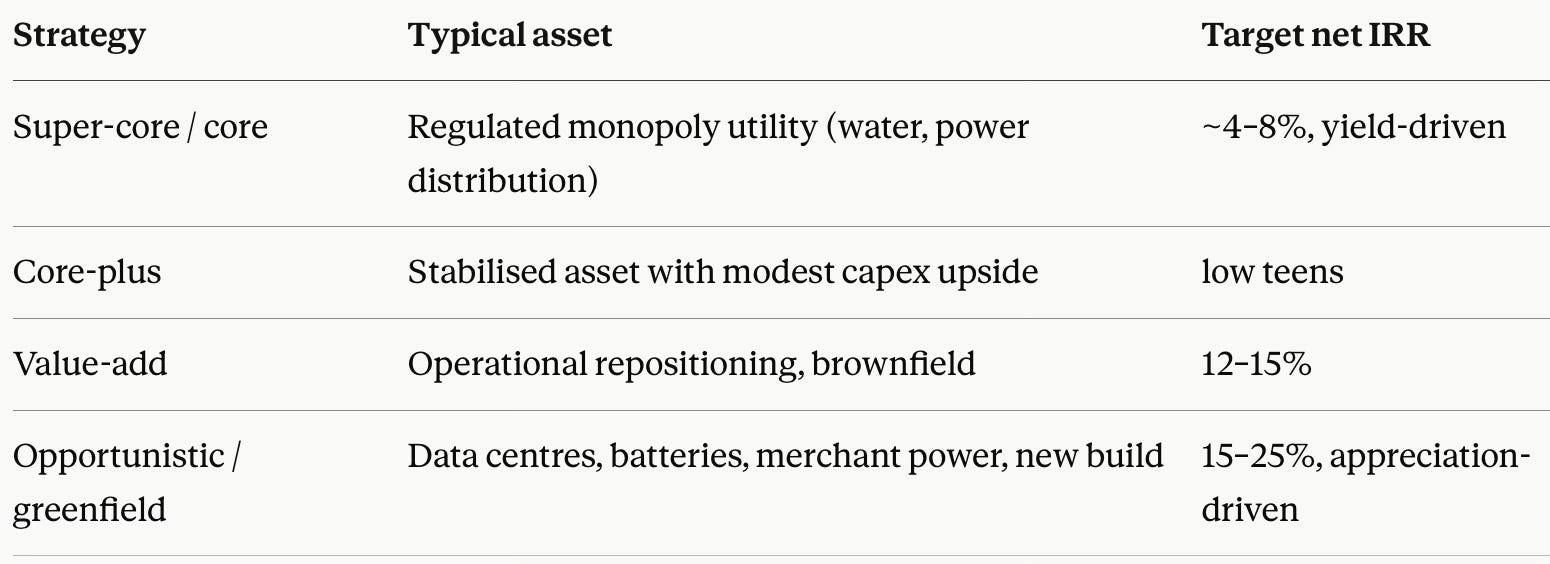
To better understand such investments, the table below shows the likely returns from various categories of infrastructure investments. 

If an asset’s true economic return is 4–6% because a regulator sets it, and the private fund must clear a 12–20% net IRR to justify its fee load and honour its LP promise, the ~10-point gap cannot come from operations, which are capped by the regulator. It has to come from somewhere, and there are only four options. 

The first option of leverage (i.e. excessive) is fatal in a regulated asset base (RAB) framework since debt-service costs enter the allowed tariff, thereby making the customer pay the interest bill. It is about socialising the financing choice. The second option is tax structuring of the kind that Macquarie did when Thames Water paid no UK corporation tax during its ownership tenure. The third option is to skimp on cost and maintenance by deferring capital investments, stretching maintenance schedules, socialising externalities (sewage, leakage). Finally, there is the option of dividend recapitalisations, multiple arbitrage, and ‘pass the parcel’ secondary sales. 

The balance sheet on the UK water sector privatisation over the 32 years is instructive in so far as it exhibits the use of all four options by PE investors. The sixteen monopolies paid out roughly £78bn in dividends against about £190bn of capex. At the same time, net debt rose from zero at privatisation to the £60–72bn range, much of it borrowed to fund the payouts and loaded onto customers’ bills. Thames alone now carries over £19bn of debt - the highest of any UK water company - after a £3bn rescue loan at 9.75%, was fined £123m by Ofwat in 2025 (the largest ever, including £18m for unjustified dividends), and has been allowed a 35% bill rise to 2030 despite losing roughly a quarter of its treated water to leaks. On the investors’ side, Water UK claims £236bn has been invested since privatisation.

Water is representative of several low-risk and low-but-stable-return sectors (also here) in which private capital has been deployed, such as health, education, prisons, veterinary care, and public housing. Research (also here) shows that PE ownership of clinics raised short-term mortality by about 10%, implying roughly 21,000 additional deaths over the sample, while increasing spending by 19%, the vast majority billed to taxpayers, via lower nurse staffing, worse patient well-being, and reduced compliance with care standards. Similar concerns are highlighted in the Indian context in education and health sectors in a recent oped which argued that in the absence of an independent statutory regulator with outcome-disclosure powers, the extraction by PE runs through billing intensity and selective access rather than balance-sheet gearing. 

There are some generalisable lessons from the history of PE funds in infrastructure and similar sectors. Wherever four features coincide - an essential service, a captive or vulnerable user who cannot judge quality at the point of purchase, a third-party payer (the taxpayer or the ratepayer), and an implicit public backstop - high-powered return incentives invariably create faultlines. 

In this context, as a slight digression, I came across a brilliant articulation by Aswath Damodaran of how alternative investment strategies have lost their way in the quest for scale

His broader point is that hedge funds, private equity, and private credit… began as a genuinely good niche business solving a real problem. Hedge funds 30 years ago produced positive alpha, beating passive investing by 3 to 5 percent annually. Today they look like expensive mutual funds, underperforming passive by roughly 1.5 percent. Private equity started as a focused, disciplined strategy for a small set of operators and has grown into a sprawling category that now struggles to deliver the returns that justified its emergence. Private credit had a legitimate original purpose, which was lending to borrowers that banks structurally could not serve. What killed each of these businesses was the same disease. Overreach. A $200 billion niche business gets sold as a $20 trillion opportunity. When that scaling happens, sloppiness follows, bad actors enter the space, and the average quality of every participant deteriorates. The original alpha disappears not because the strategy stopped working, but because too much money chased too few good deals.

The danger with private credit is far more severe than the parallel problems in private equity and hedge funds. Equity investors take their losses and move on. Lending businesses, when they overreach, take others down with them. Banks. Pensions. Insurance companies. Sovereign wealth funds. The systemic linkages run far deeper than most participants understand, and the social costs of a real default cycle in private credit would extend well beyond the funds themselves… the industry is repeating the exact mistake that produced every previous credit crisis. Take a good idea, scale it past its natural capacity, attract bad actors with the promise of easy returns, and wait for the inevitable cycle that exposes how much of the underwriting was never serious in the first place.

I have blogged earlier here and here about Ludovic Phalippou’s extensive research on PE returns (here and here). Across three large datasets for the period 2006-20, PE funds delivered net Multiple of Money (net-of-fee) of ~1.55–1.63x, or about 11% annually, matching public equity indices in the same period. During that time, roughly $230bn in carry accrued to a small number of managers, with the number of PE multibillionaires rising from 3 in 2005 to 22 by 2020. Much of the apparent outperformance, he shows, came from choice of benchmark rather than from the returns themselves.

Now, back to our examination of PE in infrastructure sectors. 

Given all the aforesaid, investing in infrastructure becomes a rational choice for PE funds. Once the alpha is gone but the fee structure and the promised IRRs remain, reaching into stable, socially backstopped, “boring” cashflows is not a puzzle. It is the rational move. Those assets are attractive precisely because they are low-risk and captive: low-risk cashflows can bear more leverage, and an essential service that the state cannot let fail carries a free option on the public balance sheet. The infrastructure fund is not, in economic substance, buying a low-return asset. It is buying a levered claim on a government guarantee.

In short, a return-maximiser in a regulated essential monopoly is not investing in a low-return asset at all, but it is buying a levered claim on the public balance sheet, which is why it is drawn to “boring” cashflows. Its investment is not despite the low returns, but because low-risk, captive, socially-guaranteed cashflows can support an extraction that competitive assets cannot.

Some important qualifications are in order lest it be seen as a sweeping claim that private capital investment, especially private equity, in infrastructure is uniformly bad. 

As I have written here, infrastructure is not one asset class. PE investment becomes problematic when three conditions coincide - a regulated natural monopoly with captive demand; an essential service the state cannot allow to fail; and returns set by a regulator so operational upside is capped. Water and sewerage hit all three. But they do not apply to a large and growing share of infrastructure segments like fibre, data centres, batteries, new technologies etc., where higher returns are legitimately earned by bearing real development, technology and demand risk. There, return-seeking capital is not merely tolerable, but given fiscal constraints, it is arguably necessary, because patient capital typically won’t take the associated construction and demand risks. 

The question should therefore not be about the asset’s headline return but its structure. “Should return-maximisers be in low-return assets?” is the wrong question. Instead, “should they own regulated essential monopolies whose returns are capped and whose failure is likely to be socialised?” is the right one.

It must also be acknowledged that it is not the specific vehicle of PE that is the problem. Apart from Macquarie, an infrastructure fund manager and not a classic buyout shop, Thames’s later owners have included pension and sovereign funds (OMERS, USS, CPPIB-type investors), some of which geared just as aggressively. The largest infrastructure owners today are pension/SWF/insurer capital, though much of it is deployed through fee-charging, IRR-targeting fund structures (Brookfield, GIP-BlackRock, KKR). The problem is a configuration - high return target plus leverage plus regulatory arbitrage - that any owner, including a public pension, can adopt. 

Finally, there are the issues of competition and regulation. Too much return-seeking capital chasing a genuinely competitive asset pushes returns down toward the asset’s true economic return. However, in the absence of competition, as with captive-customer monopolies with a public backstop and a weak regulator, incentive distortions emerge quickly. Here the deficiency of regulatory competence and/or avoidance of regulatory capture assumes significance. 

In conclusion, the problem with private capital in infrastructure arises when there is a combination of return-maximising capitalhigh leverageregulator-capped returnscaptive userssocialised failure moral hazard, and a weak or captured regulator. This is a recipe for systematic transfer of value from the public to investors through a pass-the-parcel game, presented as investment and public-private partnership. 

The policy challenge then is to match the ownership and return model to the asset’s structure, and where the asset is a regulated essential monopoly, regulate the balance sheet, not just the tariff. This aligns with the findings of the UK government’s Cunliffe Independent Water Commission (July 2025), which, apart from proposing the scrapping of Ofwat in favour of a single integrated regulator and nine regional water authorities, also proposed a supervisory (rather than arms-length) regulatory approach and mandatory asset-health monitoring. This goes against the conventional wisdom on regulation and is exactly in line with the patient capital under active public oversight approach proposed in the long paper here

The main takeaway for India is not to import the UK’s RAB-plus-leverage-plus-socialisation architecture, but to reserve genuinely patient capital (NIIF/NABFID-type, pension, insurer, etc.) for revenue-generating infrastructure assets (or Core I/II from the paper here), admit return-seeking capital only where the asset is genuinely commercial or greenfield and bears real risk, and in TOT-style road or water monetisation, get the discount rate and the balance-sheet ring-fence right before the concession, not after the renegotiation. 

Most importantly, these assets should be regulated with active supervision, including of financing practices, and close asset-health monitoring. This is especially important since, when stripped to its bare bones, the binding constraint to the successful management of private investment in any kind of regulated asset is regulatory capacity and independence. Unfortunately, both are challenging, even in developed countries.

Saturday, June 27, 2026

Weekend reading links

1. New research by Emma Harrington, Natalia Emanuel, and Amanda Pallais shows that remote work is adversely impacting mental health. They paraphrase Robert Putnam to argue that Americans "typing alone" brings serious social consequences

In 2024, nearly 80 percent of workers said they would be happiest if they could work remotely... Surveys of over half a million Americans from the last decade and a half revealed an uncomfortable truth: Despite its advantages, remote work has significantly deepened Americans’ isolation and distress. Our estimates indicate that remote work explains a third of the deterioration in mental health between 2011 and 2024... Our study compares workers in jobs that could be done remotely, such as finance and software engineering, with workers in jobs that must be done in person. People in remote-capable jobs worked from home three times as often in 2024 as in 2019. As they did, their days became far more solitary. Eighty-four percent of remote workers spend their workday entirely alone. Over half report feeling less connected to their colleagues. Even when communicating online, people working from home receive less feedback from their co-workers and contact fewer people outside their immediate teams.

These workers did not compensate by socializing more outside work. More days passed with no social contact of any kind... In one study, when commuters were instructed to connect with a stranger near them, they reported being happier than those who continued in silence as usual, much to their own surprise. With fewer social encounters, workers in jobs that can be remote saw steeper increases in distress, mental health visits and prescriptions for antidepressants than other workers did... The pain was not evenly shared. People who lived with their spouse and kids saw their mental health hold fairly steady, while those who lived alone experienced a 20 percent decrease in mental well-being. Overall, we found that the rise of remote work increased distress by 7 percent, which accounts for a third of the total increase over the 13-year period we measured.

They argue that face-to-face time with colleagues has no substitute.

2. Katie Martin points to the different ways in which bonds and equities are reacting to Trump policies.

US government bonds, or Treasuries, have never recovered from the drop in price they suffered around the start of the war. Investors in this market, who broadly consider themselves a more cerebral bunch than those in stocks, never bought the hints of a ceasefire with Iran. Bond prices have still not returned to square one, leaving borrowing costs markedly higher. With the prospect of interest rate rises ahead to douse inflation pressures exacerbated by the Iran war, and relentless more borrowing, this is likely to remain the case for some time.

3. As AI threatens to bring down India's tech sector, this is a good article.

On the whole, Indian IT companies spent around 3.7 per cent of their total revenue on R&D in the year that the report covered. This is minuscule compared to around 15 to 25 per cent that Silicon Valley companies spend on R&D. The top IT companies are laggards of first order. For example, in 2022-23, Infosys spent just 0.9 per cent of its total revenue on R&D. The figure for TCS was 1.30 per cent. For Wipro it was 0.5 per cent while for HCL it was 1.60 per cent. The other big companies don’t fare all too well. Reliance, a giant in every way, spent only 0.53 per cent of its total turnover on R&D in 2022-23. Tata Steel is at 0.67 per cent. Maruti Suzuki spent 0.65 per cent on R&D.

4. Indian markets have more to fall before they become competitive.

The FPI outflows have tracked the decline of rupee, feeding a self-fulfilling cycle.

5. The costs of RBI's FCNR (B) deposits and foreign currency borrowing schemes. 
If the scheme were to attract $50 billion of FCNR (B) deposits and $20 billion of foreign borrowing by banks and public-sector enterprises, the mark-to-market loss on the RBI’s swap position could approach ₹64,000 crore at current market prices, besides increasing the RBI’s balance-sheet risk. This is not merely an accounting cost. The subsidy is real and will be monetised by participating non-resident Indians (NRIs), banks and borrowers.   
Large Indian banks are raising five-year FCNR (B) deposits in dollars at 6 per cent. Their attractiveness is evident from the willingness of overseas banks to lend against the same deposits at around 5 per cent. This, in turn, will allow wealthy NRIs to achieve double-digit leveraged dollar returns against India cross-border risk. Indian banks can further transform the FCNR (B) deposits into clean five-year rupee funding at around 6.4 per cent, below comparable government bond yields.

Banks are being permitted to offer leverage to NRIs. The currency risk on such deposits will be borne by the RBI. As reported by this newspaper, State Bank of India is offering leverage of up to nine times on deposits of more than $1 million. Calculations indicate that this could translate into returns of over 14 per cent. Other banks are likely to come up with similar schemes for NRIs.

Banks are competing aggressively for FCNR (B), and are also offering leverage to increase returns.  

6. A new large-scale survey experiment of EU companies shows that firms substantially underestimate competitors' current AI investment, and when updated about their competitors' future AI investment plans they increase their own AI investment plans in a statistically significant manner. But this effect, while strong for domestic peers, is weak for information on foreign peers. 

We documented large underestimation of competitor AI investment, substantial belief updating in response to information, and a clear asymmetry in how firms react to domestic versus foreign competition... A 1 pp increase in the expected share of domestic peers investing in AI raises a firm's own expected AI investment rate by 0.570 pp. These complementarities are absent across borders: the effect of an increase in the expected share of foreign peers investing in AI on a firm's own expected AI investment rate is statistically insignificant... Firms update both domestic and foreign beliefs when informed, but their own expected AI investment rate responds primarily to domestic posterior beliefs. These findings suggest that strategic complementarities in innovation weaken with distance, broadly understood to include not only geography but also informational, cultural, and market frictions... This asymmetry helps explain why AI diffusion may remain geographically uneven, even within an integrated economic area like Europe. While firms may observe and learn from foreign competitors, their behavioral response to such foreign signals is much weaker compared to domestic competitors.

7. Aswath Damodaran makes a great point about hedge funds, private equity, and private credit - all niche businesses which had a role, but have vastly overextended themselves and set themselves up for failure. 

Each one began as a genuinely good niche business solving a real problem. Hedge funds 30 years ago produced positive alpha, beating passive investing by 3 to 5 percent annually. Today they look like expensive mutual funds, underperforming passive by roughly 1.5 percent. Private equity started as a focused, disciplined strategy for a small set of operators and has grown into a sprawling category that now struggles to deliver the returns that justified its emergence. Private credit had a legitimate original purpose, which was lending to borrowers that banks structurally could not serve. What killed each of these businesses was the same disease. Overreach. A $200 billion niche business gets sold as a $20 trillion opportunity. When that scaling happens, sloppiness follows, bad actors enter the space, and the average quality of every participant deteriorates. The original alpha disappears not because the strategy stopped working, but because too much money chased too few good deals. The danger with private credit is far more severe than the parallel problems in private equity and hedge funds. Equity investors take their losses and move on. Lending businesses, when they overreach, take others down with them. Banks. Pensions. Insurance companies. Sovereign wealth funds. The systemic linkages run far deeper than most participants understand, and the social costs of a real default cycle in private credit would extend well beyond the funds themselves.

8. Friedrich Merz initiates measures to address Germany's rising pension burden, which took up 41% of all federal government welfare spending in 2024. The proposals came from a bipartisan committee of MPs who were appointed to examine and make suggestions. 

Germany’s pay-as-you-go system is facing widening deficits, with 16.5mn baby boomers retiring by 2036 and only 12.5mn new workers joining the workforce, according to the Cologne Institute for Economic Research. The government in 2024 paid €118bn to plug holes in the system, or about a quarter of the total federal budget. That share could double to 50 per cent within the next two decades, according to economists... Under the proposal, a compulsory individual contribution of 2 per cent of salaries would “be managed centrally and invested in capital markets”... The move would be a novelty for risk-averse and cash-loving Germans, who have been more reluctant than European peers to embrace capital markets to invest their large savings... Other recommendations include linking the statutory retirement age — currently 67 — to the country’s life expectancy and withdrawing early-retirement incentives. For every year gained, people should work eight months longer, the commission proposed. The experts also suggested raising the age — currently 64 — at which people who have made contributions for 45 years are able to go into retirement with their full pensions. Unions are likely to oppose the measure.

9. India has been a laggard in attracting FDI.

10. Ten years on, Brexit has turned to 'Bregret'!
The Brexiteers persuaded a small majority — the vote was 52 percent to 48 percent — that Britain could throw out the austerity that had followed the 2008 global financial crash, reverse the hollowing out of well-paid manufacturing jobs and trade freely and profitably on international markets. Immigrants who had flocked to Britain from Eastern and Central Europe would be sent home. Europe merely held Britain back, and to choose to leave was to believe, as Britons had before, that the nation was meant for more... 

It was, of course, a fantasy... The economy has stalled and trade has shrunk. Britain is poorer than it might have been. Its gross domestic product is at least 4 percent — but could be as much as 8 percent — lower, according to independent calculations, while business investment is more than 10 percent lower. It added new frictions to the lives of Britons: new border checks when traveling to E.U. countries, stricter residency rules for living there, fewer opportunities for students to study abroad. Even just using a cellphone while “roaming” often costs more than it used to. There have been other costs, one of them a weakening of the glue between the nations of the United Kingdom itself. The referendum result was more a statement of English than of British nationalism — majorities in Scotland and Northern Ireland voted to remain. Forced to leave, Scottish nationalists claimed stronger cause to promote their case for full independence from England, and the complex political arrangements for Northern Ireland needed to protect the Good Friday peace agreement between Irish nationalists and British unionists in the province have weakened the cause of the unionists.

Rather than a newly independent Britain cutting a swath on the international stage, economic realities forced cuts in spending on foreign aid and diplomacy. The hopes among Brexiteers for a new Anglosphere, adding the English-speaking Commonwealth nations of Canada, Australia and New Zealand to Britain’s “special relationship” with the United States, turned to dust, and Britain’s privileged place in Washington was lost to Mr. Trump’s disdain for traditional alliances.

11. Fascinating graphic that maps the values of AI models.

The models’ answers, in English, on topics ranging from political petitions to God, suggest values that are different from those of most people. In fact, the models are often more extreme than the average respondent in every country included in the polling. On the survey’s “cultural map”, " AI models fall overwhelmingly into the quadrant populated by rich countries. The worldview of GPT models, created by OpenAI, is more secular than any country on earth (see chart 1). Gemini models, made by Google, place more weight on individual freedom (for example, “homosexuality is justifiable”) than people do anywhere. No model reflects the worldviews of most African or Muslim countries.

12. The Economist looks at the issue of popular backlash against AI. This scenario in particular is important.

Scenarios in which some countries give in to popular rage but others forge ahead are also worrying. If America succumbs, it could cede the global ai frontier, and the attendant cyber and military capabilities, to authoritarian China. Europe and Canada are more risk-averse than America. If they choked off ai while the rest of the world kept pushing forward, their losses could be unrecoverable. More than two centuries after the Industrial Revolution, few countries have managed to catch up with the first movers.

13. Rolex SA is a profit-making company with $12-13 bn in revenues and $3-4 bn in profits whose ultimate owner is a spiritual holding company (SHC), a charitable trust called the Hans Wildorf Foundation. Rolex SA has no public shareholders, investors, or owning family, and has been so since 1960. A similar example is Robert Bosch GmbH, the German engineering giant, which has 94% ownership by the Robert Bosch Foundation (SHC) holds 94 per cent and the Bosch family the rest. In both cases, the management and ownership have been clearly separated.