Substack

Showing posts with label Equity markets. Show all posts

Saturday, May 9, 2026

Weekend reading links

1. China may be turning to its traditional industrial policy playbook to reduce its current import dependence and achieve self-sufficiency in food, especially animal protein, thereby upending global supply chains. 
Adam Tooze writes, pointing to analysis by the research group Systemiq.
This involves a combination of investment and innovation. Beijing is coordinating central and provincial government, state-owned enterprises and financial institutions around smart agriculture. It has licensed the commercialisation of genetically modified maize and soya. Research clusters are forming around neoproteins, fermentation-derived ingredients, feed additives and agricultural biotechnology. State banks are on hand to provide cheap finance. To channel demand, Beijing is tightening food and feed standards and tweaking procurement requirements. This is the kind of whole-system policy that has given China a commanding lead in the new energy sectors. With all the levers in play, we may, by as early as 2030, see a significant fall in soyabean demand, slashing imports from the US dramatically. By 2040, innovation and efficiency gains could plausibly turn China into a net exporter of poultry, dairy, eggs, fish and seafood. If agriculture follows the industrial policy timeline, by 2050 we should expect to see China emerging as a major source of “cultivated meat”.

2. Indonesia's President Prabowo Subianto has signed a presidential regulation cutting the percentage that ride-hailing platforms like Grab and GoTo can take from each order to a maximum on 8%, down from the current 20%. 

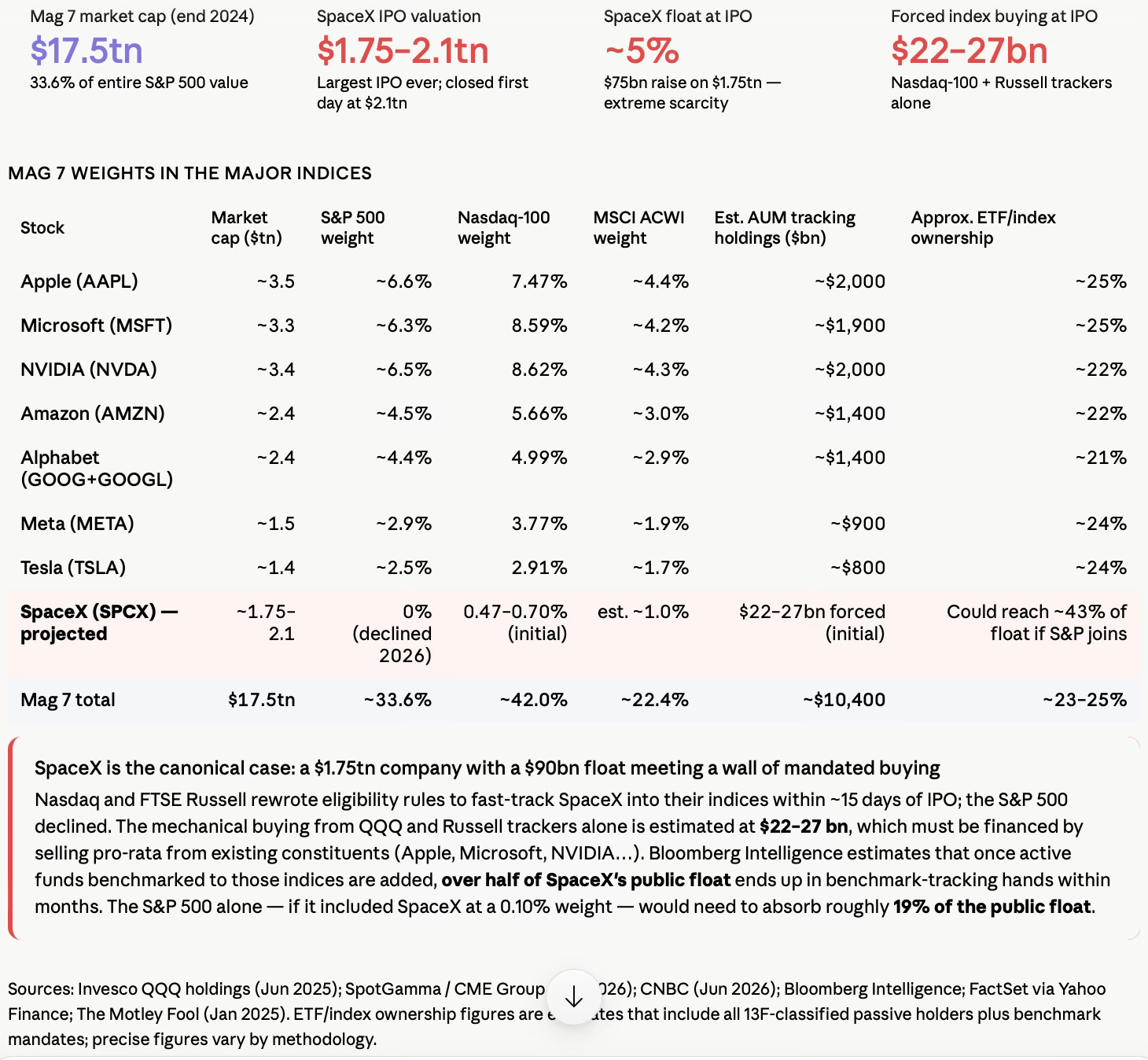
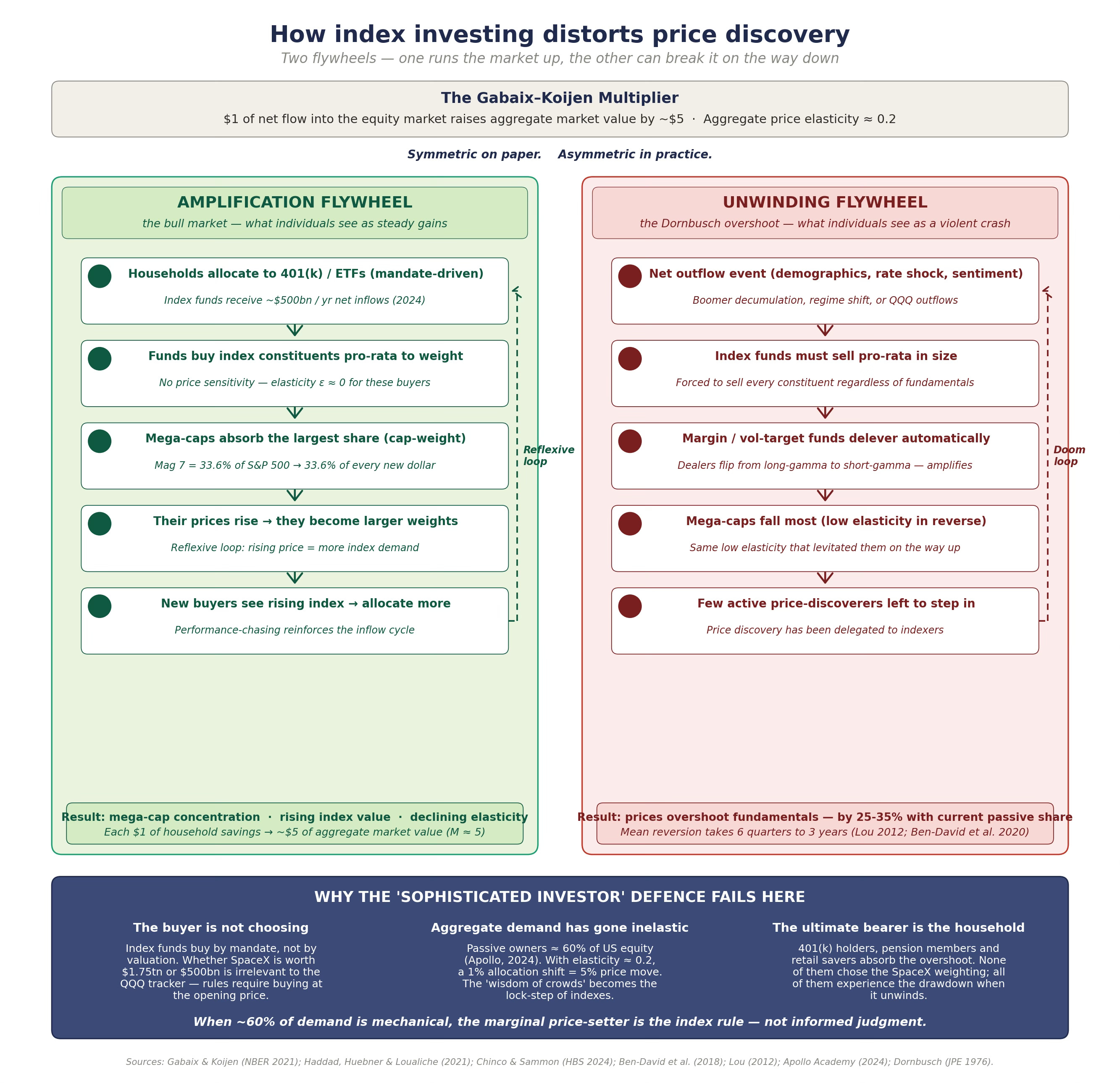
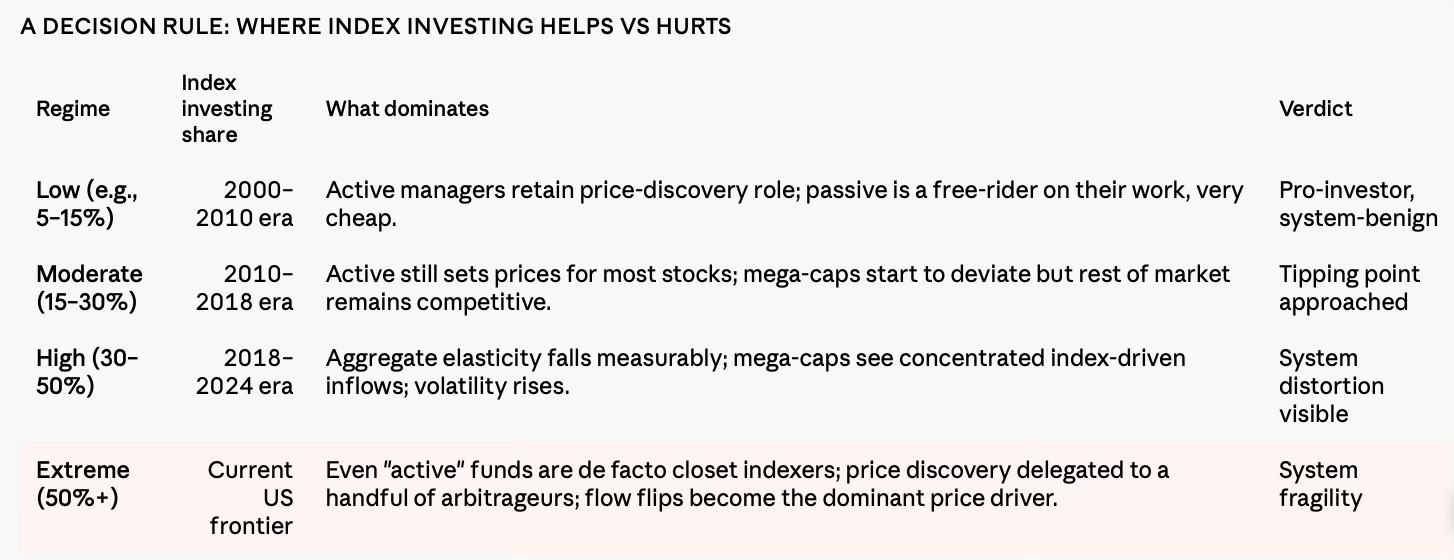
3. The latest on the dominance of the Magnificent Seven (US stocks make up 65% of global stock market capitalisation, up from 40% in 2010).

This is an important data point.
Bloomberg data suggests that almost 80 per cent of the S&P 500 companies that reported first-quarter results this month beat analyst earnings estimates.

4. Chinese ports facts of the week.

Chinese firms now operate or have a financial stake in at least 129 ports outside China (see map), and have spent at least $80bn on port construction from Antigua to Tanzania, with many of the investments tied to bilateral trade and regional shipping agreements. More than a third of China’s overseas ports are near maritime chokepoints, including the Strait of Malacca, the Strait of Hormuz and the Suez Canal, making them indispensable operators in strategic areas. China’s firm grip on global ports has rattled Western governments. MERICS, a think-tank in Berlin, found that after a terminal operating contract is signed, total trade with China rises by more than a fifth, while countries that allow Chinese firms to run all their terminals at one of their ports see a 19% drop in exports to the rest of the world. Operating ports allowed Chinese firms to prioritise their cargo and vessels and speed up customs and logistics...
China’s reach extends beyond physical infrastructure. LOGINK, a Chinese government-run logistics-management software, is used in at least 24 countries and 86 ports (America banned its use in 2023). LOGINK shares data with CargoSmart, another shipping-management software firm owned by COSCO, another Chinese state-owned firm, and in turn gives it access to the whereabouts of 90% of the world’s container ships. It also has a tie-up with CaiNiao, a logistics provider with hundreds of warehouses around the world... Chinese firms are also building industrial parks and manufacturing facilities close to their existing ports in Africa and Europe.

5. Good FT article on how data centres construction is triggering local backlash as residents fear for their water and electricity.

Around two-fifths of all US data centres are located in areas of high water stress, according to S&P Global... In DeKalb, a city of around 40,000 people, water demand averages just over 3mn gallons a day, rising to in excess of 4.5mn gallons at peak. The latter figure is broadly comparable to the needs of a single large AI data centre.
Data centres have already emerged as a significant driver of economic expansion in the US, accounting for 80 per cent of private sector growth in the first half of 2025, according to S&P Global... Researchers at the Lawrence Berkeley Laboratory forecast that so-called hyperscaler data centres will consume anywhere between 60bn and 124bn litres (16bn and 33bn gallons) of water on-site each year in 2028. This figure excludes the indirect water use tied to electricity generation, which the lab previously forecast could be as much as 12 times higher than direct consumption...

Of the roughly 100GW of additional electricity capacity that the US is projected to need at peak times by 2030, roughly half will be used by data centres, according to the Department of Energy... On average, American bill payers — including residential, commercial and industrial customers — paid over 6 per cent more for electricity year on year at the end of 2025. This increase was starkly higher in the mid-Atlantic states which house a large number of data centres such as Pennsylvania and Virginia, where bills rose by 19 and 10 per cent respectively.
6. Indian equities suffer from a high valuation gap with EM peers.
In recent weeks, a string of global brokerages – including Goldman Sachs, Nomura, HSBC, UBS, and JPMorgan – have downgraded Indian equities in their emerging market portfolios. The concerns converge around a common theme: Deteriorating macro conditions amid rising energy prices, weakening earnings visibility and, crucially, more attractive opportunities in other EMs... The relative valuation gap still stands at around 65 per cent—well above South Korea, Brazil, China, Mexico and South Africa. “South Korea is expected to deliver about 180 per cent earnings growth at around 7x P/E. Taiwan offers about 35 per cent growth at 18x. China delivers about 14 per cent at 11x. India, by contrast, offers 8–14 per cent growth but trades at ~19x,” said Amish Shah, head of India Research, BofA Securities. From a global allocator’s perspective, India remains expensive.

The weight of Indian equities in the MSCI EM index has continued to fall since March 2025, from 18.5% to 12.58% in March 2026.

7. India's trade deficit with China continues to grow.

On April 8, Xu Feihong, Chinese ambassador to India, posted on X: “Glad to know that China has become India’s largest trading partner in FY2026 — for the 11th straight month.” This was great news for China but not for India. The $151.1 billion trade between the two comprised $131.63 billion of exports from China to India and a meagre $19.47 billion of imports from India. It was a one-way street. China was flooding Indian markets even as it became India’s “largest trading partner”...
India must import electronics and electrical equipment ($40 billion-50 billion), machinery ($27 billion), organic chemicals ($12 billion-13 billion), plastics, steel, medical equipment, and so on from China every year. These are critical products without which the Indian economy would not be able to function. Alternative sources exist for some, but at a much steeper price. Moreover, China has diversified its supply sources, so even if not directly from it, Chinese goods would still reach India through Southeast Asian and other manufacturing bases.

8. One explanation with oil markets are still not rising as much as expected. 

In 1973, the year of the first oil price shock, I calculate from industry sources that about 80 per cent of one barrel of oil was consumed per $1,000 of global GDP in 2025 prices — 131 litres, to be precise. In 1980, the year after the Iranian revolution, this was down to 116 litres. Last year, it was 52 litres. The current level is still a lot, but the average oil burden is 60 per cent less than 50 years ago. If so much less oil is needed, real prices should have much more room to escalate before they cause the economic damage associated with previous disruptions. A simple illustration of today’s diminished oil cost burden to the global economy is to adjust the nominal price of oil not only for inflation but also for the efficiency improvements. If one does, a hypothetical price of $115 per barrel today compares with an average price of $339 in 1980 in today’s dollars. By this measure, prices have plenty of runway before the oil burden resembles 1980.
But it must be balanced against other factors pulling in the opposite direction.
Oil consumption today is more concentrated in high-value uses and in areas where there is no substitute, like road or air freight and maritime shipping. These are load-bearing economic activities, less price sensitive than discretionary or consumption-oriented drivers of growth. Once disrupted they are likely to cascade through the economy... Oil concentrated in high-value uses is a little bit like rare earths, tiny compared with the size of GDP but essential for much of it. If the size of a supply disruption requires demand to come down and prices surge to the required level, the response will be sudden with a potentially unforeseen and disproportionate impact on economic activity.

9. Jakarta's success with mass transit appears exemplary.

In 2014, Jakarta was crowned the world’s most congested city by the Stop-Start Index and a year later was ranked far below other Asian cities on livability by the Economist Intelligence Unit. Ten years later, Jakarta has the world’s largest and one of the most used bus rapid transit (BRT) systems. The old, crowded diesel commuter trains, famous for allowing passengers to ride on the roofs, are now electrified, air conditioned, and run on regular schedules linking the suburbs to the city center. There are multiple subway and light rail lines crisscrossing the city. The transformation has been remarkable: in 2015, less than 20% of residents were within walking distance of transit. Now, nearly 90% of the city has access to BRT or trains... 

The user experience has also been streamlined. All of the new MRT lines are part of an integrated digital fare system. A journey from one end of Jakarta to another is capped at 10,000 rupiah (about 70 US cents). According to WRI Indonesia, as of 2024, 10 percent of trips in Greater Jakarta are now made by public transit, compared to just 2 percent in 2015... While the JICA loans covered the cost of building the MRTS and training local staff, the full cost of operation has now fallen to the city government. So far, this has worked reasonably well, with Jokowi arguing that the cost of running the system — at about 800m billion rupiah (US$50 million) a year — is justified by the estimated 65 trillion rupiah (US$3.5 billion) in annual economic losses due to traffic.

However, much more remains to be done. 

The city has recently overtaken Tokyo as the world’s largest city, with a metro population of over 41 million people, and it is still growing rapidly. It is projected to add another 10 million people in the next 25 years. To serve this population, Greater Jakarta has only six train lines and under 250 miles (400 km) of track. Tokyo, by contrast, has an astounding 158 train lines and 2,930 miles (4,715 kilometers) of track connecting 2,210 stations throughout its massive metro area.

10. Foreign portfolio investors sharply cut exposure to Indian software firms.

Foreign Institutional Investors’ (FIIs) allocation to the Indian technology sector stood at an all-time low of 7.3% at the end of March compared to 10.1% at the end of FY25, according to brokerage Motilal Oswal Financial Services... So far in 2026, FIIs have sold $21.6 billion of Indian equities – more than the $18.9 billion they sold in all of 2025 – of which $2.4 billion worth of net sales have been of Indian IT stocks (until April 15). As a result, FII holdings in the IT sector reduced to $41.4 billion from $59.8 billion at the end of 2025.

11. TIDCO stake in Titan Company.

This state government-owned industrial promotion agency, TIDCO, has a 27.88% stake in Titan Company Ltd. That’s more than the combined 25.02% share of the Tata Group through its holding company and various subsidiaries. It makes TIDCO the main promoter of Titan, which was established in 1984 as a joint venture for manufacturing quartz analog watches at Hosur on the Tamil Nadu-Karnataka border. That company — originally Titan Watches Ltd — has today grown to a premier lifestyle accessories maker with a product portfolio spanning watches and wearables (Titan, Fastrack and Sonata brands), jewellery (Tanishq and CaratLane), eyecare, women’s bags (IRTH) and ethnic wear (Taneira sarees and tops). Titan Company earned a net profit after tax of Rs 3,337 crore on a total income of Rs 60,942 crore during the year ended March 31, 2025... at the share’s closing traded price on May 6... TIDCO’s 27.88% holding in Titan will alone be valued at Rs 1,07,873 crore... if TIDCO were to sell its entire stake in Titan Company, the Tamil Nadu government would be able to mobilise upwards of Rs 1 lakh crore and bring down its outstanding debt by roughly a tenth. The annual savings in interest outgo resulting from it will far exceed the Rs 272 crore that TIDCO received as dividend for 2024-25 from its 27.88% shareholding in Titan Company.

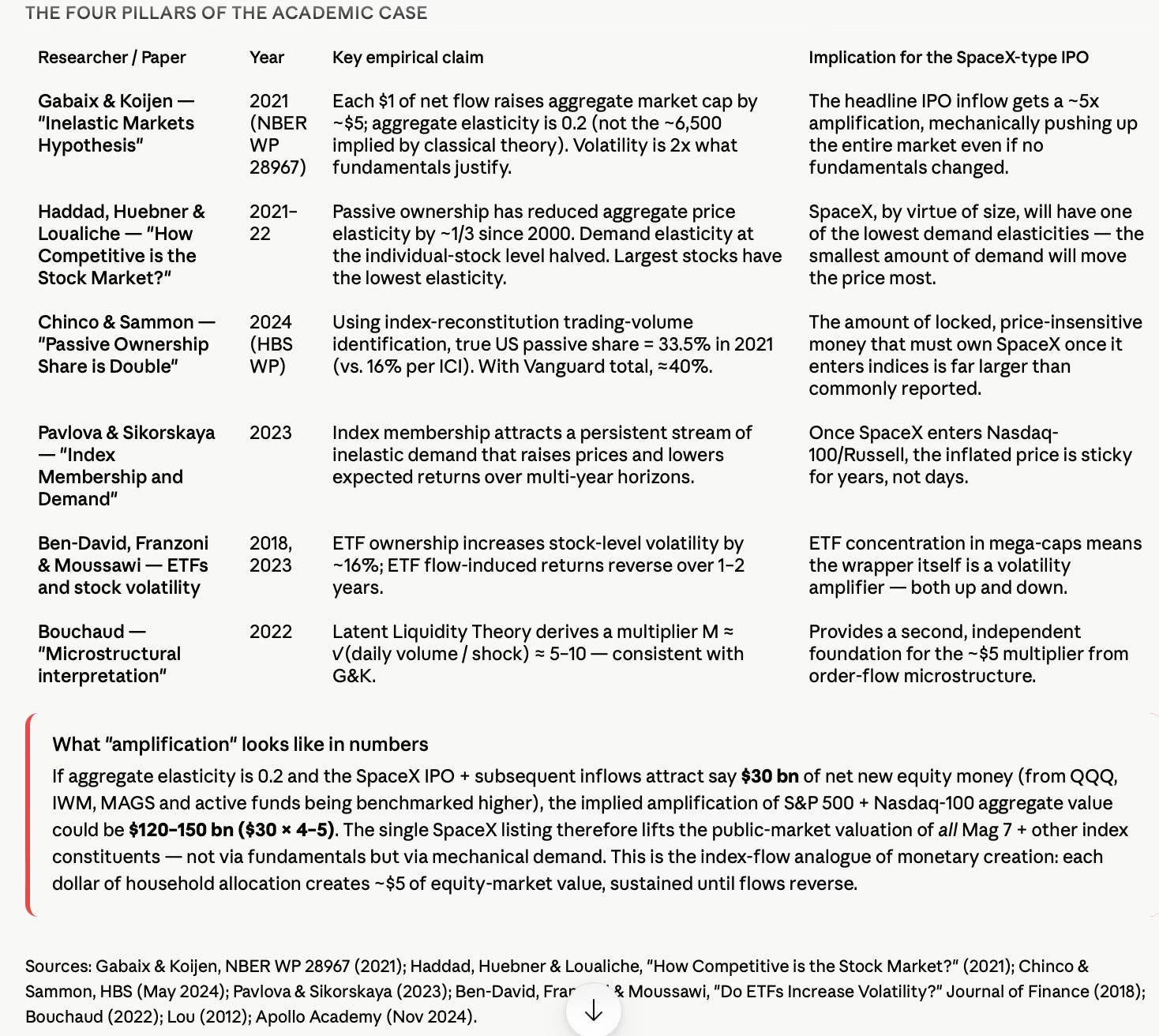
12. Ruchir Sharma makes some very important points about the critical role being played by retail investors in the US equity markets. Some numbers.

The share of US households that own stocks has surged this decade to nearly 60 per cent, the highest proportion in any country. Americans are all in on the market, holding more wealth in stocks than in their homes for the first time. And retail is now the most active class of traders as well. Retail’s share of daily trading in US stocks doubled in the past 15 years to 36 per cent, surpassing that of big banks or hedge funds, and making them the market price-setters. Last year US retail trading topped $5tn, exceeding the pandemic high, only this time Americans weren’t stuck at home or flush with savings.

He points to contributors to the rise of retail investors.

Three forces are encouraging small investors’ deep faith in the stock market: stimulus, bailouts and technology. Record sums of money pouring out of government and central banks, intended to lift the fortunes of the real economy, have instead been used by households (particularly the richer ones) to invest in the stock market. With policymakers rushing to rescue the economy at the slightest hint of trouble, investors have come to believe the government will always bail them out. And low-cost, mobile trading platforms have given everyone easy access to investments of all kinds.

Finally, a very important political economy dynamic arises from this trend. 

The larger the retail community gets, the more pressure builds on politicians to support the market. What was said of Wall Street banks after the crisis of 2008 can now be said of the stock market as a whole: it’s “too big to fail”.

13. The rise and rise of stock market concentration in the US.

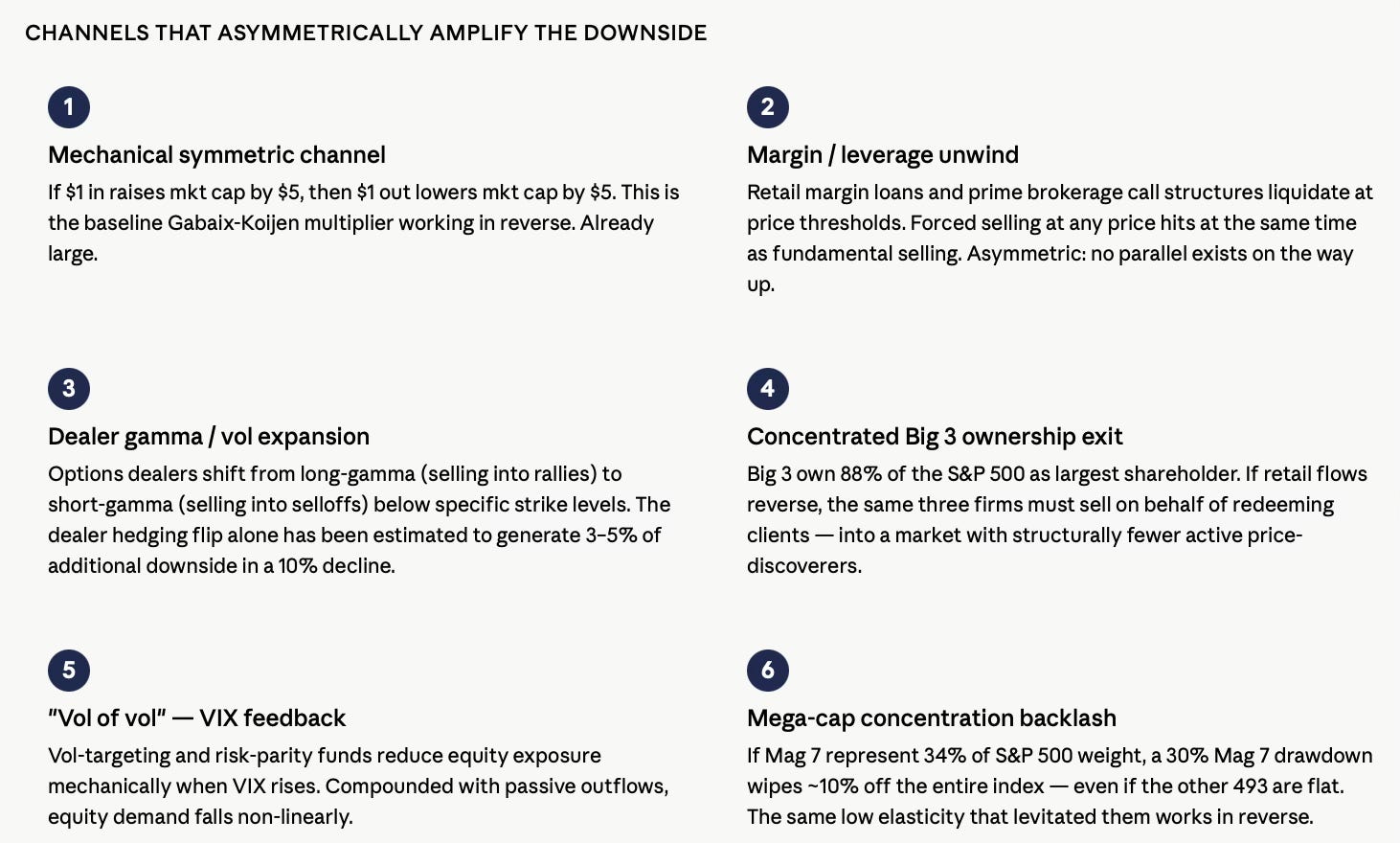
Analysts at UBS said that a measure of how many stocks were materially contributing to the index’s performance — so-called “effective constituents” — hit a record low of 42 last week, far below the level of about 100 that has been typical in recent decades.

14. Nice interactive story of how oil from the Gulf reaches Japan, gets refined, and is distributed. 

15. The $725 bn capex spending projected by the Big Tech (Amazon, Alphabet, Microsoft and Meta) is estimated to leave them with their lowest free cash flow since 2014. 

16. Fascinating 5km split of Sebastian Sawe's sub-two-hour marathon.

Saturday, April 25, 2026

Weekend reading links

1. The world's food supply chain is deeply enmeshed in fossil fuels from the Gulf.
In 2024, for instance, Saudi Arabia, Oman and Qatar together supplied more than three-quarters of India’s ammonia imports and 30 per cent of Morocco’s. As a result, food production in south Asia and north Africa has become deeply dependent on Gulf nitrogen flows... About 70 per cent of the world’s ammonia is used in fertiliser production, and just under30 per cent of global ammonia exports originate in the Middle East... Roughly half of the world’s global seaborne sulphur passes through the Strait of Hormuz, with most of this produced by the Gulf’s state-owned energy companies — above all Adnoc, QatarEnergy, the Kuwait Petroleum Corporation and Saudi Aramco... Gulf countries account for 35 per cent of global urea trade; Saudi Arabia was the world’s largest urea exporter in 2024, while Oman ranked third. Monoammonium phosphate (MAP) and diammonium phosphate (DAP), two of the principal fertilisers used to supply crops with phosphorus, are also closely tied to Gulf production and export routes. In 2024, countries upstream of Hormuz accounted for 18 per cent of global MAP and DAP trade.

As Leiden University’s Christian Henderson has recently shown, Gulf countries have also become deeply enmeshed in cross-border control of large agribusiness companies throughout the Middle East as a whole. Egypt, the world’s second-largest urea exporter, offers a clear example of what this means for the production of fertiliser. A substantial share of Egypt’s export-oriented nitrogen capacity is controlled by Fertiglobe, a company in which the UAE’s Adnoc now holds a controlling stake and that claims to be the world’s largest seaborne exporter of urea and ammonia, according to its 2024 financial results. Fertiglobe’s Egyptian assets include the Egyptian Fertilizers Company, with an annual capacity of 1.7mn tonnes of urea and 0.9mn tonnes of ammonia, alongside Egypt Basic Industries Corporation, which adds another 0.7mn tonnes of ammonia. For comparison, Misr Fertilizers Production Company (MOPCO), which operates Egypt’s largest nitrogen fertiliser plant, reported 1.7mn tonnes of urea and 1.1mn tonnes of ammonia in 2024. About 44 per cent of MOPCO is owned by Saudi and UAE investment funds.

This level of dependence on the Middle East makes claims of food security ring hollow in countries like India. These countries can exercise chokeholds that can expose countries to deep vulnerabilities in their food security system. It is an area that needs to be kept in mind and diversification strategies should be pursued.

2. European luxury houses are struggling.

So far this year, nine leading European luxury stocks have lost at least a collective €140bn in market capitalisation, a bitter blow for an industry that was riding high during the first half of this decade, when LVMH was the continent’s most valuable company... The luxury sector, which supersized between 2019 and 2023, was already grappling with some hard truths before the conflict began. Middle-class shoppers who previously spent tens of billions of dollars on luxury items pulled back once their Covid-era savings and furlough payments ran out and the cost of living rose. Some 50mn luxury consumers exited the market between 2022 and 2024, according to a report by Bain, most of them aspirational shoppers who felt left behind by skyrocketing prices... the Chinese market, the motor of growth until 2023, has been hit by relatively weak consumption in the pandemic’s aftermath.   

And the problems in the Middle East will worsen matters, given that the UAE is an important market. 

3. India's contract manufacturers command much higher PE valuations than their much bigger global counterparts.

Take Dixon Technologies. Over five years, its revenue has grown nearly fivefold to about Rs 18,000 crore, helped along by the PLI scheme and by assembling for companies like Xiaomi and Google... And yet, for all that scale, the economics remain surprisingly thin. Profit margins hover around 2%. A meaningful chunk of profits comes from government incentives. More tellingly, even at this scale, Dixon still depends on imported components, external designs, and global clients. India may now assemble a significant share of the world’s smartphones, but much of the value still sits outside the factory.

What happens when PLI gets phased out?

4. Sobering statistics about higher education in general and specialised fields like Agriculture

A 2020 survey at the Tamil Nadu Agricultural University found that less than 12% of students thought of farming as a future career. Nearly 60% of students wanted to be government employees, and more than a quarter of them wanted to get into business and entrepreneurship. Only 3% said they wanted to work for private companies. And it’s not just about the students. Their goals come from practical considerations. Take the case of the University of Agricultural Sciences, Bangalore. Just a little over 16% of its total 882 students of agriculture got placed in 2023–24. It only gets slightly better in the postgraduate courses, where only 37% out of the 287 students were placed. The story is similar in other universities as well.

What does it tell us about the career prospects in specialised fields like agriculture when nearly 60% of students want to be government employees?

5. Some stock market facts on the Adani Group.

Adani Green is trading at a trailing price-to-earnings (P/E) multiple of 1,109X, compared to peer Tata Power’s 47X, according to data from market information provider Screener.in. And Adani Total Gas’s trailing P/E multiple is 473X, compared to Indraprastha Gas’ 18X... the shareholding patterns in Adani group companies... several of them shared common foreign portfolio investors (FPIs). And strangely, several of them had negligible investments in non-Adani companies. As a result, the percentage of shares effectively available for trading by the public was just about 5% in Adani Total Gas and 11% in Adani Green. The comparable figure for Indraprastha Gas is 55%, and for Tata Power, 53%... only one FPI owns more than 1% of Adani Green now, compared to 10 in December 2020. But that FPI—Asia Investment Corporation (Mauritius)—is still heavily invested in the Adani Group, with 93% of its holdings in Adani companies... LIC’s stake in multiple Adani Group companies has gone up over the last few quarters.
See also this and this on the conglomerates in the Indian economy.

6. The New Yorker essay raises the question of whether Sam Altman can be trusted.
Altman has a relentless will to power that, even among industrialists who put their names on spaceships, sets him apart. “He’s unconstrained by truth,” the board member told us. “He has two traits that are almost never seen in the same person. The first is a strong desire to please people, to be liked in any given interaction. The second is almost a sociopathic lack of concern for the consequences that may come from deceiving someone.” The board member was not the only person who, unprompted, used the word “sociopathic.” One of Altman’s batch mates in the first Y Combinator cohort was Aaron Swartz, a brilliant but troubled coder who died by suicide in 2013 and is now remembered in many tech circles as something of a sage. Not long before his death, Swartz expressed concerns about Altman to several friends. “You need to understand that Sam can never be trusted,” he told one. “He is a sociopath. He would do anything.”

This is a good portrait.

Altman is not a technical savant—according to many in his orbit, he lacks extensive expertise in coding or machine learning. Multiple engineers recalled him misusing or confusing basic technical terms. He built OpenAI, in large part, by harnessing other people’s money and technical talent. This doesn’t make him unique. It makes him a businessman. More remarkable is his ability to convince skittish engineers, investors, and a tech-skeptical public that their priorities, even when mutually exclusive, are also his priorities. When such people have tried to hinder his next move, he has often found the words to neutralize them, at least temporarily; usually, by the time they lose patience with him, he’s got what he needs. “He sets up structures that, on paper, constrain him in the future,” Wainwright, the former OpenAI researcher, said. “But then, when the future comes and it comes time to be constrained, he does away with whatever the structure was.” “He’s unbelievably persuasive. Like, Jedi mind tricks,” a tech executive who has worked with Altman said.
Guyana, a former British colony on the north-eastern flank of South America with a population of about 800,000, is undergoing rapid change following ExxonMobil’s 2015 discovery of about 11bn barrels of oil, one of the largest finds in decades. Crude production has since risen to more than 900,000 barrels per day, with consultancy Wood Mackenzie projecting that the government’s share of oil profits will total $41bn over the next five years. Between 2019 and 2024, Guyana’s GDP almost quintupled to $25bn.

8. India's trade balance sheet.

The cumulative exports (merchandise and services) during FY26 (April-March) are expected to be $860.09 billion, as compared to $825.26 billion in FY25 (April-March), an estimated growth of 4.22 per cent. A closer look reveals stagnation in merchandise exports over the last four years, with a negative CAGR (compound annual growth rate) of 0.42 per cent, while total export figures have been lifted by services exports, which grew at a CAGR of about 8.9 per cent over the same period... in April 2015, the government said that the objective of the Foreign Trade Policy 2015-20 was to double India’s share in global merchandise exports in five years. The reality is that since 2014, India’s merchandise exports have grown from $314 billion to $441 billion, a CAGR of 2.9 per cent, and India’s share in global merchandise exports has remained stuck at about 1.8 percent.

9. Ruchir Sharma points to the spectacular boom in South Korean and Taiwanese equity markets led by three semiconductor stocks - TSMC, Samsung, and SK Hynix.

Over the past year, these two nations accounted for 75 per cent of emerging market returns, and most of those gains came from just three stocks — all big makers of semiconductors... Together their profits are on track to top those of Apple, Amazon and Alphabet combined. Samsung is expected to increase operating profit more than sixfold this year to around $185bn, surpassing every member of the “Mag Seven” American companies other than Nvidia... TSMC is the most widely held stock, owned by 92 per cent of global equity funds. In comparison, Microsoft, the most widely owned US stock, is held by 84 per cent of those funds... Today, by some measures, emerging markets have grown even more concentrated than the US, with the leading five stocks accounting for a greater share of the index. While the top US stock (Nvidia) represents 8 per cent of the US index, the top EM stock (TSMC) accounts for a record 13 per cent of the EM index. In fact, based on MSCI methodology, TSMC now constitutes a larger share of the MSCI EM index than all the stocks in India put together.

10. China could boost consumption by cutting its high payroll taxes.

China levies European-level payroll taxes, creating a large wedge between the cost of employing a worker and their after-tax income — around 38 per cent. These taxes are also highly regressive, applied to income below a ceiling of three times the average wage. Payroll taxes raised 6.5 per cent of GDP in 2024, against just 1.1 per cent for personal income taxes. A dramatic, permanent payroll tax cut would therefore significantly boost consumption. It would put more money in workers’ pockets, especially lower-income workers with the highest propensity to spend. It would raise employment by lowering labour costs. And it would reduce informal labour by giving workers stronger incentives to participate in the social security system.

11. Striking facts about India's gold ownership.

Between 2011 and 2025, India imported approximately 12,670 tonnes of gold at a cumulative cost of roughly $609 billion. At the current spot price of $4,677 per ounce (as of 4 April 2026), that gold is now worth approximately $1.905 trillion. The $1.3 trillion appreciation alone exceeds India’s entire stock of foreign exchange reserves. No other asset class, government scheme, or financial product has generated comparable wealth for Indian households over this period. Data shows there is not a single year between 2011 and 2025 in which holdings have not at least doubled in value... Gold imported in 2015 for $35 billion is now worth $157 billion—a 350% gain... Even the pandemic year of 2020, when India imported just 430 tonnes at $22 billion, has returned $65 billion at today’s prices... Estimates from the World Gold Council suggest Indian households hold between 25,000 and 34,600 tonnes of gold. At today’s prices, that equates to a holding worth between $3.8 trillion and $5.2 trillion—roughly equivalent to India’s entire GDP.

12. Norway's brand equity of democracy and humanitarianism comes up against allegations of being a war profiteer due to rising oil prices, as it adds billions to its $2.2 trillion sovereign wealth fund. 

The country has earned about $140bn more in 2022 and 2023 from petroleum following Russia’s full-scale invasion of Ukraine than it did in 2021. Now, Nordea credit investment director Robert Næss has forecast Norway has earned at least an additional $8bn from the conflict in Iran, which shows no immediate signs of ending...

Norway was something of a regional laggard in terms of support to Kyiv in the early days of the Ukraine conflict, behind the Baltic states and on some metrics neighbouring Sweden and Denmark relative to the sizes of their economies. It has since somewhat caught up but its support as a percentage of GDP is still behind Estonia and Lithuania, according to the Kiel Institut’s Ukraine Support Tracker.

13. AI bests humans in table tennis.

An AI-powered robot has beaten expert table tennis players in a landmark machine-over-human triumph in a major competitive sport. The mechanical maestro, known as Ace, uses a network of cameras and AI to achieve the rapid planning and reaction times needed to compete. The invention made by Japanese tech group Sony highlights how researchers are using AI to improve robots’ ability to adapt to physical tasks they have struggled with, particularly those involving people... Ace beat three out of five elite table tennis players who had more than ten years of training, and scored 48 points versus 70 in two defeats to professionals, according to a paper published in Nature on Wednesday. The robot had improved further, Sony said: since the paper’s submission, it had played four further matches against humans, beating two elite players and winning one out of two matches against professionals. The robot handled spin and unexpected changes in trajectory caused by the ball clipping the net on its way over, the researchers said. It outscored the elite players in aces — points won directly from serve — by 16 to eight.

14. EVs make up half of car sales in China. Of the 27.8 m cars sold in China in 2025, 13.9 m were EVs accounted for 13.9 m, a steep increases from just 1.3 m five years back.

The government aims to have 28mn public charging facilities installed by the end of next year, up from 21mn at the beginning of this year. This would be enough to power about 80mn EVs (there are already more than 50mn on China’s roads). The plan targets underserved areas such as rural communities, as well as expressway service stations and public parking lots. State media estimated the three-year investment period would drive about $28bn in spending on equipment and construction. Chinese companies are also pouring billions of dollars into research aimed at improving EV range and charging speed. CATL, the world’s biggest battery maker, on Tuesday unveiled cells that power a car for 1,500km on a single charge. As battery technology and access to charging infrastructure improves, analysts expect consumers in lower-tier cities — who number in the hundreds of millions — will favour EVs.

15. India rural-urban income facts of the week.

According to the Institute for Competitiveness’ 2025 report on Income Inequality and Labour Markets in India, in 2023-24, the top 10 per cent urban income threshold of ₹44,000 was more than double the rural equivalent of ₹21,500. The top 1 per cent urban threshold of ₹90,000 was 80 per cent higher than its rural counterpart, up from 68 per cent in 2017-18. At the bottom, the urban floor of ₹6,000 was double the rural equivalent of ₹3,000, a figure that has remained flat in nominal terms over seven years.

16. Some striking graphics from a16z. The combined market cap for the 10 largest companies in the S&P is about six times larger than it was in 2015. 

Since 2023, Tech has been responsible for more than 60% of earnings growth.
While tech is big today, it’s still not nearly as big (relatively) as Transport (or Real Estate and Finance) ever were at their peaks in the 19th Century.
Finally, about 70% of today's market is in industries that were tiny or non-existent in 1900. While in 1900, the economy was basically textiles, iron, coal, steel, and tobacco, the rails to transport them, and the banks to finance them, today those sectors are a tiny fraction of the overall pie.

Sunday, April 12, 2026

Weekend reading links

1. Jesse Norman has this brilliant oped on the lessons from Francis Bacon for the Age of AI.
Bacon articulated a new attitude to nature. As he famously wrote: “Knowledge itself is power.” Nature was not to be revered but interrogated, understood and ultimately controlled... Bacon’s further insight was that the production of knowledge itself could be organised. In The Advancement of Learning, he advocated the creation of specialist colleges of research to gather intellectual and practical knowledge. In New Atlantis, written a few years before his death, he imagined a research institution devoted to collective scientific discovery, anticipating a world in which knowledge is systematically mobilised for practical ends... 

AI, in particular, is the industrialisation of Baconian induction: the extraction of patterns from vast bodies of data in order to generate prediction and control. It is, in a sense, the logical culmination of his method... AI extends our capacity to act without necessarily deepening our understanding. It risks separating power from judgment in ways Bacon himself would have recognised as dangerous... Bacon’s project demands continued scientific and technological ambition. But it also insists on discipline, humility and vigilance against error as correctives to human hubris. In New Atlantis, Bacon imagines a new kind of advanced research institution that he names Salomon’s House. Its members decide which discoveries to publish or withhold, believing that knowledge itself must be governed, not simply unleashed. It is a strikingly prescient image. Today’s AI laboratories face precisely this dilemma: how to manage the release of systems whose power is advancing faster than our ability to understand or control them.
2. Martin Wolf has a brilliant account of Viktor Orban's 16 year rule of Hungary. 

3. Janan Ganesh on the Madman Theory of international relations, where leaders make extreme threats to bring opponents to the table. 

4. Ruchir Sharma argues that the big difference between today and earlier oil shocks is that debt-laded governments are acutely short of policy ammunition to counter the shocks. 
In the 1970s, the typical deficit in the US and other major countries was around 2 per cent of GDP. Today, the average deficit has more than doubled; as a result the average government debt level for the G7 countries has risen from 20 per cent of GDP to more than 100 per cent... Last year, driven by government borrowing, total global debt levels rose at the fastest pace since the pandemic surge, to a record $348tn, which is more than three times global GDP. That leaves very few governments in a position to roll out new stimulus. Central banks are in a similar bind. In recent decades they have worked alongside governments to extend stimulus at the first sign of trouble, but they can’t do so easily now. The US Federal Reserve has missed its 2 per cent inflation target every month for 60 months in a row. Lately, three of every four central banks in developed countries and one of two in emerging countries have been missing their targets, too. Even if the oil shock slows economies, central banks may not be able to act as the shock also pushes inflation upward. The most vulnerable nations are those with the highest government debt and deficits, and with a central bank missing its inflation target; in the developed world they include most prominently the US and the UK; in the emerging world, the most at risk are led by Brazil, Egypt and Indonesia.

5. John Burn-Murdoch points to an important difference between social media and AI, the former divides opinion whereas the latter may be converging opinions. 

Social media companies make money from attention, which in practice means rewarding sensationalism and inflammatory content with little regard for truth... In contrast, as British philosopher Dan Williams argues, AI companies are competing to serve customers who are paying for accurate, objective and, well, intelligent, tools that deliver factual information, often for business-critical purposes... In Williams’s parlance, this makes them fundamentally “technocratising”, exerting the opposite force to social media’s radically democratising influence. American writer Dylan Matthews makes a similar case, arguing that where social media’s inherent mechanisms push towards personalisation and fragmentation, LLMs are innately “converging” — their underlying dynamics push them towards objective reality... Last year I used detailed data on the ideological positions of people who post on social media to show that they over-represent the radical right and left, confirming the polarisation hypothesis. Over the past week I have used the same dataset of tens of thousands of responses to questions on policy preferences and sociopolitical beliefs to test whether and how the most widely used AI chatbots shape conversations about politics and society. The results strongly support the theory of AI chatbots as depolarising and technocratising.
While different AI platforms behave in subtly different ways, all of them nudge people away from the most extreme positions and towards more moderate and expert-aligned stances.
For the first time since the pandemic, individual investors were net sellers in the secondary market in the first 11 months of the financial year that ended in March... Much of the 19 per cent annualised, three-year return on the Nifty Smallcap 100 Index came from bumper performance in 2023 and early 2024. That will soon vanish. If the benchmark stalls at current levels, the new three-year return in March 2027 will be just 1.3 per cent... Last year, more than 60 per cent of the IPO fundraising in India ended up giving exits to firms’ original sponsors. The money didn’t create fresh assets. In fact, a lot of it may have left the country. Overall, overseas investors have sold $22 billion of Indian equities over the past year.

And this.

Foreign Institutional Investors (FIIs) executed an unprecedented sell-off in Indian equities during March 2026, marking one of the largest monthly capital outflows in recent history,” said Pabitro Mukherjee of Bajaj Broking. The total withdrawal was almost $12bn, he said, “reflecting a sharp shift in global investor sentiment towards a ‘risk-off’ approach”.

And rupee's crawling peg. 

7. The rise and rise of private capital, touching $22 trillion in assets with $2 trillion in private credit.

Over the past two decades, private loans such as those made by the Blackstone debt fund and many others have helped finance a record frenzy in private equity takeovers struck at ever higher valuations, with annualised returns of nearly 10 per cent since 2004. Large and midsized banks have been happy to lubricate the activity by offering additional financing. Insurance companies, increasingly owned by private capital giants themselves after a wave of takeovers, have also entered the market, putting portfolios intended to provide safe income to retirees into opaque private assets. Taken together, private capital, once little more than a cottage industry, has grown into a giant part of the financial system, holding $22tn in assets, largely outside the purview of banking regulators... the “retailisation” of private capital continues, following Donald Trump’s decision to allow 401(k) retirement savings accounts to invest in such assets...
Moody’s has estimated that banks have lent $300bn to the private credit industry and another $285bn to private equity funds as of June 2025. The US Treasury’s Office of Financial Research reckons lending to private credit funds by banks and other lenders could now be as high as $540bn, while noting that the data showed “leverage risk overall appears limited”.

This is a sobering note on private equity. 

Private capital’s difficulties with exiting investments have caused industry-wide returns to plummet since central banks started raising interest rates in 2021... Fundraising for private equity deals has now declined by about half from the 2021 peak... Roughly a quarter of private equity funds raised since 2015 have failed to earn the rate of return at which firms earn performance fees, according to the hedge fund Davidson Kempner. 

The problems are partly structural. Private equity groups have often used a standard template to consolidate assets as diverse as car washes, veterinary clinics and insurance brokerages, often using a single company to accumulate such acquisitions. Such businesses have proved too complex to sell to regular corporate buyers. The underlying financial health of private equity-owned companies has also been pummelled by higher rates and geopolitical turmoil. Over 10 per cent of such groups have chosen to increase their debt rather than making their interest payments in cash. The industry’s outsized exposure to software deals threatened by Al has already added to the malaise.

8. Batteries provided 12.3 GW of California electricity, a record 42.8% of demand on March 29. 

Saturday, March 14, 2026

Weekend reading links

1. Power constraints could emerge as the biggest bottleneck to America's AI growth vis-a-vis China.

Beijing has already prepared by installing an eye-popping 1,500 gigawatts of new energy capacity since 2021, taking its total to 3,891GW. However, the US has not: its installed capacity has barely risen in recent years, and now sits around 1,373GW — or less than what China added in just four years. This is shocking. Worse, China will add over 3.4 terawatts of electricity-generation capacity in the next five years, according to Bloomberg — six times as much as the US.

2. Industrial policy and infrastructure development are back again as priorities for international development actors in Africa, after couple of decades of dalliance with RCTs and small interventions. 

3. The declining labour productivity growth rates.

Between 1950 and 1973, the metric, based on output per hour worked, rose at an annual average of 4 per cent across developed economies. But the rate halved to 1.9 per cent from 1973 to 2009. And since the financial crisis, it has slowed further, averaging just 1.2 per cent between 2009 and 2025.
Pension systems are grappling with increasing dependency ratios.
When the German retirement age was set at 65 in the 1910s, life expectancy was below 50. It has now increased to over 81, while the retirement age is only set to increase to 67... In the 1960s, Japan had eight or nine people aged 20 to 64 for every person aged over 65. Now it is just over one.
4. Richard Hass makes the point that since America chose the war, it must also make the choice on ending it. This is an important point.
America did have other viable options, above all diplomacy, especially as no convincing case has been made that an imminent threat had to be dealt with militarily. The contrast between Washington’s near-unlimited willingness to compromise and demonstrate patience when it comes to persuading Russia to end its aggression against Ukraine and its unrealistic demands and lack of patience with Iran in the run-up to this war is as stark as it is telling. Ukraine’s offer to help defend against Iranian drones while Russia reportedly provides intelligence to Iran only makes the double standard worse.

5. Around 14.5 million barrels of oil transit the Strait of Hormuz daily. It has shrunk rapidly.

More on the Strait
Iran’s ace in the hole has been its de facto blockade of the strait through which one-fifth of the world’s oil and liquefied gas normally flows. At its narrowest point, the strait is less than 21 nautical miles wide, putting tankers perilously close to drones and missiles from Iran’s southern coastline. Tehran now has near-total sway over the Gulf oil market, forcing neighbours such as Iraq to almost entirely stop production and trapping roughly 300mn barrels of oil and gas in the region, a number that rises by about 20mn every day...
With its new supreme leader, Ayatollah Mojtaba Khamenei, announcing his goal to keep the strait closed indefinitely, Iran has wrongfooted oil traders who had always presumed that US military might would keep the waterway open. Iran has never blocked the strait before, despite its previous threats.
6. Some facts about Indian equity markets.

If we look at data from January 1, 2025, to the end of February 2026... emerging market (EM) equities were up 51.4 per cent, international equities were up by 47 per cent, the United States rose by 18.4 per cent, and total world equity returns were 28.3 per cent. In contrast, over this same 14 months period, India was down 0.7 per cent, the second-worst performing market in the world, with only Saudi Arabia performing worse. In fact, India and Saudi Arabia are the only two markets that are actually down (all returns in US dollar). This is when Korea has tripled, Brazil is up 80 per cent, and Taiwan has risen by more than 50 per cent. We have underperformed the EM benchmark by 5,000 basis points in just 14 months... Absolute foreign ownership of the Indian market is at a 15-year low, and we see foreign portfolio investors (FPIs) selling on a daily basis. India has received zero net foreign flows over the last five years, a very long time indeed.

It has definitively debunked the There is no alternative (TINA) hypothesis.

Our markets had done very well, and many other large EM countries were seen as uninvestable. We are the fastest-growing economy in the world — where else will FPIs go? This was the narrative. This myth has been debunked. If they wish, FPIs can totally ignore us. Five years of net zero flows. There are always choices for capital, and capital only chases potential returns. If we do not offer a good risk/return proposition, nobody will come.

7. Middle East has hundreds of desalination plants.

8. On Monday, the benchmark Brent crude price surged to $119 a barrel before diving to $84, the biggest intraday swing in dollar terms ever

9. The Government of India employee count (incl Railways) has remained stationary for the last decade. 
10. M Govinda Rao on the 16th Finance Commission. 

11. After starting out importing everything from China, Ukraine can now make drones with no components imported from China. 
Ukraine will not be mass-producing drones with no Chinese components anytime soon, because it’s still much cheaper to use them. Given China’s dominance of global manufacturing, it is hard to define any drone as truly “China-free.” Many components made outside China still contain Chinese parts or raw materials... Ukraine is one of many nations that have been working to reduce their reliance on Chinese supply chains... Two companies in Ukraine that have built “China-free” drones were picked to compete for contracts in a Pentagon “drone dominance program” under which the United States plans to buy thousands of low-cost attack drones. One of the companies, Ukrainian Defense Drones Tech Corporation, where the men were soldering circuit boards in the basement workshop, was among 11 in all selected last week for possible American drone orders... Ukrainian Defense Drones began making drones in 2023. Initially, all of its components were Chinese. Within a year, however, it had localized production of carbon fiber frames and antennas. By 2025, Ukrainian Defense Drones had expanded to produce flight controllers, speed regulators, radio modems and video transmission systems. Essentially, all its components were made in Ukraine except for the cameras. The company has since gained technology for cameras, too, which it hopes to produce in Europe... 
In the first year after the Russian invasion in February 2022, nearly all of Ukraine’s drones came from China. As demand surged, Beijing imposed export restrictions in 2023 and expanded them in 2024... As the rules tightened, Ukraine resorted to middlemen to buy some parts, and Ukrainian companies began to view the Chinese market as increasingly unreliable. Kyiv turned its focus to building its own drones, and eventually to doing so with fewer Chinese components. By 2024, the vast majority of drones that Ukraine sent to the front were assembled domestically — but still almost entirely with Chinese components. A year later, however, the share of parts from China in Ukraine’s drones had fallen to about 38 percent... Ukraine still buys cheaper Chinese components because the Ukrainian military needs huge numbers of drones and has a limited budget to buy them. Drone missions fail at very high rates, another reason that Ukraine tries to keep costs down.

12.  Finally, on how AI has impacted the Iran-US/Israel war

AI is reshaping how the US military makes decisions in war — a shift clear in Iran, where the Pentagon says it struck more than 2,000 targets in just four days... “If we look at the campaign against Isis, the coalition struck around 2,000 targets in the first six months of the campaign in Iraq and Syria,” said Jessica Dorsey, who researches the use of AI and international humanitarian law at Utrecht University... The unprecedented tempo of targeted attacks has been driven in part by AI systems that sift the torrents of intelligence data from drones, satellites and other sensors, generating strike options far faster than traditional human-led planning. The conflict also marks the first battlefield use of “frontier” generative AI models... helping commanders interpret data, plan operations and provide real-time feedback during combat. Over the past two years, the US Department of Defense has extensively integrated AI-enabled technology within its operations. The primary operating system for the Pentagon’s data is Palantir’s Maven Smart System, which alongside Anthropic’s Claude model forms a real-time data analysis dashboard for operations in Iran... 

During a live military operation such as Operation Epic Fury in Iran, Palantir’s Maven platform acts as the software “brain”. It supports the entire so-called kill chain — finding and hitting a target during active conflict. That ranges from identifying and prioritising the target to selecting the appropriate weapon and finally assessing the battle damage. Traditionally, kill chains involved printing off documents and waiting for a senior commander to study and approve it. “Those [older] kill chains are measured in hours and sometimes days,” said a defence tech expert who asked to remain anonymous. “The point of [AI] is to shrink that into seconds and minutes, almost instantaneous.”... As of May 2025, the Maven system was used by more than 20,000 users across 35 military entities in the field, according to public comments by Vice Admiral Frank Whitworth, director of the National Geospatial-Intelligence Agency. That number may be closer to 50,000 users in the US today, according to defence researchers, with Nato also signing up to use Maven in 2025...
The bombing of a girls’ primary school in Minab, in southern Iran, further illustrates the lethal risks of quickly generated or improperly vetted targets... In Iran, AI has potentially already been involved in identifying exponentially more targets than in previous wars, said Utrecht University’s Dorsey. Those targets could have existed beforehand — or they could have been generated quickly by AI systems, creating a serious concern about how carefully these have been vetted as required by law, she said.

This about the Minab school bombing.  

Saturday, February 28, 2026

Weekend reading links

1. Europe too has its chokepoints over China and the US.

A group of experts called the Geostrategic Europe Taskforce last week published a report which “identifies 41 critical chokepoints where China depends on the EU for more than 80 per cent of its imports, and 67 such dependencies for the United States. These span essential inputs including insulin, pharmaceutical intermediates, medical technologies, and specialised machinery for agriculture, paper production, and industrial processing.” And the German economic think-tank Dezernat Zukunft has also just released a study highlighting that “Europe has more cards than it thinks. We control 80 per cent of US uranium imports. Siemens dominates the turbines US data centres desperately need.”

2. US and Western VCs are struggling to exit their China investments.

Ten of the biggest buyout firms with investments in China including KKR, Blackstone and CVC had zero publicly disclosed complete divestments from mainland Chinese portfolio companies in 2025, according to data from providers PitchBook and Dealogic.

3. Declining attention spans.

A 2022 survey by King’s College London found that 49 per cent of UK adults feel their attention span is shorter than it used to be. Forty-seven per cent feel “deep thinking” has become a thing of the past. Studies that monitor people’s attention in their real-world environment show that since 2004, the average time people stay focused on a single task has dropped from about 2.5 minutes to roughly 47 seconds, according to data tracked in Attention Span, a book by Gloria Mark, professor of informatics at the University of California, Irvine.
4. South Korean stock markets rose 76% last year to become the best-performing major market. 
Retail investors have bought a net Won6.3tn ($4.3bn) of locally listed stocks since the start of 2026, according to Korea Exchange, the country’s securities market operator. In addition, they have pumped Won13tn into Korean ETFs, helping boost the benchmark Kospi by 35 per cent this year and making it one of the world’s best-performing stock market indices for the second year running... The number of individual active stock trading accounts in Korea topped 100mn for the first time last month — the equivalent of roughly two accounts for every member of the population. Deposits held at retail brokerages, reserved for stock purchases, hit a record Won103tn this month, up from Won87tn at the end of last year. Margin balances (the funds investors have borrowed from brokerages to buy stocks) have also surged to a record at Won31.5tn.

5. The MAGA right and progressive left converge in their opposition to emerging AI trends.

AI opposition spans the political spectrum. Democrat Senators Bernie Sanders and Elizabeth Warren warn against corporate power concentration and job displacement, while Maga strategist Steve Bannon and Republican Senator Josh Hawley spread warnings about the dangers of empowering tech billionaires... The list of grievances being raised against AI is varied. At the local level, communities are fighting the construction of data centres that they worry will disrupt resources such as water, land and electricity... Meanwhile, in Hollywood, celebrities have launched the “Stealing Isn’t Innovation” campaign against the use of creative work for AI training, and parents, along with 37 state attorneys-general, are pressing for accountability after Grok, xAI’s chatbot, facilitated the generation of non-consensual nude images of women and children.

6. China announces restrictions on exports of rare earth magnets and other critical minerals, in the guide of "dual-use materials", to dozens of Japanese companies, especially vehicle makers.

7. Contrary to Elon Musk's claims that space-based data centres are three years away, they may be decades away.

Google’s satellite-based data centre initiative, Project Suncatcher, estimates that launch costs would need to fall below $200 per kilogramme (a sevenfold reduction from current levels) before this becomes economically viable. That threshold isn’t expected until the mid-2030s. Even if costs do fall, the components required — including radiation-hardened servers, on-orbit communications infrastructure and in-space servicing capabilities — do not yet exist at commercial scale. Adding to the conundrum, orbital data centres turn routine IT management into a complex space systems problem. On Earth, a failed server can be replaced in minutes. In orbit, that task requires either sophisticated in-space servicing or acceptance of degrading performance and stranded capital that becomes orbital debris as components age and fail. Burning satellites up when they become obsolete is not environmentally neutral: the process injects metal particles into the upper atmosphere where they can affect winds, temperatures and ozone chemistry.

8. On the importance of manufacturing for national economic development.

Most successful development stories — from Britain’s Industrial Revolution to South Korea’s transformation to China’s ascent — have run through the factory floor. Manufacturing drives productivity through economies of scale that services struggle to replicate. It generates innovation spillovers that ripple through entire economies. It enables countries to access global markets at a scale services cannot match. And contrary to fears about automation eliminating manufacturing jobs, countries like China demonstrate that manufacturing can absorb hundreds of millions of workers even as robots proliferate... Digital platforms, financial services, and business process outsourcing... cannot replace manufacturing’s role as the engine of sustained productivity growth and structural transformation...

Between 1750 and 1950, the West’s establishment as the world’s economic hegemon was fundamentally a process of becoming the world’s manufacturing hegemon. Since 1950, this pattern has persisted with remarkable consistency. A World Bank study published in 2008 identified 13 countries that sustained annual growth rates of 7% or higher for a period of 25 years or longer. Among these growth miracles, only two — Botswana and Oman, both small countries with highly idiosyncratic economic structures — achieved this without manufacturing-led development... recent data by the UN Industrial Development Organisation (UNIDO) arrive at similar conclusions. In their Industrial Development Report 2026, they highlight that 64% of growth episodes over the last 50 years can be directly attributed to manufacturing... Manufacturing firms spend heavily on research and development (R&D), generating strong innovation spillovers throughout the economy. In fact, manufacturing is attributed to 53% of global R&D activity. Manufacturing provides the material foundation for innovation, creates demand for new technologies, and enables the accumulation of productive capabilities that underpin further innovation.

9. Britain has a peculiar worsening trend in graduate fortunes

10. Good illustration of how regulations may be stifling European business environment. From Pieter Garciano

The whole point of the AI Act, is to create an extremely consistent and level playing field across all of Europe to allow like companies to face a much larger market straight away. The problem is that because of directives, the actual enforcement of a given law is left to the member state and the member states are ordered to create their own regulatory bodies. So for example, in the case of the AI Act, every single member state is ordered to have a notifying authority and an enforcement authority... these different regulators, they talk to each other, but they’re not necessarily forced to agree with each other... And so you have cases where the Irish regulations happened with GDPR, the Irish Data Protection Authority said to Meta, this is excellent. You can do X or Y. And then the Austrian and German data protection authorities disagreed and then fine Meta billions of euros. And so, this is a case where the law, even if you agree with the intent of the law, the way it’s currently being executed, which is through directives, makes it so that you’re going to always get an extremely high friction and fragmented regulatory system... They currently have, I think the count is between these four laws, they’ve created 270 different tech regulators... And that of course has really distortionary effects as well for what kind of basically very large fixed cost. And so if you’re a large company, if you’re a Google or a Meta, you have a thousand guys in your Brussels compliance office and they’re really good at this. But if you’re a smaller company, then you actually really struggle with figuring out what the 270 different bodies want you to do.

European regulators have been influenced by beliefs against big corporations and their market power, which explains both their anti-trust actions against Big Tech and refusal to approve European mergers like those between Siemens and Alstom.  

11. China is leading the race for humanoid robots, including those which resemble human beings and mimic their facial expressions while talking. This is a real advance.

Galbot’s silvery humanoid folds T-shirts, retrieves a bottle of water from a shelf and rolls walnuts about in its hands. Developing multifunctional hands has been a major challenge for robot makers, requiring advanced sensitivity and a high density of mechanical components. The Beijing-based company says its robots can be used for household tasks or in retail contexts such as shops and pharmacies... Galbot, backed by Chinese battery giant CATL, also showed its humanoid picking up irregular shards of broken glass, suggesting “integration of perception, grasp planning, and controlled force and precision, differentiating the performance from purely staged movement”, according to analysts at Morgan Stanley.

12. Is the National Green Tribunal (NGT), the primary appellate authority against orders of the Ministries of Environment of state and central governments, becoming a captive of ease of doing business?

Between 2020 and 2025, of the 329 appeals filed by citizens and activists against the grant of clearances by the Government, only in 20% (65 cases), did the NGT rule in favour of the appeal. Conversely, when the project’s proponents appealed against the denial of clearances by the government, in nearly 80% (126 of 160) of the cases, they secured relief. This is not a historical norm. Data from 2016-2019 shows a more balanced era where relief for both sides hovered between 18% and 31%. This pro-project trend has accelerated sharply in the last 24 months. Between 2024 and 2025, only 7% of appeals challenging clearances were successful. In contrast, 88% of industry-led appeals against clearance rejections got relief... of the 264 unsuccessful citizen appeals during 2020–2025, a significant portion was dismissed on technical grounds, labelled “time-barred” for more than 90 days delay in filing. The rest were dismissed as “not tenable,” or lacking “any merit.”

13. Excellent article by Richard Hurowitz on how gum arabic, a sap that comes from the acacia tree, is fuelling the civil war in Sudan, joining Sierra Leone's blood diamonds and DRC's cobalt in fuelling their respective civil wars. 

Found in everything from soft drinks and candy to cosmetics and pharmaceuticals, gum arabic is a critical ingredient for Coke and Pepsi and gives an M&M its distinctive shell. Commonly listed as E414 on labels, it’s an ingredient in pet food, chewing gum, lipstick, pill capsules and throat lozenges... the groves of Sudan’s subsistence farmers produce 70-80 per cent of the global supply. And no one has yet found an effective synthetic substitute. Sudan exported some 60,000 tonnes of its “white gold” in the year prior to the conflict. It is no surprise, then, that multinationals have been stockpiling gum arabic since the civil war started... 

It is also, tragically, being used to finance what the UN has declared the world’s worst humanitarian disaster. Since April 2023, Sudan has been engulfed in a civil war between the government in Khartoum’s Sudanese Armed Forces and the rebel Rapid Support Forces. The war has drawn in foreign powers including Saudi Arabia, the UAE, Turkey, Russia and Egypt... The crisis in Sudan dwarfs any other current conflict on every measure... According to a former US envoy, over 400,000 people have died. More than 15mn have been displaced. Tens of thousands of Sudanese have been massacred, there is widespread sexual violence and a man-made famine has sent millions into starvation... Both sides have used the commodity to finance their efforts... and the SAF continues to export what it can while the RSF smuggles its supplies abroad... The RSF controls large portions of the main gum-producing regions in Darfur and Kordofan where they have looted warehouses, seized shipments and imposed fees on harvesters and traders. Tens of millions of dollars’ worth of gum arabic has been stolen, smuggled and sold to finance their military operations. At the same time, the SAF controls Port Sudan, where taxes on gum arabic exports fill its coffers with revenue.

14. The killing of Nemesio Oseguera, the leader of Mexico's Jalisco New Generation Cartel (CJNG) has once again drawn attention to Mexico’s pervasive drug gang problem.