Substack

Showing posts with label secular stagnation. Show all posts

Wednesday, October 25, 2023

GM Vs Apple - illustration of labour market challenge

Adam Tooze compares the output and labour force of GM and Apple to illustrate the labour market problem that faces modern manufacturing. 

In the 2010s a commonly quote set of numbers compared GM and Apple in their prime: In 1955 GM earned revenues of 105 billion in 2010 dollar terms well-nigh identical to Apple’s earnings in 2014. In 1955 GM generated this revenue with an American GM workforce of 470,000 as well as 70,000 staff working overseas in subsidiaries such as Vauxhall, Opel or Holden. It would go on to assemble a peak workforce of over 800,000 in the 1970s. In 2012 Apple, the iconic American firm of the decade, generated $ 108 billion in revenue, with a US staff numbering only 40,000. Overseas only 20,000 were employed directly by Apple. The vast majority of its workforce consisted of 700,000 foreign contract staff. GM was an American company with a clearly identifiable global footprint. Apple, by contrast, is a complex global network with a Californian brain.

In the context of secular stagnation, Larry Summers had written about the reduced cost of capital investments,

The internet revolution has allowed companies like WhatsApp—which had just 55 employees when it was acquired for $19 billion by Facebook in 2014—to reach a higher market valuation than Sony. Growing a multi-billion dollar company used to require hiring lots of workers, constructing offices and factories and so on. Nowadays, all you need is a loft and a couple of Macbooks. Summers also identifies a related problem: the types of capital companies actually do need to invest in—computers and software—have gotten drastically cheaper. The result is that as businesses open or expand, they no longer need to spread their wealth around by purchasing costly machinery.

The declining cost of capital equipment is driven by efficiency (and cost) maximising technological and process changes. While the former is well-known the latter is equally important. The emergence of process innovations like services outsourcing, shared services, Software as Service, and cloud computing has meant that companies can start with limited upfront capital investment. 

The rising capital intensity, decreasing cost of capital goods, and declining labour requirements of emerging technologies (especially compared to the ones they are replacing) coupled with the skill-biased nature of these technologies are the biggest political economy problems of our times. The first minimises labour requirement, and the latter bias it towards certain labour categories. 

In theory the reduced capital intensity, lower labour requirement, and process changes should have lowered entry barriers and increased competition. But this trend has been counteracted by network effects, consumer loyalty, and regulatory forbearance of abusive practices by large incumbents. The digital economy is only the most egregious example. The near-universal trend of business concentration shows that this trend is pervasive. 

So we have a confluence of three trends facing the economy - reduced labour requirement, preference for skilled labour, and increased entry barriers. Each of them run counter to one of arguably the most important economic priority of our time, the creation of lower-skilled jobs.

Wednesday, September 14, 2016

Mid-week reading list

Back to blogging by catching up on news.

1. So, finally it happened. Henkel and Sanofi became the first two non-government companies to sell corporate bonds at negative rates. John Mauldin has a nice reminder about the damage being inflicted by NIRP.  

There is a first order dissonance. The assumption that extended period of low rates will help buy time to repair balance sheets, boost consumption, and thereby stoke an investment cycle may be way off the mark. In its absence, low rates are merely pushing at a string, engendering distortionary resource misallocations everywhere. This has no pleasant end-game. Strong words from Ananth.

2. Martin Wolf, in a disappointing column, has this graph from the work of Lukas Rachel and Thomas Smith of Bank of England on the different contributors to the near five percentage points decline in global neutral interest rates since 1980. 
This graphic, as Wolf likes to point out, shows that there is a secular decline in real interest rates. But an analysis of the contributing factors should also highlight the futility of trying to stoke demand and investment by keeping rates low.     

3. Wise words from Larry Summers,
There is a case for experimenting with mobilising private capital for use on infrastructure that has been a public-sector preserve, such as airports and roads. But, the reality that government borrowing costs are much lower than the returns demanded by private-sector infrastructure investors should lead to caution. It would be unfortunate if, in an effort to avoid deficits, large subsidies were given to private financial operators. Only when private-sector performance in building and operating infrastructure is likely to be better than what the public sector can do is there a compelling argument for privatisation.
Though made in a different context, the underlying message that cautions against the indiscriminate advocacy of public private partnerships and private investments in infrastructure. As we wrote sometime back, PPPs make sense only when there are real efficiency gains to be had. Unfortunately, governments have come to rely on PPPs as a means to overcome their fiscal constraints.

4. Interesting twist to the Milanovic "elephant graph" that had become the focus of debates on widening inequality and the role of globalisation. A new study by the Resolution Foundation appears to show that the hump is largely the result of China's spectacular rise and the trough is due to the declining or stagnant incomes in post-Cold War Eastern Europe and Japan. Stripped of these, incomes appear not to have done as bad.
This revision does not upend the globalisation-has-produced-winners-and-losers story. There are too many smaller stories within countries, which are likely to convey a more accurate story. 

5. Amidst all the talk of the "fastest growing large economy", the underlying reality for India may not be very healthy. Ananth points to this dismal trend on corporate investment from the latest RBI bulletin.
Private investment is unlikely to rebound anytime soon given the twin balance sheet problem that has ravaged banks and corporates. While the non performing asset problem of banks is well-known, what is less known is the country's corporate sector woes. The FT writes,
According to Ashish Gupta, Credit Suisse’s Mumbai-based financial analyst, almost one-third of Indian companies are “chronically stressed” — defined as lacking the cash to cover interest payments in four of the past eight quarters. Most of these are infrastructure companies that over-borrowed on the erroneous assumption that India’s economy would grow quickly, sustaining demand for the roads and power they sought to provide. They did not envisage unhelpful government policies and payment delays. Today, their plight, and that of their lenders, is preventing the flow of credit needed to fuel further economic growth. As a result, the entire country has become caught in a lending gridlock, since few banks have the capital to absorb a huge writedown of their bad loans.
The article points to HSBC having NPAs cross ten percentage points, levels already breached by many public sector banks some quarters back. Scratch the surface more vigorously, and do not be surprised if some of the largest private sector banks join the group.

6. Nice weekend article in FT which captures the age of Rodrigo Duterte. Boris Johnson, the British Foreign Secretary, has interesting things to say about the two US Presidential candidates. On Donald Trump,
“The only reason I wouldn’t visit some parts of New York is the real risk of meeting Donald Trump.”
And on his rival, Hillary Clinton, 
“a sadistic nurse in a mental hospital”.
7. Finally, Tim Harford points to a new term for the 'economics of rottenness', kakonomics. It is a state where economics get caught in a low level equilibrium of mediocrity, a kakocracy! Could extend this term to all social science.

Saturday, April 30, 2016

Weekend reading links

1. The story that Africa, with its burgeoning middle-class and a new dawn of democracy, would be the new East Asia was always questionable. Now "over-exuberance has given way to uber-pessimism",
In its semi-annual report, the World Bank forecast growth in Sub-Saharan Africa of just 3.3 per cent this year, less than half the average of 6.8 per cent recorded between 2003 and 2008. Because of their growing populations, most African states need nearly 3 per cent growth just to stand still in per capita terms.
The biggest challenge for the African economies is their lack or slow pace of productive structural transformation, a problem not amenable to easy solutions,
Perhaps the biggest flaw in the middle class story is that, with a few exceptions, Africa hardly makes anything. For too many countries, the economic model continues to be to dig stuff out of the ground and sell it to foreign companies... Unless governments can build sustainable growth models less dependent on commodities and based more on adding value domestically, the ‘Africa Rising’ story will be just that: a story.
2. This snapshot of the reversal of commodity prices since January 2014 says it all,

3. Gavyn Davies points to the relative exchange rate movements since 2010, which marks out renminbi as being the biggest loser, in terms of currency appreciation.
The scale of renminbi's appreciation makes it a ripe candidate for an one-way bet, something which Beijing would go out of the way to dispel.

4. FT points to China's spectacular debt accumulation, rising from 148% at end-2007 to $25 trillion (163 trillion RMB) or 237% at March 2016., far higher than the emerging markets debt to GDP ratio of 175 at the end of Q3 2015. New borrowing rose by 6.2 trillion RMB in Q1 2016, the biggest three-month surge on record. As the graphic below shows, the country today has the largest corporate debt ratio among all major economies.
However, the article's reference to the concern of Michael Pettis and others about a Japan-style balance sheet recession in China may be overblown. For a start, there is a compelling argument that demographics has been the driving force behind the Japanese problems. More importantly, in terms of the space for responding, unlike Japan, the government and households in China are among the least indebted. The big worry with China would be the impact of large-scale corporate defaults and its impact on a largely public banking system, which gets amplified as the government struggles to increase consumption spending by consumers.

5. Bloomberg reports that $7.8 trillion of sovereign bonds are currently yielding negative rates, as against just $3 trillion yielding more than 2%!

To put the distortions in perspective,
Ireland’s 100 million euros ($113 million) of bonds due in 2116 were issued to yield 2.35 percent -- similar to yields that benchmark 10-year German bunds offered as recently as 2011.
And FT has country-wise break-up of negative yield debt,

Half a century ago, harvesting California’s 2.2 million tons of tomatoes for ketchup required as many as 45,000 workers... by the year 2000, only 5,000 harvest workers were employed in California to pick and sort what was by then a 12-million-ton crop of tomatoes.
7. FT has a longform on China's robot revolution, which will make it the largest operator of industrial robots in the world by the end of the year. Even as it is automating its factories with robots, its entrepreneurs have been moving very rapidly up the robot production chain. Backed by government support, Chinese robot manufacturers have been rising fast. In 2014, President Xi Jinping called for a 'robot revolution' to address labor shortages and improve Chinese manufacturing quality, and exhorted,
Our country will be the biggest market for robots, but can our technology and manufacturing capacity cope with the competition? Not only do we need to upgrade our robots, we also need to capture markets in many places.
Driving the rapid adoption of robots in China is its economics - the payback period of robots fell from 5.3 years to 1.7 years in the 2010-15 period and is expected to fall to 1.3 years by 2017. 

8. Corporates in the US may be flush with cash surpluses. But the market expectations of long-term corporate health may have rarely been as bleak as now,
Three decades ago, the club of triple A-rated American corporate borrowers was a busy place. About 60 big companies, ranging from Pfizer to General Motors, were deemed so “safe” that they held this coveted tag from the credit rating agencies. No longer. Standard & Poor’s has just stripped the mighty ExxonMobil of its triple-A rank because of understandable concerns about falling oil prices and mounting energy sector debt... This leaves just two — yes, two — American companies still in that triple-A club: the unlikely duo of Microsoft and healthcare giant Johnson & Johnson.
This further shrinks the global space of "safe assets", thereby amplifying the flight in "search of yield". In this context, Gillian Tett also points out the parched global landscape for "safe assets",
Ricardo Caballero and Emmanuel Farhi calculate, using data from Barclays, that between 2007 and 2011, the value of safe assets fell from $20.5tn to $12.2tn, equivalent to a drop from 36.9 per cent of global gross domestic product to a mere 18.1 per cent... Prof Caballero and Prof Farhi argue the imbalance is so severe that the problem confronting the world today is not a “liquidity” trap but a “safety trap”: the shortage is creating a self-reinforcing, panicky cycle that is contributing to stagnant growth.
More stringent post-GFC financial market regulatory provisioning norms, QE purchases by central banks, growing global sovereign indebtedness, and now the shrinking space of AAA rated corporate debt, have all contributed to the scarcity of "safe assets".

Friday, April 22, 2016

Secular stagnation, corporate surpluses, industry concentration, and declining business dynamism

The widening inequality, especially driven by the out-sized compensation in the financial sector and the rising pile of corporate profits, and reflected in the stagnant median labor incomes, must count as the arguably the most disturbing social and political theme of our times.

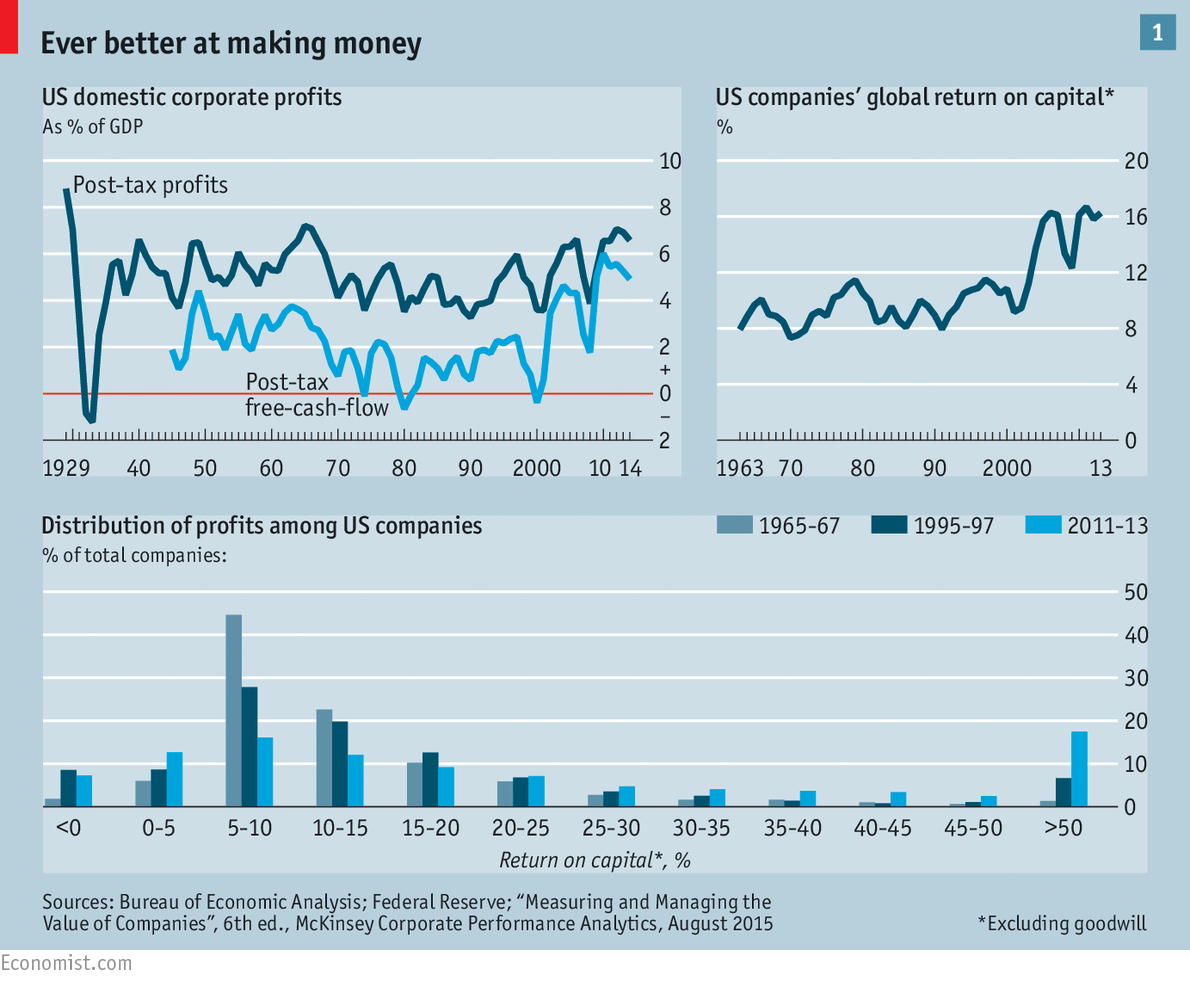
Now Larry Summers has argued that monopoly profits, extracted by the growing concentration of market power across sectors among the top firms, is responsible for the increasing returns to capital despite the persistently low real interest rates. Profits, free-cash flows, and returns on capital are at historic highs among US corporates.
A spate of mergers and aggressive cost-cutting have boosted profitability from both supply and production sides. The persistence of high profitability and the likelihood of the same firms being the beneficiaries over time points to prohibitive entry barriers. Pointing to high levels of entry barriers, the Kauffman index of startup activity is at its lowest since the 1970s.

The Economist examined US firms in 893 industries, grouped into broad sectors, and found that two-thirds of them became more concentrated between 1997 and 2012 and the weighted average share of the top four firms in each sector rose from 26% to 32%.
The concentration is especially pronounced in sectors like Finance, Retail, and Wholesale.
In this context, MR points to the findings of a recent study by Grullon, Larkin, and Michaelly which finds an alarming decline in publicly traded US firms and attendant concentration of economic activity,
There has been a systematic decline in the number of publicly-traded firms over the last two decades. Half of the U.S. industries lost over 50% of their publicly traded peers [from 6,797 in 1997 to 3,485 in 2013, AT].... This decline has been so dramatic, that the number of firms these days is lower than it has been in the early 1970s, when the real gross domestic product in the U.S. was one third of what it is today. This phenomenon has been a general pattern that has affected over 90% of U.S. industries... The decline has increased industry concentration, as the void left by public firms has not been filled by an increase in the number of private businesses or by greater presence of foreign firms. Firms in industries with the largest decline in the number of firms have generated higher profit margins and abnormal stock returns, and enjoyed better investment opportunities through M&A deals. Overall, our findings suggest that the nature of US product markets has undergone a structural shift that has potentially weakened competition.
This US CEA study finds a significant increase in the concentration of economic activity in many industries recent decades, a reflected in record levels of mergers and acquisitions. It also finds declining new firm entry and returns that are greatly in excess of historical standards. The share of US workers requiring some form of State occupational licensing grew five-fold over the last half of the 20th century to about a quarter of all US workers in 2008. 

Nowhere is the concentration more pronounced than in the financial sector. Noted investor, Henry Kaufman, has cautioned that such concentration undermines the operation of market forces,
The number of FDIC-insured institutions fell from more than 15,000 in 1990 to a mere 6,300 today, and the ten largest U.S. financial institutions currently control some 80 percent of all financial assets... financial concentration increases the spreads for securities, drives up financing costs, increases price volatility, reduces traditional sources of liquidity, and requires greater government supervision of credit markets... Debt has been shifting tectonically as well... U.S. government debt... now equals – GDP; in 2000 it was only half of GDP. In the 1990s, corporate equity increased $131 billion while debt soared an astonishing $1.8 trillion. And the quality of corporate debt has been deteriorating... In the mid-1980s, the number of non-financial corporations rated AAA was 61; today it is 4.
The returns on capital invested, excluding goodwill, among the American publicly traded non-financial companies have become increasingly concentrated in a small segment at the 90th percentile and above, whose returns are more than five times those of the median. 
Another recent paper by Ryan Decker et al points to declining entrepreneurship, job creation and destruction, and economic dynamism in the US. It finds increased reallocation of jobs towards the more productive and more profitable sectors, which invariably require ever declining shares of workers. This has to be taken with evidence of declining workers internal mobility across occupational categories.
The opinion is divided on what are the factors driving these secular structural trends. But these trends assume significance for even developing countries which are already buffeted by adverse headwinds of premature de-industrialization and stagnation in global trade. If declining business dynamism (entry and exit), lower entrepreneurship, increased industry concentration, internal workers mobility are driven by factors that are more secular, independent of nature of economies, then they may prove insurmountable barriers to economic growth in these economies. 

Sunday, February 21, 2016

Weekend reading links

1. The banking sector and corporate balance sheets constitute the Indian economy's two biggest immediate problems. The ebitda-to-interest ratio of the median company with market capitalization of more than $100 m four years ago is lowest for Indian corporates.
2. This blog has held the view that Indian economy is currently investment demand constrained, and, therefore, unlikely to respond to supply-side measures. In this context, Jahangir Aziz highlights the challenge,
Ask any corporate (entity), and in private they will all tell you the reason to have shelved their expansion plans is not because they can’t get land, or that labour reforms have not been implemented or that cost of capital is high—instead, they will all say there is no visibility of demand, and until there is visibility of sustained demand over the medium term, regardless of reforms on the cost side, it is very difficult for them to invest.
About the priorities for public policy to re-ignite demand,
You will need to now start spending on restructuring and reforming the areas where Indians save the most—for their children’s education, housing, daughter’s wedding and healthcare. If you look at out-of-pocket expenses on health and education, they are astronomically high in India. The government needs to start attacking the areas where precautionary savings are the highest. Education and health are readily and easily observable areas where people put in massive amounts of savings and, therefore, the government should be putting in money here, rather than infrastructure. We need a better balance between infrastructure and pushing money into education and health. The biggest expenses are for higher education and not for 12 years of schooling—where you spend ridiculous amounts for private colleges and universities. This is because the centre has not met its responsibilities of building places of higher education.
And why the current priorities, even in infrastructure may be off the mark,
If you look at infrastructure design in India, we are expanding ports and connecting them to hinterlands, we are expanding airports, we are connecting the metros by expanding the Golden Quadrilateral. But no one talks about, say a 10-lane highway from Kanpur to Coimbatore. There is no way I can go from Kanpur to Coimbatore without going through either East Coast or West Coast. These large investments make sense only if we believe that the export-led model of growth that we had in the early part of 2000s will come back. But if exports won’t come back, why are we even bothering with new ports.? From infrastructure design to mindsets, all has to be changed if we need to find new sources of demand, and this new source is domestic consumption. This new demand will get me the corpus to start investing, and that will generate growth.
3. A fascinating feature on how baseball has become the ultimate socio-economic mobility ladder in the Dominican Republic. As of opening day 2015, Dominicans made up 83 of US major league baseball’s 868 players.
4. Thanks to tax inversions, the Tiebout theory would bind even more strongly for corporate tax in the years ahead. Nice article in the Times on the recent spate of tax inversions in the US. Addressing the issue of tax arbitraging should top any multilateral agenda. By the way, it is surprising why the beggar-thy-neighbor, low-tax policies of countries like Ireland does not attract the same level of indignation that currency manipulation does. 

5. Martin Wolf analyzes Japan's problem as fundamentally one of weak demand - an aging population and declining demand shrinks investment opportunities, leaving corporates with growing surpluses. In this, as has often been said, Japan may be a portend for many developed economies in the years ahead. But despite this serious headwind, the Japanese economy has done remarkably well, having the highest growth rate of GDP per working person for the 2000-15 period among all G-7 economies.
Martin Wolf's prescription is for policies to slash corporate surpluses by encouraging them to raise wages (to boost demand) and impose taxes. I am not sure. This works under the presumption that demand is currently suppressed. A country with worsening demographic balance needs a little less of everything each passing year. Higher wages are therefore only likely to be saved. A more compelling suggestion would be to ease immigration and activate that demand channel.

6. Japan may also be in the vanguard of secular stagnation trends, of which Larry Summers is ever more convinced,
With appropriate caveats about the complexities of drawing inferences from indexed bond markets, it is fair to say that inflation for the entire industrial world is expected to be close to one percent for another decade and that real interest rates are expected to be around zero over that time frame. In other words, nearly seven years into the U.S. recovery, markets are not expecting “normal” conditions to return anytime soon.
Apart from cheap capital goods, this explanation for investment demand being constrained is interesting,
The new economy tends to conserve capital. Apple and Google, for example, are the two largest U.S. companies and are eager to push the frontiers of technology forward, yet both are awash in cash and are under pressure to distribute more of it to their shareholders. Think about Airbnb’s impact on hotel construction, Uber’s impact on automobile demand, Amazon’s impact on the construction of malls, or the more general impact of information technology on the demand for copiers, printers, and office space. And in a period of rapid technological change, it can make sense to defer investment lest new technology soon make the old obsolete.
Having said all this, Summers appears to refute his original assertion and claim that it is, after all, possible to get back on the previous growth path,
Although developments in China and elsewhere raise the risks that global economic conditions will deteriorate, an expansionary fiscal policy by the U.S. government can help overcome the secular stagnation problem and get growth back on track... An expansionary fiscal policy can reduce national savings, raise neutral real interest rates, and stimulate growth.
This argument is surprising and runs contrary to his own argument about investment demand being constrained. How would fiscal policy address the headwinds of technology and capital conservation? As Japan has been finding out over nearly a quarter century, public investments in infrastructure can only get you so far. It can, at best, ameliorate some of the pains of a secular stagnation.

7. A very good exploration of the divide in the Keynesian camp between those advocating continuation of monetary accommodation (Krugman, Summers, De Long) and those (Fed insiders) preferring to proceed with raising rates.  

Saturday, December 19, 2015

Weekend Reading Links

1. Quietly, Barack Obama, the reluctant foreign policy President, has made it a landmark year for US foreign policy,
In reality, the climate change accord brings to an end a year of landmark breakthroughs in international diplomacy by the Obama administration. As well as the climate agreement, this year has brought a diplomatic pact on Iran’s nuclear programme, a major trade accord in the form of the Trans-Pacific Partnership and the reopening of US diplomatic relations with Cuba. All four of these achievements have been many years in the making.
2. Livemint has the latest dismal news on the Indian banks stressed assets problem which comes from Nomura Research,
The banking industry is sitting on around Rs.5-6 trillion of stressed assets. The brokerage further says that the loss resulting from default on these assets could be as much as Rs.1.7 trillion. Put another way, these Rs.6 trillion of assets are as high as three-fourths of the current stock of stressed assets (declared non-performing assets, or NPA, plus restructured assets) in the system.
Clearly, for metals and infrastructure, two of the drivers of investment cycle, there is no light at the end of the tunnel.

3. Livemint captures the declining share of corporate profits as a share of economic output.
In this context, Jahangir Aziz makes the point that even the mid-2000s rise in corporate profits were driven by exports rather than increased domestic demand,
In the golden years of 2003-08, when growth in India averaged almost 9 per cent, much of it was driven by corporate investment, which tripled from 6 per cent of the GDP to 18 per cent. Who consumed most of the goods produced by the increased investment? Not residents, as domestic consumption fell from 61 per cent of the GDP to 58 per cent. Instead, much of the newly created capacity was absorbed by foreigners, with exports surging from 15 per cent of the GDP to 24 per cent. With foreign demand accounting for more than 50 per cent of India’s manufacturing in the pre-crisis year, the relentless decline in exports since 2011 has, more than anything else, driven the weak industrial growth and languishing corporate investment.
This goes back to my argument that tries to make the distrinction between making in India for exports and for local market, with the trade-off being one between quality and price. Given the anemic global economy and the 12th straight month of decline in exports, the case for orienting make in India for the domestic market appear compelling.

4. Bhupesh Bhandari makes the case for industrial policy to encourage mobile handset makers to print their circuit boards in India, so that a value addition of eight to nine per cent takes place here. Currently manufacturers import everything as semi knock down (SKD) kits and then assemble them here, creating a value addition of no more than one to two per cent. Instead, he advocates imposing a countervailing duty of 12% on imports of PCBs so as to encourage phone makers to import the components as completely knock-down (CKD) kits and then print the circuits in India. This would be first step in designing and fabricating chips in India, which together make up nearly 40% of the phone cost.

This may be a good example of actually picking winners by guiding the development of a market. The duty could potentially set the industry in the path of an escalator from printing the circuit board, to designing the chip, to finally manufacturing it.

5. Whatever spin you try to give to the US health care market, one cannot but come away with convinced that it is the best example that free markets do not work in health and regulated prices are necessary. The Times points to a new study which examined US insurance data for the 2007-11 period and found,
First, health care spending per privately insured beneficiary varies by a factor of three across the 306 Hospital Referral Regions (HRRs) in the US. Moreover, the correlation between total spending per privately insured beneficiary and total spending per Medicare beneficiary across HRRs is only 0.14. Second, variation in providers’ transaction prices across HRRs is the primary driver of spending variation for the privately insured, whereas variation in the quantity of care provided across HRRs is the primary driver of Medicare spending variation. Consequently, extrapolating lessons on health spending from Medicare to the privately insured must be done with caution. Third, we document large dispersion in overall inpatient hospital prices and in prices for seven relatively homogenous procedures. For example, hospital prices for lower-limb MRIs vary by a factor of twelve across the nation and, on average, two-fold within HRRs. Finally, hospital prices are positively associated with indicators of hospital market power. Even after conditioning on many demand and cost factors, hospital prices in monopoly markets are 15.3 percent higher than those in markets with four or more hospitals.
6. The Lancet has an article calling for an integrated national health care system for India built around a strong public primary care system supported by private and indigenous providers. Livemint has a graphical summary of the report, from which two stands out. One, the personnel deficiency, especially of paramedical staff is staggering.
In a country with very high out-of-pocket spending, health care costs have been rising across the board. 

7. In a week the Fed finally took the plunge and reversed monetary accommodation by raising the Federal funds rate by 25 basis points, Larry Summers points to the work of Luckaz Rachel and Thomas Smith, who find that a 450 basis points decline in the global neutral real interest rate over the past 25 years. Summers points to the authors finding that factors other than slowing global growth being responsible for more than 75 per cent of the decline in real rates,
They note that since the global saving and investment rate has not changed much even as real rates have fallen sharply, there must have been major changes in both the supply of saving and demand for investment. They present thoughtful calculations assigning roles to rising inequalityand growing reserve accumulation on the saving side and lower priced capital goodsand slower labour force growth on the investment side. They also note the importance of rising risk premiums associated in part with an increase financial frictions.
This from Mervyn King and David Low captures the declining real rates

 8. At a time when politics is increasingly characterized by extreme caution bordering on paralysis, parochialism and short-sightedness, Angela Merkel's embrace of the Syrian refugees has rightfully earned her FT's acclaim as the Person of the year. I feel this assessment is spot on,
Her response to the refugee crisis has shaken Europe profoundly. Germany will never be the same again. For better or for worse, the cautious Ms Merkel is boldly transforming a continent. Even if she fails, she has left an indelible mark.
To put that in perspective, by end-November the country received 965,000 refugees, more than five times the figure last year. Who cares whether she succeeds or fails, this is the stuff of great leadership. This profile by George Packer is a classic.

Thursday, November 26, 2015

Quantitative easing, share buybacks, and secular stagnation

Martin Wolf lays out the reasons for the persistent low-interest rate environment. He attributes this to the "savings glut", arising not just from emerging market foreign exchange surpluses but also from the rising pile of retained surpluses of corporates from developed economies. These surpluses have been financing fiscal deficits in Japan and accumulation of foreign assets in the case of Germany. The first graphic points to the rising corporate gross savings.
However, the rising savings have been accompanied by declining corporate investment, a reminder of the secular stagnation argument.
These trends have led to accumulation of corporate retained earnings.
A significant portion of this is being used to buyback shares and return money to investors. In fact, corporates, especially in the US, have sought to leverage the ultra-low rate environment to finance the share buybacks. So much so that stock buybacks have overtaken aggregate dividends as the main form of corporate payout. These low rates and the resultant high equity risk premium make it prudent for businesses to replace costly equity financing with cheaper debt. The largest US corporates have been leading this market distorting trend. Apart from being an important contributor to fuelling the equity market boom, the resultant reduction in equity base has further inflated corporate surpluses. 

The BIS has documented that in the 2009-14 period, US non-financial corporates repurchased $2.1 trillion in shares and raised $1.8 trillion in net bond financing. 
Clearly, the extended period of quantitative easing and resultant ultra-low interest rates have served to amplify the effects of secular stagnation. 

Thursday, November 5, 2015

More on the secular stagnation debate

The main argument in favor of the extended period of extraordinary monetary accommodation has been that it would provide the space for balance sheets to heal and the economy to get back to pre-crisis growth trajectory. Now, what if a return to the pre-crisis growth path may no longer be possible, for whatever reasons?

Economists like Robert Gordon have for some time now been cautioning about a productivity growth slow-down. Tyler Cowen had popularized this trend in his book "Average is Over", claiming that all the low-hanging fruits of recent technology revolutions have been plucked and actual productivity enhancing innovation has reached a plateau. Larry Summers has sought to provide a theoretical framework to the underlying trends by resuscitating Hyman Minsky's 'secular stagnation' hypothesis. Essentially, declining investment demand, induced by a variety of long-term structural factors, have forced down the Wicksellian natural interest rate to historic low levels, with limited prospects of a recovery for the foreseeable future. 

The supporters of unconventional monetary policy responses, led by Paul Krugman, have argued that such policies will not only help repair distressed household and corporate balance sheets, but also stoke the inflationary expectations required to restore consumption and an exit from the liquidity trap. They have claimed that central bankers could "credibly promise to be irresponsible" and unhinge inflationary expectations. While they also support fiscal policy measures, all those are made conditional on the persistence of monetary accommodation.

In this context, a recent dialogue between Larry Summers and Paul Krugman is instructive. Krugman, one of cheer-leaders of ever more monetary accommodation, assumes a return to pre-crisis growth path. But Summers describes the belief in pre-crisis recovery taking hold as a 'deus ex machina' event, and writes,
The essence of the secular stagnation and hysteresis ideas that I have been pushing is that there is no assurance that capitalist economies, when plunged into downturn, will, over any interval, revert to what had been normal. Understanding this phenomenon and responding to it seems the central challenge for macroeconomics in this era... I suspect it will lead to more emphasis on fiscal rather than monetary actions in depressed economies.
Krugman has grudgingly accepted the possibility that a return to pre-crisis normalcy may not be possible, thereby making policy response that much harder. If we agree to Summers' point that pre-crisis growth may not be a possibility, then low interest rates are here to stay, thereby making government borrowings, especially to finance much-needed investments in infrastructure in the US less of a problem. But the flip side of this argument is that this too may have limited traction as a growth driver and may end up down a slippery slope, as Japan is today. While the US does not face as bad a demographic headwind, Japan's struggles with the use of fiscal expansion in triggering growth draws attention to the limitations of fiscal policy itself in such circumstances. 

In any case, all this would also mean that the US has followed Japan and, possibly, Europe, into a long period of low growth rates, with attendant drag on the emerging markets and the world economy itself. 

Monday, July 20, 2015

Secular stagnation and prospects for a new growth compact

Overcoming secular stagnation (SS) is arguably one of the biggest challenge facing developed economies. The phrase, first propounded by Alvin Hansen in the context of the Great Depression and revived in 2013 by former US Treasury Secretary Lawrence Summers to describe the present times, essentially means “chronic excess of savings over investment” which serves to keep real interest rates low for a prolonged period.

It has been construed that these countries may have entered a phase of lower trend economic growth, a new normal, driven by "persistent shortfalls of demand". The most compelling argument in favor of its demand-side origins come from the fact that even a large asset bubble fuelled economic boom in the last decade was not accompanied by inflationary over-heating.

Supporters of SS hypothesis point to multiple reasons for excessive savings - rising share of incomes going to those with "high savings propensities"; increased uncertainty, greater indebtedness, and expectations of lower returns encourage people to save more; and the burgeoning surpluses of emerging economies and oil exporters which find their way to the safety and liquidity of US Treasuries. On the investment side, they point to the substantial reductions in the relative price of capital goods as well as capital intensity, reflected in the declining share of investment goods in the GDP. This is most evocatively captured in Larry Summers’ example of "WhatsApp, worth $19 bn, with 55 people in a big room with Sony, worth $18 bn, and owning lots of factories and office buildings and the like".

Then there is the challenge posed by demographics. Demographic trends affect both investment and savings. A lower population growth reduces potential output, and limits the scope for investments. An aging population means people save more to fund their retirements. A combination of excess savings, amplified by the accumulating surpluses in emerging economies, and limited investment opportunities keeps interest rates low, even negative in real terms.

Finally, there is the productivity explanation, best captured by Tyler Cowen's best-selling book, The Average is Over - all the low hanging fruits from technological and process innovations have been plucked and large productivity enhancing innovations are very difficult to come by. The combination of all these factors point to the difficulty of operating at full employment and potential output without inflating destabilizing asset bubbles. Critics though dispute the SS hypothesis pointing to the remarkable ongoing economic recovery in the US.

The conventional wisdom on responding to SS has been either monetary accommodation, using unconventional approaches like quantitative easing, or fiscal spending on infrastructure. But the former engenders resource misallocation and ruinous asset bubbles, whereas the latter is constrained by fiscally strapped governments. It is in this context that the international dimension assumes significance.

A striking feature of the SS hypothesis is its "closed economy" assumption. Since the low hanging fruits from technological innovations have been plucked, developed countries, and their firms, face a future of declining gains in productivity. Their companies, exemplified by the cash hordes at two iconic firms Apple and Google, have limited investment opportunities. The income stagnation at all but the highest income levels boosts savings and limits consumption demand. All these trends are confined to developed economies and tend to assume them living in isolation from the rest of the world.

Faced with declining investment opportunities and lower returns to capital, Econ 101 teaches us that the natural response would be to expand trade and other economic linkages. The developed economies have the technologies, businesses, and even capital, all searching for opportunities. It also faces an aging population and therefore diminished supply of labor. In contrast, emerging economies have rising productivity, remunerative investment opportunities, growing consumer demand, and a large pool of labor. The complementarity could not have been any more mutually beneficial. The scope for a new growth compact between the two economic groups could not have been more opportune.

So far, the operations of multi-national corporations has been focused on selling products produced in developed to consumers in developing countries. Imagine the potential of a market for goods and services that are essentially needed for the developing countries. What if the firms from developed countries are able to realize increasing gains in productivity by making products for developing countries? What if there are remunerative investment opportunities in developing countries? As capital flows out from developed economies, their depreciating currencies would boost exports.

Such innovation opportunities and incentives abound – massive savings in infrastructure investments from efficient construction technologies, low cost medical technologies could dampen rising health care costs, on-line instruction technologies can transform education and health care markets, and so on. The "jugaad" innovations that characterize many breakthroughs by Indian firms are an example of such opportunities. 

Developing countries are estimated to invest trillions of dollars in their physical infrastructure over the coming decade. They include investments in electricity, mass-transit, telecommunications, and urban utility systems. The potential for technological innovations to optimize cost-effectiveness in their construction, reduce various forms of operational inefficiencies, and enhance environmental sustainability is enormous.

Consider the potential for transformational change from the recent advances in data science on governance itself. Arguably the most critical governance challenge in developing countries is with translating policies and programs into their desired outcomes during implementation. An important contribution to bridging this implementation deficit can be a right combination of analytics and visualization delivered through a variety of hand-held devices. The cash hordes of the likes of Google could transform governance in developing countries in a mutually beneficial partnership.

Finally, there is the channel of migration. It is no coincidence that Japan, with the most restrictive immigration rules, is the worst affected by secular stagnation, and US, with the least restrictive immigration rules, looks the least affected by secular stagnation. Liberalizing immigration rules could be another important contributor to alleviation of SS, especially in countries facing adverse demographic shifts like Japan and Germany.

We should therefore strive to see the current problems in the developed world as a great opportunity to construct a new paradigm of economic and social co-operation between the developed and developing countries driven by mutually beneficial imperatives.

Saturday, April 18, 2015

The declining capital intensity and secular stagnation

Barry Eichengreen (via Mark Thoma) examines the various explanations for secular stagnation,
Four explanations for secular stagnation are distinguished: a rise in global saving, slow population growth that makes investment less attractive, averse trends in technology and productivity growth, and a decline in the relative price of investment goods. A long view from economic history is most supportive of these four views. 
The same investment projects can be pursued, it is hypothesized, by committing a smaller share of GDP, and any additional projects that might be rendered attractive by this lower cost of capital are not enough to offset the decline in the investment share. With less investment spending chasing the same savings, the result can be lower real interest rates and, potentially, a chronic excess of desired saving over desired investment.
He has this graphic which highlights the declining relative price of investment goods. 
While this may be true of many developed economies, where the services sector predominates, it may be less so with developing economies. In these countries, manufacturing still makes up a significant share of the GDP and services a less dominant one. This is one more reason for appreciating the international dimension of secular stagnation hypothesis. Once we assume an open economy, the potential for mutually beneficial outcomes from international trade and cross-border capital flows are immense.