Substack

Showing posts with label Nudges. Show all posts

Saturday, December 18, 2021

Weekend reading links

1. New Zealand bans cigarette smoking,

New Zealand unveiled a plan on Thursday to eventually ban all sales of cigarettes in the country, a decades-long effort unique in the world to prevent young people from taking up smoking. The proposed legislation, which is expected to become law next year, would leave current smokers free to continue buying cigarettes. But it would gradually raise the smoking age, year by year, until it covers the entire population. Starting in 2023, anyone under age 15 would be barred for life from buying cigarettes. So, for instance, in 2050 people 42 and older would still be able to buy tobacco products — but anyone younger would not.

The calibrated and long-drawn nature of the policy is interesting.  

2. Like in many areas, European Commission has taken the lead in greater regulation of technology platforms by unveiling draft rules that, if implemented, would require "companies like Uber to consider their drivers and couriers as employees entitled to a minimum wage and legal protections."

The new labor rules follow a landmark case in February, when Britain’s top court ruled that Uber drivers should be classified as workers entitled to a minimum wage and holiday pay. In the Netherlands, a court ruled in September that Uber drivers should be paid under collective rules in place for taxi drivers... The new European rules would require companies to disclose more about how their software systems made decisions affecting workers. For those who may remain independent, the new rules would also require companies to grant more autonomy that self-employment entails... Spain offers a preview of the potential effects of the E.U. proposal. The country’s so-called Riders Law, enacted in August, required food delivery services such as Uber and Deliveroo to reclassify workers as employees, covering an estimated 30,000 workers.

3. Nice listing of behavioural biases. 

4. A sub-plot to the global supply chain disruptions induced shortages,

Medical device manufacturers have this year spent an estimated $6.4 billion on computer chips, according to Gartner, a research firm. The automotive industry has spent $49 billion. Makers of wireless communications gadgets like cellphones and tablets have purchased nearly $170 billion worth of chips — more than 26 times as much as medical device manufacturers, according to Gartner. The shortages are assailing every industry. But much as airlines prioritize their most frequent fliers in the face of a flight-canceling blizzard, chip makers are in many cases favoring their largest customers, expert say.

This on what caused the disruptions,

The shortages are in large part the result of botched efforts to anticipate the economic impact of the pandemic. As Covid-19 emerged from China in early 2020, it sowed fears of a global recession that would destroy demand for a vast range of products. That prompted major buyers of chips — especially automakers — to slash their orders. In response, semiconductor plants reduced their production. That proved a colossal mistake. The pandemic shut down restaurants, movie theaters and hotels, while slashing demand for cars. But lockdowns imposed to choke off the virus increased demand for an array of products that use chips, like desktop monitors and printers for newly outfitted home offices. By the time global industry figured out that demand for chips was surging, it was too late. Adding chip-making capacity requires as much as two years of lead time and billions of dollars. 

This about the transmission of disruptions in one part of the supply chain throughout the entire chain,

Once a company like ResMed gains regulatory clearance to use a supplier, it cannot simply seek out a new one that might have a ready stock of chips without first going through a time-consuming approval process. That meant that ResMed had to figure out how to squeeze more chips out of its existing supply chain... Faced with the prospect of getting shut out, Mr. Farrell rooted through his supply chain, identifying the suppliers of his suppliers, in the hopes of persuading them to prioritize ResMed’s factories. Mr. Farrell soon realized that a primary reason that his chip supplier could not meet his demand was that — five levels up the chain — a Taiwanese manufacturer of silicon wafers had exhausted its inventory.

Because that plant could not deliver extra products, the next link in the chain — a company that combines wafers and circuitry — could not produce more of its components. That meant that another company that buys those components and packages them into clusters was unable to make more of them. And that meant that ResMed’s supplier of circuit boards could not buy enough of those clusters, leaving ResMed’s factories in Singapore, Sydney and Atlanta short of circuit boards.

See also this excellent FT series on supply chains in times of Covid 19.

5. By Beata Javorcik, Chief Economist at EBRD, in the FT on the possibility of shifts in the prevailing ideology on supply chain management,

The quest to find the most cost-effective suppliers has left many companies without a plan B. More than half of firms surveyed by the Shanghai Japanese Commerce and Industry Club reported their supply chains were affected by the outbreak. Less than a quarter said they had alternative production or procurement plans in case of a prolonged disruption... Businesses will be forced to rethink their global value chains. These chains were shaped to maximise efficiency and profits. And while just-in-time manufacturing may be the optimal way of producing a highly complex item such as a car, the disadvantages of a system that requires all of its elements to work like clockwork have now been exposed... Resilience will become the new buzzword. Firms will think harder about diversifying their supplier base to hedge against disruptions to a particular producer, geographic region or changes in trade policy. This means building in redundancy and perhaps even moving away from the practice of holding near-zero inventories. Costs will certainly rise but, in the post-Covid world, concerns about supply chain fragility will come right after those over cost. Firms will be expected to assess resilience of their second and third-tier suppliers, too. We may see some reshoring as automation reduces labour costs.

6. John Thornhill argues that the mathematics of animal populations may have important insights for the prospects of digital networks. He points to the work of Andrew Chen, a partner at the VC firm Andreessen Horowitz who claims that the Metcalfe's Law, which states that the systemic value of communicating devices/nodes grows as a square of their number, is misleading. 

To take two obvious objections: no two networks are the same, and the value of individual connections varies... In Chen’s view, it may be more useful to study the mathematics of animal populations, including meerkats, sardines, bees and penguins, to understand the life cycles of networks. His insights largely derive from the work of Warder Clyde Allee, a pioneering ecologist from the 1930s who devised the “Allee threshold” to explain the growth and contraction of social animal populations. For example, when mobs of meerkats are too small then they are easily picked off by predators because there are not enough lookouts to scan the skies for raptors. When they pass the “Allee threshold” they multiply and thrive. But when they grow too populous they eat too many bugs and fruits and deplete their surrounding environment. “Allee’s population curves describe a sort of ecological version of the network effect,” writes Chen. 

Look at Uber, for example. Although it would appear to be one global network benefiting from vast economies of scale, it is more accurately understood as a network of networks. As Chen describes in his book, Uber’s war room in San Francisco focused on hyperlocal competition in each and every one of its locations, figuring out ways to outsmart rival taxi firms and exploit regulatory loopholes. But now that Uber has achieved critical mass in most of its markets and is nudging up prices to recoup its massive investments, it is in danger of overeating bugs and fruits. “They are focusing on efficiency and profitability. But if you are a city-by-city network you can be picked off by competitors,” says Chen, pointing to the threat from hungrier food delivery rivals, such as DoorDash and Gopuff.

7. Good table of anti-trust cases globally filed against big technology companies here.

8. Since over two decades, the central government has set aside 5% of its receipts from telecommunications sector to a Universal Service Obligation (USO) fund to bridge market failures in the sector. The fund collection till date exceeds Rs 1 trillion. However, its utilisation remains poor, with nearly Rs 60,000 Cr of un-utilised amount. 

The Comptroller and Auditor General has repeatedly pulled up the government for how it is managing the fund. In the past, the statutory obligation to pass dues on to the USO fund has not always been observed in a timely manner; as a consequence, the money has remained in the Consolidated Fund of India while the Union Budget’s mathematics are being worked out, thereby artificially reducing the fiscal deficit. But, even more worryingly, the CAG has also pointed out that the fund, even when topped up, has been only half used.

9. Neelkanth Mishra has an informative oped with figures on the residential construction industry in India. The argument is simple - the country has too few of houses of the required sizes and good quality, and with increasing incomes this will get addressed and attract massive investments.

India also has fewer houses than households (in comparison, China has 20 per cent more houses than households; and the US 10 per cent more), and still has “mixed-use” dwellings, like a shopkeeper’s family sleeping in the shop at night... the average American house is five times the size of an average Indian house, and has expanded by more than a third since the 1980s... Even though more than 80 per cent of India’s houses are now pukka, either the roof, the walls or the floor for many still need better quality material. Moreover, the pressure of a growing population means taller buildings. Today, 93 per cent of India’s houses are in buildings of one or two storeys and only 0.2 per cent in buildings with more than 10 storeys. In the latter set, which is growing rapidly, construction cost per square foot is nearly 10 times the cost of building a one-floor house in a village.

Rising land prices has been an important constraint to growth of housing, 

The value of dwelling construction was more than a sixth of gross domestic product (GDP) in 2012, and rent is the single largest component of the consumption basket after food. However, growth has been less than 6 per cent annually since 2012 in nominal terms, and nearly zero once adjusted for inflation. Its share of GDP has fallen by 5 percentage points to at least a 17-year low. Why did this happen? The reason may lie in land price movements: On average, they have risen by 10 per cent to 12 per cent a year in the last few decades, but between 2002 and 2013 urban land prices rose 19 per cent annually, and likely well over 25 per cent a year between 2006 and 2013. This overshoot meant that a correction was necessary: The pace slowed to less than 4 per cent a year between 2013 and 2019.

This is a positive trend,

In the last four years, rents have grown faster than real-estate prices, even as the share of rents in overall consumption has fallen from 11.5 per cent in 2012 to 9.5 per cent now.

10. Mahesh Vyas points to the index of consumer sentiments, a barometer of the well-being of households and their income growth perceptions. 

The index of consumer sentiments in November 2021 was 16.1 per cent higher than it was during the pandemic-affected November 2020. What is important is that it was a substantial 43 per cent lower than it was during the pre-pandemic month of November 2019, or in fiscal 2019-20... we are today worse off today compared to where we were two years ago by as much as 43 per cent. The index had reached its nadir in May 2020, when it was over 60 per cent lower than the 2019-20 level. From there, it has scaled back 44 per cent... In November, 39 per cent of the households reported that their income was lower than it was a year ago, and 37 per cent expected their income a year ahead to be worse than their current income. Only 6 per cent of the households believed this was a better time to buy non-durables compared to a year ago compared to the over 50 per cent who believed this was a worse time... 

Rural India saw a much faster improvement in sentiments compared to urban regions. The index of consumer sentiments grew by 18 per cent in urban India between June and November 2021. It grew by a much faster 30 per cent in rural India in this period. With this, the gap between rural and urban sentiments has widened. What is remarkable about this starkly divergent improvement is that even the better-off regions are significantly worse off than they were before the pandemic struck India. Rural sentiments in Novem­ber 2021 were 40 per cent worse than their level in 2019-20. In urban regions, sentim­ents are 49 per cent lower than in 2019-20... Only about 8.5 per cent of the households report income levels that are better than a year ago and even lesser expect these to improve in the coming 12 months. Even fewer, about 6.5 per cent, expect economic conditions in ge­neral to improve over the next one year—or even five years. As a result, less than 6 per cent of the urban households feel that this is a better time to buy non-essentials.

11. Striking figures on the economic contribution of migrants,

The next 25 years will see 33m people retiring with no replacements, thus shrinking the combined UK and EU workforces from 240m to 207m... Migrants usually create far more wealth abroad than if they’d stayed home. When the mass exodus from Syria and its neighbours sparked Europe’s “migrant crisis” in 2015, a study reported that migrants’ worldwide economic contribution was $6.7tn, about 40 per cent more than their likely domestic value. Although only 3.4 per cent of the global population, they accounted for 9.4 per cent of its gross domestic product.

12. Indian stock markets are the frothiest

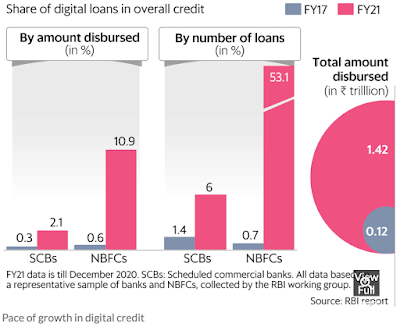
13. Sharp increase in the pace of digital credit growth of banks and NBFCs

14. The Economist has a briefing on the rise of a movement against the use of personal transport vehicles in global cities.
In New York Eric Adams, the incoming mayor, though famous for flouting parking rules, has promised to implement congestion-charging in Manhattan at last. In Boston Michelle Wu, another newly elected mayor, promises to make several important bus routes free for the next two years. In Cleveland, Ohio, Justin Bibb, the mayor-elect, promises to put “people over cars”, and to encourage more people to bike and walk, largely by turning traffic lanes into protected bike lanes. Cities as diverse as Buffalo, New York, and Minneapolis, Minnesota, have begun to ditch “parking minimum” rules, which required developers to provide ample free parking at new buildings. Even in California, a state where driving is practically a way of life, state-assembly members have proposed bills to ban cities from imposing parking minimums near public transport. la Metro, Los Angeles’s transport authority, is studying congestion pricing.

European cities have been doing this in some cases for decades. London established its congestion charge in 2003. The leading city now is arguably Paris, the capital of France. Under Anne Hidalgo, the socialist mayor, and her predecessor, Bertrand DelanoĆ«, cars were banned from the left and then the right banks of the Seine in 2013 and 2017. On the right bank, an expressway named for Georges Pompidou, who proudly opened it in 1967 when he was prime minister, has been converted into a sort of urban park. Ms Hidalgo, who achieved this despite lawsuits led by the right, called it a “reconquest” of the city for its residents. Bars now line the open sections of the road, while families on bicycles zoom through the eerily quiet (and now unpolluted) tunnels. Ms Hidalgo has been a vocal proponent of “15-minute cities”, the idea that almost everything a person needs for daily life ought to be within a 15-minute walk or cycle... 
Britain’s government gave local councils the power to close roads to create “low-traffic neighbourhoods” (ltns) without the usual consultations with residents that block them. Planter bollards have proliferated across England’s cities, blocking off residential streets to all but bicycles (typically, residents can enter and exit with their cars, but cannot drive through). When lockdowns started, Amsterdam temporarily banned cars from Spuistraat, Haarlemmerdijk, and Haarlemmerstraat, three central boulevards. The change now seems likely to be made permanent. As Glasgow, Scotland’s biggest city, played host to cop26 last month, city leaders announced plans to ban all cars from the centre over the next five years, in the hope of reducing carbon-dioxide emissions. In New York City, as in many places, street parking was converted into outdoor dining space, so that restaurants could stay open. Chicago has unveiled plans for a further 160km of segregated cycle lanes.

The results have been impressive, with car ownership in Paris dropping from 60% of households to 35%. But these municipal government measures, apart from raising local opposition from vehicle owners, also come up against the incentives of politicians at the national and provincial levels, who prefer the expand vehicle manufacturing (for revenue generation and job creation) and ownership (for feel-good income effect). 

15. Shyam Saran has a very good oped about the latest political trends in China in the build up to the 20th Party Congress in October 2022 which will also decide on President Xi Jinping's tenure extension. In particular, the recently organised annual Central Economic Work Conference which sets the overall policy guidance for China's economic managers within the overall framework of the 14th Five Year Plan, stressed on "maintenance of macroeconomic stability in 2022". It identified three risks - declining demand, supply shocks, and weakening outlook for future growth. Saran has a good summary of the challenges facing China, 

The country is clearly on a slowing growth trajectory. Even Chinese analysts expect the GDP to grow by 4.5-5 per cent per annum during the 14th Five-Year Plan. The economy is likely to become more domestic-oriented and inward-looking. If the pandemic lingers, the domestic orientation will become more pronounced. China is aware of the headwinds it will be confronting, most importantly the rapid aging of its population and the declining competitiveness of its manufacturing sector. It is betting on technological innovation to avoid a middle-income trap. However, keeping wages low and resisting the secular increase in the exchange value of the Chinese currency slows down the transition of the Chinese economy towards a higher value-added and more service-oriented economic activity. It is not clear how China’s leaders will deal with such contradictions.
16. In an important development, India has lost the dispute at the WTO's DSB over subsidies for sugar exports on a complaint that Brazil, Australia, and Guatemala had filed. The DSB report's finding,
We find that, for five consecutive sugar seasons, from 2014-15 to 2018-19, India provided non-exempt product-specific domestic support to sugarcane producers in excess of the permitted level of 10 per cent of the total value of sugarcane production. Therefore, we find that India is acting inconsistently with its obligations under Article 7.2(b) of the Agreement on Agriculture.

However, in the absence of a functional appellate tribunal, means that if India decides to appeal, the DSB's decision is unlikely to take effect anytime soon.  

18. Scott Galloway has some stunning data on the rise of Apple.

It took 42 years for Apple to reach a $1 trillion valuation — the first ever company to do so. But it took just 2 years to add another $1 trillion in value. Today, Apple’s market cap is roughly equal to all the world’s unicorns combined!


19. The Union Cabinet in India has approved a five-year Rs 76,000 Cr ($10 bn) production linked incentive (PLI) scheme to catalyse a semiconductor manufacturing eco-system in India. It aims to support firms in semiconductor fabs, display fabs, compound semiconductors/silicon photonics/sensors (including MEMS) fabs, semiconductor packaging (ATMP/OSAT), semiconductor design. 

20. It's remarkable that the US Fed FOMC meeting decision to take a more aggressive stance against inflation by indicating that they expected to raise rates thrice in 2022 instead of spooking the markets evoked a 2.2% rise in Nasdaq Composite. The Fed also announced that it would cut its bond purchases by $30 bn a month in January, double its previous pace. FT points to this market rationalisation, 
Investors were not put off by the prospect of reduced direct market stimulus from the Fed, and instead focused on the message that the central bank would not let inflation spiral out of hand. James McCann, deputy chief economist at Abrdn, the asset manager, said: “The Fed really had to demonstrate that they’re willing to move faster and go further to tighten policy more than previously planned as they’ve slipped behind the curve over recent months. It was vital that the Fed acted now to protect its credibility on inflation.”

This is an example of markets collectively suspending logic and preferring to believe that the stock market boom will continue no matter what. 

Saturday, August 14, 2021

Weekend reading links

1. Richard Thaler on measures to increase Covid 19 vaccination rates,

A focus on teamwork is also featured in the Cleveland-Cliffs steel company’s generous offer to its employees. Vaccinated employees get a bonus depending on how many others at their work site do likewise. The company will pay vaccinated workers $1,500 if 75 percent of employees get the vaccine, and $3,000 if the proportion reaches 85 percent. This focus on group vaccination rates reinforces the message that everybody benefits if more people get jabs.

2. Morgan Housel eternal wisdom of the week,

Incentives are almost like a drug in their ability to cloud your judgment in a way you would have found unthinkable beforehand. They can get good people to justify all kinds of things... it’s hard to know what you’d be willing to do until you’re exposed to an extreme incentive, and that blindness makes it easy to criticize other people’s mistakes when you yourself may have been just as tempted if you were in their shoes...
Everything worth pursuing has a less than 100% chance of working. And a lot of terrible ideas have at least some chance of working. So you can make good decisions that don’t work, bad ones that do, and everything in between. The hard thing is that when the probability isn’t easy to determine, the path of least resistance is to put your own failures in the “good bet that unfortunately didn’t work” category and other people’s failures in the “that was clearly a bad idea” one.

3. ReNew Power has won an SECI tender for delivering 1.3 GW of hybrid renewable energy to provide round-the-clock (RTC) renewable power by quoting a tariff of Rs 2.9 per unit. This, the first such tender in the country, will involve an investment of $1.2 bn and a plant load factor of 80%. 

The company would set up the cumulative capacity at three locations – Karnataka, Maharashtra and Rajasthan. The hybrid capacity would include 0.9 Gw wind power, 0.4 Gw solar power along with corresponding battery storage... The project will be designed to operate at an 80 per cent average annual PLF and will have a minimum capacity utilisation factor of 70 per cent monthly, despite being a renewable energy project... Power from this hybrid project is likely to be sold to northern and eastern states. SECI officials did not confirm the states. The tender provides for 3 per cent tariff escalation annually for 15 years. The company said ReNew Power will supply the electricity in the first year at Rs 2.90 per unit and this tariff will increase by 3 per cent annually for the first 15 years. After which it will stabilise for the remaining 10 years of the 25-year contract. Industry calculations indicate that the average tariff over the life of the life of the project would come to around Rs 3.5-3.6 per unit.

4. The multiple "truths" (HT: Collaborative Fund Blog)

Your truth and the truth are not always the same thing. The truth is a fact. Your truth is just an opinion. Nobody values somebody who is honest about their opinions if their opinions always suck. Knowing when to offer your truth and keep your mouth shut is a rare quality. The line between thoughtful dialogue and disrespectful disagreement is razor-thin.

5. Iceland has nearly three-quarters of its population vaccinated. Despite this, its third wave is clearly the worst. Also this about the resurgence of Covid in Israel, the first country to largely vaccinate its population. 

From a few dozen daily cases in early June — even zero on June 9 — new Covid infections twice hovered near 6,000 this week, the highest daily rate in six months... The Israeli ministry of health has twice revised downwards the long-term efficacy of the jabs — from the advertised 94 per cent protection from asymptomatic infections against the then-dominant Alpha variant, to as low as 64 per cent against the now-dominant Delta variant.

6. Fascinating NYT article about Liechtenstein. In terms of pace of casinoisation, the principality has few equals,

But only four years after opening its first casino, Liechtenstein — a tiny principality squeezed between Switzerland and Austria that is known mainly for its private banking and former status as a tax haven — now has more casinos per capita than Monaco, Macau or Clark County, Nev., which is home to Las Vegas. In the past few years, Liechtenstein has seen five casinos open — aimed mainly at attracting gamblers from neighboring countries — and there are plans for five more. The proliferation is causing alarm among some in a country where gambling had largely been illegal until 2010... The gambling boom in Liechtenstein dates to 2017, with the opening that year of two casinos. Three more followed soon after, and another two are scheduled to open by the end of this year.

This is predictably creating its backlash.

7. Business Standard report about the project for redevelopment of the Bombay Development Directorate's (BDD) chawls (large buildings divided into many separate tenements, offering cheap, basic accommodation) in central Mumbai. 

Spread over 92 acres in Central Mumbai's prime localities of Worli, Lower Parel, and Dadar and consisting of 195 four-storey houses, the BDD chawls were constructed in the 1920s... They were used as prisons to house freedom fighters. Later, they were used as accommodation for textile mill workers. Now, tenants live cheek by jowl in 160-square (sq.) feet (ft) cramped spaces. These chawls have remained trapped in time, even as swanky office buildings got constructed on textile mill lands next door... The Worli chawls will be redeveloped by the Tatas. Shapoorji Pallonji Group will redevelop the chawls on NM Joshi Road. Larsen & Toubro will redevelop the chawls in the Naigaon area. We have promised to hand over the keys within three and a half years to the present-day tenants, with only Rs 100 as registration fee... Meanwhile, the tenants have been given free housing in the government's transit camps till they are given the keys to their brand new 500-sq. ft home. As an additional incentive, the new highrises will not attract maintenance fees for the next 10 years after possession... smaller structures will be replaced by nearly 40-storey buildings, the entire landmass will significantly decongest these areas, bringing in elements of recreation, retail, and open spaces... Experts say over the next decade, 12-million sq. ft development will transform the micro markets of Worli and Lower Parel into a mid-market affordable housing settlement. Worli is currently a luxury destination, with prices ranging from upwards of Rs 50,000 per square feet on carpet area. With the BDD development, prices are likely to significantly come down to the Rs 30,000-40,000 per square feet on the carpet area... The possible addition to the housing stock, after settlement of all the project-affected people, may run into over 25,000 apartments of various sizes. 

If this gets completed in even five years, it'll be a great achievement. A rare example of large urban renewal in the Indian context. 

8. A bill in the California Legislature proposes deregulation of parking requirements to boost new housing construction, 

Known as AB 1401, the legislation would abolish local parking requirements for new residential and commercial developments near bus or train stops. It applies to counties with more than 600,000 residents and cities with more than 75,000 people. The bill does not prohibit or restrict parking. It merely deregulates it, allowing developers to decide what works best for a given project. It opens up the possibility, for example, of providing parking in an off-site garage or lot. It permits tandem parking to save space or subsidized shared ride services. It doesn’t prescribe a one-size-fits-all solution to how buildings can best serve the people who use them, and it allows flexibility as transportation options evolve.

This is an illustration of the distortions engendered by restrictive parking regulations,

Shoup’s book gives the real-life example of a standard-size L.A. parcel whose zoning allows eight apartments, with required parking of 2.25 spaces each, or 18 total. The lot is only big enough to accommodate 16 spaces on one level of underground parking, however. Going from seven to eight apartments means digging down another level, which is prohibitively expensive. So the builder settles for seven units. The parking requirement costs one more family a home. The biggest beneficiaries of abolishing parking requirements would probably be the sorts of projects both planners and ordinary city dwellers tend to like: smaller infill buildings, mixed-use projects with street-level retail that neighbors can walk to, repurposed historic buildings, and nonprofit low-income projects. Stringent parking requirements encourage large buildings that can spread garage costs over many units and charge luxury prices. Add in the parking minimums for commercial operations, and many mixed-use developments become impossible... A 2020 study of Low-Income Housing Tax Credit developments, conducted by the Terner Center for Housing Innovation at the University of California, Berkeley, found that a parking structure cost nearly $36,000 a unit. “For a 100-unit building required to include an on-site parking structure, this would mean that roughly $3.6 million of the project cost goes to parking,” write the Terner Center’s David Garcia and Julian Tucker in a report on AB 1401.

9. Berliners are campaigning for expropriating large residential landlords, 

... a radical campaign urging Berlin’s city government to expropriate 240,000 properties from Germany’s biggest publicly listed residential landlords, accusing them of squeezing out lower income, long-term residents through shoddy maintenance and jacked-up rents. After collecting more than 350,000 petition signatures, their proposal — which targets corporate landlords with more than 3,000 apartments each — will be voted on in a local referendum in September. Polling suggests nearly half of Berliners support expropriation, which would force the companies to sell their properties to the city government at a “fair” price.

Also this,

A referendum due in Berlin next month on expropriating big residential landlords should be a wake-up call. The ballot, prompted by a petition, would activate a never-before-used part of the German constitution that allows the state to take over “land, natural resources and means of production” in exchange for compensation. If it passes, the largest private landlords would be forced to sell their properties to the city government at a “fair” price. This would do little to solve Berliners’ grievances, but it demonstrates the extent of anger about seemingly broken housing markets across the developed world.

10. Last week saw the latest (and first since 2013) report of the UN's Intergovernmental Panel on Climate Change, signed off by 234 scientists from more than 60 countries, which estimated that even in a best case scenario of deep cuts in greenhouse gas emissions the world is likely to temporarily reach 1.5 C of warming within 20 years. Living in a world 1.5 C warmer than it was 200 years ago means that a heatwave that would previously have occurred once in 50 years is likely to occur nine times

CO2 will have the dominant contribution to global surface temperature increases from various kinds of emissions.
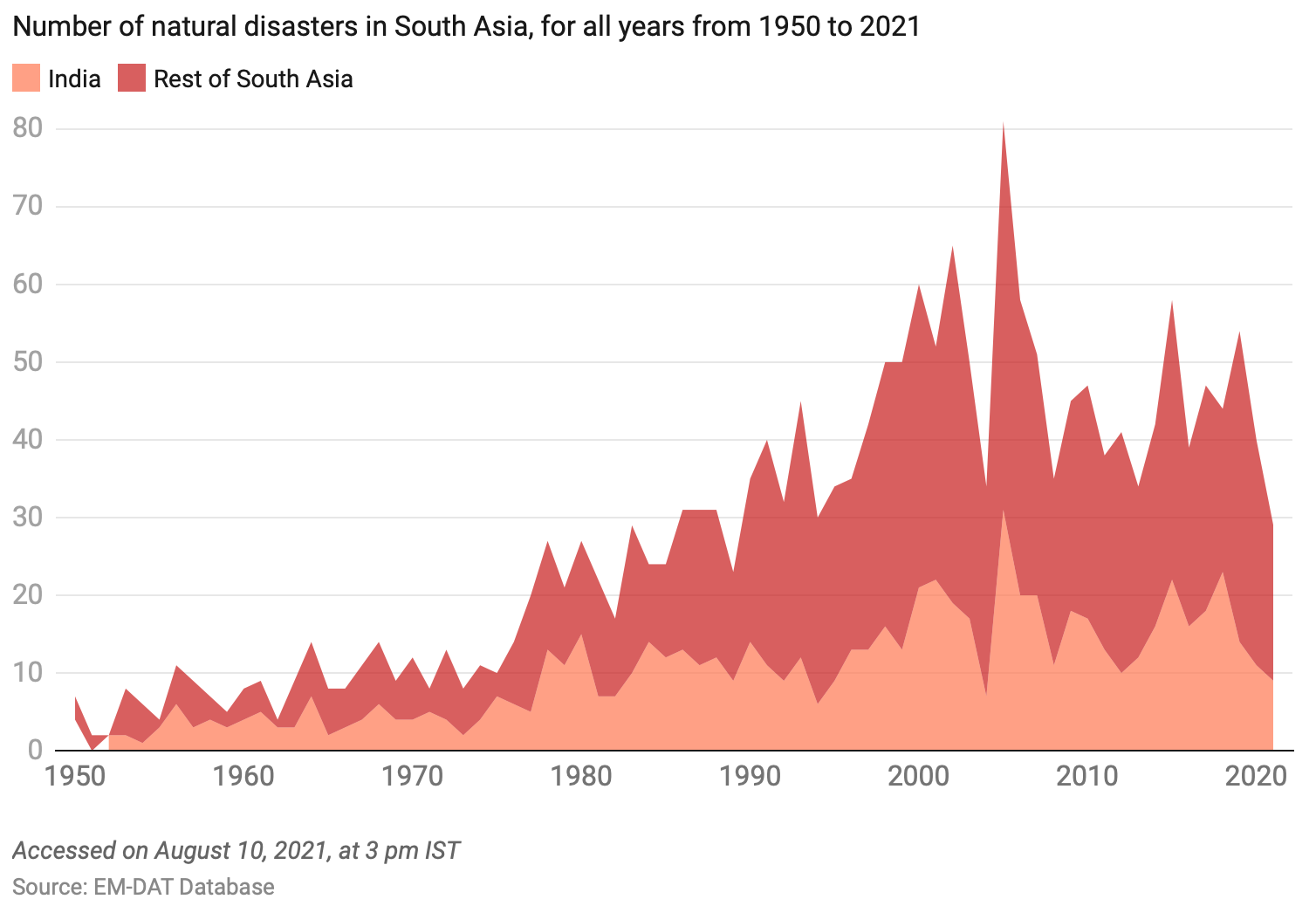
11. On a related note, India has been experiencing the effects of global warming - a 0.6 degree Celsius increase in temperature since 1950 has led to a three-fold increase in extreme rainfall and flooding
12. Chinese authorities have been clamping down on for-profit schools to promote public education,  
China has almost 190,000 private schools, educating more than 56m, or one-fifth of all students, according to official figures. There are more than 12,000 primary and middle schools. Beijing wants to reduce the proportion of non-high-school students attending for-profit schools from more than 10 per cent to less than 5 per cent as soon as the end of this year... Annual earnings for the tutoring industry have been forecast to fall from $100bn to less than $25bn. The problem for private sector owners of junior and middle schools has become more acute since May, when Beijing told local governments to “rectify” their runaway expansion. “We must make sure public schools are the main compulsory education provider,” said a circular sent by the central government to lower-level authorities, adding that Beijing would encourage the conversion of some for-profit schools into public ones... The education reforms marked a striking change after years of liberalisation. Over the past two decades, China’s private primary schools grew 10-fold, teaching about 9.5m students in 2019.

India faces the same problem of hugely expensive private schools creating an elite-only market and also a highly competitive coaching market. But the Chinese actions are not possible in the Indian context.

13. FT has an article on the rising trend of outsourcing of fund management by smaller investors. Globally, as on March 2020, there were about $2 trillion in assets managed with full or partial discretion by outsourced fund managers, a two-fold rise from 2013. Smaller funds and investors prefer not to incur the high fixed cost of putting in place an in-house investment team. This imperative is also amplified by the search for yields prevalent in the financial markets today. 

The article points to the latest seven year projection by Jeremy Grantham's GMO of returns from various asset classes.

14. Status report on piped drinking water supply to villages under the Jal Jeevan Mission.

This is very impressive,

New tap connections, which had ranged between 2,000 and 10,000 per day till FY20, zoomed to more than 88,000 taps per day in FY21... Government officials said one reason for this speed is the use of groundwater. Household tap water systems can be developed quickly in such villages with the next 30-40 years in mind... However, the speed has mellowed somewhat this year, despite a fivefold increase in central funding. In 2021-22 (FY22) till August, the daily rate has gone down to 18,000.

Even 18000 is impressive. The issue here is to ensure they are actually working and supply water.

15. Finally, an article that highlights how Sweden has emerged as the Silicon Valley of Europe

Sweden's home computer drive (government policy to put a computer in every home), and concurrent early investment in internet connectivity, help explain why its capital Stockholm has become such rich soil for startups, birthing and incubating the likes of Spotify, Skype and Klarna, even though it has some of the highest tax rates in the world... In the three years the scheme ran, 1998-2001, 850,000 home computers were purchased through it, reaching almost a quarter of the country's then-four million households, who didn't have to pay for the machines and thus included many people who were otherwise unable to afford them... Some executives and campaigners say the Scandinavian nation demonstrates that a deep social safety net, often viewed as counter to entrepreneurial spirit, can foster innovation... Childcare is, for the most part, free. A range of income insurance funds can protect you if your business fails or you lose your job, guaranteeing up to 80% of your previous salary for the first 300 days of unemployment...

It has the third highest startup rate in the world, behind Turkey and Spain, with 20 startups per 1000 employees and the highest three year survival rate for startups anywhere, at 74%, according to a 2018 study by OECD economists. Stockholm is second only to Silicon Valley in terms of unicorns - startups valued at above $1 billion - per capita, at around 0.8 per 100,000 inhabitants, according to Sarah Guemouri at venture capital firm Atomico. Silicon Valley - San Francisco and the Bay Area - boasts 1.4 unicorns per 100,000, said Guemouri, co-author of a 2020 report on European tech companies. No one can say for sure if the boom will last, though, in a country where capital gains are taxed at 30 percent and income tax can be as high as 60 percent.

Tuesday, May 25, 2021

An excess of incentives and institutions in development

One of the problems with modern development discourse is its dissonance with both history and reality. One example of this is the idea of using incentives to generate development outcomes. So, if people don't vaccinate, then incentivise them with payment (or lentils). If you want children to do homework, incentivise them with payment. If people don't quit smoking, pay them to quit. And so on. In general, if you want to get people to do something, incentivise them with conditional cash transfers. 

The body of work on getting people to do stuff which advances development causes revolves almost completely around rewards/incentives and nudges. There is an asymmetricity in policy response to such problems in so far as in contrast to incentives, there is little by way of plain vanilla stuff like just making people abide by rules and enforcing those rules.

In this context, in a recent paper, Edward Glaeser points to how nineteenth century New York got people to connect to water and sewerage networks. He writes on the role of mandates and their enforcement in utilisation of infrastructure,

In 1842, New York City opened its Croton Aqueduct, which brought clean water into the city. This engineering achievement did not, however, end New York City’s Cholera problem. Somewhat surprisingly, the city would continue to suffer from cholera outbreaks for another 24 years. The persistence of cholera was not a puzzle to Dr. Stephen Smith, who led a team of doctors during the 1860s that trooped through the city and produced the 1865 “Report of the Council of Hygiene and Public Health of the Citizen's Association of New York Upon the Sanitary Conditions of the City.”
New York City had piped water, but water connections were expensive and tenement owners avoided the expense. Poorer renters lacked both resources and the incentive to internalize the wider health benefits of sanitation. New York City even had about 2,300 hydrants that dispensed free water, but using hydrants requires carrying water significant distances. Consequently, poorer New Yorkers continued to use shallow wells and pit latrines and they continued to die from cholera.

Smith’s report then produced the legislation that created New York City’s Board of Health, and Smith became its first leader. He began a system of inspections and fines that pushed tenement owners to connect to the water system. The Board’s inspection service was independent of the corrupt police force controlled by the Tammany Hall Machine. The doctors who set atop the Board’s leadership seemed to have been reputable men, like Smith, whose preferences (and reputations) kept them from striking corrupt bargains with those property owners who preferred not to pay for clean water.

This has resonance with all cities across developing countries. Even when water lines or underground sewerage systems are laid, very few households take the connections. The incentive-compatible approach that development economics advocates revolves around finance (and now nudges) - pay people to take connections, lotteries, lower connection charges, amortise connection charges with bills (pay-as-you-go) etc. 

I am inclined to argue that these are logically neat and theoretically robust. Besides they are amenable to guilt-free and elegant field experiments and research publications. In short, this is all fine for armchair theorising. Nothing beyond that. 

Let me layout a conceptual framework on thinking about this issue. 

Social contracts are two-sided. Citizens and governments agree to a contract. Citizens demand certain public goods and services and pay taxes for it. Governments use the taxpayer money to produce/provision those public goods and services. There is often a gap, for whatever reasons (including poverty and access), between delivery of those goods/services and their utilisation or uptake. Even when access has been provided, utilisation often remains elusive. In such cases, citizens have to be made to utilise the good/service offered. 

This process of making citizens utilise what is offered is a combination of rules/regulations/mandates (or exercise of state capability) and incentives. As the example of water and sewerage in New York shows, on most development issues and from historical examples of developed countries, ensuring utilisation has been largely about rules/regulations/mandates and their enforcement. Incentives have mostly been marginal contributors, relevant mainly in mopping up the few holdouts. This holds just as much to vaccination or school enrolment, as it does to taking water/sewerage connections. 

In the case of most public goods/services, history points to rules/regulations (in the form of exercising state capability) as the preferred choice to ensure utilisation. Development economics, on the other hand, is blind to rules/regulations and is focused on rewards/incentives, and in recent times on overcoming human psychological biases (the nudge factor).  

In simple terms, on the issue of utilisation of public goods/services (and more) development economics skirts around the difficult to grasp and even more difficult to implement issue of state capability and settles down on the comforting and logically neat ideas of measurable and testable incentives and nudges. 

In many developing country cities, utility connections have less than 20% households coverage in streets with water and sewerage connections, especially with latter, even in the middle class colonies. In low income areas with public taps, water connections uptake is similarly very low (even when connection charges are low). Unlike a case where just 10-20% of households are holdouts, and would perhaps need some incentives or subsidies, a case where just 10-20% have taken connections demands enforcement of rules. 

This World Bank working paper is a good example of a study that lists out as reasons (see the table in page 12) for low coverage of water and sewerage connections everything except the simple fact that many people just don't want to change the status quo and take a connection. And they don't face significant cost in maintaining the status quo. It's a teachable exhibit - it uses the word 'incentives' 36 times and the words 'enforcement' and 'rules' just six times each! Its 128 pages is also a classic example of over analysis in the context of development problems. Incidentally, it's also replete with several examples from developing countries on successful experiments with increasing utilisation through the likes of incentives, but none from developed countries about how they achieved the same. 

Incidentally, this is a very rare experimental study on the effectiveness of disconnections in ensuring utility bill payments. 

This is an unfortunate distortion, a deep negative externality imposed by excessively theoretical and deeply disconnected discourse that dominates international development and aid agencies. It has crowded-out serious engagement with hard issues of state capability improvements and crowded-in massive aid spending into mostly marginal and even silly ideas tailored around financial incentives and nudges. 

None of the above is an advocacy for strict penalties and hard enforcement, and avoiding incentives. But the reality is that when the baseline of compliance is so low, even among those who can afford to comply, then the first line of engagement should be enforcement. We can get to incentives and subsidies when we come to those who clearly cannot afford.

The anecdote about New York is also important for another aspect. It highlights the importance of individual agency. The personal initiative and role of Dr Stephen Smith in bringing forth the legislation and also working to enforce its implementation was critical in New York's success in delivering clean water. 

In the 18th Brumaire, Marx pointed to the limitations of individual human beings and the importance of circumstances and legacies. Extending that logic, development theories focus excessively on institutions - organisations and systems - and somewhat less on contexts/circumstances and historical paths (path dependencies). But it more or less marginalises the role of individuals. 

There is very little systematic research on the importance of individual (mostly non-political) bureaucratic or technocratic leaders in transformational development. This is surprising. History is replete with names like Stephen Smith, Robert Moses, Joseph Bazalgette, Baron Haussmann etc whose contributions were immense. Or the numerous Latin American mayors in cities like Mexico City, Sao Paulo, Curitiba, Medellin, Bogota etc who left indelible marks on their cities. Each country has their heroes among bureaucrats and technocrats.

Closer home, India has its names - KL Rao, E Sreedharan etc. There are several IAS officers who have played remarkable roles in transforming their terrains. It's common place for institutions and districts/corporations to be meandering along for years, only to be galvanised by the arrival of a dynamic officer who undertakes far reaching reforms and implements them with militant discipline and commitment, and for the system to revert back to its initial somnolence once the same officer departs. There cannot be anymore definitive evidence of human agency. And India's development history is full of such instances across geographical jurisdictions, Departments of state and centre, and state and central public sector entities.

Saturday, February 8, 2020

Weekend reading links

1. FT writes on the railway reforms in UK,
A rejig is sorely needed. More than 25 years after privatisation, passengers continue to be poorly served by a network structure that has encouraged short-termism and a lack of accountability among stakeholders. Regulated fares have risen at twice the rate of wages over the past decade. Several large franchises are struggling not only to operate a reliable service but also to make money. Northern Rail will be nationalised in March. It will be the second to be taken into state hands. Frustrated passengers want radical change; polls show the majority of the public favour wholesale nationalisation... What is often forgotten is that most railway operations have already returned to public ownership: the track, signalling, and major stations are all part of nationalised Network Rail. Adding the train operators would be a relatively small step... the franchising model has run out of steam. It was meant to lead to cheaper fares and more efficient railways. Instead, tightly controlled contract terms encouraged operators to make overambitious bids that could never be delivered, especially when passenger growth did not materialise as expected... The government is expected to replace franchises with “management contracts”. It will receive fare income directly and pay operators based on performance. A similar model has worked well on the London Overground suburban network where Transport for London, which runs the capital’s transport, sets fares and timetables and grants concessions to a single operator.
2. Alphaville points to the story of Southland Royalty, an oil and gas company, owned by private equity firm Encap, which recently filed for bankruptcy. It raises questions about the industry claims that PE offers diversification in so far as the value of its portfolio gyrates far less than in the public markets,
EnCap wrote down the value of its investment in Southland by 25 per cent in early 2019, according to the first person. The October investor report showed that the firm valued its investment in the company at $773.7 million at the end of September, nearly the same amount as the $775.5 million it had invested in the business until then. EnCap wrote down the investment to zero at the end of 2019, a person familiar with the matter said... How did an investment marked at 0.99 times its invested equity collapse so suddenly? It’s not the broader energy market. Since September 30, the Dow Jones US Energy Index is down 7.75 per cent, according to S&P Global Market Intelligence. Perhaps then, as some private equity critics have ventured, it’s that markings in private assets are more mark-to-myth than mark-to-model.
3. NYT has a story about the bankrupt shoe retailer, Payless, highlighting the problems associated with private equity managed companies. Sample this on asset stripping,
In the two-year period ending in January 2015, Payless generated $249 million in “Ebitda,” a common metric for operating profits; paid $352 million in one-time dividends to shareholders; and made $94 million in interest payments. For every dollar that came in the door of the company in that span, it paid out $1.41 to its owners and 38 cents to its lenders. That left the company with less of a financial cushion to ride out any future challenges.
Lack of industry experience by PE managers is another problem, exacerbated by excessive focus on cost-cutting and other short-term efficiency improvement measures which rebound badly in the long-run.

4. Nice visual summary of cognitive biases. The website has some great visualisations. This is a fascinating table of commodity returns since 2010. (HT: Ananth)

5. FT has an article that investigates the opaque power structures the govern Brookfield Asset Management (BAM), the $500 bn Canadian private equity giant,
To unpack the Canadian group’s accounts is to discover not so much a company as a giant, triangular jigsaw board that spreads across the world and covers assets worth $500bn. The pieces are hundreds of corporate entities, all locked together by elaborate contracts, which give 40 people at the top the right to rule huge sections of the puzzle almost as if it were their own. Those insiders wield such power that the companies below them could face risks similar to those of “pyramid control companies”, according to a draft investor disclosure that Brookfield filed with the Securities and Exchange Commission in 2013. (The final version warned instead of risks “associated with a separation of economic interest from control”.)... Yet in interviews, securities filings, litigation records and other documents, a picture emerges of an investment group that defies convention: highly secretive, seemingly obsessed with control and susceptible to family squabbles that have few parallels among its Wall Street peers.
Brookfield's ownership and controlling stakes are complex and opaque, with tight control exercised by Bruce Flatt, its CEO, and Jack Cockwell, who played an important role in turning BAM into what it is today,
BAM shareholders have earned compound annual returns of 18 per cent over the past 25 years. And even if that performance should falter, the two men would be difficult to dislodge, for they own a big piece of a lesser-known company named Partners Limited, which has the power to override the votes of every other Brookfield shareholder. “In form, Partners is a corporation,” explains a two-page memo sent in the mid-1990s to a handful of Peter Bronfman’s employees, and seen by the FT. In substance, it sounds like something else entirely: a routine of “weekly luncheon meetings” that comes with serious financial perks. Conceived as a way for executives to “become a financial partner with Mr Bronfman”, Partners today wields enormous power over Brookfield. Its 40 members own about one-fifth of BAM, but have enough votes to appoint nine of its 16 directors. A dual-class structure means they can also overrule shareholder motions even if they are supported by outside shareholders. The identity of some of those “partners” is not clear. Brookfield named only a handful in its 2018 public filings, although all are said to be current or former Brookfield executives.
This from Bruce Flatt, the CEO of Brookfield, has resonance with what "fixers" do,
'Our reputation is that if you have a large transaction, if you have a difficult transaction . . . go to Brookfield.'
The most disturbing manifestation of this opacity and all the questionable and corrupt practices it camouflages is the 2016 deal Brookfield struck to bailout Jared Kushner's Manhattan Fifth Avenue tower, which was it leased wholesale for $1.3 bn covering nearly a century of rent in advance. The article describes the complex financial transaction, involving transfers within the very opaque corporate structure of BAM, that was undertaken to support this purchase.
The Kushner deal was assembled from several pieces of the Brookfield empire. The lease was signed by a company named BSREP III Nero LLC, a possible allusion to the emperor who was blamed for the burning of Rome. That company is owned by a fund called BSREP III, which is managed by BAM and was, at the time, controlled by BPY — all of which placed the deal where global finance blends into geopolitics on the jigsaw. The known links between Qatar and Brookfield all converge on the investment group’s listed property fund BPY. About one-tenth of the fund’s assets are tied up in skyscrapers in Canary Wharf and Manhattan that are co-owned by Qatar, but the connection goes further. Through a sovereign wealth fund, Doha is one of BPY’s biggest investors, holding $1.8bn worth of BPY preferred equity... In the public accounts of BPY, the listed property fund that received Qatari investment, 666 Fifth Avenue has already all but disappeared. Last January, BPY lost control of BSREP III, the private vehicle that owns the building, after reducing its stake to $1bn. New investors piled in, each taking a piece of the Kushner tower, and lifting the private fund’s commitments to $15bn. That influx of cash has not made the tower’s ownership any more transparent. A handful of US pension funds have acknowledged their participation, but few other investors have been identified publicly. Knowledgeable people insist that no Qatari money is involved. Materials reviewed by the FT show that about $3bn of the fund’s total firepower comes from sovereign governments, although they do not specify which ones, and $2bn of it from the Middle East, although the document does not say exactly where. 
6. Ananth points to this excellent article from Simon Kuper on how Netherlands, most parts of which are below sea level or prone to flooding, has "learnt to manage flooding". Its Delta Works project, initiated in the aftermath of the 1953 floods which killed 1835 people, is a network of dams, dykes, sluices and storm barriers that is unmatched worldwide, and has ensured that not one person has died in floods since then!

There are two features of the Dutch model. One, a sense of co-operative management, whereby everyone got together to build dykes to protect the so-called polders, or land parcels below the sea level. The polder model means "to bring all groups together to hammer out a compromise". Two, investments in prevention, even if the incidence of the risk is very unlikely but damage extreme if it happened, and the maintenance of infrastructure created for this purpose.
Dutch prevention has long been a source of much pride among officialdom... Most of the time, though, the Dutch public live in happy complacency about the potential risk of flooding. Their defences have worked so well, at a relatively modest annual price, that most citizens have almost forgotten about them. The Netherlands has spread its spending on flood defences over seven centuries. About half the Delta Fund’s budget of €1.1bn for this year goes on protection against the water... Water boards can also raise local taxes to invest in flood defences, so altogether the Dutch spend about €1bn a year, or just over 0.1 per cent of gross domestic product, on what they call “dry-feet insurance”. Much of that money, as they always tell visiting foreigners, goes on maintenance. All this is cheaper than waiting for disaster and then rebuilding: the World Bank estimates that every dollar spent on flood defences yields returns of $7 to $10... Under the slogan “Room for the river”, it has created lakes, parks and even parking garages designed to flood when necessary so as to divert the waters from inhabited places.
The consensus required for such preventive investment is rare and very difficult to achieve,
Though the Maeslantkering was completed in 1997, foreign visitors often find it futuristic. It consists of two metal arms, each the size of an Eiffel Tower. It’s an open door: ships sail by every few minutes, into and out of Rotterdam. The barrier stands ready to close when the waters rise by three metres. That level hasn’t been reached since its construction... His team spend their days doing maintenance, training and exercise, and carrying pagers ready for the big moment. The door needs to close just once in its lifetime to earn its money: any flood that shuts Europe’s busiest harbour, Rotterdam, could cause hundreds of billions’ worth of damage, one official told me.
7. Good use of regulatory forbearance by the RBI to ease the stress faced by sectors like MSMEs and commercial real estate. Their loans can now be restructured by one year. Further, certain sectors will benefit from lower CRR requirements. These are welcome, if belated, measures.

Another important measure is the decision to go beyond the overnight repo operations and conduct 14-day, 1 and 3 year repo transactions for banks. Theoretically it significantly lowers the cost of borrowing for banks. But this is also effectively printing money.

8. Nice profile of Shiv Kishan Agarwal, the 79 year old Chairman of Haldiram, the Bhujia King.

Wednesday, March 6, 2019

Nudging on indirect taxes

Governments around the world are encouraging consumers to ask for receipts by turning them into lottery tickets. Taiwan was an early experimenter, in 1951. The past decade has seen a flurry of such schemes: China, the Czech Republic, Lithuania, Portugal, Romania and Slovakia all now have them. Latvia will launch one later this year. The aim is to make it harder for retail businesses to evade taxes... The problem is not business-to-business transactions; firms can usually reclaim any vat they pay if they keep proper records. But when selling direct to consumers, it is tempting to accept cash without recording the sale... The idea of a receipt-lottery scheme is to give customers an incentive to ask for receipts, thereby forcing sales to be recorded and taxed. Receipts might be printed with a code that can then be submitted into a central draw. Prizes range from decent sums of money to cars and holidays. Digital technology means schemes are cheap to run, even allowing for the cost of prizes... According to a report for the European Commission in 2017, of the ten European countries with the biggest shortfalls in collection of vat in 2014-15, nine have, or are setting up, a receipt-lottery scheme. (Italy is the exception.)
There is little doubt that it will, in most places, have some impact. The degree of impact, and cost-effectiveness, though will depend. For example, complementing this with rigorous data analytics and strong enforcement can potentially have significant impacts.

Wednesday, May 16, 2018

A Nudge carried too far?

I am a strong believer in the use of nudges in development. They are cute and simple. But the same cuteness and simplicity can blind us to the relevance of the specific nudge (in the specific context) as a serious enough development tool.

Martin Abel and Co have a paper which examines a nudge to increase the effectiveness of job search efforts by unemployed youth in S Africa. The youth are grouped with peers, encouraged to make daily job search plans, and are sent weekly SMS reminders. The youth in the treatment group (in the RCT evaluation) had 30% more job offers and were 27% more likely to get a job.

This is undoubtedly a really cute nudge, a useful addition to the body of knowledge on nudges in development. But is this something which would excites policy makers? Very very unlikely. Let me illustrate. 

The hypothesis is that nudging job seekers into being more effective with their job searches will increase their likelihood of getting jobs - more active searches, more offers, and greater likelihood of a placement. Given all these jobs will anyways be filled, the intervention will only add one more person (the one treated with this intervention) into the long line of active job seekers. We cannot claim any social return on investment (SROI) since for each person who is nudged ahead of his competitors to get the job, another equally deserving person (who ironically was enterprising on his own with the job search and did not need the nudge to be active with job search) is denied the job. 

In other words, the net partial equilibrium social impact of the intervention is virtually zero. 

In the general equilibrium, one can of course say it has contributed its tiny bit to improving the efficiency of labour market matching (for e.g., assuming the treated person was more capable than the one who would have otherwise got the job).

But should a deeply capacity constrained government get into such things, with the certainty of this activity displacing effort from something else more likely more important?

And we have not even talked about the state capacity challenge in implementing this with acceptable fidelity in these countries. Take this description of the treatment,
Study participants are randomly assigned to one of three treatment arms: Control (pure control), Workshop (workshop only), and Workshop Plus (workshop + plan making). A random subset of job seekers in the Workshop Plus group were additionally asked to identify a peer. Participants across the Workshop and Workshop Plus groups were further randomized to receive text-message reminders. 
This is not as simple as it appears. Making plans, weekly reminders, peer-support engagements etc in scale requires reasonably strong state capacity. It is inconceivable that this can be done in scale without being routinised by the implementing bureacracy to a degree that makes it ineffectual. Do we really think that the S African State (in any province) can do this in scale without significantly compromising the quality of implementation as to render it virtually ineffectual?

We are also talking about countries where for every decent job opening that becomes available, there are potentially thousands go job seekers. It is very unlikely that a job will remain unfilled because of lack of applicants or lack of awareness among job seekers (in any case with such cases the more appropriate intervention, by orders of magnitude, is to support placement agencies). For sure, some individual job seekers will be better off if they can be nudged into being more effective at jobs search (though at the cost of making some others, who would have got the job without this intervention, worse-off). 

The best that can be said about this is that, IF implemented in scale, it can very marginally (or more appropriately trivially, considering all the factors that constrain S African labour market and placing this intervention in perspective) increase the efficiency of S African labour market. And compare this with the competing areas for policy attention on the labour market side - education of kids, trainings to make the educated kids employable, facilitate job creation by businesses, enhancing productivity of those jobs, mechanism for efficient matching job seekers with jobs and so on.

Tuesday, January 30, 2018

The general equilibrium with nudges

Development is hard! Apparently simple solutions most often end up with unintended consequences which detract from the solution's gains.

Default auto-enrolment into savings plan has been hailed as a major progress in influencing people's savings habits. But a new study has contrarian findings,
Automatic enrollment has pushed millions of people who weren’t previously saving for retirement into 401(k)-style plans. But many of these workers appear to be offsetting those savings over the long term by taking on more auto and mortgage debt than they otherwise would have.
The findings,
The study looked at the savings and debt levels of 32,073 civilian employees the U.S. Army hired in the 12 months before Aug. 1, 2010, when the federal government adopted automatic enrollment in its $537 billion Thrift Savings Plan... After adjusting for differences in the economic cycle and in characteristics of the two employee groups, including education and salary levels, the study found that four years after hire, the employees who were auto-enrolled amassed an average of $3,237 more in 401(k) contributions than those who were left to sign up on their own. (That number includes both employee and employer contributions, but not market growth.) But the auto-enrolled employees also had an average of $1,563 more in consumer and auto debt than those who were hired before auto-enrollment. When mortgage debt is factored in, the picture becomes more complicated. The auto-enrolled employees owed $4,131 more, on average, on their homes than their colleagues who were hired before auto-enrollment. This debt more than offsets the extra $3,237 the auto-enrolled employees contributed to the plan, including the employer match.
As the article points out, the takeaway appears to be that auto-enrolment does not make you save more overall but it helps you put away a nest egg to buy a home, which in turn can contribute to a higher net worth over time.  

Saturday, January 20, 2018

Weekend reading links

1. Development of sub-centres as "wellness centres" and promotion of Ayush are two priorities of the government. But data on patient preference of different health facilities from NFHS 4 shows that this may be one hell of a challenge. The sub-centre is used by just 1.5% and 3.1% of the rural and urban populations respectively. About 1% of people use Ayush facilities. It is to be noted that only 42% in urban areas and 46% in rural areas opt for government health services. 

Another striking graphic is below about the reasons for not visiting public facilities.
Note that absenteeism is among the least of problems. Even when doctors are available, people prefer to skip public hospitals for reasons like poor quality of care.

2. Justin Sandefur uses data from the new and richer dataset of the World Inequality Report to show that the famous Elephant graph of incomes gains to world population percentiles over the past twenty years constructed by Branko Milanovic and Christoph Lakner may have to be replaced by a Loch Ness Monster graph. See the original Milanovic et al graph...
And Sandefur's Loch Ness Monster graph for the same period by using WIR data
The WIR graph for 1980-2016 looks like this
The takeaway is that incomes gains have been much smaller than expected even among those benefiting from the rise of China and India whereas that accruing to those at the top of the income ladder much higher. In simple terms inequality has worsened even more than we had thought.

3. Richard Thaler's Nobel Lecture slides here.

4. Uday Kotak makes a less discussed point about foreign ownership of Indian companies,
In 1982 when I started my career, HDFC Ltd’s total market capitalization was Rs 500 crore and foreign ownership was zero. Today that Rs 500 crore has become Rs 275,000 crore. More than 80 per cent is foreign owned. Here’s a company whose core business is money from retail savers – Indian house owners. And of the entire gain made by that company, 80 per cent belongs to foreign investors... Four out of five Indian private banks have majority foreign ownership. Only one with Indian majority is us (Kotak Mahindra Bank)... Let me give the comparison of America and China. The biggest growth companies in the US are Amazon, Facebook, Google, Microsoft and Apple. Go and check out. The majority of these companies are American owned. American savers benefited by them. In China, Alibaba, Tencents and Baidu. What’s the majority holding?
He makes the point about India's relative aversion to foreign debt as against foreign equity. This one deserves a longer post. 

5. Gautum Bhatia has a good article on why the Chief Justice of India's power to allocate cases is a matter of concern.
First, the Supreme Court now consists of 26 judges, who predominantly sit in benches of two. Compare this with the US Supreme Court, for example, where all its nine judges sit together (en banc) to hear cases, or the UK’s Supreme Court, where 12 judges often sit in panels of five (or more). The Chief Justice of the US Supreme Court, therefore, has no choice in the question of which judges will hear a case, and in the UK, the choice is significantly constrained. By comparison, the Chief Justice of India has significantly more discretion in determining which judges will hear and decide a case... 
The rise of public interest litigation has diluted the practice of strict adherence to the legal text, and the Court’s habit of sitting in multiple small benches has undermined the gravitational pull of precedents. This means that when a judge surveys the legal landscape before her, she finds that it gives her greater room to effectuate a personal interpretive philosophy than she might otherwise have. Multiple examples can be cited to demonstrate this. Perhaps the starkest is a brief period in the mid-2000s, where two Supreme Court benches were hearing cases involving the death penalty. One of these benches confirmed virtually every death sentence, while the other commuted most of the cases before it. The question of whether a person lived or died, then, depended upon the lottery of which bench his case came before or — in the Indian legal system — which bench the chief justice assigned it to.
And third, the Supreme Court is dealing with a massive backlog of cases. This means that “in the normal course of things”, a petition will take many years to be heard and decided. The chief justice, however, has the power to “list” cases for hearing. Given the huge backlog, this simple administrative function becomes a source of significant power... Backlog, therefore, allows the Court, through the office of the chief justice, to engage in the practice of judicial evasion — that is, effectively deciding a time-sensitive case in favour of one party by simply not hearing it. In a legal system where a significant percentage of the judges of the Court sit on every case, where there is at least a surface consensus about the interpretive philosophy that judges use to decide cases, and where all cases are heard within a short time of being filed, the chief justice’s power as “Master of the Roster” would be purely administrative. However, in our system, where none of these three conditions obtain, this harmless administrative power has transformed itself into a significant ability to influence the outcomes of cases.
6. More on the puzzle that global equity markets have become,
In all of 2017, the Standard & Poor’s 500-stock index experienced no decline greater than 3 percent, the first time that had happened. And a widely followed volatility index known as the VIX closed below 10 on more than 40 days in a six-month period through late November, according to Citi Research. Before that, the VIX had not closed below 10 on more than six days in any six-month period.
7. The decision by India's securities regulator, SEBI, to ban Price Waterhouse, the auditing arm of PwC, from auditing listed firms in India for two years for its complicity in manipulating accounts in the Satyam scandal may sound harsh but is a very welcome decision.

We have seen too many examples of these large institutional service providers escape with slight rap on their knuckles for even very grave misdemeanours. The expectations need to be realigned. It is therefore appropriate that the regulator took the harsh step.

8. Is Amazon under-paying its workers compared to industry standards? The Economist writes,
According to available data from the Bureau of Labour Statistics (BLS), warehouse workers in counties where Amazon operates a fulfilment centre earn about $41,000 per year, compared with $45,000 per year in the rest of the country, a difference of nearly 10% (see chart 2). The BLS data also show that in the ten quarters before the opening of a new Amazon centre, local warehouse wages increase by an average of 8%. In the ten quarters after its arrival, they fall by 3%.
And adding more evidence to the growing body of reasons supporting exercise of monopoly power by large corporates,
An NBER working paper by JosƩ Azar of the IESE business school, Ioana Marinescu of the University of Pennsylvania and Marshall Steinbaum of the Roosevelt Institute finds that a relatively small number of employers account for a large share of job opportunities in many American communities. In places where such labour-market concentration is highest, wages tend to be lower. These findings suggest that if Amazon is the only major employer in the cities and towns where it operates, the company can offer wages that are well below those of its competitors.
How much more evidence will be necessary before the likes of folks at Marginal Revolution accept the reality of business concentration and its damaging social and political consequences?

9. The competition-gone-crazy (or beggar-thy-competitor) story that is India's telecom market,
Reliance Jio’s entry in 2016, with never-before tariffs, has led to a calamitous fight for dominance over the last 18 months. It dragged down Airtel’s profit by a staggering 90% in the June-September 2017 quarter while Idea swung to a loss of over Rs 1,100 crore, 11 times worse than a year earlier. British telecom major Vodafone had to write down the value of its India business by a mind-boggling 5 billion euros, even as it worked a merger with Idea to take on its competitors.


“You have built a market that expects you to give 35 GB of data for a monthly price of Rs 400 [$6.25] per month. How will you make money?,” Kapoor said. “In the US today, you won’t get more than 3-4 GB data for $100 a month. Wireless networks are not built to give you 35 GB of data a month”.
10. Finally, this may be a simplification, but the coincidence between convergence of income shares of the top 0.1% and bottom 90% in the US and the rise of populism is striking,