Substack

Showing posts with label Society. Show all posts

Saturday, May 2, 2026

Weekend reading links

1. China's beggar-thy-neighbour trade policy, titanium dioxide edition.

LB Group produced titanium dioxide at $1,500 a tonne in China, including subsidies, nearly half the estimated $2,800 a tonne cost to produce in the UK... China became a net exporter of titanium dioxide after 2010, with exports rising from just 48,000 tonnes that year to more than 1.7mn tonnes in 2025, creating a global glut of excess production that coincided with a wave of factory closures outside China. Over that 15-year period, factories with a combined capacity of nearly 1.3mn tonnes were shut down in Asia, Europe and the US, according to data compiled by industry analyst Reg Adams, who has tracked titanium dioxide markets since 1993. Chinese capacity hit 5.7mn tonnes at the end 2025.

2. John Burn-Murdoch points to the aspiration gap among today's youth, or the gap between their actual incomes and their expectations. 

Even though today’s young adults, and graduates in particular, are over-represented in the top quartile of the earnings distribution, they are also far more likely to be at the bottom than the top for earnings relative to reasonable expectations. In both the UK and US, even though only 10 percent of graduates are in the lowest earnings quartile, one in three is in the bottom bracket for earnings relative to expectations.
The average thirty-something university graduate in the UK today sits at the same rank of the earnings ladder as the average high school graduate did in 1995 and the average high school graduate today sits at the same rank as someone who never completed school in 1995.
Are today’s twenty- and thirty-somethings earning more than their parents did at the same age? Yes. But their relative position in society is lower than their parents’ was, and their position relative to their peers and expectations is significantly lower. Since it’s the latter that drives satisfaction, young adult malaise should come as no surprise.
3. The US AI spending estimates pale in comparison to the money spent on railways in the late nineteenth century. 
By 1890 railway companies in the US alone had issued about $5bn worth of bonds. Adjusting for inflation that equates to about $180bn in today’s money. However, this understates the enormous scale of the undertaking, because the US economy was much smaller then. In 1890, $5bn was about one-third of America’s GDP, so the investment spree was arguably the equivalent of spending over $10tn today. It also resulted in an epic, generation-defining crash. In 1873, Jay Cooke & Co, the premier investment bank run by America’s dominant financier at the time, suddenly collapsed under the weight of unsold railway bonds. This caused a giant financial crisis and ushered in what was long known as the Great Depression, until the even larger one in the 1930s.

4. McKinsey Global Institute have identified 18 future arenas of growth.

Their performance over the 2022-25 period validates their prioritisation.
They added about $18 trillion in market capitalisation in the last three years.
5. The 2 hour mark in a marathon is broken as Sebastian Sawe of Kenya wins the London marathon.
Both Sawe and Assefa were wearing Adizero Pro Evo 3 shoes, which were only unveiled a few days before the race. Known as “supershoes”, such ultralight, high-tech trainers cost hundreds of dollars a pair, but are worn only once in competition races by elite runners. Since the release of the Nike Vaporfly, the first supershoe, in 2017, the number of men and women breaking new time barriers has risen sharply. Based on a UK size 8.5, the new shoes worn on Sunday by Sawe and Assefa weigh just 97 grams, according to Adidas, making them 30 per cent lighter than the German sportswear company’s previous design. They also cost $500 a pair.

Also this

6. Power subsidy facts of the week.

7. Ajay Shah points to an important opportunity in the Gulf as the post-war reconstruction starts.

The region of the Persian Gulf will have capital expenditure for massive construction and engineering projects, expanding to perhaps $150 billion annually. Simultaneously, the geopolitical environment dictates investment in military capability. Procuring new defence systems to protect against drone and missile attacks will require approximately $100 billion annually. We may then envision this combination of engineering and defence procurement as a new pathway for demand of $250 billion a year into the global economy from the GCC... A lot of the projects in West Asia will be done by global firms, using Indian workers. Remittances from Indian workers will do well. Renewables, drones and missiles, oil and gas engineering: These three areas are important in export markets. The domestic environment in these areas is relatively subdued. Indian firms will do well by trying to obtain revenues from the coming engineering boom in the West Asia, and from the global boom in renewables and defence.

8. So far Apple has ploughed back its massive cash surpluses to buyback more than 40% of its outstanding shares!

This is an important moat for Apple (its profit after tax is set to touch $125 bn this year!).

Around 40 per cent of Apple’s profits now come from services, led by App Store commissions and Apple’s cut of the revenue Google makes on its gadgets. This makes it look less like an innovative tech leader and more like a powerful gatekeeper able to extract tolls from those who want to reach the estimated 1.5bn people with iPhones... Apple’s shares are still close to their all-time highs, reflecting the market’s generally sanguine view that it doesn’t need to join the ruinously expensive AI race that is consuming much of the tech world. Instead it can just sit back and take a cut from distributing the AI services of others to its massive user base.

9. Xiaomi is trying to compete with Tesla et al in the European premium brand market. 

Just two years after building its first car, China’s largest smartphone maker has already delivered 650,000 electric vehicles — on par with the number of Tesla vehicles sold last year in the world’s largest automotive market. Xiaomi founder Lei Jun, who has earned comparisons with Steve Jobs, now aims to take on Elon Musk’s company in Europe with its premium EVs known for their breakneck acceleration and advanced features... Since Lei announced his plan to build a car in 2021, Xiaomi stunned the global car industry with the launch of its first model — the Speed Ultra 7 sports sedan — just three years later... After the SU7 became one of China’s best-selling cars, its second model, the $35,000 YU7 that rivals Tesla’s Model Y with designs resembling Ferrari’s Purosangue model, received 200,000 pre-orders in just three minutes at last year’s launch... 

Xiaomi established an EV research and development centre in Munich last year, hiring more than 75 engineers. Many Chinese brands have rapidly expanded into Europe with prices roughly double those in China, yet they remain affordable due to advanced software... At its only EV factory in China, Xiaomi has deployed its own manufacturing methods and materials to bring down production costs while strengthening the durability of its vehicles. The plant, which produces a car every 76 seconds, has a 91 per cent automation rate with hundreds of robotic arms to assemble the cars while “autonomous mobile robots” carry car parts around the factory.

10. Announced Vs actual Trump tariffs.

11. EV prices are falling and ranges are rising.
Prices for lithium-ion batteries, the primary type used for E.V.s, have fallen to around $100 per kilowatt-hour in 2025, from $1,000 in the early 2010s, according to BloombergNEF. Battery density has gone up too. As battery costs fell and manufacturers built more E.V.s, ranges rose and prices fell. Tesla’s cheapest Model 3 climbed to a range of 321 miles this year, up from 220 when it was launched in the late 2010s, while its inflation-adjusted price decreased. Or consider the Leaf, which debuted 15 years ago. By 2016, the cheapest Leaf had 84 miles of range and cost around $30,000, the equivalent of $40,000 today. Nissan’s $32,000 2026 Leaf has a range of more than 300 miles.

12. Facts about German rearmament.

After loosening its constitutional debt brake last year to unlock virtually unlimited spending on the sector, Berlin intends to allocate €779bn to defence between 2026 and 2030 — more than double the previous five years. By the end of the decade — more than five years ahead of the 2035 target date — the country would surpass Nato’s goal of spending 3.5 per cent of GDP on the military, with an annual budget reaching almost €190bn.

The loss of oil supply is the highest in history.
And it has impacted the prices of several commodities.
14. Microsoft, Meta, Alphabet and Amazon are set to invest $700 bn this year on AI infrastructure.
15. Nice illustration of the conflict of interest problem that bedevils health care.

Wednesday, October 8, 2025

The dissonance between politics and public opinion

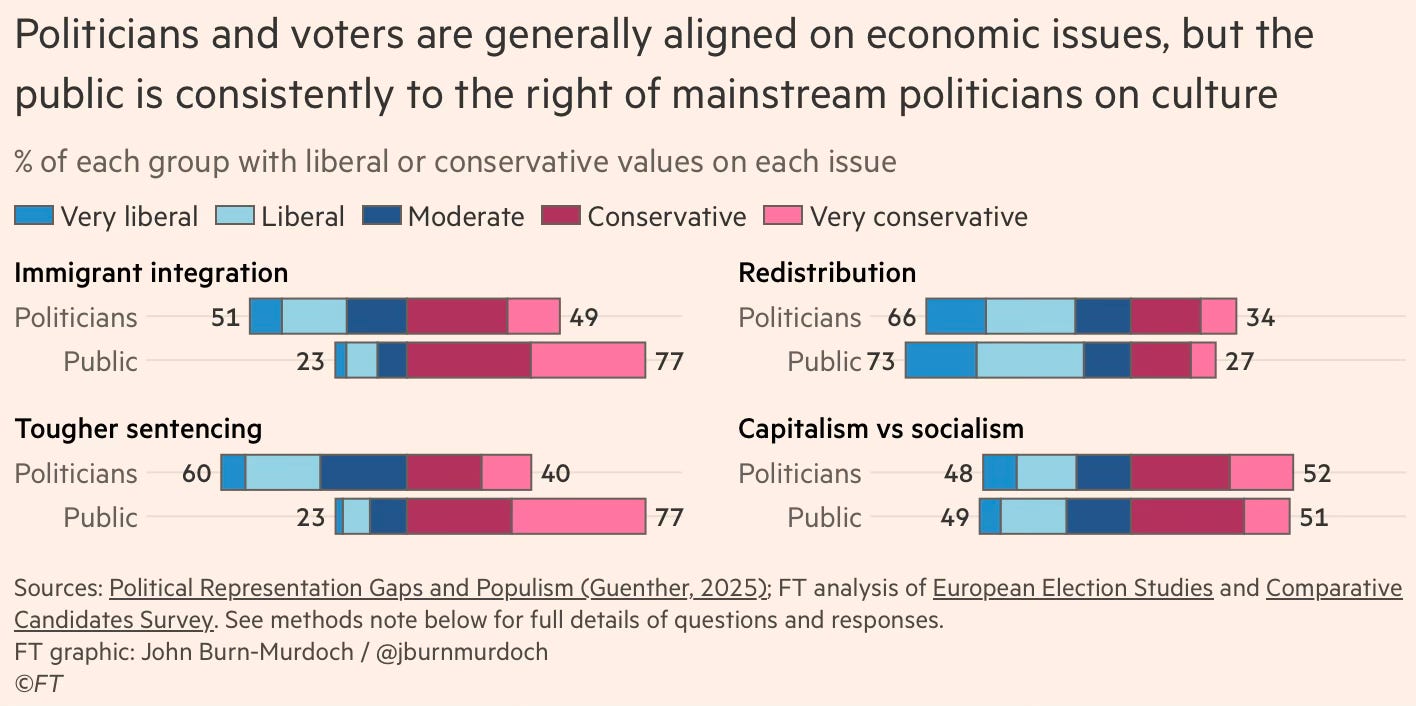
John Burn-Murdoch has an excellent op-ed that compares the views of politicians and voters in Western countries on economic and sociocultural issues. He cites the work of political economist Laurenz Guenther, who draws attention to a remarkable convergence on the former and divergence on the latter. 

Guenther’s analysis shows that voters and mainstream politicians have long been broadly aligned on economic issues like tax and spend or public ownership. But on sociocultural issues such as immigration and criminal justice there is a yawning gulf. Western publics have long desired greater emphasis on order, control and cultural integration. Their politicians have tilted in the opposite direction, favouring more inclusive and permissive approaches. The result is the opening up of a wide “representation gap” — a space on the political map with large numbers of voters but few mainstream politicians or parties — into which the populist right is now rapidly expanding as cultural issues rise in salience.

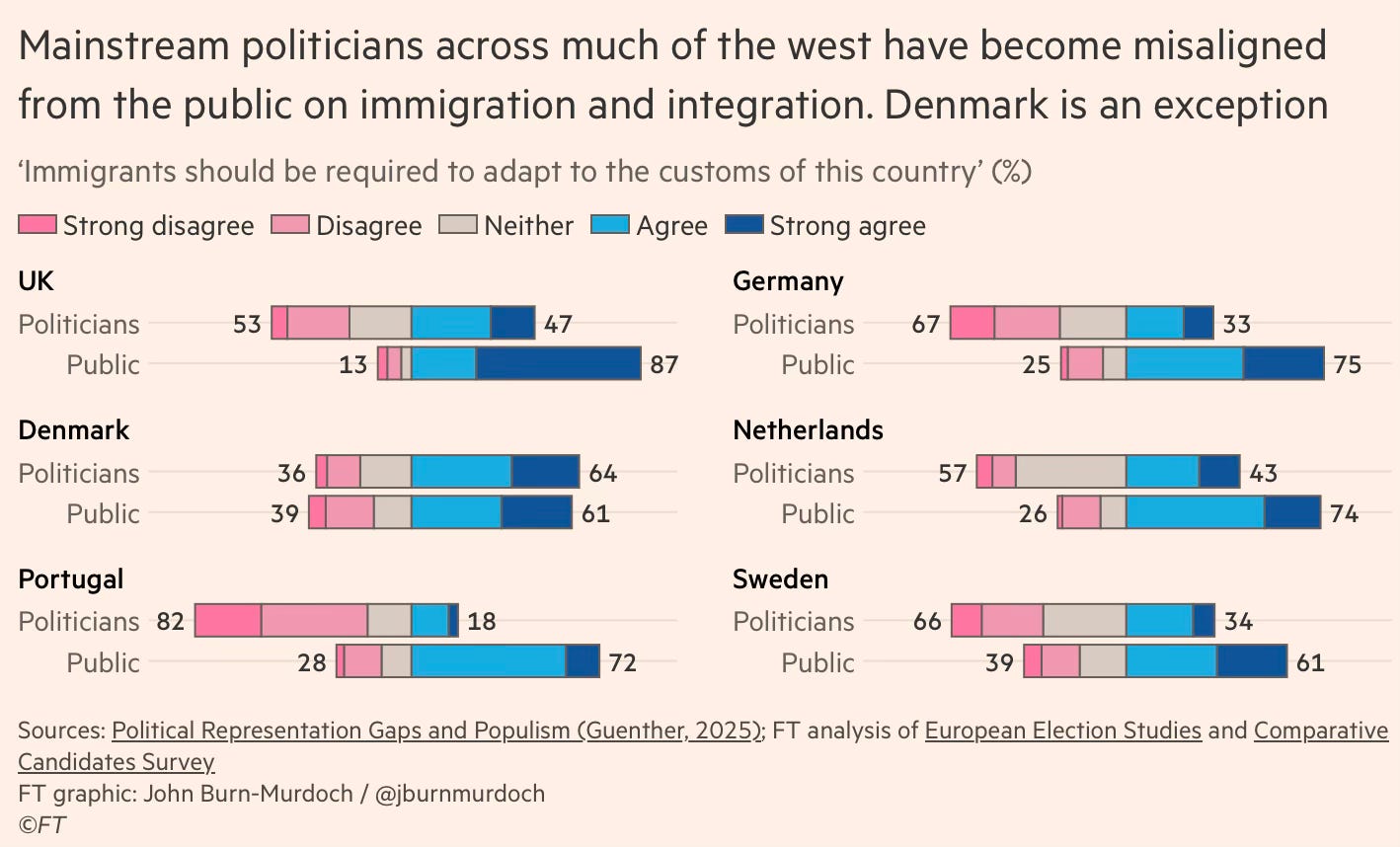
Aside from Denmark, he finds a sharp divergence between the views of politicians and voters on sociocultural issues. 

Burn-Murdoch also writes that 

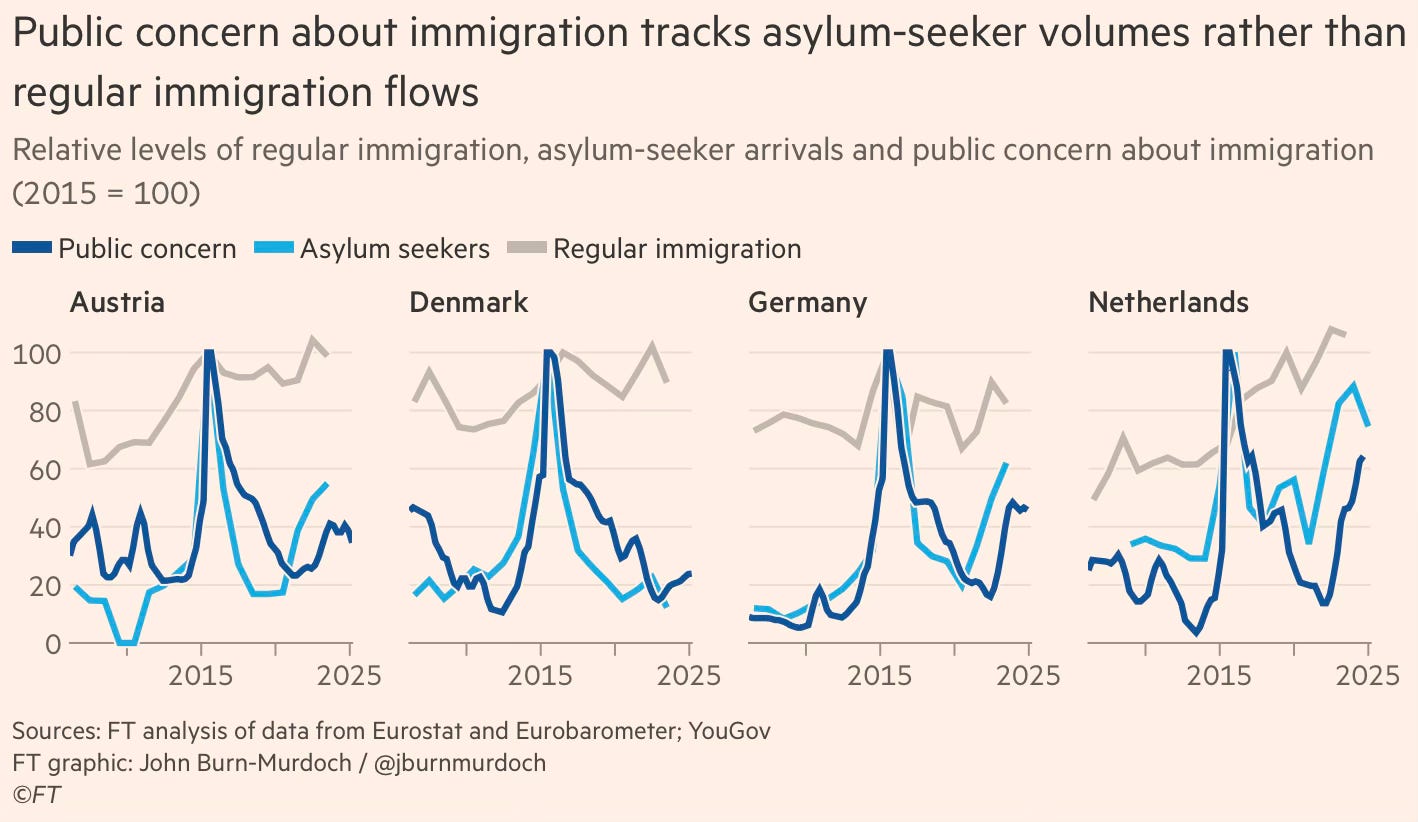
My analysis of decades of data on public perceptions and immigration levels shows that concern consistently tracks irregular migration and failed integration, not people coming to work and study. But Guenther’s research corroborates the consistent finding that the public does not want large flows of arrivals without visas, or a growing share of the population unable to speak the language (both of which have happened). A similar pattern is clear with crime, where rates of arrest and prosecution have fallen in several countries and lower-level disorder is on the rise. Sustained failure to curb these trends under governments of both the centre left and centre right has signalled to the public that the political class either doesn’t see this as a problem or is incapable of addressing it.

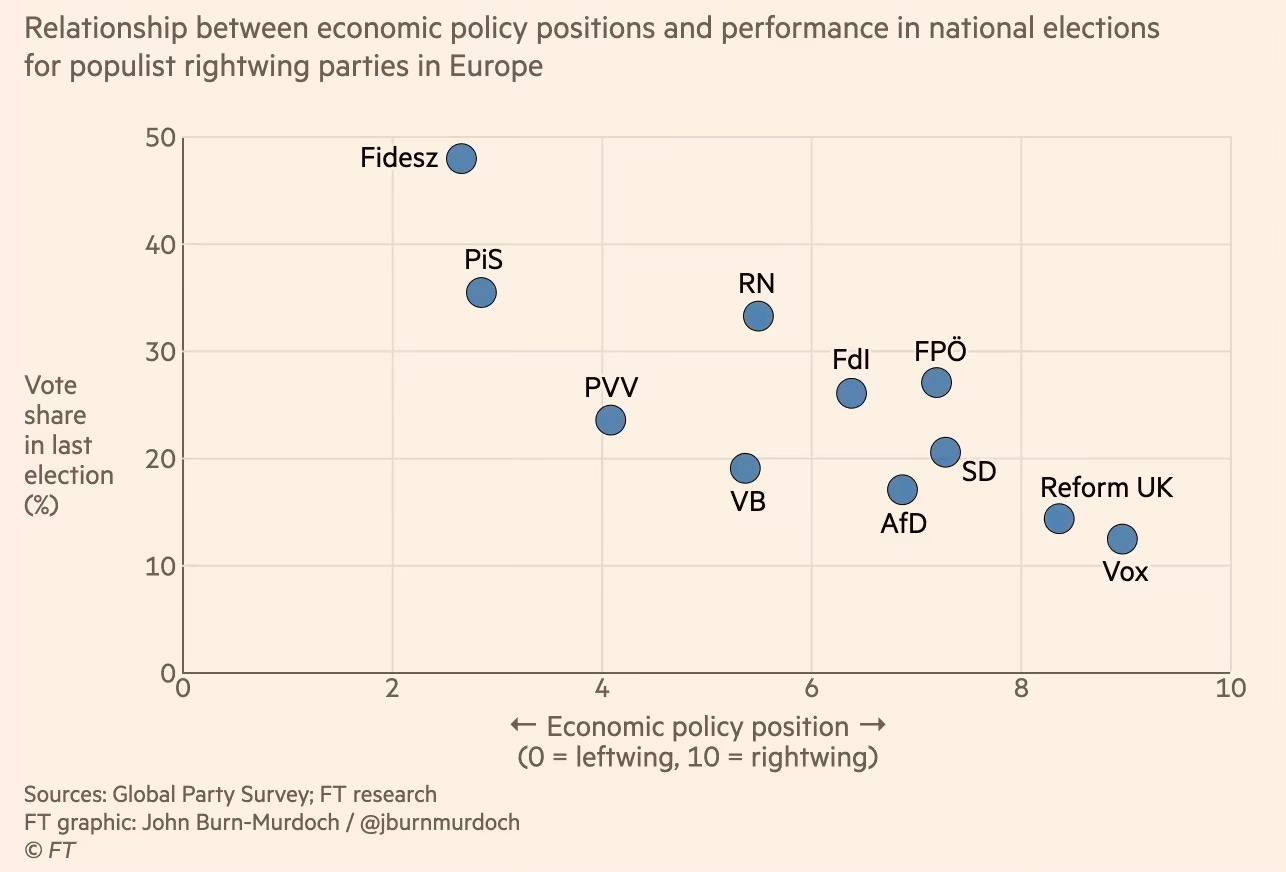
In another article, Burn-Murdoch has shown how “populist parties on the right combine rightwing positions on social issues with left-wing positions on economics”. 

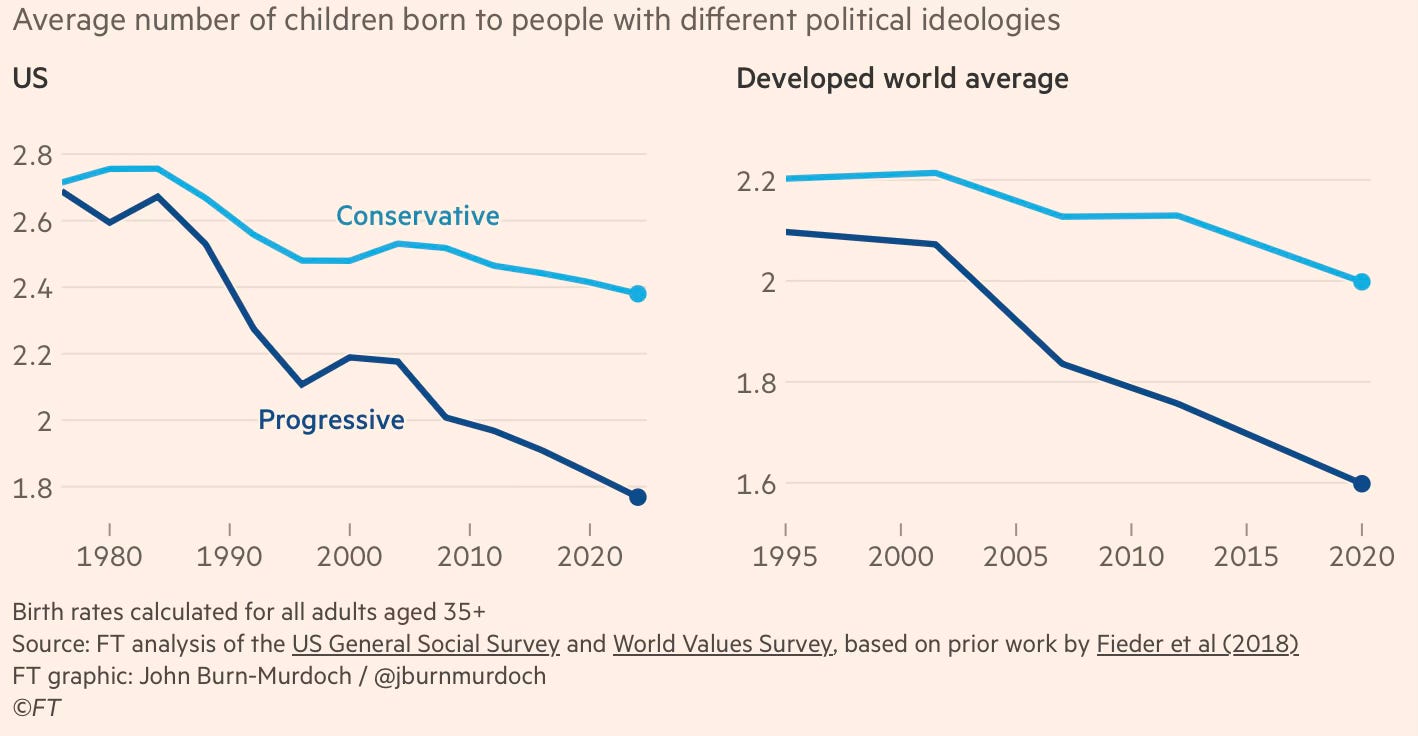
In a third article, he points to declining fertility levels among progressives as a possible explanation for the world becoming more socio-culturally conservative.

I find that the assumption that birth rates are falling across society in general is not really true. From the US to Europe and beyond, people who identify as conservative are having almost as many children as they were decades ago. The decline is overwhelmingly among those on the progressive left, in effect nudging each successive generation’s politics further to the right than they would otherwise have been… A growing left-right birth rate gap will slow that liberalising conveyor belt, and could result in societies and politicians that are less liberal and less concerned with the environment than would otherwise be the case.

The dissonance between the political parties and their voters on socio-cultural issues is surprising, given the importance politicians tend to attach to public opinion surveys. It begs the question as to why parties are unable to recalibrate their positions to reflect the views of their electorate. Also, what explains the dissonance being confined to socio-cultural issues and not to economic issues?

An important reason for the failure to incorporate public perceptions, as I have blogged here and here, is that the leadership of mainstream political parties have become captives of certain interests. This is especially true of the centre-left or social democratic parties, whose leadership largely consists of the beneficiaries of the capitalist economic system. Their social and cultural proclivities are towards the liberal positions on immigration, diversity, minority rights, etc. Sample this description of the Democratic Party leadership in the US.

Since 1980, among all Democratic candidates for president and vice-president of the US, Tim Walz, Kamala Harris’s running mate, was the first not to have a law degree. During the same period, none of the four Republican presidents had a legal background: the first, Ronald Reagan, was an actor and the other three were businessmen. In the US, lawyers are rivalled only by politicians as the most hated professional group. Is it any wonder, then, that the lawyers’ party was overwhelmed? That a platform entirely conceived by lawyers, centred on the defence of democratic procedures and respect for minority rights, whose main argument consisted in the lawsuits against the Republican candidate, was swept away by the recriminations of Trump supporters: inflation, illegal immigration, class contempt? 

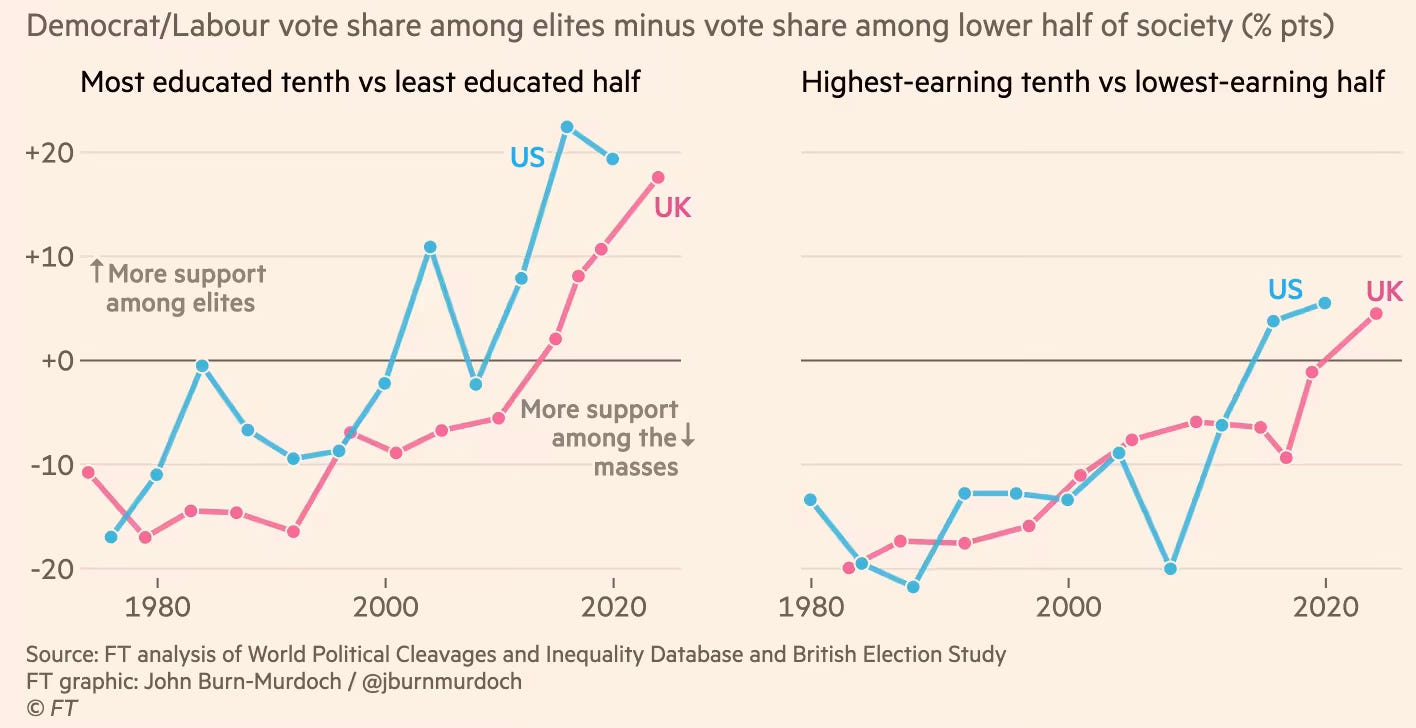
It’s not unsurprising then that in the aggregate, left-wing parties tend to fare better with elites than with the masses on both sides of the Atlantic. 

Burn-Murdoch points to the idea that class has been replaced by education as the new defining cleavage in politics. 

In their book Polarized by Degrees, political scientists Matt Grossman and David Hopkins set out how the realignment of the political divide from class to education has formed strong new alliances that are likely to survive changes in political personnel. While arts and entertainment elites have long leaned leftward, academia has veered further to the left of the general population over recent decades. Conservatives have become a rare breed in journalism, and corporate bosses are increasingly aligned with the left.

While the occupational base of Republican Presidents and candidates may have been more diverse, their economic class base is narrower and has several common features with their Democratic Party counterparts. The traditional left-wing mass electoral base of factory and service industry workers, and the right-wing mass base of primary sector and hinterland residents, are characterised by their lower levels of education, especially compared to the political leadership of both Parties in the US. This explains the comparable levels of dissonance between them and their respective electoral bases on socio-cultural issues. The class dominance has come in the way of their remaining connected with the social views of their electorate.

However, as Rana Faroohar writes, there’s an important, unmistakable emerging political reality arising from the deepening of the class-based dissonance. It’s called populism, of either variants. 

Whatever the outcome, it’s clear that future elections are going to be won or lost on who can convince working people that they will fight for them. For example, the issue of healthcare affordability — surveys show premiums will probably rise by 10 per cent or more next year — is driving the launch of “TrumpRx”, a federal website through which Americans will be able to purchase discounted drugs (ironically taking a page from Obamacare). The affordability crisis is also behind the rent freezes and municipally owned groceries suggested by (Zohran) Mamdani.

The alignment on economic issues is more intriguing, especially given the clearly widening inequality and rising relative deprivation in the US. Besides, there are clear faultlines along education levels between political leadership in both Parties and their respective electorates. 

I’m inclined to argue that while the dissonance between political leadership and electorate will be less likely (at least for now) on broad principles like support for the capitalist system with a social welfare net (as captured in the survey mentioned above), it’s likely to be more pronounced on issues like business concentration and anti-trust actions, or tax cuts and welfare squeezing, or deregulation and quality of job creation.

Saturday, August 10, 2024

Weekend reading links

1. Fascinating tweet thread by Ed Conway about the Bretton Woods System that pegged the exchange rates of 44 countries with the IMF entrusted the responsibility of managing it. This graphic illustrates the remarkable currency stability among these countries in the 29 years of its existence.

This currency stability combined with a few other things resulted in a period of remarkable economic prosperity. This is a striking graphic about productivity and compensation in the US.
2. Good article that evaluates the semiconductor chips making in India, specifically the partnership between Tata Electronics and PSMC, one of the smaller Taiwanese chip manufacturing companies.
This is unlike the venture the other big player, Taiwan SemiconductorManufacturing Company (TSMC), is undertaking abroad – the company’s new fab in the Japanese city of Kumamoto, two $40 billion facilities in Phoenix, Arizona, and a commitment to invest nearly $4 billion to build a fab in Dresden, Germany. In these new fabs, apart from significant equity investment, TSMC, the ninth-most valuable business in the world, is an equity partner, and has invested in the ecosystem; it has taken along its key vendor base of some 25-30 companies to each of these locations, and is also undertaking large-scale training of manpower on the nuances of chip fabrication, a high tech-intensive job. In the Tata-PSMC venture, much of the heavy lifting is done by the Tatas, who have no real experience in chip manufacturing so far... The fact is, for TSMC to be successful outside Taiwan, it takes more than just its expertise. It takes its suppliers along so that an ecosystem develops locally for the construction expertise, material supplies, and equipment deliveries. For instance, TSMC has moved around 40 Taiwanese companies to Japan (for the new plant in Kumamoto), and taken around 30 of them to Arizona for the new plants.

3. NYT has an interview with Robert Putnam.

We looked at long-run trends in connectedness, trends in loneliness, that sort of thing, over the last 125 years. And the short version is, it’s an upside-down U curve. We were socially isolated and distrustful in the early 1900s, but then there was a turning point, and then we had a long upswing from roughly 1900 or 1910 till roughly 1965, and that was the peak of our social capital. People were more trusting then, they were more connected then, they were more likely to be married then, they were more likely to join clubs then, etc. And then for the next 50 years, that trend turned around...

That trend in political depolarization follows the same pattern exactly that the trends in social connectedness follow: low in the beginning of the 20th century, high in the ’60s and then plunging to where we are now. So now we have a very politically polarized country, just as we did 125 years ago. The next dimension is inequality. America was very unequal in what was called the Gilded Age, in the 1890s and 1900s, but then that turned around, and the level of equality in America went up until the middle ’60s. In the middle ’60s, America was more equal economically than socialist Sweden! And then beginning in 1965, that turns around and we plunge and now we’re back down to where we were. We’re in a second Gilded Age. And the third variable that we look at is harder to discuss and measure, but it’s sort of culture. To what extent do we think that we’re all in this together, or it’s every man for himself, or every man or woman? And that has exactly the same trend.

He makes the distinction between bonding and bridging social capital.

Ties that link you to people like yourself are called bonding social capital. So, my ties to other elderly, male, white, Jewish professors — that’s my bonding social capital. And bridging social capital is your ties to people unlike yourself. So my ties to people of a different generation or a different gender or a different religion or a different politic or whatever, that’s my bridging social capital. I’m not saying “bridging good, bonding bad,” because if you get sick, the people who bring you chicken soup are likely to reflect your bonding social capital. But I am saying that in a diverse society like ours, we need a lot of bridging social capital. And some forms of bonding social capital are really awful. The K.K.K. is pure social capital — bonding social capital can be very useful, but it can also be extremely dangerous. So far, so good, except that bridging social capital is harder to build than bonding social capital. That’s the challenge, as I see it, of America today.

4. In an interesting reversal of fortunes, developing countries have become more fiscally prudent compared to their developed counterparts, and central banks across developing countries are exhibiting greater responsibility and independence. Sample this from Gavekal.

Across the emerging markets, political leaders with populist leanings are calling for looser fiscal policy. Many are also berating local central banks for failing to do more to support growth, and leaning on them to loosen monetary policy. For the most part, central bankers, jealous of their independence, are pushing back and keeping monetary conditions relatively tight to counter inflation. This raises the prospect of loose fiscal, tight monetary policy settings in a number of key emerging markets, argues Udith Sikand. It also throws the contrast between emerging and developed market central banks into sharp relief. Arguably, developed market central banks have caved in to fiscal dominance, keeping real rates for the most part low or negative over recent years to prevent public debt burdens from becoming unsustainable. By contrast, emerging market central banks are likely to maintain positive real rates in order to attract funding to cover growing fiscal deficits. The bottom line is that this sets up conditions for a potential triple merit scenario in emerging markets over the coming years, with local risk assets and currencies rising strongly.
5. India's long tail of corporate tax distribution

A total of 353 companies earning above Rs 500 crore accounted for 55.7 per cent of the Rs 14.7 trillion in gross total income recorded by all companies in 2018-19. A total of 842 companies made more than Rs 500 crore in 2023-24 and accounted for 62 per cent of the Rs 34.6 trillion in gross total income recorded by all companies.
India's textile industry, valued at USD 250 billion, provides jobs to 50 million people. The sector is divided into three broad categories - Textiles (fibre, yarn, and fabrics); Garments and; Made-ups (Bed sheets, curtains etc.). India is present across all parts of the value chain. In 2023, China exported USD 114 billion worth of garments, followed by the EU (USD 94.4 billion), Vietnam (USD 81.6 billion), Bangladesh (USD 43.8 billion), and India with just USD 14.5 billion. From 2013 to 2023, Bangladesh's garment exports grew by 69.6 per cent, Vietnam's by 81.6 per cent, and India's by only 4.6 per cent. "As a result, India's global market share in garment trade has declined from 2015 to 2022. The share of knitted apparel dropped from 3.85 per cent to 3.10 per cent, and the share of non-knitted apparel decreased from 4.6 per cent to 3.7 per cent," GTRI founder Ajay Srivastava said. He said that the garment imports too surged by 47.90 per cent, from USD 1.06 billion in 2018 to USD 1.56 billion in 2023. Textile imports also saw a notable increase of 20.86 per cent, from USD 5.77 billion to USD 6.97 billion. 

7.  A new NBER working paper points to more evidence of price markups in the US economy. It uses data on price data from more than 100 distinct product categories in the US in the 2008-19 period. 

We estimate demand with flexible consumer preferences and recover time-varying markups for individual products under the assumption of profit maximization. Our results indicate that markups increased by about 30 percent during our sample period. This reflects within-product changes and is primarily due to reductions in marginal costs, rather than increases in (real) prices. Changes in marginal costs, along with declining consumer price sensitivity, account for the vast majority of the time series variation in aggregate markup changes between 2006 and 2019. Our model indicates that consumer surplus has increased despite rising markups, though the increases are concentrated among higher-income consumers.
Between 2006 and 2023, Mr. Buffett had given more than $39 billion to the Gates Foundation. By comparison, Mr. Gates and Ms. French Gates gave $39 billion between 1994 and 2022, including $22 billion to get the foundation going in 2000. In some years, the former couple gave less than half a billion. In 2021, they pledged $15 billion to the foundation’s endowment, and the following year, they transferred that money, as well as another $5 billion Mr. Gates had contributed.

9. Important point made by Richard Rorty (HT: Rana Faroohar)

National pride is to countries what self-respect is to individuals: a necessary condition for self-improvement. Too much national pride can produce bellicosity and imperi­alism, just as excessive self-respect can produce arrogance. But just as too little self-respect makes it difficult for a person to display moral courage, so insufficient national pride makes energetic and effective debate about national policy unlikely.

10. An important trend to be kept in mind as we follow China, the sharply increasing Chinese emmigration.

The number of Chinese citizens living in Malaysia has almost doubled over the past three years, driven by a jump in students and new investors, according to government officials, academics, schools, and business and community associations... China’s slowing economic growth as well as a more heavy-handed approach to business have driven more of its citizens to seek new lives abroad. Wealthy Chinese citizens have flocked to destinations such as Singapore and Malta where they have acquired citizenship through investment, and they make up the largest source of golden visa applicants in Portugal and Greece. Chinese citizens also form one of the largest groups of illegal migrants attempting to enter the US from Latin America...

Malaysia... is home to a centuries-old Chinese diaspora that makes up about 23 per cent of its 34mn citizens. Most new Chinese arrivals are middle-class families who see south-east Asia as a more affordable destination, or students shying away from anti-China sentiment in the west, making Chinese people the largest group of foreign students and long-stay residents in Malaysia. Universities and international schools in Malaysia are reporting soaring demand. The nation’s higher education institutions had 44,043 Chinese students enrolled last year, up 35 per cent from 2021, according to the education ministry... the number of Chinese pupils in international schools more than doubled in the same timeframe from 2021 to 2023. More than 56,000 Chinese immigrants now hold Malaysia My Second Home long-stay visas, more than double last year’s number. Chinese investors are also contributing to the boom in expatriate numbers. There are about 45,000 owners, managers and workers of Chinese companies in Malaysia, up from an estimated 10,000 in 2021, according to a Chinese trade official... The rise in Chinese residents mirrors an earlier trend in Thailand. Sivarin Lertpusit at Thammasat University in Bangkok said the number of new Chinese immigrants in Thailand was “rapidly increasing”, reaching 110,000-130,000 living in the country in 2022, most of them entrepreneurs, employees, students and their family members as well as lifestyle migrants.

11. The week saw a US federal judge ruling on a DoJ suit that Google spent billions of dollars on exclusive deals to maintain an illegal monopoly on search, a sector where it handles more than 90% of online queries. The judge, Amit Mehta, of the US District Court for the District of Columbia, said, "Google is a monopolist, and it has acted as one to maintain its monopoly."

The DoJ argued the search giant paid tens of billions of dollars a year for anti-competitive deals with wireless carriers, browser developers and device manufacturers — and in particular Apple. These payments, which cemented Google as the default search engine, totalled more than $26bn in 2021, according to the decision... The proceedings will now enter a second phase in which the court will determine what remedies Google needs to take. The DoJ has not yet indicated what penalties it would seek, but it may focus on curbing Google’s ability to strike the deals at issue in the case. The decision is the biggest win against Big Tech by US antitrust enforcers in decades... the DoJ’s antitrust division, led by Kanter, has sued Apple and has a second case pending against Google, accusing it of allegedly exercising monopolistic control of the digital advertising market. The second Google trial is set to begin next month. The Federal Trade Commission, chaired by Big Tech critic Lina Khan, has also filed lawsuits against Amazon and Meta. 

Google’s years-long agreement with Apple to make it the default search engine on the iPhone’s Safari browser has long drawn scrutiny. Unsealed court documents showed that Google paid Apple $20bn in 2022 alone. This would amount to a substantial portion of Apple’s $85bn-a-year services business, which includes its App Store and Apple Pay... Also at issue in the case were contracts the tech giant reached over the years with browser developer Mozilla, Android smartphone makers Samsung, Motorola and Sony, and wireless carriers AT&T, Verizon and T-Mobile... The ruling strikes at the heart of Google’s most prominent business. The company made $175bn in revenue from its search-based advertising last year, more than half its $307bn of total revenue... Google’s “distribution agreements foreclose a substantial portion of the general search services market and impair rivals’ opportunities to compete”, Mehta said in the ruling. “Google has not offered valid pro-competitive justifications for those agreements.” The deals deny competitors “scale”, he said, which is “the essential raw material for building, improving, and sustaining” a general search engine. Google benefits from a “feedback loop” in which parties “routinely renew” exclusive distribution deals with the company, Mehta added. “That is the antithesis of a competitive market.”

Judge Mehta pointed to three ways in which Google distorted competition

The company’s grip over 90 per cent of the search market enabled it to make super-profits from advertisers. Its business model, based on surveillance advertising, compromised user privacy, which rival search engines might otherwise prioritise. And its massive payments to Apple, and other tech companies, for default distribution of Google search on their devices and services in effect buy off potential competitors, stifling innovation.

This about the extent of Google's dominance

According to Mehta’s decision, nearly 90 per cent of US search queries flowed through Google in 2020, and 95 per cent for mobile. It has no serious rivals — the next closest, Microsoft’s Bing, accounted for just 6 per cent. The advertising business Google has built around its search business generates enormous revenue: $175bn last year, more than half its $307bn total. It has spent lavishly to protect its cash cow: Google’s total payments to the likes of Apple and Mozilla to make it their default search engine reached more than $26bn in 2021 alone, Mehta said.

This is a summary of the cases against the other Big Tech companies. 

12. This blog has long held that India's objective should be to grow at 6% for the next 30 years, and use the occasional tailwinds to opportunistically engage for episodes of slightly higher rates. TT Rammohan points to the WDR 2024 and makes this important point.

The WDR 2024 report complements the findings of a study carried out by the World Bank in 2008 under the leadership of Nobel Laureate Michael Spence. That study showed that growth of over 7 per cent for over 25 years from any starting point, not just from a MIC starting point, is a tall order — only 13 economies had been able to do so. Of these, nearly half were small economies. The economies that had grown rapidly had had the benefit of a post-World War II world environment that was substantially open to free trade.

M Govinda Rao points to the accounting challenges with India's growth aspirations

According to the World Bank’s definition, a developed country in fiscal 2025 has a per capita gross national income (GNI) of $14,005. India’s GNI is estimated at $2,600, implying that to leapfrog into the developed country club, India must multiply its per capita GNI by 5.3 times. This translates into an average annual growth of about 7.5 per cent in per capita GNI or about 9 per cent per year in overall GNI for the next 23 years... Accelerating growth requires the economy to enhance both investments and productivity. At the present incremental capital-output ratio of 5, the investment rate must increase to 40 per cent of gross domestic product (GDP) from the prevailing 34 per cent. Any shortfall will have to be compensated by increasing productivity.

13. Some striking numbers about the role of state in today's capitalist society.

Sovereign Wealth Funds (SWFs) controlled more than $11.8 trillion in 2023, beating hedge funds and private equity firms combined, up from $1 trillion in 2000. State-owned enterprises (SOEs) had assets worth $45 trillion in 2020, the equivalent of half of global gross domestic product, up from $13 trillion in 2000. The Organization for Economic Cooperation and Development calculates that half of the world’s 10 biggest companies and 132 of its 500 biggest are SOEs...

For the most part, these SOEs are different from the state-owned bureaucracies of old. The state acts as a passive shareholder (sometimes with a majority but often with a minority share) rather than as a hands-on owner. The chief executives tend to have MBAs from fashionable schools and, in many cases, experience in the private sector. And the companies participate fully in global markets rather than, like old fashioned state-owned companies, hiding behind national walls... Big European SOEs have been buying up smaller private companies across Europe: France’s SNCF and Deutsche Bahn AG have purchased British railway companies, creating the oddity of foreign state companies running Britain’s privatized railways, while Spain’s Telefonica SA has expanded across Europe and the Americas. The Norwegian sovereign wealth fund is so big, controlling more than $1.7 trillion in assets, that it owns almost 1.5 per cent of the shares in all the world’s listed companies.

14. Some interesting snippets about China's priortisation of science education and applied research in areas close to the country's strategic priorities. 

A majority of undergraduates in China major in math, science, engineering or agriculture, according to the Education Ministry. And three-quarters of China’s doctoral students do so. By comparison, only a fifth of American undergraduates and half of doctoral students are in these categories, although American data defines these majors a little more narrowly... China’s lead is particularly wide in batteries. According to the Australian Strategic Policy Institute, 65.5 percent of widely cited technical papers on battery technology come from researchers in China, compared with 12 percent from the United States. Both of the world’s two largest makers of electric car batteries, CATL and BYD, are Chinese. China has close to 50 graduate programs that focus on either battery chemistry or the closely related subject of battery metallurgy. By contrast, only a handful of professors in the United States are working on batteries...

The roots of China’s battery successes are visible at Central South University in Changsha, a city in south-central China and a longtime hub of China’s chemicals industry. Central South University has nearly 60,000 undergraduate and graduate students on an extensive, modern campus. Its chemistry department, once in a small brick building, has moved to a six-story concrete building with labyrinths of labs and classrooms. In one lab, which is filled with glowing red lights, hundreds of batteries with new chemistries are tested at the same time. Electron microscopes and other advanced equipment occupy other rooms... Peng Wenjie, a professor, has set up a battery research company nearby that employs more than 100 recent doctoral and master’s program graduates and over 200 assistants. The assistants work in relays for each researcher so that the testing of new chemistries and designs continues 24 hours a day... Building and equipping an electric-car battery factory in the United States costs six times as much as in China, said Robin Zeng, the chairman and founder of CATL. The work is also slow — “three times longer,” he said in an interview.

It would be useful to go back and check on similar articles that compared the scientific research focus in the Soviet Union and its comparison with the US. The Communist Party recognised the importance of higher education and research, and the USSR was a leader in basic sciences education and in applied research, competing on level terms in many of the cutting-edge areas of technology. We now know that it didn't go much far. 

Not saying that the same fate awaits China. But it's useful to keep history in mind and judge such trends with some perspective, and not in any absolute terms. 

Thursday, August 3, 2023

Family is destiny - evidence from college admissions in the US

I have blogged many times on the ovarian lottery, the disproportionate importance of family connections in determining life outcomes. Family is destiny.

Raj Chetty, David Deming, and John Friedman have just released a new Opportunity Insights study (pdf here and NYT illustration here) using college admissions data from 1999 to 2015 from 12 elite colleges (Ivy League, MIT, Duke, U Chicago, and Stanford) that illustrate the outsized nature of preferential treatment that children of alumni (legacy applicants) enjoy in Ivy League undergraduate admissions. The authors used detailed anonymised internal admissions assessments data, SAT and ACT scores, and incomes of parents and post-graduation incomes of students. A summary of their findings

Children from families in the top 1% are more than twice as likely to attend an Ivy-Plus college as those from middle-class families with comparable SAT/ACT scores. Two-thirds of this gap is due to higher admissions rates for students with comparable test scores from high-income families; the remaining third is due to differences in rates of application and matriculation. In contrast, children from high-income families have no admissions advantage at flagship public colleges. 

The high-income admissions advantage at private colleges is driven by three factors: (1) preferences for children of alumni, (2) weight placed on non-academic credentials, which tend to be stronger for students applying from private high schools that have affluent student bodies, and (3) recruitment of athletes, who tend to come from higher-income families... we show that attending an Ivy-Plus college instead of the average highly selective public flagship institution increases students’ chances of reaching the top 1% of the earnings distribution by 60%, nearly doubles their chances of attending an elite graduate school, and triples their chances of working at a prestigious firm. Ivy-Plus colleges have much smaller causal effects on average earnings... Adjusting for the value-added of the colleges that students attend, the three key factors that give children from high-income families an admissions advantage are uncorrelated or negatively correlated with post-college outcomes, whereas SAT/ACT scores and academic credentials are highly predictive of post-college success. 

We conclude that... highly selective private colleges serve as gateways to the upper echelons of society in the United States. Because these colleges currently admit students from high-income families at substantially higher rates than students from lower-income families with comparable academic credentials, they perpetuate privilege across generations.

The graphic below captures the admissions advantage enjoyed by legacy students

That the legacy status is large is borne out by the finding that the legacy advantage enjoyed over other non-legacy applicants is much higher than the same students' admission prospects in other elite colleges 
They also compared legacies’ chance of admission at the colleges their parents attended versus similarly elite schools. They found that they were slightly more likely to get in to the other colleges than applicants with the same test scores. But that was dwarfed by the advantage they got at the school their parents attended.
The study goes further and examined the income tax records of graduates of these colleges and analysed their post-college outcomes. 
They estimated that legacy students were no more likely than other graduates to make it into the top 1 percent of earners, attend an elite graduate school or work at a prestigious firm. If anything, they were slightly less likely to do so.

Needless to say, legacy students are more likely to be white and more likely to come from rich families. The study found that even among the legacies, the richest had an advantage. One in six Ivy League students has parents in the top 1%.

The legacy status builds on an already entrenched advantage arising from these students having access to much superior schooling, tuition, coaching, exposure and so on. Unsurprisingly, the study finds that even without legacy status, these students would still be about 33% more likely to be admitted than applicants with the same test scores, based on all their other qualifications. In fact, even without legacy, family wealth already has a stunning relationship with elite college admissions.  

The study looks at the non-academic credentials like extracurricular activities, internships, volunteering, recommendations etc of students admitted to these colleges.

The academic ratings of richer students didn’t vary much from other students with the same test scores. But richer students were vastly more likely to earn high marks on nonacademic measures like extracurricular activities and recommendation letters... At one of the colleges that shared admissions data, students from the top 0.1 percent were 1.5 times as likely to have high nonacademic ratings as those from the middle class... The biggest contributor was that admissions committees gave higher scores to students from private, nonreligious high schools. They were twice as likely to be admitted as similar students — those with the same SAT scores, race, gender and parental income — from public schools in high-income neighborhoods. A major factor was recommendations from guidance counselors and teachers at private high schools... Recommendation letters from private school counselors are notoriously flowery... and the counselors call admissions officers about certain students... Nobody’s calling on behalf of a middle- or lower-income student. Most of the public school counselors don’t even know these calls exist.

Even after adjusting for higher SAT scores, finely honed resumes, higher application rates etc, they were still over-represented

For applicants with the same SAT or ACT score, children from families in the top 1 percent were 34 percent more likely to be admitted than the average applicant, and those from the top 0.1 percent were more than twice as likely to get in.
The new data shows that among students with the same test scores, the colleges gave preference to the children of alumni and to recruited athletes, and gave children from private schools higher nonacademic ratings. The result is the clearest picture yet of how America’s elite colleges perpetuate the intergenerational transfer of wealth and opportunity... In effect, the study shows, these policies amounted to affirmative action for the children of the 1 percent, whose parents earn more than $611,000 a year.
The study finds that the elite nine flagship public universities were much more equitable. 
At places like the University of Texas at Austin and the University of Virginia, applicants with high-income parents were no more likely to be admitted than lower-income applicants with comparable scores.
The paper points to the share of individuals who attended Ivy-Plus colleges in leadership positions across different realms. Though these twelve colleges made up less than 1% of all college admissions in the US, their dominance is widely present across leadership positions.
The striking statistic is the dominance of Ivy graduates in public service leadership positions. About three in four US Supreme Court judges graduated from Ivy Pls colleges! In simple terms, the influential positions that inform public issues have vastly disproportionate representation of Ivy-plus graduates. 

One of the authors, Raj Chetty, captured the findings best
“Are these highly selective private colleges in America taking kids from very high-income, influential families and basically channeling them to remain at the top in the next generation? Flipping that question on its head, could we potentially diversify who’s in a position of leadership in our society by changing who is admitted?”

This Mathew Effect has two implications - wealth begets wealth, and also wealth shuts out the rest. To borrow Peter Turchin's framework in his latest book, End Times, the former leads to elite overproduction and the latter leads to mass immiseration. At a macro-level, the former is a dynamic of capitalism, especially the modern globalised economy with its economies of scale and knowledge-based sectors with their network effects. And the latter is accentuated by the elite capture of the establishment and the rules -making process. As I have blogged on several occasions, it's this latter dynamic that's the most disturbing aspect of modern capitalism - Big Tech and Wall Street invariably end up capturing the rules-making process and corroding the social contract. 

Most of the disturbing economic, social and political trends we see today across the world have these two factors as important contributors. The rise of populism and widening inequality threatens to destroy the social fabric and usher in the crisis that the likes of Turchin and Neil Howe write about. 

Instead of their mindless and almost unconstrained pursuit of market capitalisation, executive compensation, profits maximisation, tax reduction and avoidance, deregulation, efficiency maximisation, automation, technology led lifestyles, union busting, etc elites need to realise that the ship is entering very stormy waters and could sink. Karl Marx may turn out to have the last laugh, if only a few decades late. 

Update 1 (05.08.2023)

From David Brooks

A 2018 study found that more than 50 percent of the staff writers at the beloved New York Times and The Wall Street Journal attended one of the 29 most elite universities in the nation.