Substack

Showing posts with label Technology. Show all posts

Saturday, July 18, 2026

Weekend reading links

1. Are people overreacting to small struggles?

When asked if they would consider someone experiencing typical fluctuations in mood (described as broad happiness but occasional moments of worry, frustration or loss of confidence) as having a mental illness, more than half of young Americans say yes, up from just a fifth 15 years ago.

2. A picture of state finances.

3. The promise of quantum computing.
Quantum computers can transcend the limitations of the traditional binary computer bit, which can exist in two states, denoted by zero and one. By contrast, quantum bits, or “qubits”, can exist in both those states at once. This allows quantum machines to survey multiple potential solutions simultaneously, rather than dealing with them one by one like a conventional computer. One analogy is a maze. Where a quantum computer can examine the whole map to find a way through, a traditional machine will keep exploring dead ends until it finds the route. Quantum computers’ superior processing power should make them better able to generalise from small amounts of data and sift through multiple complex patterns...
But many companies are already experimenting with the technology because of its promised leap in capability, predicting early uses for the machines in areas such as chemistry and materials science. The idea is that because of their own workings and structure the computers will be better able to analyse and predict chemical behaviour determined by atomic and subatomic interactions governed by quantum rules. In a sense, they will be speaking the same language rather than translating an analysis into a string of ones and zeros as a traditional computer does. As a result, a sufficiently powerful quantum machine should in theory be adept at predicting the interactions between drugs and living cells that determine whether a new pharmaceutical will work. Such possibilities have already led tech companies to pair up with industrial groups.

4. India's trade account in a nutshell.

In 2025-26, its exports of services, at $421.3 billion, was close to the export of goods worth $446.1 billion. On the other hand, imports of goods ($783.4 billion) were way above the imports of services ($204.7 billion). Thus, while India recorded a merchandise trade deficit of $337.3 billion, it had a surplus of $216.6 billion on the services account.

5. Brilliant article by Simon Kuper on how football came to be dominated by Western Europe.

Western Europeans didn’t start by asking, “How can we win the World Cup?” Instead, they pursued a different goal: making amateur football cheap and widely available. The intended outputs were happiness, community and public health. Winning World Cups was a byproduct... I began playing football aged six, in 1976, after moving from London to Leiden in the Netherlands. Most Dutch boys I met belonged to a football club... The little Leiden region had dozens of football clubs. Some fielded 20 senior teams, seven teams of under-eights and so on. Many people built their identity and social life on being the right-back or linesman of the 14th team. The Netherlands in the 1970s reached two World Cup finals. Everyone played and understood how to play. Football is geometry — about creating space when you have the ball, and shrinking it when you don’t. That knowledge is all around you in western Europe, unlike in Asia, Africa, the US or Brazil... In 2017, the average Dutch person lived 1.6km from a football field. Neighbouring Germany’s football federation is the world’s largest sports association, with more than 7.7mn members...

As a father, I raised three footballers in Paris, now the game’s deepest talent pool. Almost all Parisian suburbs, or banlieues, have well-kept sports complexes, with artificial fields, used nonstop: at half-time of any amateur game, children storm on to the field for a kickaround. So structured is the system that my son had to earn a coaching diploma to train his little club’s under-eights. His own beloved coach, Mustapha SangarĂ©, who only joined a football club aged 15, now plays for Bulgaria’s Levski Sofia and Mali. He is far from an anomaly: almost 100 players across all squads in the current World Cup were born in France and just under 70 in the Netherlands.

In another article Tej Parikh looks at why China and India does so badly in football.

This is a striking statistic, pointing how globalised football has become and how the leading European clubs have become the feeding grounds for national teams. 

At this World Cup, more than 72 per cent of players appear for a club outside the country of their national team, and almost one in four are foreign born. (More than half of Cape Verde’s squad was born outside the nation and ply their trade in various European leagues.)

6. In what will prove to be a dramatic decision, DP World, which operates the Jebel Ali port that has been paralysed by the closure of the Strait of Hormuz, is reportedly planning to build a new port and a container terminal on the UAE's eastern coastal area of Fujairah. 

Shifting some of the port’s capacity outside Dubai marks a seismic change for the emirate, which has established itself as a global trade and finance hub partly off the back of Jebel Ali’s growth... But DP World’s plans align with a broader UAE government initiative to attempt to bulletproof its economy against future hostilities with Iran by reducing its dependence on the strait, where shipping has been disrupted by Iranian drones and missile strikes since the US-Israeli attack. The new project would deepen DP World’s presence on the Gulf of Oman, allowing containers to enter and leave the country without having to pass through the strait, before moving them on trucks overland to Dubai, Abu Dhabi and neighbouring Gulf countries. Since the war began at the end of February, Iran has fired nearly 3,000 drones or missiles at the UAE — more than any other country... DP World’s plans underline how the Iran war has forced governments and companies in the region to reconsider infrastructure and economic corridors developed on the premise that there would be uninterrupted passage through the strait.

7. Rote memorisation in schools is celebrated in China.

The guidelines to the gaokao, an exam for 18-year-olds and the world’s largest standardised test, describe memorisation as “the most basic level of ability”, placing it first among six traits that include comprehension, analysis and synthesis, appreciation and evaluation, expression and application, and inquiry. At the simplest level, the Chinese script itself, which operates at the level of the syllable and involves thousands of individually meaningful characters, requires years of memorisation... It is hard not to draw a contrast with the English-language west, where rote memorisation has taken on a faintly pejorative meaning. More than a century and a half ago, at the height of Britain’s industrial age, Charles Dickens was skewering the “facts alone are wanted in life” approach of fictional educator Gradgrind in the novel Hard Times.

8. Trump's makeover of the US State Department

Abandoning the precedent of the past 60 years, Trump has brushed aside the foreign service officers who have typically run at least two-thirds of embassies. Of the 101 nominations for ambassadorships in his second term, just nine were career diplomats. All this is against the backdrop of swingeing cuts to the department, whose workforce has shrunk by more than 3,000, over 20 per cent, since Trump resumed office.
9. China's remarkable success in reducing air pollution by 60% since 2013. 

10. Interesting that the IT sector explains half the difference in productivity growth between the US and EU.
Strikingly, even though the tech sector was only 9.2 per cent of US GDP, against 5.4 per cent of the EU’s, almost half of the difference in productivity growth between the two economies was explained by differences in the relative size of this one sector. Moreover, productivity growth in the EU’s (relatively small) tech sector was also measured as being lower than in the US one. So, overall, the tech sector alone accounts for well over half of the overall difference in growth of GDP per head.

This is important

Life expectancy for US men was 76.5 in 2024, against an average of 80.5 in comparable high-income countries. For women, it was 81.4 against 84.8. That is despite spending a far higher proportion of its GDP on health. The US homicide rate was 5.9 per 100,000 in 2023, against 1.3 in France and 0.9 in Germany. Its prison population was 542 per 100,000 in 2023, against 130 in France and 69 in Germany. Thus, if one takes a wider view of human welfare, the US is very far from superior.

11. China reports the lowest quarterly growth rate in decades at 4.3% for the second quarter of 2026. Industrial production and exports are propping up growth, even as consumption declines.

Retail sales added just 1 per cent in June from a year earlier, while fixed-asset investment was down 5.7 per cent year on year for the first half of the year, compared to 4.1 per cent in the first five months. Industrial production, one sign of strength, grew 5.3 per cent last month on a year earlier... Separate data on Tuesday showed exports soared 27 per cent year on year in June, adding to signs of reliance on trade to support economic activity... Julian Evans-Pritchard, head of China economics at Capital Economics, noted that the GDP data brought it “closer in line” with the consultancy’s alternative measure, which has been around 3 per cent.
Underlining the importance of exports, there was a surge in China's EV exports in June.
China’s monthly car exports rose to a record 1mn cars in June as part of an overall surge in trade that will heighten tensions with partners such as the EU. Shipments of cars rose 71.2 per cent from a year earlier to 1.06mn, putting the country on track to export more than 10mn cars this year, up from 7.1mn last year and more than double the 4.9mn in 2023. The surge in exports comes as domestic sales slow sharply following the phaseout of EV subsidies and a decline in demand for fuel-powered cars... The wave of Chinese exports has been driven by lower-cost cars boasting superior software, further threatening carmakers from Japan, South Korea, Europe and the US... China’s exports of rare earths in June fell 34 per cent year on year and 6.4 per cent in the first half, following tight export controls on the minerals, which are essential for high-technology products... The NBS’s Wang said China’s exports of green energy-related products such as lithium batteries and wind turbines increased 37.6 per cent and 35.6 per cent, respectively, during the first half.

And this highlights how production and exports have sustained growth.

Industrial production rose by 5.4 percent in the first six months of the year, versus the same period last year. High-tech manufacturing rose by more than 13 percent over that period. But fixed asset investment — which includes infrastructure, property construction and manufacturing — fell by 5.7 percent. Real estate development dropped 18 percent. The value of China’s exports surged by more than 20 percent in the first half. But consumer spending, which a Moody’s Analytics report said “remains the economy’s weakest link,” faltered. Retail sales of consumer goods increased by 1.3 percent over the first half of the year.
12. Ruchir Sharma holds that peak China was reached in 2021, and since then it has been a story of decline, papered over by exports and AI.

Since then, China’s share of global GDP has fallen in nominal terms from 18 to 16.5 per cent, while the US share has risen to 26 per cent. China’s growth rate has dropped below the rest of the world, including the US. In real terms, independent estimates now put China’s growth in real terms closer to zero than to the official target of 4.5 to 5 per cent... China’s population also peaked in 2021. Last year, births hit a record low, and deaths hit a record high. The working-age population is on pace to shrink by 75mn every decade this century... After adding little in the 2010s, net exports now account for about a third of the country’s growth, driven mainly by AI-related goods... And though every country now hopes for an AI-driven productivity miracle, the expected boost in China is about a third of a percentage point by 2030, hardly enough to halt its decline.

13. India agriculture statistics

If one looks at the growth areas in agriculture in the 12 years between 2011-12 and 2023-24, production of paddy and wheat rose by just 27 per cent. Fruit and vegetable production rose by 52 per cent, and milk production by 85 per cent, even though they did not receive any substantial support by way of subsidies or minimum support price procurement by the government. The true growth areas in agriculture are out of direct central government support and depend largely on producer enterprise... In 2023-24, the value of output of cereals (mainly paddy and wheat) was ₹8.5 trillion, while the value of the largely cooperative-controlled milk sector was ₹12.2 trillion.

14. Outbound corporate investments from India on the rise.

Indian companies have announced overseas equity investments worth more than $14bn in the first four months of the fiscal year that began on April 1, compared with $18.7bn in the previous 12 months. The outflows come as foreign investors flee India’s markets at the fastest pace ever this year, pulling out more than $23bn as of the end of June over a lack of AI champions.

15. Simon Kuper on Lionel Messi.
On the field, Messi sees everything. All his career, he ignored the ball for the first five minutes and instead walked around, memorising the position of each opponent and the spaces between them. But now he spends almost the entire game walking and scanning. When he breaks into a run, his teammates know he has seen an opening. They play to serve him. When he moved to the right wing against Egypt, seeing space there, the team remade itself around him. Argentina, two goals down after 78 minutes, won 3-2. Scaloni said afterwards: “We were not the ones who told him to go out to the right.” Messi moved right again against England and again Argentina came back to win.

16. The AI-boom is spilling over to energy sector.  

Initial public offerings for energy firms raised $12.6bn in the first half of this year, according to data firm Dealogic. That marks the highest half-year level since the peak of the dotcom bubble in late 1999 and the highest first-half figure on record. It is well above 2025’s full-year total of $4.3bn. The surge in fundraising comes as access to the vast amounts of energy needed to run data centres emerges as a bottleneck in a multi-trillion-dollar AI investment boom... US electricity demand is projected to increase 39 per cent between 2026 and 2035, according to consultancy ICF, in large part due to ballooning demand from data centres...
Companies that have been able to raise money on public markets include those involved in complex, capital-heavy projects such as nuclear and geothermal power plants, while investors have also been willing to back businesses trying to develop new technologies... “This is a moment in which speculative projects are being funded and underwritten,” said Julien Dumoulin-Smith, a Jefferies research analyst covering power, utilities and clean energy. “They’re not just limited to venture capital or private equity.”... Nearly two-thirds of the energy companies that floated this year and last are now trading below their offer price, according to Dealogic. That compares with less than 40 per cent of IPOs across all sectors that are underwater.

And Wall Street Banks are already AI trades

Four of the five big Wall Street banks reported yesterday: JPMorgan Chase, Bank of America, Citigroup and Goldman Sachs (Morgan Stanley chimes in today). The numbers were outstanding, as one would expect in a quarter when markets whipped around and big deals were done. In aggregate, equity and debt trading revenue at the four hit $38bn, up more than a third from a year ago and 60 per cent higher than two years ago. Investment banking fees, at $10bn on the quarter, have grown almost as much... It is AI that has markets churning and drives capital-raising. The banks are another example of the false “broadening” of the stock market that has also driven up industrial and utility stocks in the past few years. All these sectors have lived, and could die, with AI.

And their profits are not confined to the US, with even Asia becoming a major source.

Equities trading in Asia is helping power a record-breaking run from Wall Street’s banks, with the region on course to surpass Europe as the industry’s second-largest source of revenue behind the US. In the past 12 months, clients of large investment banks have ploughed into companies in Asia that provide critical infrastructure to the AI semiconductor industry, including South Korean SK Hynix, Taiwan’s TSMC and China’s Cambricon Technologies... In the most recent quarter, the largest investment banks collectively reported an unprecedented $25.7bn in earnings from equities trading and called out Asia as a crucial factor in the growth.

17. Even by the low standards of Trump 2.0, this is surely an outrageous example of private profiteering from public office

Donald Trump’s social media company has discussed charging traders and investors as much as $100,000 a month for faster access to the US president’s posts on his Truth Social platform. Trump Media & Technology Group (TMTG) has quoted the six-figure monthly sum in talks with prospective buyers of the “Truth API” data service, according to people familiar with the matter. Proprietary trading firms and hedge funds pay huge sums for ultrafast data feeds because every millisecond counts when reacting to market-moving news. Trump often makes major announcements on Truth Social that trigger huge fluctuations across global markets... TMTG, which is majority owned by the Trump family, controls Truth Social...
A pitch sheet circulated by TMTG to promote Truth API, seen by the FT, lists 10 “documented market-moving posts” from the president’s Truth Social account. On April 9 2025, for example, the document says Trump’s “THIS IS A GREAT TIME TO BUY!!!” post “restored” $4tn to the market capitalisation of the S&P 500. Trump’s post in early June that the US would hit Iran “very hard tonight” caused a 6 per cent intraday jump in oil prices, the document says. “When @realDonaldTrump Truths, the world reacts,” the document continues. “No comparable signal exists. No official API has ever been offered. Until now.” Trump has also touted specific stocks, complimenting companies such as Nvidia and Apple and fuelling rallies in their share prices. More recently after the outbreak of the war with Iran, Trump posted on March 23 that there had been “very good and productive conversations with Iran”, sending oil prices falling sharply.

Saturday, July 11, 2026

Weekend reading links

1. FT long read on how senator Deborah O'Neill, as chair of the Parliamentary joint committee on corporations and financial services, has single-mindedly exposed and brought the knees the Big Four auditing and consulting firms in Australia. 
Deborah O’Neill has led the charge against KPMG in Australia over a client confidentiality scandal that prompted the departure of the firm’s chair, chief executive, chief operating officer, audit leader and a senior partner over the past month... comes on the heels of a similar implosion at PwC. The rival Big Four firm came unstuck when a data leak led to the exit of senior management... An EY employee was charged with accessing the bank details of Prime Minister Anthony Albanese while working on contract at Australia’s biggest bank. Meanwhile, Deloitte partially refunded the Australian government after admitting that it used AI to compile a report...
In 2023, the Labor senator forced the publication of emails that implicated PwC partners in the tax leaks scandal. PwC partners were caught sharing secret government tax plans that one of them had obtained from his work on an advisory board in Canberra, in the hopes of winning business in the US. This year O’Neill used parliamentary privilege to air allegations made by a KPMG whistleblower that had been inadequately investigated by the firm. KPMG has now been exposed as having used confidential information from existing audit clients to try to win new business from rivals — some from PwC as its audit customers looked to switch in the wake of that firm’s woes...

She entered parliament in 2010 having spent her career in education. O’Neill soon discovered that some Big Four consultants acted like some of her former pupils — copying the answers from the back of the book and then marking their own work, as she puts it — and used her role to put the leaders of the firms under pressure.
2. Soumaya Keynes points to a fascinating study by Rebecca Diamond of Harvard University of the use of GLP drugs that appears to show increased confidence and employment rates among women in the US. The study finds, using data gathered between 2021 and 2023, that the poorest third of women in the US suffered an obesity rate 14 percentage points higher than the richest third, whereas the gap was negligible for men. 
The study's main findings:
After 18 months, women using GLP-1 drugs who start off without a job enjoy employment rates 27 percentage points higher than otherwise similar non-users. Women who start off with a job see their employment rate fall slightly, and although the data is too noisy to pick out effects on their earnings, it looks like their household income rises by 10 per cent. That second effect is a bit surprising, and possibly explained by parallel developments in these women’s love lives. Diamond estimates that GLP-1 drugs give single women a dramatic 29 percentage point increase in their chances of coupling up. On average, their new partners are richer than them, giving their household income a bump. Which could explain why a few of the women losing weight then feel able to drop out of work.
The study also points to a more disturbing consequence.
So far at least, GLP-1 drugs are disproportionately used by the rich. In Diamond’s study two-fifths of the women paid for the drugs out of pocket, at a median cost of $275 a month. Research based on Voy prescriptions shows how, adjusting for relative obesity rates, uptake is skewed towards more affluent areas. If obesity becomes an even stronger signal of economic disadvantage, the stigma attached could grow.

3. The rise of London's King's Cross area as perhaps Europe's AI capital.

Two decades ago, King’s Cross was central London’s most neglected district. Today, it is home to the main foreign outposts for several of the world’s wealthiest companies, from Big Tech giants Google and Meta to their richly funded AI challengers including OpenAI, Anthropic and Jeff Bezos’ Prometheus. AI researchers and entrepreneurs are packing out the area’s canal-side cafĂ©s so densely that venture capitalists prowling for their next deal are struggling to prevent their coffee meetings from being overheard by rivals.
For many, this resurgence can be traced back to one individual: Sir Demis Hassabis, the DeepMind co-founder and Nobel laureate who stayed in London to build his AI lab following its sale to Google in 2014 for £400mn. “Demis keeping DeepMind in London and resisting the gravitational pull of [America’s] West Coast is the most important thing that has ever happened to the London tech ecosystem,” says Tom Hulme, a tech investor at Alphabet’s GV venture capital unit... Just as PayPal helped launch the careers of a generation of Silicon Valley founders and investors including Elon Musk and Peter Thiel, a “DeepMind mafia” in London is pulling in billions of dollars to AI start-ups founded by Hassabis’s former lieutenants, including David Silver’s Ineffable Intelligence and Tim Rocktäschel at Recursive Superintelligence...
It was Hassabis’s pursuit of an “artificial general intelligence” capable of scientific research and a wide range of human tasks that in many ways kick-started the current AI boom. DeepMind’s sale to Google prompted Elon Musk to set up a research lab to counterbalance the internet group’s dominance of AI; that lab was OpenAI. DeepMind went on to make a series of AI breakthroughs including AlphaGo, which in 2016 beat the board game Go’s world champion Lee Sedol, and AlphaFold, which used deep learning to predict protein structures with superhuman speed.

King's Cross has emerged as the Canary Wharf of tech in UK, and this description is apt and underlines the continuing importance of personal interactions and connections. 

The density of AI talent in King’s Cross was why the government’s scientific research agency Aria took a “very conscious decision” to base itself there rather than Whitehall, says Pippy James, its deputy chief executive. “We were definitely inspired by Kendall Square in Boston,” she says, referring to the area surrounding MIT where Google, Microsoft and Amazon, as well as biotech companies Moderna and Novartis, have offices. “Value creation comes from those serendipitous collisions.” In recent weeks there has been a steady stream of American AI companies announcing moves into the area. OpenAI and Anthropic have signed leases for tens of thousands of square feet in King’s Cross. Others moving in include Bezos’s “physical AI” company Prometheus, Cursor, the AI coding company that recently agreed a $60bn sale to SpaceX, AI agent group Perplexity and open model developer Reflection. Google, which already has many researchers and engineers in the area, plans to start moving staff into its vast new “Platform 37” office this summer after almost a decade in development.

4. This is a striking factoid about the importance of chips now. 

With SpaceX going public, the list of the 10 most valuable US public companies is entirely made up of tech companies for the first time. Of those, three are semiconductor specialists. But with chips a key ingredient in AI, the other seven are also now all designing their own chips.

Some stats about the global chip squeeze.

... Elon Musk’s xAI to rent out spare capacity in its data centres. In recent weeks, Anthropic, Google and start-up Reflection AI have agreed to pay a total of around $2.3bn a month — or $28bn a year. This looks like a big return on Musk’s data centre investments. As of March this year, xAI’s total capital spending over its lifetime totalled $26.5bn... this surge in demand has already prompted a huge increase in supply, both of planned chipmaking capacity and newly minted chip stocks. One sign is the $600bn that memory chipmakers Samsung and SK Hynix said this week they plan to invest in Korea. Another is the $29bn that SK Hynix hopes to raise when its American depositary receipts begin trading in the US next week... TSMC has said it will boost its capital spending by as much as 37 per cent this year, as it did in 2025. But those increases follow two years of retrenchment and would leave 2026 capex only around 50 per cent higher than 2022. Contrast that with the biggest buyers of AI chips. Seven of the largest data centre operators are planning to spend an astounding $848bn this year, at least five times what they spent in 2022, according to a calculation by the newsletter Exponential View.

5. On the new bonds issued by SpaceX.

The bonds enjoyed very robust demand at the point of issuance, but some see that as a problem in itself. Allianz’s chief investment officer has described the market’s willingness to hand money over to Musk as a clear sign that we have moved from “a healthy boom, a stretched boom . . . into bubble territory”. Ominously, the bonds have weakened since they launched.

6. The AI LLMs scorecard

Where will Sarvam stand?

Also national scorecard.
7. The low-margin business of mobile phone assembly. Amber Industries which makes air conditioners for eight of the top 10 brands and more than a quarter of all ACs made in the country, now proposes to assemble smartphones for Oppo. 
Now, the company plans to sub-lease a part of Oppo India’s factory in Noida, set up SMT lines, and start assembling phones there... But smartphone assembly is one of the toughest businesses in electronics manufacturing... The target is to eventually assemble about a fifth of Oppo India’s volumes, scaling from roughly 8 million handsets in the first year to nearly 15 million in the second... Amber expects Ebitda margins of 1.5–2%, excluding benefits from the government’s production-linked incentive (PLI) scheme. That’s well below the 8.8% Ebitda margin generated by its broader electronics business in FY26, and the 7.1% operating margin recorded by its AC-heavy consumer-durables segment... Take Dixon, for instance. The company already accounts for nearly one-fifth of India’s smartphone output. Even at that scale, smartphone assembly, aided by PLI incentives, generates Ebitda margins of only about 3%.

8. AI boom compared with historical episodes.

9. On the rise of non-compete clauses in OECD countries and their adverse impact on productivity.
About 30 per cent of employers surveyed by the OECD said they had increased their use of the clauses in the past five years... It estimates that a 10 percentage-point increase in the prevalence of non-compete clauses in an industry was associated with a 1.9 per cent decline in the level of labour productivity, with workers stuck in sub-optimal jobs and firms less able to gain new skills. In many countries, non-competes have spread into parts of the labour market where the original justification of protecting sensitive information and firm-specific information is “weak or absent”, the research found, pointing to their use among entry-level fast-food staff in the US, manual workers in Italy and childcare workers or yoga instructors in Australia.

10. The market concentration in DRAM chips.

A market in which a monopolist owns 100 per cent gets an HHI of 10,000, a duopoly scores above 5,000, and a perfectly competitive market approaches zero... The US DoJ considers anything between 1,000 and 1,800 points to be “moderately concentrated”. Per Counterpoint Research, as of the first quarter of 2026 the memory market is 38 per cent Samsung (South Korea), 29 per cent SK Hynix (South Korea), 22 per cent Micron (US), 8 per cent CXMT (China), 2 per cent Nanya (Taiwan), and 1 per cent everyone else. This gives us an HHI of 2,838... Both Samsung and SK are two of Korea’s largest conglomerates (the so-called chaebols) which benefit from cosy relations with the state, so viewing them as fierce competitors in the same memory market might be wrong-minded in this case... And if the two companies function as a single economic entity in the global DRAM market, we should probably count them together for HHI purposes. And doing this we get a much higher HHI reading of 5,042. That’s above 5,000 —the HHI of a perfect duopoly.
11. China’s excess capacity in manufacturing requires something similar to what was done by the former Prime Minister Zhu Rongji

In the late 1990s and early 2000s… under Zhu’s slogan of “zhua da, fang xiao” or “grasp the large, let go of the small”, Beijing retained its grip on key strategic industries while relinquishing control of a vast sea of smaller companies and factories…Thousands of mines, steel mills and other industrial sites were shut for good. An estimated 30mn to 40mn workers lost their jobs. The process was deemed painful but necessary: not only in setting up China’s accession to the World Trade Organization in 2001, but in freeing Beijing from supporting uneconomic industries… 

Over the past 15 years, as China’s share of global manufacturing surged to around one-third, the share of lossmaking industrial businesses jumped from about 10 per cent in 2010 to nearly 25 per cent last year, according to the MERICS China Overcapacities Monitor. This dynamic exists across everything from steel and cement to cars, computer chips and robots. Take the automotive sector for example. Domestic car sales last year totalled 23.9mn against estimated production capacity of 45mn to 50mn. Sales are highly concentrated among a clutch of leading companies. According to HSBC, more than 70 per cent of EV sales — including plug-in hybrids — are being soaked up by 10 brands, leaving 47 others jostling for the remainder. In the shrinking market for petrol and diesel cars, 10 brands have about 70 per cent of sales and 73 others compete for the rest.

12. South Korean capitalism and windfall profits sharing - SK Hynix and Samsung edition.

Soaring global demand for high-bandwidth memory chips used in AI systems has propelled SK Hynix and Samsung Electronics to record earnings. This week Samsung announced quarterly operating profit of Won89.4tn ($59.7bn). The windfall is being shared with employees. Last September, SK Hynix agreed to pay workers 10 per cent of annual operating profits for a period of 10 years. Samsung followed with a similar arrangement in May after its union threatened strike action. With both firms expected to earn hundreds of billions of dollars this year, average bonus payouts per memory chip worker could reach about Won600mn ($400,000) at Samsung and even more at SK Hynix. Such amounts are staggering in a country where the average worker earns Won50.6mn per year, according to Korea Enterprises Federation data. 

The Bank of Korea has warned of potential inflationary pressure as a result, and towns where many semiconductor workers live are undergoing property price jumps. Competition is intensifying for places at universities offering semiconductor “contract” programmes that guarantee jobs at Samsung Electronics or SK Hynix upon graduation. Admission scores required for some such courses now exceed the average for natural sciences at Seoul National University, the country’s top-ranked university, and are just below those needed for medicine... The boom is also reshaping Korea’s marriage market. Matchmaking agencies, which are known for using meticulously harsh metrics to rank clients, are now giving higher points to chip workers.

13. Data centres are consuming massive amounts of power and water.

Data hubs already devour more electricity globally than all but 10 countries. About 448 terawatt hours last year if you’re interested. The AI boom means that amount is on track to roughly double within four years... By 2030, they could be using enough water to meet the basic needs of all 1.3bn sub-Saharan Africans for a year, UN researchers estimate.

And it is provoking backlashes. Sample this from the US.

An unprecedented 75 US data centre projects worth around $130bn were blocked or delayed in the first three months of this year, nearly as many as in the whole of 2025, says the Data Center Watch research group. It reckons active opposition group numbers have grown from 396 at the end of 2025 to 833 by the end of March.

14. The Strait of Hormuz squeeze was not as bad as earlier episodes. 

15. Transformers are at the heart of power transmission, distribution, and use. Thanks to the AI and data centre boom, transformer prices have gone over the roof.
Specialist electrical steel — essential for transformer cores — is produced by only a handful of global suppliers, many of whom are struggling to keep up with the surge in demand. Market growth, price volatility and limited mining capacity have also strained supplies of copper, crucial to the conductivity of windingsaround a device’s core. But one of the most acute bottlenecks is the shortage of skilled workers needed to carry out complex, labour-intensive manufacturing tasks...
With up to 80,000 different designs, most transformers still have to be built largely to order, taking three to six months to make. The most demanding stage is the windings, when copper wire is applied around a transformer’s core — a “beautiful” process, according to Bruno Melles, an engineer now leading Hitachi’s global transformer business. Each winding is unique and is “still a human manual activity that we’re very proud of”, he says. The number and pattern of these windings dictate voltage — fewer turns lead to lower voltage while higher-voltage devices can have multiple windings stretching hundreds of kilometres. Once complete, the assembly is placed in a protective outer metal shell, where oil acts to insulate and cool the device...

The world’s biggest transformer manufacturers have reported tens of billions of dollars in backlogs in the first quarter of 2026... US developers are turning to imports. The EU, Mexico, South Korea and Brazil are the biggest suppliers of power transformers to the US, together accounting for more than three-quarters of imports by value last year.

Into this mix come innovations in the form of modular solid-state transformers that use modern power electronics and respond dynamically to changing power needs, enabling real-time monitoring and control (which legacy transformers with their steel and copper cannot do). 

Wednesday, July 1, 2026

The problems of additionality and technology sector skew in the public funding of startups and innovation

Public risk capital funding of innovation and startups in India is done almost entirely through the VC-driven Fund of Funds (FoF). The RDIF is only the latest effort. 

However, as I have blogged earlier, there are two important concerns with public funding of innovation through the FoF approach. 

One, would it primarily expand the investable universe of startups (genuine additionality) or primarily subsidise returns on investments that would have happened anyway (returns-amplification for private investors)? Second, would it prioritise scalable digital technology innovations at the cost of manufacturing and industrial innovations

The evidence on both suggests returns amplification for private investors and the dominance of technology innovators. This should raise concerns about whether scarce public funds are being deployed most effectively. This post points to yet more evidence in this regard. 

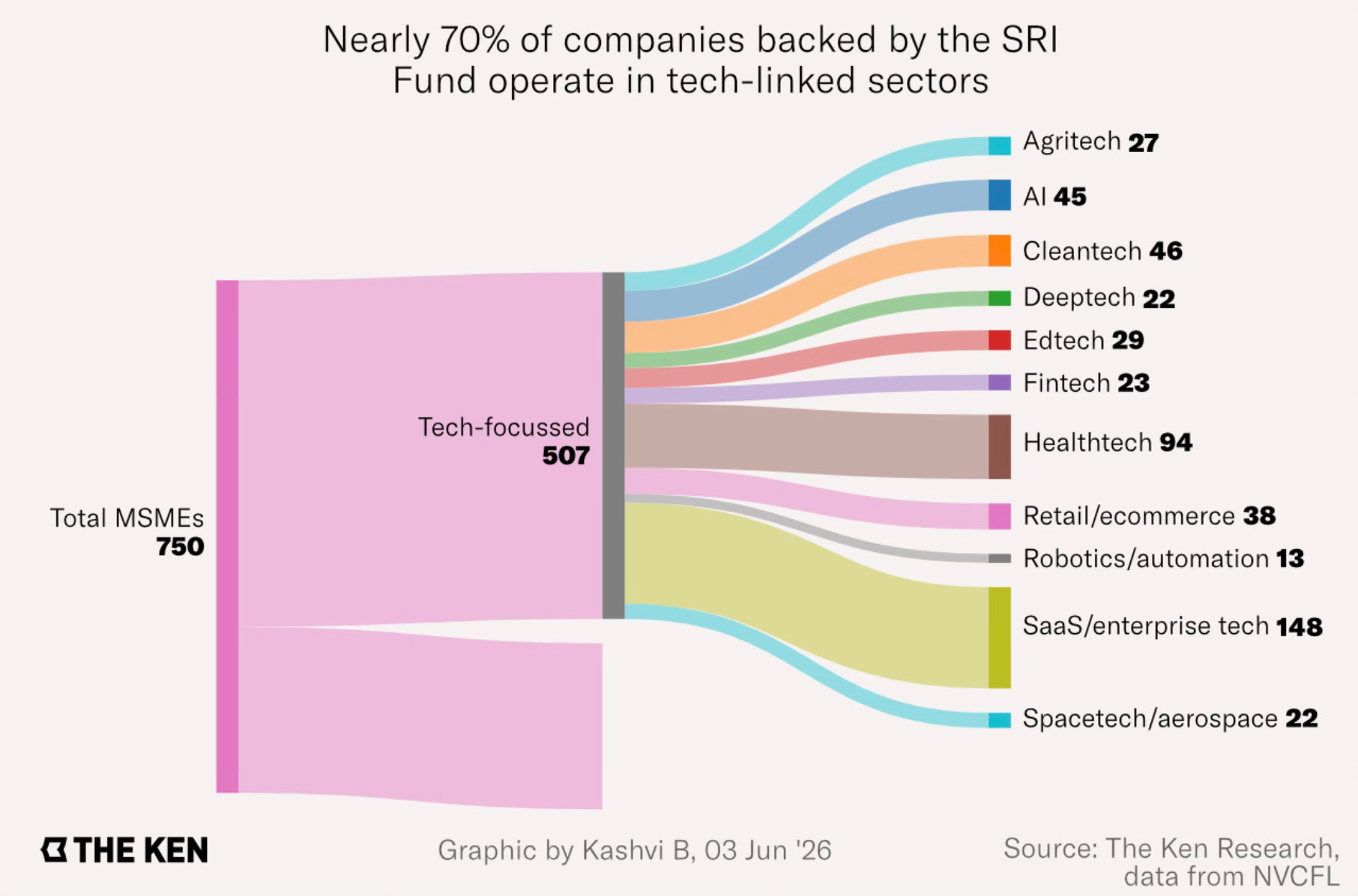
The Ken has analysed the performance of the Self-Reliant India (SRI) Fund, a Rs 50,000 Cr fund with 20% government contribution (the rest coming from VC and PE) to finance MSMEs, and found both concerns being validated. 

The SRI fund model is described here.

SRI Fund is being implemented by NSIC Venture Capital Fund Limited (NVCFL), which is an Alternative Investment Fund (AIF) of Category II registered with SEBI. SRI fund is oriented to provide the funding support through NVCFL to the Daughter Funds for onward provision to MSMEs as growth capital, in the form of equity or quasi- equity, for the following:

Since the start of the fund in 2020, it has backed around 750 companies and catalysed more than Rs 16,000 crore of investment. 

Nearly seven out of every 10 companies it has backed are tech-heavy businesses. Only three are in traditional manufacturing… In fact, several of these companies had already been backed by VC firms before the SRI Fund got anywhere near them. Truemeds, for instance, is backed by Accel, Peak XV, and Westbridge, while Chai Point is backed by Eight Roads Ventures and Saama Capital. Understandably, this dims, if not outright flouts, the proposition of the SRI Fund, which was supposed to scope out companies “ignored” by venture capitalists… 

“Fund managers get empanelled under SRI with the intention of backing underserved MSMEs,” said Ishaan Ajay, a development-and-sustainable-finance consultant. “But when faced with the choice between a profitable but slow-growing industrial supplier and a software platform capable of scaling rapidly, they tend to gravitate towards the latter. It’s what they understand the best.” Just consider the numbers. Suppose there’s a precision components manufacturer growing 15% annually with, say, 18% Ebitda margins. That may be a great business, but if you invest Rs 10 crore today, you’ll get only 2–3X your money over seven years. Contrast this with a spacetech company, which, if it succeeds, could be worth hundreds of crores.

“Venture funds are built around the second outcome,” said an analyst at a VC firm. This explains why SRI-funded companies tend to be tech-heavy. For every Bellatrix Aerospace in the portfolio, there’s an invisible machine-parts manufacturer outside it that was passed up… startups are generally more innovation- and tech-heavy, whereas MSMEs tend to be traditional, manufacturing-heavy businesses…

The government, for its part, tries its best to redirect funds towards their intended purpose. If it doesn’t agree with a fund’s investment choices, it expresses its objections, according to a VC with knowledge of the matter. But at the end of the day, it’s one LP among many. And when it can’t sway others, it ends up “recusing” itself from investing in that particular portfolio company, added the VC… “There is no prescription that a certain percentage of the fund must necessarily go towards traditional manufacturing or non-tech MSMEs,” a VC said. Which is the one thing that might have prevented all the confusion.

The point about returns amplification for private investors has also been highlighted in a study of IFC’s blended finance deals in the 2000-20 period, which found comparable financial returns to non-blended projects but “no statistically significant excess private mobilisation beyond what IFC’s standard lending would attract.” In other words, blending did not increase the quantum of private investment — it redistributed risk between IFC and private co-investors. 

This finding is echoed in a 2023 study of SIDBI’s Fund of Funds for Startups (FFS) 1.0 by the Impact and Policy Research Institute (IMPRI), India’s Startup Engine: A Policy Review of the Fund of Funds Initiative. It finds that most FFS 1.0 capital went to established VC funds that would have raised capital independently. It also found that “crowding-in effect was primarily reputation/signal, not financial additionality”; the government’s involvement functioned more as a validation of fund managers to private investors than as a necessary injection of capital. While FFS 1.0 delivered a 2x mobilisation ratio, it was mostly in already-functioning VC markets.

As I have blogged several times, the startup and innovation sector is going through the same journey that the infrastructure sector has undergone over the last three decades. Multiple policy experiments to catalyse DFIs - IDFC, IIFCL, NIIF, and now NaBFID - have struggled to crowd in private capital into the riskier infrastructure segments like water supply and sewerage, mass transit, solid waste management, street lighting, energy-saving companies, electricity distribution, etc. Instead, these institutions and instruments may have ended up competing and crowding out private capital in the entirely derisked segments of the infrastructure sector. 

In this context, it is also useful to ask the question whether the VC model is the right instrument for the funding of non-technology startups and innovations. 

Livemint has two long reads that describe the emergence of consumer food brands catering to the niche category of health-conscious people. Sample this

The past few years have seen a spurt in new food brands specializing in regional staples and cooking ingredients. From rural Bengal winter specialty date palm jaggery (nolen gur) to ancient emmer wheat flour (Khapli atta) from Maharashtra, regional staples are finding customers beyond their states of origin. Some brands like Gurugram-based Anveshan and Two Brothers Organic Farms from Pune have crossed a critical mass, with annual sales close to ₹200 crore in 2025-26… Anveshan sources ingredients from key growing regions—like Pollachi in Tamil Nadu known for its high-quality coconuts and aromatic varieties of groundnut from elsewhere in Tamil Nadu and Karnataka—suited to make cold-pressed oils. The ghee, made from the milk of native breeds like the Gir from Gujarat is made using the traditional bilona process where milk is first set to curd and later churned to separate the butter (this has resulted in a new category called ‘cultured ghee’)…

Venture capital funds are betting on these brands: in September last year, Two Brothers raised a $15 million round taking its total fundraise to $25 million (and its post-money valuation to $85 million or ₹781 crore as per data from market intelligence platform Tracxn)… In April this year, KisaanSay, which markets single-origin grocery items like cardamom from Idukki and black raisins from Nashik, raised ₹34 crore ($3.6 million), taking the total funding at the Gurugram-based startup to $5.6 million since it was set up in mid-2022.

In a way, these brands have also helped promote traditional farming practices with more farmers returning to heirloom grain varieties such as the fragrant, short-grain Kala Namak rice grown in eastern Uttar Pradesh and emmer wheat in Maharashtra and Karnataka. These grains have a low glycemic index (a measure of the spike in blood sugar levels from carbohydrate intake) making them suitable for diabetics and often have higher protein and fiber content compared to conventional hybrid varieties… Three distinct factors—growing consumer willingness to pay for clean food driven by a surge in lifestyle diseases, the rise of quick commerce (allowing brands to quickly test consumer response), and influence of social media platforms are reshaping the premium staples market.

All these businesses are distinct from the rapidly scalable technology startups. Take the story of the Two Brothers Organic Farms.

They use organic farming and traditional methods of primary processing to make ghee, jaggery, Khapli flour, and cold-pressed oils. The jaggery is made using native sugarcane with lady finger extract used as a coagulant. “In Khapli, we have created a revolution. We own a seed bank and pay farmers 2.5-times the price of regular wheat. More than 800 farmers grow this wheat for us in 3,000+ acres,” Satyajit said. “It took us ten years to build this brand. At the back-end, our farms are open to everyone (to visit). Consumers trust us and we have a 70% retention rate. But a proliferation of brands (offering traditional, hand-processed staples) also carries the risk of a dilution in quality standards,” he added with a note of caution.

Much the same can be said about most businesses outside of technology - food, textiles, footwear, manufacturing, recycling, etc. Building these businesses requires painstaking efforts for several years, and there are natural limits to their scalability. They are unsuitable for the VC model of funding, as the second Livemint story about the plant-based nutrition startup Oziva shows.

Venture funding, Aarti Gill (co-founder of Oziva) points out, comes with built-in expectations around exits within five to eight years. Unlike venture-backed software companies, consumer health brands compound slowly through trust, habit and repeat behaviour. “If you have investors willing to stay for 10 or 15 years, that changes the equation completely,” she adds. Gill broadly sees three paths for consumer brands: staying profitable and scaling independently over a long period, going public after reaching meaningful scale, or partnering strategically with a larger company. For Oziva, the third route eventually felt like the most practical one. And, that’s where HUL came in… For Oziva, the partnership offered distribution scale, capital and the ability to build beyond a digitally native audience.

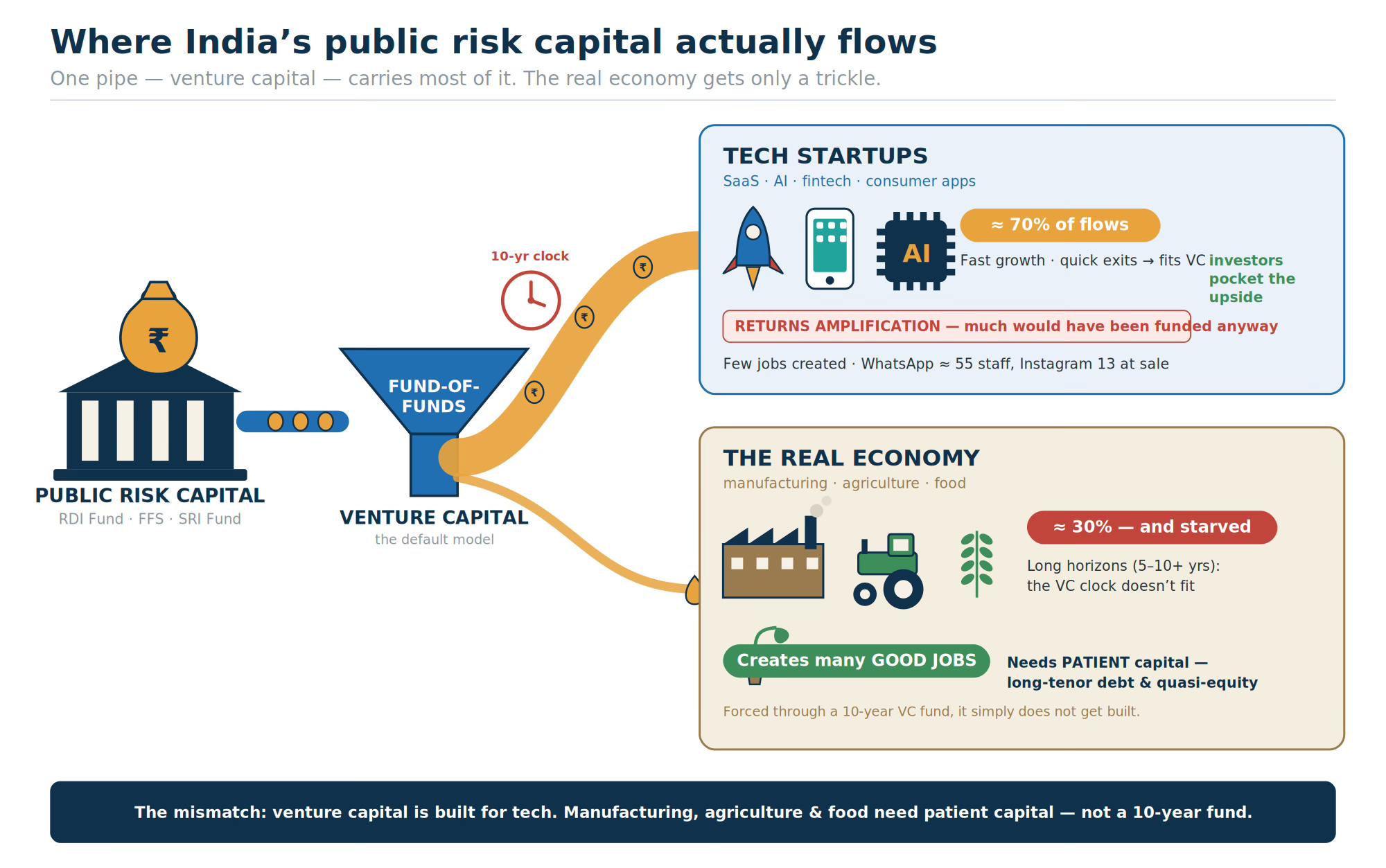
Therefore, at a conceptual level and as a framework, it may be a prudent choice for public policy on the funding of startups to distinguish between technology and non-technology sectors. While VCs are appropriate for technology, with their smaller and rapid growth phase, the same may not be appropriate for non-technology startups, which require longer incubation and growth periods. However, in India, most public risk capital funding happens through the VC-driven FoF strategy, which raises concerns of returns amplification and a preference towards technology startups and innovations. 

This is also a concern since technology innovations, far from creating jobs, often also tend to destroy jobs, whereas the non-technology innovations, especially in manufacturing, create good jobs. The graphic below captures the problem.

Note: The percentage breakup is probably even more skewed in favour of technology startups.

It also raises the question of effective strategies - instruments and institutions - for funding such non-technology innovations. How are such innovations funded globally? Are there institutional structures in India (state or central governments) that offer promise and can be adopted with tweaks? What are the lessons from the likes of the Maharashtra Aerospace and Defence Fund? What are actionable recommendations on funding of non-technology startups? If it also requires the government to directly fund them, what institutional structures are most practical and realistic? I’ll explore these in another post. 

Saturday, June 6, 2026

Weekend reading links

1. Potato glut hits Europe, and in particular Belgium.
Europe faces a surplus of five million metric tons of the type of potato used for fries. For months, the price of a metric ton of potatoes on the spot market in Belgium, the world’s biggest exporter of frozen fries, has languished at precisely zero. It was nearly 600 euros ($690) three years ago.

2. The Murugappa Group (through Axiro Semiconductors and CG Semi), the Tata Group (through Tata Electronics), and Crystal Matrix are leading India's semiconductor chip design and manufacturing push

3. Very good assessment of a decade of the IBC law.

The idea was to enable timely exit of non-viable firms, preserve viable businesses, restore credit discipline, and unclog credit channels... Till March 2026, 1,419 companies had emerged from insolvency with approved resolution plans, with the proportion of companies achieving such outcomes improving steadily... Creditors have realised ₹4.32 trillion through resolution plans. The oft-cited haircut of around two-thirds, measured against admitted claims, can be misleading because claims are frequently inflated while asset values are deeply eroded by the time firms enter insolvency. A more meaningful benchmark is liquidation value: Resolution plans have, on average, yielded 167 per cent of the liquidation value. Importantly, firms resolved under the IBC demonstrated operational revival post-resolution. Within five years, sales and capital expenditure nearly doubled, asset utilisation improved sharply, and the aggregate market capitalisation of resolved firms rose from about ₹2.8 trillion to ₹9 trillion... 

In all, 3,003 companies have entered liquidation under the IBC, but most had little realistic prospect of revival. Their assets averaged barely 5 per cent of admitted claims, and four-fifths were already sick or defunct before entering insolvency. The IBC merely provided an orderly exit for firms that had failed long before the process began. Yet, the incidence of liquidations in India is comparable to that in the United States and significantly lower than in the United Kingdom and Australia... Resolution plans rescued 78 per cent of distressed assets, while liquidations accounted for 22 per cent. When all pathways to revival are considered — resolution plans, withdrawals, settlements, appeals, and rescues during liquidation — the number of revived companies substantially exceeds those liquidated.

4. John Burn-Murdoch points to evidence that remote working and NOT AI is responsible for the ongoing declines in entry-level hirings. 

Peter John Lambert and Yannick Schindler have a fascinating counter-proposal: the take-off of remote work. Early-career workers require more supervision than experienced hires, and build important skills, knowledge and social capital by observing and working alongside senior colleagues. Working from home adds friction to these processes, making entry-level workers more costly to bring on board in terms of time and resources and slowing their prospects for promotion. As such, the rise of remote work has worsened the trade-off for hiring entry-level workers, while leaving the calculus for senior hires unchanged. The evidence fits the theory. Lambert and Schindler analysed hundreds of millions of new hires and job postings and found that although both occupational exposure to AI and remote working rates line up with the outsized pullback in junior hiring, the link with AI evaporates once you account for whether a role is remote. In other words, it only looks like AI is behind the hiring crunch for junior software developers because coding jobs are also disproportionately done remotely. Jobs less exposed to AI but amenable to remote work (eg lawyers) have also seen weak junior hiring; roles with high AI exposure but an emphasis on in-person work (eg receptionists) have held up better.
5. Is Steve Jobs leaving the greatest corporate legacy ever?
Apple now rakes in sales of over $1bn a day. Its services business alone, driven by the App Store and Apple Pay, generates more revenue than Netflix, Spotify and Adobe combined, with a margin of around 75 per cent. Under Cook, the company has returned around $1tn to shareholders through dividends and buybacks… Nearly two decades since the product launched, Apple shipped well over 200mn iPhones in 2025 and the device still accounts for about half of Apple’s $400bn of annual sales, with high product margins underpinned by the highly efficient, Asia-based supply chain also created by Cook. Apple’s astonishing profitability is sustained by an annual cadence of new iPhones, each iteration featuring largely incremental improvements on the one before. Research and development spending as a proportion of revenue went from 8 per cent at its height in 2001 to a 2 per cent low in 2012 as the iPhone boom began, meaning that for a while Apple was spending proportionally far less than its Big Tech peers.
6. Good primer on why oil prices have remained less elevated than expected - decline in Chinese oil imports (almost 4 m bpd) and rise in US exports (almost 4.5 mbpd).

7. The US economy is increasingly resembling a one-trick pony of AI.
The US corporate profit share has climbed to a record 13.8 per cent of GDP, while net income margins across the broad US equity market have recovered to about 9.7 per cent, close to earlier highs. At the same time, market leadership has become unusually concentrated: a handful of AI‑linked stocks now account for roughly 40 per cent of the S&P 500’s market capitalisation, according to Bank of America data. Headline profitability is being flattered by a small slice of the economy earning extraordinary returns from the scramble to build AI capacity...
Spending strength is increasingly coming from upper-income households where wealth and income are more tied to equities than wages. The stock market has, in effect, become part of the growth model: rising AI profits lift share prices; higher share prices support the spending power of wealthier households; and that spending helps keep demand alive. Lower-income households, by contrast, are more exposed to squeezed real incomes and softer labour-market momentum... Large technology groups have produced surging revenues and margins with only limited growth in headcount... So long as investors believe AI will earn very high long-term returns, the loop can remain self-sustaining: capital expenditure stays firm, equities stay buoyant and affluent consumers keep spending.

8. The spectacular surge in Google's capex.

Five years ago, its capital expenditure on servers, network equipment and such was $25bn, which it funded out of operating cash flows of $92bn. In 2027, analysts expect $250bn of capital expenditure, versus cash flows of $260bn — a tighter fit. In its second quarter next year, Visible Alpha estimates suggest Google will spend more than it makes, for the first time in its listed history.

9. A good illustration of deficient national security discipline comes from how the US is allowing the exports of tungsten scrap to China even as it spends money abroad buying tungsten mines

Since early 2025, Chinese scrap traders have been seeking tungsten throughout the US, prompted by a shortage outside China caused by declining supply and intense demand from the aerospace, weapons and tools industries. The effort has set off a bidding war with American buyers and calls to ban sales of a critical national security resource to overseas buyers... Sellers said they were fielding calls from Chinese buyers looking for the material, while American buyers said they were being outbid by Chinese rivals willing to pay as much as five times the usual price... 

Tungsten scrap commonly comes from worn-out industrial tools such as drill bits and mining equipment. It can be crushed and chemically processed back into tungsten powder or carbide for use in new machinery and tools. The shortage has been triggered by Beijing imposing export restrictions on it and an array of other critical minerals in early 2025 and the country cutting mining quotas. China accounts for more than half of global mined and refined tungsten supply and about half of demand... 

Tungsten is broadly used in military applications, including in bullets and missiles. Traders said stocks were already low before the Iran war and that companies do not typically hold large stores of the metal. There was “no availability” outside China of the so-called “intermediate” products that manufacturers need — mined ore that has been processed... The price of tungsten has risen by more than 200 per cent since May 2025, while tungsten scrap has risen 350 per cent, according to Argus Media.

10. The AI wave is lifting all stocks, including those legacy IT firms like HP and Dell

11. India's non-tax revenue fact of week.

In the last three years, the share of RBI surplus in the government’s non-tax revenue has stayed between 42 and 52 per cent.

12. SpaceX IPO in a graphic.

13. Real Madrid at the top of European football club valuations.

14. The universe of PSUs in India has been rising.
15. Rama Bijapurkar's categorisation of India's consumption class.
The important thing is that 93% of households have annual consumption less than $5700.

Last month, Anthropic crossed $47bn in run-rate revenue, a metric used by start-ups which estimates annual revenues based on short-term performance. This is a more than fivefold increase since the start of the year... Anthropic’s valuation has soared from $350bn to $900bn in 12 weeks. It is now one of the fastest-growing companies in history.
17. The biggest threat to the US superpower status now appears to be its surging public debt, which is now $36 trillion held by the public and federal agencies 
The exorbitant privilege has ensured the dollar's status as the world's pre-eminent reserve currency and the Treasury market's role as the world's safest haven asset, thereby allowing the US access to unlimited global capital at a low cost. While there are no competitors to the dollar on the horizon, the Treasury's safe haven status is facing competition. 

18. The most important difference between the dotcom bubble and the AI bubble.
19. Japan is losing people. 
Japan’s population peaked in 2008 at 128 million, and it is projected to fall to 87 million by 2070. The country is now roughly the same size it was in 1989... All but two of the country’s 47 prefectures reported population decreases in 2025, and the rate of decline is accelerating.

20. Finally, this says as much about the Indian stock markets as about the Korean and Taiwanese markets.

India’s stock market capitalisation was overtaken in the past week first by Taiwan and then by South Korea, as the value of Indian equities held by foreign investors slumped to a 10-year low of 7.3tn rupees ($76bn) on June 1. The value of Indian stocks was more than double that of Taiwanese stocks and roughly 3.5 times that of South Korean stocks 18 months ago, analysts at Bernstein said this week. “Fast forward just five months into 2026, and that lead has evaporated,” they added.