Substack

Showing posts with label Fiscal deficits. Show all posts

Monday, February 2, 2026

Lessons from India's fiscal policy management

It has become a feature of economic policymaking to define thresholds for fiscal prudence and macroeconomic stability. Accordingly, it is held that fiscal deficits should not exceed 3% of GDP, public debt should not exceed 60% of GDP, inflation should not exceed 2% (or 4%), etc. 

I have blogged earlier here and here about the problems with the uniform adoption of such targets. 

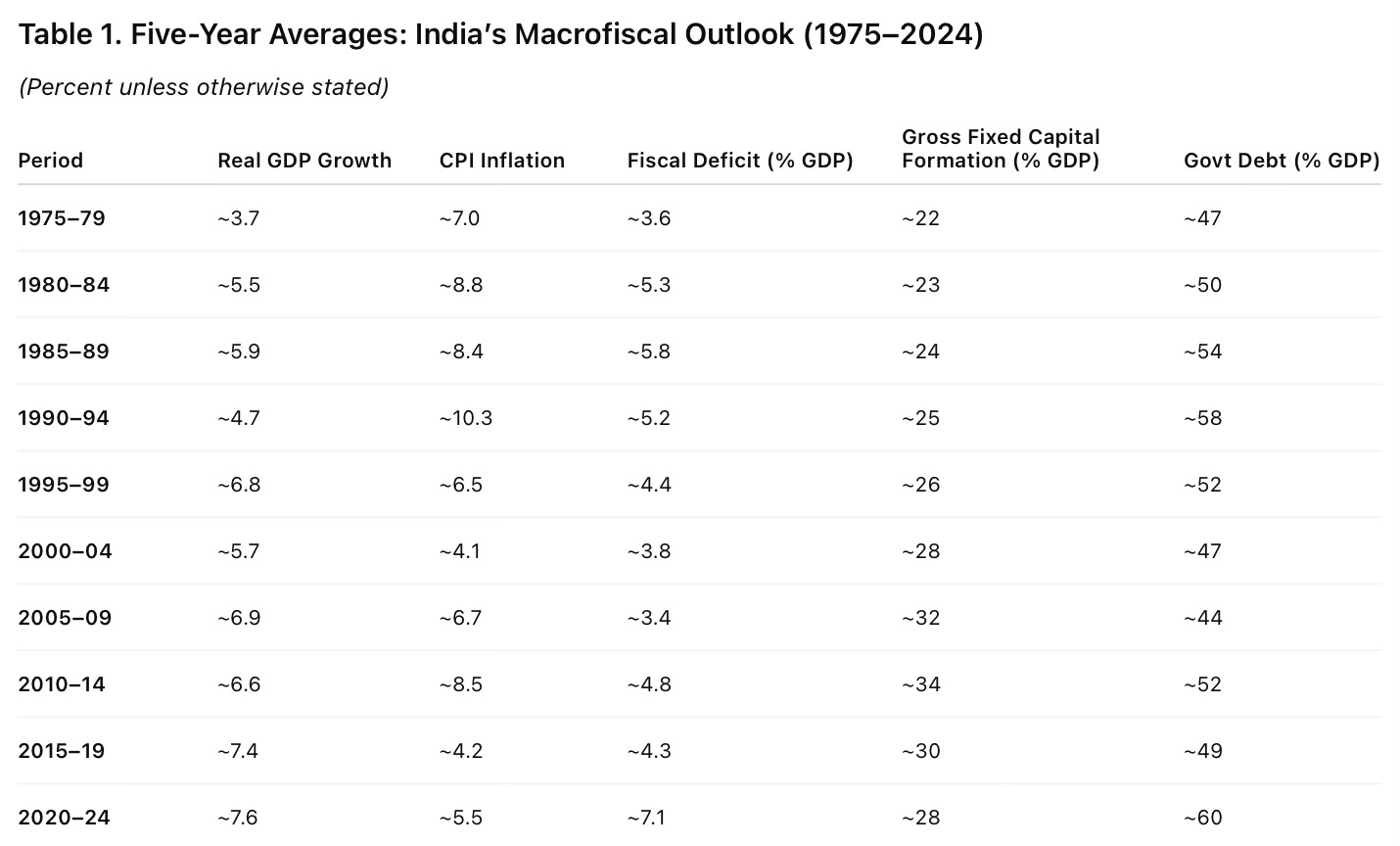
This post will examine India’s macroeconomic record over the last fifty years against these benchmarks. It will use data for 1975-2024 from the World Bank’s WDI to assess the impacts of CPI inflation, central government debt (% of GDP), fiscal deficit, and gross fixed capital formation (GFCF) on GDP growth rates. 

The table below captures the five-year averages on each of the above parameters. 
This is the same table with ten-year averages.
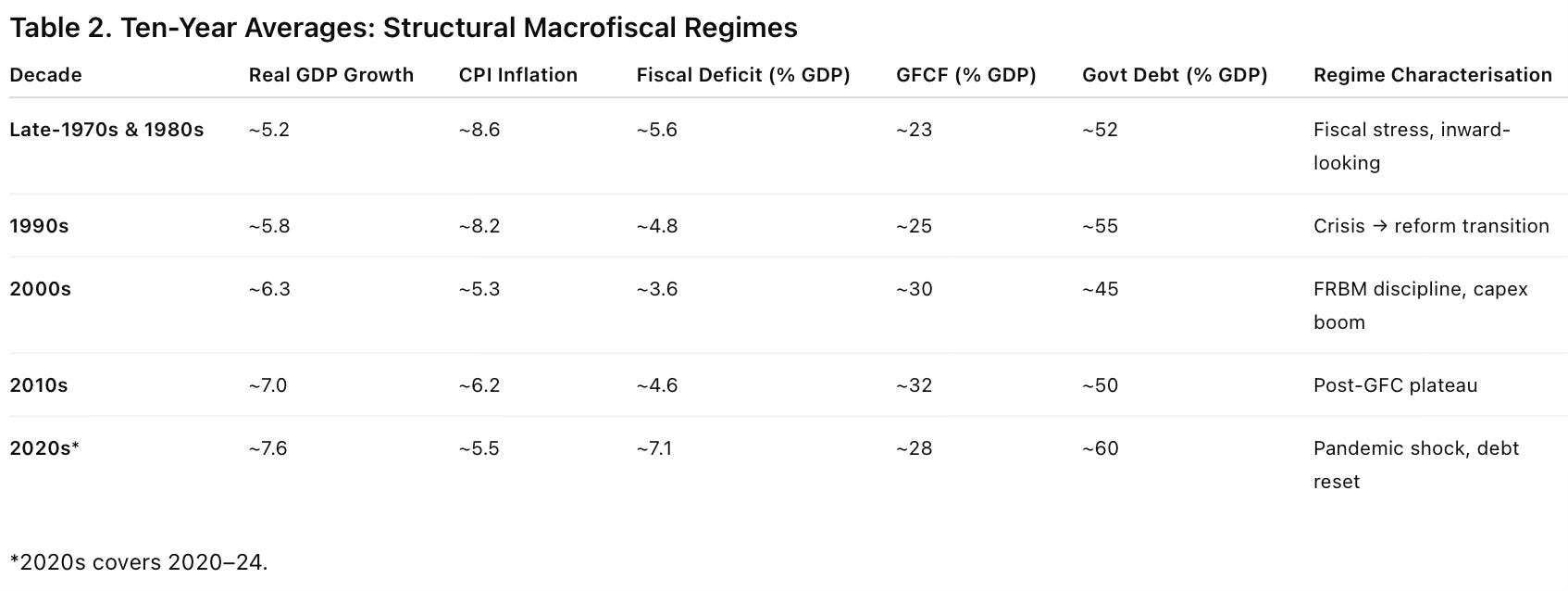
This is a ChatGPT summary which broadly conforms to the economic orthodoxy on macroeconomic stability. 

A five- and ten-year view of India’s macrofiscal indicators highlights a clear structural shift after the mid-1990s, marked by lower inflation, higher investment, and improved growth outcomes. The FRBM period stands out as the most balanced macro regime. However, major shocks since 2008—particularly the COVID-19 pandemic—have resulted in persistently higher fiscal deficits and public debt, underscoring the importance of restoring fiscal space while protecting capital expenditure.

We get broadly similar conclusions from models with different specifications (lagged multivariate growth regression, structural break regression, and reduced-form VAR).

India’s growth experience shows that fiscal deficits support growth only in the short run and only when macro-credibility is intact. Sustained growth is driven far more by investment and macro-stability than by deficit expansion, while rising public debt increasingly constrains long-term growth.

However, if we disaggregate the fifty years into identifiable macroeconomic regimes and perform lagged GDP growth regressions against each parameter separately, the shorter-term trends become less clear and regime-dependent. It provides some useful takeaways. 
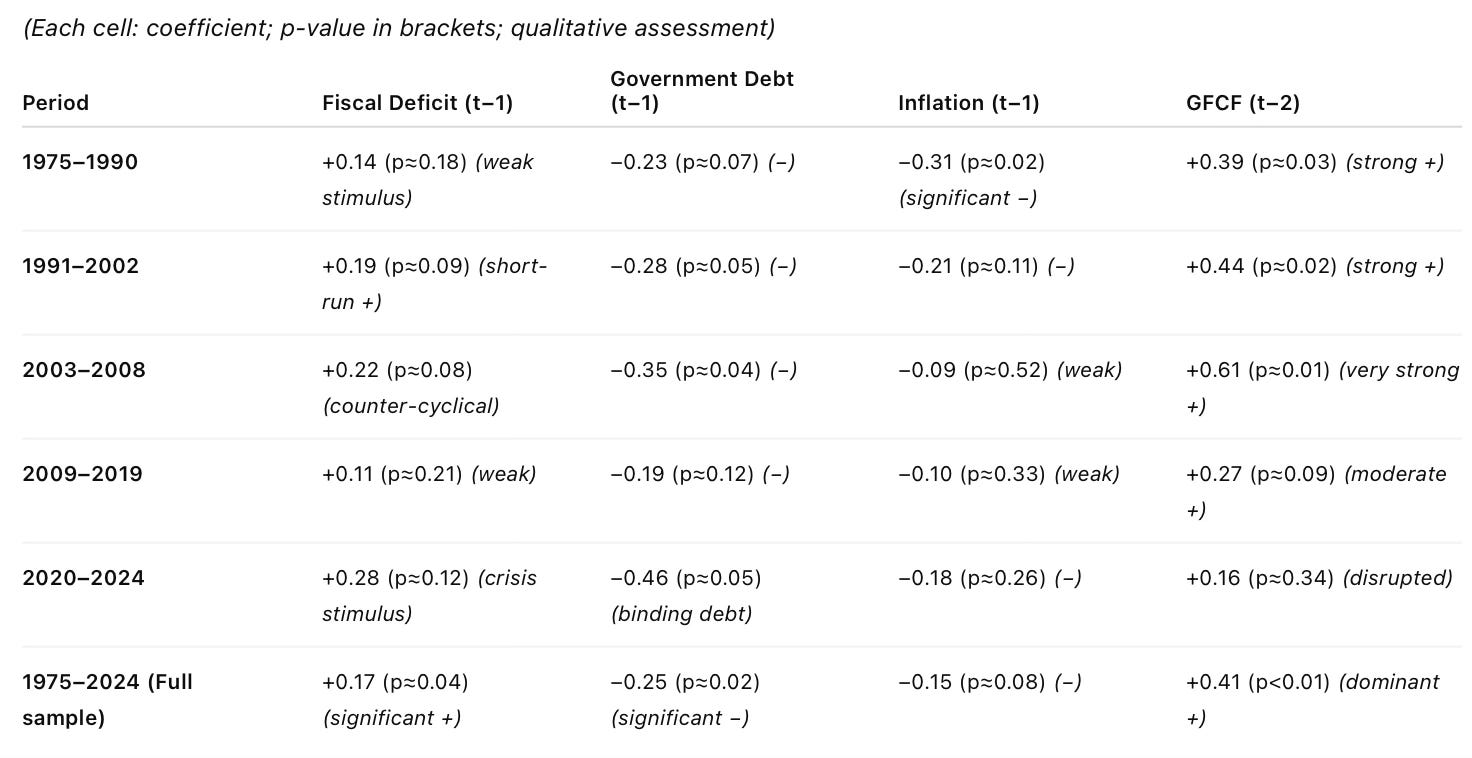
There are some distinct takeaways. The strongest relationship is that between GFCF and growth. It holds in both short and long-run time frames. 

The short-run relationship with fiscal deficits is generally positive. However, the magnitude of this relationship depends on the regime. As can be expected, the three periods with the greatest perceived thrust on macroeconomic stability - post-liberalisation decade, FRBM era (2003-08), and post-Covid 19 years - are also associated with the highest positive impulse from fiscal deficits. 

The trends on fiscal deficit show a distinct shift towards a higher deficit. Interestingly, though the post-pandemic period has had the highest deficits, it has also been associated with the highest economic growth rates. 
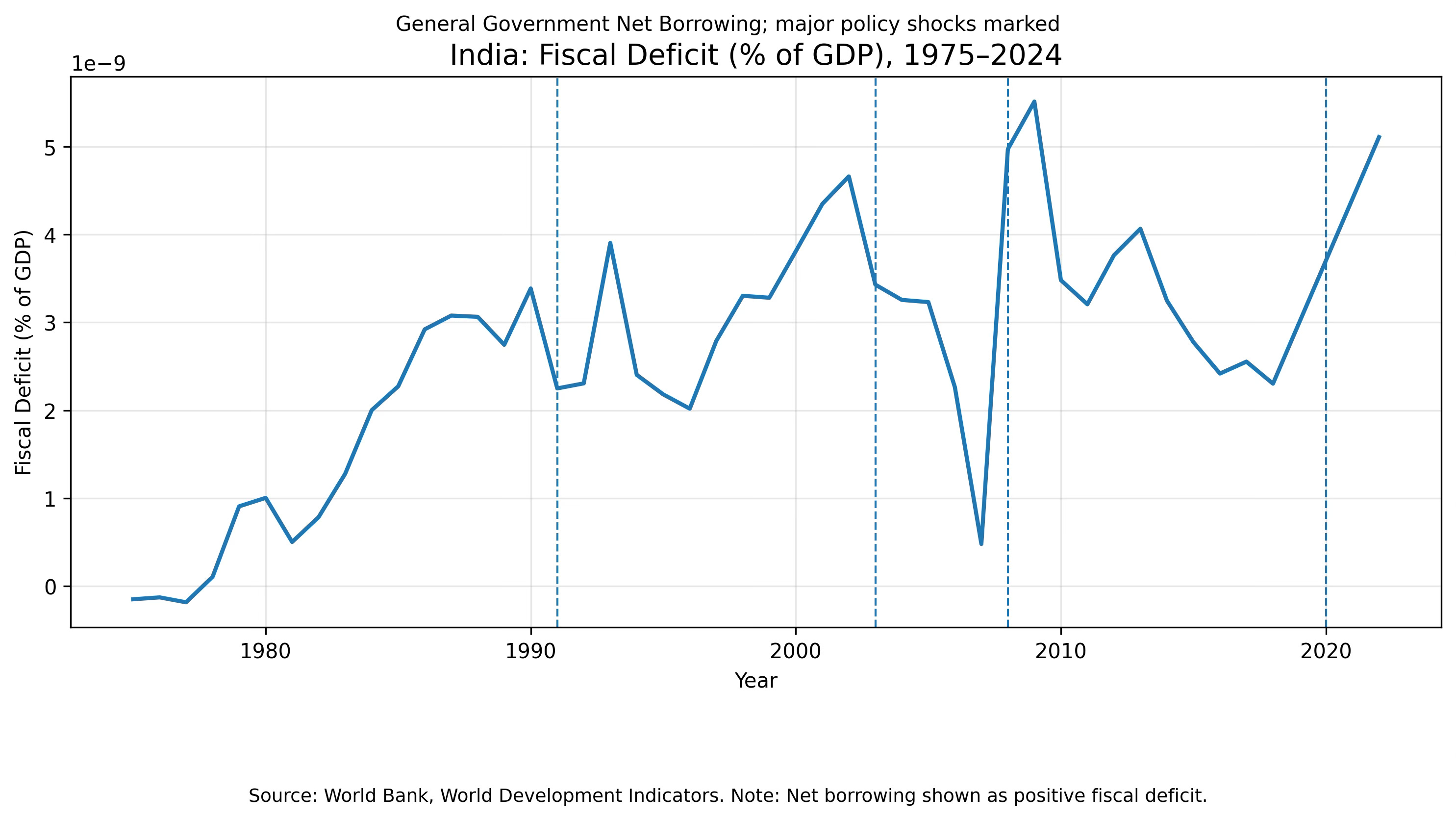
In fact, since 2010, the economy has shifted to a regime with fiscal deficits that are much above the 3% of GDP threshold. But it does not appear to have adversely impacted growth rates, nor market perceptions. An obvious reason is the quality of fiscal deficits, which have shifted sharply towards capital expenditures. 

Overall, as the graphic below shows, there’s a very weak correlation between growth and fiscal deficit. At least, there’s nothing to suggest a fiscal deficit threshold around 3% of GDP. 
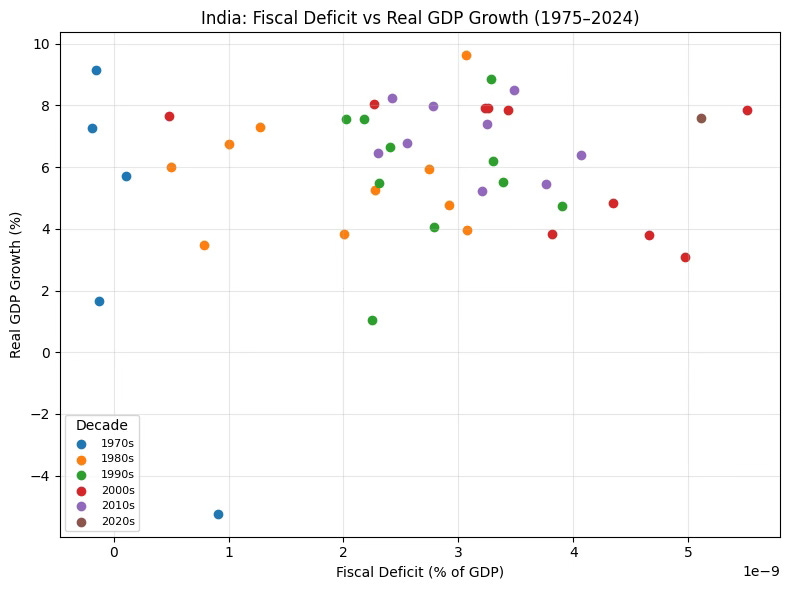
Since around 1995, successive governments in India have generally exercised fiscal prudence in terms of the public debt to GDP ratio being range-bound in the 45-50% range. However, unlike fiscal deficit, there’s a strong inverse correlation between the stock of public debt and GDP growth rates. Therefore, the rise in the public debt ratio in the post-pandemic period should be a matter of concern. When the state government debt is added, the gross public debt is inching towards 100%, easily the highest among all major developing countries. 

Similar to fiscal deficit, inflation higher than the target rates has been found to co-exist with high growth rates. There’s little relationship between an inflation rate of 2%, or even 4%, and GDP growth rates. In general, inflation effects tend to weaken once macro stability is achieved. 

Over the last decade, India has significantly improved its economic attractiveness. This has come about through a combination of political stability, large infrastructure investments, expansion in the IT services market (GCCs), the emergence of e-commerce and startups with the resultant job creation, gradual but consistent pursuit of economic reforms, interspersed with some critical reforms, and generally good macroeconomic governance through fiscal discipline, quality of public expenditures, and transparency. It has also helped that the country has been growing at steady high rates, and has emerged as the fourth biggest economy in the world and is one of the few big growth markets. 

All this has provided the fiscal credibility to run a higher level of deficits. In fact, the Indian economy has benefited from the free lunch of an additional 2-3 percentage points of GDP of fiscal space for the last decade or so, which was unavailable in the FRBM-constrained regime. This fiscal boost has been central to the high growth rates of recent years. 

This is a good case study for at least two reasons. One, while such quantitative targets do play a fiscal disciplining role, there’s nothing sacrosanct or objective about arbitrarily defined thresholds. In fact, a rigid adherence to such targets is counter-productive and growth-squeezing. Second, in a world where these targets have become accepted norms, market perceptions about reform commitment and fiscal prudence can significantly expand the fiscal space available for governments. Market credibility provides the flexibility for fiscal expansion. 

So what does this all say? Here is the summary from ChatGPT

Over the last five decades, India’s growth experience shows no stable linear relationship between fiscal deficits and growth. Periods of high growth have occurred under both fiscal expansion and consolidation. Inflation control appears growth-enhancing primarily in high-inflation regimes, while capital formation is largely pro-cyclical. The results underscore that fiscal quality, institutional credibility, and macro stability matter more than headline fiscal aggregates.

A major macroeconomic challenge for India going forward will be the management of its fiscal balance. It must pursue fiscal consolidation to significantly reduce its current high flows and stock of debt, while also significantly raising GFCF. And it must do all these at a time when private investment remains caught in a low equilibrium trap with no signs of a breakout, and when global headwinds are likely to squeeze capital inflows and export growth. This is especially daunting since, as the figures show, economic growth since the GFC, and more so since the pandemic, has been largely propped up by public investment, which is now hitting hard fiscal constraints. 

Saturday, August 10, 2024

Weekend reading links

1. Fascinating tweet thread by Ed Conway about the Bretton Woods System that pegged the exchange rates of 44 countries with the IMF entrusted the responsibility of managing it. This graphic illustrates the remarkable currency stability among these countries in the 29 years of its existence.

This currency stability combined with a few other things resulted in a period of remarkable economic prosperity. This is a striking graphic about productivity and compensation in the US.
2. Good article that evaluates the semiconductor chips making in India, specifically the partnership between Tata Electronics and PSMC, one of the smaller Taiwanese chip manufacturing companies.
This is unlike the venture the other big player, Taiwan SemiconductorManufacturing Company (TSMC), is undertaking abroad – the company’s new fab in the Japanese city of Kumamoto, two $40 billion facilities in Phoenix, Arizona, and a commitment to invest nearly $4 billion to build a fab in Dresden, Germany. In these new fabs, apart from significant equity investment, TSMC, the ninth-most valuable business in the world, is an equity partner, and has invested in the ecosystem; it has taken along its key vendor base of some 25-30 companies to each of these locations, and is also undertaking large-scale training of manpower on the nuances of chip fabrication, a high tech-intensive job. In the Tata-PSMC venture, much of the heavy lifting is done by the Tatas, who have no real experience in chip manufacturing so far... The fact is, for TSMC to be successful outside Taiwan, it takes more than just its expertise. It takes its suppliers along so that an ecosystem develops locally for the construction expertise, material supplies, and equipment deliveries. For instance, TSMC has moved around 40 Taiwanese companies to Japan (for the new plant in Kumamoto), and taken around 30 of them to Arizona for the new plants.

3. NYT has an interview with Robert Putnam.

We looked at long-run trends in connectedness, trends in loneliness, that sort of thing, over the last 125 years. And the short version is, it’s an upside-down U curve. We were socially isolated and distrustful in the early 1900s, but then there was a turning point, and then we had a long upswing from roughly 1900 or 1910 till roughly 1965, and that was the peak of our social capital. People were more trusting then, they were more connected then, they were more likely to be married then, they were more likely to join clubs then, etc. And then for the next 50 years, that trend turned around...

That trend in political depolarization follows the same pattern exactly that the trends in social connectedness follow: low in the beginning of the 20th century, high in the ’60s and then plunging to where we are now. So now we have a very politically polarized country, just as we did 125 years ago. The next dimension is inequality. America was very unequal in what was called the Gilded Age, in the 1890s and 1900s, but then that turned around, and the level of equality in America went up until the middle ’60s. In the middle ’60s, America was more equal economically than socialist Sweden! And then beginning in 1965, that turns around and we plunge and now we’re back down to where we were. We’re in a second Gilded Age. And the third variable that we look at is harder to discuss and measure, but it’s sort of culture. To what extent do we think that we’re all in this together, or it’s every man for himself, or every man or woman? And that has exactly the same trend.

He makes the distinction between bonding and bridging social capital.

Ties that link you to people like yourself are called bonding social capital. So, my ties to other elderly, male, white, Jewish professors — that’s my bonding social capital. And bridging social capital is your ties to people unlike yourself. So my ties to people of a different generation or a different gender or a different religion or a different politic or whatever, that’s my bridging social capital. I’m not saying “bridging good, bonding bad,” because if you get sick, the people who bring you chicken soup are likely to reflect your bonding social capital. But I am saying that in a diverse society like ours, we need a lot of bridging social capital. And some forms of bonding social capital are really awful. The K.K.K. is pure social capital — bonding social capital can be very useful, but it can also be extremely dangerous. So far, so good, except that bridging social capital is harder to build than bonding social capital. That’s the challenge, as I see it, of America today.

4. In an interesting reversal of fortunes, developing countries have become more fiscally prudent compared to their developed counterparts, and central banks across developing countries are exhibiting greater responsibility and independence. Sample this from Gavekal.

Across the emerging markets, political leaders with populist leanings are calling for looser fiscal policy. Many are also berating local central banks for failing to do more to support growth, and leaning on them to loosen monetary policy. For the most part, central bankers, jealous of their independence, are pushing back and keeping monetary conditions relatively tight to counter inflation. This raises the prospect of loose fiscal, tight monetary policy settings in a number of key emerging markets, argues Udith Sikand. It also throws the contrast between emerging and developed market central banks into sharp relief. Arguably, developed market central banks have caved in to fiscal dominance, keeping real rates for the most part low or negative over recent years to prevent public debt burdens from becoming unsustainable. By contrast, emerging market central banks are likely to maintain positive real rates in order to attract funding to cover growing fiscal deficits. The bottom line is that this sets up conditions for a potential triple merit scenario in emerging markets over the coming years, with local risk assets and currencies rising strongly.
5. India's long tail of corporate tax distribution

A total of 353 companies earning above Rs 500 crore accounted for 55.7 per cent of the Rs 14.7 trillion in gross total income recorded by all companies in 2018-19. A total of 842 companies made more than Rs 500 crore in 2023-24 and accounted for 62 per cent of the Rs 34.6 trillion in gross total income recorded by all companies.
India's textile industry, valued at USD 250 billion, provides jobs to 50 million people. The sector is divided into three broad categories - Textiles (fibre, yarn, and fabrics); Garments and; Made-ups (Bed sheets, curtains etc.). India is present across all parts of the value chain. In 2023, China exported USD 114 billion worth of garments, followed by the EU (USD 94.4 billion), Vietnam (USD 81.6 billion), Bangladesh (USD 43.8 billion), and India with just USD 14.5 billion. From 2013 to 2023, Bangladesh's garment exports grew by 69.6 per cent, Vietnam's by 81.6 per cent, and India's by only 4.6 per cent. "As a result, India's global market share in garment trade has declined from 2015 to 2022. The share of knitted apparel dropped from 3.85 per cent to 3.10 per cent, and the share of non-knitted apparel decreased from 4.6 per cent to 3.7 per cent," GTRI founder Ajay Srivastava said. He said that the garment imports too surged by 47.90 per cent, from USD 1.06 billion in 2018 to USD 1.56 billion in 2023. Textile imports also saw a notable increase of 20.86 per cent, from USD 5.77 billion to USD 6.97 billion. 

7.  A new NBER working paper points to more evidence of price markups in the US economy. It uses data on price data from more than 100 distinct product categories in the US in the 2008-19 period. 

We estimate demand with flexible consumer preferences and recover time-varying markups for individual products under the assumption of profit maximization. Our results indicate that markups increased by about 30 percent during our sample period. This reflects within-product changes and is primarily due to reductions in marginal costs, rather than increases in (real) prices. Changes in marginal costs, along with declining consumer price sensitivity, account for the vast majority of the time series variation in aggregate markup changes between 2006 and 2019. Our model indicates that consumer surplus has increased despite rising markups, though the increases are concentrated among higher-income consumers.
Between 2006 and 2023, Mr. Buffett had given more than $39 billion to the Gates Foundation. By comparison, Mr. Gates and Ms. French Gates gave $39 billion between 1994 and 2022, including $22 billion to get the foundation going in 2000. In some years, the former couple gave less than half a billion. In 2021, they pledged $15 billion to the foundation’s endowment, and the following year, they transferred that money, as well as another $5 billion Mr. Gates had contributed.

9. Important point made by Richard Rorty (HT: Rana Faroohar)

National pride is to countries what self-respect is to individuals: a necessary condition for self-improvement. Too much national pride can produce bellicosity and imperi­alism, just as excessive self-respect can produce arrogance. But just as too little self-respect makes it difficult for a person to display moral courage, so insufficient national pride makes energetic and effective debate about national policy unlikely.

10. An important trend to be kept in mind as we follow China, the sharply increasing Chinese emmigration.

The number of Chinese citizens living in Malaysia has almost doubled over the past three years, driven by a jump in students and new investors, according to government officials, academics, schools, and business and community associations... China’s slowing economic growth as well as a more heavy-handed approach to business have driven more of its citizens to seek new lives abroad. Wealthy Chinese citizens have flocked to destinations such as Singapore and Malta where they have acquired citizenship through investment, and they make up the largest source of golden visa applicants in Portugal and Greece. Chinese citizens also form one of the largest groups of illegal migrants attempting to enter the US from Latin America...

Malaysia... is home to a centuries-old Chinese diaspora that makes up about 23 per cent of its 34mn citizens. Most new Chinese arrivals are middle-class families who see south-east Asia as a more affordable destination, or students shying away from anti-China sentiment in the west, making Chinese people the largest group of foreign students and long-stay residents in Malaysia. Universities and international schools in Malaysia are reporting soaring demand. The nation’s higher education institutions had 44,043 Chinese students enrolled last year, up 35 per cent from 2021, according to the education ministry... the number of Chinese pupils in international schools more than doubled in the same timeframe from 2021 to 2023. More than 56,000 Chinese immigrants now hold Malaysia My Second Home long-stay visas, more than double last year’s number. Chinese investors are also contributing to the boom in expatriate numbers. There are about 45,000 owners, managers and workers of Chinese companies in Malaysia, up from an estimated 10,000 in 2021, according to a Chinese trade official... The rise in Chinese residents mirrors an earlier trend in Thailand. Sivarin Lertpusit at Thammasat University in Bangkok said the number of new Chinese immigrants in Thailand was “rapidly increasing”, reaching 110,000-130,000 living in the country in 2022, most of them entrepreneurs, employees, students and their family members as well as lifestyle migrants.

11. The week saw a US federal judge ruling on a DoJ suit that Google spent billions of dollars on exclusive deals to maintain an illegal monopoly on search, a sector where it handles more than 90% of online queries. The judge, Amit Mehta, of the US District Court for the District of Columbia, said, "Google is a monopolist, and it has acted as one to maintain its monopoly."

The DoJ argued the search giant paid tens of billions of dollars a year for anti-competitive deals with wireless carriers, browser developers and device manufacturers — and in particular Apple. These payments, which cemented Google as the default search engine, totalled more than $26bn in 2021, according to the decision... The proceedings will now enter a second phase in which the court will determine what remedies Google needs to take. The DoJ has not yet indicated what penalties it would seek, but it may focus on curbing Google’s ability to strike the deals at issue in the case. The decision is the biggest win against Big Tech by US antitrust enforcers in decades... the DoJ’s antitrust division, led by Kanter, has sued Apple and has a second case pending against Google, accusing it of allegedly exercising monopolistic control of the digital advertising market. The second Google trial is set to begin next month. The Federal Trade Commission, chaired by Big Tech critic Lina Khan, has also filed lawsuits against Amazon and Meta. 

Google’s years-long agreement with Apple to make it the default search engine on the iPhone’s Safari browser has long drawn scrutiny. Unsealed court documents showed that Google paid Apple $20bn in 2022 alone. This would amount to a substantial portion of Apple’s $85bn-a-year services business, which includes its App Store and Apple Pay... Also at issue in the case were contracts the tech giant reached over the years with browser developer Mozilla, Android smartphone makers Samsung, Motorola and Sony, and wireless carriers AT&T, Verizon and T-Mobile... The ruling strikes at the heart of Google’s most prominent business. The company made $175bn in revenue from its search-based advertising last year, more than half its $307bn of total revenue... Google’s “distribution agreements foreclose a substantial portion of the general search services market and impair rivals’ opportunities to compete”, Mehta said in the ruling. “Google has not offered valid pro-competitive justifications for those agreements.” The deals deny competitors “scale”, he said, which is “the essential raw material for building, improving, and sustaining” a general search engine. Google benefits from a “feedback loop” in which parties “routinely renew” exclusive distribution deals with the company, Mehta added. “That is the antithesis of a competitive market.”

Judge Mehta pointed to three ways in which Google distorted competition

The company’s grip over 90 per cent of the search market enabled it to make super-profits from advertisers. Its business model, based on surveillance advertising, compromised user privacy, which rival search engines might otherwise prioritise. And its massive payments to Apple, and other tech companies, for default distribution of Google search on their devices and services in effect buy off potential competitors, stifling innovation.

This about the extent of Google's dominance

According to Mehta’s decision, nearly 90 per cent of US search queries flowed through Google in 2020, and 95 per cent for mobile. It has no serious rivals — the next closest, Microsoft’s Bing, accounted for just 6 per cent. The advertising business Google has built around its search business generates enormous revenue: $175bn last year, more than half its $307bn total. It has spent lavishly to protect its cash cow: Google’s total payments to the likes of Apple and Mozilla to make it their default search engine reached more than $26bn in 2021 alone, Mehta said.

This is a summary of the cases against the other Big Tech companies. 

12. This blog has long held that India's objective should be to grow at 6% for the next 30 years, and use the occasional tailwinds to opportunistically engage for episodes of slightly higher rates. TT Rammohan points to the WDR 2024 and makes this important point.

The WDR 2024 report complements the findings of a study carried out by the World Bank in 2008 under the leadership of Nobel Laureate Michael Spence. That study showed that growth of over 7 per cent for over 25 years from any starting point, not just from a MIC starting point, is a tall order — only 13 economies had been able to do so. Of these, nearly half were small economies. The economies that had grown rapidly had had the benefit of a post-World War II world environment that was substantially open to free trade.

M Govinda Rao points to the accounting challenges with India's growth aspirations

According to the World Bank’s definition, a developed country in fiscal 2025 has a per capita gross national income (GNI) of $14,005. India’s GNI is estimated at $2,600, implying that to leapfrog into the developed country club, India must multiply its per capita GNI by 5.3 times. This translates into an average annual growth of about 7.5 per cent in per capita GNI or about 9 per cent per year in overall GNI for the next 23 years... Accelerating growth requires the economy to enhance both investments and productivity. At the present incremental capital-output ratio of 5, the investment rate must increase to 40 per cent of gross domestic product (GDP) from the prevailing 34 per cent. Any shortfall will have to be compensated by increasing productivity.

13. Some striking numbers about the role of state in today's capitalist society.

Sovereign Wealth Funds (SWFs) controlled more than $11.8 trillion in 2023, beating hedge funds and private equity firms combined, up from $1 trillion in 2000. State-owned enterprises (SOEs) had assets worth $45 trillion in 2020, the equivalent of half of global gross domestic product, up from $13 trillion in 2000. The Organization for Economic Cooperation and Development calculates that half of the world’s 10 biggest companies and 132 of its 500 biggest are SOEs...

For the most part, these SOEs are different from the state-owned bureaucracies of old. The state acts as a passive shareholder (sometimes with a majority but often with a minority share) rather than as a hands-on owner. The chief executives tend to have MBAs from fashionable schools and, in many cases, experience in the private sector. And the companies participate fully in global markets rather than, like old fashioned state-owned companies, hiding behind national walls... Big European SOEs have been buying up smaller private companies across Europe: France’s SNCF and Deutsche Bahn AG have purchased British railway companies, creating the oddity of foreign state companies running Britain’s privatized railways, while Spain’s Telefonica SA has expanded across Europe and the Americas. The Norwegian sovereign wealth fund is so big, controlling more than $1.7 trillion in assets, that it owns almost 1.5 per cent of the shares in all the world’s listed companies.

14. Some interesting snippets about China's priortisation of science education and applied research in areas close to the country's strategic priorities. 

A majority of undergraduates in China major in math, science, engineering or agriculture, according to the Education Ministry. And three-quarters of China’s doctoral students do so. By comparison, only a fifth of American undergraduates and half of doctoral students are in these categories, although American data defines these majors a little more narrowly... China’s lead is particularly wide in batteries. According to the Australian Strategic Policy Institute, 65.5 percent of widely cited technical papers on battery technology come from researchers in China, compared with 12 percent from the United States. Both of the world’s two largest makers of electric car batteries, CATL and BYD, are Chinese. China has close to 50 graduate programs that focus on either battery chemistry or the closely related subject of battery metallurgy. By contrast, only a handful of professors in the United States are working on batteries...

The roots of China’s battery successes are visible at Central South University in Changsha, a city in south-central China and a longtime hub of China’s chemicals industry. Central South University has nearly 60,000 undergraduate and graduate students on an extensive, modern campus. Its chemistry department, once in a small brick building, has moved to a six-story concrete building with labyrinths of labs and classrooms. In one lab, which is filled with glowing red lights, hundreds of batteries with new chemistries are tested at the same time. Electron microscopes and other advanced equipment occupy other rooms... Peng Wenjie, a professor, has set up a battery research company nearby that employs more than 100 recent doctoral and master’s program graduates and over 200 assistants. The assistants work in relays for each researcher so that the testing of new chemistries and designs continues 24 hours a day... Building and equipping an electric-car battery factory in the United States costs six times as much as in China, said Robin Zeng, the chairman and founder of CATL. The work is also slow — “three times longer,” he said in an interview.

It would be useful to go back and check on similar articles that compared the scientific research focus in the Soviet Union and its comparison with the US. The Communist Party recognised the importance of higher education and research, and the USSR was a leader in basic sciences education and in applied research, competing on level terms in many of the cutting-edge areas of technology. We now know that it didn't go much far. 

Not saying that the same fate awaits China. But it's useful to keep history in mind and judge such trends with some perspective, and not in any absolute terms. 

Thursday, May 18, 2023

A pension reform proposal - guaranteed pension?

I have a co-authored oped in Indian Express today with Noorul Quamer which explains the need for pension reform, why the reversion to the old pension scheme is fiscally ruinous and unsustainable, and presents an alternative that makes the current contributory pension more fair and attractive.

This is our proposal,
The government could then guarantee a certain percentage of the last drawn salary as a fixed annuity pension. The pensioner would purchase the annuity at retirement, and the government could bridge the gap, if any, between the guaranteed pension and the purchased annuity. The gap could be met by direct budget transfers to the pension. The guaranteed annuity would reduce in proportion to any lump sum withdrawal from the corpus... the guaranteed pension could be topped with additional benefits, currently unavailable to NPS pensioners. They include extending pension to the spouse, albeit with a lower annuity, health and life insurance benefits, and a minimum pension to cover for those with lower service tenures.

Given that a reversion to OPS is fiscally just not sustainable and the contributory NPS puts all risks on the pensioner, the only alternative may be to guarantee an amount that is sustainable. And it's here that the debate on pension reform should focus. 

Some graphs that are useful in reading the oped. 

1. The decline in interest rates is a secular trend in the long arc of history. And as I blogged here, demographics makes it even more likely.

2. The pension fund returns in different countries trend in the 3-5% range.

3. The demographic challenge in a graph - the post-retirement life span may be as long as the average service career!
4. Finally, the extent of escalation associated with the current OPS over a 25-year post-retirement life is in the graph above. Given the family pension too, we are looking at around 30-40 years of pension payout.
This, this, this, and this are posts which discuss the pensions problem and its reform. 

Sunday, November 21, 2021

Weekend reading links

1. Fascinating account of the social debates taking place in Canada's Atlantic coast areas like villages and towns in New Foundland,

Until recently, Canada’s Atlantic provinces were suffering from so much outward migration that some towns started offering free land to lure workers. But as urban life across the world has been upended by the coronavirus, with lockdowns, shuttered bars and socially distanced gyms, the picturesque region is experiencing the largest inward migration in nearly 50 years. Desperate to escape pandemic doldrums and soaring housing prices, and energized by a global shift to remote working, the newcomers are flocking to Atlantic Canada, where they have been largely welcomed. But in the distinctive coastal region — shaped by the traditional values of its Indigenous peoples and Irish, Scottish, English and French settlers — the migration of moneyed urbanites is also fanning some tensions.

Though housing prices remain low compared with bigger urban centers, in Bonavista, population 3,752, they are exploding, and some local residents bemoan the higher property taxes that come with them. The social fabric of the town has also been changing. Traditional craft shops and restaurants offering fish and brewis, a starchy local dish of cod and bread, have been gradually giving way to designer sea salt companies and to purveyors of cumin kombucha and iceberg-infused soap...

According to Statistics Canada, about 33,000 people from other provinces migrated to the region of 2.5 million people in the first half of this year alone, compared with about 18,500 in the same period in 2005. Many of the new arrivals are millennials... Reg Butler, a crab fisherman, whose family has been in Bonavista for five generations, credited the newcomers for rejuvenating the local economy after the town emptied in the 1990s following a moratorium on cod fishing. But he said a housing shortage was stoking some resentment.

2.  South Korea hallyu facts of the day,

In the last few years alone, South Korea shocked the world with “Parasite,” the first foreign language film to win best picture at the Academy Awards. It has one of the biggest, if not the biggest, band in the world with BTS. Netflix has introduced 80 Korean movies and TV shows in the last few years, far more than it had imagined when it started its service in South Korea in 2016, according to the company. Three of the 10 most popular TV shows on Netflix as of Monday were South Korean... In September, the Oxford English Dictionary added 26 new words of Korean origin, including “hallyu,” or Korean wave... It wasn’t until last year when “Parasite,” a film highlighting the yawning gap between rich and poor, won the Oscar that international audiences truly began to pay attention, even though South Korea had been producing similar work for years.

3. Upshot has this summary of how the pandemic stimuluses have benefited American labour,

Workers have seized the upper hand in the labor market, attaining the largest raises in decades and quitting their jobs at record rates. The unemployment rate is 4.6 percent and has been falling rapidly. Cumulatively, Americans are sitting on piles of cash; they have accumulated $2.3 trillion more in savings in the last 19 months than would have been expected in the prepandemic path. The median household’s checking account balance was 50 percent higher in July of this year than in 2019, according to the JPMorgan Chase Institute... Over the 12 months that ended in September, those in the top quarter of earners experienced 2.7 percent gains in hourly earnings, compared with 4.8 percent for the lowest quarter of earners. For lower earners, that follows years leading up to the pandemic in which pay gains exceeded inflation rates.

4. Barry Eichengreen and Poonam Gupta, along with another, have a reprise of their earlier paper comparing emerging economies during the taper tantrum. Their headline finding on EM vulnerability is on the public debt and fiscal deficit fronts, and India leads on both.

Where emerging markets are weaker is in terms of public-sector indebtedness... interest rates in the U.S. are poised to begin moving up, which will make for higher interest rates in India, as we have shown above. Even without these unfavorable growth and interest-rate developments, it would have been necessary to cut the government’s primary budget deficit to prevent the debt-to-GDP ratio from moving higher. With these developments, larger cuts will be required... What happens when public debt relative to the resources that the government is able to mobilize rises even higher? Either taxes have to be raised or public spending must be cut to generate additional revenues for debt service. If this proves politically impossible, governments have responded, historically, in two ways. When the debt is held externally, they restructure. When it is held internally, they inflate.

The paper is full of graphs comparing EM economies on various indicators. This one is the most disturbing one from India's perspective, even though most government debt is internal (external is just 4% of GDP).

It draws attention to the differential between real interest rate and real GDP growth. 

Since the turn of the century, the real-growth-rate-real-interest rate differential has averaged around 5 percentage points. This means that India can run a primary deficit of 4.5 percent of GDP without seeing its debt/GDP ratio move higher...This follows from the standard equation for debt dynamics: Δb = d + (r – g)b, where the change in the debt b is the sum of the primary budget deficit d and the existing debt multiplied by the difference in the real interest rate r and the real GDP growth rate g. With a value for r-g of 5, as posited in the text, and value for b of 0.9, the product yields a value for d of 4.5 percent of GDP in a steady state... if interest rates now go up owing to global factors, the real-interest- rate-real-growth-rate differential could turn even less favorable... yields on the Indian government’s 10-year securities co-move with US 10-year Treasury yields. The elasticity with respect to U.S. rates approaches unity; this is true in both nominal and real terms. If U.S. yields are now going up, this suggests that even stronger steps will be needed to stabilize the debt/GDP ratio. With a growth rate of 6 percent and a real interest rate of 2 percent, the deficit would have to be cut to roughly 3.6 percent of GDP to stabilize the debt/GDP ratio.

5. The Ken has an investigative report on abusive practices by baby food manufacturers,
On 18 October, Union health Secretary Rajesh Bhushan received an unusual letter. It was a complaint penned by an employee of Nutricia International, the Indian arm of French food-products conglomerate Danone. The employee, one of 216 sales executives tasked with pushing the company’s infant milk substitutes and baby food, accused Danone India of a host of illegal and unethical practices in order to garner better sales in the baby food category. Danone had, according to the letter, sponsored overseas trips for doctors under the garb of an education grant, hosted liquor-fuelled parties for them, arranged for their transport, and even offered them financial inducements and gifts. If true, Danone would be in blatant contravention of India’s Infant Milk Substitutes (IMS) Act. The Act prohibits companies involved in manufacturing baby milk formula and food for babies upto two years of age from indulging in promotional activities. The allegations against Danone are damning... between January 2019 and May 2021, the Ministry of Health and Family Welfare (MoHFW) received 33 complaints about violations of the IMS Act. That’s more than one complaint a month. The alleged offenders included baby food manufacturers such as Nestle, Abbott, Mead Johnson, Danone, and Amul, but also extended to Apollo Pharmacy, Amazon, and even YouTube.

6. The surge in tech IPOs in Indian equity market - tech listings in India has so far raised $2.6 bn in 2021, a jump of 550% compared to last year's total! 

From an FT long read about the Chinese crackdown benefiting India,

For every dollar invested in Chinese tech in the quarter that ended September, $1.50 went into India, according to the Asian Venture Capital Journal.

This is a good indicator of the growth potential of Indian markets,
While listed “new economy” companies account for 60 per cent of China’s MSCI index, they make up only 5 per cent of India’s, according to Goldman Sachs.

And this about what's happening now,

Analytics platform Venture Intelligence says 35 Indian start-ups have become “unicorns” worth over $1bn this year, more than every year since 2013 combined.
7. Scott Galloway has a stunning graphic which shows that the middle 60% of Americans now own less wealth than the top 1%.

In 1989, the middle class in the US owned 36% of wealth, compared to just 17% for the top 1%. 

8. The recent break-ups of GE, Toshiba, and Johnson&Johnson have triggered a debate on the demise of the conglomerate model. In the context of India, Shyamal Majumdar writes
Though the aggregate financial ratios of some of the conglomerates still look respectable, that’s primarily because one company usually makes up for all the other underperforming businesses in the group. For example, Tata Consultancy Services accounts for 67 per cent of the combined market capitalisation of all listed Tata group companies and over 90 per cent of the group holding company Tata Sons’ dividend income. TCS has virtually funded the group’s growth for over a decade now. Similarly, Aditya Birla group’s financial ratios would look less impressive if Ultratech Cement and its parent Grasim Industries are excluded.

9. Putting the PayTm fiasco in perspective,

10. Are low valuations of industrial companies a cause for inflation? Merryn Somerset Webb writes,
In a letter to investors last year, David Einhorn of Greenlight Capital suggested that the low valuations of industrial companies might in themselves be inflationary. If traditional industrial companies have low valuations, and hence an implicitly high cost of equity, it makes sense for holders of the stock to demand that dividend payouts and share buybacks take priority over capacity expansion: if the market attributes little value to your business, why expand it? That leads to continued under-investment and, due to lack of new supply, to “sustained higher prices in a number of industries”, wrote Einhorn.

11. The rise and rise of private equity giants,

12. John Authers points to the poor performance of emerging economy equity markets. 

The BRIC markets are still below their Halloween 2007 peak.
Since 2011, the fates of equity markets of BRIC and developed markets have decoupled.
Authers points to the possibility of an interesting trend - decoupling of EM equity markets from that of China.

13. The ASER 2021 is out. An interesting graphic is the sharp rise in student enrolment in government schools, shifting away from private schools. 

The share of private schools has been rising for a long period, and now the trend appears to have reversed. It's hard to believe that the quality of government schools have improved across India and that of private schools have similarly declined across to warrant this near universal trend since 2018. Is it a proxy for economic distress translating into parents forced to exit private schools and fall back on government schools.

This is the full report.

14. Finally, on Udaan, a B2B online retailer which may be more sensible bet for investors than the other inflated unicorns,
Currently Udaan has 35 lakh installed customers on the platform and as many as 25 lakh undertake regular transactions. From an average 10 per cent of their total transactions going through the Udaan platform two years ago, that share has gone up to 40 per cent. “There are 30 million retailers in the country but three to four million of them account for 85-90 per cent of the trade. So while the number of retailers on our platform might go up slowly to 40-45 lakh, we are targeting the most relevant of them in the ecosystem and ensuring that they source the bulk of their products from us,’ said co-founder Sujeet Kumar. To do so, Udaan will also focus on the availability of those stock keeping units (SKUs) which sell the most for a retailer. For instance, in the FMCG and food space, Kumar says the top 200 SKUs account for 80 per cent of the sales. “We want the retailer to source 90 per cent of these items from us,” he said.

Sunday, April 26, 2020

Covid 19 - The economic imperative for India now

On March 25, 2020, V Ananthanageswaran and me had written arguing in favour of burning the playbooks and called for unprecedented fiscal and monetary actions, despite all its implications. Evidently, as with all such complex policy choices, it requires time for the political economy to play out and explore various options before biting the bullet. But the time may have come to make those choices for both the government and the RBI.

As the pandemic disruption endures, it is increasingly clear that the Indian economy will contract this year and will suffer large drop in revenue collections, thereby worsening an already bad fiscal position. As Mr Subhash Chandra Garg has very eloquently demonstrated in a series of blog posts, Covid 19 has questioned all the fiscal projections of the government. While the medical mitigation and basic relief measures are well underway, the challenge now is to ensure that recovery is managed in the quickest possible time. 

The developed countries have thrown the kitchen sink at the pandemic with extraordinary stimulus spending. Apart from direct income transfers, they have included wage subsidies to prevent lay-offs, debt forbearance and very generous lending programs to businesses, and even equity infusions into private businesses. The major share of stimulus measures have been in the form of tax deferrals and loan guarantees. This is apart from the unlimited liquidity taps opened by their central banks.

While developed country governments have been profligate with their stimulus responses, with several attendant problems likely in the days ahead, anything even remotely close to the same fiscal space is not available to developing countries. Besides, it is an institutional flaw of the global financial markets that developing countries, even the best managed ones, do not enjoy the same market confidence as enjoyed by even the likes of Greece or Italy with history of massive and unsustainable debts. 

Be that as it may, all major economies, developing and developed, have announced significant stimulus measures. 
Interestingly, among the major economies, the Indian government's stimulus has been among the smallest.

The Rs 1.2 trillion stimulus package of the government, when stripped off all revenue deferrals and front-loading of expenditures, has been estimated by the Citibank economist Samiran Chakraborty (HT: Ananth) to be just 0.55 percent of GDP. They estimate the fiscal slippage due to Covid 19 to be about 2.3%, thereby pushing the fiscal deficit for 2020-21 to 6% of GDP. Combined with a 4% FD of state governments, they see space for a 1.5-2%of GDP fiscal stimulus space. 

In recent days, several other notable people too have called for higher stimulus spending. Arvind Subramanian and Devesh Kapur have proposed five options to mobilise 5% of GDP in additional fiscal stimulus spending required - eliminating wasteful or “un­spendable” expenditures; borrowing from multilaterals and non-resident Indians (NRIs); borrowing from public (via markets and financial repression); printing money; and raising “solidarity resources” via increasing taxes or cutting subsidies. They estimate 2.5% of GDP to come from public market borrowings, and 0.5-0.75% of GDP to come from each of the remaining four.

Unfortunately, again as Mr Garg has shown, while they provide a framework for thinking in theory, they are perhaps not well-thought through in details and unlikely to yield much given the scale of additional spending required. Further, expenditure compression as a means to find space for fiscal stimulus, while necessary to some extent with certain kinds of low-multiplier expenditures, may also be counter-productive with capital expenditures. This is especially important given that recovery is the top priority now and government is the only game in the town in these times to lead the economic recovery. 

Andy Mukherjee has argued against "excessive virtue signalling" and in favour of the Indian government burning the fiscal rectitude playbook and deficit financing by the RBI. He suggests that the government complement deficit monetisations with a big-bang privatisation of public sector units. The approach,
For a start, Prime Minister Narendra Modi’s government should sell stakes in every company that’s on the block for privatization — as well as some that aren’t — to a special purpose vehicle run by, say, the National Investment and Infrastructure Fund Ltd., which has demonstrated fund-raising clout with global investors. The SPV will finance the purchase by issuing sovereign-backed debt. When market conditions improve, it will sell its stakes and redeem the bonds. Whatever is raised should be deployed in an infrastructure plan that has health at its centerpiece. This will boost construction and create jobs. Subsidized loans should be made available, but only to businesses that keep at least as many people on their payrolls as they had in February and make suppliers’ invoices available on a bill-discounting platform so vendors can get paid. It’s the workers and small and mid-size enterprises that are getting hammered by large companies passing on the painof dislocation. In some private firms, such as airlines, the government will have to infuse equity.
Given the extraordinary situation, C Rangarajan, the RBI Governor who put an end to deficit monetisation from April 1997, has now called for RBI to directly finance the fiscal deficit. He suggests a doubling of the fiscal deficit target from its current 3% limit under the FRBM Act. With that doubling and another 4% from states, he estimates the general government deficit to therefore be 10%. He's not alone in this, there have been calls from several prominent people in this regard. The Kerala Finance Minister has called for the RBI financing even the state government debt issuances. And Dr Rangarajan has suggested that even states too be allowed additional borrowing beyond the FRBM 3% limit.

The problem with this analysis is that the starting point, the real current fiscal deficit, is more likely 5-6%. Then there is the revenue decline which would add at least 2-3 percentage points. Coupled with the 4% state government deficits, which too is perhaps being conservative, we are starting with a 11-13% fiscal deficit. Any stimulus space will have to be on top of this. A 3 percentage points stimulus package would entail a general government deficit of 14-17% of GDP. Now, that's some number!

On the credit policy side too, he also felt the need to go beyond mere rate cuts, liquidity provision and temporary forbearance to get banks to lend to distressed businesses. He points to the need for some guarantees to certain types of businesses. More on this latter.

The government faces one of its toughest choices since the financial liberalisation. On the one hand, its fiscal spending demands are massive, while its space is limited. Foremost, such spending is required to mitigate the suffering of people who have lost their incomes and livelihoods. Further, as the country exits lockdown and starts the recovery journey, it is inevitable that there will be demands for fiscal spending to support businesses. Recovery has to be expeditiously managed to ensure that businesses don't become insolvent and recovery does not become long-drawn. While debt forbearance and additional lending can help, it cannot completely make up for the losses incurred by businesses due to the force majeure event. Some of the losses will have to manifest on the balance sheet of the government. It could be by way of greater defaults by borrowers (which hits public sector banks, and thereby forces recapitalisation) and lower revenues (due to slower recovery).

On the other hand, there is the challenge of how to plug the fiscal gap. The standard practice of issuing Treasuries has hard limits given the low level of national savings. Further, as Mr Subhash Garg has written in another separate series of posts, there are reasons to feel that the various proposals for revenue mobilisation pathways suggested are based on optimism and theory than practical assessment. 

It is here that, breaking ranks from orthodoxy, several prominent people have in recent times called for deficit monetisation. As per this, the government would request the RBI to skip the financial market and directly purchase Bonds issued by it and provide credit (or "print" money). Indian Express has a primer on deficit monetisation here. This has the advantage of not crowding out private investors or raising the general cost of capital in the debt markets. This path may well have to become the primary, even predominant, source to bridge the fiscal deficit.

(Note that while local experts have made several constructive suggestions, none of the reputed academics ensconced in top US universities have had anything but inane platitudes - this and this - to offer as suggestions in this regard.)

If the RBI finances the government directly, then it would purchase Treasuries from the government directly and issues credit to the government's account held at the RBI. Government's expenditures will be made through the commercial banks, in turn driving up their (banks') reserves with the RBI, probably not proportionately. This earlier post outlines all the issues on deficit monetisation.

In this context, there is a need for some costs-benefits assessment required. How do the long-term benefits of fiscal rectitude balance with the political cost of immediate suffering and the economic cost of a long-drawn recovery?

So, what are the consequences of higher fiscal deficit. One, it would immediately cascade into the foreign exchange market, and rupee will fall. This is only to be expected since all the major EM peers of India have undergone 10-25% exchange rate depreciation over the last month after their respective announcements. While India's fiscal deficit position is weaker than that of peers, its external exposure situation is superior to peers. However, unlike peers, India is not vulnerable to sovereign bond exposures and its short-term public and private combined external exposures are smaller. Besides, it is sitting on nearly half a trillion dollars of foreign exchange reserves. So, while a stimulus amounting to 5% of GDP will most likely lead to a 10-15% fall in Rupee. 

This is perhaps even desirable given the trends with other peer currencies and the resultant issue of export competitiveness. The problem will be with the unhedged ECB exposure of corporates which is over $200 bn. These are mostly the larger corporate groups, who are perhaps among those best placed to manage the risks. However, in recent months NBFCs and HFCs too have picked up exposures, and this would have to be carefully considered and mitigated. This is an important challenge requiring attention. But, given the stakes involved and the lack of alternative courses of action (to finance the stimulus), this risk will have to be assumed.

Further, while the rupee depreciated 28.2% between May 1 and August 28, 2013 (taper tantrum) (HT: Ananth, FRED) and it did doubtless trigger its set of immediate problems, its consequences were soon left behind. Given the nature of the shock, even a 20-25% post-stimulus announcement hit, as has already happened to the currencies of countries like Mexico and Brazil, is unlikely to be of the same effect as would have been the case in other more normal times. Also, the universal impact of the pandemic and the universal over-shooting of fiscal deficit targets, and that too by large percentages in the developed economies, means that the consequences of FD excess of 5% of GDP are likely to be less damaging. As I blogged earlier, when everyone is in the same boat, even the credit rating agencies will have to recalibrate their models.

Another concern is that government's borrowing cost will go up, as was the case with the other EM peers in the aftermath of their stimulus announcements and currency drops. Again, here too unlike the other EM peers, the local treasury market is not too reliant on the foreign institutional investors. In fact, foreign portfolio investors hold a mere Rs 4 trillion out of the total Rs 140 trillion of government debt. Further, a significant share of their investments have already fled, with $15.9 bn fleeing the equity and debt markets in March 2020, of which around $5 bn were from debt markets. This concern, as mentioned earlier, can be mitigated by having the RBI directly finance the government through deficit monetisation.

The final concern is that it can be inflationary. This, however, is unlikely to be an issue for atleast the immediate future given the deeply deflationary nature of the Covid 19 shock. The economy was anyways in a disinflationary path even before the Covid 19 struck. It is likely to take atleast a couple of years for economic normalcy to be restored and purchasing powers regained in a broad-based enough manner to trigger demand-pull inflationary pressures. In this context, given the accumulation of debt stock, it may actually make some sense to have a mild dose of inflation after the two years. In fact, before the Covid 19 struck, the economy was already feeling the pinch from low inflation and attendant low nominal GDP growth.

As to the specific stimulus measures, given the fiscal constraints, loan guarantees are a good strategy to generate value for money from public spending. This assumes greater relevance given the nature of the shock, the demands for working capital especially for SMEs, and the general reluctance of already embattled banks to pass on interest rate cuts and open their lending taps. This could be used to finance SMEs and MUDRA loan-holders with working capital loans, with a lending limit of twice their last working capital loan availed in the previous six months. Larger businesses in certain other sectors, especially those worst affected by the pandemic (HORECA), too could be considered for inclusion.

This could be operated in a couple of ways. One, the government could set apart Rs 25000 Cr to guarantee loans by banks with a first-loss buffer of say 10%, which could help unlock bank lending of about Rs 2.5 trillion. Second, would be for the government to set up an entity with 10% equity and have the RBI providing the remaining fund, and the same being administered through banks. The option to be selected would depend on the constraints faced by banks in unlocking its own capital. 

The government should mandate that any business or bank benefiting from stimulus should necessarily register on the factoring receivables platform, TReDS. Further, it should not be confined to mere registration, but active participation. This can be monitored in terms of their activity, transactions or volumes. Beneficiary banks would need to finance small businesses, and larger businesses would need to provide the support required for their payables being financed for their suppliers. Some incentive structure can be framed to expedite the growth of TReDS. Some measures are suggested here.

In fact, TReDS should become the default platform for small business to access working capital loans availed through the guarantee fund. Similarly, for MUDRA loan beneficiaries availing such loans, some of the reforms suggested here could be considered. 

In any case, to sum up on the fiscal policy side, the government has actually initiated a stimulus of only 0.55% of GDP. It could immediately announce on-budget measures for upto 2 percentage points (and additional 1.45 percentage points), which could include measures aimed at small businesses, corporates in general, and also on the guarantee funds. All measures aimed at providing the backstops required to support a swift recovery. It should then keep the powder dry for quickly unpacking more stimulus spending as required to support the emergent requirements in the post-lockdown exit period. 

As a strategic choice, it is important to announce any fiscal breach with a time-bound medium-term plan for fiscal consolidation. The rating agencies will be interested in this, though the history of reneging on such commitments means that they may not take these at face value. For whatever it is worth, this is required. 

It may therefore be useful to supplement it with a detailed reform plan with milestones and timelines (along the lines of the National Infrastructure Pipeline) both to commit the governments, both at central and state levels, to these reforms as well as thereby signal to investors and other stakeholders about the commitment of the government to undertake these reforms. This may be helpful not only in partially addressing the concerns from the higher fiscal deficit, but also in creating a positive sentiment among investors about India. The latter could be especially valuable in an environment of global economic despair. And India’s unquestioned economic potential makes it uniquely positioned to make this offer.

Finally, while the government does the fiscal heavy lifting, the RBI may have to borrow from the playbook of the western central banks and step in with measures that go beyond its traditional toolkit.  The credit squeeze is already binding and will devastate the financial markets and spill over into the real economy.

A proactive role by the RBI assumes even greater importance given the perilous state of the banking sector and the uncertainties surrounding the NBFCs. The unprecedented decision by Franklin Templeton to shut down six funds with Rs 31000 Cr of assets under management is certain to exacerbate the credit squeeze. The resultant liquidity crunch can lead to insolvencies. For example, the Franklin decision can spook MFs with exposure to NBFCs, besides also spooking investors in MFs themselves. 

In a very good article, Mr UK Sinha warns about the dangers,
The liquidity released by the RBI is just not reaching the desired beneficiaries. Banks have instead parked huge amount with the RBI under reverse repo. Insurance companies are, reportedly, out of the bond market right now. Today, no HFC is getting any repayment from home loan buyers, no SME is able to service its Non-Banking Financial Company (NBFC) loans and no MFI can hope to get any repayment from its low-income borrowers. Banks are reluctant to lend and refusing to apply the moratorium facility to them. Part of the reason could be the bankers’ worry about punitive action even if honest mistakes are made. But the problem of the mutual fund industry can swiftly migrate to the entire financial services industry and might then soon spread to the real economy. The All India Manufacturers’ Organisation predicts the closure of 25 per cent of MSMEs if the lockdown is extended. Microfinance clients may not have a place to go for fresh support whenever the lockdown is lifted and similar will be the fate of home loan buyers. According to a McKinsey report, in case of a 25 per cent default by the MSMEs, there will be solvency issues for the entire financial system.
He also points to the prevailing credit squeeze,
In the week ending April 9, state development loans of Rs 37,500 crore which were put for auction had to be either cancelled or reduced in size — and that too at a yield almost 70-75 basis points higher than the previous week. This was in spite of the rate cut by 75 bps by the Reserve Bank of India (RBI) and injection of liquidity in the previous week. Even highest rated Public Sector Undertaking (PSU) bond issues faced a gripping problem. Rural Electrification Corporation (REC) had to withdraw one of its issues and National Bank For Agriculture & Rural Development (NABARD) could not get the full amount it had sought. ‘AAA’ rated private sector issuers met similar fate and lower rated (investment grade) wouldn’t even consider entering the market. RBI came out with a second package on April 17, where 50 per cent of the Rs 50,000 crore was earmarked for smaller Non-Banking Financial Company (NBFCs) and Microfinance Institutions (MFIs). But, no bank is willing to entertain this. In the first such auction made by RBI on April 23 for Rs 25,000 crore, only half the amount was subscribed. Another booster shot from RBI by way of refinance through NABARD, National Housing Bank (NHB) and Small Industries Development Bank of India (SIDBI) is yet to take off.
The RBI has been providing liquidity and credit to banks by lowering the CRR and through its Targeted Long-term Refinancing Option (TLTRO) window for lending to SMEs, NBFCs etc. But spooked by market uncertainty, recent auctions have not received enough takers and banks have been unwilling to on-lend and have been keeping the money with RBI as excess reserves (more than twice the volume of liquidity off-take has returned to RBI as excess reserves in recent days). This makes a case for direct lending by RBI to NBFCs through the TLRTO window, a mandate that RBI already has. This assumes importance also because the NBFCs are now experiencing Rs 50000-60000 crore funding gap, which is only certain to increase in the coming weeks.

Besides NBFCs, the TLTRO operations may have to target other worst impacted sectors and those where impacts are likely to remain significant even after exiting the lockdown. Here too, if the banks hesitate to lend, taking a leaf out of the Federal Reserve, the RBI may have to consider directly providing them credit. 

Direct purchases by the RBI of solvent and top rated corporate bonds, which too run the risk of being caught up in the liquidity crunch, is most likely to become inevitable. This would ensure that these markets (which are solvent and good businesses) do not get disrupted by a pandemic shock and sink into insolvency. 

Strong co-ordination between the market regulators and government, with perhaps daily calls between the heads of the main regulatory agencies among themselves as well as with the political leadership for some days may be necessary to also create market confidence. These are truly extraordinary times, a perfect storm of real economy and financial markets in synchronised turmoil, and that too globally.

Update 1 (03.05.2020)

Widening CDS spreads of overseas bonds issued by Indian companies. See also Manish Sabharwal here.

Update 2 (08.05.2020)

As they discuss the next stimulus package, ratings downgrade is the elephant in the room for India's policy makers.

C Rangarajan and DK Srivastava does the fiscal arithmetic for India,
Financing of the fiscal deficit poses a major challenge this year. On the demand side, the Central (6.0%) and State governments (4.0%) and Central and State public sector undertakings (3.5%) together present a total public sector borrowing requirement (PSBR) of 13.5% of GDP. Against this, the total available resources may at best be 9.5% of GDP consisting of excess saving of the private sector at 7.0%, public sector saving of 1.5%, and net capital inflow of 1.0% of GDP3. The gap of 4.0% points of GDP may result in increased cost of borrowing for the Central and State governments. This gap may be bridged by enhancing net capital inflows including borrowing from abroad and by monetising some part of the Centre’s deficit. Monetisation of debt can at best be a one-time effort. This cannot become a general practice.
M Govinda Rao argues for empowering states with more resources to fight the pandemic,
it is important for the Central government to provide additional borrowing space by 2% of GSDP from the prevailing 3% of GSDP. This is the time to fiscally empower States to wage the COVID-19 war and trust them to spend on protecting lives, livelihoods and initiate an economic recovery.
Update 3 (21.05.2020)

Vivek Kaul argues that the liquidity support measures enacted by the Government may be pushing at a string.