Substack

Showing posts with label Africa. Show all posts

Sunday, December 7, 2025

Weekend reading links

1. Toronto's pedestrian tunnel system, The Path, that emerged in response to congestion in the main streets.
In the early twentieth century, Toronto’s businesses developed a novel response to this. They began to create pedestrian tunnels from their offices to the metro stations so that their employees could flow in smoothly, avoiding the congested streets (and, in winter, the cold). Shops quickly started to be added. After a few businesses had done this, a ‘network effect’ emerged whereby other businesses started to add their own tunnels to the system, benefiting from the existing tunnels while also making them more useful. It became routine for downtown developers to tie new office blocks into the network. Over many decades, a sort of ‘pedestrian metro’ emerged.

Known as the Path, the network today stretches for more than 30 kilometers, linking nearly all central metro and railway stations with many of the major office buildings. Although the Path forms a unified network, it is not in unified ownership: it is divided into some 35 chunks, each of which is still owned and managed separately by descendants of whichever business originally contributed it. Many branches of the Path thus terminate in the lobbies of office buildings, with the curious result that these grand spaces function as metro entrances for the general public. The municipal authorities play only a limited regulatory role.

The Path is unlike the gloomy and malodorous underpasses with which most of us are familiar. It is expensively decorated and feels like a high-end shopping mall, which in a way it is. It is extremely clean and closely policed by dozens of private security teams. Until recently, it was thronged with shoppers: this use suffered in the pandemic and has not wholly recovered, but the Path is still used for its original commuting purpose by hundreds of thousands of people every weekday.

2. Nvidia has a new rival for its GPU chips, Google's tensor processing units (TPUs), which it used to train its latest Gemini 3 LLM. 

Nvidia’s customers have a big incentive to explore cheaper alternatives. Bernstein, an investment-research firm, estimates that Nvidia’s GPUs account for over two-thirds of the cost of a typical AI server rack. Google’s TPUs cost between a half and a tenth as much as an equivalent Nvidia chip. Those savings matter, given the vast sums currently being poured into computing power for AI. Bloomberg Intelligence, another research group, expects Google’s capital expenditures to hit $95bn next year, with nearly three-quarters of that being used to train and run AI models.
But Nvidia's moat is unlikely to disappear.
For Nvidia’s other customers, however, switching to Google’s chips will not be straightforward. Nvidia’s edge lies partly in CUDA, the software platform that helps programmers make use of its GPUs. AI developers have become accustomed to it. And whereas the software surrounding TPUs has been created with Google’s own products in mind, including search, CUDA is intended to cater to a wide range of applications. What is more, reckons Jay Goldberg of Seaport Research Partners, an industry analyst, there may be a limit to Google’s willingness to sell its TPU; it could prefer instead to steer prospective customers towards its lucrative cloud-computing service. To stymie its AI competitors, Google may also be tempted to keep prices for its chips high.

3. AI adoption is stalling, so says a survey by statisticians at the US Census Bureau. It finds that the employement-weighted share of Americans using AI at work has fallen by a percentage point to 11%, and has fallen sharply at the largest businesses. 

The article has this description of the challenge facing the AI market.
From today until 2030 big tech firms will spend $5trn on infrastructure to supply AI services. To make those investments worthwhile, they will need on the order of $650bn a year in AI revenues, according to JPMorgan Chase, a bank, up from about $50bn a year today. People paying for AI in their personal lives will probably buy only a fraction of what is ultimately required. Businesses must do the rest... Jon Hartley of Stanford University and colleagues found that in September 37% of Americans used generative ai at work, down from 46% in June. A tracker by Alex Bick of the Federal Reserve Bank of St Louis and colleagues revealed that, in August 2024, 12.1% of working-age adults used generative AI every day at work. A year later 12.6% did. Ramp, a fintech firm, finds that in early 2025 AI use soared at American firms to 40%, before levelling off. The growth in adoption really does seem to be slowing...

According to a poll of executives by Deloitte, a consultancy, and the Centre for AI, Management and Organisation at Hong Kong University, 45% reported returns from AI initiatives that were below their expectations. Only 10% reported their expectations being exceeded. A study by McKinsey, another consultancy, argued that for most organisations, the use of aihas not yet significantly affected enterprise-wide profits... A paper by Yvonne Chen of ShanghaiTech University and colleagues refers to “genAI's mediocrity trap”. With the assistance of the tech, people can produce something “good enough”. This helps weaker workers. But the paper finds it can harm the productivity of better ones, who decide to work less hard.

4. India has caught up with China in education imports from the US (or students travelling to the US to study there). India's exports have doubled in just three years.

And India's share of US exports has now caught up with China. 
5. Striking statistic about private credit and insurance.
Close to 37 per cent of North American life insurance investments are allocated to private credit. But private credit encompasses a world of different types of lending — from private placements and commercial real estate lending to asset-based finance and fund finance — in which they have long-standing expertise.

Banks are also big lenders to private credit firms. 

6. Comparing AI investments with those in railways in the 19th century.

The railways, for example, were considered similarly transformative in the 19th century... As a percentage of investment in the United Kingdom, the world’s economic behemoth in the mid-Victorian period, domestic railways accounted for perhaps half. This was at the peak of the mania, in the 1840s. But even over the longer term, railway investment accounted for around a fifth of total investment over the four decades after George IV died in 1830. Around the turn of the century, railway bonds and shares accounted for between a quarter and a third of household financial portfolios in Britain. In the United States, during various railway-building booms (the 1840s, the 1870s), investment in the sector accounted for 40 per cent of total investment in the economy. At some points, it accounted for almost 10 per cent of gross domestic product (GDP)... AI investment may have accounted for all of US GDP growth in the first half of this year, but that still means only a couple of percentage points of GDP, as compared to the 6-10 per cent that was routinely achieved during railway booms.

7. Indian equity market facts

The MSCI India index has returned 2.5 per cent in dollar terms this year compared with 27.7 per cent for the MSCI Emerging Markets index, India’s weakest relative performance since 1993. Foreign investors have pulled more than $16bn out of India this year, the second-largest drawdown on record
Real interest rates have risen.
8. Indian economy update
9. Rising interest rates in Japan are bringing to an end decades of the yen carry trade which allowed western markets to benefit from Japan's savings. 
To get a sense of how little electricity people use in sub-Saharan Africa, imagine each person there turning on a single 50-watt light bulb. That alone would instantly double electricity consumption. Nigeria, with 240m people, generates less electricity than the American state of Wyoming, which has 0.6m inhabitants. Uganda, with 50m people, produces less than Latvia, which has a population of 1.9m. Around 600m Africans have no electricity at all.

11. A good summary of the Indigo fiasco that is now playing out in India.

The story begins with pilot associations filing petitions in the Delhi High Court around 2019-20, pushing for stricter rules regarding pilot fatigue. The High Court repeatedly questioned India’s Directorate General of Civil Aviation about updating its rules on pilot fatigue and, in response, the DGCA unleashed the Flight Duty Time Limitations (FDTL) rules... FDTL is a set of safety regulations that determines how long a pilot can work, how much rest they must get, and how many night flights they can operate... These rules were notified in January 2024 and were to come into full effect on November 1, 2025. IndiGo has now admitted that it did not plan adequately for these changes and thus faced pilot and crew shortages, which have led to this mayhem.

This is an important aspect about what happens when a dominant market player defaults in an infrastructure sector. 

In advanced economies, the repercussions would be through the markets and the courts. The markets are the first recourse – customers would punish the airline by choosing alternatives, and the company would have to go out of its way to win back market share. The problem, however, is the lack of alternatives in India, which was one of the main causes of such a scenario in the first place. IndiGo commands about 65 per cent of the market share, which translates to roughly two out of every three domestic flyers in India being on IndiGo on an average day, with the rest of the industry effectively competing for the remaining third. This enormous market power means that customers, despite themselves, might have to choose IndiGo again for their travel needs due to the lack of options.

Saturday, November 22, 2025

Weekend reading links

1. As grocery prices rise and popularity ratings dive, President Trump rolls back tariffs on certain agricultural products where import reliance is high. 
Trump issued an executive order on Friday afternoon saying that imports of certain goods that were generally not grown or produced in the US would no longer be subject to “reciprocal tariffs” — the high levies he set based on emergency powers starting in April. The president’s order said the tariff exemptions would apply to common and tropical fruits including oranges, tomatoes and bananas — as well as cocoa, coffee and tea. Beef imports were also included in the list, as well as spices and some fertilisers, according to a factsheet provided by the White House.

Beef prices have surged in the US, with the average price of a pound of ground beef rising 13% in a year, while uncooked steaks rose 11%, leading to steakhouses raising prices or trimming portions or both.

The exorbitant tariffs of 50% on Brazil, the world's largest beef exporter, have been a major contributor. 
Before the Trump administration levied a sweeping 50 per cent tariff on Brazil in July, the US had been steadily increasing imports from Brazil in order to keep up with domestic demand. In the first five months of 2025, the US imported some 215,000 tonnes, more than double during the same period in 2024. After July, the effective rate for out-of-quota Brazilian beef rose to more than 76 per cent. Exports to the US, Brazil’s second-largest beef market year-to-date, fell 41 per cent in September to $102.9mn.

2. Continuing on the tariff front, Switzerland has reached an agreement with the US to lower tariffs from 39% to 15%, the same rate as EU exports to the US. In return for the deal, Swiss companies have promised to invest $200 billion in the US by the end of 2028. White House has said at least $67 of the investment would occur in 2026, and Swiss businesses would set up apprenticeships and training programs in the US. 

This also follows trade deals with Argentina, Guatemala, El Salavador, and Ecuador over the week. 

3. Good news on the South African economy, as S&P upgrades sovereign ratings for the first time in two decades to BB, two notches below investment grade, on the back of reforms and fiscal revenues. 

The rolling blackouts that hamstrung the economy have largely been avoided this year and Eskom, the state power company, returned to profit after eight years of losses and reliance on government bailouts... S&P said the upgrade reflected South Africa’s recent record of budget surpluses, excluding interest payments, and less financial pressure from Eskom... After a decade in which GDP expansion remained below 1 per cent, there have been other positive developments. The country was recently removed from the Financial Action Task Force’s grey list while the survival of the government of national unity has improved investor confidence. This week, the government cut its inflation target for the first time this century to 3 per cent, bolstering a rand rally...

S&P said it expected South Africa’s GDP growth to pick up to 1.1 per cent this year, from 0.5 per cent in 2024. South African assets have stood out this year even in the midst of a rally in other emerging markets, while the rand is up about a tenth against the dollar in spot terms. The Johannesburg all-share index has risen about a third this year, or nearly 50 per cent in dollar terms. The yield on South Africa’s 10-year rand government debt has fallen from 11 per cent in April to about 8.7 per cent.

3. The latest in rent-seeking by the Trump family is a report that the Trump Organisation is in talks to bring a Trump-branded property to a $63 billion government-owned project that is set to transform the historic Saudi town of Diriyah into a luxury destination with hotels, retail shops, and office space. The Organisation is also talking to bring Trum branded property to other developments in Saud Arabia. 

The negotiations are the latest example of Mr. Trump blending governance and family business, particularly in Persian Gulf countries. Since returning to office, the president’s family and businesses have announced new ventures abroad involving billions of dollars, made hundreds of millions from cryptocurrency, and sold tickets to a private dinner hosted by Mr. Trump... In Saudi Arabia, a Trump tower is planned for Jeddah, and two projects have been announced in Riyadh. A Trump hotel and tower has moved forward in Dubai, the largest city in the United Arab Emirates. And a golf course deal in Qatar has put the Trump family in business with a government-owned real estate firm there... Each venture generates licensing fees for using the Trump name... Licensing deals can be lucrative, particularly if a development does well. Often, a company is paid for the use of its name and is not required to invest any money in the project itself. The Trump Organization’s licensing agreements are not public, making it impossible to know the terms.

4. Sustainable high growth rates in India is not possible without broad-basing aggregate demand. More here

5. Corporate India's R&D problem in a graphic.

And global comparison.
And it does not seem to be improving.
Most of the top six sectors saw a dip in their share in the R&D expenditure by Nifty 100 companies during FY23-25.

6.  Retail is an illustration of the deeply price-sensitive and low-margin nature of Indian market. 

Foreign brands including West Elm, Pottery Barn and Superdry have stores in Reliance’s shopping malls in upmarket Mumbai. However, those joint ventures have largely struggled to gain traction with shoppers in India, where the per capita income remains less than $3,000. The conglomerate’s foreign brands business housing these joint ventures lost Rs2.7bn ($30mn) in the financial year through March 2025, according to the latest available accounts... Reliance’s high-profile partnership with fast-fashion retailer Shein has also been underwhelming... Shein’s app has been downloaded just 11mn times so far, according to market intelligence firm Sensor Tower. Its discount prices are largely matched, if not undercut, by many Indian ecommerce and fashion retailers, say analysts... Blinkit, Swiggy and Zepto, which together control more than 90 per cent of the quick commerce delivery market and compete with Amazon and Walmart-owned Flipkart. None of the companies are profitable.

7. Arvind Datar has a good explainer of the telecommunications adjusted gross revenue issue that the Supreme Court has just allowed for reconsideration (after having created the problem in the first place).

8. Even as Delhi grapples with toxic air pollution levels, here's something from England.

In my home country of England, levels of PM2.5 — fine particulate matter which is widely seen as the most damaging pollutant to human health — have plummeted. A report by the Institute for Fiscal Studies describes “remarkable progress” over the past two decades. Between 2003 and 2023, the average level of PM2.5 roughly halved in every region of England, and almost everywhere is now already below the target the UK government set for England for 2040.

Also India's VC industry facts

The country has created more than 120 unicorns, start-ups valued at more than $1bn, according to Tracxn — the third highest number after the US and China. Indian and international venture capital firms have invested $96bn over the past five years, according to consultants Bain, in around 8,000 funding rounds. Most of this has come from foreign investors but the domestic long-term capital base is developing fast, from family offices to insurance companies and pension funds.

9. The remarkable precision of Chinese economic forecasts raises red flags.

10. The spectacular reduction in the cost of renewable energy.

Since 1976, the price of solar modules has fallen by 99.6 per cent. With each doubling of installed capacity, the price fell by 20 per cent.
11. Janan Ganesh may well be spot on with his assessment of Rachel Reeves, the British Chancellor of Exchequer,
Rachel Reeves: one of life’s triers, but never cut out for this particular office at this particular time. At next week’s Budget, she will announce a second round of tax rises, which she said would never come. She has spent 2025 fanning and then dousing speculation about certain levies, such as higher income tax, with predictable effects on confidence. (A Tory who behaved like this would be called a vandal.) Most workplaces, including newspapers, contain staff who are out of their depth but survive because the boss is too embarrassed to fire them. They just tend not to be the second-highest person in the organisation.

And on her boss, the Prime Minister, Keir Starmer.

There were warnings about Starmer’s character in opposition. He let others stand up to Jeremy Corbyn, whom he served in shadow cabinet. He let others fight woke dogma, until the tide turned against it. Even now, he makes liberal use of human shields. Notice that every crisis for Starmer quickly becomes a conversation about his underlings. His then chief of staff Sue Gray used to be the problem. Now it is her successor Morgan McSweeney. What rotten luck the prime minister has with recruitment. The British are having to relearn a lesson that Theresa May should have fixed in their minds forever. Don’t assume that uncharismatic people have hidden depths. Being boring does not make someone a “technocrat”. One can be dull and inept.

12. Britain has the biggest difference between the bottom and top tax slabs. 

According to the latest figures from the OECD, 45 per cent of top earners’ salaries goes on taxes and social contributions, compared with 29 per cent for the average worker, for a top-to-middle gap of 16 percentage points. Scandinavian gaps come in at about 12 points. Northern Europe’s social democracies tax everyone from bottom to top at a moderately high rate. In Britain, taxes at the top are comparable to Denmark and Norway but the average Briton is taxed less than the average American.
13. John Martinis, Professor of Physics at the University of California, Santa Barbara, and the winner of 2025 Nobel Prize in Physics, poses a manufacturing challenge to realise quantum computing.
Anyone who has looked inside a modern quantum system can see the truth of this. Look at the diagrams or pictures of devices and what do you see? A jungle of wires and discrete components, all designed to cool and control a single, small chip hidden at the bottom of the cryostat. We have reached a stage where the complexity of the plumbing completely overwhelms the quantum device itself. My vision is that the entire, spaghetti-like control system must be replaced by a single, integrated chip. Think of it as the transition from the room-sized mainframe computers of the 1960s to the microchips of the 1970s and beyond. That transition wasn’t an innovation in abstract mathematics; it was an industrial engineering marvel. We need cryogenic integrated circuits to operate at the very low temperatures required for superconducting qubits. Using this approach, we can put not hundreds but 20,000 high-fidelity qubits on a single, clean wafer, and then achieve the target of millions of qubits per system by interconnecting those wafers. Quantum computing must adopt state-of-the-art chip manufacturing — the same technology that builds billions of transistors into every modern smartphone. This means getting rid of outdated, inefficient methods, such as the 60-year-old lift-off fabrication process used in the development of quantum computing chips, which simply is not clean or scalable enough.

He sees this as an industrial engineering challenge for the US and wonders whether the modern culture distracts from its realisation.

When the classical semiconductor industry offshored much of its fabrication capacity, it shifted technological leadership overseas. I do not wish my scientific legacy to simply mint a few more billionaires... I wonder whether modern culture, with its focus on the latest result and aggressive marketing, makes the necessary, difficult and frankly less glamorous work of deep industrial engineering harder to justify and fund. But the path to scalable quantum computers is paved with high-tech fabrication equipment, not just high-impact papers. It is time for the superconducting qubit community to shift its focus from chasing the next algorithmic demonstration to tackling the immense manufacturing and engineering challenge that lies ahead. The moment for foundational scientific discovery needs to give way to the era of industrial manufacturing.

Saturday, October 18, 2025

Weekend reading links

1. As Zohran Mamdani charges to victory in New York mayoral elections, an FT long read looks at the rise of Democratic Socialists of America (DSA) and socialism in general in the US.

In 1910, Wisconsin elected the first Socialist member of the US House of Representatives. And in the same year, Milwaukee, the largest city in the state, returned a socialist as mayor. Socialists would run Milwaukee for a total of 38 of the next 50 years, earning it the reputation as one of the best-governed cities in the country. The press called the Milwaukee mayors “sewer socialists”, a label they adopted for themselves, as it drew attention to their preference for providing high-quality public goods and services over the pursuit of class struggle. The term made a comeback this year when Mamdani used it to describe his own vision for New York. “Sewer socialism,” he said, means “that we want to showcase our ideals, not by lecturing people about how correct we are, but rather by delivering and letting that delivery be the argument itself.” 

As the historian Joshua Freeman pointed out, New York had a sewer socialist of its own in the first half of the 20th century: Fiorello La Guardia, who was mayor from 1934 to 1946. Although nominally a Republican, La Guardia governed “like a socialist”, Freeman argued. During his tenure, the city’s physical infrastructure was transformed out of all recognition. And as well as building highways, swimming pools and playgrounds across all five boroughs, he established the New York City Housing Authority, the first such public body in the country, introduced rent controls, brought competing private subway lines under unified public control and kept transport fares low — priorities all echoed in Mamdani’s promises to “freeze the rent” for stabilised tenants and provide “fast and free buses”. “Zohran has definitely seen La Guardia as one of the mayors to emulate,” said Gustavo Gordillo, a co-chair of the New York DSA.

2. Good primer on the practice of borrowing against receivables. This practice has a long history, including Satyam Computers in India to Enron in the US. 

Receivables are difficult for auditors to scrutinise. Companies have lots of clients. Even when they are legitimate, it is hard to tell how much cash will eventually arrive from them. Shady practices such as “channel stuffing”, which involves sending customers more product than they have ordered and temporarily recognising the additional revenue, require a forensic eye to spot... Factoring, in which a supplier sells its receivables to another party at a discount to get hold of cash more quickly, has grown fast. According to FCI, a trade body, the field had a turnover of $4trn last year, up from just over $2trn in 2010... the cost of digging into the creditworthiness of a given company’s receivables can ruin the economics of lending money in such a manner, as margins are often thin. Some forms of credit, such as that secured against regular transactions, are among the most reliable in corporate lending, and thus offer modest returns. Others are riskier and mean borrowers must cough up to entice lenders. 

China’s local-government-financing vehicles, through which the country’s astounding infrastructure boom has been funded, might be the source of the next receivables blow-up. According to data collected by Goldman Sachs, a bank, the receivables of LGFVs for which financial information is available ran to 22.7trn yuan last year, equivalent to $3.2trn or 17% of China’s GDP, up from 13% in 2018. That is bad enough. Worse still, money is largely owed to the LGFVs by local governments themselves, many in perilous financial positions.

3. Important China fact of the day - Nobel Prize edition.

China, despite its vast scientific workforce, has won only one Nobel for research conducted on the mainland (although six Chinese-born laureates have won for research in America, and one for research in Britain).

4. Africa is returning to the era of long-serving dictators


 5. Advances in battery and e-bike technologies and dedicated bike lanes are powering a revolution in the use of bicycles across global cities. 

Montreal has become North America’s leading cycling city... Across the city more than a third of the population cycles at least once a week... In London cyclists now outnumber cars in the City, the financial district, by two to one. Paris, where they now outnumber motorists across the whole city, is catching up with Europe’s traditional bike capitals, Amsterdam and Copenhagen, though cycling is still growing in those cities, too. In Copenhagen, the Danish capital, bikes account for almost half of commuter journeys to work and school... Even in Beijing, just 30 years after most cyclists were pushed off the city’s roads to make way for cars, the number of cyclists is rising again.
6. The Government of India has approved a new scheme to promote the shipbuilding industry.
The Union Cabinet has just approved an outlay of nearly ₹70,000 crore to re-vitalise the shipbuilding industry. On the anvil are the establishment of a Shipbuilding Finance Scheme of about ₹25,000 crore to help domestic shipbuilders, a ₹25,000 crore Maritime Development Fund for low-cost financing that will be made available to shipbuilding and related industries, and a ₹20,000 crore fund for setting up shipbuilding development clusters where concentrated attention can be given to the requirements of shipbuilders. This will include expanding the existing capacity of maritime infrastructure and enhancing land connectivity. In addition, the state will establish an apex body to provide credit risk coverage and generally to enhance capability development.

But Michael Pinto urges a note of caution on one aspect of the scheme

This is the proposal to link disbursement of funds under the scheme to the use of at least 40 per cent of local content. It is difficult to see the logic of this proposal. The government must decide its priorities: Does it want to encourage shipbuilding in the country or does it want to encourage the use of local inputs? There could well be a contradiction between the two. If an entrepreneur is investing his money in shipbuilding, we must assume that he will use the best materials at the most competitive rates. If such materials are available locally, there is no way that anyone would go outside to source them. By insisting on a minimum local content will we not be compromising on quality issues and protecting local suppliers who have not taken the trouble to upgrade their production to international standards?

7. Putting in perspective, the importance of rare earths in the defence sector.

In the first week of the Iran-Israel conflict in June this year, approximately 800 missiles were exchanged. Each contained anywhere between two and 20 kilogrammes of rare earth elements, including two, dysprosium and terbium, now subject to Chinese export controls. Based on conservative estimates from the limited data, this means anywhere between 1.6 and 16 metric tonnes of rare earth elements were vaporised in that conflict in seven days. Ukraine’s extraordinary recent performance in its drone war against the Russian invasion is almost entirely dependent on electronics and magnets imported from China. Ukraine is now less concerned about whether European arms deliveries will arrive on time and more worried about the flow of tech imports from China. In the past 30 years, China has become the world leader in the processing of most of the 54 raw minerals that the US Geological Survey classifies as critical for US industry, including the defence sector. Currently the Chinese can process virtually any mineral 30 per cent more cheaply than its competitors.

8. This long read on the story of Patrick James, the founder of the collapsed auto-parts conglomerate, First Brands, is fascinating. With a string of business failures behind him, and finding formal asset-backed lenders cut off, he turned to the private credit industry, and his success in mobilising massive private debt is a testament to the problems of lax lending standards in the $2 trillion industry.  

The bankruptcy filing was only the beginning of a harrowing experience for the group’s lenders. It was soon revealed that First Brands, which last year made a loss of $12mn, had racked up close to $12bn in both conventional loans and off-balance sheet financing. That was billions of dollars more than many of its lenders had realised. Even worse, an investigation under way as part of the bankruptcy began to probe whether the invoices and inventory underpinning much of the group’s financing were pledged “more than once” or “commingled” between lenders. Department of Justice prosecutors are also examining how so much money disappeared so quickly... many of First Brands’ mainstream lenders were unaware that the group had also raised billions of dollars backed by its inventory through off-balance sheet “special purpose entities”...
Many lenders now fear they may have fallen prey to a shell game, involving hidden off-balance sheet entities and phantom collateral. One lawyer told a Texas courtroom this month that his client was as much a “victim” as a creditor. Another claims that more than $2bn extended by lenders “simply vanished”... Billions of dollars in losses have been collectively inflicted on titans and pioneers of private capital, such as Blackstone and CarVal, to little-known equipment leasing firms. Financial institutions from Zurich to Tokyo are facing reputational damage for their dealings with a company that was scarcely known outside the murkier corners of credit markets until a few weeks ago. Even insurance firms may now be on the hook after writing policies against the complex financial products that funded First Brands.

This description of loans made by Jeffries, one of the earliest private credit lenders to First Brands, is instructive. 

Jefferies, which does not take deposits, generally did not underwrite such loans. Instead, it passed on much of the risk outside the banking system to collateralised loan obligations, investment vehicles that transform risky loans into bonds with pristine credit ratings through the alchemy of securitisation. Several CLO managers told the FT that many of their peers were likely to have done only cursory checks on James’s business record in their haste to package his company’s debt up into tradeable securities. While Jefferies’ stock in trade was selling risky loans to investment funds, James also made heavy use of supply-chain financing — a controversial tool through which a bank pays a company’s suppliers, in an arrangement accountants do not class as debt. In addition, First Brands tapped other forms of borrowing tied to assets, inventory and invoices, although it consistently also took out traditional bank loans.

9. China's sweeping rare earth export control restrictions take a leaf out of the US playbook

The type of supply chain restriction that China is embarking on first came into play in 2020. Washington dusted off an obscure provision known as the foreign direct product rule to target the Chinese tech giant Huawei, which the U.S. government considered a national security threat. But instead of restricting American technology exports just to Huawei, the United States said any company anywhere in the world could not ship a product to Huawei if it contained U.S. parts or was made with U.S. equipment or software. Because of the United States’ key role in the global chipmaking industry, the rules basically encompassed all advanced technology. It was a broad exertion of U.S. economic power that became the basis of a series of global tech rules during the Biden administration. Although foreign governments chafed at being told what to do, many cooperated for fear of being cut off from U.S. technology.

10. In a reflection of how dependent the US economy has become on the AI-fuelled equity market boom, research by Mark Zandi at Moody’s shows that the top 10% of spenders account for half of all US personal spending, and a wealth effect of 5 cents (from every dollar Americans gain on the stock market, they spend a nickel).  

Monday, October 13, 2025

Electrification in Africa is a global development failure

I had blogged here arguing that the availability of adequate and good-quality power is the biggest constraint to Africa’s sustained economic growth. 

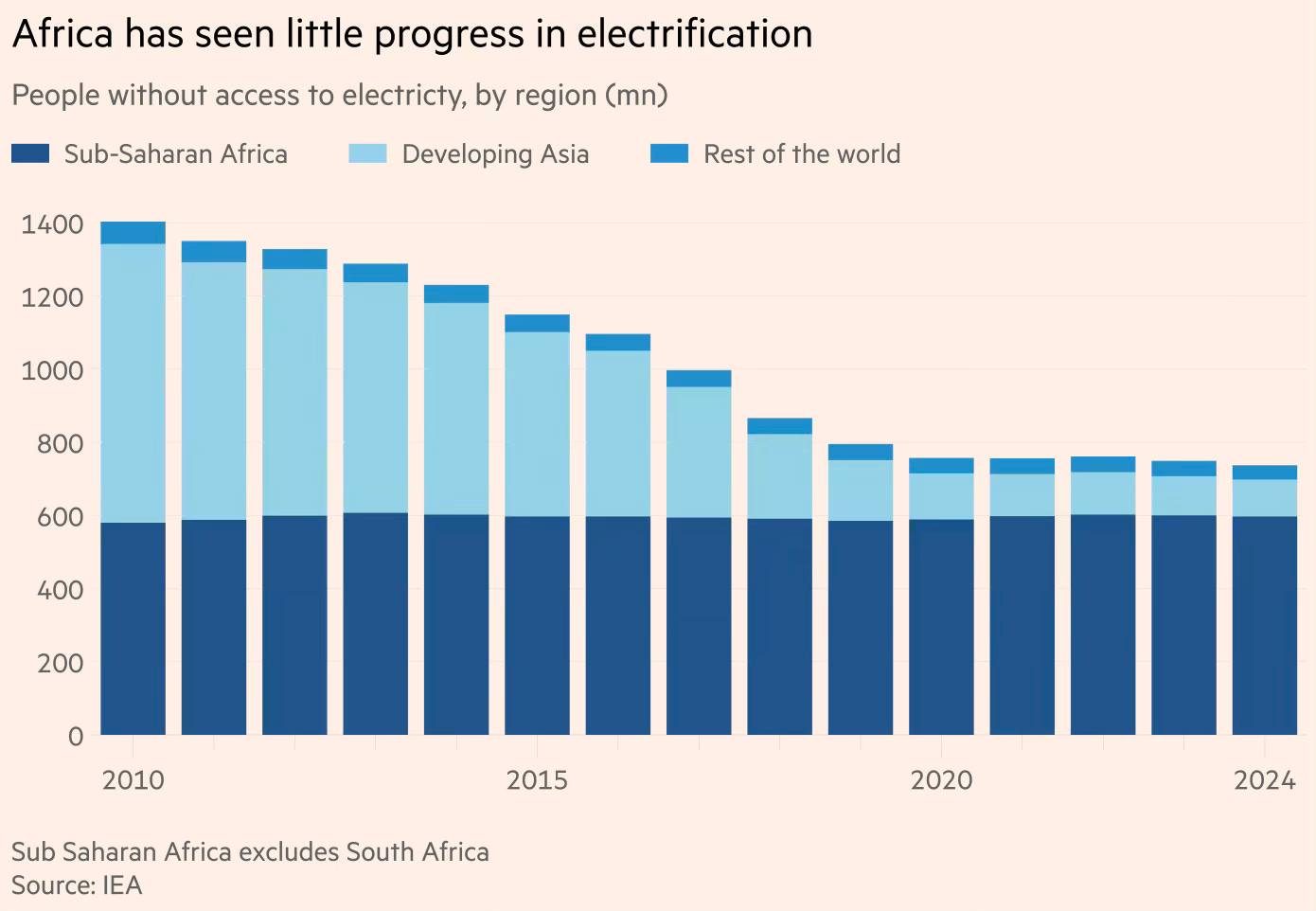
The graphic below is a powerful illustration of one of the biggest failures of global development efforts.

The number of people in Africa without access to electricity remains at 600 million, unchanged from 15 years ago. Among those without electricity globally, the share of Africans has risen from a third in 2010 to 80% in 2024. 

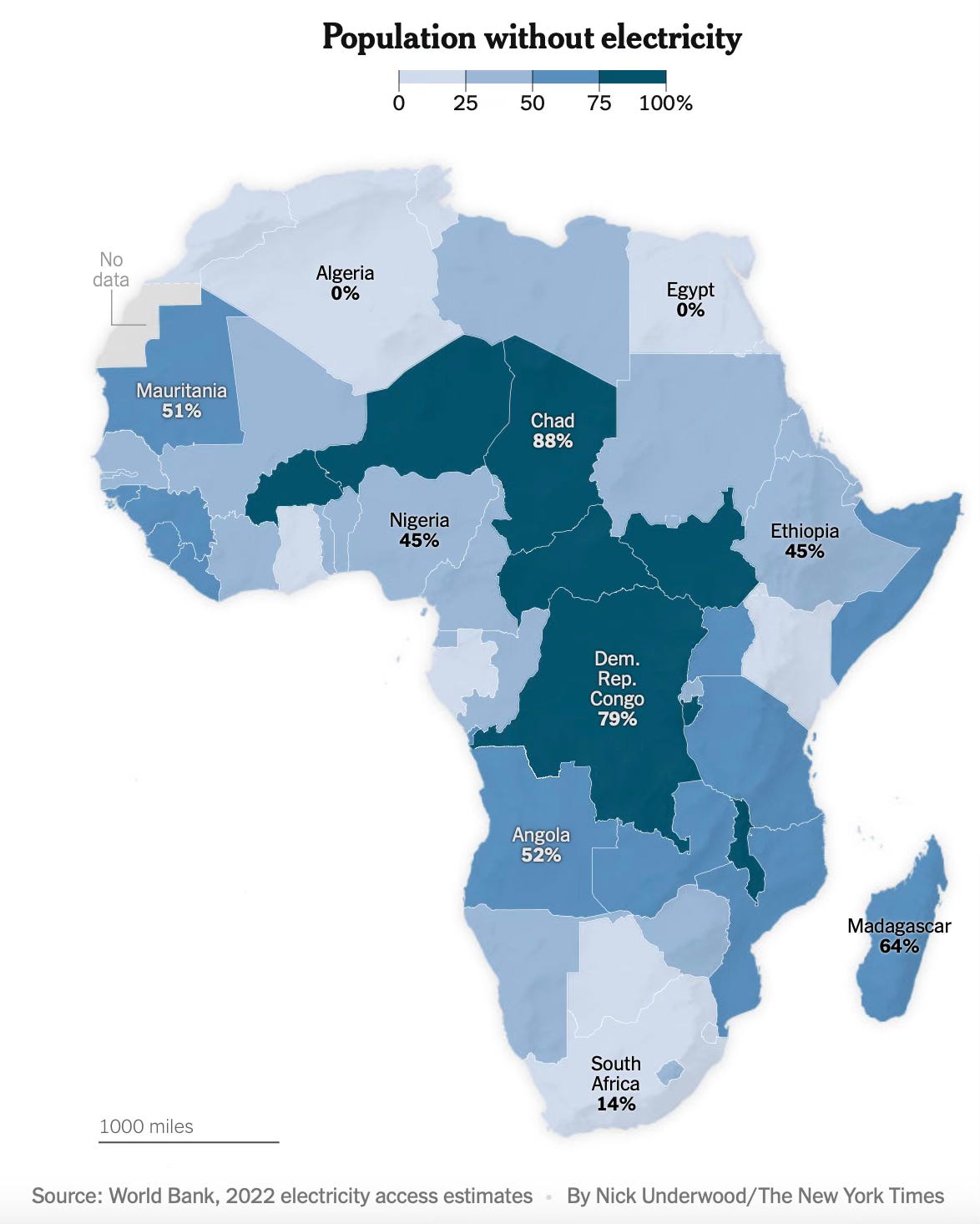
Africa’s electrification problem seems to be excessively concentrated in its hinterland areas, in the region sandwiched between the North and the South. 

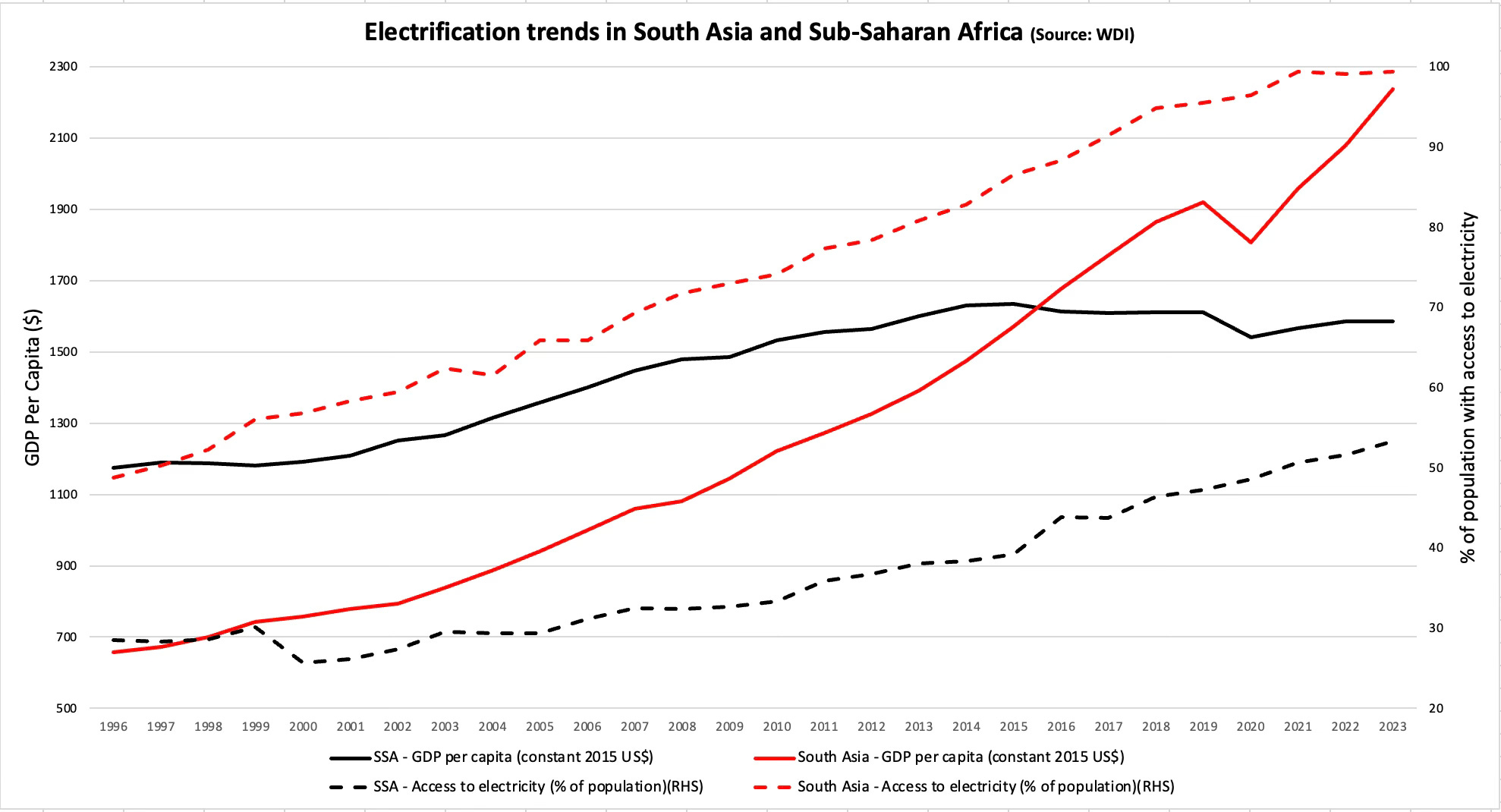
In this context, it’s also useful to see the contrasting fortunes of South Asia and Sub-Saharan Africa in electrification. 

Africa has had a very low baseline of electrification. For example, SSA reached South Asia’s 1995 level of electrification only by 2020, despite its percapita GDP in 2020 being 2.34 times more than that of South Asia in 1995. East Asia and Latin America had a much higher baseline of electrification than even South Asia. This questions an oft-repeated argument that Africa will be able to afford high electrification rates only if its incomes rise enough to sustain a viable market. 

I’m inclined that a very big reason for the gap is the governance of the electricity supply. Through a series of reforms, South Asia, especially India, managed to restructure the sector, regulate it more effectively, improve operational efficiencies of state utilities, and gradually bring in consumer payment discipline. The industrial, commercial, and other higher consumption subscribers were able to ensure that the discoms could become viable entities even after subsidising the vast majority of residential consumers. All this, in turn, derisked the sector and opened the door for private investments in generation. 

The take-off point for electrification in India was the Electricity Act 2003, one of the least appreciated among India’s economic reforms. Today, almost all incremental generation capacity addition from all sources comes from the private sector, and it owns more than half the total installed capacity, from virtually zero at the turn of the millennium. Domestic promoters and capital, intermediated mostly by regular banks, have been the major financiers. 

Africa too must go through these reforms if it’s to derisk its electricity sector and make it viable enough for private investments into generation. In most African countries today, it appears futile to rely on private financing in any meaningful manner to meet power generation requirements. I had blogged here, highlighting the challenges with attracting private investments into power generation in Africa. Till then, public financing may have to do the heavy lifting on electrification in Africa. 

In the spectrum between public and private goods, electricity is an interesting outlier. While it’s a private good insofar as people pay for access, power itself has several positive externalities in human resource development and economic growth. In fact, reliable three-phase electricity is one of the most essential preconditions for economic growth. Public production and provisioning of electricity may, therefore, be an unavoidable necessity in Africa for the foreseeable future. 

In this context, South Africa’s recent success with reforming its electricity sector and reviving Eskom after numerous scandals and rolling power cuts for several years offers an encouraging sign. 

In the latest global endeavour to electrify Africa, the World Bank and the African Development Bank have launched a $90 billion scheme to bring electricity to 300 million people in Sub-Saharan Africa by 2030. About 30 countries have already signed ‘energy compacts’ under the Mission 300 initiative. 

A cursory reading of the Mission 300 plan reveals a mix of objectives thrown in under the broad umbrella of electrification - promotion of renewable energy, decentralised and distributed generation, supply through mini and micro-grids, private participation, complex financial instruments, partnerships between DFIs and philanthropic foundations, microentrepreneurs, etc. In simple terms, the objective of electrification is being pursued through private participation, foreign funding, and renewable energy generation. There are several problems with this approach.

For a start, it’s the classic “everything bagel” development, where multiple laudable objectives are being sought to be achieved in the guise of electrifying Africa. Each of these objectives is challenging by itself, and bundling them only makes the objective of electrification in Africa manifold and daunting. 

The involvement of several partners in the coalition, while laudable, also risks diffusing accountability and responsibilities. Given the scale of the problem, the role of philanthropies and impact investors is marginal. Even meaningful private investments will be difficult to realise in most countries, especially in the early stages. Given the requirements, small renewable energy units and mini grids are marginal compared to thermal generation and grid supply. As the long history of infrastructure financing in low-income countries shows, complex financial instruments will struggle to make any headway. 

Importantly, the opportunity cost of coal (and rivers) rich Africa foregoing thermal (and hydel) power and relying on intermittent solar or wind power is considerable. Besides, given the commercial risks involved, the total cost of renewable power generation by the private sector (including the cost of capital and storage) is likely to far exceed pithead thermal and hydel generation that’s possible in many African countries. In the first stage, it may be useful to prioritise projects with a demand mix that primarily serves industrial and other bulk consumers. The Mission 300 should prioritise all such projects.

The quantum of funds required means that the major share of financing must come from national governments and traditional bilateral and multilateral DFIs through grants and concessional loans. Unless this fundamental constraint is relaxed, the rest are only distractions in the serious endeavour of significantly increasing electrification in Africa.

Saturday, September 27, 2025

Weekend reading links

1. For all talk of AI focus, it does not appear to be showing up in Infosys's personnel hiring over the last six months. 
Amidst all the investment frenzy in the US and elsewhere over AI, Infosys is spending Rs 18,000 Cr buying back its shares, on top of spending Rs 95,000 Cr on buybacks and dividends over the last five years. 

2. China's dominance of the wind turbines market increased sharply since 2020! (HT: Adam Tooze)
As recently as 2020 the global wind turbine market was still a two-horse race with the US not out of the running. Today, China produces more than double the turbines built by the US and Europe put together.
3. It must remain a matter of big concern that even as the world economy has financialised, the cost of sending hard-earned and pitifully small amount of remittances remains elevated at an astronomically high 7.9% for Sub-Saharan Africa (HT: Adam Tooze). 
Additionally, the cost of sending remittances to Africa remains the highest in the world, which dampens the benefits from migration that accrue to Africa. Remittances are one of the most tangible ways for countries of origin to realize the development benefits of migration. Despite the technological advancements in recent decades, the cost of sending remittances remained at 6.2 percent globally in the second quarter of 2023, more than twice the Sustainable Development Goal target of 3 percent. This is largely due to the fees and foreign exchange margins that migrants and their families must pay in origin and destination countries. SubSaharan Africa was the region with the highest cost of remittances in 2023, at 7.9 percent, whereas South Asia had the lowest cost, at 4.3 percent. Figure 3.3 shows that in 18 of Africa’s 29 core countries and seven of Africa’s nine periphery countries for which data are available, the cost of sending remittances is higher than the global average.

The low rate for South Asia is one of the less discussed successes of India's financial market evolution. 

4. France's public debt has risen alarmingly since the GFC.

5. Adam Tooze points to the scale of Friedrich Merz's fiscal stimulus (via TS Lombard). 
Clearly, Germany is stimulating its economy with vengeance, and it appears to have enough space to do so.

6. Unit economics of AI solutions in India is not very attractive.
Netflix, a video-streaming service, costs as little as $1.69 a month in India, compared with $7.99 in America. For cloud services with a low marginal cost, this is no great sacrifice. But running AI queries is expensive. Processing costs for typical users currently hover at around $0.07 per million “tokens” (the units of data processed by AI models) and the response to a single query can run to hundreds or thousands of tokens. That expense is the same whether the user is in Bangalore or the Bay Area.

7. This sums up the challenge with making money in India.

While India’s large population offers scale, it is a difficult market to monetise. According to digital market researcher Sensor Tower, Indians led the world in 2024, downloading 24.3bn apps and spending 1.13tn hours on them. However, their spending was not even in the top 20, at less than $1bn.

8. Palestine is rapidly disappearing.

9. The Economist has an issue focusing on gig workers, who number 200 million in China (40% of urban workforce) of whom about 84 million rely on platform-based employment (delivering parcels and food, and driving bikes and cars) and another 40 million are freelance factory workers. There are some emerging trends in gig work in China.
Lately gig work in China has spread to its vaunted manufacturing sector. The regimented proletariat is gradually being replaced by millions of casual workers who fill jobs “on-demand”, flitting from one factory floor to another at the direction of giant recruitment platforms. The jobs often require no skills beyond a knowledge of the Roman alphabet. The workers may stick with them for no more than a few weeks or even days. Researchers put their number at perhaps 40m, a third of China’s manufacturing workforce—and more than three times the size of America’s.

One reason for the rise of this gig army is that firms want flexibility. Employers prize the freedom to scale their business up or down, responding to seasonal demand, the vagaries of the market and the shifting winds of geopolitics. Technology has played a role, too. Smartphone apps help match customers’ orders with available delivery drivers; in manufacturing, technology has automated away many tricky tasks that used to need experience. Even as this has created jobs for highly skilled engineers, it has left gaps in assembly, packaging and inspection that any warm body can fill. Flexible employment of all kinds suits many workers. Those who are adept at navigating the platform economy can earn more by job-hopping than they could from a single employer.

This is an important snippet about the gig workers.

The average age of factory gig workers is 26. About 80% are male; 75-80% are single and childless. In manufacturing hubs increasing numbers of young workers sleep in parks and under overpasses.

10. FT reports of failures by subprime auto lender Tricolor Holdings and car parts supplier First Brands Group that raise questions about lending and gatekeeping standards. 

Tricolor had won pristine triple-A ratings as it borrowed in credit markets, while First Brands may have amassed as much as $10bn in debt and off-balance sheet financing and was close to raising even more last month... Both companies made use of asset-backed debt, with Tricolor bundling up subprime car loans into bonds and First Brands tapping specialist funds to provide credit against its invoices. At its core, asset-backed finance is the ability to lend against a specific asset or loan, including consumer credit card balances, leases on railcars and solar panels, aircraft and music royalties...
US investment firms have in recent years pushed deeper into asset-backed debt, often pitching it as a safer product than the loans to junk-rated companies that are their bread and butter. But Tricolor is now being probed over fraud allegations by the US Department of Justice, while some investors have long had questions around First Brands’ financial reporting and use of invoice factoring, with lenders now concerned that they lacked visibility about the scale of off-balance sheet financing... Several large banks have also been caught up in the collapse, including JPMorgan Chase and Fifth Third, which are exposed to losses on hundreds of millions of dollars' worth of auto loans. A second investor who has since sold their position in packaged-up Tricolor loans said they had no idea how potential financial irregularities went unnoticed by JPMorgan Chase, one of the banks that underwrote debt offerings.

These kinds of news are now a recurrent staple of financial markets.

11. Michael Moritz comes out all guns blazing at the decision to levy $100,000 fees for H-1B visas.

Every day the Oval Office seems closer to becoming the equivalent of what the sidewalk outside Satriale’s Pork Store used to be for Tony Soprano: a place where a dubious cast of characters spawns brutish extortion schemes and hit jobs... As usual with the Trump administration, the announcement was chaotic and half-baked... Set aside the drama, the announcement demonstrated yet again the fragile grasp the president and his acolytes have about why the US — especially its technology sector — has worked so well. The large tech companies hire foreign nationals because they possess particular skills. They also retain them to perform tasks in areas where the US has labour shortages.

12. New Zealand appoints Anna Bremen, a Swedish economist who has been the first deputy governor of the Sveriges Riksbank since 2019, to head its central bank, the Reserve Bank of New Zealand. 

13. Akash Prakash has some striking numbers about the AI boom in equity markets in the US.

The Magnificent Seven (Mag-7) holds a 32 per cent weight in the S&P 500. In January 2023, just after ChatGPT was launched, this number was only 18 per cent. Nvidia, with an 8 per cent weight in the S&P 500, now has the largest single-stock weight in the history of the index. Its current market capitalisation is equivalent to 15 per cent of US gross domestic product... If we look at the top 10 companies in the S&P 500 (basically the Mag-7, Broadcom, Berkshire and JPMorgan), they account for a record 40 per cent share of the index and 25 per cent share of corporate earnings. We have never seen such concentration of company size and earnings... Since January 2021, 55 per cent of the entire gain in the S&P 500 was accounted for by the top 10 stocks... In 2023 and 2024, the Mag-7 saw earnings growth of about 35 per cent within the S&P 500, while earnings for the remaining 493 stocks grew only 3 per cent...

The Mag-7 and Oracle account for over 35 per cent of total S&P 500 capex. US hyperscalers (the major tech companies) have doubled their share of private domestic investment since 2023. For these hyperscalers, capex has now crossed 20 per cent of sales, compared with under 10 per cent previously. Even on operating cash flow, they are using over 65 per cent to fund data centre buildouts. To put this in perspective, their capex-to-sales ratio is 20 per cent, and research & development-to-sales is 15 per cent, meaning 35 per cent of sales is being reinvested into growth. Truly unprecedented numbers... At their peak in 2000, telecom companies’ capital expenditure accounted for 0.8 per cent of US gross domestic product. Today, hyperscalers’ capex is already at 1.2 per cent of US gross domestic product (GDP), with the current projection being that this number will cross 1.4 per cent by 2028.

14. Countries that have managed to increase their tax to GDP ratio significantly between 2000 and 2022.

15. Very interesting snippet about the impact of superstitions.

In 1966 — a hinoeuma, or “fire horse”, year under an astrological superstition — the fear of giving birth to a wild, destructive and unmarriageable daughter induced a nationwide collapse in pregnancies... The number of babies born in Japan in 1966 plummeted by 463,000 from the previous year, representing a 25 per cent drop. To reduce opportunity risk, marriages also tumbled by 10 per cent. By the end of 1967, with the threat lifted, births had rebounded by an astounding 42 per cent. On historic charts, the spasmodic V-shape makes 1966 look like a colossal data error... Hinoeuma years, which combine the animals of the Chinese zodiac with 10 celestial signs, come around on a 60-year cycle. The next one is 2026.

16. The Magnificent Seven now make up a third of the US stock market capitalisation. 

Nvidia's $4.3 trillion capitalisation exceeds the $3 trillion value of UK FTSE 100.

17. A China Labour Watch (CLW) report has found that more than half the factory staff assembling iPhones at Foxconn's largest factory at Zhengzhou were seasonal staff known as "dispatch workers", despite Chinese law capping their use at 10% of companys workforce. 

US-based CLW also found that dispatch workers faced staggered payment schedules that withhold part of their wages to deter them from quitting during peak production. These staff were not entitled to the same benefits as full-time employees, such as paid sick leave, paid holiday and social insurance that includes medical coverage and pension contributions. CLW also claimed that there is systematic discrimination in hiring certain ethnic minorities and pregnant women... Foxconn uses the flexibility afforded by temporary contracts to adjust to fluctuating demand cycles and, in recent years, to respond to Apple’s shifting requirements about where iPhones should be made... Dispatch workers get a base salary of Rmb2,100 per month, the minimum wage in Henan, but the bonuses make their salaries competitive in the manufacturing sector. These bonuses are typically paid out after three to four months to ensure retention. Many workers preferred the flexibility of short-term contracts and higher hourly wages. However, many said that they had to work a lot of overtime to bolster their hourly wages, which can be as low as Rmb12 for some workers, but range between Rmb25 and Rmb28 for most, depending on experience levels and hiring cycles. CLW found that many staff work 60 hours per week and others up to 75 hours.

18. Stunning graphic that shows the scale of Nvidia stock's performance.