Substack

Showing posts with label impact investing. Show all posts

Wednesday, July 1, 2026

The problems of additionality and technology sector skew in the public funding of startups and innovation

Public risk capital funding of innovation and startups in India is done almost entirely through the VC-driven Fund of Funds (FoF). The RDIF is only the latest effort. 

However, as I have blogged earlier, there are two important concerns with public funding of innovation through the FoF approach. 

One, would it primarily expand the investable universe of startups (genuine additionality) or primarily subsidise returns on investments that would have happened anyway (returns-amplification for private investors)? Second, would it prioritise scalable digital technology innovations at the cost of manufacturing and industrial innovations

The evidence on both suggests returns amplification for private investors and the dominance of technology innovators. This should raise concerns about whether scarce public funds are being deployed most effectively. This post points to yet more evidence in this regard. 

The Ken has analysed the performance of the Self-Reliant India (SRI) Fund, a Rs 50,000 Cr fund with 20% government contribution (the rest coming from VC and PE) to finance MSMEs, and found both concerns being validated. 

The SRI fund model is described here.

SRI Fund is being implemented by NSIC Venture Capital Fund Limited (NVCFL), which is an Alternative Investment Fund (AIF) of Category II registered with SEBI. SRI fund is oriented to provide the funding support through NVCFL to the Daughter Funds for onward provision to MSMEs as growth capital, in the form of equity or quasi- equity, for the following:

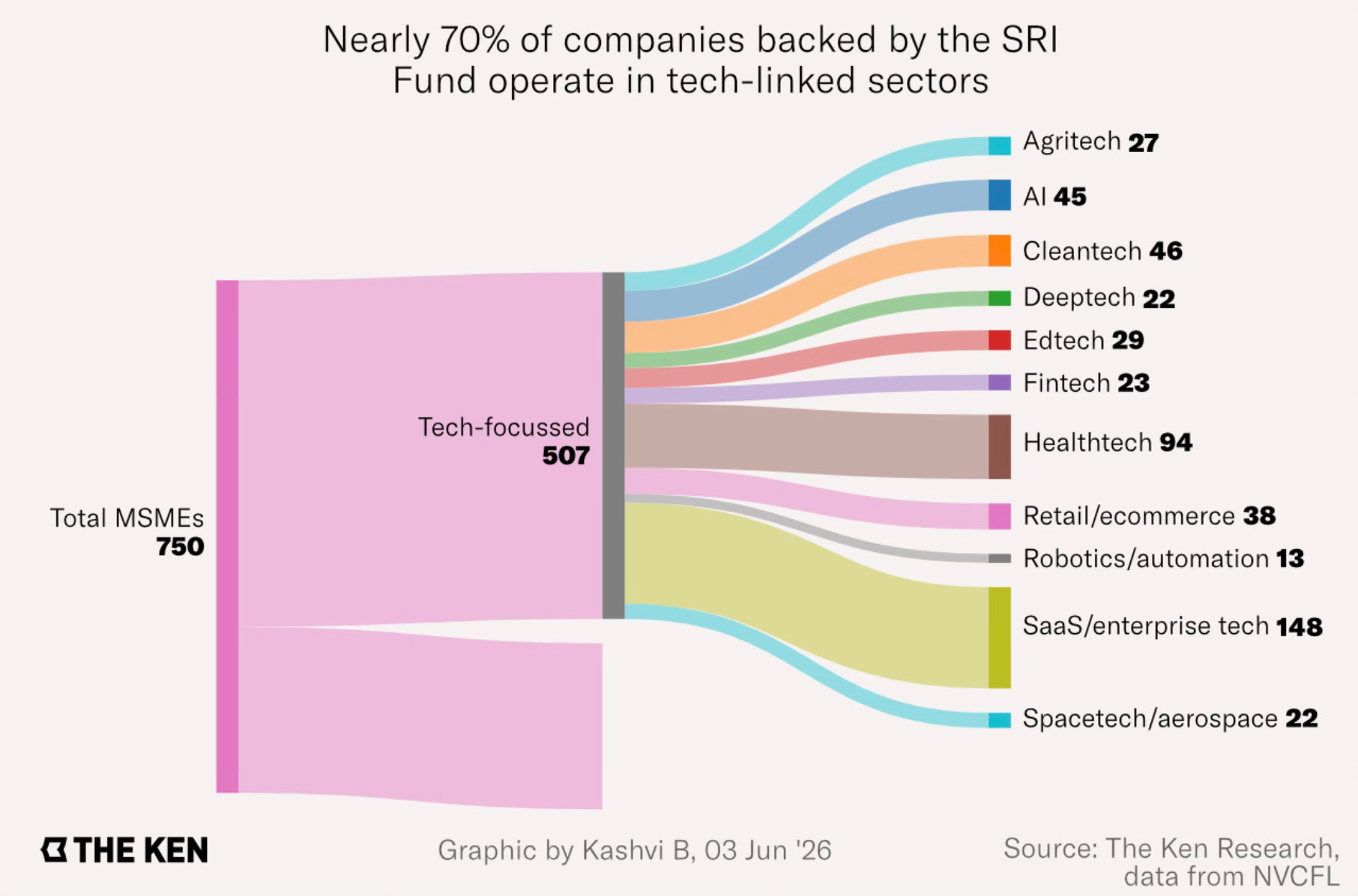
Since the start of the fund in 2020, it has backed around 750 companies and catalysed more than Rs 16,000 crore of investment. 

Nearly seven out of every 10 companies it has backed are tech-heavy businesses. Only three are in traditional manufacturing… In fact, several of these companies had already been backed by VC firms before the SRI Fund got anywhere near them. Truemeds, for instance, is backed by Accel, Peak XV, and Westbridge, while Chai Point is backed by Eight Roads Ventures and Saama Capital. Understandably, this dims, if not outright flouts, the proposition of the SRI Fund, which was supposed to scope out companies “ignored” by venture capitalists… 
“Fund managers get empanelled under SRI with the intention of backing underserved MSMEs,” said Ishaan Ajay, a development-and-sustainable-finance consultant. “But when faced with the choice between a profitable but slow-growing industrial supplier and a software platform capable of scaling rapidly, they tend to gravitate towards the latter. It’s what they understand the best.” Just consider the numbers. Suppose there’s a precision components manufacturer growing 15% annually with, say, 18% Ebitda margins. That may be a great business, but if you invest Rs 10 crore today, you’ll get only 2–3X your money over seven years. Contrast this with a spacetech company, which, if it succeeds, could be worth hundreds of crores.

“Venture funds are built around the second outcome,” said an analyst at a VC firm. This explains why SRI-funded companies tend to be tech-heavy. For every Bellatrix Aerospace in the portfolio, there’s an invisible machine-parts manufacturer outside it that was passed up… startups are generally more innovation- and tech-heavy, whereas MSMEs tend to be traditional, manufacturing-heavy businesses…

The government, for its part, tries its best to redirect funds towards their intended purpose. If it doesn’t agree with a fund’s investment choices, it expresses its objections, according to a VC with knowledge of the matter. But at the end of the day, it’s one LP among many. And when it can’t sway others, it ends up “recusing” itself from investing in that particular portfolio company, added the VC… “There is no prescription that a certain percentage of the fund must necessarily go towards traditional manufacturing or non-tech MSMEs,” a VC said. Which is the one thing that might have prevented all the confusion.

The point about returns amplification for private investors has also been highlighted in a study of IFC’s blended finance deals in the 2000-20 period, which found comparable financial returns to non-blended projects but “no statistically significant excess private mobilisation beyond what IFC’s standard lending would attract.” In other words, blending did not increase the quantum of private investment — it redistributed risk between IFC and private co-investors. 

This finding is echoed in a 2023 study of SIDBI’s Fund of Funds for Startups (FFS) 1.0 by the Impact and Policy Research Institute (IMPRI), India’s Startup Engine: A Policy Review of the Fund of Funds Initiative. It finds that most FFS 1.0 capital went to established VC funds that would have raised capital independently. It also found that “crowding-in effect was primarily reputation/signal, not financial additionality”; the government’s involvement functioned more as a validation of fund managers to private investors than as a necessary injection of capital. While FFS 1.0 delivered a 2x mobilisation ratio, it was mostly in already-functioning VC markets.

As I have blogged several times, the startup and innovation sector is going through the same journey that the infrastructure sector has undergone over the last three decades. Multiple policy experiments to catalyse DFIs - IDFC, IIFCL, NIIF, and now NaBFID - have struggled to crowd in private capital into the riskier infrastructure segments like water supply and sewerage, mass transit, solid waste management, street lighting, energy-saving companies, electricity distribution, etc. Instead, these institutions and instruments may have ended up competing and crowding out private capital in the entirely derisked segments of the infrastructure sector. 

In this context, it is also useful to ask the question whether the VC model is the right instrument for the funding of non-technology startups and innovations. 

Livemint has two long reads that describe the emergence of consumer food brands catering to the niche category of health-conscious people. Sample this

The past few years have seen a spurt in new food brands specializing in regional staples and cooking ingredients. From rural Bengal winter specialty date palm jaggery (nolen gur) to ancient emmer wheat flour (Khapli atta) from Maharashtra, regional staples are finding customers beyond their states of origin. Some brands like Gurugram-based Anveshan and Two Brothers Organic Farms from Pune have crossed a critical mass, with annual sales close to ₹200 crore in 2025-26… Anveshan sources ingredients from key growing regions—like Pollachi in Tamil Nadu known for its high-quality coconuts and aromatic varieties of groundnut from elsewhere in Tamil Nadu and Karnataka—suited to make cold-pressed oils. The ghee, made from the milk of native breeds like the Gir from Gujarat is made using the traditional bilona process where milk is first set to curd and later churned to separate the butter (this has resulted in a new category called ‘cultured ghee’)…

Venture capital funds are betting on these brands: in September last year, Two Brothers raised a $15 million round taking its total fundraise to $25 million (and its post-money valuation to $85 million or ₹781 crore as per data from market intelligence platform Tracxn)… In April this year, KisaanSay, which markets single-origin grocery items like cardamom from Idukki and black raisins from Nashik, raised ₹34 crore ($3.6 million), taking the total funding at the Gurugram-based startup to $5.6 million since it was set up in mid-2022.

In a way, these brands have also helped promote traditional farming practices with more farmers returning to heirloom grain varieties such as the fragrant, short-grain Kala Namak rice grown in eastern Uttar Pradesh and emmer wheat in Maharashtra and Karnataka. These grains have a low glycemic index (a measure of the spike in blood sugar levels from carbohydrate intake) making them suitable for diabetics and often have higher protein and fiber content compared to conventional hybrid varieties… Three distinct factors—growing consumer willingness to pay for clean food driven by a surge in lifestyle diseases, the rise of quick commerce (allowing brands to quickly test consumer response), and influence of social media platforms are reshaping the premium staples market.

All these businesses are distinct from the rapidly scalable technology startups. Take the story of the Two Brothers Organic Farms.

They use organic farming and traditional methods of primary processing to make ghee, jaggery, Khapli flour, and cold-pressed oils. The jaggery is made using native sugarcane with lady finger extract used as a coagulant. “In Khapli, we have created a revolution. We own a seed bank and pay farmers 2.5-times the price of regular wheat. More than 800 farmers grow this wheat for us in 3,000+ acres,” Satyajit said. “It took us ten years to build this brand. At the back-end, our farms are open to everyone (to visit). Consumers trust us and we have a 70% retention rate. But a proliferation of brands (offering traditional, hand-processed staples) also carries the risk of a dilution in quality standards,” he added with a note of caution.

Much the same can be said about most businesses outside of technology - food, textiles, footwear, manufacturing, recycling, etc. Building these businesses requires painstaking efforts for several years, and there are natural limits to their scalability. They are unsuitable for the VC model of funding, as the second Livemint story about the plant-based nutrition startup Oziva shows.

Venture funding, Aarti Gill (co-founder of Oziva) points out, comes with built-in expectations around exits within five to eight years. Unlike venture-backed software companies, consumer health brands compound slowly through trust, habit and repeat behaviour. “If you have investors willing to stay for 10 or 15 years, that changes the equation completely,” she adds. Gill broadly sees three paths for consumer brands: staying profitable and scaling independently over a long period, going public after reaching meaningful scale, or partnering strategically with a larger company. For Oziva, the third route eventually felt like the most practical one. And, that’s where HUL came in… For Oziva, the partnership offered distribution scale, capital and the ability to build beyond a digitally native audience.

Therefore, at a conceptual level and as a framework, it may be a prudent choice for public policy on the funding of startups to distinguish between technology and non-technology sectors. While VCs are appropriate for technology, with their smaller and rapid growth phase, the same may not be appropriate for non-technology startups, which require longer incubation and growth periods. However, in India, most public risk capital funding happens through the VC-driven FoF strategy, which raises concerns of returns amplification and a preference towards technology startups and innovations. 

This is also a concern since technology innovations, far from creating jobs, often also tend to destroy jobs, whereas the non-technology innovations, especially in manufacturing, create good jobs. The graphic below captures the problem.
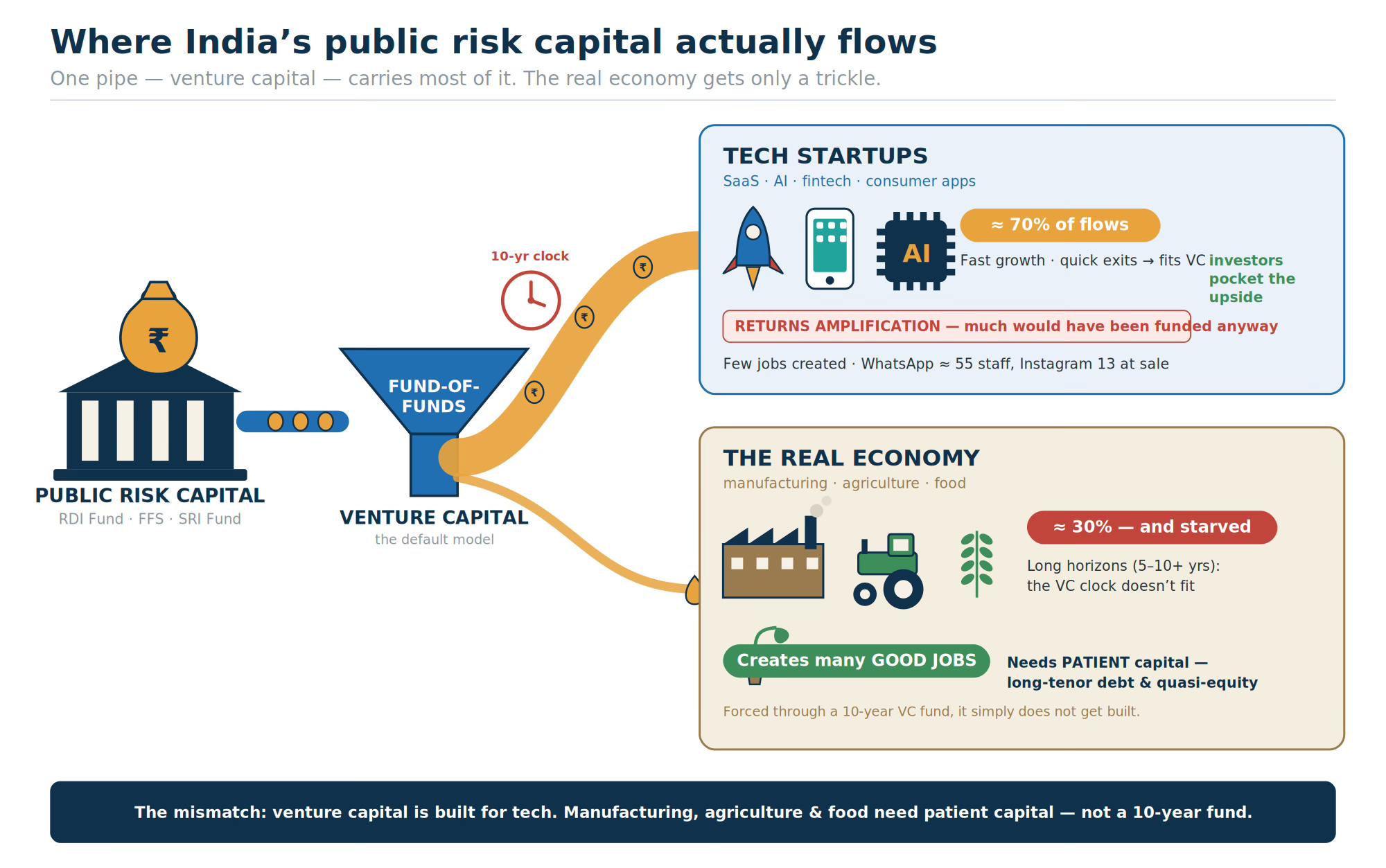
Note: The percentage breakup is probably even more skewed in favour of technology startups.

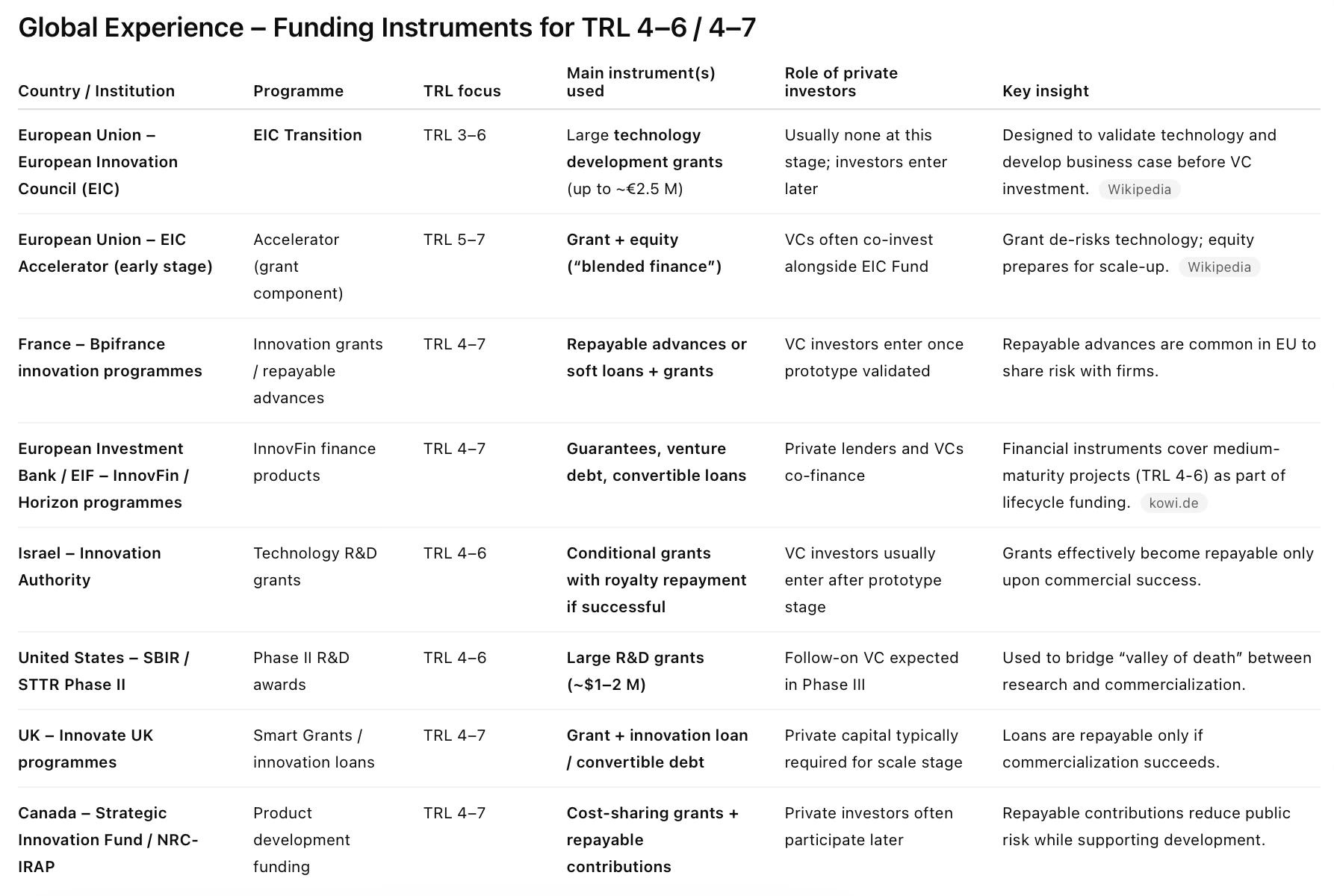
It also raises the question of effective strategies - instruments and institutions - for funding such non-technology innovations. How are such innovations funded globally? Are there institutional structures in India (state or central governments) that offer promise and can be adopted with tweaks? What are the lessons from the likes of the Maharashtra Aerospace and Defence Fund? What are actionable recommendations on funding of non-technology startups? If it also requires the government to directly fund them, what institutional structures are most practical and realistic? I’ll explore these in another post. 

Monday, March 16, 2026

A framework for public funding of innovation and startups

I blogged here exploring models of innovation funding generates the greatest bang for the buck in terms of achieving the primary objective of catalysing innovation. This post will provide some analytical frameworks to formulate a policy on innovation funding. This (on the importance of portfolio management activities), this (on an industrial policy for funding startup innovation largely through grants), and this (on the success of Maharashtra’s Defence and Aerospace Fund) are other recent blogs on the topic. This post will summarise all the takeaways and outline some guidance on startup innovation funding. 

The policy objective of startup financing is fundamentally to expand the envelope of investible startups and innovations and thereby crowd-in private risk capital. What is the best approach to achieve this objective?

Answering the question requires addressing the challenge of whether public innovation funding primarily expands the investable universe (genuine additionality) or primarily subsidises returns on investments that would have happened anyway (return-amplification / crowding-in of already-attracted capital). 

In the context of infrastructure, I have written here arguing that India’s efforts to crowd-in private capital into infrastructure sectors through the likes of IIFCL and NIIF, and IDFC earlier, have struggled to deliver the additionality (in terms of derisking sectors outside the traditional strongholds of public private partnerships) as the new institutions have ended up competing with the private sector for investments. 

What does the empirical evidence on these efforts globally report? 

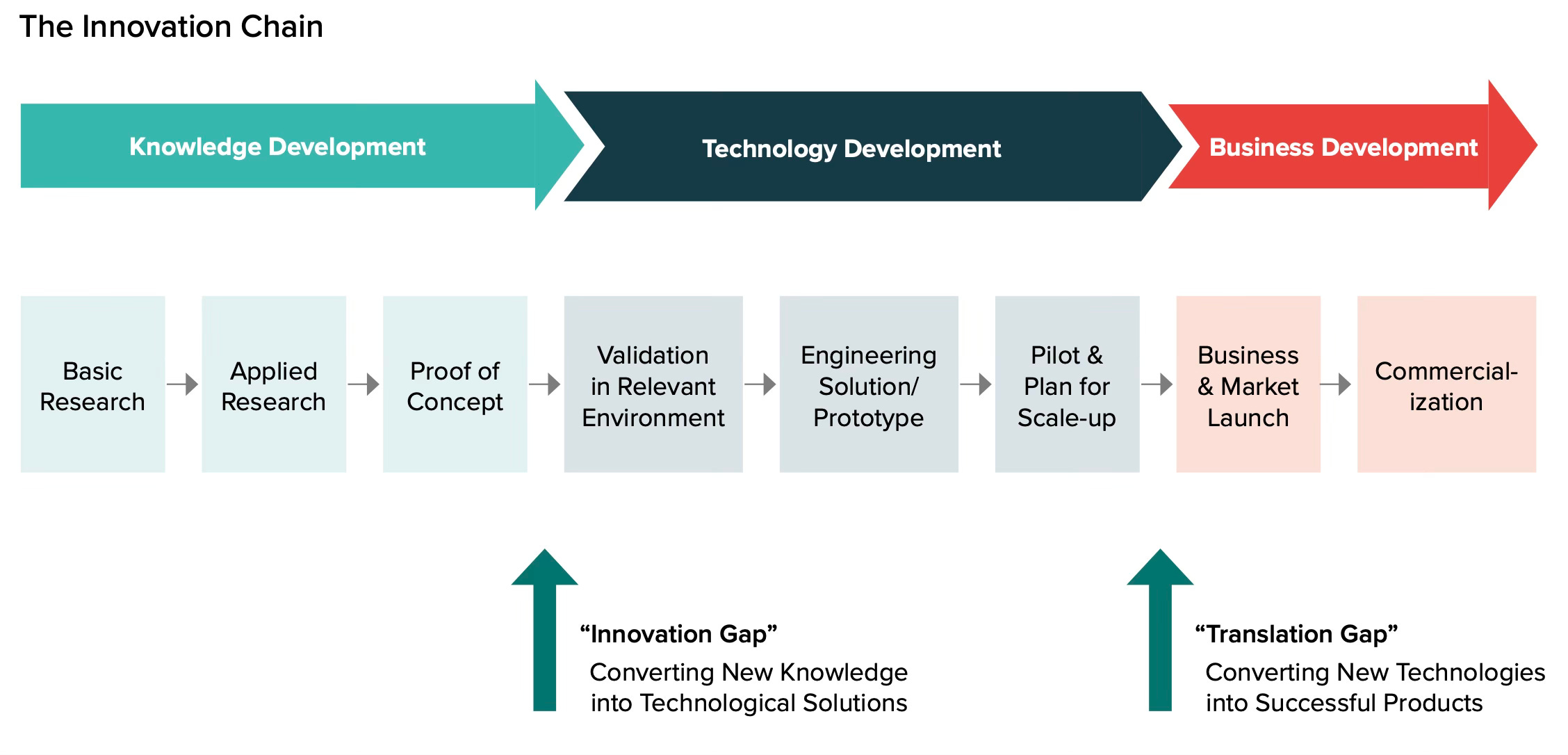
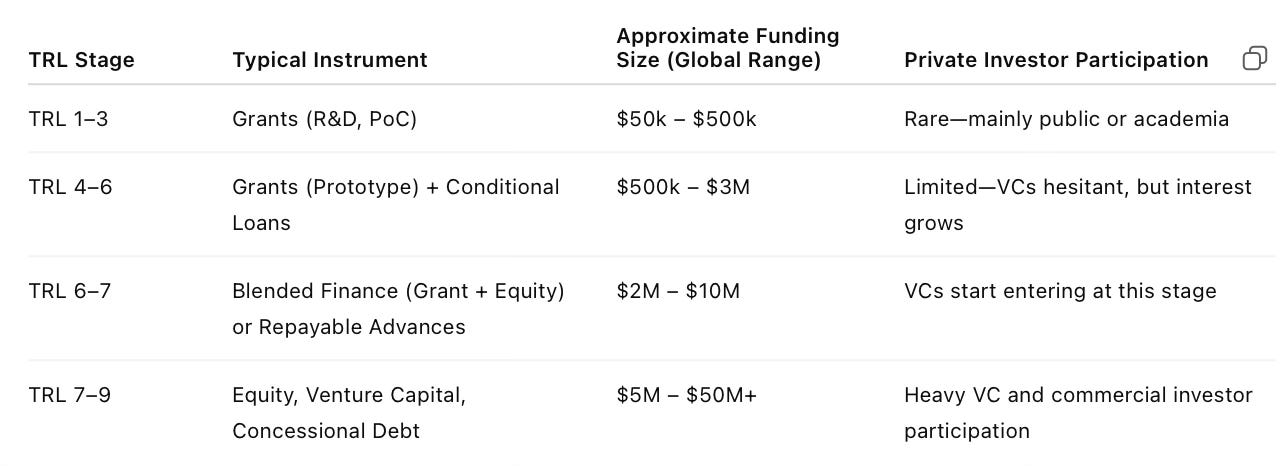
A useful framework for thinking about this would be to categorise funding into three buckets: seed/angel stage (one that leads to proof of concept and lab validation, TRL 2-4), technology/product development stage (includes prototypes and pilots, TRL 4-7), and commercial scaling stage (TRL 7-9). The first category is pure incubation of ideas through grants; the second is about expanding the pool of scalable innovations; and the third is about derisking and crowding in private capital to scale innovations. 

The first stage, being the riskiest, will have the greatest additionality from public funding. It is invariably grant-funded, and gets the biggest share of public funding focus across countries, also because it is essential to create the pipeline of startups that can be feedstock for VCs and other investors. It is no good to have a VC ecosystem without a strong investible startup pipeline in the prioritised technologies. 

In the second stage, being the “innovation valley of death”, grants may be the best option. While instruments such as a Simple Agreement for Future Equity (SAFE), popularised by Y Combinator, and other forms of convertible funding are commonly discussed in the context of technology/product development, the evidence from successful global cases points to grants, with at best hybrid forms like clawbacks or profit sharing. Interestingly, apart from India (BIRAC and MEITY MSH), no major country uses SAFE in public funding.

This is because while investors obviously favour equity instruments like SAFE in pure private market contexts, they create problems with the determination of future cap tables, significantly diluting entrepreneurs and diminishing their incentives at so early a stage of the startup’s journey, and also making them significantly unattractive for commercial investors (who generally prefer startups without the encumbrances from public shareholding). 

It can be observed that those with risk capital instruments tend to kick in only at the TRL 6-7 stages. 

In this context, it is worth briefly discussing the critiques of grant funding to startups. Those who critique giving grants to startups do not realise the central role of public funding in deepening the innovation ecosystem for commercial capital to then come in. In countries like India, where early-stage risk capital is tiny, public funding is critical to create a deep and broad pipeline of innovations. The concern of possible incentive distortions from giving away free money is largely minimised through milestone-based tranches or conditional grants. Critics also tend to conflate these two categories of funding with the third stage of commercial scaling capital, which we now turn to.

The dilemma between expanding the pool of capital and returns-amplification is most relevant to this stage of commercial scaling capital. The global evidence on this is mixed. The Israeli Yozma program, which deployed funds through Fund of Funds (FoFs), is thought to have catalysed the country’s vibrant VC industry

However, other examples point to returns-amplification. A study of IFC’s blended finance deals in the 2000-20 period finds comparable financial returns to non-blended projects but “no statistically significant excess private mobilisation beyond what IFC’s standard lending would attract.” In other words, blending did not increase the quantum of private investment — it redistributed risk between IFC and private co-investors. 

This finding is echoed in a 2023 study of SIDBI’s Fund of Funds for Startups (FFS) 1.0 by the Impact and Policy Research Institute (IMPRI), India’s Startup Engine: A Policy Review of the Fund of Funds Initiative. It finds that most FFS 1.0 capital went to established VC funds that would have raised capital independently. It also found “crowding-in effect was primarily reputation/signal, not financial additionality,” the government’s involvement functioned more as a validation of fund managers to private investors than as a necessary injection of capital. While FFS 1.0 delivered a 2x mobilisation ratio, it was mostly in already-functioning VC markets.

This brings us to the question of the most cost-effective approach to achieve the public finance objective while supporting commercial scaling. The options span the spectrum from directly investing in the startup to indirectly investing through FoFs

While the former allows for targeting the riskiest innovations/startups, it creates the challenge of due diligence, which can be addressed through co-investment with professional investors that piggyback on their diligence. While the latter limits the control over who/what is funded, it allows full play for professional investment practices. 

In either case, the nature of the entity that deploys the public funds is important. A fully public or majority public shareholding corporation, whether non-profit or for-profit, will struggle to deploy risk capital and will be hobbled by the restraints of the General Financial Rules (GFR) and the vigilance from oversight agencies. It is for this reason that there is no instance from India of a government-owned entity directly making risk capital investments (apart from the Maharashtra Defence and Aerospace Fund). Its alternative, a majority privately owned entity or a Category I Alternative Investment Fund (AIF) with private Limited Partners (LPs), cannot avoid the returns-amplification problem. 

In the circumstances, the most prudent and effective strategy would be the FoFs route with some sharply defined conditionalities. The funds could be committed at concessional terms - subordinate equity, first loss buffer to a certain threshold, capped returns, warrants with lower liquidation preference, etc. It should be complemented by broad mandates on the nature of investments made, specifically on the TRL stages of the innovations, and pre-defined technology areas. 

When public capital is subordinated to private capital in the waterfall through any of the aforesaid approaches, the public subsidy is targeted precisely at the risk premium that blocks private investment. Return-amplification is minimised because private investors bear disproportionate upside — they are not getting a free subsidy on already-viable deals.

In this context, the RDIF is instructive. For a start, all its funding is debt or equity and only for TRL 4 and above stages. It has three modes of investing based on where it stands in the returns waterfall. In the first mode, RDIF effectively absorbs the first losses and receives distributions after private investors have received their hurdle rate. In the second mode, it receives distributions pari passu with other contributors at the same hurdle rate and IRR. In the third mode, it receives distributions at a higher priority or higher IRR than private contributors. 

While the first mode is a good example of concessional lending as discussed above, the second and third modes may need to be justified on other considerations. Scarce public capital should flow to those areas where it has the highest additionality. While it prescribes the broad areas of investing, it may not suffice in pre-empting returns-amplification investing. 

In the circumstances, the RDIF runs the risk of ending up with the same problems as those with the likes of IDFC and NIIF in infrastructure (whose portfolios clearly indicate that they tend to compete and crowd-out rather than crowd-in private capital). It may struggle to realise the promised additionality. For instance, it is most likely that most of the funding will flow into the TRL 8-9 innovators in the less risky among the defined areas. Finally, I’m not sure how Focused Research Organisations (FRO) can deploy returnable capital in startups, unless they merely act as pass-throughs to FoFs. 

If the second-level fund managers (SLFMs) of RDIF are required to meet additionality criteria (invest in TRL 6-9 companies they would not otherwise fund; report on portfolio-level additionality; face consequences for drift towards safe/commercial deals), the public mandate will be preserved. But without this discipline, every SLFM will cherry-pick the best deals, and the public capital risks becoming a subsidy for private returns. At best, public capital ends up competing with private capital and marginally expanding the large enough and growing pool of risk capital. 

Finally, the biggest constraint to scaling is finding the deployment platform in a country where the indigenous product ecosystem, especially domestic OEMs, is very limited. In the circumstances, public policy must play an important role in value addition by facilitating the creation of scaling pathways. This could be through direct procurements (solar cells, smart meters, street lighting LEDs, etc.) or domestic content mandates (cameras, telecom equipment, etc.). This has been a very important pathway for commercial scaling in both the advanced countries and in China, but it will be a challenge for India’s public policy. It is also for this reason that investors should pursue proactive portfolio management in terms of actively facilitating the linking of startups with the public procurement pathways. 

In conclusion, a few points to be borne in mind. One, grants at Stage 1 (TRL 1-4) are the highest-additionality instrument globally. No other instrument produces a comparable expansion of the investable universe. The evidence is unambiguous. Two, since private capital will remain scarce, public capital is critical to develop the pipeline of risky innovations and startups. Three, this nature of funding and additionality will also largely apply to the stage of technology/product development.

Four, a blended fund with a derisking public tranche and a set of sharply defined target investment-related conditions, is the highest-additionality structured instrument for commercial scaling. The public tranche absorbs the risk premium, and private capital fills behind. Five, government procurement is the highest-additionality instrument for commercial scaling for hardware companies. Procurement creates more private capital crowding-in than any equity instrument, because it proves market demand.

Finally, as public policy interventions to realise the aforesaid objectives, there are perhaps two low-hanging fruits. One, there should be a portal that consolidates all the startups financed by state and central government departments, and it should become the primary universe of the pipeline for risk capital funding. This portal should be tightly integrated with the ecosystems of VCs and other investors. Second, there should be active portfolio management at the level of all departmental funds to facilitate access to larger public risk capital funds like RDIF and SIDBI FFS 2.0. The objective should be to ensure that promising publicly financed innovations do not remain stranded.

Saturday, October 28, 2023

Weekend reading links

1. Debashis Basu writes about the case of C&C Towers Ltd (CCTL), the latest example of the unholy nexus between bankers and businessmen that has resulted in socialised losses.

It had signed a 20-year concession agreement with the Greater Mohali Area Development Authority (GMADA) in April 2009 for an inter-state bus terminal (ISBT), three multi-storey towers with retail and office spaces, a multiplex, a five-star hotel, a banquet hall, hypermarkets, and a helipad on top of one of the towers. The project turned bankrupt and went into liquidation, and was admitted for debt resolution. On October 19, the Chandigarh Bench of the National Company Law Tribunal (NCLT) passed an order... against an admitted claim of over Rs 579 crore, the resolution plan could provide for only Rs 81.5 crore, or just 14.08 per cent... The moment CCTL bagged the large multiplex project, it immediately gave an advance of Rs 110.78 crore as pre-construction advance and Rs 63.30 crore as mobilisation advance to a group company, C&C Construction Ltd (a listed firm which is also bankrupt). As always, a bunch of public-sector banks sanctioned money in November 2010. CCTL also collected Rs 490 crore from 400 property buyers. Construction was inordinately delayed, leading to the GMADA issuing termination notice in April 2016 and invoking bank guarantees of Rs 11.90 crore. A corporate insolvency resolution process (CIRP) started on October 10, 2019...
Consider these details of related-party transactions. CCTL had extended an advance to the extent of 35 per cent of the contract price to C&C. The transaction auditor has pointed out that the general business/industry practice is to advance 15-20 per cent of the contract value. As much as Rs 25.93 crore of the advance is still unadjusted against construction. CCTL had also made an excess payment of Rs 40.87 crore to C&C over and above the bills and mobilisation advances allowed. No lender approval had been sought for this payment, said the NCLT order. According to the terms of the contract, CCTL had the right to impose and levy liquidated damages of 0.25 per cent of the contract value per week or part of a week, a maximum of up to 5 per cent of the total contract value, ie Rs 15.82 crore in the case of default by the contractor (C&C). The work was scheduled to be completed within 18-30 months from December 16, 2009, for the ISBT and the hotel & commercial complex. Despite inordinate delay, CCTL has not imposed liquidation damages on C&C.

Basu is spot on in his assessment,

The CCTL promoters crafted a contract to drain substantial amounts of money and got away with it. The bankers and “independent engineers” of the GMADA did not monitor the project and did nothing to prevent money from being drained off to group companies. They are primarily responsible for this fraud, but they too got away... What were the bankers doing? What were the engineers of the GMADA doing? The answer is crystal clear in all such bankruptcy cases (especially in real estate involving public-sector banks), but it is one that we don’t want to see: Rampant fraud and corruption by everybody involved... The source of humungous bad loans that are written off periodically has nothing to do with poor bankruptcy laws, as claimed by bankers, such as Arundhati Bhattacharya, former State Bank of India chairperson. Yet, there is widespread opposition (even articulated by former Reserve Bank of India governor Raghuram Rajan) to criminal action against bankers because they would like to label these normal “business failures”.

Solutions like IBC and privatisation of banks without addressing fundamental issues of governance and political economy are like band-aid policies. 

2. Interesting that the technology companies have laid off more people in India this year than all but the US! And layoffs among startups in India this year has already exceeded that for the full of last year.

This hiring winter comes even as Infosys and Wipro which together hired 208,000 graduates last three years have announced that they'll not be hiring this year. This is the first time since 2008 that any of the big Indian IT firms have not hired. 

3. China's Belt and Road Initiative (BRI) is at a crossroad.

The decline in investments has also been accompanied by rising criticism and domestic opposition in BRI countries, even as those countries struggle to repay the loans. 

The best example is Pakistan where projects worth $62 bn have been committed. But 40% of projects have run into problems of corruption, cost overruns, funding shortfalls or adverse environmental impacts, and 20% have been cancelled or delayed indefinitely.
The current problems should also not take away from the scale at which BRI was done and its unprecedented promise.
Recipient countries such as Pakistan find themselves able to finance projects they could never have dreamt of under old-style foreign bilateral or multilateral aid programmes, from power plants to high-speed data networks... “In some senses, it was an absolute game changer,” says Bilal Gilani, executive director of Gallup Pakistan, a consultancy. He added that China was bringing in almost as much foreign investment into energy alone than “what Pakistan received as FDI in total in various sectors in 25 years prior to CPEC”. Hussain, the Pakistani senator, goes further, saying infrastructure on this scale was inconceivable in the country prior to BRI. “The only two projects which we have successfully done with a certain sustainability, with a certain perseverance, with a certain determination — one was the nuclear bomb . . . and the second is CPEC.”
A big problem has been the absence of private sector linkages. The Chinese have avoided seeing BRI as an economic investment opportunity. Instead, they have followed the model of lending, contracting, and supplying, thereby multiplying the value capture from the loans and limiting local spillover benefits. 
“[We hoped] to get some Chinese companies to invest in Pakistan, in our special economic zones and then to export,” says a former Pakistani official, who declined to be identified. “That never took place. It’s OK to borrow money and build infrastructure, but it’s more difficult to bring investors into our zones to make stuff and sell it.” This lack of follow-through from Chinese private companies has arguably been CPEC’s biggest shortcoming. Analysts say that few Chinese businesses have shown an interest in setting up factories there, depriving the Pakistani government of the foreign currency earnings needed to service its non-rupee borrowings.

4. Livemint points to the annual survey of Indian cities by Janagraha and has some interesting graphics. This on the human resource deficiencies of Indian cities

This on the the low degree of devolution of powers to municipalities. 

This on how poorly paid municipal councillors are.

5. Tell-all memoirs by senior government officials like this do a lot of dis-service. Most often, as in this case, it's driven by personal agendas and egos. If that's not bad, it immediately increases risk-aversion in already risk-averse governments. 

Senior bureaucrats earlier too used to write their memoirs. But there are three differences. One, their memoirs used to be atleast some years after their retirement. Two, even when it came out, it avoided controversial topics and playing to the galleries. Three, these memoirs used to be dignified accounts. 

6. Some snippets on the emerging trends with the Indian economy.

Sample this about wages

Real wages of casual wage workers in agriculture shows a negligible growth of 0.1% per year compared to the wages in 2019. For non-agricultural wages, they are yet lower than the level in 2019, with a decline of 1.1% from a year earlier... The situation for regular workers is no better... The latest Periodic Labour Force Survey (PLFS) gives their earnings in 2022-23. Still, they fare worse, with real earnings remaining lower compared to the pre-pandemic levels. For the April-June quarter, real monthly earnings of regular workers have declined 0.5% per annum compared to their 2019 level. This is also true for the July-September quarter of last year, which shows real earnings decline at 1.6% per annum compared to their 2019 levels. But even compared to 2017-18, which is the year when the PLFS series begins, real earnings are lower for every quarter of 2022-23 compared to their levels in 2017-18. The decline is greater when compared to 2017-18, at an average 1.8% per annum.

This on a possible K-shape in the housing loans sector,

The housing loan interest rates before May 2022 had stood at 6.5-7%. Now they are at around 8.4% to 10%, with housing loan equated monthly instalments (EMIs) having jumped 20%. But this hasn’t slowed down their disbursal. Why? The answer lies in looking at the breakdown of housing loans between priority sector loans and the non-priority loans. Priority sector housing loans are defined as: “Loans to individuals up to ₹35 lakh in metropolitan centres (with a population of 10 lakh and above) and up to ₹25 lakh in other centres… provided the overall cost of the dwelling unit in the metropolitan centre and at other centres does not exceed ₹45 lakh and ₹30 lakh, respectively." The remaining loans are non-priority loans.

In the months leading up to May 2022, priority sector housing loans formed around 35-36% of the overall outstanding housing loans of banks. By June 2023, they had fallen to 31.5%, implying that banks are giving out more non-priority housing loans. Of course, these loans are largely taken on by the well-to-do, who do not get impacted much by the rise in EMIs. In fact, the outstanding priority sector housing loans of banks from January to June have been just 1-2% higher than during the same months in 2022. When it comes to non-priority housing loans of banks, they have been around 22% higher from January to June in comparison to the same months in 2022. Further, the percentages don’t explain this inequality well enough. The outstanding priority sector housing loans from June 2022 to June 2023 went up by ₹137.76 billion. In comparison, the non-priority sector housing loans went up by ₹2.47 trillion, nearly 17 times more.

And this about automobile sales in India

Vehicle sales have been declining since 2018-19 and car and passenger vehicle sales have been nearly stagnant since 2011-12. The real growth in all categories happened from 2003-04 to 2010-11.  

7.  One of the intriguing things has been the stock market's calm reaction to geopolitical events like in the Middle East. But Ruchir Sharma points to historical data which appears to inform that the reaction now is par for the course.

In the days after the terror attacks in the US on 9/11, much cited as an analogue to 10/7 in Israel, America was on red alert for a follow-up. The S&P 500 fell by 12 per cent, the fall magnified no doubt by the fact that the US was six months into an eight-month recession. But that phase passed quickly — the S&P 500 would recover all its losses by October 11. The same pattern can be traced back much earlier. Looking at the stock market reaction to 25 of the most significant geopolitical crises since the second world war, including cross-border conflicts from Korea in 1950 and acts of terror from the first World Trade Center bombing in 1993, the S&P 500 dropped on average by around 4 per cent, reaching bottom in 15 days, but recovering fully in 33 days. Sixteen of these events took place in the Middle East or stemmed from conflicts or terror groups there — such as the bombings on public transport that hit Madrid in March 2004 and London in July 2005. After an initial impulsive sell-off, the market usually recovered the losses quickly. And the market sell-off on the latest conflict in the Gaza Strip is so far less striking than it has generally been. The bigger worry is rising interest rates.

We tend to overreact to present crises

The collective mind of the market, in contrast, recognises geopolitical risk as a historical constant, and frames fraught moments in that context. Is it clear, for example, that the Middle East is more precarious now than during any of the major conflagrations there since the second world war? That Russia is a more dangerous power after the loss of half its combat capacity in Ukraine? That China is a greater threat today, despite the steady weakening of its economy? The sum total of these threats is highly uncertain and debatable; the market, an aggregation of millions of views, is inclined not to rush to judgment. I met the legendary investor Julian Robertson in the late 1990s, when the hopes for world peace that followed the collapse of the Soviet empire were erased by new risks, including India and Pakistan carrying out a series of nuclear tests. Robertson advised me, as a young rookie investor, not to overreact.

This is a very wise article. 

There's a natural propensity of humans to be more alarmed by their present and be blind to the long view. Are we really in a more fractured times? Is it worse than in 1972-73 or 1979, or earlier times of convulsions, especially during the peak of the Cold War? I'm being deliberately contrarian here.

8. On the implications of India's decision to ban on rice exports on the face of rising prices

By the end of July, India had banned exports of non-basmati white rice and followed this in August with a minimum sale price for basmati rice and a 20 per cent tariff on parboiled rice, extended until March. “It’s tough when a country that accounts for 40 per cent of global trade slaps a ban on half of what they export, and duties on the other half,” says Joseph Glauber, senior research fellow at food security think-tank International Food Policy Research Institute (IFPRI) and a former chief economist at the US Department of Agriculture... the benchmark rice prices in Thailand and Vietnam, the world’s second and third largest rice exporters, have risen 14 and 22 per cent since India imposed its ban. Arif Husain, chief economist at the UN World Food Programme, points out that the countries likely to be worst affected are already suffering from a litany of woes: sky-high food prices, soaring debt and depreciating currencies... 

... countries in west Africa... are particularly exposed to India’s export ban, says the WFP’s Husain. In Togo, for example, almost 88 per cent of all rice imports came from India in 2022 and 61 per cent for Benin, the world’s largest importer of Indian broken rice. In Senegal, where 47 per cent of rice imports come from India... 

The rice export ban is also important since over 40% of the global rice exports come from India. 

The article points to concerns about global rice production going forward and its ability to meet the rising demand
Today’s predicament, analysts warn, is not so easily fixed. Fifteen years ago the world was not lacking in the grain, but that is no longer the case. The world population is set to reach close to 10bn by 2050 with the biggest growth in Africa and Asia. Researchers estimate this rise will increase demand for rice by almost a third, but yields are not keeping pace. After decades of rapid growth thanks to the development of new varieties, yields are stagnating in four big rice-producing countries in south-east Asia, according to a recent study in Nature Food, an academic journal. Globally, on average yields increased 0.9 per cent a year between 2011 and 2021, a slowdown from 1.2 per cent a year between 2001 and 2011, according to data from the UN. 

The chief reason for this setback is climate change. Because rice grows in hot climates — 90 per cent of the world’s rice is produced in Asia — it is often assumed that a few extra degrees will not matter... This is not the case. Above certain temperatures, rice yields drop, explains Sander, adding that the grain is particularly sensitive to night-time heat. A 2017 study found that a global increase in temperature of 1C was likely to reduce rice yield by an average of 3.3 per cent. Temperatures have already risen by at least 1.1C since pre-industrial times. Modelling by commodity data group Gro Intelligence forecasts that by 2100, Asia’s top rice exporters will all experience a sharp increase in the number of days above 35C, with Thailand potentially seeing an 188 additional days above this threshold in a worst-case scenario. For Asia’s rice-producing deltas, from the Mekong to Ganges, climate change could present other complications. As temperatures increase, sea levels rise and salty water flows into fresh water rivers, irrigation channels and the soil, reducing yields or making growing impossible.

9.  Parental income determines your SAT score in the US. Among SAT takers, the children of the richest 1% were 13 times and top 20% seven times more likely to score 1300 than children of the poorest quintile. 

Given the low proportion of SAT takers among poor students, the disparity becomes even greater when we compare the ratio for all students who score more than 1300.

And the picture of the distribution of SAT score by income is even worse.

10. Aswath Damodaran writes the obituary of ESG investing
Born in sanctimony, nurtured with hypocrisy and sold with sophistry, ESG grew unchallenged for a decade, but it is now facing a mountain of troubles, almost all of them of its own making... If an asset is less risky, it should have lower expected returns. Thus advocates who argue that improving ESG will make firms less risky are directly contradicting other claims that investors will earn higher returns if they invest in high ESG companies. Adding an ESG constraint to investing will lower expected returns, with the only question being how much, leaving fund managers who have fallen for its charms in a fiduciary bind.

And he points to an unintended perverse consequence of the ESG fetish,

ESG pressures have led publicly traded fossil fuel companies to reduce spending on exploration and to divest fossil fuel assets, but private equity has filled the investment void. Is it any surprise that after trillions of dollars invested in fighting climate change, we are just as dependent on fossil fuels now as we were a decade or two ago?
11. Rana Faroohar points to the latest UNCTAD report that highlights rising business concentration among exporters,
High levels of export concentration among the largest 2,000 firms globally increased during the pandemic. This was particularly true in developing countries, where data shows that the top 1 per cent of exporting businesses within each country received between 40 and 90 per cent of total export revenues for the nation as a whole. The median rate of corporate export concentration in a database of 30 developing countries is a whopping 40 per cent... The rise in corporate concentration has also mirrored the continued decline of labour share globally, which is down from 57 per cent in 2000 to 53 per cent today. As the authors put it: “The declining labour share and the rising profits of [multinationals] point to the key role of large corporations dominating international activities . . . [and] driving up global functional income inequality”.

12. Newspapers are reporting that Reliance is close to clinching a deal to buyout Walt Disney Co.'s India operations, Disney Star, at $7-10 bn. This would be a big coup for Reliance, coming on the back of pipping Disney Star to buy IPL rights for $2.7 bn and clinching a multi-year pact to broadcast Warner Bros Discovery Inc.'s HBO shows in India. 

This of course raises concerns about India's media landscape and the control that Reliance would exert on it, over advertisers, content producers, and audiences. 

13. India should refrain from pushing hard on IMF voting reform for now unless it has a good proposal with reasonable backing from others. As Alan Beattie has written here, any reform of IMF quotas in terms of voting rights proportionate to contributions or economic output is playing into China's hands and would leave India even worse off. He estimates that it would increase China'a voting rights from 6.4% to 14.1% and India's from 2.7% to 3.5%, a multiple of four compared to 2.25 now. 

For now, replenishing IMF and WB's finances without change in voting pattern would be in India's interest. This is an area where India and US align perfectly.

14. Akash Prakash explains the perspective of foreign portfolio investors to the Indian equity market

The primary concern regarding India is its valuations. India is now, along with the US, the most expensive market in the world. Most allocators are naturally hesitant to commit capital with such high expectations already priced in. The most common questions remain on what can go wrong and what are we missing? What are the flaws in the India story? Some mentioned that we have been here before only for India to disappoint in the past. Why is this time different? My sense is that on any correction, a wall of money is waiting to come in, as few doubt the long-term potential of India. Every allocator we met was clear that five years from now they will have a lot more capital in India than they have today. While new investors are hesitant to commit capital today, most of the existing India investors are happy to live with the current valuations and keep their allocations largely unchanged. I heard the comment that India has always been expensive many times from this set of investors. There seemed to be no desire to take profits off the table in any significant manner.

15. Seven US tech companies not only dominate the US S&P 500 but also the global markets.

Seven large US tech companies have driven all of the gains in global stocks this year, pushing the US dominance of equity markets to new heights. The so-called “magnificent seven” — Apple, Microsoft, Meta, Amazon, Alphabet, Nvidia and Tesla — have been propping up the S&P 500 index of blue-chip US companies for most of the year because of investor excitement about the growth of artificial intelligence. The trend has become so extreme that it is dominating markets abroad. But for the seven companies, MSCI’s benchmark All-Country World index of almost 3,000 large and midsized companies would have declined in the year to date, according to Bloomberg data. The seven have added almost $4tn in market capitalisation in 2023, compared with $3.4tn in gains for the MSCI index as a whole. They have added a combined 40 points to the index, which has risen 37 points overall. Unless there is a sharp turnaround by December, 2023 will mark the eighth year in the past decade that the US share of global market capitalisation has risen. US companies now account for 61 per cent of the $60tn index, compared with less than 50 per cent a decade ago. The largest 10 stocks make up almost 19 per cent of the index, up from 8 per cent in 2013.

This dominance has been accompanied by a rising concentration in valuations at the top in global equity markets. 

16. I have blogged on multiple occasions about the need for startup businesses to establish their value proposition to build long-lasting businesses and not focus on scaling/growth for its own sake. Here's what Nitin Kamath of internet stock brokerage firm Zerodha said while referring to his firm's valuation being "way higher than reality".
All of us on the core team have never thought of notional valuations right from the start because they can go up and down with market conditions. Focus on ever-changing valuations is a distraction... The focus has always been on building a resilient business, which means never having to rely on external capital.

17. Evoking memories of its crackdown on Jack Ma following his questioning of the government, China has cracked down on Foxconn

Two months ago, Terry Gou was talking big. Announcing his intention to run for president in his native Taiwan, Foxconn’s billionaire founder argued that China — home to most of the factories where the world’s largest contract electronics manufacturer churns out Apple’s iPhones — could not touch him or his company. “If the Chinese Communist party regime were to say, ‘If you don’t listen to me, I’ll confiscate your assets from Foxconn’, I would say: ‘Yes, please do it!’ I cannot follow their orders, I won’t be threatened,” Gou said, insisting his business interests would not make him beholden to China. Now, Beijing has called his bluff on that boast. Tax inspectors have descended on Foxconn subsidiaries in two Chinese provinces and are investigating land use by group companies in two others, in a co-ordinated large-scale probe that Taiwanese executives and government officials say smacks of a politically motivated crackdown... His presidential bid has irked the Chinese leadership because it further fragments votes for Taiwan’s opposition and makes a victory for the Democratic Progressive party — which refuses to define the island as part of China — more likely, said a person close to Foxconn.

This might perhaps be the crossing the Rubicon moment for China's relationships with foreign investors. For decades, Chinese provinces and the central government have courted foreign investors. Foxconn in particular was especially feted. But now that Chinese companies have acquired enough expertise across the value chain of manufacturing in many sectors, Beijing feels that it can afford to arm-twist foreign investors who refuse to follow the Party line.

Saturday, February 25, 2023

Weekend reading links

1. Market concentration fact of the day - English Premier League edition
During a frantic January transfer window in Europe, English clubs spent €830mn, almost double the previous record. Chelsea alone spent more than all the top-tier clubs in Italy, Spain, Germany and France combined, a sign of the Premier League’s increasing financial dominance over the world’s most popular sport. Of the top 10 biggest spenders in Europe this season, all but one play in England... Deloitte’s league table of the 20 wealthiest teams in Europe now includes 11 English clubs, up from seven a decade ago...  Only one French team and three Italian clubs make it into the top 30 clubs by revenue, according to Deloitte...

Javier Tebas, chief of Spain’s La Liga, accused the Premier League of allowing its wealthy club owners — from Middle Eastern petrostates to US private equity billionaires — to weather “barbaric” losses, which put the health of the broader game at risk by driving up costs for everyone else. “It is quite dangerous that the [transfer] markets are doped, inflated, as has been happening in recent years,” he said. “That can jeopardise the sustainability of European football.” 

This comes even as a recently released report of a four year investigation by EPL found that Manchester City, the current champions and the richest club, and owned by the Abu Dhabi royal family since 2008 had indulged in more than 100 breaches of the League's financial rules. This adds more fuel to the perception that English clubs have enjoyed an unfair advantage due to light-touch regulation, which allows it to attract wealthy Middle Eastern and American owners who have the deep pockets to absorb large losses. 

Club owners include a Serbian-born media tycoon, a Greek shipping magnate, the Saudi sovereign wealth fund, and several American billionaires, making ownership something of a status symbol for the mega-rich. “Owning shares in IT companies and property in Manhattan is not as sexy as owning a Premier League club,” says Francis. Without billionaire benefactors, other leagues in Europe have chosen to implement stricter financial standards. The idea is to stop teams living beyond their means in pursuit of glory. In Spain, La Liga’s economic controls require clubs to submit regular updates on their revenue, which the league then uses to calculate pre-determined spending limits. Last summer, those rules briefly barred FC Barcelona from registering new signings, before the Catalan club used asset sales to boost its balance sheet. The league has since tweaked its controls to make that harder to do. In Germany, ownership of clubs is guarded by the so-called 50+1 rule, which prevents outside investors from acquiring controlling stakes in most teams, leaving clubs to rely on their own income to fund themselves. The Bundesliga says these rules help protect German football from “reckless owners”.

2.  FT writes how the B Corp, an ESG certification benchmark widely recognised as the gold standard, is being abused in the form of green washing. In order to achieve B Corp status firms have to ostensibly "meet high levels of overall social and environmental performance, public transparency and legal accountability to balance profit and purpose". 

There are now over 6400 companies across 158 industries certified as B Corp, including several multinational companies with deeply questionable ESG claims. The certification is done by a non-profit network B Lab Global and its national chapters. 

There are limits to the certification. A company may commit to paying its own employees a fair wage but there is no requirement to extend this further down the supply chain. If a company makes increased profits, how it deploys those funds is not for B Lab to dictate. It could invest in growers or farms, increase staff wages, install solar panels — or just ramp up dividends or executive pay. For these and other reasons, questions linger over whether B Corps are enacting truly meaningful change internally and whether the effects of that change is being felt more widely. Another UK executive says that while the certification helped show the company in a good light when pitching business to clients, beyond that he does not really think about the larger purpose of the movement. “Companies are keen to say we have a social purpose, therefore we have a good company,” says Mark Goyder, a corporate governance expert and founder of business think-tank Tomorrow’s Company. “But they don’t emphasise the how. Here are the ways we underpin this, how do you ensure values are upheld and how do you govern things like culture?”...
Companies gain B Corp status based on how they score out of 200 on a variety of metrics across governance, treatment of workers and customers, community and the environment. The process can be long and expensive — anywhere between $500 and $50,000 each year — and this has to be reappraised every three years. Companies, which have to get at least 80 points, are also required to legally cement the B Corp commitment into the mission statement of their company... the points system allows companies to pick and choose which criteria apply to them, usually with the help of sustainability consultants, and focus on meeting them.

3. Supply chains relocating out of China

The shift away from mass textile production in the country, albeit still in its early stages, marks the reversal of years of outsourcing to a region that has come to dominate the textile supply chain. Big names such as Mango and Dr Martens have recently cut or signalled their intention to shift manufacturing out of China or south-east Asia... Dr Martens (the bootmaker) has moved 55 per cent of its total production out of the country since... 2018. Just 12 per cent of its production for the 2022 autumn/winter collection was manufactured in China compared with 27 per cent in 2020 and it estimated this will drop to 5 per cent this year... The relocation was also being driven by stricter laws being introduced in the US and Europe against labour abuses, she added, following the alleged use of forced labour in the cotton-rich territory of Xinjiang in China... According to statistics from China’s National Bureau of Statistics, the average factory wage doubled between 2013 and 2021, from Rmb46,000 ($6,689) per year to Rmb92,000.

For all such talk China remain the export behemoth in sectors like textiles  

4. McKinsey is the latest to announce mass layoffs. 
McKinsey & Co. plans to eliminate about 2,000 jobs, one of the consulting giant’s biggest rounds of cuts ever... Under a plan dubbed Project Magnolia, the management team is hoping the move will help preserve the compensation pool for its partners, the people said, asking not to be identified discussing non-public information... Companies in industries from finance to technology to retailing are reducing staff amid a slowdown in demand and predictions of a looming recession. Tech giants including Amazon.com Inc. and Microsoft Corp. have announced plans for deep cuts, and Goldman Sachs Group Inc., Morgan Stanley and other top banks have been eliminating thousands of positions.

I have been thinking about this. I wonder how much of the spate of layoffs in corporate America has been triggered by Elon Musk. Musk culled the vast majority of Twitter workforce after takeover and that does not, at least till now, have had any major adverse impact on the company. For businesses waiting to seize any opportunity to cut costs, this would have been the trigger. Besides, they could use the excuse of the pandemic hirings etc to justify the layoffs. 

5. Good FT article on how Apple has hooked Gen Z consumers and entrenched itself

Gen Z users — those born after 1996 — make up 34 per cent of all iPhone owners in the US, versus 10 per cent for Samsung, according to new data from Attain, an adtech data platform... As Gen Z is the most online of any age group — spending up to six hours a day on their smartphones — the iPhone’s dominance is shaping the social circles of young Americans... The propensity of Gen Z to purchase iPhones — or convince their parents to — comes even as the average price of an iPhone approaches $1,000, roughly three times the average Android device globally, according to Counterpoint. The Gen Z preference for iPhone is more pronounced in the US than elsewhere, but when market intelligence group Canalys did research in western Europe it found that 83 per cent of Apple users under 25 years of age planned to keep using iPhone. The percentage of Android users of the same age who plan to stick with Android was less than half that.

6. Andy Mukherjee has two excellent graphics that shows how the Adani Group companies differ from the remaining companies of corporate India. 

The sharp difference between return on capital employed and stock market returns over the last three years

And that over this year till date

7. In the context of talking about Elon Musk, Palanivel Thiagarajan, the Finance Minister of Tamil Nadu, has this piece of eternal wisdom,
"... if you get successful very quickly, and very successful, it's a very dangerous thing because it starts putting the notion in your head, that somehow you exist in a different plane than the rest of us. And I don't mean that in terms of racism and classism. I mean, you start thinking that you're such a genius that you can't get anything wrong... that you have this unique ability to always see everything perfectly, and predict and manage and run all the stuff. And I've seen it before in large hedge funds, in large banks, in fact at Lehman, we saw some of that. And that almost always ends one way. Or, in fact, every time it ends one way. The only question is how long. It ends with you getting way ahead of your abilities. Because the reality is, and I'll say this in a very very important message to the youth. The reality is that you could be successful 100 different ways through a different combination of circumstances, and you could lose or fail at something a 100 different ways. So it's very hard when you're successful to either assume that you are very smart or very good or uniquely qualified. And the same way just because you fail at something you shouldn't let that failure determine your self worth or your self understanding or realisation... Everything is redeemable. All failures are redeemable, all success is temporary. There is no guarantee of any of this stuff. But most people who get really successful really fast forget that."

I'm also reminded of this in the context of this article in The Economist about the new tech and self-centric worldview of the technology billionaires of Silicon Valley. 

8. The Ken examines the economics of fashion e-commerce sites in India (Mantra, Flipkart, Amazon, Jabong etc) and finds that their commercial viability is questionable.

These companies have done almost everything they can to squeeze profits. They’ve created private labels, resorted to favourable terms of sale, and achieved reinventorisation. Most recently, they’ve even started charging some customers for returns—something unheard of so far. And yet, profits continue to elude them. So it’s time to ask—will profitability ever come?

Despite the much higher margins of 35-40% these sites demand from sellers, the biggest challenge for fashion e-commerce sites comes from the very high percentage of sale returns. Typically fashion and apparel have return rates of 35-40%. This from an article in The Economic Times

There’s bad news for fashion retailers hoping to cut real estate expenses by venturing into ecommerce — running an apparel business online is almost just as expensive as running a brick-and-mortar store in any mall... Some fashion brands that entered the online space in the past five years claim to be paying 30-40% commission to ecommerce platforms such as Jabong, Flipkart, Amazon, Myntra and Koovs for sales and product delivery... This is almost as much as they would pay to run a physical retail store, which includes costs like rental (15%), staffing and utilities (8-10%) and maintenance and discounts (5-6%), according to Arvind Singhal, chairman of retail consultancy firm Technopak Advisors.

9. Some snippets on bank credit growth which points to the lop-sided nature of India's economic growth

Six of every ten personal loans were for homes and vehicles as of 31 January 2023, according to the RBI’s latest bank credit data. The two categories combined have surpassed the loan amount given to the entire agricultural sector. The real-estate sector is also observing some unprecedented developments: residential properties priced above Rs 1.5 crore (~US$181,300) accounted for ~30% of total sales—the highest ever proportion—across the country in 2022, according to a 2023 report by Knight Frank, a global property consultancy. This share was ~23% in 2021, similar to pre-pandemic levels... Overall, the launch of luxury properties priced above Rs 2.5 crore (US$302,000) doubled in 2022, said Mumbai-based real-estate-services company Anarock Property Consultants in its report... “Sales of apartments priced over Rs 1.5 crore (US$181,300) doubled in 2022 in India. Luxury projects priced above Rs 2.5 crore (US$302,000) in tier-1 cities are getting sold out at the pre-launch stage. Inventory overhang for such projects is at a decadal low,” said a senior employee at JLL India, a real-estate services company. 

Similar trends of higher growth at the premium segments are visible in vehicles market. 

... domestic sales of utility vehicles outpacing that of passenger vehicles (PVs) by more than 185,000 was witnessed in 2022, showed data by the Society of Indian Automobile Manufacturers (Siam)... A Siam official broke down the data. “While compact SUVs (sport utility vehicles) were the go-to option in 2021 and for the most part of 2022, cars priced well above Rs 15 lakh (~US$18,000) drove the growth in the later half of the year and the first month of 2023.”... Audi reported a 27% year-on-year (y-o-y) sales growth in 2022 on the back of newer launches. Meanwhile, Mercedes Benz and BMW have registered a y-o-y growth of 41% and 37%, respectively, largely driven by the demand in tier-1 cities... outstanding car loans have spiked by ~25%, according to the RBI’s data.

Another aspect of the credit growth story is this

In the one year from 30 December 2021, retail loans grew over 20%, while trade advances rose ~14%. During the same period, loans to industries grew by ~9%.

10. An example of the hypocrisy on climate change is the passenger vehicle ownership and usage patterns in the US. 

The average new American car purchased in 2021 weighed 1.94 tonnes, fully half a tonne more than the European average. Purchases of SUVs and “light” trucks together now account for four out of every five new vehicles bought in the US, up from one in five 50 years ago. The pattern of car purchasing maps on to the US political divide. Republicans are more likely than Democrats to buy a new vehicle of any kind, and vastly more likely to buy a big one. About 65 per cent of buyers of the largest pickup trucks, utility vehicles and SUVs last year were Republican, compared with just 15 per cent bought by Democrats, according to a survey by the research company Strategic Vision. And this isn’t driven by America’s political geography. Whether you look at buyers in dense urban centres or isolated rural areas, trucks and SUVs are red, small hybrids blue. The divide becomes even more stark when Americans are asked to pick which attributes they look for in a new car: “aggressive”, “powerful” and “rugged” all rank among the top five selected by Republican-leaning purchasers. The US fleet of huge vehicles is down to identity, not necessity: individualism on wheels.

The heavy vehicles coupled with excessive individualism also takes its toll in the form of accidents,

Almost one in 10 drivers and passengers in the front seat of US cars do not wear a seatbelt, and 45 per cent say they often drive at least 15 miles per hour above the speed limit on motorways. In the UK, both measures are way lower, at 3 per cent. The grim result is that half of the car occupants killed in the US in 2020 were not wearing seatbelts vs 23 per cent in the UK. Speeding is implicated in 30 per cent of fatal crashes in the US but just half of that in Britain. All told, 43,000 people died on America’s roads in 2021, the highest mortality rate in the developed world by some margin. By my calculations, a fifth of those could be averted every year if rates of speeding and seatbelt-wearing matched peer countries.