Substack

Showing posts with label Bond markets. Show all posts

Wednesday, February 18, 2026

India's non-financial corporate bond market trends

Deepening of the non-financial corporate bond market has been the big endeavour of financial market reforms in India. I have blogged here and here, pointing to the limits to bond market financing of infrastructure sectors. 

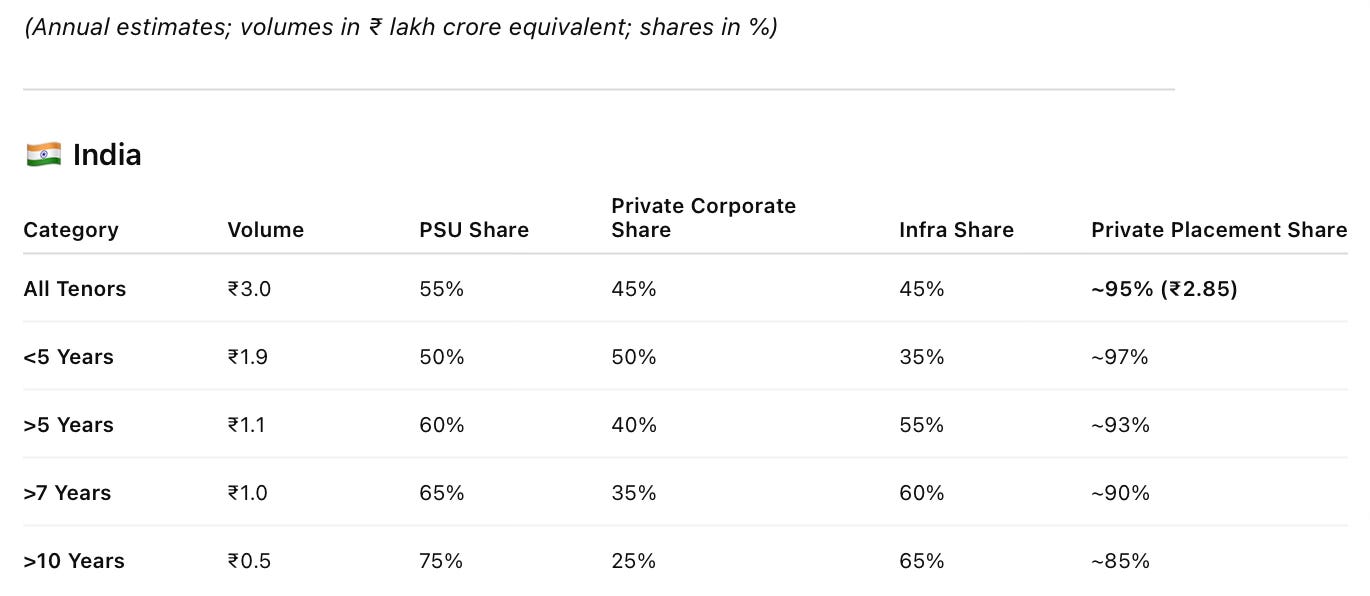
In the absence of readily available longitudinal data, I ran some queries on ChatGPT to estimate the landscape of India’s non-financial bond markets, issued by public sector units and private corporates, across different bond tenors, the respective shares of infrastructure and private placements in each tenor category, and comparison across countries. The data used are from RBI/SEBI, SIFMA (the US), AFME/ECB (Europe), and BIS/Brazilian Central Bank. 

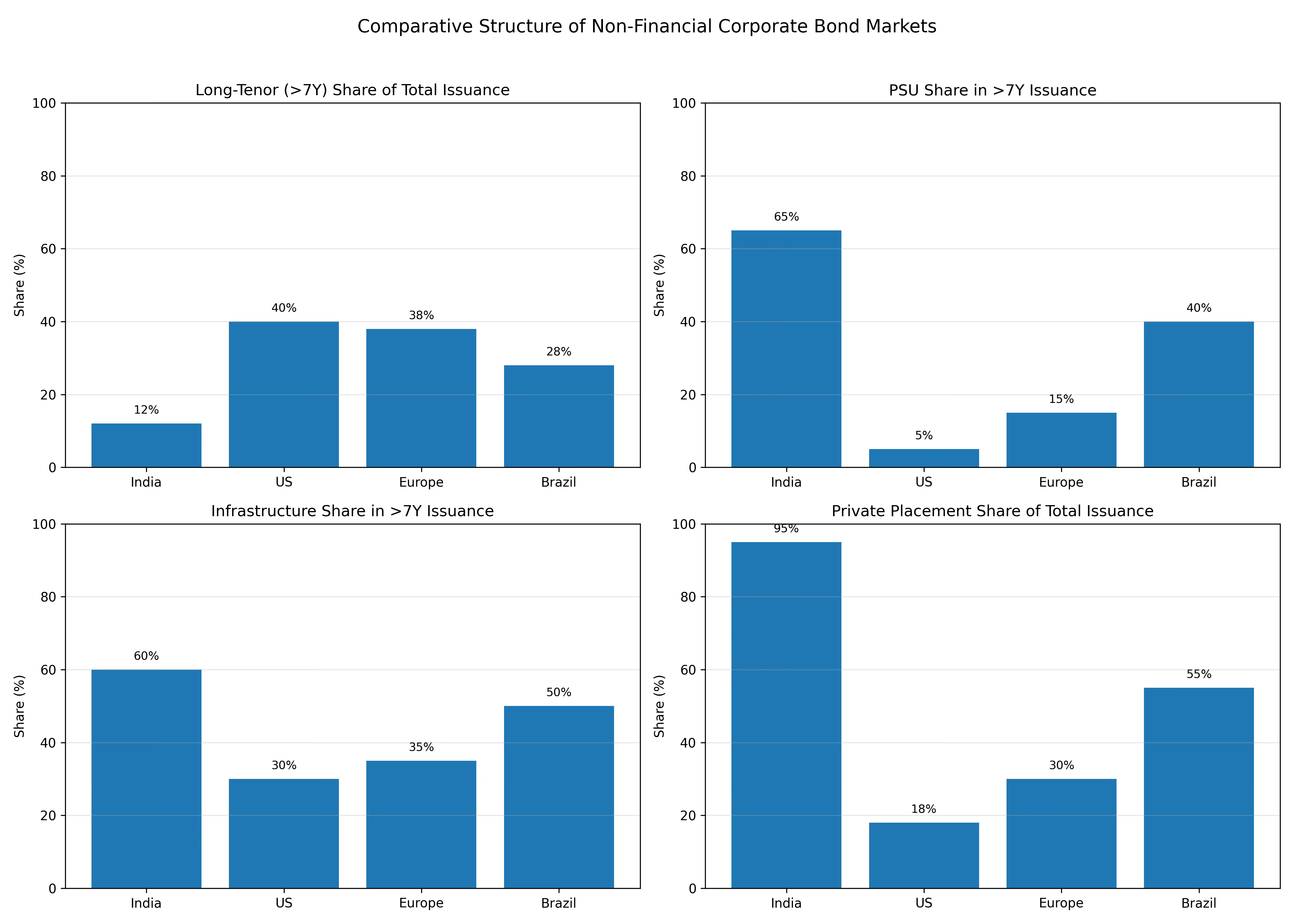
India’s bond market is dominated by private placement, skewed towards the short tenor, and issuance by the PSUs. A positive feature is the high share of infrastructure issuances.

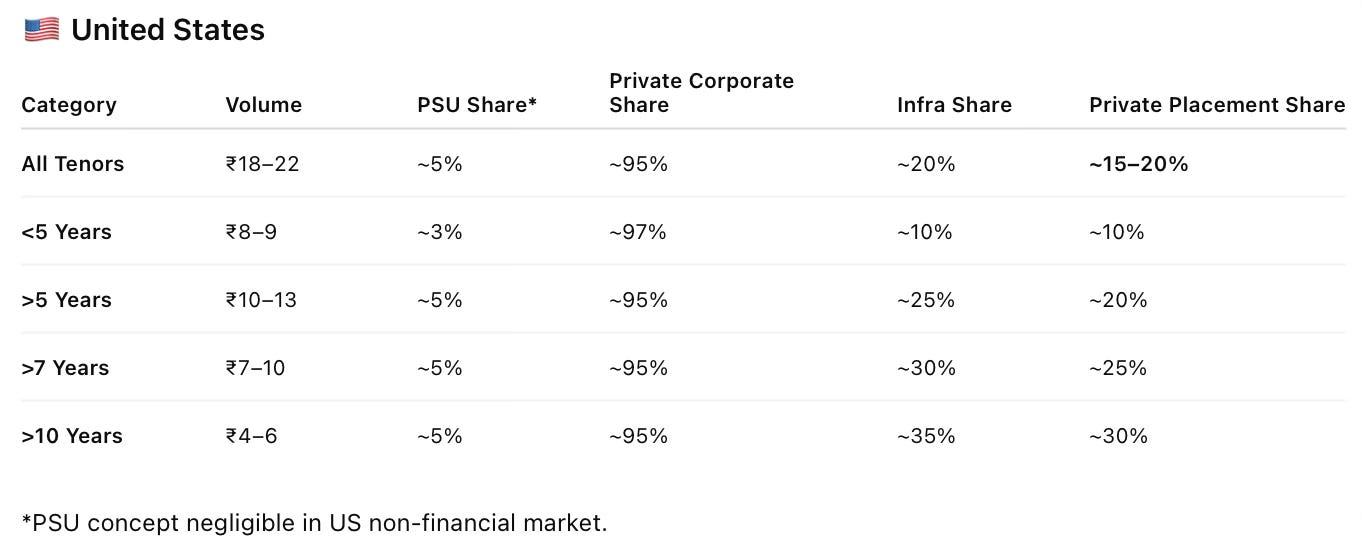
The same result for the US showed up as below. The US corporate bond market is mostly through public placement, dominated by private corporates, and with the majority in longer tenors. The volume below is in Rs lakh crores.

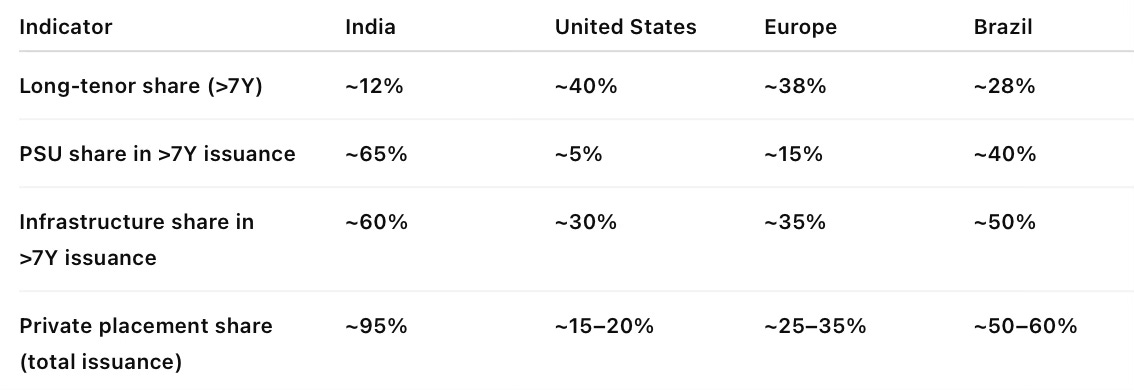
The table below compares across India, the US, Europe (including the UK), and Brazil. India stands out for its dominance in private placements, a high share of public-sector issuance, and a very low share of long-tenor bonds. The private placement market is dominated by AAA and AA bond issuances, thereby squeezing out the vast majority of potential issuers. All three trends must reverse to deepen and broaden the bond markets.

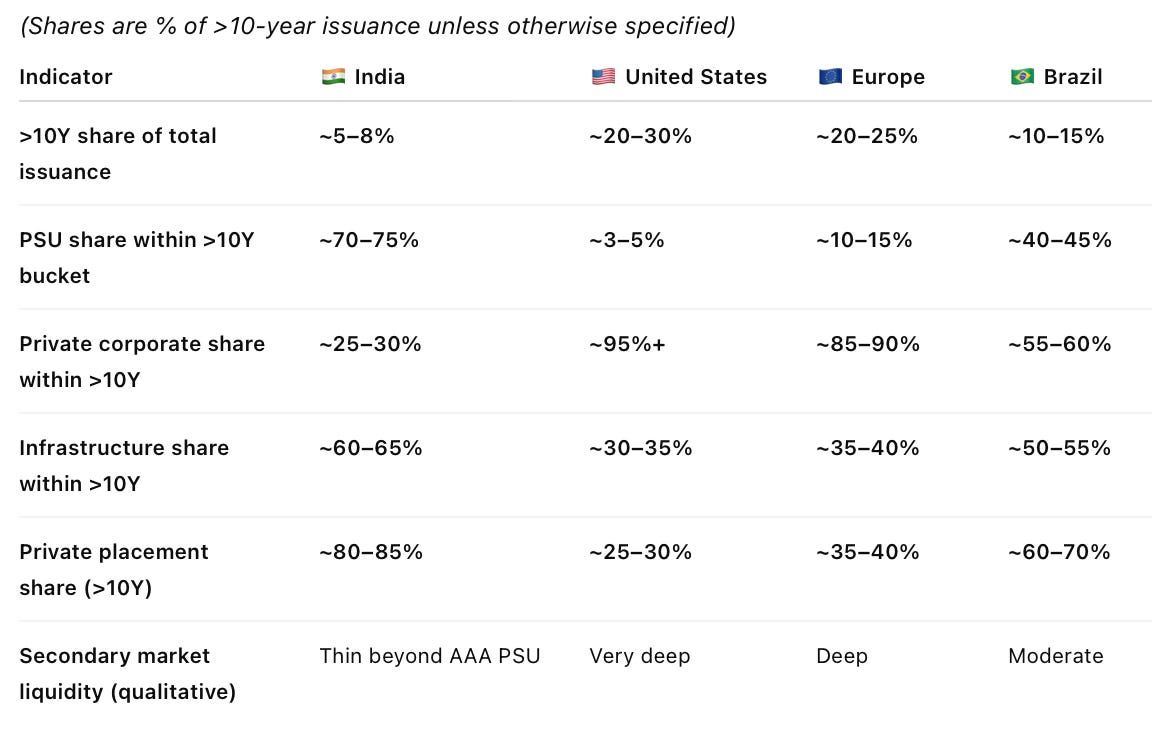
How does the table look for tenor greater than 10 years?

Putting all of them together, we get the following charts. Brazil does a very good job of mobilising long-term infrastructure funds, in absolute value (see latter tables). 

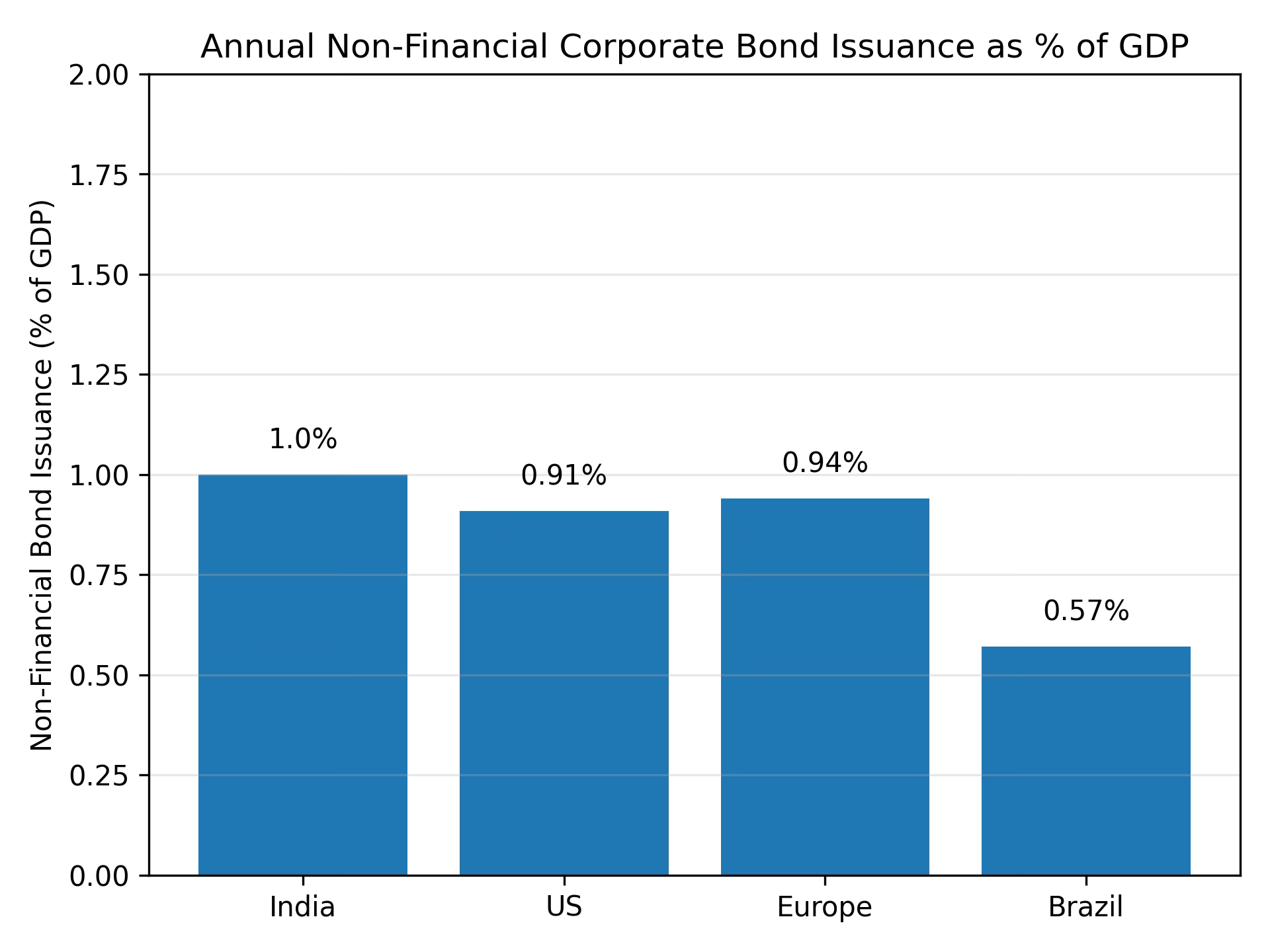
As a percentage of GDP, India does well in non-financial corporate bond issuance. Its challenge, as aforementioned, is with maturity depth and structural composition. 

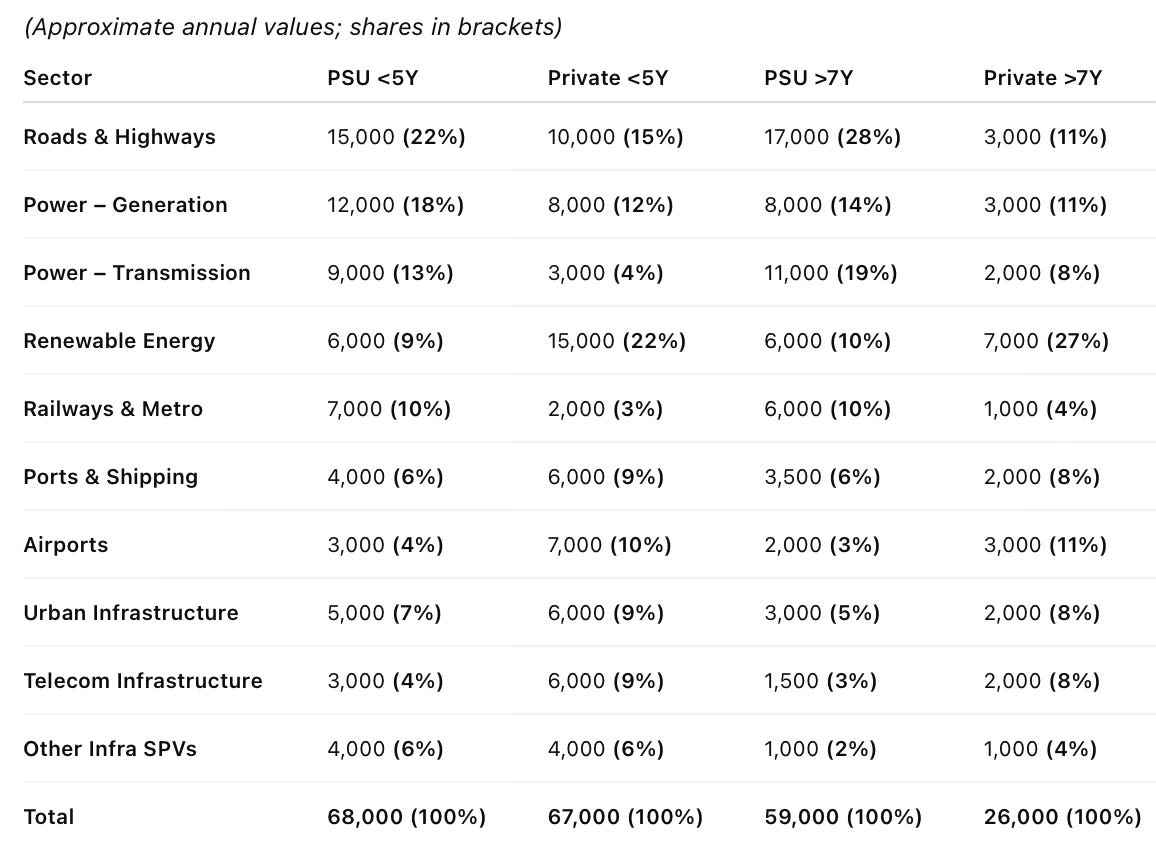
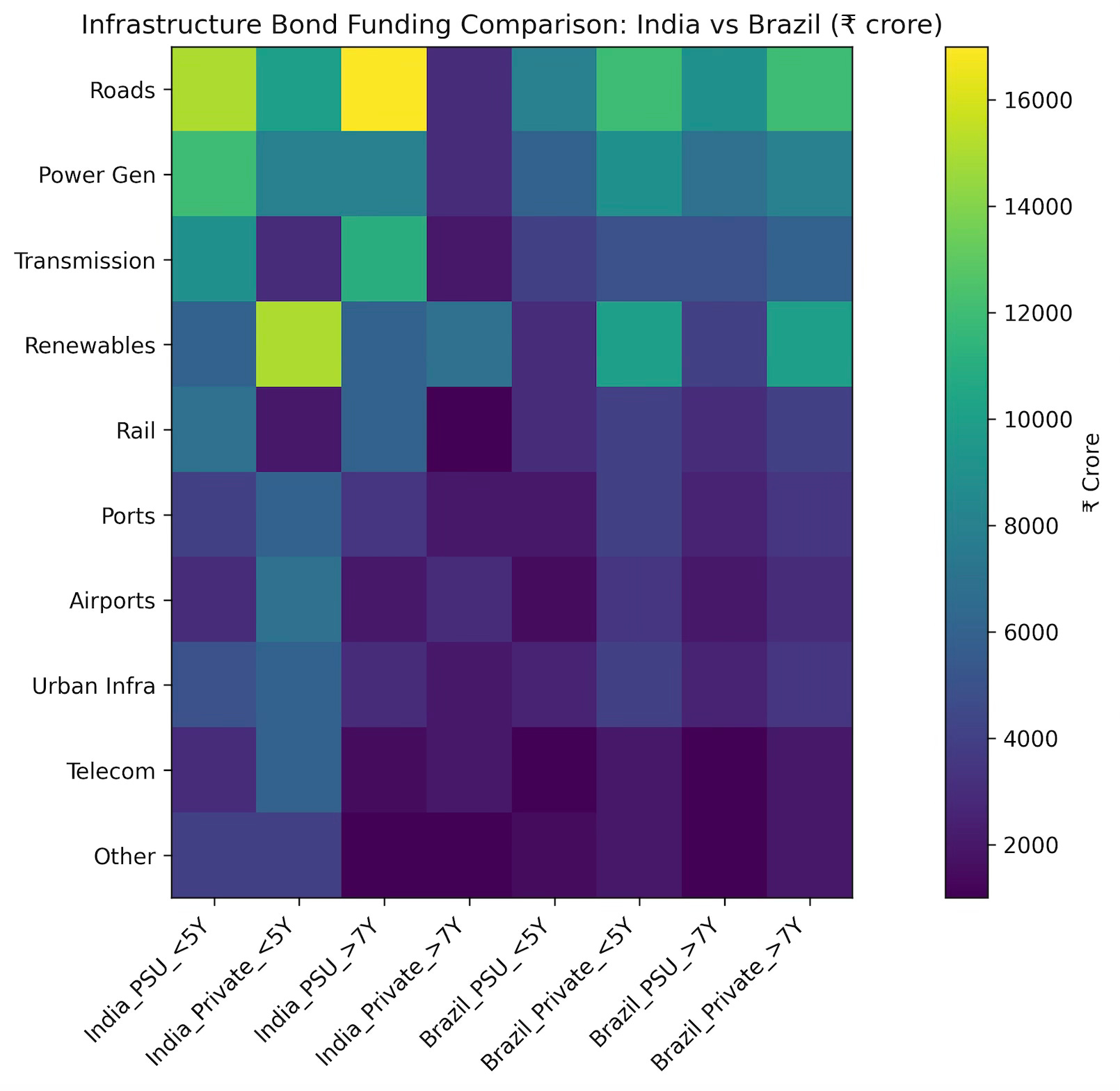
The total infrastructure sector bond raising is estimated in the range of Rs 2.2-2.4 lakh Cr, of which about Rs 1.3-1.4 lakh Cr is with tenor less than 5 years (55% raised by PSUs), and Rs 80,000-90,000 Cr with tenor more than 7 years (65% by PSUs). The table below has the approximate values in Rs crore.

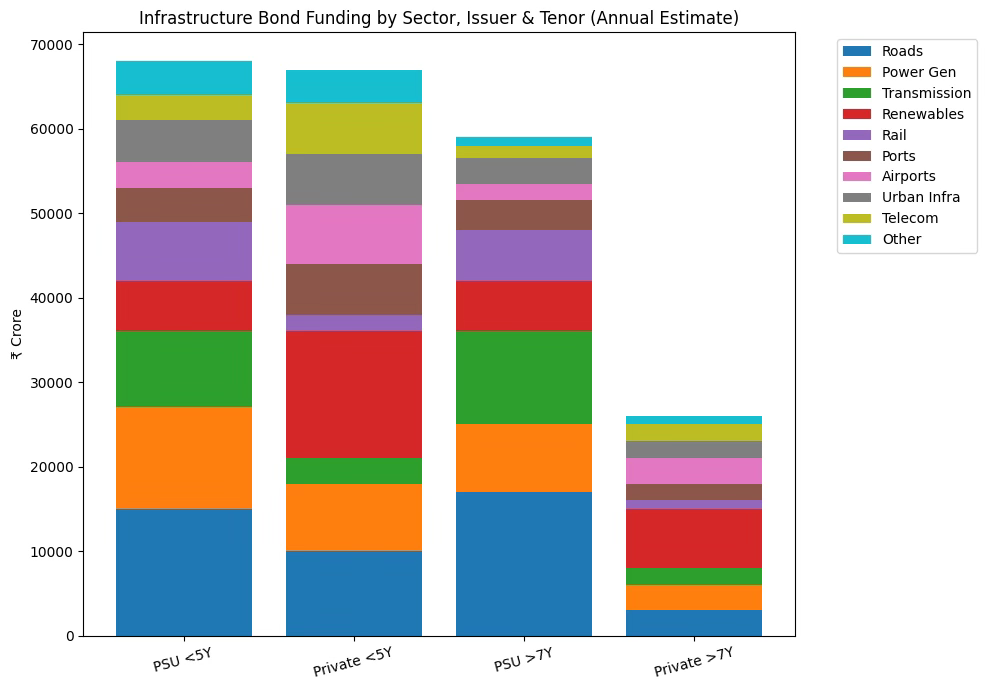
Below is the graphical representation of the estimates.

As can be seen, the usual suspects - roads, power generation (thermal and renewables), power transmission, railways, ports, and airports - make up most of the bond issuance. 

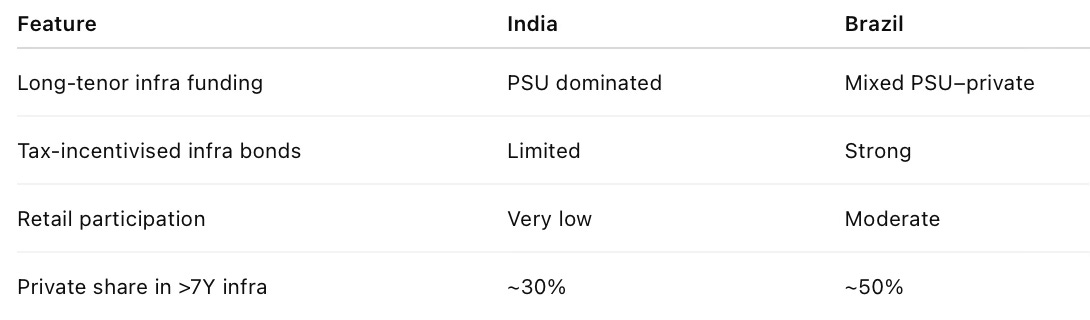
A comparison with Brazil is instructive. Brazil has managed to develop a deeper and broader market for private corporate bond raising, including in infrastructure. In 2011, it introduced the “DebĂȘntures Incentivadas” (Infrastructure Debentures) to finance infrastructure projects. It offers tax exemption on interest income, is mostly issued for 7-15 years, and is used in transport, energy, sanitation, and renewables. 

This is a summary of the comparison of the infrastructure bond markets in India and Brazil.

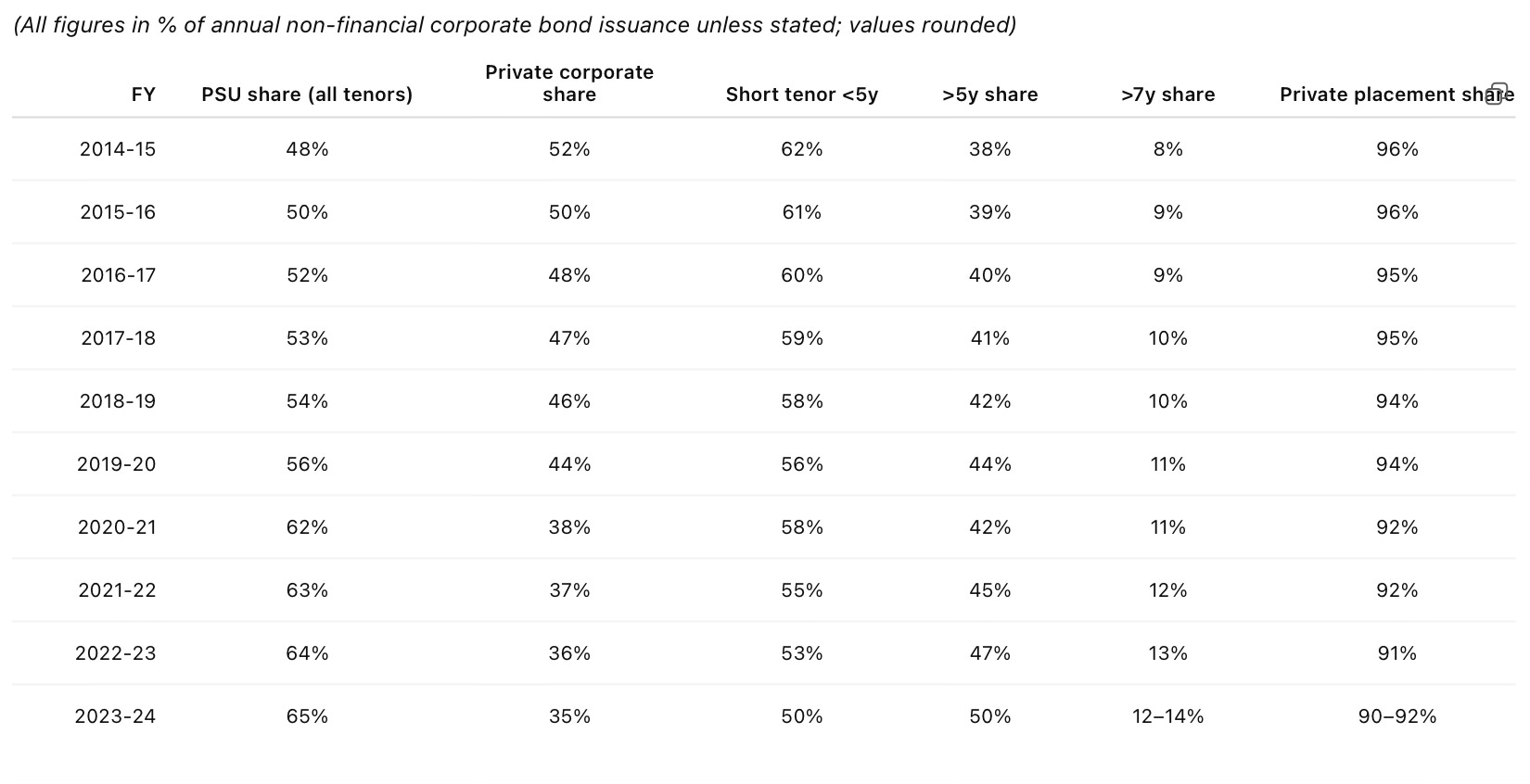
What have been the trends over the past ten years? Disturbingly, the share of private corporates in bond issuance has been falling, declining from over half to about a third. This may have been due to the focus on public capital expenditures through NHAI, Railways, PFC/REC. The share of long tenor bonds (>7 years) has risen only slightly from 8% to about 13-14%. Private placement route has remained stubbornly in the 90-92% range.

Given all the above, what are the policy takeaways?

Policy actions are required on at least three fronts. One, prioritised efforts to expand public placement, thereby ushering in greater liquidity and deeper markets. A practical intermediate pathway would be to promote the listing of existing privately placed bonds. 

Second, diversify the issuer base away from PSUs by encouraging private infrastructure developers to issue long-term bonds by offering policy support through credit enhancement schemes, partial guarantee mechanisms, takeout financing, etc. The DFIs (NIIF, IIFCL, and NaBFID) should have a specific mandate to derisk infrastructure finance instruments. 

Third, increase the tenor of bonds by expanding the use of partial credit guarantees, first-loss facilities, and blended finance models. This should also be complemented by demand-side measures to expand the pool of long-term buyers like pension funds, retirement savings accounts, and insurance funds. 

On all these, the policy actions will be in the form of numerous small steps to simplify disclosures, documentation, listing requirements, listing processes, standardisation of bond structures, improvements on rating transparency, and so on. It must be complemented with initiatives like credit enhancements and guarantees, increasing the proportion allocated to long-term bonds for pension funds and insurers, revisiting risk-weights on long-term bonds, etc.

For references, I blogged here that India could take the lead in demonstrating how DFIs can work on both the demand and supply sides to de-risk infrastructure projects and crowd in long-term capital, respectively. I blogged here on how to reduce the cost of capital for foreign investments in the infrastructure sector, here on how to revise the credit rating framework in general, and here on de-risking and lowering the cost of capital of bank loans and de-risking the use of guarantees to crowd-in bank financing. All of these ideas are consolidated in this long paper

Saturday, January 3, 2026

Weekend reading links

After scaling India’s renewable energy landscape faster than anyone else, across solar parks, transmission networks and green hydrogen, the Adani Group now wants to manufacture wind turbines not just for itself, but for the market... Adani has said it wants to deploy around 30GW of wind capacity by 2030, or a third of the country’s 100GW target by then. Until recently, Adani’s turbine manufacturing was widely assumed to be a captive exercise, designed primarily to feed the group’s own rapidly expanding power needs... For Suzlon Energy Ltd, India’s largest wind turbine maker and one of the few global survivors in a brutally cyclical industry, the timing is unsettling. The company has only just emerged from a long financial winter. It is debt-free, profitable again, and benefiting from a renewed policy and market push for wind as India confronts a structural mismatch in its power mix... Apart from Adani, the JSW Group and Reliance Industries Ltd have also disclosed their intent to manufacture turbines. These are conglomerates that can absorb early losses, compress supply chains and tolerate long gestation periods.

2. Italian and Spanish bond yields have declined as markets reward them for measures taken for fiscal discipline. 

Government borrowing costs paid by Italy and Spain have fallen to their lowest level relative to Germany in 16 years, as investors reward Rome and Madrid for belt-tightening and grow more worried about surging debt elsewhere in the Eurozone. The extra yield on 10-year Italian debt compared with German Bunds — a closely watched measure of the risk associated with lending to Italy — narrowed to within 0.7 percentage points this month, the lowest since late 2009. Strong economic growth in Spain has helped to cut its 10-year spread with Germany to less than 0.5 percentage points. That is also the lowest since before the Eurozone crisis, when high debt loads drove up both countries’ borrowing costs and stoked worries about the currency bloc breaking up... Investors point to Spain’s improving economic trajectory and Italy’s prudent fiscal policies under a politically stable government, as part of a broad reduction in fiscal risks for these countries as well as for other previous debt hotspots such as Greece.

3. Roger Federer's commencement speech at Dartmouth College is a classic. He makes the point by invoking the fact that, though he won almost 80% of his 1526 singles matches, he only won 54% of all points. 

“When you lose every second point, on average, you learn not to dwell on every shot,” he told the crowd. “You teach yourself to think, ‘OK, I double-faulted. It’s only a point.’ When you’re playing a point, it has to be the most important thing in the world, and it is. But when it’s behind you, it’s behind you. This mindset is really crucial, because it frees you to fully commit to the next point and the next point after that, with intensity, clarity and focus.”

This has resonance elsewhere. 

It’s an easy concept to apply to almost any field. In 2022, Ronald van Loon, a portfolio manager at BlackRock, authored a paper on the percentage of investment decisions that need to be correct to beat market benchmarks for returns. He researched markets, crunched the numbers and came up with a number: As low as 53 percent.

4. Men's athletics records dating back to the 20th century.

Jonathan Edwards (triple jump, 18.29m, 1995), Mike Powell (long jump, 8.95m, 1991), Jan ĆœeleznĂœ (javelin, 98.48m, 1996), Javier Sotomayor (high jump, 2.45m, 1993) and Yuriy Sedykh (hammer throw, 86.74m, 1986)

5. Frothy US equity markets

The so-called Shiller cyclically adjusted price-to-earnings ratio of the US stock market, which is ending 2025 just shy of 40, an extremely high level relative to history. The only time the S&P 500 has had a higher ratio was just prior to the dotcom bubble bursting in the early 2000s. Starting from valuations at this level, Adler said, the market has never generated a return above inflation for investors.

6. The Big Three IPOs expected in 2026

OpenAI, which is currently valued at $500bn, is engaged in discussions with investors about a new fundraise at a valuation of $750bn or more... SpaceX is working on a secondary stock sale which would value it at $800bn, according to multiple people with knowledge of the deal. Anthropic is also in talks for new funding, which investors expect will value the company at more than $300bn... Figma, Klarna, CoreWeave and Chime were among the technology groups to list in 2025, contributing to a total of more than $30bn in US IPO proceeds in the first nine months, the bulk of it from technology groups, according to EY. This year’s total is likely to dwarf that sum, if even one of the three big start-ups goes public. SpaceX alone is widely expected to surpass Saudi Aramco’s $29bn raise in 2019 to become the largest public listing.
7. Good interactive graphic of President Trump's epic conflicts of interest in his government deal-making.

8. Japanese scallop exports have become the latest victim of China's weaponisation of trade. 
As China has emerged as a global economic power, its 1.4 billion citizens have become critical consumers of international goods. Beijing has dangled market access to its growing middle class as a diplomatic lever, imposing import restrictions for Taiwanese pineapples, Australian wine, American soybeans and Lithuanian beef in recent years... 
The latest trade spat between Japan and China began in August 2023, when Beijing suspended imports of Japanese seafood after the release of treated wastewater from the decommissioned Fukushima Daiichi nuclear plant. While Japanese officials and U.N. regulators defended the move — noting the water was filtered and heavily diluted — Beijing protested. Before the freeze, China was the top buyer of Japanese seafood, with scallops accounting for most of that trade. Hokkaido’s scallops, harvested from the region’s nutrient-rich, frigid waters, are prized for a distinct buttery flavor and deep umami. They command a premium in China, where they have become a staple luxury at high-end celebratory banquets... In 2022, the year before the halt, Japan exported roughly $641 million worth of scallops, with China accounting for more than half of all sales. Scallop exports plunged 30 percent in 2023 from a combination of China’s trade ban and a fallow period of production... 

Japan’s prime minister, Sanae Takaichi, stated in the National Diet that a Chinese attack on Taiwan could be a “survival-threatening situation,” a legal trigger implying Japan could use military force. It was a rare public declaration regarding an island that Beijing considers a breakaway province. Within two weeks, Beijing abruptly froze all new seafood export applications.

9. Nokia's successful reinventions.

By 2000, Nokia had 26.4 per cent of the global handset market, according to CCS Insight. At its peak in 2000, amid the mania of the dotcom bubble, Nokia was worth about €286bn and was estimated to be contributing about 4 per cent of Finland’s GDP… However, Nokia’s failure to grasp the signficance of the smartphone era, ushered in with the release of the first iPhone in 2007, ultimately cost it dearly… With the writing on the wall, Nokia sold its devices and services division — which housed its once world-beating mobile phone business — to Microsoft for €5.4bn in 2014. Its revenues had fallen from a peak of €37.7bn in 2007 to just €10.7bn by the time it was sold…
With the Nokia brand rapidly disappearing from consumers’ minds, it fell to new chief executive Rajeev Suri to chart a new course for the company. Nokia’s €1.7bn acquisition of Siemens’ stake in a networks joint venture in 2013 suddenly made up about 90 per cent of Nokia’s revenues after it got out of the handset business. “That had to be the foundation because you cannot invent a company on a weak core,” Suri, who left Nokia in 2020, told the FT, adding that his “first priority” was to “remove any ambiguity about what Nokia was going to be”. To turn Nokia into a major player in the networks business. Suri made the biggest acquisition in Nokia’s history: a contentious €15.6bn deal for French network provider Alcatel-Lucent in 2015.

10. BSE Sensex

The BSE Sensex has compounded at just over 13.5 per cent annually over the past four decades, making the Indian stock market one of the best performers globally in US dollar terms.

11. Another K-shaped signature of the US economy (HT: Adam Tooze)

12. Finally, the audacious US invasion of Venezuela and capture of President Nicolas Maduro and his family will be discussed much in the days ahead. The NYT has an early editorial that highlights one aspect.
Mr. Trump’s recently released National Security Strategy... claimed the right to dominate Latin America: “After years of neglect, the United States will reassert and enforce the Monroe Doctrine to restore American pre-eminence in the Western Hemisphere.” In what the document called the “Trump Corollary,” the administration vowed to redeploy forces from around the world to the region, stop traffickers on the high seas, use lethal force against migrants and drug runners and potentially base more U.S. troops around the region.

Venezuela has apparently become the first country subject to this latter-day imperialism, and it represents a dangerous and illegal approach to America’s place in the world. By proceeding without any semblance of international legitimacy, valid legal authority or domestic endorsement, Mr. Trump risks providing justification for authoritarians in China, Russia and elsewhere who want to dominate their own neighbors. More immediately, he threatens to replicate the American hubris that led to the invasion of Iraq in 2003.

For India, the National Security Strategy, and its operationalisation through actions like the above, should be a wake-up call that the US can no longer be relied on in any meaningful manner in case of any conflict with China. 

Saturday, October 11, 2025

Weekend reading links

1. India might need to look for a Tom Barrack equivalent to open informal doors with Donald Trump. Barrack, a private equity magnate and long-time confidant of Trump, has swung the rapprochement between Erdogan and Trump. People like Barrack, Steve Witkoff, Joshua Kushner etc., seem to have an outsized influence in engaging with the Trump administration. 

2. In the meantime, Pakistan is throwing a series of goodies at Trump to entice deeper engagement with it. The latest is a proposal to construct a port at Pasni for $1.2 billion with Pakistani federal government and US-backed development finance, linked to a new railway to transport critical minerals from the country's interior. Pasni is just 100 miles from Iran and 70 miles from the Pakistani city of Gwadar, which has a China-backed port.

3. John Burn-Murdoch points to peak social media.
Time spent on social media peaked in 2022 and has since gone into steady decline, according to an analysis of the online habits of 250,000 adults in more than 50 countries carried out for the FT by the digital audience insights company GWI. And this is not just the unwinding of a bump in screen time during pandemic lockdowns — usage has traced a smooth curve up and down over the past decade-plus. Across the developed world, adults aged 16 and older spent an average of two hours and 20 minutes per day on social platforms at the end of 2024, down by almost 10 per cent since 2022. Notably, the decline is most pronounced among the erstwhile heaviest users — teens and 20-somethings... The shares of people who report using social platforms to stay in touch with their friends, express themselves or meet new people have fallen by more than a quarter since 2014. Meanwhile, reflexively opening the apps to fill up spare time has risen, reflecting a broader pernicious shift from mindful to mindless browsing.

The trend appears not to be the case with North America where it's still rising.

Fixed-line telephony, the very cornerstone of 20th-century communication, took a staggering 25 years to reach 1 million users in the United States. Pagers took a decade, and the mobile phone slightly less. The internet, a seismic shift in itself, took about five years, and Facebook less than a year. But the most breathtaking leap came with ChatGPT — the world’s current favourite generative AI tool. It took a mere five days to cross the one million user threshold globally.

5. Palantir could be the makings of the 'mother of all bubbles'! (HT: Adam Tooze)

Once more for the record … Palantir is not some world-bestriding titan of reactionary capitalism that merits inclusion alongside the true giants of big tech. Palantir is a medium-sized business, enormously pleased with itself if it generates as much as $1 billion in revenue per quarter, 55 percent of which comes from modestly sized government contracts.
6. Fascinating profile of Bari Weiss, the former NYT journalist who quit in protest at lack of freedom to express there and founder The Free Press as an independent media outlet. Paramount has announced her appointment as the new editor in chief of the CBS News and acquisition of her startup The Free Press for $150 million.

6. Ruchir Sharma describes the US economy, and especially the equity markets, as one giant bet on AI.
The hundreds of billions of dollars companies are investing in AI now account for an astonishing 40 per cent share of US GDP growth this year... AI companies have accounted for 80 per cent of the gains in US stocks so far in 2025. That is helping to fund and drive US growth, as the AI-driven stock market draws in money from all over the world, and feeds a boom in consumer spending by the rich. Since the wealthiest 10 per cent of the population own 85 per cent of US stocks, they enjoy the largest wealth effect when they go up. Little wonder then that the latest data shows America’s consumer economy rests largely on spending by the wealthy. The top 10 per cent of earners account for half of consumer spending, the highest share on record since the data begins. 

No nation has seen an immigration boom-bust cycle near the scale of the one roiling America. Net immigration nearly quadrupled after 2020 to peak at well over 3mn in 2023, but the backlash led by President Donald Trump sent that figure into freefall. This year only around 400,000 net new arrivals are expected, and that could be the trend in the coming years. This labour force squeeze alone will reduce America’s growth potential by more than a fifth, Goldman Sachs analysis suggests.

This is an interesting snippet about the US equity markets. 

Foreigners poured a record $290bn into US stocks in the second quarter and now own about 30 per cent of the market — the highest share in post-second world war history. Europeans and Canadians have been boycotting American goods but continue buying US stocks in bulk — especially the tech giants. In a way, then, America has become one big bet on AI. Outside of the AI plays, even European stock markets have been outperforming the US this decade, and now that gap is starting to spread. So far in 2025, every major sector from utilities and industrials to healthcare and banks has fared better in the rest of the world than in the US.

7. China seeks to expand its influence in South Asia.

FT research shows Chinese officials have held at least seven high-profile meetings with Bangladeshi politicians in the 14 months since the interim government of Muhammad Yunus, a former social finance entrepreneur, took office. This compares with eight meetings in the last five-year term of Bangladesh’s long-standing autocrat, Sheikh Hasina. Beijing officials, meanwhile, have held 22 high-profile meetings this year with counterparts from Pakistan — on track to match last year’s 30. Among the smaller countries surrounding India, Beijing has conducted at least six high-profile meetings with Nepali officials this year and at least five in Sri Lanka.

8. French sovereign bond yields shoot up following the collapse of another government. 

The yield on the benchmark 10-year French OAT is now trading above its Italian counterpart (BTP) — a once unthinkable inversion. This financial penalty places the Eurozone’s second-largest economy behind a market sometimes characterised in the past as one of the bloc’s “peripheral” economies. This is more than a metric of fiscal imbalance; it is a loss of confidence in the French political system’s ability to govern decisively. Meanwhile, the sovereign spread between the 10-year French OAT and the benchmark German Bund has widened dramatically, pushing it to more 0.85 percentage points... The widening spread between French and German bonds threatens the ECB’s ability to ensure its single monetary policy is transmitted well across the bloc. When dispersion in yields increases, it risks the type of market fragmentation and stress that could become a systemic threat... The bond markets are losing patience with political paralysis.

9. OpenAI has signed up for 20GW for computing capacity.

OpenAI has signed about $1tn in deals this year for computing power to run its artificial intelligence models, commitments that dwarf its revenue and raise questions about how it can fund them. Monday’s deal with chipmaker AMD follows similar agreements with Nvidia, Oracle and CoreWeave, as OpenAI races to find the computing power it thinks it will need to run services such as ChatGPT. The deals would give OpenAI access to more than 20 gigawatts of computing capacity, roughly equivalent to the power from 20 nuclear reactors, over the next decade. Each 1GW of AI computing capacity costs about $50bn to deploy in today’s prices, according to estimates by OpenAI executives, making the total cost about $1tn... OpenAI is burning through cash on infrastructure, chips and talent, with nowhere near the capital required to fund these grand plans. The deals also involve circular arrangements between the world’s most valuable start-up and its partners, as well as complex financing terms that have in most cases yet to be agreed...
OpenAI’s deals with Nvidia and AMD could cost up to $500bn and $300bn respectively, according to Financial Times calculations, although both include incentives that could also help OpenAI pay for the chips it buys. Oracle’s deal will cost OpenAI another $300bn, while data centre group CoreWeave has disclosed computing deals with OpenAI worth more than $22bn. OpenAI also launched an initiative with SoftBank, Oracle and others in January known as Stargate that pledged to invest up to $500bn in US infrastructure for OpenAI. It is not clear how the Nvidia and AMD deal will fit into the Stargate plans. The ChatGPT maker has not disclosed whether it will buy chips directly or through its cloud computing partners, and is expected to lease some Nvidia chips.

This is an intriguing financing arrangement

AMD will give OpenAI warrants entitling it to buy up to 10 per cent of the company for just a cent a share, depending on their project hitting certain targets, including some linked to AMD’s share price. AMD shares were worth nearly $204 when markets closed on Monday. If they keep rising, OpenAI could sell its stock to fund its spending on AMD’s chips.
10. Leo Lewis points to Japan's demographic problem of labour shortages, which he describes as 'enshortification'!

Take carpenters — essential in a country where a great deal of construction uses wood. Their numbers have more than halved since 2020, while more than 43 per cent of those still working are over 65. Many projects, large and small, are being delayed. A shortage of bus drivers has caused operators in Tokyo to cut over 200 services. The military cannot get close to its recruitment targets. The Foreign Ministry revealed earlier this year that it cannot hire enough Japanese chefs for its embassies. In some parts of the countryside, home deliveries of certain goods are undertaken by scooter riders in their mid-80s. There are genuine concerns across industry that companies are going to run into trouble because Japan no longer has enough tax accountants.  

11. Ahead of the meeting between US and Chinese Presidents in Seoul later this month, China announces sweeping export controls on rare earths and related technologies, where China controls 70% of mining, 90% of separation and processing, and 93% of magnet manufacturing. 

Under the new rules, foreign companies will need Beijing’s approval to export magnets that contain even trace amounts of Chinese-sourced rare earth materials, or that were produced using the country’s extraction methods, refining or magnet-making technology. The restrictions announced on Thursday by China’s commerce ministry will for the first time create a Chinese version of the US foreign direct product rule, a measure Washington has used to block semiconductor-related exports to China from third countries. The rules give Beijing more leverage to exert control over the global rare-earth supply chain. Rare earth minerals and magnets are critical to technologies from smartphones to electric vehicles and fighter jets.

It has drawn a predictably strong reaction from President Trump, who has now threatened to cancel the meeting and raise massive tariffs on China. He has announced the imposition of 100% tariffs on all products from China and export controls on critical software. 

It's hard not to come away with the feeling that China has made a significant miscalculation with this decision. After having won Round One, it now risks squandering those early gains. 

12. Declining birth rates (18 million births in 2016 to 9 million in 2023) and a preference for inshoring (Nestle has won approval for a factory in Suzhou in eastern China to make and sell a similar product) have led to the shutdown of a Nestle factory producing formula for Chinese newborn babies and employing 540 workers in Askeaton, a small town in the Irish county of Limerick with a population of 1100. 

13. William Buiter on the rise and rise of gold.

Of the total 216,265 tonnes of above-ground stock of gold at the end of 2024, jewellery accounted for 97,149 tonnes (45 per cent). I believe that much of this “consumer demand” — indeed most of it — is in fact investment demand. Only gold coins and bars (including exchange traded funds) are counted as investment demand. At the end of 2024, this accounted for 22 per cent of the total stock. Central bank holdings were 17 per cent. Gold’s use in technology accounts for part of the 15 per cent of the global stock, classified as “other”... The flow supply of new gold in 2024 was 4,975 tonnes... Gold, extracted underground at material cost, was turned into gold bars and then put back underground at additional cost. Globally, gold reserves (ore deposits that can be economically extracted) are estimated at 54,770 tonnes and gold resources (ore deposits where the profitable extraction is more doubtful) at 132,110 tonnes. The only gold production strategy that makes socio-economic sense is to leave it all in the ground... At the end of 2024, gold holdings accounted for 20 per cent of central bank reserves, more than euro reserves (around 16 per cent). Gold’s price surge since would have pushed its relative share higher.
14. John Burn-Murdoch questions the narrative of the great graduate unemployment crunch, where new graduate entrants to the labour market are being squeezed by the rise of AI among other trends. 

Saturday, September 13, 2025

Weekend reading links

1. Some facts about how increasing intermittent renewable power is upending the electricity market in India. 
Real time market (RTM) volumes exceeded Day Ahead Market (DAM) volumes for the first time ever in Q1FY26 – a reversal, since DAM volumes have been much higher than RTM volume in the past. In June of Q1FY26, DAM prices fell from record peaks of around ₹6.95/unit in Q2FY24 to below ₹4/unit. Nine of the last 10 months have seen month-on-month declines in DAM prices. In the RTM market, prices dropped to nearly ₹0/unit between 7 am and 1 pm, and spiked to as high as ₹5/unit between 8 pm and midnight. This seems to be the norm during April-October. The diurnal variations are huge. On the same days, RTM units were sold at a few paisa/unit and also at above ₹5/unit... During sunlight hours, there are big surpluses. At night, shortfalls occur as solar no longer contributes and price surges. Peak RTM demand in summer typically occurs between 2000 and 2400 hours (8pm and midnight). Solar is off at that time. On most days in Q1FY26, night-time supply was 10 per cent below demand, with shortfalls reaching 90 per cent sometimes. Conversely, during peak solar hours (0700–1700 or 7 am–5 pm), supply was nearly three times the demand. RE capacity is scaling up at 25-30 Gw per year. There’s a case for a big push on the storage front, to ensure surplus solar units can be used at night.

2. Distribution of teachers between different school management.

3. India's cost advantage in medical procedures is clear.
4. FT long read about how a wave of middle-class Chinese migrants to Tokyo, described as Run-ri, seeking permanent residency in Japan, is slowly transforming the city. 

Chinese buyers propel Tokyo property prices beyond the reach of many Japanese. The government has been pushed to tighten the requirements for the “business manager” visas on which so many Chinese secure their residencies. Some predict a full nationalist backlash, pointing to the klaxons of xenophobia audible in July’s upper-house election campaigns… The number of foreign residents rose by an average of roughly 1,000 per day over the course of 2024, of which about 10 per cent were Chinese. By next year, according to some projections, the total Chinese population of Japan is likely to hit a million… 

There has also been a surge of Chinese enquiries for places in Tokyo’s international schools, to as much as 60 per cent of the total in some cases… the Branz tower, a huge block of high-end flats overlooking Tokyo Bay, of which about 20 per cent are believed to have been sold to people with Chinese names, according to local estate agents. A listing for a three-bedroom flat in a nearby tower displayed in the window of a Chinese-owned estate agent in Roppongi, has an asking price of ¥350mn ($2.4mn). Other newly built developments nearby, including a vast complex built as the athletes’ village for the Tokyo 2020 Olympics, have similar ratios of Chinese buyers…

As the Chinese community in Bunkyo has expanded, the children have begun to group together and do not speak Japanese outside school. Within school, it is already becoming a distraction… The most tangible impact has been on property prices in Tokyo — one issue over which populist Japanese politicians have been able to stoke public anger. The prices of higher-end apartments in the capital, and the land in central wards on which low-rise houses can be built, has risen significantly since 2022.

5. More from the brilliant John Burn-Murdoch, this time on how the progressives may be ceding ground to the conservatives by having less children.
Recent studies find that the left’s lack of concern over falling birth rates is likely to be pushing societies in a more conservative direction. Extending previous analysis of the interplay between political ideology and family formation, I find that the assumption that birth rates are falling across society in general is not really true. From the US to Europe and beyond, people who identify as conservative are having almost as many children as they were decades ago. The decline is overwhelmingly among those on the progressive left, in effect nudging each successive generation’s politics further to the right than they would otherwise have been. This may ultimately mean more curtailing of individual freedoms, not less. Of course, children do not inherit their parents’ politics wholesale, and each successive generation has historically tended to be more liberal than the last on social issues. But it is well established that children’s values are strongly shaped by those of their parents. A growing left-right birth rate gap will slow that liberalising conveyor belt, and could result in societies and politicians that are less liberal and less concerned with the environment than would otherwise be the case.
6. China dominates EV sales across the developing world, with Vietnam and India being the exceptions. This is data from 2023 and 2024. 
7. The rise and rise of government bond yields.
8. Nvidia's market cap now exceeds FTSE, CAC, and DAX! (HT: Adam Tooze)
In a 2023 report, Mr. de Boer and a colleague estimated that Delta’s SkyMiles program was the world’s most valuable loyalty plan, worth about $28 billion. Investors value Delta itself at around $40 billion, based on its stock price. The loyalty program at American is worth about $24 billion, while United’s is worth $22 billion, according to the report. At Southwest Airlines, which started as a low-fare airline but has become one of the country’s biggest carriers, the loyalty program is worth around $9 billion.

The airlines share little publicly about their loyalty programs, but American and Delta each received about $7 billion from frequent-flier programs last year and United about $6 billion, according to an analysis of financial filings by Jay Sorensen, who runs IdeaWorksCompany, a consulting firm that works for airlines and other aviation businesses. Those programs are supported in part by the millions of people who use airline credit cards and then earn airline points for spending. The banks that issue those cards buy those points from the airlines in bulk, typically spending many billions of dollars every year... Banks recoup that money by charging interest and fees to card users and from fees paid by retailers, restaurants and other merchants every time customers pay with credit cards. For the banks, airline cards bring in many customers who fly and spend a lot.

Last year, consumers spent about $186 billion on Delta-branded credit cards, according to an analysis of securities filings of American Express, the airline’s credit card partner. That was about 12 percent of global spending on cards issued by the bank. Delta said in a financial filing that cash sales of loyalty points to American Express were $7.4 billion in 2024, an 8 percent increase from the year before. 

Many travelers love the cards and loyalty programs. By earning status, they can board planes early, enter airport lounges and enjoy other perks. Racking up points for dream vacations or seat upgrades is a powerful motivator, too. Those benefits create what Dwight James, Delta’s senior vice president of loyalty, calls “an emotional bias” toward the airline... Loyalty programs have become so valuable that during the pandemic, American, United and Delta each used their programs as collateral to borrow billions of dollars. The companies were struggling because they had to ground many planes and others flew largely empty.

10. New York City is a big outlier among US cities, thanks to its intra-city mass transit and high FAR.  

These numbers point to large amounts being taken out by foreign investors who invested earlier and have been exiting their positions.  
A lot of FDI that flowed into India from roughly the middle of the last decade, peaking in 2020-21, were in the form of private equity (PE) and venture capital (VC) investments – in diverse sectors, from retail, e-commerce and financial services to green energy, healthcare and real estate. Those who put in this money are now cashing out by selling the shares they had originally bought, either to other firms engaged in the same business or via initial public offerings by the investee companies. Such exits by investors seeking to monetise their profitable “mature positions” were valued at $24 billion in 2022, $29 billion in 2023 and $33 billion in 2024, according to Bain & Company. The American management consulting firm reckons about 59% of PC/VC exits in 2024 to have been through public markets that were, in turn, enabled by the rich stock valuations in India.

12. Labour-intensive exports made up 35% of India's exports to the US in FY25, down from 50% in FY19. However, the share of the US in each of them have risen in the period. 

Textlies and food processing, in particular, are major employers.

And also forms a major share of manufacturing wages.
13. Tej Parikh writes that the US economy is already in recession based on several of NBER's economic indicators. 
While private investment has shrunk, AI investments have propped up net investment. Total private fixed investment rose by about 3 per cent year on year in the second quarter, but it would have fallen by around 1.5 per cent if AI-related components were excluded.
Health care and social assistance jobs made up 86% of the 598,000 jobs created in this Trump term till date.
And household spending has been propped up by the well off households who also have been the beneficiaries of the stock market boom. 
14. China and the US compared economically.
Its economy, while slowing, is still nearly 30 percent larger than America’s when one accounts for purchasing power. China has twice the manufacturing capacity, producing vastly more cars, ships, steel and solar panels than the United States and more than 70 percent of the world’s batteries, electric vehicles and critical minerals. In science and technology, China produces more active patents and top-cited publications than the United States. And militarily, it has the world’s largest naval fleet, a shipbuilding capacity estimated to be more than 230 times as great as America’s and is fast establishing itself as a leader in hypersonic weapons, drones and quantum communications.

The balance changes when compared with allies.

Together with economies such as Europe, Japan, South Korea, Australia, India, Canada, Mexico, Taiwan and others, there is no competition. This coalition would be more than twice China’s G.D.P. when adjusted for purchasing power, more than double its military spending, the top trading partner of most countries in the world, and would represent half of global manufacturing to China’s one-third. It would possess deeper talent pools, create more patents and top-cited research, and wield a degree of market power that could deter Chinese coercion. Allied scale would win the future.