Substack

Showing posts with label Europe. Show all posts

Saturday, October 24, 2026

Weekend reading links

1. The semiconductor market facts of the week.
In the early 2000s some 25 firms could make the most advanced processors. Today four can, and tsmc makes nearly all of the high-end ones. Memory chips, which are also vital for ai, have gone the same way. More than 20 firms made advanced memory chips in 1990. Now only three—Samsung, sk Hynix and Micron—make almost all of them. China has produced new entrants in both processors and memory chips, but without access to the most advanced chipmaking tools, they remain behind the frontier...

TSMC's capital expenditure is expected to hit roughly $62bn this year, more than one and a half times as much as in 2025. Next year analysts expect it to be around $76bn... their outlays are modest in comparison with the windfall from AI. As a share of revenue, TSMC's capital spending is expected to fall from 44% in 2023 to 36% this year. Moreover, investments are being paid for from the cash that chipmakers are generating, rather than borrowing. This year TSMC's capacity expansions will use up a little more than half of its operating cashflow, and Samsung’s barely a fifth. The debts of these chipmakers look modest next to their swelling cash piles.

Manufacturers are enjoying a “very good pricing environment”, according to Bill Wiseman of McKinsey, a consultancy, and have every reason to pace their expansion to preserve it. DRAM, a type of memory used in nearly all electronics, costs about six times what it did in early 2023. TSMC has not cut the price of its three-nanometre manufacturing process, which it launched in late 2022, even though a process normally gets cheaper after a couple of years...

Consolidation has also given chipmakers more bargaining power, shifting who will bear the burden of any slowdown. Until recently, memory was sold mostly on the spot market or through short-term contracts. When demand slackened, customers were not obliged to keep buying and prices therefore collapsed. Now, with capacity scarce and only a few suppliers to choose from, buyers are signing up years in advance, and on the sellers’ terms. Nvidia has committed more than $250bn to securing supply and components until January 2029. In September Micron said that “take-or-pay” agreements, under which customers must buy the agreed volumes or pay anyway, had locked in 35% of its revenue through to 2030, with $32bn-worth of commitments, most of which involve cash deposits. Such prepayments help fund new factories. They also shift at least part of the risk of a bust onto buyers.

2. Corporate tax revenues fall in the US even as profits rise, a divergence arising after the tax breaks that allow firms to make larger deductions in the year they make investments.  

Revenue from the corporate income tax, which applies to the profits made by the largest and most sophisticated companies in the United States, fell roughly 15 percent, to $381 billion, in the fiscal year that ended on Oct. 1, according to data released on Friday by the Treasury Department. The roughly $70 billion drop followed a similar decline the previous year. Corporate tax revenue is down more than quarter from 2024, the last full fiscal year of the Biden administration.
3. Thailand is experiencing its version of China shock from the Chinese EV imports. 
For decades, Japanese automakers dominated Thailand. They arrived in the 1960s, built supply chains and transformed the country into the “Detroit of the East.” Then the Chinese automakers arrived. Today, they control about 85 percent of Thailand’s electric vehicle market, up from almost zero four years ago... Electric vehicles made up a third of new car sales in the first seven months of 2026... Japanese automakers, slow to embrace the technology, have struggled. In 2024 and 2025, Subaru and Suzuki shut down their Thai plants, while Nissan and Honda have scaled back production. Several Thai auto-parts suppliers that depended on Japanese manufacturers went bankrupt, threatening a supply chain that employs about 700,000 workers... 

Thailand is a cautionary tale about the unintended consequences of opening the door to China’s electric vehicle manufacturers... In the first seven months of this year, about two-thirds of electric vehicles sold in Thailand were imported, primarily from China. The government is trying to curb the flood. Last month, it unveiled a three-tier tax system that imposes the highest rates on automakers importing vehicles with no plans for local production and the lowest on those that source a large share of their parts locally... Ruth Banomyong, a professor of supply chain management at Thammasat University in Thailand, and his colleagues have estimated that 300,000 jobs could disappear within five years if electric vehicles dominate Thailand’s auto market... 

In 2022, Thailand’s prime minister at the time, Prayuth Chan-ocha, declared electric vehicles crucial to the country’s economic future and its fight against pollution. He set a target for zero-emission vehicles to account for 30 percent of the country’s vehicle production by 2030... Then the government rolled out tax cuts and subsidies and allowed electric vehicles to be imported for two years before automakers had to meet local manufacturing requirements. A free-trade agreement between China and the Association of Southeast Asian Nations meant the vehicles faced no customs duty. Within months, Chinese brands like Changan, GAC Aion, Neta and Chery were driving on Thai roads.

4. Good description of the semiconductor manufacturing supply chain.

5. Gideon Rachman worries that the world may be sleepwalking into World War III.

The Russia-Ukraine war has now been going on longer than the USSR’s war against Nazi Germany. The British government says that Russia has sustained 1.5mn casualties — killed or wounded — since the invasion began. Ukrainian casualties are less publicised but will run into the hundreds of thousands. The war in Gaza is estimated to have led to 70,000 Palestinian deaths, as well as 2,000 Israelis — in addition to the 1,200 who died as a result of the Hamas attack of October 7 2023... the International Crisis Group recently counted 65 ongoing conflicts around the world — the highest number since the end of the second world war. The conflict in Sudan, fuelled by outside powers, is particularly bloody — punctuated by massacres of civilians and the displacement of more than 14mn people.

6. Shyam Saran is spot on.

It is somewhat perverse to have a government policy that seeks to export its professional and skilled personnel abroad. In trade negotiations, India wants to be able to find opportunities for its educated and professional citizens in foreign countries. This is an admission of a continuing failure to find meaningful employment for them at home. The ugly truth is that highly educated young Indians prefer to seek their future abroad should the opportunity arise. We are investing in educating our young but the fruits of the investment are taken advantage of elsewhere. This is not good economics. In the past, one recalls that there was at least an awareness of a “brain drain” from India and that this was a loss to the country. Now the brain drain has been turned into a virtue. Rather than formulate policies to offer meaningful opportunities to our young professionals in the country itself, we are allowing the best and the brightest to seek their future abroad. This is an admission of a glaring policy failure.

7. Exports are keeping the Chinese economy afloat. In the three months to September, GDP growth was 4.5%, up from 4.3% in the previous quarter. 

The actual GDP growth rate may be much lower.

8. London by the numbers.
London has six airports. There are also more than 80 Michelin-starred restaurants and, by Cvent’s count, 200 museums, 270 theatres, 857 art galleries and four Unesco World Heritage sites. If you are wondering, they are the Tower of London, the Palace (and Abbey) of Westminster, Kew Gardens and maritime Greenwich.

9. Impact of data centres in the US on electricity prices.

An August Centre for Economic Policy Research discussion paper that examined data centre expansion across US utility territories estimated that an increase of 10 data centres in a particular territory raises household electricity prices by 13 per cent, and a single large facility can raise household prices by 4 per cent.
10. As the satellite telephony market hots up, four of Europe's largest telecom groups - Deutsche Telekom, Orange, Telefonica, and Vodafone - have announced the signing of a letter of intent to explore a potential joint bid for radio wave spectrum that would enable them to provide "direct-to-device" satellite mobile services in Europe. 
In May, the European Commission proposed reserving the part of its spectrum band that allows smartphones to connect directly to satellites for European players. The so-called 2 GHz frequency band is currently used by two American companies, Viasat and EchoStar, whose licences expire next year... The initiative would mean the companies establishing the necessary ground infrastructure, or base stations, needed for satellite connectivity. However, instead of developing their own satellite constellation, they would partner with an existing provider, which is yet to be selected.

11. More reasons to be cautious about Elon Musk's Starlink.

Ukrainian troops have been caught off guard by restrictions on Elon Musk’s Starlink satellite internet systems that disrupted frontline operations, while Kyiv received no warning from its partners of a Russian missile attack on its energy facilities for the second day running, according to Ukrainian officials. Starlink terminals used by Ukrainian drone units began experiencing signal failures at speeds above 160kph, disrupting several missions early on Wednesday morning, according to military personnel and senior Ukrainian officials.

12. The rising US interest rates comes at a time when China's exposure to dollar assets is declining, thereby squeezing the offshore dollar liquidity, the weakening of other currencies, and increased rates for foreign borrowers.

The internationalisation of the renminbi is a big priority for Beijing, which is pushing the use of its currency — instead of dollar — for overseas lending and investment. Chinese banks have expanded their overseas lending denominated in renminbi. It has increased from less than 15 per cent of total overseas lending to more than half in the past four years, according to a Reserve Bank of Australia study. Given the lower interest rates on renminbi debt compared with dollar borrowing, this is supporting appetite for borrowing in reminbi, particularly in the global south. Furthermore, China’s capital outflows tend to be parked in Hong Kong, using the special instruments that Beijing has introduced that support this process, such as the Southbound Bond and Stock Connect. These allow mainland Chinese investors to trade and invest in bonds and equities in Hong Kong. 

A clear sign of the excess liquidity parked in the territory is the much lower cost of funding in the Hong Kong dollar versus financing in the dollar. Given the territory’s currency is pegged to its US counterpart, the two costs should be close. But the one-month HIBOR rate for interbank lending in Hong Kong dollars is about 2.7 per cent compared with about 3.9 per cent for the dollar-denominated US Secured Overnight Financing Rate (Sofr) over the equivalent time... In other words, less of China’s trade surplus is being recycled in New York or London when there were more US listings.

13. Africa is urbanising rapidly, but with a difference that is not for the good.

Until relatively recently, Africa was predominantly rural. In 1950, nearly 90 per cent of Africans lived in the countryside and the continent had only two cities — Cairo and Alexandria — with more than 1mn people. Today nearly three-quarters of Africans live in either an urban or semiurban setting, according to new UN methodology that applies a consistent global definition. Some 42 per cent live in cities. There are 88 African cities with more than 1mn people, according to the UN, 17 in Nigeria alone. In 1950, there were 228mn people living in Africa, with about 33mn in cities. Today there are 1.6bn Africans, 19 per cent of the world’s total, of whom 670mn live in cities. Almost unnoticed, Africa has become an urban story... Africa’s rapid urbanisation bears some similarities to the world-shaking growth of Chinese cities after Deng Xiaoping launched market reforms in 1979. But it is happening even faster. When China’s urban growth peaked in the 1990s, its cities were adding roughly 14mn people a year, according to the UN’s The World Cities in 2025 report. African cities expanded by 15mn people annually in the past few years and are expected to grow by 19mn annually by 2050. That’s almost two Londons a year, or more than 50,000 new African city dwellers every day. 
Yet the growth in Africa’s cities is not following a familiar path. “In China, and before that in Europe, industrialisation and job creation pulled people from the countryside,” says Jeffrey Paller of Sweden’s Uppsala University, one of the world’s foremost experts on African urbanisation. “That’s not what’s driving urbanisation in African cities.” With great variations, Africa is urbanising with a nominal average income per capita of around $2,000. Many city dwellers have to hustle for a living, carrying goods, shining shoes, cooking street food, cleaning and washing. In World Bank speak, a person hawking soft drinks to passing cars is a “micro-entrepreneur”. But in economic terms, they are shut out from a system of mass production and specialisation that characterises successful capitalist economies...
Academics call this kind of urbanisation “fast, late and poor”. With a few exceptions, most of Africa’s cities are unplanned sprawls. They lack public transport, reliable power and — especially in poorer neighbourhoods — basic services such as sewerage, rubbish collection or even a land registry. More than half of the continent’s urban residents live in informal settlements or slums... The unplanned nature squanders the efficiencies — and ultimately wealth creation — that occur in densely packed, well-planned, well-connected conurbations... “What you see in [places like these] is a kind of transfer of rural life into urban areas,” says Ken Opalo, associate professor at Georgetown University. City planners, he argues, must avoid “rurification” which deprives cities of the economic and social impetus offered by well-organised conurbations. “Many cities still have the same fertility rates as rural areas, the same levels of education, people still do farming,” he says. “We can’t just sit back and hope that urbanisation will do what it did elsewhere.”... Most African cities lack the tax base, investment and institutional capacity that enabled cities in China and elsewhere in Asia to turn large concentrations of people into a productivity surge.

Amidst the above, this is promising.

Kigali, the manicured capital of Rwanda, is practising what Kampeta Sayinzoga, former chief executive of the Development Bank of Rwanda, calls “aggressive urbanisation” by encouraging people to move to cities and forcing developers to build taller buildings to encourage density. Kigali has recently introduced bus lanes and has restricted the import of non-electric vehicles. 

14.  Europe enters an election cycle over the next twelve months that could define the continent's path for sometime to come. Four of the five most populous EU members as well as four small others go to polls. 

There is a broad electoral shift to the right and a growing readiness among centre-right parties to share power with far-right rivals, spelling the end of so-called firewall policies of non-co-operation. The far right has itself radicalised with the arrival of new upstart parties such as National Future in Italy and the Confederation of the Polish Crown (KKP). At the same time, more established ones such as Alternative for Germany (AfD) are becoming more extreme or refusing to moderate the closer they get to power. Nathalie Tocci, professor at the European campus of Johns Hopkins School of Advanced International Studies in Bologna, says that if the nationalist right held power in Spain, France, Poland and Italy all at once, “I don’t think it’s hyperbolic to say it’s the end of the European Union as we’ve known it.”

Spain will kick off the process (Bulgarians vote for their president on October 25 but the role has limited powers) and Italy could theoretically close it with elections due by December next year, although they are likely to come earlier. In between, there are presidential and parliamentary elections in France — potentially the most consequential of them all — and legislative elections in Poland. Estonia, Finland, Greece and Slovakia will hold parliamentary votes next year. One could even include Germany in this cycle. There are no national elections in the country this year. But three regional ones in April could spell the end for Chancellor Friedrich Merz, who appears to be living on borrowed time after his Christian Democratic Union took a hammering in regional elections in eastern Germany last month.

This is an important change in the landscape of European politics.

Long-term demographic and social trends have eroded party loyalty. Party systems have fragmented. Opinion is polarised. France, for example, could end up with a presidential run-off between a far-right and far-left candidate. Perceptions of politics have been made far more negative, in part by social media and the demise of curated news sources. As a result, Europe is now experiencing unprecedented electoral volatility. More and more people do not vote for the same party in subsequent elections. Voters, especially younger ones, increasingly act as critical consumers, de Vries says. It is a market for votes made for political entrepreneurs with attractively simple messages...

Europe’s nationalist populist and far-right parties share a similar critique of the failures of liberalism and globalisation and they combine it with “crisis entrepreneurship”, reshaping themselves for the crisis of the moment. Germany’s AfD started off as a movement opposing bailouts for Greece and other southern EU members during the Eurozone debt crisis, became an anti-immigration party during the 2015-16 migrant influx, latched on to anti-vaccination sentiment during the pandemic and now uses the energy price shock to campaign against the green transition and in favour of a rapprochement with Russia. Such parties also all target those who do not feel the benefits of globalisation, especially less-educated working-class voters. In addition, the core of their policy prescription is the reassertion of national culture and control, translating into a policy of favouring, for example, French citizens for welfare, jobs or public contracts over foreign nationals, even those with residency. Finally, they are all digital-native parties, well attuned to an algorithmic information space where provocation gets views.

12. Brilliant oped from Janan Ganesh questioning the wisdom of the adults in the room in moderating erratic and extremist leaders. 

13. This graphic captures the extent of advances made by China in innovation and at the technology frontier. 

The business of discovering new drugs, securing the intellectual property and exporting them globally — which is the real prize in the pharma world — used to be dominated US and European companies. But in recent years, Chinese pharma groups have been developing drugs that global pharma giants want to license and export.

14. What is the impact of AI on inflation?

Earlier this month, economists at Goldman Sachs took a more systematic approach, totting up estimates of AI’s effects on different components of spending in the US, both direct and indirect. They counted four: on components and software directly relevant to AI; on electronics competing for those components; on electricity; and on the construction materials that go into making data centres. Overall, they estimated that AI-related price pressures were adding around 0.5 percentage points to annual headline inflation. That fell to around 0.3 percentage points after they stripped out some mismeasurement related to the way different spending categories were being combined in the official statistics. That’s meaningful, but not massive. And the analysts noted that since they couldn’t remove all tariff effects, the true effect could be lower.

And more on the AI investment boom.

Stijn Van Nieuwerburgh of Brookings estimates the AI infrastructure boom will cost the equivalent of 3.6 per cent of US GDP a year over the eight-year period to the end of 2032 — equalling the annual spending on the railroad boom of the late 19th century, plus the interstate highway projects of the mid-20th century, plus about two-thirds of the electrification spending of the early 20th century. Total bill: $10.3tn, an estimate including only tangible expenditures, not intangibles such as software... Alphabet, Amazon, Microsoft, Meta, Oracle and SpaceX are expected to generate $760bn in cash flow this year. All of this and more will be invested, meaning “free cash flow” will be negative, a situation Wall Street expects to persist for several years, even as profits at the companies are projected to grow at a breakneck 30 per cent a year.

15. The changing face of Chinese investments in Africa.

Data from Rhodium Group, a US research firm that monitors Chinese investment worldwide, shows that in the early 2010s, Chinese funding in Africa concentrated on projects tied to natural resource extraction. Last year, however, investment in manufacturing and processing reached $7.7bn, exceeding the $4.8bn invested in extraction.

16.  The combination of persistent deflation, weakening economy, dismal consumer sentiments, rising public and pivate debt, and ageing population means that China is staring at Japanification. 

According to Goldman Sachs, an updated version of the Japanisation index — a gauge originally devised by the late economist Takatoshi Ito — shows that for the past five years, China has been consistently more “Japanised” than Japan itself. Looming over all of this is what economists describe as the iron law of demographics. Japan’s population started to shrink in 2009; China’s decline began in 2022 and is on track to be steeper, worsening the country’s economic prospects... In another echo of Japan’s post 1990s-slump, the IMF warned last week of growing numbers of “zombie” companies across Asia, kept alive only by lenient banks. This is now evident across China’s heavily subsidised manufacturing economy. Outside favoured sectors, companies are increasingly refusing to invest while households hoard cash instead of spending... Consumers are deleveraging, with bank lending to households as of August this year declining outright for the first time in history... China’s weakening economic conditions meant that up to 10.6 per cent of the adult population had overdue loans last year, compared with about 7.8 per cent a year earlier, according to a report by Gavekal Dragonomics analyst Xiaoxi Zhang... 

Phrases coined in 1990s Japan, such as “job hunting ice age” and “price destruction”, are creeping into China’s vernacular... economists can see the signals of Japanification in the data... Restaurants across China are competing to offer meals for under Rmb10 ($1.50). This too is redolent of Japan, where restaurants entered a margin-crushing price war to attract an ever-shrinking pool of consumer spending as deflation took hold. The price of a basic bowl of rice and beef at the nation’s leading gyudon chain hit a high of ¥400 ($2.50 at current exchange rates) at the end of 1990 before falling. It only reached ¥400 again in 2021... The “expectation channel”, where households and businesses saw no prospect of longer-term growth, created a vicious circle of reduced consumption and investment in Japan which in turn lowered expectations...
China’s real estate bubble was the largest in history, outpacing even Japan’s speculative frenzy of the late 1980s and at its peak accounting for a third of the country’s economy. The contraction since it burst in 2021 has been dramatic, with new housing starts down 78 per cent from their peak, according to Macquarie. That compares with a 73 per cent fall in the US between 2005 and 2009 and Japan’s 65 per cent drop between 1996 and 2025. The collapse of the property market has set off what Richard Koo, the Nomura Research Institute’s chief economist, calls a “balance sheet recession” — a term he originally coined in the 1990s to describe the tendency of Japanese companies and individuals to pay down debt rather than borrow to invest or spend. Weaker demand and deflation then worsen the debt burden, leading to a vicious cycle. Investment opportunities decline, the labour market calcifies and salaries stagnate... The ultimate sign of China’s weak credit demand is the 1.7 per cent yield on 10-year government bonds, which Nomura’s Koo describes as “absolutely ridiculous”... 

One reason for Beijing’s reluctance to resort to domestic stimulus, economists believe, is China’s strong export performance. The trade surplus hit $1.2tn last year — the biggest recorded by any country, ever — and may meet or exceed that level this year. Policymakers in Beijing think the country’s export performance will buy China time while it waits for the property market to stabilise. In the meantime, they are pursuing investment in areas such as chipmaking and AI as the country competes with the US for geopolitical dominance... Gross fixed capital formation — the acquisition of assets for the production of goods and services — was 40 per cent of GDP in 2024 against Japan’s 28 per cent and the OECD average of 22 per cent, fuelled by an augmented fiscal deficit that Goldman Sachs forecasts will hit 11 per cent of GDP this year. No one knows when this debt will become unsustainable.
The central bank since June has already used about $90bn of the more than $140bn it raised from India’s diaspora to prop up the rupee, including through sales to the spot market and currency swaps to absorb surplus liquidity... The rupee is one of Asia’s worst-performing currencies this year, having fallen 5 per cent against the dollar... As the currency neared new lows this month, the RBI took unexpected steps to curb volatility. They included opening a special window to absorb state oil companies’ dollar purchases away from the spot market; cutting the threshold for rupee-linked derivative transactions without proof of underlying exposure; and requiring dealers to maintain a 20 per cent cash reserve on forward contracts with the central bank. Those moves, which came on top of earlier measures such as curbing short positions against the rupee and courting deposits from Indians living abroad, have helped bolster the currency... But bankers and economists said the RBI could not keep spending down its foreign exchange reserves at its current pace. The central bank’s reserves have fallen by about $60bn from an early September peak of $785bn. Its net forward dollar liabilities — dollars which it will have to pay in the future — ballooned to $200bn in August from about $137bn in July, according to official data.

18. Aliko Dangote's plans for Africa.

Dangote plans to double the capacity of the Lagos refinery — which made revenue of $22.5bn in the first nine months of this year — and to build another 700,000 b/d refinery in Kenya to serve east Africa. He is also constructing a $4bn fertiliser and petrochemicals complex in Ethiopia that will help quadruple the group’s fertiliser capacity to 12mn tonnes.

19. Finally, very good account of the TSMC's Arizona facility which is now fully operational and is ground zero for the US's reshoring of industrial capacity.  

In July, TSMC announced its intention to invest a total of more than a quarter of a trillion dollarsfor 10 chip production plants, two packaging facilities and a research and development site, all in Arizona. TSMC now employs over 3,500 people in the state, including skilled Taiwanese engineers on temporary visas... TSMC Arizona is rebuilding America’s manufacturing backbone by teaching Americans the skills that they have lost... Thousands of teachers of these skills, in the form of Taiwanese engineers, have moved to north Phoenix. Many bring their families in tow... New immigrants from Taiwan more closely resemble corporate shock troops on a mission to build chips fast... TSMC sends engineers to Arizona on contracts of up to three years, which means that the first wave of families to move to the United States are returning home... TSMC Arizona’s first plant has been producing chips for two years, and its rate of output in Phoenix is comparable to that in Taiwan... the second and third factories are being built ahead of schedule. TSMC’s announcement in July that it would raise its total investment to $265 billion is an obvious sign of confidence in Arizona’s operations... TSMC is grafting a Taiwanese engineering community onto the American economy.

Saturday, August 22, 2026

Weekend reading links

1. Germany used to be the unquestioned global leader in chemicals, machinery, and automobiles. Now, thanks to the onslaught from China, it has fallen on bad times. Sample this on automobiles.
When German companies expand or build factories, it is often in places like Hungary, China or Mexico. The number of cars produced in Germany has fallen 28 percent since 2016, according to the VDA, the German automakers’ association, putting the country well behind China, the United States, Japan and India. Germany could soon also be overtaken by South Korea and Mexico... The German carmakers face an assault on two fronts. In China — the world’s largest car market — sales of foreign car brands are plummeting. And Chinese automakers are making big strides in Europe. In June, Chinese carmakers outsold Japanese carmakers in Western Europe for the first time, according to figures compiled by Schmidt Automotive Research.

China was once a lucrative market for the Germans, accounting for 37 percent of Volkswagen sales in 2019. But after Chinese automakers learned how to manufacture cars through joint ventures with foreign carmakers, the tables turned. BAIC Group, an automaker owned by the Chinese government, has become Mercedes’s largest shareholder, with a stake of almost 10 percent. Chinese companies like BYD and Geely Auto were quicker to develop electric vehicles that were heavily promoted by the Chinese government and are selling briskly in Europe. The Germans took too long to offer appealing electric vehicles. Volkswagen sold 26 percent fewer cars in China in the first six months of the year compared with a year earlier, while Mercedes reported a 28 percent decline and BMW a 20 percent slump.

2. The latest on AI's limitations on vertical use cases, explained with three illustrative use cases.

While A.I. can excel regularly at complex tasks, it can be unreliable when put in charge of an entire job. It can certainly add value to certain areas of the work force, but for now, A.I. still needs a human boss... In our experiment, we deployed A.I. “agents” to act as office workers and found that they were capable of performing some of the tasks we assigned, but not all of them. The agents, which can act autonomously and make decisions based on detailed instructions, excelled at problems they could solve by writing computer programs. But they struggled with understanding the nuances of human language and at navigating user interfaces like the Chrome web browser.

3. Important point about how wealth inequality has come to dominate income inequality as the reason for social discontent.

While wealth inequality has not changed much, the relative importance of wealth compared to income has. The median household’s disposable net worth (net property and financial wealth excluding pensions) in the UK, US, Germany and France has roughly doubled in real terms since the mid-1990s; incomes have grown by only around 30 per cent. The result is that where a generation ago it would have taken about 20 years of savings from the average salary to earn your way from the bottom quarter of the UK’s wealth distribution to the top quarter, it now takes 40. There are similar or even larger upward extensions to society’s economic ladder elsewhere.
This is all the more pernicious since the growing role of passive wealth gains (whether gifted by an asset price boom or one’s parents) relative to income in determining someone’s economic status is mirrored by their growing importance for wellbeing. In the 1990s income rank mattered more than wealth rank for life satisfaction or avoiding distress. Since then wealth has become steadily more influential and is now the larger driver. 

4. Ukraine has run out of Patriot air defence systems to shoot down incoming Russian ballistic missiles. 

5. Chrystia Freedland on Baumol's disease and public services.
Baumol’s assignment was to determine why in-person classical music performances seemed harder to fund. He found that the snag wasn’t that the musicians were getting worse — it was that the rest of the economy was getting better. It took four musicians one hour of work to perform a Schubert string quartet, exactly the same as it always had done. But four hours of human labour would produce roughly a hundred times as much wheat as it did in the pre-industrial era. For manufactured goods, the multiple is even greater. The same insight applies to taking a two-year-old on a walk in the park, or supporting a mother as she gives birth. As such, Baumol’s disease poses a knotty challenge for the state in liberal democracies because so much of what governments do is more like playing the violin than manufacturing a car.

6. Two points from John Burn-Murdoch's latest on the crisis of social isolation among youth. First, the share of those without any in-person contact during a typical day rose sharply during the pandemic and has not returned back to normalcy.

The least socially connected are increasing their disconnectedness. 

7. Rent controls are back as housing prices rise.
Rent controls, where a government sets price limits on rents or annual rent increases for certain types of housing, tend to be effective in their primary objective. A 2024 review of dozens of studies on the policy published globally between 1967 and 2023 found controls were effective in capping rents. The quid pro quo, say their critics, is that they increase rents on unregulated properties and reduce the overall supply and quality of housing in the long term... Of the 38 members of the OECD club of mostly richer nations, 23 already have some form of rent control. Ireland and Austria widened the scope of existing rules this year... In practice, rent regulation can encompass a wide range of measures. Outright freezes, such as in New York, tend to be temporary. More enduring limits can apply to existing or new tenancies, or both, and may apply nationwide or be focused on areas of high rental demand. There are often exemptions, such as for newly built properties, and a variety of yardsticks are used to determine the size of permitted increases... 
New Yorkers are the most burdened tenants in the US. Despite decades of regulation, new renters in the city spend an average of 40 per cent of their income on rent. Rent stabilisation — where annual increases are set by a city board based on its assessment of the market, inflation and other variables — is the main mechanism, applying to almost a million units. Households living in rent-stabilised apartments tend to have median incomes lower than overall renter households... In Berlin about 700,000 households, or a third of the total, spend more than 45 per cent of their income on rent, according to the Berlin Tenants’ Association. Like several hundred other high-demand areas in Germany, Berlin is subject to the Mietpreisbremse, or rental brake, a 2015 law that applies to new leases, and the Kappungsgrenze, introduced two years earlier, which limits rises on certain types of existing tenancies. Despite these guardrails, rents have risen almost 70 per cent over the past decade. 

Scotland has come up with new rent controls which have evoked interest globally.

The new controls are more precisely calibrated than before; they will apply only to specific areas, last for a maximum term of five years, and limit rent increases for both new and existing tenancies to consumer price inflation plus 1 per cent, up to a 6 per cent maximum. There are some exemptions, for instance properties that are coming to the rental market for the first time.

8. China's investment slump deepens in July.

Industrial output expanded 4.5 per cent in July on a year earlier, official statistics showed on Monday, short of the 4.8 per cent forecast by a Reuters analyst survey and growth of 5.3 per cent in June. Retail sales rose just 0.6 per cent last month, compared with analyst forecasts of 1.5 per cent growth and 1 per cent in June, as the waning effects of consumer goods trade-in subsidies weighed on household spending. Fixed asset investment declined 6.7 per cent for the first seven months of the year on the same period in 2025, deepening from a 5.7 per cent drop in the year to June. 
Over the last 10 years, across spot and forward markets, the RBI’s net annual currency intervention has averaged about $60 billion, or 2 per cent of gross domestic product (GDP). During FY21 and FY22, when India’s balance of payments generated surpluses, the RBI net purchased $157 billion. That effectively put a floor on the exchange rate. In contrast, the RBI sold a significant $118 billion in FY25, helping restrict the rise in USD/INR from 83.50 to 85.50. Between April 2025 and February 2026, the RBI sold another $37 billion, even as USD/INR moved up to 91. Following the outbreak of the Iran war, the RBI sold a further $37 billion in March 2026 alone, with USD/INR eventually ending the month around 93.50... Such interventions were not necessarily incorrect. But when sustained at this scale and over such timeframes, it inevitably influences currency levels, not just volatility...
The RBI also intervenes in bond markets and modulates banking liquidity to facilitate monetary-policy transmission. During FY26, India’s net government debt across central and state government bonds and Treasury bills grew by ₹17.8 trillion. About ₹10.6 trillion was net purchased by banks, insurers, and pension and provident funds, which have regulatory obligations to buy such bonds. The RBI’s own holdings net increased by the remaining ₹7.2 trillion, thus accounting for a substantial 40 per cent of the incremental government debt... The RBI’s large bond purchases and liquidity operations helped keep rupee-denominated interest rates below levels that might otherwise have been required to attract discretionary savings.

10. Israeli national security minister Itamar Ben-Gvir, a hardline settler previously convicted of incitement to racism, advocates killing Gazans each night. 

“I think we should be doing 30 to 40 targeted assassinations per night,” Ben-Gvir said. “Not just those who pose an immediate threat. There are people there who don’t deserve to live . . . They are not even people.” Ben-Gvir also called for the re-establishment of Jewish settlements in the Palestinian territory, saying he envisaged “all Gaza” belonging to Israel and reiterating his previous calls for Palestinians to “emigrate”. “I imagine settlements not just in Gush Katif but throughout Gaza, and encouraging emigration, the more the better,” he said, referring to settlements that were dismantled by Israel in 2005. “And for the terrorists, there should be no emigration. We should just kill them one by one.”

11. Fear of AI is uniting American politics.

Almost three quarters of Americans do not trust businesses to use AI responsibly, according to Gallup. More than 70 per cent oppose having data centres built in their area because of fears about water and electricity inflation. Eighty per cent or more distrust AI for driving, medical advice and corporate hiring decisions. As The New York Times recently put it, fear of AI is the “most bipartisan issue since beer”. That feeling is as strong in the centre as it is on the Maga right and the democratic socialist left. That such fears are often conspiratorial should be no surprise. Paranoia is a natural response to the unknown. Maga’s Steve Bannon calls data centres “weapons labs”. Marjorie Taylor Greene, the former pro-Trump lawmaker, refers to Big Tech as “Skynet” after the self-aware computer system that triggers nuclear holocaust in the Terminator movies. Progressives talk of AI killing US democracy and ushering in a Blade Runner-style dystopia.

12. The big economics story of the recent months is the return of interest rates.

13. For long the World Bank and IFC have tried to get African countries to capture value by investing in the processing of their natural resources. Nigerian billionaire Aliko Dangote is doing exactly that by constructing the world's second-largest petroleum refinery, which has allowed Nigeria to export refined oil to Europe and elsewhere, while also ensuring that Africa's largest crude producer does not need to import refined oil. 
His new $20 billion oil refinery in Lagos, which has seen a spike in demand for petroleum products — both in Africa and elsewhere — since the war began in February. Despite having abundant crude oil, Africa still relies heavily on imported fuel... Jet fuel shipments from the Dangote Refinery reached the U.S. market for the first time ever this year, according to the company. The Dangote Refinery was “the world’s single largest exporter of jet fuel” in April and May, said Daniel Evans, a vice president of S&P Global Energy, a market-research firm. Last month, the refinery was Europe’s largest supplier of jet fuel and diesel, according to Devakumar Edwin, a vice president of Dangote Industries. On Tuesday, Dangote Refinery said it had secured $1 billion in financial backing from a Dubai-based investment group to go public on the Nigerian stock exchange. If the listing goes through, it will be Africa’s largest-ever public offering.

14. The rise and rise of America's public debt.

The US’s national debt has hit a record $40tn as borrowing rises at a historic pace... It has grown by $3tn over the past year, its fastest ever pace outside the pandemic era... America’s national debt has surged over the past two decades, rising from less than $6tn (about $12tn in 2026 dollar terms) at the turn of the century as vast public spending during the financial crisis and Covid pandemic exacerbated yawning budget deficits. In the past 10 years alone, the overall debt burden has doubled. Debt held by the public — a key metric monitored by markets that excludes intragovernmental holdings — now exceeds $32tn, roughly equal to the size of the US economy. The Congressional Budget Office, a non-partisan watchdog, expects the debt held by the public to exceed the high of 106 per cent of GDP reached in the aftermath of the Second World War by the end of the decade and hit 120 per cent by 2036.

15. The moderation of Meloni...

As prime minister, Meloni’s cautious pragmatism has dismayed hardline Maga purists such as Bannon, who told Italian media she was “a total globalist” who had betrayed her “fundamental beliefs”. Meloni has paired tough measures to curb irregular migration with higher quotas for legal migrants, helping Italian businesses cope with labour shortages. She has also softened her anti-EU rhetoric and forged effective working relations in Brussels.

... and fall out with Trump.

After Trump’s return to the White House in 2025, Meloni — the only EU leader to attend his inauguration — sought to cast herself as Europe’s bridge to Washington, hoping it would strengthen her hand in Brussels and at home. Instead, Meloni has been tarnished in the eyes of many Italian voters by her close association with an unpopular US president. Trump has imposed high tariffs on EU imports, pressed Nato allies to sharply increase defence spending and attacked Iran — policies deeply damaging to Italian interests. “Her proximity to Trump has failed to give her any appreciable results,” said Riccardo Alcaro, research director at Rome’s Institute of International Affairs, calling her erstwhile friendship an “electoral albatross” as Meloni gears up for a bruising re-election campaign... analysts say Meloni’s difficulties with the White House reflect not only Trump’s personality but a Maga world view that appears to expect near-total subservience from its allies... Maga’s deep-rooted antagonism towards the EU as a political project also made it hard for any leader with a pan-European outlook “to cosy up” to the administration for long.

16. One of the biggest innovations of the 20th century, container shipping.

Seventy years ago it would take at least 10 days for a ship at London Docklands to be emptied and reloaded by around 50 dockers. Pilfering was rife, accidents were commonplace and port business was vulnerable to labour strikes. Then came the shipping container, an 8ft x 20ft steel box that needed increasingly vast vessels to carry an ever-expanding volume of goods... it takes cranes roughly 40 hours to empty and reload a large container ship — around 20,000 steel boxes lifted by 146-metre-high computerised cranes that move two containers every three to four minutes. That efficiency and scale is testament to the unglamorous steel container, an invention that has driven down shipping costs to such a low fraction of total manufacturing value that it has enabled the rapid expansion of global trade over the past 70 years... The box’s dimensions were standardised from 1968 — a step that is “frequently overlooked”, says Brian Slack, a professor in geography and planning at Concordia University, Montreal. Without it, “containerisation would not have been as revolutionary as it turned out to be”...
More than 280mn journeys were made by containers between world markets last year. They bear around two-thirds of global seaborne cargo — about 60 per cent of total world trade, according to UN Trade and Development. More than 7,000 container ships are currently operating. The largest can carry cargo equivalent to a 44-mile-long freight train with, for example, around 120,000 bananas or 10,000 pairs of jeans per box. The average size of the ships has more than doubled since 2000, according to the WSC... To service the demand for goods, shipping lines have ordered larger and larger ships. The current record size for a container ship is the so-called ultra-large container vessel MSC Irina, which has a carrying capacity of 24,346 twenty-foot equivalent containers, or TEUs. The number of new container ships on order is equivalent to around 40 per cent of the current sailing fleet — a record high.

17. Circular trading in China's humanoid robots industry.

China’s humanoid robot makers are generating much of their revenue from selling machines to government-backed training centres — which then collect and sell training data back to the robot makers, raising concerns about actual demand in an industry Beijing is keen to promote.

18. Data centre job creation facts.

At the peak of construction, according to a November 2025 study by the University of Southern California, a data centre in the US needs between 0.7 and 2 workers per megawatt. To build India’s targeted capacity of 10 GW by 2030, that works out to a peak construction workforce of 26,000... In direct employment, a 100 MW data centre supports 120–150 jobs. Take the generous end of that range and India’s 10 GW target yields 15,000 full-time, sustainable jobs. And these aren’t, for the most part, gold-collar jobs. A handful of C-suite roles rake in Rs 1 crore a year. Design and engineering workers make Rs 30–40 lakh. The staff who actually keep the lights on—on-site security and hands-on hardware engineers—earn around Rs 10 lakh. A recent study from the US—the world leader in data centres with an installed capacity of 55 GW—examined the employment records of 770 server farms going back two decades and concluded that the industry overstated their job impact by a factor of three at least. Apply the cut to India’s job-creation estimate and the promise wilts before a single server is switched on.

And who will use it.

Of the 10 GW capacity India intends to build by 2030, only a sliver is meant for the country. The industry estimates that 90–95% will be leased by foreign firms such as AWS, Microsoft Azure, Google Cloud, Oracle, and Meta. Even now, of the roughly 2 GW already installed, barely 30% is used by Indian players.

Friday, June 19, 2026

The quartet of global imbalances

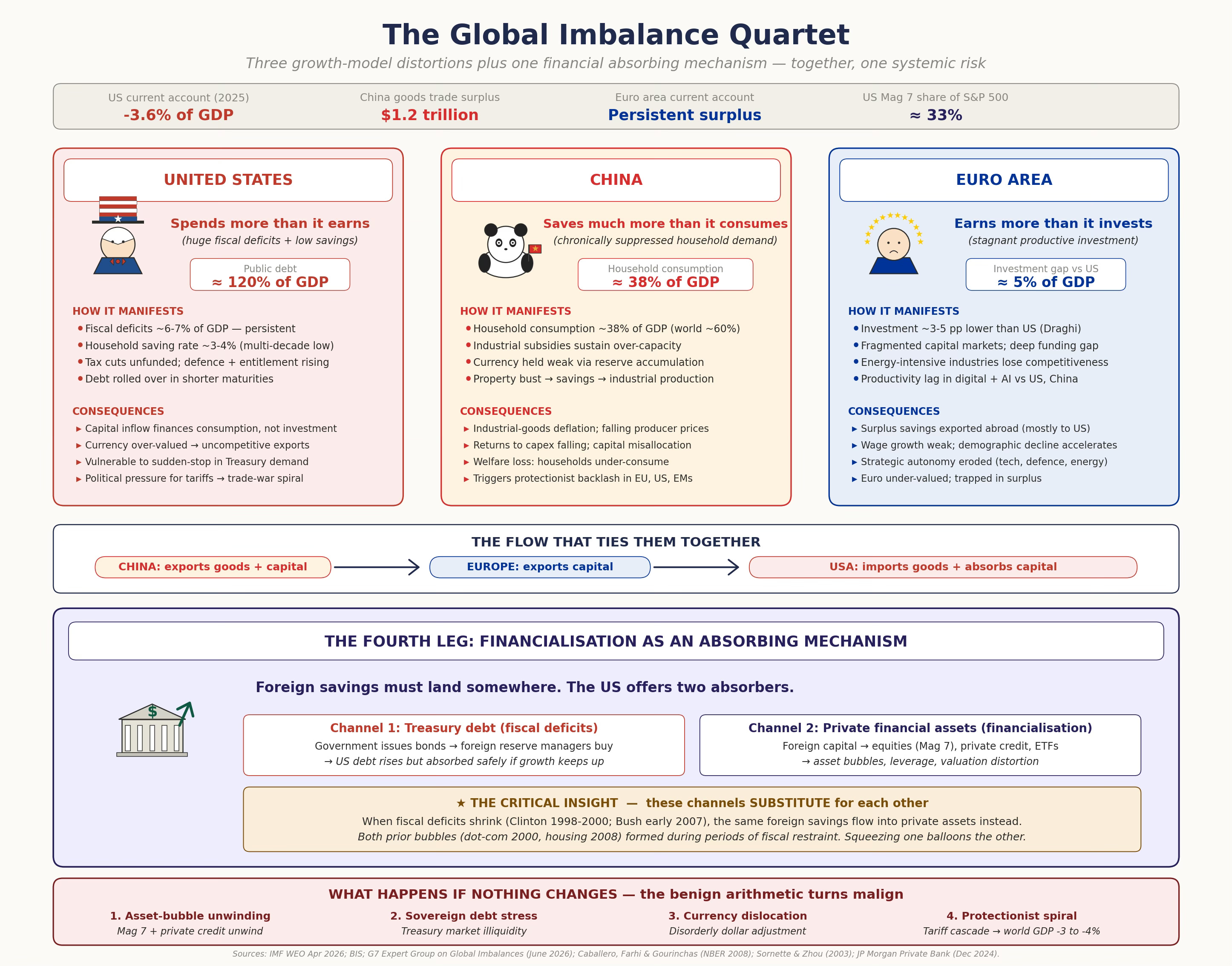
President Donald Trump’s single-minded pursuit of rebalancing the US economy using tariffs is unlikely to yield much without addressing fundamental distortions that have crept into the US economy and financial markets. Trade surpluses are a mere symptom of deeper malaises. I had blogged about the global twin structural imbalances, arguing that an American economy skewed towards consumption and a Chinese one skewed away from consumption are two sides of the same coin. 

Helene Rey (see also this report to G7) has a very nice summary of global imbalances, where she locates it within the dynamics of saving and investment, and questions the focus on tariffs.

A country that saves more than it invests lends abroad and runs a current account surplus; one that invests more than it saves borrows and runs a current account deficit. It is the collective saving and investment decisions of a country’s households, companies and government that drive imbalances. There is now some agreement — crystallising in the G7 discussions — that the sources of imbalances are linked to unbalanced growth models and mostly made at home: chronically weak consumption in China, feeble productive investment in Europe and outsized fiscal deficits in the US. Tariffs are not an effective mechanism to change any of those and issuing an international currency is no justification to run current account deficits. 

She also proposes the solutions in terms of complementary actions. 

China rebalancing towards consumption, Europe lifting productive investment and America repairing its public finances are not three grudging favours. They are parts of a single, mutually reinforcing policy. One country’s exports are another’s imports; one country’s capital outflow is another’s inflow. When all three move at once, each adjustment cushions the others: the deficit country that consolidates finds external demand waiting as surplus countries spend more at home, and the surplus country that stimulates demand finds a market at home rather than a protectionist wall… The IMF’s scenario of simultaneous rebalancing raises global output by around 0.8 per cent and narrows medium-term imbalances by half a percentage point of world GDP.

I think this analysis misses a critical fourth leg of the imbalance, financialisation. It cannot be seen as merely a symptom of US borrowing. As evidence, there are two natural experiments. The last two episodes of US fiscal deficit reduction (in the late nineties and mid-2000s) were accompanied by financial market bubbles (the dot-com bubble and housing and mortgage market bubble). 

Underlining this, Ricardo Caballero, Emmanuel Farhi, and Pierre Olivier Gourinchas have shown that if the financial markets do not work well, the economy might accommodate investments that deliver a rate of return that is below the growth rate of the economy. In this situation, both stock market bubbles and government debt can play the useful role of displacing inefficient investments. 

Foreign savings flowing into the US must find a US asset to absorb them - either Treasury debt (the fiscal deficit channel) or private financial assets (the financialisation channel). These two are substitutes, not complements. Squeezing fiscal deficits without restraining private credit pushes the same global savings glut into asset bubbles. So US fiscal consolidation alone is not sufficient, and must be paired with financial-sector reform that prevents the likes of private credit from filling the void.

I asked Claude to generate a graphic that describes the global imbalances quartet. 

So, how to address these imbalances?

The rebalancing would require global diplomacy and coordination to mobilise support from all key stakeholders. This looks onerous in a deeply polarised world, of rising tensions between the West and China and the unpredictable and whimsical nature of the Trump Presidency. 

In fact, among the four adjustments required, interventions pertaining to the much-derided Euro area appear to be the most promising and likely to materialise. In fact, on investments, the train has already started. 

It is possible that a deep crisis on the economic front, a very likely near to medium-term possibility in either case, may force both China and the US to rebalance towards consumption and consolidation, respectively. However, there are daunting political economy challenges to be overcome in both countries, especially the US. 

It is the fourth leg that might prove the most challenging. The financial markets are where the power of entrenched interests is so strong that it might require a counter-revolution to upend the order and regulate financial markets more tightly. This will also require global coordination and collective action, and not mere reforms at the US front. 

Saturday, May 30, 2026

Weekend reading links

1. This captures the big problems with Chinese exports to Europe.
In the early 1970s workers at Dongfeng, or “East Wind”, imported American trucks to inform their early attempts at making off-road vehicles destined for the People’s Liberation Army. Nearly 60 years later Stellantis, the European owner of the Jeep brand, is partnering with Dongfeng to produce a new battery-powered version of the iconic American light utility vehicle for consumers in China, the Middle East and south-east Asia... International carmakers, struggling for survival amid an expensive transition to electric vehicles, are turning to China’s technologically advanced and cost-efficient factories as manufacturing bases for their global businesses. Foreign companies already account for around two-fifths of China’s car exports to Europe, when joint ventures with local groups are included, according to the Rhodium Group, a US consultancy... Indeed, Volkswagen, BMW, Nissan, Hyundai and others are increasing exports from Chinese factories with spare capacity to markets other than Europe and the US.

2. A new approach to making clean hydrogen. 

Most of the hydrogen the world uses today — mainly for fertilizer and refining — is produced using natural gas in a process that creates lots of emissions. In recent years, the United States and other countries have invested billions of dollars trying to make “green” hydrogen with wind and solar power, but it has proved difficult and expensive. Now a growing number of companies think a better answer could lie underground. Dozens of start-ups are trying to find large reservoirs of natural hydrogen thought to exist below the surface. Others, like Vema, are trying to stimulate the processes that generate that hydrogen, without any emissions. It’s a field often referred to as “geologic hydrogen.”...
Hydrogen is the most abundant element in the universe, and it gets made naturally in the Earth’s crust when certain iron-rich minerals react with water and rust. This process, known as serpentinization, often leaves behind rocks with a mottled green color. For a long time, many geologists believed that any natural hydrogen produced this way was unlikely to accumulate in large underground deposits because the tiny molecules would slip away through cracks in rocks. Lately, that conventional wisdom has been upended... By the 2020s, scientists were publishing papers estimating that natural hydrogen deposits underground could supply the world’s needs for hundreds of years. One promising location was North America’s Midcontinent Rift, an enormous formation of iron-rich basalt that stretches 1,200 miles from Kansas to Michigan... The Energy Department has estimated that geologic hydrogen could be produced for less than $1 per kilogram. That would be cheaper than hydrogen made from fossil fuels and one-sixth the current cost of making hydrogen from wind and solar power.

It has started attracting private capital.

Companies are racing to find the fuel. One of the best-funded start-ups, Koloma, has raised $400 million from investors including Amazon and United Airlines and has drilled exploratory wells in Iowa. HyTerra, an Australian firm, is searching for hydrogen and helium in Kansas and Nebraska. Not everyone thinks the best strategy is to search for natural deposits underground. A better idea, some say, is to create them. In Quebec, a startup called Vema Hydrogen plans to spend the rest of the year injecting water into its underground test wells to see if it can speed up the process of serpentinization that creates natural hydrogen underground... Vema has already raised $15 million and is working to raise more. There are ophiolites all over the Earth, including a ridge stretching from Costa Rica to Alaska, and the company is looking at sites in Oregon and California as well. Other start-ups, including one out of M.I.T. called GeoRedox, are developing their own approaches.

3.  Semiconductor chips are one area where China lags badly.

Chinese companies will most likely make just 2 percent as many A.I. chips as foreign firms do this year, said Tim Fist, a director at the Institute for Progress, a think tank in Washington. The production gap between Chinese and foreign manufacturers is especially big for memory chips, which are essential for the large calculations done by A.I. Companies outside China will make 70 times as much memory storage capacity this year as Chinese chip makers will, Mr. Fist said...The inability to get essential tools from ASML has been a major chokehold for Chinese chip makers. Since U.S. officials led an effort to lobby the Dutch government to block shipments to China, no Chinese company has been able to buy ASML’s most advanced tools. Instead, Chinese chip makers have recruited engineers with experience using those machines at TSMC, the world’s top chip maker. And now, Chinese start-ups are trying to make their own chip manufacturing equipment... China’s A.I. companies are trying to get the computing power they need by strapping together numerous less powerful chips. Huawei has taken such an approach... The chips Huawei does produce are prone to defects and use more electricity than cutting-edge foreign ones.

4. This is one of the greatest messages from a student to a teacher, Albert Camus to his elementary school teacher Louis Germain after he won the Nobel Prize.  

5. Japanification in demographics.
And this impact of smartphones is striking.
6. Soumaya Keynes has a good read on the history of export restrictions and their impact, and why trade wars will endure. 

7. Southeast Asian economies struggle on the face of rising inflation from the War.
Their currencies have weakened.
The Philippines and Indonesia have already raised interest rates. 

This is a good illustration of the extent of damage from the Strait of Hormuz closure.
In a sign of Bab el-Mandeb strait’s strategic importance, Djibouti – whose coastline runs along the waterway – is home to military bases of several major countries, including the US, Italy, France, Japan, and the sole People’s Liberation Army base outside China. The Bab el-Mandeb strait is among several trade chokepoints that, when blocked, require vessels to travel more than 8,000 miles. These also include the Strait of Gibraltar and the Suez and Panama Canals...
The knock-on effects of a blockage can be much more significant where there is no alternative route to fall back on, as with the Strait of Hormuz, the Øresund between Denmark and Sweden, and the Turkish straits, comprising the Dardanelles and the Bosphorus, which act as the gateway between the Black Sea and Mediterranean. With the Hormuz strait, says Jasper Verschuur, co-author of a study into the risks of the world’s 24 narrow straits, “there is no alternative for 80 per cent of the trade”.

This is India's exposure to various maritime routes

9. Sajjid Chinoy writes that India's economic problem is less of a current account and more a capital account problem, arising from the sharp decline in FDI and FPI inflows. In the circumstances, he argues that demand compression can be counterproductive by slowing growth. He suggests a combination of depreciation and augmentation measures for foreign capital inflows.
The objective must be to attract a large-enough quantum of near-term capital inflows across multiple avenues — even if it involves a subsidised swap — to change exporter, importer and investor behaviour, and prevent a destabilising overshooting of the Rupee.

I am not sure how this is at all possible precisely when capital is flowing the other direction.  

10. For all talk of private participations and efficiencies, the long-distance railway networks in continental Europe is largely state-owned - Deutsche Bahn (Germany), Ferrovie dello Stato (Italy), Renfe (Spain), SNCF (France), and SBB (Switzerland). The Economist writes about how Italo, the private high-speed rail operator co-founded by Luca Cordero di Montezemolo, is trying to disrupt the German network. 

11. Securitisation and deepening of financial intermediation in Europe. 

The securitisation market in Europe remains moribund, comprising around 0.3 per cent of GDP compared with 4 per cent in the US.

12. SpaceX's IPO prospectus takes the widest liberties with US securities law. 

13. K-shape in US economy.

And now in wage decline
14. Ukraine's drones are inflicting massive damage and casualties on Russia as the country forces its way into its most favourable situation since the war began.
Some intelligence reports indicate that a staggering 1.2mn Russian soldiers have been killed or wounded since February 2022, a casualty figure no major power has suffered in a single conflict since the second world war... Backed by some €90bn in EU loans, Kyiv is pouring resources into domestic arms production in a bid to reduce dependence on western weapons and the political constraints that often accompany them. It has moved at breakneck speed to scale up the manufacture of land, sea and air drones, artillery systems, electronic warfare equipment, and even ballistic and cruise missiles.

15. The consulting industry is threatened by AI.  

Few industries are debating AI’s implications more intensely than consulting, whose core work of research, summarising data and producing neatly designed PowerPoint presentations is highly automatable. Richard Susskind, co-author of The Future of the Professions, says consultants are more vulnerable than other mainstream professions in part because the work of junior staff “can now be taken on, with mild supervision, by increasingly capable AI systems”. The sector now has two new competitors, he adds: “the AI-empowered client and disruptive start-ups. Both challenge the conventional model.”... AI also threatens one of professional services’ foundational economic models: billing by time. When a bot can review thousands of contracts in minutes and draft complex documents in seconds, the relationship between hours worked and value delivered begins to break down. Increasingly, clients are demanding pricing linked to outcomes rather than labour inputs.

16.