Substack

Showing posts with label insurance. Show all posts

Thursday, November 6, 2025

Next target for economic nationalism - capital flows?

The restrictions imposed on the inflows of people and goods into the US have ushered in a new era of economic nationalism. It’s unlikely that these trends will reverse even after President Trump demits office. 

Amidst this new wave of economic nationalism, it is only a matter of time before capital flows become the focus of attention and attract restrictions. This is already evident in President Trump’s policies that mandate foreign countries to make massive investment commitments in the US and directives to US multinationals to invest in the US. It’s only a small step to force US companies to restrict investments outside. Don’t be surprised if one of the high-profile investment commitments abroad by a US company triggers resentment and policy measures in this direction. Capital controls may well be the next big Trump policy action. 

This comes on top of growing restrictions on capital flows due to national security and strategic reasons, on the back of rising geopolitical tensions. US outbound investments in critical technologies like AI, quantum, and semiconductors are being subjected to scrutiny and permissions. The US, for example, tightly controls outbound sales of the latest Nvidia chips (and associated investments) that are a major part of the data centre boom. 

This is not a US phenomenon. The general reversal in the trend of offshoring will invariably reduce investments in developing countries. In addition, there are already signs of countries questioning the trend of their pension funds lowering domestic exposure while chasing returns outside. 

The Canadian Industry Minister, Melanie Joly, has called on its C$3tn (US$2.1tn) pension system to boost domestic investment as it seeks C$500bn in new finance to reboot the economy and lower its dependence on the US. 

The Canada Pension Plan Investment Board, the country’s largest fund with C$714bn of assets, revealed its total allocation to Canadian assets dropped to 12 per cent of the fund in March from 14 per cent two years earlier, although the total value of Canadian assets still increased… Last year more than 90 Canadian corporate executives signed an open letter calling on the government to amend rules which would allow them to increase domestic investments, saying the amount they allocated to Canadian equities had dwindled from 28 per cent in 2000 to 4 per cent by 2023. Ottawa in December lifted its 30 per cent cap for investments in Canadian entities at a time when Trump was threatening tariffs and trade wars against its major trading partner… CPP Investments has nearly 50 per cent of all its assets invested in the US, despite pressure from Ottawa to invest more in its home market. Similarly Omers, the pension fund for Ontarian municipal workers with C$141bn of assets, had 16 per cent invested in Canada and 55 per cent invested in the US at the end of June.

A similar trend is emerging in the UK for raising domestic equity allocations for British pension funds.

Targets of 5 per cent, 8 per cent and 10 per cent were discussed as reasonable thresholds to consider, and there was broad agreement that defined contribution schemes should be prioritised over defined benefit schemes… Pension funds are expected this month to sign a voluntary compact — an update of the 2023 Mansion House compact signed under the last Conservative government — to invest 10 per cent in private assets by the end of the decade, with half of that in the UK.

Chancellor Rachel Reeves has announced that she will create a “backstop” power to compel investment in British assets if voluntary efforts fall short. 

She vowed to unleash more than £50bn of investment in domestic infrastructure, housing and fast-growing businesses. The highly contentious move towards “mandation”… will feature in new pensions legislation later in the year. The chancellor hopes creating pension “megafunds” with more than £25bn in assets, coupled with a voluntary accord with industry to boost allocations to private assets, will reverse long-term falls in investment in the UK… It is the first time the Treasury has publicly confirmed it will legislate to create a backstop power to mandate pension funds on their investment strategy.

In both countries and elsewhere, there are growing pressures on pension funds to reduce foreign exposures and mandate higher domestic investment requirements. Australia’s National Reconstruction Fund and other infrastructure initiatives incentivise, in various forms, domestic institutional funds to direct capital into domestic projects. France and several other EU members have similar incentives and regulatory frameworks to direct insurance and pension funds into domestic projects, and these trends are on the rise. 

Given the massive infrastructure replenishment requirements across developed countries, there will be increased pressure on long-term funds to prioritise domestic deployments of capital. The already small share of long-term capital—institutional funds and private equity—flowing to infrastructure in developing countries will decrease further. 

This trend in finance squares with the broader shift towards protectionism elsewhere. There’s nothing about economic nationalism that ought to confine it to only goods and services, and people. Capital will inevitably join the list. Given these trends, we may well be at peak global financial integration, too. 

An IMF paper from 2024 finds empirical evidence indicating that capital controls on outflows (CCOs) are associated with crises and declines in GDP growth. Given the emerging situation of macroeconomic and financial distress in many developed economies, the likelihood of the implementation of CCOs is growing stronger. 

In the circumstances, developing countries like India should be prepared for a reduced flow of foreign direct investments (FDI). This is more likely to be pronounced in technology areas. While financial markets will always pursue returns, domestic political economy factors are likely to hold back outflows of long-term capital like pension funds and insurers.

Saturday, May 3, 2025

Weekend reading links

1. Blackstone is Spain's biggest residential property landlord

Over the past decade, Blackstone has become Madrid’s largest private owner of residential real estate, and the second largest in all of Spain. Ms. Riquelme’s apartment is one of 13,000 that Blackstone currently owns in Madrid, and among 19,600 it owns nationwide. Across Spain, around 185,000 rental properties are now owned by large corporations, half of those by firms based in the United States, according to a review of property registries by the nonprofit Civio. Rental prices have increased 57 percent since 2015 and home prices 47 percent, according to PwC, in large part because the country has failed to build enough homes for its growing population, even as more than 4 million homes sit empty. After the pandemic pushed Spain’s unemployment rate up to 15 percent, evictions nationwide spiked. In Madrid, tenant groups estimate that 20,000 renters in the city currently face the threat of eviction.

Ms. Riquelme, a bookkeeper by trade, emigrated from Chile in 2000 and bought her apartment for 56,000 euros during the housing bubble, making mortgage payments to CaixaCatalunya, a now defunct bank. After she and her husband split, she could no longer keep up, and the bank eventually foreclosed. CaixaCatalunya sought €150,000 ($170,000) in fees and mortgage arrears, then sold her apartment at auction for just €40,000 ($45,000) to a subsidiary of Blackstone... Ms. Riquelme’s apartment was one of 400,000 private units across the country bought a decade ago by three American equity firms: Blackstone, Cerberus and Lone Star. Blackstone oversees at least 27 different domestic subsidiaries and investment funds in Spain that use a variety of models to buy both private and public housing. Some funds have focused on buying foreclosed residences, often converting entire buildings into short-term rentals. Others have scooped up public-housing units from cash-strapped city governments and then privatized them. Still more bought up homes as the government cleared its books of troubled assets after nationalizing several banks amid the Eurozone debt crisis...

For Blackstone, it was an expansion of a real estate plan that took root in the wake of the 2008 housing crash... In 2013, Madrid’s city government sold 5,000 public-housing units to Blackstone and to another American investment bank, Goldman Sachs. Blackstone bought 1,860 apartments in 18 complexes for €128.5 million ($146 million) — including hundreds of units in the PAU development in Carabanchel. That amounts to just €69,500 (about $78,000) per unit, on average. A court-mandated audit of the deal later revealed that the sales were made at well below market rates... These days, just 2 percent of Spanish homes available for rent are public housing, according to the Organization for Economic Cooperation and Development. In France it’s 14 percent; in the Netherlands it’s 34 percent.

2. The Chairman of Maruti Suzuki India Ltd (MSIL), the largest car maker in India, has said that car purchases in India are largely limited to the top 12% of households with an annual income of over Rs 12 lakh. MSIL reported a 4.3% year-on-year decline in net profit for Q4 FY 25. While overall passenger sales for 2024-25 grew by 2% to 4.3 million units, the sale of small cars declined by 9%. He said

“We have seen that in this current year, the sale of small cars (sedans and hatchbacks) has declined by about 9 per cent. So, if there is a 9 per cent decline in the car segment that is bought by 88 per cent of the people in this country, from where will you get the growth?” he added. Bhargava further noted that India has penetration of cars of just 34 of 1,000, “probably the lowest among any country around this area of the world”. “For a country that is growing, this PV sales growth rate of just 2-3 per cent a year is not going to increase the penetration of cars at all... especially because 2025-26... growth has been foreseen at 1-2 per cent.” The MSIL chairman expressed doubts on whether the major income tax relief, given by the Union government in the latest Budget, is going to boost small car sales in 2025-26.
“The cost of the car has gone up by an average of ₹80,000-90,000. How much cash will the income tax relief give? People are not going to put all the income tax savings aside and use it to buy a car. They have other priorities too. I mean, these are small households and they have many requirements. Their children have requirements. A car is not going to be the top requirement for these people,” he said. The small car segment has been declining over the past few years. In 2024-25, the Indian car industry sold 1.353 million sedans and hatchbacks, which was about 12.6 per cent lower year-on-year, according to Siam. Bhargava said it is a fallacy to think that the decline in the small car market and the growth of the SUV (sport utility vehicle) market is a result of people’s aspirations changing, and people wanting to buy big cars. “It's not true. What is happening is that people can’t afford small cars,” he added.

3. Is there a bond market "put" that's a boundary for President Trump's policies?
Nouriel Roubini, the economist, telling his clients that “traders [now] trump Trump”. Or, to put it another way, there now seems to be a bond market “put”, or a level of price swings that will force the White House to modify policy, at least verbally — probably around 4.5 per cent for 10-year yields.

4. The world of Trump in a graphic!

Adam Posen says
“China at present imports very few things from the US that it can’t get from others, including money. The US imports all kinds of things that we can’t get from anyone other than China at speed, or at affordable prices.”

Wonder why he does not ask where China will sell all its $300 bn odd goods that used to go to the US, and how those factories will remain open?

5. Robots are largely born in Asia

In June 1941, and in response to a proposal by the MIT engineer Vannevar Bush, Roosevelt established the Office of Scientific Research and Development. Bush was its head, reporting directly to the president. The results of its work — mass production of penicillin for battlefield wounded, proximity fuses that transformed anti-aircraft fire, and, not least, the Manhattan Project — made an unarguable case for the partnership between government and university-based research science... Largely forgotten now beyond histories of science, he was one of the 20th century’s most remarkable visionaries, not least for his conviction that peacetime federal governments had an obligation to fund basic scientific research, liberated from the demands of commercial profit...
Bush argued that since colleges were “the wellsprings of knowledge and understanding”, they should be parties to research contracts with the government that would provide the necessary stability of funding for sustained experimental work. This would guarantee the “free play of free intellects working on subjects of their own choice, in the manner dictated by their curiosity for exploration of the unknown”. The National Science Foundation, created by Congress and signed into law by President Harry S Truman in May 1950, owed much to Bush’s eloquence and vision.

7. The US Treasuries have not been a risk-free asset for several decades, as this graphic's volatility shows. 

This is a good long read on the US Treasury basis trades of hedge funds.  

8. Vietnam's problems in two graphics. China's share of its imports doubled to 32% between 2005-22. 
And in the same period, US share of its exports rose from 18% to 29.5%!
Vietnam's merchandise trade (imports plus exports) as a share of its GDP rose from 96% in 2000 to 158% in 2023!

But most economists agree that the decline in manufacturing jobs is mainly the result of rising productivity. New technologies have boosted output per worker, pushing down the relative price of manufactured goods. One study by Michael Hicks and Srikant Devaraj at Ball State University in Indiana estimated that 88% of the decline in manufacturing jobs in America between 2000 and 2010 can be attributed to productivity improvements. Trade accounted for only 13%.

Changing consumption patterns are also a factor. When incomes rise in poor countries, individuals tend to spend less on food and more on manufactured goods, a phenomenon known as Engel’s law. When incomes rise in rich countries, consumption shifts away from manufactured goods towards services. In 1950 goods accounted for around 60% of American consumption; today they represent just a third of spending with services accounting for two-thirds.

10. Some statistics on India's life and health insurance markets. 

Health and general insurance companies covered 572 million lives in FY24. The industry settled claims worth Rs 83,500 crore in FY24, up 17.7 per cent from FY23. It processed 26.8 million claims that year, up from 23.5 million the previous year, and 21.8 million in FY22. The stand-alone health insurance companies improved their claim ratio to 89 per cent in FY24, from 84 per cent in FY23. The industry had an agent network of 1.9 million and assets under management of Rs 4.75 trillion in FY24. There were 25 general insurance companies in FY24, including four public sector undertakings. The number of stand-alone health insurance companies was five. Overall, the non-life insurance penetration in India, which includes health insurance, is just 1 per cent of GDP. This includes health coverage by different government schemes. Globally, the US has the maximum non-life insurance penetration (9.3 per cent), followed by the Netherlands (7.2 per cent), Canada (4.7 per cent), Germany (3.4 per cent), and Australia (3.3 per cent). Insurance penetration is measured as the percentage of insurance premium to gross domestic product (GDP)... 

Medical inflation was 14 per cent in FY24, the highest in Asia... the growth rate in health insurance dropped in FY25 to 8.98 per cent from 20.25 per cent in the previous year, with the gross premium income of insurers at Rs 1.18 trillion against Rs 1.08 trillion in FY24... The stand-alone health insurance industry operated on around a 3.5 per cent profit margin in 2023-24 (FY24). For the overall general insurance industry, it’s slightly higher. The private general insurers enjoy a much higher margin; the public sector players much lower. The average margin for hospitals could be at least 30 per cent.
Some China-based firms hit hard by US tariffs are reaching out to Indian exporters to fill orders on their behalf and help them retain their American customers as they navigate a trade war causing seismic shocks in global commerce. At the Canton Fair that runs through May 5 in Guangzhou — the world’s biggest trade fair — several Indian firms were approached by Chinese companies to supply goods to their US customers... In return for the sales, the Indian firms would pay a commission to the Chinese businesses... Indian firms at the Canton Fair were instead approached to supply goods to US companies under the brands of the Chinese firms, or co-branded with the Indian firms... Most of the queries came in sectors like hand tools, electronics and home appliances... The commission paid to the Chinese firms would be negotiated between the buyers and suppliers.

12. India healthcare facts of the day.

India’s out-of-pocket expenditure (OOPE), as a percentage of total health expenditure (THE), declined from 62.6 per cent in 2014-15 to 48.2 per cent in 2018-19, the year when Ayushman Bharat was launched. Since then, it has dropped down further to 39.4 per cent in 2021-22. Such reduction in OOPE has gone hand-in-hand with increased public spending in healthcare from 29 per cent of THE in 2014-15 to 48 per cent in 2021-22.

Over half of those admitted in the Ayushman Bharat authorised hospitals for treatment under the scheme were above 45 years.

90% of the 36,118 empanelled hospitals have less than 50 beds. 

13. Good article that brings out the issues likely in the India-US FTA negotiations. Important point that the value add in India on an iPhone retailing for $1000 is less than $25, compared to $450 captured by the US. 

14. FT graphics on 100 days of Trump. 
Market reactions and electoral support will likely be the two restraining forces on Trump. His pause on reciprocal tariffs in reaction to the Treasury market convulsions is definitive evidence. The stock market performance in the first 100 days of Trump has been the worst in five decades!

15. World trade facts of the day
Between 1995 and 2023, world trade (goods and commercial services) registered strong growth, averaging 5.8 per cent per year, resulting in almost a fivefold increase... (it) outpaced growth in global gross domestic product (GDP), which increased by an average of 4.4 per cent per year over the same period. The global trade-to-GDP ratio showed a significant upward trend, rising from 20 per cent in 1995 to 31 per cent in 2022.

16. Finally, the collapse of the Spanish and Portuguese electricity grids is a stark reminder of the challenges with electricity grid management once intermittent renewables assume a high share of the energy mix.  

At 12.33pm local time on Monday, the frequency on Spain’s electricity grid suddenly dropped, from the 50 hertz level at which the grid’s operator tries to maintain it, to 49 hertz, according to Aurora Energy Research, a consultancy. A move bigger than 0.1 hertz forces many power stations to automatically switch off for safety reasons. Any loss of power in Spain has an immediate knock-on effect in Portugal, which relies heavily on its neighbour for electricity supplies... Frequency fluctuations are not uncommon, but grid operators normally overcome them by asking power generators to increase or decrease their output, or by using batteries. However, in this case, not enough additional generation capacity could be brought online fast enough...

Renewables are weather-dependent, but solar panels lack the big turbines that can help keep the system running if there is a power failure somewhere along the line — a process known as “inertia”. About a fifth of Spain’s annual electricity supply comes from solar, on average, but at lunchtime on Monday the proportion was far higher — at more than 55 per cent. Aurora said the lack of inertia “contributed to the instability”... Greater use of batteries, as well as cables that import and export power to other countries, can also help balance out intermittent supplies. Spain’s relatively poor connection with France has long been a source of complaint in Madrid.

In fact, it's reported that of the scheduled 26 GW of electricity supply on Monday, just 5 GW came from non-intermittent sources.

Saturday, July 20, 2024

Weekend reading links

1. Nigeria can lay claim to the dubious honour of being the worst-governed big country in the world and the most consistent global economic under-performer. The FT has a long read.

During the eight years Muhammadu Buhari was in office, Nigeria’s GDP shrank, in per capita terms, as he pursued ineffective economic policies with an interventionist theme. Decades before that, Nigeria fell to the so-called resource curse: though oil contributes a relatively small amount to the country’s GDP, it plays an overweening role in state finances, making up 80 per cent of government revenue.

President Bola Tinbu, who's entering his second year, has pursued a shock therapy policy of austerity, Tinbunomics, which involves cutting subsidies (the fuel subsidy of $10bn in a total budget of $34 bn) and two sharp devaluations. The result has been a tripling of oil prices and inflation climbing to a three-decade high of 34%.

Food prices are rising faster, putting even basic staples like rice, milk and maize beyond the reach of many and sending malnutrition levels soaring. The Food and Agriculture Organization estimates that 26.5mn of Nigeria’s 220mn people are food insecure with at least 9mn children at risk of wasting, a medical condition that stunts development. 

Desperate groups of hungry people have raided warehouses storing food. There have been deadly stampedes for the bags of emergency rations being handed out by some states, largesse that goes by the name of “palliatives”. Nigeria, which for years took pride in being Africa’s biggest economy, has tumbled to fourth place in dollar terms. Without a strong recovery, the IMF predicts it is likely to slip to fifth by the end of 2024, behind South Africa, Egypt, Algeria and Ethiopia — a huge blow to Nigeria’s self-image as “the giant of Africa”.
See also this article on how the IMF austerity policies resulted in riots and protests in Kenya. This is a good long read on Kenya by Ken Opalo.

2. John Burn-Murdoch has a very good insight into populism.
The most successful such parties in Europe — Fidesz in Hungary and the conservative nationalist Law and Justice in Poland — are left-leaning on economics while rightwing on social issues, positioning themselves squarely in the quadrant inhabited by most voters. In France, RN has moved in a similar direction, as has Geert Wilders’ PVV party, which now forms part of the Dutch government. Giorgia Meloni’s ruling Brothers of Italy party (FdI) is no crusader for free markets.
3. Fascinating article about how the high cost of elevators in apartment complexes in the US has become an example of the challenges with the broader construction industry in the country.
The problem with elevators is a microcosm of the challenges of the broader construction industry — from labor to building codes to a sheer lack of political will. These challenges are at the root of a mounting housing crisis that has spread to nearly every part of the country and is damaging our economic productivity and our environment. Elevators in North America have become over-engineered, bespoke, handcrafted and expensive pieces of equipment that are unaffordable in all the places where they are most needed. Special interests here have run wild with an outdated, inefficient, overregulated system. Accessibility rules miss the forest for the trees. Our broken immigration system cannot supply the labor that the construction industry desperately needs. Regulators distrust global best practices and our construction rules are so heavily oriented toward single-family housing that we’ve forgotten the basics of how a city should work. 

Similar themes explain everything from our stalled high-speed rail development to why it’s so hard to find someone to fix a toilet or shower. It’s become hard to shake the feeling that America has simply lost the capacity to build things in the real world, outside of an app... With around one million of them, the United States is tied for total installed devices with Italy and Spain... In Western Europe, small new apartment buildings of just three stories typically include a small elevator (and sometimes buildings of just two stories as well). These types of buildings have almost never had elevators in America, and developers are planning and building new five- and six-story walk-ups in some cities. When a developer in Philadelphia or Denver comes across a piece of land zoned for a few stories, elevator expenses are often one reason they build townhouses rather than condos — fewer in number and with higher price tags. 

Behind the dearth of elevators in the country that birthed the skyscraper are eye-watering costs. A basic four-stop elevator costs about $158,000 in New York City, compared with about $36,000 in Switzerland. A six-stop model will set you back more than three times as much in Pennsylvania as in Belgium. Maintenance, repairs and inspections all cost more in America, too. The first thing to notice about our elevators is that, like many things in America, they are huge. New elevators outside the U.S. are typically sized to accommodate a person in a large wheelchair plus somebody standing behind it. American elevators have ballooned to about twice that size, driven by a drip-drip-drip of regulations, each motivated by a slightly different concern — first accessibility, then accommodation for ambulance stretchers, then even bigger stretchers. The United States and Canada have also marooned themselves on a regulatory island for elevator parts and designs. Much of the rest of the world has settled on following European elevator standards, which have been harmonized and refined over generations... Not only do we have our own elevator code, but individual U.S. jurisdictions modify it further.

4. Another example of market failure, in the US home insurance market.

Higher premiums are being charged in states where regulators apply less scrutiny to requests for rate increases, compared with states where officials question the justifications offered by companies and try to keep rates low, the research shows. The effects of those state-by-state regulatory differences are only now becoming clear. In a separate paper, new data makes it possible for the first time to see what households pay for home insurance by county and ZIP code, across the United States. The average premium jumped 33 percent between 2020 and 2023, far more than the rate of inflation, the data show. But in some places, homeowners are paying more than twice as much for insurance, as a share of home value, than people who live elsewhere and face similar exposure to severe weather. As a result, America’s home insurance market is increasingly distorted, said Ishita Sen, a professor of finance at Harvard Business School who studies why insurance rates diverge from risk. In communities where insurance rates exceed the actual risk, homeownership can be unaffordable. And in places where insurance prices are too low, it encourages people to move into homes in areas likely to be hit by wildfires or other disasters that could deliver financial ruin, Dr. Sen said...
After big losses in those tightly regulated states, such as California, national insurers tend to raise rates in more loosely regulated states. In other words, homeowners in states with weaker rules may be overpaying for insurance, effectively subsidizing homeowners in states with tougher rules, she said. If California makes it especially hard for insurers to increase premiums, Oklahoma makes it much easier... the home insurance market is far less competitive than it might seem. After choosing an insurer, people often stick with that same company, even if their premiums go up, she said. Three insurers — State Farm, Farmers, and Allstate — collectively wrote more than half of all home insurance in Oklahoma last year.

5. Manufacturing for exports has replaced real estate as the primary destination for credit flows in China.

Net new bank loans to industrial borrowers reached $614 billion in the 12 months through March. That was six times the annual lending to those borrowers before the pandemic, as lending to industries has almost exactly replaced the loans that previously went to the real estate sector.

This shift to manufacturing is showing up in the trade surpluses.

China’s already formidable exports surged in June, China’s customs administration reported on Friday. But imports shrank, with Chinese companies and households becoming more cautious about spending money. The result was a record monthly trade surplus of just over $99 billion... China’s trade surplus last month broke a record set in July 2022, when the country’s factories and ports were racing to catch up with global demand after a stringent Covid-19 lockdown in Shanghai had crippled output throughout much of central China... Factories in China already make almost a third of the world’s manufactured goods.

5. Matt Stoller has a profile of JD Vance, the Vice President pick of Donald Trump. Despite this Republican and VC background, Vance comes out as a very interesting politician, a populist who tries to bridge the left-right divide and one whose professions appear to take on the rich power elites. 

This bit of bipartisanship could be regarded as sage advice for any incoming government anywhere in the world.
A lot of what will determine Trump administration and interest policy is who ultimately takes the reins and the senior roles in the Trump administration, because they're going to be the ones who are executing on this stuff… So when I think about how to solve how to put those instincts into policy, a lot of it's going to be getting the right people in some of these roles and making sure we don't get rid of some of the good people from the previous administration who are doing the right thing. So I think that's the question, how do we get proper personnel rights so that we can get policy right the next Trump administration?
6. I can't see many positives in having private equity investing in sectors like school education, neither for PE and not certainly for the schools. 

FT reports that in one of the largest European deals of the year at upto $15 bn, Bain Capital, Permira, and Veritas Capital are competing to buyout a majority stake in the London-based school operator Nord Anglia. The operator is currently owned by Swedish PE group EQT and Canada Pension Plan Investment Board (CPPIB). It has 87 international day and residential schools in 33 countries, including China, India, Middle East, and Americas, and has over 85,000 students up tp the age of 18 and 11,000 teachers and thousands of support staff. It added 10 schools over the last two years, mainly through acquisitions. 
Education has proved a popular sector for investment in the private markets.
A consortium led by the Canadian investment group Brookfield agreed a deal last month to invest in the Dubai-based education company GEMS. Meanwhile, the French investor Wendel earlier this month took a 50 per cent stake in the European primary and secondary school group Globeducate for €625mn, acquiring part of current shareholder Providence Equity Partners’ interest.

7. Nguyen Phu Trong, Vietnam's most powerful leader since Ho Chi Minh and who oversaw the country's emergence as a manufacturing powerhouse, passed away at the age of 80. 

Trong consolidated power into his hands during his tenure and weakened the other parts of Vietnam’s four-pillar leadership system — which includes not only his post as Communist party chief, but also the president, the prime minister and the chair of the National Assembly... As party chief from 2011 and the country’s president between 2018 and 2021, he played a central role in Vietnam’s economic rise. Vietnam has attracted billions of dollars in foreign investment from companies across the world, becoming an important link in the supply chain for companies such as Apple and Samsung. Trong deftly balanced Hanoi’s relationship with the global superpowers, maintaining close ties with the US, China and Russia. He forged ties with Vietnam’s former foe, the US, by upgrading the relationship between the two countries to a “comprehensive strategic partnership” — the highest level of diplomatic ties afforded by Hanoi. He also drew criticism because during his leadership the Vietnamese government tightened control over news media, social media and civil society. In 2021, he was elected party chief for an unprecedented third term after the party decided to exempt him from the two-term rule. His defining policy was an anti-corruption drive called “blazing furnace”, in which thousands of government officials were disciplined and many prosecuted. Two presidents and two deputy prime ministers quit after being accused of violations, triggering political instability that has paralysed government activity and affected economic growth.

8. A sample of big state interventionism likely in the UK under Keir Starmer

Sir Keir Starmer’s government looks set to be the most interventionist since the 1970s. He plans to force through housebuilding, nationalise the railways, create an industrial council and a state-backed energy company, roll back curbs on trade unions and usher in new employment rights. Renters will get more rights and there will be new state agencies — including a football regulator — added to the alphabet soup of acronyms.

9. China housing prices graphic of the day

Three years on from a crackdown on excess leverage in the industry, the official measure of new home prices is falling at its fastest pace in almost a decade while the number of foreclosed houses listed for auction in the first quarter increased 35 per cent from a year ago, according to the China Index Research Institute. Official figures show about 10mn of China’s 300mn migrant workers left the construction industry in 2022 and 2023.

Saturday, June 29, 2024

Weekend reading links

1. The RBI has recently come out with regulations requiring higher risk weights for infrastructure project loans
In the eye of the storm is the proposal to raise the provision requirement by more than 12 times – from 0.4 per cent to 5 per cent of the outstanding as well as fresh exposure during the construction phase of a project. Once a project reaches the operational phase, the provision can be halved to 2.5 per cent. It will be reduced further to 1 per cent when the project’s cash flow can meet the repayment obligation to all lenders, and the long-term debt of the project declines by at least 20 per cent when it starts commercial operations. The rationale behind such a measure could be that lenders have been evergreening their exposures to under-construction and delayed infrastructure projects. The 5 per cent provisioning during the construction will be achieved in a phased manner: 2 per cent by March 31, 2025 (spread over the four quarters of 2024-25); 3.5 per cent by March 31, 2026 (spread over the four quarters of 2025-26); and 5 per cent by March 31, 2027 (spread over the four quarters of 2026-27)... Typically, the return from such projects for the lenders is around 9 per cent and, for the investors, it’s around 15 per cent. The debt-to-equity ratio for infra projects varies, depending on its nature, but roughly 70:30 is the norm... With the rise in the cost of money, the cost of loans for project finance will rise as no lender would like to compromise on profitability. Analysts predict the impact could be between 0.5 and 0.7 per cent, depending on the balance sheets of the lenders.

2. Interesting observation by Janan Ganesh

Dissent is core to financial success. Why buy an asset unless you think the market has underpriced it? Why set up a business unless you think the world is wrong not to have offered that product or service already? Opening the humblest corner bistro is, in essence, a statement that everyone who hasn’t opened one there has missed a trick. Imagine how much stronger that contrarian impulse must be in a hedge fund seeking above-market returns. 

All power to this attitude. The world would be less prosperous without it. But it doesn’t transfer well to public life. In politics, if you support a radical proposition and turn out to have misjudged it, the consequence might be, oh I don’t know, societal ruin. (Or deaths in the Capitol.) There is no equivalent of limited liability. There is no equivalent of the circuit breakers that the state puts in place to contain bad business bets. The state itself is on the line.

3. Akash Prakash has this view on foreign portfolio investments in India.

The fact is that for the last 2.5 years, the net flow of foreign portfolio investors’ money into India has been zero. India is now at best a neutral weight for most emerging markets investors, having always been an overweight historically. For those allocators who were smart enough to have been in India early, they are rebalancing from the country and taking profits. For new flows, we will have to look at the global funds, which have not been in India historically or took profits much earlier. India’s continuously rising weights make it harder to totally ignore. Until markets catch a breath and consolidate for some time, I don’t think we can expect large foreign flows. The longer-term intention remains to raise weights in India, but there seems to be no urgency. Foreign capital continues to wait for the correction, which surging domestic flows do not allow to happen.

4. Good article on the gravitation of Indian automakers towards hybrid cars and the slowing down of their EV ambitions.  

5. Changing trends in the insurance industry as insurers try to shift from "repair and replace" to "predict and prevent" model of insurance management.

Auto insurers opened the door a decade ago, by offering lower premiums to customers who installed data recorders, known as telematics, in their cars to monitor their driving. Since then, cheaper digital sensors and improved analytics have allowed insurers to step up from tracking to advice and even outright intervention. State Farm offers homeowners free smart plugs that constantly check for electrical faults. Chubb bought a company that makes leak detection systems and offers discounts to homeowners who install them. Manulife first used fitness trackers to monitor customers of its John Hancock Vitality life insurance and reward them for physical activity with prizes as well as lower premiums. But its efforts to nudge customers towards longevity now run the gamut from discounts on fruits and vegetables, to cancer screening and whole-body MRI scans... Corporate insurers are also now helping clients identify and reduce risk. They hope this will take the sting out of rising premiums and generate consulting fees. Chubb sends inspectors armed with infrared cameras to commercial buildings to look for electrical system weaknesses. Zurich advises property owners on how to install rooftop solar panels to minimise future wind and fire damage. It also helps manufacturers guard against product liability claims by advising on quality control programmes.

6. Noice interactive graphic that informs the trajectory of inflation in the US since the pandemic.  

7. Good example of PPPs

The Taj Mahal Hotel of Delhi is a good example of public-private partnership (when the phrase had not yet come into usage) where the New Delhi Municipal Council and Delhi Development Authority provided land and the building structure with the Tatas investing in finishing and furnishing and entering into a long-term revenue sharing contract. These were highly profitable investments for both sides.

8. The volatility in Nvidia's prices is striking

However, it has had far more positive spikes than negative ones, reflecting in its 156% year to date rise. Such volatility is not unique to Nvidia.
More than 200 companies, or roughly 40 percent of the stocks in the index, are at least 10 percent below their highest level of this year. Almost 300 companies, or roughly 60 percent of the index, are more than 10 percent above their low for the year. And each group includes 65 companies that have actually swung both ways. Traders say this lack of correlated movement — known as dispersion — among individual stocks is at historic extremes, undermining the idea that markets have been blanketed by tranquillity... So even on a day like Monday, when Nvidia slumped 6.7 percent, the S&P 500 dropped only 0.3 percent. The broad index was buttressed by other stocks, especially other mammoth technology companies like Microsoft and Alphabet... The options market has ballooned — the number of contracts traded is set to exceed 12 billion this year, according to Cboe, up from 7.5 billion in 2020 — and while there have always been specialists with wonky derivatives strategies, now more mainstream fund managers are said to be piling in. Assets in mutual funds and exchange-traded funds that trade options, including trading dispersion, swelled to more than $80 billion this year, from around $20 billion at the end of 2019, according to Morningstar Direct.

This presents both opportunities and dangers.

This is presenting an opportunity for Wall Street, as investment funds and trading desks pile into dispersion trading, a strategy that typically uses derivatives to bet that index volatility will remain low while turbulence in individual stocks will stay high... The risk to investors is that stocks will again begin to move in the same direction, all at once — most likely because of a spark that ignites widespread selling. When that happens, some fear, the role of complex volatility trades could reverse and, rather than dampen the appearance of turbulence, exacerbate it.

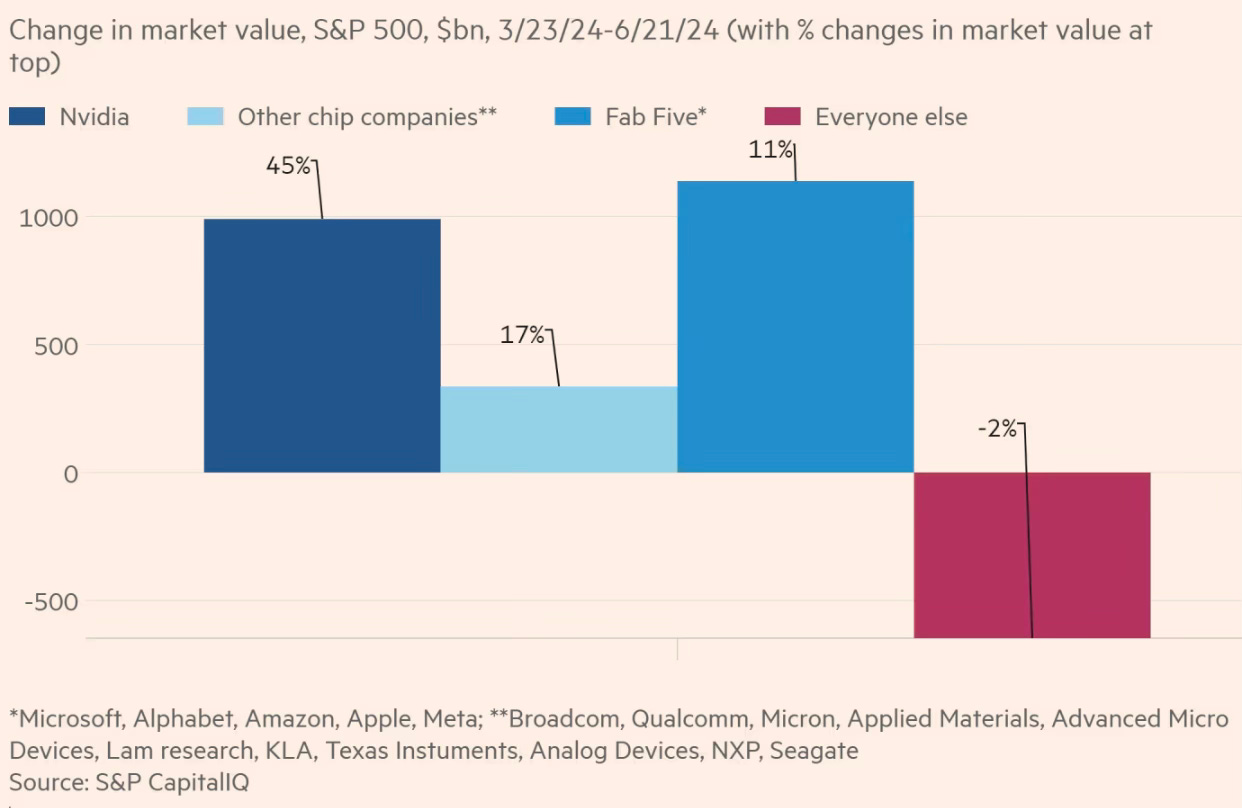
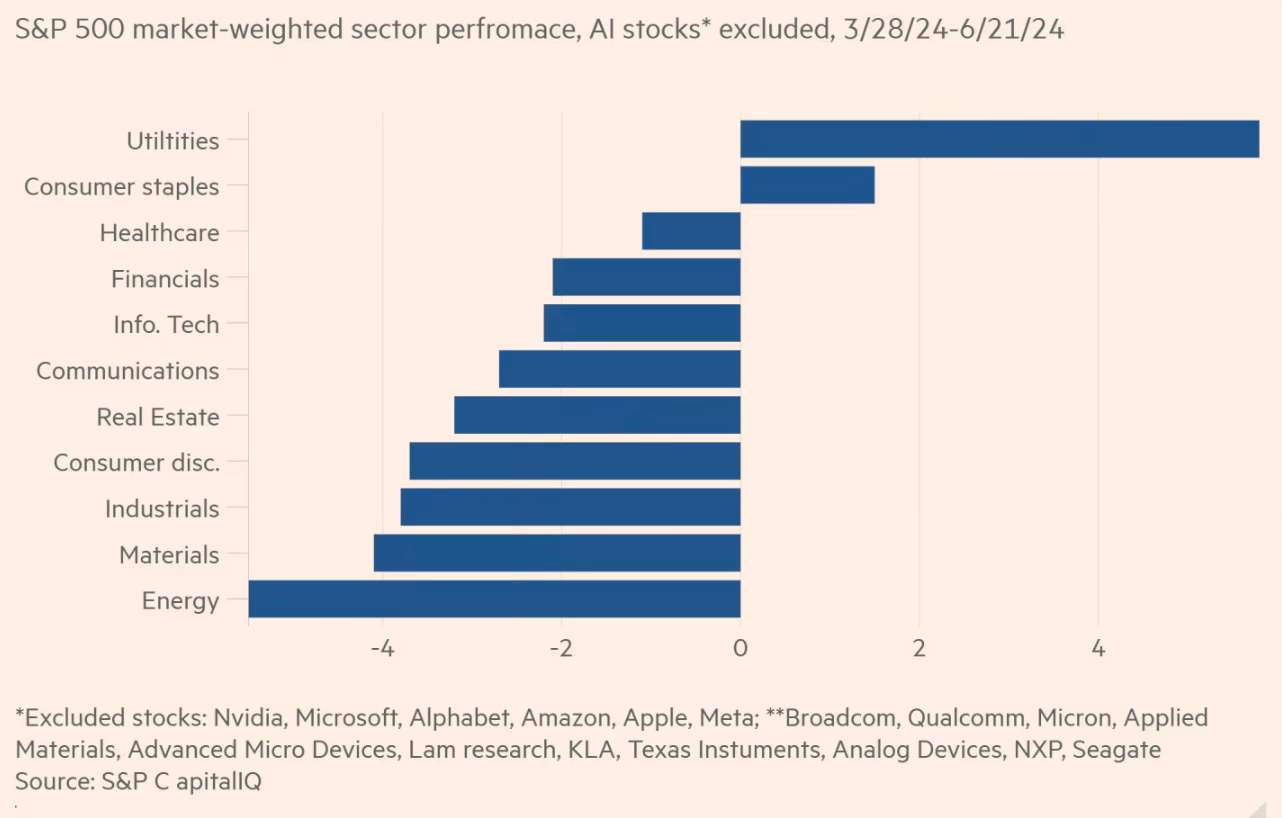
9.  More on Nvidia. FT points to the fact that all the gains in S&P 500 since late March has come from AI or AI-adjacent stocks. 

In the same period, the non-AI stocks are down 2%, with 9 out of 11 sectors are down.

It's hard for anyone to make informed choices. Consider both the bullish and bearish of views on Nvidia. 

Consensus estimates for revenue growth for next year and for 2026 do not, in fact, seem wildly demanding. Analysts are expecting a 23 per cent annual growth rate for Nvidia over that period. This would represent something of a moderation in rate; over the past five years Nvidia revenue has grown at 50 per cent a year. Similarly, the two-year revenue growth rates pencilled in for the Fab Five are at or below the growth rates of recent history. It is only a handful of the chip stocks — Micron, Texas Instruments, Analog, and Lam — where a major acceleration in revenue is expected. Is the recent rally in the AI group driven by upgrades of earnings estimates? Looking at 2025 estimates, not really. Since the end of March, earnings estimates for the group as a whole have crept up in the low single digits, percentage wise. Apple, Amazon, and Micron are the only ones that have received meatier upgrades... In the past three months, the price/earnings ratios of Nvidia, Apple, Broadcom, and Qualcomm have all risen by over 20 per cent. Looking back to last October, when the rally began, the average (harmonic mean) P/E ratio in the AI group is up almost 50 per cent.

Unhedged also points to the internal tension within the AI rally

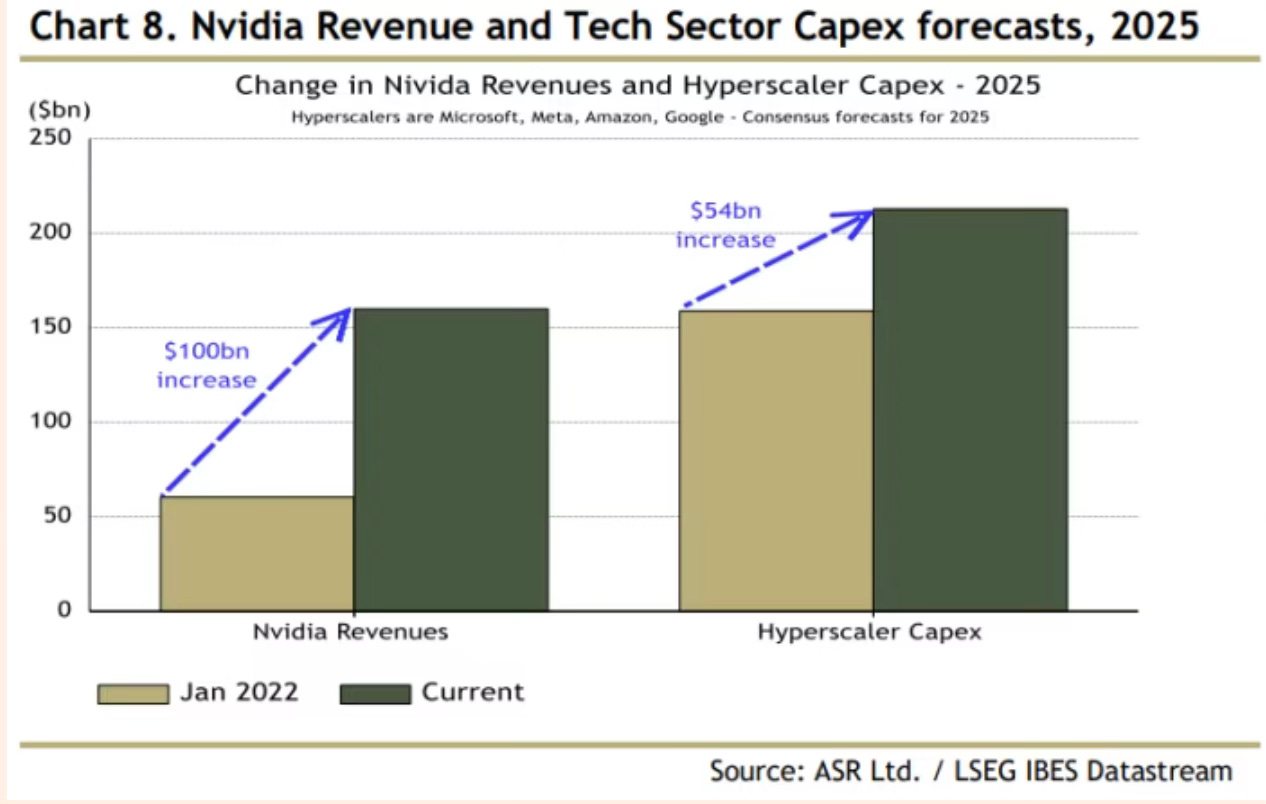
One internal tension within the AI rally is that the revenues of its leading company, Nvidia, are expenses for some of its biggest beneficiaries, the Fab Five. In the short term, Nvidia’s success is a drag on the cash flows of Big Tech companies, which are buying the bulk of Nvidia’s chips. Charles Cara of Absolute Strategy Research has recently made a provocative point about this. He notes that 40 per cent of Nvidia’s revenues come from Microsoft, Meta, Amazon, and Google, and that even the very large expected increase in capital expenditure at those companies is not very large relative to the expected increase in Nvidia’s revenues. The increase in the four companies’ capital spending between the last fiscal year and 2025, at $54bn, is more than 40 per cent of the $100bn expected increase in Nvidia’s revenues, but presumably only a fraction of Big Tech’s capital spending goes to Nvidia’s GPUs. So either the Big Tech will spend more, or Nvidia will make less.

Here's Robert Armstrong's conclusion in interpretation of the spectacular rally.

Perhaps it just reflects momentum and animal spirits. More charitably, it could reflect the expectation that the AI business will provide an increase in profits that lasts for many years into the future. That is to say, it is a bet about the competitive dynamics within the AI industry: that it will not be hypercompetitive, and the winners in the long term will be the same as the winners now — the Fab Five and today’s leaders in the semiconductor industry. To me, the second half of the bet, that the incumbents will keep on winning, seems like a reasonable one. Incumbency in tech is very powerful, to the extent that companies can use their strong market position in one technology to create a strong position in another (think of Microsoft moving from PC operating systems to cloud computing). The first half of the bet, that AI will not turn into a capital-intensive knife fight where no one makes high profits, I don’t know how to assess.

10. Simon Kuper makes an interesting point about why there's so much disillusionment about France about its economy despite the economic health of the country being at its best in decades. 

France has western Europe’s largest territory. Millennia of small farming ended here in a few confusing decades. Today LVMH exports more than all of French agriculture. The consequence: most French towns and villages outside tourist hotspots have lost their reason to exist. If they weren’t already there, nobody would now build them. They are shedding shops, schools and doctors. Places without post offices and train stations are statistically more likely to vote far right, because residents feel abandoned by the Republic. Workers have moved to cities, especially Paris. The EU’s biggest international metropolis is another French asset, but inside France it stands for arrogance and wealth, embodied by Macron. There’s an obvious solution: encourage hybrid working, which would let people leave cities for France’s plethora of cheap charming places near TGV stations.

The article also has a case for nuclear energy

Thanks to its nuclear power stations, France produces electricity with the lowest carbon intensity of any large economy, calculates energy think-tank Ember.

Saturday, May 4, 2024

Weekend reading links

1. Less discussed achievements of Abenomics, on corporate governance and capital market reforms that are major contributors to the country's economic resilience and equity market rebound.

“Reforms, new policy ideas, and civil society participation arrived in a heady rush (with Abe),” says Jamie Allen, who recently stepped down as secretary general of the Asian Corporate Governance Association (ACGA), a non-profit membership organisation driving effective corporate governance practices throughout Asia. He lists the Japan Stewardship Code of February 2014 (it has undergone two revisions since, in 2017 and in 2020); the Ito Review, in August 2014, which put return on equity (RoE) and corporate competitiveness on the map; the Corporate Governance Code of June 2015; a new third system of board governance, the Audit and Supervisory Committee Company, in 2015; the growth of sustainability reporting, strongly encouraged by the Financial Services Agency and the Ministry of Economy, Trade and Industry (METI); the emergence of new director-training institutes; an official set of Guidelines for Investor and Company Engagement in June 2018; new METI guidelines on group governance in June 2019. “Part of (Abe’s) government’s genius was to link CG reform not to risk reduction — as in most markets where governance is a corrective to excessive corporate risk taking — but to the long-term growth of companies and the revitalization of the underperforming Japanese economy,” avers Jamie...
Japan Inc was cash-heavy and that the financial indicators for Japanese companies trailed their European and United States counterparts. Years of poor capital allocation led to low RoE and low price to book (P/B)... The challenge was to link governance and financial performance, which the Tokyo Stock Exchange did through its focus on capital allocation... In March 2023, the exchange asked companies with a P/B ratio below 1 to disclose specific policies and initiatives to lift their value above it. While there may have been other financial indicators for companies to focus on, like return on capital equity or return on capital employed, the exchange narrowed in on P/B, which is now the prominent indicator. Since then, companies have begun focusing on capital efficiency. They have begun buybacks, mergers, spinoffs, unwinding crossholdings, and disposal of treasury stocks. All these are standard tools for any well-managed company but were shunned by Japanese enterprises.

As can be seen,  these are not the kind of big bang ones that commentators harp on. Instead, they are the plumbing of corporate governance and equity market regulation. These less noticed reforms are the kinds of reforms that countries need.

2. India's trade story in numbers over the last two decades

The total merchandise exports figures went up from $63.84 billion in 2003-04 to $314.40 billion in 2013-14 (a rise of $250.62 billion), and now stand at $437.06 billion (a rise of $122.65 billion). So, while the merchandise exports grew almost four-fold during 2004-14, they grew by a little over a third during 2014-24. The services exports, however, grew from $46 billion in 2003-04 to $167 billion in 2013-14 (a rise of $123 billion) and to $340 billion in 2023-24 (a rise of $173 billion from 2013-14). Thus the rise in exports of services is more than the rise in the exports of merchandise in the past ten years... the share of petroleum products (Chapter 27) in our exports basket has stagnated around 20 per cent in the past ten years. The share of gem and jewellery (Chapter 71) exports (7.7 per cent) have halved during the past 20 years. The share of pharmaceuticals (Chapter 30) has doubled in 20 years but still is only around 5 per cent. The shares of chemicals (Chapters 28 and 29) at 5.2 per cent and farm, marine etc. products (Chapters 1 to 24) at 11.01 per cent have stagnated in 20 years. The share of cotton including yarn, fabrics etc. (Chapter 50) at 5.4 per cent has gone up from 3.9 per cent two decades back. The share of highly labour intensive readymade garments (Chapters 62 and 63) has gone down from 8 per cent to 3 per cent in 20 years. The success story is that of engineering products exports (Chapters 72 to 89) whose share in our total exports went up from 18.78 per cent in 2003-04 to 21.33 per cent in 2013-14, and now stands at 29.01 per cent. The share of other products has halved at 13.06 per cent in the past 20 years. From these figures, it is clear that engineering and petroleum products account for almost half of our exports.

3.  Tamal Bandopadhyay has a very good column taking stock of the Insolvency and Bankruptcy Code.

A November 2023 report of rater Crisil Ltd pointed out that the recovery rates (as a percentage of admitted claims) have fallen from 43 per cent to 32 per cent between March 2019 and September 2023 even as the average resolution time has more than doubled, from 324 to 653 days. Realisation by financial creditors, as a percentage of liquidation value, has also dropped from 194 per cent to 168.5 per cent during this period... Since the IBC’s inception, 6,815 cases have been admitted to the NCLT, and 2,827 of these cases, that’s 41 per cent, are still undergoing the resolution process. The average resolution time has been rising and is now at a three-year high. Till December 2023, of the 6,815 cases, 891 had been resolved (against financial creditors’ claims of Rs 9.09 trillion, the realisation is Rs 3.1 trillion); 2,376 ended in liquidation (1,789 received no resolution plans and 587 got at best a couple of plans); and 721 in voluntary liquidation.

There are two problems that are not easily addressed. One, corporate India's innate instincts of using vexatious litigation to delay and subvert the process. Two, more importantly, the judiciary's willingness to foist themselves on these cases and leave them unheard for months (as the Videocon-Vedanta case pending in Supreme Court for more than two years shows). 

4. Have long run neutral interest rates in the US gone higher?

The neutral rate, sometimes called “r*" or “r-star," can’t be directly observed, only inferred... Every quarter, Fed officials project the longer-run interest rate, which is, in effect, their estimate of neutral. Their median estimate declined from 4.25% in 2012 to 2.5% in 2019. After subtracting inflation of 2%, that yielded a real neutral rate of 0.5%... if inflation resumes its decline, questions about neutral would drive how much the Fed ultimately cuts rates. The Fed wants to “normalize policy, but ‘normalize’ to where?" said David Mericle, chief U.S. economist at Goldman Sachs. “They are not going to stay in the 5s, but normalization is not going to take them all the way to 2.5%. Where in the 3s or 4s they feel comfortable stopping is still up in the air." There are several factors cited for why neutral may be rising: soaring government deficits and strong investment driven by the green-energy transition and an artificial-intelligence-fueled frenzy for electricity-intensive data centers. Higher productivity from AI could also lift long-run growth and the neutral rate. Dallas Fed President Lorie Logan warned in a recent speech that interest rates may not be as restrictive as believed because of a higher neutral rate. “Failing to recognize a sustained move up in the neutral rate could lead to over-accommodative monetary policy," she said... Interest-rate futures suggest the fed-funds rate will stabilize around 4% in coming years.

5. Interesting that the growth of GST collections have lagged behind the growth rates of nominal GDP and Income Tax.

The corporate tax cuts have not only not revived private investments but has also led to a reduction in corporate tax revenues as a share of GDP.
The tax cut failed to achieve its goals, as private investments have not taken off and the government has been forced to pump in massive amounts through capital expenditure to support the economy. At the same time, the immediate result of the tax cut is visible in collections, which is expected to be 3.2% of GDP in 2024-25, significantly less than the average mop-up a decade before the decision. As such, the government’s coffers are being filled more by personal tax collections than by corporate tax, raising questions about whether it is indeed pro-corporate.
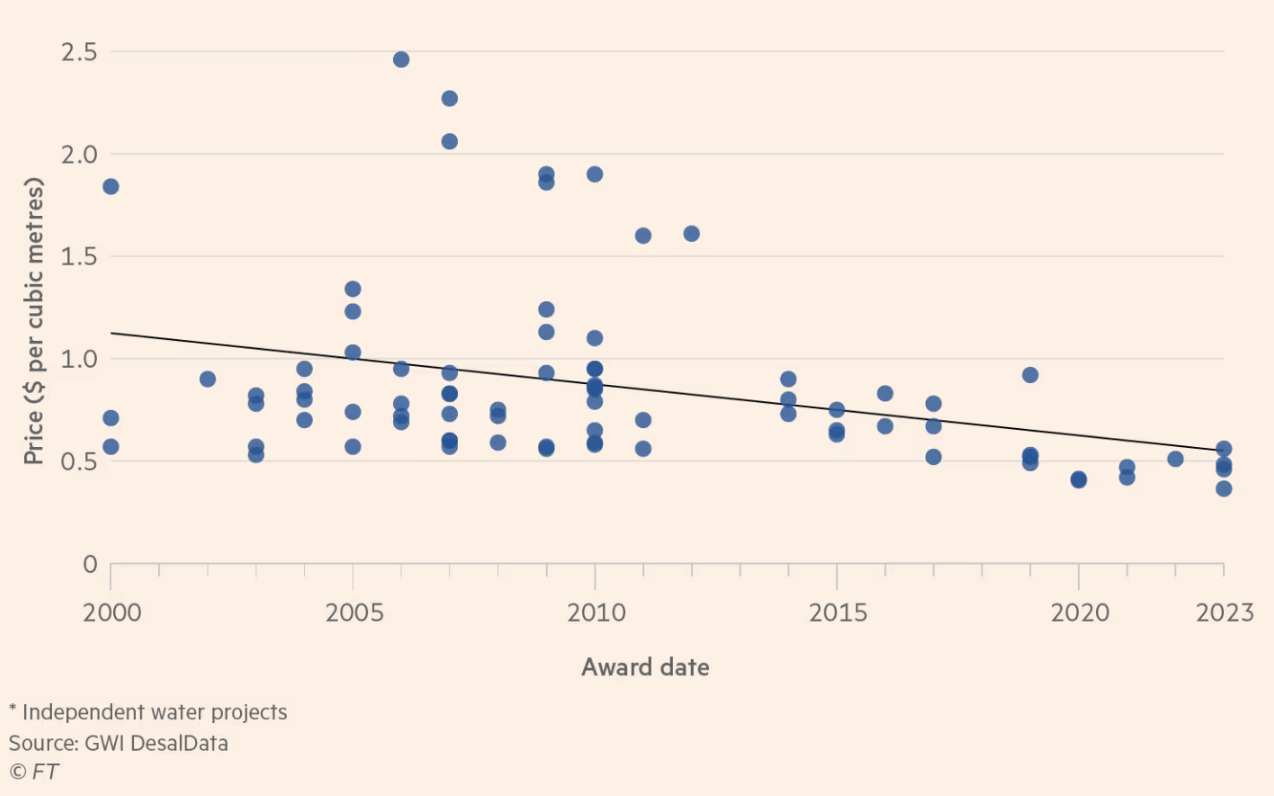
6. FT has an article that points to the steep decline in water desalination costs on the back of cheap solar power.
Older, thermal plants, which used heat to turn salt water into steam, delivered potable water at more than $3 per cubic metre. Since then, reverse osmosis technology — in which water is pushed through a membrane to remove salt, minerals and impurities — has taken over. Plants cost less to build — perhaps $400mn to purify 500,000 cubic metres per day, says Christopher Gasson of GWI. Including installation, a return on capital and operating costs, that translates to $0.30 per cubic metre of water. Newer plants also need less energy — 2.6KWh per cubic metre — and are increasingly powered by cheap solar plants. The cheapest plant in the world gets energy at $0.025/KWh, or $0.07 per cubic metre. Put that together and it explains how the Hassyan project in Dubai has promised desalinated water at just $0.37 per cubic metre. For reference, drinking water in London is priced at £1 per cubic metre. At this sort of level, desalination becomes more affordable for dry, coastal areas, not just in the Middle East but also in Egypt, Algeria and Morocco, which are all building new plants... the market for new plants is expected to grow by perhaps 8 per cent a year from now to 2030... early movers in the desalination sphere, including Saudi Arabia’s ACWA power, Spain’s Acciona and France’s Veolia, have a clear advantage in a competitive race.
7. Rana Farrohar points to the dysfunctional nature of the US home insurance market.
A couple of months ago, my insurance company decided to raise the price of the yearly insurance premiums on our Brooklyn home by 51 per cent over three years, after more than doubling the estimated cost to rebuild should it burn to the ground or be washed away in a hurricane. While neither outcome seems likely for a limestone townhouse that sits on a hill more than a mile and a half away from the nearest flood zone, our insurer came up with an estimate that was more than double what the house would go for on the open market, making coverage both excessive and unaffordable... No one was willing to sell us a premium for the market value of our home and simultaneously prepared to write us a cheque for that value in case of total loss. We had two choices. Take out a policy with a handful of luxury insurers that would only sell us far greater coverage than we wanted for much more than we could afford. Or go with a budget policy offering roughly a third of what it would cost to buy a similar home in the case of a total loss — with the money only paid out if we chose to rebuild on site... we have any number of friends with similar homes who are paying wildly different prices for insurance. When I asked our broker how it was possible, or even legal, for a neighbour with the same insurer and the exact same house three doors away to pay a bit more than half our new quote, she told us that their premiums would very likely be raised next... 

How could there be so few options, so little transparency and such tolerance of inflation and inefficiency in a market as big as New York? Why was my home, which has never been seriously damaged by weather, being risk-assessed like something in a hurricane flood zone that is more than a mile and a half away? Why is the insurance industry so bad at pricing risk in a more precise way around the city, and indeed, much of the rest of the country?

Talk about free markets and their magic! This is a great example of how markets on their own fail to work, thereby necessitating regulation and government intervention to make them work effectively.  

8. China economy imbalance facts of the week.

China’s investment to gross domestic product ratio, at more than 40 per cent last year, is one of the highest in the world, according to the IMF, while private consumption to GDP was about 39 per cent in 2023 compared to about 68 per cent in the US. With the property slowdown, more of this investment is pouring into manufacturing rather than household consumption, stimulating oversupply, western critics say. “China is responsible for one-third of global production but one-tenth of global demand, so there’s a clear mismatch,” US secretary of state Antony Blinken said in Beijing last week... China’s high national savings rates, which, at more than 47 per cent of GDP in 2022, are double the world average.
“The solution has always been a massive increase in investment,” Pettis says. But, he adds, with signs of over-investment now “everywhere”, from the property sector to overbuilt infrastructure, and debt to GDP at about 300 per cent, “you can see that investment can no longer be the solution”... Greater consumption would also necessarily mean reducing the role of manufacturing or investment in the economy. This could be done by unwinding China’s intricate system of subsidies to producers, which includes government infrastructure investment, access to cheap labour, land and other credit, says Pettis. But if that was done in a big bang fashion, the share of household consumption to GDP would increase while overall GDP would contract as manufacturers suffered. This was obviously not a politically preferable option for Xi. “They are locked into this system,” Pettis says.

9. Michael Pettis has a nice summary of the economic imbalance problem.

China’s structurally-high domestic saving rate is the result of a decades-long development strategy in which income is effectively transferred from households to subsidise the supply side of the economy — the production of goods and services. As a result of these transfers, growth in household income has long lagged behind productivity growth, leaving Chinese households unable to consume much of what they produce. Some of these subsidies are explicit but most are in the form of implicit and hidden transfers. These include directed credit, an undervalued currency, labour restrictions, weak social safety nets, and overinvestment in transportation infrastructure. These various policies automatically force up Chinese savings. By effectively exporting excess savings through the subsidy of the production of goods and services, China is able to externalise the resulting demand deficiency...

China’s structurally-high domestic saving rate is the result of a decades-long development strategy in which income is effectively transferred from households to subsidise the supply side of the economy — the production of goods and services. As a result of these transfers, growth in household income has long lagged behind productivity growth, leaving Chinese households unable to consume much of what they produce. Some of these subsidies are explicit but most are in the form of implicit and hidden transfers. These include directed credit, an undervalued currency, labour restrictions, weak social safety nets, and overinvestment in transportation infrastructure. These various policies automatically force up Chinese savings. By effectively exporting excess savings through the subsidy of the production of goods and services, China is able to externalise the resulting demand deficiency.

10. The economic imbalance is also creating foreign policy tensions, and increasingly with other developing countries over cheap Chinese imports flooding their markets and destroying local industries. 

Brazil’s industry ministry has launched a number of investigations into the alleged dumping of industrial products by China as Latin America’s largest economy reels from a wave of cheap imported goods. At the request of industry bodies, the ministry has in the past six months opened at least half a dozen probes on products ranging from metal sheets and pre-painted steel to chemicals and tyres... In addition to Brazil, China’s steel exports to Vietnam, Thailand, Malaysia and Indonesia have risen sharply in recent months... In Thailand, the government has accused Chinese companies of evading anti-dumping duties, while industry groups have warned of big losses from cheaper steel in the market. Vietnam’s government has launched investigations into dumping of wind towers and some steel products from China after complaints from the local industries. In August last year Mexico imposed tariffs of 5-25 per cent on imports of hundreds of goods from countries with which it does not have a free trade agreement, with China being one of the countries most affected.

11. A less discussed but one of the most remarkable achievements of energy policy, foreign policy (and the European Project), and infrastructure mobilisation was the success of Germany and Europe in replacing Russian natural gas imports in the aftermath of the Ukraine invasion. Germany took the lead in establishing LNG import terminals, Floating Storage Regasification Units (FSRU). 

Wilhelmshaven was the first floating storage regasification unit (FSRU) to come online during the crisis but many more are in the works. Since Russia started cutting pipeline supplies to Europe in 2021, at least 17 liquefied natural gas (LNG) terminals have been planned or are under construction. LNG received by these FSRUs have helped replace all but 10 per cent of the gas supplies that previously came to the EU from Russia via pipelines, helping to reduce gas prices from record highs of over €300 per megawatt hour in August 2022 to near pre-crisis levels of around €30 per megawatt hour today. The energy crisis that Europeans feared two winters ago has not come to pass, thanks to a combination of unprecedented energy policy interventions, cuts in demand and good luck... The bloc is reliant on imports, either through pipelines or LNG shipments, for nearly 90 per cent of its supplies. Before the war, flows through four main pipelines from Russia accounted for around 40 per cent of the EU’s total supplies.

The higher prices being paid in Europe led LNG traders to prioritise deliveries to customers there over those in Asia, says Tom Marzec-Manser, head of gas analytics at ICIS. “Market signals were fundamental in allocating resources where it was needed.”
12. Hybrids cars are growing faster than EVs, whose growth has declined globally.
According to S&P Global, the penetration of all categories of hybrids has gone up from 9 per cent globally to 11 per cent in 2023 and is neck-and-neck with electric cars, though the latter are marginally ahead at 12 per cent, compared to 10 per cent in 2022. In the United States, hybrid sales in 2023 were 1.4 million and overtook electric cars, which sold 1.2 million. Globally, sales of plug-in hybrids grew faster, going up by 43 per cent in 2023, compared to a 28 per cent increase for electric cars.
Plug-in hybrids have two engines and the electric part has a much larger battery than in the regular hybrids. As the name suggests, plug-in hybrids require to be plugged into an electric socket to charge their battery. A regular hybrid gets its battery (smaller than in plug-ins) charged by the gasoline engine – the two complement each other -- and regenerative braking. Plug-in hybrids in China grew by 85 per cent in 2023, while electric vehicles grew by 70 per cent. In India, the popular hybrids, such as Toyota Hyryder and Maruti Suzuki’s Grand Vitara, do not require to be plugged in. The global trend towards hybrids is now visible in India, where they are being seen as an essential bridge to EV land... Electric cars attract a goods and services tax (GST) rate of 5 per cent. Hybrid cars attract 28 per cent GST, but the cess takes the total tax incidence to 43 per cent, unless it is a small car. ICE cars attract the same GST, but the cess takes the total to up to 50 per cent, varying according to the size of the body and engine.

This is an interesting cautionary tale from Norway about the promised emission benefits from EVs.

A study by Goehring & Rozencwajg, a natural resource investor, says despite the noise on Norway’s successful model for electrification of cars, the country forks out $4 billion on electric vehicle subsidies annually, as much as it does for building highways and maintaining public infrastructure, which has a big financial impact. Goehring & Rozencwajg also points out that despite all the action on the electric front in Norway — 20 per cent of all vehicles on the country’s roads and 80 per cent of new vehicles are electric — gasoline demand has gone down by only 4 per cent. That is because Norwegians are reluctant to give up their ICE cars even after they have bought an electric. Two-thirds of car owners in Norway have at least one ICE vehicle, and they continue to use it.

This effect is likely to be more pronounced in India.

13. Shyam Saran has a good oped on the ongoing situation in Gaza, which is clearly a genocide and a humanitarian disaster happening with the full knowledge of the UN and the international community and with so limited restraints on Israel. As Saran writes, the political survival of Netanyahu depends on the continuation and escalation of the situation in the region.