Substack

Showing posts with label PDS. Show all posts

Saturday, August 1, 2026

Weekend reading links

1. US equity markets fact of the week.

In the year to March 2026, the US received well over $600bn in net equity inflows. Not only was this a record sum, it was also double the flow into government and agency bonds. Net equity flows exceeded debt flows by the largest margin in history.

2. US utilities are shifting from net metering to net billing on rooftop and home solar installations.

Many utilities pay homeowners the same rate they charge for electricity, meaning the energy sent to the grid when the sun is out offsets the cost of the energy pulled from the grid at night. That’s called net metering, a system where the energy you send is worth typical U.S. prices of 10 to 30-plus cents per kilowatt-hour. Under newer policies, often called net billing, utilities buy the extra energy back at a lower rate, often 2 to 10 cents.
3. In a country ravaged by deflation (pork prices have hit a 16-year low), egg prices are rising in China.
Egg prices are up by more than 40 percent from a year ago, according to an index that tracks the top producing provinces. They recently hit a 10-year high by another benchmark that tracks prices at a wholesale market in Guantao, in northern China... Two years ago, farmers started expanding after several bumper years, adding more egg-laying hens from 2024 to 2025 than ever before, according to Aspen Li, an analyst who studies the egg market. Suddenly, there were too many eggs and the price plunged. Farmers then found themselves short of money to feed all their chickens. So they culled them, at a rate that experts considered excessive. Eventually, there were not enough egg-laying hens to meet demand, sending prices to levels that Mr. Li said were “even higher than my expectations.”

4. Japan's return to normalcy.

5. President Xi's flagship Belt and Road Initiative (BRI) projects hit a record $20.1 bn in green energy financing in the first half of 2026, topping its total value for the whole of 2025, 
Total BRI deals rose to a record high of $126.3bn in the first half of 2026, up from $123.3bn in the same period in 2025. The 2026 figure was composed of $49.8bn in investment and $76.5bn in construction projects.

A distinguishing feature of BRI projects is the increased share of the private sector.
The latest data highlighted how the BRI had become primarily driven by private companies rather than China’s state-owned enterprises. According to the University of Queensland data, the share of engagement from the private sector, as opposed to SOEs, reached 48 per cent in the first half, compared with 13 per cent in 2022.
6. The Great Divergence between labour productivity and wages. 

Labour's share of income has fallen sharply.
7. Tata Zudio is following in the footsteps of Zara.
Despite its bargain offerings, Tata said gross margins at Trent, which includes the more upmarket Westside clothing stores, stood at 44 to 45 per cent. “The playbook is you go end-to-end — you go from the source of the product to the customer and you do everything yourself in between,” he said. “That’s why we do our own transporting. We do our own warehousing. We have our own shops. The manufacturing units we use are more or less dedicated to us.”... Zudio eschews online retailing, believing that high return rates clog up the operation and generate too much extra cost.Rapid turnover is key to Zudio’s appeal. New lines are launched every Thursday and a team of social media watchers monitors fashion trends and feeds them to a design team.

8. The IPOs of SpaceX, OpenAI, and Anthropic could generate a massive flush of philanthropic capital.

Nan Ransohoff, the head of public goods at the payment processor Stripe, estimated in a Substack post, between $37 billion and $100 billion could become available to charities annually... And that doesn’t even include OpenAI’s employees. Or the newly rich created by SpaceX, whose I.P.O. spawned an estimated 4,400 millionaires (and some 400 employees now worth more than $100 million). Or the many other IP.O.s on the docket... Giving money away is a common maneuver to avoid taxes: Up to 74 cents of every dollar donated to charity would have been paid as taxes, according to the Institute for Policy Studies. It reported that charitable giving in 2022 alone had resulted in $73 billion in lost tax revenue.

9.  Debt service and defence make up two-thirds of Pakistan's budget expenditure.

10. On Europe's pensions problem.

Across the EU, 47 per cent of the bloc’s social protection expenditure is spent on old age and survivors’ benefits, ahead of 36.7 per cent spent on sickness and disability and 8.7 per cent on families and children. Even in the UK, where private provision plays a greater role, the country’s fiscal watchdog has forecast that spending on the state pension — the second-largest item in the government budget after health — will rise from almost 5 per cent of GDP to 7.7 per cent by the early 2070s. Italy has the EU’s highest pension costs at just over 15 per cent of GDP, according to statistics from the European Commission. France and Greece each spend over 14 per cent. In Germany, a third of all federal tax revenue will be spent plugging holes in the state pension system this year, according to an estimate by Munich economic think-tank Ifo... 

In France, the audit office estimated last year that the country’s pension deficit, currently around €1.7bn, could grow to €15bn by 2035 and balloon out to €30bn by 2045 if further reforms are not made. European countries have tried to tackle their surging pension costs since the 1990s, and have had some successes, with many lifting the state pension age from 65 to 67 or more. Italy has tied its pension age to life expectancy, while France has pegged annual pension increases to consumer price inflation rather than earnings. In some countries, spending on pensions as a percentage of GDP is set to fall in the long term as a result of such moves...

In most big European countries including Germany, France, Italy and Spain, the state provides the main earnings-related pension, paid for by contributions from current workers, which aims to replace a proportion of pre-retirement income. Such systems were modelled after the one created by Otto von Bismarck, who introduced national state pensions in 1889 to ward off surging socialism and strengthen loyalty to the authoritarian German monarchy... It paid up to 20 per cent of average salary to industrial workers when it became payable. It was designed to prevent destitution rather than facilitate a comfortable retirement. Other countries soon followed. In the UK, Prime Minister David Lloyd George ushered in old age pensions in 1909... A full UK state pension is currently close to a third of median earnings; private provision, usually through workplace schemes, is meant to provide additional security in retirement... Italy has one of Europe’s highest replacement rates, with pensions paying out close to 80 per cent of average earnings... Contribution rates, from workers and their employers, are correspondingly high at 33 per cent of earnings in Italy, 28 per cent in France and 19 per cent in Germany... That compares with an average of over 20 per cent in the UK — paid via national insurance — and just 11 per cent in the US.

11. Ramesh Chand argues for rationalising the PDS and moving to a nutrition security programme.

Between 2013-14 and 2025-26, India’s real per capita income (net national income at 2011-12 prices) increased by 78 per cent, from ₹68,572 to about ₹1.22 lakh... At the time of the NFSA’s enactment, around 22 per cent of the population lived below the poverty line. Both official estimates and independent studies now suggest that poverty had declined to around 5 per cent by 2022-23... In the early years of the NFSA, roughly one-third of the beneficiaries were poor and two-thirds were above the poverty line. By 2025-26, only about 10 per cent of those receiving free food grains were estimated to be below the poverty line while the remaining 90 per cent were non-poor... The latest UN report... estimates that the proportion of Indians unable to afford a healthy diet declined sharply from 59.8 per cent in 2017 to 35.5 per cent in 2025. In absolute terms, the number of such people fell from 759 million to 589 million. This indicates that about 170 million people crossed the affordability threshold for a healthy diet during this period as their purchasing power improved... The prevalence of undernourishment in India declined from 13 per cent in 2013-14 to 9.8 per cent during 2023-25, indicating progress but at a relatively slow pace.

12. The Fed under Kevin Warsh appears to be facing a credibility crisis as it grapples with rising inflation.

As Mr. Warsh spoke, longer dated Treasury yields rose sharply, with the 30-year bond closing in on its May peak of 5.2 percent. That was the highest level since 2007. The rise in the 30-year Treasury yield suggests some worry about Mr. Warsh’s ability to tackle inflation in the long run.

And this.

Long-term government borrowing costs shot higher as Mr. Warsh spoke, with the 30-year bond notching its largest one-day increase in more than a year. Trading around 5.22 percent, it is at the highest level since 2007. The 10-year Treasury yield, which serves as the benchmark for borrowing costs around the world, also rose alongside expectations about inflation over a longer time horizon.

13. FT has a long read describing the story of Situational Awareness, the $20 bn hedge fund of 24-year-old Leopold Aschenbrenner, which had racked up gains over 400 per cent on the back of massive leverage, and has now run into the wrong side of the AI sell-off. The fund sold its portfolio to Ken Griffin's Citadel in an almost distressed sale. Apart from being an alumnus of OpenAI, Aschenbrenner is also the husband of Avital Balwit, who now works as chief of staff to the CEO of Anthropic. 

What stands out in the entire article is the reluctance to call out the obvious contributor to Aschenbrenner's success: the strong likelihood of insider trading at a massive scale. It is hard to believe that the smart investors who were betting on Situational Awareness were betting on the expertise or competence of Leopold Aschenbrenner, and not on the insider information he possessed.  

14. Fascinating snippet on wealth creation in the equity markets.

Economic analyst Hendrik Bessembinder has shown that half of the net wealth creation in US stock markets over the last century flowed from just 46 public companies, out of a total of almost 30,000. Looking at his list of the greatest wealth creators, the knowledge companies dominate the top spots, and all the winners have high walls around them.

Saturday, January 8, 2022

Weekend reading links

1. On the NHAI's growing pile of debt and its asset monetisation estimates. 

In the current financial year, for instance, the NHAI was able to monetise only 840 km. Of this, 390 km was under the Infrastructure Investment Trust (InvIT) model and 450 km through the Toll Operate Transfer (TOT). The expected backlog is about 4,912 km... The projects it has bundled out under InvIT are the older ones where traffic has expanded. Even among them, those which found bidders were the ones where the revenues have crossed Rs one crore per km. Of the eight bundles bid out, only three have seen such levels of traffic and were picked. Three other fell through since the toll collections, though growing healthily, still average less than Rs 70 lakh per km. Those would improve with the growth rate of the economy with larger demands for freight and passenger traffic. NHAI data shows as of now about 38 per cent of its projects with a history of over six years of toll collections have reached this magic figure.

2. Another article on the travails of the other major source of off-balance sheet debts, FCI. The basic problem has been the growing excess of procurement over the requirement. 

Last year (2020-21), the FCI and state agencies procured more than 132 million tonnes (mt) of cereals from Indian farmers at the minimum support price (MSP), consisting of 89 mt rice and 43 mt wheat. This was twice the average procurement of a decade ago. As a result, FCI had a record 110 million tonnes of rice and wheat in its stock this summer (including rice from unmilled paddy), or 2.5 times the buffer norm of 40 mt. On the other hand, the annual requirement under the National Food Security Act (NFSA) is not more than 65 million tonnes... the record 2021 summer stocks of more than 100 mt are despite the 31 mt free giveaway under PMGKAY... the giveaway under the temporary scheme will be smaller in 2021-22, but the procurement of paddy and wheat may again be a record this year.

In case of rice

And wheat

3. Debashis Basu writes about the last IPO boom,
The abolition of control of capital issues removed all checks on IPOs, allowing a free for all. The IPO market peaked in February 1995 with the infamous price rigging and misstatements in the prospectus of MS Shoes. In January 1995, 145 equity issues opened for subscription. In one frenzied week in February that year, 78 companies went public, crowning a financial year of 1,400 issues, most of them small and shady companies that vanished with investors’ money. When you consider the period between 1998 and 2001, when only 219 companies went public, you begin to see the farce of the 1994-95 IPO boom. The regulation of the primary and secondary markets was so lax that just about anybody could raise money with false statements and rigged-up prices in the thriving pre-IPO grey market.

And the dominant role of retail investors in the ongoing boom,

In the two decades till 2019-20, some 40.8 million demat accounts were opened. And in just 20 months after the 2020 lockdown, that figure had almost doubled to 74 million at the end of November 21.

He points to the reasons for the post-pandemic boom,

Four factors were behind this retail boom: One, online sign-ups for broking and demat accounts; two, continuously booming capital markets in India and around the world; three, retail investors having more time, money, and the opportunity to trade as they were forced to stay at home; and four, for the first time an explosion of easy to consume information on stocks, including videos. The net effect was enormous. For the first time in decades, retail investors as a group came to dominate cash market trading — some 45 per cent in FY21. The share of foreign institutional investors and domestic institutional investors is down to single digits.

4. Highlighting the enormity of the global debt binge,

Twenty-five countries including the US and China have total debt above 300 per cent of GDP, up from none in the mid-1990s.

5. Highlighting the problems with MSP, Ashok Gulati and Ranjana Roy use the NSO's latest Situation Assessment of Agricultural Households report to show that only about 5.6% farmers benefit from MSP and only 2.2% of agricultural produce by value is covered under MSP. Besides the benefit is cornered mostly by farmers from Punjab and Haryana. 

6. Mahesh Vyas on the Indian labour market,

The unemployment rate rose to 7.9 per cent in December 2021. It was 7 per cent in November. A year ago, in December 2020, the unemployment rate was higher at 9.1 per cent... In 2018-19, the unemployment rate was 6.3 per cent and in 2017-18 it was 4.7 per cent... In 2019-20, India employed 408.9 million... In December 2021, employment was 406 million. This was 2.9 million less compared to the employment in 2019-20. The shortfall was not evenly spread at all. The biggest fall in employment was in salaried employees. This class saw a loss of 9.5 million jobs. Another 1 million jobs were lost among entrepreneurs. This massive 10.5 million loss of jobs was offset by gains in employment among daily wage labourers and more so among farmers. An industry-wise break-up of the difference between employment in December 2021 and 2019-20 shows that the manufacturing sector has lost 9.8 million jobs. But, construction jobs increased by 3.8 million and agricultural jobs increased by 7.4 million. Services sector lost 1.8 million jobs. Within services industries, hotels and tourism lost 5 million jobs and education lost 4 million jobs but retail trade gained 7.8 million jobs... It is disappointing to see the sustained weakness in salaried jobs. These had risen to 84 million in September and October 2021 but have since fallen to 77 million in November and December 2021. In 2019-20, there were 86.6 million salaried jobs in India. In December 2021, while India added 3.9 million jobs, it did not see any increase in salaried jobs.

7. Merryn Somerset Webb attributes the ongoing natural gas price rises in Europe to a decarbonisation shock,

The Bank of America reckons that the average European household spent about €1,200 on electricity and gas in 2020, a number that, based on current wholesale prices, will rise to €1,850 by the end of 2022 — up 55 per cent. Next year is unlikely to be much better. Energy prices will keep on rising. Why? Because too many governments have jumped the gun on renewables — thinking that we can phase out fossil fuels in favour of deeply unreliable renewable energy significantly faster than we actually can — if indeed we ever can. This is a decarbonisation shock — which one fund manager tells me could even end up causing as much pain as the Opec-driven oil shocks of the 1970s...

It is, say analysts at JPMorgan, a simple matter of supply and demand — as ever . . .  There has been a collapse in investment in oil and gas production — capital spending on new projects is 75 per cent down from its peak. But at the same time global demand for thermal energy sources as a whole has “barely declined” — and the demand for oil just keeps rising. JPM expects global oil demand to grow by 3.5m barrels per day in 2022, ending the year both slightly above 2019 levels and at a record high. There will be a new record high in 2023 — there are a lot of record highs in today’s column — more unwanted inflation I’m afraid. JPMorgan’s various research teams forecast oil prices in 2022 to range from $80 to $125 a barrel. The world’s efforts to energy transition are obviously well intentioned. But good intentions often come at an unexpectedly high price.

She quotes Charles Gave of Gavekal Draganomics to argue that energy prices induced inflation can have adverse consequences on the economic output. 

All “structural bear markets in the US have all started when the S&P 500 was significantly overvalued versus energy”, says Gave. This was the case in 1912, 1929, 1968 and 2000. In each of those years valuations reflected investors underestimating the future cost of energy and hence overestimating the future profitability of listed companies. Those who aren’t nervous enough yet might also note that all these bear markets, bar that of 1929-34, took place with inflation on the up and “lasted as long as inflation endured”. This makes sense if you think of it in terms of rising energy prices pushing up costs and companies then not being able to add value or improve efficiency fast enough to absorb the costs without raising prices or suffering severely collapsing profits. The first creates inflation and causes a fall in demand — which hits profits anyway — so either way stocks valued with low energy costs baked into the models begin to look nastily overvalued.
One additional point to make here. For the past few decades, one of the disinflationary impulses in the west has been the cheap goods coming out of China. Those goods were cheap partly because they were made with cheap labour — now getting more expensive — but also because they were made with the cheapest thermal fuel there is — coal. That’s something that is also shifting. China, keen to reduce pollution and maybe even to decarbonise, aims to get coal down to 20 per cent of its energy mix by 2026. This is far from certain of course, given the domestic political and economic pressures, but you can see which way things are going. The key point here is that energy prices matter even more than you think. Bull markets start when energy is plentiful and cheap (1922, 1949, 1982, 2010 says Gave). Bear markets start in times when it is not. Times like these.

8. As Apple touches $3 trillion in market capitalisation, FT has a story on Tim Cook's role since taking over in August 2011. 

During his time at the helm, Apple’s annual revenues have ballooned from $108bn in the year he took over to $365bn in 2021. Net profits have grown 3.7 times, from $26bn to $95bn. But more significant is how Cook has built a services juggernaut to eke out every penny of the Apple ecosystem, garnering a steady stream of recurring revenues from App Store fees and nearly 800m customers paying for digital media that expanded during his tenure. That substantially reduced Apple’s dependence on the iPhone — and propelled the company’s share price to a level where its price-to-earnings ratio is now three times higher than what it was a decade ago. “Tim Cook’s biggest success is the cultivation and the fostering of services, and the degree to which he’s been able to revolutionise the way that the company is perceived in the eyes of investors,” says Mickle.
Two major products have emerged in Cook’s first decade, AirPods and the Apple Watch — big successes with market shares of 25 per cent and 31 per cent, respectively. But the services division has proved far more significant. Last year it delivered nearly $70bn in revenue — roughly double that of the Mac, iPad or wearables divisions — and margins were 70 per cent. “We’re not going to credit Tim with coming up with the next innovative idea, but what you can credit him with is that you have a platform of hardware that suddenly has services that will be 25 per cent of revenue by 2025,” says Ray Wang. “You’ve got an ecosystem that’s unparalleled to any. A supply chain that is unparalleled to any. And of all the different attacks on Big Tech, Apple has weathered it the best.”

This about his diplomatic dexterity,

Cook has also proved to be a skilled diplomat. His focus on consumer privacy has helped Apple avoid Brussels’ ire amid widespread anti-tech sentiment. In China, he signed deals to expand a massive manufacturing footprint while building up a $68bn business in the country — far more lucrative than any of its tech rivals. And in Washington, he avoided tariffs on Apple products by appealing to Trump’s narcissism.

This is stunning,

Apple has produced a regular cadence of product iterations impressive enough that consumers are willing to pay premiums the rest of the industry can only marvel at. The iPhone held a market share of 17 per cent last year, but it accounted for 80 per cent of global smartphone profits, according to Counterpoint Research.

This about why Wall Street loves Tim Cook,

Wall Street loves Cook for two reasons. One is buybacks. Apple’s sharecount in the past decade has been cut 37 per cent, from a split-adjusted 26bn to around 16bn today. As a result, earnings-per-share are up 5.6 times. So while Apple’s market cap has grown nine times over 10 years, share prices are up 14 times in the same period. Second, Apple started paying dividends in 2012, following a 17-year gap. So on a total return basis, shareholders in the Cook era have earned 33 per cent a year for a decade. If someone had invested $10,000 the day Cook was anointed CEO, and reinvested all dividends, that sum would be worth more than $200,000 today.

As the article alludes to, there are question marks about how much of Apple's valuation is also about the times - emerging technologies, globalised markets, cheap money, pandemic induced tech adoption etc.

9. NYT has an article on re-shoring of manufacturing in the US hastened by the disruptions to supply chains due to the pandemic. As the article notes, businesses have started to prefer the security of supplies over cost. 

This is an interesting observation. 

Repositioning the supply chain isn’t just an American phenomenon, however. Experts say the trend is also encouraging manufacturing in northern Mexico, a short hop to the United States by truck. Called near-shoring, the move to Mexico is paralleled in Europe with factories opening in Eastern Europe to serve Western European markets like France and Germany. 

Every now and then, there opens up new opportunities which, if encashed, can have transformative effects. With some luck, if built-on with strategic policies, this may well be Mexico and Eastern Europe's springboard moment for an East Asian Miracle type movement.

10. In a data rich article, Apoorva Javadekar casts doubts on the return of the investment cycle in India. 

First, India’s fixed capital formation rate has steadily fallen from 36 per cent of GDP in 2008 to 26 per cent in 2020, while China and the US registered improvements in the capital formation ratio from 37 per cent to 42 per cent and from 18 per cent to 21 per cent, respectively. For a set of 718 listed companies for which data is consistently available from 2005, the capex growth rate has dwindled from 7 per cent in 2008 to around 2 per cent in 2020. The return on invested capital in FY21 is still low at 2-3 per cent compared with 16-18 per cent returns in 2005-08... As per CMIE data, the quarter ending in June 2021 saw Rs 2.72 lakh crore worth of new projects announced. This fell to Rs 2.22 lakh crore for the September 2021 quarter and to Rs 1.80 lakh crore between October 1 and December 14, 2021. This is much below the average of Rs 4 lakh crore a quarter of new project announcements during 2018 and 2019. Further, new projects are concentrated in fewer industries (power, and technology) with the top three accounting for 44 per cent of the total of new projects announced. Importantly, capex stood at 16 per cent of total government expenditure for Apr-Sept 21, which is not higher than in previous periods.

At the same time, capacity utilisation for corporate India is at an all-time low. From a peak of 83 per cent in 2010, when capex was running hot, utilisation levels declined to 70 per cent just before the pandemic, and further to 60 per cent in June 2021 as per the RBI’s latest OBICUS data... historically, higher cash does not predict higher capex. For the 718 firms considered earlier, cash has increased from Rs 1.95 lakh crore in March 2017 to Rs 2.50 lakh crore in March 2020, without a corresponding pick up in capex. So the fact that cash has further increased to Rs 3.21 lakh core in March 2021 does not necessarily lead to higher capex.

Underlining the point is this graphic from the RBI's recent report on the health of banking sector.


My larger point from all these is that without broad-based revival of aggregate demand, a capex cycle may remain elusive. 

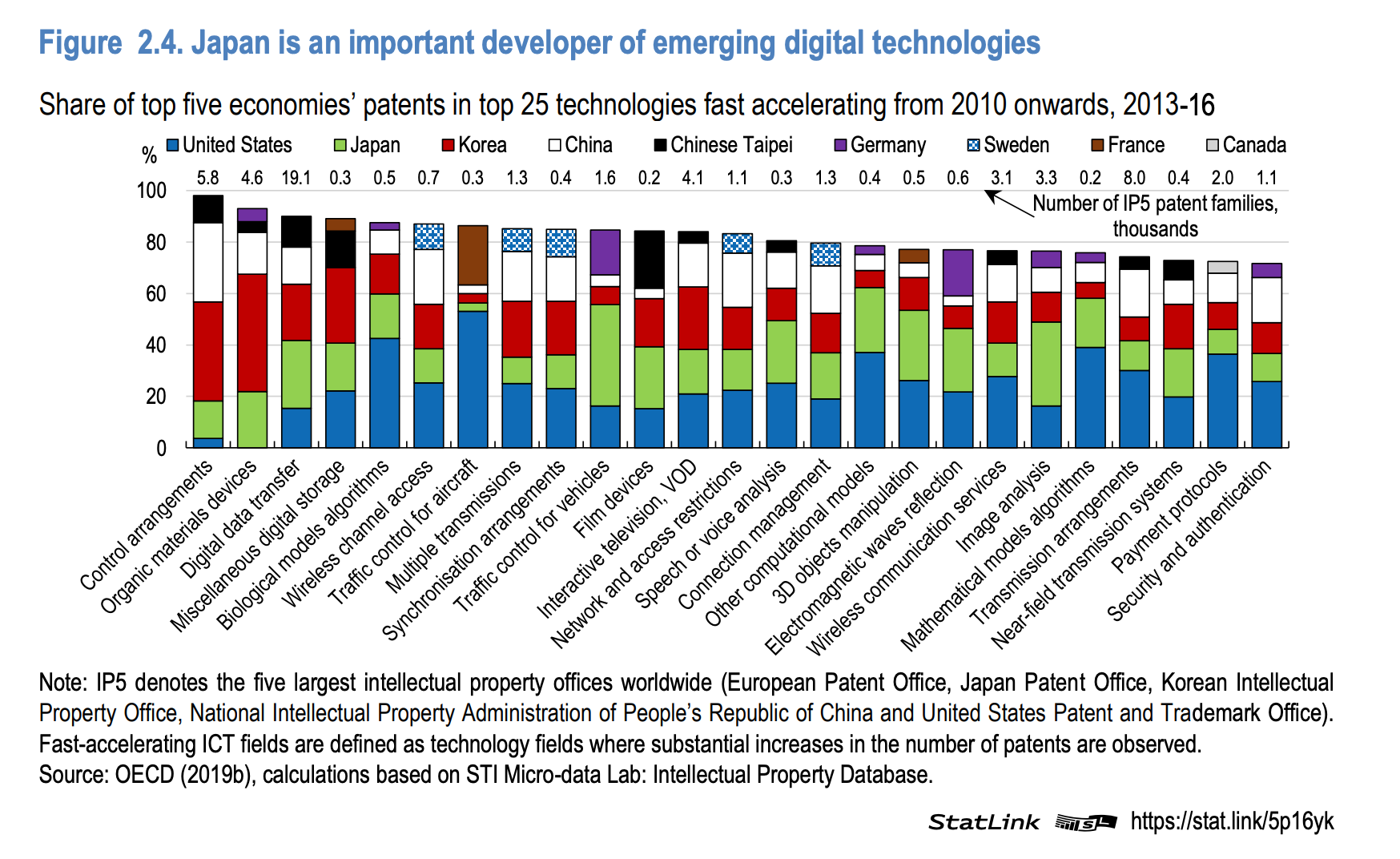
11. Interesting graphic that captures the dominance of US, Japan, South Korea, and China in 25 cutting-edge digital technologies in the 2013-16 period (HT: Adam Tooze)

Wednesday, June 23, 2021

More on why economists make bad plumbers

I've blogged earlier about why economists make bad plumbers. Another exhibit is this interview of Abhijit Banerjee and Esther Duflo. Banerjee says,

I think India is a good example of [a country] where they literally had not thought through their own plumbing. If you think of what happened to the urban migrants, India’s welfare system is actually completely designed on the assumption that people live in their stable families which live in one place for year after year. In your village, you’re entitled to apply for the public distribution, which is essentially nearly free food . . . and in rural areas there is the rural employment guarantee system. Both of those are designed for rural citizens who live in their own village. You’re not entitled to go to any village and say: ‘I want my employment guarantee.’ There might be as many as 50m of these low-income migrants who temporarily live in cities. They can’t connect to the welfare system. That’s why there were pictures in the first lockdown of people walking 1,000 kilometres . . . there was no way for them to survive. They just had to go home. That is pure plumbing failure.

This is pure rhetoric. It's the classic hatchet job - form your hypothesis (a system where migrant workers can access food and other welfare benefits), set up a straw man (the public distribution system, PDS, or any welfare benefit), demonstrate how the straw man fails the hypothesis test (the example of covid induced migration), and blame the system (the government "did not think through their own plumbing" on its programs). Before passing such sweeping judgement on something like the PDS or NREGS, it's useful to understand its original purpose and its trajectory of evolution. It's also classic hindsight-based judgement. 

The PDS, in existence since independence, has the objective of providing food security by distributing foodgrains to the poor living in villages and slums at subsidised rates. Despite its undoubted deficiencies, given its scale and the pervasive state capacity weakness, it's been a remarkable success and is arguably a practical model for food security in any developing country. As I've blogged earlier, along with NREGS, it's been one of the two policy instruments that have ensured India avoided starvation during the pandemic. It has undergone constant improvements over the years, with its effectiveness in terms of inclusion and exclusion errors and service levels being very good in some states. 

But the additional requirement of migrant coverage and describing its absence as a plumbing failure is unfair. Consider the critical requirements for a portable PDS - a portable identity (which allows credible identification of the beneficiary), a dynamic state-wise PDS allocation mechanism (which allows for shifting of PDS allocations across states based on migration trends), a dynamic supply chain (which allows PDS shops to adjust stocks for periodic changes in migration trends), and a country-wide real-time stock management system (that connects all PDS shops). I have overlooked several other factors. The same analysis could be done about employment guarantee schemes. 

Pause and reflect on the enormity of the challenge. Given the context of rural and urban India, a robust and dynamic logistics management of this nature would have been unthinkable till very recently. Now, this is real thinking through the plumbing. How many economists can claim this expertise?

No amount of thinking through the plumbing would have helped overcome these challenges. Each of the four requirements would have been daunting impossible. With advances in digital technologies and Aadhaar, it may now be possible to start pursuing this objective. Recognising this, and even before the migrant crisis, the Government of India had launched the One-Nation-One-Ration Card scheme to make ration cards portable. Portability was even a incentivised as a condition for state governments to access the additional borrowing permitted during covid.

In simple terms, castigating PDS with plumbing failure for non-portability and not covering urban migrants is like judging the batting strike rate of Sunil Gavaskar in comparison to that of the T20-era batsmen. The PDS was designed for a purpose and, on a purely relative terms and in the world of second-bests, it's done a reasonably good job over decades in ensuring food security and eliminating famines from India. Like anything, it has to evolve with time to accommodate the emerging challenge of migrant coverage and more. 

The issue of providing welfare to the 50 million or so migrants in cities with an acceptable enough level of leakages is perhaps one of the hardest targeting challenges in development. Migrants are a floating population, almost exclusively engaged in informal and outside the market activities, with little incentive and a lot of disincentive to being tracked. Therefore, despite the awareness of the problem, tracking them will remain a daunting challenge. In the circumstances, it's the perfect example of armchair analysis to nonchalantly call for transferring cash and other benefits to poor urban migrants. 

It's an altogether different matter that the government (and the vast majority of mainstream opinion makers and researchers) have seriously underestimated the sheer scale of internal migration. It was surely a governance failure that the system was unprepared to deal with the pandemic induced reverse migration. That's not a plumbing failure with PDS or with any specific prevailing government program. But it also needs to be acknowledged that even with the best technologies, targeting migrants with PDS and other welfare services in a reasonably efficient manner will remain elusive for some more time. 

As I have written earlier, instead armchair analysis of areas on which their understanding is limited and grandstanding to reinforce their pet ideas (demonstrating government plumbing failures in development), economists should focus on their research and let the evidence generated inform public debates. Plumbing should be left to plumbers.   

Sunday, February 21, 2021

Weekend reading links

1. Indian Express has this on the challenge facing FCI,

The Food Corporation of India’s (FCI) “economic cost” of wheat sold through the public distribution system (PDS) is budgeted to go up to Rs 29.94 per kg and that of rice to Rs 42.94 per kg in 2021-22, from their corresponding current levels of Rs 27.40 and Rs 39.99 per kg. These numbers are significant, given that under the National Food Security Act (NFSA) of 2013, 81.35 crore persons, accounting for over 67% of the country’s population, are entitled to receive 5 kg of PDS wheat or rice per month at Rs 2 and Rs 3 per kg, respectively... The economic cost is what the FCI incurs in procuring, transporting, storing and distributing every kg of wheat or rice. The estimated Rs 29.94/kg economic cost for wheat in 2021-22 includes a “pooled cost” of Rs 19.21 (roughly what the farmer gets); “procurement incidentals” of Rs 3.20 (gunny bags, market fee, arhtiya commission, labour and other mandi-level expenses); and “distribution cost” of Rs 7.53 (freight, handling, storage, interest and other administrative charges). In the case of the Rs 42.94/kg for rice, the pooled cost is Rs 27.90, with procurement incidentals at Rs 4.85 and distribution cost at Rs 10.19.

2. A good summary of the school reforms in Delhi. This is impressive,

A recent study by consultancy firm BCG has found that perhaps the biggest reform pulled off by AAP is the sea change in the mindset of the most important resource in the city's government schools: Teachers and the headmaster. Teachers have been made to feel human and are being treated with respect and dignity... Headmasters (over 1,000) have been sent overseas, including to Cambridge and Singapore, or to institutions like the IIMs for training... One, instead of keeping parents out, schools are now sending invitation cards for parent-teacher interactions. Many parents contacted for the study expressed surprise, awe and delight at being offered a cup of tea at their child’s school... The change in the school’s attitude towards parents has reflected in a change in the parents’ attitude towards schooling, education and its benefits. The parents have begun to take whatever the school says more seriously, rather than brushing their children off when they mention what the school requires of them.

These are all low investment but high human engagement activities. Don't know how much of this has translated into learning outcomes improvements. But hard to not feel that this is a more promising and essential pathway to improving learning outcomes than mere inputs.

3. Dani Rodrik makes four important points about the new social contract, one which goes beyond the older welfare state paradigm,

We can do much better on our active labour market policies, in terms of linking them up with employers to ensure that training programmes are . . . supplying the hard and soft skills that employers need. Second, [in] industrial and regional policies, we must target the creation of good jobs and maybe de-emphasise a little the traditional focus on capital investment, global competitiveness, innovation and so forth. Because even when those work they don’t necessarily create good jobs. Third, we need to rethink our innovation policies. We’re doing nothing right now to invest in technologies that augment rather than replace labour. Fourth, our international economic policies have to be those that enable countries to carry out these policies without them being overwhelmed by forces of international arbitrage.

As to what can be done in this regard, he say,

Move away from these open-ended subsidies or tax incentives and engage in attracting investment from good firms to distressed areas by essentially providing them with the customised services that they need most. That could be improving some brownfield area for their investment, providing infrastructure, investing in specific kinds of skills, providing technology, marketing assistance or help with business plans. On innovation, I’m really trying to countervail against this view that you always hear [that] technology is rapidly changing the kinds of skills needed on the job and workers need to adjust to increased education and continuous training. Here is this inexorable train that is moving and the rest of our society has to adjust. There are norms, private and public, that are embedded in innovation systems and the narratives in Silicon Valley, and that are very much about saving on labour. Finally, there’s relative power. When workers have more voice in the workplace they might either militate towards the adoption of technologies that are more complementary to their skills or, at least, ensure that when new technologies are adopted, the consequences for workers are less severe.

He refutes the evidence-based policy making crowd and channels FDR in calling for "bold and persistent experimentation",

Many of my colleagues respond by saying . . . show me what evidence-based policy you’re supporting — show me what has actually worked. I feel that is inadequate for the time. It is sort of like saying FDR should have been forced to take on policies only for which there had been evidence. That’s like a recipe for not trying anything new and FDR very explicitly said this is a time where we have to experiment.

4. Tom Peters has a scathing takedown of MBAs and the modern corporate culture in the context of McKinsey,

... business schools typically emphasise marketing, finance, and quantitative rules. The “people stuff” and “culture stuff” gets short shrift in virtually all cases. McKinsey is loaded with high-IQ MBAs addicted to spreadsheets and PowerPoint presentations. So are many other places that have fallen apart... Furthermore, McKinsey’s typical assignment is to improve market share and profitability. That combination, taken too far, is a poisonous combination in my opinion... Milton Friedman... introduced the idea that maximising shareholder value should be a company’s raison d'être. That led to an insane push for profitability at all costs. Investment of corporate profits in people and research has fallen through the floor ever since. One rigorous study found that the share of profits apportioned to people and R&D dropped from 50 per cent in the 1980s to 9 per cent in the 2000s. I loved my Stanford and McKinsey years. But I do not remember even a single moment directly related to the moral responsibilities of enterprise.

This comes as McKinsey just paid almost $600m to 49 states to settle, without admitting liability, allegations that it urged Purdue Pharma to “turbocharge” OxyContin sales via tactics that included the rebate formula. 

5. In order to change perception of public toilets as dark, dirty, and unsafe spaces, Tokyo is experimenting with see-through toilets made with a special glass which becomes opaque when the lock is turned. 

6. Adani Ports (APSEZ) acquires 100% stake in Dighi Port Ltd (DPL) for Rs 705 Cr, making it the 12th port to join the company across the eastern and western coasts. 

7. Interesting intervention by the government in the residential housing sector. In order to complete the large stock of nearly $63 billion stalled real estate projects, in November 2019, the Government of India established an alternative investment fund, 'Special Window for Completion of Construction of Affordable and Mid-Income Housing Projects' (SWAMIH). It appointed SBICAP Ventures Ltd to be the fund manager, and contributed 50% of the Rs 250 billion ($3.5 bn) fund, with 10% each from LIC and SBI and remaining from private investors. 

The fund has so far approved investments in 159 projects involving Rs 145 billion investments to complete around 100,000 projects. The Fund has first charge on assets and cash-flows, over other earlier creditors, and invest via zero-coupon non-convertible debentures and at a standard 12% IRR across projects. 

In an interview, Irfan Kazi, CIO at SBICAP says, 

When you look at parameters like setup time, fundraise time, we are probably the fastest. The fund was set up in a month after the official announcement (2019), capital was raised in a month. No real estate fund, I believe, has done more than 100 deals probably in their lifetime. We are close to almost 150 deals now... In many cases we are dealing with the bottom rung of companies, which have lost manpower and some even no longer have a finance team, so due diligence can be hard. A no-objection certificate from existing lenders has come only in some cases and takes an exceedingly long amount of time. Then there are also pending court cases or home buyers demanding compensation.

8. Business Standard has a Reuters report on how Amazon lobbied the US government to influence the Indian government as well as how just 35 sellers make up more than two-third of the sales on the platform in India. It questions the companies claim that it provides a platform for over 400,000 producers and traders in India. 

Indian traders, both brick-and-mortar and smaller online sellers, have long alleged that Amazon's platform largely benefits a tiny number of big sellers and that the American giant engages in predatory pricing that has crushed legions of retailers. Amazon rejects this: It says it complies with Indian law, which stipulates that an e-commerce platform can only connect sellers to buyers for a fee, unlike in the United States, where Amazon can both act as middleman and sell goods directly to consumers. The company also says it runs a transparent online marketplace and treats all sellers equally. The internal Amazon documents contradict those claims, revealing how the e-commerce giant has helped a small number of sellers prosper, giving them discounted fees and helping one cut special deals with big tech manufacturers such as Apple Inc. The documents also show that the company has exercised significant control over the inventory of some of the biggest sellers on Amazon.in, even though it says publicly that all sellers operate independently on its platform...

Because foreign investment regulations in India bar e-commerce firms from holding inventories of goods and selling them directly to customers, companies like Amazon can only collect fees from vendors selling products on their marketplace. Globally, about 58% of Amazon sales of physical goods in 2018 came from third-party merchants; the rest come from direct sales to consumers, the company has disclosed. The ability to sell straight to people in the United States and elsewhere packs big benefits. It means Amazon can deal directly with manufacturers, for one, giving it greater control over its product range. It is this barrier - the regulatory wall around the consumer - that Amazon has been trying to overcome for much of the past decade in India.

This about Narayanamurthy owned Cloudtail raises several questions, 

But Amazon has been deeply involved in expanding Cloudtail - often referred to as "SM," or "Special Merchant," in the documents... Amazon had big plans for Cloudtail. The target was to ensure Cloudtail accounted for 40% of Amazon.in sales, "and build this into a $1+B business" in 2015, according to the report. To that end, the report reveals, Amazon helped Cloudtail "acquire key relationships" with major tech companies, including Apple, Microsoft and OnePlus. This included exclusive deals with these companies to sell their products, such as smartphones. The tech companies got a big new sales channel, while Cloudtail got coveted products that it listed on Amazon.in... The deals Amazon facilitated with smartphone makers, coupled with deep discounts Cloudtail was offering on the Amazon website.

9. NYT writes about the rise of dividend payouts by private equity owned companies by borrowings,

In the second half of 2020, private equity-owned companies borrowed some $27 billion to pay for dividends or debt restructurings, according to a report by S&P Global Market Intelligence’s Leveraged Commentary & Data. That was the most active period for these loans in nearly three years. And the borrowing hasn’t slowed down this year: $4.7 billion in the first six weeks. That was the second-highest amount for any comparable period since the firm began tracking that data in 2000... When private equity firms take dividends from their companies, the money doesn’t entirely go straight into its coffers. Rather, the payment goes to the investment fund that technically owns the company and in which the private equity firm’s clients — including charitable foundations and big pension systems — hold a stake. That makes dividend recaps a crucial tool for private equity firms to keep clients happy — and a way to deliver returns to clients even if a company isn’t turning a big profit. “Dividend recapitalizations are occasionally used to return funds to the pension fund investor so they can reinvest in another asset and ultimately strengthen retirements,” said Drew Maloney, president of the American Investment Council, the association for private equity industry.

10. Finally, the one reason being cited why equity market valuations may not be that far into the excessive bubble territory, the ultra-low interest rates. This graphic adjusts valuation for the interest rates.

But this assumes rates are going to remain low forever, which is most unlikely.

Saturday, July 18, 2020

Weekend reading links

1. It is a sign of times that the IMF has advocated the once unthinkable idea of governments taking equity stakes in private companies instead of offering them debt. This is what the Chief Economist, Gita Gopinath had to say,
Because there's a bigger insolvency issue here, government support would have to shift more towards being equity-like as opposed to debt-like. Otherwise, you would end up with a lot of firms that exit this crisis with a huge amount of debt over-hang. If the lending takes form more like equity ... then that's less onus on the firms. That will make it easier for firms to recover from the crisis.
2. Ajay Shah writes about the value of informal traditional business relationships (landlord and tenant, lender and borrower, large firm and suppliers etc) in times of crises like the Covid 19. They act as automatic stabilisers, with the parties negotiating revised contracts on leases, payment dues etc.

3. The less discussed migrant problem is one of returning migrants from the Gulf. While Covid 19 has hastened the process, there are also localisation forces at play in the Gulf countries. Kuwait recently took the decision to limit migrant population from 70% to 30%. India received $83 bn in remittances in 2019, the largest among countries. It also creates major labour market concerns,
Since the global financial crisis of 2008, the number of Indian workers travelling to West Asia has fallen from 762,484 to 321,721 in 2018, according to the Ministry of External Affairs. At least part of this has to do with falling wages, which have prompted skilled workers from Kerala and Tamil Nadu to search for jobs in India (since the wage differential has narrowed considerably) even as West Asian locals have moved up the skills value chain to occupy those jobs in their own countries... Kerala accounts for a fifth of remittances... Since 2009, it is the investment-poor states of Uttar Pradesh, Bihar, and West Bengal that have accounted for the bulk of the migration to West Asia. The first two states alone accounted for 145,454 workers in 2018 — mainly for the hard-scrabble blue-collar jobs that locals are loath to do. Many of them come from India’s poorest districts.
4. The Mumbai-Ahmedabad bullet train project faces the usual issues of land acquisition and other delays, with implications of cost overrun, as it races against its 2023 deadline.

Alon Levy had a very informative post which raises questions on the use of standard gauge Shinkansen technology, when Indian Railways runs on broad gauge.  

5. Good Livemint status report on the Covid 19 vaccine development. This is one huge challenge, if precedents are any indication,
An analysis of all vaccine projects in development from 1998 to 2009 found that the average vaccine took 10.71 years to be developed from the preclinical phase, and had a market entry probability of 6%.
6. Very good essay on how Amul managed to ensure that its supply and distribution chains for milk and milk products remained unaffected during the Covid 19 lockdowns. 
The Gujarat Cooperative Milk Marketing Federation or GCMMF, which sells its products under the Amul brand, is owned by 3.6 million farmers. Of these, around 2.6 million farmers bring their milk twice daily to 18,600 village societies from where chilled milk is transported to district milk unions for processing into packaged milk and value-added products. The products then reach over a billion consumers daily via 10,000 distributors and a million retailers.
This is a summary of the basic things that Amuld did right,
Soon after the lockdown was in place, Amul announced cash incentives for dairy plant workers, drivers, sales executives, distributors and retailers. While casual workers received between ₹100 to ₹125 extra cash support for working during a pandemic, distributors got an extra 35 paisa incentive per litre of milk. Food and stay arrangements were made for workers inside dairy plants to avert any labour shortages. Simultaneously, the company reached out to the Union home ministry and state animal husbandry departments to arrange passes for its workers and ensure that empty trucks were allowed to return (after delivering milk products). To ensure uninterrupted supply of packaging materials, it engaged with district collectors where packaging factories were located. Amul even arranged for cattle feed to be transported from states like Punjab and Haryana for its farmers in Gujarat. Close to 45% of its products were moved via freight trains, which cut down transit time.
With hotels and restaurants closed, demand naturally fell. But Amul bucked the trend,
As unorganized trade and small dairies withdrew from milk procurement, Amul received 15-17% more milk from farmers. Demand for Amul’s liquid packaged milk went up by 5-7% compared to pre-covid times as households chose a trusted brand over loose milk. Demand for cheese and paneer is at least 30% more despite closure of hotels and restaurants, while butter and ghee sales are up by 10-20%. Demand for ice creams nosedived during the lockdown but Amul was quick to divert its distribution network for ice creams to other product segments... Amul is likely to gain market share. In 2020-21, Sodhi is expecting an enviable 15-16% revenue growth, only marginally lower than the 17% CAGR seen in the past years.
Amul has several lessons to improving India's agriculture. It has also lessons for the Indian private sector firms, including e-commerce ones which struggled during the pandemic. 

7. As commentators hype up the Indian digital commerce economy in the aftermath of the pandemic, it is useful to keep in mind this,
In 2019, of the 583 million internet users in India, only 232 million people paid for any service or product online at least once (the rest used the internet primarily for messaging and browsing), according to RedSeer. And even among the 232 million, only 135 million bought products from e-commerce platforms, indicating the relative shallowness of the internet economy. According to RedSeer, it is largely the same set of users that has driven the recovery in the internet economy since May. What’s different is that users who were earlier only buying something once or twice a year in the past have now been forced to buy both more frequently and a wider range of goods and services. “There hasn’t been much expansion in the overall number of transacting users, but there is a steep growth in the number of serious or holistic users who are shopping on multiple platforms," said Mrigank Gutgutia, an associate director, RedSeer.
Covid 19 and the banning of the Chinese apps means that there cannot be a opportunity for Indian developers to bring out something original or global scale in the digital domain. This will be a test for the much hyped Indian start-up eco-system. 

The race seems to have started in great earnest. An Indian TikTok or Facebook, but which is not a mere clone?

8. Shyam Saran makes the case for India to devise a strategy to respond to the Chinese two steps forward, one step backward approach at the India-China border.

9. Jugal Mahapatra and Siraj Hussain argue in favour of extending the additional allocation under National Food Security Act (NFSA) till March 2021 and also expanding its coverage by another 10 million. This is an important point to be borne in mind,
If there are no reports of starvations, even from the poorest districts of India, despite loss of income of crores of people, the credit should go to National Food Security Act, 2013.
10. Far too often policy targets are completely unrealistic. But even by those standards, this needs revision big time,
The production target in the electronics sector for 2025 is $190 billion, with a 30 per cent share in global value creation, as distinct from the current figures of $29 billion and 5 per cent, respectively. This is massively ambitious, and can only be achieved through export promotion.
11. Important area for expediting policy action is the regulatory space on digital economy, especially on data protection and privacy. This from a Business Standard editorial highlights the concerns,
The draft legislation has been pending since 2018, when the B N Srikrishna Committee submitted it, and has been amended by a Parliamentary committee. The new draft has no safeguards against blanket surveillance by government agencies. In addition, the government is pushing for complete access to non-personal data, which means the commercial secrets of businesses would be at risk. It would also like access to source codes of telecom equipment, including mobile devices, and has reportedly asked for social media data to be stored on local servers and deciphered on demand, breaking end-to-end encryption. These demands might retard the development of this huge market and put citizens’ privacy at risk. Therefore, the government should get the data protection law passed with adequate protection. A more robust legal framework will increase activity in the sector and attract investment.
12. Madan Sabanvis makes the important point about exiting the stimulus in India, especially on the liquidity support and debt forbearance side measures. These will not be easy and the government and RBI will have to carefully plan for them.

13. Bari Weiss (HT: Ananth), an editor with the New York Times has a scathing indictment of the culture of self-sensorship and political correctness within the Times. Her resignation letter captures the issues nicely.
A new consensus has emerged in the press, but perhaps especially at this paper: that truth isn’t a process of collective discovery, but an orthodoxy already known to an enlightened few whose job is to inform everyone else... Stories are chosen and told in a way to satisfy the narrowest of audiences, rather than to allow a curious public to read about the world and then draw their own conclusions... Why edit something challenging to our readers, or write something bold only to go through the numbing process of making it ideologically kosher, when we can assure ourselves of job security (and clicks) by publishing our 4000th op-ed arguing that Donald Trump is a unique danger to the country and the world? And so self-censorship has become the norm.

What rules that remain at The Times are applied with extreme selectivity. If a person’s ideology is in keeping with the new orthodoxy, they and their work remain unscrutinized. Everyone else lives in fear of the digital thunderdome. Online venom is excused so long as it is directed at the proper targets. Op-eds that would have easily been published just two years ago would now get an editor or a writer in serious trouble, if not fired. If a piece is perceived as likely to inspire backlash internally or on social media, the editor or writer avoids pitching it. If she feels strongly enough to suggest it, she is quickly steered to safer ground. And if, every now and then, she succeeds in getting a piece published that does not explicitly promote progressive causes, it happens only after every line is carefully massaged, negotiated and caveated.
In this context, this from JS Mill assumes relevance (via Walter E Block)
“He who knows only his own side of the case, knows little of that. His reasons may be good, and no one may have been able to refute them. But if he is equally unable to refute the reasons on the opposite side; if he does not so much as know what they are, he has no ground for preferring either opinion. . . . Nor is it enough that he should hear the arguments of adversaries from his own teachers, presented as they state them, and accompanied by what they offer as refutations. . . . He must be able to hear them from persons who actually believe them; who defend them in earnest, and do their very utmost for them.”
14. Sanjaya Baru writes about the brain drain problem facing India. This may turn out to be true for a majority of elite-children,
Children of business leaders, politicians, government officials, diplomats and just about every influential section of society are seeking exit visas. The next generation of the Indian elite is increasingly domiciled overseas.
15. Andy Mukherjee examines Reliance's plans to become a competitor to Tencent (digital platform), Huawei (5G equipment and telecommunications), and Xiaomi (mobile phone). In the context of the 5G race, The Economist writes,
On July 15th Reliance Industries, an Indian conglomerate, announced that its Jio network, which uses a Samsung 4G network, will be building its own 5G infrastructure and selling it to others. Jio is likely to follow in the steps of some other carriers, most notably Rakuten Mobile in Japan, which are betting on networks based on advanced software, off-the-shelf hardware and open standards, thus side-stepping the need for systems integrators like Ericsson, Huawei or Nokia.
This is a sceptical look at Reliance's claims. V Sridhar feels that Reliance may be talking about 5G-like network. It is likely to be the case.

16. Interesting that the UK government and Bill Gates Foundation are the largest funders of WHO in 2020-21.

Thursday, May 21, 2020

The targeting challenge in delivering welfare services and limits of digital solutions

India's digital identity program, Aadhaar, has achieved several successes. It has facilitated financial inclusion through simplified no-frills savings bank accounts under the Jan Dhan Yojana (JDY). It underpins the entire architecture of the Direct Benefits Transfer (DBT) program which has doubtless increased the efficiency of welfare services delivery.

Perhaps the most important transformation from Aadhaar may be its role in becoming an anchor that underpins financial transactions and allows the flowering of fintech in India. The UPI is rightly being hailed as a transformative development. 

But it has not addressed several other important issues, which, while it was never likely to have resolved, had become part of the narrative around Aadhaar. Targeting and delivery of public services are two examples. 

Targeting has been one of the biggest problems with the delivery of welfare programs across the world. The ongoing Covid 19 pandemic has only reinforced the challenge with targeting, especially in the case of migrants. It was one of the major public narratives that Aadhaar will help address this problem. As India has proceeded with the likes of no-frills bank accounts (JDY) and DBT, this narrative may have become entrenched.

However, like several other narratives, this too has little basis. Aadhaar is an identity validator - it validates a person. Validation comes after the identity (or eligibility) is established.

Aadhaar cannot identify whether he's eligible for something. That eligibility depends on whether the person meets the requirements of the particular program. This, almost always, involves some form of physical survey and attestation before being declared eligible. Once declared eligible and tagged with Aadhaar, the administration of that person's account for the particular program becomes simpler. Here too, if there is a dynamic dimension to eligibility (people move out of poverty, by say getting a formal or government job), then too the administration of the person's account becomes a problem.

In other words, Aadhaar is relevant only for administering program beneficiaries identified as eligible through other means, and that too where the eligibility is static. The problem of targeting remains.

Take three of the biggest examples in India - PDS, JDY and farmers.

In case of PDS, the biggest challenge is the issue of identification of eligible households. There has been much progress in this area, including with the latest Socio-Economic Census Survey. But even with these, exclusions are significant. The exclusions cover not only those unidentified but also those identified and not covered under the PDS for various administrative reasons. Some studies point to the extent of under-coverage under PDS being as high as 100 million.

While the actual number is most likely lower, as multiple independently done studies by reputed institutions/researchers here, here, and here show, the numbers are large and very significant. A fundamental problem is that the underlying statistical considerations on PDS are based on the 2011 census.

This problem does not figure in the entrenched narrative about PDS. For far too long, PDS reform has been about eliminating wastage and leakage. Commentators look at any PDS reform as one aimed at enhancing efficiency. The attention of young bureaucrats in the field is aimed at "weeding out the bogus ration cards" using the wonders of Aadhaar-enabled digital technologies. You get an award for reducing leakages due to inclusion errors but not for reducing exclusion errors and expanding coverage. While this should be done, a greater or at least equal priority should be to identify those excluded genuine beneficiaries.

One immediate fiscally-neutral policy response would be to mandate that District Collectors would be allowed to retain the total number of ration cards. They should be incentivised to "weed out the bogus cards" and allot them to the excluded. Needless to say, even this policy can create its set of distortions and will need to be revised in 2-3 years of implementation.

In case of JDY, again the challenge is the eligibility of those who have opened the no-frills JDY account. In the absence of robust eligibility screening mechanism, it suffers from both exclusion and inclusion errors. Sample this,
According to official statistics, roughly 200 million Indian women (47 per cent of adult females) have a PMJDY account... Official statistics do not tell us how many of the 200 million female PMJDY account holders belong to poor households... A 2018 survey (using) a Grameen Foundation methodology where answers to 10 questions about a household’s characteristics and asset ownership are scored to compute the likelihood that the household lives below the poverty line... tells us that roughly two-thirds of adult women — just over 325 million in total — are living on less than the UN-recognised poverty criterion of $2.50 per day. In normal times, nearly nine out of 10 of these women say it would be difficult to pull together Rs 6,000 within a month to deal with an emergency. So, even if we go by government statistics and assume that PMJDY accounts were opened only by these poor women — a generous estimate — then over one-third of poor women or 125 million women, do not have a PMJDY account. However, we know that some better-off households also have accounts. The 2018 survey numbers suggest that 75 per cent of PMJDY account holders are poor. If we instead allocate the government’s count of PMJDY accounts to poor women based on these 2018 survey numbers, then roughly 175 million poor women lack PMJDY accounts.
In fact, as the article shows, even when a JDY account is notionally opened, it still does not ensure access,
A nationally representative survey from 2018, the Financial Inclusion Insights Survey, asked respondents whether they have a bank account and, if yes, whether it is a PMJDY account. Roughly 80 per cent of female respondents stated they have a bank account, but only 21 per cent said they have a PMJDY account. What drives the gap between government and survey numbers? Likely some combination of dormancy, account duplication in the system and the lack of knowledge among women about the type of account they hold.
And all this is even without the biggest challenge of them all, easy access to physical cash-out or digital transaction channels so as to be able to regularly utilise these accounts. A cash-transfer mechanism does not achieve the objective of ensuring genuine access for those once enrolled. There is the issue of accessing the transfers under JDY, utilisation of the no-frills account, replenishing the gas cylinders after the first one, and so on.

In case of farmers, the big and insurmountable problem is to differentiate and identify tenant farmers. It is widely acknowledged that the biggest problem with PM-KISAN is that of identification, as it includes only landowners and mostly excludes landless and tenant farmers and sharecroppers. Aadhaar cannot solve this problem of identifying the excluded.

Any formalisation will run into complex political economy challenges since owners will be loath to recognise them. Land records maintenance by way of updating Adangal every crop season has long since fallen out of favour across the country. In short, there is no record that links the tenant/sharecropper to the land. Their identification therefore requires physical field verification surveys. And, given the dynamic nature of these relationships, they need to be revisited periodically.

The only option is to do what some states like AP and Telangana have done. Do physical survey and then recognise tenants and give them some document, and keep doing it every 3-4 years. Even with all its challenges and problems, it seems the only practical solution. It is a reminder that Aadhaar and digital technologies have not moved us one inch in the tenant farmer targeting problem!

Again, even if the identification and validation problems are solved, there is the real problem of access to the associated benefits.
In its 2019 report, the Reserve Bank’s Internal Working Group to Review Agricultural Credit estimated that despite numerous existing initiatives, at most, only 40 per cent of India’s small and marginal farmers are covered by formal credit... KCCs, a scheme first introduced in 1998, over 20 years ago, should concern us. The RBI’s Internal Working Group estimated that as of 2019, only around 45 per cent of all Indian farmers possessed an operative KCC and that given the existence of multiple accounts per farmer, the percentage is likely to be even lower. Nabard’s own NAFIS Survey 2016-17, reported that only 10.5 per cent of agricultural households were found to have a valid KCC.
All this puts in perspective the true gains from Aadhaar and DBT. For sure while efficiency gains have been aggressively reaped, what about the welfare loss from these various aforementioned problems? 

We should not be under any illusion that the problem of identification has somehow become any less important in the aftermath of Aadhaar. To put it in simple terms, Aadhaar has not moved the needle in any meaningful manner on the issue of identification. And it will not do so. It was meant to only validate identified beneficiaries of public welfare programs. 

And let's not talk about the other idea supporters often point to, the use of data analytics. We can safely say that while data analytics will doubtless help with weeding out certain categories of false positives in some programs, it will be of no help with identification of new beneficiaries.

Then there are the technical challenges with delivering the cash benefit through the Aadhaar enabled eco-system. See this account of the problems in case of NREGS. 

Ironically, there is a compelling case that in times of Covid 19, despite all the Aadhaar innovations and digital technologies, the good old NREGS job cards may be the most reliable (in terms of being dynamically adjusting) targeting database for rural areas,
There are... about 14 crore for NREGA job cards, and 12 crore or so for women’s JDY accounts in rural and semi-urban areas (assuming that the gender distribution of accounts is similar in rural and urban areas). For purposes of cash relief, the JDY approach turns out to fare poorly on several counts. First, JDY accounts are a mighty mess – the NREGA job-cards list is far more transparent and well-organised... a large proportion of JDY accounts (40% in March 2017, down to 19% in January 2020) went “dormant” as customers were unable or unwilling to use them... It is not clear what proportion of JDY accounts are operational today, in the sense that a bank transfer to these accounts will actually reach the recipient in good time. Second, cash transfers to women’s JDY accounts are likely to involve large exclusion errors... Third, inclusion errors are also likely to be larger in the JDY approach. Job cards are meant for rural workers, JDY accounts are for everyone... (studies) show... JDY beneficiaries tend to be better-off than NREGA beneficiaries... the probability of having a JDY account is more or less the same for poor and non-poor households. 
Aadhaar has doubtless helped improve the efficiency of transfers through DBT. But it has done precious little on addressing the issue of eligibility verification and helping enrol the excluded into government programs. It was never meant to. 

There are serious limits to any digital pathway to address targeting and access, leave alone poverty reduction. Acknowledging that may be a good first step. 

Update 1 (23.07.2020)

Rohini Pande et al on how PDS helped during Covid 19,
Our research team recently evaluated how Chhattisgarh’s public distribution system functioned through the lockdown and how rural households were faring in the state. Ration shops functioned well: Out of over 4,000 PDS shops we surveyed, 99 per cent were open through the lockdown and stock-outs were extremely rare. Of the over 3,900 households we surveyed in rural Raipur, 95 per cent reported receiving rations. But 20 per cent of the surveyed households worried they would run low or out of food in the coming weeks. Interviews with anganwadi workers revealed that households were eating fewer fruits and vegetables, and more rice and dal than before the lockdown. This is consistent with the NSS data that suggest free rations in Chhattisgarh helped households cover 15 to 33 per cent of their monthly food expenditure, depending on the ration card holder.

Update 2(01.11.2020)

Indian Express investigation on fraud with the DBT in scholarships for minorities in Jharkhand. The two sources of corruption being failures in verification during registration of eligible students, and fraud in fingerprint validations.