India is spending scarce fiscal resources to support domestic semiconductor chip design startups. These startups and their innovations are most likely to remain stranded unless this support is supplemented with a market access strategy. This is the binding constraint to their scale-up.
I have articulated this in multiple posts on this blog. This provides a policy framework for public funding of innovation; this looks specifically at catalysing the chip design market; this describes how large domestic corporate groups can be roped into catalysing domestic manufacturing; and this provides a template for the most promising opportunity in smart meter manufacturing. However, given its importance, I think the issue merits one more post.
India now has a stable of chip design companies, including the nearly 25 startups that were funded under the Design Linked Incentive (DLI) scheme. They have designed chips of various kinds, and at least some are at stages of deployment, if not commercial scaling.
True, they still need to get their tapeouts to be of good enough quality, build internal capabilities to be ready with version updates, and generally ensure that the chip fabrication and supply chain are standardised and de-risked. While the chip design startups must work on getting these right, this work also requires the visibility of a scaling pathway.
But such deployment and scaling require Original Equipment Manufacturers (OEMs). But unfortunately, India’s domestic OEM landscape in electronics is barren. And foreign OEMs will not risk disrupting their well-entrenched chip supply chains by experimenting with an Indian chip design firm. There are too many uncertainties associated with such supplier shifts. We therefore have a demand-side binding constraint on the scaling of chip design startups.
So the only option to enable scaling is to create the conditions for OEMs to adopt these chips. There are two strategies in this regard. One is to mandate the use of domestically designed chips, at least some share of it, in those products sold in India. The other strategy is to incentivise the same with some industrial policy support.
I have articulated such a policy in detail here. It is a combination of both strategies. It involves mandating a progressively increasing share of the chips used in their products to be domestically designed, and supporting such product manufacturing with a Production-linked incentive (PLI).
This approach is easier to adopt effectively in products that are B2G or B2B in nature. Smart meters for electricity consumers, set-top boxes and fixed wireless access devices, surveillance cameras, drones purchased by defence agencies, etc., are examples. The relative simplicity of B2G and B2B markets can be leveraged to formulate market-shaping policies.
This strategy would be useful for the indigenisation of other components and sub-assemblies too, ranging from compressors to transceivers. Mandate and incentivise the use of a progressively increasing share of components from domestic firms.
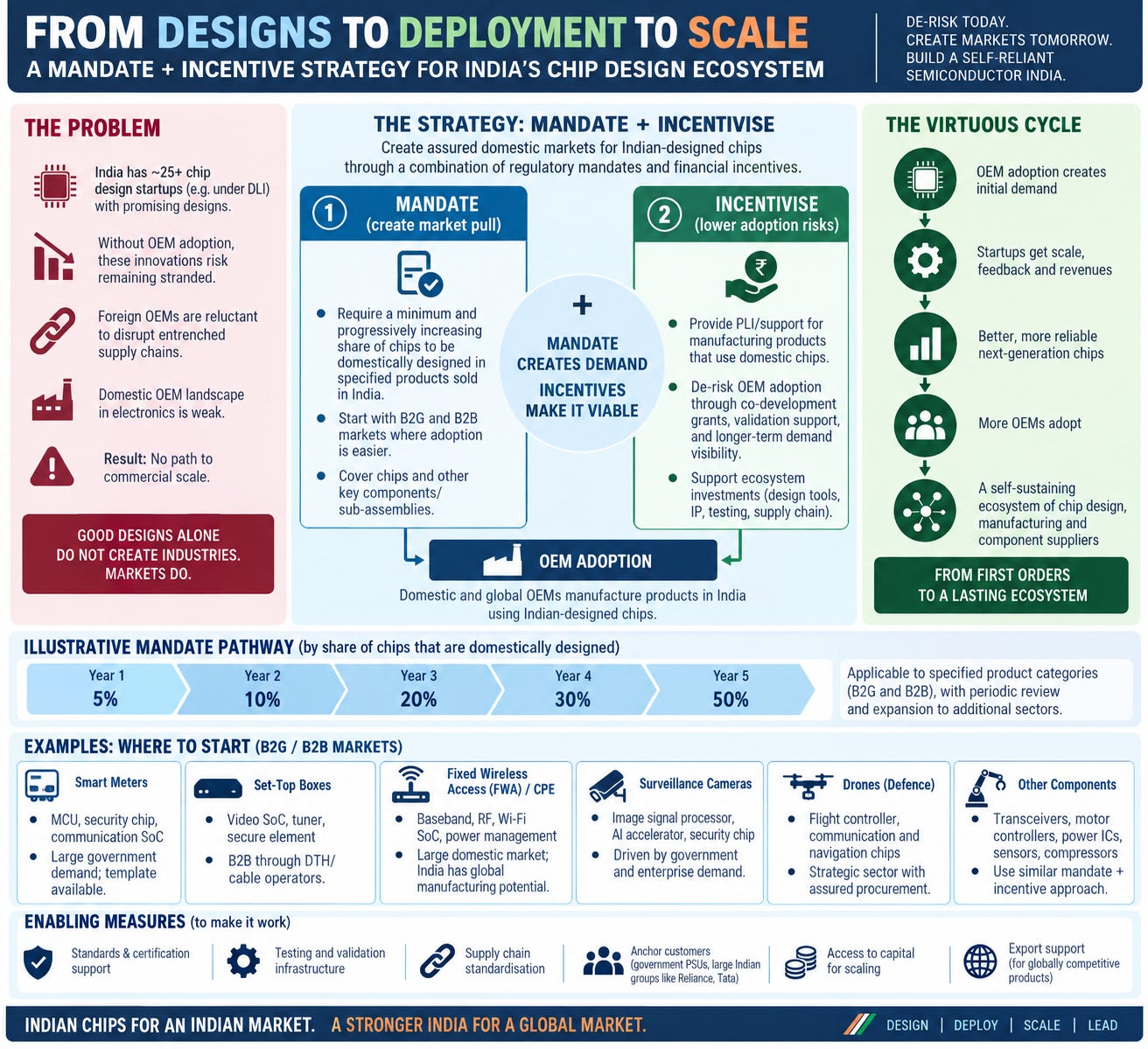
This would emulate the Chinese playbook through which they have come to develop a vast ecosystem of domestic component manufacturers and OEMs. The Chinese smartphone OEMs like Huawei, Xiaomi, Oppo, and Vivo were instrumental in the emergence of domestic chip design firms. India will have to develop both the OEMs and component makers.
This would require a high level of state capabilities in both designing the policy and calibrating and closely monitoring its implementation. But more critically, it would require a very high degree of inter-departmental coordination among the departments and ministries in the Union government. For example, smart meters would involve collective ownership and close coordination across the Ministries of IT, Power, and Finance, and financing agencies like REC and PFC. This would require a genuine breakdown of silos within the government.


No comments:
Post a Comment