In a recent op-ed, Janan Ganesh made the provocative point that if the Democratic Party in the US could muster a liberal without being woke, then he/she would march to the Presidency. So why is it hard for such a candidate to emerge?
We live in polarised times, where the overlap between the right and left, or Republicans and Democrats (in the US case), on issues has become vanishingly small. This poses a problem for the median voter theorem, which states that in a majority-vote electoral system, candidates will position themselves to appeal to the median voter. Polarisation weakens the conditions under which the median-voter theorem predicts convergence. The nature of the US political system compounds this problem.
The US Presidential candidates have to fight through primaries, progressively winning over their opponents and accumulating votes through a series of compromises. The candidates dropping out keep transferring their endorsement to a remaining candidate in return for support on some of their causes. This plays out till the last candidate remains.
The very nature of this process entails accommodation. This accommodation was fine as long as there was large overlap between the left and right within the same party on issues and the tails on both sides were small. These compromises would come out as centre-right or centre-left. In this context, candidates constantly adjust their platforms to appeal to moderate voters.
But the greater ideological sorting and partisanship means a significant and growing proportion of the electorate now occupy the tails.
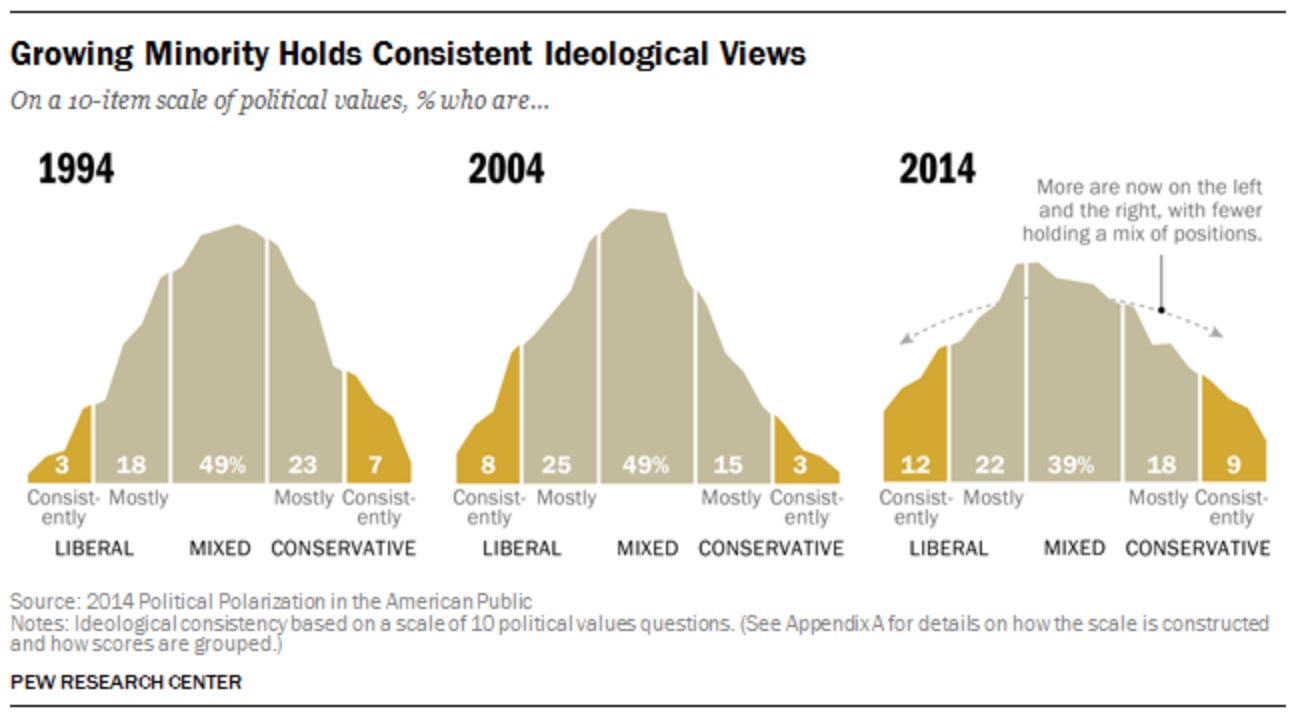
They are also the most politically active electorate. The most politically polarized being more actively involved in politics results in the amplification of the voices that are the least willing to see the parties meet each other halfway.
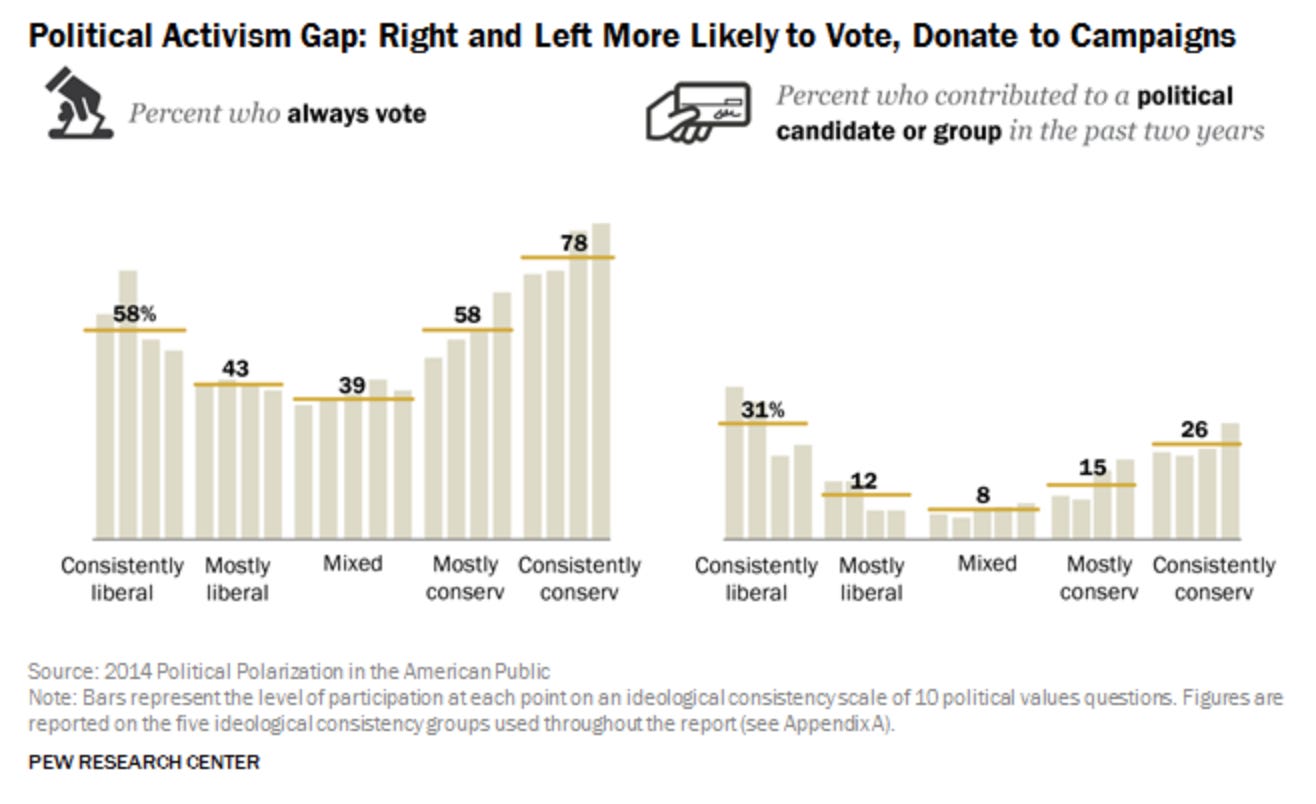
This necessitates compromises and the candidates must constantly adjust their platforms to accommodate at least some elements of the extreme left/right positions.
For the Democrats, it then becomes necessary to accommodate at least some elements of the woke position - progressive cultural positions on immigration, taxation, race, gender and social policy. This, in turn, leaves them vulnerable to being branded as woke-washed. This, in turn, scares away the median voter, who gravitates to the right or doesn’t turn up to vote. The challenge becomes even more daunting as progressive-woke candidates gradually make deep inroads into the Democratic Party.
What complicates matters is that woke positions can create a gap between the Democratic activist base and moderate voters, especially when voters perceive the party as more culturally radical than its candidates actually are. Therefore, accommodating any of these views can concern even moderates. But without accommodation, the likelihood of electoral success in the primaries decreases. This logic applies just as much to Republicans.
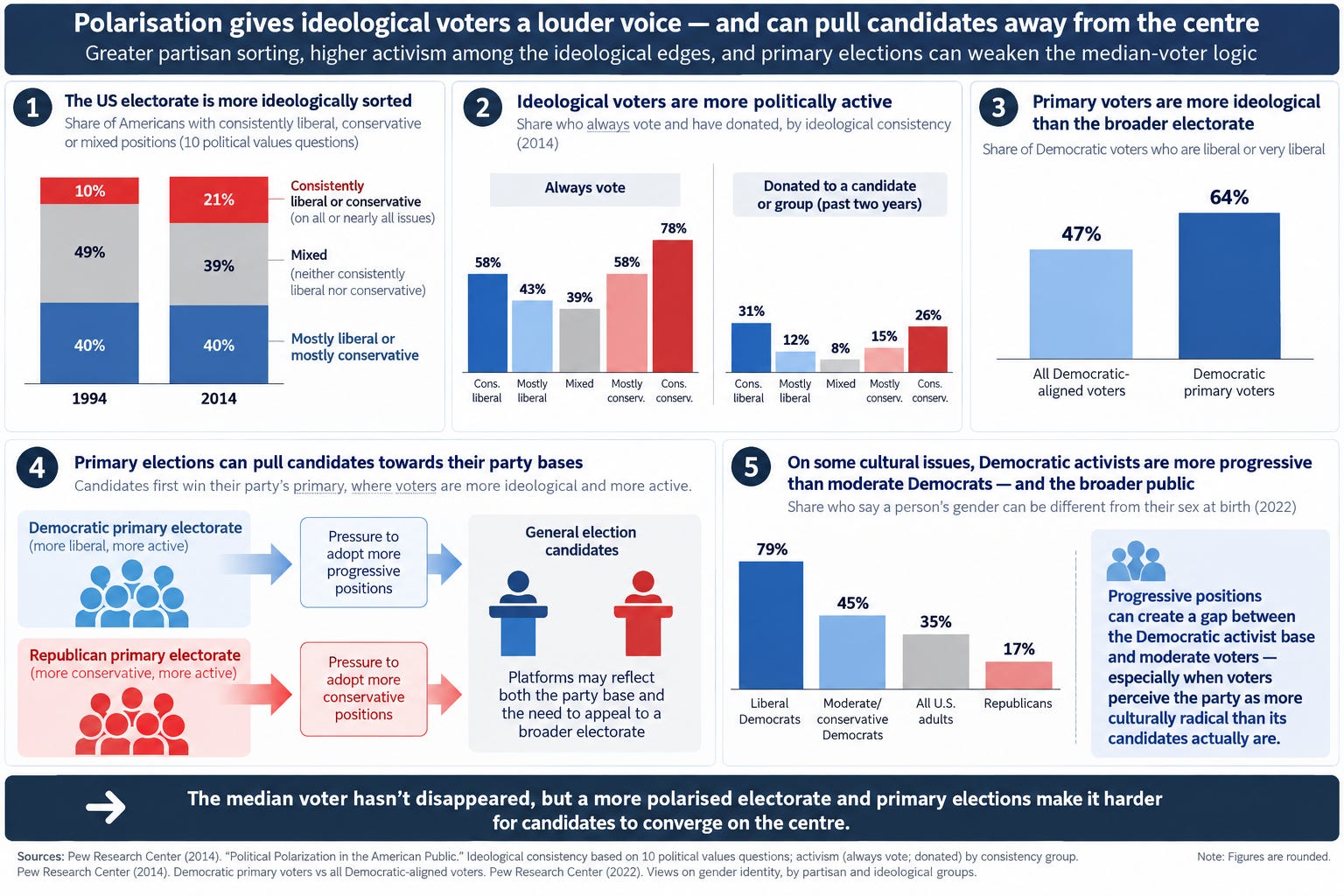
All this creates a potential gap between nomination and election. A candidate with strong support among a party’s ideological base can succeed in a primary even when their positions differ substantially from those of the broader electorate. The electorate that determines the nominee can therefore be systematically different from the electorate that determines the winner in the general election.
This may create particular challenges when a party’s activist base is substantially more progressive than its broader coalition on issues such as taxation, government spending and the role of government. Positions embraced by activists may be less popular among moderate voters, and opponents may amplify that gap by portraying them as more radical than the candidate or party actually is. A Democratic party candidate may be more vulnerable here than a Republican counterpart.
One way out of this gridlock is that the candidate first satisfy one electorate to win the nomination and then appeal to a substantially broader electorate to win the general election. This has its set of practical problems, especially for Democrats given the substantial divergence between the progressive ideologicals and the broader coalition, and the substantial share of those who describe themselves as progressives.
A second route would be to nominate a candidate whose personal appeal and policy positioning extend beyond the ideological base from the outset. The objective would be to assemble a sufficiently broad coalition of moderates, independents and swing voters to offset any loss of enthusiasm among the ideological edges. But this requires a candidate who can hold the party coalition together while also establishing credibility with voters outside it. That is a demanding political task since the candidate must satisfy enough of the primary electorate to win the nomination without becoming so identified with the ideological base that they narrow their appeal in the general election.


No comments:
Post a Comment